Sorry, you need to enable JavaScript to visit this website.
Skip to main content

Global

Our Commodities Strategy team advises against positioning for a near-term rebound in lithium prices, given the current headwinds from soft EV sales growth. They recommend patience, with more compelling opportunities likely to emerge later in the decade as…

The US economy has never entered a demand-driven recession without labour demand running below labour supply and without the job vacancy rate running below the unemployment rate. Right now though, US labour demand is still running 1.7 million workers above labour supply, and the job vacancy rate is running comfortably above the unemployment rate. This suggests that the labour market is still supply-constrained, and that a demand-driven recession is not imminent. We discuss the investment implications. Plus, more about our ‘trade of the century’: long cotton versus coffee.

TN TN …
Our Emerging Market strategists reviewed their recommendations on South African assets as economic prospects start fading. South Africa’s fiscal tightening will suppress growth without achieving the necessary 4.2% primary surplus to stabilize public…
Gold is testing the $3,000/oz level. The yellow metal had a great run, outperforming every DM currency for the past few months. Despite rising real yields since the beginning of the year, gold prices are up nearly 15%.The relationship between real yields and…

This report is our Part III series on valuation and subsequent returns, where we recalibrate our short-term models to emphasize signals over the next nine-to-twelve months. We will henceforth call these models STTM: Short Term Timing Models.

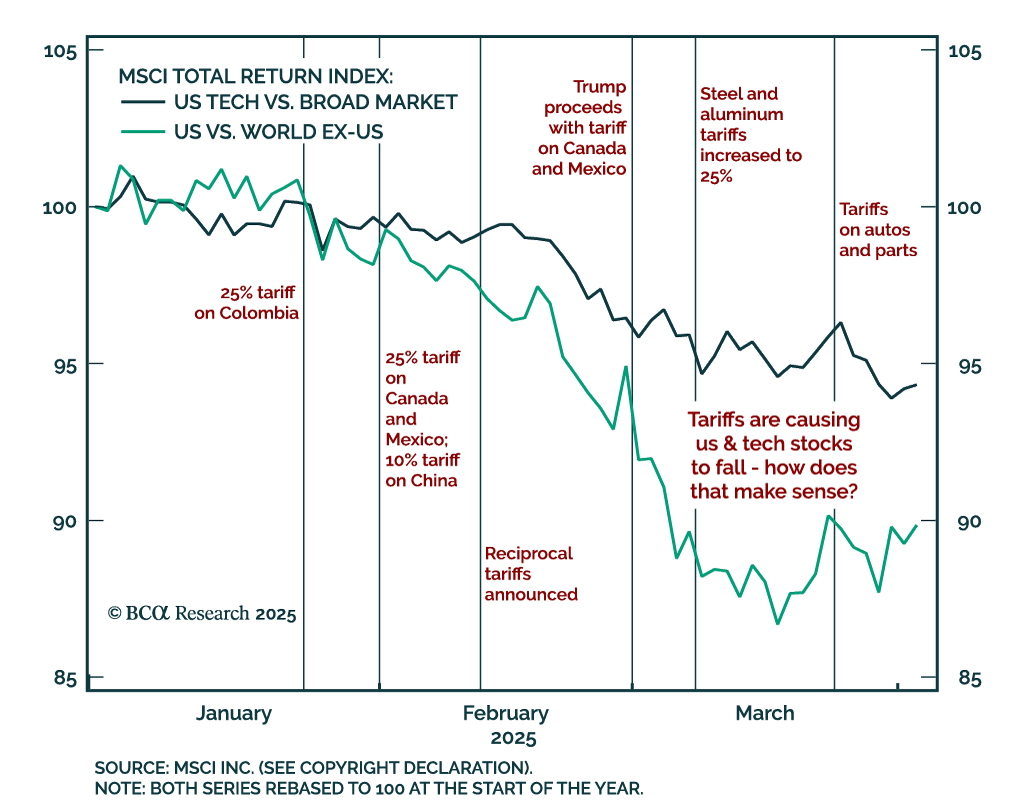
The Trump administration launched its biggest trade action on Tuesday, levying 25% tariffs on Canadian and Mexican goods, and an additional 10% to current tariffs on Chinese imports. Given its crucial role in US supply chains, Canadian energy only sees a 10%…

Europe’s resilience to global liquidity deterioration isn’t a fluke—it signals a structural shift. Our latest report explains why the decline in precautionary money demand marks the end of Europe’s liquidity trap and what it means for investors.

In this webcast, Dhaval will give an update on his key views for 2025. The discussion will include: Why the US is heading into ‘mini stagflation’. Why the BoJ must hike interest rates, and the global consequences. The outlook for global bond yields and the dollar. The latest advances to our complexity analysis and indicators. When the bull market will end.

As gold keeps making new highs, many clients have asked us whether a gold allocation makes sense for their portfolios and, if so, how big that allocation should be. In this report we try to answer these questions from the perspective of investors with eight different home currencies. Specifically, we analyze the following properties of gold:  1) What drives gold? 2) What is gold’s role in a portfolio? 3) How much gold should investors own?