Sorry, you need to enable JavaScript to visit this website.
Skip to main content

Canada

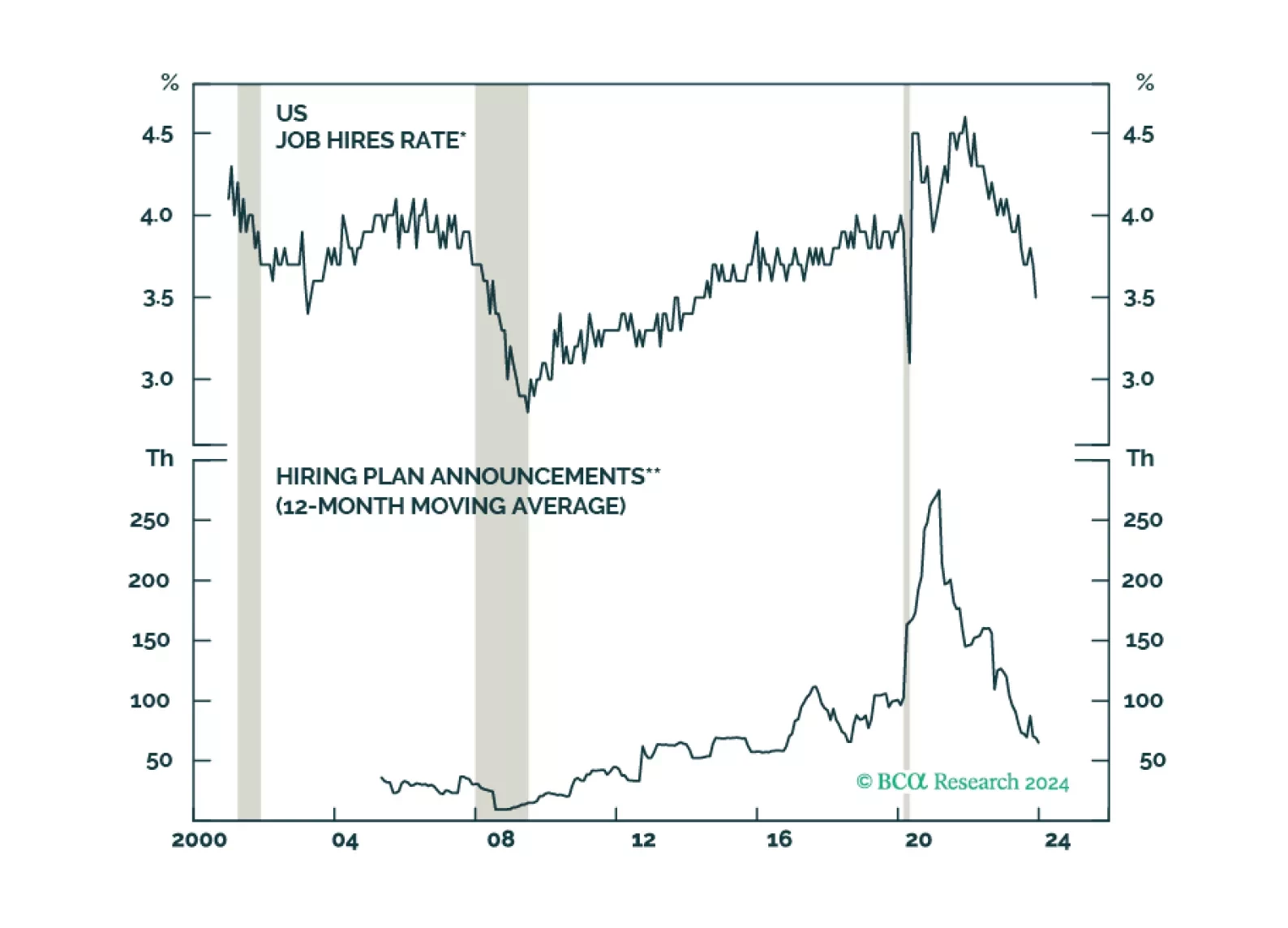
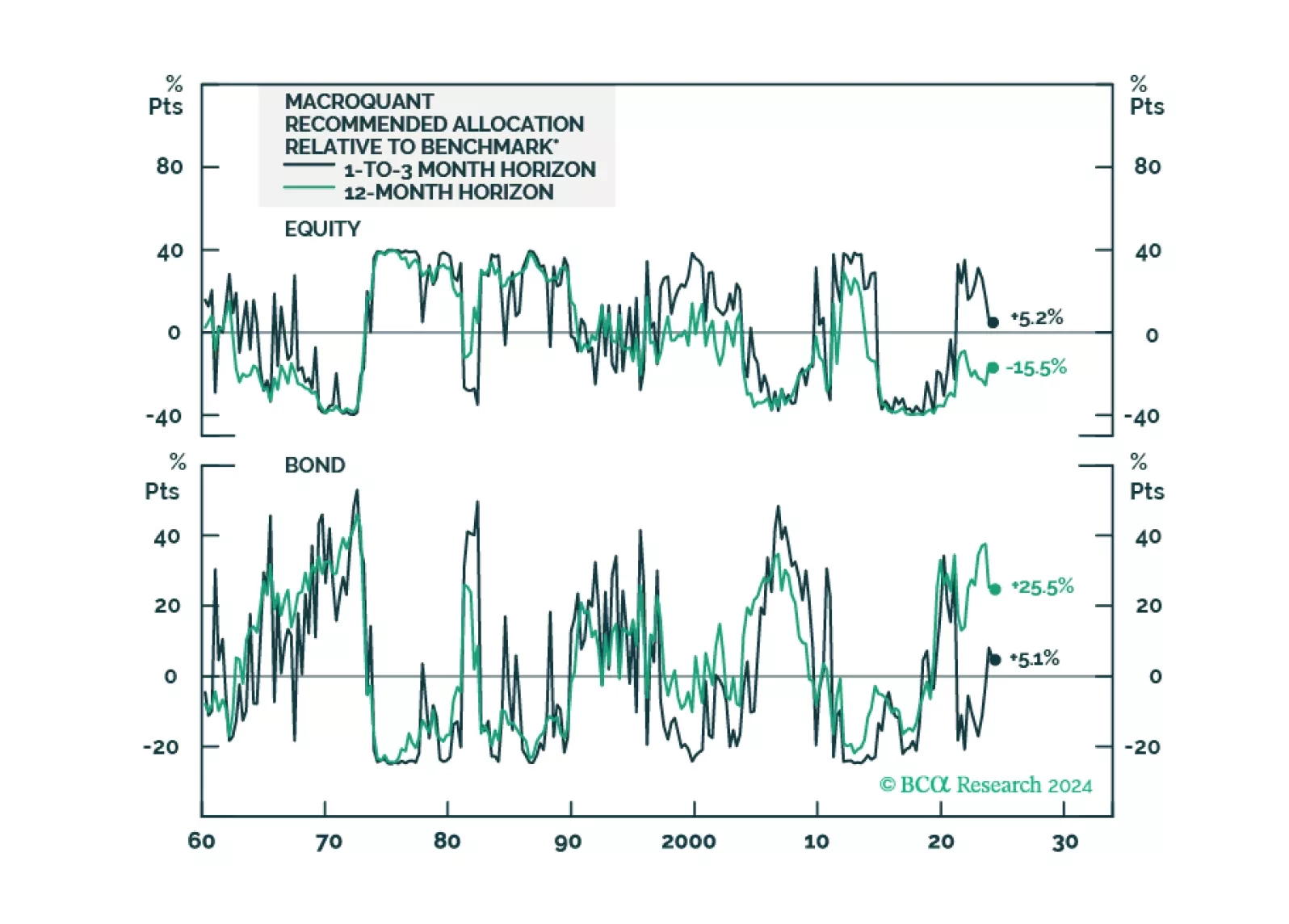
Labor markets are softening in most developed economies, as is usually the case in the lead-up to recessions. Our base case is that the global recession will begin in the second half of 2024, but we will be monitoring our MacroQuant model on a daily basis for confirmation.

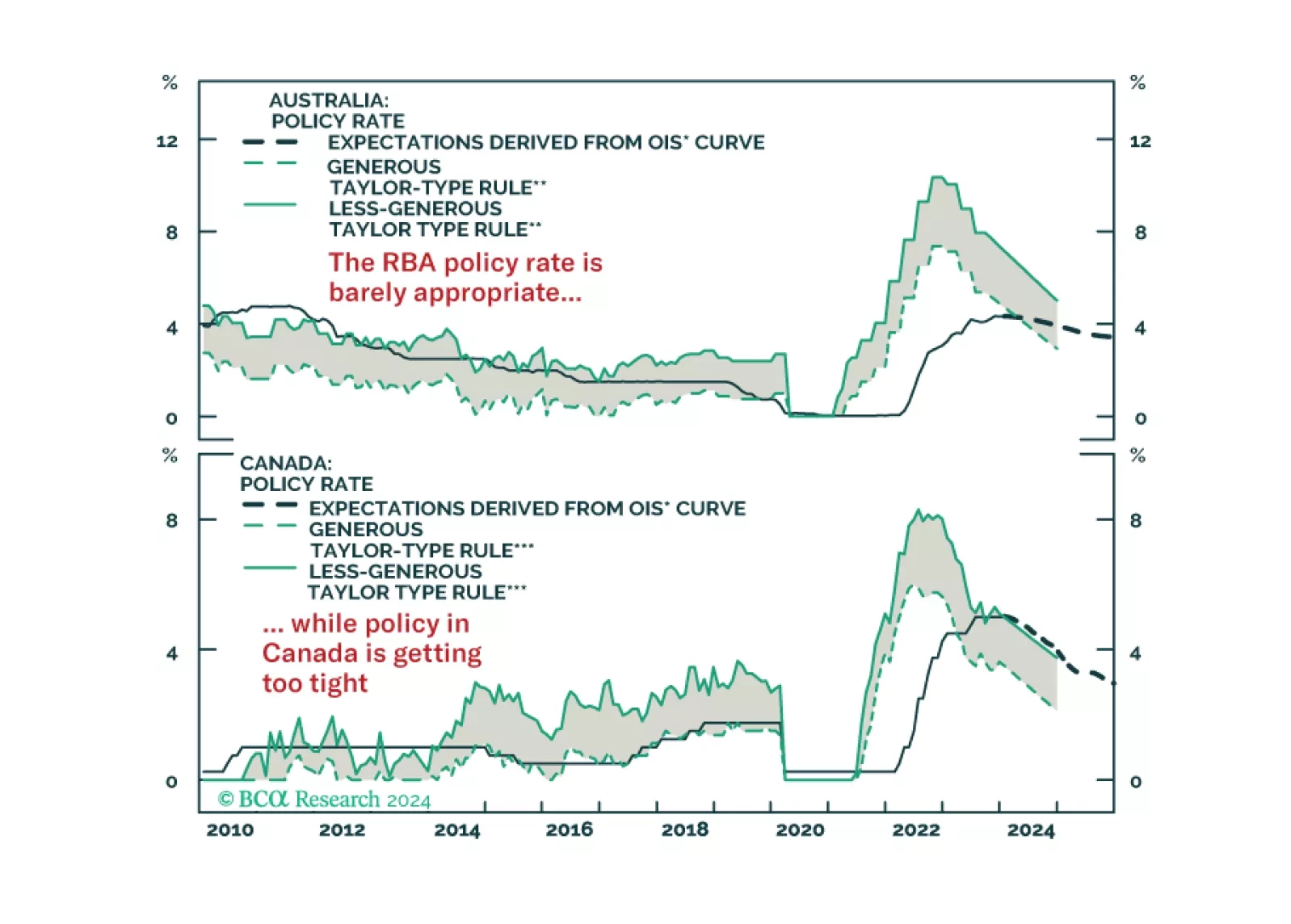
A Growing Monetary Policy Divergence Between Australia & Canada …
As expected, the Bank of Canada kept its target for the overnight rate unchanged at 5% for the second meeting in a row on Wednesday. The Bank cited clear evidence of the impact of elevated interest rates on demand — especially in durable and semi-durable…

In this Special Report, we introduce two strategies that use our Central Bank Monitors for global fixed income country allocations and currency trades. We find that using the Monitors in country selection helps improve the performance of a developed markets government bond portfolio. The CBMs can also help substantially minimize the drawdowns on a standard FX carry strategy.

In this insight, we look at whether the recent data justifies a shift by the BoC, and some potential trades.

In this insight, we look at whether the recent data justifies a shift by the BoC, and some potential trades.

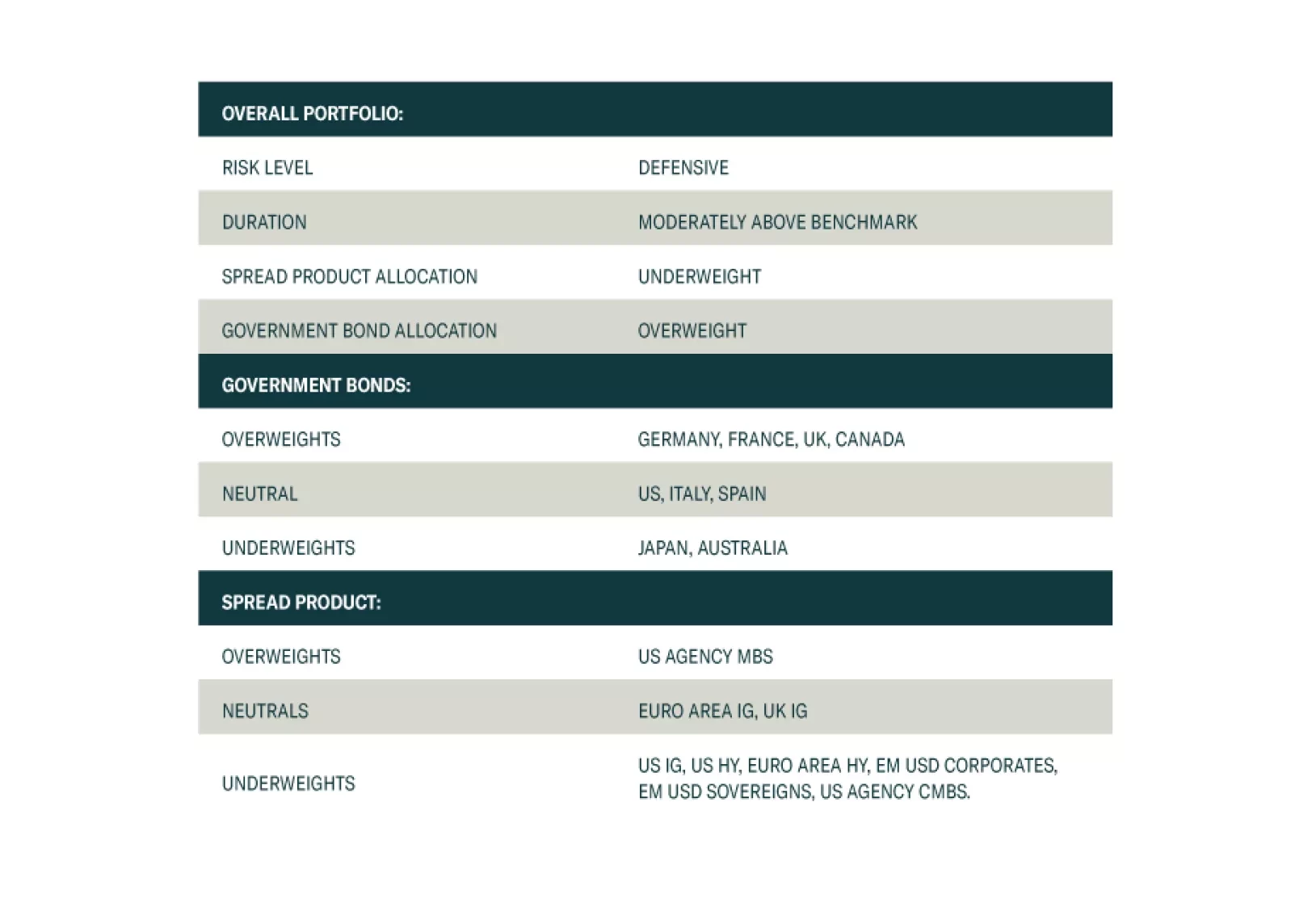
In this report, we present the quarterly review of the Global Fixed Income Strategy Model Bond Portfolio. The portfolio remains positioned for slower global growth momentum over the next 6-12 months, favoring government bonds over corporate debt. The portfolio also favors government bonds in countries flirting with recession where policy rates are too high (core Europe & the UK).

Results of the Banks of Canada’s Q3 business and consumer surveys reveal that the aggressive tightening cycle is dampening economic agents’ sentiment. Putting aside the sharp decline at the onset of the pandemic in Q2 2020, the Business Outlook Survey (BOS)…
Highlights Canadian economic growth slowed significantly in Q2, raising the question of whether one of the most indebted economies in the world is buckling under the weight of tight monetary policy. Contrary to a popular narrative in Canada, the country’s increase in household sector debt over the past two decades has mostly been a demand-driven phenomenon caused by low interest rates. This means that the housing supply deficit that currently exists is likely to only offer a partial cushion to Canada’s housing market, and that Canadian households are legitimately and possibly dangerously exposed to higher interest rates. We do find evidence suggesting that mounting debt service is already impacting Canadian consumers. While the “canary in the coal mine” for the global economy is not dead yet, it appears to be struggling to breathe. We expect to see a continuation of weak/weakening consumer spending in Canada so long as the current stance of monetary policy is maintained, which is our base case view. Recent trends in Canadian inflation point more toward a stalling disinflationary trend rather than a true reacceleration. Monetary conditions are set to tighten further, even without additional rate hikes, suggesting that Canadian policy rates are more likely to move sideways rather than higher. We are biased against the Canadian dollar over a cyclical time horizon. Over the nearer term, we expect that CADUSD may act as a hedge against further supply-driven increases in energy prices. Cyclically, we are also biased in favor of Canadian long-maturity government bonds relative to their US counterparts. Fundamental support for Canadian bank stocks may be rapidly eroding due to mounting loan loss provisioning in Canada, implying that investors should be underweight Canadian banks within a global equity portfolio. The existence of negative amortization mortgage loans among some lenders implies that the Canadian banking system has been lax in its lending practices and that nontrivial mortgage loan losses are coming because of Canada’s current monetary policy stance. Feature Over the past several months, the US economy has displayed resilience in the face of what has clearly become tight monetary policy. The existence of excess savings likely explains why there has been a longer lag between the emergence of tight policy and the onset of recession in the US than has historically been the case. But many investors have also pointed to the fact that many homeowners are not affected by rising mortgage rates due to the structure of the US mortgage market: unlike those in most other countries, US homeowners can lock in low interest rates with a conventional mortgage. Given this, many investors have kept a close eye on countries like Canada to act as a warning sign for the US. Canada’s household sector debt relative to GDP is among the most extreme globally and the impact of rising mortgage rates should be felt more quickly in Canada than in the US (Chart II-1). Roughly 30% of Canadian mortgages have variable interest rates. Fixed-rate mortgages in Canada rarely have contract term lengths longer than five years. Chart II-1Canada's Household Sector Debt Burden Is Extreme Canada's Household Sector Debt Burden Is Extreme Canada's Household Sector Debt Burden Is Extreme Recently, many investors have noted Canada’s disappointing growth in Q2, especially versus the US. While growth in the euro area has also been quite weak, at least some of Europe’s poor economic performance is related to China’s extremely weak property market. This raises the question of whether Canada is a “canary in the coal mine” for the US consumer, and whether the canary has just died. We conclude that Canadian households are legitimately and possibly dangerously exposed to higher interest rates. While the “canary in the coal mine” for the global economy is not dead yet, it appears as though it is struggling to breathe. We expect to see a continuation of weak/weakening consumer spending in Canada as long as the current stance of monetary policy is maintained, which is our base case view. Over the nearer term, we expect that CADUSD may act as a hedge against further supply-driven increases in energy prices, but we are bearish over a cyclical time horizon. We favor long-maturity Canadian government bonds versus their US counterparts. Investors should be underweight Canadian banks within a global equity portfolio. The Canadian Economy Since 2000: A Brief Review Until very recently, reports in the financial press about Canada have focused heavily on what has become known as the country’s housing “affordability crisis.” Over the past few years, Canadian housing has become progressively unaffordable and rental rates have risen sharply, even in previously affordable markets (such as Montreal). While the relative affordability of Canadian housing is seemingly a separate issue from whether the Canadian economy is providing a warning sign for the US, the two issues are strongly linked. It is thus important to understand the evolution of the Canadian economy and its housing market over the past two decades to gauge the nature and extent of the vulnerability facing the Canadian household sector. There are two components to Canada’s housing crisis: An excess demand component that is linked to Canada’s extraordinary rise in household sector indebtedness A supply component, that has emerged more recently and is related to the recent surge in Canada’s population For some time, the focus of many Canadian market commentators has been that Canada’s housing distortions are due to supply-side factors, but Canada’s housing crisis was first caused by excess demand. Like the US, Canada maintained too-easy monetary policy on average from 2001 to 2007, but Chart II-2 shows that monetary policy was even looser in Canada than in the US. Monetary policy was justifiably loose during this period because of persistent corporate sector weakness in the US following the otherwise relatively shallow 2001 recession. Chart II-2, however, shows that the monetary authorities in both the US and Canada kept policy too easy for too long. In both the US and Canada, this period of too-easy monetary policy led to a housing market bubble, but only the US bubble burst in the lead-up to and during the global financial crisis. This discrepancy in outcomes underscores the important role that US bank losses on securitized assets had in catalyzing the subprime/global financial crisis, as Canadian banks had comparatively little exposure to asset-backed securities at the time. Chart II-2 shows that, while monetary policy in Canada became less easy following the GFC, it was still easy even though Canada did not suffer from a long-lasting shock to household net worth as occurred in the US. This continued period of easy monetary policy occurred because of a desire on the part of the Bank of Canada (BoC) to avoid a massive appreciation in the Canadian dollar. Chart II-3 shows that CADUSD traded close to or above parity from 2010 to 2013. It would have appreciated meaningfully more had the BoC maintained domestically-appropriate interest rates. Thus, the Bank of Canada’s attempt to prevent Dutch Disease, i.e., the severe atrophy of Canada’s manufacturing sector in response to a surge in the exchange rate, ended up creating systemic vulnerability for the Canadian economy for the better part of two decades. Chart II-2Canadian Monetary Policy Has Been Persistently Too Easy Canadian Monetary Policy Has Been Persistently Too Easy Canadian Monetary Policy Has Been Persistently Too Easy Chart II-3The Bank Of Canada Kept Rates Low After The GFC To Avoid Massive Currency Appreciation The Bank Of Canada Kept Rates Low After The GFC To Avoid Massive Currency Appreciation The Bank Of Canada Kept Rates Low After The GFC To Avoid Massive Currency Appreciation Where does the supply-side of the equation fit in? First, investors should understand that, contrary to the popular narrative in Canada, supply constraints did not play a major role in the extraordinary rise in Canadian house prices and household sector debt prior to the pandemic. Chart II-4 highlights that housing completions relative to the change in population were only modestly below their average in the late-1990s and surged in the 2000s in response to the massive demand that resulted from too-easy monetary policy. Since the onset of the COVID-19 pandemic, the supply situation has become more relevant, but mostly due to a large change in Canada’s population. Chart II-5 highlights that there was a supply response to the pandemic, but it has not been large enough to keep up with the rise in Canada’s population. Chart II-4Limited Housing Supply Is Only A Very Recent Phenomenon Limited Housing Supply Is Only A Very Recent Phenomenon Limited Housing Supply Is Only A Very Recent Phenomenon Chart II-5There Was A Supply Response To The Pandemic, But Canada's Population Growth Outpaced The Rise There Was A Supply Response To The Pandemic, But Canada's Population Growth Outpaced The Rise There Was A Supply Response To The Pandemic, But Canada's Population Growth Outpaced The Rise Canada’s population growth collapsed in 2020 due to the pandemic but has since surged. Statistics Canada reported that nearly all of Canada’s population growth last year was due to international migration, which occurred in response to the federal government’s aggressive efforts to recruit migrants to help address labor shortages. In this sense, we agree that the lack of a fuller supply response to historically strong population growth is now a factor driving Canadian house prices. But the pandemic also created a surge in housing demand due to the prevalence and persistence of work-from-home policies, suggesting that only part of post-pandemic housing market dynamics in Canada are attributable to supply effects. The conclusion for investors is that Canada’s increase in household sector debt has mostly been a demand-driven phenomenon caused by low interest rates. This means that the supply deficit that currently exists is likely to offer only a partial cushion to Canada’s housing market, and that Canadian households are legitimately and possibly dangerously exposed to higher interest rates. Canadian Monetary Policy And Consumer Spending At the onset of the pandemic, the Canadian household sector debt-to-disposable-income ratio was vastly higher than it was in the US at its peak in late-2007 (Chart II-6). While the extent of the deleveraging pressure faced by US households following the global financial crisis was not only the result of their indebtedness level, it certainly contributed to the severity of the 2008-2009 recession and its aftermath. The implication, then, is that the Canadian economy is at imminent risk of a consumer-led recession given the sharp increase in interest rates that has occurred since early 2022. Chart II-6Canadian Household Debt-To-Income Is Significantly Higher Than In The US In 2008 Canadian Household Debt-To-Income Is Significantly Higher Than In The US In 2008 Canadian Household Debt-To-Income Is Significantly Higher Than In The US In 2008 Chart II-7Canada’s Fiscal Response To The Pandemic Was Large… October 2023 October 2023 Chart II-8...And Helped Reduce Household Non-Mortgage Indebtedness ...And Helped Reduce Household Non-Mortgage Indebtedness ...And Helped Reduce Household Non-Mortgage Indebtedness At the same time, the fiscal response to the pandemic at least partially improved the indebtedness situation of Canadian households, which has helped prevent a massive breakout in the household sector debt service ratio. Chart II-7 highlights that Canada had one of the most substantive fiscal policy responses to the pandemic among developed economies, as measured by the cumulative change in gross general government debt over the past four years. One consequence of generous COVID-19 income support policies is that many Canadians used funds from the program to pay down non-mortgage debt. Chart II-8 shows that Canadian non-mortgage liabilities fell in level terms during the pandemic and that the non-mortgage debt-to-income ratio collapsed. This had a significant impact on Canadian household sector debt burdens, given that non-mortgage loans typically carry much higher interest rates than mortgage loans. Chart II-9 illustrates what will happen to the Canadian mortgage and overall household sector debt service ratios in a scenario in which the BoC holds the policy rate constant over the coming year. We use generous assumptions when projecting the likely path of the debt service ratio, including the assumption that the non-mortgage debt service ratio is unchanged in response to constant policy. Given the historical pattern of lags between a rise in mortgage rates and subsequent mortgage payments, the chart shows that the mortgage debt service ratio will continue to rise, even without any further increases in the policy rate, by an additional 44 basis points by the end of 2024. Chart II-9 also shows that this increase will cause a clear breakout in the overall debt service ratio to a new high, exceeding prior late-2007 and late-2019 highs by approximately 30 basis points. Chart II-9Canada's Current Monetary Policy Stance Will Push Household Debt Service To A New High Canada's Current Monetary Policy Stance Will Push Household Debt Service To A New High Canada's Current Monetary Policy Stance Will Push Household Debt Service To A New High One challenge for investors is that it is difficult to judge what level of debt service will push an economy past its “tipping point” and into recession. This is especially true for a small open economy like Canada, whose economic prospects also depend significantly on energy prices as well as the general state of the US economy. This means that investors often need to employ an inferential approach when judging whether tight monetary policy is beginning to trigger recessionary dynamics. Chart II-10Weak Consumption In Q2 Drove Canadian Real GDP Growth Lower October 2023 October 2023 When applying such an approach to Canada, we do find evidence suggesting that mounting debt service is already impacting Canadian consumers: Canadian real GDP growth contracted in the second quarter, in sharp contrast to what occurred in the US. While final domestic demand was considerably stronger than overall GDP, it still grew at a below-trend pace. Chart II-10 highlights that the contribution to growth from Canadian personal consumption expenditures decelerated significantly and was meaningfully weaker than overall final domestic demand. Canadian consumption has lagged US consumption relative to pre-pandemic levels, a phenomenon that appears to have become more durable since central banks around the world began raising rates last year. Chart II-11 shows relative real personal consumption expenditures for Canada versus the US indexed to 100 as of the start of the pandemic and highlights that a meaningful relative consumption “gap” exists. This is especially relevant given the data shown in Chart II-7, which underscores that Canada had a larger fiscal policy response to the pandemic than the US did. That implies that Canadian excess savings were not materially smaller than was the case for US households. In many parts of the country, Canada’s COVID-19 restrictions were more severe than what occurred on average in the US, which partially explains why consumption in Canada was weaker than in the US prior to the widespread availability of vaccines. Chart II-11 makes it clear that Canadian consumption was rebounding in relative terms from mid-2021 until the middle of last year, but then stagnated – seemingly in response to higher interest rates. Canadian nominal retail sales growth picked up in July, but the increase mostly reflects a pickup in food prices. Real Canadian retail sales have been negative for seven of the last twelve recorded months (including in July), in contrast to recent trends in the US. Chart II-12 highlights that the trend in Canadian seated diners is also down, especially in cities such as Toronto, which are the most exposed to rising mortgage rates. This implies that Canadian consumers are cutting back on discretionary spending. Chart II-11Canadian Consumption Is Lagging That In The US, Despite A Similar Policy Rate And Pandemic Fiscal Response Canadian Consumption Is Lagging That In The US, Despite A Similar Policy Rate And Pandemic Fiscal Response Canadian Consumption Is Lagging That In The US, Despite A Similar Policy Rate And Pandemic Fiscal Response Chart II-12Weak Canadian Restaurant Spending... Weak Canadian Restaurant Spending... Weak Canadian Restaurant Spending... Canadian consumer confidence is falling again, after having rebounded earlier this year (Chart II-13). While a shortage of skilled labor remains the top concern, a growing share of Canadian small businesses are reporting insufficient domestic demand as a factor limiting sales or production growth (Chart II-14). Canadian small business trends are more likely to reflect the real final domestic demand picture, given the significant impact of the energy sector on Canadian exports. Chart II-13...And Consumer Confidence ...And Consumer Confidence ...And Consumer Confidence Chart II-14Canadian Small Businesses Are Reporting Weak Domestic Demand Canadian Small Businesses Are Reporting Weak Domestic Demand Canadian Small Businesses Are Reporting Weak Domestic Demand Chart II-15A Tick Up In Unemployment That Is Not Being Caused By Increased Labor Force Participation A Tick Up In Unemployment That Is Not Being Caused By Increased Labor Force Participation A Tick Up In Unemployment That Is Not Being Caused By Increased Labor Force Participation Recessions in developed economies ultimately reflect a significant rise in unemployment and consumer spending. Chart II-15 highlights that the Canadian unemployment rate has already begun to rise without any meaningful change in the participation rate. The rise that has occurred so far cannot yet be labeled as recessionary, given that the “Sahm rule” threshold is meaningfully higher in Canada than it is in the US. But the recent uptick in unemployment, in conjunction with a clear slowdown in consumer spending, is not a positive sign for the Canadian economy’s capacity to tolerate high interest rates. The bottom line for investors is that while the “canary in the coal mine” for the global economy is not dead yet, it appears to be struggling to breathe. We expect to see a continuation of weak/weakening consumer spending in Canada as long as the current stance of monetary policy is maintained, which is our base case view. Inflation And The Policy Rate Chart II-16No Major Reacceleration In Inflation Yet, But Disinflation Is Stalling No Major Reacceleration In Inflation Yet, But Disinflation Is Stalling No Major Reacceleration In Inflation Yet, But Disinflation Is Stalling Chart II-9 works on the assumption that policy rates stay constant in Canada, but the August inflation data has caused many investors to question whether the Bank of Canada is done with its tightening campaign. It is possible that the BoC could raise interest rates somewhat more over the near term. That said, our reading of the inflation data, the already-visible impact of the current stance of monetary policy, and the fact that monetary conditions are set to tighten further even without additional rate hikes suggest that Canadian policy rates are more likely to move sideways rather than higher. Chart II-16 presents Canadian headline inflation, alongside a headline inflation series that removes the effects of rising mortgage interest costs. The bottom panel of Chart II-16 shows two measures of Canadian core inflation, without adjusting for mortgage costs. Some investors have asked whether the pickup in headline inflation is a sign of a durable pickup in inflation, but we see the data as being more consistent with a stalling disinflationary trend rather than a true reacceleration. First, as we noted in Section I of our report, the recent pickup in oil and gasoline prices reflects a response by OPEC 2.0 to the resilience of US economic data. We believe that energy prices could continue to rise in the short term, but we doubt that this could be sustained for an extended period given the current state of the global economy. And as mentioned earlier when discussing Canadian retail sales, food inflation is also having an impact. We doubt that these factors alone could cause a renewed breakout in long-term inflation expectations. If sustained, we acknowledge that rising food and energy prices could ultimately feed into core inflation, but we regard this as a risk rather than a base-case view. Second, panel 2 of Chart II-16 highlights that the August pickup in core inflation is minimal, especially when examining the BoC’s core measure that excludes the eight most volatile components. Based on shorter-term rates of change, Canadian core inflation is barely above 3%, underscoring that it is too early to conclude that core inflation has entered a new uptrend. Even putting the recent developments of actual inflation aside, it is easy to see why the BoC remains quite concerned about inflation. Based on business inflation expectations from the BoC’s (now dated) second quarter Business Outlook Survey, roughly two-thirds of firms reported that they expected inflation to only return to 2% in 2025 or later (in line with their expectations in Q4 2022 and Q1 2023).1 Chart II-17 highlights that over 60% of firms expect that the annual rate of headline inflation will be over 3% over the coming two years. And yet, respondents to the survey also reported, on balance, lower expectations of labor costs, significantly lower input and output price inflation, and less intense labor shortages over the coming year than over the last twelve months (Chart II-18). Thus, our judgement is that the trend in actual inflation and forward- looking indicators of price-setting behavior are consistent with a continued, potentially gradual deceleration in inflation. Chart II-17Very Elevated Business Inflation Expectations Have Spooked The Bank Of Canada Very Elevated Business Inflation Expectations Have Spooked The Bank Of Canada Very Elevated Business Inflation Expectations Have Spooked The Bank Of Canada Chart II-18Businesses Are Reporting Elevated Inflation Expectations, But Significantly Weaker Drivers Of Inflation Businesses Are Reporting Elevated Inflation Expectations, But Significantly Weaker Drivers Of Inflation Businesses Are Reporting Elevated Inflation Expectations, But Significantly Weaker Drivers Of Inflation   It remains to be seen whether that will be enough for the Bank of Canada to end its tightening cycle, but we suspect that any further rate hikes are likely to be minimal. Ultimately, rising unemployment will very likely return Canadian inflation back (or much closer) to the Bank of Canada’s target. Chart II-9 underscored that further monetary policy tightening will occur in Canada without any further rate hikes. Since there is already evidence of a negative impact on consumption from the tightening that has already occurred, we do not expect Canadian interest rates to move meaningfully higher from current levels. Investment Conclusions There are four main conclusions that investors can draw from our analysis. The first is that we are biased against the Canadian Dollar over a cyclical time horizon. The fact that Canadian household sector debt service burdens are so much more elevated than they are in the US with little difference in the policy rate underscores that the neutral rate is likely lower in Canada than it is in the US. While the median FOMC participant continues to project a nonsensically low long-term neutral rate of 2.5%, investors have moved on from the secular stagnation narrative that underpins the FOMC’s long-term forecasts and are now pricing meaningfully higher policy rates in the future. Even with the rate cuts that are likely to occur during the next recession, we suspect that the BoC will end up cutting more than the Fed and that investors will end up pricing in a shallower path of interest rate increases during the next global economic recovery. That is likely to weigh on CADUSD. Over the nearer term, we expect that CADUSD may act as a hedge against further supply-driven increases in energy prices, as was recently discussed by my colleague Chester Ntonifor, BCA’s Foreign Exchange Strategist, in a recent report.2 We agree that aggressive short-term bets against CADUSD are not currently warranted, but we would advise short cyclical CAD positions in response to clearer signs of a weakening Canadian consumer or indications that rising global oil prices are beginning to push developed economies more generally toward a recessionary outcome. Second, for the same reason as described above, we are biased in favor of Canadian long-maturity government bonds relative to their US counterparts. Chart II-19 highlights that while Canadian 5-year/5-year forward government bond yields are lower than they are in the US, the spread is not yet outside of the range that has prevailed over the past two decades. This is in spite of a massive and widening gap in household sector indebtedness between the two countries over that period and the fact that the US is unlikely to return, outside of the context of a recession, to the ultra-low interest rate environment that prevailed during the last economic expansion. Third, Chart II-20 suggests that the fundamental support for Canadian bank stocks may be rapidly eroding due to mounting loan loss provisioning in Canada, implying that investors should be underweight Canadian banks within a global equity portfolio. The chart highlights that the relative ROE of Canadian versus global banks has recently plunged. It is this relative ROE advantage over the past decade that kept Canadian banks priced at a premium compared to their global counterparts. We do not expect a major banking crisis in Canada in response to mortgage loan losses, but there are some concerning signs of risky loan practices that have emerged at some Canadian banks. Chart II-19Canadian Long-Maturity Bond Yields Are Not As High As In The US, But Should Be Even Lower Canadian Long-Maturity Bond Yields Are Not As High As In The US, But Should Be Even Lower Canadian Long-Maturity Bond Yields Are Not As High As In The US, But Should Be Even Lower Chart II-20Underweight Canadian Banks In A Global Equity Portfolio Underweight Canadian Banks In A Global Equity Portfolio Underweight Canadian Banks In A Global Equity Portfolio   For example, three of Canada’s big banks, TD, BMO, and CIBC, recently disclosed that approximately 20% of their residential mortgage borrowers are in a negative amortization position, meaning that these borrowers are now seeing their outstanding mortgage balances grow every month. This can occur when variable-rate mortgages are offered to homeowners with fixed payments, as has apparently occurred at these three banks. While loans with negative amortization are not necessarily a major structural risk to the Canadian banking system in and of themselves, their existence implies that the Canadian banking system has been lax in its lending practices, and that nontrivial mortgage loan losses resulting from of Canada’s current monetary policy stance are likely to occur. Finally, the fact that Canadian consumers are already feeling the pinch from higher interest rates supports the notion that the US and global economies are on a recessionary path, unless the Fed and other DM central banks soon cut interest rates meaningfully. As discussed in Section I of our report, the Fed has recently made it clear that rate cuts are likely to be trivial, unless core PCE inflation falls meaningfully below 2.6% over the coming several months or unemployment rises significantly. The latter scenario would be clearly recessionary, underscoring that a positive global economic outlook hinges on a US inflation scenario that does not seem likely to materialize. Consequently, as noted in Section I of our report, we continue to recommend that investors position themselves conservatively and prioritize capital preservation over return maximization. Jonathan LaBerge, CFA Vice President The Bank Credit Analyst   Footnotes 1 The Bank of Canada’s third quarter Business Outlook Survey is set to be released shortly after the publication of our report, which will provide investors with an update on business inflation expectations, wage growth, and expected input/output prices over the coming year. 2 Please see Foreign Exchange Strategy “Currencies And Commodities: Hedging Upside Risks,” dated September 14, 2023, available at fes.bcaresearch.com
Tuesday’s release of Canadian CPI in August raised concerns that inflationary pressures are picking up again. Headline CPI inflation rose from 3.3% y/y to 4.0% y/y – above expectations of 3.8% y/y and marking the second consecutive increase after it fell to…