China
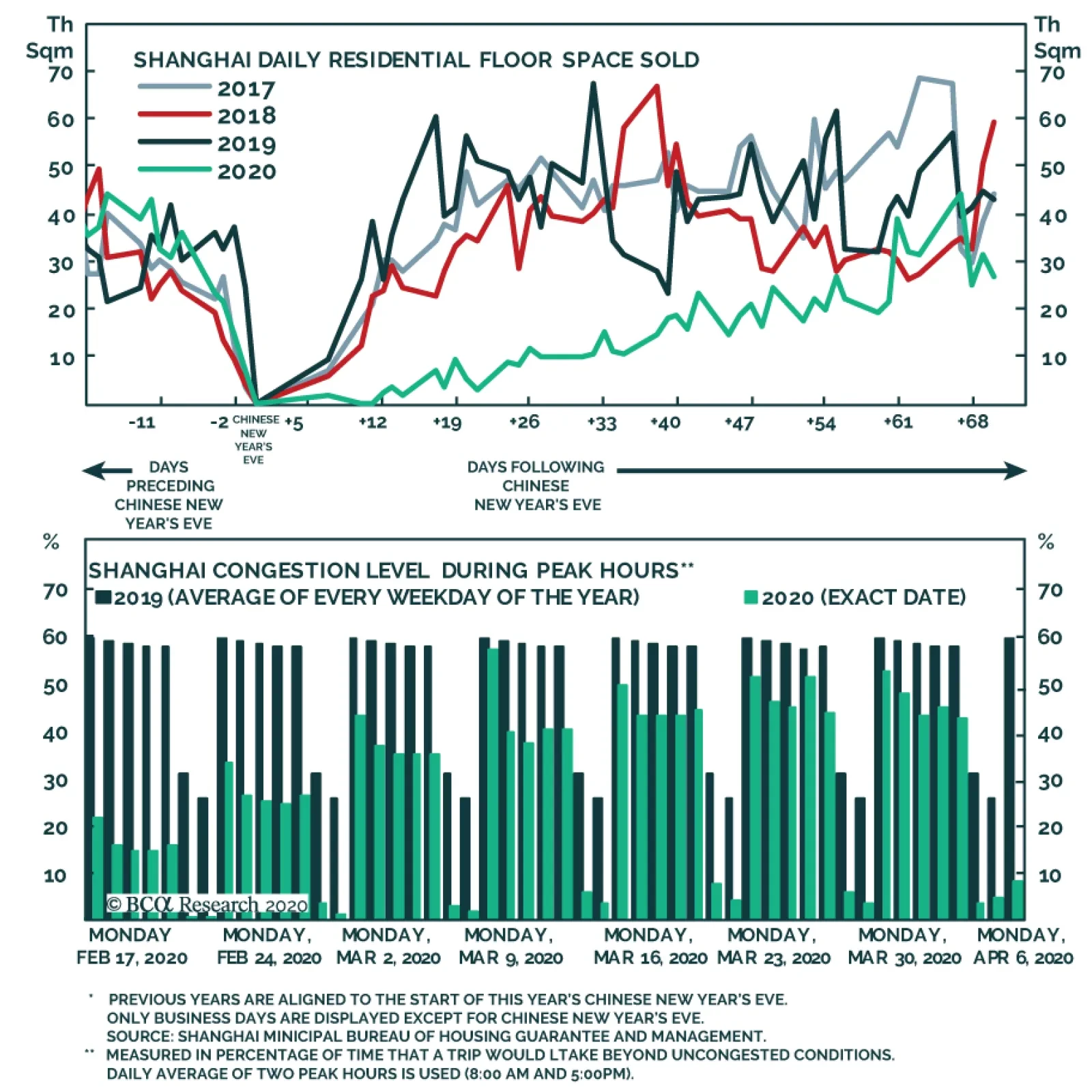
We have been closely monitoring the dynamics of the COVID-19 outbreak in Italy. If the containment of the virus can gather momentum, it could fuel the prospect that other Western countries can also gain control of the epidemic. The data on new infections…

Highlights Global shortages of medical equipment – including medicines – are frontloaded until emergency production kicks in. As the crisis abates, political recriminations between the US and China will surge. The US will seek to minimize medical supply exposure to China going forward, a boon for India and Mexico. China has escaped the COVID-19 crisis with minimal impact on food supply. Pork prices are surging due to African Swine Flu, but meat is a luxury. Still, the “Misery Index” is spiking and this will increase social instability. Food insecurity, inflation, and large current account deficits suggest that emerging market currencies will remain under pressure. Turkey and South Africa stand to suffer while we remain overweight Malaysia. Feature Chart 1Collapse In Economic Activity
Collapse In Economic Activity
Collapse In Economic Activity
With a third of the world population under some form of lockdown, general activity in the world’s manufacturing powerhouses has collapsed (Chart 1). The breakdown is a double whammy on market fundamentals. On the supply side, government-mandated containment efforts force workers in non-essential services to stay home while, on the demand side, households confined to their homes are unable to spend. Acute demand for medical supplies is causing shortages, while supply disruptions threaten states that lack food security. While global monetary and fiscal stimulus will soften the blow (Chart 2), the economic shock is estimated to be a 2% contraction in real GDP for every month of strict isolation. If measures are extended beyond April, markets will sell and new stimulus will be applied. Already the US Congress is negotiating the $1-$2 trillion infrastructure package that we discussed in our March 4 report, and cash handouts will be ongoing. When the dust settles the political fallout will be massive. Authoritarian states like China and especially Iran will face greater challenges maintaining domestic stability. Democracies like Italy and the US, which lead the COVID-19 case count, are the most likely to experience a change in leadership (Chart 3). Initially the ruling parties of the democracies are receiving a bump in opinion polling, but this will fade as households will be worse off and will likely vent their grievances at the ballot box.
Chart 2
Chart 3
Until a vaccine or treatment is discovered, medical equipment and social distancing are the only weapons against the pandemic. National production is (rightly) being redirected from clothing and cars to masks and ventilators to meet the spike in demand. Will the supply shock cause shortages in food and medicine – essential goods for humankind? In this report we address the impact of COVID-19 on global supply security and assess the market implications. Medical Equipment Shortages Will Spur Protectionism
Chart
Policymakers are fighting today’s crisis with the tools of the 2008 crisis, but a lasting rebound in financial markets will depend on surmounting the pandemic, which is prerequisite to economic recovery (Table 1). As the US faces the peak of its COVID-19 outbreak, public health officials and doctors are raising the alarm on the shortage of medical supplies. A recent US Conference of Mayors survey reveals that out of the 38% of mayors who say they have received supplies from their state, 84.6% say they are inadequate (Chart 4). Italy serves as a warning: A reported 8% of the COVID-19 cases there are doctors and health professionals, often treating patients without gloves or with compromised protective gear. These workers are irreplaceable and when they succumb the virus cannot be contained. In the US, doctors and nurses are re-using masks and sometimes treating patients behind a mere curtain, highlighting the supply shortage. While the shortages are mainly driven by a surge in demand from both medical institutions and households, they also come from the supply side, particularly China. Factory closures and transportation disruptions in China earlier this year, coupled with Beijing’s government-mandated export curbs, reduced Chinese exports, a major source of US and global supplies (Chart 5).
Chart 4
Chart 5
Other countries have imposed restrictions on exports of products used in combating the spread of COVID-19. Following export restrictions by the French, German, and Czech governments in early March, the European Commission intervened on March 15 to ensure intra-EU trade. It also restricted exports of protective medical gear outside of the EU. At least 54 nations have imposed new export restrictions on medical supplies since the beginning of the year.1 Both European and Chinese measures will reduce supplies in the US, the top destination for most of these halted exports (Chart 6).
Chart 6
Thus it is no wonder that the Trump administration has rushed to cut import duties and boost domestic production. The administration has released strategic stockpiles and cut tariffs on Chinese medical equipment used to treat COVID-19. With the whole nation mobilized, supply kinks should improve greatly in April. After a debacle in rolling out test kits (Chart 7), the US is rapidly increasing its testing capabilities to manage the crisis, with over a million tests completed as of the end of March (Chart 8). Meanwhile a coalition of companies is taking shape to make face masks. The president has invoked the defense production act to force companies to make ventilators.
Chart 7
Chart 8
However, with the pandemic peaking in the US, the hardest-hit regions will continue experiencing shortages in the near term. Shortages are prompting public outcry against the US government for its failure to anticipate and redress supply chain vulnerabilities that were well known and warned against. A report in The New York Times tells how Mike Bowen, owner of Texas-based mask-maker Prestige Ameritech, has advised the past three presidents about the danger in the fact that the US imports 95% of its surgical masks. “Aside from sitting in front of the White House and lighting myself on fire, I feel like I’ve done everything I can,” he said. He is currently inundated with emergency orders from US hospitals. The same report tells of a company called Strong Manufacturers in North Carolina that had to cut production of masks because it depends on raw materials from Wuhan, China, where the virus originated.2 The Trump administration will suffer the initial public uproar, but the US government will also seek to reduce import dependency going forward, and it will likely deflect some of the blame by focusing on the supply risks posed by China. Beijing, for its part, is launching a propaganda campaign against the US to distract from its own failures at home (some officials have even blamed the US for the virus). Meanwhile it is cranking up production and shipping medical supplies to crisis hit areas like Italy to try to repair its global image after having given rise to the virus. In addition, the city of Shenzhen is sending 1.2 million N95 masks to the US on the New England Patriots’ team plane. Even Russia is sending small donations. But these moves work to propagandistic efforts in these countries and will ultimately shame the Americans into taking measures to improve self-sufficiency. Bottom Line: The most important supply shortage amid the global pandemic is that of medical equipment. While these shortages will abate sooner rather than later, the supply chain vulnerabilities they have exposed will trigger new policies of supply redundancy and import substitution. The US in particular will seek to reduce dependency on China. That COVID-19 is aggravating rather than reducing tensions between these states, despite China’s role as a key supplier in a time of need, highlights the secular nature of their rising tensions. The US-China Drug War Shortages of pharmaceuticals are also occurring, despite the fact that the primary pandemic response is necessarily “non-pharmaceutical” (e.g. social distancing). The US Food and Drug Administration (FDA) announced the first COVID-19 related drug shortage in the US on February 27. While the specific drug was not disclosed, the announcement notes that “the shortage is due to an issue with manufacturing of an active pharmaceutical ingredient used in the drug.”3 The FDA is monitoring 20 other (non-critical) drugs potentially at risk of shortages because the sole source is China. The global spread of the pandemic will increase these shortages. On March 3 India announced export restrictions on 26 drugs, including paracetamol and several antibiotics, due to supply disruptions caused by the Chinese shutdown. While Chinese economic activity has since picked up, India is now among the string of countries under a nationwide lockdown. Similar measures enforced across Europe will also hamper the production and transportation of these goods. The implication is that even if Chinese drugs return to market, supplies further down the chain and from alternative suppliers will take a hit. The risk that this will evolve into a drug shortage depends on the intensity of the outbreak. Drug companies generally hold 3-6 months’ worth of inventories. Consequently, while inventories are likely to draw as supplies are disrupted, consumers may not experience an outright shortage immediately. In the US, as with equipment and protective gear, the government’s strategic stockpile will buffer against shortfalls in supplies of critical drugs. COVID-19 is aggravating rather than reducing US-China tensions. Nevertheless the supply chain is getting caught up in the larger US-China strategic conflict. Even before the pandemic, the US-China trade war brought attention to the US’s vulnerabilities to China’s drug exports. This dispute is not limited to illicit drugs, as with China’s production of the opioid fentanyl, but also extends to mainstream medicines, as highlighted in the selection of public statements shown in Table 2.
Chart
Chart 9
How much does the US rely on China for medicine? According to FDA data, just over half of manufacturing facilities producing regulated drugs in finished dosage form for the US market are located abroad, with China’s share at 7% (Chart 9).4 The figures are higher for manufacturing facilities producing active pharmaceutical ingredients, though still not alarming – 72% of the facilities are located abroad, with 13% in China. Of course, high-level data understate China’s influence. The complex nature of global drug supply chains means that the source of finished dosage forms masks dependencies and dominance higher up the supply chain (Figure 1).
Chart
For instance, active pharmaceutical ingredients produced in Chinese facilities are used as intermediate goods by finished dosage facilities in India as well as China. The FDA reports that Indian finished dosage facilities rely on China for three-quarters of the active ingredients in their generic drug formulations, which are then exported to the US and the rest of the world. Any supply disruption in China – or any other major drug producer – will lead to shortages further down the supply chain.
Chart 10
Chinese influence becomes more apparent when the sample is restricted to generic prescription drugs. These are especially relevant because nearly 70% of Americans are on at least one prescription drug, of which more than 90% are dispensed in the generic form. In this case, 87% of ingredient manufacturers and 60% of finished dosage manufacturers are located outside the US, with 17% of ingredient facilities and 8% of dosage facilities in China (Chart 10). Of all the facilities that manufacture active ingredients that are listed on the World Health Organization’s Essential Medicines List – a compilation of drugs that are considered critical to the health system – 71% are located aboard with 15% located in China (Chart 11). Moreover, manufacturers are relatively inflexible when adapting to market conditions and shortages. Drug manufacturing facilities generally operate at above 80% of their capacity and are thus left with little immediate capacity to ramp up production in reaction to shortages elsewhere. In addition, manufacturers face challenges in changing ingredient suppliers – there is no centralized source of information on them, and additional FDA approvals are required. The US will look to reduce its dependency on China for its drug supplies regardless of 2020 election outcome. China also has overwhelming dominance in specific categories. The Council on Foreign Relations reports that China makes up 97% of the US antibiotics market.5 Other common drugs that are highly dependent on China for supplies include ibuprofen, acetaminophen, hydrocortisone, penicillin, and heparin (Chart 12).
Chart 11
Chart 12
Taking it all together, US vulnerability can be overstated. Consider the following: Of the 370 drugs on the Essential Medicines List that are marketed in the US, only three are produced solely in China. None of these three are used to treat top ten causes of death in the United States. Import substitution is uneconomical. Foreign companies, especially Chinese companies, are attractive due to their lower costs and lax regulations. While China’s influence extends higher up the supply chain, this is true for US markets as well as other consumer markets. While China can cut off the US from the finished dosages it supplies, it cannot do the same for the ingredients that are used by facilities in other countries and eventually make their way to the US in finished dosage form. Americans are demanding that drug prices be reduced and an obvious solution is looser controls on imports. The recent activation of the Defense Production Act shows that the US can take action to boost domestic production in emergencies. Nevertheless, China is growing conspicuous to the American public due to general trade tensions and COVID-19. As it moves up the value chain, it also threatens increasing competition for the US and its allies. Hence the US government will have a strategic reason to cap China’s influence that is also supported by corporate interests and popular opinion. This will lead to tense trade negotiations with China and meanwhile the US will seek alternative suppliers. China will not want to lose market share or leverage over the United States, so it may offer trade concessions at some point to keep the US engaged. Ultimately, however, strategic tensions will catalyze US policy moves to reduce the cost differential with China and promote its rivals. Pressure on China over its currency, regulatory standards, and scientific-technological acquisition will continue regardless of which party wins the White House in 2020. The Democrats would increase focus on China’s transparency and adherence to international standards, including labor and environmental standards. Both Republicans and Democrats will try to boost trade with allies. The key beneficiaries will be India, Southeast Asia, and the Americas. Taiwan’s importance will grow as a middle-man, but so will its vulnerability to strategic tensions. Bottom Line: The US and the rest of the world are suffering shortfalls of equipment necessary to combat COVID-19. There is also a risk of drug shortages stemming from supply disruptions and emergency protectionist policies. These shortages look to be manageable, but they have exposed national vulnerabilities that will be reduced in future via interventionist trade policies. While the US and Europe will ultimately manage the outbreak, the political fallout will be immense. The US will look to reduce its dependency on China. This will increase investment in non-China producers of active pharmaceutical ingredients, such as India and Mexico. The US tactics against China will vary according to the election result, but the strategic direction of diversifying away from China is clear and will have popular impetus in the wake of COVID-19. Food Security In addition to the challenges posed by COVID-19 on medical supplies, food – another essential good – also faces risk of shortages. China is a case in point. Food prices there were on the rise well before the COVID-19 outbreak, averaging 17.3% in the final quarter of 2019. However inflation was limited to pork and its substitutes – beef, lamb and poultry – and reflected a reduction in pork supplies on the back of the African Swine Flu outbreak. While year-on-year increases in the prices of pork and beef averaged 102.8% and 21.0%, respectively, grain, fresh vegetable, and fresh fruit prices averaged 0.6%, 1.5%, and -5.0% in Q42019 (Chart 13). Chart 13Chinese Inflation Has (Thus far) Been Contained To Pork
Chinese Inflation Has (Thus far) Been Contained To Pork
Chinese Inflation Has (Thus far) Been Contained To Pork
Chart 14China's Misery Index Is Spiking - A Political Liability
China's Misery Index Is Spiking - A Political Liability
China's Misery Index Is Spiking - A Political Liability
However China’s COVID-19 containment measures had a more broad-based impact on food supplies, threatening to push up China’s Misery Index (Chart 14). Travel restrictions, roadblocks, quarantined farm laborers, and risk-averse truck drivers introduced challenges not only in ensuring supplies were delivered to consumers, but also to daily farm activity and planting. The absence of farm inputs needed for planting such as seeds and fertilizer, and animal feed for livestock, was especially damaging in regions hardest hit by the pandemic. Livestock farmers already struggling with swine flu-related reductions in herd sizes were forced to prematurely cull starving animals, cutting the stock of chicken and hogs. Now as the country transitions out of its COVID-19 containment phase and moves toward normalizing activity (Chart 15), food security is top of the mind. Authorities are emphasizing the need to ensure sufficient food supplies and adopt policies to encourage production.6 This is especially important for crops due to be planted in the spring. Delayed or reduced plantings would weight on the quality and quantity of the crops, pushing prices up.
Chart 15
With food estimated to account for 19.9% of China’s CPI basket – 12.8% of which goes towards pork (Chart 16) – a prolonged food shortage, or a full-blown food crisis, would be extremely damaging to Chinese families and their pocketbooks.
Chart 16
However, apart from soybeans and to a lesser extent livestock, China’s inventories are well stocked (Chart 17) and are significantly higher than levels amid the 2006-2008 and 2010-2012 food crises. Inventories have been built up specifically to provide ammunition precisely in times of crisis. Corn and rice stocks are capable of covering consumption for nearly three quarters of a year, and wheat stocks exceeding a year’s worth of consumption. Thus, while not completely immune, China today is better able to weather a supply shock. Moreover, with the exception of soybeans, China is not overly dependent on imports for agricultural supplies (Chart 18).
Chart 17
Chart 18
As the COVID-19 epicenter shifts to the US and Europe, farmers there are beginning to face the same challenges. Reports of delays in the arrival of shipments of inputs such as fertilizer and seeds have prompted American farmers to prepare for the worst and order these goods ahead of time.
Chart 19
While these proactive measures will help reduce risks to supply, farmers in Europe and parts of the US who typically rely on migrant laborers will need to search for alternative laborers as the planting season nears. Just last week France’s agriculture minister asked hairdressers, waiters, florists, and others that find themselves unemployed to take up work in farms to ensure food security. As countries become increasingly aware of the risks to food supplies, some have already introduced protectionist measures, especially in the former Soviet Union: The Russian agriculture ministry proposed setting up a quota for Russian grain exports and has already announced that it is suspending exports of processed grains from March 20 for 10 days. Kazakhstan suspended exports of several agricultural goods including wheat flour and sugar until at least April 15. On March 27, Ukraine’s economy ministry announced that it was monitoring wheat export and would take measures necessary to ensure domestic supplies are adequate. Vietnam temporarily suspended rice contracts until March 28 as it checked if it had sufficient domestic supplies. The challenge is that, unlike China, inventories in the rest of the world are not any higher than during the previous food crisis and do not provide much of a buffer against supply shortfalls (Chart 19). Higher food prices would be especially painful to lower income countries where food makes up a larger share of household spending (Chart 20). In addition to using their strategic food stockpiles, governments will attempt to mitigate the impact of higher food prices by implementing a slew of policies:
Chart 20
Trade policies: Producing countries will want to protect domestic supplies by restricting exports – either through complete bans or export quotas. Importing countries will attempt to reduce the burden of higher prices on consumers by cutting tariffs on the affected goods. Consumer-oriented policies: Importing countries will provide direct support to consumers in the form of food subsidies, social safety nets, tax reductions, and price controls. Producer-oriented policies: Governments will provide support to farmers to encourage greater production using measures such as input subsidies, producer price support, or tax exemptions on goods used in production. While these policies will help alleviate the pressure on consumers, they also result in greater government expenditures and lower revenues. Thus, subsidizing the import bill of a food price shock can weigh on public finances, debt levels, and FX reserves. Currencies already facing pressure due to the recessionary environment, such as Turkey, South Africa and Chile will come under even greater downward pressure. Food inventories ex-China are insufficient to protect against supply shortages. Bottom Line: COVID-19’s logistical disruptions are challenging farm output. This is especially true when transporting goods and individuals across borders rather than within countries. This will be especially challenging for food importing countries, as some producers have already started erecting protectionist measures and this will result in an added burden on government budgets that are already extended in efforts to contain the economic repercussions of the pandemic. Investment Implications Chart 21Ag Prices Inversely Correlated With USD
Ag Prices Inversely Correlated With USD
Ag Prices Inversely Correlated With USD
China will continue trying to maximize its market share and move up the value chain in drug production. At the same time, the US is likely to diversify away from China and try to cap China’s market share. This will result in tense trade negotiations regardless of the outcome of the US election. The COVID-19 experience with medical shortages and newfound public awareness of potential medical supply chain vulnerabilities means that another round of the trade war is likely. Stay long USD-CNY. Regarding agriculture, demand for agricultural commodities is relatively inelastic. This inelasticity should prevent a complete collapse in prices even amid a weak demand environment. Thus given the risk on supplies, prices face upward pressure. However, not all crops are facing these same market dynamics. While wheat and rice prices have started to move in line with the dynamics described above, soybeans and to a greater extent corn prices have not reacted as such (Chart 21). In the case of soybeans, we expect demand to be relatively muted. China accounts for a third of the world’s soybean consumption. 80% of Chinese soybeans are crushed to produce meal to feed China’s massive pork industry. However, the 21% y/y decline in pork output in 2019 on the back of the African Swine Flu outbreak will weigh on demand and mute upward pressures on supplies. Demand for corn will also likely come in weak. The COVID-19 containment measures and the resulting halt in economic activity reduce demand for gasoline and, as a consequence, reduce demand for corn-based ethanol, which is blended with gasoline. In addition to the above fundamentals, ag prices have been weighed down by a strong USD which makes ex-US exporters relatively better off, incentivizing them to raise exports and increase global supplies. A weaker USD – which we do not see in the near term – would help support ag prices. It is worth noting that if there is broad enforcement of protectionist measures, then producers will not be able to benefit from a stronger dollar. In that case we may witness a breakdown in the relationship between ag prices and the dollar. In light of these supply/demand dynamics, we expect rice and wheat prices to be well supported going forward and to outperform corn and soybeans. Roukaya Ibrahim Editor/Strategist Geopolitical Strategy RoukayaI@bcaresearch.com Matt Gertken Vice President Geopolitical Strategist mattg@bcaresearch.com Footnotes 1 See "Tackling COVID-19 Together: The Trade Policy Dimension," Global Trade Alert, University of St. Gallen, Switzerland, March 23, 2020. 2 See Rachel Abrams et al, "Governments and Companies Race to Make Masks Vital to Virus Fight," The New York Times, March 21, 2020. 3 The announcement also notes that there are other alternatives that can be used by patients. See "Coronavirus (COVID-19) Supply Chain Update," US FDA, February 27, 2020. 4 All regulated drugs include prescription (brand and generic), over the counter, and compounded drugs. 5 Please see Huang, Yanzhong, "The Coronavirus Outbreak Could Disrupt The US Drug Supply," Council on Foreign Relations, March 5, 2020. 6 The central government ordered local authorities to allow animal feed to pass through checkpoints amid the lockdowns. In addition, Beijing has relaxed import restrictions by lifting a ban on US poultry products and announcing that importers could apply for waivers on goods tariffed during the trade war such as pork and soybeans. The lifting of these restrictions also serves to help China meet its phase one trade deal commitments. Please see "Coronavirus hits China’s farms and food supply chain, with further spike in meat prices ahead," South China Morning Post, dated February 21, 2020.
Highlights Chinese stocks have outperformed global benchmarks by a wide margin. We are taking profits on our overweight position, and downgrading our tactical call on Chinese stocks to neutral. In absolute terms, Chinese stocks have failed to buck the trend in a global selloff of risk assets. This suggests Chinese stocks are not immune to worldwide panics. Investors should wait for a peak in the global pandemic before going long on Chinese equities. Chinese stocks have become less cheap relative to global benchmarks. The size of Chinese stimulus is also less impressive compared with other major economies such as the US. Therefore, in order to maintain an overweight stance on Chinese risk assets in a global portfolio, Chinese stocks need to either offer a better price entry point, or a more upside potential in earnings outlook relative to their global peers. Feature Chart I-1Chinese Stocks Have Significantly Outperformed Global Benchmarks...
Chinese Stocks Have Significantly Outperformed Global Benchmarks...
Chinese Stocks Have Significantly Outperformed Global Benchmarks...
In the current pandemic environment, economic fundamentals mean little to panicked investors who have mostly ignored the unprecedented degree of monetary and fiscal stimulus pouring into the global economy. Investors are looking for clear signs that the COVID-19 crisis can be brought under control, but medical experts have been unable to predict the timing of a peak in the pandemic. Policymakers around the world are beginning to address investors’ concerns that substantial and timely fiscal policy supports are needed to offset the knock-on effects on businesses and individuals.1 However, until the number of new infections in major economies peaks, the erratic trading behavior among global investors will persist. Given the lack of near-term certainty, we are downgrading our tactical stance on Chinese stocks from overweight to neutral. Chart 1 highlights since we upgraded our tactical call to overweight in end-2019, Chinese stocks have significantly outperformed global stocks. This outperformance has been passive in nature; Chinese stocks are down about 10% year-to-date in US$ terms, versus a 23% decline in global stocks. We are also closing 7 of our 10 high-conviction investment calls from our trade book, for reasons cited here and then detailed in the next sections. Of the 10 active trades in our book, 7 have generated a positive return since their inceptions, including 3 that have recorded double-digit gains.2 Investors should wait for clarity on the peak of the global pandemic before going long on risk assets. Investors should wait for more signs of an upside potential in earnings and/or a better price entry point to go long on Chinese stocks. China Is Not Immune To A Global Pandemic Chart I-2...But Their Prices Have Also Plunged In Absolute Terms
...But Their Prices Have Also Plunged In Absolute Terms
...But Their Prices Have Also Plunged In Absolute Terms
Chinese equities have not been immune from the gyrations in the global financial markets, which have not responded to monetary and fiscal stimulus measures in either a customary or predictive manner. Unlike the 2008 global recession triggered by a financial crisis, public health crises damage the economy by reducing human activity and, therefore, erode both supply and demand. A return to normalcy depends almost entirely on whether the pandemic can be contained. Even though Chinese business activities are gradually resuming, Chinese stocks failed to buck the worldwide trend of a liquidation in risk assets. While Chinese stocks have outperformed global benchmarks by a wide margin, the relative gains have mostly been passive since early March. In absolute terms, Chinese domestic stocks have lost all their gains from February and investable stock prices have fallen back to their November 2018 level (Chart 2). Chart I-3Number Of Imported Cases Now On The Rise
Investing During A Global Pandemic
Investing During A Global Pandemic
China is not immune to a second COVID-19 wave. China has been reporting zero-to-low single-digit numbers of locally transmitted cases since mid-March, but it is now experiencing an increase in imported cases from overseas travelers (Chart 3). The mounting numbers have led the Chinese government to shut its borders to non-Chinese citizens.3 This indicates that it is still too early to claim a victory in China’s virus containment efforts. Given that China’s domestic businesses are open, the trajectory of new cases also remains unknown. These lingering doubts will slow the pace in the resumption of Chinese production (Chart 4). Chart I-4Chinese Companies Operating At 80% Capacity
Investing During A Global Pandemic
Investing During A Global Pandemic
Moreover, China is not immune to qualms about the depth and duration of a global recession. China has the political will and policy room to stimulate its economy, and the country’s dominant domestic demand makes the economy relatively insulated from a global recession. However, when more than 40% of China’s trading partners (including Europe and the US) remain under lockdown, a collapse of external demand will weigh on China’s economic and corporate profit recovery in the next quarter or two. Therefore, short-term risks on Chinese stocks are tilted to the downside. Bottom Line: Chinese stocks have failed to buck the trend in the global pandemic and the tsunami selloff in risk assets. Investors should wait for a peak in the outbreak before going long on Chinese equities. Chinese Stocks Have Become Less Cheap Relative To Global Benchmarks Chart I-5Outperformance In Chinese Stocks Seems Quite Extended
Outperformance In Chinese Stocks Seems Quite Extended
Outperformance In Chinese Stocks Seems Quite Extended
Chinese stocks, particularly in the domestic market, are no longer priced at deep discounts compared with global equities (Chart 5). The recent outperformance of Chinese stocks has brought the relative performance trend in both investable and domestic stocks back close to late-2017/early-2018 levels. That was before the US-China trade war began, and at a point where China’s economy was close to peak strength for the cycle. Although a passive outperformance does not automatically warrant an underweight stance on Chinese stocks, investors will demand a higher upside potential in Chinese corporate earnings to justify an overweight position in Chinese equities. Therefore, we will watch for the following signs before buying Chinese stocks: a strengthening in China’s economy and corporate profits outpacing recoveries in other major economies, and/or a near-term drop in Chinese stock prices outsizing the decline in global stock prices. Given the exceedingly strong policy responses from G20 economies (particularly the US), China’s stimulus will need to be amplified so that investors are confident that the rate of Chinese corporate profit recovery will surpass their global counterparts.4 In a recent Politburo meeting, Chinese policymakers signaled their willingness to expand stimulus, including much larger fiscal deficits and local-government special bond issuance quotas in 2020, along with further interest rate cuts.5 An escalation in policy support will probably bring China’s stimulus in line with that extended in the 2008-2009 global financial crisis. However, the size of the stimulus package will be determined at the National People’s Congress (NPC) meeting, which is delayed to end-April or early May. In the near term, the selloff in Chinese stocks will likely persist as financial markets continue to price in bad news in the global economy. Chinese investable stock prices continue to be priced at a discount relative to global benchmarks, although the discount is much smaller than it was three months ago. In absolute terms, Chinese investable stock prices have not reached their technical support levels. The offshore market historically rebounds when prices approach a major defense line, measured by a 12-year moving average. This technical support for the MSCI China Index is currently 65, still about 13% below the March 30 close (Chart 6). Chart I-6Investable Stock Prices Not Yet At Their Long-Term Support
Investable Stock Prices Not Yet At Their Long-Term Support
Investable Stock Prices Not Yet At Their Long-Term Support
The prices in Chinese domestic stocks have reached their 12-year moving average, although A-share prices are not decisively in a structural “cheap” territory yet (Chart 7). Investors should wait on the sidelines for now, since the full effects of any enhanced stimulus in China will be felt in the real economy with a time lag. China’s production supply side is only operating at about 80% of normal capacity, and demand has yet to catch up (Chart 4 and Chart 8). This suggests the rebound in economic activities in Q2 will likely be gradual, and corporate profits are likely to remain depressed. Chart I-7Domestic Stock Prices Approaching A Structural "Cheap" Territory
Domestic Stock Prices Approaching A Structural "Cheap" Territory
Domestic Stock Prices Approaching A Structural "Cheap" Territory
Chart I-8Demand In Manufacturing Remains Sluggish
Demand In Manufacturing Remains Sluggish
Demand In Manufacturing Remains Sluggish
Bottom Line: Chinese stocks have become less cheap against the backdrop of a massive liquidation of global equities. Chinese existing stimulus also appears moderate compared with other major economies. Therefore, in order for investors to overweight Chinese risk assets in a global portfolio, Chinese stocks either will have to offer a better entry price point or more upside corporate earnings potential. Both are currently missing. Investment Conclusions Investors should stay neutral on Chinese stocks in the next 3 months, and we are closing 7 out of the 10 active positions in our trade book. These trades are especially vulnerable to a protracted global recession and more selloffs in the domestic stock market. We will look for opportunities to incrementally add new trades to our book in the coming months. Here are our reasons for retaining or closing some of our positions: Long China Onshore Corporate Bonds (Maintain): The trade has yielded a handsome return of 16% since its inception in June 2017, (Chart 9). Although the spread in Chinese onshore corporate bond yields has widened sharply in the past few weeks, it has been the result of an indiscriminate global selloff of financial assets rather than the market pricing in any China-centric credit risks (Chart 10). In the next 6 to 12 months, corporate credit spreads should normalize as we expect monetary policies in major economies to remain ultra-loose, the global economy to recover and investors’ risk sentiment to improve. Chinese onshore corporate bonds will likely continue to offer a better risk-reward profile relative to other economies, with a higher risk premium and relatively stable default rate. Chart I-9Chinese Onshore Corporate Bonds Remain Attractive
Chinese Onshore Corporate Bonds Remain Attractive
Chinese Onshore Corporate Bonds Remain Attractive
Chart I-10Corporate Credit Spreads Should Narrow Over A 12-Month Horizon
Corporate Credit Spreads Should Narrow Over A 12-Month Horizon
Corporate Credit Spreads Should Narrow Over A 12-Month Horizon
Long MSCI China Energy Stocks (Close): This trade has had the worst performance among our positions due to consistently falling oil prices since October 2018 (Chart 11). Although BCA’s commodity strategists expect Brent prices to average $36/barrel in 2020, $3 higher than the average oil prices in March, it is still at a 50% discount from the $70 price tag just 3 months ago. Such a minor improvement in the price outlook does not offer enough upside potentials to offset downside risks in earnings in the next 9 months. Therefore, we would rather cut the losses. Long China Domestic Consumer Discretionary Equities Versus Benchmark and Long China Domestic Consumer Discretionary Equities/Short China Domestic Consumer Staples Equities (Close): As explained in the previous sections, we think there will be better entry price points for Chinese stocks as well as cyclical stocks. Besides, discretionary consumption in China has yet to show signs of a meaningful rebound. In the near term, we will also look for opportunities to go long position in domestic consumer staple stocks because we think that food and beverage price inflation will persist well into the second half of this year (Chart 12). Chart I-11Depressed Oil Prices Lead To Significant Underperformance In Energy Stocks
Depressed Oil Prices Lead To Significant Underperformance In Energy Stocks
Depressed Oil Prices Lead To Significant Underperformance In Energy Stocks
Chart I-12Consumer Staple Stocks Should Benefit From Stubbornly High Food Prices
Consumer Staple Stocks Should Benefit From Stubbornly High Food Prices
Consumer Staple Stocks Should Benefit From Stubbornly High Food Prices
Long MSCI China Index, Long MSCI China Onshore Index, Long MSCI China Growth Index/ Short MSCI All Country World (Close): We will need to see more stable sentiment in the global financial markets, a better entry price point for Chinese stocks and a sure sign of outsized Chinese stimulus before reinitiating a long position on Chinese stocks. Jing Sima China Strategist jings@bcaresearch.com Appendix Table 1Massive Stimulus In Response To Pandemic
Investing During A Global Pandemic
Investing During A Global Pandemic
Footnotes 1 Please see Table 1 in the Appendix. 2 Please see the trade table at the end of the report. 3 https://www.bloomberg.com/news/articles/2020-03-26/china-to-suspend-foreigners-entry-starting-saturday?mc_cid=1bdcd29ddd&mc_eid=9da16a4859 4 The stimulus package announced in the US amounts to 9% of the country’s 2019 GDP, whereas China’s stimulus would be about 3% of its 2019 GDP. 5 http://www.xinhuanet.com/politics/leaders/2020-03/27/c_1125778940.htm Cyclical Investment Stance Equity Sector Recommendations
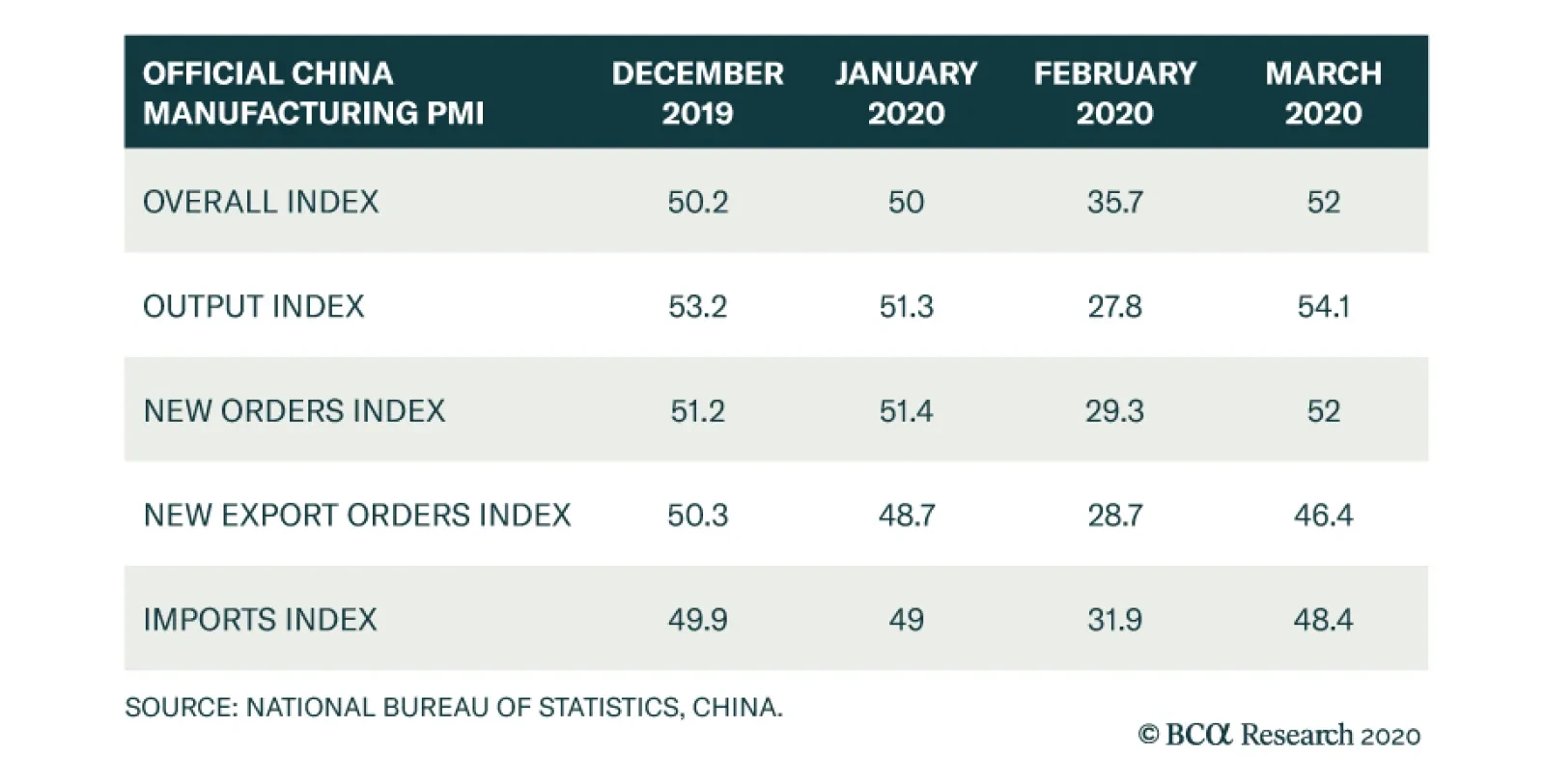
At first blush, China’s official manufacturing PMI release was encouraging. After having fallen from 50 in January to 35.7 in February, the PMI rebounded to 52 in March. The rise was led by the output subcomponent, which rose from 27.8 to 54.1. However, it…
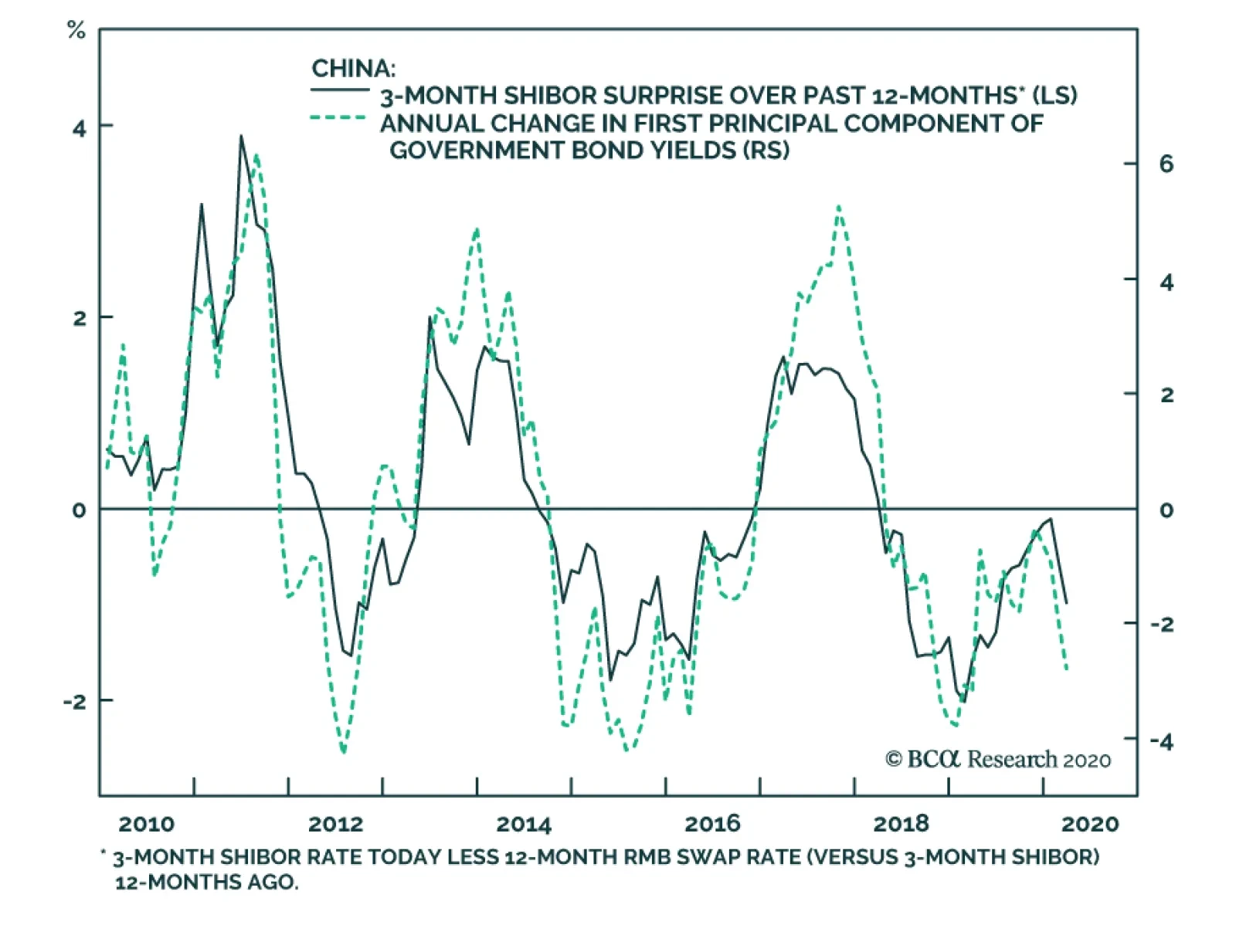
The PBOC cut its 7-day reverse repo rate on Monday, as part of an injection of liquidity into the Chinese banking system. Ma Jun, an advisor to the PBOC, guided expectations towards additional cuts by stating that the PBOC had entered “a stage with stronger…
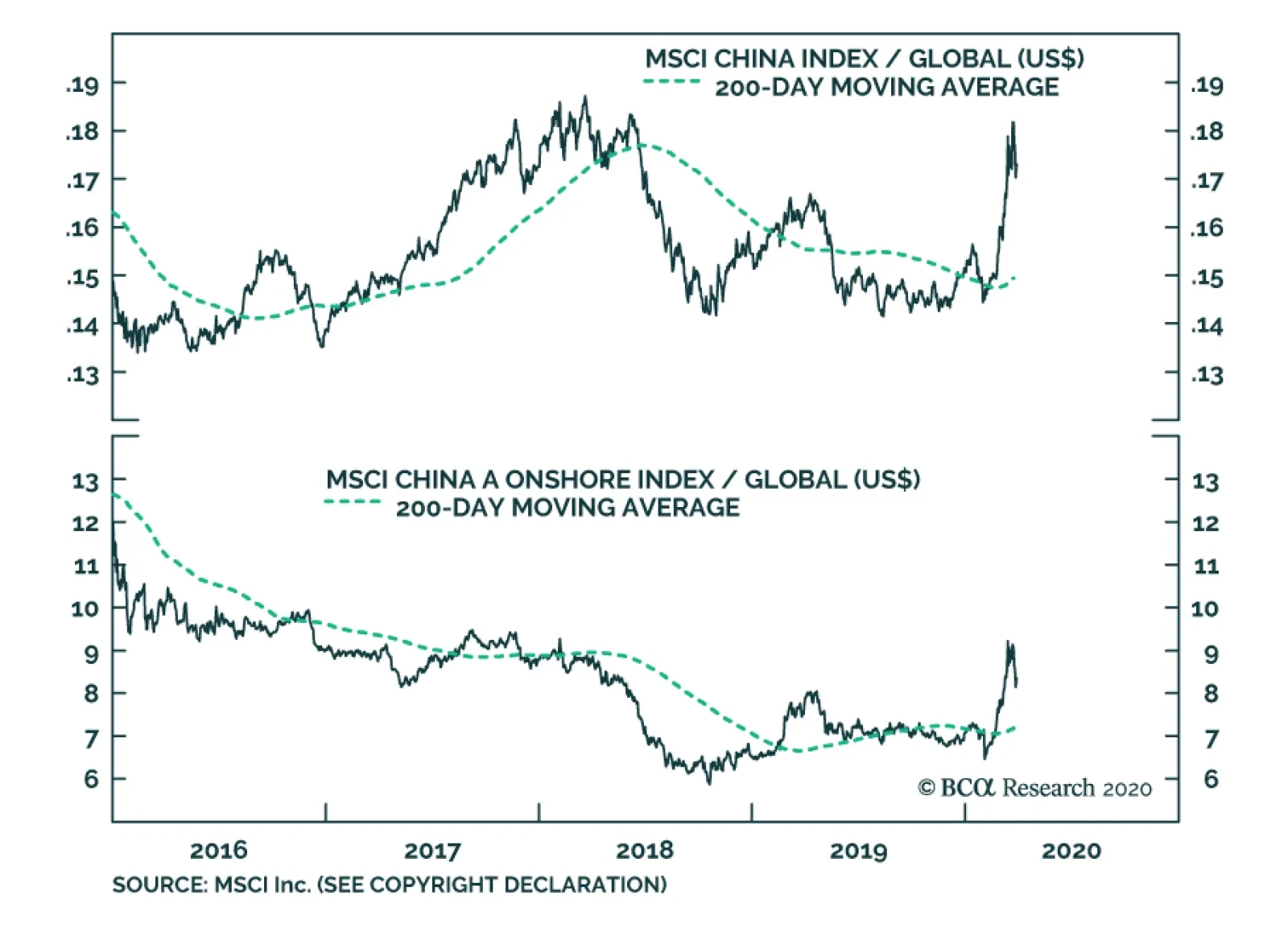
The COVID-19 pandemic began in China, but it has become the world’s problem. China’s aggressive response to the disease, particularly in Hubei province, means that it is now “outperforming” the world in terms of new cases of the disease, and this…
Highlights The pandemic has a negative impact on households and has not peaked in the US. But a depression is likely to be averted. Our market-based geopolitical risk indicators point toward a period of rising political turbulence across the world. We are selectively adding risk to our strategic portfolio, but remain tactically defensive. Stay long gold on a strategic time horizon. Feature I'm going where there's no depression, To the lovely land that's free from care. I'll leave this world of toil and trouble My home's in Heaven, I'm going there. - “No Depression In Heaven,” The Carter Family (1936) Chart 1The Pandemic Stimulus Versus The Great Recession Stimulus
GeoRisk Update: No Depression
GeoRisk Update: No Depression
Markets bounced this week on the back of a gargantuan rollout of government spending that is the long-awaited counterpart to the already ultra-dovish monetary policy of global central banks (Chart 1). Just when the investment community began to worry about a full-fledged economic depression and the prospect for bank runs, food shortages, and martial law in the United States, the market rallied. Yet extreme uncertainty persists over how long one third of the world’s population will remain hidden away in their homes for fear of a dangerous virus (Chart 2). Chart 2Crisis Has Not Verifiably Peaked, Uncertainty Over Timing Of Lockdowns
GeoRisk Update: No Depression
GeoRisk Update: No Depression
Chart 3The Pandemic Shock To The Labor Market
The Pandemic Shock To The Labor Market
The Pandemic Shock To The Labor Market
While an important and growing trickle of expert opinion suggests that COVID-19 is not as deadly as once thought, especially for those under the age of 50, consumer activity will not return to normal anytime soon.1 Moreover political and geopolitical risks are skyrocketing and have yet to register in investors’ psyche. Consider: American initial unemployment claims came in at a record-breaking 3.3 million (Chart 3), while China International Capital Corporation estimates that China’s GDP will grow by 2.6% for the year. These are powerful blows against global political as well as economic stability. This should convince investors to exercise caution even as they re-enter the equity market. We are selectively putting some cash to work on a strategic time frame (12 months and beyond) to take advantage of some extraordinary opportunities in equities and commodities. But we maintain the cautious and defensive tactical posture that we initiated on January 24. No Depression In Heaven The US Congress agreed with the White House on an eye-popping $2.2 trillion or 10% of GDP fiscal stimulus. At least 46% of the package consists of direct funds for households and small businesses (Chart 4). This includes $290 billion in direct cash handouts to every middle-class household – essentially “helicopter money,” as it is financed by bonds purchased by the central bank (Table 1). The purpose is to plug the gap left by the near complete halt to daily life and business as isolation measures are taken. A depression is averted, but we still have a recession. Go long consumer staples. Chart 4The US Stimulus Package Breakdown
GeoRisk Update: No Depression
GeoRisk Update: No Depression
Table 1Distribution Of Cash Handouts Under US Coronavirus Response Act
GeoRisk Update: No Depression
GeoRisk Update: No Depression
China, the origin of the virus that triggered the global pandemic and recession, is resorting to its time-tried playbook of infrastructure spending, with 3% of GDP in new spending projected. This number is probably heavily understated. It does not include the increase in new credit that will accompany official fiscal measures, which could easily amount to 3% of GDP or more, putting the total new spending at 6%. Germany and the EU have also launched a total fiscal response. The traditionally tight-fisted Berlin has launched an 11% of GDP stimulus, opening the way for other member states to surge their own spending. The EU Commission has announced it will suspend deficit restrictions for all member states. The ECB’s Pandemic Emergency Purchase Program (PEPP) enables direct lending without having to tap the European Stability Mechanism (ESM) or negotiate the loosening of its requirements. It also enables the ECB to bypass the debate over issuing Eurobonds (though incidentally Germany is softening its stance on the latter idea). The cumulative impact of all this fiscal stimulus is 5% of global GDP – and rising (Table 2). Governments will be forced to provide more cash on a rolling basis to households and businesses as long as the pandemic is raging and isolation measures are in place. Table 2The Global Fiscal Stimulus In Response To COVID-19
GeoRisk Update: No Depression
GeoRisk Update: No Depression
President Trump has signaled that he wants economic life to begin resuming after Easter Sunday, April 12. But he also said that he will listen to the advice of the White House’s public health advisors. State governors are the ones who implement tough “shelter in place” orders and other restrictions, so the hardest hit states will not resume activity until their governors believe that the impact on their medical systems can be managed. Authorities will likely extend the social distancing measures in April until they have a better handle on the best ways to enable economic activity while preserving the health system. Needless to say, economic activity will have to resume gradually as the government cannot replace activity forever and the working age population can operate even with the threat of contracting the disease (social distancing policies would become more fine-tuned for types of activity, age groups, and health risk profiles). The tipping point from recession to depression would be the point at which the government’s promises of total fiscal and monetary support for households and businesses become incapable of reassuring either the financial markets or citizens. The largest deficit the US government has ever run was 30% of GDP during World War II (Chart 5). Today’s deficit is likely to go well beyond 15% (5% existing plus 10% stimulus package plus falling revenue). If authorities were forced to triple the lockdown period and hence the fiscal response the country would be in uncharted territory. But this is unlikely as the incubation period of the virus is two weeks and China has already shown that a total lockdown can sharply reduce transmission. Chart 5The US's Largest Peacetime Budget Deficit
The US's Largest Peacetime Budget Deficit
The US's Largest Peacetime Budget Deficit
Any tipping point into depression would become evident in behavior: e.g. a return to panic selling, followed by the closure of financial market trading by authorities, bank runs, shortages of staples across regions, and possibly the use of martial law and curfews. While near-term selloffs can occur, the rest seems very unlikely – if only because, again, the much simpler solution is to reduce the restrictions on economic activity gradually for the low-risk, healthy, working age population. Bottom Line: Granting that the healthy working age population can and will eventually return to work due to its lower risk profile, unlimited policy support suggests that a depression or “L-shaped” recovery is unlikely. The Dark Hour Of Midnight Nearing While the US looks to avoid a depression, there will still be a recession with an unprecedented Q2 contraction. The recovery could be a lot slower than bullish investors expect. Global manufacturing was contracting well before households got hit with a sickness that will suppress consumption for the rest of the year. There is another disease to worry about: the dollar disease. The world is heavily indebted and holds $12 trillion in US dollar-denominated debt. Yet the dollar is hitting the highest levels in years and global dollar liquidity is drying up. The greenback has rallied even against major safe haven currencies like the Japanese yen and Swiss franc (Chart 6). Of course, the Fed is intervening to ensure highly indebted US corporates have access to loans and extending emergency dollar swap lines to a total of 14 central banks. But in the near term global growth is collapsing and the dollar is overshooting. This can create a self-reinforcing dynamic. The same goes for any relapse in Chinese growth. Unlike in 2008 – but like 2015 – China is the epicenter of the global slowdown. China has much larger economic and financial imbalances today than it did in 2003 when the SARS outbreak occurred, and it will increase these imbalances going forward as it abandons its attempt to deleverage the corporate sector (Chart 7). Chart 6The Greenback Surge Deprives The World Of Liquidity
The Greenback Surge Deprives The World Of Liquidity
The Greenback Surge Deprives The World Of Liquidity
Chart 7China's Financial Imbalances Are A Worry
China's Financial Imbalances Are A Worry
China's Financial Imbalances Are A Worry
The rest of emerging markets face their own problems, including poor governance and productivity, as well as the dollar disease and the China fallout. They are unlikely to lift themselves out of this crisis, but they could become the source for credit events and market riots that prolong the global risk-off phase. Bottom Line: It is too soon to sound the all-clear. If the dollar continues on its rampage, then the gigantic stimulus will not be enough, markets will relapse, and fears of deflation will grow. World Of Toil And Trouble Political risk is the next shoe to drop. The pandemic and recession are setting in motion a political earthquake that will unfold over the next decade. Almost all of our 12 market-based geopolitical risk indicators have exploded upward since the beginning of the year. Chart 8China's Political Risk Is Rising
China's Political Risk Is Rising
China's Political Risk Is Rising
These indicators show that developed market equities and emerging market currencies are collapsing far more than is justified by underlying fundamentals. This risk premium reflects the uncertainty of the pandemic, but the recession will destabilize regimes and fuel fears about national security. So the risk premium will not immediately decline in several important cases. China’s political risk is shooting up, as one would expect given that the pandemic began in Hubei (Chart 8). The stress within the Communist Party can be measured by the shrill tone of the Chinese propaganda machine, which is firing on all cylinders to convince the world that Chinese President Xi Jinping did a great job handling the virus while the western nations are failing states that cannot handle it. The western nations are indeed mishandling it, but that does not solve China’s domestic economic and social troubles, which will grow from here. Of course, our political risk indicator will fall if Chinese equities rally more enthusiastically than Chinese state banks expand credit as the economy normalizes. But this would suggest that markets have gotten ahead of themselves. By contrast, if China surges credit, yet equity investors are unenthusiastic, then the market will be correctly responding to the fact that a credit surge will increase economic imbalances and intensify the tug-of-war between authorities and the financial system, particularly over the effort to prevent the property sector bubble from ballooning. China needs to stimulate to recover from the downturn. Obviously it does not want instability for the 100th birthday of the Communist Party in 2021. An even more important reason for stimulus is the 2022 leadership reshuffle – the twentieth National Party Congress. This is the date when Xi Jinping would originally have stepped down and the leading member of the rival faction (Hu Chunhua?) would have taken over the party, the presidency, and the military commission. Today Xi is not at risk of losing power, but with a trade war and recession to his name, he will have to work hard to tighten control over the party and secure his ability to stay in power. An ongoing domestic political crackdown will frighten local governments and private businesses, who are already scarred by the past decade and whose animal spirits are important to the overall economic rebound. It is still possible that Beijing will have to depreciate the renminbi against the dollar. This is the linchpin of the trade deal with President Trump – especially since other aspects of the deal will be set back by the recession. As long as Trump’s approval rating continues to benefit from his crisis response and stimulus deals, he is more likely to cut tariffs on China than to reignite the trade war. This approach will be reinforced by the bump in his approval rating upon signing the $2 trillion Families First Coronavirus Response Act into law (Chart 9). He will try to salvage the economy and his displays of strength will be reserved for market-irrelevant players like Venezuela. But if the virus outbreak and the surge in unemployment turn him into a “lame duck” later this year, then he may adopt aggressive trade policy and seek the domestic political upside of confronting China. He may need to look tough on trade on the campaign trail. Diplomacy with North Korea could also break down. This is not our base case, but we note that investors are pricing crisis levels into the South Korean won despite its successful handling of the coronavirus (Chart 10). Pyongyang has an incentive to play nice to assist the government in the South while avoiding antagonizing President Trump. But Kim Jong Un may also feel that he has an opportunity to demonstrate strength. This would be relevant not because of North Korea’s bad behavior but because a lame duck President Trump could respond belligerently. Chart 9Trump’s Approval Gets Bump From Crisis Response And Stimulus
GeoRisk Update: No Depression
GeoRisk Update: No Depression
Chart 10South Korean Political Risk Rising
South Korean Political Risk Rising
South Korean Political Risk Rising
We highlighted Russia as a “black swan” candidate for 2020. This view stemmed from President Vladimir Putin’s domestic machinations to stay in power and tamp down on domestic instability in the wake of domestic economic austerity policies. For the same reason we did not expect Moscow to engage in a market share war with Saudi Arabia that devastated oil prices, the Russian ruble, and economy. At any rate, Russia will remain a source of political surprises going forward (Chart 11). Go long oil. Putin cannot add an oil collapse to a plague and recession and expect a popular referendum to keep him in power till 2036. The coronavirus is hitting Russia, forcing Putin to delay the April 22 nationwide referendum that would allow him to rule until 2036. It is also likely forcing a rethink on a budget-busting oil market share war, since more than the $4 billion anti-crisis fund (0.2% of GDP) will be needed to stimulate the economy and boost the health system. Russia faces a budget shortfall of 3 trillion rubles ($39 billion) this year from the oil price collapse. It is no good compounding the economic shock if one intends to hold a popular referendum – even if one is Putin. For all these reasons we agree with BCA Research Commodity & Energy Strategy that a return to negotiations is likely sooner rather than later. Chart 11Russia: A Lake Of Black Swans
Russia: A Lake Of Black Swans
Russia: A Lake Of Black Swans
However, we would not recommend buying the ruble, as tensions with the US are set to escalate. Instead we recommend going long Brent crude oil. Political risk in the European states is hitting highs unseen since the peak of the European sovereign debt crisis (Chart 12). Some of this risk will subside as the European authorities did not delay this time around in instituting dramatic emergency measures. Chart 12Europe: No Delay In Offering 'Whatever It Takes'
Europe: No Delay In Offering 'Whatever It Takes'
Europe: No Delay In Offering 'Whatever It Takes'
Chart 13Political Risk Understated In Taiwan And Turkey
Political Risk Understated In Taiwan And Turkey
Political Risk Understated In Taiwan And Turkey
However, we do not expect political risk to fall back to the low levels seen at the end of last year because the recession will affect important elections between now and 2022 in Italy, the Netherlands, Germany, and France. Only the UK has the advantage of a single-party parliamentary majority with a five-year term in office – this implies policy coherence, notwithstanding the fact that Prime Minister Boris Johnson has contracted the coronavirus. The revolution in German and EU fiscal policy is an essential step in cementing the peripheral countries’ adherence to the monetary union over the long run. But it may not prevent a clash in the coming years between Italy and Germany and Brussels. Italy is one of the countries most likely to see a change in government as a result of the pandemic. It is hard to see voters rewarding this government, ultimately, for its handling of the crisis, even though at the moment popular opinion is tentatively having that effect. The Italian opposition consists of the most popular party, the right-wing League, and the party with the fastest rising popular support, which is the right-wing Brothers of Italy. So the likely anti-incumbent effect stemming from large unemployment would favor the rise of an anti-establishment government over the next year or two. The result would be a clash with Brussels even in the context of Brussels taking on a more permissive attitude toward budget deficits. This will be all the worse if Brussels tries to climb down from stimulus too abruptly. Our political risk indicators have fallen for two countries over the past month: Taiwan and Turkey (Chart 13). This is not because political risk is falling in reality, but because these two markets have not seen their currencies depreciate as much as one would expect relative to underlying drivers of their economy: In Taiwan’s case the reason is the US dollar’s unusual strength relative to the Japanese yen amidst the crisis. Ultimately the yen is a safe-haven currency and it will eventually strengthen if global growth continues to weaken. Moreover we continue to believe that real world politics will lead to a higher risk premium in the Taiwanese dollar and equities. Taiwan faces conflicts with mainland China that will increase with China’s recession and domestic instability. In Turkey’s case, the Turkish lira has depreciated but not as much as one would expect relative to European equities, which have utterly collapsed. Therefore Turkey’s risk indicator shows its domestic political risk falling rather than rising. Turkey’s populist mismanagement will ensure that the lira continues depreciating after European equities recover, and then our risk indicator will shoot up. Chart 14Brazilian Political Risk Is No Longer Contained
Brazilian Political Risk Is No Longer Contained
Brazilian Political Risk Is No Longer Contained
Prior to the pandemic, Brazilian political risk had remained contained, despite Brazilian President Jair Bolsonaro’s extreme and unorthodox leadership. Since the outbreak, however, this indicator has skyrocketed as the currency has collapsed (Chart 14). To make matters worse, Bolsonaro is taking a page from President Trump and diminishing the danger of the coronavirus in his public comments to try to prevent a sharp economic slowdown. This lackadaisical attitude will backfire since, unlike the US, Brazil does not have anywhere near the capacity to manage a major outbreak, as government ministers have warned. This autumn’s local elections present an opportunity for the opposition to stage a comeback. Brazilian stocks won’t be driven by politics in the near term – the effectiveness of China’s stimulus is critical for Brazil and other emerging markets – but political risk will remain elevated for the foreseeable future. Bottom Line: Geopolitical risk is exploding everywhere. This marks the beginning of a period of political turbulence for most of the major nation-states. Domestic economic stresses can be dealt with in various ways but in the event that China’s instability conflicts with President Trump’s election, the result could be a historic geopolitical incident and more downside in equity markets. In Russia’s case this has already occurred, via the oil shock’s effect on US shale producers, so there is potential for relations to heat up – and that is even more true if Joe Biden wins the presidency and initiates Democratic Party revenge for Russian election meddling. The confluence of volatile political elements informs our cautious tactical positioning. Investment Conclusions If the historic, worldwide monetary and fiscal stimulus taking place today is successful in rebooting global growth, then there will be “no depression.” The world will learn to cope with COVID-19 while the “dollar disease” will subside on the back of massive injections of liquidity from central banks and governments. Gold: The above is ultimately inflationary and therefore our strategic long gold trade will be reinforced. The geopolitical instability we expect to emerge from the pandemic and recession will add to the demand for gold in such a reflationary environment. No depression means stay long gold! US Equities: Equities will ultimately outperform government bonds in this environment as well. Our chief US equity strategist Anastasios Avgeriou has tallied up the reasons to go long US stocks in an excellent recent report, “20 Reasons To Buy Equities.” We agree with this view assuming investors are thinking in terms of 12 months and beyond. Chart 15Oil/Gold Ratio Extreme But Wait To Go Long
Oil/Gold Ratio Extreme But Wait To Go Long
Oil/Gold Ratio Extreme But Wait To Go Long
Tactically, however, we maintain the cautious positioning that we adopted on January 24. We have misgivings about the past week’s equity rally. Investors need a clear sense of when the US and European households will start resuming activity. The COVID-19 outbreak is still capable of bringing negative surprises, extending lockdowns, and frightening consumers. Hence we recommend defensive plays that have suffered from indiscriminate selling, rather than cyclical sectors. Go tactically long S&P consumer staples. US Bonds: Over the long run, the Fed’s decision to backstop investment grade corporate bonds also presents a major opportunity to go long on a strategic basis relative to long-dated Treasuries, following our US bond strategists. Global Equities: We prefer global ex-US equities on the basis of relative valuations and US election uncertainty. Shifting policy winds in the United States favor higher taxes and regulation in the coming years. This is true unless President Trump is reelected, which we assess as a 35% chance. Emerging Markets: We are booking gains on our short TRY-USD trade for a gain of 6%. This is a tactical trade that remains fundamentally supported. Book 6% gain on short TRY-USD. Oil: For a more contrarian trade, we recommend going long oil. Our tactical long oil / short gold trade was stopped out at 5% last week. While we expect mean reversion in this relationship, the basis for gold to rally is strong. Therefore we are going long Brent crude spot prices on Russia’s and Saudi Arabia’s political constraints and global stimulus (Chart 15). We will reconsider the oil/gold ratio at a later date. Matt Gertken Vice President Geopolitical Strategist mattg@bcaresearch.com Footnotes 1 See Joseph T. Wu et al, "Estimating clinical severity of COVID-19 from the transmission dynamics in Wuhan, China," Nature Medicine, March 19, 2020, and Wei-jie Guan et al, "Clinical Characteristics of Coronavirus Disease 2019 in China," The New England Journal Of Medicine, February 28, 2020. Section II: Appendix : GeoRisk Indicator China
China: GeoRisk Indicator
China: GeoRisk Indicator
Russia
Russia: GeoRisk Indicator
Russia: GeoRisk Indicator
UK
UK: GeoRisk Indicator
UK: GeoRisk Indicator
Germany
Germany: GeoRisk Indicator
Germany: GeoRisk Indicator
France
France: GeoRisk Indicator
France: GeoRisk Indicator
Italy
Italy: GeoRisk Indicator
Italy: GeoRisk Indicator
Canada
Canada: GeoRisk Indicator
Canada: GeoRisk Indicator
Spain
Spain: GeoRisk Indicator
Spain: GeoRisk Indicator
Taiwan
Taiwan: GeoRisk Indicator
Taiwan: GeoRisk Indicator
Korea
Korea: GeoRisk Indicator
Korea: GeoRisk Indicator
Turkey
Turkey: GeoRisk Indicator
Turkey: GeoRisk Indicator
Brazil
Brazil: GeoRisk Indicator
Brazil: GeoRisk Indicator
Section III: Geopolitical Calendar
Highlights Rapidly changing news flows are forcing oil markets to recalibrate supply-demand fundamentals continuously. This will keep volatility at or close to recent record highs (Chart of the Week). The demand shock from COVID-19 accounts for ~ 65% of the oil price collapse, based on our modeling. USD demand is fueling record dollar strength, which could suppress commodity consumption after the COVID-19 shock dissipates. If the Fed’s epic monetary policy response sates USD demand, commodity demand will rebound strongly. Highly uncertain expectations on the supply side – fueled by the market-share war between the Kingdom of Saudi Arabia (KSA) and Russia set to begin in earnest April 1 – will keep global policy uncertainty elevated post-COVID-19. Texas regulators are debating the efficacy of re-establishing a long-dormant policy mandating the state’s Railroad Commission (RRC) pro-rate production. The chairman of the RRC and the CEO of Russia’s state oil champion Rosneft both oppose production-management schemes, arguing they allow other producers to steal market share. The Trump administration, however, sees potential in working with KSA to stabilize markets. Feature Sparse information available to markets makes it extremely difficult to estimate the impact of the COVID-19 shock to demand. Oil options’ implied volatility reached record levels following unprecedented price changes – down and up – in the underlying futures markets over the past month, as the Chart of the Week shows.1 This reflects the markets’ profound uncertainty regarding supply, demand and near-term policy outcomes that will affect these fundamentals in the short-, medium- and long-term. Sparse information available to markets makes it extremely difficult to estimate the impact of the COVID-19 shock to demand. The ever-changing evolution of supply dynamics presents its own – unprecedented – difficulties. The usual lags in information on supply and demand are compounded by the near-certain substantial revisions that will accompany these data as a better picture of the fundamentals emerges. Chart of the WeekOil Price Volatility At Record Level
Oil Price Volatility At Record Level
Oil Price Volatility At Record Level
That said, we are attempting to develop models and an intuition for likely turning points on both sides of the fundamentals. We stress up front that these estimates are tentative, particularly on the demand side, as they use commodity prices and financial variables that are difficult to track closely even in the best of times, and are themselves continuously adjusting to highly uncertain fundamentals. COVID-19 Crushes Commodity Demand Oil prices fell 60% YTD after being struck by simultaneous demand and supply exogenous shocks (Chart 2). We capture the effect of the demand shock with a combination of multivariate regressions using various cyclical commodities, the US trade-weighted dollar, and 10-year treasury yields. Global demand for cyclical commodities – including oil – is fundamentally related to global economic activity. By extracting the common information from these commodity prices, we can estimate the proportion of the oil price decline associated with the ongoing demand shock.2 Chart 2Oil-Price Collapse Of 2020
Oil-Price Collapse Of 2020
Oil-Price Collapse Of 2020
We estimate roughly 60% of the crude oil price drop so far this year can be explained by the sharp contraction in global demand caused by the COVID-19 pandemic. To estimate the impact of the demand shock from the COVID-19 pandemic on crude oil prices, we expanded a model developed by James Hamilton in the last market-share war of 2014-16.3 Hamilton’s model uses market-cleared prices outside of oil – copper, the USD and 10-year nominal US treasurys – to estimate the extent of the global aggregate demand shock. We estimate roughly 60% of the crude oil price drop so far this year can be explained by the sharp contraction in global demand caused by the COVID-19 pandemic (Chart 3). Some specific refined-product demand (i.e., air and car travel, marine-fuel consumption) was hit harder, meaning the demand shock would be higher in those sectors. For transportation-related refined products, COVID-19-related impacts could account for as much as 70% of the decline in prices. Chart 3COVID-19 Crushes Oil Demand
COVID-19 Crushes Oil Demand
COVID-19 Crushes Oil Demand
Chinese Demand May Be Recovering News reports suggesting a tentative recovery from the COVID-19 demand shock are emerging in China, where the virus originated late last year. Weekly data indicate inventories in bellwether commodity markets – copper and steel – should begin to fall as demand slowly recovers. While encouraging, this may not be sufficient to offset the massive losses in copper demand that likely will be posted this year as a result of the lockdown imposed in China – and globally – to contain the spread of COVID-19. China accounts for ~ 50% of global demand and ~ 40% of refined copper supply.4 Global copper inventories will be useful indicators of the state of China’s recovery, as they will be sourced early as mining and refining operations are ramped up in response to increasing demand (Chart 4). Chart 4Copper Inventories Will Track Aggregate Demand Recovery
Copper Inventories Will Track Aggregate Demand Recovery
Copper Inventories Will Track Aggregate Demand Recovery
Chart 5China Expected To Roll Infrastructure Investment Into 2020
China Expected To Roll Infrastructure Investment Into 2020
China Expected To Roll Infrastructure Investment Into 2020
China is set to roll a large portion of its multi-year 34-trillion-yuan (~ $5 trillion) investment plan into this year, to secure economic recovery from the COVID-19 pandemic. For example, our colleagues at BCA Research’s China Investment Service expect a near 10% increase in infrastructure investments this year, which would take such investment to 198 billion yuan (Chart 5). Local governments already have ramped up their expenditures, frontloading 1.2 trillion yuan of bond issuance in the first two months of 2020, a 53% jump versus the same period last year. This includes 1 trillion yuan of special government bonds (SPBs), which is expected to rise to 3-3.5 trillion yuan by the end of 2020, up 30% from 2019 levels. Additional funding channels likely will be opened to support public spending this year. Aggressive policy easing by the Peoples Bank of China (PBOC) in recent weeks, coupled with likely additional debt issuance and infrastructure spending this year will support revived aggregate demand in China. China’s policy responses will be additive to those of the US, where more than $2.2 trillion of fiscal stimulus could be deployed following Congressional agreement on a massive fiscal package that likely will be endorsed by the White House. For its part, the Fed has gone all-in on fighting the economic, liquidity and credit shocks unleashed by the COVID-19 pandemic.5 The EU also is expected to roll out large fiscal-stimulus packages, led by Germany, which is lining up a 150-billion-euro (~ $162 billion) bond issue this year, and a 156 billion-euro supplementary budget.6 Texas Railroad Commission To The Rescue? Another possible element of a global oil-production-regulation scheme emerged in recent days from America’s Lone Star state: The Texas Railroad Commission (RRC). Based on our modeling, 30% to 40% of the decline in oil prices this year is explained by the expectation of higher supply in the coming months (Chart 6).7 It is worthwhile remembering this is anticipatory, given statements and actions from KSA and Russia regarding steps both are taking to sharply increase future production. KSA, for example, provisionally chartered transport to move close to ~ 38mm barrels of crude to refining centers, 12mm barrels of which will be pointed toward the US.8 This was part of the Kingdom’s plan to boost supplies to the market to 12.3mm b/d beginning in April, most of which will come from higher production, augmented by storage drawdowns. If we get a rapprochement between OPEC 2.0’s leaders – KSA and Russia – and the coalition’s production-management scheme is rebuilt, oil prices could outperform other cyclical commodities post-COVID-19, as a large component of supply uncertainty is removed. However, before that can happen, markets will have to absorb the surge in exports from KSA that are being priced in for April and May. Chart 6Expected Supply Increase From KSA, Russia Accounts For 30-40% Of Oil Price Collapse
Expected Supply Increase from KSA, Russia Accounts for 30-40% Of Oil Price Collapse
Expected Supply Increase from KSA, Russia Accounts for 30-40% Of Oil Price Collapse
Another possible element of a global oil-production-regulation scheme emerged in recent days from America’s Lone Star state: The Texas Railroad Commission (RRC). Texas regulators are openly debating the efficacy of re-establishing a long-dormant policy mandating the RRC pro-rate production. The idea was floated by outgoing RRC Commissioner Ryan Sitton, who earlier this month in an op-ed proposed KSA, Russia and the US could jointly agree to 10% reductions in output to stabilize global oil markets. This would expand the management of oil production and spare capacity globally, a profound shift from earlier eras when the RRC then OPEC took on that role.9 While RRC staff are studying the idea, Sitton’s proposal has not received the endorsement of fellow commissioners, particularly Wayne Christian, the chairman of the RRC.10 Christian’s argument against the scheme is similar to that of Rosneft CEO Igor Sechin’s: Both argue such schemes allow other producers to steal market share. Russian government officials continue to signal they are open to returning to the negotiating table with KSA. The Trump administration, however, sees potential in working with KSA and to stabilize markets. Earlier this month, the administration sent a “senior Energy Department official” to Riyadh to support the State Department and the US’s energy attache.11 For its part, Russian government officials continue to signal they are open to returning to the negotiating table with KSA. The “Russian position was never about triggering an oil prices fall. This is purely our Arab partners initiative,” according to a Reuters report quoting Andrei Belousov, Russia’s first deputy prime minister, in an interview with state news agency TASS. “Even oil companies who are obviously interested to maintain their markets, did not have a stance that the deal (OPEC+) should be dissolved.” According to Reuters, Russia proposed an extension of existing production cuts of 1.7mm b/d, perhaps to the end of this year, but “(our) Arab partners took a different stance.” 12 Investment Implications The big uncertainty at present is the extent of demand destruction that will be caused by COVID-19. At this point, the diplomatic maneuvering among states on the oil-supply side is a distraction. Any substantive action will require drawn-out negotiation, particularly to reconstitute and expand OPEC 2.0 to include the Texas RRC in the management of global oil production and spare capacity. In the here and now, markets are forcing sharp reductions in oil output, particularly in the US shales – e.g., Chevron announced it will be cutting capex and exploratory spending 20% this year on Tuesday.13 This is occurring throughout the industry in the US and around the world. Reuters compiled announcements by oil producers that have indicated they will cut an average 30% reduction in capex in response to the oil-price collapse.14 We are expecting US shale output to grow ~ 650k b/d this year, and to fall by ~ 1.35mm b/d next year on the back of the price collapse this year (Chart 7).15 We do not expect a resurgent shale-producing sector in the short- to medium-term, given the capital markets’ demonstrated aversion to funding this sector until it can demonstrate long-term profitability. The big uncertainty at present is the extent of demand destruction that will be caused by COVID-19, and the effectiveness of fiscal and monetary policy in supporting national economies during the pandemic. Equally important will be policy responsiveness post-COVID-19, and how quickly economies worldwide return to normal. Chart 7US Shale Output Will Fall Sharply
US Shale Output Will Fall Sharply
US Shale Output Will Fall Sharply
Bottom Line: We expect a re-building of OPEC 2.0, with KSA and Russia restoring their production-management scheme before global storage facilities are filled and markets push prices below cash costs to force production to shut in. The revenue gains from this course of action far exceed any benefit derived from increasing production and prolonging a market-share war.16 Any agreement to include the Texas RRC will occur after demand is bottoming and moving up – i.e., once the outlook for demand is more stable – as happened when OPEC 2.0 was formed. Robert P. Ryan Chief Commodity & Energy Strategist rryan@bcaresearch.com Hugo Bélanger Associate Editor Commodity & Energy Strategy HugoB@bcaresearch.com Fernando Crupi Research Associate Commodity & Energy Strategy FernandoC@bcaresearch.com Commodities Round-Up Energy: Overweight The COVID-19 pandemic produced one undisputed winner: the environment. Limits on movement and factory shutdowns have massively reduced air pollution in countries hit by the pandemic early on (e.g. China and Italy). We expect similar declines elsewhere in Europe. This already is reflected in the ~ 30% drop in Carbon Emission Allowances (EUA) futures this year (Chart 8). Following the GFC, worldwide CO2 emissions dropped by 2.2%, but rapidly rebounded in 2010 – surpassing pre-crisis levels. We expect a similar recovery in global emissions as record stimulus measures kick in and normal traffic resumes post-COVID-19. Therefore, we are going long December 2020 ICE EUA futures. Base Metals: Neutral The LME base metal index is down 20% YTD. Downside risks remain large as lockdowns globally continue to intensify in the wake of the COVID-19 pandemic. These drastic measures also threaten mine operations for some metals. Copper supply is reportedly reduced in Peru and Chile. Nonetheless, weak economic growth along with a strong US dollar remain the dominant factors. Base metals prices gained from a lower USD on Tuesday, signaling market participants welcomed the Fed’s actions to relieve global liquidity fears. Still, it is too early to confirm these measures will be sufficient to circumvent further deterioration in the global economy. Precious Metals: Neutral Gold, silver, platinum, and palladium rose 12%, 15%, 14%, and 16% from the start of the week, recovering part of the sharp losses from the COVID-19 shock. Metals – especially Gold – were supported by the Fed’s resolve to provide much-needed liquidity to markets. Platinum and palladium were pushed higher following South Africa’s government decision to halt metal and mining operations as part of a 21-day nationwide shutdown to prevent the spread of the virus. Silver prices remain disconnected from their main drivers – i.e. safe-haven and industrial demand – and should rise along with gold once liquidity concerns dissipate (Chart 9). Ags/Softs: Underweight After being under pressure for the last three sessions, CBOT May Corn futures rose this week, trading above $3.50/bu, as expectations of stronger demand for ethanol were revived by increasing oil prices. Wheat and beans also put in strong showings this week, as demand starts to lift. US grain exports are holding up relatively well versus the competition – chiefly the South America powerhouses Argentina and Brazil – as COVID-19 hampers their exports. Wheat futures remain firm on the back of stronger demand as consumers stockpile during the pandemic. Chart 8
EUA Futures Will Rebound As Traffic Resumes Post Covid-19
EUA Futures Will Rebound As Traffic Resumes Post Covid-19
Chart 9
Silver Prices Should Rise As Liquidity Concerns Dissipate
Silver Prices Should Rise As Liquidity Concerns Dissipate
Footnotes 1 The Chart of the Week shows prompt volatility at the end of last week, when it stood at a record 183.22%, and a sharply backwardated volatility forward curve. Implied volatility is a parameter in option-pricing models, which equates the premium paid for options with the principal factors determining its value (i.e., the underlying futures price, the option’s strike price, time to expiry, interest rates and the expected volatility, or standard deviation of expected returns on the underlying). All of the factors other than volatility can be observed in the underlying market and interest rate markets, leaving volatility to be determined using an iterative search. Please see Ryan, Bob and Tancred Lidderdale (2009), Short-Term Energy Outlook Supplement: Energy Price Volatility and Forecast Uncertainty, published by the US Energy Information Administration, for a discussion of volatility as a market-cleared parameter. 2 We estimate our model both in (1) levels given that base metals, the US dollar and oil prices are cointegrated – i.e. these variable follow a common long-term stochastic trend – and (2) log-difference. We include the US dollar and 10-year treasury yields as explanatory variables. These series are closely linked to global growth trends, weakness in global economic activity is associated with a rising dollar and falling treasury yields. We only include treasury yields in the first difference model given that it is not cointegrated with oil and metal prices in levels. 3 Please see Oil prices as an indicator of global economic conditions, posted by Prof. Hamilton on his Econbrowser blog December 14, 2014. Our model uses monthly market inputs – non-oil commodities, the trade-weighted USD, US 10-year treasurys from January 2000 to February 2020, and the last daily close for March 2020. We extend Brian Prest’s 2018 model, which is based on Hamilton but uses monthly data instead of weekly data as in Hamilton. Please see Prest, C. Brian, 2018. "Explanation for the 2014 Oil Price Decline: Supply or Demand?" Energy Economics 74, 63-75. 4 Please see China steel, copper inventories dip as demand recovers from virus and Rupture of copper demand to fuel surplus as industry hit by virus, published March 20 and March 23, 2020, by reuters.com. 5 For an in-depth discussion, please see Life At The Zero Bound published March 24, 2020, by BCA Research’s US Bond Strategy. It is available at usbs.bcaresearch.com. 6 Please see Germany expected to announce fiscal stimulus as European death toll rises published by thehill.com March 23, 2020. 7 We estimate the share of the price collapse explained by the supply shock using the residuals from our demand-only Brent price model presented in Chart 3. The difference between actual Brent prices and our demand-only estimates captures oil-specific factors unexplained by global economic growth – mainly supply dynamics. 8 Please see Saudi provisionally charters 19 supertankers, six to U.S. as global oil price war heats up published by reuters.com March 11, 2020. 9 Please see Texas regulator considers oil output cuts for the first time in decades published by worldoil.com on March 20, 2020. We discussed the historic role of the RCC during the 2014-16 OPEC-led market-share war in End Of An Era For Oil And The Middle East, a Special Report published April 9, 2014, with BCA Research’s Geopolitical Strategy. We noted, “In March of 1972, the (RRC) effectively relinquished control of Texas oil production, when it allowed wells in the state to produce at 100% of their capacity. This signaled the exhaustion of U.S. spare capacity – production no longer had to be pro-rated to maintain prices above marginal costs – and the ascendance OPEC to global prominence in the oil market.” 10 Please see Texas Railroad Commission chairman opposes OPEC-style oil production cuts published by S&P Global Platts March 20, 2020. 11 Please see U.S. to send envoy to Saudi Arabia; Texas suggests oil output cuts published by reuters.com March 20, 2020. 12 Please see Russia: Gulf nations, not us, to blame for oil prices fall -TASS published by reuters.com March 22, 2020. 13 Please see Chevron cuts spending by $4 billion, suspends share buybacks published by worldoil.com March 24, 2020. 14 Please see Factbox: Global oil, gas producers cut spending after crude price crash, published by reuters.com March 23, 2020. Refiners also are cutting runs – particularly in the US and Europe – in the wake of collapsing demand for gasoline and distillates (jet, diesel and marine fuels), as S&P Global Platts reported March 23, 2020: Refinery margin tracker: Global refining margins take a severe hit on falling gasoline demand. 15 This extends to oil-services companies as well, which are anticipating a deeper crash in their businesses than occurred in the 2014-16 market-share war. Please see Shale service leaders warn of a bigger crash this time around published by worldoil.com March 24, 2020. 16 We argued this outcome was more likely than not – given the economic and welfare stakes – in last week’s report, KSA, Russia Will Be Forced To Quit Market-Share War. Investment Views and Themes Recommendations Strategic Recommendations Tactical Trades TRADE RECOMMENDATION PERFORMANCE IN 2019 Q4
Oil-Market Risk At Unprecedented Levels, As Is Uncertainty Regarding Fundamentals
Oil-Market Risk At Unprecedented Levels, As Is Uncertainty Regarding Fundamentals
Commodity Prices and Plays Reference Table Trades Closed in Summary of Closed Trades
Oil-Market Risk At Unprecedented Levels, As Is Uncertainty Regarding Fundamentals
Oil-Market Risk At Unprecedented Levels, As Is Uncertainty Regarding Fundamentals
Feature We closed our short position in EM equities last week but still maintain our short recommendation on EM currencies. Going forward we will be looking for signs of a durable bottom in risk assets. The clash between forthcoming massive economic stimulus around the world and the unprecedented plunge in global economic activity has generated a great deal of uncertainty over the magnitude and duration of the global recession. In turn, enormous ambiguity continues to produce extreme gyrations in financial markets. The unparalleled drop in the level of business activity and uncertainty over the length of lockdowns make it impossible to determine how much stimulus is required to produce a V-shaped recovery. Notably, all these stimuli will have an effect on the real economy with a lag. In the meantime, the real economy will remain in an air pocket. Overall, financial markets will remain very volatile as they try to recalibrate the magnitude and duration of recession as well as the speed of recovery. Chart 1China: Level Of Business Activity Is Still Lower Than A Year Ago
China: Level Of Business Activity Is Still Lower Than A Year Ago
China: Level Of Business Activity Is Still Lower Than A Year Ago
Even in China, where the authorities have been stimulating and trying hard to restart the economy following lockdowns, the level of business activity remains below last year’s levels. In particular, Chart 1 illustrates that residential floor space sold in Shanghai in the past couple of weeks remains 60% lower than a year ago. This reveals how difficult it is to reboot discretionary consumer spending and business investment following a negative income shock. Overall, financial markets will remain very volatile as they try to recalibrate the magnitude and duration of recession as well as the speed of recovery. Such heightened uncertainty warrants a higher risk premium. Given financial markets are already discounting a lot of bad news, incoming economic data will be of little use. In our opinion, investors can only rely on various market indicators to gauge the direction of risk assets. Given financial markets are already discounting a lot of bad news, incoming economic data will be of little use. In our opinion, investors can only rely on various market indicators to gauge the direction of risk assets. Review Of Indicators The following market-based indicators lead us to believe that the selloff is in a late-stage, but not over. Chart 2More Downside In This Risk-On/Safe-Haven Currency Ratio
More Downside In This Risk-On/Safe-Haven Currency Ratio
More Downside In This Risk-On/Safe-Haven Currency Ratio
Our Risk-On/Safe-Haven1 currency ratio is in free fall but has not reached the level that marked its 2011 and 2015 troughs (Chart 2). It is still well above its 2008 level. Odds are that this indicator will drop to 2011 and 2015 levels before staging a major recovery. EM share prices, commodities and global cyclical stocks correlate closely with this ratio. A further drop in Risk-On/Safe-Haven currency ratio will be consistent with more downside in EM equities, resource prices and global cyclicals. The global stock-to-US 30-year bond ratio has crashed but is still above its 2008 trough (Chart 3). Given this global recession is worse than the one in 2008, it is reasonable to expect the ratio to drop to its 2008 level before recovering. The gold-to-US bonds ratio2 has not yet broken out of its rising channel (Chart 4). Only a decisive breakout above the upper boundary of this channel will confirm a sustainable rally in reflation plays. Chart 3Global Stock-To-Bond Ratio: More Downside Is Likely
Global Stock-To-Bond Ratio: More Downside Is Likely
Global Stock-To-Bond Ratio: More Downside Is Likely
Chart 4The Gold-To-Bond Ratio Is Not Yet Confirming The Reflation Trade
The Gold-To-Bond Ratio Is Not Yet Confirming The Reflation Trade
The Gold-To-Bond Ratio Is Not Yet Confirming The Reflation Trade
Meanwhile, the industrial metals-to-gold ratio has plunged below its 2008 and 2015/16 lows (Chart 5). This qualifies as a structural regime change in this indicator. Odds are that this ratio will continue to fall, heralding further weakness in global cyclicals in general and EM risk assets in particular. The relative performance of non-financial Swiss stocks versus Swedish non-financials seems to have broken below 2002 and 2008 lows The relative performance of non-financial Swiss stocks versus Swedish non-financials seems to have broken below 2002 and 2008 lows (Chart 6). Such a breakdown typically entails additional decline. The latter will be consistent with more weakness in global cyclicals versus defensives. Chart 5A Noteworthy Breakdown
A Noteworthy Breakdown
A Noteworthy Breakdown
Chart 6Cyclicals Vs Defensives
Cyclicals Vs Defensives
Cyclicals Vs Defensives
Interestingly, Chinese equity indexes have dropped less than their global and EM peers. Nevertheless, cyclical sectors within the Chinese equity universe are exhibiting very disturbing chart patterns. Chinese bank stocks appear to be in a genuine downtrend, with no immediate support (Chart 7, top panel). Property developers in the onshore A-share market have hit key resistance levels and appear to be vulnerable to the downside (Chart 7, middle panel). Finally, Chinese investable small-cap stocks have broken down, and their path of least resistance is down (Chart 7, bottom panel). Overall, the relative resilience of Chinese share prices has been due to tech and “new economy” stocks. The rest of Chinese equities have been quite week in absolute terms. Finally, the net aggregate long position in US equity futures by asset managers and leveraged funds as of March 17 was still above its 2011 and 2016 lows (Chart 8). It is reasonable to expect that the ultimate capitulation in US stocks will be consistent with a lower reading of this indicator. Chart 7Weak Internals Of Chinese Equity Markets
Weak Internals Of Chinese Equity Markets
Weak Internals Of Chinese Equity Markets
Chart 8No Capitulation Among Investors In US Equity Futures
No Capitulation Among Investors In US Equity Futures
No Capitulation Among Investors In US Equity Futures
Bottom Line: The recent rebound in EM risk assets is unlikely to be sustainable. Several important indicators are not confirming a durable rally in reflation plays. Investment Strategy Even though EM equities have become cheap and very oversold as we discussed last week, odds are that the bear market in EM risk assets and currencies is not yet over. It might be too late to sell EM stocks, but also too risky to buy them aggressively. Chart 9EM Corporate Credit And Domestic Bonds: A Bear Market, Not A Correction
EM Corporate Credit And Domestic Bonds: A Bear Market, Not A Correction
EM Corporate Credit And Domestic Bonds: A Bear Market, Not A Correction
Provided the selloff in EM fixed-income markets commenced only a couple of weeks ago, it will likely persist as investors facing losses are forced to further trim their positions (Chart I-9). We continue to recommend staying put on EM fixed-income markets. As EM US dollar and local currency bond yields rise, EM share prices will struggle. Finally, EM currencies remain vulnerable against the greenback. We are maintaining our short in a basket of the following EM currencies versus the US dollar: BRL, CLP, ZAR, IDR, PHP and KRW. Reshuffling EM Equity Country Allocation We are making the following changes within a dedicated EM equity portfolio: Upgrading Peru from neutral to overweight, and Colombia from underweight to neutral. Both bourses have underperformed substantially and warrant a one-notch upgrade. Peru will - on the margin - benefit from relative resilience in gold and silver prices. The collapse in Colombia’s relative equity performance is advanced. While we are not bullish on oil prices, we are protecting our gains on the underweight Colombian stocks allocation by moving it to neutral. Reiterating our underweight allocations in both Indonesian and Philippine equities. Both bourses are breaking down relative to the EM benchmark (Chart I-10). More downside is in the cards. Readers can click here to access our latest fundamental analysis on financial markets in Indonesia and the Philippines. Maintaining our overweight positions in Korean and Thai equities. Underperformance in both bourses relative to the EM benchmark is at a late stage. We expect the relative performance of these markets versus the overall EM equity index to find a support close to current levels (Chart I-11). Chart 10Continue Underweighting Indonesian And Philippines Equities
Continue Underweighting Indonesian And Philippines Equities
Continue Underweighting Indonesian And Philippines Equities
Chart 11Overweight Korean And Thai Stocks Within The EM Universe
Overweight Korean And Thai Stocks Within The EM Universe
Overweight Korean And Thai Stocks Within The EM Universe
Downgrading UAE from overweight to underweight. We have been bearish on oil prices, but the speed of the collapse in crude prices has wreaked havoc on Gulf equity markets. Similarly, the speed of decline in oil prices has caused considerable tremors in Mexican and Russian financial markets. Our overweight position in Russian equities is now back to its breakeven level, but the one in Mexican stocks is deep under water. We are reiterating our overweight in both bourses but have much lower conviction on Mexican stocks versus Russian ones. We will publish an updated analysis on Mexico in the near term. Finally, we have been and remain neutral on the following equity markets relative to the EM benchmark: China, Taiwan, India, Malaysia, Brazil and Chile. We have been negative on Brazil but have not formally downgraded it to underweight. Among our underweights are also Turkey, South Africa and Hong Kong domestic stocks. The complete list of our equity recommendations is available on page 8. Our fixed-income and currencies recommendations are available on page 9 (all of our recommendations are always enclosed at the end of our Weekly Reports and are available on our Website as well). Arthur Budaghyan Chief Emerging Markets Strategist arthurb@bcaresearch.com Footnotes 1 Average of CAD, AUD, NZD, BRL, IDR, RUB, CLP, MXN & ZAR total return indices relative to the average of CHF & JPY total returns. 2 It is calculated by dividing gold prices by total return on 10-year US government bonds. Equities Recommendations Currencies, Credit And Fixed-Income Recommendations
Highlights The global economy is in the midst of a painful recession. Monetary and fiscal authorities are responding forcefully to the crisis, but the lengths of the lockouts and quarantines remain a major source of downside risk to the economy. Investors should favor stocks over bonds during the next year. The short-term outlook remains fraught with danger, so avoid aggressive bets. Central banks can tackle the global liquidity crunch, thus spreads will narrow and the dollar will weaken. The long-term impact of COVID-19 will be inflationary. Feature “The only thing we have to fear is fear itself.” Franklin Delano Roosevelt 1932 A violent global recession is underway. Last month, we wrote that a deep economic slump would be unavoidable if COVID-19 cases could not be controlled within two to three weeks.1 Since then, the number of new, recorded COVID-19 cases has mounted every day and fear prevails. Consumers are not spending; firms will face a cash crunch and/or bankruptcy, and employment will be slashed. The next few quarters could result in some of the worst GDP prints since the Great Depression. Risk assets have moved to discount this dire scenario. The global stock-to-bond ratio has collapsed by 47% since its peak on January 17th and stands at the 1st decile of it post-1980 distribution. 10-year US bond yields temporarily fell below 0.4%. The dollar has rallied against every currency and even gold traded below $1500 an ounce. Brent crude trades below $30/bbl. In this context, investors must assess if risk asset prices have declined enough to compensate for the economic hazards created by the COVID-19 pandemic. If the massive amount of monetary and fiscal stimulus announced can turn around the economy in the second half of the year, then stocks and risk assets are attractive. Otherwise, they are still not cheap enough and cash remains king. We think it is a good time to begin to parsimoniously deploy capital into risk assets. A Global Recession And An Extraordinary Response The global economy has suffered its worst shock since the Great Financial Crisis (GFC), but policymakers are deploying every tool available. In our base case, GDP will contract more quickly for two quarters than it did during the GFC, and then will recover smartly. It is hard to pinpoint exactly how quickly global GDP will contract in the next six months, but key indicators point to a grim outcome. Chart I-1Global Growth Is Plunging
Global Growth Is Plunging
Global Growth Is Plunging
China’s economy was at the forefront of the COVID-19 pandemic and its trajectory provides a glimpse into what the rest of the world should anticipate. In February, Chinese retail sales contracted by 20.5% annually and industrial production plunged by 13.5%. The German ZEW survey for March paints an equally bleak picture. The growth expectations component for the Eurozone and Germany fell to its lowest level since the GFC. The same indicator, but computed as an average of US, European and Asian subcomponents is also collapsing at an alarming pace (Chart I-1). The European flash PMI for March also points to a deep slowdown, with the services PMI plunging to 28.4, an all-time low. The performance of EM carry trades flashes a somber warning for our Global Industrial Production Nowcast (Chart I-2). Carry trade returns are imploding because global liquidity is incapable of meeting the demand for precautionary money by economic agents. This lack of liquidity is inflicting enormous damage on worldwide growth. Live trackers for US and global economic activity are also melting down. Traffic in some of the US’s largest cities is a fraction of last year's (Chart I-3). Globally, restaurant bookings have dried up and fewer airlines are flying compared to 2008. Initial jobless claims in the US have surged to 3.28 million, rapidly and decisively overtaking the weaknesses seen during the GFC. Chart I-2The Liquidation Of Carry Trade Is A Bad Omen
The Liquidation Of Carry Trade Is A Bad Omen
The Liquidation Of Carry Trade Is A Bad Omen
Chart I-3Live Trackers Are In Free Fall
April 2020
April 2020
Despite the dismal situation, some positive developments are emerging. It has been demonstrated that quarantines contain the spread of the virus. On March 18th, Wuhan recorded no new COVID-19 cases. Moreover, 10 days after its January 24th quarantine began, new cases started to fall off quickly (Chart I-4) in the city. If the recent softening in new cases in Italy’s Lombardy region continues, it will illustrate that democratic regimes can also reduce the pace of infection. Chart I-4Quarantines Do Work
April 2020
April 2020
Most importantly, policymakers around the world have shown their willingness to do “whatever it takes.” Governments are easing fiscal policy with abandon. Germany’s state bank KfW is setting aside EUR550 billion to support the economy. France will spend EUR45 billion and has earmarked EUR300 billion in small business loan guarantees. Spain announced EUR200 billion to protect domestic activity. The White House just passed a stimulus package of $2 trillion, and Canada follows suit with a CAD82 billion relief bill. (Table I-1). As A. Walter and J. Chwieroth showed, the growing financial wealth of the middle class is forcing governments to always provide large bailouts after financial crises and recessions. Otherwise, their political parties suffer extreme repudiation from power.2 Table I-1Massive Stimulus In Response To Pandemic
April 2020
April 2020
Central bankers have also become extreme reflators. Nearly every central bank in advanced economies has cut interest rates to zero or into negative territory. Most importantly, central banks have become lenders of last resort. The US Federal Reserve has announced it will engage in unlimited asset purchases; it has reopened various facilities to provide liquidity to the market and is using the US Department of the Treasury to lend directly to the private sector. Among its many measures, the European Central Bank is scrapping artificial limits on its bond purchases that were its capital keys and has offered a EUR750 billion bond purchase program. The ECB is also looking to open its OMT program. Other central banks are injecting cash directly into their domestic markets (Table I-2). The list and size of actions will expand until the markets are satiated with enough liquidity. Table I-2The Central Banks Still Had Some Options When Crisis Hit
April 2020
April 2020
The impact of these policy measures is threefold. First, the actions are designed to alleviate the global economy’s cash crunch. Secondly, they aim to support growth directly. The private sector needs direct backing to survive the lack of cash inflows that will develop in the coming weeks. If fiscal and monetary authorities can plug that hole, then spending will not have to collapse as deeply nor for as long as would otherwise be the case. Finally, it is imperative that policymakers boost confidence and ease financial conditions to allow “animal spirits” to stabilize. If risk-taking continues to tailspin, then spending will never recover and the demand for cash will only grow, creating the worst liquidity trap since the Great Depression. Policymakers around the world have shown their willingness to do “whatever it takes.” The economy will continue to weaken in the second half of 2020 if quarantines remain in place beyond the summer. Not being epidemiologists, we are not equipped to make this call with any degree of certainty. Much depends on the evolution of the disease and the political decisions taken. We do not yet know if the population will be willing to endure the economic pain of a depression, or if political pressures will rise to force isolation on those over age 60 and those suffering dangerous comorbidities who are at higher risk, and allow everyone else to return to work and school.3 Investment Implications Part 1: Bonds and Stocks Chart I-5The Stock-To-Bond Ratio Has Capitulated
The Stock-To-Bond Ratio Has Capitulated
The Stock-To-Bond Ratio Has Capitulated
While the short-term outlook remains murky for asset markets, investors with a 12-month or longer investment horizon should begin to move capital into equities at the expense of bonds. Beyond the relative technical and valuation backdrops (Chart I-5), the outlook for fiscal and monetary policy favors this allocation decision. US Treasury yields have dropped from 1.9% at the turn of the year to as low as 0.31% on March 9th. According to the bond market, inflation will average less than 1% during the coming 10 years. The OIS curve is pricing in a fed funds rate of only 68 basis points in five years. In response to this extreme pricing, Treasury bonds are exceptionally expensive (Chart I-6). Moreover, using BCA Research’s Golden Rule of Treasury Investing, there is little scope for yields to fall any lower. The Golden Rule states that the return of Treasury bonds is directly linked to the Fed's rate surprises. If over the next year the Fed cuts interest rates more than is currently priced into the OIS curve, then bond yields will fall in the next 12 months (Chart I-7). Given that the fed funds rate is already at its lower limit, the Fed will not be able to deliver such a dovish surprise and yields will have limited downside. Chart I-6Bonds Are Furiously Expensive
Bonds Are Furiously Expensive
Bonds Are Furiously Expensive
Chart I-7The Fed Cannot Pull Another Dovish Surprise Out Of Its Hat
The Fed Cannot Pull Another Dovish Surprise Out Of Its Hat
The Fed Cannot Pull Another Dovish Surprise Out Of Its Hat
The bond market is also vulnerable from a technical perspective. Our Composite Technical Indicator is as overbought today as it was in December 2008 (Chart I-8). Thus, bond prices are vulnerable to good news. Economic activity will be weak for many months, but the recent policy announcements will boost global fiscal deficits by more than $3 trillion in the next 12 to 18 months. Such a large supply of paper is bearish for bonds, especially when they are very expensive. Moreover, global central banks are engaging in large-scale quantitative easing (QE). Globally, monetary authorities have already announced the equivalent of at least $1.9 trillion in asset purchases. The GFC experience showed that QE programs put upward pressure on Treasury yields (Chart I-9). This time will not be different given the combination of QE, supply disruptions caused by quarantines and large fiscal stimulus. Chart I-8A Dire Combination For Bonds
A Dire Combination For Bonds
A Dire Combination For Bonds
Chart I-9QE Pushes Yields Up
QE Pushes Yields Up
QE Pushes Yields Up
Equities offer the opposite risk/reward ratio to bonds. Technical indicators are consistent with maximum pessimism toward equities and imply that most of the selloff is behind us, at least for the time being. The Complacency-Anxiety Indicator developed by BCA Research’s US Equity Strategy service points to widespread pessimism among investors,4 an intuition confirmed by our Sentiment indicator (Chart I-10). Moreover, our Equity Capitulation Index is as depressed as in March 2009. Investors with a 12-month or longer investment horizon should begin to move capital into equities at the expense of bonds. Despite the magnitude of the shock hitting the global economy, equities will rally if they become cheap enough and monetary conditions are accommodative enough. The BCA Valuation indicator has collapsed to “undervalued” territory and our Monetary Indicator has never been more supportive of equities (both variables are shown on page 2 of Section III). The gap between these two indicators is at its lowest level since Q1 2009 or 1982, two points that marked the end of bear markets (Chart I-11). Chart I-10Equities Have Capitulated
Equities Have Capitulated
Equities Have Capitulated
Chart I-11Supportive Combined Valuation And Monetary Backdrop For Equities
Supportive Combined Valuation And Monetary Backdrop For Equities
Supportive Combined Valuation And Monetary Backdrop For Equities
Equity multiples also offer some insight into the risk/reward ratio for stocks. The S&P 500 has collapsed by 34% since its February 19th peak and trades at 13 times forward earnings. True, analysts will revise their forecasts, but the market also only trades at 14 times trailing earnings, which cannot be downgraded. Most importantly, investors are extremely gloomy about expected growth when multiples and risk-free rates are so subdued. Risk assets cannot stabilize durably as long as the demand for dollar liquidity is not satiated. Table I-3Evaluating Where The Floor Lies
April 2020
April 2020
We can use a simple discounted cash flow model to extract the expected growth rate of long-term earnings embedded in the S&P 500. To do so, we assume that the ERP is 300 basis points, close to the long-term outperformance of stocks versus bonds. At current multiples and 10-year yields, investors are pricing in a long-term growth rate of -2% annually for earnings (Table I-3). In comparison, investors were more pessimistic in 1974, 2008 and 2011 when they anticipated long-term earnings contractions of -2.5% annually. If we assume that the long-term growth of expected earnings will fall to that depth, then we can estimate trailing P/E multiples will be under different risk-free rates. If yields fall to zero, then the P/E would be 17.7 or a price level of 2,692; however, if they rise to 1.5%, then the P/E would decline to 13.9 or a price level of 2,115 (Table I-3). Chart I-12Expected Earnings Growth And Interest Rates Are Co-Integrated
Expected Earnings Growth And Interest Rates Are Co-Integrated
Expected Earnings Growth And Interest Rates Are Co-Integrated
This method suggests that 2200 is the S&P 500’s likely floor. Risk-free rates and the expected growth rate of long-term earnings are correlated series because the anticipated evolution of economic activity drives both real interest rates and earnings (Chart I-12). Thus, it is unlikely that yields will climb if expected earnings growth falls. Instead, if the expected growth rate of long-term earnings drops to -2.5%, then yields should stand between 1% and 0.5%, implying equilibrium trailing P/Es of 15 to 16.3 times, or prices levels of 2,278 to 2,468. P/E will only fall much further if the dollar scramble lasts longer. As investors seek cash and liquidate all assets, the process can push anticipated growth rates lower while pulling bond yields higher (see next section). Investment Implications Part 2: The Uncontrolled Liquidity Crunch Is Still An Immediate Risk Risk assets cannot stabilize durably as long as the demand for dollar liquidity is not satiated. The large programs announced around the world seem to be calming this liquidity crunch. However, the situation is fluid and the crunch can come back at a moment's notice. Despite the magnitude of the shock hitting the global economy, equities will rally if they become cheap enough and monetary conditions are accommodative enough. Credit spreads blew up as investors priced in the inevitable increase in defaults that accompanies recessions (Chart I-13). Junk spreads moved to as high as 1100 basis points, their highest level since 2009. If we assume that next year, US EBITDA contracts by its average post-war magnitude (a timid assumption), then the interest coverage ratio will deteriorate to readings not seen since the S&L crisis, which will force default rates higher (Chart I-14). Chart I-13Defaults Will Rise
Defaults Will Rise
Defaults Will Rise
Chart I-14Corporate Fundamentals Will Deteriorate
Corporate Fundamentals Will Deteriorate
Corporate Fundamentals Will Deteriorate
The anticipated contraction in cash flows creates another more pernicious and dangerous consequence: an insatiable demand for dollar liquidity by the private sector. Companies are worried they may not generate the necessary cash flows to service their debt. This is especially worrisome for foreign borrowers who have loans in US dollars. The BIS estimates that foreign currency debt denominated in USDs stands at $12 trillion. Meanwhile, these foreign borrowers are hoarding dollars. The risk aversion of US-based companies is accentuating the dollar crunch. US companies have pulled on their credit lines en masse. US commercial banks must provide this cash to their clients. However, US banks must still meet liquidity requirements imposed by the Basel III rules. As a result, the banks are also hoarding as much cash as possible in the form of excess reserves and curtailed their capital market lending, especially in the repo market. Repos are the lifeblood of capital markets and without repos, market liquidity (the ability to sell and buy securities) quickly deteriorates. This chain of events has caused a sharp widening in Treasury bid-ask spreads, LIBOR-OIS spreads and commercial paper-T-Bill spreads, and has fueled weaknesses in mortgage and municipal bond markets (Chart I-15). The evaporation of the repo market accentuates the foreign liquidity crunch. Without functioning repo markets, dollar funding in offshore markets becomes more onerous, as highlighted by the widening in global cross-currency basis swap spreads (Chart I-16). Borrowers are buying dollars at any cost. This has led to the surge in the dollar from March 9th, which forced the collapse of risky currencies such as the NOK, the BRL or the MXN, but also of safe-haven currencies such as the JPY and the CHF. Chart I-15Symptoms Of A Liquidity Crunch
Symptoms Of A Liquidity Crunch
Symptoms Of A Liquidity Crunch
Chart I-16Offshore Funding Pressures Point To A Dollar Shortage
Offshore Funding Pressures Point To A Dollar Shortage
Offshore Funding Pressures Point To A Dollar Shortage
The strength in the dollar is problematic. As a symptom of the liquidity crunch, it accompanies forced selling of assets by investors seeking to acquire cash. Moreover, the USD is a funding currency, hence a strong dollar also tightens the global cost of capital for all foreign borrowers who have tapped into US capital markets. For US firms, it also accentuates deflationary pressures and the resulting lower price of goods sold increases the risk of bankruptcies. Thus, a strong dollar would feed the weakness in asset prices and further widen credit spreads. Moreover, because the liquidity crunch hurts growth and can concurrently push yields higher, it could pull P/Es below 15 and drive equity prices far below our 2,200 floor. On the positive side, central banks worldwide are keenly aware of the danger created by the liquidity crunch. The Fed has started and restarted a long list of liquidity facilities (Table I-2). Its unlimited QE program also addresses the dollar shortage directly by expanding the supply of money. Crucially, the Fed has re-opened dollar swap lines with other central banks, including emerging markets such as Korea, Singapore, Mexico and Brazil. Even the ECB and the Bank of England are relaxing liquidity ratios for their banks, which at the margin will alleviate the supply of liquidity in their domestic economies. The Fed will likely follow its European counterparts, which could play a large role in alleviating the global dollar shortage. Investors seeking to assess if the supply of liquidity is large enough should pay close attention to gold prices. The global, large-scale fiscal stimulus programs will also address the dollar liquidity crisis. When investors judge there is sufficient fiscal stimulus to put a floor under global economic activity, the markets will take a more sanguine view of the risk of default. If large enough, government spending will support corporate cash flows and, therefore, limit corporate bankruptcies. Consequently, demand for liquidity will also decline and mass asset liquidations will ebb. Chart I-17Gold Is The Ultimate Liquidity Gauge
Gold Is The Ultimate Liquidity Gauge
Gold Is The Ultimate Liquidity Gauge
Investors seeking to assess if the supply of liquidity is large enough should look for some key market signals. We pay close attention to gold prices; after March 9th they fell despite the global spike in risk aversion due to gold's extreme sensitivity to global liquidity conditions. Both today and in the fall of 2008, gold prices fell when illiquidity grew. Our gold fair-value model shows that the precious metal is extremely sensitive to inflation expectations and real bond yields (Chart I-17). As illiquidity grows and the dollar appreciates, inflation breakevens collapse and real yields spike. Thus, the recent gold rebound suggests that the Fed and other major central banks have expanded the supply of liquidity sufficiently to meet demand, the price of money will fall (real interest rates) and inflation expectations will rebound. Monitor whether gold can remain well bid. Investment Implications Part 3: FX And Commodity Markets Chart I-18China's Stimulus Will Once Again Be Paramount
China's Stimulus Will Once Again Be Paramount
China's Stimulus Will Once Again Be Paramount
China’s stimulus will be a key driver of the FX market in the post-liquidity-crunch world. Historically, because Chinese reflation has lifted the global manufacturing cycle, it possesses a large influence on the dollar’s trend (Chart I-18). We believe that China’s stimulus will be comparable to the one implemented in 2008 and will boost global growth. Moreover, the interest rate advantage of the US has declined and global macro volatility will not remain at current extremes for an extended time. These three factors (Chinese stimulus, lower interest rate differentials and declining volatility) will weigh on the USD in the coming 18 months (Chart I-18, bottom panel). EM currencies and the AUD will benefit most from the dollar depreciation later this year. In the short term, these currencies remain exposed to any flare up in the liquidity crunch and can cheapen further. But, as Chart I-19 highlights, investing in those currencies will likely generate long-term excess returns because they have cheapened significantly. Commodities, too, are becoming attractive at current valuations. Industrial metals such as copper will benefit greatly from China’s stimulus. A rising Chinese credit and fiscal impulse lifts the price of base metals because it pushes up Chinese infrastructure spending as well as residential and capex investment (Chart I-20). Moreover, a lower dollar and accommodative global monetary policy will further boost the appeal of industrial metals. Chart I-19EM FX Is Cheap
EM FX Is Cheap
EM FX Is Cheap
Chart I-20China Will Drive Metal Prices Higher
China Will Drive Metal Prices Higher
China Will Drive Metal Prices Higher
China’s stimulus will be a key driver of the FX market in the post-liquidity-crunch world. The oil outlook is particularly unclear as both demand and supply factors are in flux. At $27/bbl, Brent is cheap enough to compensate investors for the decline in demand that will emerge between now and the end of the second quarter. However, the market-share war between Saudi Arabia and Russia layers on the problem of supply risk. Saudi Aramco is set to increase production to 12.3 million barrels by April and Saudi’s GCC allies have announced they are increasing output as well. According to BCA Research’s Commodity and Energy Strategy service, the oil market is already oversupplied by 1.6 million barrels per day, a number that will expand if the KSA and its allies fulfill their production pledges. If this situation persists, oil will lag behind industrial metals when global risk aversion recedes. Nonetheless, our commodity strategists believe that the collapse in oil prices is more painful for Russia than for KSA. We believe there will be a compromise between OPEC and Russia in the coming weeks that will push supply lower.5 Additionally, the Texas Railroad Commission is preparing to impose limitations on Texas oil production, which has not been done since the 1970s. Such a decision would magnify any rebound in oil prices. Thinking Long-Term: The Return Of Stagflation? The COVID-19 outbreak will likely be viewed as an epoch-defining moment. The policy response to the outbreak will be far reaching and the disease will change the way firms manage supply chains for decades to come. There will be a substantial pullback in globalization. COVID-19 has generated an inflationary shock in the medium term. Chart I-21War Spending Is Always Inflationary
War Spending Is Always Inflationary
War Spending Is Always Inflationary
COVID-19 has generated an inflationary shock in the medium term. Governments have suddenly abandoned their preferences for fiscal rectitude. The US deficit will reach a peacetime record of 15% of GDP. These are war-like spending measures. In history, gold standard or not, wars were the main reason for inflationary outbreaks as they involved massive budgetary expansions (Chart I-21). The large monetary easing accompanying the current fiscal expansion will only add to this inflationary impulse. Many of the proposals discussed by governments involve funneling cash directly to households, while central banks buy bonds issued by the same government. This is very close to helicopter money. These policies will increase the velocity of money, which is structurally inflationary (Chart I-22). Naysayers may point to the lack of inflation created by QE programs in the direct aftermath of the GFC. However, at that time, households and commercial banks were much sicker. Today, capital ratios in the US and the Eurozone are 60% and 33% higher than in 2007, respectively (Chart I-23). Thus, banks are much more likely to add to money creation instead of retracting from it as they did in the last cycle. Chart I-22If Velocity Rises, So Will Inflation
If Velocity Rises, So Will Inflation
If Velocity Rises, So Will Inflation
Chart I-23Banks Are Much Healthier Than In 2008
April 2020
April 2020
Chart I-24Financial Assets Have No Inflation Cushion
Financial Assets Have No Inflation Cushion
Financial Assets Have No Inflation Cushion
Markets are not ready for higher inflation. The 5-year/5-year forward CPI swaps in the US and the euro area stand at only 1.6% and 0.7%, respectively. Household long-term inflation expectations are also at all-time lows (Chart I-24). Therefore, an increase in inflation will have a deep impact on asset prices. The first implication is that gold prices have probably begun a new structural bull market. Inflation will surprise on the upside and keep real interest rates lower. Both these factors are highly bullish for the yellow metal. Additionally, easy fiscal policy and money printing will devalue currencies versus hard assets, which will benefit all precious metals, including gold. EM central banks have recently been diversifying aggressively in gold, which will add another impetuous to its rally. The second implication is that the stock-to-bond ratio has structural upside. Equities are not a perfect inflation hedge, but their profits can rise when selling prices accelerate. However, bonds display rock bottom real yields, inflation protection and term premia. Moreover, their low-running yields are below the dividend yields of equities, which has also boosted bond duration to record levels. Therefore, bonds offer even less protection against higher inflation. Hence, the stock-to-bond ratio will probably follow the historical experience of the 20th century structural bull market and inflect higher (Chart I-25). However, this outperformance will not stem from the superior performance of stocks in real terms; rather, it will emerge from a very poor performance by bonds. Chart I-25The Stock-To-Bond Ratio Will Follow The 20th Century Road Map
The Stock-To-Bond Ratio Will Follow The 20th Century Road Map
The Stock-To-Bond Ratio Will Follow The 20th Century Road Map
Thirdly, the structural relative bear market in EM equities will likely end soon. EM equities will enjoy strong real asset prices and EM assets have much more appealing valuations than DM stocks. This is an imbedded inflation protection. The world is witnessing a fiscal and monetary push that will result in lower productivity growth and profit margins, along with feared inflation. The next decade could increasingly look like the stagflationary 1970s. Mathieu Savary Vice President The Bank Credit Analyst March 26, 2020 Next Report: April 30, 2020 II. Revisiting The Neutral Rate Of Interest: A Contrarian View In A Time Of Crisis Global investors have come to accept the secular stagnation narrative as described by Larry Summers in November 2013, and have gravitated to the only available real time estimate of the real neutral rate of interest: the Laubach & Williams (“LW”) “R-star” estimate. With this apparent visualization of secular stagnation as a guide, many investors have concluded that monetary policy ceased to be stimulative last year and that recent Fed rate cuts will be of limited benefit to economic activity even once economic recovery takes hold unless inflation meaningfully accelerates (thus pushing real rates lower for any given nominal Fed funds rate). This report revisits the “LW” R-star estimate in detail, and demonstrates why the estimation is almost certainly wrong, at least over the past two decades. We also outline an inferential approach that investors can use to monitor where the neutral rate is in real time and whether it is rising or falling. The core conclusion for investors is that US Treasury yields reflect a “low rates forever” view with much higher certainty than is analytically warranted and thus appear to be anchored by a false narrative. While bond yields may not rise significantly in the near-term, investors should avoid dogmatic medium-to-longer term views about yields as they may rise meaningfully over a cyclical and secular horizon once a post-COVID-19 expansion takes hold. Over the past several weeks financial markets have moved rapidly to price in a global recession stemming from the COVID-19 outbreak. As financial market participants began to turn to policy makers for support, eyes focused first on the Federal Reserve, and then fiscal authorities. Earlier this week, the ECB joined the party and announced aggressive further measures of its own. When responding to the Fed’s return to the lower bound and its other recent monetary policy decisions, many market participants have expressed the view that the Fed is largely impotent to deal with a global pandemic. There are three elements to this view. The first is that interest rate cuts are ill equipped to stimulate domestic demand if quarantine measures or other forms of “social distancing” are in effect. The second element is that the Fed has only been capable of delivering a fraction of the reduction in interest rates compared to what has occurred in response to previous contractions. The third aspect of this view is that because the neutral rate of interest is so much lower now than it was in the past, Fed rate cuts will not be as stimulative as they were before. Chart II-1Monetary Policy Ceased To Be Stimulative Last Year, According To The LW R-star Estimate
Monetary Policy Ceased To Be Stimulative Last Year, According To The LW R-star Estimate
Monetary Policy Ceased To Be Stimulative Last Year, According To The LW R-star Estimate
While we at least partly agree with the first and second elements of this view, we feel strongly that the third is flawed. Global investors have come to accept the secular stagnation narrative as described by Larry Summers in November 2013,6 and have gravitated to the only available real time estimate of the neutral rate of interest: the Laubach & Williams (“LW”) “R-star” estimate. This time series, which is regularly updated by the New York Fed,7 suggests that the real fed funds rate reached neutral territory in the first quarter of 2019 (Chart II-1). With this apparent visualization of secular stagnation as a guide, many investors have concluded that monetary policy ceased to be stimulative last year and that recent Fed rate cuts will be of limited benefit to economic activity even beyond the near term unless inflation meaningfully accelerates (thus pushing real rates lower for any given nominal Fed funds rate). In this Special Report we revisit the “LW” R-star estimate in detail, and demonstrate why the estimation is almost certainly wrong, at least over the past two decades. Our analysis does not reveal a precise alternative estimate of the neutral rate, although we do provide some inferential perspective on how investors may be able to monitor where the neutral rate is in real time and whether it is rising or falling. However, the core insight emanating from our report, particularly for US fixed income investors, is that US Treasury yields reflect a “low rates forever” view with much higher certainty than is analytically warranted and thus appear to be anchored by a false narrative. While bond yields may not rise significantly in the near-term, this underscores that they have the potential to rise meaningfully over a cyclical and secular horizon once economic activity recovers. As such, we caution fixed-income investors against dogmatic medium-to-longer term views about bond yields, as their potential to rise may be larger than many investors currently expect. Demystifying The LW R-star Estimate The LW estimate of the neutral rate of interest has gained credibility for three reasons. First, as noted above, the evolution of the series fits with the secular stagnation narrative re-popularized by Larry Summers. Second, the series is essentially sponsored by the Federal Reserve even if it is not officially part of the Fed’s forecasting framework, as its two creators are long-time Fed employees (Thomas Laubach is a director of the Fed’s Board of Governors, and John Williams is the current President of the New York Fed). But, in our view, there is a third important reason that global investors have accepted the LW R-star estimate of the neutral rate of interest: the methodology used to generate the estimate is extremely technically complex, and thus is difficult for most investors to penetrate. Much of the technical complexity of the LW estimate is centered around the use of a statistical procedure called a Kalman filter (“KF”). Simply described, the KF is an algorithm that tries to estimate an unobservable variable based on 1) an idea of how the unobservable variable might relate to an observable variable (the “measurement equation”), and 2) an idea of how the unobservable variable might change through time (the “transition equation”). Through a repeated process of simulating the unobserved variable based on a set of assumptions, the KF is able to compare predicted results to actual results on an observation-by-observation basis, and use that information to generate ever more reliable future estimates of the unobserved variable (Chart II-2). Chart II-2A Very Simplified Overview Of The Kalman Filter Algorithm
April 2020
April 2020
We acknowledge that a full technical treatment of the Kalman Filter as it relates to the LW estimate of the neutral rate of interest is beyond the scope of this report, and we provide a more technical overview in Box II-1. But what emerges from a detailed analysis of the model is that the Kalman Filter jointly estimates R-star, potential GDP growth, potential GDP, and the variable “z”, the determinants of R-star that are not explained by potential GDP growth. As we will highlight in the next section, this joint estimation of these four variables is a crucial aspect of the model, because a valid estimate of R-star necessitates a valid estimate of the remaining variables. BOX II-1 A Technical Overview Of The Laubach & Williams R-star Model Chart Box II-1 shows that there are three sets of formulas involved in the LW estimation: the “law of motion” for the neutral rate of interest, two measurement equations, and three transition equations. The law of motion for the neutral rate is fairly simple: R-star is a function of trend real GDP growth, as well as “other factors” represented by the variable “z”. Laubach & Williams note that z “captures factors such as households’ rate of time preference”. The measurement equations are also fairly straightforward. First, the (unobservable) output gap is a function of lagged values of itself as well as the lagged real Fed funds rate gap (relative to the unobservable neutral rate). Second, inflation is a function of lagged values of itself, past values of the output gap, relative core import prices, and lagged relative imported oil prices (the latter two variables are included to capture potential supply shocks to inflation). Note that this second measurement equation is required for the model to work, as it relates the unobservable output gap to observable inflation. As presented in Chart II-2, the three transition equations are present to simulate how the unobservable variables might move through time. Potential growth and potential output are a random walk, and “z” from the law of motion follows either a random walk or an autoregressive process. Chart Box II-1The Laubach & Williams R-star Model
April 2020
April 2020
Debunking The LW R-star Estimate Before criticizing the LW estimate of the neutral rate of interest, it is important for us to note that we have the utmost respect for the Federal Reserve and its research methods. We fully acknowledge that the LW R-star estimation is rooted in solid economic theory, and we have identified no technical errors in the setup of the LW model. Nevertheless, valid analytical efforts sometimes lead to problematic real-world results, and there are two key reasons to believe that the Kalman filter in the LW model is almost certainly misspecifying R-star, at least in terms of its estimate over the past two decades. The first reason relates to the sensitivity of the model to the interval of estimation (the period over which R-star is estimated). Chart II-3 presents the range of quarterly estimates of R-star since 2005, along with the difference between the high and low end of the range in the second panel. The chart shows that while previous estimates of R-star have generally been stable for values ranging between the early-1980s and 2006/2007, pre-1980 estimates have varied quite substantially and we have seen material revisions to the estimates over the past decade. Q1 2018 serves as an excellent example: in that quarter R-star was estimated to be 0.14%; today, the Q1 2018 R-star estimate sits at 0.92%. Chart II-3Since 2005, There Has Been Some Instability In The LW R-star Estimates
Since 2005, There Has Been Some Instability In The LW R-star Estimates
Since 2005, There Has Been Some Instability In The LW R-star Estimates
However, Table II-1 and Chart II-4 highlight the real instability of the Kalman filter estimation by demonstrating the effect of varying the starting point of the model (please see Box II-2 for a brief description of how our estimation of R-star using the LW approach differs slightly from the original procedure). Laubach & Williams originally estimated R-star beginning in Q1 1961; Table II-1 shows what happens to today’s estimate of R-star simply by incrementally varying the starting point of the model from Q1 1958 to Q4 1979. Table II-1Alternative Current LW Estimates Of R-star By Model Starting Point
April 2020
April 2020
Chart II-4Alternative Starting Points Produce Wildly Different Estimates Of R-star Today
April 2020
April 2020
BOX II-2 The Laubach & Williams R-star Model With Simplified Inflation Expectations To proxy inflation expectations in their model, Laubach & Williams use a “forecast of the four-quarter-ahead percentage change in the price index for personal consumption expenditures excluding food and energy (“core PCE prices”) generated from a univariate AR(3) of inflation estimated over the prior 40 quarters”. The authors note that a simplified measure of expectations, a 4-quarter moving average of quarterly annualized core inflation, does not materially alter their results. For the sake of parsimony we use this simplified measure in our analysis. We find that the effect shifts the current estimate of R-star only slightly (+10 basis points), and that the historical differences between our version of the 1961 estimation and the official series are indeed minor. The table highlights that the model fails to even generate a result in a majority of the cases (only 39 out of 88 of the model runs were error-free). In addition, Chart II-4 shows that of the successful estimates of R-star using the LW procedure and alternate starting dates of the model, the estimate of R-star today varies from -2% (in one case) to +2%. Excluding the one extremely negative outlier results in an effective estimate range of 0% to 2%, but the key point for investors is that this range is massive and underscores that the original model’s estimate of R-star today is heavily and unduly influenced by the interval of estimation. Investors should also note that of all of the alternative estimates of R-star today shown in Chart II-4, the estimate using the original interval is very much on the low end of the distribution. The second (and most important) reason to believe that the LW estimate is misspecifying R-star is that the output gap estimate generated by the model is almost certainly invalid, at least over the past two decades. Chart II-5presents the LW output gap estimate alongside an average of the CBO, OECD, and IMF estimates of the gap; panel 1 shows the official current LW output gap estimate, whereas panel 2 shows the range of output gap estimates that are generated using the different estimation intervals highlighted in Table II-1 and Chart II-4. Chart II-5The LW Output Gap Estimates, Upon Which R-star Depends, Have Been Wrong For Two Decades
The LW Output Gap Estimates, Upon Which R-star Depends, Have Been Wrong For Two Decades
The LW Output Gap Estimates, Upon Which R-star Depends, Have Been Wrong For Two Decades
Given that the Kalman filter in the LW model jointly determines R-star and the output gap (by way of estimating potential output via estimating potential GDP growth) and that these estimates are dependent on each other, Chart II-5 highlights that in order to believe the LW R-star estimate investors must believe three things: That the US economy was chronically below potential in the late-1990s when the unemployment rate was below 5%, real GDP growth averaged nearly 5%, and the equity market was booming, That output exceeded potential in 2004/2005 by a magnitude not seen since the late-1970s / early-1980s despite an average unemployment rate, That the 2008/2009 US recession was not particularly noteworthy in terms of its deviation from potential output, and that the economy had returned to potential output by 2010/2011 when the unemployment rate was in the range of 8-9%. Chart II-6The US Economy Was Definitely Not At Full Employment In 2010
The US Economy Was Definitely Not At Full Employment In 2010
The US Economy Was Definitely Not At Full Employment In 2010
While we do not believe any of these three statements, the third is especially unlikely. Chart II-6 highlights that the economic expansion from 2009 – 2020 was the weakest on record in the post-war era in terms of average annual real per capita GDP growth. To us, this is a clear symptom of a chronic deficiency in aggregate demand, and that it is essentially unreasonable to argue that the economy was operating at full employment prior to 2014/2015. This means that the Kalman filter is generating incorrect and unreliable estimates of the output gap, which means in turn that the filter’s estimation of R-star is almost assuredly wrong. How Can Investors Tell What The Neutral Rate Is? An Inferential Approach Table II-2 presents the sensitivity of the original Q1 1961 LW estimate of R-star to a series of counterfactual scenarios for inflation, real GDP growth, nominal interest rates, and import and oil prices since mid-2009. While these scenarios do not in any way improve the validity of the LW R-star estimate, they do help clarify the theoretical basis of the model and they help reveal how investors may infer whether the neutral rate of interest is higher or lower than prevailing market rates, and whether it is rising or falling. Table II-2Sensitivity Of Current LW R-star Estimate To Counterfactual Scenarios (2009 - Present)
April 2020
April 2020
Chart II-7Core Import Price Growth Has Been Weak On Average During This Expansion
Core Import Price Growth Has Been Weak On Average During This Expansion
Core Import Price Growth Has Been Weak On Average During This Expansion
Table II-2 highlights that today’s estimate of R-star using the original LW approach is mostly sensitive to our counterfactual scenarios for growth and interest rates, but not inflation or oil prices. Shifting down import price growth also has a meaningful effect on R-star, but since core import price growth has been particularly weak over the past several years (Chart II-7), it seems unreasonable to suggest that they have been abnormally high and thus “explain” a low R-star estimate today. Table II-2 essentially highlights that the entire question of the neutral rate of interest over the past decade, and the core contradiction that led to the re-emergence of the secular stagnation thesis, can effectively be boiled down to the following simple question: “Why hasn’t US economic growth been stronger this cycle, given that interest rates have been so low?” Based on the (hopefully uncontroversial) view that interest rates influence economic activity and that economic activity influences inflation, we propose the following checklist for investors to ask themselves in order to not only determine the answer to this important question, but to help identify whether R-star in any given country is likely higher or lower than existing policy rates at any given point in time. Are interest rates above or below the prevailing level of economic growth? Are interest rates rising or falling, and how intensely? Are there identifiable non-monetary shocks (positive or negative) that appear to be influencing economic activity? Is private sector credit growth keeping pace with economic growth? Are debt service burdens in the economy high or low? The first question reflects the most basic view of R-star, which is that the real neutral rate of interest should be equal to, or at least closely related to, the potential growth rate of the economy, ceteris paribus. Questions 2 through 5 attempt to determine whether ceteris paribus holds. In terms of how the answers to these questions relate to identifying the neutral rate, consider two economies, “Economy A” and “Economy B” (Chart II-8). Economy A has broadly stable or slightly rising interest rates that are well below prevailing rates of economic growth (questions 1 & 2), no obvious beneficial shocks to domestic demand from fiscal policy or other factors (question 3), and strong private sector credit growth that is perhaps above or strongly above the current pace of GDP growth (question 4). Chart II-8'Economy A', Versus 'Economy B'
April 2020
April 2020
Inferentially, it would seem that interest rates in this hypothetical economy are below R-star today. Question 5 is in our list because the more that active private sector leveraging occurs (thus pushing up debt burdens), the more that we would expect R-star in the future to fall. This is because debt payments as a share of income cannot rise forever, and we would expect that the capacity of economy A’s central bank to raise interest rates in the future are negatively related to economy A’s private sector debt service burden today. Now, imagine another economy (“Economy B”) with interest rates well below average rates of economic growth, an interest rate trend that is flat-to-down, no identifiable non-monetary policy shocks that are restricting aggregate demand, persistently sluggish credit growth, and high private sector debt service burdens in the past. If economy B is growing (even sluggishly) and not in the middle of a recession, it would seem that prevailing interest rates are below R-star, but not significantly so. In this scenario it would seem reasonable to conclude that R-star in economy B has fallen non-trivially below its potential growth rate, and that interest rate increases are likely to move monetary policy into restrictive territory earlier than otherwise would be the case. Is The United States “Economy B”? From the perspective of some investors, our description of economy B above perfectly captures the experience of the US over the past decade: an extremely low Fed funds rate, sluggish to weak growth and inflation, all the result of a huge build-up in leverage and debt service burdens during the last economic cycle. We do not doubt that R-star fell in the US for some period of time during the global financial crisis and in the early phase of the economic recovery. But we doubt that it is as low today as the secular stagnation narrative would imply, in large part because it ignores several important aspects concerning questions 2 through 5 noted above. Chart II-9Fiscal Austerity Has Been A Serious Non-Monetary Shock To Aggregate Demand
Fiscal Austerity Has Been A Serious Non-Monetary Shock To Aggregate Demand
Fiscal Austerity Has Been A Serious Non-Monetary Shock To Aggregate Demand
Non-monetary shocks to the US and global economies: Over the past 12 years, there have been at least five deeply impactful non-monetary shocks to both the US and global economies that have contributed to the disconnect between growth and interest rates: 1) a prolonged period of US household deleveraging from 2008-2014, 2) the euro area sovereign debt crisis, 3) fiscal austerity in the US, UK, and euro area from 2010 – 2012/2014 (Chart II-9), 4) the US dollar / oil price shock of 2014, and 5) the recent trade war between the US and China. Several of these shocks have been policy-driven, and in the case of austerity the negative consequences of that policy has led to a lasting change in thinking among fiscal authorities (outside of Japan) that is unlikely to reverse in the near-future. Chart II-10Recent Trends In US Private Sector Leverage Do Not Suggest R-star Is Very Low
Recent Trends In US Private Sector Leverage Do Not Suggest R-star Is Very Low
Recent Trends In US Private Sector Leverage Do Not Suggest R-star Is Very Low
Private sector credit growth: Chart II-10 highlights the extent of household deleveraging noted above by showing the growth in total household liabilities over the past decade alongside income growth. Panel 2 shows the leveraging trend of firms, as represented by the nonfinancial corporate sector debt-to-GDP ratio. Chart II-10 underscores two points: the first is that while US household sector credit contracted for several years following the global financial crisis, it is now growing again and has largely closed the gap with income growth. The second point is that the nonfinancial corporate sector has clearly leveraged itself over the course of the expansion, arguing that interest rates have not in any way been restrictive for businesses. While it is true that firms have largely leveraged themselves to buy back stock instead of significantly increasing capital expenditures, in our view this reflects the fact that US consumer demand was impaired for several years due to deleveraging. We doubt that firms would have altered their capital structures to this degree if they did not view interest rates as extremely low. Debt service burdens: Chart II-11 highlights that US household debt service burdens were at very elevated levels prior to the financial crisis, suggesting that the neutral rate did fall for some time following the recession. But today, the debt burden facing households is the lowest it has been in the past 40 years due to both rate reductions and deleveraging, arguing against the view that household debt levels will structurally weigh on interest rates in the years to come. Chart II-12 shows that the picture is different for nonfinancial corporations, as the substantial leveraging noted above has indeed raised debt service burdens for firms. However, the nonfinancial corporate sector debt service ratio remains 400 basis points below early-2000 levels when excess corporate sector liabilities had a clear impact on the economy, suggesting that the Fed’s capacity to raise interest rates still exists following the onset of economic recovery if corporate sector credit growth does not rise sharply relative to GDP over the coming 6-12 months. Chart II-11The Debt Burden Facing US Households Is At A Record Low
The Debt Burden Facing US Households Is At A Record Low
The Debt Burden Facing US Households Is At A Record Low
Chart II-12Businesses Have Levered Up Their Balance Sheets, But There Is Still Room For Rates To Rise
Businesses Have Levered Up Their Balance Sheets, But There Is Still Room For Rates To Rise
Businesses Have Levered Up Their Balance Sheets, But There Is Still Room For Rates To Rise
The intensity of recent interest rate changes: Finally, many investors have pointed to sluggish housing activity over the past three years as evidence of a low neutral rate. However, Chart II-13 highlights that the rise in the 30-year US mortgage rate from late-2016 to late-2018 was one of the largest two-year changes in US history, and Chart II-14 shows that the growth in household mortgage credit did not fall below its trend during this period until Q4 2018, when the US stock market fell 20% from its high in response to the economic consequences of the US/China trade war. Chart II-14 also shows that mortgage credit growth responded sharply to a recent reduction in interest rates. All in all, Charts II-13 & II-14 cast doubt on the notion that the level of mortgage rates over the past three years reached restrictive territory. Chart II-13Mortgage Rates Rose Very Significantly From Late-2016 To Late-2018
Mortgage Rates Rose Very Significantly From Late-2016 To Late-2018
Mortgage Rates Rose Very Significantly From Late-2016 To Late-2018
Chart II-14A Record Rise In Mortgage Rates Did Not Crack The Housing Market
A Record Rise In Mortgage Rates Did Not Crack The Housing Market
A Record Rise In Mortgage Rates Did Not Crack The Housing Market
Investment Conclusions In the face of a global pandemic and an attendant global recession this year, the idea of eventual Fed rate hikes and the notion that the US economy will be able to tolerate them likely seems preposterous to many investors. We agree that over the coming 6-12 months US Treasury yields are unlikely to rise; even at current levels of the 10-year Treasury yield, we are reluctant to call a trough. Chart II-15US 10-Year Treasurys Are Mostly Priced For A Repeat Of The Past Decade
US 10-Year Treasurys Are Mostly Priced For A Repeat Of The Past Decade
US 10-Year Treasurys Are Mostly Priced For A Repeat Of The Past Decade
However, Chart II-15highlights that over a long-term time horizon, the bond market is now essentially priced for a repeat of the ten-year path of the Fed funds rate following the global financial crisis. While some investors will view this as a reasonable expectation in the face of what they see as a persistent and unexplainable gap between growth and interest rates over the past decade, we think this gap is explainable and we highly doubt that a pandemic with minimal mortality risk to the working age population and the young will cause the US economy to be afflicted with active consumer deleveraging lasting 4 to 6-years, substantial and wide-ranging fiscal austerity, persistently rising trade tariffs, and sharply lower oil prices. So while we agree that the US economy will be substantially cyclically affected by COVID-19, US Treasury yields reflect a “low rates forever” view with much higher certainty than is analytically warranted and thus appear to be anchored by a false narrative. As such, we caution fixed-income investors against dogmatic medium-to-longer term views about bond yields, as their potential to rise following the upcoming recession may be larger than many investors currently believe. Jonathan LaBerge, CFA, Vice President Special Reports jonathanl@bcaresearch.com III. Indicators And Reference Charts Last month, we continued to strike a cautious tactical tone. Valuations were not depressed enough to compensate investors for the lack of clarity around the path of COVID-19. In other words, there was not enough of a risk premium imbedded in asset prices if COVID-19 cases were to spread around the world. Now that COVID-19 has spread around the planet, asset valuations have adjusted massively. The BCA Valuation Indicator for the S&P 500 is now in undervalued territory, thanks to both lower prices and interest rates. Meanwhile, the BCA Monetary Indicator has never been more accommodative than it is today. Together, these two indicators suggest that twelve months from now, equities will stand at higher levels than they do today. Tactically, equities have most probably found their floor. Both our Composite Sentiment Indicator and the VIX are consistent with a capitulation. Anecdotal evidences also point to a capitulation by retail investors. Additionally, Our RPI indicator is finally starting to try to turn up. Nonetheless, equities will likely re-test their Monday March 23rd floor as the length of US and global quarantines that are so damaging to growth (but for now, necessary) remain uncertain. The cleanest way to express a positive 12-month outlook on equities is to bet on a rise in the stock-to-bond ratio. 10-year Treasurys are as expensive as they were in late 2008 and early 1986, two periods followed by rapid rises in yields. Moreover, our Composite Technical Indicators is 2.5 sigma overbought. The yield curve is steepening anew, which confirms the intuition that yields will experience significant upside over the coming 12 months. On a longer-term basis, inflation expectations are too low to compensate investors for the inflation risk created by a larger monetary and fiscal expansion than the one witnessed in 2008. That being said, EM sovereigns are getting attractive for long-term investors. Following the surge in the dollar that accompanied the liquidity crunch that surrounded the COVID-19 panic, the dollar is now trading at its most expensive level since 1985. The large liquidity injections by the Fed should cap the dollar for now, but the greenback will need more clarity on the end of global quarantines before it can fall decisively. Nonetheless, it will depreciate significantly once the global economy rebounds due to the powerful reflationary impulse building up around the world. Finally, commodity prices are retesting their 2008 lows. They are not as oversold as they were then, but this is good sign as the advance/decline line of our Continuous Commodity Index continues to trend higher. Thus, if as we expect, the dollar’s surge is ending, commodities are likely to be in the process of finding a floor right now. Once investors become more optimistic about the outlook for global growth, commodities will likely rebound sharply, maybe even more so than stocks. Therefore, it is a good time to begin accumulating metals, energy and equities as well as FX linked to natural resources prices. EQUITIES: Chart III-1US Equity Indicators
US Equity Indicators
US Equity Indicators
Chart III-2Willingness To Pay For Risk
Willingness To Pay For Risk
Willingness To Pay For Risk
Chart III-3US Equity Sentiment Indicators
US Equity Sentiment Indicators
US Equity Sentiment Indicators
Chart III-4Revealed Preference Indicator
Revealed Preference Indicator
Revealed Preference Indicator
Chart III-5US Stock Market Valuation
US Stock Market Valuation
US Stock Market Valuation
Chart III-6US Earnings
US Earnings
US Earnings
Chart III-7Global Stock Market And Earnings: Relative Performance
Global Stock Market And Earnings: Relative Performance
Global Stock Market And Earnings: Relative Performance
Chart III-8Global Stock Market And Earnings: Relative Performance
Global Stock Market And Earnings: Relative Performance
Global Stock Market And Earnings: Relative Performance
FIXED INCOME: Chart III-9US Treasurys And Valuations
US Treasurys And Valuations
US Treasurys And Valuations
Chart III-10Yield Curve Slopes
Yield Curve Slopes
Yield Curve Slopes
Chart III-11Selected US Bond Yields
Selected US Bond Yields
Selected US Bond Yields
Chart III-1210-Year Treasury Yield Components
10-Year Treasury Yield Components
10-Year Treasury Yield Components
Chart III-13US Corporate Bonds And Health Monitor
US Corporate Bonds And Health Monitor
US Corporate Bonds And Health Monitor
Chart III-14Global Bonds: Developed Markets
Global Bonds: Developed Markets
Global Bonds: Developed Markets
Chart III-15Global Bonds: Emerging Markets
Global Bonds: Emerging Markets
Global Bonds: Emerging Markets
CURRENCIES: Chart III-16US Dollar And PPP
US Dollar And PPP
US Dollar And PPP
Chart III-17US Dollar And Indicator
US Dollar And Indicator
US Dollar And Indicator
Chart III-18US Dollar Fundamentals
US Dollar Fundamentals
US Dollar Fundamentals
Chart III-19Japanese Yen Technicals
Japanese Yen Technicals
Japanese Yen Technicals
Chart III-20Euro Technicals
Euro Technicals
Euro Technicals
Chart III-21Euro/Yen Technicals
Euro/Yen Technicals
Euro/Yen Technicals
Chart III-22Euro/Pound Technicals
Euro/Pound Technicals
Euro/Pound Technicals
COMMODITIES: Chart III-23Broad Commodity Indicators
Broad Commodity Indicators
Broad Commodity Indicators
Chart III-24Commodity Prices
Commodity Prices
Commodity Prices
Chart III-25Commodity Prices
Commodity Prices
Commodity Prices
Chart III-26Commodity Sentiment
Commodity Sentiment
Commodity Sentiment
Chart III-27Speculative Positioning
Speculative Positioning
Speculative Positioning
ECONOMY: Chart III-28US And Global Macro Backdrop
US And Global Macro Backdrop
US And Global Macro Backdrop
Chart III-29US Macro Snapshot
US Macro Snapshot
US Macro Snapshot
Chart III-30US Growth Outlook
US Growth Outlook
US Growth Outlook
Chart III-31US Cyclical Spending
US Cyclical Spending
US Cyclical Spending
Chart III-32US Labor Market
US Labor Market
US Labor Market
Chart III-33US Consumption
US Consumption
US Consumption
Chart III-34US Housing
US Housing
US Housing
Chart III-35US Debt And Deleveraging
US Debt And Deleveraging
US Debt And Deleveraging
Chart III-36US Financial Conditions
US Financial Conditions
US Financial Conditions
Chart III-37Global Economic Snapshot: Europe
Global Economic Snapshot: Europe
Global Economic Snapshot: Europe
Chart III-38Global Economic Snapshot: China
Global Economic Snapshot: China
Global Economic Snapshot: China
Mathieu Savary Vice President The Bank Credit Analyst Footnotes 1 Please see The Bank Credit Analyst "March 2020," dated February 27, 2020, available at bca.bcaresearch.com 2 Chwieroth, Jeffrey M., Walter, Andrew, The Wealth Effect: How the Great Expectations of the Middle Class Have Changed the Politics of Banking Crises, 2019. 3 A relaxation of social-distancing measures would likely mean that large-scale gatherings are still prohibited, and life would not return to normal for a long time. 4 Please see US Equity Strategy "The Darkest Hour Is Just Before The Dawn," dated March 23, 2020, available at uses.bcaresearch.com 5 Please see Commodity & Energy Strategy "KSA, Russia Will Be Forced To Quit Market-Share War," dated March 19, 2020, available at ces.bcaresearch.com 6 "IMF Fourteenth Annual Research Conference in Honor of Stanley Fischer," Washington DC, November 8, 2013. 7 "Measuring the Natural Rate of Interest," Federal Reserve Bank of New York.