China

Highlights So What? Economic stimulus will encourage key nations to pursue their self-interest – keeping geopolitical risk high. Why? The U.S. is still experiencing extraordinary strategic tensions with China and Iran … simultaneously. The Trump-Xi summit at the G20 is unlikely to change the fact that the United States is threatening China with total tariffs and a technology embargo. The U.S. conflict with Iran will be hard to keep under wraps. Expect more fireworks and oil volatility, with a large risk of hostilities as long as the U.S. maintains stringent oil sanctions. All of our GeoRisk indicators are falling except for those of Germany, Turkey and Brazil. This suggests the market is too complacent. Maintain tactical safe-haven positioning. Feature “That’s some catch, that Catch-22,” he observed. “It’s the best there is,” Doc Daneeka agreed. -Joseph Heller, Catch-22 (1961) One would have to be crazy to go to war. Yet a nation has no interest in filling its military’s ranks with lunatics. This is the original “Catch-22,” a conundrum in which the only way to do what is individually rational (avoid war) is to insist on what is collectively irrational (abandon your country). Or the only way to defend your country is to sacrifice yourself. This is the paradox that U.S. President Donald Trump faces having doubled down on his aggressive foreign policy this year: if he backs away from trade war to remove an economic headwind that could hurt his reelection chances, he sacrifices the immense leverage he has built up on behalf of the United States in its strategic rivalry with China. “Surrender” would be a cogent criticism of him on the campaign trail: a weak deal will cast him as a pluto-populist, rather than a real populist – one who pandered to China to give a sop to Wall Street and the farm lobby just like previous presidents, yet left America vulnerable for the long run. Similarly, if President Trump stops enforcing sanctions against Iranian oil exports to reduce the threat of a conflict-induced oil price shock that disrupts his economy, then he reduces the United States’s ability to contain Iran’s nuclear and strategic advances in the wake of the 2015 nuclear deal that he canceled. The low appetite for American involvement in the region will be on full display for the world to see. Iran will have stared down the Great Satan – and won. In both cases, Trump can back down. Or he can try to change the subject. But with weak polling and yet a strong economy, the point is to direct voters’ attention to foreign policy. He could lose touch with his political base at the very moment that the Democrats reconnect with their own. This is not a good recipe for reelection. More important – for investors – why would he admit defeat just as the Federal Reserve is shifting to countenance the interest rate cuts that he insists are necessary to increase his economic ability to drive a hard bargain with China? Why would he throw in the towel as the stock market soars? And if Trump concludes a China deal, and the market rises higher, will he not be emboldened to put more economic pressure on Mexico over border security … or even on Europe over trade? The paradox facing investors is that the shift toward more accommodative monetary policy (and in some cases fiscal policy) extends the business cycle and encourages political leaders to pursue their interests more intently. China is less likely to cave to Trump’s demands as it stimulates. The EU does not need to fear a U.K. crash Brexit if its economy rebounds. This increases rather than decreases the odds of geopolitical risks materializing as negative catalysts for the market. Similarly, if geopolitical risk falls then the need for stimulus falls and the market will be disappointed. The result is still more volatility – at least in the near term. The G20 And 2020 As we go to press the Democratic Party’s primary election debates are underway. The progressive wave on display highlights the overarching takeaway of the debates: the U.S. election is now an active political (and geopolitical) risk to the equity market. A truly positive surprise at the G20 would be a joint statement by Trump and Xi plus some tariff rollback. Whenever Trump’s odds of losing rise, the U.S. domestic economy faces higher odds of extreme policy discontinuity and uncertainty come 2021, with the potential for a populist-progressive agenda – a negative for financials, energy, and probably health care and tech.
Chart 1
Yet whenever Trump’s odds of winning rise, the world faces higher odds of an unconstrained Trump second term focusing on foreign and trade policy – a potentially extreme increase in global policy uncertainty – without the fiscal and deregulatory positives of his first term. We still view Trump as the favored candidate in this race (at 55% chance of reelection), given that U.S. underlying domestic demand is holding up and the labor market has not been confirmed to be crumbling beneath the consumer’s feet. Still Chart 1 highlights that Trump’s shift to more aggressive foreign and trade policy this spring has not won him any additional support – his approval rating has been flat since then. And his polling is weak enough in general that we do not assign him as high of odds of reelection as would normally be afforded to a sitting president on the back of a resilient economy. This raises the question of whether the G20 will mark a turning point. Will Trump attempt to deescalate his foreign conflicts? Yes, and this is a tactical opportunity. But we see no final resolution at hand. With China, Trump’s only reason to sign a weak deal would be to stem a stock market collapse. With Iran, Trump is no longer in the driver’s seat but could be forced to react to Iranian provocations. Bottom Line: Trump’s polling has not improved – highlighting the election risk – but weak polling amid a growing economy and monetary easing is not a recipe for capitulating to foreign powers. The Trump-Xi Summit On China the consensus on the G20 has shifted toward expecting an extension of talks and another temporary tariff truce. If a new timetable is agreed, it may be a short-term boon for equities. But we will view it as unconvincing unless it is accompanied with a substantial softening on Huawei or a Trump-Xi joint statement outlining an agreement in principle along with some commitment of U.S. tariff rollback. Otherwise the structural dynamic is the same: Trump is coercing China with economic warfare amid a secular increase in U.S.-China animosity that is a headwind for trade and investment. Table 1 shows that throughout the modern history of U.S.-China presidential-level summits, the Great Recession marked a turning point: since then, bilateral relations have almost always deteriorated in the months after a summit, even if the optics around the summit were positive. Table 1U.S.-China Leaders Summits: A Chronology
The G20 Catch-22 ... GeoRisk Indicators Update: June 28, 2019
The G20 Catch-22 ... GeoRisk Indicators Update: June 28, 2019
The last summit in Buenos Aires was no exception, given that the positive aura was ultimately followed by a tariff hike and technology-company blacklistings. Of course, the market rallied for five months in between. Why should this time be the same? First, the structural factors undermining Sino-American trust are worse, not better, with Trump’s latest threats to tech companies. Second, Trump will ultimately resent any decision to extend the negotiations. China’s economy is rebounding, which in the coming months will deprive Trump of much of the leverage he had in H2 2018 and H1 2019. He will be in a weaker position if they convene in three months to try to finalize a deal. Tariff rollback will be more difficult in that context given that China will be in better shape and that tariffs serve as the guarantee that any structural concessions will be implemented. Bottom Line: Our broader view regarding the “end game” of the talks – on the 2020 election horizon – remains that China has no reason to implement structural changes speedily for the United States until Trump can prove his resilience through reelection. Yet President Trump will suffer on the campaign trail if he accepts a deal that lacks structural concessions. Hence we expect further escalation from where we are today, knowing full well that the G20 could produce a temporary period of improvement just as occurred on December 1, 2018. The Iran Showdown Is Far From Over Disapproval of Trump’s handling of China and Iran is lower than his disapproval rating on trade policy and foreign policy overall, suggesting that despite the lack of a benefit to his polling, he does still have leeway to pursue his aggressive policies to a point. A breakdown of these opinions according to key voting blocs – a proxy for Trump’s ability to generate support in Midwestern swing states – illustrates that his political base is approving on the whole (Chart 2).
Chart 2
Yet the conflict with Iran threatens Trump with a hard constraint – an oil price shock – that is fundamentally a threat to his reelection. Hence his decision, as we expected, to back away from the brink of war last week (he supposedly canceled air strikes on radar and missile installations at the last minute on June 21). He appears to be trying to control the damage that his policy has already done to the 2015 U.S.-Iran equilibrium. Trump has insisted he does not want war, has ruled out large deployments of boots on the ground, and has suggested twice this week that his only focus in trying to get Iran back into negotiations is nuclear weapons. This implies a watering down of negotiation demands to downplay Iran’s militant proxies in the region – it is a retreat from Secretary of State Mike Pompeo’s more sweeping 12 demands on Iran and a sign of Trump’s unwillingness to get embroiled in a regional conflict with a highly likely adverse economic blowback. The Iran confrontation is not over yet – policy-induced oil price volatility will continue. This retreat lacks substance if Trump does not at least secretly relax enforcement of the oil sanctions. Trump’s latest sanctions and reported cyberattacks are a sideshow in the context of an attempted oil embargo that could destabilize Iran’s entire economy (Charts 3 and 4). Similarly, Iran’s downing of a U.S. drone pales in comparison to the tanker attacks in Hormuz that threatened global oil shipments. What matters to investors is the oil: whether Iran is given breathing space or whether it is forced to escalate the conflict to try to win that breathing space.
Chart 3
Chart 4Iran’s Rial Depreciated Sharply
Iran's Rial Depreciated Sharply
Iran's Rial Depreciated Sharply
The latest data suggest that Iran’s exports have fallen to 300,000 barrels per day, a roughly 90% drop from 2018, when Trump walked away from the Iran deal. If this remains the case in the wake of the brinkmanship last week then it is clear that Iran is backed into a corner and could continue to snarl and snap at the U.S. and its regional allies, though it may pause after the tanker attacks. Chart 5More Oil Volatility To Come
More Oil Volatility To Come
More Oil Volatility To Come
Tehran also has an incentive to dial up its nuclear program and activate its regional militant proxies in order to build up leverage for any future negotiation. It can continue to refuse entering into negotiations with Trump in order to embarrass him – and it can wait until Trump’s approach is validated by reelection before changing this stance. After all, judging by the first Democratic primary debate, biding time is the best strategy – the Democratic candidates want to restore the 2015 deal and a new Democratic administration would have to plead with Iran, even to get terms less demanding than those in 2015. Other players can also trigger an escalation even if Presidents Trump and Rouhani decide to take a breather in their conflict (which they have not clearly decided to do). The Houthi rebels based in Yemen have launched another missile at Abha airport in Saudi Arabia since Trump’s near-attack on Iran, an action that is provocative, easily replicable, and not necessarily directly under Tehran’s control. Meanwhile OPEC is still dragging its feet on oil production to compensate for the Iranian losses, implying that the cartel will react to price rises rather than preempt them. The Saudis could use production or other means to stoke conflict. Bottom Line: Given our view on the trade war, which dampens global oil demand, we expect still more policy-induced volatility (Chart 5). We do not see oil as a one-way bet … at least not until China’s shift to greater stimulus becomes unmistakable. North Korea: The Hiccup Is Over Chart 6China Ostensibly Enforces North Korean Sanctions
China Ostensibly Enforces North Korean Sanctions
China Ostensibly Enforces North Korean Sanctions
The single clearest reason to expect progress between the U.S. and China at the G20 is the fact that North Korea is getting back onto the diplomatic track. North Korea has consistently been shown to be part of the Trump-Xi negotiations, unlike Taiwan, the South China Sea, Xinjiang, and other points of disagreement. General Secretary Xi Jinping took his first trip to the North on June 20 – the first for a Chinese leader since 2005 – and emphasized the need for historic change, denuclearization, and economic development. Xi is pushing Kim to open up and reform the economy in exchange for a lasting peace process – an approach that is consistent with China’s past policy but also potentially complementary with Trump’s offer of industrialization in exchange for denuclearization. President Trump and Kim Jong Un have exchanged “beautiful” letters this month and re-entered into backchannel discussions. Trump’s visit to South Korea after the G20 will enable him and President Moon Jae-In to coordinate for a possible third summit between Trump and Kim. Progress on North Korea fits our view that the failed summit in Hanoi was merely a setback and that the diplomatic track is robust. Trump’s display of a credible military threat along with Chinese sanctions enforcement (Chart 6) has set in motion a significant process on the peninsula that we largely expect to succeed and go farther than the consensus expects. It is a long-term positive for the Korean peninsula’s economy. It is also a positive factor in the U.S.-China engagement based on China’s interest in ultimately avoiding war and removing U.S. troops from the peninsula. From an investment point of view, an end to a brief hiatus in U.S.-North Korean diplomacy is a very poor substitute for concrete signs of U.S.-China progress on the tech front or opening market access. There has been nothing substantial on these key issues since Trump hiked the tariff rate in May. As a result, it is perfectly possible for the G20 to be a “success” on North Korea but, like the Buenos Aires summit on December 1, for markets to sell the news (Chart 7). Chart 7The Last Trade Truce Didn't Stop The Selloff
The Last Trade Truce Didn't Stop The Selloff
The Last Trade Truce Didn't Stop The Selloff
Chart 8China Needs A Final Deal To Solve This Problem
China Needs A Final Deal To Solve This Problem
China Needs A Final Deal To Solve This Problem
Bottom Line: North Korea is not a basis in itself for tariff rollback, but only as part of a much more extensive U.S.-China agreement. And a final agreement is needed to improve China’s key trade indicators on a lasting basis, such as new export orders and manufacturing employment, which are suffering amid the trade war. We expect economic policy uncertainty to remain elevated given our pessimistic view of U.S.-China trade relations (Chart 8). What About Japan, The G20 Host?
Chart 9
Japan faces underrated domestic political risk as Prime Minister Abe Shinzo approaches a critical period in his long premiership, after which he will almost certainly be rendered a “lame duck,” likely by the time of the 2020 Tokyo Olympics. The question is when will this process begin and what will the market impact be? If Abe loses his supermajority in the July House of Councillors election, then it could begin as early as next month. This is a real risk – because a two-thirds majority is always a tall order – but it is not extreme. Abe’s polling is historically remarkable (Chart 9). The Liberal Democratic Party and its coalition partner Komeito are also holding strong and remain miles away from competing parties (Chart 10). The economy is also holding up relatively well – real wages and incomes have improved under Abe’s watch (Chart 11). However, the recent global manufacturing slowdown and this year’s impending hike to the consumption tax in October from 8% to 10% are killing consumer confidence. Chart 10Japan's Ruling Coalition Is Strong
Japan's Ruling Coalition Is Strong
Japan's Ruling Coalition Is Strong
The collapse in consumer confidence is a contrary indicator to the political opinion polling. The mixed picture suggests that after the election Abe could still backtrack on the tax hike, although it would require driving through surprise legislation. He can pull this off in light of global trade tensions and his main objective of passing a popular referendum to revise the constitution and remilitarize the country. Chart 11Japanese Wages Up, But Consumer Confidence Diving
Japanese Wages Up, But Consumer Confidence Diving
Japanese Wages Up, But Consumer Confidence Diving
We would not be surprised if Japan secured a trade deal with the U.S. prior to China. Because Abe and the United States need to enhance their alliance, we continue to downplay the risk of a U.S.-Japan trade war. Bloomberg recently reported that President Trump was threatening to downgrade the U.S.-Japan alliance, with a particular grievance over the ever-controversial issue of the relocation of troops on Okinawa. We view this as a transparent Trumpian negotiating tactic that has no applicability – indeed, American military and diplomatic officials quickly rejected the report. We do see a non-trivial risk that Trump’s rhetoric or actions will hurt Japanese equities at some point this year, either as Trump approaches his desired August deadline for a Japan trade deal or if negotiations drag on until closer to his decision about Section 232 tariffs on auto imports on November 14. But our base case is that there will be either no punitive measures or only a short time span before Abe succeeds in negotiating them away. We would not be surprised if the Japanese secured a deal prior to any China deal as a way for the Trump administration to try to pressure China and prove that it can get deals done. This can be done because it could be a thinly modified bilateral renegotiation of the Trans-Pacific Partnership, which had the U.S. and Japan at its center. Bottom Line: Given the combination of the upper house election, the tax hike and its possible consequences, a looming constitutional referendum which poses risks to Abe, and the ongoing external threat of trade war and China tensions, we continue to see risk-off sentiment driving Japanese and global investors to hold then yen. We maintain our long JPY/USD recommendation. The risk to this view is that Bank of Japan chief Haruhiko Kuroda follows other central banks and makes a surprisingly dovish move, but this is not warranted at the moment and is not the base case of our Foreign Exchange Strategy. GeoRisk Indicators Update: June 28, 2019 Our GeoRisk indicators are sending a highly complacent message given the above views on China and Iran. All of our risk measures, other than our German, Turkish, and Brazilian indicators, are signaling a decrease geopolitical tensions. Investors should nonetheless remain cautious: Our German indicator, which has proven to be a good measure of U.S.-EU trade tensions, has increased over the first half of June (Chart 12). We expect Germany to continue to be subject to risk because of Trump’s desire to pivot to European trade negotiations in the wake of any China deal. The auto tariff decision was pushed off until November. We assign a 45% subjective probability to auto tariffs on the EU if Trump seals a final China deal. The reason it is not our base case is because of a lack of congressional, corporate, or public support for a trade war with Europe as opposed to China or Mexico, which touch on larger issues of national interest (security, immigration). There is perhaps a 10% probability that Trump could impose car tariffs prior to securing a China deal. Chart 12U.S.-EU Trade Tensions Hit Germany
U.S.-EU Trade Tensions Hit Germany
U.S.-EU Trade Tensions Hit Germany
Chart 13German Greens Overtaking Christian Democrats!
German Greens Overtaking Christian Democrats!
German Greens Overtaking Christian Democrats!
Germany is also an outlier because it is experiencing an increase in domestic political uncertainty. Social Democrat leader Andrea Nahles’ resignation on June 2 opened the door to a leadership contest among the SPD’s membership. This will begin next week and conclude on October 26, or possibly in December. The result will have consequences for the survivability of Merkel’s Grand Coalition – in case the SPD drops out of it entirely. Both Merkel and her party have been losing support in recent months – for the first time in history the Greens have gained the leading position in the polls (Chart 13). If the coalition falls apart and Merkel cannot put another one together with the Greens and Free Democrats, she may be forced to resign ahead of her scheduled 2021 exit date. The implication of the events with Trump and Merkel is that Germany faces higher political risk this year, particularly in Q4 if tariff threats and coalition strains coincide. Meanwhile, Brazilian pension reform has been delayed due to an inevitable breakdown in the ability to pass major legislation without providing adequate pork barrel spending. As for the rest of Europe, since European Central Bank President Mario Draghi’s dovish signal on June 18, all of our European risk indicators have dropped off. Markets rallied on the news of the ECB’s preparedness to launch another round of bond-buying monetary stimulus if needed, easing tensions in the region. Italian bond spreads plummeted, for instance. The Korean and Taiwanese GeoRisk indicators, our proxies for the U.S.-China trade war, are indicating a decrease in risk as the two sides moved to contain the spike in tensions in May. While Treasury Secretary Steve Mnuchin notes that the deal was 90% complete in May before the breakdown, there is little evidence yet that any of the sticking points have been removed over the past two weeks. These indicators can continue to improve on the back of any short-term trade truce at the G20. The Russian risk indicator has been hovering in the same range for the past two months. We expect this to break out on the back of increasing mutual threats between the U.S. and Russia. The U.S. has recently agreed to send an additional 1000 rotating troops to Poland, a move that Russia obviously deems aggressive. The Russian upper chamber has also unanimously supported President Putin’s decree to suspend the Intermediate Nuclear Forces treaty, in the wake of the U.S. decision to do so. This would open the door to developing and deploying 500-5500 km range land-based and ballistic missiles. According to the deputy foreign minister, any U.S. missile deployment in Europe will lead to a crisis on the level of the Cuban Missile Crisis. Russia has also sided with Iran in the latest U.S.-Iran tension escalation, denouncing U.S. plans to send an additional 1000 troops to the Middle East and claiming that the shot-down U.S. drone was indeed in Iranian airspace. We anticipate the Russian risk indicator to go up as we expect Russia to retaliate in some way to Poland and to take actions to encourage the U.S. to get entangled deeper into the Iranian imbroglio, which is ultimately a drain on the U.S. and a useful distraction that Russia can exploit. In Turkey, both domestic and foreign tensions are rising. First, the re-run of the Istanbul mayoral election delivered a big defeat for Turkey’s President Erdogan on his home turf. Opposition representative Ekrem Imamoglu defeated former Prime Minister Binali Yildirim for a second time this year on June 23 – increasing his margin of victory to 9.2% from 0.2% in March. This was a stinging rebuke to Erdogan and his entire political system. It also reinforces the fact that Erdogan’s Justice and Development Party (AKP) is not as popular as Erdogan himself, frequently falling short of the 50% line in the popular vote for elections not associated directly with Erdogan (Chart 14). This trend combined with his personal rebuke in the power base of Istanbul will leave him even more insecure and unpredictable.
Chart 14
Second, the G20 summit is the last occasion for Erdogan and Trump to meet personally before the July 31 deadline on Erdogan’s planned purchase of S-400 missile defenses from Russia. Erdogan has a chance to delay the purchase as he contemplates cabinet and policy changes in the wake of this major domestic defeat. Yet if Erdogan does not back down or delay, the U.S. will remove Turkey from the F-35 Joint Strike Fighter program, and may also impose sanctions over this purchase and possibly also Iranian trade. The result will hit the lira and add to Turkey’s economic woes. Geopolitically, it will create a wedge within NATO that Russia could exploit, creating more opportunities for market-negative surprises in this area. Finally, we expect our U.K. risk indicator to perk up, as the odds of a no-deal Brexit are rising. Boris Johnson will likely assume Conservative Party leadership and the party is moving closer to attempting a no-deal exit. We assign a 21% probability to this kind of Brexit, up from our previous estimate of 14%. It is more likely that Johnson will get a deal similar to Theresa May’s deal passed or that he will be forced to extend negotiations beyond October. Matt Gertken, Vice President Geopolitical Strategist mattg@bcaresearch.com Ekaterina Shtrevensky, Research Analyst ekaterinas@bcaresearch.com France: GeoRisk Indicator
France: GeoRisk Indicator
France: GeoRisk Indicator
U.K.: GeoRisk Indicator
U.K.: GeoRisk Indicator
U.K.: GeoRisk Indicator
Germany: GeoRisk Indicator
Germany: GeoRisk Indicator
Germany: GeoRisk Indicator
Italy: GeoRisk Indicator
Italy: GeoRisk Indicator
Italy: GeoRisk Indicator
Spain: GeoRisk Indicator
Spain: GeoRisk Indicator
Spain: GeoRisk Indicator
Russia: GeoRisk Indicator
Russia: GeoRisk Indicator
Russia: GeoRisk Indicator
Korea: GeoRisk Indicator
Korea: GeoRisk Indicator
Korea: GeoRisk Indicator
Taiwan: GeoRisk Indicator
Taiwan: GeoRisk Indicator
Taiwan: GeoRisk Indicator
Turkey: GeoRisk Indicator
Turkey: GeoRisk Indicator
Turkey: GeoRisk Indicator
Brazil: GeoRisk Indicator
Brazil: GeoRisk Indicator
Brazil: GeoRisk Indicator
What's On The Geopolitical Radar?
Chart 25
Section III: Geopolitical Calendar
Highlights Like in any currency board, Hong Kong dollar money supply is not fully backed by foreign currency (FX) reserves. Yet, the Hong Kong authorities have large FX reserves to defend the currency peg for now. Regardless, mounting capital outflows and the ensuing currency defense will lead to higher interest rates. Contrary to Hong Kong, Singapore has a flexible exchange rate regime and will begin easing monetary policy soon. Interest rates in Singapore will drop relative to Hong Kong. We are therefore reiterating our short Hong Kong / long Singaporean property stocks strategy. Feature The recent popular protests in Hong Kong against the extradition bill will likely mark a regime shift – not only in the territory’s socio-political dynamics but also in its financial outlook. It seems the local authorities are still considering an adoption of the extradition bill. For now, the bill has been suspended, but it has not been withdrawn outright. In light of elevated political uncertainty over the one-country, two-systems model, it is reasonable to assume that capital outflows from Hong Kong will rise in the coming year or so. In light of elevated political uncertainty over the one-country, two-systems model, it is reasonable to assume that capital outflows from Hong Kong will rise in the coming year or so. The question therefore becomes whether or not the Hong Kong Monetary Authority (HKMA) has sufficient foreign currency (FX) reserves to defend the Hong Kong dollar’s peg. Even though Hong Kong's broad money supply is not fully backed by FX reserves, we see no major risk to the currency peg at the moment. That said, mounting capital outflows will necessitate higher interest rates, as least relative to U.S. ones, to defend the peg. This is negative for Hong Kong’s property market and share prices. Are Hong Kong Dollars Fully Backed By FX Reserves? Hong Kong operates a linked-exchange rate system, which stipulates that its monetary base must be fully backed by FX reserves. The monetary base includes (Table I-1): The balance of the clearing accounts of banks kept with the HKMA (called the Aggregate Balance, which represents commercial banks’ excess reserves). Exchange Fund bills and notes – securities issued by the Exchange Fund to manage excess reserves/liquidity in the interbank market. Certificates of Indebtedness which are equivalent to currency in circulation. These certificates are held by note-issuing banks in exchange for their FX deposits at the Exchange Fund. The Exchange Fund is a balance sheet vehicle of the HKMA. Government-issued coins in circulation.
Chart I-
Presently, Hong Kong’s FX reserves-to-monetary base ratio is 2.2 (Chart I-1on page 1). This ratio is well above the stipulated currency board rule of one: a unit of monetary base can be issued only when it is backed by an equivalent foreign currency asset. Chart I-1HK: FX Coverage Of Monetary Base Is Well Above 1
HK: FX Coverage Of Monetary Base Is Well Above 1
HK: FX Coverage Of Monetary Base Is Well Above 1
The reason the ratio is currently more than double where it technically should be is because the HKMA’s foreign exchange reserves also include the fiscal authorities’ foreign currency deposits at the Exchange Fund. Hence, the large pool of fiscal assets converted into foreign currency and sitting in the Exchange Fund has pushed the monetary base’s coverage ratio above two. As of December 31, 2018, the Exchange Fund’s foreign currency assets consisted of HK$743 billion of its own foreign currency reserves (net FX reserves), HK$1.17 trillion of the fiscal authorities’ foreign currency deposits, and HK$485 billion of foreign currency deposits by money issuing commercial banks (Table I-1). However, broad money supply in Hong Kong is not fully backed by foreign currency reserves (Chart I-2). At 0.45, this coverage ratio entails that each HK dollar of broad money supply is backed by 0.45 USD foreign currency reserves within the Exchange Fund. Broad money supply includes currency in circulation, demand, savings and time deposits, and negotiable certificates of deposits (NCDs) issued by licensed banks. Chart I-2HK: FX Coverage Of HK Dollars Is Only 0.45
HK: FX Coverage Of HK Dollars Is Only 0.45
HK: FX Coverage Of HK Dollars Is Only 0.45
Crucially, broad money supply does not include commercial banks’ reserves at the central bank in any economy, including Hong Kong. The pertinent measure of any exchange rate backing is the ratio of FX reserves to broad money supply (all local currency deposits plus cash in circulation). The motive is that households and companies can use not only cash in circulation but also their deposits to acquire foreign currency. With the ratio standing at 0.45, the Hong Kong monetary authorities do not have sufficient amounts of U.S. dollars to guarantee the exchange of each unit of local currency (cash in circulation and all deposits) into U.S. dollars in the event of a full-blown flight out of HK dollars. It is essential to clarify that the monetary authorities in Hong Kong have not deviated from the original framework of the currency board. This exchange rate mechanism was devised in 1983 in such a way that only the monetary base – not broad money supply – was supposed to be backed by foreign currency. In short, any currency board entails that only the monetary base – not broad money supply - is backed by FX reserves. Hong Kong is not an exception. Nevertheless, there is widespread perception in the financial community and among economists that all Hong Kong dollars are backed by foreign currency reserves, which is incorrect. Like in any banking system, when commercial banks in Hong Kong grant loans or buy assets from non-banks, they create local currency deposits “out of thin air.” These deposits are not backed by foreign currency, and commercial banks that create these deposits are not obliged to deposit FX reserves at the Exchange Fund. The credit boom in Hong Kong has accelerated since 2009 (Chart I-3, top panel). Consistently, since that time, the amount of local currency deposits has mushroomed – these deposits are not backed by foreign currency (Chart I-3, bottom panel). Chart I-3Banks' Loans And Deposit Growth Go Hand-In-Hand
Banks' Loans And Deposit Growth Go Hand-In-Hand
Banks' Loans And Deposit Growth Go Hand-In-Hand
On the whole, the currency board system in Hong Kong and elsewhere cannot guarantee full convertibility of broad money supply (all types of deposits). Therefore, these currency regimes are ultimately based on confidence. If and when confidence in the exchange rate plummets and economic agents rush to exchange a large share of their local currency cash in circulation and deposits into foreign currency, the monetary authorities’ FX reserves will not be sufficient. That said, there is presently no basis to argue that close to 45% of Hong Kong broad money supply (cash and coins in circulation and deposits of all types) is poised to panic-flood the currency market. Hence, we do not foresee a de-pegging of the HKD exchange rate for now. The currency will continue to trade within its HKD/USD 7.75-7.85 band. Bottom Line: Like in any currency board, the Hong Kong dollars are not fully backed by its FX reserves. However, the Hong Kong authorities have large FX reserves to defend the currency peg for some time. Liquidity Strains? According to the Impossible Trinity thesis, in an economy with an open capital account, the monetary authorities can control either interest rates or the exchange rate, but not both simultaneously. Provided Hong Kong has both an open capital account and a fixed exchange rate, the monetary authorities have little control over interest rates. Balance-of-payment (BoP) dynamics determine whether the HKMA has to buy or sell foreign currency to preserve the exchange rate peg. When the BoP is in surplus, the HKMA accumulates FX reserves, and vice versa. The odds are rising that Hong Kong will begin experiencing capital outflows due to heightening political uncertainty over the one-country, two-systems model. Consistently, the BoP will swing from recurring surpluses to deficits and the HKMA will have to finance them by selling FX reserves (Chart I-4). By doing so, the monetary authorities will drain banks’ excess reserves, thereby tightening interbank liquidity. Chart I-4Balance Of Payments And FX Reserves
Balance Of Payments And FX Reserves
Balance Of Payments And FX Reserves
Chart I-5Falling Excess Reserves = Higher Interbank Rates
Falling Excess Reserves = Higher Interbank Rates
Falling Excess Reserves = Higher Interbank Rates
Notably, the HKMA’s FX reserves have plateaued, commercial banks’ excess reserves (the Aggregate Balance at the HKMA) have shrunk and money market rates have risen since 2016 (Chart I-5). Importantly, the latter has continued, even as U.S. interest rates have dropped over the past six months (Chart I-5, bottom panel). These dynamics are set to continue. To defend the HKD’s fixed exchange rate, interest rates in Hong Kong should rise and stay above those in the U.S. This will be the equivalent of pricing in a risk premium in Hong Kong rates due to higher political uncertainty in domestic politics as well as the ongoing U.S.-China trade confrontation. To defend the HKD’s fixed exchange rate, interest rates in Hong Kong should rise and stay above those in the U.S. On a positive note, the HKMA has ample room to mitigate liquidity strains resulting from FX interventions. In years when the BoP was in surplus, to prevent HKD appreciation the authorities purchased substantial amounts of U.S. dollars. As a result, the aggregate balance/excess reserves swelled, and Exchange Fund bills and notes were issued to absorb excess reserves (Chart I-6). Chart I-6HK Authorities Have Large Liquidity Firepower
HK Authorities Have Large Liquidity Firepower
HK Authorities Have Large Liquidity Firepower
Going forward, with capital outflows causing tightening liquidity, the HKMA can redeem its own bills and notes to replenish the Aggregate Balance. This will ease interbank liquidity and preclude interest rates from shooting up dramatically. The HKMA’s liquidity firepower is sizable: the amount of Exchange Fund bills and notes is more than HK$1 trillion. This compares with aggregate balance (excess reserves) of HK$55 billion. Hence, potential interbank liquidity is HK$1.1 trillion (the Aggregate Balance plus the Exchange Fund’s bills and notes) (Chart I-6, top panel). There is no way to guesstimate potential capital outflows from Hong Kong. Hence, it is difficult to know what the equilibrium level of the interest rate spread over U.S. rates will be. The market will be re-balancing continuously, and the interest rate differential will fluctuate – i.e., it will be a moving target that ensures the fixed value of the currency. Bottom Line: Odds are that market-based interest rates in Hong Kong have to rise and stay above the U.S. ones for now. Heading Into Recession? With non-financial private sector debt close to 300% of GDP (Chart I-7) and property/construction and financial services sectors accounting for a large share of the economy, the Hong Kong economy is extremely sensitive to interest rates. Chart I-7Hong Kong: Leverage And Debt Servicing
Hong Kong: Leverage And Debt Servicing
Hong Kong: Leverage And Debt Servicing
Chart I-8HK Economy Is In A Cyclical Downtrend
HK Economy Is In A Cyclical Downtrend
HK Economy Is In A Cyclical Downtrend
Economic conditions have already been worsening, and any further rise in interest rates will escalate the economic downtrend: Private credit growth has decelerated and is probably heading into contraction (Chart I-8, top panel). The property market is one of the most expensive in the world. Property transactions have plunged and real estate prices will likely deflate (Chart I-8, middle panels). China’s weakening economy and subsiding Hong Kong business and investor confidence will hurt domestic demand. Retail sales volumes are already contracting (Chart I-8, bottom panel). Investment Implications The interest rate differential between Hong Kong and the U.S. has recently become positive after two and a half years of lingering below zero (Chart I-9). Odds are that it will remain positive at least over the next couple years. Therefore, even if U.S. interest rates decline further, Hong Kong rates will not. This has major investment ramifications: Hong Kong stocks will likely underperform U.S. and EM equity benchmarks, as its interest rate differential with the U.S. stays on the positive side and widens further (Chart I-10). Chart I-9HK Interest Rate Spread Over U.S. Will Rise And Stay Positive
HK Interest Rate Spread Over U.S. Will Rise And Stay Positive
HK Interest Rate Spread Over U.S. Will Rise And Stay Positive
Chart I-10Higher HK Interest Rates Herald HK Equity Underperformance
Higher HK Interest Rates Herald HK Equity Underperformance
Higher HK Interest Rates Herald HK Equity Underperformance
The MSCI Hong Kong stock index is composed of financials (36% of market cap) and property stocks (26% of market cap). Therefore, domestic stocks are very sensitive to interest rates. Hong Kong companies are also very exposed to mainland growth. A recovery in the latter is not yet imminent. As a market neutral trade, we are reiterating our short Hong Kong property / long Singapore property stocks strategy. Chart I-11Favor Singapore Stocks Versus Hong Kong Ones
Favor Singapore Stocks Versus Hong Kong Ones
Favor Singapore Stocks Versus Hong Kong Ones
All of this leads us to maintain our underweight stance on Hong Kong domestic stocks versus U.S. and EM equity indexes (Chart I-10). As a market neutral trade, we are reiterating our short Hong Kong property / long Singapore property stocks strategy. Hong Kong interest rates will rise above Singapore’s, leading to the former’s equity underperformance versus the latter across property, banks and probably the overall stock index (Chart I-11). For a more detailed discussion of Singapore, please see below. Arthur Budaghyan Chief Emerging Markets Strategist arthurb@bcaresearch.com Lin Xiang, Research Analyst linx@bcaresearch.com Footnotes
Highlights U.S. consumption remains robust despite the recent intensification of global growth headwinds. The G-20 meeting will not result in an escalation nor a major resolution of Sino-U.S. tensions. Kicking the can down the road is the most likely outcome. China’s reflationary efforts will intensify, impacting global growth in the second half of 2019. Fearful of collapsing inflation expectations, global central banks are easing policy, which is supporting global liquidity conditions and growth prospects. Bond yields have upside, especially inflation expectations. Equities have some short-term downside, but the cyclical peak still lies ahead. The equity rally will leave stocks vulnerable to the inevitable pick-up in interest rates later this cycle. Gold stocks may provide an attractive hedge for now. A spike in oil prices creates a major risk to our view. Stay overweight oil plays. Feature Global growth has clearly deteriorated this year, and bond yields around the world have cratered. German yields have plunged below -0.3% and U.S. yields briefly dipped below 2%. Even if the S&P 500 remains near all-time highs, the performance of cyclical sectors relative to defensive ones is corroborating the message from the bond market. Bonds and stocks are therefore not as much in disagreement as appears at first glance. To devise an appropriate strategy, now more than ever investors must decide whether or not a recession is on the near-term horizon. Answering yes to this question means bond prices will continue to rise, the dollar will rally further, stocks will weaken, and defensive stocks will keep outperforming cyclical ones. Answering no, one should sell bonds, sell the dollar, buy stocks, and overweight cyclical sectors. The weak global backdrop can still capsize the domestic U.S. economy. We stand in the ‘no’ camp: We do not believe a recession is in the offing and, while the current growth slowdown has been painful, it is not the end of the business cycle. Logically, we are selling bonds, selling the dollar and maintaining a positive cyclical stance on stocks. We also expect international equities to outperform U.S. ones, and we are becoming particularly positive on gold stocks. Oil prices should also benefit from the upcoming improvement in global growth. Has The U.S. Economy Met Its Iceberg? Investors betting on a recession often point to the inversion of the 3-month/10-year yield curve and the performance of cyclical stocks. However, we must also remember Paul Samuelson’s famous quip that “markets have predicted nine of the five previous recessions.” In any case, these market moves tell us what we already know: growth has weakened. We must decide whether it will weaken further. A simple probit model based on the yield curve slope and the new orders component of the ISM Manufacturing Index shows that there is a 40% probability of recession over the next 12 months. We need to keep in mind that in 1966 and 1998, this model was flagging a similar message, yet no recession followed over the course of the next year (Chart I-1). This means we must go back and study the fundamentals of U.S. growth. Chart I-1The Risk Of A Recession Has Risen, But It Is Not A No Brainer
The Risk Of A Recession Has Risen, But It Is Not A No Brainer
The Risk Of A Recession Has Risen, But It Is Not A No Brainer
Chart I-2Lower Rates Will Help Residential Investment
Lower Rates Will Help Residential Investment
Lower Rates Will Help Residential Investment
On the purely domestic front, the U.S. economy is not showing major stresses. Last month, we argued that we are not seeing the key symptoms of tight monetary policy: Homebuilders remain confident, mortgage applications for purchases are near cyclical highs, homebuilder stocks have been outperforming the broad market for three quarters, and lumber prices are rebounding.1 Moreover, the previous fall in mortgage yields is already lifting existing home sales, and it is only a matter of time before residential investment follows (Chart I-2). Households remain in fine form. Real consumer spending is growing at a 2.8% pace, and despite rising economic uncertainty, the Atlanta Fed GDPNow model expects real household spending to expand at a 3.9% rate in the second quarter (Chart I-3). This is key, as consumers’ spending and investment patterns drive the larger trends in the economy.2 Chart I-3Consumers Are Spending
Consumers Are Spending
Consumers Are Spending
Chart I-4The Labor Market Is Still Doing Fine...
The Labor Market Is Still Doing Fine...
The Labor Market Is Still Doing Fine...
Going forward, we expect consumption to stay the course. Despite its latest dip, consumer confidence remains elevated, household debt levels have fallen from 134% of disposable income in 2007 to 99% today, and debt-servicing costs only represent 9.9% of after-tax income, a multi-generational low. In this context, stronger household income growth should support spending. The May payrolls report is likely to have been an anomaly. Layoffs are still minimal, initial jobless claims continue to flirt near 50-year lows, the Conference Board’s Leading Credit index shows no stress, and the employment components of both the manufacturing and non-manufacturing ISM are at elevated levels (Chart I-4). If these leading indicators of employment are correct, both the employment-to-population ratio for prime-age workers and salaries have upside (Chart I-5), especially as productivity growth is accelerating. Despite these positives, the weak global backdrop can still capsize the domestic U.S. economy, and force the ISM non-manufacturing PMI to converge toward the manufacturing index. If global growth worsens, the dollar will strengthen, quality spreads will widen and stocks will weaken, resulting in tighter financial conditions. Since economic and trade uncertainty is still high, further deterioration in external conditions will cause U.S. capex to collapse. Employment would follow, confidence suffer and consumption fall. Global growth still holds the key to the future.
Chart I-5
Following The Chinese Impulse As the world’s foremost trading nation, Chinese activity lies at the center of the global growth equation. The China-U.S. trade war remains at the forefront of investors’ minds. The meeting between U.S. President Donald Trump and Chinese President Xi Jinping over the next two days is important. It implies a thawing of Sino-U.S. trade negotiations. However, an overall truce is unlikely. An agreement to resume the talks is the most likely outcome. No additional tariffs will be levied on the remaining $300 billion of untaxed Chinese exports to the U.S., but the previous levies will not be meaningfully changed. Removing this $300 billion Damocles sword hanging over global growth is a positive at the margin. However, it also means that the can has been kicked down the road and that trade will remain a source of headline risk, at least until the end of the year. Chart I-6The Rubicon Has Been Crossed
The Rubicon Has Been Crossed
The Rubicon Has Been Crossed
Trade uncertainty will nudge Chinese policymakers to ease policy further. In previous speeches, Premier Li Keqiang set the labor market as a line in the sand. If it were to deteriorate, the deleveraging campaign could be put on the backburner. Today, the employment component of the Chinese PMI is at its lowest level since the Great Financial Crisis (Chart I-6). This alone warrants more reflationary efforts by Beijing. Adding trade uncertainty to this mix guarantees additional credit and fiscal stimulus. More Chinese stimulus will be crucial for Chinese and global growth. Historically, it has taken approximatively nine months for previous credit and fiscal expansions to lift economic activity. We therefore expect that over the course of the summer, the imports component of the Chinese PMI should improve further, and the overall EM Manufacturing PMI should begin to rebound (Chart I-7, top and second panel). More generally, this summer should witness the bottom in global trade, as exemplified by Asian or European export growth (Chart I-7, third and fourth panel). The prospect for additional Chinese stimulus means that the associated pick-up in industrial activity should have longevity. Global central banks are running a brand new experiment. We are already seeing one traditional signpost that Chinese stimulus is having an impact on growth. Within the real estate investment component of GDP, equipment purchases are growing at a 30% annual rate, a development that normally precedes a rebound in manufacturing activity (Chart I-8, top panel). We are also keeping an eye out for the growth of M1 relative to M2. When Chinese M1 outperforms M2, it implies that demand deposits are growing faster than savings deposits. The inference is that the money injected in the economy is not being saved, but is ready to be deployed. Historically, a rebounding Chinese M1 to M2 ratio accompanies improvements in global trade, commodities prices, and industrial production (Chart I-8, bottom panel). Chart I-7The Turn In Chinese Credit Will Soon Be Felt Around The World
The Turn In Chinese Credit Will Soon Be Felt Around The World
The Turn In Chinese Credit Will Soon Be Felt Around The World
Chart I-8China's Stimulus Is Beginning To Have An Impact
China's Stimulus Is Beginning To Have An Impact
China's Stimulus Is Beginning To Have An Impact
To be sure, China is not worry free. Auto sales are still soft, global semiconductor shipments remain weak, and capex has yet to turn the corner. But the turnaround in credit and in the key indicators listed above suggests the slowdown is long in the tooth. In the second half of 2019, China will begin to add to global growth once again. Advanced Economies’ Central Banks: A Brave New World Chart I-9The Inflation Expectations Panic
The Inflation Expectations Panic
The Inflation Expectations Panic
While China is important, it is not the only game in town. Global central banks are running a brand new experiment. It seems they have stopped targeting realized inflation and are increasingly focused on inflation expectations. The collapse in inflation expectations is worrying central bankers (Chart I-9). Falling anticipated inflation can anchor actual inflation at lower levels than would have otherwise been the case. It also limits the downside to real rates when growth slows, and therefore, the capacity of monetary policy to support economic activity. Essentially, central banks fear that permanently depressed inflation expectations renders them impotent. The change in policy focus is evident for anyone to see. As recently as January 2019, 52% of global central banks were lifting interest rates. Now that inflation expectations are collapsing, other than the Norges Bank, none are doing so (Chart I-10). Instead, the opposite is happening and the RBA, RBNZ and RBI are cutting rates. Moreover, as investors are pricing in lower policy rates around the world, G-10 bond yields are collapsing, which is easing global liquidity conditions. Indeed, as Chart I-11 illustrates, when the share of economies with falling 2-year forward rates is as high as it is today, the BCA Global Leading Indicator rebounds three months later. Chart I-10Central Banks Are In Easing Mode, Everywhere
Central Banks Are In Easing Mode, Everywhere
Central Banks Are In Easing Mode, Everywhere
The European Central Bank stands at the vanguard of this fight. As we argued two months ago, deflationary pressures in Europe are intact and are likely to be a problem for years to come.3 The ECB is aware of this headwind and knows it needs to act pre-emptively. Four months ago, it announced a new TLRTO-III package to provide plentiful funding for stressed banks in the European periphery. On June 6th, ECB President Mario Draghi unveiled very generous financing terms for the TLTRO-III. Last week, at the ECB’s Sintra conference in Portugal, ECB Vice President Luis de Guindos professed that the ECB could cut rates if inflation expectations weaken. The following day, Draghi himself strongly hinted at an upcoming rate cut in Europe and a potential resumption of the ECB QE program. These measures are starting to ease financial conditions where Europe needs it most: Italy. An important contributor to the contraction in the European credit impulse over the past 21 months was the rapid tightening in Italian financial conditions that followed the surge in BTP yields from May 2018. Now that the ECB is becoming increasingly dovish, Italian yields have fallen to 2.1%, and are finally below the neutral rate of interest for Europe. BTP yields are again at accommodative levels. Chart I-11This Much Of An Easing Bias Boosts Growth Prospects
This Much Of An Easing Bias Boosts Growth Prospects
This Much Of An Easing Bias Boosts Growth Prospects
With financial conditions in Europe easing and exports set to pick up in response to Chinese growth, European loan demand should regain some vigor. Meanwhile, the TLTRO-III measures, which are easing bank funding costs, should boost banks’ willingness to lend. The European credit impulse is therefore set to move back into positive territory this fall. European growth will rebound, and contribute to improving global growth conditions. The Fed’s Patience Is Running Out
Chart I-12
The Federal Reserve did not cut interest rates last week, but its intentions to do so next month were clear. First, the language of the statement changed drastically. Gone is the Fed’s patience; instead, there is an urgency to “act as appropriate to sustain the expansion.” Second, the fed funds rate projections from the Summary of Economic Projections were meaningfully revised down. In March, 17 FOMC participants expected the Fed to stay on hold for the remainder of 2019, while six foresaw hikes. Today, eight expect a steady fed funds rate, but seven are calling for two rate cuts this year. Only one member is still penciling in a hike. Moreover, nine out of 17 participants anticipate that rates will be lower in 2020 than today (Chart I-12). The FOMC’s unwillingness to push back very dovish market expectations signals an imminent interest rate cut. Like other advanced economy central banks, the Fed’s sudden dovish turn is aimed at reviving moribund inflation expectations (Chart I-13). In order to do so, the Fed will have to keep real interest rates at low levels, at least relative to real GDP growth. Even if the real policy rate goes up, so long as it increases more slowly than GDP growth, it will signify that money supply is growing faster than money demand.4 TIPS yields are anticipating these dynamics and will likely remain soft relative to nominal interest rates. Chart I-13...As Inflation Expectations Plunge
...As Inflation Expectations Plunge
...As Inflation Expectations Plunge
Since the Fed intends to conduct easy monetary policy until inflation expectations have normalized to the 2.3% to 2.5% zone, our liquidity gauges will become more supportive of economic activity and asset prices over the coming two to three quarters: Our BCA Monetary indicator has not only clearly hooked up, it is now above the zero line, in expansionary territory (see Section III, page 41). Excess money growth, defined as money-of-zero-maturity over loan growth, is once again accelerating. This cycle, global growth variables such as our Global Nowcast, BCA’s Global Leading Economic Indicator, or worldwide export prices have all reliably followed this variable (Chart I-14). After collapsing through 2018, our U.S. Financial Liquidity Index is rebounding sharply, and the imminent end of the Fed’s balance sheet runoff will only solidify this progress. This indicator gauges how cheap and plentiful high-powered money is for global markets. Its recovery suggests that commodities, globally-traded goods prices, and economic activity are all set to improve (Chart I-15). Chart I-14Excess Money Has Turned Up
Excess Money Has Turned Up
Excess Money Has Turned Up
Chart I-15Improving Liquidity Conditions Argue That Nominal Growth Will Pick Up...
Improving Liquidity Conditions Argue That Nominal Growth Will Pick Up...
Improving Liquidity Conditions Argue That Nominal Growth Will Pick Up...
The dollar is losing momentum and should soon fall, which will reinforce the improvement in global liquidity conditions. A trough in our U.S. Financial Liquidity Index is often followed by a weakening dollar (Chart I-16). Moreover, the Greenback’s strength has been turbocharged by exceptional repatriations of funds by U.S. economic agents (Chart I-17). The end of the repatriation holiday along with a more dovish Fed and the completion of the balance sheet runoff will likely weigh on the dollar. Once the Greenback depreciates, the cost of borrowing for foreign issuers of dollar-denominated debt will decline, along with the cost of liquidity, especially if the massive U.S. repatriation flows are staunched. This will further support global growth conditions. Chart I-16...And That The Dollar Will Turn Down...
...And That The Dollar Will Turn Down...
...And That The Dollar Will Turn Down...
Trade relations are unlikely to deteriorate further, China is likely to stimulate more aggressively; and easing central banks around the world, including the Fed, are responding to falling inflation expectations. This backdrop points to a rebound in global growth in the second half of the year. As a corollary, the deflationary patch currently engulfing the world should end soon after. As a result, this growing reflationary mindset should delay any recession until late 2021 if not 2022. However, as the business cycle extends further, greater inflationary pressures will build down the road and force the Fed to lift rates – even more than it would have done prior to this wave of easing. Chart I-17...Especially If Repatriation Flows Slow
...Especially If Repatriation Flows Slow
...Especially If Repatriation Flows Slow
Investment Implications Bonds BCA’s U.S. Bond Strategy service relies on the Golden Rule of Treasury Investing. This simple rule states that when the Fed turns out to be more dovish than anticipated by interest rate markets 12 months prior, Treasurys outperform cash. If the Fed is more hawkish than was expected by market participants, Treasurys underperform (Chart I-18). Today, the Treasury market’s outperformance is already consistent with a Fed generating a very dovish surprise over the next 12 months. However, the interest rate market is already pricing in a 98% probability of two rates cuts this year, and the December 2020 fed funds rate futures imply a halving of the policy rate. The Fed is unlikely to clear these very tall dovish hurdles as global growth is set to rebound, the fed funds rate is not meaningfully above neutral and the household sector remains resilient. Chart I-18Treasurys Already Anticipate Large Dovish Surprises
Treasurys Already Anticipate Large Dovish Surprises
Treasurys Already Anticipate Large Dovish Surprises
Reflecting elevated pessimism toward global growth, the performance of transport relative to utilities stocks is as oversold as it gets. The likely rebound in this ratio should push yields higher, especially as foreign private investors are already aggressively buying U.S. government securities (Chart I-19). As occurred in 1998, Treasury yields should rebound soon after the Fed begins cutting rates. Moreover, with all the major central banks focusing on keeping rates at accommodative levels, the selloff in bonds should be led by inflation breakevens, also as occurred in 1998 (Chart I-20), especially if the dollar weakens. Chart I-19Yields Will Follow Transportation Relative To Utilities Stocks
Yields Will Follow Transportation Relative To Utilities Stocks
Yields Will Follow Transportation Relative To Utilities Stocks
Chart I-201998: Yields Rebounded As Soon As The Fed Began Cutting
1998: Yields Rebounded As Soon As The Fed Began Cutting
1998: Yields Rebounded As Soon As The Fed Began Cutting
Equities A global economic rebound should provide support for equities on a cyclical horizon. The tactical picture remains murky as the stock market may have become too optimistic that Osaka will deliver an all-encompassing deal. However, this short-term downside is likely to prove limited compared to the cyclical strength lying ahead. This is particularly true for global equities, where valuations are more attractive than in the U.S. Chart I-21Easier Liquidity Conditions Lead To Higher Stock Prices
Easier Liquidity Conditions Lead To Higher Stock Prices
Easier Liquidity Conditions Lead To Higher Stock Prices
Even if the S&P 500 isn’t the prime beneficiary of the recovery in global growth, it should nonetheless generate positive absolute returns on a cyclical horizon. As Chart I-21 illustrates, a pickup in our U.S. Financial Liquidity Index often precedes a rally in U.S. stocks. Since the U.S. Financial Liquidity Index has done a superb job of forecasting the weakness in stocks over the past 18 months, it is likely to track the upcoming strength as well. A weaker dollar should provide an additional tailwind to boost profit growth, especially as U.S. productivity is accelerating. This view is problematic for long-term investors. The cheapness of stocks relative to bonds is the only reason why our long-term valuation index is not yet at nosebleed levels Chart I-22). If we are correct that the current global reflationary push will build greater inflationary pressures down the road and will ultimately result in even higher interest rates, this relative undervaluation of equities will vanish. The overall valuation index will then hit near-record highs, leaving the stock market vulnerable to a very sharp pullback. Long-term investors should use this rally to lighten their strategic exposure to stocks, especially when taking into account the risk that populism will force a retrenchment in corporate market power, an issue discussed in Section II. Gone is the Fed’s patience; instead, there is an urgency to “act as appropriate to sustain the expansion.” In this environment, gold stocks are particularly attractive. Central banks are targeting very accommodative policy settings, which will limit the upside for real rates. Moreover, generous liquidity conditions and a falling dollar should prove to be great friends to gold. These fundamentals are being amplified by a supportive technical backdrop, as gold prices have broken out and the gold A/D line keeps making new highs (Chart I-23). Chart I-22Beware What Will Happen To Valuations Once Rates Rise Again
Beware What Will Happen To Valuations Once Rates Rise Again
Beware What Will Happen To Valuations Once Rates Rise Again
Chart I-23Strong Technical Backdrop For The Gold
Strong Technical Backdrop For The Gold
Strong Technical Backdrop For The Gold
Structural forces reinforce these positives for gold. EM reserve managers are increasingly diversifying into gold, fearful of growing geopolitical tensions with the U.S. (Chart I-24). Meanwhile, G-10 central banks are not selling the yellow metal anymore. This positive demand backdrop is materializing as global gold producers have been focused on returning cash to shareholders instead of pouring funds into capex. This lack of investment will weigh on output growth going forward. Chart I-24EM Central Banks Are Diversifying Into Gold
EM Central Banks Are Diversifying Into Gold
EM Central Banks Are Diversifying Into Gold
This emphasis on returning cash to shareholders makes gold stocks particularly attractive. Gold producers are trading at a large discount to the market and to gold itself as investors remain concerned by the historical lack of management discipline. However, boosting dividends, curtailing debt levels and only focusing on the most productive projects ultimately creates value for shareholders. A wave of consolidation will only amplify these tailwinds. Our overall investment recommendation is to overweight stocks over bonds on a cyclical horizon while building an overweight position in gold equities. Our inclination to buy gold stocks transcends our long-term concerns for equities, as rising long-term inflation should favor gold as well. The Key Risk: Iran The biggest risk to our view remains the growing stress in the Middle East. BCA’s Geopolitical Strategy team assigns a less than 40% chance that tensions between the U.S. and Iran will deteriorate into a full-fledged military conflict. The U.S.’s reluctance to respond with force to recent Iranian provocations may even argue that this probability could be too high. Nonetheless, if a military conflict were to happen, it would involve a closing of the Strait of Hormuz, a bottleneck through which more than 20% of global oil production transits. In such a scenario, Brent prices could easily cross above US$150/bbl. Chart I-25Oil Inventories Are Set To Decline
Oil Inventories Are Set To Decline
Oil Inventories Are Set To Decline
To mitigate this risk, we recommend overweighting oil plays in global portfolios. Not only would such an allocation benefit in the event of a blow-up in the Persian Gulf, oil is supported by positive supply/demand fundamentals and Brent should end the year $75/bbl. After five years of limited oil capex, Wood Mackenzie estimates that the supply of oil will be close to 5 million barrels per day smaller than would have otherwise been the case. Moreover, OPEC and Russia remain disciplined oil producers, which is limiting growth in crude output today. Meanwhile, in light of the global growth deceleration, demand for oil has proved surprisingly robust. Demand is likely to pick up further when global growth reaccelerates in the second half of the year. As a result, BCA’s Commodity and Energy Strategy currently expects additional inventory drawdowns that will only push oil prices higher in an environment of growing global reflation (Chart I-25). A falling dollar would accentuate these developments. Mathieu Savary Vice President The Bank Credit Analyst June 27, 2019 Next Report: July 25, 2019 II. The Productivity Puzzle: Competition Is The Missing Ingredient Productivity growth is experiencing a cyclical rebound, but remains structurally weak. The end of the deepening of globalization, statistical hurdles, and the possibility that today’s technological advances may not be as revolutionary as past ones all hamper productivity. On the back of rising market power and concentration, companies are increasing markups instead of production. This is depressing productivity and lowering the neutral rate of interest. For now, investors can generate alpha by focusing on consolidating industries. Growing market power cannot last forever and will meet a political wall. Structurally, this will hurt asset prices. “We don’t have a free market; don’t kid yourself. (…) Businesspeople are enemies of free markets, not friends (…) businesspeople are all in favor of freedom for everybody else (…) but when it comes to their own business, they want to go to Washington to protect their businesses.” Milton Friedman, January 1991. Despite the explosion of applications of growing computing power, U.S. productivity growth has been lacking this cycle. This incapacity to do more with less has weighed on trend growth and on the neutral rate of interest, and has been a powerful force behind the low level of yields at home and abroad. In this report, we look at the different factors and theories advanced to explain the structural decline in productivity. Among them, a steady increase in corporate market power not only goes a long way in explaining the lack of productivity in the U.S., but also the high level of profit margins along with the depressed level of investment and real neutral rates. A Simple Cyclical Explanation The decline in productivity growth is both a structural and cyclical story. Historically, productivity growth has followed economic activity. When demand is strong, businesses can generate more revenue and therefore produce more. The historical correlation between U.S. nonfarm business productivity and the ISM manufacturing index illustrates this relationship (Chart II-1). Chart II-1The Cyclical Behavior Of Productivity
The Cyclical Behavior Of Productivity
The Cyclical Behavior Of Productivity
Chart II-2Deleveraging Hurts Productivity
Deleveraging Hurts Productivity
Deleveraging Hurts Productivity
Since 2008, as households worked off their previous over-indebtedness, the U.S. private sector has experienced its longest deleveraging period since the Great Depression. This frugality has depressed demand and contributed to lower growth this cycle. Since productivity is measured as output generated by unit of input, weak demand growth has depressed productivity statistics. On this dimension, the brief deleveraging experience of the early 1990s is instructive: productivity picked up only after 1993, once the private sector began to accumulate debt faster than the pace of GDP growth (Chart II-2). The recent pick-up in productivity reflects these debt dynamics. Since 2009, the U.S. non-financial private sector has stopped deleveraging, removing one anchor on demand, allowing productivity to blossom. Moreover, the pick-up in capex from 2017 to present is also helping productivity by raising the capital-to-workers ratio. While this is a positive development for the U.S. economy, the decline in productivity nonetheless seems structural, as the five-year moving average of labor productivity growth remains near its early 1980s nadir (Chart II-3). Something else is at play.
Chart II-3
The Usual Suspects Three major forces are often used to explain why observed productivity growth is currently in decline: A slowdown in global trade penetration, the fact that statisticians do not have a good grasp on productivity growth in a service-based economy, and innovation that simply isn’t what it used to be. Slowdown In Global Trade Penetration Two hundred years ago, David Ricardo argued that due to competitive advantages, countries should always engage in trade to increase their economic welfare. This insight has laid the foundation of the argument that exchanges between nations maximizes the utilization of resources domestically and around the world. Rarely was this argument more relevant than over the past 40 years. On the heels of the supply-side revolution of the early 1980s and the fall of the Berlin Wall, globalization took off. The share of the world's population participating in the global capitalist system rose from 30% in 1985 to nearly 100% today. The collapse in new business formation in the U.S. is another fascinating development. Generating elevated productivity gains is simpler when a country’s capital stock is underdeveloped: each unit of investment grows the capital-to-labor ratio by a greater proportion. As a result, productivity – which reflects the capital-to-worker ratio – can grow quickly. As more poor countries have joined the global economy and benefitted from FDI and other capital inflows, their productivity has flourished. Consequently, even if productivity growth has been poor in advanced economies over the past 10 years, global productivity has remained high and has tracked the share of exports in global GDP (Chart II-4). Chart II-4The Apex Of Globalization Represented The Summit Of Global Productivity Growth
The Apex Of Globalization Represented The Summit Of Global Productivity Growth
The Apex Of Globalization Represented The Summit Of Global Productivity Growth
This globalization tailwind to global productivity growth is dissipating. First, following an investment boom where poor decisions were made, EM productivity growth has been declining. Second, with nearly 100% of the world’s labor supply already participating in the global economy, it is increasingly difficult to expand the share of global trade in global GDP and increase the benefit of cross-border specialization. Finally, the popular backlash in advanced economies against globalization could force global trade into reverse. As economic nationalism takes hold, cross-border investments could decline, moving the world economy further away from an optimal allocation of capital. These forces may explain why global productivity peaked earlier this decade. Productivity Is Mismeasured Recently deceased luminary Martin Feldstein argued that the structural decline in productivity is an illusion. As the argument goes, productivity is not weak; it is only underestimated. This is pure market power, and it helps explain the gap between wages and productivity. A parallel with the introduction of electricity in the late 19th century often comes to mind. Back then, U.S. statistical agencies found it difficult to disentangle price changes from quantity changes in the quickly growing revenues of electrical utilities. As a result, the Bureau Of Labor Statistics overestimated price changes in the early 20th century, which depressed the estimated output growth of utilities by a similar factor. Since productivity is measured as output per unit of labor, this also understated actual productivity growth – not just for utilities but for the economy as a whole. Ultimately, overall productivity growth was revised upward. Chart II-5Plenty Of Room To Mismeasure Real Output Growth
Plenty Of Room To Mismeasure Real Output Growth
Plenty Of Room To Mismeasure Real Output Growth
In today’s economy, this could be a larger problem, as 70% of output is generated in the service sector. Estimating productivity growth is much harder in the service sector than in the manufacturing sector, as there is no actual countable output to measure. Thus, distinguishing price increases from quantity or quality improvements is challenging. Adding to this difficulty, the service sector is one of the main beneficiaries of the increase in computational power currently disrupting industries around the world. The growing share of components of the consumer price index subject to hedonic adjustments highlight this challenge (Chart II-5). Estimating quality changes is hard and may bias the increase in prices in the economy. If prices are unreliably measured, so will output and productivity. Chart II-6A Multifaceted Decline In Productivity
A Multifaceted Decline In Productivity
A Multifaceted Decline In Productivity
Pushing The Production Frontier Is Increasingly Hard Another school of thought simply accepts that productivity growth has declined in a structural fashion. It is far from clear that the current technological revolution is much more productivity-enhancing than the introduction of electricity 140 years ago, the development of the internal combustion engine in the late 19th century, the adoption of indoor plumbing, or the discovery of penicillin in 1928. It is easy to overestimate the economic impact of new technologies. At first, like their predecessors, the microprocessor and the internet created entirely new industries. But this is not the case anymore. For all its virtues, e-commerce is only a new method of selling goods and services. Cloud computing is mainly a way to outsource hardware spending. Social media’s main economic value has been to gather more information on consumers, allowing sellers to reach potential buyers in a more targeted way. Without creating entirely new industries, spending on new technologies often ends up cannibalizing spending on older technologies. For example, while Google captures 32.4% of global ad revenues, similar revenues for the print industry have fallen by 70% since their apex in 2000. If new technologies are not as accretive to production as the introduction of previous ones were, productivity growth remains constrained by the same old economic forces of capex, human capital growth and resource utilization. And as Chart II-6 shows, labor input, the utilization of capital and multifactor productivity have all weakened. Some key drivers help understand why productivity growth has downshifted structurally.
Chart II-7
Chart II-8Demographics Are Hurting Productivity
Demographics Are Hurting Productivity
Demographics Are Hurting Productivity
Let’s look at human capital. It is much easier to grow human capital when very few people have a high-school diploma: just make a larger share of your population finish high school, or even better, complete a university degree. But once the share of university-educated citizens has risen, building human capital further becomes increasingly difficult. Chart II-7 illustrates this problem. Growth in educational achievement has been slowing since 1995 in both advanced and developing economies. This means that the growth of human capital is slowing. This is without even wading into whether or not the quality of education has remained constant. Human capital is also negatively impacted by demographic trends. Workers in their forties tend to be at the peak of their careers, with the highest accumulated job know-how. Problematically, these workers represent a shrinking share of the labor force, which is hurting productivity trends (Chart II-8). The capital stock too is experiencing its own headwinds. While Moore’s Law seems more or less intact, the decline in the cost of storing information is clearly decelerating (Chart II-9). Today, quality adjusted IT prices are contracting at a pace of 2.3% per annum, compared to annual declines of 14% at the turn of the millennium. Thus, even if nominal spending in IT investment had remained constant, real investment growth would have sharply decelerated (Chart II-10). But since nominal spending has decelerated greatly from its late 1990s pace, real investment in IT has fallen substantially. The growth of the capital stock is therefore lagging its previous pace, which is hurting productivity growth.
Chart II-9
Chart II-10The Impact Of Slowing IT Deflation
The Impact Of Slowing IT Deflation
The Impact Of Slowing IT Deflation
Chart II-11A Dearth Of New Businesses
A Dearth Of New Businesses
A Dearth Of New Businesses
The collapse in new business formation in the U.S. is another fascinating development (Chart II-11). New businesses are a large source of productivity gains. Ultimately, 20% of productivity gains have come from small businesses becoming large ones. Think Apple in 1977 versus Apple today. A large decline in the pace of new business formation suggests that fewer seeds have been planted over the past 20 years to generate those enormous productivity explosions than was the case in the previous 50 years. The X Factor: Growing Market Concentration Chart II-12Wide Profit Margins: A Testament To The Weakness Of Labor
Wide Profit Margins: A Testament To The Weakness Of Labor
Wide Profit Margins: A Testament To The Weakness Of Labor
The three aforementioned explanations for the decline in productivity are all appealing, but they generally leave investors looking for more. Why are companies investing less, especially when profit margins are near record highs? Why is inflation low? Why has the pace of new business formation collapsed? These are all somewhat paradoxical. This is where a growing body of works comes in. Our economy is moving away from the Adam Smith idea of perfect competition. Industry concentration has progressively risen, and few companies dominate their line of business and control both their selling prices and input costs. They behave as monopolies and monopsonies, all at once.1 This helps explain why selling prices have been able to rise relative to unit labor costs, raising margins in the process (Chart II-12). Let’s start by looking at the concept of market concentration. According to Grullon, Larkin and Michaely, sales of the median publicly traded firms, expressed in constant dollars, have nearly tripled since the mid-1990s, while real GDP has only increased 70% (Chart II-13).2 The escalation in market concentration is also vividly demonstrated in Chart II-14. The top panel shows that since 1997, most U.S. industries have experienced sharp increases in their Herfindahl-Hirshman Index (HHI),3 a measure of concentration. In fact, more than half of U.S. industries have experienced concentration increases of more than 40%, and as a corollary, more than 75% of industries have seen the number of firms decline by more than 40%. The last panel of the chart also highlights that this increase in concentration has been top-heavy, with a third of industries seeing the market share of their four biggest players rise by more than 40%. Rising market concentration is therefore a broad phenomenon – not one unique to the tech sector.
Chart II-13
Chart II-14
This rising market concentration has also happened on the employment front. In 1995, less than 24% of U.S. private sector employees worked for firms with 10,000 or more employees, versus nearly 28% today. This does not seem particularly dramatic. However, at the local level, the number of regions where employment is concentrated with one or two large employers has risen. Azar, Marinescu and Steinbaum developed Map II-1, which shows that 75% of non-metropolitan areas now have high or extreme levels of employment concentration.4
Chart II-
Chart II-15The Owners Of Capital Are Keeping The Proceeds Of The Meagre Productivity Gains
The Owners Of Capital Are Keeping The Proceeds Of The Meagre Productivity Gains
The Owners Of Capital Are Keeping The Proceeds Of The Meagre Productivity Gains
This growing market power of companies on employment can have a large impact on wages. Chart II-15 shows that real wages have lagged productivity since the turn of the millennium. Meanwhile, Chart II-16 plots real wages on the y-axis versus the HHI of applications (top panel) and vacancies (bottom panel). This chart shows that for any given industry, if applicants in a geographical area do not have many options where to apply – i.e. a few dominant employers provide most of the jobs in the region – real wages lag the national average. The more concentrated vacancies as well as applications are with one employer, the greater the discount to national wages in that industry.5 This is pure market power, and it helps explain the gap between wages and productivity as well as the widening gap between metropolitan and non-metropolitan household incomes.
Chart II-16
Growing market power and concentration do not only compress labor costs, they also result in higher prices for consumers. This seems paradoxical in a world of low inflation. But inflation could have been even lower if market concentration had remained at pre-2000s levels. In 2009, Matthew Weinberg showed that over the previous 22 years, horizontal mergers within an industry resulted in higher prices.6 In a 2014 meta-study conducted by Weinberg along with Orley Ashenfelter and Daniel Hosken, the authors showed that across 49 studies ranging across 21 industries, 36 showed that horizontal mergers resulted in higher prices for consumers.7 While today’s technology may be enhancing the productive potential of our economies, this is not benefiting output and measured productivity. Instead, it is boosting profit margins. In a low-inflation environment, the only way for companies to garner pricing power is to decrease competition, and M&As are the quickest way to achieve this goal. After examining nearly 50 merger and antitrust studies spanning more than 3,000 merger cases, John Kwoka found that, following mergers that augmented an industry’s concentration, prices increased in 95% of cases, and on average by 4.5%.8 In no industry is this effect more vividly demonstrated than in the healthcare field, an industry that has undergone a massive wave of consolidation – from hospitals, to pharmacies to drug manufacturers. As Chart II-17 illustrates, between 1980 and 2016, healthcare costs have increased at a much faster pace in the U.S. than in the rest of the world. However, life expectancy increased much less than in other advanced economies.
Chart II-17
In this context of growing market concentration, it is easy to see why, as De Loecker and Eeckhout have argued, markups have been rising steadily since the 1980s (Chart II-18, top panel) and have tracked M&A activity (Chart II-18, bottom panel).9 In essence, mergers and acquisitions have been the main tool used by firms to increase their concentration. Another tool at their disposal has been the increase in patents. The top panel of Chart II-19 shows that the total number of patent applications in the U.S. has increased by 3.6-fold since the 1980s, but most interestingly, the share of patents coming from large, dominant players within each industry has risen by 10% over the same timeframe (Chart II-19, bottom panel). To use Warren Buffet’s terminology, M&A and patents have been how firms build large “moats” to limit competition and protect their businesses. Chart II-18Markups Rise Along With Growing M&A Activity
Markups Rise Along With Growing M&A Activity
Markups Rise Along With Growing M&A Activity
Chart II-19How To Build A Moat?
How To Build A Moat?
How To Build A Moat?
Why is this rise in market concentration affecting productivity? First, from an empirical perspective, rising markups and concentration tend to lead to lower levels of capex. A recent IMF study shows that the more concentrated industries become, the higher the corporate savings rate goes (Chart II-20, top panel).10 These elevated savings reflect wider markups, but also firms with markups in the top decile of the distribution display significantly lower investment rates (Chart II-20, bottom panel). If more of the U.S. output is generated by larger, more concentrated firms, this leads to a lower pace of increase in the capital stock, which hurts productivity.
Chart II-20
Chart II-
Second, downward pressure on real wages is also linked to a drag on productivity. Monopolies and oligopolies are not incentivized to maximize output. In fact, for any market, a monopoly should lead to lower production than perfect competition would. Diagram II-I from De Loecker and Eeckhout shows that moving from perfect competition to a monopoly results in a steeper labor demand curve as the monopolist produces less. As a result, real wages move downward and the labor participation force declines. Does this sound familiar? The rise of market power might mean that in some way Martin Feldstein was right about productivity being mismeasured – just not the way he anticipated. In a June 2017 Bank Credit Analyst Special Report, Peter Berezin showed that labor-saving technologies like AI and robotics, which are increasingly being deployed today, could lead to lower wages (Chart II-21).11 For a given level of technology in the economy, productivity is positively linked to real wages but inversely linked to markups – especially if the technology is of the labor-saving kind. So, if markups rise on the back of firms’ growing market power, the ensuing labor savings will not be used to increase actual input. Rather, corporate savings will rise. Thus, while today’s technology may be enhancing the productive potential of our economies, this is not benefiting output and measured productivity. Instead, it is boosting profit margins.12 Unsurprisingly, return on assets and market concentration are positively correlated (Chart II-22).
Chart II-21
Chart II-22
Finally, market power and concentration weighing on capex, wages and productivity are fully consistent with higher returns of cash to shareholders and lower interest rates. The higher profits and lower capex liberate cash flows available to be redistributed to shareholders. Moreover, lower capex also depresses demand for savings in the economy, while weak wages depress middle-class incomes, which hurts aggregate demand. Additionally, higher corporate savings increases the wealth of the richest households, who have a high marginal propensity to save. This results in higher savings for the economy. With a greater supply of savings and lower demand for those savings, the neutral rate of interest has been depressed. Investment Implications First, in an environment of low inflation, investors should continue to favor businesses that can generate higher markups via pricing power. Equity investors should therefore continue to prefer industries where horizontal mergers are still increasing market concentration. Second, so long as the status quo continues, wages will have a natural cap, and so will the neutral rate of interest. This does not mean that wage growth cannot increase further on a cyclical basis, but it means that wages are unlikely to blossom as they did in the late 1960s, even within a very tight labor market. Without too-severe an inflation push from wages, the business cycle could remain intact even longer, keeping a window open for risk assets to rise further on a cyclical basis. Third, long-term investors need to keep a keen eye on the political sphere. A much more laissez-faire approach to regulation, a push toward self-regulation, and a much laxer enforcement of antitrust laws and merger rules were behind the rise in market power and concentration.13 The particularly sharp ascent of populism in Anglo-Saxon economies, where market power increased by the greatest extent, is not surprising. So far, populists have not blamed the corporate sector, but if the recent antitrust noise toward the Silicon Valley behemoths is any indication, the clock is ticking. On a structural basis, this could be very negative for asset prices. An end to this rise in market power would force profit margins to mean-revert toward their long-term trend, which is 4.7 percentage-points below current levels. This will require discounting much lower cash flows in the future. Additionally, by raising wages and capex, more competition would increase aggregate demand and lift real interest rates. Higher wages and aggregate demand could also structurally lift inflation. Thus, not only will investors need to discount lower cash flows, they will have to do so at higher discount rates. As a result, this cycle will likely witness both a generational peak in equity valuations as well as structural lows in bond yields. As we mentioned, these changes are political in nature. We will look forward to studying the political angle of this thesis to get a better handle on when these turning points will likely emerge. Mathieu Savary Vice President The Bank Credit Analyst III. Indicators And Reference Charts Over the past two weeks, the ECB has made a dovish pivot, President Trump announced he would meet President Xi, and the Fed telegraphed a rate cut for July. In response, the S&P 500 made marginal new highs before softening anew. This lack of continuation after such an incredible alignment of stars shows that the bulls lack conviction. These dynamics increase the probability that the market sells off after the G-20 meeting, as we saw last December following the supposed truce in Buenos Aires. The short-term outlook remains dangerous. Our Revealed Preference Indicator (RPI) confirms this intuition. The RPI combines the idea of market momentum with valuation and policy measures. It provides a powerful bullish signal if positive market momentum lines up with constructive readings from the policy and valuation measures. Conversely, if stong market momentum is not supported by valuation and policy, investors should lean against the market trend. Cheaper valuations, a pick-up in global growth or an actual policy easing is required before stocks can resume their ascent. The cyclical outlook is brighter than the tactical one. Our Willingness-to-Pay (WTP) indicator for the U.S. and Japan continues to improve. However, it remains flat in Europe. The WTP indicator tracks flows, and thus provides information on what investors are actually doing, as opposed to sentiment indexes that track how investors are feeling. In aggregate, the WTP currently suggests that investors are still inclined to add to their stock holdings. Hence, we expect global investors will continue to buy the dips. Our Monetary Indicator is moving deeper into stimulative territory, supporting our cyclically constructive equity view. The Fed and the ECB are set to cut rates while other global central banks have been opening the monetary spigots. This will support global monetary conditions. The BCA Composite Valuation Indicator, an amalgamation of 11 measures, is in overvalued territory, but it is not high enough to negate the positive message from our Monetary Indicator, especially as our Composite Technical Indicator remains above its 9-month moving average. These dynamics confirm that despite the near-term downside, equities have more cyclical upside. According to our model, 10-year Treasurys are now expensive. Moreover, our technical indicator is increasingly overbought while the CRB Raw Industrials is oversold, a combination that often heralds the end of bond rallies. Additionally, duration surveys show that investors have very elevated portfolio duration, and both the term premium and Fed expectations are very depressed. Considering this technical backdrop, BCA’s economic view implies minimal short-term downside for yields, but significant downside for Treasury prices over the upcoming year. On a PPP basis, the U.S. dollar remains very expensive. Additionally, after forming a negative divergence with prices, our Composite Technical Indicator is falling quickly. Being a momentum currency, the dollar could suffer significant downside if this indicator falls below zero. Monitor these developments closely. EQUITIES: Chart III-1U.S. Equity Indicators
U.S. Equity Indicators
U.S. Equity Indicators
Chart III-2Willingness To Pay For Risk
Willingness To Pay For Risk
Willingness To Pay For Risk
Chart III-3U.S. Equity Sentiment Indicators
U.S. Equity Sentiment Indicators
U.S. Equity Sentiment Indicators
Chart III-4Revealed Preference Indicator
Revealed Preference Indicator
Revealed Preference Indicator
Chart III-5U.S. Stock Market Valuation
U.S. Stock Market Valuation
U.S. Stock Market Valuation
Chart III-6U.S. Earnings
U.S. Earnings
U.S. Earnings
Chart III-7Global Stock Market And Earnings: Relative Performance
Global Stock Market And Earnings: Relative Performance
Global Stock Market And Earnings: Relative Performance
Chart III-8Global Stock Market And Earnings: Relative Performance
Global Stock Market And Earnings: Relative Performance
Global Stock Market And Earnings: Relative Performance
FIXED INCOME: Chart III-9U.S. Treasurys And Valuations
U.S. Treasurys And Valuations
U.S. Treasurys And Valuations
Chart III-10Yield Curve Slopes
Yield Curve Slopes
Yield Curve Slopes
Chart III-11Selected U.S. Bond Yields
Selected U.S. Bond Yields
Selected U.S. Bond Yields
Chart III-1210-Year Treasury Yield Components
10-Year Treasury Yield Components
10-Year Treasury Yield Components
Chart III-13U.S. Corporate Bonds And Health Monitor
U.S. Corporate Bonds And Health Monitor
U.S. Corporate Bonds And Health Monitor
Chart III-14Global Bonds: Developed Markets
Global Bonds: Developed Markets
Global Bonds: Developed Markets
Chart III-15Global Bonds: Emerging Markets
Global Bonds: Emerging Markets
Global Bonds: Emerging Markets
CURRENCIES: Chart III-16U.S. Dollar And PPP
U.S. Dollar And PPP
U.S. Dollar And PPP
Chart III-17U.S. Dollar And Indicator
U.S. Dollar And Indicator
U.S. Dollar And Indicator
Chart III-18U.S. Dollar Fundamentals
U.S. Dollar Fundamentals
U.S. Dollar Fundamentals
Chart III-19Japanese Yen Technicals
Japanese Yen Technicals
Japanese Yen Technicals
Chart III-20Euro Technicals
Euro Technicals
Euro Technicals
Chart III-21Euro/Yen Technicals
Euro/Yen Technicals
Euro/Yen Technicals
Chart III-22Euro/Pound Technicals
Euro/Pound Technicals
Euro/Pound Technicals
COMMODITIES: Chart III-23Broad Commodity Indicators
Broad Commodity Indicators
Broad Commodity Indicators
Chart III-24Commodity Prices
Commodity Prices
Commodity Prices
Chart III-25Commodity Prices
Commodity Prices
Commodity Prices
Chart III-26Commodity Sentiment
Commodity Sentiment
Commodity Sentiment
Chart III-27Speculative Positioning
Speculative Positioning
Speculative Positioning
ECONOMY: Chart III-28U.S. And Global Macro Backdrop
U.S. And Global Macro Backdrop
U.S. And Global Macro Backdrop
Chart III-29U.S. Macro Snapshot
U.S. Macro Snapshot
U.S. Macro Snapshot
Chart III-30U.S. Growth Outlook
U.S. Growth Outlook
U.S. Growth Outlook
Chart III-31U.S. Cyclical Spending
U.S. Cyclical Spending
U.S. Cyclical Spending
Chart III-32U.S. Labor Market
U.S. Labor Market
U.S. Labor Market
Chart III-33U.S. Consumption
U.S. Consumption
U.S. Consumption
Chart III-34U.S. Housing
U.S. Housing
U.S. Housing
Chart III-35U.S. Debt And Deleveraging
U.S. Debt And Deleveraging
U.S. Debt And Deleveraging
Chart III-36U.S. Financial Conditions
U.S. Financial Conditions
U.S. Financial Conditions
Chart III-37Global Economic Snapshot: Europe
Global Economic Snapshot: Europe
Global Economic Snapshot: Europe
Chart III-38Global Economic Snapshot: China
Global Economic Snapshot: China
Global Economic Snapshot: China
Mathieu Savary Vice President The Bank Credit Analyst Footnotes 1 Please see The Bank Credit Analyst "June 2019," dated May 30, 2019, available at bca.bcaresearch.com 2 Please see Global Investment Strategy Special Report "Give Credit Where Credit Is Due," dated November 27, 2015, available at gis.bcaresearch.com 3 Please see The Bank Credit Analyst Special Report "Europe: Here I Am, Stuck In A Liquidity Trap," dated April 25, 2019, available at bca.bcaresearch.com 4 Money demand is mostly driven by the level of activity and wealth. If the price of money – interest rates – is growing more slowly than money demand, the most likely cause is that money supply is increasing faster than money demand and policy is accommodative. 5 A monopsony is a firm that controls the price of its input because it is the dominant, if not unique, buyer of said input. 6 G. Grullon, Y. Larkin and R. Michaely, “Are Us Industries Becoming More Concentrated?,” April 2017. 7 The Herfindahl-Hirschman Index (HHI) is calculated by taking the market share of each firm in the industry, squaring them, and summing the result. Consider a hypothetical industry with four total firm where firm1, firm2, firm3 and firm4 has 40%, 30%, 15% and 15% of market share, respectively. Then HHI is 402+302+152+152 = 2,950. 8 J. Azar, I. Marinescu, M. Steinbaum, “Labor Market Concentration,” December 2017. 9 J. Azar, I. Marinescu, M. Steinbaum, “Labor Market Concentration,” December 2017. 10 M. Weinberg, “The Price Effects Of Horizontal Mergers”, Journal of Competition Law & Economics, Volume 4, Issue 2, June 2008, Pages 433–447. 11 O. Ashenfelter, D. Hosken, M. Weinberg, "Did Robert Bork Understate the Competitive Impact of Mergers? Evidence from Consummated Mergers," Journal of Law and Economics, University of Chicago Press, vol. 57(S3), pages S67 - S100. 12 J. Kwoka, “Mergers, Merger Control, and Remedies: A Retrospective Analysis of U.S. Policy,” MIT Press, 2015. 13 J. De Loecker, J. Eeckhout, G. Unger, "The Rise Of Market Power And The Macroeconomic Implications," Mimeo 2018. 14 “Chapter 2: The Rise of Corporate Market Power and Its Macroeconomic Effects,” World Economic Outlook, April 2019. 15 Please see The Bank Credit Analyst Special Report "Is Slow Productivity Growth Good Or Bad For Bonds?"dated May 31, 2017, available at bca.bcaresearch.com. 16 Productivity can be written as:
Image
17 J. Tepper, D. Hearn, “The Myth of Capitalism: Monopolies and the Death of Competition,” Wiley, November 2018. EQUITIES:FIXED INCOME:CURRENCIES:COMMODITIES:ECONOMY:
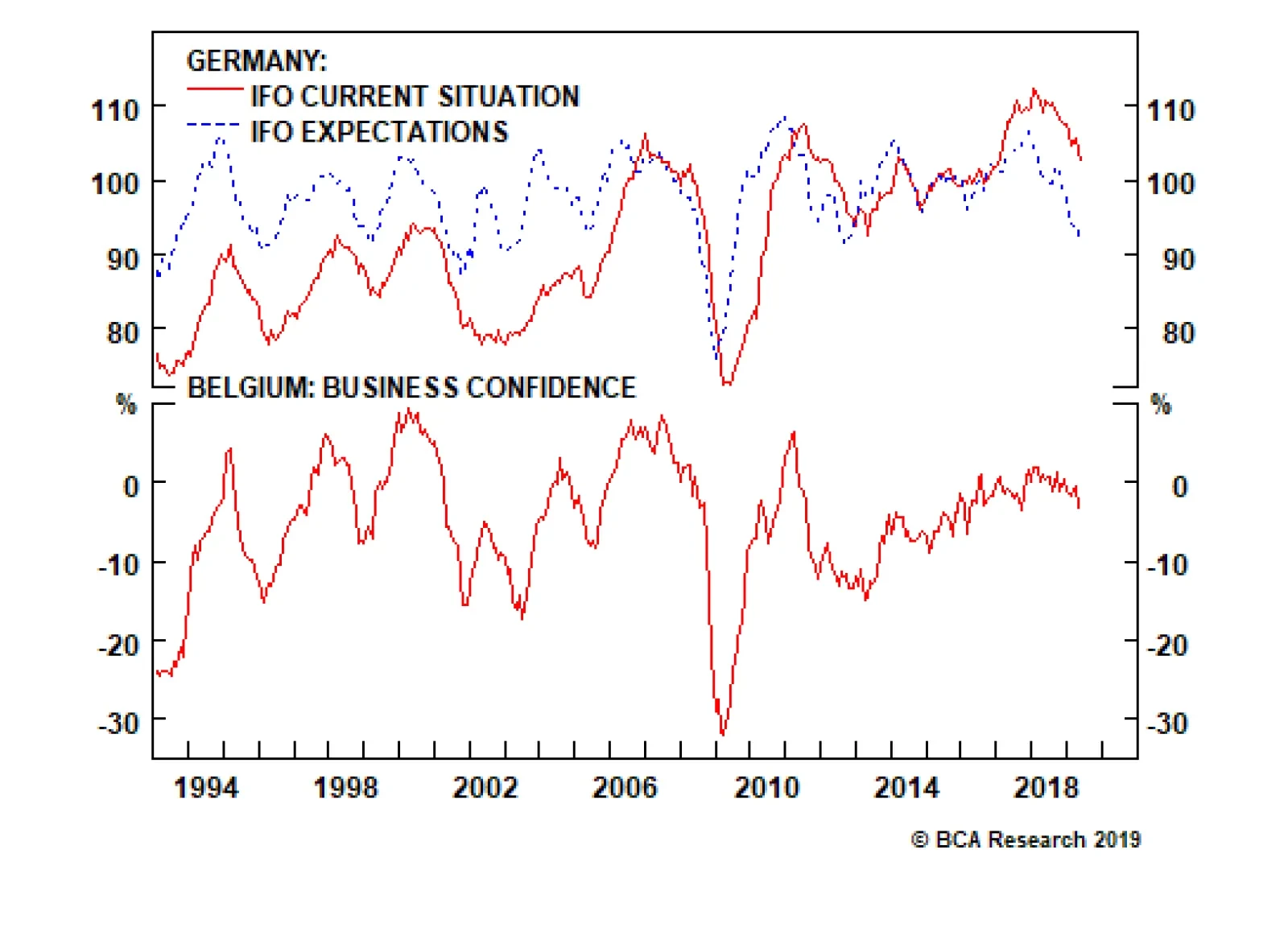
The highlight of next week will be the highly anticipated Xi-Trump meeting at the G20 in Osaka on Friday or Saturday. BCA does not anticipate a deal that will end the trade to come out of this get-together, but an agreement for China and the U.S. to start…
Highlights So What? Geopolitical risks are not about to ease. Why? Fiscal policy becomes less accommodative next year unless politicians act. Financial conditions give President Trump room to expand his tariff onslaught. Our Iran view is confirmed by rapid escalation of tensions – war risk is high. The odds of a no-deal Brexit have risen. Feature The AUD-JPY cross and copper-to-gold ratio – two market indicators that flag global growth and risk-on sentiment – are hovering over critical points at which a further breakdown would catalyze a renewed flight to quality (Chart 1). Chart 1Risk-On Indicators Breaking Down?
Risk-On Indicators Breaking Down?
Risk-On Indicators Breaking Down?
Global sentiment remains depressed amid a rash of negative economic surprises and bonds continue to rally despite a more dovish outlook from the Fed (Chart 2). Chart 2Global Sentiment Remains Depressed
Global Sentiment Remains Depressed
Global Sentiment Remains Depressed
The cavalry is on the way: European Central Bank President Mario Draghi oversaw a dramatic easing of monetary policy on June 18, driving the Italian-German sovereign bond spread down to levels not seen since before the populist election outcome of March 2018 (Chart 2, bottom panel). The Federal Reserve adjusted its policy rate projections to countenance an interest rate cut in the not-too-distant future. More needs to be done, however, to sustain the optimism that has propelled the S&P 500 and global equities upward since the volatility catalyzed by President Donald Trump’s announcement of a tariff rate hike on May 6. Political and geopolitical risks are higher, not lower, since that time as market-negative scenarios are playing out with U.S. policy, Iran, and Brexit, while we take a dim view of the end-game of the U.S.-China negotiations despite recent improvements. Fiscal And Trade Uncertainties This year’s growth wobbles have occurred in the context of expansive fiscal policy in the developed markets. Next year, however, the fiscal thrust (the change in the cyclically adjusted budget balance) is projected to decline in the U.S. and Japan and nearly to do so in Europe (Chart 3). We expect President Trump and the House Democrats to raise spending caps (or at least keep spending at current levels) and thus prevent the budget deficit from contracting in FY2020 – this is their only substantial point of agreement. But this at best neutralizes what would otherwise be a negative fiscal backdrop. Meanwhile it is not at all clear that Brussels will relax its scrutiny of member states seeking to cut taxes and boost spending, such as Italy. Japanese Prime Minister Abe Shinzo would need to arrange for the Diet to pass a new law to avoid the consumption tax hike from 8% to 10% on October 1. He can pull this off, especially if the U.S. trade war escalates – or if he decides to turn next month’s upper house election into a general election and needs to boost his popularity. But as things currently stand in law, the world’s third biggest economy will face a deep fiscal pullback next year (Chart 3, bottom panel). In short, DM fiscal policy will not really become contractionary in 2020, but this is a view and not yet a reality (Chart 4). Chart 3Fiscal Pullback Likely Next Year
Fiscal Pullback Likely Next Year
Fiscal Pullback Likely Next Year
Chart 4Only The U.S. Is Profligate
Only The U.S. Is Profligate
Only The U.S. Is Profligate
Meanwhile China’s stimulus is still in question – in fact it remains the major macro question this year. The efficacy of China’s stimulus is declining ... An escalating trade war will bring greater stimulus but also greater transmission problems. Since February we have argued that the Xi administration has shifted to sweeping fiscal-and-credit stimulus in the face of the unprecedented external threat posed by the Trump administration (Charts 5A and 5B). We expect China’s credit growth to continue its upturn in June and in H2. Ultimately, we think the whole package will be comparable to 2015-16 – and anything even close to that will prolong the global economic expansion. We do not see a massive 2008-style stimulus occurring unless relations with the U.S. completely collapse and a global recession occurs. Chart 5AStimulus Amid The Trade War
Stimulus Amid The Trade War
Stimulus Amid The Trade War
Chart 5
The catch – as we have shown – is that the efficacy of China’s stimulus is declining over time because of over-indebtedness and bearish sentiment in China’s private sector. These tepid animal spirits stem from epochal changes: Xi’s reassertion of communism and America’s withdrawal of strategic support for China’s rise. An escalating trade war will bring greater stimulus but also greater transmission problems. The magnitude of the tariffs that President Trump is threatening to impose on China, Mexico, the EU, and Japan is mind-boggling. We illustrate this with a simple simulation of duties collected as a share of total imports under different scenarios (Chart 6).
Chart 6
China and Mexico are fundamentally different from the EU and Japan and hence the threat of tariffs will continue to weigh on markets for Trump’s time in office – China because of a national security consensus and Mexico because of the Trump administration’s existential emphasis on curbing illegal immigration. But we still put the risk of auto tariffs (or other punitive measures) on Europe at 45% if Trump seals a China deal. The odds are lower for Japan but it is still at risk. Global supply chains are shifting – a new source of costs and uncertainty for companies – as a slew of recent news has highlighted. Already 40% of companies surveyed by the American Chamber of Commerce in China say they are relocating to Southeast Asia, Mexico, and elsewhere (Chart 7). If the G20 is a flop – or results in nothing more than a pause in tariffs for another three-month dialogue – relocations will gain steam, forcing companies’ bottom lines to take a hit.
Chart 7
Even in the best case, in which the Trump-Xi summit produces a joint statement outlining a “deal in principle” accompanied by a rollback of the May 10 tariff hike, uncertainty will persist due to President Trump’s unpredictability, China’s incentive to wait until after the U.S. election, and Trump’s incentive to corner the “China hawk” platform prior to the election. We maintain that, by November 2020, there is a roughly 70% chance of further escalation. At least the U.S.-China conflict is nominally improving. The same cannot be said for other geopolitical risks discussed below: the U.S. and Iran are flirting with war; the U.S. presidential election is injecting a steady trickle of market-negative news; the chances of a no-deal Brexit are rising; and Trump may turn on Europe at a moment when it lacks leadership. This list assumes that Russia takes advantage of American distraction by improving domestic policy rather than launching into a new foreign adventure – say in Ukraine or Kaliningrad. If there is any doubt as to whether political risk can outweigh more accommodative monetary policy, remember that President Trump actually can remove Chairman Jerome Powell. Legally he is only allowed to do so “for cause” as opposed to “at will.” But the meaning of this term is a debate that would go to the Supreme Court in the event of a controversial decision. Meanwhile the stock market would dive. Now, this is precisely why Trump will not try. But the implication, as with Congress and the border wall, is that Trump is constrained on domestic policy and hence tariffs are his most effective tool to try to achieve policy victories. With an ebullient stock market and a Fed that is adjusting its position, Trump can try to kill two birds with one stone: wring concessions from trade partners while forcing the FOMC to keep responding to rising external risks. Bottom Line: Central banks are riding to the rescue, but there is only so much they can do if global leaders are tightening budgets and imposing barriers on immigration and trade. We remain tactically cautious. Oh Man, Oh Man, Oman Iran has swiftly responded to the Trump administration’s imposition of “maximum pressure” on oil exports. The shooting down of an American drone that Tehran claims violated its airspace on June 20 is the latest in a spate of incidents, including a Houthi first-ever cruise missile attack on Abha airport in Saudi Arabia. Two separate attacks on tankers near the Strait of Hormuz (Map 1) demonstrate that Iran is threatening to play its most devastating card in the renewed conflict with the U.S.
Chart
Chart 8
Hormuz ushers through a substantial share of global oil demand and liquefied natural gas demand (Chart 8). The amount of spare pipeline capacity that the Gulf Arab states could activate in the event of a disruption is merely 3.9 million barrels per day, or 6 million if questionable pipelines like the outdated Iraqi pipeline in Saudi Arabia prove functional (Table 1). Table 1No Sufficient Alternatives To Hormuz
Escalation ... Everywhere
Escalation ... Everywhere
A conflict with Iran could cause the biggest oil shock of all time. Even if this spare capacity were immediately utilized, a conflict could cause the biggest oil shock of all time – considerably bigger than that of the Iranian Revolution (Chart 9).
Chart 9
We have shown in the past that Iran has the military capability of interrupting the flow of traffic in Hormuz for anywhere from 10 days to four months. A preemptive strike by Iran would be most effective, whereas a preemptive American attack would include targets to reduce Iran’s ability to retaliate via Hormuz. The impact on oil prices ranges from significant to devastating. Needless to say, blocking the Strait of Hormuz would initiate a war so Iran is attempting to achieve diplomatic goals with the threats themselves – it will only block the strait as a last resort, say if it is convinced that the U.S. is about to attack anyway. As the experience of President Jimmy Carter shows, Americans may rally around the flag during a crisis but they will also kick a president out of office for higher prices and an economic slowdown. President Trump cannot be unaware of this precedent. The intention of his Iran policy is to negotiate a “better deal” than the 2015 one – a deal that includes Iran’s regional power projection and ballistic missile capabilities as well as its nuclear program. The problem is that Trump has already been forced to deploy a range of forces to the region, including additional troops (albeit so far symbolic at 2,500) (Chart 10). He is also sending Special Representative for Iran, Brian Hook, to the region to rally support among Gulf Cooperation Council. The week after Hook will court Britain, Germany, and France, three of the signatories of the 2015 deal. Trump ran on a campaign of eschewing gratuitous wars in the Middle East – a popular stance among war-weary Americans (Chart 11) – but there is a substantial risk that he could get entangled in the region. First, he is adopting a more aggressive foreign policy to attempt to compensate for the lack of payoff in public opinion from the strong economy. Second, Iran is not shrinking from the fight, which could draw him deeper into conflict. Third, there is always a high risk of miscalculation when nations engage in such brinkmanship. Chart 10Is The 'Pivot To Asia' About To Reverse?
Is The 'Pivot To Asia' About To Reverse?
Is The 'Pivot To Asia' About To Reverse?
Chart 11
The Iranian response has been, first, to reject negotiations. When Trump sent a letter to Rouhani via Japanese Prime Minister Abe Shinzo, Abe was rebuffed – and one of the tankers attacked near Oman was a Japanese flagged vessel, the Kokuka Courageous. This is a posture, not a permanent position, as the Iranian release of an American prisoner demonstrates. But the posture can and will be maintained in the near term – with escalation as the result. Second, Iran is increasing its own leverage in any future negotiation by demonstrating that it can sow instability across the region and bring the global economy grinding to a halt. Iran cannot assume that Trump means what he says about avoiding war but must focus on the United States’ actions and capabilities. Cutting off all oil exports is a recipe for extreme stress within the Iranian regime – it is an existential threat. Therefore, the Iranians have signaled that the cost of a total cutoff will be a war that will cause a global oil price shock. The Iranian leaders are also announcing that they are edging closer to walking away from the 2015 nuclear pact (Table 2). If so, they could quickly approach “breakout” capacity in the uranium enrichment – meaning that they could enrich to 20% and then in short order enrich to 90% and amass enough of this fuel to make a nuclear device one year thereafter. The Trump administration has reportedly reiterated that this one-year limit is the U.S. government’s “red line,” just as the Obama administration had done. Table 2Iran Threatens To Walk Away From 2015 Nuclear Deal
Escalation ... Everywhere
Escalation ... Everywhere
This Iranian threat is a direct reaction to Trump’s decision in May not to renew the oil sanction waivers. Previously the Iranians had sought to preserve the 2015 deal, along with the Europeans, in order to wait out Trump’s first term. These developments push us to the brink of war. Iran is retaliating with both military force and a nuclear restart. This comes very close to meeting our conditions for an American (and Israeli) retaliation that is military in nature. Diagram 1 is an update of our decision tree that we have published since last year when Trump reneged on the 2015 deal. The window to de-escalate is closing rapidly. The Appendix provides a checklist for air strikes and/or the closure of Hormuz. Diagram 1Iran-U.S. Tensions Decision Tree
Escalation ... Everywhere
Escalation ... Everywhere
At very least we expect to see the U.S. attempt to create a large international fleet to assert freedom of navigation in the Persian Gulf and Strait of Hormuz. While Iran may lay low during a large show of force, it will later want to demonstrate that it has not been cowed. And it has the capacity to retaliate elsewhere, including in Iraq, an area we have highlighted as a major geopolitical risk to oil supply. The U.S. government has already reacted to recent threats there from Iranian proxies by pulling non-essential personnel. Iran has several incentives to test the limits of conflict if the U.S. insists on the oil embargo. First, tactically, it seeks to deter President Trump, take advantage of American war-weariness, drive a wedge between the U.S. and Europe, and force a relaxation of the sanctions. This would also demonstrate to the region that Iran has greater resolve than the United States of America. This goal has not been achieved by the recent spate of actions, so there is likely more conflict to come. Second, President Hassan Rouhani’s government is also likely to maintain a belligerent posture – at least in the near term – to compensate for its loss of face upon the American betrayal of the 2015 nuclear deal. Rouhani negotiated the deal against the warnings of hardline revolutionaries. The 2020 majlis elections make this an important political goal for his more reform-oriented faction. Negotiations with Trump can only occur if Rouhani has resoundingly demonstrated his superiority in the clash of wills. Structurally, Iran faces tremendous regime pressures in the coming years and decades because of its large youth population, struggling economy, and impending power transition from the 80 year-old Supreme Leader Ali Khamanei. A patriotic war against America and its allies – while not desirable – is a risk that Khamenei can take, as an air war is less likely to trigger regime change than it is to galvanize a new generation in support of the Islamic revolution. For oil markets the outcome is volatility in the near term – reflecting the contrary winds of trade war and global growth fears with rising supply risks. Because we expect more Chinese stimulus, both as the trade talks extend and especially if they collapse, we ultimately share BCA’s Commodity & Energy Strategy view that the path of least resistance for oil prices is higher on a cyclical horizon, as demand exceeds supply (Chart 12). We remain long EM energy producers relative to EM ex-China. Chart 12Crude Oil Supply-Demand Balance Should Send Prices Higher
Crude Oil Supply-Demand Balance Should Send Prices Higher
Crude Oil Supply-Demand Balance Should Send Prices Higher
Bottom Line: The risk of military conflict has risen materially. This also drastically elevates the risk of a supply shock in oil prices that would kill global demand. The U.S. Election Adds To Geopolitical Risk The 2020 U.S. election poses another political risk for the rising equity market. The Democratic Party’s first debate will be held on June 26-27. The leftward shift in the party will be on full display, portending a possible 180-degree reversal in U.S. policy if the Democrats should win the election, with the prospect of a rollback of Trump’s tax cuts and deregulation of health, finance, and energy. The uncertainty and negative impact on animal spirits will be modest if current trends persist through the debates. Former Vice President Joe Biden remains the frontrunner despite having naturally lost the bump to his polling support after announcing his official candidacy (Chart 13). Biden is a known quantity and a centrist, especially compared to the farther left candidates ranked second and third in popular support– Vermont Senator Bernie Sanders and Massachusetts Senator Elizabeth Warren.
Chart 13
Chart 14
Biden is not only beating Sanders in South Carolina, which underscores the fact that he is competitive in the South and hence has a broader path to the White House, but also in New Hampshire, where the Vermont native should be ahead (Chart 14). These states hold the early primaries and caucuses and if Biden maintains his large lead then he will start to appear inevitable very early in the primary campaign next year. Hence a poor showing in the debate on June 27 is a major risk to Biden – he should be expected to be eschew the limelight and play the long game. Elizabeth Warren, by contrast, has the most to gain as she appears on the first night and does not share a stage with the other heavy hitters. If she or other progressive candidates outperform then the market will be spooked. The market could begin to trade off the polls. All of these candidates are beating Trump in current head-to-head polling – Biden is even ahead in Texas (Chart 15). This means that any weakness from Biden does not necessarily offer the promise of a Trump victory and policy continuity.
Chart 15
The Democrats also have a powerful demographic tailwind. The just-released projections from the U.S. Census Bureau reveal how Trump’s narrow margins of victory in the swing states in 2016 are in serious jeopardy in 2020 as a result of demographics if he does not improve his polling among the general public (Chart 16).
Chart 16
We still give Trump the benefit of the doubt as the incumbent president amid an expanding economy, but it is essential to recognize that his popular approval rating is reminiscent of a president during recession – i.e. one who is about to lose the White House for his party (Chart 17).
Chart 17
Even if there is not a recession, an increase in unemployment is likely to cost him the election – and even a further decrease in unemployment cannot guarantee victory (Chart 18). This is why we see Trump making a bid to become a foreign policy president and seek reelection on the basis that it is unwise to change leaders amid an international crisis.
Chart 18
We still give Trump the benefit of the doubt ... but his popular approval rating is reminiscent of a president during recession. The race for the U.S. senate is extremely important for the policy setting from 2021. If Republicans maintain control, they will be able to block sweeping Democratic legislation – which is particularly relevant if a progressive candidate should win the White House. However, if Democrats can muster enough votes to remove a sitting president with a strong economy – including a strong economy in the key senate swing races (Chart 19) – then they will likely win over the senate as well. Chart 19Hard To Win The Senate In 2020 While Key States Prosper
Hard To Win The Senate In 2020 While Key States Prosper
Hard To Win The Senate In 2020 While Key States Prosper
Bottom Line: The 2020 election poses a double risk to the bull market. First, the Democratic primary campaign threatens sharp policy discontinuity, especially if and when developments cause Biden to drop in the polls (dealing a blow to centrism or the political establishment). Second, Trump’s vulnerability makes him more likely to act aggressive on the international stage, whether on trade, immigration, or national security, reinforcing the risks outlined above with regard to China, Iran, Mexico, and even Europe. Rising Odds Of A No-Deal Brexit Former Mayor of London and former foreign secretary Boris Johnson looks increasingly likely to seal the Conservative Party leadership contest in the United Kingdom. It is not yet a done deal, but the shift within the party in favor of accepting a “no deal” exit is clear. None of the remaining candidates is willing to forgo that option. The newest development advances us along our decision tree in Diagram 2, altering the conditional probabilities for this year’s events. We expect the next prime minister to try to push a deal substantially similar to outgoing Prime Minister Theresa May before attempting any kamikaze run as the October 31 deadline approaches. The attempt to leverage the EU’s economic weakness will not produce a fundamental renegotiation of the exit deal, but some element of diplomatic accommodation is possible as the EU seeks to maintain overall stability and a smooth exit if that is what the U.K. is determined to accomplish. Diagram 2Brexit Decision Tree
Escalation ... Everywhere
Escalation ... Everywhere
Hence the prospect of passing a deal substantially similar to outgoing Prime Minister Theresa May’s deal is about 30%, roughly equal to the chance of a delay (28%). These options are believable as the new leader will have precious little time between taking the reins and Brexit day. The EU can accept a delay because it ultimately has an interest in keeping the U.K. bound into the union. Public opinion polling is not conducive to the new prime minister seeking a new election unless the change of face creates a massive shift in support for the Conservatives, both by swallowing the Brexit Party and outpacing Labour. If the purpose is to deliver Brexit, then the risk of a repeat of the June 2017 snap election would seem excessive. Nevertheless, the Tories’ working majority in parliament is vanishingly small, at five MPs, so a shift in polling could change the thinking on this front. The pursuit of a no-deal exit would create a backlash in parliament that we reckon has a 21% chance of ending in a no-confidence motion and new election. Bottom Line: The odds of a crash Brexit have moved up from 14% to 21% as a result of the leadership contest. The threat that the U.K. will crash out of the EU is not merely a negotiating ploy, although it will be a last resort even for the new hard-Brexit prime minister. Public opinion is against a no-deal Brexit, as is the majority of parliament, but the risk to the U.K. and EU economies will loom large over global risk assets in the coming months. Investment Conclusions Political and geopolitical risks to the late-cycle expansion are rising, not falling. U.S. foreign policy remains the dominant risk but U.S. domestic policy pre-2020 is an aggravating factor. Easing financial conditions give President Trump more ammunition to use tariffs and sanctions. Meanwhile our view that this summer will feature “fire and fury” between the U.S. and Iran has been confirmed by the tanker attacks in Oman. Tensions will likely escalate from here. Ultimately, we believe Trump is more likely to back off from the Iran conflict than the China conflict. This is part of our long-term theme that the U.S. really is pivoting to China and geopolitical risk will rotate from the Middle East to East Asia. But as highlighted above, the risk of entanglement is very high due to Trump’s approach and Iran’s incentives to raise the stakes. Oil prices will not resume their upward drift until Chinese stimulus is reconfirmed – and even then they will continue to be volatile. We remain cautious and are maintaining our safe-haven tactical trades of long gold and long JPY/USD. Matt Gertken, Vice President Geopolitical Strategist mattg@bcaresearch.com Appendix
Image
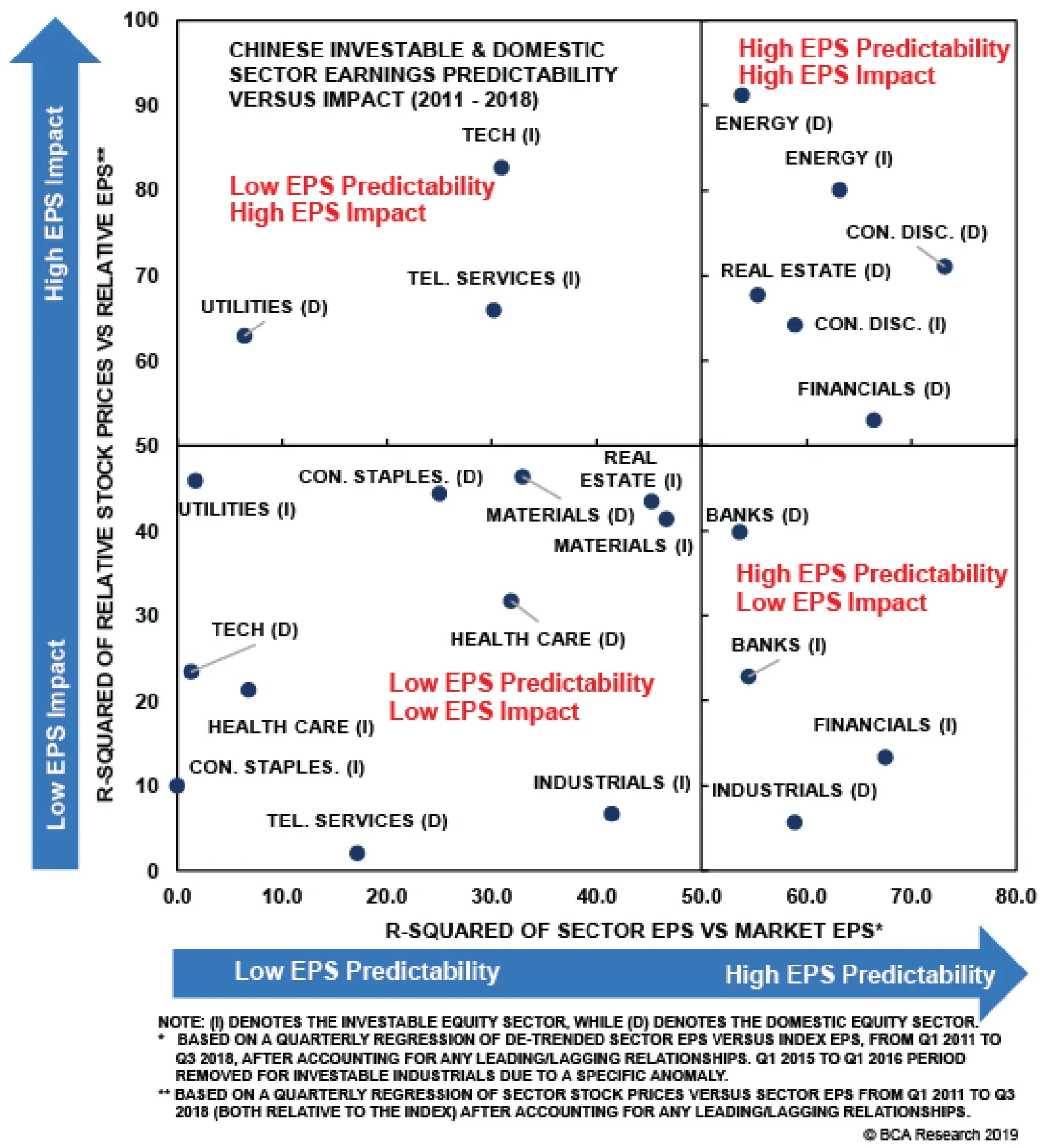
Energy and consumer discretionary in both the domestic and investable markets, along with real estate and financials in the domestic market have had the strongest relationship across both dimensions (top-right quadrant). For energy and consumer discretionary,…
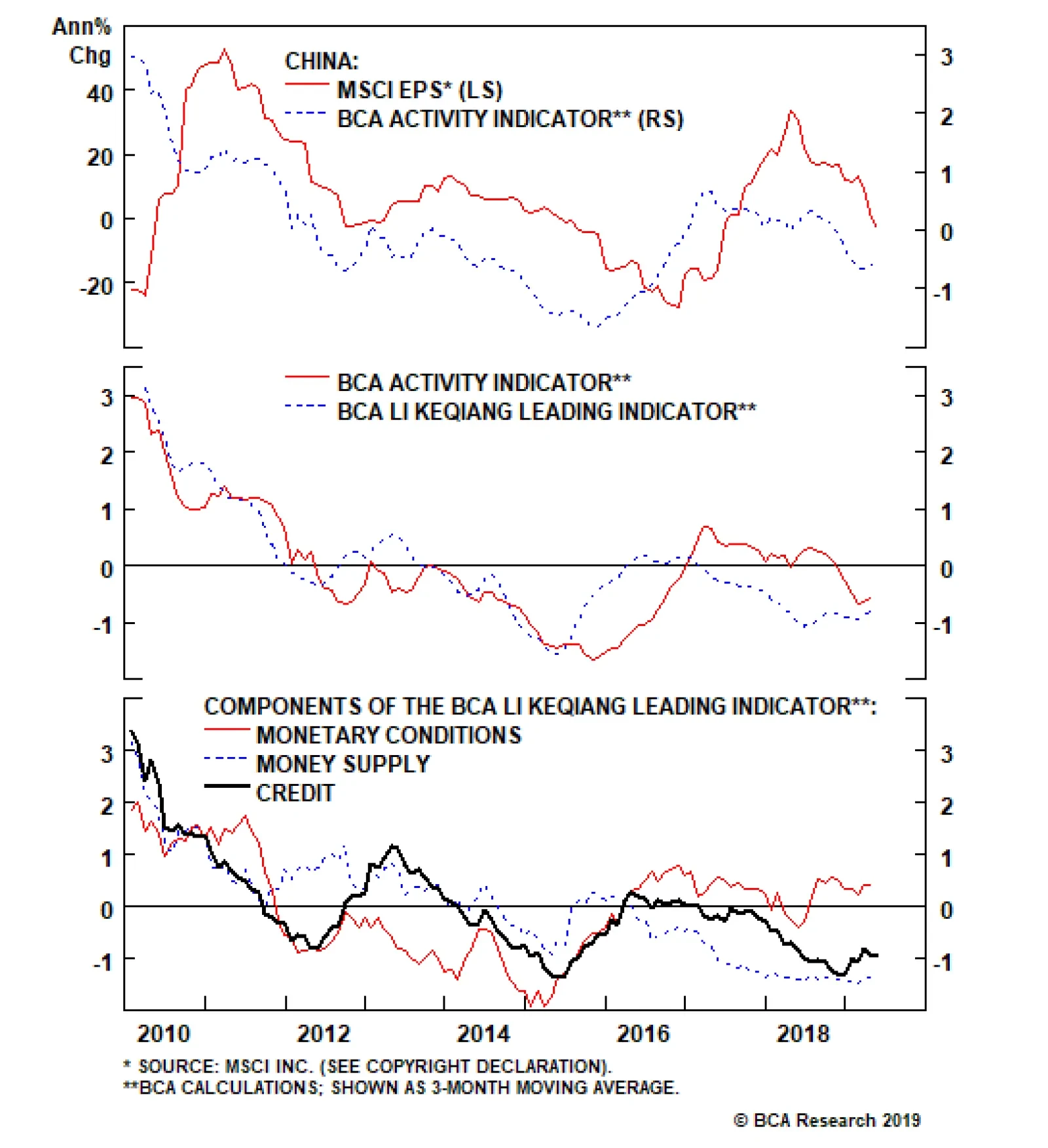
The first element of our framework for predicting Chinese investable earnings per share (EPS) growth is the strong leading relationship between the BCA China Activity Indicator and the year-over-year growth rate of investable EPS. This…
Analysis on Thailand is available below. Feature Last week we were on the road meeting with some of our U.S. clients. This week’s report presents some of the key topics of our discussions in a Q&A format. Question: You have been downplaying the potentially positive impact of lower bond yields in advanced economies on EM risk assets. Why do you think lower bond yields in developed markets (DM) and potential rate cuts by DM central banks won’t suffice to lift EM markets on a sustainable basis? Answer: Falling interest rates are positive for share prices when profits are growing, even at a slower rate. When corporate profits are contracting, lower interest rates typically do not preclude equity prices from dropping. Presently, EM and Chinese corporate earnings are shrinking rapidly (Chart I-1). This is the primary reason why we believe DM monetary easing will not help EM share prices much. Furthermore, EM exchange rates follow relative EPS cycles in local currency terms (Chart I-2). In short, EM currencies are driven by relative corporate profitability between EM and the U.S. – not by interest rate differentials. Chart I-1EM & China EPS Are Contracting
EM & China EPS Are Contracting
EM & China EPS Are Contracting
Chart I-2Relative EPS And Exchange Rate
Relative EPS And Exchange Rate
Relative EPS And Exchange Rate
The contraction in EM and China EPS has not been caused by higher interest rates and slump in DM domestic demand. Rather, the EM/China profit contraction has been due to China’s economic slowdown spilling over to the rest of EM. Crucially, there is no empirical evidence that interest rate cuts and QEs in DM preclude EM selloffs when EM/Chinese growth is slumping. Specifically: Chart I-3A and I-3B illustrate that neither the level of G4 central banks’ assets nor their annual rate of change correlates with EM share prices or EM local bonds’ total returns in U.S. dollar terms. Hence, QEs have not always guaranteed positive returns for EM financial markets. Chart I-3APace Of QE And EM Performance
Pace Of QE And EM Performance
Pace Of QE And EM Performance
Chart I-3BPace Of QE And EM Performance
Pace Of QE And EM Performance
Pace Of QE And EM Performance
Chart I-4U.S. Treasury Yields And EM Performance
U.S. Treasury Yields And EM Performance
U.S. Treasury Yields And EM Performance
Chart I-4 demonstrates the correlation between U.S. 5-year Treasurys yields on the one hand and EM spot exchange rates, EM sovereign credit spreads and EM share prices on the other. There has been no stable relationship – at times it has been positive, and at other times negative. We are not implying that DM interest rates have no bearing on EM financial markets. Our point is that lower interest rates and QEs in DM do not constitute sufficient conditions for EM financial markets to rally. Even though DM monetary policy has not been the driving force of cyclical fluctuations in EM financial markets, it has had a structural impact. QEs and lower bond yields in DM have prompted an expanded search for yield and have produced substantial compression in risk premia worldwide. For example, Chart I-5 demonstrates that excess returns on EM corporate bonds have historically been correlated with the global manufacturing cycle, but the correlation has diminished in recent years. The widening gap between the two lines is due to investors’ search for yield. Investors have bought and continue to hold securities of “zombie” companies and countries that have low productivity and poor fundamentals. In short, QEs have undermined the efficiency of global capital allocation. This is marginally adverse for productivity in the global economy in the long run. Question: But doesn’t DM monetary policy influence DM demand, which in turn affects EM corporate profits? Answer: DM monetary policy influences DM domestic demand, but there is little correlation between DM domestic demand and EM corporate profits. For example, U.S. import volumes have been growing at a decent pace, yet EM corporate profits have shrunk (Chart I-6). Indeed, robust growth in U.S. imports did not preclude EM EPS contraction in 2012, 2014-‘15 and 2018-‘19, as shown in this chart. Chart I-5Fundamentals Have Become Less Important Due To QE Programs
Fundamentals Have Become Less Important Due To QE Programs
Fundamentals Have Become Less Important Due To QE Programs
Chart I-6EM EPS And U.S. Imports
EM EPS And U.S. Imports
EM EPS And U.S. Imports
Chart I-7 reveals additional evidence of the diminished impact of U.S. growth on Asian exports. Korean, Taiwanese, Japanese and Singaporean exports to the U.S. are growing at 7% rate, while their shipments to China are contracting at an 11% rate from a year ago as of May. As a result, these countries’ overall exports are shrinking because they ship to China considerably more than they do to the U.S. We are not implying that DM interest rates have no bearing on EM financial markets. Our point is that lower interest rates and QEs in DM do not constitute sufficient conditions for EM financial markets to rally. The current global slowdown did not originate in the U.S. or Europe. Rather, it originated in China and has spilt across the world, affecting the economies that sell to China the most. The deceleration in global trade can be tracked to Chinese imports contraction (Chart I-8). Chart I-7Asia's Exports To China And U.S.
Asia's Exports To China And U.S.
Asia's Exports To China And U.S.
Chart I-8Chinese Imports And Global Trade
Chinese Imports And Global Trade
Chinese Imports And Global Trade
U.S. manufacturing is the least exposed to China, which is the main reason why it was the last shoe to drop in the global manufacturing recession. Question: So, what drives EM business cycles if it is not DM growth and DM interest rates? Chart I-9China's Credit & Fiscal Impulse And EM EPS
China's Credit & Fiscal Impulse And EM EPS
China's Credit & Fiscal Impulse And EM EPS
Answer: The key and dominant driver of EM risk assets – stocks, credit markets and currencies – has been the global trade and EM/China growth cycles. There is a much stronger correlation between EM financial markets and the global business cycle in general, and Chinese imports in particular than with DM interest rates. In turn, Chinese imports are driven by its capital spending cycle. 85% of the mainland’s good imports are composed of industrial goods and devices, machinery, chemicals, various commodities and autos. Only 15% are non-auto consumer goods. Meanwhile, the credit/money cycles drive capital spending. That is why China’s credit and fiscal spending impulse leads EM corporate profits (Chart I-9). This is also why we spend a significant amount of time analyzing and discussing China's credit cycle. Question: Why has the policy stimulus in China not revived growth in its economy and its suppliers around the world? Answer: Our aggregate credit and fiscal spending impulse bottomed in January of this year, but its recovery has so far been timid. In the past, this indicator led China’s business cycle and the global manufacturing PMI by an average of about nine months (Chart I-10, top panel) and EM corporate profits by 12 months (Chart I-9). According to this pattern, the bottom in global manufacturing should occur in August of this year. However, global share prices have not led global manufacturing PMI during this decade; they have instead been coincident (Chart I-10, bottom panel). Hence, there was no historical justification for global share prices to rally since early January - well ahead of a potential bottom in the global manufacturing PMI in August. The current global slowdown did not originate in the U.S. or Europe. Rather, it originated in China and has spilt across the world, affecting the economies that sell to China the most. That said, due to the U.S.-China confrontation and other structural reasons currently prevailing in China – including high levels of indebtedness and more regulatory scrutiny over shadow banking as well as local government debt – a recovery in mainland household and corporate spending is likely to be delayed. Crucially, as we have documented in previous reports, the marginal propensity to spend for consumers and companies continues to fall (Chart I-11). This is the opposite of what occurred in early 2016. Chart I-10Chinese Stimulus, Global Manufacturing And Global Stocks
Chinese Stimulus, Global Manufacturing And Global Stocks
Chinese Stimulus, Global Manufacturing And Global Stocks
Chart I-11China: What Is Different From 2016
China: What Is Different From 2016
China: What Is Different From 2016
Overall, a revival in China’s growth will likely take longer to unfold and EM risk assets will likely sell off anew before bottoming. Chart I-12Global Slowdown Is Not Yet Over
Global Slowdown Is Not Yet Over
Global Slowdown Is Not Yet Over
Chart I-13Global Semiconductor Demand Is Shrinking
Global Semiconductor Demand Is Shrinking
Global Semiconductor Demand Is Shrinking
Question: Apart from China’s credit and fiscal spending impulse and marginal propensity to spend among households and companies, what other indicators are you monitoring to gauge a bottom in the global manufacturing cycle? Answer: Among many variables and indicators we continuously monitor, there are a few we have been paying particular attention to: The difference between global narrow (M1) and broad money growth correlates well with global corporate earnings (Chart I-12). The rationale for this indicator is that it is akin to the marginal propensity to spend: When demand deposits (M1) outpace time/savings deposits, it is indicative that households and companies are getting ready to spend on large-ticket items or kick off capital spending, and vice versa. Presently, this narrow-to-broad money growth differential continues to point to lower global growth. Last week we published a report on the global semiconductor industry, arguing that upstream demand for semiconductors is withering as sales of servers, smartphones, PCs and autos are all shrinking globally (Chart I-13). With consumption of these goods contracting, demand for semiconductors remains lackluster, and semiconductor prices are still deflating (Chart I-14). Hence, semiconductor prices can be used as an indicator of final demand dynamics in many important segments of the global economy. China’s Container Freight Index – the price to ship containers – is also currently lackluster, reflecting weak global trade dynamics (Chart I-15, top panel). Chart I-14Semiconductor Prices Are Still Deflating
Semiconductor Prices Are Still Deflating
Semiconductor Prices Are Still Deflating
Chart I-15Global Shipments Are Very Weak
Global Shipments Are Very Weak Global Shipments Are Very Weak
Global Shipments Are Very Weak Global Shipments Are Very Weak
In the U.S., both total intermodal carloads and railroad carloads excluding petroleum and coal are tanking, reflecting subsiding growth (Chart I-15, middle and bottom panel). In turn, Chinese imports continue to contract. This is the primary channel in terms of how the Middle Kingdom affects the rest of the world economy. From the rest of the world’s perspective, China is in recession because their shipments to the mainland are shrinking. In China and Taiwan, the seasonally adjusted manufacturing PMI new orders have rolled over after the temporary pick up early this year (Chart I-16). Finally, we are monitoring our Reflation Indicator and Risk-On/Safe-Haven Currency Ratio (Chart I-17). Both are market-based indicators and are very sensitive to global growth conditions – especially to the dynamics in commodities markets – making them very pertinent to EM investors. Chart I-16Manufacturing PMI: New Orders Seasonally-Adjusted
Manufacturing PMI: New Orders Seasonally-Adjusted
Manufacturing PMI: New Orders Seasonally-Adjusted
Chart I-17Market-Based Indicators
Market-Based Indicators
Market-Based Indicators
As with any marked price-based signals, both are very volatile. Even though both indicators have rebounded in recent days, only a major trend reversal matters for macro investors. Technically speaking, the profile of both indicators is consistent with a breakdown rather than a breakout. Question: You have highlighted that EM corporate EPS is contracting. How widespread is the profit contraction, and how long will it persist? Answer: EM corporate EPS contraction is widespread across almost all sectors. Chart I-18A and I-18B illustrate EPS growth in U.S. dollar terms for all sectors. EPS growth is negative for most sectors, close to zero for three (technology, financials and materials) and still positive for the energy sector. However, technology, materials and energy EPS are heading into contraction, given the drop in semiconductor, industrial metals and oil prices, respectively. Chart I-18ASynchronized EM EPS Contraction
Synchronized EM EPS Contraction
Synchronized EM EPS Contraction
Chart I-18BSynchronized EM EPS Contraction
Synchronized EM EPS Contraction
Synchronized EM EPS Contraction
Consequently, all EM equity sectors will soon be experiencing synchronized profit contraction. EM corporate EPS contraction is widespread across almost all sectors. Our credit and fiscal spending impulse for China leads EM EPS growth by about 12 months, and it currently entails that the profit contraction will continue to deepen all the way through December (Chart I-9 on page 6). It would be surprising if EM share prices stage a major rally amid a hastening decline in corporate EPS (please refer to Chart I-1 on page 1). Arthur Budaghyan Chief Emerging Markets Strategist arthurb@bcaresearch.com Thailand: A Defensive Play Within EM The Thai parliament has elected to keep the ex-military general Prayuth Chan-ocha as the country’s prime minister. This will instill political stability for now, which is positive for investor confidence. In absolute terms, Thai financial markets are leveraged to global trade and will, therefore, sell off if our negative views on the latter and EM risk assets play out. Chart II-1Thailand's Current Account Is In Surplus
Thailand's Current Account Is In Surplus
Thailand's Current Account Is In Surplus
Relative to their EM peers, Thai equities, credit, currency and domestic bonds will continue outperforming: The Thai current account balance remains in large surplus, which provides a large cushion for the Thai baht amid the slowdown in global growth (Chart II-1). Critically, Thailand is less exposed to China and is more leveraged to the U.S. and Europe than its EM peers. Thailand’s shipments to China account for 12% of the former’s total exports, while exports to the U.S. and EU together account for 21%. Both U.S. and European imports are holding up better than those of China. Thailand also has the lowest foreign debt obligations (FDO) among EM countries. FDOs measure the sum of short-term claims, interest payments and amortization over the next 12 months. The country’s current FDOs stand at 8% relative to its exports of goods and services and 12% relative to the central bank’s foreign exchange reserves. The rest of EM countries have much higher ratios. In addition, foreign ownership of local currency bonds is amongst the lowest in the region (18%). As a result, currency depreciation will not trigger major portfolio outflows and a self-reinforcing downtrend in Thai financial markets. Thailand also has the lowest foreign debt obligations (FDO) among EM countries. Chart II-2Thailand: Moderate Growth In Private Consumption
Thailand: Moderate Growth In Consumption
Thailand: Moderate Growth In Consumption
Thailand’s private consumption is growing reasonably well (Chart II-2, top panel). Likewise, passenger and commercial vehicle sales are rising and so is household credit (Chart II-2, bottom two panels). The Thailand MSCI index carries a large weight in domestic and defensive stocks such as transportation, utilities, telecommunication, and consumer staples. These sectors will benefit from moderate consumption growth. In fact, Thai equity outperformance versus EM has been justified by its non-financial companies’ EBITDA outpacing that of EM non-financials (Chart II-3). This trend remains intact. Concerning banks, Thailand’s commercial banks suffer from credit excesses, as do many of their EM peers. However, Thai commercial banks have been responsible in terms of recognizing NPLs and have been properly provisioning for them (Chart II-4). This is contrary to many other EM banks. This means that share prices of Thai commercial banks will outperform their EM counterparts. Finally, although the Thai bourse is more expensive than its EM counterparts, relative equity valuation will likely get even more stretched before a major reversal occurs. Given our cautious view on overall EM, we continue to prefer this richly valued and defensive bourse to the more cyclical, albeit cheaper, but fundamentally vulnerable EM peers. Chart II-3Equity Outperformance Has Been Justified By Earnings
Equity Outperformance Has Been Justified By Earnings
Equity Outperformance Has Been Justified By Earnings
Chart II-4Thai Commercial Banks Are Well Provisioned
Thai Commercial Banks Are Well Provisioned
Thai Commercial Banks Are Well Provisioned
Bottom Line: Investors should keep an overweight position in Thai equities, currency, domestic bonds and credit markets. Ayman Kawtharani, Editor/Strategist ayman@bcaresearch.com Footnotes Equity Recommendations Fixed-Income, Credit And Currency Recommendations
Following up on our May 30th Chinese apparent diesel demand and SPX momentum pictorial, the latest KOMATSU monthly demand growth rate update on Chinese excavator sales corroborates the plunging diesel demand data (as a reminder most earthmoving machinery are diesel-powered). In more detail, over the last three months ending in May, KOMATSU Chinese excavator sales have registered -10%, -16% and -27% year-over-year contraction rates, respectively.1 Such an accelerated decline is telling. Japanese construction machinery companies are not tangled up in the U.S./China trade tussle, at least not yet, so this appears to be a clean/reliable number. Moreover, it seems as though infrastructure spending is not the preferred way to stimulate the Chinese economy at the current juncture. This is important and likely serves as a near-real time indicator of Chinese reflation efforts translating into economic activity. The chart shows that in late-2015/early-2016 this economic data series went parabolic, led the U.S. stock market and clearly signaled that a Chinese reflationary push was being successful. Currently, excavator sales data suggest that Chinese reflation is either delayed or the transmission mechanism is broken, warning that U.S. stocks are in danger of disappointment. Bottom Line: Broad U.S. equity market caution is still warranted.
The Hope Rally
The Hope Rally
Footnotes 1https://home.komatsu/en/ir/demand-orders/__icsFiles/afieldfile/2019/06/07/201903main_products_order_e_0607.pdf
Highlights The report reviews our framework for predicting broad market earnings in China based on the experience of the past decade, and documents the relationship between sector earnings and broad market earnings for both the investable and domestic market. We also review the cyclicality of earnings in each sector, and highlight the sectors where relative earnings have been successful at predicting relative performance. Energy and consumer discretionary in both markets, along with real estate and financials in the domestic market, have historically been the best candidates for a classic top-down fundamental “sector rotation” strategy. Compared with these sectors, investable telecom stocks have exhibited a weaker link between sector and index earnings, but this has occurred because of relatively steady, low volatility earnings growth. As such, telecom stocks are reliably defensive, but only in the investable market. We conclude by noting the extreme nature of long-term de/re-rating trends that have occurred for several of China’s equity sectors, and argue that the strength of the relationship between earnings and stock prices for these sectors is set to rise over a secular time horizon. Over the coming few years, investors should focus nearly exclusively on the earnings outlook for high flying and beaten down sectors, as further multiple expansion/contraction is unlikely to drive future returns (without an earnings catalyst). Feature Last week’s joint report with our Geopolitical Strategy service provided investors with an update on the trade war in the lead up to the G20 meeting in Osaka.1 While a new tariff ceasefire may emerge from the meeting, the report underscored why the odds are skewed against a positive outcome over the coming 18 months. Our bet is that investors are unlikely to assume that a deal will occur merely in response to a new timetable for talks, implying that any near-term boost to stock prices will be minimal until negotiators provide market participants with evidence (rather than hope) that a deal is achievable. This means that a financial market riot point remains likely over the coming few months, and that a cyclically bullish stance towards Chinese stocks rests on the likelihood of a major policy response in China to counter the likely shock to its export sector. During times of high policy uncertainty, we often take the opportunity to review and update our framework for key asset drivers. In today’s report we review our framework for predicting broad market earnings in China based on the experience of the past decade, and then document the relationship between sector earnings and broad market earnings for both the investable and domestic market. We review the cyclicality of earnings in each sector, and highlight the sectors where relative earnings have been successful at predicting relative performance. We conclude with a summary of what our results would imply over the tactical and cyclical investment horizons given our view of China’s likely growth trajectory, and highlight why several sectors may see a stronger relationship between their earnings and stock prices over the secular horizon. The report illustrates our key conclusions in the body of the text, but reference charts for each sector/industry group in both the investable and domestic market are provided as a convenience on pages 12 - 23. Predicting Chinese Equity Index Earnings Our framework for predicting index EPS is straightforward but reliable. Chart 1Stronger Economic Activity = Stronger Investable Earnings
Stronger Economic Activity = Stronger Investable Earnings
Stronger Economic Activity = Stronger Investable Earnings
Chart 1 presents the first element of our framework for predicting Chinese investable earnings per share (EPS) growth. The chart illustrates the strong leading relationship between our BCA China Activity Indicator and the year-over-year growth rate of investable EPS, which underscores that the fundamental performance of Chinese equities is still predominantly driven by China’s “old economy”. The leading nature of our activity index partly reflects the fact that earnings per share are measured on a trailing basis; the key point for investors is that indicators such as our Activity Index have been more successful at capturing the coincident trend in China’s economy than, for example, real GDP growth has over the past several years. Chart 2illustrates that the earnings cycle for the investable and domestic equity markets is the same, with the magnitude of a given cycle accounting for the difference between the two markets. This means that investors exposed to the Chinese equity market should be focused heavily on predicting the coincident trend in the economy, as doing so will lead investors to the same conclusion about the trend in H- and A-share EPS growth. Chart 2Same Earnings Cycle In The Investable And Domestic Markets
Same Earnings Cycle In The Investable And Domestic Markets
Same Earnings Cycle In The Investable And Domestic Markets
Chart 3Our Leading Indicator Reliably Predicts Economic Activity
Our Leading Indicator Reliably Predicts Economic Activity
Our Leading Indicator Reliably Predicts Economic Activity
In turn, Chart 3 presents our framework for predicting Chinese economic activity, which we originally laid out in our November 30, 2017 Special Report.2 The chart shows that our leading activity indicator has reliably predicted inflection points in actual activity over the past several years, including the slowdown of the past two years (the leading indicator peaked in Q1 2017). As detailed in the report, our indicator is based on monetary conditions and money & credit growth. Panel 2 of Chart 3 shows that monetary conditions are very easy and credit growth is picking up, though it needs to continue to improve alongside a forceful pickup in money growth in order for the economy to strengthen. The key takeaway for investors is that the overall earnings cycle in China is strongly linked to “old economy” economic activity, which in turn appears to reliably predicted by our indicator. This provides us with a stable platform from which we can examine (and ultimately predict) equity sector EPS. Sector Earnings: Predictability And Cyclicality Given the strong link between Chinese economic activity and equity market EPS that we noted above, the question for equity-oriented investors is then to identify the relationship between sector and overall index EPS. In other words, to what degree are sector EPS in China linked to the overall earnings trend (versus being driven by idiosyncratic factors), and is this relationship pro- or counter-cyclical in nature? Charts 4 and 5 present the answers to these questions, based on the 2011 – 2018 period.3 The charts present the highest R-squared value resulting from a regression of detrended sector EPS versus broad market EPS for both the investable and domestic markets, after accounting for any leading/lagging relationships. The color/shading of each bar denotes whether the beta of the relationship for each sector or industry group is above or below 1.
Chart 4
Chart 5
The charts present a mix of surprising and unsurprising results. Among the latter in the investable market, the cyclicality of typically high-beta sectors such as energy, materials, industrials, consumer discretionary, and technology would be readily accepted by most investors, as would the defensive characteristics of financials, telecom services, health care, utilities, and consumer staples. Investable consumer staples, health care, and utilities EPS are driven by either bottom-up/industry-specific factors or macro factors that are not fully captured by the trend in China’s business cycle. However, there were several less-intuitive results that emerged from our analysis, related to both the investable and domestic markets:
Chart 6
Within the investable market, the low predictability of health care, utilities, and consumer staples EPS is somewhat difficult to explain. A weak relationship would easily be explained if EPS growth for these sectors were somewhat constant in the face of fluctuations in overall index EPS, but Chart 6 shows that the volatility in EPS growth for these sectors are not bottom-ranked (see also pages 16, 17 and 22). In fact, utilities EPS growth vol has been relatively high, and it is higher for health care and consumer staples than it is for financials and banks, whose EPS growth are highly linked to the overall earnings cycle. This result suggests that the determinants of earnings for these sectors are driven by either bottom-up/industry-specific factors or macro factors that are not fully captured by the trend in China’s business cycle. The low predictability of consumer staples and utilities EPS observed in the investable market is also evident in the domestic market, suggesting that this finding is not the result of quirky data. We noted earlier that overall index earnings are highly correlated with our BCA China Activity Index, and we have noted in past reports that China’s business cycle continues to be subject to its “old” growth model centered on investment and exports rather than the services and consumer sectors.4 This may explain the relatively idiosyncratic EPS profile for consumer staples, although it still fails to explain the low predictability and relatively high volatility of utilities earnings. Telecom services and technology earnings also have a very low correlation with overall earnings in the domestic market, which is similar to the investable market but more extreme. On the tech front, this is explained by the fact that Alibaba and Tencent, China’s tech giants, are not listed in the domestic market, underscoring that investable tech and domestic tech should be considered by investors to be distinctly separate sectors. In the investable market the low predictability and defensive characteristic of telecom services EPS can be explained by stable, low-volatility growth, but this is not true in the domestic market. In fact, over the past several years the volatility of domestic telecom EPS growth has been among the highest of any of China’s domestic equity sectors, and it has been cyclical rather than defensive in nature. These findings are difficult to explain from a top-down perspective. Finally, while Charts 4 and 5 show a difference in the cyclicality of real estate earnings between the investable and domestic markets, the difference is not substantial: the beta of the former is 1.03 versus 0.94 for the latter. The truly surprising result from real estate stocks is that their EPS growth is not considerably high-beta, given the boom & bust nature of Chinese property prices and the enormous amount of activity that has occurred in Chinese real estate over the past decade. Given that beta is determined relative to the overall index, this is emblematic (and an important reminder) of the underlying cyclicality of China’s economy and its financial markets relative to its global counterparts. Sector Earnings: Relevance For Stock Prices Following our review of the predictability and cyclicality of Chinese sector EPS, Charts 7 and 8 illustrate the relationship between relative EPS and relative stock price performance for these sectors. The charts highlight several notable points:
Chart 7
Chart 8
In both the investable and domestic markets, the relative performance of energy and consumer discretionary stocks have been highly explained by the trend in relative EPS. Both of these sectors have also shown reasonably high EPS predictability (based on overall index EPS), suggesting that these two sectors have historically been the best candidates for a classic top-down fundamental “sector rotation” strategy. The relative re-rating of consumer staples and de-rating of banks reflects the existence of a long consumer economy / short industrial economy trade. Chart 9Multiples Have Been More Important In Driving The Returns Of These Sectors
Multiples Have Been More Important In Driving The Returns Of These Sectors
Multiples Have Been More Important In Driving The Returns Of These Sectors
Within the investable market, relative EPS has not been successful at predicting relative stock price performance for financials/banks, health care, consumer staples, and industrials. This means that multiple expansion/contraction has been a relatively more important factor in driving returns, which can clearly be seen in Chart 9. The chart shows that investable banks, health care, and industrials have been meaningfully de-rated over the past several years, whereas the relative P/E ratio for consumer staples stocks has risen (albeit in a choppy fashion). Domestic consumer staples have also benefited from re-rating, although it has occurred entirely within the past three years and has merely made up for the substantial de-rating that took place in 2012 (Chart 9, panel 2). Taken together, the relative re-rating of consumer staples and de-rating of banks and industrials reflects, at least in part, the existence of a long consumer economy / short industrial economy trade. The relative EPS trend of utilities in both markets and that of telecom services stocks in the investable market have done a decent-to-good job of predicting relative stock price performance. We noted earlier that investable telecom services earnings appear to have a weak relationship with overall index earnings because of their low variability, meaning that they have also been a good top-down rotation candidate on the defensive side of the spectrum. The high responsiveness of the relative equity performance of Chinese utilities to relative EPS raises the importance of predicting the latter, which is likely to be a topic of future reports for BCA’s China Investment Strategy service. Finally, Chart 7 shows that the most important sector trend in the investable market over the past several years, the outperformance of information technology, has been strongly explained by the trend in relative EPS. This is good news for investors, as it suggests that relative tech returns can be reasonably predicted by accurate earnings analysis. From a top-down perspective, we noted earlier that the relationship between tech and overall index EPS has not been extremely high, which raises the bar for investors to understand the idiosyncratic drivers of earnings for the BAT (Baidu, Alibaba, and Tencent) stocks. Chinese consumer spending remains the most important macro factor for these stocks, but our understanding of this relationship is not complete and is an area of ongoing research at BCA. Investment Conclusions Chart 10 summarizes the results of Charts 4-5 and 7-8, by grouping investable and domestic equity sectors into four quadrants based on top-down EPS predictability (x-axis) and the impact of the trend in relative EPS on relative stock price performance (y-axis):
Chart 10
Over a multi-year time horizon, the relationship between relative earnings and relative stock prices is likely to rise for several sectors. As we noted above, energy and consumer discretionary in both markets along with real estate and financials in the domestic market have had the strongest relationship across both dimensions (top-right quadrant). The EPS relationship is cyclical in both markets in the case of energy and consumer discretionary, whereas it is modestly cyclical for domestic real estate and defensive for domestic financials. Sectors in the top-left quadrant have shown a strong link between earnings and stock price performance, but a weaker link between sector and index earnings. This is the case for telecom services because of relatively steady, low volatility earnings growth, meaning that telecom stocks are reliably defensive. Fluctuations in the growth of index EPS do not explain the majority of changes in investable tech EPS, but it is an important driver in a cyclical relationship. Sectors in the bottom-right quadrant have a predominantly strong and defensive relationship with index earnings growth (with the exception of domestic industrials), but have experienced significant changes in multiples over the past several years that have materially impacted their relative stock price performance. We showed in Chart 9 that banks have been meaningfully de-rated over the past several years; this process appears to have halted at the end of 2017, suggesting that the relationship between relative earnings and relative stock prices may be stronger going forward. Chart 11Investable Real Estate And Materials Stocks Trade At A Huge Discount
Investable Real Estate And Materials Stocks Trade At A Huge Discount
Investable Real Estate And Materials Stocks Trade At A Huge Discount
Finally, sectors in the bottom left quadrant have had relatively idiosyncratic earnings trends, and relative EPS have not explained a majority of the trend in relative performance. We would draw a distinction between investable industrials, real estate, and materials and the rest of the sectors shown, as they are on the cusp of being in the top-right or bottom-right quadrants, and all three appear to have suffered from meaningful de-rating. Investable real estate and materials now trade at over a 40% discount to the overall index (Chart 11), raising a serious question as to whether relative P/Es can continue to compress and explain the majority of relative equity performance. However, investable consumer staples and health care, along with domestic technology and telecom services stocks, do appear to be legitimately idiosyncratic, suggesting that an equity beta approach (regressing sector returns against index returns) is the best top-down method available to investors when allocating to these sectors. For investable staples and health care their equity return betas are clearly defensive, whereas domestic tech and telecom services stocks are market neutral. What does this all mean for investors? Our findings above lead us to some specific conclusions over the tactical (0-3 months), cyclical (6-12 months), and secular (multi-year) horizons: Over the cyclical horizon, we expect Chinese co-incident economic activity to pick up and for overall index EPS to improve, suggesting that global investors have a fundamental basis to be overweight investable energy, consumer discretionary, materials, media & entertainment (within the new communication services sector) and industrial stocks, at the expense of telecom services and financials.5 Investable health care, consumer staples, and utilities stocks are also likely to underperform, although this view is based on a statistical/empirical relationship rather than a fundamental one. In the domestic market, our findings support substituting real estate for technology in comparison to the investable sectors we listed above, but we are concerned that policymakers may crack down more heavily on the property sector if they allow overall credit growth to rise meaningfully as part of a stimulative response. For now, we would not recommend aggressive bets in favor of the domestic real estate sector. Chart 12Flagging Earnings Growth Heightens Tactical Risks To Chinese Stocks
Flagging Earnings Growth Heightens Tactical Risks To Chinese Stocks
Flagging Earnings Growth Heightens Tactical Risks To Chinese Stocks
Over the tactical horizon, however, we would advise either the opposite stance, or a benchmark sector allocation. In addition to our view that a financial market riot point remains likely over the coming few months to force policymakers to address the economic weakness that an escalated tariff scenario would entail, broad-market Chinese EPS growth continues to decelerate (Chart 12). We see this continued slowdown as a lagged response to past economic weakness, which we expect will be reversed over the coming year due to stronger money & credit growth. However, sectors with pro-cyclical earnings growth may fare poorly in the near term until investors gain confidence that the (inevitable) policy response will stabilize the earnings outlook. Over the secular horizon, the most important conclusion is that there have been several long-term sectoral de/re-rating trends within China’s equity market. In the investable market, health care, consumer staples, and consumer discretionary (of which Alibaba is heavily represented) trade at 100-200% of a premium relative to the broad equity market on a trailing earnings basis, whereas financials, materials, and real estate stocks trade at a 40-60% discount. These divergences also exist in the domestic market, although the range is somewhat less extreme. A simple contrarian instinct might be to strategically overweight/underweight expensive/cheap sectors, but to us the simpler conclusion is that the extreme nature of these trends means that the strength of the relationship between EPS and stock prices for these sectors is set to rise. Over the coming few years, investors should focus nearly exclusively on the earnings outlook for high flying and beaten down sectors, a question that is very likely to be the topic of additional China Investment Strategy reports this year. Stay tuned! Jonathan LaBerge, CFA, Vice President Special Reports jonathanl@bcaresearch.com Reference Charts Energy Chart 13
Energy
Energy
Chart 14
Energy
Energy
Materials Chart 15
Materials
Materials
Chart 16
Materials
Materials
Industrials Chart 17
Industrials
Industrials
Chart 18
Industrials
Industrials
Consumer Discretionary Chart 19
Consumer Discretionary
Consumer Discretionary
Chart 20
Consumer Discretionary
Consumer Discretionary
Consumer Staples Chart 21
Consumer Staples
Consumer Staples
Chart 22
Consumer Staples
Consumer Staples
Health Care Chart 23
Health Care
Health Care
Chart 24
Health Care
Health Care
Financials Chart 25
Financials
Financials
Chart 26
Financials
Financials
Banking Chart 27
Banking
Banking
Chart 28
Banking
Banking
Information Technology Chart 29
Information Technology
Information Technology
Chart 30
Information Technology
Information Technology
Telecom Services Chart 31
Telecom Services
Telecom Services
Chart 32
Telecom Services
Telecom Services
Utilities Chart 33
Utilities
Utilities
Chart 34
Utilities
Utilities
Real Estate Chart 35
Real Estate
Real Estate
Chart 36
Real Estate
Real Estate
Footnotes 1 Please see Geopolitical Strategy and China Investment Strategy Special Report, “Another Phony G20? And A Word On Hong Kong”, dated June 14, 2019, available at cis.bcaresearch.com. 2 Please see China Investment Strategy Special Report, “The Data Lab: Testing The Predictability Of China’s Business Cycle”, dated November 30, 2017, available at cis.bcaresearch.com. 3 S&P Dow Jones and MSCI Inc. implemented major structural changes to the Global Industry Classification Standard (GICS) in Q4 2018 that substantially altered the sector composition of the MSCI China Investable index. The weight of the information technology sector in the investable index dropped dramatically after the GICS changes occurred. Investors should note that we used Q3 2018 as the end date of our analysis in order to remove any impact from the GICS sector change; the reference charts shown on pages 12 – 23 provide all data since 2011. 4 Please see China Investment Strategy Weekly Report, “The Three Pillars Of China’s Economy”, dated May 16, 2018, available at cis.bcaresearch.com. 5 Due to the changes to the GICS classification structure noted in footnote 3, the tech sector relationships that we highlighted above now apply to the consumer discretionary sector (level 1) and media & entertainment industry-group (level 2, within the new level 1 communication services sector. Cyclical Investment Stance Equity Sector Recommendations