China

Highlights Our main leading indicator for China’s economy and the broad trend in coincident measures both suggest that investment-relevant Chinese growth is set to slow over the coming months. Even in a trade deal scenario, an earnings recession for Chinese investable stocks looks likely unless the flow of credit soon increases to an annual pace of RMB 26 Trillion. The recent trend in money & credit growth is not yet consistent with this outcome. The RMB has risen relative to several currencies over the past two months, meaning that it does not simply reflect a weaker dollar. The RMB rally is linked to the trade negotiations with the U.S., suggesting that further gains are likely if a genuine truce emerges. Feature Tables 1 and 2 on pages 2 and 3 highlight key developments in China’s economy and its financial markets over the past month. On the growth front, our Li Keqiang (LKI) leading indicator continues to point to weaker activity over the coming 6-12 months, even though the LKI itself has actually trended higher over the past year. We maintain that trade frontrunning has caused this gap (which is in the process of unwinding), as broader measures of coincident activity have been trending lower and are poised to decelerate further. The growth rate of housing construction also seems set to decline, given that the current pace of starts is still running substantially above the pace of sales volume. Finally, while we do not expect the speed at which Chinese import and export growth decelerated in December to continue, the export components of China’s PMIs and the end of trade frontrunning both suggest that trade growth will remain weak over the coming few months. Table 1China Macro Data Summary
China Macro And Market Review
China Macro And Market Review
Table 2China Financial Market Performance Summary
China Macro And Market Review
China Macro And Market Review
From an investment strategy perspective, we continue to recommend a neutral stance towards Chinese stocks within a global equity portfolio over a 6-12 month horizon, and remain tactically long until the end of this month. The recent outperformance of investable stocks vs. the global benchmark reflects global investor expectations of a trade deal between China and the U.S. later this month, but a deal alone will not reverse slowing domestic demand (which will negatively impact earnings). Even in a trade deal scenario, an earnings recession looks likely unless the flow of credit soon increases to an annual pace of RMB 26 Trillion, and the recent trend in money & credit growth is not yet consistent with this outcome. Finally, the rally in the RMB over the past two months does not simply reflect a weaker dollar, as it has risen relative to several currencies. The timing of the rally is clearly linked to the trade negotiations between the U.S. and China, suggesting that further gains are likely if a genuine truce emerges later this month. In reference to Tables 1 and 2, we provide several detailed observations concerning developments in China’s macro and financial market data below: Both the Bloomberg Li Keqiang index (LKI) and our alternative LKI rose to 9.3 in December, maintaining an uptrend that has been in place for the majority of the past 12 months. As we noted in last week’s report,1 this uptrend is not only in contrast to our leading indicator for China’s old economy, but also other coincident measures of economic activity. Chart 1 highlights that China’s investment-relevant economic activity is trending lower when broadly measured, implying that the uptrend in the LKI over the past 12 months is anomalous and is set to wane. Chart 1China's Investment-Relevant Economic Activity Is Trending Lower
China's Investment-Relevant Economic Activity Is Trending Lower
China's Investment-Relevant Economic Activity Is Trending Lower
Our LKI leading indicator ticked down in December, as a rise in the RMB reversed some of the improvement in monetary conditions that had previously lifted the indicator. More important, however, is the very recent trend in the money & credit components of the indicator: while the YoY growth rates in M2, BCA’s calculation of M3, and adjusted total social financing (TSF) have recently stabilized, Chart 2 shows that the trend over the past three months has been down. We highlighted in last week’s report that Chinese credit growth needs to accelerate this year to avoid an earnings recession even assuming a trade deal with the U.S., and Chart 2 illustrates that the recent trend in money & credit growth is not yet consistent with this outcome. Chart 2The Recent Trend In Money & Credit Growth Is Down
The Recent Trend In Money & Credit Growth Is Down
The Recent Trend In Money & Credit Growth Is Down
Based only on the trend in construction, China’s housing market is healthy and growing at a robust pace. However, fundamental support for the housing market is materially weaker: housing sales volume growth is in negative territory, growth in PBOC pledged supplementary lending injections has turned negative, and our house price diffusion indexes are rolling over from elevated levels. Housing sales volume has historically led the trend in construction, suggesting that China’s housing inventories are rising anew and that the pace of construction is set to cool significantly. The NBS and Caixin manufacturing PMIs for January provided conflicting readings: the former ticked up fractionally, whereas the latter deteriorated meaningfully further. The fact that the new export orders components of both PMIs moved higher in January suggests two things: 1) exporter sentiment is stabilizing (at a low level) in response to expectations of a trade truce with the U.S., and 2) the domestic demand outlook is weaker than the external outlook. This underscores that a framework trade deal with the U.S. at the end of the month is not, on its own, likely to lead to a significant reacceleration in the Chinese economy. Chinese investable stocks have rallied significantly in absolute US$ terms since the beginning of 2019, up over 11% year-to-date. Given that Chinese stocks are comparatively high-beta, most of this performance can be attributed to the rally in global stocks (up 8% YTD). However, it is notable that Chinese stocks outperformed global stocks both when the latter sold off aggressively in December, and in response to the recent global rally. This likely reflects global investor expectations of a trade deal between China and the U.S., which was the basis for our recommendation of a tactical overweight towards Chinese stocks in our December 5 Weekly Report.2 Chart 3 provides some additional evidence that global investors have driven the recent rally in investable stocks. First, panel 1 highlights that domestic stocks have underperformed investable stocks meaningfully over the past two months. Second, panel 2 shows that domestic infrastructure stocks, likely beneficiaries of a policy-driven reaccleration in domestic demand, have not rallied at all in absolute terms over the past few months. Chart 3Global Investors Drove The Recent Rally In Investable Stocks
Global Investors Drove The Recent Rally In Investable Stocks
Global Investors Drove The Recent Rally In Investable Stocks
Within the equity sector space, the most notable development over the past month has been the substantial outperformance of Chinese consumer discretionary stocks (up almost 11% relative to global consumer discretionary in US$ terms year-to-date). For the most part, these gains reflect the idiosyncratic performance of Alibaba, due to recent changes to the global industrial classification standard (GICS).3 Prior to the changes, the automobiles & components industry group competed with retailing as a driver of the Chinese investable consumer discretionary sector; today, retailing accounts for 3/4ths of the index, with Alibaba accounting for all of the increase in retailer market cap (from 26% in November). Alibaba’s stock price recently bounced in response to a positive Q4 earnings surprise, but disappointing revenue growth underscores the challenges facing investable consumer discretionary stocks from deteriorating consumer sentiment in China.4 Despite the rally in China-related global financial assets over the past two months, Chinese onshore corporate bond spreads remain elevated in reflection of concerns over rising defaults (Chart 4). While we believe that investors are pricing in excessively high default rates over the coming year (i.e. the level of spreads is probably wider than warranted), the trend in onshore corporate spreads is highly informative and served as an early indicator that China’s economy was set to slow. Somewhat concerningly, the trend in spreads of different quality are not moving in a direction that would be consistent even with a stabilization in the Chinese economy. Panel 2 shows that AAA-rated corporate bond spreads have recently been trending higher, in contrast to that of bonds rated AA-. The former has reliably led the latter over the past year, implying that the odds of overall onshore spreads rising have gone up. Chart 4High-Quality Corporate Spreads Are Moving Higher
High-Quality Corporate Spreads Are Moving Higher
High-Quality Corporate Spreads Are Moving Higher
The budding rally in the RMB that we identified last month has continued, with CNY-USD having recently broken above its 200-day moving average (Chart 5). Panels 2 and 3 highlight that this does not simply reflect a weaker dollar, as the RMB has risen relative to the euro and the basket of currencies included in the Bloomberg U.S. dollar spot index. It remains unclear whether this recent strength has been driven by trade talk-related intervention or market expectations of a trade deal, but its link to the negotiations is clear. This suggest that further gains are likely if a genuine truce emerges later this month. Chart 5A Genuine Rebound In The RMB
A Genuine Rebound In The RMB
A Genuine Rebound In The RMB
Jonathan LaBerge, CFA, Vice President Special Reports jonathanl@bcaresearch.com Footnotes 1 Please see China Investment Strategy Weekly Report “A Gap In The Bridge”, dated January 30, 2019, available at cis.bcaresearch.com. 2 Please see China Investment Strategy Weekly Report “2019 Key Views: Four Themes For China In The Coming Year”, dated December 5, 2018, available at cis.bcaresearch.com. 3 Please see China Investment Strategy Special Report “GICS Sector Changes: The Implications For China”, dated September 26, 2018, available at cis.bcaresearch.com. 4 Please see China Investment Strategy Special Report “Chinese Household Consumption: Full Steam Ahead?”, dated November 14, 2018, available at cis.bcaresearch.com. Cyclical Investment Stance Equity Sector Recommendations
Highlights So What? The late-cycle rally faces non-trivial political hurdles. Why? The rally is based on a too-sanguine view of the Fed, China, and the trade war. Other issues – like Brexit and the U.S. border showdown – are also problematic. Venezuela still has the potential to push oil prices sharply upwards. Feature All is well. Global equities are on the path of recovery, as should be the case at the end of an economic cycle. The U.S. S&P 500 has gained 16% since the bottom on December 24, with healthy technicals suggesting a breakout is ahead (Chart 1). The S&P 500 may be entering one of its typical late-cycle rallies, which tend to be the second best-performing decile of a bull market (Chart 2).1 Meanwhile, emerging market equities and currencies are outperforming developed market peers (Chart 3), a reversal from 2018 Chart 1Late Cycle Rally Ahead?
Late Cycle Rally Ahead?
Late Cycle Rally Ahead?
Chart 2
Chart 3...As Does Current Global Outperformance
...As Does Current Global Outperformance
...As Does Current Global Outperformance
Typically, global risk assets outperform American risk assets at the end of an economic cycle. While institutional investors can use these rallies to lighten the load ahead of a recession, most investors cannot afford to miss such a rally. As such, BCA (and others) are calling for investors to play what is expected to be a yearlong rally in global risk assets and the S&P 500. Our view at BCA Geopolitical Strategy is more cautious, perhaps because it is informed by a methodological bias rooted in geopolitics. We believe that the reversal in U.S. outperformance relative to global risk assets rests on three pillars: The Federal Reserve remains dovish throughout 2019; China begins a major reflationary effort; The U.S.-China tariff truce results in a trade deal. In addition, a consensus is emerging that a “no deal” Brexit will not occur, that U.S. polarization cannot get worse, and that President Trump eschews foreign interventionism. While we hold a nuanced view on each of these assertions, the mix is far less bullish than investors may think. We see a witches’ brew of factors that is murky at best and bearish at worst. The Three Pillars Of The Bullish View Before we turn to geopolitics, let us examine the three pillars underpinning the bullish view. Our colleague Peter Berezin, BCA’s Chief Global Strategist, remains bullish on the U.S. economy and expects the Fed to resume hiking rates by mid-year.2 The Conference Board’s Leading Credit Index remains in expansionary territory (Chart 4). While business capex intention surveys have come off their highs, they still point to robust spending plans over the next few quarters (Chart 5). Chart 4Little Sign Of A Looming Credit Crunch
Little Sign Of A Looming Credit Crunch
Little Sign Of A Looming Credit Crunch
Chart 5Capex Plans Still Solid
Capex Plans Still Solid
Capex Plans Still Solid
It is no surprise that the BCA Fed Monitor continues to suggest that “tighter monetary policy is required” (Chart 6). This is a far cry from 2016, when our indicator was in deeply “tightening” territory and the Fed paused for 12 months. If we compare 2019 to 2016, it is difficult to see how the market expectation of 4.72 bps of rate cuts will occur over the next 12 months (Chart 7). Of the three components that make up the BCA Fed Monitor, only the financial conditions have fallen into “easing required” territory (Chart 8), and they are already shifting back to “tightening required” territory with the stock market rally underway (Chart 9). Chart 6A Hawkish Fed Is Needed
A Hawkish Fed Is Needed
A Hawkish Fed Is Needed
Chart 7
Chart 8BCA Fed Monitor Calls For Tighter Policy
BCA Fed Monitor Calls For Tighter Policy
BCA Fed Monitor Calls For Tighter Policy
Chart 9Financial Conditions Starting To Ease
Financial Conditions Starting To Ease
Financial Conditions Starting To Ease
In addition, in 2016 the Fed was not contracting its balance sheet. Today it is doing so, although the pace has moderated. As such, the Fed’s rate hike pause is occurring amidst an ongoing effort to normalize monetary policy and to transfer rate risks back to the private sector. By chance, this is also occurring at a time when the Treasury Department must issue more debt to cover a larger deficit, a process that could significantly pull U.S. rates higher and, by extension, yields on assets further down the risk curve. This would be a particular problem for global risk assets given the exposure of several EM economies to dollar-denominated debt. The bottom line for investors is that a rate hike pause is not a pause in the overall hawkish policy of the U.S. Fed, which acts as a global central bank. The fall in the amount of dollars available for the international financial system acts as a brake on growth. Over the past 10 years, each time money supply growth fell below the loan uptake of the U.S. corporate sector, BCA’s Global Industrial Activity Nowcast, BCA’s Global Leading Economic Indicator, Korean exports, and global export prices all deteriorated considerably (Chart 10). Chart 10Deteriorating Excess Liquidity Hurts Global Growth
Deteriorating Excess Liquidity Hurts Global Growth
Deteriorating Excess Liquidity Hurts Global Growth
Our muted view on Chinese reflation is unnecessary to repeat here. There is no doubt that Chinese policymakers are stimulating the economy, but the question is whether they are willing to pull the credit lever as aggressively as they have done in the past (Chart 11).So far, all of the evidence we have reviewed point to a cautious effort to stabilize growth, not reflate the entire planetary economy as Beijing did in 2016. If our BCA House View on the Fed is correct, a tepid Chinese effort to stimulate the domestic economy will fall short of lighting the flame of a global risk rally in 2019. Chart 11Compare Any Stimulus To Previous Efforts
Compare Any Stimulus To Previous Efforts
Compare Any Stimulus To Previous Efforts
The BCA China Play Index, which in the past has tracked EM vs. DM equity outperformance, is sending mixed signals today (Chart 12). Enthusiasm for global risk assets has not been confirmed by the most China-sensitive plays. Chart 12Mixed Signals From China-Sensitive Plays
Mixed Signals From China-Sensitive Plays
Mixed Signals From China-Sensitive Plays
Finally, there is the trade truce that should produce a trade deal. The logic is clear: President Trump sets aside the political constraints working against a deal and focuses on ensuring that he wins 2020 by avoiding a recession. The near bear market in the S&P 500 was a game changer that focused the White House on averting any further downside to markets and the economy from the trade war. But if the current rally proves that the selloff in December was a temporary pullback, the White House may be emboldened to play hard-to-get with China. After all, the electorate is generally supportive of getting tough on China (Chart 13) and there is no demand from either Trump voters or Democrats for a quick deal. The Fed pause and lower oil prices also give Trump some space to push negotiations a bit harder.
Chart 13
Already there are leaks from the negotiations that the U.S. is asking for a lot from China, which could prolong the talks. This includes genuine structural changes to the economic relationship that would address long-standing U.S. concerns of forced technology transfers, intellectual property theft, and foreign investor access to the Chinese domestic market. It also includes U.S. demands that these changes be verifiable and enforceable. China is likely to balk at some of the U.S. demands, particularly if the U.S. is indeed pushing for regular reviews of China’s progress, a condition that implicitly creates a hierarchy between the two economies and would thus represent a loss of face for Beijing.3 Table 1 presents our latest expectations of where the U.S. and China will be on March 1. We assign only 10% each to “black and white” outcomes, a “Grand Compromise” and “No deal, with major escalation.” The remaining 80% is divided between “mushy” outcomes, including a 25% probability that negotiations simply continue. Table 1Updated U.S.-China Trade War Probabilities
Witches' Brew: How Geopolitical Risks May Short-Circuit The Late-Cycle Rally
Witches' Brew: How Geopolitical Risks May Short-Circuit The Late-Cycle Rally
How would the market react to such uncertain outcomes? We think that almost anything other than a “Grand Compromise” would be greeted with limited relief, if not outright market correction. A vaguely positive meeting between Presidents Trump and Xi, and a memorandum of understanding, would not remove long-term risks in the relationship, especially if the parallel “tech war” is not resolved. On top of the ongoing U.S.-China negotiations, there is one remaining trade issue that investors should keep in mind: auto tariffs. The Section 232 investigation into whether auto imports are a national security threat is ongoing and U.S. authorities are expected to present their conclusions on February 17. We fear that the Trump administration could still stage a surprise and impose tariffs on auto imports. This is because the just-concluded NAFTA deal likely raised the cost of vehicle production within the trade bloc, necessitating import tariffs in order for the deal to make sense from President Trump’s set of political priorities. An extended truce with China could provide the opportunity. The Trump administration may not have the stomach for a long-term trade war with Europe, but the timing of this decision could upset the market’s perception of Trump’s commitment to free trade once again. Bottom Line: The conventional narrative is that global markets are experiencing a late-cycle rally, one that is worth playing given its usual duration and amplitude. This view rests on three pillars: that the Fed has backed off from tightening, that China is stimulating in earnest, and that the trade deal will produce a definitive outcome. We fear that all three pillars are shaky. First, the Fed is not easing. Its balance sheet contraction process, which is ongoing, is a form of tightening. And the U.S. economy remains healthy. As such, the expectation of a 12-month Fed pause is overly optimistic. Second, China is stimulating, but only tepidly. Third, “black and white,” definitive outcomes are unlikely in the U.S.-China negotiations. In fact, more protectionism could be around the corner if U.S.-China tech issues continue to flare or if the U.S. announces the conclusion of its investigation into auto imports. Geopolitical Factors To Monitor Aside from shaky pillars, markets will also have to contend with several uncertain geopolitical processes this year. While we are not necessarily bearish on each one, we are concerned that the collective investment community is overly bullish. Take Brexit. We agree with the conventional view that the chances of a no-deal Brexit outcome are below 10%. Political betting markets have only priced in an actual exit on March 29, which is in ink in British legislation, at just above 30% (Chart 14). Chart 14Online Betters Expect A Brexit Delay
Online Betters Expect A Brexit Delay
Online Betters Expect A Brexit Delay
The problem is not with the conventional view but with its timing. While Prime Minister Theresa May will ultimately be forced to extend the Article 50 deadline, it may take a lot of brinkmanship and eleventh hour negotiations to do so. Getting from here – collective bullishness – to there – an actual extension of Article 50 – may require a downturn in GBP/USD or other U.K. assets. Furthermore, several scenarios could produce a downturn in GBP/USD (Diagram 1). For example, the Labour Party remains neck-and-neck with the Tories in the polls, despite being led by the most left-leaning leader since the 1970s. Although a new election that produces a Labour government would likely reduce the odds of Brexit eventually occurring, it would raise the odds of Corbyn pursuing unorthodox economic policy while also trying to negotiate his own version of Brexit with the EU. Diagram 1Brexit: The Path To Salvation Remains Fraught With Dangers
Witches' Brew: How Geopolitical Risks May Short-Circuit The Late-Cycle Rally
Witches' Brew: How Geopolitical Risks May Short-Circuit The Late-Cycle Rally
The point is that it is tough to recommend that investors close their eyes and buy GBP/USD, no matter how cheap the currency may look, unless one has a very long time horizon and a high threshold for pain. The second issue where we take a more nuanced position is the ongoing U.S. executive-legislative standoff over the border. The government shutdown is only on pause until February 15. The House Democrats are demanding that a solution be found by Friday, February 8 if it is to be voted on in time. Meanwhile President Trump’s popularity is in the doldrums (Chart 15). His supporters note that President Reagan was even less popular at this point in his term, but that is because unemployment hit 10.4% in January 1983 (Chart 16). The grave risk for President Trump is that he is as unpopular as Reagan, even though unemployment is at 4% and the U.S. economy is on fire. Chart 15President Trump Is Unpopular...
President Trump Is Unpopular...
President Trump Is Unpopular...
Chart 16...And It Can't Be Blamed On Unemployment
...And It Can't Be Blamed On Unemployment
...And It Can't Be Blamed On Unemployment
As such, the real risk is not another shutdown, but rather political dysfunction in Congress that imperils the legislative process. The current two-year budget deal, which raised spending levels in January 2018, is set to expire when the FY2019 ends. Democrats and Trump have to come to an agreement to avert the “stimulus cliff” expected in 2020 (Chart 17). If they cannot conclude the border issue and the FY2019 appropriations, then Trump may declare a national emergency (or act unilaterally in other ways) and spark a new conflict with the courts. He could also threaten not to raise the debt ceiling in spring or summer. This is not an atmosphere in which a FY2020 deal looks very easy. Chart 17Stimulus Cliff Ahead
Stimulus Cliff Ahead
Stimulus Cliff Ahead
Ultimately, we expect Democrats to succumb to the pressure from their voters for more spending. But a total failure to cooperate is a risk. Furthermore, the greatest political risk in the U.S. is that the 2020 election will not be contested on the same issues as in 2016: trade and immigration. Instead, income inequality is rearing its head, as Democratic candidates jostle for attention and as they test various messages on focus groups. If income inequality catches fire as the issue of 2020, we will know it soon. And it may begin to impact the markets as Democrats begin to campaign on, for instance, reversing President Trump’s income tax cuts. While the market may ignore headline election risks for some time, we do not think that non-financial corporates can do the same. Any hint that President Trump’s pro-business policies will be reversed could send shivers down the spines of CEOs and negatively impact capex intentions, hurting the real economy well before the next election. Finally, there is the issue of foreign policy. President Trump has abandoned his maximum pressure tactic on Iran and has begun withdrawing the remaining troops in the Middle East. These trends are likely to continue in 2019 as President Trump focuses on China and lesser issues like Venezuela. There is one important area of alignment between him and the defense and intelligence community, notwithstanding recent scuffles: less focus on the Middle East means more focus on Asia and specifically China. However, President Trump is facing a dilemma. Despite an extraordinary economic performance, his popularity remains in the doldrums. When faced with similar situations in the past, presidents far more orthodox than Trump have sought relevance abroad, by means of military interventions. A convenient opportunity has presented itself in Venezuela, where a revolution against Chavismo could give the U.S. an opening to intervene. On paper, we see how such a scenario could look appealing for a quick, and relatively painless, intervention. The problem is that it could also get messy and, in the analysis of BCA’s Commodity & Energy Strategy, raise oil prices to nearly $100 per barrel by mid-year if a total loss of Venezuelan production ensues (Chart 18). This is a non-negligible risk. Chart 18A Venezuela Collapse Could Send Brent Crude Prices Toward $100/Bbl
A Venezuela Collapse Could Send Brent Crude Prices Toward $100/Bbl
A Venezuela Collapse Could Send Brent Crude Prices Toward $100/Bbl
Bottom Line: Geopolitical risks still abound. We are not alarmist. However, there is little reason to believe that Brexit, U.S. polarization, U.S.-China tensions, or a potential U.S. intervention in Venezuela will end painlessly for the market. An unpopular U.S. president is seeking to remain relevant and a global populist wave is continuing to create unorthodox and anti-establishment policy prescriptions. Given that the current rally is supported by three shaky pillars, any one of these geopolitical risks could catalyze a relapse, the history of late-cycle rallies be damned. Marko Papic, Senior Vice President Chief Geopolitical Strategist marko@bcaresearch.com Matt Gertken, Vice President Geopolitical Strategy mattg@bcaresearch.com Footnotes 1 Please see BCA U.S. Investment Strategy Weekly Report, “Late-Cycle Blues,” dated October 29, 2018, available at usis.bcaresearch.com. 2 Please see BCA Global Investment Strategy Weekly Report, “Patient Jay,” dated January 18, 2019, available at gis.bcaresearch.com. 3 Please see Reuters, “Exclusive: U.S. demands regular review of China trade reform,” dated January 18, 2019, available at reuters.com. Geopolitical Calendar
Highlights Portfolio Strategy Chinese reflation, the ongoing global capex upcycle, and the Fed induced cap on the greenback with the knock-on effect of higher commodity prices, all signal that it still pays to overweight S&P cyclicals at the expense of S&P defensives. Sustained EM stock outperformance, a soft U.S. dollar, improving semi equipment operating metrics, along with compelling relative valuations and technicals, all suggest that there are high odds that the recent semi equipment run up has more upside. Recent Changes There are no changes in the portfolio this week. Feature The SPX consolidated the 350 point advance since the Christmas Eve trough last week, setting the stage for a durable advance in the coming months. The Fed stood pat last Wednesday, and signaled a much more dovish policy stance going forward. Chairman Powell was clearly humbled by last December’s convulsing equity market and abrupt tightening in financial conditions. On that front, in the latest FOMC statement the explicit mention of patience is significant: “the Committee will be patient as it determines what future adjustments to the target range for the federal funds rate may be appropriate”. A definitively more dovish Fed, which will help restrain the greenback, remains one of the three key catalysts for a durable equity market advance as we have highlighted in recent research.1 Encouragingly, our proprietary Equity Capitulation Indicator (ECI) has bottomed at two standard deviations below the historical mean (Chart 1). Over the past two decades, such a depressed level in our ECI has marked previous equity market troughs including the early-2016, 2011, 2002 and 1998 iterations. Only the GFC episode was lower, falling to three standard deviations below the mean. Clearly the late-December selling frenzy registers as another investor capitulation point and, if history at least rhymes, more gains are in store for the broad equity market. Chart 1Capitulation
Capitulation
Capitulation
Chart 2 shows some other measures of breadth that corroborate our ECI’s message: investors hit the panic button and exited equities in droves in Q4. The upshot is that with selling exhausted, stocks can now stage a durable recovery as long as profits continue to expand. As a reminder, the continuation of the earnings juggernaut is the second key catalyst we identified two weeks ago.2 Midway through earnings season, SPX EPS have held up well with growth approaching 16%. For calendar 2019 we expect mid-single digit EPS growth in line with the signal from our macro driven S&P 500 EPS growth model (please refer to Chart 4 from the mid-January Weekly Publication).3 Chart 2Selling Is Exhausted
Selling Is Exhausted
Selling Is Exhausted
A positive resolution to the U.S./China trade spat is the third catalyst we highlighted recently in order for equities to break out to fresh all-time highs.4 Related to this, China’s reflation efforts are equally important. On that front, news of quasi QE from the PBOC suggests that the Chinese authorities remain committed to injecting liquidity into their economy.5 Already, the PBOC balance sheet, with over $5.5tn in assets, is expanding anew. Empirical evidence suggests that SPX momentum and the ebb and flow of the PBOC balance sheet are joined at the hip, and the current message is positive (second panel, Chart 3). Chart 3Heed The PBoC Message
Heed The PBoC Message
Heed The PBoC Message
Beyond the PBOC balance sheet expansion, the Chinese six-month credit impulse is also in a sling shot recovery. This Chinese credit backdrop is enticing and moves more or less in tandem with the SPX six-month impulse (top panel, Chart 4). Chart 4Reflating Away
Reflating Away
Reflating Away
Two forces explain these relationships. First, China’s rise to become the second largest economy in the world along with its insatiable appetite for commodities and durable goods. Second, 40% of S&P 500 sales are international and an increasing share now originates in emerging markets in general and in China in particular. Keep in mind that the S&P cyclicals/defensives ratio is not only a high beta play on the SPX itself (top panel, Chart 3), but also an S&P global versus domestic gauge. Thus, both of these Chinese indicators also enjoy a positive correlation with the cyclicals vs. defensives tilt (bottom panels, Charts 3 & 4). With that in mind, this week we are drilling deeper into why we continue to prefer S&P cyclicals over S&P defensives and also highlight a highly cyclical index we went overweight in mid-December that has gone parabolic. Double Down On Cyclicals Vs. Defensives Early-October 2017 marks the initiation of our cyclical vs. defensive preference. Initially, this tilt jumped and peaked in mid-2018 returning 18% since inception. Since then, it has given up all of those gains and then some before troughing with the market on Christmas Eve, suffering a 6% drop since inception. Currently, the ratio has moved full circle and is back to where it was when we first recommended this portfolio bent (Chart 5). Chart 5Full Circle
Full Circle
Full Circle
Should investors commit capital to this tilt at this stage of the cycle and given the current global macro backdrop? The short answer is yes. Charts 3 & 4 show that China’s reflation efforts and the fate of the S&P cyclicals/defensives ratio are closely correlated. In addition to the PBOC’s expanding balance sheet and rising Chinese credit impulse, Chinese monetary easing also benefits S&P cyclicals at the expense of S&P defensives. The Chinese reserve requirement ratio (RRR) has plummeted to the lowest point since the GFC and Chinese interest rates are also plumbing multi-year lows (RRR shown inverted, top panel, Chart 6). Chart 6China Flashing Green
China Flashing Green
China Flashing Green
Tack on a resurgent currency with the CNY briefly breaking 6.70 with the U.S. dollar, and factors are falling into place for a playable rally in the cyclicals/defensive ratio. Likely, the Chinese are trying to appease President Trump by underpinning the yuan, but the Fed’s recent more dovish stance on interest rate hikes is also pushing the greenback lower. Taken together, this is a boon for the commodity exposed U.S. cyclicals that also garner a significant share of their sales from abroad (bottom panel, Chart 6). Commodity prices troughed last September, staying true to their leading properties and have been in recovery mode ever since (top panel, Chart 7). Now that the Fed has capped the U.S. dollar, more gains are in store for commodities and that is a boon for commodity producers’ top line growth prospects. Chart 7Capex Remains Healthy
Capex Remains Healthy
Capex Remains Healthy
The demand backdrop is also enticing at the current stage of the business cycle, not only domestically, but also in China. Capital outlays remain upbeat and despite some recent turbulence, U.S. capex intentions are near multi-year highs (third panel, Chart 7). In China, recent piece meal fiscal easing announcements are far from negligible; already infrastructure spending has jumped after contracting late last year (second panel, Chart 7). Were these announcements to get supplemented by a bigger and more comprehensive package, then commodity-levered equities will excel further. A look at the relative balance sheet health of cyclicals versus defensives is revealing. Cyclicals are paying down debt and their cash flow continues to improve, still recovering from the late-2015/early 2016 global manufacturing recession. On the flipside, defensives are piling on debt. All four safe haven sectors have been degrading their balance sheets (relative net debt-to-EBITDA shown inverted, middle panel, Chart 8). Interest coverage sends a similar message: cyclicals are in excellent health both in absolute terms and compared with defensives (top panel, Chart 8). Chart 8B/S Improvement Continues
B/S Improvement Continues
B/S Improvement Continues
Sell-side analysts have not yet taken notice of the macro tide that is turning in favor of cyclicals over defensives. Relative forward profit growth has collapsed to nil and net EPS revisions are at previous nadirs (fourth & fifth panels, Chart 9). Chart 9Oversold And Unloved
Oversold And Unloved
Oversold And Unloved
In sum, if our thesis pans out that China will continue to reflate, global capex will remain vibrant, the greenback will drift lower (U.S. dollar shown inverted, top panel, Chart 9) courtesy of a dovish Fed that will push the broad commodity complex higher, then a significant valuation rerating looms for the cyclicals/defensives tilt (second panel, Chart 9). Bottom Line: Continue to the prefer S&P cyclicals to S&P defensives. We also reiterate our recent long S&P materials/short S&P utilities pair trade.6 Semi Equipment: Buy Into Strength In mid-December we boosted the S&P semi equipment index to overweight from underweight and since then this niche chip subindex has outperformed the broad market by 17%.7 Semi equipment stocks are high beta (bottom panel, Chart 10) and, while we are recommending to buy into strength, from a portfolio risk management perspective, today we are also setting a trailing stop at the 10% return mark in order to protect profits in this tactical (three-to-six month time horizon) position. Chart 10Buy Into Strength...
Buy Into Strength...
Buy Into Strength...
These high-octane highly-cyclical tech stocks move in lockstep with other volatile asset classes. Rebounding emerging market (EM) stocks and FX confirm the S&P semi equipment breakout, and signal additional gains in the coming months (Chart 11). Not only do they share the high-beta status, but also semi equipment stocks garner 90% of their sales outside U.S. shores and 21% of total revenues come from China (please refer to Table 3 in our December 17, 2018 Weekly Report). Thus, the tight inverse correlation with the greenback and positive correlation with the outperforming EM stocks comes as no surprise (Chart 11). Chart 11...But Expect Heightened Vol
...But Expect Heightened Vol
...But Expect Heightened Vol
Importantly, Taiwan and Korea are chip manufacturing hubs and semi equipment stocks are levered plays on the macro backdrops of these two economies. Recent data suggests that a turn is in the making in two key indicators in these countries, respectively. Taiwanese tech capex has likely troughed at a depressed level (middle panel. Chart 12), and Korean electronic components manufacturing capacity is now contracting for the first time since late-1997 (bottom panel, Chart 12). The latter is significant as this abrupt and sizable reining in of productive capacity will soon help arrest the fall in chip prices, which serves as an excellent pricing power proxy for the semi equipment industry. Chart 12Green Shoots
Green Shoots
Green Shoots
Historically, relative forward profit growth and DRAM price momentum are joined at the hip. Therefore, were DRAM prices to exit deflation on the back of constrained Korean capacity, that would be a boon for relative profit prospects (second panel, Chart 13). Chart 13Analysts Have Thrown In The Towel
Analysts Have Thrown In The Towel
Analysts Have Thrown In The Towel
Despite these marginal positive developments, sell-side analysts’ pessimism reigns supreme. Industry revenue and profit growth expectations trail the broad market by a wide margin and net EPS revisions remain as bad as they get. The upshot is that these lowered profit and sales growth bars will be easy to surpass in 2019 (Chart 13). With regard to technicals and valuations, oversold conditions bounced, as we posited in mid-December using history as a guide, but still remain depressed (middle panel, Chart 14). Valuations are compelling with the S&P semi equipment forward P/E trading at a roughly 40% discount to the overall market (fourth panel, Chart 13). Chart 14Technicals Remain Depressed
Technicals Remain Depressed
Technicals Remain Depressed
Finally, earnings season has revealed that the bifurcated semiconductor market has staying power with semi equipment stocks (we are overweight) outperforming their ailing semi producer brethren (we remain underweight). Netting it out, sustained EM stock outperformance, a soft U.S. dollar, improving industry operating metrics, along with compelling relative valuations and technicals, all suggest that there are high odds that the recent semi equipment run up has more upside. Bottom Line: Maintain the overweight stance in the S&P semi equipment index for a while longer, but set a trailing stop at the 10% relative return mark in order to protect profits in this tactical (three-to-six month time horizon) position. The ticker symbols for the stocks in this index are: BLBG: S5SEEQ – AMAT, LRCX, KLAC. Anastasios Avgeriou, Vice President U.S. Equity Strategy anastasios@bcaresearch.com Footnotes 1 Please see BCA U.S. Equity Strategy Weekly Report, “Dissecting 2019 Earnings” dated January 22, 2019, available at uses.bcaresearch.com. 2 Ibid. 3 Please see BCA U.S. Equity Strategy Report, “Catharsis” dated January 14, 2019, available at uses.bcaresearch.com. 4 Please see BCA U.S. Equity Strategy Weekly Report, “Dissecting 2019 Earnings” dated January 22, 2019, available at uses.bcaresearch.com. 5 Please see Bloomberg Article, “PBOC Sets Up Swap Tool to Aid Bank Capital via Perpetual Bonds” dated January 24, 2019, available at www.bloomberg.com. 6 Please see BCA U.S. Equity Strategy Report, “Trader’s Paradise” dated January 28, 2019, available at uses.bcaresearch.com. 7 Please see BCA U.S. Equity Strategy Report, “Signal Vs. Noise” dated December 17, 2018, available at uses.bcaresearch.com. Current Recommendations Current Trades Size And Style Views Favor value over growth Favor large over small caps
Highlights After rising for thousands of years, human intelligence has begun to decline in developed economies. This can be seen in falling IQ scores and a decline in math and science test scores. Environmental factors appear to account for the bulk of this decline, but no one knows what these factors are. If left unchecked, falling intelligence will severely undermine productivity growth. This could lead to lower equity multiples, larger budget deficits, and ultimately, much higher government bond yields. Technological advances, particularly in the genetic realm, promise to radically raise IQs. In a complete abandonment of its one-child policy, China will combine these controversial technologies with pro-natal measures in order to boost sagging birth rates. The coming Eugenic Wars will be one of the most important economic and geopolitical developments of the 21st century. Feature Part 1: What The Tame Fox Says In 1959, a Soviet scientist named Dmitry Belyaev embarked on an ambitious experiment: to domesticate the silver fox. A geneticist by training, Belyaev wanted to replicate the process by which animals such as cats and dogs came to live side-by-side with humans. It was a risky endeavor. The Soviets had essentially banned the study of Mendelian genetics in favor of the blank slate ideology that is popular in progressive circles today. Belyaev persevered. Working under the guise of studying vulpine physiology, he selected foxes based on only one trait – tamability. Less than 10% of foxes made it to the subsequent generation, with the other 90% being sent off to fur farms. By the fourth generation, the changes were undeniable. Rather than fleeing humans, the foxes sought out their attention with no prompting whatsoever. They even wagged their tails and whined and whimpered like dogs do. The tame foxes also displayed physical changes. Their ears flopped over. Their snouts became shorter and their tails stood upright. “By intense selective breeding, we have compressed into a few decades an ancient process that originally unfolded over thousands of years,” wrote Lyudmila Trut, who began as Belyaev’s assistant and took over the project when her boss died in 1985. Genetically Capitalist? Evolution can broadly proceed in two ways. The first way is through random mutations. This form of evolution, which scientists sometimes refer to as genetic drift, can take thousands of years to yield any discernable changes. The second way is through natural selection, a process that exploits existing variations in genetic traits. As the Russian fox experiment illustrates, evolution driven by selective pressures (either natural or artificial) can occur fairly quickly. Did selective pressures manifest themselves in human evolution in the lead up to the Industrial Revolution? Did humans, in some sense, domesticate themselves? In his book, A Farewell To Alms, economic historian Gregory Clark argued in the affirmative. Clark documented that members of skilled professions in Medieval England had twice as many surviving children as unskilled workers (Chart 1). Indeed, the fledgling middle class of the time had even more surviving children than the aristocracy, who were often out fighting wars. As a result, the wages of craftsmen declined by a third relative to laborers between 1200 and 1800, implying that the supply of skilled labor was growing more quickly than the demand for skilled workers over this period.
Chart 1
In subsequent work, Clark and Cummins argued that the spread of bourgeois values across pre-industrial England was more consistent with a model of genetic transmission than a cultural one (see Box 1 for details). Similar developments occurred in other parts of the world. For example, in China, the gateway into the bureaucracy for a thousand years was the highly competitive imperial exam. Xi Song, Cameron Campbell, and James Lee showed that high-status men had more surviving children during the eighteenth- and nineteenth-centuries (Chart 2).1
Chart 2
The 10,000 Year Explosion Stephen Jay Gould famously said that “There’s been no biological change in humans in 40,000 or 50,000 years. Everything we call culture and civilization we’ve built with the same body and brain.” Gould was wrong. Data from the International HapMap Project show that human evolution accelerated by 100-fold starting around 10,000 years ago (Chart 3).
Chart 3
In their book The 10,000 Year Explosion: How Civilization Accelerated Human Evolution, Gregory Cochran and the late Henry Harpending explained why evolution sped up so rapidly.2 The advent of agriculture led to a surge in population levels. This, in turn, increased the absolute number of potentially beneficial genetic mutations that could be subject to selection effects. Farming and the rise of city states also completely reshaped the environment in which people lived. Basic biology teaches us that environmental dislocations of this kind tend to generate selective pressures that cause evolution to accelerate. John Hawks, professor of anthropology and genetics at the University of Wisconsin-Madison, put it best: “We are more different genetically from people living 5,000 years ago than they were different from Neanderthals.” Many of the changes to our genomes relate to diet and diseases. The various genetic resistances that people have built up to malaria are all less than 10,000 years old. Mutations to the LCT gene, which confers lactose tolerance into adulthood, occurred independently in three different geographical locations: one in East Asia, one in the Middle East, and one in Africa. The Middle Eastern variant was probably responsible for the rapid enlargement of the Indo-European language group, which now stretches from India to Ireland. The African variant likely facilitated the Bantu expansion, which started near the present-day border of Nigeria and Cameroon, and then spread out across almost all of sub-Saharan Africa. Evolution Of The Human Brain About half of the genes in the human genome regulate some aspect of brain function. Given the rapid acceleration in evolution, it would be rather surprising if our own brains had not been affected. And indeed, there is plenty of evidence that they were. The frontal lobe of the brain has increased in size over the past 10,000 years. This is the part of the brain that regulates such things as language, memory, and long-term planning. Testosterone levels have also declined. That may explain the steady reduction in violent crime rates (Chart 4).
Chart 4
We know that certain genes that are associated with higher intelligence have been under recent selective pressure. For example, the gene that leads to torsion dystonia – a debilitating movement disorder – appears to have increased in frequency. Why would a gene that causes a known disease become more widespread? The answer is that individuals who have this particular mutation tend to have IQs that are around 10-to 20-points above the population average. Why IQ Matters IQ has a long and contentious history. Yet, despite numerous efforts to jettison the concept, it has endured for one simple reason: It has more predictive power than virtually anything else in the psychological realm. A simple 30-minute IQ test can help predict future educational attainment, job performance, income, health, criminality, and fertility choices (Table 1 and Chart 5). IQ even predicts trader performance!3 Table 1What IQ Predicts (Results From Meta-Analyses)
The Most Important Trend In The World Has Reversed And Nobody Knows Why
The Most Important Trend In The World Has Reversed And Nobody Knows Why
Chart 5
Like most physiological traits, IQ is highly heritable.4 The genetic contribution to IQ increases from 20% in early childhood to as high as 80% by one’s late teens and remains at that level well into adulthood.5 This makes IQ almost as heritable as height (Chart 6).
Chart 6
Although there is a great deal of variation among individuals, on average, more intelligent people earn higher incomes (Chart 7). If the same relationship existed in the pre-industrial era, as seems likely, then human intelligence probably increased in a way that facilitated the economic explosion that we associate with the Industrial Revolution. The stunning implication is that the emergence of the modern era was a question of “when, not if.”
Chart 7
Part 2: The Flynn Effect By the late-19th century, it had become clear that the rich were no longer having as many children as the poor. This realization, together with the growing popularity of Darwin’s theories, helped galvanize the eugenics movement. Contrary to popular belief, this movement was not a product of the far-right. In fact, the most vocal proponents of eugenics were among the progressive left. John Maynard Keynes, for example, served as the Director of the British Eugenics Society between 1937 and 1944. Yet, a funny thing happened on the road to idiocracy: The concerns of eugenicists did not come to pass. Rather than becoming dimmer, people became smarter. This phenomenon is now known as the Flynn Effect, named after James Flynn, a psychologist who was among the first to document it. Chart 8 shows the evolution of IQ scores in a sample of countries between 1940 and 1990. The average country recorded IQ gains of three points per decade over this period, a remarkably large increase over such a relatively short period of time.
Chart 8
Explaining The Flynn Effect The Flynn Effect must have been entirely driven by environmental factors since genetic factors – namely the tendency of less-educated people to have more children, and to have them at an earlier age – would have reduced average IQs over the past two hundred years. But how could environmental factors have played the dominant role in light of the strong role of genes discussed above? The answer was proposed by geneticist Richard Lewontin in the 1970s. Lewontin suggested imagining a genetically-diverse sack of seed corn randomly distributed between two large identical fields. One field had fertilizer added to it while the other did not. Genetic variation would explain all of the differences in the height of corn stalks within each field, while environmental factors (the addition of fertilizer) would explain all of the difference in the average height of corn stalks between the two fields. This logic explains why genes can account for the bulk of the variation in IQs within any demographic group, while environmental effects may explain most of the variation across groups, as well as why average scores have changed over time. And what environmental effects are these? The truth is that no one really knows. Plenty of theories have been advanced, but so far there is still little consensus on the matter. Bigger, Healthier Brains It has long been known that learning increases the amount of grey matter in the brain. For example, a recent study showed that the hippocampi of London taxi drivers tend to be larger due to the need for drivers to memorize and navigate complex routes.6 The emergence of modern societies likely kicked off a virtuous circle where the need to solve increasingly complex tasks forced people to hone their learning skills, leading to higher IQs and further technological progress. The introduction of universal primary education amplified this virtuous circle. Better health undoubtedly helped as well. Early childhood diseases reduce IQ by diverting the body’s resources away from mental development towards fighting off infections. There is a strong correlation between measured IQ and disease burden across countries (Chart 9). A number of studies have documented a strong relationship between the timing of malaria eradication in the U.S. and other parts of the world and subsequent observed gains in childhood IQs.7
Chart 9
Brain size and IQ are positively correlated. Forensic evidence from the U.S. suggests that the average volume of adult human skulls has increased by 7% since the late 1800s, or roughly the size of a tennis ball.8 Part 3: The End Of A 10,000 Year Trend The problem with environmental effects is that they eventually run into diminishing returns. This appears to have happened with the Flynn Effect. In fact, not only does the recent evidence suggest that the Flynn Effect has ended, but the data suggest that IQs are starting to decline. Chart 10 shows that average math and science test scores fell in the OECD’s Program For International Scholastic Achievement (PISA) between 2009 and 2015, the latest year of the examination. The drop in math and science test scores has been mirrored in falling IQ scores. Flynn observed a decade ago that IQs of British teenagers were slipping.9 Similar results have been documented in France, the Netherlands, Germany, Denmark, and most recently, Norway.
Chart 10
The Norwegian results, published last year, are particularly noteworthy.10 Bernt Bratsberg and Ole Rogeberg examined three-decades worth of data on IQ tests of Norwegian military conscripts. Military duty has been mandatory for almost all men in Norway since 1814, which means that the study’s authors were able to collect comprehensive data on most Norwegian men and their fathers. Their paper clearly shows that IQ peaked with the generation born in the mid-1970s and declined by about five points, or one-third of a standard deviation, for the one born in 1990 (Chart 11). For the first time in recorded history, Norwegian kids today are not scoring as well as their parents.
Chart 11
A Mystery What caused the sudden reversal of the Flynn Effect in Norway and most other developed economies? Nobody knows. We can, however, offer three possible theories: New Technologies For much of human history, rising intelligence and technological innovation were complementary processes, meaning that the smartest people were the ones who could best exploit the new technologies that were coming their way. Moreover, as noted above, even those who were less gifted benefited from the mental stimulation that a technologically advanced society provided. It remains to be seen how future technological advances such as generalized AI will affect human intelligence, but recent technological advances seem to have had a dumbing down effect.11 For example, the GPS has obviated the need for people to navigate unfamiliar locations, thus blunting the development of their visuospatial skills. Modern word processors have made spelling skills less important. Having all the information in the world just a click away is a wonderful thing, but it has reduced the need for our brains to retain and codify what we learn. Meanwhile, the constant bombardment of information to which we are subject has made it difficult to concentrate on anything for long. How many youth today can read a report of this length without checking their Facebook feed multiple times? My guess is not many. Diminishing Returns To Education The ability to take young bright minds, who would have otherwise spent their lives doing menial labor, and provide them with an education was probably the greatest tailwind to growth that the 20th century enjoyed. There is undoubtedly still scope to continue this process, but the low-hanging fruit have been picked. Educational attainment has slowed dramatically in most of the world (Chart 12). Economist James Heckman estimates that U.S. high-school graduation rates, properly measured, peaked over 40 years ago.12
Chart 12
Despite billions of dollars spent, efforts to improve school performance have generally fallen flat. A recent high-level report by the U.S. Department of Education concluded that “The panel did not find any empirical studies that reached the rigor necessary to determine that specific turnaround practices produce significantly better academic outcomes.”13 This gets to a point that most parents already know, which is that when people talk about “bad schools,” they are really talking about “bad students.” Deteriorating Health Better health probably contributed to the Flynn Effect. But is it possible to have too much of a good thing? More calories are welcome when people are starving, but today’s calorie-rich, nutrient-poor diets have led to a surge in obesity rates. A clean environment reduces the spread of germs, but it also makes children hypersensitive to foreign substances. Following German reunification, researchers observed that allergies were much more common among West German children than their Eastern peers, presumably because of the West’s more salubrious environment.14 All sorts of weird and concerning physiological changes are occurring. Sperm counts have fallen by nearly 60% since the early 1970s.15 Testosterone levels in young men are dropping. Among girls, the age of first menarche has declined by two years over the past century.16 Are chemical agents in the environment responsible? If they are, what impact are they having on cognitive development? Nobody knows. Reported mental illness is also on the rise. The share of U.S. teenagers with a reported major depressive episode over the prior year surged by over 60% between 2010 and 2017 (Chart 13). The fraction of young adults that made suicide plans nearly doubled.17 More than 20% of U.S. women over the age of 40 are on antidepressants.18 Five percent of U.S. children are receiving ADHD medication.19
Chart 13
Implications For Economic Growth And Asset Markets So far, the reversal of the Flynn Effect has been largely confined to the developed economies. Test scores are still rising in the developing world, albeit from fairly low levels. For example, two recent studies have documented significant IQ gains in Kenya and Brazil.20 In the poorest countries, opportunities for improving health abound. Even small steps such as fortifying salt with iodine (which costs about five cents per person per year) have been shown to boost IQ by nearly one standard deviation.21 Measures to reduce inbreeding are also likely to boost IQ scores.22 Yet, we should not underestimate the importance of falling cognitive skills in developed economies. Chart 14 shows that there is a clear positive correlation between student score on math and science and per capita incomes.
Chart 14
Most technological innovation still takes place in developed economies. There is an extremely tight relationship between visuospatial IQ and the likelihood of becoming an inventor (Chart 15). Since IQ is distributed along a bell curve, a 0.1 standard deviation drop in IQs across the entire distribution will result in an 8% decline in the share of people with IQs over 100, a 14% decline in those with IQs over 115, and a 21% decline in those with an IQ over 130 (by convention, each standard deviation on an IQ test is worth 15 points).
Chart 15
Falling IQs could result in slower productivity growth, which could further strain fiscal balances. Lower IQs are also associated with decreased future orientation.23 People who live for the moment tend to save less. A decline in savings would push up real rates, leading to less capital accumulation. History suggests that a deceleration in productivity growth and higher real rates will put downward pressure on equity multiples (Chart 16). Chart 16Equity Multiples Tend To Fall When Real Rates Rise And Productivity Growth Declines
Equity Multiples Tend To Fall When Real Rates Rise And Productivity Growth Declines
Equity Multiples Tend To Fall When Real Rates Rise And Productivity Growth Declines
Part 4: Generation E For 200 years, the environmentally-driven Flynn Effect disguised the underlying genetically-driven decline in IQs that began not long after the dawn of the Industrial Revolution. Flynn has acknowledged this himself, noting at the 2017 International Society For Intelligence Research Conference that “I have no doubt that there has been some deterioration of genetic quality for intelligence since the late Victorian times.”24 Now that the Flynn Effect has reversed, both genes and the environment are working together to reduce cognitive abilities in developed economies. This means that the most important trend in the world – a trend that allowed the human population to increase during the Malthusian era and later allowed output-per-worker to soar following the Industrial Revolution – has broken down. Yet, there may be another twist in the story – one that began just a few months ago: the first members of Generation E were born. E Is For Edited ... Or Eugenics Lulu and Nana will be like most other children, but with one key difference: They will be the first humans ever to have their genomes edited through a procedure know as CRISPR-Cas9. Rogue Chinese scientist He Jiankui deactivated their CCR5 gene, which the HIV virus uses as a gateway into the body. His actions were rightfully condemned around the world for endangering the twins’ health by using a procedure that has not yet been fully vetted in animal studies, let alone in human trials (Lulu and Nana’s father is HIV+ but it is debatable whether the children were at an elevated risk of infection). He Jiankui remains under house arrest at the university where he worked. But whatever his fate, the dam has been broken. For better or for worse, the era of personal eugenics has arrived. The Return Of The Silver Fox It is easier to delete a gene than to add one. It is even more difficult to swap out a large number of genes in a way that achieves a predictable outcome. Thus, the successful manipulation of highly polygenic traits such as intelligence – traits that are linked to hundreds of different genes – may still be decades away.25 Predicting a trait is much simpler than modifying it, however. The cost of sequencing a human genome has fallen by more than 99% since 2001 (Chart 17). Start-up company Genomic Prediction has already developed a test for fertilized embryos for IVF users that predicts height within a few centimetres and IQ with a correlation of 0.3-to-0.4, roughly as accurate as standardized tests such as the SAT or ACT.26 Other companies are following suit.27
Chart 17
Some will recoil in horror at the prospect of selecting prospective children in this manner. They will argue that such technologies, beyond being simply immoral, will widen social inequality between those who can afford them and those who cannot. Others will counter that screening embryos for certain traits is not that dissimilar to what people already do with prospective romantic partners. They will also point out that mass usage of these technologies will drive down prices to the point that even poor people will be able to access them, thus giving low IQ parents the chance to have high IQ kids. They might also note that such technologies may be the only way to reverse the ongoing accumulation of deleterious mutations within the human germline that has been the unintended by-product of the proliferation of life-saving medicines.28 We will not wade into this thorny debate, other than to note that there will be huge incentives for people to avail themselves of these technologies. The Coming Eugenic Wars And not just individuals either – governments too. While the initial impact of eugenic technologies will be small, the effects will compound over time. Carl Shulman and Nick Bostrom estimate that genetic screening could boost average IQs by up to 65 points in five generations (Table 2). Table 2A Poisoned Chalice? Genetic Screening Can Raise IQ
The Most Important Trend In The World Has Reversed And Nobody Knows Why
The Most Important Trend In The World Has Reversed And Nobody Knows Why
China has been investing heavily in genetic technologies. As Geoffrey Miller has argued, China’s infatuation with eugenics spans into the modern day.29 Like most other countries, fertility in China is negatively correlated with IQ. Mingrui Wang, John Fuerst, and Jianjun Ren estimate that China is currently losing nearly one-third of a point in generalized intelligence per decade, with the loss having accelerated rapidly between the 1960s and mid-1980s.30 The decline in the genetic component of Chinese IQs is coming at a time when the population itself is about to shrink. According to the UN’s baseline forecast, China will lose 450 million working-age people by the end of the century (Chart 18). Meanwhile, the country is saddled with debt, the result of an economic model that has, for decades, recycled copious household savings into debt-financed fixed-investment spending in an effort to shore up domestic demand.
Chart 18
The authorities may be tempted to tackle all three problems simultaneously by adopting generous pro-natal measures – call it the “at least one-child policy”– which increasingly harnesses emerging eugenic technologies. The resulting baby boom would strengthen domestic demand, thus making the economy less dependent on exports, while ensuring China’s long-term geopolitical viability. The Eugenic Wars are coming, and they will be unlike anything the world has seen before. Peter Berezin, Chief Global Strategist Global Investment Strategy peterb@bcaresearch.com Box 1 The Diffusion Of Bourgeois Values: Culture Or Genes? Higher-income people had more surviving children in the centuries leading up to the Industrial Revolution. Real per capita income was broadly stable during this period. This implies that there must have been downward social mobility, with sons, on average, being less wealthy than their fathers. This downward mobility, in turn, spread the characteristics of higher-income people across the broad swathe of society. What were these characteristics? Cultural values that emphasized thrift, diligence, and literacy were undoubtedly part of what was passed on to future generations. But surprisingly, it also appears that genetic transmission played an important, and perhaps pivotal, role. Models of genetic transmission make very concrete predictions about the correlations in economic status that one would expect to see among relatives. Biological brothers share 50% of their genes, as do fathers and sons. Likewise, first cousins share 25% of their genes, the same as grandfathers and sons. These facts yield two testable predictions: The first is that the correlation coefficient on status measures such as wealth, occupation, and education should be the same for relatives that share the same fraction of genes such as sibling pairs and father-son pairs. Box Chart 1 shows that this is borne out by the data. The second prediction is that the correlation between status and genetic distance should follow a linear trend so that, for example, the correlation in wealth among brothers is twice that of first cousins and four times that of second cousins. Box Chart 2 shows that this is also borne out by the data. Other evidence supports the importance of genes in the transmission of status across generations. The correlation in measures such as wealth, education, and occupation is much higher among identical twins than fraternal twins. Adopted children turn out to be more similar to their biological parents on these measures when they reach adulthood than their adopted parents, even when the children have never met their biological parents. The parent-child correlation also remains the same regardless of family size, suggesting that spreading the same resources over more children may not harm life outcomes to any discernible degree, at least on the measures listed above.
Image
Image
Source: Gregory Clark and Neil Cummins, "Nature Versus Nurture in Social Outcomes. A Lineage Study of 263,000 English Individuals, 1750-2017," Luxembourg Institute of Socio-Economic Research. Footnotes 1 Xi Song, Cameron Campbell, and James Lee, "Descent Line Growth and Extinction From A Multigenerational Perspective, Extended Abstract," American Sociological Review 80:3, (April 21, 2015): 574-602. 2 Gregory Cochran and Henry Harpending, "The 10,000 Year Explosion: How Civilization Accelerated Human Evolution," Basic Books, (2009). 3 Mark Grinblatt, Matti Keloharju, and Juhani T. Linnainmaa, “IQ, Trading Behavior, and Performance,” Journal of Financial Economics, 104:2, (May 2012): 339-362. 4 Thomas Bouchard, “Genetic Influence On Human Psychological Traits - A Survey,” Current Directions in Psychological Science 13:4, (August 2004): 148-151. 5 The tendency for the genetic contribution to IQ to increase until early adulthood and then to remain at high levels until old age is known as the Wilson Effect. There is no consensus on what causes it, but it probably reflects a number of factors: 1) It may take some children longer than normal to reach full intellectual maturity. Testing their IQs at a young age will result in scores that are lower than those expected based on their parents’ IQs. The opposite is true for children whose IQs increase relatively quickly in young age, but possibly top out earlier; 2) Environmental effects are probably more important in young age when a child’s brain is still quite malleable; 3) Self-reinforcing gene-environment interactions tend to increase with age. Children do not have much control over their environment, but as they get older, they will seek out activities that are more in keeping with their genetic predispositions. For example, a studious child may pursue a career that reinforces their love of learning. 6 "Cache Cab: Taxi Drivers' Brains Grow to Navigate London's Streets," Scientific American, (December 2011). 7 Atheendar Venkataramani, “Early Life Exposure to Malaria and Cognition in Adulthood: Evidence from Mexico,” Journal of Health Economics 31:5, (July 2012): 767-780; Hoyt Bleakley, “Health, Human Capital and Development,” Annual Review of Economics 2, (March 2010): 283-310; Hoyt Bleakley, “Malaria Eradication in the Americas: A Retrospective Analysis of Childhood Exposure,” American Economic Journal: Applied Economics 2, (April 2010): 1-45. 8 “Anthropologists Find American Heads Are Getting Larger,” ScienceDaily, (May 2012). 9 “British Teenagers Have Lower IQs Than Their Counterparts Did 30 Years Ago,” The Telegraph, (February 2009). 10 Bernt Bratsberg and Ole Rogeberg, “Flynn Effect And Its Reversal Are Both Environmentally Caused,” Proceedings of the National Academy of Sciences 115:26, (June 2018): 6674-6678. 11 On the face of it, artificial intelligence would appear to be a substitute for human intelligence. Many applications of AI would undoubtedly have this feature, especially those that allow computers to perform complex mental tasks that humans now must do. However, there are several ways that AI may eventually come to complement human intelligence. First, and most obviously, AI could be used to augment human capabilities either directly by hardwiring it into our brains, or indirectly through the development of drugs or genetic techniques which improve cognition. Second, looking further out, the benefits of highly intelligent AI systems would be limited if humans did not possess the requisite intelligence to understand certain concepts that are currently beyond our mental reach. No matter how well intentioned, trying to explain string theory to a mouse is not going to succeed. There are probably a multitude of ideas that AI could reveal that we simply cannot comprehend at current levels of human intelligence. 12 James Heckman and Paul La Fontaine, “The American High School Graduation Rate: Trends and Levels,” The Review of Economics and Statistics 92:2, (May 2010): 244–262. 13 “Turning Around Chronically Low-Performing Schools,” The Institute of Education Sciences (IES), (May 2008). 14 E. von Mutius, F.D. Martinez, C. Fritzsch, T. Nicolai, G. Roell, and H. H. Thiemann, "Prevalence Of Asthma And Atopy In Two Areas Of West Germany And East Germany," American Journal of Respiratory and Critical Care Medicine 149:2, (February 1994): 358-64. 15 "Sperm Counts In The West Plunge By 60% In 40 Years As ‘Modern Life’ Damages Men’s Health," Independent, (July 2017). 16 Kaspar Sørensen, Annette Mouritsen, Lise Aksglaede, Casper P. Hagen, Signe Sloth Mogensen, and Anders Juul, "Recent Secular Trends in Pubertal Timing: Implications for Evaluation and Diagnosis of Precocious Puberty," Hormone Research in Paediatrics 77:3, (May 2012): 137-145. 17 “Results from the 2017 National Survey On Drug Use And Health: Detailed Tables,” Substance Abuse and Mental Health Services Administration, Center for Behavioral Health Statistics and Quality, Rockville (Maryland), (September, 2018). 18 Laura A. Pratt, Debra J. Brody, and Qiuping Gu, “Antidepressant Use Among Persons Aged 12 and Over: United States, 2011–2014,” NCHS Data Brief No. 283, Centers for Disease Control and Prevention, (August 2017). 19 Some, but not all, of the increase in reported rates of mental illness may be due to more aggressive diagnosis by health practitioners. For example, a recent study revealed that children born in August were 30% more likely to receive an ADHD diagnosis than those born in September, simply because they were less mature compared to other kids in the first few years of elementary school. See: Timothy J. Layton, Michael L. Barnett, Tanner R. Hicks, and Anupam B. Jena, “Attention Deficit-Hyperactivity Disorder and Month of School Enrollment,” New England Journal of Medicine 379:22, (November 2018): 2122-2130. 20 Tamara C. Daley, Shannon E. Whaley, Marian D. Sigman, Michael P. Espinosa, and Charlotte Neumann, “IQ On The Rise: The Flynn Effect In Rural Kenyan Children,” Psychological Science 14:3, (June 2003): 215-9; Jakob Pietschnig and Martin Voracek, “One Century of Global IQ Gains: A Formal Meta-Analysis of the Flynn Effect (1909-2013),” Perspectives on Psychological Science 10:3, (May 2015): 282-306. 21 N. Bleichrodt and M. P. Born, “Meta-Analysis of Research on Iodine and Its Relationship to Cognitive Development,” In: ed. J. B. Stanbury, “The Damaged Brain of Iodine Deficiency,” Cognizant Communication Corporation, New York, (1994): 195-200; “Iodine status worldwide: WHO Global Database on Iodine Deficiency,” World Health Organization, Geneva, (2004). 22 Mohd Fareed and Mohammad Afzal, “Estimating the Inbreeding Depression on Cognitive Behavior: A Population Based Study of Child Cohort,” PLOS ONE 9:12, (October 2015): e109585. 23 H. de Wit, J. D. Flory, A. Acheson, M. McCloskey, and S. B. Manuck, “IQ And Nonplanning Impulsivity Are Independently Associated With Delay Discounting In Middle-Aged Adults,” Personality and Individual Differences 42:1, (January 2007): 111-121; W. Mischel and R. Metzner, “Preference For Delayed Reward As A Function Of Age, Intelligence, And Length Of Delay Interval,” Journal of Abnormal and Social Psychology 64:6, (July 1962): 425-31. 24 James Flynn, “IQ decline and Piaget: Does the rot start at the top?” Lifetime Achievement Award Address, 18th Annual meeting of ISIR, (July 2017). 25 For a good discussion of these issues, please see Richard J. Haier, “The Neuroscience of Intelligence,” Cambridge Fundamentals of Neuroscience in Psychology, (December 2016). 26 “The Future of In-Vitro Fertilization and Gene Editing,” Psychology Today, (December 2018). 27 “DNA Tests For IQ Are Coming, But It Might Not Be Smart To Take One,” MIT Technology Review, (April 2018). 28 Michael Lynch, “Rate, Molecular Spectrum, And Consequences Of Human Mutation,” Proceedings of the National Academy of Sciences 107:3, (January 2010): 961-968. 29 Geoffrey Miller, “What *Should* We Be Worried About?” Edge, (2013). 30 Mingrui Wang, John Fuerst, and Jianjun Ren, “Evidence Of Dysgenic Fertility In China,” Intelligence 57, (April 2016): 15-24. Strategy & Market Trends MacroQuant Model And Current Subjective Scores
Image
Tactical Trades Strategic Recommendations Closed Trades
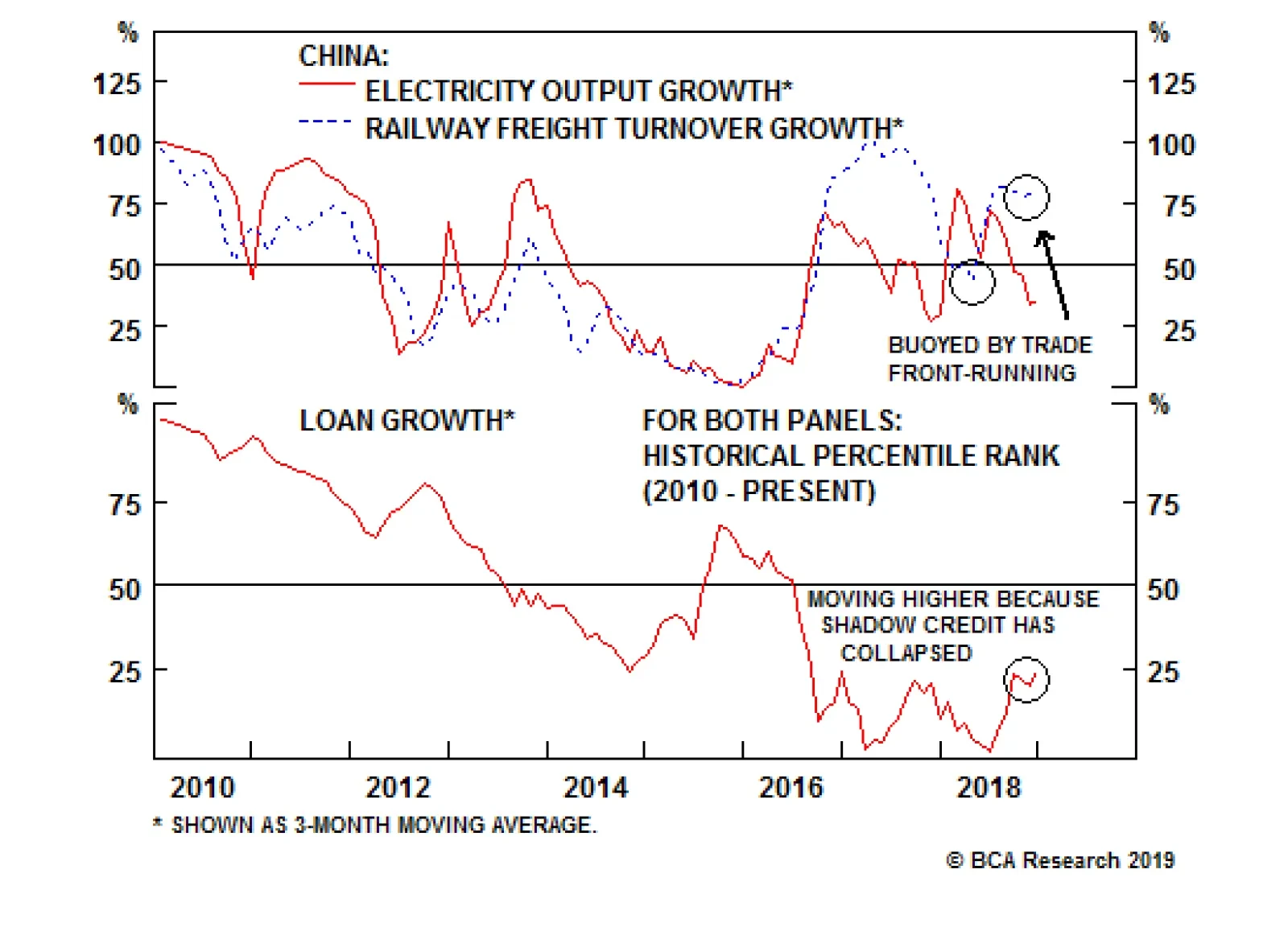
With high conviction, our answer to this question is no. Panel 1 of above chart shows the percentile rank of the two most cyclical components of the LKI. From 2010 to early-2018, electricity production and railway freight volume moved closely together, with…
After rising for thousands of years, human intelligence has begun to decline in developed economies. This can be seen in falling IQ scores and a decline in math and science test scores. Environmental factors appear to account for the bulk of this decline, but no one knows what these factors are. If left unchecked, falling intelligence will severely undermine productivity growth. This could lead to lower equity multiples, larger budget deficits, and ultimately, much higher government bond yields. Technological advances, particularly in the genetic realm, promise to radically raise IQs. In a complete abandonment of its one-child policy, China will combine these controversial technologies with pro-natal measures in order to boost sagging birth rates. The coming Eugenic Wars will be one of the most important economic and geopolitical developments of the 21st century. Part 1: What The Tame Fox Says In 1959, a Soviet scientist named Dmitry Belyaev embarked on an ambitious experiment: to domesticate the silver fox. A geneticist by training, Belyaev wanted to replicate the process by which animals such as cats and dogs came to live side-by-side with humans. It was a risky endeavor. The Soviets had essentially banned the study of Mendelian genetics in favor of the blank slate ideology that is popular in progressive circles today. Belyaev persevered. Working under the guise of studying vulpine physiology, he selected foxes based on only one trait – tamability. Less than 10% of foxes made it to the subsequent generation, with the other 90% being sent off to fur farms. By the fourth generation, the changes were undeniable. Rather than fleeing humans, the foxes sought out their attention with no prompting whatsoever. They even wagged their tails and whined and whimpered like dogs do. The tame foxes also displayed physical changes. Their ears flopped over. Their snouts became shorter and their tails stood upright. "By intense selective breeding, we have compressed into a few decades an ancient process that originally unfolded over thousands of years," wrote Lyudmila Trut, who began as Belyaev’s assistant and took over the project when her boss died in 1985. Genetically Capitalist? Evolution can broadly proceed in two ways. The first way is through random mutations. This form of evolution, which scientists sometimes refer to as genetic drift, can take thousands of years to yield any discernable changes. The second way is through natural selection, a process that exploits existing variations in genetic traits. As the Russian fox experiment illustrates, evolution driven by selective pressures (either natural or artificial) can occur fairly quickly. Did selective pressures manifest themselves in human evolution in the lead up to the Industrial Revolution? Did humans, in some sense, domesticate themselves? In his book, A Farewell To Alms, economic historian Gregory Clark argued in the affirmative. Clark documented that members of skilled professions in Medieval England had twice as many surviving children as unskilled workers (Chart II-1). Indeed, the fledgling middle class of the time had even more surviving children than the aristocracy, who were often out fighting wars. As a result, the wages of craftsmen declined by a third relative to laborers between 1200 and 1800, implying that the supply of skilled labor was growing more quickly than the demand for skilled workers over this period. Chart II-1Richer Men Had More Surviving Children In Medieval England
The Most Important Trend In The World Has Reversed And Nobody Knows Why
The Most Important Trend In The World Has Reversed And Nobody Knows Why
In subsequent work, Clark and Neil Cummins argued that the spread of bourgeois values across pre-industrial England was more consistent with a model of genetic transmission than a cultural one (see Box II-1 for details). Similar developments occurred in other parts of the world. For example, in China, the gateway into the bureaucracy for a thousand years was the highly competitive imperial exam. Xi Song, Cameron Campbell, and James Lee showed that high-status men had more surviving children during the eighteenth- and nineteenth-centuries (Chart II-2).1 Chart II-2High-Status Men In China Produced More Descendants In The 18th And 19th Centuries
The Most Important Trend In The World Has Reversed And Nobody Knows Why
The Most Important Trend In The World Has Reversed And Nobody Knows Why
The 10,000 Year Explosion Stephen Jay Gould famously said that “There’s been no biological change in humans in 40,000 or 50,000 years. Everything we call culture and civilization we’ve built with the same body and brain.” Gould was wrong. Data from the International HapMap Project show that human evolution accelerated by 100-fold starting around 10,000 years ago (Chart II-3). Chart II-3Human Evolution Has Accelerated 100-Fold Over The Past 10,000 Years
The Most Important Trend In The World Has Reversed And Nobody Knows Why
The Most Important Trend In The World Has Reversed And Nobody Knows Why
In their book The 10,000 Year Explosion: How Civilization Accelerated Human Evolution, Gregory Cochran and the late Henry Harpending explained why evolution sped up so rapidly.2 The advent of agriculture led to a surge in population levels. This, in turn, increased the absolute number of potentially beneficial genetic mutations that could be subject to selection effects. Farming and the rise of city states also completely reshaped the environment in which people lived. Basic biology teaches us that environmental dislocations of this kind tend to generate selective pressures that cause evolution to accelerate. John Hawks, professor of anthropology and genetics at the University of Wisconsin-Madison, put it best: “We are more different genetically from people living 5,000 years ago than they were different from Neanderthals.” Many of the changes to our genomes relate to diet and diseases. The various genetic resistances that people have built up to malaria are all less than 10,000 years old. Mutations to the LCT gene, which confers lactose tolerance into adulthood, occurred independently in three different geographical locations: one in East Asia, one in the Middle East, and one in Africa. The Middle Eastern variant was probably responsible for the rapid enlargement of the Indo-European language group, which now stretches from India to Ireland. The African variant likely facilitated the Bantu expansion, which started near the present-day border of Nigeria and Cameroon, and then spread out across almost all of sub-Saharan Africa. Evolution Of The Human Brain About half of the genes in the human genome regulate some aspect of brain function. Given the rapid acceleration in evolution, it would be rather surprising if our own brains had not been affected. And indeed, there is plenty of evidence that they were. The frontal lobe of the brain has increased in size over the past 10,000 years. This is the part of the brain that regulates such things as language, memory, and long-term planning. Testosterone levels have also declined. That may explain the steady reduction in violent crime rates (Chart II-4). Chart II-4Long-Term Decline In Homicide Rates
The Most Important Trend In The World Has Reversed And Nobody Knows Why
The Most Important Trend In The World Has Reversed And Nobody Knows Why
We know that certain genes that are associated with higher intelligence have been under recent selective pressure. For example, the gene that leads to torsion dystonia – a debilitating movement disorder – appears to have increased in frequency. Why would a gene that causes a known disease become more widespread? The answer is that individuals who have this particular mutation tend to have IQs that are around 10-to 20-points above the population average. Why IQ Matters IQ has a long and contentious history. Yet, despite numerous efforts to jettison the concept, it has endured for one simple reason: It has more predictive power than virtually anything else in the psychological realm. A simple 30-minute IQ test can help predict future educational attainment, job performance, income, health, criminality, and fertility choices (Table II-1 and Chart II-5). IQ even predicts trader performance!3 Table II-1What IQ Predicts (Results From Meta-Analyses)
The Most Important Trend In The World Has Reversed And Nobody Knows Why
The Most Important Trend In The World Has Reversed And Nobody Knows Why
Chart II-5IQ Tests Don’t Just Measure How Well You Can Do On An IQ Test
The Most Important Trend In The World Has Reversed And Nobody Knows Why
The Most Important Trend In The World Has Reversed And Nobody Knows Why
Like most physiological traits, IQ is highly heritable.4 The genetic contribution to IQ increases from 20% in early childhood to as high as 80% by one’s late teens and remains at that level well into adulthood.5 This makes IQ almost as heritable as height (Chart II-6). Chart II-6The Inheritance You Cannot Renounce
The Most Important Trend In The World Has Reversed And Nobody Knows Why
The Most Important Trend In The World Has Reversed And Nobody Knows Why
Although there is a great deal of variation among individuals, on average, more intelligent people earn higher incomes (Chart II-7). If the same relationship existed in the pre-industrial era, as seems likely, then human intelligence probably increased in a way that facilitated the economic explosion that we associate with the Industrial Revolution. The stunning implication is that the emergence of the modern era was a question of “when, not if.” Chart II-7IQ Tends To Be Positively Correlated With Income And Wealth
The Most Important Trend In The World Has Reversed And Nobody Knows Why
The Most Important Trend In The World Has Reversed And Nobody Knows Why
Part 2: The Flynn Effect By the late-19th century, it had become clear that the rich were no longer having as many children as the poor. This realization, together with the growing popularity of Darwin’s theories, helped galvanize the eugenics movement. Contrary to popular belief, this movement was not a product of the far-right. In fact, the most vocal proponents of eugenics were among the progressive left. John Maynard Keynes, for example, served as the Director of the British Eugenics Society between 1937 and 1944. Yet, a funny thing happened on the road to idiocracy: The concerns of eugenicists did not come to pass. Rather than becoming dimmer, people became smarter. This phenomenon is now known as the Flynn Effect, named after James Flynn, a psychologist who was among the first to document it. Chart II-8 shows the evolution of IQ scores in a sample of countries between 1940 and 1990. The average country recorded IQ gains of three points per decade over this period, a remarkably large increase over such a relatively short period of time. Chart II-8The Flynn Effect: It Was Nice While It Lasted
The Most Important Trend In The World Has Reversed And Nobody Knows Why
The Most Important Trend In The World Has Reversed And Nobody Knows Why
Explaining The Flynn Effect The Flynn Effect must have been entirely driven by environmental factors since genetic factors – namely the tendency of less-educated people to have more children, and to have them at an earlier age – would have reduced average IQs over the past two hundred years. But how could environmental factors have played the dominant role in light of the strong role of genes discussed above? The answer was proposed by geneticist Richard Lewontin in the 1970s. Lewontin suggested imagining a genetically-diverse sack of seed corn randomly distributed between two large identical fields. One field had fertilizer added to it while the other did not. Genetic variation would explain all of the differences in the height of corn stalks within each field, while environmental factors (the addition of fertilizer) would explain all of the difference in the average height of corn stalks between the two fields. This logic explains why genes can account for the bulk of the variation in IQs within any demographic group, while environmental effects may explain most of the variation across groups, as well as why average scores have changed over time. And what environmental effects are these? The truth is that no one really knows. Plenty of theories have been advanced, but so far there is still little consensus on the matter. Bigger, Healthier Brains It has long been known that learning increases the amount of grey matter in the brain. For example, a recent study showed that the hippocampi of London taxi drivers tend to be larger due to the need for drivers to memorize and navigate complex routes.6 The emergence of modern societies likely kicked off a virtuous circle where the need to solve increasingly complex tasks forced people to hone their learning skills, leading to higher IQs and further technological progress. The introduction of universal primary education amplified this virtuous circle. Better health undoubtedly helped as well. Early childhood diseases reduce IQ by diverting the body’s resources away from mental development towards fighting off infections. There is a strong correlation between measured IQ and disease burden across countries (Chart II-9). A number of studies have documented a strong relationship between the timing of malaria eradication in the U.S. and other parts of the world and subsequent observed gains in childhood IQs.7 Chart II-9IQ And Disease Burden
The Most Important Trend In The World Has Reversed And Nobody Knows Why
The Most Important Trend In The World Has Reversed And Nobody Knows Why
Brain size and IQ are positively correlated. Forensic evidence from the U.S. suggests that the average volume of adult human skulls has increased by 7% since the late 1800s, or roughly the size of a tennis ball.8 Part 3: The End Of A 10,000 Year Trend The problem with environmental effects is that they eventually run into diminishing returns. This appears to have happened with the Flynn Effect. In fact, not only does the recent evidence suggest that the Flynn Effect has ended, but the data suggest that IQs are starting to decline. Chart II-10 shows that average math and science test scores fell in the OECD’s Program For International Scholastic Achievement (PISA) between 2009 and 2015, the latest year of the examination. The drop in math and science test scores has been mirrored in falling IQ scores. Flynn observed a decade ago that IQs of British teenagers were slipping.9 Similar results have been documented in France, the Netherlands, Germany, Denmark, and most recently, Norway. Chart II-10Math And Science Skills Are Slipping In The OECD
The Most Important Trend In The World Has Reversed And Nobody Knows Why
The Most Important Trend In The World Has Reversed And Nobody Knows Why
The Norwegian results, published last year, are particularly noteworthy.10 Bernt Bratsberg and Ole Rogeberg examined three-decades worth of data on IQ tests of Norwegian military conscripts. Military duty has been mandatory for almost all men in Norway since 1814, which means that the study’s authors were able to collect comprehensive data on most Norwegian men and their fathers. Their paper clearly shows that IQ peaked with the generation born in the mid-1970s and declined by about five points, or one-third of a standard deviation, for the one born in 1990 (Chart II-11). For the first time in recorded history, Norwegian kids today are not scoring as well as their parents. Chart II-11Norwegian IQs Have Been Falling For Those Born Since The Mid-1970s
The Most Important Trend In The World Has Reversed And Nobody Knows Why
The Most Important Trend In The World Has Reversed And Nobody Knows Why
A Mystery What caused the sudden reversal of the Flynn Effect in Norway and most other developed economies? Nobody knows. We can, however, offer three possible theories: New Technologies For much of human history, rising intelligence and technological innovation were complementary processes, meaning that the smartest people were the ones who could best exploit the new technologies that were coming their way. Moreover, as noted above, even those who were less gifted benefited from the mental stimulation that a technologically advanced society provided. It remains to be seen how future technological advances such as generalized AI will affect human intelligence, but recent technological advances seem to have had a dumbing down effect.11 For example, the GPS has obviated the need for people to navigate unfamiliar locations, thus blunting the development of their visuospatial skills. Modern word processors have made spelling skills less important. Having all the information in the world just a click away is a wonderful thing, but it has reduced the need for our brains to retain and codify what we learn. Meanwhile, the constant bombardment of information to which we are subject has made it difficult to concentrate on anything for long. How many youth today can read a report of this length without checking their Facebook feed multiple times? My guess is not many. Diminishing Returns To Education The ability to take young bright minds, who would have otherwise spent their lives doing menial labor, and provide them with an education was probably the greatest tailwind to growth that the 20th century enjoyed. There is undoubtedly still scope to continue this process, but the low-hanging fruits have been picked. Educational attainment has slowed dramatically in most of the world (Chart II-12). Economist James Heckman estimates that U.S. high-school graduation rates, properly measured, peaked over 40 years ago.12 Chart II-12The Contribution To Economic Growth From Rising Human Capital Is Falling
The Most Important Trend In The World Has Reversed And Nobody Knows Why
The Most Important Trend In The World Has Reversed And Nobody Knows Why
Despite billions of dollars spent, efforts to improve school performance have generally fallen flat. A recent high-level report by the U.S. Department of Education concluded that “The panel did not find any empirical studies that reached the rigor necessary to determine that specific turnaround practices produce significantly better academic outcomes.”13 This gets to a point that most parents already know, which is that when people talk about “bad schools," they are really talking about “bad students.” Deteriorating Health Better health probably contributed to the Flynn Effect. But is it possible to have too much of a good thing? More calories are welcome when people are starving, but today’s calorie-rich, nutrient-poor diets have led to a surge in obesity rates. A clean environment reduces the spread of germs, but it also makes children hypersensitive to foreign substances. Following German reunification, researchers observed that allergies were much more common among West German children than their Eastern peers, presumably because of the West’s more salubrious environment.14 All sorts of weird and concerning physiological changes are occurring. Sperm counts have fallen by nearly 60% since the early 1970s.15 Testosterone levels in young men are dropping. Among girls, the age of first menarche has declined by two years over the past century.16 Are chemical agents in the environment responsible? If they are, what impact are they having on cognitive development? Nobody knows. Reported mental illness is also on the rise. The share of U.S. teenagers with a reported major depressive episode over the prior year surged by over 60% between 2010 and 2017 (Chart II-13). The fraction of young adults that made suicide plans nearly doubled.17 More than 20% of U.S. women over the age of 40 are on antidepressants.18 Five percent of U.S. children are receiving ADHD medication.19 Chart II-13A Disturbing Deterioration In Mental Health
The Most Important Trend In The World Has Reversed And Nobody Knows Why
The Most Important Trend In The World Has Reversed And Nobody Knows Why
Implications For Economic Growth And Asset Markets So far, the reversal of the Flynn Effect has been largely confined to the developed economies. Test scores are still rising in the developing world, albeit from fairly low levels. For example, two recent studies have documented significant IQ gains in Kenya and Brazil.20 In the poorest countries, opportunities for improving health abound. Even small steps such as fortifying salt with iodine (which costs about five cents per person per year) have been shown to boost IQ by nearly one standard deviation.21 Measures to reduce inbreeding are also likely to boost IQ scores.22 Yet, we should not underestimate the importance of falling cognitive skills in developed economies. Chart II-14 shows that there is a clear positive correlation between student score on math and science and per capita incomes. Chart II-14Positive Correlation Between Student Scores On Math And Science And Per Capita Income
The Most Important Trend In The World Has Reversed And Nobody Knows Why
The Most Important Trend In The World Has Reversed And Nobody Knows Why
Most technological innovation still takes place in developed economies. There is an extremely tight relationship between visuospatial IQ and the likelihood of becoming an inventor (Chart II-15). Since IQ is distributed along a bell curve, a 0.1 standard deviation drop in IQs across the entire distribution will result in an 8% decline in the share of people with IQs over 100, a 14% decline in those with IQs over 115, and a 21% decline in those with an IQ over 130 (by convention, each standard deviation on an IQ test is worth 15 points). Chart II-15Having A Compass In Your Head Makes You A Better Inventor
The Most Important Trend In The World Has Reversed And Nobody Knows Why
The Most Important Trend In The World Has Reversed And Nobody Knows Why
Falling IQs could result in slower productivity growth, which could further strain fiscal balances. Lower IQs are also associated with decreased future orientation.23 People who live for the moment tend to save less. A decline in savings would push up real rates, leading to less capital accumulation. History suggests that a deceleration in productivity growth and higher real rates will put downward pressure on equity multiples (Chart II-16). Chart II-16Equity Multiples Tend To Fall When Real Rates Rise And Productivity Growth Declines
The Most Important Trend In The World Has Reversed And Nobody Knows Why
The Most Important Trend In The World Has Reversed And Nobody Knows Why
Part 4: Generation E For 200 years, the environmentally-driven Flynn Effect disguised the underlying genetically-driven decline in IQs that began not long after the dawn of the Industrial Revolution. Flynn has acknowledged this himself, noting at the 2017 International Society For Intelligence Research Conference that “I have no doubt that there has been some deterioration of genetic quality for intelligence since the late Victorian times.”24 Now that the Flynn Effect has reversed, both genes and the environment are working together to reduce cognitive abilities in developed economies. This means that the most important trend in the world – a trend that allowed the human population to increase during the Malthusian era and later allowed output-per-worker to soar following the Industrial Revolution – has broken down. Yet, there may be another twist in the story – one that began just a few months ago: the first members of Generation E were born. E Is For Edited ... Or Eugenics Lulu and Nana will be like most other children, but with one key difference: They will be the first humans ever to have their genomes edited through a procedure know as CRISPR-Cas9. Rogue Chinese scientist He Jiankui deactivated their CCR5 gene, which the HIV virus uses as a gateway into the body. His actions were rightfully condemned around the world for endangering the twins’ health by using a procedure that has not yet been fully vetted in animal studies, let alone in human trials (Lulu and Nana’s father is HIV+ but it is debatable whether the children were at an elevated risk of infection). He Jiankui remains under house arrest at the university where he worked. But whatever his fate, the dam has been broken. For better or for worse, the era of personal eugenics has arrived. The Return Of The Silver Fox It is easier to delete a gene than to add one. It is even more difficult to swap out a large number of genes in a way that achieves a predictable outcome. Thus, the successful manipulation of highly polygenic traits such as intelligence — traits that are linked to hundreds of different genes – may still be decades away.25 Predicting a trait is much simpler than modifying it, however. The cost of sequencing a human genome has fallen by more than 99% since 2001 (Chart II-17). Start-up company Genomic Prediction has already developed a test for fertilized embryos for IVF users that predicts height within a few centimetres and IQ with a correlation of 0.3-to-0.4, roughly as accurate as standardized tests such as the SAT or ACT.26 Other companies are following suit.27 Chart II-17Sequencing Costs Have Plummeted
The Most Important Trend In The World Has Reversed And Nobody Knows Why
The Most Important Trend In The World Has Reversed And Nobody Knows Why
Some will recoil in horror at the prospect of selecting prospective children in this manner. They will argue that such technologies, beyond being simply immoral, will widen social inequality between those who can afford them and those who cannot. Others will counter that screening embryos for certain traits is not that dissimilar to what people already do with prospective romantic partners. They will also point out that mass usage of these technologies will drive down prices to the point that even poor people will be able to access them, thus giving low IQ parents the chance to have high IQ kids. They might also note that such technologies may be the only way to reverse the ongoing accumulation of deleterious mutations within the human germline that has been the unintended by-product of the proliferation of life-saving medicines.28 We will not wade into this thorny debate, other than to note that there will be huge incentives for people to avail themselves of these technologies. The Coming Eugenic Wars And not just individuals either – governments too. While the initial impact of eugenic technologies will be small, the effects will compound over time. Carl Shulman and Nick Bostrom estimate that genetic screening could boost average IQs by up to 65 points in five generations (Table II-2). Table II-2A Poisoned Chalice? Genetic Screening Can Raise IQ
The Most Important Trend In The World Has Reversed And Nobody Knows Why
The Most Important Trend In The World Has Reversed And Nobody Knows Why
China has been investing heavily in genetic technologies. As Geoffrey Miller has argued, China’s infatuation with eugenics spans into the modern day.29 Like most other countries, fertility in China is negatively correlated with IQ. Mingrui Wang, John Fuerst, and Jianjun Ren estimate that China is currently losing nearly one-third of a point in generalized intelligence per decade, with the loss having accelerated rapidly between the 1960s and mid-1980s.30 The decline in the genetic component of Chinese IQs is coming at a time when the population itself is about to shrink. According to the UN’s baseline forecast, China will lose 450 million working-age people by the end of the century (Chart II-18). Meanwhile, the country is saddled with debt, the result of an economic model that has, for decades, recycled copious household savings into debt-financed fixed-investment spending in an effort to shore up domestic demand. Chart II-18China’s Labor Pool Is Shrinking
The Most Important Trend In The World Has Reversed And Nobody Knows Why
The Most Important Trend In The World Has Reversed And Nobody Knows Why
The authorities may be tempted to tackle all three problems simultaneously by adopting generous pro-natal measures – call it the “at least one-child policy”– which increasingly harnesses emerging eugenic technologies. The resulting baby boom would strengthen domestic demand, thus making the economy less dependent on exports, while ensuring China’s long-term geopolitical viability. The Eugenic Wars are coming, and they will be unlike anything the world has seen before. BOX II-1 The Diffusion Of Bourgeois Values: Culture Or Genes? Higher-income people had more surviving children in the centuries leading up to the Industrial Revolution. Real per capita income was broadly stable during this period. This implies that there must have been downward social mobility, with sons, on average, being less wealthy than their fathers. This downward mobility, in turn, spread the characteristics of higher-income people across the broad swathe of society. What were these characteristics? Cultural values that emphasized thrift, diligence, and literacy were undoubtedly part of what was passed on to future generations. But surprisingly, it also appears that genetic transmission played an important, and perhaps pivotal, role. Models of genetic transmission make very concrete predictions about the correlations in economic status that one would expect to see among relatives. Biological brothers share 50% of their genes, as do fathers and sons. Likewise, first cousins share 25% of their genes, the same as grandfathers and sons. These facts yield two testable predictions: The first is that the correlation coefficient on status measures such as wealth, occupation, and education should be the same for relatives that share the same fraction of genes such as sibling pairs and father-son pairs. Box Chart II-1 shows that this is borne out by the data. The second prediction is that the correlation between status and genetic distance should follow a linear trend so that, for example, the correlation in wealth among brothers is twice that of first cousins and four times that of second cousins. Box Chart II-2 shows that this is also borne out by the data. BOX CHART II-1Comparative Father-Son And Brother Correlations By Status
The Most Important Trend In The World Has Reversed And Nobody Knows Why
The Most Important Trend In The World Has Reversed And Nobody Knows Why
BOX CHART II-2Wealth Correlations By Genetic Distance
The Most Important Trend In The World Has Reversed And Nobody Knows Why
The Most Important Trend In The World Has Reversed And Nobody Knows Why
Other evidence supports the importance of genes in the transmission of status across generations. The correlation in measures such as wealth, education, and occupation is much higher among identical twins than fraternal twins. Adopted children turn out to be more similar to their biological parents on these measures when they reach adulthood than their adopted parents, even when the children have never met their biological parents. The parent-child correlation also remains the same regardless of family size, suggesting that spreading the same resources over more children may not harm life outcomes to any discernible degree, at least on the measures listed above. Peter Berezin Chief Global Strategist Global Investment Strategy Footnotes 4 Xi Song, Cameron Campbell, and James Lee, "Descent Line Growth and Extinction From A Multigenerational Perspective, Extended Abstract," American Sociological Review 80:3, (April 21, 2015): 574-602. 5 Gregory Cochran and Henry Harpending, "The 10,000 Year Explosion: How Civilization Accelerated Human Evolution," Basic Books, (2009). 6 Mark Grinblatt, Matti Keloharju, and Juhani T. Linnainmaa, “IQ, Trading Behavior, and Performance,” Journal of Financial Economics, 104:2, (May 2012): 339-362. 7 Thomas Bouchard, "Genetic Influence On Human Psychological Traits - A Survey," Current Directions in Psychological Science 13:4, (August 2004): 148-151. 8 The tendency for the genetic contribution to IQ to increase until early adulthood and then to remain at high levels until old age is known as the Wilson Effect. There is no consensus on what causes it, but it probably reflects a number of factors: 1) It may take some children longer than normal to reach full intellectual maturity. Testing their IQs at a young age will result in scores that are lower than those expected based on their parents’ IQs. The opposite is true for children whose IQs increase relatively quickly in young age, but possibly top out earlier; 2) Environmental effects are probably more important in young age when a child’s brain is still quite malleable; 3) Self-reinforcing gene-environment interactions tend to increase with age. Children do not have much control over their environment, but as they get older, they will seek out activities that are more in keeping with their genetic predispositions. For example, a studious child may pursue a career that reinforces their love of learning. 9 "Cache Cab: Taxi Drivers' Brains Grow to Navigate London's Streets," Scientific American, (December 2011). 10 Atheendar Venkataramani, "Early Life Exposure to Malaria and Cognition in Adulthood: Evidence from Mexico," Journal of Health Economics 31:5, (July 2012): 767-780; Hoyt Bleakley, "Health, Human Capital and Development," Annual Review of Economics 2, (March 2010): 283-310; Hoyt Bleakley, "Malaria Eradication in the Americas: A Retrospective Analysis of Childhood Exposure," American Economic Journal: Applied Economics 2, (April 2010): 1-45. 11 "Anthropologists Find American Heads Are Getting Larger," ScienceDaily, (May 2012). 12 "British Teenagers Have Lower IQs Than Their Counterparts Did 30 Years Ago," The Telegraph, (February 2009). 13 Bernt Bratsberg and Ole Rogeberg, "Flynn Effect And Its Reversal Are Both Environmentally Caused," Proceedings of the National Academy of Sciences 115:26, (June 2018): 6674-6678. 14 On the face of it, artificial intelligence would appear to be a substitute for human intelligence. Many applications of AI would undoubtedly have this feature, especially those that allow computers to perform complex mental tasks that humans now must do. However, there are several ways that AI may eventually come to complement human intelligence. First, and most obviously, AI could be used to augment human capabilities either directly by hardwiring it into our brains, or indirectly through the development of drugs or genetic techniques which improve cognition. Second, looking further out, the benefits of highly intelligent AI systems would be limited if humans did not possess the requisite intelligence to understand certain concepts that are currently beyond our mental reach. No matter how well intentioned, trying to explain string theory to a mouse is not going to succeed. There are probably a multitude of ideas that AI could reveal that we simply cannot comprehend at current levels of human intelligence. 15 James Heckman and Paul La Fontaine, "The American High School Graduation Rate: Trends and Levels," The Review of Economics and Statistics 92:2, (May 2010): 244–262. 16 "Turning Around Chronically Low-Performing Schools," The Institute of Education Sciences (IES), (May 2008). 17 E. von Mutius, F.D. Martinez, C. Fritzsch, T. Nicolai, G. Roell, and H. H. Thiemann, "Prevalence Of Asthma And Atopy In Two Areas Of West Germany And East Germany," American Journal of Respiratory and Critical Care Medicine 149:2, (February 1994): 358-64. 18 "Sperm Counts In The West Plunge By 60% In 40 Years As ‘Modern Life’ Damages Men’s Health," Independent, (July 2017). 19 Kaspar Sørensen, Annette Mouritsen, Lise Aksglaede, Casper P. Hagen, Signe Sloth Mogensen, and Anders Juul, "Recent Secular Trends in Pubertal Timing: Implications for Evaluation and Diagnosis of Precocious Puberty," Hormone Research in Paediatrics 77:3, (May 2012): 137-145. 20 “Results from the 2017 National Survey On Drug Use And Health: Detailed Tables,” Substance Abuse and Mental Health Services Administration, Center for Behavioral Health Statistics and Quality, Rockville (Maryland), (September, 2018). 21 Laura A. Pratt, Debra J. Brody, and Qiuping Gu, "Antidepressant Use Among Persons Aged 12 and Over: United States, 2011–2014," NCHS Data Brief No. 283, Centers for Disease Control and Prevention, (August 2017). 22 Some, but not all, of the increase in reported rates of mental illness may be due to more aggressive diagnosis by health practitioners. For example, a recent study revealed that children born in August were 30% more likely to receive an ADHD diagnosis than those born in September, simply because they were less mature compared to other kids in the first few years of elementary school. See: Timothy J. Layton, Michael L. Barnett, Tanner R. Hicks, and Anupam B. Jena, "Attention Deficit-Hyperactivity Disorder and Month of School Enrollment," New England Journal of Medicine 379:22, (November 2018): 2122-2130. 23 Tamara C. Daley, Shannon E. Whaley, Marian D. Sigman, Michael P. Espinosa, and Charlotte Neumann, "IQ On The Rise: The Flynn Effect In Rural Kenyan Children," Psychological Science 14:3, (June 2003): 215-9; Jakob Pietschnig and Martin Voracek, "One Century of Global IQ Gains: A Formal Meta-Analysis of the Flynn Effect (1909-2013)," Perspectives on Psychological Science 10:3, (May 2015): 282-306. 24 N. Bleichrodt and M. P. Born, “Meta-Analysis of Research on Iodine and Its Relationship to Cognitive Development,” In: ed. J. B. Stanbury, "The Damaged Brain of Iodine Deficiency," Cognizant Communication Corporation, New York, (1994): 195-200; "Iodine status worldwide: WHO Global Database on Iodine Deficiency," World Health Organization, Geneva, (2004). 25 Mohd Fareed and Mohammad Afzal, "Estimating the Inbreeding Depression on Cognitive Behavior: A Population Based Study of Child Cohort," PLOS ONE 9:12, (October 2015): e109585. 26 H. de Wit, J. D. Flory, A. Acheson, M. McCloskey, and S. B. Manuck, "IQ And Nonplanning Impulsivity Are Independently Associated With Delay Discounting In Middle-Aged Adults," Personality and Individual Differences 42:1, (January 2007): 111-121; W. Mischel and R. Metzner, "Preference For Delayed Reward As A Function Of Age, Intelligence, And Length Of Delay Interval," Journal of Abnormal and Social Psychology 64:6, (July 1962): 425-31. 27 James Flynn, “IQ decline and Piaget: Does the rot start at the top?” Lifetime Achievement Award Address, 18th Annual meeting of ISIR, (July 2017). 28 For a good discussion of these issues, please see Richard J. Haier, “The Neuroscience of Intelligence,” Cambridge Fundamentals of Neuroscience in Psychology, (December 2016). 29 "The Future of In-Vitro Fertilization and Gene Editing," Psychology Today, (December 2018). 30 "DNA Tests For IQ Are Coming, But It Might Not Be Smart To Take One," MIT Technology Review, (April 2018). 31 Michael Lynch, "Rate, Molecular Spectrum, And Consequences Of Human Mutation," Proceedings of the National Academy of Sciences 107:3, (January 2010): 961-968. 32 Geoffrey Miller, "What *Should* We Be Worried About?" Edge, (2013). 33 Mingrui Wang, John Fuerst, and Jianjun Ren, "Evidence Of Dysgenic Fertility In China," Intelligence 57, (April 2016): 15-24.
Highlights Global equity markets have managed to recoup some of last year’s plunge since we upgraded stocks to overweight in late December. The equity rally has been tentative, however, and so far feels more like a technical bounce from oversold levels than a resumption of the bull market. One driving factor behind last year’s market swoon was that policy uncertainty spiked at a time when the last pillar of global growth, the U.S., was showing signs of cracking. Investors thus welcomed the Fed’s signal that it would pause in March. Nonetheless, shrinkage in the Fed’s balance sheet is proving to be troublesome. Quantitative tightening does not necessarily imply permanently higher risk premia, but it will be a source of volatility. There are hopeful but tentative signs that a U.S. slowdown is not the precursor to a recession. The hit to GDP from the U.S. government shutdown will be reversed next quarter. The FOMC has also signaled that policymakers are attuned to the economic risks associated with tightening financial conditions, and that the calm inflation backdrop provides room to maneuver. The FOMC will stand pat in March, but should restart rate hikes in June as the economic soft patch ends. We still see only a modest risk of a U.S. recession this year. In contrast, our outlook for growth outside the U.S. remains downbeat for at least the first half of the year. Among the advanced economies, Japan and Europe are being the most affected by the Chinese economic slowdown and global trade tensions. This means that monetary policy divergence will continue to be a tailwind for the dollar. China continues to stimulate at the margin, but efforts so far have been insufficient to put a floor under growth. The contraction in Chinese exports has just begun. It is still too early to upgrade EM assets or base metals. Despite the cloud still surrounding Brexit, sterling is beginning to look attractive as a long-term punt. Our decision to upgrade corporate bonds to overweight this month, similar to our reasoning for upgrading equities in December, is based on improved value and a sense that investor pessimism had become excessive. Just as the selloff in risk assets was overdone, so too was the rally in government bonds. It is highly unlikely that the Fed is done tightening, as is currently discounted in the money market curve. A resumption of Fed rate hikes around mid-year means that the 10-year Treasury yield will move back above 3% by year end. Feature Global equity markets have managed to recoup some of last year’s plunge since we upgraded the asset class back to overweight in the latter half of December. A decline in the VIX and high-yield bond spreads are also positive signs that global risk appetite is recovering, following an overdone investor ‘panic attack’ last quarter. The equity rally has been tentative, however, and so far feels more like a simple technical bounce from oversold levels than a resumption of the bull market. One problem is that policy uncertainty has spiked at a time when the last pillar of global growth, the U.S., is showing signs of cracking (Chart I-1). Investors are skittish while they await a clear de-escalation of U.S./China trade tensions, an end to the U.S. economic soft patch, an end to the U.S. government shutdown, and signs that global growth is bottoming (especially in China). There has only been some modestly positive news on a couple of these issues. Chart I-1Policy Uncertainty Has Spiked
Policy Uncertainty Has Spiked Watch Policy Uncertainty
Policy Uncertainty Has Spiked Watch Policy Uncertainty
Another factor that appeared to play a role in last quarter’s market swoon is the fear that the end of asset purchases by the European Central Bank and the normalization of the Fed’s balance sheet necessarily imply a structural de-rating for all risk assets. A related worry is that the de-rating might intensify the global economic slowdown, resulting in a self-reinforcing negative feedback loop. Does QT Imply Lower Multiples? The question of balance sheet normalization is a difficult one because there is widespread disagreement on how, or even whether, quantitative easing (QE) works. We have always maintained that QE was not about creating a wave of central bank liquidity that flowed into asset prices. Central banks did not “print money” – they created bank reserves. These reserves did not result in a major acceleration in broader measures of money growth, including M1 and M2, largely because there was little demand for loans and because banks tightened lending standards. In other words, the credit channel of monetary policy was broken. The implication is that investors should not worry that quantitative tightening (QT) implies a withdrawal of central bank liquidity that must mechanically come from the sale of risk assets. Rather, we believe that QE operates mostly through the portfolio balance effect. There are two ways to think about this channel. First, the central bank forced investors to move into riskier assets by purchasing large amounts of “safe” assets, such as government bonds. Investors had little choice but to redeploy the capital into other riskier areas, pushing up asset prices. The second perspective is that central bank purchases of government bonds depressed both the yield curve and bond volatility. Volatility fell because investors could forecast the policy rate with certainty – it would be glued to zero (or negative) for the foreseeable future in most of the advanced economies. This is akin to strong forward guidance that flattened the yield curve. Aggressive monetary stimulus, such as QE, also helped to reduce the perceived risk that the economy would succumb to secular stagnation or fall back into recession. Reduced bond volatility, lower bond yields, and less economic risk all increased the attractiveness of the riskier asset classes. These explanations represent two sides of the same coin. Either way, QE boosted a broad array of asset prices. If this is true, then unwinding QE must be bearish for risk assets, all else equal. In the case of the U.S., the fed funds rate is much more difficult to forecast than was the case when the Fed was buying bonds. Higher yields and bond volatility imply a lower equilibrium multiple in the equity market and wider equilibrium corporate bond spreads. Nonetheless, all else is not equal. If interest rates and bond volatility are rising in the context of healthy economic and profit growth, then it is likely that the perceived risk of secular stagnation is falling. It would be a sign that the economy has finally put the financial crisis firmly in the rear-view mirror. It could be the case that the upgrade in economic confidence overwhelms the negative impact of the reverse portfolio balance effect related to quantitative tightening, allowing risk assets to rise. No one can prove this thesis one way or the other and we are not making the case that unwinding the Fed’s balance sheet will necessarily go smoothly, especially since interest rates are rising at the same time. The problem is that both investors and the Fed are trying to figure out where the neutral fed funds rate lies. If the so-called level of R-star is still very low, then the Fed might have already made a policy mistake by raising rates too far. We discussed in last month’s Overview the market implications of four scenarios for the level of R-star and the Fed’s success in correctly guessing it. If the economy holds up and the economic soft patch ends in the coming months as we expect, then investors will revise their estimate of the neutral rate higher and risk assets will rally even as bond yields rise. The Doom Loop One risk to our base-case scenario is the so-called financial conditions “doom loop”. Irrespective of whether or not QT is playing a role, the doom loop scenario involves a shock to investor confidence that leads to a tightening in financial conditions and market liquidity as stock prices fall and credit spreads widen. More onerous financial conditions, in turn, undermine economic activity, which then feeds back into even tighter financial conditions. One could make the argument that risk assets are even more exposed to this type of negative feedback loop today than in past monetary tightening cycles because of program trading, the Fed’s balance sheet shrinkage and investors’ lingering shell shock from the Great Recession and financial crisis. Nonetheless, there are a few mitigating factors to consider. We believe that a doom loop is more likely to unfold when economic growth becomes very sensitive to changes in financial conditions. This normally happens when economic and financial imbalances are elevated. On a positive note, unlike in the lead-up to the last two recessions, the U.S. private sector is a net saver whose income outstrips spending by 2.1% of GDP (Chart I-2). The highly cyclical parts of the U.S. economy are not stretched to the upside as a share of GDP, reducing the risk that overspending in one part of the economy will required a deep contraction to correct the imbalance (Chart I-3). Chart I-2U.S. Private Sector: A New Saver
U.S. Private Sector: A New Saver The U.S. Private Sector Is A Net Saver
U.S. Private Sector: A New Saver The U.S. Private Sector Is A Net Saver
Chart I-3U.S. Cyclical Spending Not Extended
U.S. Cyclical Spending Not Extended
U.S. Cyclical Spending Not Extended
In terms of financial excesses, the good news is that the U.S. household sector is in its best shape in decades. Our main concern is debt accumulation in the corporate sector. We reviewed the related risks in a Special Report published in the November 2018 issue.1 We concluded that corporate leverage will not cause the next U.S. recession, because high levels of debt will only become a problem when profits begin to contract (i.e. when the economic downturn is already underway). Nonetheless, when a recession does occur, corporate spreads will widen by more than in the past for any given degree of economic contraction (see below). ‘Fed Put’ Still In Play Another factor that tempers the risk of a doom loop is that the so-called ‘Fed Put’ is still operating. The December FOMC Minutes and comments by various FOMC members communicated to investors that the Fed is attuned to the economic risks associated with tightening financial conditions, and that the calm inflation backdrop provides policymakers with room to maneuver. Chair Powell even said he was willing to adjust the Fed’s balance sheet run-off if necessary. One important reason for policymakers’ willingness to be flexible is that the fed funds rate is still not far from the zero-lower-bound, making it potentially more difficult for the FOMC to respond adequately in the event of a recession this year because the fed funds rate can only be cut by 250 basis points. Several U.S. data releases have been delayed due the government shutdown, but what has been released has been mixed. The downdraft in the January reading of the manufacturing ISM was eye-opening, highlighting that the global manufacturing slowdown has reached U.S. shores. The good news is that the non-manufacturing ISM and the small business survey, although off their peaks, remain consistent with solid underlying growth. The December U.S. payroll report revealed that wage growth continued to accelerate on the back of gangbusters job creation at the end of the year. There have also been some recent hints that the soft patch in capital spending and housing is ending (Chart I-4). Existing home sales fell sharply in December, but extremely low inventories suggest that it is more of a supply than a demand problem. The impressive bounce in home mortgage applications for purchases is a hopeful sign. U.S. commercial and industrial loan growth is also accelerating. Chart I-4Some Tentative Signs
Some Tentative Signs
Some Tentative Signs
These tentative signs that the economic soft patch is close to an end will not be enough to get the FOMC to tighten in March, after so many members have gone out of their way to signal a pause in recent weeks. Nonetheless, we believe the economy will remain strong enough for the Fed to resume hiking in June. The U.S. government shutdown will complicate interpreting incoming economic data. Ultimately, while its impact on Q1 real GDP growth will be non-trivial, it will be reversed the following quarter and we do not expect any permanent damage to be done. U.S. inflation should edge higher by mid-year, supporting our view that the Fed will resume tightening in June. The decline in oil prices will continue to feed into a lower headline inflation rate in the coming months, but that does not mean that the core rate will fall. Indeed, core CPI has increased by roughly 0.2% in each of the past three months, translating into an annualized rate of approximately 2.4%. Base effects will depress annual core inflation in February but, thereafter, this effect will begin to reverse. The acceleration in wage growth according to measures such as average hourly earnings and the Employment Cost Index highlights that underlying inflationary pressures continue to percolate (Chart I-5). The implication is that the Treasury bond market is overly complacent in discounting that the fed funds rate has peaked for the cycle. Chart I-5U.S. Wage Pressure Is Percolating
U.S. Wage Pressure Is Percolating
U.S. Wage Pressure Is Percolating
Looking further ahead, our base case remains that the next U.S. recession will not occur until 2020, and will be the result of tighter fiscal policy and further Fed tightening that takes short-term rates a step too far. No Bottom Yet For Global Growth Our outlook for growth outside the U.S. remains downbeat for at least the first half of the year. Our global economic indicators still show no sign of a turnaround, except for a bottoming in the diffusion index based on BCA’s Global Leading Economic Indicator (Chart I-6). The global ZEW economic sentiment index continued to fall in January, while business and consumer confidence readings in the advanced economies eroded heading into year end. Chart I-6Global Leading Indicators Still Deteriorating
Global Leading Indicators Still Deteriorating Global Growth Is Still Moderating...
Global Leading Indicators Still Deteriorating Global Growth Is Still Moderating...
A better global growth dynamic awaits more serious policy stimulus in China. Real GDP growth decelerated further to 6.4% year-over-year in the last quarter of 2018. This is no disaster, but the point is that there are still no signs of stabilization. The Chinese authorities continue to tweak the policy dials at the margin, most recently providing some tax cuts and a liquidity injection into the banking system. Nonetheless, the central government has so far abstained from stimulating the property market due to existing speculative excesses. This is very different from the previous two policy easing episodes, including 2015/16 (Chart I-7). Chart I-7China: No Property Market Stimulus...
China: No Property Market Stimulus...
China: No Property Market Stimulus...
The stimulus undertaken so far has been insufficient in terms of putting a floor under growth according to our 12-month Credit Impulse (Chart I-8). It is a hopeful sign that broad money growth is trying to bottom, but this does not guarantee that the credit impulse is about to turn. The latter is required to confirm that Chinese import demand will accelerate, providing a lift to EM exporters, EM asset prices and commodity prices. Without a positive credit impulse, China’s investment and construction activity will continue to moderate, leading to lower imports of machinery and raw materials. Chart I-8...And No Credit Impulse
...And No Credit Impulse
...And No Credit Impulse
The economic situation in China is likely to get worse before it gets better. Dismal trade figures in December confirmed that the trade war is beginning to bite. The period of export ‘front-running’ related to higher U.S. tariffs is over as total exports fell by 4.4% year-over-year. Last year’s collapse in export orders indicates that the woes are just beginning. In turn, moderating production related to the Chinese export sector will bleed into domestic consumption and imports, suggesting that it is too early to expect a durable rally in EM assets or commodity prices. Lackluster Chinese demand and growing trade concerns have weighted on global business confidence, contributing to the pullback in capital goods orders, manufacturing PMIs and industrial production in the advanced economies (Chart I-9). Even the average service sector PMI and consumer confidence index in the advanced economies have fallen in recent months, although both remain at a high level. Chart I-9The Fallout From Trade
The Fallout From Trade
The Fallout From Trade
Europe and Japan, in particular, are feeling the pinch. German GDP only grew 1.5% in 2018, implying that Q4 GDP growth was in the vicinity of just 0.2% QoQ. Meanwhile, European industrial production contracted by 3.3% year-over-year in December. The German Ifo and ZEW surveys do not point to any significant improvements in this trend. A few idiosyncratic factors explain some of this poor performance, including new emissions testing standards that have weighted on the German auto industry, a tightening in financial conditions in Italy, and the ‘gilets jaunes’ protests in France. Nonetheless, the euro area slowdown cannot be fully explained by one-off factors. The economy is highly sensitive to global trade fluctuations given that 18% of the euro area’s gross value added is generated in the manufacturing sector. Hence, China’s poor economic health has been painful for Europe, and the trend in Chinese credit does not bode well for the near term (Chart I-10). The European Central Bank (ECB) is likely to stay on the defensive as a result, especially as euro area core inflation, which has been stuck near 1% for three years, is unlikely to pick up if growth remains on the back foot. The ECB stuck with the view that the economic soft patch is temporary after the January policy meeting, but policymakers will consider providing more stimulus in March if the economy does not pick up (using forward guidance or a new TLTRO). This will weigh on the euro. Chart I-10China's Woes Are Infecting Europe
China's Woes Are Infecting Europe
China's Woes Are Infecting Europe
Japan is suffering from similar ills. Exports are no longer growing, and foreign machinery and factory orders are contracting at a 4.1% and 4.3% pace, respectively. This weakness is not mimicked in domestic growth, but the disproportionate contribution of the external sector to Japan’s overall economic health means that this country is also falling victim to the malaise witnessed in China and emerging markets, the destination of 19% and 45% of Japanese shipments, respectively (Chart I-11). Collapsing oil prices and a firming trade-weighted yen have amplified this deflationary backdrop. It is therefore far too early to bet that the Bank of Japan will tighten the monetary dials. Chart I-11Japan Hit By The Chinese Cold As Well
Japan Hit By The Chinese Cold As Well
Japan Hit By The Chinese Cold As Well
If we are correct that the U.S. economic soft patch will soon end, then the dollar will once again look to be the best of a bad lot. Interest rate expectations will move in favor of the dollar. We expect the dollar to rise by about 6% this year on a trade-weighted basis, appreciating most strongly against the AUD and SEK. As for sterling, it is beginning to look attractive as a long-term punt. Brexit Deadlock We are a month closer to the end-March deadline and a Brexit deal seems even farther out of reach. It could play out in one of three ways: (1) a “no deal” where the U.K. leaves the EU with no alternative in place; (2) a “soft Brexit” involving an agreement to form a permanent customs union or some sort of “Norway plus” arrangement; or (3) a decision to reverse the results of the original referendum and stay in the EU. There is no support for the “no deal” option in Parliament, which means that it won’t happen. We do not have a strong view on which of the latter two scenarios will occur. The odds of another referendum are rising and the polls are swinging away from any sort of Brexit, suggesting that the original referendum result may be over-turned via another referendum (Chart I-12). Nonetheless, for investors, it does not matter much whether it is scenario 2 or 3; either outcome would be welcomed by markets. Overweight sterling positions are attractive as a long-term play, although it could be some time before the final solution emerges. Chart I-12Brexit Result May Be Overturned
Brexit Result May Be Overturned
Brexit Result May Be Overturned
Upgrade Corporate Bonds To Overweight Given the recent global economic dynamics, it is perhaps surprising that U.S. corporate financial health actually improved in 2018 according to our Corporate Health Monitors (CHM). We highlighted in the aforementioned Special Report the risks facing U.S. corporate bonds when the economic expansion ends. High levels of corporate leverage mean that the interest coverage ratio for the median corporation in the Barclays-Bloomberg index will plunge to near or below all-time historic lows. The potential for a large wave of fallen angels implies that downgrade activity will be particularly painful for corporate bond investors. The surge in lower-quality issuance has led to a downward trend in the average credit rating and has significantly raised the size of the BBB-rated bonds relative to the IG index and relative to the broader universe of corporate bonds. Moreover, poor market liquidity and covenant erosion will intensify pressure for corporate spreads to widen when the bear market arrives. Rapid debt accumulation is reflected in our bottom-up Corporate Health Monitors (CHM) for the U.S. investment-grade and high-yield sectors (Chart I-13). The CHMs are constructed from six financial ratios that the rating agencies use when rating individual companies. The companies in our bottom-up sample were chosen so as to mimic the sector and quality distribution in the Bloomberg-Barclay’s corporate bond index. Chart I-13U.S. Corporate Health
U.S. Corporate Health
U.S. Corporate Health
The debt-to-book-value of equity ratio for both the U.S. IG and HY sample of companies has risen to nose-bleed levels, although the ratio appears to have flattened off for the latter. Despite rising leverage, the HY CHM has shifted into “improved health” territory and the IG CHM is on the verge of doing the same. Last year’s upturn in the profitability measures, such as the return on capital, overwhelmed the deteriorating leverage trend. In Europe, where we distinguish between domestic and foreign issuers, rising leverage has been concentrated among the latter until recently (Chart I-14). In any event, the CHM for both types of issuers is close to the neutral zone. Chart I-14Euro Area Corporate Health
Euro Area Corporate Health
Euro Area Corporate Health
Improving U.S. corporate health on its own would not justify increasing exposure to corporate bonds within balanced portfolios or moving down in quality. Profit growth is likely to moderate this year, especially in Europe, such that last year’s improvement in corporate health is likely to reverse. And, as previously discussed, the economic cycle is well advanced and this sector is particularly vulnerable to a recession. Nonetheless, value has improved enough to warrant a tactical upgrade to overweight within fixed-income portfolios, at a time when the FOMC has signaled a pause and the next recession is at least a year away. Implied volatility should continue to moderate and spreads should narrow, similar to dynamics in 2016, the last time that the Fed signaled patience following a period of market turmoil (Chart I-15). Chart I-15Fed Patience To Narrow Spreads
Fed Patience To Narrow Spreads
Fed Patience To Narrow Spreads
Spreads have already narrowed from the peak in late December, but 12-month breakeven spreads for most credit tiers are all still close to or above their historical means, except for AA-rated issues (Chart I-16). For example, the 12-month breakeven spread2 for the Baa credit tier is 46%. This means that the spread has been tighter than its current level 46% of the time since 1988 and wider than its current level 54% of the time. Historically, spreads tend to hover within the tight-end of their historical range during this phase of the credit cycle, and only cheapen significantly when the yield curve inverts and the default rate moves higher. Chart I-16Value Restored In IG Corporates...
Value Restored In IG Corporates...
Value Restored In IG Corporates...
For U.S. high yield, our estimate of the spread adjusted for expected defaults has risen to 237 bps (Chart I-17). This implies that investors are discounting a 2019 default rate of 3.2%, in line with Moody's forecast. Since we do not foresee recession this year, high-yield bonds are not expensive enough to be avoided within a portfolio. Chart I-17...And In HY Too
...And In HY Too
...And In HY Too
Value has also improved in the European corporate bond market, but our global fixed-income team still recommends favoring the U.S. market for global credit investors. Leverage is higher in the U.S., especially relative to domestic issuers in Europe, but the U.S. economic and profit outlook for 2019 is better. Conclusions Our decision to upgrade corporate bonds this month, similar to our reasoning for upgrading equities to overweight in December, is based on improved value and a sense that investor pessimism had become excessive. For the equity market, the S&P 12-month forward P/E is an attractive 15.4 as we go to press, and bottom-up estimates for 2019 EPS have been slashed to a very reasonable 8%. Just as the selloff in risk assets late last year was overdone, so too was the rally in government bonds. It is highly unlikely that the Fed is done tightening. A resumption of Fed rate hikes, probably in June, means that the 10-year Treasury yield will move back above 3% by year end. Across the major countries, market expectations for yields 5-10 years from now are close to current levels, which is extremely complacent (Chart I-18). Investors should keep duration short of benchmark. Chart I-18Forward Rates Far Too Low
Forward Rates Far Too Low
Forward Rates Far Too Low
Our shift to overweight in both equities and corporate bonds is tactical in nature. We fully expect to move back to neutral and then to underweight later this year or into 2020, as the peak in U.S. GDP draws nearer. Timing will be difficult as always, which means that investors should be prepared to trim risk exposure earlier than implied by our base-case economic timeline. The tactical upgrade does not imply that we have become more sanguine on the economic and geopolitical risks for 2019. We do not believe that quantitative tightening or U.S. corporate leverage will truncate the U.S. expansion prematurely. Nonetheless, there is a plethora of other risks to keep us up at night. These include a Fed policy mistake, a hard economic landing in China, a full-blown financial crisis in Italy and an escalation in U.S./China trade tensions. The last one has diminished marginally in probability. We have a sense that the recent equity market downdraft unnerved President Trump, such that he now has a diminished appetite for upsetting investors with talk of an escalating trade war ahead of next year’s election. Outside of these well-known risks, our geopolitical team has recently published its “Black Swans” report for 2019. These are deemed to be risks that are off of most investors’ radar screens, but that would have profound implications if they were to occur: It is premature to expect armed conflict over Taiwan, but an outbreak of serious tensions between China and Taiwan is possible as Sino-American strategic distrust continues to build. Russia and Ukraine may have a shared incentive to renew hostilities this year. Saudi Arabia has received a “blank cheque” from Donald Trump, and thus it may continue to be provocative. This could boost the geopolitical risk premium in oil prices. Tensions are building in the Balkans. A renewed conflict on Europe’s doorstep could be the next great geopolitical crisis. A “Lame Duck” Trump could stage a military intervention in Venezuela. We encourage interested readers to see our Special Report for details.3 As for emerging market assets and base metals, we continue to shy away until we receive confirmation that China is aggressively stimulating. We expect better news on this front by mid-year, but watch our China Credit Impulse indicator for timing. In contrast, investors should be overweight oil and related assets now because our commodity specialists still see the price of Brent rising above US$80/bbl sometime this year. Recent political turmoil in Venezuela buttresses our bullish oil view. Finally, this month’s fascinating Special Report, penned by BCA’s Chief Global Strategist, Peter Berezin, examines the long-term implications of the peaking in the average IQ in the advanced economies. Average intelligence is falling for both demographic and environment reasons. The impact will be far from benign, potentially leading to lower productivity growth, lower equity multiples, larger budget deficits and higher equilibrium bond yields. The report begins on page 20. Mark McClellan Senior Vice President The Bank Credit Analyst Mathieu Savary Vice President Foreign Exchange Strategy January 31, 2019 Next Report: February 28, 2019 II. The Most Important Trend In The World Has Reversed And Nobody Knows Why After rising for thousands of years, human intelligence has begun to decline in developed economies. This can be seen in falling IQ scores and a decline in math and science test scores. Environmental factors appear to account for the bulk of this decline, but no one knows what these factors are. If left unchecked, falling intelligence will severely undermine productivity growth. This could lead to lower equity multiples, larger budget deficits, and ultimately, much higher government bond yields. Technological advances, particularly in the genetic realm, promise to radically raise IQs. In a complete abandonment of its one-child policy, China will combine these controversial technologies with pro-natal measures in order to boost sagging birth rates. The coming Eugenic Wars will be one of the most important economic and geopolitical developments of the 21st century. Part 1: What The Tame Fox Says In 1959, a Soviet scientist named Dmitry Belyaev embarked on an ambitious experiment: to domesticate the silver fox. A geneticist by training, Belyaev wanted to replicate the process by which animals such as cats and dogs came to live side-by-side with humans. It was a risky endeavor. The Soviets had essentially banned the study of Mendelian genetics in favor of the blank slate ideology that is popular in progressive circles today. Belyaev persevered. Working under the guise of studying vulpine physiology, he selected foxes based on only one trait – tamability. Less than 10% of foxes made it to the subsequent generation, with the other 90% being sent off to fur farms. By the fourth generation, the changes were undeniable. Rather than fleeing humans, the foxes sought out their attention with no prompting whatsoever. They even wagged their tails and whined and whimpered like dogs do. The tame foxes also displayed physical changes. Their ears flopped over. Their snouts became shorter and their tails stood upright. "By intense selective breeding, we have compressed into a few decades an ancient process that originally unfolded over thousands of years," wrote Lyudmila Trut, who began as Belyaev’s assistant and took over the project when her boss died in 1985. Genetically Capitalist? Evolution can broadly proceed in two ways. The first way is through random mutations. This form of evolution, which scientists sometimes refer to as genetic drift, can take thousands of years to yield any discernable changes. The second way is through natural selection, a process that exploits existing variations in genetic traits. As the Russian fox experiment illustrates, evolution driven by selective pressures (either natural or artificial) can occur fairly quickly. Did selective pressures manifest themselves in human evolution in the lead up to the Industrial Revolution? Did humans, in some sense, domesticate themselves? In his book, A Farewell To Alms, economic historian Gregory Clark argued in the affirmative. Clark documented that members of skilled professions in Medieval England had twice as many surviving children as unskilled workers (Chart II-1). Indeed, the fledgling middle class of the time had even more surviving children than the aristocracy, who were often out fighting wars. As a result, the wages of craftsmen declined by a third relative to laborers between 1200 and 1800, implying that the supply of skilled labor was growing more quickly than the demand for skilled workers over this period.
The Most Important Trend In The World Has Reversed And Nobody Knows Why
The Most Important Trend In The World Has Reversed And Nobody Knows Why
In subsequent work, Clark and Neil Cummins argued that the spread of bourgeois values across pre-industrial England was more consistent with a model of genetic transmission than a cultural one (see Box II-1 for details). Similar developments occurred in other parts of the world. For example, in China, the gateway into the bureaucracy for a thousand years was the highly competitive imperial exam. Xi Song, Cameron Campbell, and James Lee showed that high-status men had more surviving children during the eighteenth- and nineteenth-centuries (Chart II-2).4
The Most Important Trend In The World Has Reversed And Nobody Knows Why
The Most Important Trend In The World Has Reversed And Nobody Knows Why
The 10,000 Year Explosion Stephen Jay Gould famously said that “There’s been no biological change in humans in 40,000 or 50,000 years. Everything we call culture and civilization we’ve built with the same body and brain.” Gould was wrong. Data from the International HapMap Project show that human evolution accelerated by 100-fold starting around 10,000 years ago (Chart II-3).
The Most Important Trend In The World Has Reversed And Nobody Knows Why
The Most Important Trend In The World Has Reversed And Nobody Knows Why
In their book The 10,000 Year Explosion: How Civilization Accelerated Human Evolution, Gregory Cochran and the late Henry Harpending explained why evolution sped up so rapidly.5 The advent of agriculture led to a surge in population levels. This, in turn, increased the absolute number of potentially beneficial genetic mutations that could be subject to selection effects. Farming and the rise of city states also completely reshaped the environment in which people lived. Basic biology teaches us that environmental dislocations of this kind tend to generate selective pressures that cause evolution to accelerate. John Hawks, professor of anthropology and genetics at the University of Wisconsin-Madison, put it best: “We are more different genetically from people living 5,000 years ago than they were different from Neanderthals.” Many of the changes to our genomes relate to diet and diseases. The various genetic resistances that people have built up to malaria are all less than 10,000 years old. Mutations to the LCT gene, which confers lactose tolerance into adulthood, occurred independently in three different geographical locations: one in East Asia, one in the Middle East, and one in Africa. The Middle Eastern variant was probably responsible for the rapid enlargement of the Indo-European language group, which now stretches from India to Ireland. The African variant likely facilitated the Bantu expansion, which started near the present-day border of Nigeria and Cameroon, and then spread out across almost all of sub-Saharan Africa. Evolution Of The Human Brain About half of the genes in the human genome regulate some aspect of brain function. Given the rapid acceleration in evolution, it would be rather surprising if our own brains had not been affected. And indeed, there is plenty of evidence that they were. The frontal lobe of the brain has increased in size over the past 10,000 years. This is the part of the brain that regulates such things as language, memory, and long-term planning. Testosterone levels have also declined. That may explain the steady reduction in violent crime rates (Chart II-4).
The Most Important Trend In The World Has Reversed And Nobody Knows Why
The Most Important Trend In The World Has Reversed And Nobody Knows Why
We know that certain genes that are associated with higher intelligence have been under recent selective pressure. For example, the gene that leads to torsion dystonia – a debilitating movement disorder – appears to have increased in frequency. Why would a gene that causes a known disease become more widespread? The answer is that individuals who have this particular mutation tend to have IQs that are around 10-to 20-points above the population average. Why IQ Matters IQ has a long and contentious history. Yet, despite numerous efforts to jettison the concept, it has endured for one simple reason: It has more predictive power than virtually anything else in the psychological realm. A simple 30-minute IQ test can help predict future educational attainment, job performance, income, health, criminality, and fertility choices (Table II-1 and Chart II-5). IQ even predicts trader performance!6
The Most Important Trend In The World Has Reversed And Nobody Knows Why
The Most Important Trend In The World Has Reversed And Nobody Knows Why
The Most Important Trend In The World Has Reversed And Nobody Knows Why
The Most Important Trend In The World Has Reversed And Nobody Knows Why
Like most physiological traits, IQ is highly heritable.7 The genetic contribution to IQ increases from 20% in early childhood to as high as 80% by one’s late teens and remains at that level well into adulthood.8 This makes IQ almost as heritable as height (Chart II-6).
The Most Important Trend In The World Has Reversed And Nobody Knows Why
The Most Important Trend In The World Has Reversed And Nobody Knows Why
Although there is a great deal of variation among individuals, on average, more intelligent people earn higher incomes (Chart II-7). If the same relationship existed in the pre-industrial era, as seems likely, then human intelligence probably increased in a way that facilitated the economic explosion that we associate with the Industrial Revolution. The stunning implication is that the emergence of the modern era was a question of “when, not if.”
The Most Important Trend In The World Has Reversed And Nobody Knows Why
The Most Important Trend In The World Has Reversed And Nobody Knows Why
Part 2: The Flynn Effect By the late-19th century, it had become clear that the rich were no longer having as many children as the poor. This realization, together with the growing popularity of Darwin’s theories, helped galvanize the eugenics movement. Contrary to popular belief, this movement was not a product of the far-right. In fact, the most vocal proponents of eugenics were among the progressive left. John Maynard Keynes, for example, served as the Director of the British Eugenics Society between 1937 and 1944. Yet, a funny thing happened on the road to idiocracy: The concerns of eugenicists did not come to pass. Rather than becoming dimmer, people became smarter. This phenomenon is now known as the Flynn Effect, named after James Flynn, a psychologist who was among the first to document it. Chart II-8 shows the evolution of IQ scores in a sample of countries between 1940 and 1990. The average country recorded IQ gains of three points per decade over this period, a remarkably large increase over such a relatively short period of time.
The Most Important Trend In The World Has Reversed And Nobody Knows Why
The Most Important Trend In The World Has Reversed And Nobody Knows Why
Explaining The Flynn Effect The Flynn Effect must have been entirely driven by environmental factors since genetic factors – namely the tendency of less-educated people to have more children, and to have them at an earlier age – would have reduced average IQs over the past two hundred years. But how could environmental factors have played the dominant role in light of the strong role of genes discussed above? The answer was proposed by geneticist Richard Lewontin in the 1970s. Lewontin suggested imagining a genetically-diverse sack of seed corn randomly distributed between two large identical fields. One field had fertilizer added to it while the other did not. Genetic variation would explain all of the differences in the height of corn stalks within each field, while environmental factors (the addition of fertilizer) would explain all of the difference in the average height of corn stalks between the two fields. This logic explains why genes can account for the bulk of the variation in IQs within any demographic group, while environmental effects may explain most of the variation across groups, as well as why average scores have changed over time. And what environmental effects are these? The truth is that no one really knows. Plenty of theories have been advanced, but so far there is still little consensus on the matter. Bigger, Healthier Brains It has long been known that learning increases the amount of grey matter in the brain. For example, a recent study showed that the hippocampi of London taxi drivers tend to be larger due to the need for drivers to memorize and navigate complex routes.9 The emergence of modern societies likely kicked off a virtuous circle where the need to solve increasingly complex tasks forced people to hone their learning skills, leading to higher IQs and further technological progress. The introduction of universal primary education amplified this virtuous circle. Better health undoubtedly helped as well. Early childhood diseases reduce IQ by diverting the body’s resources away from mental development towards fighting off infections. There is a strong correlation between measured IQ and disease burden across countries (Chart II-9). A number of studies have documented a strong relationship between the timing of malaria eradication in the U.S. and other parts of the world and subsequent observed gains in childhood IQs.10
The Most Important Trend In The World Has Reversed And Nobody Knows Why
The Most Important Trend In The World Has Reversed And Nobody Knows Why
Brain size and IQ are positively correlated. Forensic evidence from the U.S. suggests that the average volume of adult human skulls has increased by 7% since the late 1800s, or roughly the size of a tennis ball.11 Part 3: The End Of A 10,000 Year Trend The problem with environmental effects is that they eventually run into diminishing returns. This appears to have happened with the Flynn Effect. In fact, not only does the recent evidence suggest that the Flynn Effect has ended, but the data suggest that IQs are starting to decline. Chart II-10 shows that average math and science test scores fell in the OECD’s Program For International Scholastic Achievement (PISA) between 2009 and 2015, the latest year of the examination. The drop in math and science test scores has been mirrored in falling IQ scores. Flynn observed a decade ago that IQs of British teenagers were slipping.12 Similar results have been documented in France, the Netherlands, Germany, Denmark, and most recently, Norway.
The Most Important Trend In The World Has Reversed And Nobody Knows Why
The Most Important Trend In The World Has Reversed And Nobody Knows Why
The Norwegian results, published last year, are particularly noteworthy.13 Bernt Bratsberg and Ole Rogeberg examined three-decades worth of data on IQ tests of Norwegian military conscripts. Military duty has been mandatory for almost all men in Norway since 1814, which means that the study’s authors were able to collect comprehensive data on most Norwegian men and their fathers. Their paper clearly shows that IQ peaked with the generation born in the mid-1970s and declined by about five points, or one-third of a standard deviation, for the one born in 1990 (Chart II-11). For the first time in recorded history, Norwegian kids today are not scoring as well as their parents.
The Most Important Trend In The World Has Reversed And Nobody Knows Why
The Most Important Trend In The World Has Reversed And Nobody Knows Why
A Mystery What caused the sudden reversal of the Flynn Effect in Norway and most other developed economies? Nobody knows. We can, however, offer three possible theories: New Technologies For much of human history, rising intelligence and technological innovation were complementary processes, meaning that the smartest people were the ones who could best exploit the new technologies that were coming their way. Moreover, as noted above, even those who were less gifted benefited from the mental stimulation that a technologically advanced society provided. It remains to be seen how future technological advances such as generalized AI will affect human intelligence, but recent technological advances seem to have had a dumbing down effect.14 For example, the GPS has obviated the need for people to navigate unfamiliar locations, thus blunting the development of their visuospatial skills. Modern word processors have made spelling skills less important. Having all the information in the world just a click away is a wonderful thing, but it has reduced the need for our brains to retain and codify what we learn. Meanwhile, the constant bombardment of information to which we are subject has made it difficult to concentrate on anything for long. How many youth today can read a report of this length without checking their Facebook feed multiple times? My guess is not many. Diminishing Returns To Education The ability to take young bright minds, who would have otherwise spent their lives doing menial labor, and provide them with an education was probably the greatest tailwind to growth that the 20th century enjoyed. There is undoubtedly still scope to continue this process, but the low-hanging fruits have been picked. Educational attainment has slowed dramatically in most of the world (Chart II-12). Economist James Heckman estimates that U.S. high-school graduation rates, properly measured, peaked over 40 years ago.15
The Most Important Trend In The World Has Reversed And Nobody Knows Why
The Most Important Trend In The World Has Reversed And Nobody Knows Why
Despite billions of dollars spent, efforts to improve school performance have generally fallen flat. A recent high-level report by the U.S. Department of Education concluded that “The panel did not find any empirical studies that reached the rigor necessary to determine that specific turnaround practices produce significantly better academic outcomes.”16 This gets to a point that most parents already know, which is that when people talk about “bad schools," they are really talking about “bad students.” Deteriorating Health Better health probably contributed to the Flynn Effect. But is it possible to have too much of a good thing? More calories are welcome when people are starving, but today’s calorie-rich, nutrient-poor diets have led to a surge in obesity rates. A clean environment reduces the spread of germs, but it also makes children hypersensitive to foreign substances. Following German reunification, researchers observed that allergies were much more common among West German children than their Eastern peers, presumably because of the West’s more salubrious environment.17 All sorts of weird and concerning physiological changes are occurring. Sperm counts have fallen by nearly 60% since the early 1970s.18 Testosterone levels in young men are dropping. Among girls, the age of first menarche has declined by two years over the past century.19 Are chemical agents in the environment responsible? If they are, what impact are they having on cognitive development? Nobody knows. Reported mental illness is also on the rise. The share of U.S. teenagers with a reported major depressive episode over the prior year surged by over 60% between 2010 and 2017 (Chart II-13). The fraction of young adults that made suicide plans nearly doubled.20 More than 20% of U.S. women over the age of 40 are on antidepressants.21 Five percent of U.S. children are receiving ADHD medication.22
The Most Important Trend In The World Has Reversed And Nobody Knows Why
The Most Important Trend In The World Has Reversed And Nobody Knows Why
Implications For Economic Growth And Asset Markets So far, the reversal of the Flynn Effect has been largely confined to the developed economies. Test scores are still rising in the developing world, albeit from fairly low levels. For example, two recent studies have documented significant IQ gains in Kenya and Brazil.23 In the poorest countries, opportunities for improving health abound. Even small steps such as fortifying salt with iodine (which costs about five cents per person per year) have been shown to boost IQ by nearly one standard deviation.24 Measures to reduce inbreeding are also likely to boost IQ scores.25 Yet, we should not underestimate the importance of falling cognitive skills in developed economies. Chart II-14 shows that there is a clear positive correlation between student score on math and science and per capita incomes.
The Most Important Trend In The World Has Reversed And Nobody Knows Why
The Most Important Trend In The World Has Reversed And Nobody Knows Why
Most technological innovation still takes place in developed economies. There is an extremely tight relationship between visuospatial IQ and the likelihood of becoming an inventor (Chart II-15). Since IQ is distributed along a bell curve, a 0.1 standard deviation drop in IQs across the entire distribution will result in an 8% decline in the share of people with IQs over 100, a 14% decline in those with IQs over 115, and a 21% decline in those with an IQ over 130 (by convention, each standard deviation on an IQ test is worth 15 points).
The Most Important Trend In The World Has Reversed And Nobody Knows Why
The Most Important Trend In The World Has Reversed And Nobody Knows Why
Falling IQs could result in slower productivity growth, which could further strain fiscal balances. Lower IQs are also associated with decreased future orientation.26 People who live for the moment tend to save less. A decline in savings would push up real rates, leading to less capital accumulation. History suggests that a deceleration in productivity growth and higher real rates will put downward pressure on equity multiples (Chart II-16).
The Most Important Trend In The World Has Reversed And Nobody Knows Why
The Most Important Trend In The World Has Reversed And Nobody Knows Why
Part 4: Generation E For 200 years, the environmentally-driven Flynn Effect disguised the underlying genetically-driven decline in IQs that began not long after the dawn of the Industrial Revolution. Flynn has acknowledged this himself, noting at the 2017 International Society For Intelligence Research Conference that “I have no doubt that there has been some deterioration of genetic quality for intelligence since the late Victorian times.”27 Now that the Flynn Effect has reversed, both genes and the environment are working together to reduce cognitive abilities in developed economies. This means that the most important trend in the world – a trend that allowed the human population to increase during the Malthusian era and later allowed output-per-worker to soar following the Industrial Revolution – has broken down. Yet, there may be another twist in the story – one that began just a few months ago: the first members of Generation E were born. E Is For Edited ... Or Eugenics Lulu and Nana will be like most other children, but with one key difference: They will be the first humans ever to have their genomes edited through a procedure know as CRISPR-Cas9. Rogue Chinese scientist He Jiankui deactivated their CCR5 gene, which the HIV virus uses as a gateway into the body. His actions were rightfully condemned around the world for endangering the twins’ health by using a procedure that has not yet been fully vetted in animal studies, let alone in human trials (Lulu and Nana’s father is HIV+ but it is debatable whether the children were at an elevated risk of infection). He Jiankui remains under house arrest at the university where he worked. But whatever his fate, the dam has been broken. For better or for worse, the era of personal eugenics has arrived. The Return Of The Silver Fox It is easier to delete a gene than to add one. It is even more difficult to swap out a large number of genes in a way that achieves a predictable outcome. Thus, the successful manipulation of highly polygenic traits such as intelligence — traits that are linked to hundreds of different genes – may still be decades away.28 Predicting a trait is much simpler than modifying it, however. The cost of sequencing a human genome has fallen by more than 99% since 2001 (Chart II-17). Start-up company Genomic Prediction has already developed a test for fertilized embryos for IVF users that predicts height within a few centimetres and IQ with a correlation of 0.3-to-0.4, roughly as accurate as standardized tests such as the SAT or ACT.29 Other companies are following suit.30
The Most Important Trend In The World Has Reversed And Nobody Knows Why
The Most Important Trend In The World Has Reversed And Nobody Knows Why
Some will recoil in horror at the prospect of selecting prospective children in this manner. They will argue that such technologies, beyond being simply immoral, will widen social inequality between those who can afford them and those who cannot. Others will counter that screening embryos for certain traits is not that dissimilar to what people already do with prospective romantic partners. They will also point out that mass usage of these technologies will drive down prices to the point that even poor people will be able to access them, thus giving low IQ parents the chance to have high IQ kids. They might also note that such technologies may be the only way to reverse the ongoing accumulation of deleterious mutations within the human germline that has been the unintended by-product of the proliferation of life-saving medicines.31 We will not wade into this thorny debate, other than to note that there will be huge incentives for people to avail themselves of these technologies. The Coming Eugenic Wars And not just individuals either – governments too. While the initial impact of eugenic technologies will be small, the effects will compound over time. Carl Shulman and Nick Bostrom estimate that genetic screening could boost average IQs by up to 65 points in five generations (Table II-2).
The Most Important Trend In The World Has Reversed And Nobody Knows Why
The Most Important Trend In The World Has Reversed And Nobody Knows Why
China has been investing heavily in genetic technologies. As Geoffrey Miller has argued, China’s infatuation with eugenics spans into the modern day.32 Like most other countries, fertility in China is negatively correlated with IQ. Mingrui Wang, John Fuerst, and Jianjun Ren estimate that China is currently losing nearly one-third of a point in generalized intelligence per decade, with the loss having accelerated rapidly between the 1960s and mid-1980s.33 The decline in the genetic component of Chinese IQs is coming at a time when the population itself is about to shrink. According to the UN’s baseline forecast, China will lose 450 million working-age people by the end of the century (Chart II-18). Meanwhile, the country is saddled with debt, the result of an economic model that has, for decades, recycled copious household savings into debt-financed fixed-investment spending in an effort to shore up domestic demand.
The Most Important Trend In The World Has Reversed And Nobody Knows Why
The Most Important Trend In The World Has Reversed And Nobody Knows Why
The authorities may be tempted to tackle all three problems simultaneously by adopting generous pro-natal measures – call it the “at least one-child policy”– which increasingly harnesses emerging eugenic technologies. The resulting baby boom would strengthen domestic demand, thus making the economy less dependent on exports, while ensuring China’s long-term geopolitical viability. The Eugenic Wars are coming, and they will be unlike anything the world has seen before. BOX II-1 The Diffusion Of Bourgeois Values: Culture Or Genes? Higher-income people had more surviving children in the centuries leading up to the Industrial Revolution. Real per capita income was broadly stable during this period. This implies that there must have been downward social mobility, with sons, on average, being less wealthy than their fathers. This downward mobility, in turn, spread the characteristics of higher-income people across the broad swathe of society. What were these characteristics? Cultural values that emphasized thrift, diligence, and literacy were undoubtedly part of what was passed on to future generations. But surprisingly, it also appears that genetic transmission played an important, and perhaps pivotal, role. Models of genetic transmission make very concrete predictions about the correlations in economic status that one would expect to see among relatives. Biological brothers share 50% of their genes, as do fathers and sons. Likewise, first cousins share 25% of their genes, the same as grandfathers and sons. These facts yield two testable predictions: The first is that the correlation coefficient on status measures such as wealth, occupation, and education should be the same for relatives that share the same fraction of genes such as sibling pairs and father-son pairs. Box Chart II-1 shows that this is borne out by the data. The second prediction is that the correlation between status and genetic distance should follow a linear trend so that, for example, the correlation in wealth among brothers is twice that of first cousins and four times that of second cousins. Box Chart II-2 shows that this is also borne out by the data.
Image
Image
Other evidence supports the importance of genes in the transmission of status across generations. The correlation in measures such as wealth, education, and occupation is much higher among identical twins than fraternal twins. Adopted children turn out to be more similar to their biological parents on these measures when they reach adulthood than their adopted parents, even when the children have never met their biological parents. The parent-child correlation also remains the same regardless of family size, suggesting that spreading the same resources over more children may not harm life outcomes to any discernible degree, at least on the measures listed above. Peter Berezin Chief Global Strategist Global Investment Strategy III. Indicators And Reference Charts Our tactical equity upgrade to overweight last month has still not been confirmed by most of our proprietary indicators. Our Willingness-to-Pay (WTP) indicator for the U.S. is falling fast. It is also eroding for Europe, although it has ticked higher in Japan. The WTP indicators track flows, and thus provide information on what investors are actually doing, as opposed to sentiment indexes that track how investors are feeling. Investors have clearly moved funds away from the U.S. equity market and there is no sign yet that this is reversing. Our Revealed Preference Indicator (RPI) for stocks continued to issue a ‘sell’ signal in January. The RPI combines the idea of market momentum with valuation and policy measures. It provides a powerful bullish signal if positive market momentum lines up with constructive signals from the policy and valuation measures. Conversely, if constructive market momentum is not supported by valuation and policy, investors should lean against the market trend. While the RPI is still cautious, value has improved significantly according to BCA’s composite valuation indicator. It is a composite of 11 different valuation measures. This indicator almost reached the fair value line in December. Moreover, our Monetary Indicator has suddenly shifted out of negative territory for stocks, rising to the neutral line in December. Calming words from the Fed has improved the monetary backdrop by removing expected rate hikes from the money market curve. Given the improvement in both value and the monetary backdrop, the RPI could generate a ‘buy’ signal next month. Our Composite Technical indicator for stocks broke down last month, providing a clear ‘sell’ signal, and has not yet delivered a ‘buy’. However, sentiment is now washed out and earnings expectations have been revised heavily downward. These signals are bullish from a contrary perspective. The 10-year Treasury yield is in the neutral range according to our valuation model. Bonds are not overbought, despite the rally in December, because they were still working off oversold conditions. Contrary to the bond valuation model, the 10-year term premium moved further into negative territory in January, suggesting that yields are unsustainably low. Our bond-bearish bias is consistent with the view that the Fed rate hike cycle is not over. The U.S. dollar is somewhat overbought and very expensive on a PPP basis. Nonetheless, we believe it will become more expensive in the first half of 2019, before its structural downtrend resumes in broad trade-weighted terms. EQUITIES: Chart III-1U.S. Equity Indicators
U.S. Equity Indicators
U.S. Equity Indicators
Chart III-2Willingness To Pay For Risk
Willingness To Pay For Risk
Willingness To Pay For Risk
Chart III-3U.S. Equity Sentiment Indicators
U.S. Equity Sentiment Indicators
U.S. Equity Sentiment Indicators
Chart III-4Revealed Preference Indicator
Revealed Preference Indicator
Revealed Preference Indicator
Chart III-5U.S. Stock Market Valuation
U.S. Stock Market Valuation
U.S. Stock Market Valuation
Chart III-6U.S. Earnings
U.S. Earnings
U.S. Earnings
Chart III-7Global Stock Market And Earnings: Relative Performance
Global Stock Market And Earnings: Relative Performance
Global Stock Market And Earnings: Relative Performance
Chart III-8Global Stock Market And Earnings: Relative Performance
Global Stock Market And Earnings: Relative Performance
Global Stock Market And Earnings: Relative Performance
FIXED INCOME: Chart III-9U.S. Treasurys And Valuations
U.S. Treasurys And Valuations
U.S. Treasurys And Valuations
Chart III-10Yield Curve Slopes
Yield Curve Slopes
Yield Curve Slopes
Chart III-11Selected U.S. Bond Yields
Selected U.S. Bond Yields
Selected U.S. Bond Yields
Chart III-1210-Year Treasury Yield Components
10-Year Treasury Yield Components
10-Year Treasury Yield Components
Chart III-13U.S. Corporate Bonds And Health Monitor
U.S. Corporate Bonds And Health Monitor
U.S. Corporate Bonds And Health Monitor
Chart III-14Global Bonds: Developed Markets
Global Bonds: Developed Markets
Global Bonds: Developed Markets
Chart III-15Global Bonds: Emerging Markets
Global Bonds: Emerging Markets
Global Bonds: Emerging Markets
CURRENCIES: Chart III-16U.S. Dollar And PPP
U.S. Dollar And PPP
U.S. Dollar And PPP
Chart III-17U.S. Dollar And Indicator
U.S. Dollar And Indicator
U.S. Dollar And Indicator
Chart III-18U.S. Dollar Fundamentals
U.S. Dollar Fundamentals
U.S. Dollar Fundamentals
Chart III-19Japanese Yen Technicals
Japanese Yen Technicals
Japanese Yen Technicals
Chart III-20Euro Technicals
Euro Technicals
Euro Technicals
Chart III-21Euro/Yen Technicals
Euro/Yen Technicals
Euro/Yen Technicals
Chart III-22Euro/Pound Technicals
Euro/Pound Technicals
Euro/Pound Technicals
COMMODITIES: Chart III-23Broad Commodity Indicators
Broad Commodity Indicators
Broad Commodity Indicators
Chart III-24Commodity Prices
Commodity Prices
Commodity Prices
Chart III-25Commodity Prices
Commodity Prices
Commodity Prices
Chart III-26Commodity Sentiment
Commodity Sentiment
Commodity Sentiment
Chart III-27Speculative Positioning
Speculative Positioning
Speculative Positioning
ECONOMY: Chart III-28U.S. And Global Macro Backdrop
U.S. And Global Macro Backdrop
U.S. And Global Macro Backdrop
Chart III-29U.S. Macro Snapshot
U.S. Macro Snapshot
U.S. Macro Snapshot
Chart III-30U.S. Growth Outlook
U.S. Growth Outlook
U.S. Growth Outlook
Chart III-31U.S. Cyclical Spending
U.S. Cyclical Spending
U.S. Cyclical Spending
Chart III-32U.S. Labor Market
U.S. Labor Market
U.S. Labor Market
Chart III-33U.S. Consumption
U.S. Consumption
U.S. Consumption
Chart III-34U.S. Housing
U.S. Housing
U.S. Housing
Chart III-35U.S. Debt And Deleveraging
U.S. Debt And Deleveraging
U.S. Debt And Deleveraging
Chart III-36U.S. Financial Conditions
U.S. Financial Conditions
U.S. Financial Conditions
Chart III-37Global Economic Snapshot: Europe
Global Economic Snapshot: Europe
Global Economic Snapshot: Europe
Chart III-38Global Economic Snapshot: China
Global Economic Snapshot: China
Global Economic Snapshot: China
Mark McClellan Senior Vice President The Bank Credit Analyst Footnotes 1 Please see The Bank Credit Analyst Special Report "The Long Shadow Of The Financial Crisis," dated October 25, 2018, available at bca.bcaresearch.com 2 The amount of spread widening required for corporate returns to break-even with duration-matched U.S. Treasuries on a one-year horizon. 3 Please see Geopolitical Strategy Special Report "Five Black Swans In 2019," dated January 16, 2019, available at gps.bcaresearch.com 4 Xi Song, Cameron Campbell, and James Lee, "Descent Line Growth and Extinction From A Multigenerational Perspective, Extended Abstract," American Sociological Review 80:3, (April 21, 2015): 574-602. 5 Gregory Cochran and Henry Harpending, "The 10,000 Year Explosion: How Civilization Accelerated Human Evolution," Basic Books, (2009). 6 Mark Grinblatt, Matti Keloharju, and Juhani T. Linnainmaa, “IQ, Trading Behavior, and Performance,” Journal of Financial Economics, 104:2, (May 2012): 339-362. 7 Thomas Bouchard, "Genetic Influence On Human Psychological Traits - A Survey," Current Directions in Psychological Science 13:4, (August 2004): 148-151. 8 The tendency for the genetic contribution to IQ to increase until early adulthood and then to remain at high levels until old age is known as the Wilson Effect. There is no consensus on what causes it, but it probably reflects a number of factors: 1) It may take some children longer than normal to reach full intellectual maturity. Testing their IQs at a young age will result in scores that are lower than those expected based on their parents’ IQs. The opposite is true for children whose IQs increase relatively quickly in young age, but possibly top out earlier; 2) Environmental effects are probably more important in young age when a child’s brain is still quite malleable; 3) Self-reinforcing gene-environment interactions tend to increase with age. Children do not have much control over their environment, but as they get older, they will seek out activities that are more in keeping with their genetic predispositions. For example, a studious child may pursue a career that reinforces their love of learning. 9 "Cache Cab: Taxi Drivers' Brains Grow to Navigate London's Streets," Scientific American, (December 2011). 10 Atheendar Venkataramani, "Early Life Exposure to Malaria and Cognition in Adulthood: Evidence from Mexico," Journal of Health Economics 31:5, (July 2012): 767-780; Hoyt Bleakley, "Health, Human Capital and Development," Annual Review of Economics 2, (March 2010): 283-310; Hoyt Bleakley, "Malaria Eradication in the Americas: A Retrospective Analysis of Childhood Exposure," American Economic Journal: Applied Economics 2, (April 2010): 1-45. 11 "Anthropologists Find American Heads Are Getting Larger," ScienceDaily, (May 2012). 12 "British Teenagers Have Lower IQs Than Their Counterparts Did 30 Years Ago," The Telegraph, (February 2009). 13 Bernt Bratsberg and Ole Rogeberg, "Flynn Effect And Its Reversal Are Both Environmentally Caused," Proceedings of the National Academy of Sciences 115:26, (June 2018): 6674-6678. 14 On the face of it, artificial intelligence would appear to be a substitute for human intelligence. Many applications of AI would undoubtedly have this feature, especially those that allow computers to perform complex mental tasks that humans now must do. However, there are several ways that AI may eventually come to complement human intelligence. First, and most obviously, AI could be used to augment human capabilities either directly by hardwiring it into our brains, or indirectly through the development of drugs or genetic techniques which improve cognition. Second, looking further out, the benefits of highly intelligent AI systems would be limited if humans did not possess the requisite intelligence to understand certain concepts that are currently beyond our mental reach. No matter how well intentioned, trying to explain string theory to a mouse is not going to succeed. There are probably a multitude of ideas that AI could reveal that we simply cannot comprehend at current levels of human intelligence. 15 James Heckman and Paul La Fontaine, "The American High School Graduation Rate: Trends and Levels," The Review of Economics and Statistics 92:2, (May 2010): 244–262. 16 "Turning Around Chronically Low-Performing Schools," The Institute of Education Sciences (IES), (May 2008). 17 E. von Mutius, F.D. Martinez, C. Fritzsch, T. Nicolai, G. Roell, and H. H. Thiemann, "Prevalence Of Asthma And Atopy In Two Areas Of West Germany And East Germany," American Journal of Respiratory and Critical Care Medicine 149:2, (February 1994): 358-64. 18 "Sperm Counts In The West Plunge By 60% In 40 Years As ‘Modern Life’ Damages Men’s Health," Independent, (July 2017). 19 Kaspar Sørensen, Annette Mouritsen, Lise Aksglaede, Casper P. Hagen, Signe Sloth Mogensen, and Anders Juul, "Recent Secular Trends in Pubertal Timing: Implications for Evaluation and Diagnosis of Precocious Puberty," Hormone Research in Paediatrics 77:3, (May 2012): 137-145. 20 “Results from the 2017 National Survey On Drug Use And Health: Detailed Tables,” Substance Abuse and Mental Health Services Administration, Center for Behavioral Health Statistics and Quality, Rockville (Maryland), (September, 2018). 21 Laura A. Pratt, Debra J. Brody, and Qiuping Gu, "Antidepressant Use Among Persons Aged 12 and Over: United States, 2011–2014," NCHS Data Brief No. 283, Centers for Disease Control and Prevention, (August 2017). 22 Some, but not all, of the increase in reported rates of mental illness may be due to more aggressive diagnosis by health practitioners. For example, a recent study revealed that children born in August were 30% more likely to receive an ADHD diagnosis than those born in September, simply because they were less mature compared to other kids in the first few years of elementary school. See: Timothy J. Layton, Michael L. Barnett, Tanner R. Hicks, and Anupam B. Jena, "Attention Deficit-Hyperactivity Disorder and Month of School Enrollment," New England Journal of Medicine 379:22, (November 2018): 2122-2130. 23 Tamara C. Daley, Shannon E. Whaley, Marian D. Sigman, Michael P. Espinosa, and Charlotte Neumann, "IQ On The Rise: The Flynn Effect In Rural Kenyan Children," Psychological Science 14:3, (June 2003): 215-9; Jakob Pietschnig and Martin Voracek, "One Century of Global IQ Gains: A Formal Meta-Analysis of the Flynn Effect (1909-2013)," Perspectives on Psychological Science 10:3, (May 2015): 282-306. 24 N. Bleichrodt and M. P. Born, “Meta-Analysis of Research on Iodine and Its Relationship to Cognitive Development,” In: ed. J. B. Stanbury, "The Damaged Brain of Iodine Deficiency," Cognizant Communication Corporation, New York, (1994): 195-200; "Iodine status worldwide: WHO Global Database on Iodine Deficiency," World Health Organization, Geneva, (2004). 25 Mohd Fareed and Mohammad Afzal, "Estimating the Inbreeding Depression on Cognitive Behavior: A Population Based Study of Child Cohort," PLOS ONE 9:12, (October 2015): e109585. 26 H. de Wit, J. D. Flory, A. Acheson, M. McCloskey, and S. B. Manuck, "IQ And Nonplanning Impulsivity Are Independently Associated With Delay Discounting In Middle-Aged Adults," Personality and Individual Differences 42:1, (January 2007): 111-121; W. Mischel and R. Metzner, "Preference For Delayed Reward As A Function Of Age, Intelligence, And Length Of Delay Interval," Journal of Abnormal and Social Psychology 64:6, (July 1962): 425-31. 27 James Flynn, “IQ decline and Piaget: Does the rot start at the top?” Lifetime Achievement Award Address, 18th Annual meeting of ISIR, (July 2017). 28 For a good discussion of these issues, please see Richard J. Haier, “The Neuroscience of Intelligence,” Cambridge Fundamentals of Neuroscience in Psychology, (December 2016). 29 "The Future of In-Vitro Fertilization and Gene Editing," Psychology Today, (December 2018). 30 "DNA Tests For IQ Are Coming, But It Might Not Be Smart To Take One," MIT Technology Review, (April 2018). 31 Michael Lynch, "Rate, Molecular Spectrum, And Consequences Of Human Mutation," Proceedings of the National Academy of Sciences 107:3, (January 2010): 961-968. 32 Geoffrey Miller, "What *Should* We Be Worried About?" Edge, (2013). 33 Mingrui Wang, John Fuerst, and Jianjun Ren, "Evidence Of Dysgenic Fertility In China," Intelligence 57, (April 2016): 15-24. EQUITIES:FIXED INCOME:CURRENCIES:COMMODITIES:ECONOMY:
Highlights Our leading indicator for China’s “old economy” remains weak, and the beneficial trade front-running effect that has supported some of China’s macro data over the past year is beginning to wane. Our "earnings recession" model for Chinese investable stocks suggests that a trade deal alone is not enough to prevent a contraction in earnings growth over the coming year. A meaningful rebound in credit relative to GDP would also be required, one that would retrace roughly 50% of the decline that has occurred since late-2017. An overweight cyclical stance (i.e. over a 6-12 month period) towards Chinese stocks versus their global peers remains premature. The equity market is conceptually supported until the beginning of March if trade talks continue to make progress, but will face (potentially severe) headwinds thereafter until credit durably accelerates at some point in the second half of the year. Feature China’s macro data remains at the forefront of investor attention, and December’s updates did not provide market participants with much comfort. Our leading indicator for China’s “old economy” deteriorated anew in December after a shallow three-month rise (Chart 1), driven by a currency-driven retracement in monetary conditions, as well as slowing growth in both M3 and adjusted total social financing (TSF). The flow of adjusted TSF relative to GDP technically ticked higher in December, but only because of a material slowdown in nominal GDP growth from 9.6% in Q3 to 8.1% in Q4 (Chart 2). This decline in nominal GDP means that it has retraced 70% of its rise from 2015 to 2017. Chart 1A Relapse In Our Leading Indicator For China's Old Economy
A Relapse In Our Leading Indicator For China's Old Economy
A Relapse In Our Leading Indicator For China's Old Economy
Chart 2A 70% Retracement In Chinese Nominal GDP Growth
A 70% Retracement In Chinese Nominal GDP Growth
A 70% Retracement In Chinese Nominal GDP Growth
On the housing front, sales volume growth ticked slightly higher but remains negative (and well below the pace of construction growth), and pledged supplementary lending from the PBOC, a factor that we have identified as a core driver of China’s housing market since 2015,1 decelerated further. Finally, December’s trade data was uniformly negative, with import and export growth decelerating 6-7 percentage points even on a smoothed basis, depending on whether measured in U.S. dollars or local currency. Revisiting The Measurement Of China’s “Old Economy” One notable exception to the weak data was the Bloomberg Li Keqiang index (LKI) itself, which rose from 8.4 in November to 9.3 in December. Our alternative LKI rose to exactly the same level, closing the gap with Bloomberg’s measure that had existed earlier this year (Chart 3). Chart 3Our Coincident Measures Of The Old Economy Are Trending Higher...
Our Coincident Measures Of The Old Economy Are Trending Higher...
Our Coincident Measures Of The Old Economy Are Trending Higher...
In fact, the LKI has been providing a different message than our LKI leading indicator for several months, and the apparent uptrend in the series raises the question of whether the Chinese economy is actually strengthening rather than weakening. With high conviction, our answer to this question is no. As we have highlighted in previous reports, our view is that the gap can be explained by the (anomalous and only temporary) positive impact that the trade war has had on economic activity since March last year, as Chinese exporters rushed to front-load the production and shipment of goods to the U.S. in advance of the imposition of tariffs. Panel 1 of Chart 4 makes this point explicitly, by showing the percentile rank of the two most cyclical components of the LKI. From 2010 to early-2018, electricity production and railway freight volume moved closely together, with the former leading the latter somewhat from 2017 to early-2018. While the trade war-driven bounce in electricity production has since rolled off, railway cargo volume remains elevated and is only now rolling over. December’s extremely poor trade data suggests that a material further decline is likely in Q1 of this year. Chart 4...Because Of A (Temporarily) Beneficial Trade War Effect
...Because Of A (Temporarily) Beneficial Trade War Effect
...Because Of A (Temporarily) Beneficial Trade War Effect
Panel 2 shows that bank lending, the third component of the LKI, has begun to pick up over the past few months. However, this reflects, at least in part, the goal of policymakers to shrink the size of shadow banking in the economy and reorient the provision of credit back to traditional financial institutions (Chart 5). A sustainable rise in bank loan growth that overwhelms a shrinking shadow banking sector will almost certainly show up in our preferred measure of aggregate credit growth (adjusted total social financing), which for now remains in a clear downtrend. From a bigger picture perspective, it is worth revisiting why we focus on the LKI at all. Our use of the index to represent China’s investment-relevant economic activity dates back to a November 2017 Special Report,2 in which we noted that it correlated well with China’s nominal import growth and led the growth in earnings for the MSCI China index ex-technology. Real GDP growth, by contrast, has shown barely any cyclicality over the past four years in the face of large changes in Chinese import growth and the prices of China-related assets (Chart 6). This underscores that aggregate Chinese real GDP is not, by and large, investment-relevant. Chart 5A Stunning Collapse In Shadow Banking Activity
A Stunning Collapse In Shadow Banking Activity
A Stunning Collapse In Shadow Banking Activity
Chart 6Chinese Real GDP Growth Is Not Relevant For Investors
Chinese Real GDP Growth Is Not Relevant For Investors
Chinese Real GDP Growth Is Not Relevant For Investors
What can we infer about the trend in China’s old economy if the LKI is combined with other closely correlated measures of investment-relevant economic activity? Panel 1 of Chart 7 answers this question by presenting the standardized LKI alongside standardized nominal import growth and nominal manufacturing output, the measure of Chinese coincident activity preferred by BCA’s Emerging Markets Strategy service. Panel 2 of the chart shows an equally-weighted average of all three measures alongside our leading indicator for the LKI. We note four key observations from Chart 7: Chart 7China's Investment-Relevant Economic Activity Is Trending Lower
China's Investment-Relevant Economic Activity Is Trending Lower
China's Investment-Relevant Economic Activity Is Trending Lower
Since 2010, the primary trend in the LKI, nominal import growth, and nominal manufacturing output has been the same The modest uptrend in the LKI since early-2018 is not corroborated by imports or manufacturing output Economic activity in China has been stronger over the past year than our leading indicator would have suggested, even after abstracting from the anomalous uptrend in the LKI The gap between our leading indicator and China’s actual economic activity is now beginning to close. These observations support the conclusion that we reached when analyzing the components of the LKI itself: a temporary boost from trade front-running has masked an underlying slowdown over the past year. But this boost has now begun to wane, implying that actual activity will continue to slow in the coming months. Is A Trade Deal Enough To Prevent An Earnings Contraction? While most global investors would acknowledge that China’s domestic economy is slowing, the performance of China-related assets over the past year highlights that the market views the trade war with the U.S. as being at least equally important as slowing Chinese money & credit growth. Chart 8 highlights that our market-based China growth indicator did not break down until the second quarter of 2018, when the threat of tariffs from the Trump administration became a reality. The indicator’s prior resilience was in contrast to a steady deterioration in our LKI leading indicator, which peaked at the beginning of 2017. Chart 8Investors Are Largely Focused On The U.S./China Trade War
Investors Are Largely Focused On The U.S./China Trade War
Investors Are Largely Focused On The U.S./China Trade War
The surge in the indicator since early-December underscores that investor expectations of a trade deal with the U.S. have materially improved sentiment about China’s growth profile, despite the fact that Chinese money & credit growth have yet to meaningfully improve. Given that our geopolitical strategy team assigns odds as high as 45% of a framework deal emerging by the March 1 deadline,3 how can investors gauge the net impact of an improving external outlook and still-weak domestic demand? Chart 9 illustrates one method of approaching this question, using a model of Chinese investable earnings growth that we introduced in our January 16 Special Report.4 The model is designed to predict the likelihood of a serious investable earnings contraction over the coming 12-months, and includes data on credit, trade, and forward earnings momentum as predictors. The chart shows what would have to happen to the flow of adjusted total social financing as a share of GDP in a trade deal scenario, calibrated in a way that the odds of a major earnings contraction fall to 33% (the highest historical reading of the model that did not correspond to a major earnings decline). Chart 9A Trade Deal Is Not Enough To Avoid An Earnings Recession In China
A Trade Deal Is Not Enough To Avoid An Earnings Recession In China
A Trade Deal Is Not Enough To Avoid An Earnings Recession In China
The chart shows that a meaningful rebound in credit flow to GDP would be required, one that would retrace roughly 50% of the decline that has occurred since late-2017. In short, our analysis shows that a trade deal alone is likely not enough to prevent a contraction in Chinese earnings growth over the coming year. Importantly, Chart 10 shows what this would imply for the volume of credit that would need to be created over the coming several months in order for the scenario shown in Chart 9 to come to pass (assuming an 8% growth rate in nominal GDP). The chart highlights that China would need to create approximately RMB 26 trillion in new credit over the coming 12 months (nearly US$ 4 trillion at current exchange rates), which would exceed the prior high set in late-2017 by a non-trivial amount. While this goal looks on its way to being achieved based on a 6-month annualized rate of change (panel 2), this largely reflects a one-month surge in local government bond issuance in September. Over the past 3-months, the annualized pace of credit creation has fallen well below the RMB 26 trillion mark, implying that either traditional credit growth, shadow credit, or local government bond issuance will have to pick up significantly over the coming several months in order for the domestic demand situation to stabilize. We expect this to occur, but it has not occurred yet. Chart 10China Needs To Create 26 Trillion RMB In Credit In 2019
China Needs To Create 26 Trillion RMB In Credit In 2019
China Needs To Create 26 Trillion RMB In Credit In 2019
Investment Conclusions The key conclusion of our analysis above is that an overweight cyclical stance (i.e. over a 6-12 month period) towards Chinese stocks versus their global peers remains premature. We noted in our December 5 weekly report that a tactical (0-3 month) overweight was probably warranted due to the prospect of a framework trade deal with the U.S. on March 1, but Chart 9 makes it clear that an improving external demand outlook is not a sufficient basis to expect that Chinese stocks will avoid an earnings recession. In this regard, investors should conceptualize the absence of a significant pickup in the volume of credit as a “gap” in a bridge representing the market support for Chinese stocks over the course of the calendar year (Chart 11). Assuming leaks from the negotiations continue and are consistent with the agreement of a framework deal, the market is conceptually supported until the beginning of March. However, following March 1, a gap in support emerges until credit durably accelerates at some point in the second half of the year.
Chart 11
In our view, investors who go long Chinese stocks today with a 6-12 month time horizon are betting not only on the success of trade negotiations, but that this gap will close by the time that a deal is announced. This is a risky gamble given the still-relevant desire of policymakers to avoid another major credit overshoot, and as such our cyclical recommendation remains unchanged: wait. Jonathan LaBerge, CFA, Vice President Special Reports jonathanl@bcaresearch.com Footnotes 1 Please see China Investment Strategy Special Report “China's Property Market: Where Will It Go From Here?”, dated September 13, 2018, available at cis.bcaresearch.com. 2 Please see China Investment Strategy Special Report “The Data Lab: Testing The Predictability Of China's Business Cycle”, dated November 30, 2017, available at cis.bcaresearch.com. 3 Please see Geopolitical Strategy and China Investment Strategy Special Report “Is China Already Isolated?”, dated January 23, 2019, available at cis.bcaresearch.com. 4 Please see China Investment Strategy Special Report “Six Questions About Chinese Stocks”, dated January 16, 2019, available at cis.bcaresearch.com. Cyclical Investment Stance Equity Sector Recommendations
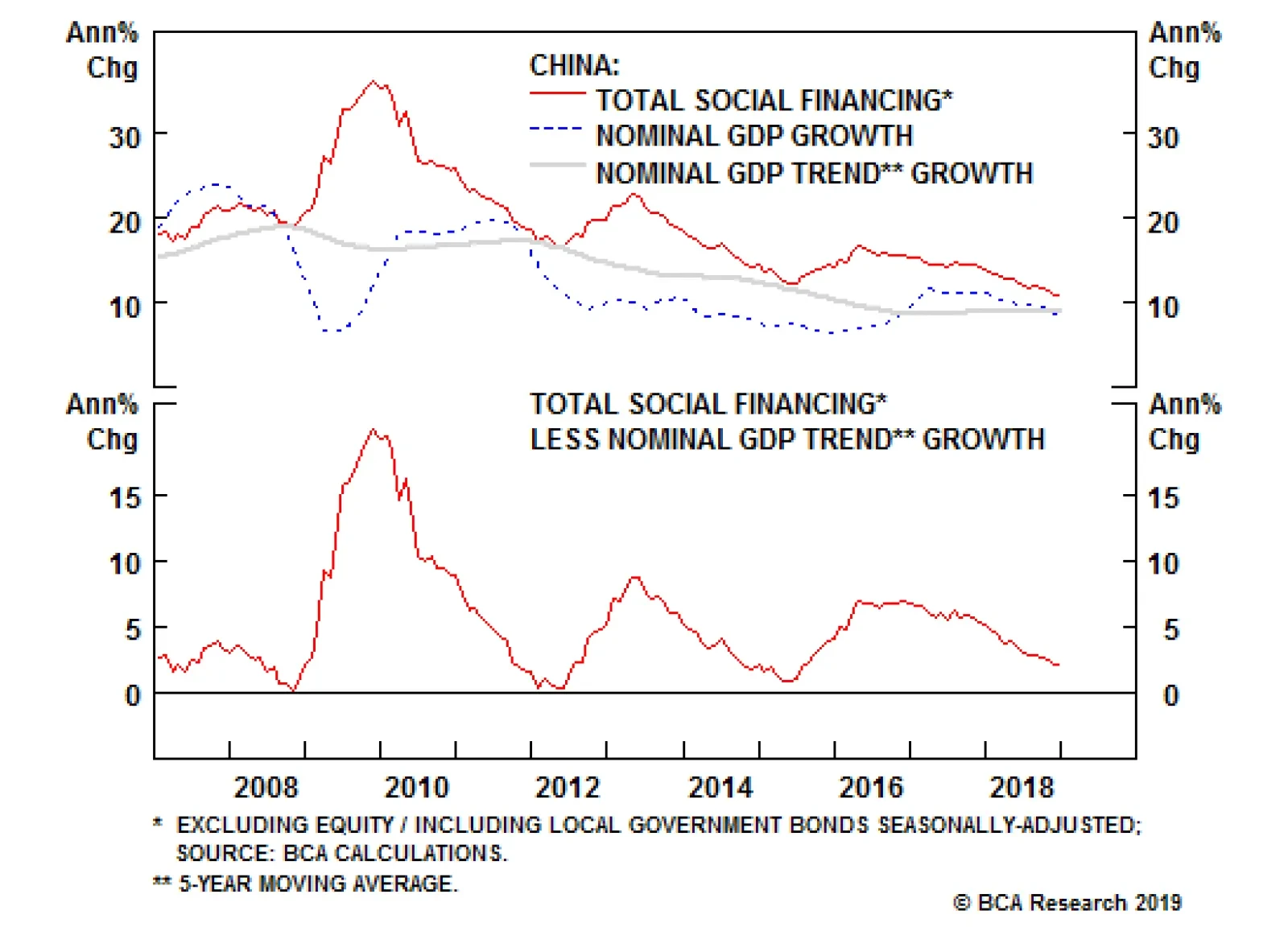
Not only does a weaker economy endanger domestic stability, but also, it puts the Chinese government in a weaker negotiating position with the Trump administration over trade. This suggests that the government will continue to ease off its deleveraging…
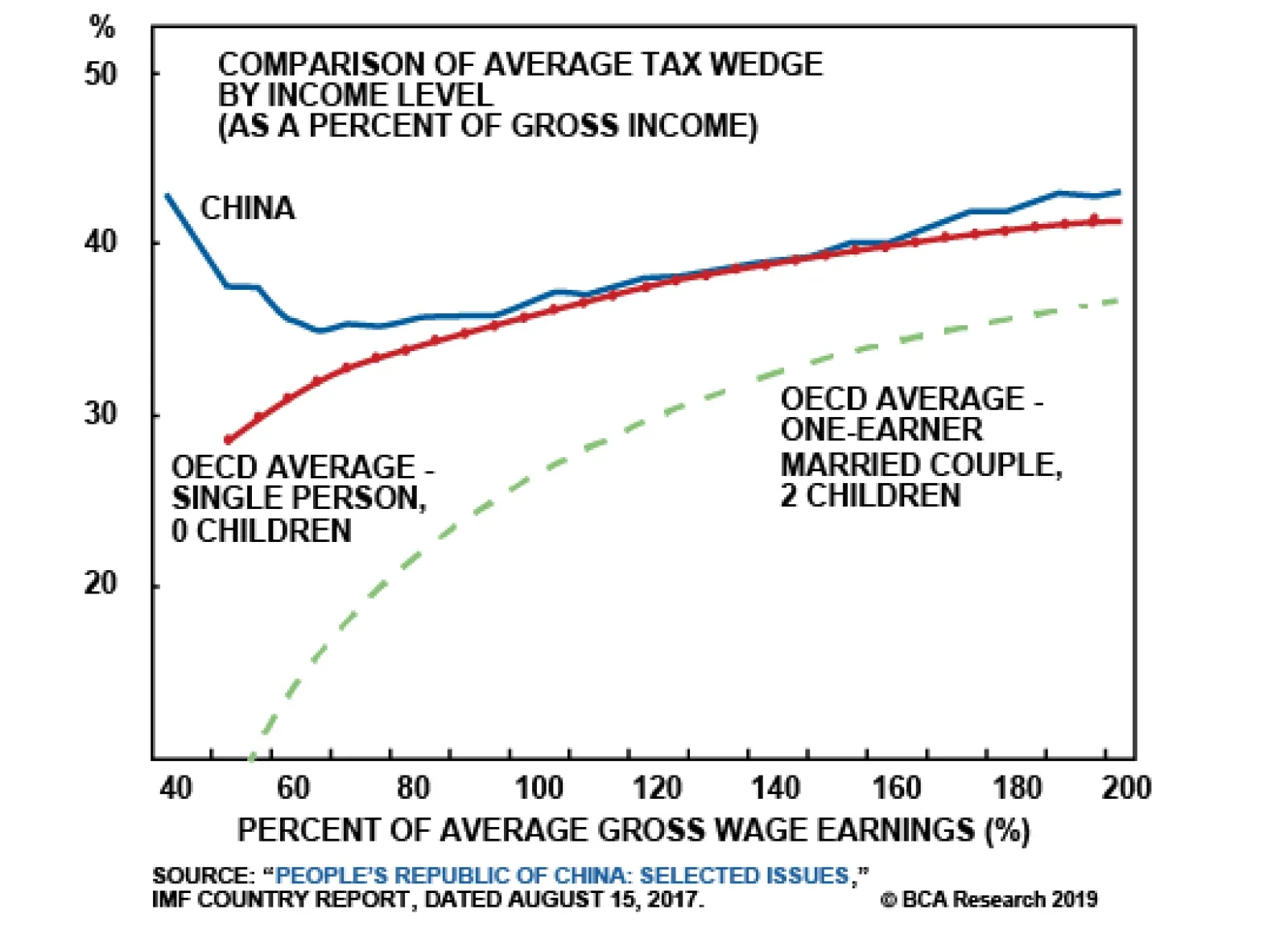
The good news is that there is some scope to do so. The Chinese income tax structure is fairly regressive. Poor households face an effective income tax rate exceeding 40%, well above OECD norms. A more progressive tax system would boost spending among poorer…