China
US financial conditions have become noticeably easier since August. The Fed has embarked on its easing cycle with a bang, sending equities higher and spreads lower, while the trade-weighted dollar gave back more than half of its year-to-date gains. The…
September’s Chinese PMIs were uninspiring. The Caixin manufacturing PMI dipped into contraction territory (50.4 to 49.3) despite expectations it would modestly improve. The alternative NBS manufacturing PMI improved from 49.1 to 49.8, above expectations,…
According to BCA Research’s Emerging Market Strategy service, the monetary and fiscal policies announced last week are unlikely to produce a meaningful business cycle recovery in China. Below are actions the authorities need to undertake for our colleagues to…
We highlighted last week that while the Politburo policy announcements are unlikely to produce a meaningful business cycle recovery in China, they nevertheless administered a shot of adrenaline to investor sentiment. Chinese equities, China-plays and other…
According to BCA Research’s European Investment Strategy service, the surprise fiscal announcement from China’s Politburo is a very different animal from previous stimulus attempts. Although the details are still vague, it adopts a much more pragmatic tone…
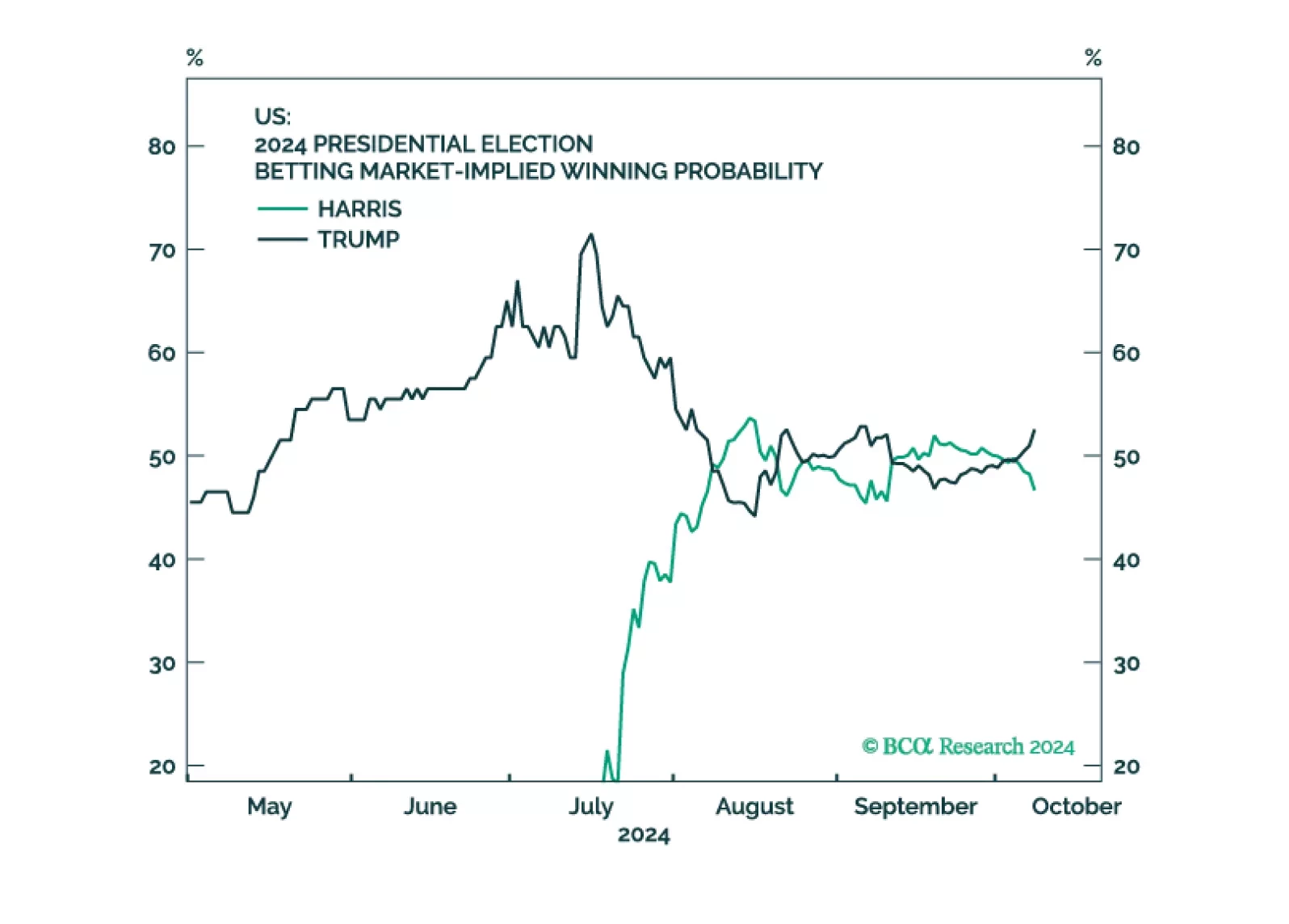
Markets are rallying on Fed rate cuts and China stimulus but there will also be October surprises ahead of the US election, which Trump could still win. Russia’s conflict with the West is escalating and the Middle East is destabilizing further. Investors should favor US bonds but they should add some risk in emerging markets in response to China’s policy turn.
Executive Summary The odds are that the adrenaline from the recent policy stimulus will be sufficient to produce a window of outperformance for Chinese equities and China-plays in financial markets. This is because the starting point for these assets is from very oversold levels. However, this adrenaline will not extend to the real economy in China. We present our checklist of what is needed for the Chinese economy to recover on a cyclical basis. Given ongoing debt deflation in the economy and depressed sentiment among households, private businesses, and local government officials, the announced stimulus measures might not be sufficient to create a cyclical recovery in the mainland economy. Bottom Line: BCA’s Emerging Markets Strategy recommends upgrading the allocation to EM in a global equity portfolio from underweight to neutral. As to Chinese stocks, we upgraded Chinese A-shares to overweight and offshore stocks to neutral relative to the global and EM benchmarks in August. This strategy remains intact. While short-term traders might consider engaging in this rally in EM and Chinese stocks, we are reluctant to institute a long position in EM and Chinese equities for medium-term investors. For short- and medium-term investors, we recommend the following relative equity trade: long Chinese stocks (any mix of A-shares and offshore stocks) / short Indian equities. Today’s Chinese Politburo announcement has excited financial markets, particularly igniting fireworks among Chinese stocks and China-plays. This news follows the PBoC policy easing announcement from earlier this week – which we addressed in a Strategy Insight. A key question now facing investors is whether Chinese policy has turned the corner and will be a meaningful source of support for the economy and financial markets. In this note, we provide an update on our latest thinking following these policy developments. Adrenaline for Financial Markets… Chart 1Chinese Stocks’ Relative Performance: A Very Low Starting Point
Chinese Stocks’ Relative Performance: A Very
Low Starting Point
Chinese Stocks’ Relative Performance: A Very
Low Starting Point
The policy announcements this week have released adrenaline into financial markets. The odds are that this fuel will be sufficient to produce a window of outperformance in Chinese equities and China-plays. The point is that Chinese share prices have become so depressed on a relative basis that it will not take much for them to outperform global and EM equities for a couple of months (Chart 1). Therefore, BCA’s Emerging Markets Strategy recommends upgrading the allocation to EM in a global equity portfolio from underweight to neutral. We have been underweight EM in a global equity portfolio since 2010, with a brief period of a neutral allocation in H2 2020 (Chart 2). As to Chinese stocks, we upgraded Chinese A-shares to overweight and offshore stocks to neutral relative to the global and EM benchmarks in August. This strategy remains intact. Chart 2Our Calls On EM Versus Global Equities
Our Calls On EM Versus Global Equities
That said, the absolute performance of EM and Chinese stocks will depend on the global risk environment. If the global risk-on trade persists, then EM and Chinese share prices will also rally in absolute terms. However, we do not have much confidence in the sustainability of the current global risk-on regime beyond the next several weeks. Chart 3Go Long Chinese / Short Indian Stocks
Go Long Chinese / Short Indian Stocks
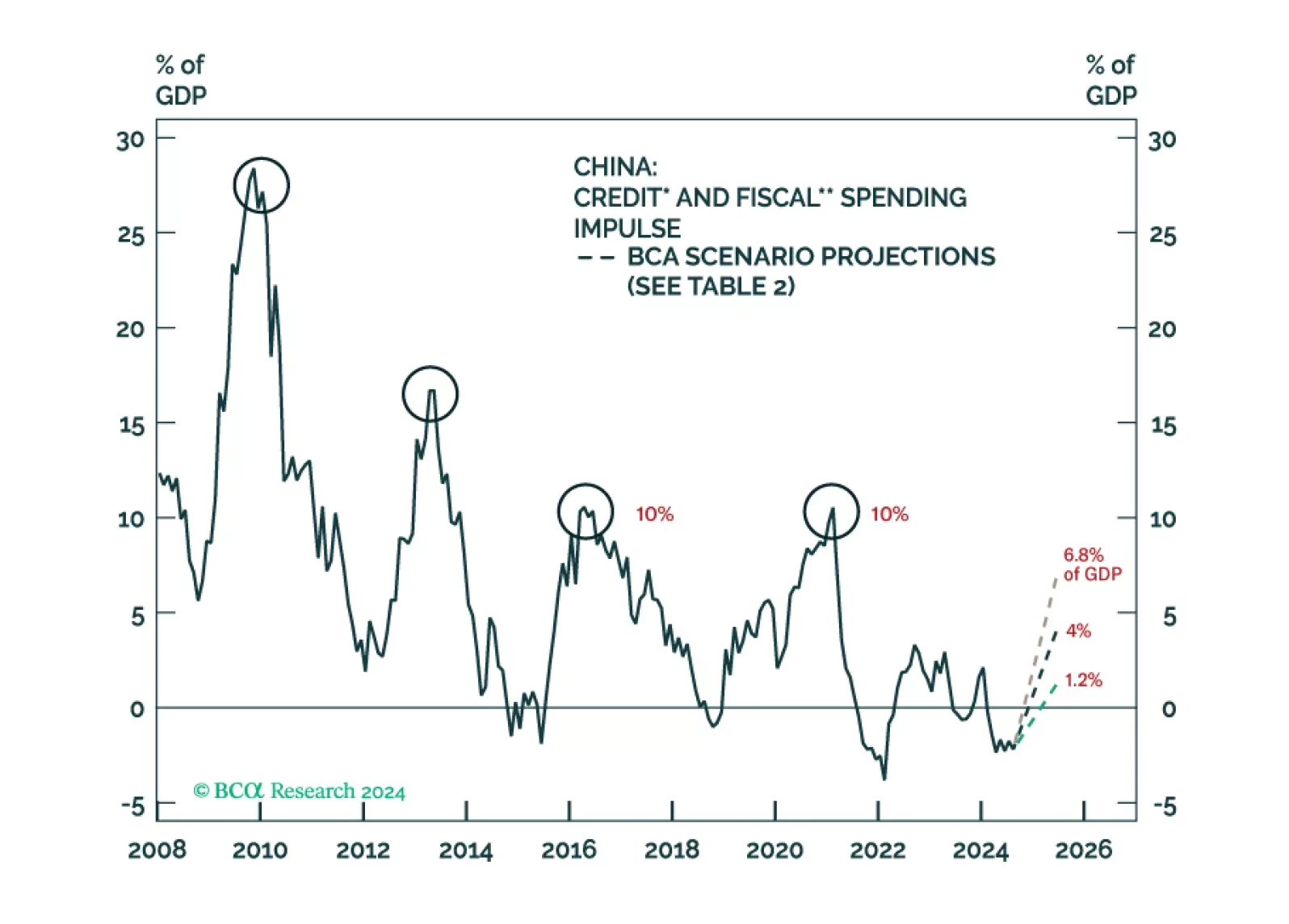
While short-term traders might consider engaging in this rally in EM and Chinese stocks, we are reluctant to institute a long position in EM and Chinese equities for medium-term investors. For short- and medium-term investors, we recommend the following relative equity trade: long Chinese stocks (any mix of A-shares and offshore stocks) / short Indian equities (Chart 3). We will publish a report on India next week. …But The Adrenaline Won’t Extend To The Chinese Economy Chart 4China’s Credit And Fiscal Spending Impulse
China’s Credit And Fiscal Spending Impulse
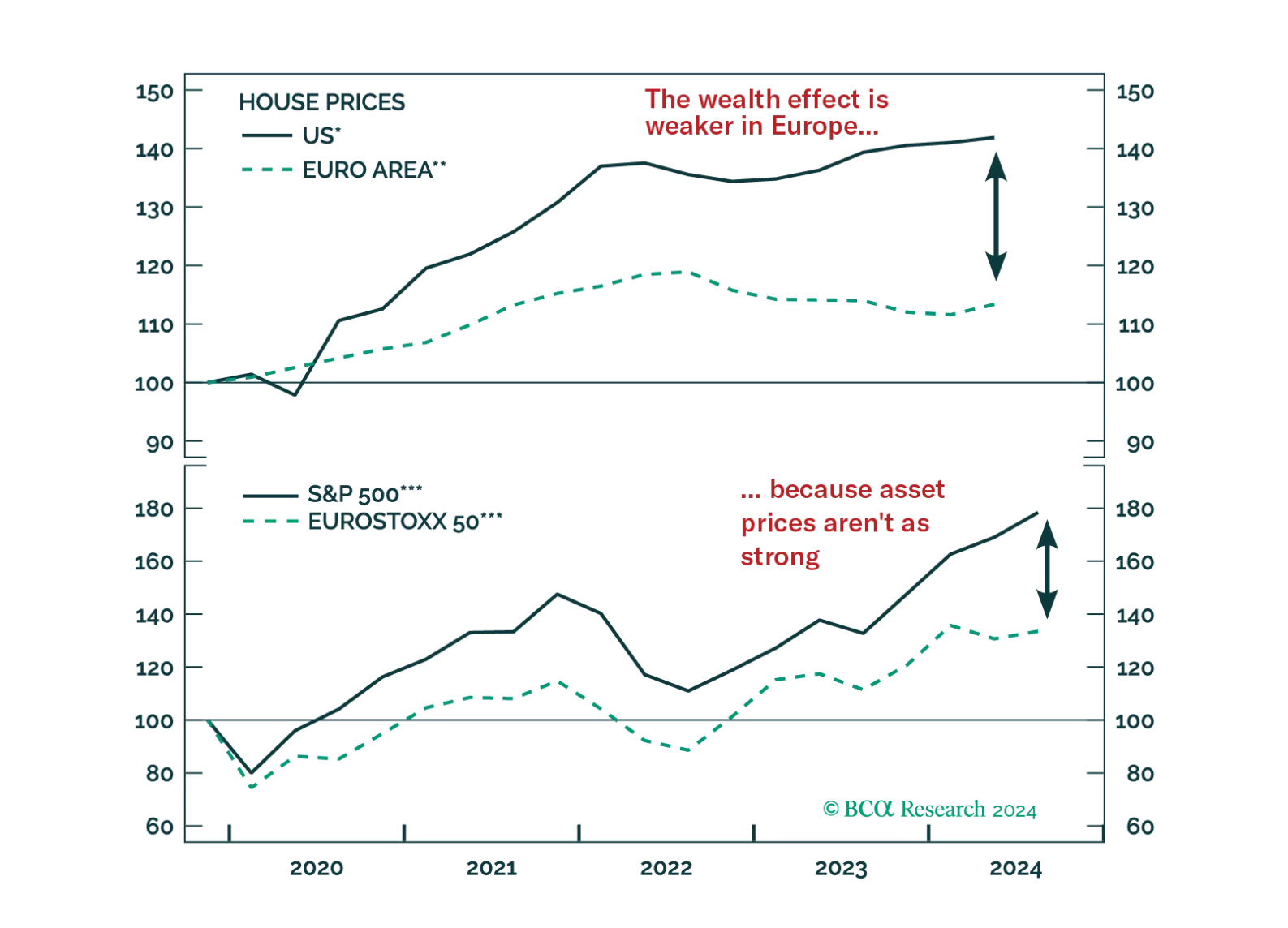
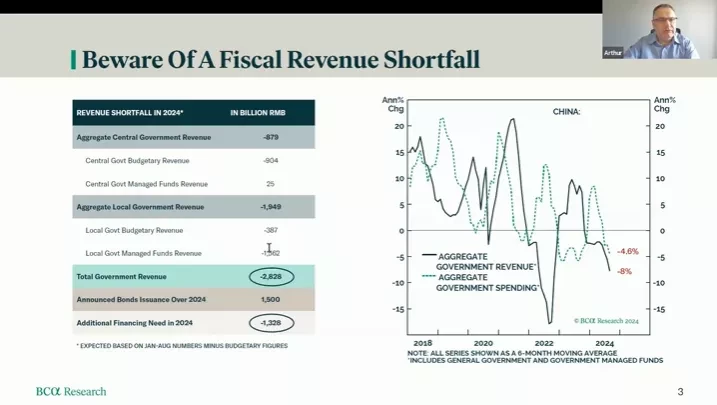
We doubt the announced measures will produce a meaningful business cycle recovery in China in the next six months. In fact, our credit and fiscal spending impulse suggests that business cycle risks are tilted to the downside in the next six months (Chart 4, top panel). Consistently, Chinese import growth will downshift over this period, as shown in the bottom panel of Chart 4. Imports are the channel through which China affects economies in the rest of the world. Therefore, a deterioration in mainland imports bodes ill for global trade in the coming months. The main takeaway from Chart 4 above is that policy stimulus works with a time lag. Any impact on Chinese domestic demand from the current round of easing will not be felt until next year. The following is our checklist of what authorities need to do for the Chinese economy to recover on a cyclical basis. Conduct large fiscal transfers to households: Reuters released an article suggesting that RMB 1 trillion (out of potential RMB 2 trillion of central government bond issuance) will be used to subsidize the trade-in and renewal of consumer goods and to upgrade large-scale business equipment. This subsidy makes up only 0.8% of GDP and thus might not be a game changer. Weak household income growth, worries about employment conditions, and negative wealth effects from low house prices are weighing on sentiment, reducing the odds that consumers will alter their spending behavior on a dime. Chart 5Unlike In 2015-17, There Are No Plans For Large QE Targeting The Property Market
Unlike In 2015-17, There Are No Plans For Large
QE Targeting The Property Market
Unlike In 2015-17, There Are No Plans For Large
QE Targeting The Property Market
Lift property prices: A large QE program targeting real estate is needed. The latest program authorities unveiled in May – which they modestly expanded this week – has yet to boost the housing market. There has been no mention of an initiative like the Pledged Supplementary Lending (PSL) program, which was used in 2015-2017 to revive the property market (Chart 5). Notably, in late 2022, authorities enacted new financing worth RMB 1.88 trillion for property developers to complete unfinished housing. This money was deployed over the course of 2023. Yet, it had little effect on the property market and the economy. Boost private business confidence: Today’s Politburo readout emphasized the need to improve business confidence, but words might not be enough to drive a turnaround. Businesspeople remain suspicious of current government policies toward large private enterprises. Despite the decline in the nominal bank lending rate, the real lending rate has increased (Chart 6). Unless policymakers successfully end deflation and produce modest inflation, real borrowing costs will not drop sufficiently to encourage borrowing and spending. Only very large fiscal spending and an aggressive QE program targeting the property market can end deflation in China. Make local government officials focus on and promote growth: The government’s statement contains many references to this matter. Yet, facts are more powerful than statements. A record high number of anticorruption cases speaks louder than the Politburo’s release, at least for now (Chart 7). Chart 6China: Lending Rates In Real Terms Are Very High
China: Lending Rates In Real Terms Are Very High
Chart 7The Anti-Corruption Campaign Has Been Heightening
The Anti-Corruption Campaign Has Been
Heightening
The Anti-Corruption Campaign Has Been
Heightening
While we may be too pessimistic on certain aspects of policy stimulus, in the aggregate, our judgment is that conditions are not yet in place to produce a cyclical recovery in China. On another note, recapitalizing state-owned banks will do little if credit demand is non-existent. In fact, bank recapitalization often entails dilution for existing shareholders. Bottom Line: Given widespread debt deflation pressures in the Chinese economy and depressed sentiment among households, private businesses, and local government officials, the odds are that it will take more than what has been announced to create a cyclical recovery in the mainland economy. That said, an improvement in investor sentiment might boost the performance of Chinese stocks over the coming months. Arthur Budaghyan Chief EM/China Strategist arthurb@bcaresearch.com Please follow me on LinkedIn
The adrenaline from the recent policy stimulus might be sufficient to produce a window of outperformance for Chinese equities and China-plays in financial markets. However, this adrenaline will not extend to China's real economy. Net-net, we are upgrading the allocation to EM in a global equity portfolio from underweight to neutral.
This week has not been short of developments on Chinese policy. After unleashing a monetary policy blitz, the authorities held an unscheduled Politburo meeting resulting in a pledge to take actions towards stabilizing the housing market and to support fiscal…