Coal
European regulatory carbon credits (EUAs) are becoming increasingly investable as an asset class. In a Special Report published last September, our Global Investment strategists agreed to the strategic bull case for EUAs, but highlighted a bearish view on…
According to BCA Research's Commodity & Energy Strategy service, Qatar will be the winner as it takes advantage of the global energy transition towards renewables and the world fragments under economic and military competition. Qatar recently…
BCA Research presents a limited monthly special series about the Nuclear Renaissance.
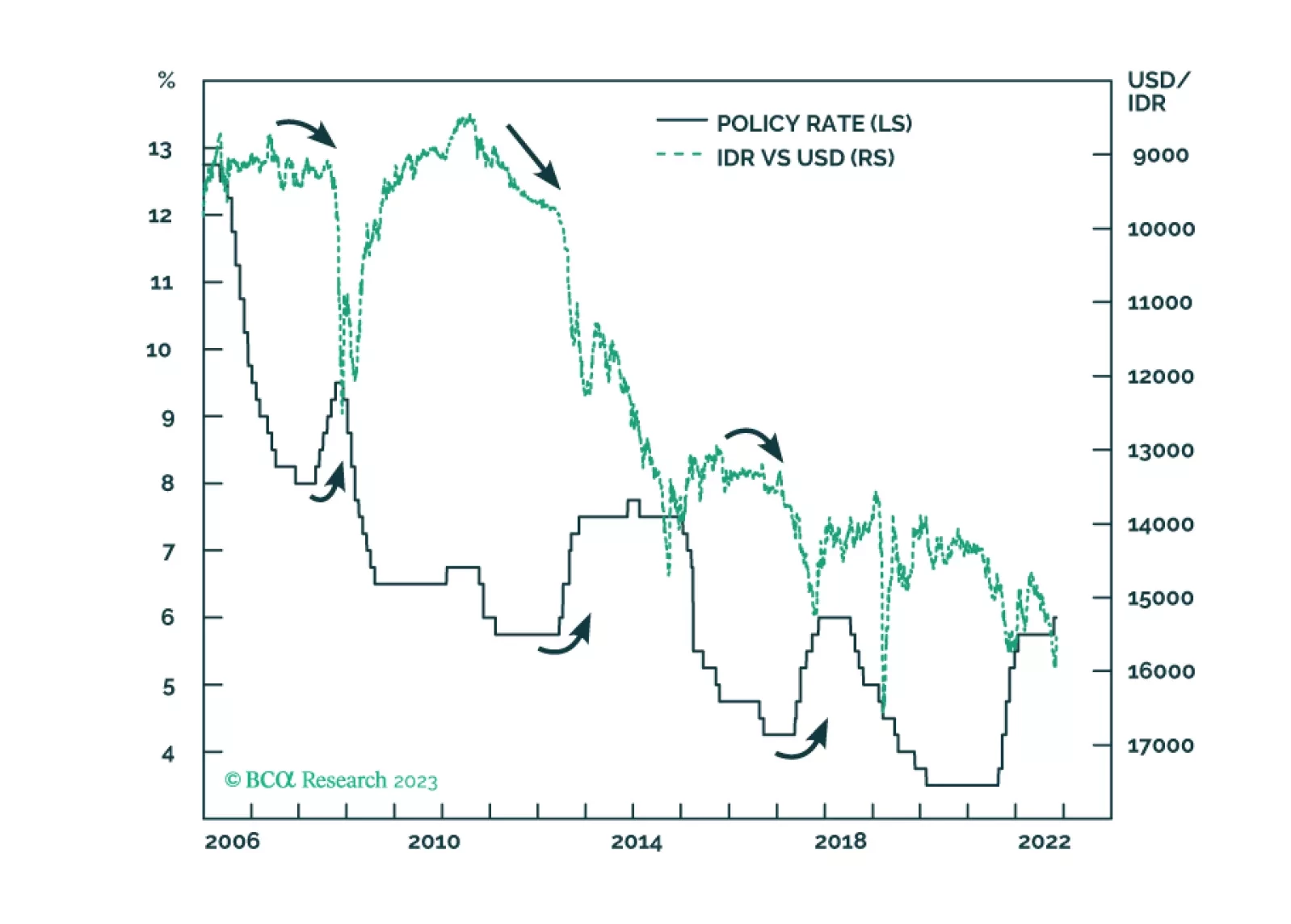
Despite very low inflation, Bank Indonesia raised its policy rates last month to support the currency. The strategy did not work before and will not work now. Stay short the rupiah.
There has been an unprecedented divergence between global and Chinese thermal coal ("coal") prices since the Russia-Ukraine war commenced in February 2022. Such a wide price gap is unsustainable. This price convergence will continue, with international prices falling faster than Chinese ones.
Listen to a short summary of this report. Executive Summary Euro Bulls Are Evaporating
Euro Bulls Are Evaporating
The euro is likely to undershoot in the near term, as the winter months approach and economic volatility in Europe rises. However, much of the euro’s troubles are well understood and discounted by financial markets. This suggests a floor closer to parity for the EUR/USD. Unlike many other developed economies, the fiscal drag in the eurozone is likely to be minimal for the rest of this year and early next year. The forces pressuring equilibrium rates lower in the periphery are slowly dissipating. That should lift the neutral rate of interest in the entire eurozone. China’s zero Covid-19 policy along with property market troubles has weighed heavily on the euro, but that could change. RECOMMENDATIONS INCEPTION LEVEL inception date RETURN Long EUR/GBP 0.846 2021-10-15 -0.13 Short EUR/JPY 141.20 2022-07-07 2.46 Bottom Line: The euro tends to be largely driven by pro-cyclical flows, which will be a positive when risk sentiment picks up. Meanwhile, making a structural case for the euro is easy when it comes to valuation. According to our in-house PPP models, an investor who buys the euro today can expect to make 6% a year over the next decade, should the euro mean revert to fair value and beyond. Our current stance is more measured because investors could see capitulation selling in the coming months. Feature Chart 1Two Decades After The Creation Of The Euro
Two Decades After The Creation Of The Euro
The creation of the euro was an ambitious project. It began with a simple idea – let’s create the biggest monetary union and everything else will follow, not least, economic might. Over the last two decades, the euro has survived, but its ambitions have been jolted by various crises. Today, the euro is sitting around where it was at the initiation of the project (Chart 1). That has been a tremendous loss in real purchasing power for many of its citizens. Given that we are back to square one, this report examines the prospects for the euro from the lens of its original ambitions, while navigating the economic and geopolitical landscape today. Surviving The Winter Chart 2A European Recession Is Well Priced In
A European Recession Is Well Priced In
Winter will be tough for eurozone citizens. But how tough? In our view, less than what the euro is pricing in. According to the ZEW sentiment index, the eurozone manufacturing PMI should be around 45 today, but sits at 49.8. The euro, which has been tracking the ZEW index tick-for-tick has already priced in a deep recession, worse than the 2020 episode (Chart 2). Bloomberg GDP growth consensus forecasts for the eurozone are still penciling in 2.8% growth for 2022, down from a high of 4%. For 2023, forecasts have hit a low of 0.8%. It is certainly possible that euro area growth undershoots this level, which will cause a knee jerk sell off in the euro. However, much of the euro’s troubles are well understood and discounted by financial markets. Natural gas storage is already close to 80%, the EU’s target, to help the eurozone navigate the winter. Coal plants are firing on all cylinders, and Germany has decided to delay the closure of its nuclear power plants. It is true that electricity prices are soaring, but part of the story has been weather-related, notably a heat wave across Europe, falling water levels along the Rhine that has delayed coal shipments, and lower wind speeds that have affected renewable energy generation. France is also having problems with nuclear power generation, due to little availability of water for cooling reactors. Looking ahead, energy markets are already discounting a steep fall in prices from the winter energy cliff (Chart 3). If that turns out to be true, it will be a welcome fillip for eurozone growth. First, it will ease the need for the ECB to tighten policy aggressively, and second, it will boost real incomes, which will support spending. This is not being discussed in financial markets today. Chart 3AFutures Markets Suggest The Energy Crunch Will Ebb
Futures Markets Suggest The Energy Crunch Will Ebb
Chart 3CFutures Markets Suggest The Energy Crunch Will Ebb
Futures Markets Suggest The Energy Crunch Will Ebb
Chart 3BFutures Markets Suggest The Energy Crunch Will Ebb
Futures Markets Suggest The Energy Crunch Will Ebb
Fiscal Policy To The Rescue? Unlike many other developed economies, the fiscal drag in the eurozone is likely to be minimal for the rest of this year and early next year (Chart 4). As funds from the next generation EU plan are being disbursed into strategic sectors, including renewable energy, Europe’s productive capital base will also improve. This is likely to have a huge multiplier effect on European growth. Chart 4AThe Fiscal Drag In The Eurozone Could Be Minimal
The Fiscal Drag In The Eurozone Could Be Minimal
Chart 4BThe Fiscal Drag In The Eurozone Could Be Minimal
The Fiscal Drag In The Eurozone Could Be Minimal
Taking a bigger-picture view, what has become evident in recent years is stronger solidarity among eurozone countries, both economically and politically. Related Report Foreign Exchange StrategyMonth In Review: Inflation Is Still Accelerating Globally Economically, the standard dilemma for the eurozone was that interest rates were too low for the most productive nation, Germany, but too expensive for others, such as Spain and Italy. As such, the euro was often caught in a tug of war between a rising equilibrium rate of interest for Germany, but a very low neutral rate for the peripheral countries. The good news is that for the eurozone, a lot of this internal rupture has been partly resolved. Labor market reforms have seen unit labor costs in Greece, Ireland, Portugal and Spain collectively contract since 2008. This has effectively eliminated the competitiveness gap with Germany, accumulated over the last two decades (Chart 5). Italy remains saddled with a rigid and less productive workforce, but the overall adjustments have still come a long way to close a key fissure plaguing the common currency area. The result has been a collapse in peripheral borrowing spreads, relative to Germany (Chart 6). Ergo, interest payments as a share of GDP are now manageable. It is true that Italy remains a basket case but the ECB’s Transmission Protection Instrument (TPI) will ensure that peripheral spreads remain well contained and a liquidity crisis (in Italy) does not morph into a solvency one. Chart 5The Periphery Is Now Competitive
The Periphery Is Now Competitive
Chart 6Peripheral Spreads Are Still Contained In Real Terms
Peripheral Spreads Are Still Contained In Real Terms
Beyond the adjustment in competitiveness, productivity among eurozone countries might also converge. Our European Investment Strategy colleagues suggest that the neutral rate is still wide between Germany and the periphery. That said, gross fixed capital formation in the periphery has been surging relative to core eurozone members (Chart 7). If this capital is deployed in the right sectors, it will have two profound impacts. First, the neutral rate of interest in the eurozone will be lifted from artificially low levels. The proverbial saying is that a chain is only as strong as its weakest link. This means that if the forces pressuring equilibrium rates lower in the periphery are slowly dissipating, that should lift the neutral rate of interest in the entire eurozone. Over a cyclical horizon, this should be unequivocally bullish for the euro. Second, and more importantly, economic solidarity among eurozone members will help ensure the survival of the euro, over the next decade and beyond. Chart 7The Periphery Could Become More Productive
The Periphery Could Become More Productive
Trading The Euro The above analysis suggests long-term investors should be buying the euro today. However, the long run can be a very long time to be offside. Our trading strategy is as follows: Over the next 6 months, stay neutral to short the euro. The economic landscape for the eurozone remains fraught with risk. This is a typical recipe for a currency to undershoot. Eurozone banks are very sensitive to economic conditions in the eurozone, and ultimately the performance of the euro, and the signal from bank shares remains negative (Chart 8). Chart 8European Banks Are Not Part Of The Agenda Watch Eurozone Banks
European Banks Are Not Part Of The Agenda Watch Eurozone Banks
Investors have been cutting their forecasts for the euro but have not yet capitulated. Bets are that the euro will be at 1.10 by the end of next year, and 14% higher in two years. A bottom will be established when investors cut their forecasts below current spot prices (Chart 9). This corroborates with data from net speculative positions that have yet to hit rock bottom. Chart 9Euro Bulls Are Evaporating
Euro Bulls Are Evaporating
Real interest rates in the euro area are still plunging across the curve, relative to the US. The two-year real yield has hit a cyclical low. Five-year, 10-year and 30-year real yields are also falling. Historically, the euro tends to trend higher when interest rate differentials are moving in favor of the eurozone (Chart 10). Chart 10AReal Rates Are Dropping In The Euro Area
Real Rates Are Dropping In The Euro Area
Chart 10BReal Rates Are Dropping In The Euro Area
Real Rates Are Dropping In The Euro Area
Hedging costs have risen tremendously, as the forward market (like investors) is already pricing in an appreciation in the euro. The embedded two-year return for EUR investors is circa 4%, in line with the carry costs (Chart 11). In real terms, the returns are closer to 9% to compensate for much higher inflation expectations in the eurozone. Higher hedging costs will dissuade foreign investors from gobbling up European assets on a hedged basis. Chart 11A 5% Rally In The Euro Is Already Anticipated
A 5% Rally In The Euro Is Already Anticipated
In short, the euro is likely to enter a capitulation phase. Our sense is that that it will push EUR/USD below parity, towards 0.98. Below that level, we believe the risk/reward profile will become much more attractive for both short- and longer-term investors. Signals From External Demand Chart 12The Euro Is Increasingly Dependant On Chinese Data
The Euro Is Increasingly Dependant On Chinese Data
The eurozone is a very open economy. Exports of goods and services represented 51% of euro area GDP in 2021. This means that what happens with external demand, especially in the US, the UK and China, matters for European growth (Chart 12). Of all its major export partners, China is the biggest question mark. China’s zero Covid-19 policy along with property market troubles has weighed heavily on the euro. Historically, the Chinese credit impulse has been a good coincident indicator for EUR/USD. Lately, that relationship has decoupled (Chart 13A). We favor the view that the credit transmission mechanism in China is merely delayed, rather than broken. For one, a rising Chinese credit impulse usually leads European exports, and this time should be no different. Chinese bond markets are also becoming more liberalized, and as such are a key signal for financial conditions in China. For over a decade, easing financial conditions have usually been a good signal that import demand is about to improve (Chart 13B). This is good news for European export demand. The bottom line is that investors are currently too pessimistic on Europe’s growth prospects at a time when a few green shoots are emerging for external demand. That may not save the euro in the near term but will be a welcome fillip for euro bulls when it does undershoot. Chart 13AThe Muse For The Euro Is Chinese Data
The Muse For The Euro Is Chinese Data
Chart 13BThe Muse For The Euro Is Chinese Data
The Muse For The Euro Is Chinese Data
Concluding Thoughts Chart 14The Goldilocks Case For The Euro
The Goldilocks Case For The Euro
The euro tends to be largely driven by pro-cyclical flows. Fortunately for investors, European equities remain unloved, given that they are trading at some of the cheapest cyclically adjusted price-to-earnings multiples in the developed world. Analysts are aggressively revising up their earnings estimates for eurozone equities, relative to the US. They might be wrong in the near term, but over a 9-to-12-month horizon, this has been a good leading indicator for the euro. Making a structural case for the euro is easy when it comes to valuation. According to our in-house PPP models, an investor who buys the euro today can expect to make 6% a year over the next decade, should the euro mean revert to fair value and beyond (Chart 14). Meanwhile, beyond the winter months, inflation could come crashing back to earth in the eurozone, which will provide underlying support for the fair value of the currency. Our near-term stance is more measured because investors are only neutral the euro, and risk reversals are not yet at a nadir. This is particularly relevant given that Europe still has a war in its backyard, with the potential of generating more market volatility ahead. Given this confluence of factors, we have chosen to play euro via two channels: Long EUR/GBP: As we argued last week, the UK has a bigger stagflation problem compared to the eurozone. This trade is also a bet on improving economic fundamentals between the eurozone and the UK, as well as a bet on policy convergence between the two economies. Short EUR/JPY: The yen is even cheaper than the euro. In a risk-off environment, EUR/JPY will sell off. In a risk-on environment, the yen can still benefit since it is oversold. Meanwhile, investors remain bullish EUR/JPY. Long EUR/USD: We will go long the euro if it breaks below 0.98. Chester Ntonifor Foreign Exchange Strategist chestern@bcaresearch.com Trades & Forecasts Strategic View Cyclical Holdings (6-18 months) Tactical Holdings (0-6 months) Limit Orders Forecast Summary
Executive Summary Europe Is Russia's Key Gas Customer
Germany Closer To Rationing Natgas
Full-on rationing of natural gas by Germany took a step closer to reality, as the standoff with Russia over its insistence on being paid in roubles for gas plays out. News that Germany initiated its first step toward rationing spiked European and UK natgas prices by more than 12% on Wednesday. Higher prices for coal, oil and renewable energy will follow, as these energy sources compete at the margin with natgas in Europe. Inflation and inflation expectations will move higher if Germany ultimately rations scarce natgas supplies. We are watching to see who blinks first – Germany or Russia. The risk of aluminum-smelter shut-downs in Europe once again is elevated. Other metals-refining operations also are at risk of shutdown if rationing is invoked. Trade difficulties arising from Russia's invasion of Ukraine and related sanctions will lead to further bottlenecks on base-metal exports from Russia, as Rusal warned this week. This will further confound the energy transition. Western governments will be forced to accelerate investments and subsidies in carbon-capture technology as fossil-fuel usage and prospects revive. Bottom Line: Fast-changing EU natural gas supply-demand dynamics are impacting competing energy and base metals markets. This is throwing up confusion around the global renewable-energy transition and extending its timetable. Fossil fuels fortunes are being revived, as a result. We remain long commodity index exposure and the equities of oil-and-gas producers and base-metals miners. Feature Events in the EU natural gas markets are changing rapidly in the wake of fast-changing developments in the Russia-Ukraine war. In the wake of these changes, economic prospects for Europe and Russia are rapidly evolving – both potentially negatively over the short run. Full-on rationing of natural gas by Germany took a step closer to reality, as its standoff with Russia over payment for gas in roubles plays out. News Germany is preparing its citizens for rationing spiked European and UK natgas prices by more than 12% Wednesday. It's not clear whether Russia or Germany are bluffing on this score. Russia's oil and gas exports last year accounted for close to 40% of the government's budget. According to Russia's central bank, crude and product revenue last year amounted to just under $180 billion, while pipeline and LNG shipments of natgas generated close to $62 billion last year. Europe is Russia's biggest natgas market, accounting for ~ 40% of its exports. However, as the relative shares of revenues indicate, natgas exports are less important to Russia than crude and liquids exports. Losing this revenue stream for a year would amount to losing ~ $25 billion of revenue, all else equal. In the event, however, the net loss might be lower, since this would put a bid under the natgas market ex-Europe, which would offset part or most of the lost natgas sales to Europe. If Russia is able to re-market those lost volumes, it could offset the loss of European sales. Knock-On Effects The immediate knock-on effect of this news turns out to be higher prices for oil, UK and European natgas. This is not unexpected, as gasoil competes at the margin with natgas in space heating markets, while competition across regions also can be expected to increase. Once again, the risk of aluminum-smelter shut-downs in Europe is elevated if rationing is imposed by Germany. Other metals-refining operations also are at risk of shutdown if rationing is invoked. Lastly, fertilizer production in Europe would be materially impacted, given some 70% of fertilizer costs are accounted for by natgas. In addition to these endogenous EU effects, trade difficulties arising from Russia's invasion of Ukraine and related sanctions will lead to further bottlenecks on base-metal exports from Russia, as Rusal warned this week.1 This will further confound the energy transition as the world's third-largest aluminum smelter faces sanctions – official and self-imposed – and the loss of inputs from Western suppliers, along with reduced access to capital and funding from the West. If, over time, Russia's base metals industries are degraded by the lack of access to capital and technology as oil and gas will be, the global renewable-energy transition will be slowed considerably. We already expect Russia's oil and gas production to fall over time due to the economic isolation created by Russia's invasion of Ukraine, rendering it a diminished member of OPEC 2.0. Russia accounts for ~ 10% of global crude oil supplies, and is the second largest producer of crude oil in the coalition. A long-term degradation of its production profile will exacerbate the persistent imbalance between demand relative to supply globally, which continues to force oil inventories lower (Chart 1). On the metals side, Russia accounts for 6%, 5% and 4% of global primary aluminum, refined nickel and copper production. Persistent supply deficits have left inventories in these markets – particularly nickel and copper – tight and getting tighter (Chart 2).2 Chart 1Oil Inventories Remain Tight...
Oil Inventories Remain Tight...
Chart 2… As Do Metals Inventories
Germany Closer To Rationing Natgas
Europe's Radical Pivot In a little over a month's time, the EU has been forced to abandon once-immutable post-Cold War beliefs shared by the electorate and politicians of all stripes. Ever-deepening commercial ties with Russia did not ensure EU energy security, nor did they obviate what arguably is any state's primary responsibility: Protecting and defending its citizens. Because of its failed engagement policy with Russia over the post-Cold War interval, the EU is forced to scramble to restore its energy production and expand its sources of energy imports. In addition, it is repeatedly asserting its intent to "double down" of the speed of its renewable-energy transition. And, last but certainly not least, it is forced to rapidly rearm itself in industrial commodity markets that are in the midst of prolonged physical deficits and inventory drawdowns.3 The Russian invasion of Ukraine spurred the EU to action on both the energy and defense fronts. It is rushing head-long into eliminating its dependence on Russia for fuel, particularly natural gas, and will pursue re-arming its member states forthwith (Chart 3). Chart 3Weaning EU Off Russian Gas Will Prove Difficult
Germany Closer To Rationing Natgas
On the energy front, the EU adopted a two-prong approach to cleave itself from Russian natgas: 1) Diversify its sources of natural gas, which largely will be in the form of liquified natural gas (LNG), and 2) doubling down on renewable energy generation. EU officials are aiming to replace two-thirds of their Russian gas imports by the end of this year, which is an ambitious target. Over the next two years or so, EU officials hope to fully wean themselves from Russian natgas via a combination of infrastructure buildouts and a renewed push to increase domestic production, which was being throttled back by earlier attempts to secure increased Russian supplies, and a strong focus on renewables. EU's US LNG Deal The EU signed a deal with the US to receive an additional 15 Bcm of natural gas in 2022, and 50 Bcm annually by 2030, which is equal to ~ 30% of the EU’s 2020 Russian gas imports. How exactly this will be done is unknown. In 2021, the EU imported 155 bcm of natgas from Russia, or more than 3x the amount being discussed with the US; 14 bcm of that was LNG.4 Just exactly what meeting of the minds was achieved between the EU and US government is totally unclear at this point. The US is not an LNG supplier, nor can it order private companies to renege on existing contacts. The US government likely will use its good offices to attempt to persuade Asian buyers to allow their contracted volumes to be diverted to European buyers, but that would, in all likelihood, mean they would switch to another fuel (e.g., coal) as an alternative if they take that deal. This would, we believe, require some sort of financial incentive to induce such behavior. US liquefaction capacity is also running at near full capacity (Chart 4). While there are projects in the pipeline, in the medium-term (2 – 5 years) the lack of export capacity will act as a constraint to the amount of LNG that can be shipped to the EU. Chart 4Europe Critical To Russia's Gas Industry
Germany Closer To Rationing Natgas
For Russia, its shipments of gas to OECD-Europe represent more than 70% of its exports (Chart 5). Arguably, Europe is just as important to Russia as Russia is to Europe. With the EU set on a course to sever ties completely, Russia will be forced to invest in pipeline capacity to take more of its gas to China via the Power of Siberia 2 pipeline. In the short-term, US LNG exports to the EU will face headwinds since much of Central and Eastern Europe rely on piped gas from Russia. As a result, many countries within Europe are not equipped with sufficient regasification facilities and are running at near peak utilization rates (Chart 6). Germany does not have any such capacity. Chart 5Not Much Room For US LNG Exports To Grow…
Germany Closer To Rationing Natgas
Chart 6…Or For Additional European LNG Imports
Germany Closer To Rationing Natgas
LNG import facilities that have additional intake capacity in the Iberian Peninsula and Eastern Europe do not have sufficient pipeline capacity to move gas inland. This will require additional infrastructure investment as well. To deal with this lack of infrastructure, Germany, Italy and the Netherlands are moving quickly to procure Floating Storage and Regasification (FSRUs) to convert LNG back to its gaseous state. While not the five-year proposition a dedicated LNG train requires to bring on line, setting up FSRUs still could be a years-long process.5 How quickly these assets can be mobilized, and the volumes they can deliver remain to be seen. Investment Implications Fast-changing EU natural gas supply-demand dynamics are impacting competing energy and base metals markets. This is throwing up confusion around the global renewable-energy transition and extending its timetable. Fossil fuels fortunes are being revived, as a result. At this point it is impossible to handicap the odds of a cut-off of Russian natgas to Europe, or its duration if it does occur. Either way, competitive suppliers to Russia – particularly US shale-gas producers selling into the LNG market and the vessels that transport it – will benefit regardless of the course taken by Germany and Russia on rationing. We remain long commodity index via the S&P GSCI and COMT ETF, and the equities of oil-and-gas producers and base-metals miners via the PICK, XME and XOP ETFs. Commodity Round-Up Energy: Bullish Oil prices were whipsawed by new reports suggesting Russia would substantially reduce its military operations in Kyiv ahead of ceasefire talks with Ukraine, only to have that speculation dashed by US officials indicating nothing had changed in the status quo to warrant such a view. Markets restored the risk premium that fell out of prices on the unwarranted speculation, with Brent prices once again above $110/bbl this week. At present, the fundamental oil picture remains tight. In the run-up to a decision from OPEC 2.0's March meeting today, we continued to expect KSA, the UAE and Kuwait to increase production by up to 1.6mm b/d this year, and another 600k b/d next year. To date, OPEC 2.0 has fallen short by ~ 1.2mm b/d since it started returning production taken off line during the pandemic. In return for higher output, we continue to expect the US to deepen its commitment to defending the Gulf Co-operation Council (GCC) states making up core-OPEC 2.0. If we do not see an increase in core-OPEC 2.0 production, we will have to re-assess our fundamental outlook on KSA's, the UAE's and Kuwait's ability to increase production. We also will have to determine whether – even if the supply is available to return to the market – these states have embraced a revenue-maximization strategy, given the fiscal breakeven price for these states now averages ~ $64/bbl. It also is possible that heavily discounted Russian crude oil – trading more than $30/bbl below Brent (vs. the standard $2.50/bbl Urals normally commands) – convinces core-OPEC 2.0 states that oil prices are not so high for large EM buyers like India and China as to create demand destruction. We believe the latter view likely is prevailing at present. We continue to expect Brent to average $93/bbl this year and next (Chart 7). Base Metals: Bullish BHP Group Ltd. will invest more than $10 billion to expand metals production over the next 50 years in Chile. The metals giant aims to stay ESG compliant, provided there is a supportive investment environment provided by the Chilean government. Resource-rich Latin American countries such as Chile and Peru have elected left-leaning governments intent on redistributing mining profits and ensuring companies comply with the ESG framework. As Chile considers raising mining royalties and redrafts its constitution, mining investment in the country has stalled. Political uncertainty in these countries has coincided with low global copper inventories (Chart 8) and high demand. Chart 7
Higher Prices Expected
Chart 8
Copper Inventories Moving Up
Robert P. Ryan Chief Commodity & Energy Strategist rryan@bcaresearch.com Footnotes 1 Please see Aluminum Giant Rusal Flags Stark Risks Triggered by War in Ukraine published by Bloomberg on March 30, 2022. 2 Please see our Special Report entitled Commodities' Watershed Moment, published on March 10, 2022. It is available at ces.bcaresearch.com. 3 Please see footnote 2. 4 Please see How Deep Is Europe's Dependence on Russian Oil? published by the Columbia Climate School on March 14, 2022. 5 Please see Europe battles to secure specialised ships to boost LNG imports published by ft.com 28 March 2022. Germany appears to be most advanced in its procurement of FSRU capacity, and is close to concluding a deal that would allow it to regasify 27 bcm annually. Investment Views and Themes Strategic Recommendations Trades Closed in 2021
Image
Executive Summary Tight Inventories Spike Metals
Commodities' Watershed Moment
Russia's war against Ukraine is a watershed moment, which will realign production, distribution and consumption of commodities globally. The development of new sources of the critical metals desperately needed to build out renewable energy grids and the drive to secure access to oil, gas and coal will intensify along political lines. China, reinforced by Russia, will lead the East, while the US and its allies will lead the West, in a redux of the Cold War. Local politics will intrude on this process, as left-of-center governments in important commodity-producing states secure their electoral victories and claim greater shares of commodity revenues. The rebuilding of defense systems, particularly in Europe, will compete with the renewable-energy transition. This will stress already-tight metals markets, where low inventories will predispose markets to higher volatility a la this week's oil, natgas and nickel price spikes. This will retard economic growth. In the short term, CO2 emissions will surge. Longer term, the transition to net-zero carbon emissions by 2050 will be pushed back years, as states compete for access to commodities. East-West trade restrictions and hoarding of commodities secured via trade within these respective blocs, as is occurring presently, will increase. Bottom Line: Russia's war against Ukraine is a watershed moment. The development of new sources of the critical metals desperately needed to build out renewable energy grids, and the drive to secure access to oil, gas and coal will intensify. China, reinforced by Russia, will lead the East, while the US and its allies will lead the West, in a redux of the Cold War. Feature Russia's war with Ukraine provoked a watershed moment for Europe: Leaders suddenly realized they had to reverse decades of energy dependence on Russia, rebuild their militaries, and sustain a massive buildout of the continent's renewable-energy generation and grid. This occurred as inventories of the basic commodities required to achieve all of these objectives were stretched so tight that the mere threat of the cutoff of pipeline natural gas was enough to send benchmark EU natgas prices to a record $113/MMBtu, up nearly 80% from the previous day's close before it settled back to still-elevated levels (Chart 1). Oil inventories also were stretched extremely thin even before Russia launched its invasion of Ukraine 24 February (Chart 2). The situation is not improving, since, in the wake of the Ukraine war, numerous refiners and trading companies now are observing self-imposed sanctions against taking any Russian oil or refined products. It is worthwhile remembering this began before the US and UK announced they would ban all imports of Russian material this week.1 This will stretch supply chains by unknow durations – the movement of crude from Russia to a refiner could take months instead of weeks, until new trade patterns are established. Chart 1Little Flex In EU Gas Inventories
Commodities' Watershed Moment
Chart 2Little Flex In EU Gas Inventories
Little Flex In EU Gas Inventories
Global economic and policy uncertainty is massively elevated, with percent changes in oil and gas prices swinging on a double-digit basis daily. This makes it extremely difficult to bid or offer oil cargoes in the physical market or make markets (i.e., bid or offer) in the futures markets, which has the effect of compounding uncertainty and volatility. Fundamentals – supply, demand and inventories – take a back seat to fear and uncertainty in such markets. This makes it virtually impossible to assign a probability to any price outcomes based on supply and demand – the true definition of uncertainty in the Frank Knight sense – and to make long-term capex decisions over the long term.2 We raised our 2022 and 2023 Brent forecasts on the back of the massive uncertainty in the markets to $90/bbl and $85/bbl, respectively, right after Russia's invasion of Ukraine. We assume 1Q22 Brent will average $100/bbl. We expect core OPEC 2.0 producers – Saudi Arabia, UAE and Kuwait – will increase production beginning in 2Q22; US shale-oil output will rise, and ~ 1.2mm b/d of Iranian production will return to market in 2H22. Among the risks to our forecasts are a failure by core OPEC 2.0 to lift output (we expect an announcement at the end of this month when the producer coalition meets); lower-than-expected US shale output, and a failure to resolve the Iran nuclear deal with the US. Our modeling indicated these outcomes could lift Brent to between $120/bbl and $140/bbl by 2023 (Chart 3). We will be updating our forecasts next week.3 Chart 3Brent Forwards Lift
Brent Forwards Lift
Brent Forwards Lift
EU's Watershed Metals Moment EU leadership is setting out to reverse decades of energy dependence on Russia, rebuild their militaries, and sustain a massive buildout of the continent's renewable-energy grid, all a result of the Ukraine war. This will require massive investment in metals mining and refining, along with steel-making capacity. Already, Germany is pledging to increase LNG import capacity and measures to reduce its dependence on Russian natural gas by 75% this year.4 The EU is looking to restore its natgas inventories to 90% of capacity before next winter, and has pledged to double down on renewables, in order to remove member-state dependence on Russian energy exports.5 These ambitious goals are up against the hard reality of scarce base metals supply globally. This will be exacerbated going forward by actions taken by and against Russia. The Russia-Ukraine crisis will destabilize metal markets, given supply uncertainty from Russia and its contribution to global supply. The commodities heavyweight constitutes 6%, 5% and 4% of global primary aluminum, refined nickel and copper production. Against the backdrop of very low global inventories in these metals (Chart 4), the prices of all three hit record highs over the last few days due to uncertain supply (Chart 5). LME nickel prices more than quadrupled on Tuesday as traders rushed to cover short positions and margin calls. Chart 4Low Inventories...
Low Inventories...
Low Inventories...
Chart 5...Lead To Price Volatility
...Lead To Price Volatility
Uncertainty has engulfed metal markets, with a Western ban on Russian metal imports still a possibility. Putin’s announcement regarding raw material export restrictions will further fuel supply uncertainty.6 As in the case of oil, private entities’ self-sanctioning, sanctions on the Russian financial system, and war-related supply chain disruptions are causing current Russian metal export disruptions.7 So far, Western sanctions on commodities have not directly interfered with metal flows from Russia. But markets are taking it day to day. Supply disruptions and sanctions force the formation of new trade patterns, as private entities aim to maximize arbitrage opportunities. For example, high European aluminum price spreads incentivized shipments from China, the world’s largest producer and consumer of refined aluminum. Normally, Europe relies on Russia for aluminum supplies. Rising European physical premiums for delivered metal, caused by Russian export disruptions, will see trading companies take advantage of arbitrage opportunities in other commodities as well. Europe's Risk Profile Rising Since the Ukraine war began, rising European physical premiums in commodities ranging from metals to natgas indicate the continent – more so than others – is particularly vulnerable to Russian export disruptions. Europe’s reliance on Russian energy and its supply disruptions will raise operating costs for smelters and refiners on the continent, threatening smelter shutdowns similar to those we saw this past winter. Markets were expecting power price relief over the warmer months and higher smelting activity. Elevated fuel and power prices, however, will constrain metals refining in Europe, and could shut or close even more smelters, keeping refined metals supply scarce and prices high. Rebuilding Europe's Defenses EU leaders are scheduled to take up a new energy and defense funding proposal today, which media reports are describing as "massive" (no detail provided ahead of the meeting, of course). This program reportedly will be akin to the EU's $2 trillion COVID-relief fund.8 The EU's fast response to defense shortfalls comes against the backdrop discussed above regarding super-tight metals markets, which now face a further complication of unpredictable local politics in metals-producing states. Some of these states have voted left-of-center governments into office, which now appear to be intent on nationalizing mining operations.9 Chile, e.g., accounts for ~ 30% of global copper ore output, and is in the process of re-writing its constitution, which will change tax and royalty law, and could pave the way for nationalization of copper and lithium mines. This political risk compounds any long-term planning operations by consumers like the EU and producers. Investment Implications Energy markets – broadly defined to include oil, gas and coal along with the base metals required for renewables and their supporting grids and electric vehicles – are being rocked by Russia's war with Ukraine. Base metals, in particular, will have to find price levels that destroy demand among competing uses, if the EU's dual-track plan to build out its renewables generation and restore a military capability is approved. A "massive" funding effort in Europe, coupled with equally massive efforts in the US and China – both intent on building out their renewable generation and grids, as well as expanding their defensive capabilities – will be extremely difficult to pull off. Critical base metals inventories remain low, and prices are high because demand exceeds supply for the foreseeable future (Chart 6). Chart 6Tight Inventories Spike Metals
Commodities' Watershed Moment
The EU will join a world in which the other two great economic centers – the US and China – will engage in a geopolitical competition over access to and control of scarce base metals, oil, gas and coal resources. Russia will remain aggressive toward the West, at least until the Putin regime falls, and will play an ancillary role to China. Fossil fuels and base metals have been starved for capex for more than a decade. Governmental pronouncements will not reverse this. These markets will remain tight, and will get tighter in order to allocate increasingly scarce supply with rapidly growing demand. As such, we remain long commodity-index exposure (S&P GSCI and the COMT ETF), along with equity exposure to oil and gas producers via the XOP ETF, and the XME and PICK ETFs to retain exposure to base metals and bulks producers and traders. Robert P. Ryan Chief Commodity & Energy Strategist rryan@bcaresearch.com Ashwin Shyam Research Associate Commodity & Energy Strategy ashwin.shyam@bcaresearch.com Footnotes 1 Please see Russian tankers at sea despite ‘big unknown’ over who will buy oil, published by ft.com on March 7, 2022. 2 Please see Explained: Knightian uncertainty, published by mit.edu for discussion. 3 Please see Oil Risk Premium Abates, But Still Remains, which we published on February 25, 2022. 4 Please see Germany Revives LNG Import Plans to Cut Reliance on Russian Natural Gas in Marked Policy Shift, published by naturalgasintel.com on March 1, 2022. 5 Please see Climate change: EU unveils plan to end reliance on Russian gas, published by bbc.co.uk on March 8, 2022, and The EU plan to drastically ramp renewables to replace Russian gas, published by pv-magazine.com on March 9, 2022. 6 Please see Russia to Omit Raw Material Exports but Omits Details, published by Bloomberg on March 9, 2022. 7 Please see here for Which companies have stopped doing business with Russia? 8 Please see Ukraine: ECB governing council to meet as crisis intensifies, published on March 8, 2022 by greencentralbanking.com. 9 Please see Chile a step closer to nationalizing copper and lithium, published by mining.com on March 7, 2022, and Add Local Politics To Copper Supply Risks, which we published on November 25, 2021. Investment Views and Themes Recommendations Strategic Recommendations
Highlights Global equities are poised to deliver mid-to-high single-digit returns this year, with the outlook turning bleaker in 2023 and beyond. Non-US markets are likely to outperform. We examine the four pillars that have historically underpinned stock market performance. Pillar 1: Technically, the outlook for equities is modestly bullish, as investor sentiment is nowhere near as optimistic as it usually gets near market tops. Pillar 2: The outlook for economic growth and corporate earnings is modestly bullish as well. While global growth is slowing, it will remain solidly above trend in 2022. Pillar 3: Monetary and financial conditions are neutral. The Fed and a number of other central banks are set to raise rates and begin unwinding asset purchases this year. However, monetary policy will remain highly accommodative well into 2023. Pillar 4: Valuations are bearish in the US and neutral elsewhere. Investors should avoid tech stocks in 2022, focusing instead on banks and deep cyclicals, which are more attractively priced. The Bedrock For Equities In assessing the outlook for the stock market, our research has focused on four pillars: 1) Sentiment and other technical factors, which are most pertinent for stocks over short-term horizons of about three months; 2) cyclical fluctuations in economic growth and corporate earnings, which tend to dictate the path for stocks over medium-term horizons of about 12 months; 3) monetary and financial conditions, which are also most relevant over medium-term horizons; and finally 4) valuations, which tend to drive stocks over the long run. In this report, we examine all four pillars, concluding that global equities are likely to deliver mid-to-high single-digit returns this year, with the outlook turning bleaker in 2023 and beyond. Pillar 1: Sentiment And Other Technical Factors (Modestly Bullish) Chart 1US Equities: Breadth Is A Concern
US Equities: Breadth Is A Concern
Scaling The Wall Of Worry Stocks started the year on a high note, before tumbling on Wednesday following the release of the Fed minutes. Market breadth going into the year was quite poor. Even as the S&P 500 hit a record high on Tuesday, only 57% of NYSE stocks and 38% of NASDAQ stocks were trading above their 200-day moving averages compared to over 90% at the start of 2021 (Chart 1). The US stock market had become increasingly supported by a handful of mega-cap tech stocks, a potentially dangerous situation in an environment where bond yields are rising and stay-at-home restrictions are apt to ease (more on this later). That said, market tops often occur when sentiment reaches euphoric levels. That was not the case going into 2022 and it is certainly not the case after this week's sell-off. The number of bears exceeded the number of bulls in the AAII survey this week and in six of the past seven weeks (Chart 2). The share of financial advisors registering a bullish bias declined by 25 percentage points over the course of 2021 in the Investors Intelligence poll. Option pricing is far from complacent. The VIX stands at 19.6, above its post-GFC median of 16.7. According to the Minneapolis Fed’s market-based probabilities model, the market was discounting a slightly negative 12-month return for the S&P 500 as of end-2021, with a 3.6 percentage-point larger chance of a 20% decline in the index than a 20% increase (Chart 3). Chart 3Option Pricing Is Not Pointing To Elevated Complacency
Option Pricing Is Not Pointing To Elevated Complacency
Chart 2Sentiment Is Not Exceptionally Bullish, Despite The S&P 500 Trading Close To All-Time Highs
Sentiment Is Not Exceptionally Bullish, Despite The S&P 500 Trading Close To All-Time Highs
Equities do best when sentiment is bearish but improving (Chart 4). With bulls in short supply, stocks can continue to climb the proverbial wall of worry. Whither The January Effect? Historically, stocks have fared better between October and April than between May and September (Chart 5). One caveat is that the January effect, which often saw stocks rally at the start of the year, has disappeared. In fact, the S&P 500 has fallen in January by an average annualized rate of 5.2% since 2000 (Table 1). Other less well-known calendar effects – such as the tendency for stocks to underperform on Mondays but outperform on the first trading day of each month – have persisted, however.
Chart 4
Chart 5
Table 1Calendar Effects
The Four Pillars Of The Stock Market
Bottom Line: January trading may be choppy, but stocks should rise over the next few months as more bears join the bullish camp. Last year’s losers are likely to outperform last year’s winners. Pillar 2: Economic Growth And Corporate Earnings (Modestly Bullish) Economic Growth And Earnings: Joined At The Hip The business cycle is the most important driver of stocks over medium-term horizons of about 12 months. The reason is evident in Chart 6: Corporate earnings tend to track key business cycle indicators such as the ISM manufacturing index, industrial production, business sales, and global trade. Chart 6The Business Cycle Is The Most Important Driver Of Stocks Over Medium-Term Horizons
The Business Cycle Is The Most Important Driver Of Stocks Over Medium-Term Horizons
Chart 7PMIs Signaling Above-Trend Growth
PMIs Signaling Above-Trend Growth
Global growth peaked in 2021 but should stay solidly above trend in 2022. Both the service and manufacturing PMIs remain in expansionary territory (Chart 7). The forward-looking new orders component of the ISM exceeded 60 for the second straight month in December. The Bloomberg consensus is for real GDP to rise by 3.9% in the G7 in 2022, well above the OECD’s estimate of trend G7 growth of 1.4% (Chart 8). Global earnings are expected to increase by 7.1%, rising 7.5% in the US and 6.7% abroad (Chart 9). Our sense is that both economic growth and earnings will surprise to the upside in 2022. Chart 9Analysts Expect Single-Digit Earnings Growth
Analysts Expect Single-Digit Earnings Growth
Chart 8
Plenty Of Pent-Up Demand For Both Consumer And Capital Goods US households are sitting on $2.3 trillion in excess savings (Chart 10). Around half of these savings will be spent over the next few years, helping to drive demand. Households in the other major advanced economies have also buttressed their balance sheets. Chart 10Plenty Of Pent-Up Demand
Plenty Of Pent-Up Demand
After two decades of subdued corporate investment, capital goods orders have soared. This bodes well for capex in 2022. Inventories remain at rock-bottom levels, which implies that output will need to exceed spending for the foreseeable future (Chart 11). On the residential housing side, both the US homeowner vacancy rate and the inventory of homes for sale are near multi-decade lows. Building permits are 11% above pre-pandemic levels (Chart 12). Chart 11Business Investment Should Be Strong In 2022
Business Investment Should Be Strong In 2022
Chart 12Residential Construction Will Remain Well Supported
Residential Construction Will Remain Well Supported
Chart 13China's Credit Impulse Has Bottomed
China's Credit Impulse Has Bottomed
Chinese Growth To Rebound, Europe To Benefit From Lower Natural Gas Prices Chinese credit growth decelerated last year. However, the 6-month credit impulse has bottomed, and the 12-month impulse is sure to follow (Chart 13). Chinese coal prices have collapsed following the government’s decision to instruct 170 mines to expand capacity (Chart 14). China generates 63% of its electricity from coal. Lower energy prices and increased stimulus should support Chinese industrial activity in 2022. Like China, Europe will benefit from lower energy costs. Natural gas prices have fallen by nearly 50% from their peak on December 21st. A shrinking energy bill will support the euro (Chart 15). Chart 14Coal Prices Are Renormalizing In China
Coal Prices Are Renormalizing In China
Chart 15A Shrinking Energy Bill Will Support The Euro
A Shrinking Energy Bill Will Support The Euro
Chart 16
Omicron Or Omicold? While the Omicron wave has led to an unprecedented spike in new cases across many countries, the economic fallout will be limited. The new variant is more contagious but significantly less lethal than previous ones. In South Africa, it blew through the population without triggering a major increase in mortality (Chart 16). Preliminary data suggest that exposure to Omicron confers at least partial immunity against Delta. The general tendency is for viral strains to become less lethal over time. After all, a virus that kills its host also kills itself. Given that Omicron is crowding out more dangerous strains such as Delta, any future variant is likely to emanate from Omicron; and odds are this new variant will be even milder than Omicron. Meanwhile, new antiviral drugs are starting to hit the market. Pfizer claims that its new drug, Paxlovid, cuts the risk of hospitalization by almost 90% if taken within five days from the onset of symptoms. Bottom Line: While global growth has peaked and the pandemic remains a risk, growth should stay well above trend in the major economies in 2022, fueling further gains in corporate earnings and equity prices. Pillar 3: Monetary And Financial Factors (Neutral) Chart 17The Overall Stance Of Monetary Policy Will Not Return To Pre-Pandemic Levels For At Least Another 12 Months
The Overall Stance Of Monetary Policy Will Not Return To Pre-Pandemic Levels For At Least Another 12 Months
Tighter But Not Tight Monetary and financial factors help govern the direction of equity prices both because they influence economic growth and also because they affect the earnings multiple at which stocks trade. There is little doubt that a number of central banks, including the Federal Reserve, are looking to dial back monetary stimulus. However, there is a big difference between tighter monetary policy and tight policy. Even if the FOMC were to raise rates three times in 2022, as the market is currently discounting, the fed funds rate would still be half of what it was on the eve of the pandemic (Chart 17). Likewise, even if the Fed were to allow maturing assets to run off in the middle of this year, as the minutes of the December FOMC meeting suggest is likely, the size of the Fed’s balance sheet will probably not return to pre-pandemic levels until the second half of this decade. A Higher Neutral Rate We have argued in the past that the neutral rate of interest in the US is higher than widely believed. This implies that the overall stance of monetary policy remains exceptionally stimulative. Historically, stocks have shrugged off rising bond yields, as long as yields did not increase to prohibitively high levels (Table 2). Table 2As Long As Bond Yields Don’t Rise Into Restrictive Territory, Stocks Will Recover
The Four Pillars Of The Stock Market
If the neutral rate ends up being higher than the Fed supposes, the danger is that monetary policy will stay too loose for too long. The question is one of timing. The good news is that inflation should recede in the US in 2022, as supply-chain bottlenecks ease and spending shifts back from goods to services. The bad news is that the respite from inflation will not last. As discussed in Section II of our recently-published 2022 Strategy Outlook, inflation will resume its upward trajectory in mid-2023 on the back of a tightening labor market and a budding price-wage spiral. This second inflationary wave could force the Fed to turn much more aggressive, spelling the end of the equity bull market. Bottom Line: While the Fed is gearing up to raise rates and trim the size of its balance sheet, monetary policy in the US and in other major economies will remain highly accommodative in 2022. US policy could turn more restrictive in 2023 as a second wave of inflation forces a more aggressive response from the Fed. Pillar 4: Valuations (Bearish In The US; Neutral Elsewhere) US Stocks Are Looking Pricey… While valuations are a poor timing tool in the short run, they are an excellent forecaster of stock prices in the long run. Chart 18 shows that the Shiller PE ratio has reliably predicted the 10-year return on equities. Today, the Shiller PE is consistent with total real returns of close to zero over the next decade.
Chart 18
Investors’ allocation to stocks has also predicted the direction of equity prices (Chart 19). According to the Federal Reserve, US households held a record high 41% of their financial assets in equities as of the third quarter of 2021. If history is any guide, this would also correspond to near-zero long-term returns on stocks. Chart 19Valuations Matter For Long-Term Returns (II)
Valuations Matter For Long-Term Returns (II)
… But There Is More Value Abroad Valuations outside the US are more reasonable. Whereas US stocks trade at a Shiller PE ratio of 37, non-US stocks trade at 20-times their 10-year average earnings. Other valuation measures such as price-to-book, price-to-sales, and dividend yield tell a similar story (Chart 20). Chart 20AUS Stocks Are Trading At A Significant Premium To Their Non-US Peers (I)
US Stocks Are Trading At A Significant Premium To Their Non-US Peers (I)
Chart 20BUS Stocks Are Trading At A Significant Premium To Their Non-US Peers (II)
US Stocks Are Trading At A Significant Premium To Their Non-US Peers (II)
Cyclicals And Banks Overrepresented Abroad Our preferred sector skew for 2022 favors non-US equities. Increased capital spending in developed economies and incremental Chinese stimulus should boost industrial stocks and other deep cyclicals, which are overrepresented outside the US (Table 3). Banks are also heavily weighted in overseas markets; they should also do well in response to faster-than-expected growth and rising bond yields (Chart 21). Table 3Deep Cyclicals And Financials Are Overrepresented Outside The US
The Four Pillars Of The Stock Market
Chart 21Rising Bond Yields Will Help Bank Shares
Rising Bond Yields Will Help Bank Shares
Bottom Line: Valuations are more appealing outside the US, and with deep cyclicals and banks set to outperform tech over the coming months, overseas markets are the place to be in 2022. Peter Berezin Chief Global Strategist peterb@bcaresearch.com Global Investment Strategy View Matrix
Image
Special Trade Recommendations
Image
Current MacroQuant Model Scores
Image
Dear Client, Next week I will be hosting and attending client events, both virtual and in person. Our next report, on November 24 will be a recap of my observations from the meetings with our clients. Best regards, Jing Sima China Strategist Executive Summary Chart Of The DayThe Gap Between Chinese Manufacturing Input And Output Prices Reached Multi-Year High
The Gap Between Chinese Manufacturing Input And Output Prices Reached Multi-Year High
Producer price inflation in China will likely peak in the next two quarters, but inflation could remain elevated well into 2022. Chinese producers will continue to pass on inflation to domestic and foreign consumers. Core CPI is only a notch below its pre-pandemic level; rising energy and food prices, along with improved service sector consumption, will push up headline consumer prices next year. Lack of meaningful policy easing is creating an air pocket for China’s economy, with significant near-term risks for a faster-than-expected economic slowdown. We continue to prefer the CSI500 Index over the broader onshore market.
In Limbo
In Limbo
Bottom Line: China’s business cycle has rapidly matured while inflation remains a risk. We are still underweight Chinese equities in a global portfolio. Within Chinese stocks, we continue to favor CSI500 Index which has a greater exposure to external demand. Feature Chart 1Persistently Negative Economic Surprises
Persistently Negative Economic Surprises
China’s economic conditions deteriorated in the third quarter. Chart 1 shows that the nation’s economic surprise index remains in deep contraction. However, the combination of power shortages and persistent supply-side price pressures has limited policy choices, particularly the traditional measures used to stimulate the economy. We are closely monitoring the BCA China Play Index and the relative performance of domestic infrastructure stocks versus global equities as proxies for reflation; neither is signaling a significant improvement (Chart 2). The outlook for Chinese stocks in the next 6 to 12 months remains dim. Chinese corporate profit growth has peaked, and input cost pressure on domestic producers may prove to be stickier than the market has currently priced in (Chart 3). Chart 2Reflation Proxies Are Not Signaling A Major Economic Upturn
Reflation Proxies Are Not Signaling A Major Economic Upturn
Chart 3Corporate Profit Growth Has Peaked
Corporate Profit Growth Has Peaked
Producer Price Inflation Remains A Near-Term Risk China’s producer price index (PPI) inflation may stay high longer than the market is expecting. Supply-side pressures and bottlenecks will abate, but perhaps not as fast as investors expect. Moreover, energy prices will likely remain elevated into 2022 and labor shortages in the urban areas will further exacerbate inflationary pressures. As discussed in a previous report, the surge in China’s manufacturing output and prices has been driven by strong US consumer demand for goods. Robust external demand this year occurred as China’s industrial sector had gone through years of capacity reduction and domestic de-carbonization efforts gained momentum. Chart 4Expanding Mining Capacity Takes Time
Expanding Mining Capacity Takes Time
Capacity in the mining sector will expand in the next 6 to 12 months if the power crunch persists. However, the 2015/16 supply-side reforms significantly reduced China’s upstream industry’s capability to produce. Given the capital-intensive nature of upstream industries, expanding production output often takes a long time. Chart 4 shows the significant lag between mining’s higher product prices, which indicate rising demand and tighter supply, and improved output and investment in the sector. The industrial sector’s capacity utilization rate remains elevated. China’s manufacturers can ramp up output more easily compared with mining enterprises. However, both manufacturing investment growth and output in volume have been falling (Chart 5). The wide gap between manufacturing input and output prices means that the profit margin among producers of manufacturing goods has been squeezed, giving them little incentive to expand business operations (Chart 6). Chart 5Manufacturing Investment Growth And Output Volume Have Been Falling
Manufacturing Investment Growth And Output Volume Have Been Falling
Chart 6The Gap Between Chinese Manufacturing Input And Output Prices Reached Multi-Year High
The Gap Between Chinese Manufacturing Input And Output Prices Reached Multi-Year High
In addition, PPI inflation may be slow to decline for the following reasons: Coal futures prices have been clobbered since mid-October in the wake of government regulatory measures to curb speculation in the domestic commodity exchange market (Chart 7). However, the plunge does not solve the supply shortage issue. Coal prices at China’s major ports have been trending sideways and remain at historic highs (Chart 8). Chart 7Regulators Have Squashed Coal Price Speculations In Commodity Exchanges...
Regulators Have Squashed Coal Price Speculations In Commodity Exchanges...
Chart 8...But Coal Prices At Ports Remain High
...But Coal Prices At Ports Remain High
Regulators have allowed electricity producers to boost prices by as much as 20% to industrial users. We estimate that a 20% increase in electricity prices can add anywhere from half to one percentage point to PPI. The recovery in the global service sector will provide support to oil prices (Chart 9). BCA’s Commodity and Energy Strategy service expects energy prices to soften in the next 12 months, but not by as much as the markets are discounting. Our latest forecast sets Brent crude oil at an average $81/bbl in 2021Q4, $80/bbl in 2022 (versus market expectations of $77/bbl) and $81/bbl in 2023 (versus market expectations of $71/bbl) (Chart 10). Chart 9Oil Prices Find Support From Recovery In Global Service Activity
Oil Prices Find Support From Recovery In Global Service Activity
Chart 10
China’s domestic demand has weakened, particularly in the construction sector. Prices for steel rebar, iron ore and cooper have all rolled over and/or fallen sharply (Chart 11). Nonetheless, the prices remain well above pre-pandemic levels and policy-induced production cuts may limit the downside. Labor shortages in China’s urban areas have not improved. Reverse migration has increased since early last year when China imposed travel restrictions to contain domestic COVID transmission. Workers from rural areas opted to remain in their hometowns rather than return to work in urban areas. As of Q3 this year, there were still about 2 million fewer migrant workers than in the pre-COVID years, which has exacerbated an urban labor shortage that existed before the pandemic (Chart 12). Chart 11Commodity Prices In China Have Rolled Over, But Downside May Be Limited
Commodity Prices In China Have Rolled Over, But Downside May Be Limited
Chart 12Migrant Workers Are Slow To Return To Urban Jobs
Migrant Workers Are Slow To Return To Urban Jobs
Bottom Line: PPI should peak in the next one to two quarters as supply bottlenecks ease and the base factor wanes. However, China’s industrial capacity and labor market remain tight. Producer inflationary pressures may sustain longer than investors expect. Passing On Costs To Consumers Chart 13Households Are Paying Higher Prices For Durable Goods And Daily Necessities
Households Are Paying Higher Prices For Durable Goods And Daily Necessities
The weakness in demand from Chinese households has kept consumer price inflation subdued so far this year. Nonetheless, Chinese producers have started to pass on supply-side cost pressures to consumers, both domestic and foreign. Rising raw material costs have pushed up the price of Chinese consumer durable goods, such as home appliances (Chart 13). Consumer prices for fuel have reached the highest level since the data collection started in 2016. The cost of consumer daily necessities is also climbing: households are paying more for utilities (water, electricity and fuel) compared with pre-pandemic years and prices are at 2013 highs. Escalating electricity prices will further strengthen inflationary pressures on the CPI. While residential electricity costs are strictly regulated in China and are unlikely to rise in the near future, price inflation passthroughs will be mainly via higher costs on both consumer goods and services. If the 20% increase in electricity costs among Chinese manufacturers is passed onto consumers, it could potentially push up the CPI by about 0.2 -0.4 percentage points. The cost of food and vegetables has also jumped since early October. Given the high likelihood of La Niña this winter, food inflation could further mount and potentially push the headline CPI close to the PBoC’s 3% inflation target next year. The recovery in China’s service sector has lagged due to domestic COVID flareups and subsequent lockdowns (Chart 14A and 14B). However, service CPI has recovered to above its pre-pandemic level, with strong rebounds in tourism and transportation (Chart 15). Given that China is accelerating vaccine boosters, an improvement in the domestic COVID situation next year could further support the service sector’s consumption and prices. Chart 14AService Sector Recovery In China Has Lagged...
Service Sector Recovery In China Has Lagged...
Chart 14BService Sector Recovery In China Has Lagged...
Service Sector Recovery In China Has Lagged...
Chart 15...But Prices Have Not
...But Prices Have Not
Chart 16Chinese Export Growth Remained Buyout Through October
Chinese Export Growth Remained Buyout Through October
China’s exporters are passing on inflation to their foreign customers too. Newly released trade data highlights buoyant export growth through October (Chart 16). Even though goods consumption in the US will likely converge to its long-term trend next year, inventories are at multi-year lows while global industrial production growth remains well above trend (Chart 17). China’s export growth may stay strong in the next two quarters, as suggested by our regression-based modelling (Chart 18). Exporters have been charging US and global customers less than average prices (Chart 19). Robust demand for consumer and capital goods from the US and Europe should give China’s exporters sustained pricing power. Chart 17Extremely Low Inventories In The US Will Benefit Chinese Exports
Extremely Low Inventories In The US Will Benefit Chinese Exports
Chart 18Above-Trend Growth In Global Industrial Production Will Also Support Chinese Exports
Above-Trend Growth In Global Industrial Production Will Also Support Chinese Exports
Bottom Line: China’s producers will continue to pass on inflation to their domestic and foreign customers. Chart 19Chinese Export Prices Are Below Global Average
Chinese Export Prices Are Below Global Average
Chart 20Favor CSI500 Index Over A-Shares
Favor CSI500 Index Over A-Shares
Investment Conclusions China’s authorities will unlikely use policy measures to cool domestic demand, but they will be constrained by lingering inflationary risks driven by external consumption and supply-side pressures in the next six months. Monetary and fiscal policies will ease to counter the slowdown in the economy, but reflationary measures will be gradual. We expect the money and credit impulse to bottom in Q4, but the rebound will be subdued. As such, domestic demand will remain sluggish and economic growth will likely decelerate faster than the onshore market has currently discounted. While we maintain a cautious stance on Chinese stocks in general, we continue to favor the CSI500 Index relative to the broader A-share market. External demand growth may remain above trend in the next six months. The CSI500 has a larger exposure to the global economy and lower valuation relative to China’s broad onshore market, and should still have some upside potentials. (Chart 20). Jing Sima China Strategist jings@bcaresearch.com Market/Sector Recommendations Cyclical Investment Stance