Sorry, you need to enable JavaScript to visit this website.
Skip to main content

Data Processing

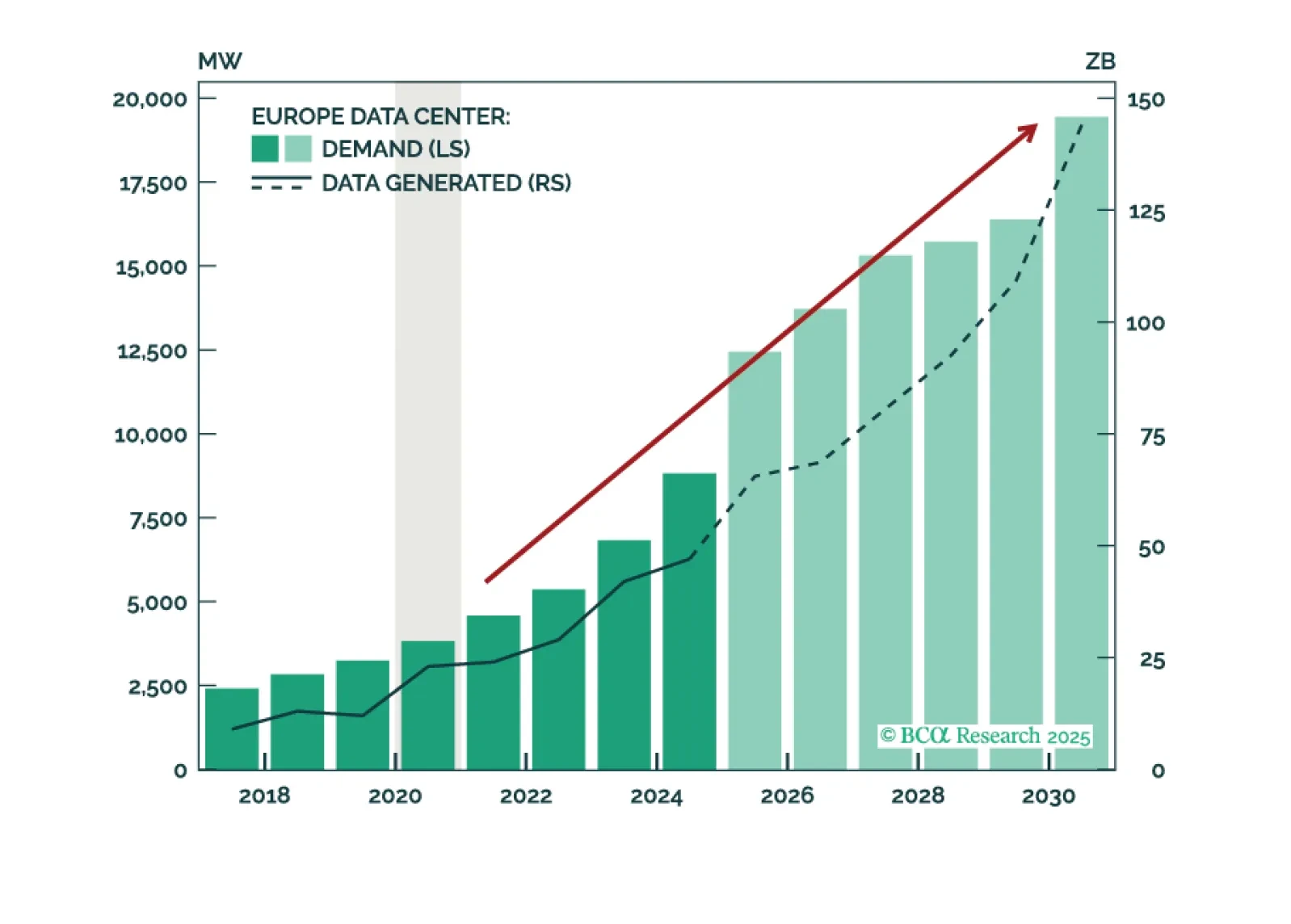
While the US is the pioneer, Europe will follow suit—more rapidly than expected. It is not a question of if GenAI will boom in Europe, but when. Europe’s Data Center growth is already strong today, but a US-style boom is just around the corner.

Innovative Tech will face macroeconomic headwinds in a new “higher for longer” interest regime. Yet, the long-term opportunity of the cohort is tremendous. Investors need to be judicious with the timing of adding new capital to these themes to bolster long-term returns.

Generative AI is a major technological breakthrough that holds tremendous economic and investment promise and will have sweeping effects on wide swaths of the economy. We are bullish on generative AI as a long-term investment theme. However, at the moment we observe hallmarks of an investment frenzy. We believe that there will be a more attractive entry point for patient investors.

Favor Defensive Tech Favor Defensive Tech In our latest Weekly Report we boosted the S&P data processing index to overweight from previously underweight. Data processing stocks are a services-based defensive tech index that typically thrive in deflationary and recessionary environments, according to empirical evidence (see chart). We are currently in recession, thus a deflationary impulse will grip the economy and investors will flock to defensive tech stocks when growth is scarce. Tack on the spike in the greenback, and the disinflationary backdrop further boosts the allure of these tech services stocks (third panel). Beyond the recessionary related tailwinds, data processing stocks should also enjoy firming relative demand. While the two bellwether stocks, V and MA, will suffer from the decrease in consumption that requires physical visits and from select services outlays that are severely affected by the coronavirus, online spending by households and corporations should at least serve as a partial offset. Bottom Line: We recently lifted the S&P data processing index to overweight from previously underweight. The ticker symbols for the stocks in this index are: BLBG: S5DPOS – ADP, V, MA, PYPL, FIS, FISV, GPN, PAYX, FLT, BR, JKHY, WU, ADS.  
Dear client, Next Monday instead of sending you a Weekly Report we will be hosting a live webcast at 10am EST, addressing the recent market moves and discussing the US equity market outlook.  Kind Regards, Anastasios Highlights Portfolio Strategy The passing of the mega fiscal package, turning equity market internals, the collapse in net earnings revisions all underscore that we may have already seen the recessionary equity market lows. Investors with higher risk tolerance and a cyclical 9-12 month time horizon will be handsomely rewarded. Firming operating metrics, the defensive nature of tech services at a time when macro data are about to nosedive, compel us to boost the S&P data processing index to overweight. Grim macro data, the rising threat of a debt deflation spiral, poor operating metrics and lofty valuations, all warn that the path of least resistance is lower for REITs. Recent Changes Boost the S&P data processing index to overweight today. Last week we obeyed our rolling stops in our cyclically underweight position in the S&P homebuilders index and cyclically overweight positions in the S&P hypermarkets and S&P household products indexes for gains of 41%, 26% and 5%, respectively.1 Feature The SPX had a streak of three green days last week as congress finally passed a $2tn fiscal easing bill. In fact the last time the S&P 500 had two consecutive green days was right before its February 19 peak. Our view remains that the risk/reward tradeoff for owning equities is favorable for investors with higher risk tolerance and a cyclical 9-12 month time horizon, as we highlighted last Monday in our “20 reasons to start buying equities” part of our Weekly Report.2 As a reminder, during the Great Recession, equities troughed 20 days after the American Recovery and Reinvestment Act of 2009 took effect on February 17, 2009. Thus if history rhymes, an equity market bottom is likely near if not already behind us.  Does this mean the SPX has definitively troughed? Not necessarily, but our playbook/roadmap calls for a retest and hold of the recent lows as we have been highlighting in recent research.3 Keep in mind that S&P 500 futures (ES) have fallen over 36% from peak to trough. This is similar to the median fall during recession bear markets dating back to the Great Depression. Most importantly, comparing the two most recent iterations is instructive in attempting to figure out what is baked in the cake. Namely, in the 9/11 catalyzed recession and subprime mortgage collapse catalyzed recession, EPS got halved. Similarly, equities fell 50% from their respective peaks. If we use that assumption – i.e. a recessionary equity bear market fall predicts the eventual profit drubbing – then what the ES futures clocking in at 2174 discounted is that trailing EPS will fall from $162 to $104 and forward EPS from $177 to $113 (Chart 1). Chart 1Joined At The Hip Joined At The Hip Joined At The Hip While we have no real visibility on EPS, our sense is that we will not fall further than what was already discounted in the broad market. If we are offside and a GFC or Great Depression ensues, then profits will get halved to $81 and the SPX will fall to 1700. Another simple way of looking at the EPS drawdown is by considering $162 as trend EPS. Then for every month that the economy is shut down roughly $13.5 get shaved off EPS. Thus, triangulating both approaches, a $104 EPS level has discounted a shutdown lasting 4 months and 10 days. This is a tall order and we would lean against such extreme pessimism. Meanwhile, analysts are scrambling to cut estimates the world over. Not only SPX net earnings revisions (NER) are at the lowest point since the GFC, but so is the emerging market NER ratio. The Eurozone and Japan are following close behind (Chart 2). Once again the speed of this downward adjustment suggests that a lot of bad news is already priced in now depressed NER. Chart 2Bad News Is Priced In Bad News Is Priced In Bad News Is Priced In Chart 3Market Internals Ticking Higher Market Internals Ticking Higher Market Internals Ticking Higher Moreover, equity market internals underscore that we may have already seen the recessionary equity market lows. Chart 3 shows that hypersensitive small caps have been outperforming their large cap peers of late, chip stocks are sniffing out a reflationary impulse and even emerging markets are besting the SPX. Finally, the best China proxy out there, the Aussie dollar, corroborates the bullish signal from all these indicators and suggests that this mini “risk-on” phase can last a while longer (third panel, Chart 3). Nevertheless, the spike in the TED spread (Treasury-EuroDollar spread, gauging default risk on interbank loans) was quite unnerving last week. While we have shown in the past that equity volatility and credit risk are joined at the hip, this parabolic move in the, up to very recently calm, TED spread disquieted us. We will keep on monitoring it closely as the coronavirus pandemic continues to unfold (Chart 4). Chart 4Disquieting Disquieting Disquieting Another significant risk that this crisis has exposed is the massive non-financial business debt uptake that has taken root during the ten-year expansion (top panel, Chart 5). We deem investors will be more mindful of debt saddled companies going forward, despite the government’s sizable looming bailout of select severely affected industries from the coronavirus pandemic. Stock market reported data also corroborate the national accounts’ debt deterioration data (bottom panel, Chart 5). Chart 5Watch The Debt Burden… Watch The Debt Burden… Watch The Debt Burden… The yield curve has already forewarned that a significant default cycle is looming (Chart 6) and this time is not different. Chart 6…A Default Cycle Looms …A Default Cycle Looms …A Default Cycle Looms Importantly, both the equity and bond markets have been sending these debt distress signals for quite some time now (Chart 7). Chart 7Distress Signals Sent A long Time Ago Distress Signals Sent A long Time Ago Distress Signals Sent A long Time Ago What interest us most from a US equity sector perspective is identifying weak spots that may come under intense pressure in the coming weeks as the economy remains shut down likely until Easter Sunday. Chart 8 shows the current level of net debt-to-EBITDA for the overall non-financial equity market, and the 10 GICS1 sectors (we use telecom services instead of communications services and exclude financials). In more detail, the bar represents the 25 year range of net debt-to EBITDA and the vertical line the current reading for each sector (Appendix 1 below showcases the net debt-to-EBITDA time series for the GICS1 sectors). Chart 8Mind The… What Is Priced In? What Is Priced In? Chart 9 goes a step further and juxtaposes EV/EBITDA with net debt-to EBITDA on a two dimensional map. Real estate and utilities clearly stand out as the most debt burdened sectors, with a pricey valuation (For completion purposes Appendix 2 below delves deeper into sectors and shows net debt-to-EBITDA for the GICS2 sectors). Chart 9…Outliers What Is Priced In? What Is Priced In? Frequent US Equity Strategy readers know that we believe the excesses this cycle have been in the commercial real estate (CRE) segment of the economy, where prices are one standard deviation above the previous peak and cap rates have collapsed to all-time lows fueled by an unprecedented credit binge (Chart 10). This week we reiterate our underweight stance in the S&P real estate sector and boost a defensive tech services index to an overweight stance. Chart 10CRE: The Epitome This Cycle’s Excesses CRE: The Epitome This Cycle’s Excesses CRE: The Epitome This Cycle’s Excesses Reality Bites We continue to recommend investors avoid the S&P real estate sector. For investors seeking defensive protection we would recommend hiding in the S&P health care sector instead, as we highlighted in our mid-March report.4 Chart 11 shows a disturbing breakdown in the inverse correlation between the relative share price ratio and the 10-year Treasury yield. While it makes intuitive sense that this fixed income proxy sector (i.e. high dividend yielding) should move in the opposite direction of the competing risk free yielding asset, at times of tumult this correlation reverts to positive (top panel, Chart 11). In other words, fear grips investors and they frantically shed REITs despite the fact that interest rates collapse. Why? Because these are highly illiquid assets that these REITs are holding and investors demand the “return of” their capital instead of a “return on” their capital when volatility and credit risk soar in tandem (see TED spread, Chart 4). While CRE prices remain extended and vulnerable to a deflationary shock (bottom panel, Chart 11), there is no real price discovery currently as no landlord would dare put any properties for sale in this market starved for liquidity. With the exception of distressed sales, we deem that the “mark to model” mantra will make a comeback, eerily reminiscent of the GFC. Using an example of how all this may play out in the near-term is instructive. As the economy remains shut down, a tenant may forego a rent payment to a landlord and if the landlord is levered and starved of cash, he/she in turn may miss a debt payment to the outfit that holds his mortgage, typically a bank. Chart 11Breakdown Breakdown Breakdown At first sight this may not seem as a big problem on a micro level as the bank may have enough liquidity to withstand a delinquent borrower’s no/late payment. If, however, the bank is itself scrambling for cash, it will foreclose and then put this asset for sale in order to recover some capital. This will put downward pressure on the underlying asset’s price that all borrowing was based upon and a debt deflation spiral ensues (Chart 12). Chart 12Debt Deflation Warning Debt Deflation Warning Debt Deflation Warning The biggest problem however arises from the bond market. If these deflating assets are all in a CLO or concentrated in a select REIT, then our current financial system setup is not really equipped to handle a failure/delay of payment. This is especially true if some bond holders have hedged their bets and bought CDS on these bonds and demand payment as a “default clause” will in practice get triggered.  The longer the economy remains shut down, the higher the credit, counterparty and default risks will rise. Therefore, given that the real estate sector has an extremely high reading on a net debt-to-EBITDA basis (Chart 8), we are concerned about the profit prospects of this niche sector in the coming months. Moreover, the economy is in recession and the recent Markit services PMI is a precursor of grim data to follow. Historically, REITs move in the opposite direction to the PMI services survey and the current message is to expect a catch down phase in the former (Chart 13). Adding insult to injury, the supply response especially on the multi-family construction side is perturbing. In fact, multi-family housing starts have gone parabolic hitting 619K recently, the highest reading since 1986! Such a jump in supply is deflationary and will weigh on the relative share price ratio (multi-family starts shown inverted, bottom panel, Chart 13). Chart 13Tiiimber Tiiimber Tiiimber Finally, lofty valuations warn that if our bearish thesis pans out in the coming months, there is no cushion left to absorb a significant profit shock that likely looms (Chart 14). Chart 14No Valuation Cushion No Valuation Cushion No Valuation Cushion In sum, grim macro data, the rising threat of a debt deflation spiral, poor operating metrics and lofty valuations, all warn that the path of least resistance is lower for REITs.   Bottom Line: Shy away from the S&P real estate sector. The ticker symbols for the stocks in this index are: BLBG: S5RLST – CCI, AMT,  PLD, EQIX, DLR, PSA, SBAC, AVB, EQR, FRT, SPG, WELL, ARE, CBRE, O, BXP, ESS, EXR, DRE, PEAK, HST, MAA, UDR, VTR, WY, AIV, IRM, PEG, VNO, SLG. Boost Data Processing To Overweight We have been offside on the data processing tech sub-index and today we are booking losses of 39% and boosting exposure to overweight. Data processing stocks are a services-based defensive tech index that typically thrive in deflationary and recessionary environments, according to empirical evidence (Chart 15). We are currently in recession, thus a deflationary impulse will grip the economy and investors will flock to defensive tech stocks when growth is scarce. Tack on the spike in the greenback, and the disinflationary backdrop further boosts the allure of these tech services stocks (third panel, Chart 15). Beyond the recessionary related tailwinds, data processing stocks should also enjoy firming relative demand. While the two bellwether stocks, V and MA, will suffer from the decrease in consumption that requires physical visits and from select services outlays that are severely affected by the coronavirus, online spending by households and corporations should at least serve as a partial offset. Chart 15Time To Buy Defensive Tech Time To Buy Defensive Tech Time To Buy Defensive Tech Chart 16What’s not To Like? What’s not To Like? What’s not To Like? Already, industry pricing power gains have been accelerating at a time when overall inflation has been tame. This will boost revenues – and given high operating leverage and high and rising profit margins – that will flow straight through to profits (Chart 16). While relative profit growth and sales estimates may appear uncharacteristically high and unrealistic to attain, this is what usually transpires in recessions: sell side analysts trim SPX profit and revenue forecasts more aggressively than they do for the defensive data processing index (Chart 17). In fact, given that we are still in the early stages of recession, we expect a further surge in relative EPS and sales estimates in the coming months. Chart 17Seeking Growth When Growth Is Scarce Seeking Growth When Growth Is Scarce Seeking Growth When Growth Is Scarce Chart 18Risk: Lofty Valuations Risk: Lofty Valuations Risk: Lofty Valuations However, there is a key risk to our bullish stance in this tech service index: valuations. Relative valuations are still pricey despite the recent fall from three standard deviations above the historical mean to half that, according to our relative valuation indicator. Technicals have also corrected from an extremely overbought reading, but a cleansing washout has yet to occur (Chart 18). Netting it all out, firming operating metrics and the defensive nature of tech services at a time when macro data are about to nosedive, compel us to boost the S&P data processing index to overweight.   Bottom Line: Boost the S&P data processing index to overweight today from previously underweight for a loss of 39% since inception. The ticker symbols for the stocks in this index are: BLBG: S5DPOS – ADP, V, MA, PYPL, FIS, FISV, GPN, PAYX, FLT, BR, JKHY, WU, ADS.   Anastasios Avgeriou US Equity Strategist anastasios@bcaresearch.com   Appendix 1 Chart A1Appendix A1 Appendix A1 Appendix A1 Chart A2Appendix A2 Appendix A2 Appendix A2   Appendix 2 Chart A3 What Is Priced In? What Is Priced In? Chart A4 What Is Priced In? What Is Priced In? Footnotes 1     Please see BCA US Equity Strategy Daily Report, “Housekeeping” dated March 26, 2020, available at uses.bcaresearch.com. 2     Please see BCA US Equity Strategy Weekly Report, “The Darkest Hour Is Just Before The Dawn” dated March 23, 2020, available at uses.bcaresearch.com 3    Please see BCA US Equity Strategy Daily Report, “Gravitational Pull” dated March 12, 2020, available at uses.bcaresearch.com. 4    Please see BCA US Equity Strategy Weekly Report, “Inflection Point” dated March 16, 2020, available at uses.bcaresearch.com.   Current Recommendations Current Trades Strategic (10-Year) Trade Recommendations What Is Priced In? What Is Priced In? Size And Style Views June 3, 2019 Stay neutral cyclicals over defensives (downgrade alert)  January 22, 2018 Favor value over growth May 10, 2018 Favor large over small caps (Stop 10%) June 11, 2018 Long the BCA  Millennial basket  The ticker symbols are: (AAPL, AMZN, UBER, HD, LEN, MSFT, NFLX, SPOT, TSLA, V).
Data processing stocks have been in a consolidation phase, but this increasingly appears to be a trend change rather than a continuation pattern. The economic backdrop is no longer conducive to capital inflows. Data processing companies enjoy hefty recurring revenue but have lower economic leverage than much of the corporate sector. As such, when growth and inflation expectations climb, capital inflows tend to wane (inflation expectations shown inverted, middle panel). Meanwhile, top-line growth has been in a funk of late, even though companies have made a significant investment to boost marketing, as evidenced by the surge in SG&A, but so far, this has sapped margins more than stoked revenue. Importantly, Visa has recently provided a fee break to retailers, who are increasingly banding together to put pressure on the industry to lower fees. Amidst increased competition on the payments processing side, this trend is likely to be structural and put downward pressure on profit margins. We shifted from overweight to underweight in yesterday's Weekly Report. The ticker symbols for the stocks in this index are: V, MA, PYPL, ADP, FIS, FISV, PAYX, ADS, GPN, WU, TSS. The Window Has Closed For Data Processors The Window Has Closed For Data Processors
Highlights Portfolio Strategy The market has quietly adopted a less cyclical sectoral tone since yearend, a trend that could amplify over the coming months, even if overall appreciation persists. Defense stocks have grown into previously extended valuations, warranting ongoing above-benchmark exposure. The opposite is true for aerospace equities. Data processing shares are more likely to roll over than break out and we recommend paring positions to underweight. Recent Changes S&P Data Processing - Downgrade to underweight from overweight. Table 1 Shifting Internal Dynamics Shifting Internal Dynamics Feature The stock market has cheered the broad-based rebound in earnings and improvement in corporate sector pricing power (Chart 1). Unbridled optimism about growth friendly policy tilts including potential tax reform and select regulatory relief combined with an easing in financial conditions have encouraged investors to make large down payments against expected future profit gains. Indeed, extreme economic and earnings bullishness is evident in record setting price/sales (P/S) multiples: Chart 1 shows that on a median basis, the industry group (P/S) ratio is far above the 2000 peak, providing yet another metric in a long list of yardsticks signaling that greed is the overriding market emotion. Nosebleed valuation levels are cause for significant cyclical concern, but as discussed last week, momentum and a valuation-agnostic transition from fixed income to equities are the dominant tactical forces at the moment. Since it is difficult to reconcile valuations at odds with realistic expectations about future earnings growth, we remain focused on sub-surface positioning to indemnify against disappointment. Since late last year, the market has adopted a more defensive than cyclically-oriented tenor. Defensive sectors have troughed at extremely attractive relative valuation levels, based on our models (Chart 2). Conversely, cyclical sectors have rolled over, meeting resistance at very demanding valuation levels of more than two standard deviations above normal (Chart 2). Chart 1Future Growth Has Been Paid For Already Future Growth Has Been Paid For Already Future Growth Has Been Paid For Already Chart 2The Market Tone Is Changing The Market Tone Is Changing The Market Tone Is Changing Contrarians should take note. These nascent trend changes have developed even though economic data have generally surprised on the upside, which may be an indication that a more forceful response will occur once the string of upside surprises loses momentum. The global PMI has been very strong, but any hint of a reversal would provide a catalyst for a full-fledged recovery in defensive vs. cyclical stocks (Chart 3). The contraction in U.S. bank lending growth may be heralding slippage in hard economic data (Chart 3), to the benefit of defensive vs. cyclical sectors. Keep in mind that the market is priced for non-inflationary growth nirvana, such that even modest economic disappointment could short circuit the buying binge. The yield curve has stopped widening and financial conditions are no longer easing (Chart 3), providing additional confirmation that the defensive vs. cyclical equity sector trough is more likely a budding trend change than a pause in a downtrend. A trend change is also consistent with the relentless downgrading in emerging market vs. developed country GDP growth expectations (Chart 4). Chart 3Forward Looking Yellow Flags Forward Looking Yellow Flags Forward Looking Yellow Flags Chart 4No EM Confirmation For Cyclicals No EM Confirmation For Cyclicals No EM Confirmation For Cyclicals The lack of a durable and credible growth thrust in EM is confirmed by regional share price performance, as EM equities have significantly lagged their developed country counterparts (Chart 4). Now that China's fiscal stimulus impulse has rolled over amidst ongoing currency depreciation, EM lacks a catalyst for incremental growth outperformance vs. developed markets. Adding it up, evidence of a sub-surface trend change continues to materialize, even in the face of upward momentum in the broad market. We expect a mostly defensive along with select interest rate-sensitive exposure to provide optimal portfolio performance in the next 3-6 months. Defense Stocks Will Continue To Protect Portfolios... A Special Report sent to clients on October 31 outlined the long-term appeal of defense stocks, prior to the installment of a new, bellicose U.S. Administration. If anything, the latter threatens to exacerbate the decline in globalization that was already in progress (as discussed since 2014 by BCA's Geopolitical Strategy Service), potentially creating a leadership vacuum that will raise the specter of open military conflict. More nationalistic foreign policies in a number of countries, i.e. moving away from collaboration and cooperation and toward isolationism and self-sufficiency, is a recipe for increased geopolitical instability. China's challenge to the status quo is also likely to motivate a boost to defense spending globally. The recent World Economic Forum estimates of global military spending by 2030 cite both China and India planning to quadruple military outlays over this time frame (Table 2). The U.S. Administration is already pressuring other NATO members to boost defense spending after a long contraction (Chart 5), which should eventually spillover into rising defense contractor sales. Reportedly, only 5 out of 28 NATO members reached the targeted goal of spending 2% of GDP on defense. Ergo, there is room for an increase, especially in some larger countries with fiscal room to maneuver. More imminently, the conditions that have created the gap between aerospace and defense relative performance are growing even stronger (Chart 6). Table 2A New Arms Race Underway Shifting Internal Dynamics Shifting Internal Dynamics Chart 5Lots Of Upside Lots Of Upside Lots Of Upside Chart 6A Growing Gap A Growing Gap A Growing Gap While U.S. defense spending has been through a soft patch for the past several years, new orders for defense goods have been one of the strongest components of overall durable goods orders (Chart 6). The unfortunate reality is that the incentive to boost defense and security spending has never been higher. Terrorist activity continues to proliferate around the world (Chart 7), raising a sense of geopolitical uncertainty and mistrust. With defense new orders continuing to make new cyclical highs, factory output should run at levels flattering operating margins. Shipments of defense goods are outpacing inventories by a wide margin, which is consistent with solid pricing power. Even exports of military goods are booming (Chart 7), despite the strong U.S. dollar, reflecting a strong undercurrent of global demand. Domestic defense spending has room to expand. Real defense outlays are only just starting to recover (Chart 8). President Trump ran on a campaign to protect the U.S. from terrorism. That should make it comparatively easy to increase defense spending in the years to come. It is normal for defense stocks to retain momentum as defense spending growth accelerates (Chart 8, top panel). Increased staffing at the U.S. Department of Defense (DOD) implies that purse strings may already be loosening in anticipation of heightened activity. DOD employment growth often provides a good leading indication for real defensive spending trends (Chart 8, bottom panel). Thus, while share prices have been on a tear and valuations are not cheap, rapid earnings growth has pushed down forward multiples to manageable, below-market, levels (Chart 9, shown as an average of the companies in the BCA Defense Index). Chart 7Powerful Momentum... Powerful Momentum... Powerful Momentum... Chart 8... With Long-Term Durability ... With Long-Term Durability ... With Long-Term Durability Chart 9Growing Into Valuations Growing Into Valuations Growing Into Valuations Prospects for strong multiyear growth should support a move to a premium valuation as margins expand (Chart 9), similar to what occurred during past defense spending booms, as chronicled in our October 31 Special Report. ...But Aerospace Stocks Are Out Of Fuel In terms of aerospace equities, the outlook is more challenging. New orders have been sinking steadily, reflecting a downturn in the commercial aerospace cycle. While long lead times and lengthy delivery schedules offer some earnings protection, dwindling order backlogs will ultimately undermine confidence in the long-term outlook. Chart 10 shows that aerospace unfilled orders are contracting, an environment typically associated with share price underperformance, or at least elevated volatility. Shipments of aerospace goods are falling, a rare occurrence (Chart 10). The implication is that aerospace industrial production is also shrinking (Chart 10). With a heavily unionized labor force, it will be difficult to maintain profitability. Will increased global growth translate into a recovery in aerospace new orders? Doubtful. Aerospace cycles tend to be long and are not always correlated with the business cycle. Aerospace new order growth has little correlation with the global leading economic indicator. In fact, if anything, it is more countercyclical. Ominously, there are signs of excess capacity. Our global airline consumer price index, a composite of airline pricing power in a number of major countries, is in negative territory. A negative CPI reflects excess capacity, and warns of grim prospects for a recovery in new airplane orders (Chart 11). Chart 10Running On Empty Running On Empty Running On Empty Chart 11Too Much Capacity Too Much Capacity Too Much Capacity Against this backdrop, aerospace profits will become increasingly reliant on maintenance, repair and consumables activity. However, weak pricing power suggests that this source of revenue is soft (Chart 11). Aerospace valuations are close to a par with those of defense stocks. Divergent profit outlooks imply that the latter should expand while the former get squeezed. Bottom Line: We remain confident that the BCA defense index (LMT, GD, RTN, NOC, LLL) will continue to generate above market returns, whereas the BCA aerospace index (BA, UTX, HON, TXT) exhibits asymmetric downside risk. Data Processors Are Losing Their Allure After a consolidation phase that restored value to a more neutral level, we upgraded the S&P data processing index to overweight in late-September, because it fit into our consumption vs. capital spending theme, outperforms in disinflationary environments and would benefit from a recovery in industry sales growth. While several of those factors still exist, the share price ratio has been unable to gain traction and the window for outperformance may be closing. The economic backdrop is no longer conducive to capital inflows. Data processing companies enjoy hefty recurring revenue and high returns on equity, warranting persistent above market valuations (Chart 12). However, the flipside of predictability is lower operating leverage than many other industries and a pattern of underperformance during periods of rising inflation expectations. Indeed, cyclical share price momentum tends to take its cue, inversely, from inflation expectations (inflation expectations shown inverted, middle panel, Chart 12). Renewed traction in global economic growth, as evidenced by the upturn in the global leading economic indicator (GLEI, shown inverted, top panel, Chart 13), represents a headwind to capital inflows and relative multiple expansion. The improvement in business sentiment has also boosted our capital spending model, albeit we are doubtful as to whether increased animal spirits will translate into much of a capital spending cycle in a world of deficient final demand and soft free cash flow. Still, any rise in capital spending would put the services-based data processing group at a disadvantage, in relative terms. The downturn in the ISM services index compared with the ISM manufacturing index reinforces that the external environment has become more challenging (Chart 13). All of these factors could be overcome if operating trends were set to improve. Data processing revenue trends are tightly linked with consumer spending (Chart 14). The personal savings rate has room to fall, facilitating an increase in outlays, particularly now that the labor market has tightened. Rising job security has buoyed consumer confidence, which has historically augured well for data processing sales growth. Chart 12The Window Has Closed The Window Has Closed The Window Has Closed Chart 13Sell Signals Sell Signals Sell Signals Chart 14Margin Squeeze Margin Squeeze Margin Squeeze But top-line growth has been in a funk of late, even with firming pricing power (second panel, Chart 14). Companies have made a significant investment to boost marketing, as evidenced by the surge in SG&A, but so far, this has sapped margins more than stoked revenue. Importantly, Visa has recently provided a fee break to retailers, who are increasingly banding together to put pressure on the industry to lower fees. Amidst increased competition on the payments processing side, this trend is likely to be structural and put downward pressure on profit margins. Thus, we are reluctant to embrace the jump in the producer price index, as future readings could be much weaker. The implication is that operating performance will not overcome macro hurdles. Bottom Line: Reduce the S&P data processing index (V, MA, PYPL, ADP, FIS, FISV, PAYX, ADS, GPN, WU, TSS) from overweight to underweight. Current Recommendations Current Trades Size And Style Views Favor small over large caps. Favor growth over value (downgrade alert).
While the corporate sector has run up debt levels and is struggling to generate profit growth, consumers have rebuilt their savings and are enjoying the benefits of a positive wealth effect. The increase in real wage and salaries growth is supporting consumer income expectations, according to the latest consumer confidence survey (top panel). The implication is that consumption-oriented plays should be well positioned to deliver profit outperformance. Consumer finance stocks provide an attractively valued play on this theme, as does the S&P data processing index. The latter is levered to total transaction volumes, and a healthy consumer should translate into positive sales momentum. We are overweight both indexes. bca.uses_in_2016_10_27_001_c1 bca.uses_in_2016_10_27_001_c1
Data processing stocks have marked time since we took profits and downgraded to neutral in mid-February. Increasingly, this lateral move looks to be a consolidation rather than a trend change. This group fits into our consumption vs. capital spending theme, and outperforms when economic growth slippage is the dominant driver of a disinflationary macro backdrop. Data processing sales went through a rough patch, but the seeds of a recovery have been sown. Top-line performance is highly correlated with consumer sector transaction volumes. Resilient consumer confidence, a high savings rate, decent job growth, and rising incomes all imply that spending should remain an economic bright spot. The relative performance consolidation has allowed the industry to grow into premium valuations, at a time when the high margin and recurring revenue nature of the industry's operating profile stands out in a disinflationary world struggling to grow at trend, let alone above it. Please see yesterday's Weekly Report for more details on the upgrade. The ticker symbols for the stocks in this index are: BLBG: S5DPOS - V, MA, PYPL, ADP, FIS, FISV, PAYX, ADS, GPN, WU, XRX, TSS. bca.uses_in_2016_09_27_001_c1 bca.uses_in_2016_09_27_001_c1

Stocks are flirting with new highs, courtesy of a gradualist Fed and the reduced threat
of incremental near-term U.S. dollar strength.
