Sorry, you need to enable JavaScript to visit this website.
Skip to main content

Debt Supercycle

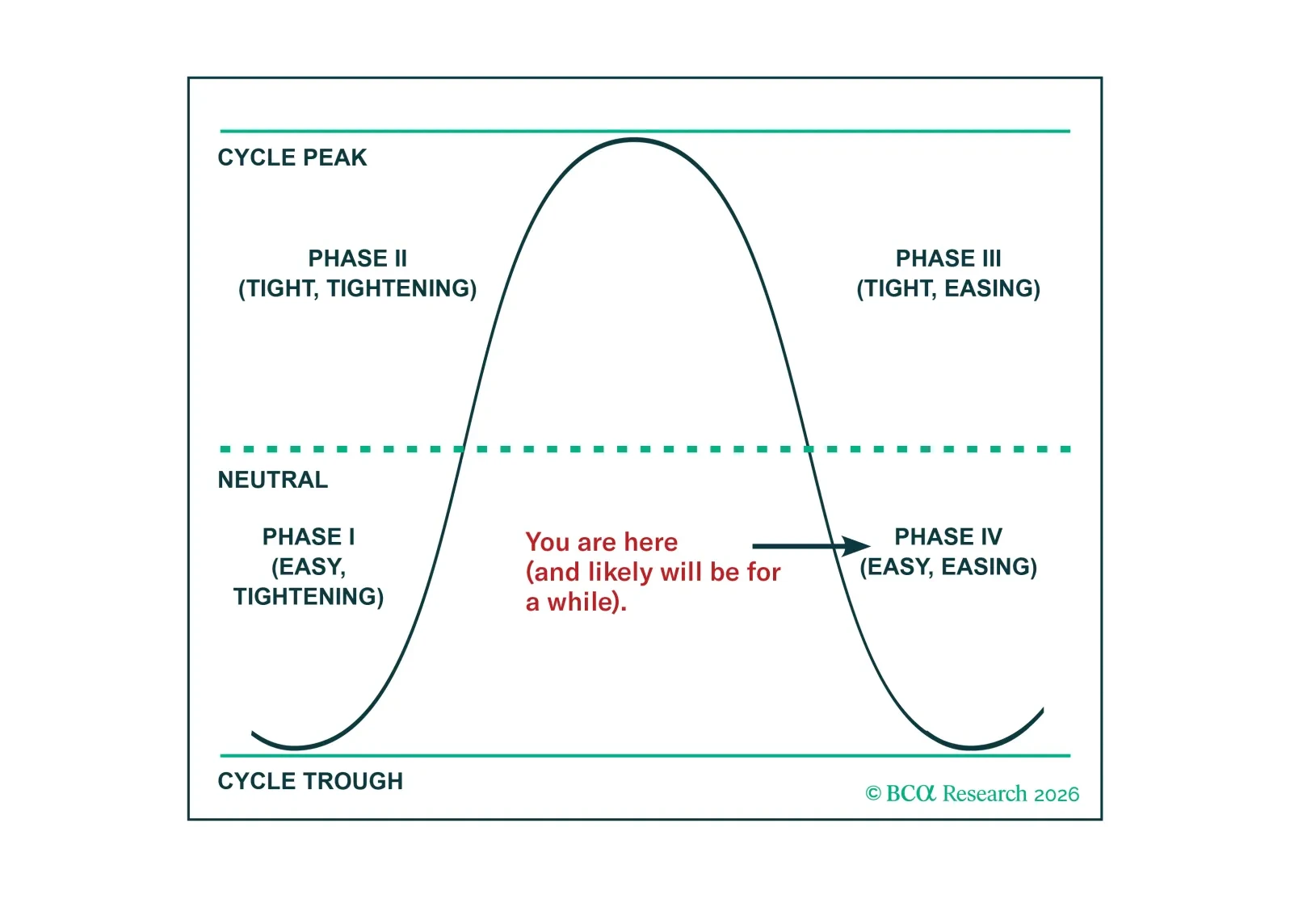
With the Fed looming larger on investors’ radar screens, we revisit our fed funds rate cycle analysis. We expect that the current easing-while-already-easy phase will be less rewarding than normal for the S&P 500 because multiples have already expanded to very elevated levels.

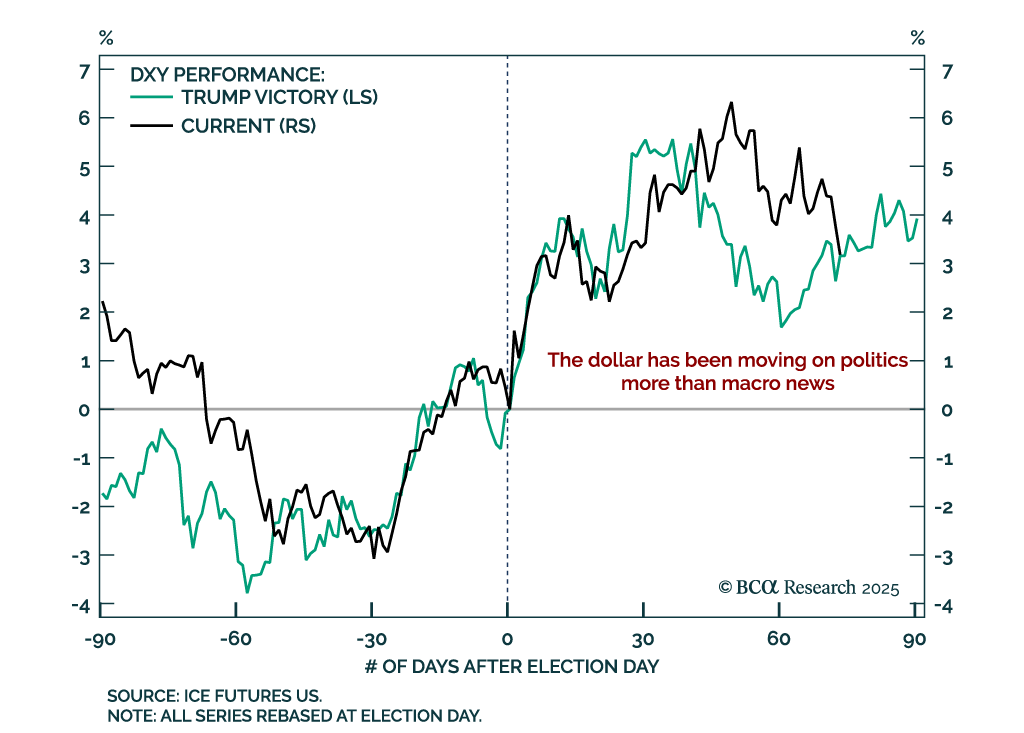
Our Foreign Exchange strategists reviewed the rationale to their short US dollar position as the DXY has been in a trading range with resistance near 110 and support around 100. The widening US budget deficit caps the dollar’s potential. It boosts…

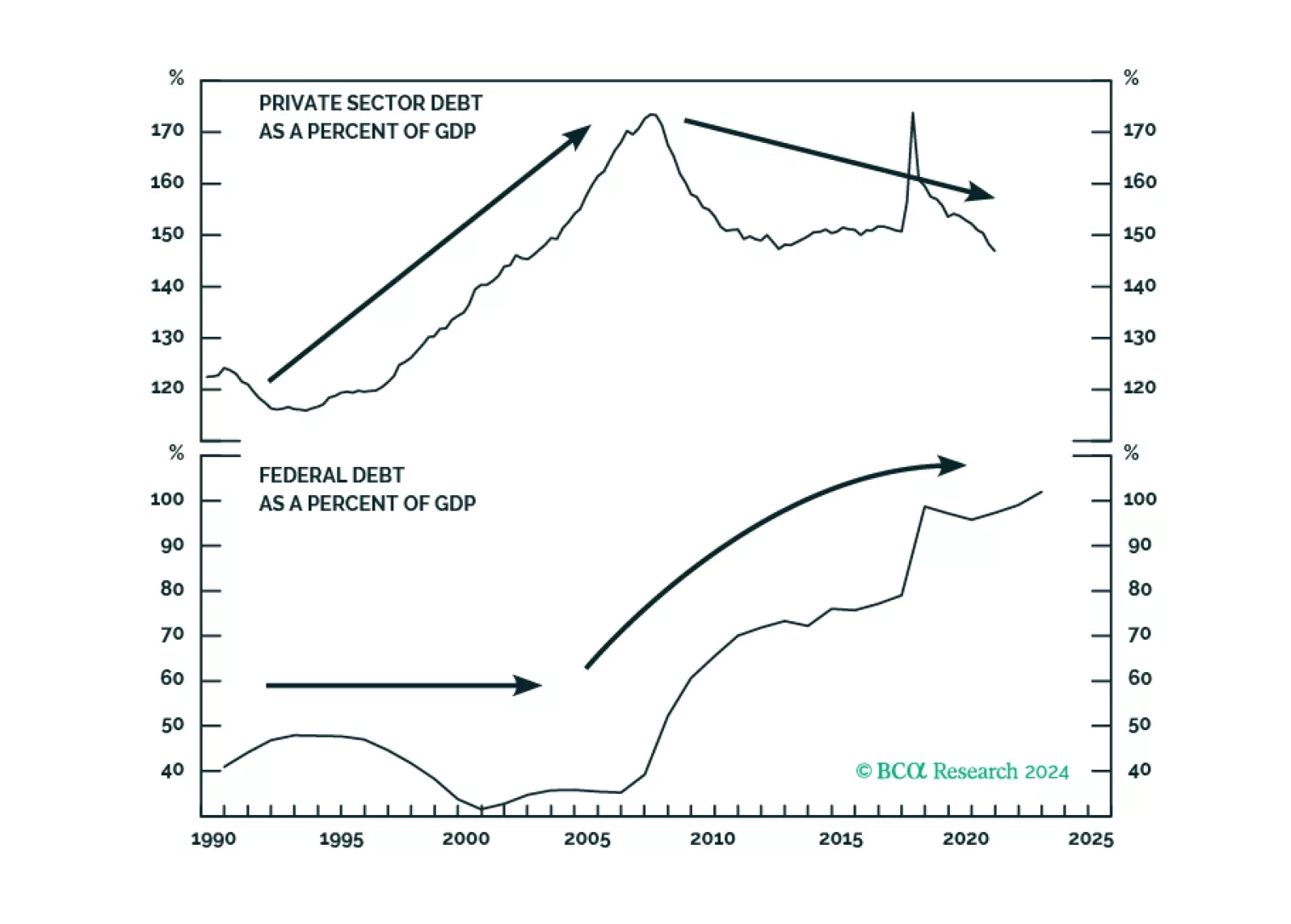
In a guest research report, Martin Barnes, BCA’s former Chief Economist, revisits the idea of the Debt Supercycle and discusses how its true end may emerge in response to a fiscal crisis in the US over the coming few years.

According to BCA Research’s US Political Strategy service, US fiscal policy is marginally negative for the economy and marginally increases the odds of recession in 2023-24. It is not a positive catalyst for equities in the third quarter. Fiscal policy is…

In Section I, we review the three possible economic scenarios over the coming year, and underscore that the “soft landing” scenario remains improbable. A “no landing” scenario could occur, but it would ultimately lead back to the recessionary path and thus is not a basis for investors to maintain pro-risk portfolio positions. US stock prices continue to be buoyed by rate cut expectations, but nonrecessionary cuts still appear to be a long way off. In Section II, we present our best estimate of the inflationary threshold that results in a positive or negative stock price / bond yield (SBY) correlation, and whether investors are likely to approach this level over the coming one-to-two years. US core inflation does not likely need to return to the Fed’s target in order for the SBY correlation to return to positive territory, but a move back to a positive correlation will very likely occur in the context of falling equity prices.

Cyclically-speaking, the risk of global indebtedness does not appear to be acute. There are several pockets of sizeable private sector debt risk, and it is possible that the next US/global recession will cause a more pronounced economic downturn in some of these countries. Over the next one-to-three years, these risks are likely to be idiosyncratic. With the possible exception of France’s corporate sector, private sector debt risks appear to be manageable in the US, euro area, and China, the main drivers of global economic activity. However, over the longer-term, there are several problems with global indebtedness that will eventually “come home to roost.” US government debt is now excessive, and we expect meaningful net interest pressure for the US government in three-to-four years, even if the US does not experience elevated structural inflation. In China, the government’s strong desire to avoid aggravating structural imbalances will lead to the limited and finely balanced use of fiscal and monetary policy to boost growth, which is not good news for China-related financial assets. On balance, our conclusions are generally consistent with a structural bear market in the US dollar that is likely to begin after the next US recession. It also speaks to the possible structural outperformance of euro area stocks within a global equity portfolio, and possibly a continuation of the structural bull market in gold – which would benefit mightily from the development of any fiscal risk premia in US assets. The global financial crisis of 2008-2009, as well as the subpar economic recovery that followed, demonstrated to global investors the threat posed by elevated private sector and government debt. There has been a substantial improvement in the risk of indebtedness in some sectors of some countries over the past 15 years, but the risks of excessive indebtedness have increased in other areas of the global economy. In this special report, we check in on the indebtedness risk of a list of major economies using the BIS’ credit to the nonfinancial sector database and examine whether these risks exist primarily in the household, non-financial corporate, or government sectors. We contextualize the indebtedness data from the BIS into a risk score using several risk factors (by sector and by country), based on how elevated a given sector’s risk factor is relative not only to its own history but also the history of other countries. The sector risk scores are presented on pages 24 to 29, and we present a synthesis of our analysis below.1 We conclude that, while there are limited cyclical implications of recent trends in global indebtedness, there are several problems that will eventually “come home to roost” – particularly in the US and China. This would be consistent with a structural bear market in the dollar and a long-term uptrend in the price of gold, and could point to structural euro area outperformance within a global equity portfolio. A Global Indebtedness Report Card Table II-1 presents the aggregate risk score for each country by sector that we examined in our report. Several themes are evident from Table II-1 and the tables shown on pages 24 to 29. Table II-1A Summary Of Our Debt Risk Scores By Country/Region And Sector May 2023 May 2023 Shifting Household Sector Indebtedness Risk Chart II-1Shifting Household Sector Indebtedness Shifting Household Sector Indebtedness Shifting Household Sector Indebtedness The risk of household sector indebtedness has rotated from countries like the US and Spain to several other countries/regions, including Hong Kong SAR, Australia, Canada, and Sweden (Chart II-1). These are relatively smaller countries/regions and thus theoretically pose less of a risk to global financial stability than excessive household sector debt in the US and select euro area economies did in 2008. Mainland China remains one important wildcard for investors to watch. Ostensibly, the risk of China’s household sector indebtedness is only moderate according to our risk score methodology, given that its household debt-to-GDP ratio is lower than in many other countries. However, it has grown at a very significant rate over the past decade. In addition, household disposable income is lower as a share of GDP in China than in most advanced economies, and China’s housing sector has experienced a significant shock over the past two years. The fact that interest rates in China are likely to remain comparatively low versus the pace of economic growth, and that China’s property market is stabilizing, suggest that a major debt crisis in China’s household sector is unlikely over the coming year. The recent property market crisis, however, serves as a reminder of the potential structural vulnerability posed by Chinese household sector debt, which would almost certainly cause a global recession were a major deleveraging event to occur. Chart II-2Elevated Corporate Sector Indebtedness In Hong Kong SAR, China, Sweden, And France Elevated Corporate Sector Indebtedness In Hong Kong SAR, China, Sweden, And France Elevated Corporate Sector Indebtedness In Hong Kong SAR, China, Sweden, And France Some Surprises From The Trend In Corporate Debt Some countries with elevated nonfinancial corporate sector debt risk scores will not be surprising to investors. Chart II-2 highlights that Hong Kong's corporate sector indebtedness is massive and that mainland China's nonfinancial corporate sector debt risk is also very elevated. Mainland China's corporate sector debt risk is concentrated in state-owned enterprises, reflecting the significant quasi-fiscal spending (mainly in the form of infrastructure investment) that has occurred over the past decade in support of economic stability. However, Sweden and France also have very elevated nonfinancial corporate sector debt risk, whose corporate sector scores closely mirror their risk scores from the shadow banking sector. “Shadow credit” references credit that is not provided by domestic banks. A rise in shadow credit appears to be the source of the increase in nonfinancial corporate sector indebtedness in both Sweden and France. Shadow credit poses a risk to financial stability because credit availability from nonbank entities could tighten rapidly in a crisis; it thus points to potentially outsized economic weakness in Sweden and France in a bad economic scenario. Based on the IMF’s stress test results, we continue to regard Sweden’s nonfinancial private sector as one of the riskiest in the developed world. Real Long-Term Risks From US Government Indebtedness Investor concerns about the rise in US government debt have prevailed for over a decade following the surge in the debt-to-GDP ratio that occurred following the global financial crisis. However, with interest rates having fallen to extremely low levels during the last economic expansion, the debt servicing burden of US government debt was minimal. The COVID-19 pandemic changed that reality in two ways. First, the fiscal response to the pandemic resulted in another surge in the debt-to-GDP ratio. Second, the surge in inflation that occurred in the latter half of the pandemic has caused both short-term interest rates and expectations for future interest rates to rise. We expect interest rates to fall meaningfully during the next US recession, so a US government debt crisis is not imminent. However, we doubt that the fed funds rate over the coming decade will be as low as it has been over the past ten years. Higher average interest rates point to net interest costs exceeding their early-1990s levels later this decade (Chart II-3), which could cause financial market participants to force fiscal adjustment via a crisis. Chart II-3The US Will Likely Face A Fiscal Reckoning By The End Of The Decade The US Will Likely Face A Fiscal Reckoning By The End Of The Decade The US Will Likely Face A Fiscal Reckoning By The End Of The Decade The US is not the only country with elevated government debt risks. China, the euro area (excluding Germany) and the UK also rank highly according to our aggregate risk score methodology, as does Canada – although this reflects our use of gross rather than net debt to facilitate international comparability (see page 27 for details). The recent mini fiscal crisis in the UK is a preview of what may occur in the US and other countries on a grander scale in three-to-four years, given our view that the next US recession is likely to be mild and that the neutral rate of interest in the US and euro area is not as low as many investors believed prior to the pandemic. China’s relatively elevated government debt risk score reflects a significant rise in local rather than central government debt over the past decade, but that too carries risks for China’s economy given the way Chinese economic policy is carried out. Admittedly, these risks are much more likely to pertain to the risk of economic stagnation rather than an acute crisis. The Presence of Fiscal Space As A Buffer Against Private Sector Indebtedness In several of the countries identified with excessive indebtedness, the debt is concentrated in either the private nonfinancial or the government sector. For example, in the case of Sweden, its very concerning private sector debt load is somewhat offset by a very low government debt risk score, suggesting the presence of fiscal space in Sweden that could allow its government to respond to any private sector deleveraging event. However, in a few countries/regions, debt appears to be elevated in both the private and public sector: chiefly in Hong Kong, mainland China, and France (Chart II-4). France is a core member of the euro area; a corporate sector debt crisis in France would have a meaningful impact on European economic activity, but China’s very sizeable debt load is obviously more concerning given the importance of China as one of the three pillars of the global economy. Chart II-4Less Fiscal Space In Hong Kong SAR And Mainland China Than Before Less Fiscal Space In Hong Kong SAR And Mainland China Than Before Less Fiscal Space In Hong Kong SAR And Mainland China Than Before Investment Conclusions There are no real cyclical investment conclusions to be drawn from our analysis of global indebtedness. There are several pockets of sizeable private sector debt risk, and it is possible that the next US/global recession will cause a more pronounced economic downturn in some of these countries. However, with the possible exception of France’s corporate sector, private sector debt risks appear to be manageable in the US, euro area, and China, the main drivers of global economic activity. China’s nonfinancial corporate sector is indeed extremely leveraged, but much of this debt resides on the balance sheet of state-owned enterprises and thus is unlikely to pose a cyclical economic risk due to government support – especially given recent incremental easing in China. Tight monetary policy in the US and euro area is a much more proximate risk to the business cycle and, as described in Section I of our report, we expect a recession in the US to begin at some point over the coming six-to-twelve months. However, our analysis of global indebtedness highlights several problems that will eventually “come home to roost”. US government debt is now excessive. The likely future path for interest rates implies meaningful net interest pressure on the government in three-to-four years, even if the US does not experience elevated structural inflation. And in China, the government’s strong desire to avoid aggravating structural imbalances will lead to the limited and finely balanced use of fiscal and monetary policy to boost growth. As we noted in last month’s report,2 that is not good news for China-related financial assets, as it implies that Chinese policymakers will remain reactive and that China will become a more insular economy with even broader state influence or control. The Xi administration’s paradigm shift implies a very different China than many investors became accustomed to between 2008 and 2014, and one that is far less likely to stimulate global economic growth. In short, this is not, and likely will not be, the China that you have been hoping for. On balance, these conclusions are generally consistent with a structural bear market in the US dollar that is likely to begin following the next US recession. It also speaks to the possible structural outperformance of euro area stocks within a global equity portfolio, and possibly a continuation of a structural bull market in gold – which would benefit mightily from the development of any fiscal risk premia in US assets. Finally, once the next US administration is in place and a new high in the servicing costs of US government debt is within sight, investors should structurally monitor the spread between 10- and 30-year US Treasury yields for signs of an abnormally steep curve. An aggressive shift into short-duration positions will be warranted in response to any true signs of a budding fiscal crisis in the US. Jonathan LaBerge, CFA Vice President The Bank Credit Analyst Private Nonfinancial Sector The countries/regions most at risk from elevated private non-financial sector debt are Hong Kong SAR, Sweden, mainland China, France, Canada, and the Netherlands (Table II-2). Across all of the metrics shown in Table II-2 that measure the risk of indebtedness, Hong Kong consistently ranks as the riskiest market. This is particularly true based on debt service measures, which show an extremely large amount of income “lost” to repaying debt. Unlike the case of mainland China, Hong Kong’s sharp rise in private sector indebtedness over the past two decades (and especially since 2009) has not occurred due to government efforts to stabilize economic activity. Hong Kong’s pegged exchange rate effectively imports US monetary policy, which has been extraordinarily easy since the global financial crisis – particularly for an economy that did not suffer the same shock to household balance sheets that occurred in the US. The source of the risk from Sweden’s indebtedness is somewhat different than is the case in Hong Kong. Sweden’s private sector debt-to-GDP level is meaningfully below Hong Kong’s, although that is mainly indicative of how extreme the latter is. More importantly, the pace of leveraging in Sweden’s private sector indebtedness has been somewhat slower than in Hong Kong and indeed a few other countries/regions (such as Japan, France, and mainland China); it ranks third after Canada based on the first of our two debt service proxies. However, based on our second DSR that uses a measure of equilibrium interest rates, Sweden appears to be much riskier. Table II-2High Private Nonfinancial Sector Debt Risk In Hong Kong SAR, Sweden, China, France, And Canada May 2023 May 2023 The Household Sector The countries/regions most at risk from elevated household sector debt are Hong Kong SAR, Australia, Canada, Sweden, and the Netherlands (Table II-3). Relative to Hong Kong’s total private sector debt, the household sector is not the dominant contributor. When compared across countries/regions, however, Hong Kong’s household sector debt-to-GDP ratio is among the most extreme. Australia, Canada, and the Netherlands rank worse than Hong Kong in terms of household sector debt-to-GDP, but both economies have recently seen meaningfully slower household debt growth than has occurred in Hong Kong. Aside from the Netherlands, euro area economies rank quite low on the list of household sector indebtedness risk and nontrivially lower than in the UK. The risk of indebtedness posed by the household sector in mainland China may be understated in Table II-3. This is because China’s household disposable income is smaller as a share of GDP than most of the other countries/regions shown in the table, which causes artificially lower debt ratios when scaled relative to GDP. Relative to developed market economies, Chinese interest rates are meaningfully below the prevailing pace of income or GDP growth, so we still suspect that China’s household sector debt service ratio is not extremely high. Investors should acknowledge, however, that the risk posed by China’s household sector leverage is probably larger than conventional debt-to-GDP measures would indicate. Table II-3High Household Debt Risk In Hong Kong SAR, Australia, Canada, Sweden, And The Netherlands May 2023 May 2023 The Nonfinancial Corporate Sector The countries/regions most at risk from elevated nonfinancial corporate sector debt are Hong Kong SAR, Sweden, France, mainland China, and Canada (Table II-4). Unlike in mainland China, where most nonfinancial corporate sector debt is held on the balance sheets of state-owned enterprises, Hong Kong’s corporate debt does not have the same defacto state backing and is enormously concentrated in the real estate and financial sectors. Hong Kong’s real estate sector does enjoy significant structural policy support from the government. It is also true that the region has been highly indebted for some time. But Table II-4 highlights that Hong Kong’s nonfinancial corporate sector is massively leveraged and is thus vulnerable to a permanent rise in US policy rates and/or a property market crisis in the region. Commercial Real Estate (CRE) debt constitutes a large portion of Sweden’s corporate debt. IMF stress tests of Sweden’s CRE sector show that the median interest rate coverage would drop below one in a severe scenario, resulting in 75% of firms with debt-at-risk.3 We continue to regard Sweden’s nonfinancial private sector as one of the riskiest in the developed world. France ranks surprisingly high on the list of nonfinancial corporate sector indebtedness, the result of an M&A boom in the years prior to the COVID-19 pandemic. Our debt service ratio calculations suggest that the servicing burden of this debt may be lower than the BIS’ DSR would suggest, but it is still elevated even based on our measures. This suggests that the French nonfinancial corporate sector should be closely watched over the coming year, especially if the ECB were to keep its policy rate in restrictive territory. Table II-4High Corporate Sector Debt Risk In Hong Kong SAR, Sweden, France, China, And Canada May 2023 May 2023 The Government Sector The countries/regions most at risk from elevated government sector debt based on the BIS’ gross government debt data are Italy, the US, Canada, the UK, and Spain (Table II-5). If Canada were removed from the list, China would be the fifth most vulnerable country according to our methodology. We show gross debt-to-GDP in Table II-5 because of the lack of reliable net debt measures for China, but gross debt measures have many drawbacks. Canada is an example, as its gross debt-to-GDP ratio suffers from two international comparability problems. First, Canadian general government debt statistics include sizeable accounts payable (20% of GDP). In addition, the Canadian government holds significant financial assets; Canada’s net debt is very low compared to other developed economies. The gross/net debt issue also impacts the government indebtedness risk score for Japan, although Japan’s net government debt is still extremely elevated (160% of GDP). Very elevated debt levels in Italy, especially in net debt terms, underscore why the effective neutral rate of interest is likely lower in the euro area than would be the case if the euro area was one political and economic entity. The extraordinary US fiscal response to the COVID-19 pandemic underscores that the US will likely face a fiscal reckoning in the latter half of the decade as net interest costs eventually exceed their early-1990 levels. It is impossible to come up with a precise estimate of when the US will face market pressure for fiscal reform, but our best guess is that it will occur at the tail end of the next US administration. Table II-5High Government Debt Risk In Italy, The US, The UK, And Spain May 2023 May 2023 The Total Nonfinancial Sector (Private Plus Government) The countries/regions most at risk from total nonfinancial sector debt (private plus government) are Hong Kong SAR, mainland China, Sweden, Canada, and France (Table II-6). As noted above, Canada’s rank in Table II-6 is likely overstated due to the country’s much lower net debt ratio, although it would still rank relatively high given very elevated private nonfinancial sector debt. We agree that private sector debt is typically more of an economic risk than public sector debt. It is important to examine total debt, however, as it reflects the combined risk of a private sector deleveraging event that the government of that country will struggle to respond to because of a lack of fiscal space. The fact that Hong Kong and mainland China top this list underscores the risk of long-term economic stagnation in the region, and partially explains why the Xi administration is focused on improving China’s financial resiliency. Sweden’s government debt risk score is extremely low, but the country’s very elevated private nonfinancial sector debt is large enough for total nonfinancial sector debt to show up at an elevated level (similar to Canada). France’s comparatively high levels of government debt, even when measured in net debt terms, underscore the economic risks to the country were its highly leveraged nonfinancial corporate sector to experience a crisis following a period of meaningfully tight euro area monetary policy. Table II-6High Total Debt Risk In Hong Kong SAR, China, Sweden, Canada, And France May 2023 May 2023 Non-Domestic Bank Credit To The Private Nonfinancial Sector The countries/regions most at risk from excessive non-domestic bank credit (“shadow banking”) are Sweden, Hong Kong SAR, France, Japan, and Canada (Table II-7). The risk posed by shadow credit is that debt provided by non-bank entities is very rarely amortized, meaning that it needs to be periodically rolled over. The other risk is that lending standards or credit availability from these entities is more discretionary than is the case for banks and thus could tighten rapidly during a crisis. Combined with non-amortized loans/bonds that need to be rolled over, high levels of credit provided by the “shadow banking” sector could result in larger or more frequent credit “crunches.” Generally speaking, the list of countries with high shadow banking risk matches those that show up as high risk for the private nonfinancial sector. Japan is an exception. Global investors should be attuned to any potential credit availability issues that arise in Japan should JGB yields eventually rise, potentially in response to the end of the BOJ’s yield curve control policy. Table II-7High Shadow Bank Risk In Sweden, Hong Kong SAR, France, Japan, And Canada May 2023 May 2023 Appendix: Debt Risk Measures Our debt risk score tables present five measures of debt risk for three individual sectors and two aggregate sectors over fourteen countries/regions. The five sectors include: Households Nonfinancial corporations Government The private nonfinancial sector (aggregate of households and nonfinancial corporations) The total nonfinancial sector (aggregate of households, nonfinancial corporations, and the government) We also examine the private nonfinancial sector focusing on debt that is not provided by domestic banks (“shadow banking”). Our methodology scales each measure of debt vulnerability for each country across the matrix of histories of all fourteen[1] countries/regions for that debt vulnerability measure using a percentile rank. In that way, we compare each country’s measure to a range of country histories, rather than only its own history. We scale these measures as scores from 0 (best / lest vulnerable) to 10 (worst / most vulnerable) and present the most recent observations in the tables included in this report. Our five measures include: The BIS[2] Credit-to-GDP Ratio: Ratio of total credit provided to the sector to GDP The BIS Debt Service Ratio: Ratio of debt payment estimate to gross disposable income (GDI). This measure is not available for the government sector, the overall nonfinancial sector, as well as for nonfinancial corporations for China and Hong Kong SAR. The BCA Credit-to-GDP Gap: Measure of Credit-to-GDP relative to its 10-year moving average The BCA Debt Service Ratio (Proxy 1): Ratio of debt payment estimate 1 to gross domestic product (GDP) The BCA Debt Service Ratio (Proxy 2): Ratio of debt payment estimate 2 to gross domestic product (GDP) We also include an Aggregate Debt Risk Score, which aggregates the scores of all debt vulnerability measures available by sector for each country using an equal weight approach. Our BCA Debt Service Ratios are calculated in the following manner: We estimate principal payment schedules of 18 years for households and of 10 years for nonfinancial corporations. We then estimate a principal payment component of the total debt payment by dividing the stock of debt by the debt maturity. We do not consider a principal payment in cases where debt is exclusively not amortized, such as government debt. We then compute the measure of debt interest payment by multiplying the overall stock of debt by an interest rate proxy. For our DSR proxy 1, we use the 10-year government bond yield as a measure of effective interest rate plus a spread of 1.75% for household sector debt and 1% for nonfinancial corporate sector debt. One exception applies to Hong Kong SAR, where we use US 10-year Treasury yields given Hong Kong’s pegged exchange rate. For our DSR proxy 2, we use an estimate of the equilibrium interest rate instead of 10-year government bond yields with the same household/corporate sector spread estimates. Our estimate considers the median 10-year nominal GDP growth rate as the equilibrium interest rate, with exceptions for euro area members, Hong Kong SAR, and mainland China. For euro area economies, we use euro area GDP rather than the individual country GDPs due to the commonality of monetary policy. For Hong Kong SAR we use US GDP rather than Hong Kong GDP given its pegged exchange rate and its importation of US monetary policy. For mainland China we use half of the estimated equilibrium interest rate, given that China has consistently maintained a large gap between domestic interest rates and the prevailing rate of nominal GDP growth. We then add the interest payment estimate to the principal payment estimate (when applicable) to obtain total debt payment. We then express these debt payments as a percent of GDP. Gabriel Di Lullo Research Analyst   Footnotes 1 Please see the appendix on pages 30 and 31 for a description of our debt score methodology. 2 Please see The Bank Credit Analyst "April 2023," dated March 30, 2023, available at bca.bcaresearch.com 3 Sweden’s Corporate Vulnerabilities: A Focus on Commercial Real Estate, IMF Working Paper, Selected Issues Paper No. 2023/024, March 21, 2023
An important annual event is when long-time client Mr. X visits BCA strategists at the end of each year to talk about the economic and financial outlook and a write-up of the discussion is published as our Annual Outlook report. Recently, BCA’s former Chief Economist Martin Barnes had the pleasure of a chance encounter with Mr. X at an airport lounge, and this report is an edited transcript of their conversation.

Dear Client, Section II of this month’s Bank Credit Analyst report is a guest piece written by Martin Barnes, which we are making available to all clients. Martin, who retired from BCA Research last year after a long and illustrious career, discusses the long-run outlook for government debt and the possibility of an eventual crisis. I trust you will find his report both interesting and insightful. Jonathan LaBerge, CFA The Bank Credit Analyst Highlights Recent developments in the UK highlight the power of financial markets to reimpose discipline over wayward fiscal policies. However, the bond vigilantes remain notably absent in the US. The strong dollar and lack of a fiscal premium in Treasury yields indicates investor complacency about the US fiscal position. However, the long-run trajectory of US government debt and deficits is unsustainable. It will take market pressures to force an inevitable change in US fiscal policies. This is very unlikely to occur in the coming year but there are good odds of it happening within five years. The ‘solution’ to a market-induced US debt crisis will involve a mix of higher inflation, financial repression, increased taxes and spending restraint. Feature I, however, place economy among the first and most important of virtues, and public sector debt as the greatest of the dangers to be feared. Thomas Jefferson I used to think that if there was reincarnation, I wanted to come back as the president or the pope. But now I want to be the bond market: you can intimidate everybody. James Carville, adviser to former US President Bill Clinton. If something cannot go on forever, then it will stop. Herb Stein, renowned US economist A remarkable feature of the economic and financial landscape during the past two decades has been the markets’ calm acceptance of an explosion in government debt throughout the developed world. In many countries, public sector debt-to-GDP ratios have hit peacetime records as a share of GDP yet until recently, bond yields remained at historically low levels. What happened to the bond vigilantes that so impressed James Carville? With the benefit of hindsight, we can look back and explain why soaring public deficits and debt levels did not cause major disruptions. Central bank purchases of government bonds reduced the supply available for private investors at a time when the demand for ‘safe’ assets was very strong. Meanwhile, private sector savings were abundant and, again until recently, inflation was quiescent. But that is the past, what about the future? There is little prospect of a significant reduction in public-sector debt burdens in the major developed economies in the coming few years. Uninspiring economic growth implies ongoing pressures for fiscal stimulus, aging populations will underpin growth in pensions and health care spending and geopolitical tensions will support increased defense spending. The rise in inflation gives some help to revenues, but higher interest rates provide an offset. The long-standing concern about large public sector deficits is that they threaten to push up interest rates, crowd out private sector investment and lower potential growth. And along the way, there is the threat of financial volatility and crises. I could fill several pages with quotes and analyses from eminent economists during the past two decades predicting impending economic and financial doom unless government finances were brought under control. Not surprisingly, the failure of any crises to emerge has discredited such gloomy forecasts, fostering complacency about the issue. Recent developments in the UK warn of what can happen. The announcement of an aggressive program of tax cuts and increased borrowing rattled investors, leading to a sharp drop in the exchange rate and rise in bond yields. As a result, the government was quickly forced to abruptly change policy, abandoning its planned tax cuts. The economic and financial fallout also led to a change in political leadership with the new government warning that tax increases and spending curbs will be needed to restore fiscal stability. The market vigilantes clearly are alive and well in the UK, even if they are missing in action in the US. The US dollar’s status as the world’s premier reserve currency gives the country protection from the wrath of investors that is not always available to others. However, this is a mixed blessing because it gives policymakers more rope with which to hang themselves. The trend in US public debt burdens is unsustainable, and as Herb Stein noted, this means something will change. The key questions relate to how and when this will occur. The Disturbing Path Of Government Debt Chart II-1The Historical Sweep Of Debt The Historical Sweep of Debt The Historical Sweep of Debt Historically, major spikes in government deficits and debt generally occurred only in wartime (Chart II-1). However, the past 15 years have witnessed two extraordinary surges in public sector indebtedness – firstly in response to the 2007-09 economic and financial meltdown and secondly because of the Covid pandemic. In both episodes, tax revenues declined, and governments boosted spending to shore up economic activity. In the major advanced economies, net government debt as a percentage of GDP jumped by around 20% from pre-crisis levels in each of the periods (Chart II-2). And when indebtedness ratchets higher, it is difficult to reverse. Despite concerns about crowding out, it is hard to find an empirical relationship between the size of budget deficits and either interest rates or the growth in private investment. For example, deficits rise when the economy is weak and this is when interest rates tend to fall, not rise. Even if the analysis uses cyclically-adjusted budget balances (i.e. removing the impact of swings in the economy) it is hard to find a good relationship. But that does not mean rising deficits and debt do not matter. At some point they impact market confidence about how policy may be forced to change in the future. Uncontrolled fiscal finances ultimately will lead to financial turbulence. Public sector dynamics are a function of two key variables: the difference between the average interest rate on the debt and nominal GDP growth, and the primary budget balance (i.e. the budget balance before interest payments). The debt-to-GDP ratio will decline if the primary budget is at least in balance and the borrowing rate is below the GDP growth rate. Conversely, it will soar if there is a primary deficit and the borrowing rate is above the economic growth rate. Currently, most countries face primary deficits (Chart II-3) and interest rates are not likely to be far enough below growth to stop debt-to-GDP ratios from rising in the years ahead. Chart II-2Economic Crises Cause Spikes In Debt Economic Crises Cause Spikes in Debt Economic Crises Cause Spikes in Debt Chart II-3Lingering Primary Deficits Lingering Primary Deficits Lingering Primary Deficits   Chart II-4The Long-Run US Debt Outlook The Long-Run US Debt Outlook The Long-Run US Debt Outlook The picture in the US is particularly disturbing given its outsized role in global markets. According to the Congressional Budget Office (CBO), absent any policy changes, the federal budget deficit will average 5% of GDP over the next decade, with the primary deficit averaging 2.5% of GDP. As a result, the ratio of federal debt to GDP will be close to 110% of GDP in ten years’ time. Importantly, these projections do not allow for any recessions and use optimistic assumptions for interest rates (averages of 2.4% and 3.5% over the next decade for 3-month rates and 10-year Treasury yields, respectively). The uptrend in indebtedness continues over the longer run, taking the federal debt-GDP ratio to 140% by 2042 and 185% by 2052 (Chart II-4). Of course, this won’t happen because markets will force a change long before we get to that point. Signposts For A Debt Crisis It is impossible to predict what level of indebtedness will trigger a market reaction because much will depend on the circumstances at the time. Nevertheless, several signs can help to warn when a country is approaching a debt wall. Warnings signs include the following: Surging debt interest payments An increased dependance on issuing short-term or foreign currency debt A limited ability to raise taxes to reduce budget deficits Rising risk premia on government yields and/or a plunging exchange rate Surging Debt Interest Payments: Failure to service the debt means falling into default – something inconceivable for any developed country. Thus, debt interest payments must be made and if they rise sharply then they can crowd out other forms of government spending, creating political and/or economic problems. Canada faced this problem in the early 1990s with federal debt interest payments exceeding 30% of total revenues and more than 25% of total spending. This forced the government into a major fiscal retrenchment, eventually leading to several years of budget surpluses. In 2021, interest costs were a mere 6.5% of federal revenues. The past 15 years have been a period of exceptionally low interest rates, dramatically reducing borrowing costs, even as debt levels have climbed. In the US, federal interest payments represented only 8.7% of revenues in fiscal 2021. This was less than half the level of the early 1990s even though the ratio of outstanding debt to revenues doubled over the period (Chart II-5). While interest rates have risen this year, it will take time for this to feed through into a significant increase in the average cost of debt financing. The fact that the Fed holds more than 20% of outstanding Treasuries also helps because the interest payments on these securities are returned to the Treasury. In sum, there are few signs of an imminent problem in the US on this score. Increasing dependence of short-term or foreign currency debt: If investors are worried about a country’s fiscal stability then they will become increasingly reluctant to take on duration risk. This should show up in increased risk premia on longer-term debt, forcing governments to rely more on short-term financing. Once again, there are few signs of problems in the US. The spread between 30- and 10-year Treasuries has fallen sharply in the past year and there has not been any notable change in the average maturity of debt (Chart II-6). It is surprising that the Treasury did not use the opportunity of historically low yields to lock in more longer-term debt. Chart II-5Low Interest Rates Have Cut Debt Servicing Costs Low Interest Rates Have Cut Debt Servicing Costs Low Interest Rates Have Cut Debt Servicing Costs Chart II-6No Evidence Of A Fiscal Risk Premium No Evidence of a Fiscal Risk Premium No Evidence of a Fiscal Risk Premium   A financial revolt against economic policies typically shows up in the foreign exchange market as investors abandon the perceived risky currency. Collapsing currencies put upward pressure on inflation and interest rates and typically force a change in government policy. And countries that depend on overseas buyers of their debt may be forced to start issuing debt in foreign currencies, creating a vicious cycle as a weak currency then adds to debt servicing costs. A rise in the issuance of US dollar-denominated debt was another sign that Canada was facing problems in the 1990s. US dollar-denominated issues as a percent of foreign purchases of Canadian public sector bonds rose from 6% in 1983-88 to 45% in 1988-93. The US is in a very favorable position because the dollar’s reserve currency status means that the US can borrow freely in its own currency. Even when the dollar suffered long-run declines such as in 1985 to 1995 and 2002 to 2011, the US never needed to issue foreign-currency debt. The last time the US issued non-dollar debt was in 1978 when it issued bonds denominated in Deutschemarks and Swiss Francs in an effort to prop up the dollar (the so-called Carter bonds). Without the dollar’s reserve status, the US would be in a very different position because it is, by far, the world’s largest external debtor to the tune of $18 trillion (79% of GDP) at the end of 2021. The combination of high ratios of public debt-to-GDP and external debt-to-GDP normally would be toxic for a currency and the US is at an extreme in both measures compared with other major countries (Chart II-7). The US position compares to countries such as Germany, Canada and Switzerland that are net international creditors and have relatively low government debt-to-GDP ratios. There is a particularly interesting contrast with Japan as it has extremely high government debt but is a massive net external creditor. The fact that Japan does not rely on foreigners to buy its debt helps to explain why bond yields have stayed low in the face of huge budget deficits. And it helps that the Bank of Japan owns close to 50% of outstanding government bonds. Since 2016, the Bank of Japan has pledged to keep 10-year bond yields within 25 basis points of zero, but yields remained low even before that policy. It seems odd for the world’s largest international debtor nation to have the major reserve currency, but there has been no major competition from other countries. Given the economic problems faced by Europe, Japan and China, no change is in prospect any time soon. Room for tax hikes: A return to fiscal discipline can come from increased taxes, lower spending, or a mixture of both. Lowering the path of spending is politically challenging, especially given that in most countries, aging populations mean that non-discretionary spending (e.g. pensions and health care) accounts for a rising share of the total. Meanwhile, if tax burdens are already high, then further increases could be self-defeating via weaker economic growth and thus revenues. Not surprisingly, structural budget deficits rise more easily than they fall. Throughout much of the developed world, overall tax burdens are at historically high levels (Chart II-8). The UK experience highlights the challenges: the government used the record level of tax burdens as the case for cutting taxes, even in the face of high deficits and debt. But there was strong opposition to any attempt to finance lower taxes with real cuts to social programs. As noted earlier, bond vigilantes did not play along with the UK government’s plans. Chart II-7External And Government Debt Ratios November 2022 November 2022 Chart II-8The US Is A Low Tax Country The US is a Low Tax Country The US is a Low Tax Country   The US is in a different situation. Overall tax burdens (total general government receipts as a percent of GDP) are not at historically high levels and are by far the lowest of any industrial country, except for Ireland. While there is strong political resistance to higher taxes in the US, this is a viable route to pursue should market pressures force action. The long-term solution may be to introduce a federal sales tax.1 Options to reduce federal spending are limited given that non-discretionary spending and interest payments account for more than 70% of total outlays, a share that will continue to rise. The Changing Pattern Of Treasury Ownership Where will market pressures for US fiscal restraint come from? A long-standing concern has been that it will come from overseas – perhaps a decision by China to dump its Treasuries as a deliberate political act. This was never a very realistic possibility as it would represent an aggressive act of economic warfare, leading to serious retaliation via sanctions and curbs on Chinese exports. Nevertheless, it is reasonable to assume that, as with smaller more open economies, foreign investors will sell Treasuries and the dollar if they expect major economic and financial instability in the US. Chart II-9Ownership Of US Federal Debt Ownership of US Federal Debt Ownership of US Federal Debt The potential impact of foreign selling was greater in the past because overseas investors have accounted for a shrinking share of outstanding federal debt. The peak was in 2008-16 when the share fluctuated in the 40% to 44% range. It has since dropped below 30% (Chart II-9). Between 2002 and 2008, foreign investors absorbed two-thirds of Treasury issuance, with the two largest holders Japan and China accounting for 8.5% and 10% respectively of total outstanding debt by the end of the period. By the middle of this year, Japan’s share was down to 4.7% while China’s was 3.7%. Of course, changes occur at the margin, and it may not need much foreign selling of Treasuries to trigger panic among domestic investors. At that point, the Fed would likely step in. The launch of the Fed’s quantitative easing in 2008 represented the start of a new era of central bank intervention in the markets.2 The Fed holds more than 20% of outstanding Treasury debt and although it wants to further reduce its holdings, there is little doubt that it would resume purchases in the event of a market panic. The Bank of England recently did just that when the UK bond market went into freefall in response to the government’s reckless fiscal announcements. The Debt End Game Chart II-10Beware Of Budget Forecasts Beware of Budget Forecasts Beware of Budget Forecasts A frequently-asked question is “how will the debt ever be paid off”. The answer is that it will not get paid off because the only way to do this is to run budget surpluses, a remote possibility for the foreseeable future. The US did run federal budget surpluses for four years between fiscal 1998 and 2001 and the CBO’s January 2001 baseline projections showed the federal debt (then at $3 trillion) being almost entirely paid off within ten years. This prompted then Fed Chairman Alan Greenspan to worry about the technical challenges of conducting monetary policy in a world without government debt. Of course, things did not pan out as expected with Treasury debt reaching $11 trillion in fiscal 2011 rather than disappearing. The trend in Federal debt versus the CBOs baseline projections makes for a dismal picture and most of the divergences can be attributed to policy actions rather than economic forecasting errors (Chart II-10). Unfortunately, it is hard to imagine how the federal budget could be returned to surplus given the high and growing burden of non-discretionary spending. The solution is to make the debt easier to live with and this can be done in a few ways. Most importantly, the debt-to-GDP ratio can be reduced by boosting the growth in the denominator – nominal GDP. Ideally, this would happen via faster real growth but that seems unlikely given the demographic outlook and the lackluster trend in productivity. So it will have to occur via inflation. Reducing debt burdens by inflating nominal GDP growth will require the cooperation of the Fed. Otherwise, higher interest rates would make the fiscal situation even worse by slowing the economy and boosting debt servicing costs. The Fed’s current tightening stance should not be taken as a sign that it would never tolerate some increase in inflation. As we wrote a few months ago, inflation is set to fall over the coming year, but this will be a temporary respite.3 It will prove extremely difficult to return to sustained inflation near 2% over the medium term and a new base of 3% to 4% is likely. Another way to ease the debt problem will be via financial repression. This means keeping interest rates below ‘normal’ levels (one of the reasons to expect higher inflation) and having regulatory rules requiring financial institutions to hold high levels of government debt for supposedly prudential reasons. And finally, we will have the Fed as the ultimate backstop, stepping in if private and overseas investors cease to be buyers of Treasury debt. Finally, there will be some measures to reduce structural deficits. Taxes will increase, and actions taken to reduce the trajectory of non-discretionary spending. For example, there is scope for savings in health care spending by negotiating better prices for drugs. While it will prove near impossible to return to surpluses, it should be possible to reduce deficits from current levels. However, no politicians will impose fiscal austerity willingly and it will thus require a market crisis to force action. The bond vigilantes will have to reemerge from the shadows. Conclusions Public finance is a kind of Ponzi scheme where the proceeds of new debt issuance are used to pay existing investors. As long as new debt can be issued at reasonable yields, the show can go on. Problems emerge when investors take fright at the path of government finances and demand ever-increasing yields to compensate for perceived risks. As with all Ponzi schemes, it falls apart when new buyers fail to emerge. Proponents of Modern Monetary Theory (MMT) argued that public deficits and debt do not matter because they can be financed by central banks. However, even MMT advocates accept that this can only persist for as long as inflation stays under control. The past year’s rise in inflation has taken the wind out the sails of the MMT movement and there is very little support for the view in the economic and financial community. Chart II-11What Debt Problem? What Debt Problem? What Debt Problem? Clearly, the US is not facing an immediate problem, despite the worrying trajectory of public deficits and debt. For example, the dollar’s trade-weighted index is at a new all-time high, up 40% in the past 12 years (Chart II-11). Higher inflation and a tightening in monetary policy have pushed up bond yields, but there is no sense of a fiscal-induced investor revolt. The near-term outlook for the economy is gloomy with high odds of a recession in the coming year. That will help ease inflation pressures and bring an end to Fed rate hikes. Against that backdrop, Treasury yields will eventually reverse some of their recent rise and bond vigilantes will remain out of sight. But that will not last. Remember: what cannot go on, will stop! We should not expect politicians or voters to willingly seek fiscal austerity. For politicians, raising taxes and cutting spending is not a vote-winning proposition. And while voters may pay lip service to the idea that governments should live within their means, few people want higher taxes or the kind of cuts in spending that would make a difference. This means that financial markets have to be the ultimate disciplinarian on profligate governments. It would be nice to put a date on when markets eventually will revolt against fiscal excesses, but any attempt would be pure speculation. I am quite confident it will not be in the next 12 months but would put a 75% probability it will be within the next five years. At that point, debt-servicing costs could be at new highs. This would make it a problem for the next administration. What has happened in the UK in terms of fiscal policy and market reactions is a good indicator of what the US ultimately will face. Martin H. Barnes Former Chief Economist, BCA Research mhbarnes15@gmail.com   Footnotes 1    The US is the only industrial country that does not have a federal sales tax. 2    The Bank of Japan embarked on quantitative easing in 2001, but it was alone in doing so at that time. 3    Please see The Bank Credit Analyst “Inflation Whipsaw Ahead,” dated June 30, 2022, available at bca.bcaresearch.com
Having worked as an economist for close to 50 years, the current strange and uncertain environment seems a good time to look back and consider some of the lessons I have learned. An additional reason for writing this rather personal report is that, after 34 exciting and interesting years, I will retire from BCA at the end of this month. Over the ages, there has been an insatiable demand for predictions – seeking those who are believed to have a window into the future, whether it be the Oracle of Delphi or the proverbial guru on the mountaintop. Surely, someone somewhere must know what is going to happen? Unfortunately, my almost half century in the forecasting business has highlighted that the future is essentially unknowable, and I have not come across anyone with a consistently good track record. Fortunately, all is not lost because forecasting errors can be minimized by following some basic rules and practices. Dealing With Shocks Chart 1My First Forecasting Shock My First Forecasting Shock My First Forecasting Shock My career as an economist began in January 1973 when I joined the Forecasting Division within the Corporate Planning Department of British Petroleum in London. At the time, this seemed a strange move to friends who had entered the booming financial sector. The oil industry was regarded as incredibly dull with the crude price averaging $2.50 a barrel during the previous five years and no expectations of a major change in the foreseeable future (Chart 1). Of course, industry experts did not foresee the October 1973 war in the Middle East and OPEC’s resulting embargo of oil deliveries to the US. The crude price spiked above $15 a barrel in early 1974 and remained in double digits even after the embargo ended. This was my first lesson in the power of unforeseen shocks to destroy the basis of current forecasts and force a complete rethink of the outlook. A problem in dealing with major shocks is that some are transitory (e.g. natural disasters such as Japan’s devastating Fukushima earthquake) and some reflect a structural shift in the outlook. The oil shock was clearly in the latter category. OPEC suddenly became aware of its power to influence the market and from that time on, it took a more aggressive role in setting prices. At BP, long-run planning could not assume a return to pre-1974 prices and that was a game changer. In practice, most shocks are transitory, even if it is not evident at the time. And I believe that is true of the Covid-19 pandemic. Even if the virus cannot be eradicated, treatments will improve and we will learn to live with it, just as we live with the common cold and seasonal flu. There may be a lasting impact on some areas such as increased working from home, but I am skeptical that there will be any major change to the underlying drivers of economic growth. At most, it may encourage some trends that are already underway. However, the extreme policy response to the crisis will have some important effects and I will return to that later. Catching Structural Shifts Many economists spend much of their time making detailed economic forecasts for the coming one and two years. That may have great value in helping firms plan production schedules but is of limited value in helping investors time the market. As I have noted in previous reports, economists have done a poor job of forecasting recessions, which is the most important thing to get right from a planning point of view. Table 1 shows the recession forecasting record of the Federal Reserve, an institution that has tremendous economic brainpower and resources at its disposal. The Fed staff failed to predict any of the recessions in the past 50 years and other official and private sector forecasters were no better. Table 1Fed Economic Forecasts vs. Outcomes Perspectives From A Long Career Perspectives From A Long Career BCA has wisely eschewed short-term economic forecasts. You would never read in a BCA publication a statement such as “we have revised next year’s GDP growth from 3.2% to 2.7%”. That does not mean we don’t care about the short-run economic outlook: we believe it is necessary to have a view about whether the consensus on economic trends is likely to be disappointed - either on the upside or downside. However, it is more important to focus on catching the long-term structural shifts in economic trends. Looking back over the past 50 years, the most important economic development for investors to get right was the rising inflation of the 1970s and its subsequent multi-decade decline. Any investors smart enough to be on the right side of the long-run inflation cycle would have avoided stocks and bonds and embraced commodities in the 1970s and done the reverse thereafter. While BCA’s track record was not perfect, it generally was on the right side of these trends. Another long-run trend that investors needed to identify was the surge in global trade and interdependence, beginning in the 1990s as former-communist countries and China embraced more market-friendly policies. This not only reinforced global disinflation but also shifted economic power from labor to capital, driving profit margins to record levels. Chart 2The Retreat From Globalization The Retreat From Globalization The Retreat From Globalization Turning to the current environment, another structural shift is underway. Several years ago, we noted that the tide was turning against globalization. This showed up in a decline in cross-border capital flows, political and popular antipathy to large-scale immigration, and a flattening in the ratio of global trade to production (Chart 2). Recent developments have exacerbated these trends. Notably, the Covid-related disruptions to supply chains has forced a rethink about the wisdom of relying so heavily on foreign production facilities. The shift away from globalization is likely to persist for some time. This will support the case for a structural increase in inflation, a development underpinned by other forces. For example, the pendulum is swinging away from capital back to labor, central banks are setting themselves up to stay too easy for too long and crushing public sector debt burdens will make policymakers more willing to tolerate inflation overshoots. A structural increase in inflation (albeit nowhere near 1970’s levels) means that investors should expect a further decline in profit margins, higher interest rates and gains in inflation hedges. This will be a gradual shift with price pressures likely to moderate in the coming year as supply chain disruptions ease. Ignore Monetary Policy At Your Peril The level of interest rates is the single most important driver of asset prices which means that investors must pay close attention to central bank policy. During my career I have had a lot of contact with central bankers, not least because I was fortunate enough to attend the Federal Reserve’s Jackson Hole symposium for 18 years. Central bankers tend to be treated with great professional reverence. Every statement is examined for nuances about their views and there seems to be an implicit assumption that superior access to information and market intelligence gives them an edge when it comes to understanding economic trends and developments. Sadly, this is not the case. My many discussions with senior policymakers have made it abundantly clear that regarding the big questions about the outlook, they are no better placed than the rest of us. For example, like forecasters in general, they are struggling to know whether the recent rise in inflation is temporary, when supply chain disruptions will end and what will happen to resource prices. This is rather disconcerting as it would be desirable if those twiddling the policy dials were more informed than us outside observers. Chart 3Low Rates Underpin the Bull Market Low Rates Underpin the Bull Market Low Rates Underpin the Bull Market Regardless of whether policymakers fully understand the long-run implications of their policies, the actions of central bankers have major market effects. One might reasonably have thought that the adverse economic impact of the pandemic would seriously damage the stock market, but the hit was short-lived with the MSCI All-Country Index currently 27% above its end-2019 level and close to its all-time high. This can be attributed to the fact that short-term interest rates in the major developed economies have been kept close to zero for more than a year (Chart 3). In 1852, the eminent financial journalist Walter Bagehot famously quipped that “John Bull can stand many things, but he can’t stand 2%”. In other words, a world of low interest rates is anathema to investors, forcing them to take greater risks in order to secure higher returns. What was true then remains true today. Low rates have driven investors into stocks as an explicit objective of central bank policy. Chart 4Inflation Undershoots For Two Decades Inflation Undershoots For Two Decades Inflation Undershoots For Two Decades In the 1960s and 1970s, central bankers erred by keeping policy too easy for too long. Their formative years as policymakers were in the earlier decades when deflation was seen as a much bigger threat than inflation. This dulled their perception about the inflation risks of their policies. In contrast, the policymakers in charge during the 1980s to 2000s were fiercely anti-inflationary as they had experienced the inflationary consequences of their predecessors. Now the pendulum has swung back again because inflation has underperformed central bank expectations for the past 20 years, a period that also saw some severe deflationary shocks (Chart 4). In other words, the scene is setting up again for policy errors on the side of too much monetary stimulus and higher inflation. The high inflation of the 1970s was grim for financial assets with both equities and bonds delivering negative real returns. Bond investors underestimated the persistence and level of inflation which means they accepted ex-ante negative real yields. On the equity side, higher inflation did tremendous damage to corporate finances because of rising costs and the failure of companies to set aside enough for depreciation. Inflation accounting did not exist in those days and corporate restructuring had yet to occur. There is now much more awareness of inflation risks and accounting is better. Thus, inflation will be much less damaging to equities than before. However, we have returned to negative bond yields, largely as a result of policy-imposed financial repression rather than investor complacency. In other words, a new inflation cycle likely will be more damaging to bonds than stocks. What About Debt? On joining BCA, I had to learn about “The Debt Supercycle”, a term the company developed in the 1970s to describe the role of policy in feeding a seemingly never-ending cycle of increased leverage, resulting financial vulnerability and ever-desperate measures by policymakers to keep things afloat. This was well highlighted by the Fed’s response to the bursting of the tech bubble in the early 2000s when it kept interest rates at historically low rates even as the economy recovered. This helped create the conditions for the subsequent debt-driven housing bubble which led to an even greater policy response when that blew up in 2007-08. The essential message from BCA’s Debt Supercycle thesis is that investors should never underestimate the lengths to which policymakers will go to keep the economic/financial ship afloat. The Debt Supercycle primarily referred to the trend in private sector indebtedness in the US, although it applied to other countries. For example, in 2012, ECB President Mario Draghi noted that he was prepared “to do whatever it takes to preserve the euro”. Chart 5A Shift in the Debt Supercycle A Shift in the Debt Supercycle A Shift in the Debt Supercycle To all intents, the financial crisis of 2007-09 effectively ended the private sector Debt Supercyle in the US. Despite keeping interest rates at extremely low levels, the Fed has been unable to trigger a new upturn to household sector leverage (Chart 5). Corporate debt burdens have risen, but largely for financial engineering purposes (equity buybacks and M&A) rather than capital spending. With the private sector no longer willing or able to go on another debt-fueled spending spree, the public sector has had to take its place. The past decade has witnessed an unprecedented peacetime increase in government deficits and debt. Inevitably, the surge in government debt has fueled bearish predictions of looming financial disaster. However, the same lessons apply regarding private sector excesses: the authorities will go to extreme lengths to prevent financial and economic chaos. The solution to excessive government debt is not to pursue even greater fiscal stimulus. Instead, the solution will be a mix of financial repression, higher inflation and eventually renewed fiscal discipline. That will not rule out periodic crises to force necessary policy actions, but investors should not assume that current high levels of government debt will inevitably lead to financial Armageddon. I apologize if that sounds complacent and I know that our long-standing client Mr. X would take a very different view. Who Is Mr. X? I have been asked countless times over the years whether Mr. X is a real person and, if so, who he is. I have always refused to answer this question, just as Coca Cola Inc. would never reveal the recipe for its drink. After all, it’s interesting to have a little mystery in an otherwise strait-laced business. What I can say is that our end-year conversations with Mr. X have proved invaluable in clarifying our thinking as we prepare our Annual Outlook report. It highlights the need to avoid groupthink and take account of a wide range of views. Mr. X is an interesting character in that he views the world through an Austrian School perspective. This means he favors free market solutions over aggressive policy interventions and has a healthy distrust of both politicians and central bankers. He does not like debt and fears inflation. All this has given him a bearish bias toward risk assets over the past few decades and it has been a perpetual struggle for us to convince him to adopt a more pro-growth investment strategy. That said, he was correctly more bearish than us in late 2007 and while we were not optimistic at that time, we should have paid more attention to his views. We recently held our annual discussion with Mr. X, along with his daughter Ms. X who joined his family office a couple of years ago. She does not share his Austrian School perspective and is much more inclined to take risks, given her hedge fund background. You will discover their latest thinking in our new Outlook report, due to be published next month. Timing The Markets The Bank Credit Analyst began publication in 1949 and it was years ahead of its time in understanding the role of money and credit in driving the economy and asset markets. Its founder, Hamilton Bolton, developed a series of monetary indicators that enabled him to make very prescient market calls and that is what put the company on the map. The focused monetary approach worked very well until the end of the 1970s because banks were the dominant financial intermediary, creating a relatively stable and predictable relationship between trends in money and the financial markets. It all changed with financial deregulation and innovation, beginning in the 1980s. BCA’s monetary indicators no longer worked so well, and we had to adopt a more comprehensive approach. Timing the markets is as much art as science but I would make the following observations: The stance of monetary policy remains the most important factor to consider, despite the less stable relationship between money flows and markets. Current negative real interest rates at a time when the economy is expanding are a powerful incentive to favor risk assets. Valuation is poor indicator of near-run trends. As Keynes famously noted “the stock market can stay irrational longer than you can remain solvent”. I learned that painful lesson in the late 1990s when I advocated caution in the Bank Credit Analyst yet the markets marched ever higher, until they finally broke in early 2000. Not a happy time! Yet, there is a well-established correlation between starting valuations and long-run returns so they cannot be completely ignored (Chart 6). Chart 6Valuation Matters for Long-Run Returns Perspectives From A Long Career Perspectives From A Long Career Chart 7Technicals Still Positive For Stocks Technicals Still Positive For Stocks Technicals Still Positive For Stocks Technical indicators can provide useful information around major turning points, although they are prone to false signals. Investor sentiment typically is at a bullish extreme at market tops and vice versa at bottoms. Also, I remember reading a large tome that reviewed every technical indicator known to man and it concluded that the most reliable one was the humble moving average crossover. Following a simple rule such as acting when the index crosses its 200-day average will keep you out of the market for the bulk of a bear phase and in for the bulk of a bull run. Of course, by definition, it will be a bit late and there will be many whipsaws. Currently, the stock market is above its rising 200-day average and investor sentiment is far from a bullish extreme (Chart 7). Don’t base your market expectations on consensus forecasts for the economy. The economy is a lagging not leading indicator of the markets. However, if your economic view is very different from the consensus, then that should impact your strategy. The bottom line is that there is no magic solution to consistently successful market timing. This explains why 86% of US active equity managers underperformed the benchmark index over the past 10 years, according to S&P Dow Jones data.1 At BCA, we follow a disciplined comprehensive approach that has served us well over the years, but inevitably we also suffer the occasional wobble. Concluding Thoughts Within BCA I have developed a reputation of being the resident bear and that does not bother me at all. It suits my Scottish temperament (probably weather-related), and anyway, I think it is more fun to be bearish. The language of the dark side is very rich and descriptive and it is not a surprise that bad news sells more newspapers than good news. To be bullish when there always are many problems around just makes one sound complacent and out-of-touch. Of course, it is important to get the markets right and I would never take a bearish view just to be different. In practice, I have generally been positive on risk assets, but that has not stopped me from pointing out the downside risks along the way. Perhaps, I have spent too much time talking to Mr. X! I have had much to be thankful for during my career. It has been a great privilege to interact with so many very smart and interesting people and a constantly changing economic and financial environment has kept me fully engaged. Whenever I was foolish enough to think I had things figured out, events taught me otherwise. I may be leaving BCA but will continue to follow economic and market developments with keen interest.   Martin H. Barnes, Senior Vice President Chief Economist mbarnes@bcaresearch.com mhbarnes15@gmail.com   Footnotes 1Detailed data on the performance of active managers are available at https://www.spglobal.com/spdji/en/research-insights/spiva/
Highlights The post-pandemic investment phase is just a continuation of the post-credit boom investment phase. This is because the pandemic has just accelerated the pre-existing shifts to a more remote way of working, shopping and interacting as well as the de-carbonisation of the economy. Combined with no new credit boom, these ongoing trends will structurally weigh on the profits of old economy sectors, consumer prices, and bond yields. At the same time, these trends are a continuing structural tailwind for the profits in those sectors that facilitate the shift to a more digital and cleaner world. Our high-conviction recommendation is to stay structurally overweight growth sectors versus old economy sectors… …and to stay structurally overweight the US stock market versus the non-US stock market. Fractal analysis: PLN/USD, Hungary versus Emerging Markets, and sugar versus soybeans. Feature Chart of the WeekUS And Non-US Profits Go Their Starkly Separate Ways US And Non-US Profits Go Their Starkly Separate Ways US And Non-US Profits Go Their Starkly Separate Ways Many people use the US stock market as a proxy for the world stock market. Intuitively, this makes sense, because the US stock market is the largest in the world, and the S&P 500 and Dow Jones Industrials are well-known indexes that we can monitor in real time. In contrast, world equity indexes such as the MSCI All Country World are less familiar and do not move in real time. Yet to use the US stock market as a proxy for the world stock market is a mistake. Although the US comprises makes up half of the world stock market capitalisation, the other half is so different – the non-US yan to the US yin – that the US cannot represent the world. As we will now illustrate. US Profits Have Doubled While Non-US Profits Have Shrunk Over the past ten years, US and non-US stock market profits have gone their starkly separate ways. While US profits have nearly doubled, non-US profits languish 10 percent below where they were in 2011! (Chart of the Week) While US profits have nearly doubled, non-US profits languish 10 percent below where they were in 2011. Of course, in any comparison of this sort, a key issue is the starting point. In this first part of our analysis, we are defining the starting point as the point at which profits had recouped all their global financial crisis losses. For both US and non-US profits this point was in March 2011 (Chart I-2 and Chart I-3). Chart I-2Comparing Profit Growth Since The Full Recovery From The Financial Crisis Comparing Profit Growth Since The Full Recovery From The Financial Crisis Comparing Profit Growth Since The Full Recovery From The Financial Crisis Chart I-3Comparing Valuation Expansion Since The Full Recovery From The Financial Crisis Comparing Valuation Expansion Since The Full Recovery From The Financial Crisis Comparing Valuation Expansion Since The Full Recovery From The Financial Crisis Because the issue of the starting point of the analysis is contentious, we will look at a much earlier starting point later in the report. But first, here are the decompositions of the US and non-US stock market moves from March 2011. US stock market profits are up 93 percent, while the multiple paid for those profits (valuation) is up 75 percent. Compounding to a total price gain of 235 percent (Chart I-4). Chart I-4US Profits Up 93 Percent, Valuation Up 75 Percent US Profits Up 93 Percent, Valuation Up 75 Percent US Profits Up 93 Percent, Valuation Up 75 Percent Non-US stock market profits are down -9 percent, while the multiple paid for those profits is up 38 percent. Compounding to a total price gain of a measly 25 percent (Chart I-5). Chart I-5Non-US Profits Down -9 Percent, Valuation Up 38 Percent Non-US Profits Down -9 Percent, Valuation Up 38 Percent Non-US Profits Down -9 Percent, Valuation Up 38 Percent The aggregate world stock market profits are up 24 percent, while the multiple paid for those profits is up 57 percent. Compounding to a total price gain of 94 percent (Chart I-6). Chart I-6World Profits Up 24 Percent, Valuation Up 57 Percent World Profits Up 24 Percent, Valuation Up 57 Percent World Profits Up 24 Percent, Valuation Up 57 Percent The Post-Credit Boom Phase Favours The US Over The Non-US Stock Market In the post-credit boom phase, several important features of stock market performance are worth highlighting. In absolute terms, valuation expansion has lifted US stocks by twice as much as non-US stocks, 75 percent versus 38 percent. Yet even the 75 percent expansion in the US stock market valuation has played second fiddle to the 93 percent expansion in US stock market profits. Absent valuation expansion, non-US stocks would stand lower today than in 2011. But for non-US stocks, whose structural profit growth has been non-existent, valuation expansion has been the only instrument for structural gains. Indeed, absent valuation expansion, non-US stocks would stand lower today than in 2011. And absent valuation expansion at a world level, the world stock market would lose three quarters of its ten-year gain. What can explain the startling performance differential between US and non-US stocks on both profit and valuation expansions? As we have argued before, most of the difference does not come from the underlying (US versus non-US) economies, but instead comes from the company and sector compositions of the stock markets. The US stock market is heavily over-weighted to global growth companies and sectors – such as technology and healthcare (Chart I-7) – which, by definition, have experienced structural growth in their profits. In contrast, the non-US stock market is heavily over-weighted to global old economy companies and sectors – such as financials, energy, and resources (Chart I-8) – whose profits have stagnated, or entered structural downtrends (Chart I-9). Chart I-7The US Stock Market Is Heavily Over-Weighted To Growth Sectors The US Stock Market Is Heavily Over-Weighted To Growth Sectors The US Stock Market Is Heavily Over-Weighted To Growth Sectors Chart I-8The Non-US Stock Market Is Heavily Over-Weighted To Old Economy Sectors The Non-US Stock Market Is Heavily Over-Weighted To Old Economy Sectors The Non-US Stock Market Is Heavily Over-Weighted To Old Economy Sectors   Chart I-9Old Economy Sector Profits Have Gone Nowhere Old Economy Sector Profits Have Gone Nowhere Old Economy Sector Profits Have Gone Nowhere At the same time, when bond yields decline, companies whose profits are growing (and time-weighted into the distant future) see a greater increase in their net present values. Hence, companies in the global growth sectors have experienced a larger valuation expansion than those in the old economy sectors. In this way, the US stock market has outperformed the non-US stock market on both profit growth and valuation expansion. The key question is, will these post-credit boom trends continue? The answer depends on whether the post-pandemic world marks a new phase for investment, or whether it is just a continuation of the post-credit boom phase. The Post-Pandemic Phase Is A Continuation Of The Post-Credit Boom Phase Let’s now address the issue of the starting point of our analysis by panning out to 1990. This bigger picture from 1990 shows three distinct phases for investors (Chart I-10 and Chart I-11). Chart I-10Since 1990, There Have Been Three Distinct Investment Phases Since 1990, There Have Been Three Distinct Investment Phases Since 1990, There Have Been Three Distinct Investment Phases Chart I-11The Post-Pandemic Investment Phase Is A Continuation Of The Post-Credit Boom Phase The Post-Pandemic Investment Phase Is A Continuation Of The Post-Credit Boom Phase The Post-Pandemic Investment Phase Is A Continuation Of The Post-Credit Boom Phase The first phase was the 1990s build-up to the dot com boom. This phase clearly favoured growth sectors, and thereby the US stock market versus the non-US stock market. The second phase was the early 2000s credit boom. This phase clearly favoured sectors that facilitated the credit boom or benefited from its spending – notably, the old economy sectors of financials, energy, and resources. Thereby it favoured the non-US stock market versus the US stock market. The third and most recent phase is the post-credit boom phase. This phase has flipped the leadership back to growth sectors as the absence of structural credit growth has stifled financials as well as the capital-intensive old economy sectors that had previously benefited from the credit boom. Additionally, the structural disinflation that has comes from weak credit growth has dragged down bond yields and – as already discussed – given a much bigger boost to growth sector valuations. Since 1990, there have been three distinct phases for investors: the dot com boom; the credit boom; and the post-credit boom. Now we come to the key question. Did 2020 mark the end of the post-credit boom phase and the start of a new ‘post-pandemic’ phase? On the evidence so far, the answer is an emphatic no. Crucially, there is no new credit boom. A still highly indebted private sector is neither willing nor able to borrow. And although public sector debt surged during the pandemic, governments are now keen to temper or rein in deficits. In any case, Japan teaches us that government borrowing – which is bond rather than bank financed – does nothing for the banks or the broader financial sector. An equally important question is, has the pandemic reversed the societal and economic trends of the post-credit boom phase? The answer is no. Quite the contrary, the pandemic has accelerated the pre-existing shifts to a more remote way of working, shopping and interacting as well as the de-carbonisation of the economy. Combined with no new credit boom, these ongoing trends are structurally disinflationary for the profits of old economy sectors as well as for consumer prices. Thereby, they will continue to weigh on bond yields. At the same time, the trends are a continuing structural tailwind for the profits in those sectors that facilitate and enable the shift to a more digital and cleaner world. While we are open to the evolving evidence, the post-pandemic investment phase seems an extension of the post-credit boom phase. This means that structurally, there is no reason to flip out of growth sectors back to old economy sectors. It also means that structurally, there is no reason to switch from US to non-US stocks. Fractal Analysis Update This week’s fractal analysis highlights three potential countertrend moves based on fragile fractal structures. First, the recent rally in the US dollar could meet near-term resistance given its weakening 65-day fractal structure. A good way of playing this would be long PLN/USD (Chart I-12). Chart I-12PLN/USD Could Rebound PLN/USD Could Rebound PLN/USD Could Rebound Second, the strong outperformance of Hungary versus Emerging Markets – largely driven by one stock, OTP Bank – has become a crowded trade based on its 130-day fractal structure. This would suggest underweighting Hungary versus the Emerging Markets index (Chart I-13). Chart I-13Underweight Hungary Versus EM Underweight Hungary Versus EM Underweight Hungary Versus EM Finally, the sugar price has skyrocketed as extreme weather has disrupted output in the world’s top producer, Brazil. Given that supply bottlenecks ultimately ease, a recommended trade would be to short sugar versus soybeans, using ICE versus CBOT futures contracts (Chart I-14). Set the profit target and symmetrical stop-loss at 8 percent. Chart I-14Short Sugar Versus Soybeans Short Sugar Versus Soybeans Short Sugar Versus Soybeans Dhaval Joshi Chief Strategist dhaval@bcaresearch.com Fractal Trading System Fractal Trades 6-Month Recommendations Structural Recommendations Closed Fractal Trades Closed Trades Asset Performance Equity Market Performance   Indicators To Watch - Bond Yields Indicators To Watch - Bond Yields ##br##- Euro Area Indicators To Watch - Bond Yields - Euro Area Indicators To Watch - Bond Yields - Euro Area Indicators To Watch - Bond Yields ##br##- Europe Ex Euro Area Indicators To Watch - Bond Yields - Europe Ex Euro Area Indicators To Watch - Bond Yields - Europe Ex Euro Area Indicators To Watch - Bond Yields ##br##- Asia Indicators To Watch - Bond Yields - Asia Indicators To Watch - Bond Yields - Asia Indicators To Watch - Bond Yields ##br##- Other Developed Indicators To Watch - Bond Yields - Other Developed Indicators To Watch - Bond Yields - Other Developed   Indicators To Watch - Interest Rate Expectations Indicators To Watch - Interest Rate Expectations Indicators To Watch - Interest Rate Expectations Indicators To Watch - Interest Rate Expectations Indicators To Watch - Interest Rate Expectations Indicators To Watch - Interest Rate Expectations Indicators To Watch - Interest Rate Expectations Indicators To Watch - Interest Rate Expectations Indicators To Watch - Interest Rate Expectations Indicators To Watch - Interest Rate Expectations Indicators To Watch - Interest Rate Expectations Indicators To Watch - Interest Rate Expectations Indicators To Watch - Interest Rate Expectations