Developed Countries

The US Employment Cost Index for Q4 delivered a positive signal that the disinflation process is intact. The ECI’s slowdown from 1.1% q/q to 0.9% q/q came in softer than anticipations of 1.0% q/q. This marks the slowest pace of quarterly increase since 2021Q2…
As expected, the Fed decided to keep policy unchanged at the conclusion of the FOMC meeting on Wednesday. The changes to the Fed Statement generally indicate that the central bank is preparing to move towards easing monetary policy. Specifically, the…
The strong H2/2023 rally in global credit markets can be attributed to lower global inflation and the associated reduction in global interest rate volatility. However, our colleagues at BCA Research’s Global Fixed Income Strategy service argue that credit…
According to BCA Research’s Foreign Exchange Strategy service investors should remain long NOK/SEK. The Norges Bank kept policy on hold last week, but the bullish case for the NOK (albeit over the short term) remains in place. There were no major…
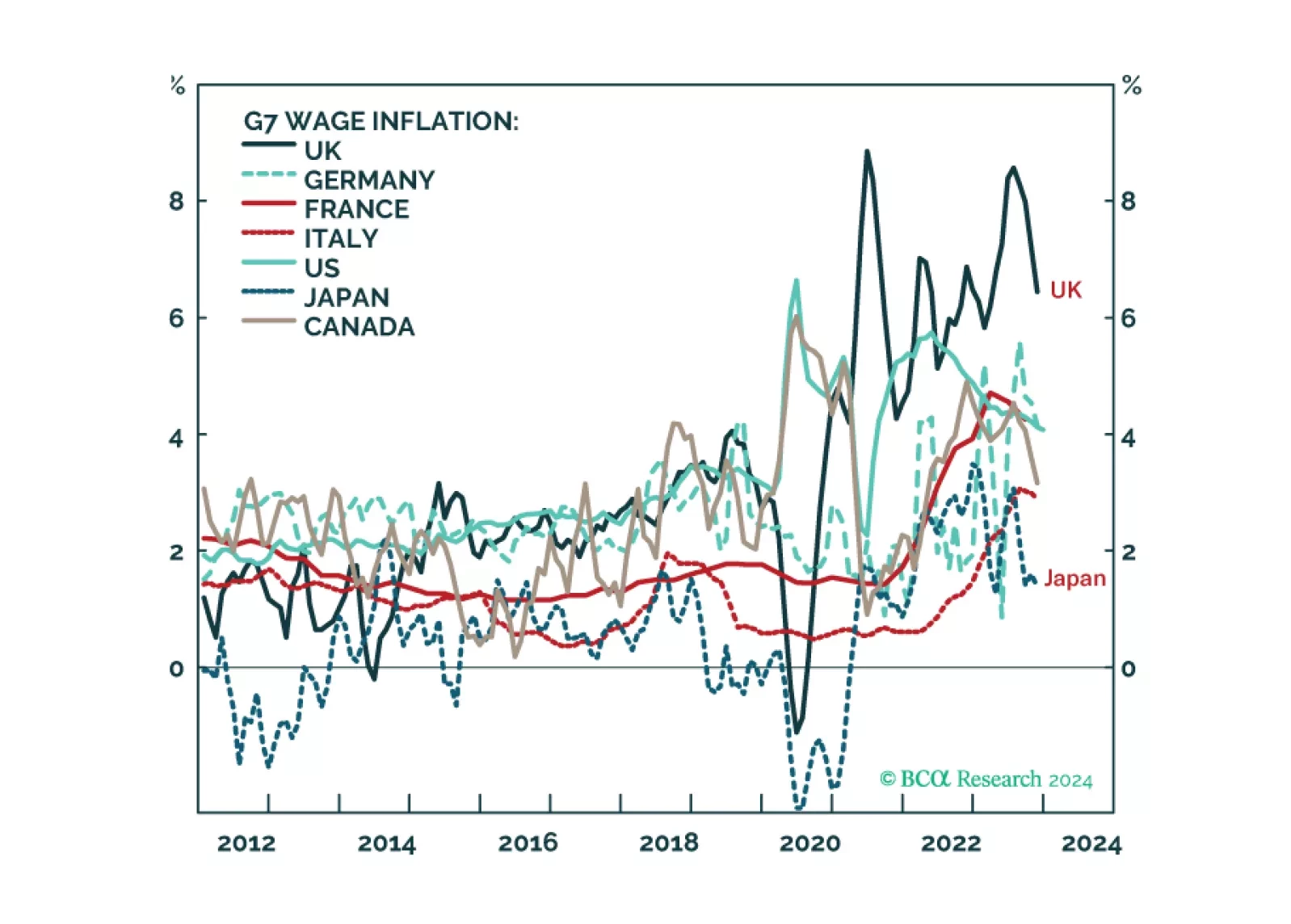
We describe and explain the wide disparity of wage inflation across G7 economies, and discuss what it means for the Fed, ECB, BoE, and BoJ policy moves in the coming year. Plus: we highlight two investments ripe for reversal, and two investments ripe for rebound.
The December JOLTS survey delivered a positive surprise on Tuesday. Job openings rose from an upwardly revised 8.93 million in November to a three month high of 9.03 million in December, beating expectations of 8.75 million. In addition, the hiring rate…
Investors are likely to pay close attention to the Fed’s communication on Wednesday for clues about the likely timing of the first rate cut. For now, markets are assigning slightly higher odds to the central bank standing pat in March – a change from a month…
Over the past few months, we have been highlighting that several indicators are pointing to an industrial recovery in Europe. Notably, Swedish indicators were a cause for optimism. The Swedish PMI’s new orders-to-inventories ratio has rebounded sharply over…
S&P 500 operating margins have been in a downdraft for nearly two years – but the consensus is still penciling in expansion for 2024. How likely is that? Our US Equity Strategy colleagues have addressed this question in their recent “Marginally Better…
BCA Research’s Global Investment Strategy service has officially launched its MacroQuant 2.0 Model. The platform consists of a variety of modules, all of which communicate with each other to produce economically sensible and internally consistent…