Sorry, you need to enable JavaScript to visit this website.
Skip to main content

Diversified Metals & Mining

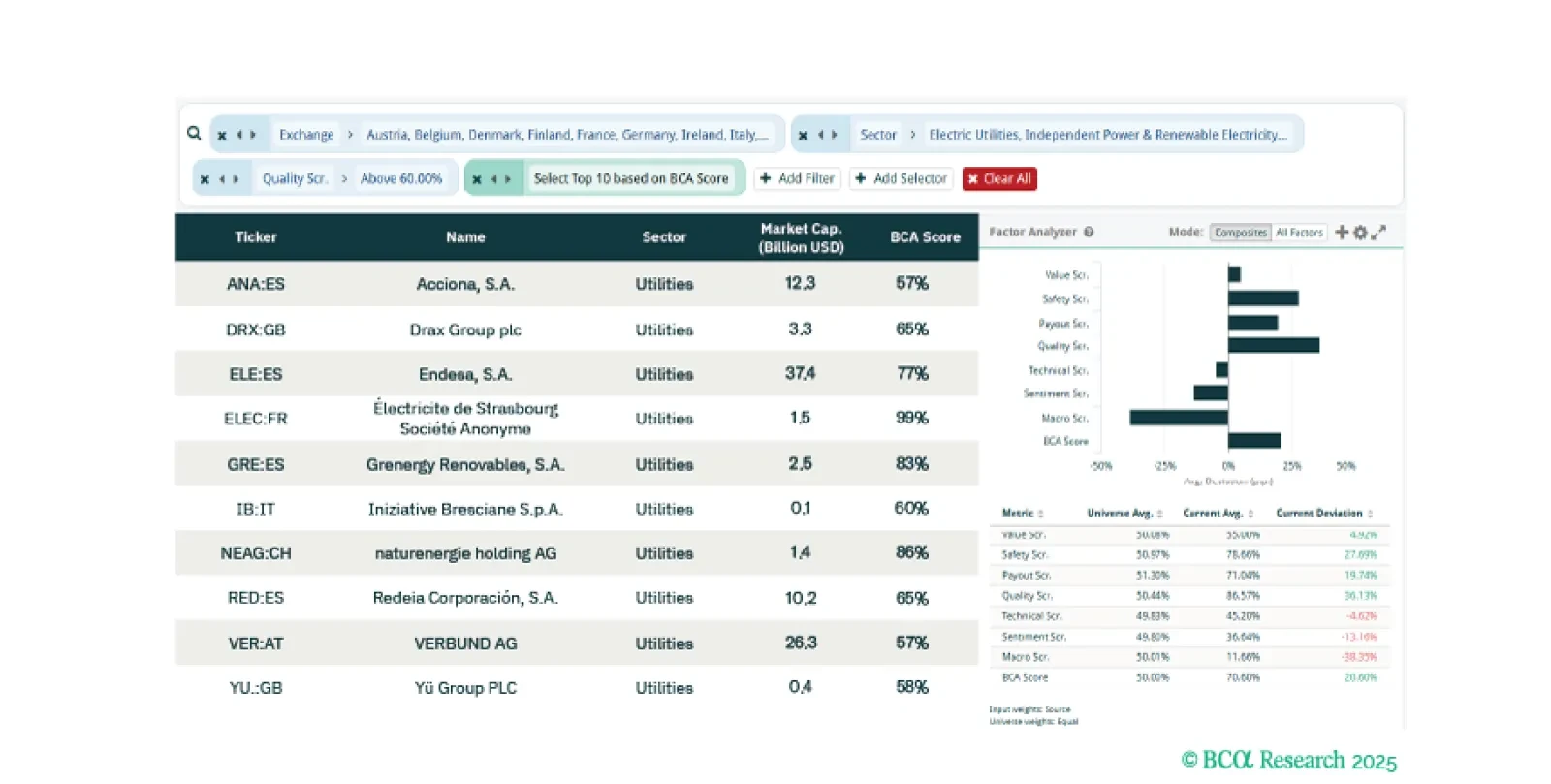
This week, our screeners explore opportunities arising from Europe’s electrification, identify high-quality Rare Earth plays, and propose a portfolio to hedge against a major global conflict.

The US and China appear to be moving toward a trade deal, though it remains unclear whether the goal is simply damage control or a genuine expansion of market access. Presidents Trump and Xi are scheduled to meet on October 30 in South Korea, with both sides…

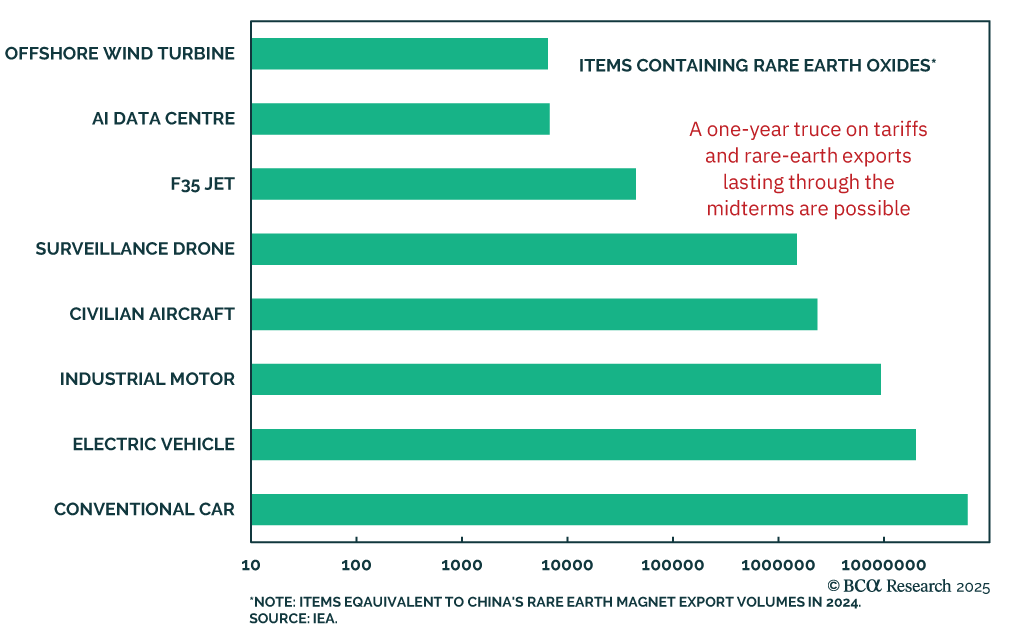
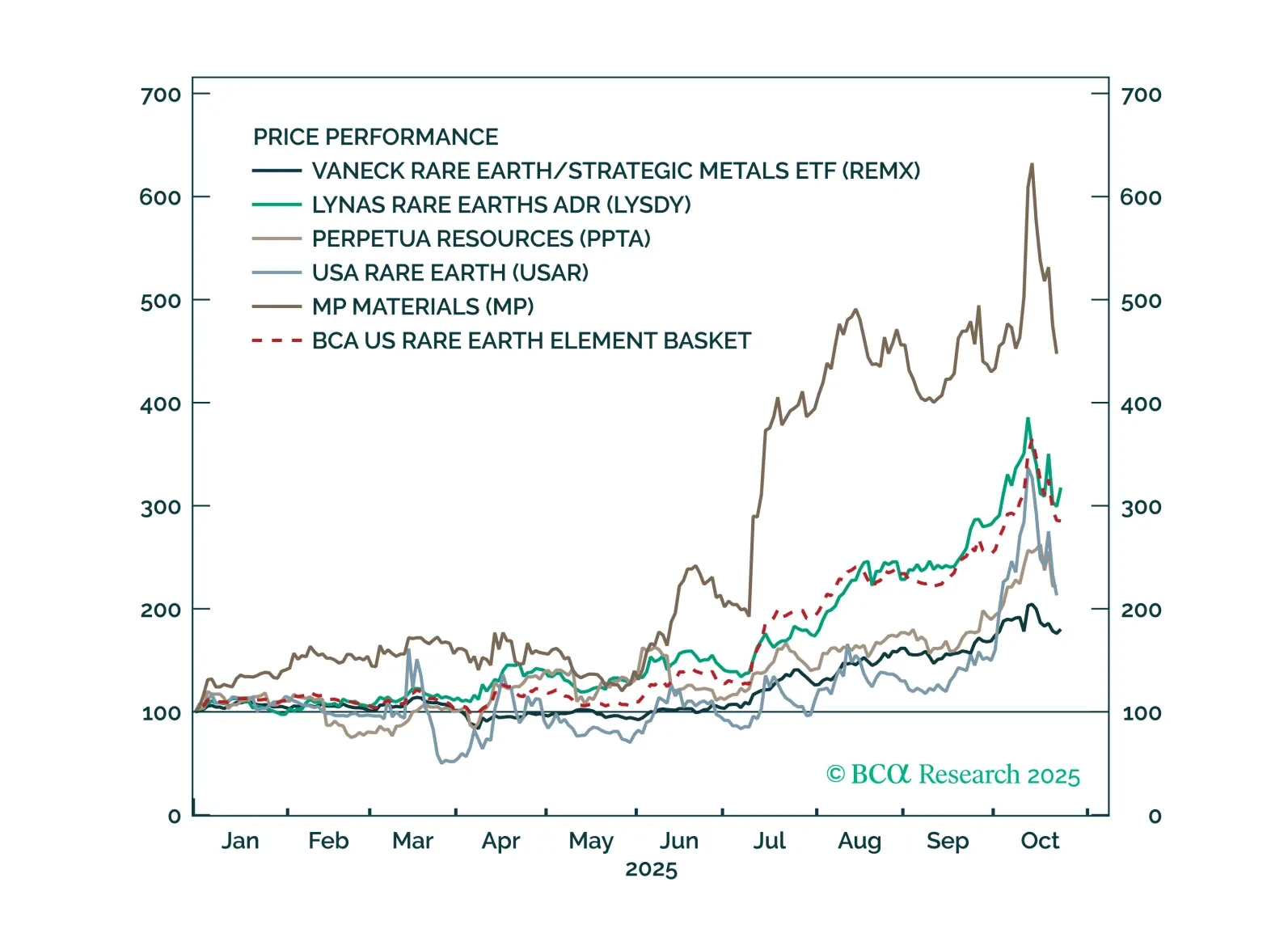
US-China decoupling and rare-earth supply disruptions created a unique opportunity for non-Chinese miners and refiners to scale production and achieve profitability. The build-out will be lengthy, costly, and fraught with challenges, but government support materially improves the odds. Rare-earth production outside China is a nascent investment theme; we are structurally bullish and recommend building a position by buying on dips by investing in a diversified basket of miners, presented in the report. 

Speculators have supported copper prices as demand growth slowed below the pace of supply growth. Our Commodity and Energy Strategy colleagues believe this does not bode well for the metal. The copper market faces a situation where demand growth will be…

The market has been held hostage by surging rates. Zombie companies are “alive” and are multiplying – they are highly sensitive to surging borrowing costs. Underweight Utilities to reduce portfolio duration. Maintain neutral positioning of Basic Materials but take a granular approach to allocations within the sector.

Today we upgrade the S&P Metals & Mining industry from underweight to neutral: This industry is one of the few beneficiaries of the war in Ukraine, as the military action and global sanctions take offline copious amounts of metals produced by Russia and Ukraine. It also enjoys increased demand resulting from a shift toward green energy and offers inflation protection. The West’s official sanctions affect Russian exports of certain commodities but there is also a reluctance on the part of private companies to buy or ship Russian exports. In addition, Putin has announced his decision to suspend some commodity exports at least until 2023. Assuming that in the near term a considerable share of Russia’s commodity exports will be blocked from global markets, the largest impact will be on oil, palladium, copper, nickel, fertilizer, and grains (Table 1). Russia’s standoff with the West is still in the early innings and further disruption of the international supply chains is to be expected. The last round of sanctions against Russia is a case in point.  Table 1Russia’s Global Share In Various Commodities Adding Commodity Exposure Adding Commodity Exposure In addition, the West’s shift toward green energy further exacerbates metal shortages as clean technologies require astronomical amounts of metals. It will take years and billions of dollars in investments for the other metals producers to fill the void left by Russia and Ukraine. As a result, a supply squeeze is a likely outcome. Rampant inflation is another tailwind for the mining names, which are quintessential real assets, and offer substantial inflation protection. All of these structural trends will enhance the profitability of the miners and metals producers and will translate into gains for the S&P 500 Metals & Mining index. Overall, we are structurally bullish on the sector and will be looking to upgrade the Mining and Metals industry to an overweight once a compelling entry point presents itself. Bottom Line: Upgrade the S&P Metals & Mining index to neutral. Look for a compelling entry point to increase exposure to an overweight.  
Highlights The bond market assumes that when recent inflation has been high, it will be higher than average for the next ten years. Yet the reality is the exact opposite. High inflation is followed by lower than average inflation. This means that the ex-post real yield delivered by 10-year T-bonds will turn out to be much higher than the negative ex-ante real yield that 10-year Treasury Inflation Protected Securities (TIPS) are now offering. Long-term investors should overweight 10-year T-bonds versus 10-year TIPS. Underweight (or outright short) US TIPS. Underweight commodities, and especially underweight those commodities that have not yet corrected. Fractal trading watchlist: the US dollar, alternative energy, biotech, nickel versus silver, and an update on semiconductors. Feature Chart of the WeekThe Real Yield Turns Out To Be Higher Than Expected The Real Yield Turns Out To Be Higher Than Expected The Real Yield Turns Out To Be Higher Than Expected Real interest rates are negative. Or are they? Given that real interest rates form the foundation of most asset prices, getting this question right is of paramount importance. Over the short term, yes, real interest rates are negative. Policy interest rates in the major developed economies are unlikely to rise quickly from their current near-zero levels. So, they will remain below the rate of inflation. But what about over the longer term, say ten years – are long-term real interest rates truly negative? The Real Bond Yield Is The Mirror Image Of Backward-Looking Inflation The negative US real 10-year bond yield of -0.7 percent comprises the nominal yield of 1.8 percent minus an expected inflation rate of 2.5 percent. This means that the negativity of the real bond yield hinges on the expectation for inflation over the next ten years. Therein lies the big problem. Many people believe that the bond market’s expected 10-year inflation rate is an independent and forward-looking assessment of how inflation will evolve. Yet nothing could be further from the truth. The bond market’s expected inflation is just the result of an algorithm that uses historic inflation. And at that, an extremely short period of historic inflation, just six months.1  The bond market’s expected inflation is just the result of an algorithm that uses historic inflation. Specifically, in the pandemic era, the bond market has derived its expected 10-year inflation rate from the historic six month (annualized) inflation rate, which it assumes will gradually converge to a long-term rate of just below 2 percent during the first four years, then stay there for the remaining six years2 (Figure I-1). We recommend that readers replicate this simple calculation for themselves to shatter any illusion that there is anything forward-looking about the bond market’s inflation expectation! (Chart I-2). Chart I- Chart I-2Expected 10-Year Inflation Is Just Based On The Last 6 Months Of Inflation! Expected 10-Year Inflation Is Just Based On The Last 6 Months Of Inflation! Expected 10-Year Inflation Is Just Based On The Last 6 Months Of Inflation! The upshot is that when the backward-looking six month inflation rate is low, like it was in the depths of the global financial crisis in late 2008 or the pandemic recession in early 2020, the market assumes that the forward-looking ten year inflation rate will be low. And when the backward-looking six-month inflation rate is high, like now or in early-2008, the bond market assumes that the forward-looking ten year inflation rate will be high. In other words, the bond market extrapolates the last six months of inflation into the next ten years. This observation leads to an immediate investment conclusion. The US six-month inflation rate has already peaked. As it cools, it will also cool the expected 10-year inflation rate, thereby putting upward pressure on the mirror image Treasury Inflation Protected Securities (TIPS) real yield. It follows that investors should underweight (or outright short) US 10-year TIPS (Chart I-3). Chart I-3As Inflation Cools, TIPS Will Underperform As Inflation Cools, TIPS Will Underperform As Inflation Cools, TIPS Will Underperform The Real Bond Yield Is Based On A False Expectation There is a more fundamental issue at stake. The market assumes that when recent inflation has been low, it will be lower than average for the next ten years. And when recent inflation has been high, it will be higher than average for the next ten years. Yet the reality is the exact opposite. Low inflation is followed by higher than average inflation, and high inflation is followed by lower than average inflation. The price level is lower than the 2012 expectation of where it would stand in 2022! Another way of putting this is that the market assumes that any breakout of the consumer price index (CPI) will be amplified over the following ten years (Chart I-4). Yet the reality is that any breakout of the price level tends to trend-revert over the following ten years. This means that after the CPI’s decline in late 2008, the market massively underestimated where the price level would be ten years later. But earlier in 2008, when the CPI had surged, the market massively overestimated where the price level would be ten years later. Chart I-4The Market Exaggerates Any Deviations In The CPI Into The Distant Future The Market Exaggerates Any Deviations In The CPI Into The Distant Future The Market Exaggerates Any Deviations In The CPI Into The Distant Future Today in 2022, the price level seems to be uncomfortably high. But the remarkable thing is that it is still lower than the 2012 expectation of where it would stand in 2022! (Chart I-5). Chart I-5The Market Overestimates Where The Price Level Will Stand 10 Years Ahead The Market Overestimates Where The Price Level Will Stand 10 Years Ahead The Market Overestimates Where The Price Level Will Stand 10 Years Ahead The crucial point is that after surges in the price level, realised 10-year inflation turns out to be at least 1 percent lower than the bond market’s expectation (Chart I-6). This means that the ex-post real yield delivered by 10-year T-bonds turns out to be at least 1 percent higher than the ex-ante real yield that 10-year TIPS offered at the start of the ten year period (Chart of the Week). Chart I-6Actual Inflation Turns Out To Be Lower Than Expected Actual Inflation Turns Out To Be Lower Than Expected Actual Inflation Turns Out To Be Lower Than Expected It follows that after the current surge in the price level, the (actual) real yield that will be delivered by 10-year T-bonds over the next ten years will not be the -0.7 percent indicated by the TIPS 10-year real yield. Instead, if history is any guide, it will be at least +0.3 percent. Therefore, in answer to our original question, the real long-term interest rate is almost certainly not negative. Of course, the obvious comeback is that ‘this time is different’. But we really wouldn’t bet the farm on it. Many people thought this time is different during the price level surge in early 2008 as well as the lows in late 2008 and early 2020. But those times were not different. And our bet is that this time isn’t any different either. This means that the real yield on T-bonds will turn out to be much higher than that on TIPS. Long-term investors should overweight T-bonds versus TIPS. Commodities Are Vulnerable A final important observation relates to commodities. Commodity prices have been tightly tracking the 6-month inflation rate, but which way does the causality run in this tight relationship? At first glance, it might seem that the causality runs from commodity prices to the inflation rate. Yet on further consideration, this cannot be right. It is not the commodity price level that drives the overall inflation rate, it is the commodity inflation rate that drives the overall inflation rate. And in the past year, overall inflation has decoupled (upwards) from commodity inflation (Chart I-7 and Chart I-8). Chart I-7Inflation Is Tracking ##br##Commodity Prices... Inflation Is Tracking Commodity Prices... Inflation Is Tracking Commodity Prices... Chart I-8...But Inflation Should Be Tracking Commodity Inflation ...But Inflation Should Be Tracking Commodity Inflation ...But Inflation Should Be Tracking Commodity Inflation Therefore, the causality in the tight relationship between the 6-month inflation rate and commodity prices must run from backward-looking inflation to commodity prices. And the likely explanation is that investors are bidding up commodity prices as a hedge against the backward-looking inflation which they are incorrectly extrapolating into the future. Low inflation is followed by higher than average inflation, and high inflation is followed by lower than average inflation. It follows that as 6-month inflation cools, so will commodity prices. The investment conclusion is to underweight commodities, and especially to underweight those commodities that have not yet corrected. Fractal Trading Watchlist This week’s observations relate to the US dollar, alternative energy, biotech, nickel versus silver, and an update on semiconductors. The US dollar reached a point of fragility in early December, from which it experienced a classic short-term countertrend sell-off. As such, the countertrend sell-off is mostly done. Alternative energy versus old energy is approaching a major buying point. Biotech versus the market is very close to a major buying point. Nickel versus silver is very close to a major selling point. Semiconductors versus technology was on our sell watchlist last week, and has now hit its point of maximum fragility (Chart I-9). Therefore, the recommended trade is to short semiconductors versus broad technology, setting a profit target and symmetrical stop-loss at 6 percent. Chart 9Semiconductors Are Due A Reversal Semiconductors Are Due A Reversal Semiconductors Are Due A Reversal Fractal Trading Watchlist Fractal Trading Watchlist Fractal Trading Watchlist Fractal Trading Watchlist Fractal Trading Watchlist Fractal Trading Watchlist Fractal Trading Watchlist Fractal Trading Watchlist Fractal Trading Watchlist Dhaval Joshi Chief Strategist dhaval@bcaresearch.com Footnotes 1 The expected 10-year inflation rate = (deviation of 6-month annualized inflation from 1.6)*0.2 + 1.6. 2 Inflation is based on the PCE deflator. Fractal Trading System Fractal Trades Image 6-Month Recommendations Structural Recommendations Closed Fractal Trades Indicators To Watch - Bond Yields Chart II-1Indicators To Watch - Bond Yields - ##br##Euro Area Indicators To Watch - Bond Yields - Euro Area Indicators To Watch - Bond Yields - Euro Area Chart II-2Indicators To Watch - Bond Yields - ##br##Europe Ex Euro Area Indicators To Watch - Bond Yields - Europe Ex Euro Area Indicators To Watch - Bond Yields - Europe Ex Euro Area Chart II-3Indicators To Watch - Bond Yields - ##br##Asia Indicators To Watch - Bond Yields - Asia Indicators To Watch - Bond Yields - Asia Chart II-4Indicators To Watch - Bond Yields - ##br##Other Developed Indicators To Watch - Bond Yields - Other Developed Indicators To Watch - Bond Yields - Other Developed   Indicators To Watch - Interest Rate Expectations Chart II-5Indicators To Watch - Interest Rate Expectations Indicators To Watch - Interest Rate Expectations Indicators To Watch - Interest Rate Expectations Chart II-6Indicators To Watch - Interest Rate Expectations Indicators To Watch - Interest Rate Expectations Indicators To Watch - Interest Rate Expectations Chart II-7Indicators To Watch - Interest Rate Expectations Indicators To Watch - Interest Rate Expectations Indicators To Watch - Interest Rate Expectations Chart II-8Indicators To Watch - Interest Rate Expectations Indicators To Watch - Interest Rate Expectations Indicators To Watch - Interest Rate Expectations  
In yesterday’s Special Report, we initiated a long S&P oil & gas exploration & production / short S&P metals & mining market neutral trade as a way to capitalize on the China/DM growth differential on a 6 to 12-month time horizon. This trade is also a way to express our view that crude oil will likely outperform copper going forward. While we outlined the demand side of the story in the Special Report, today we touch on relative supply dynamics. Ultimately, supply of crude oil and copper is dictated by how much companies invest in capex. It allows them to dig up more commodities in the future, thus increasing supply and lowering commodity prices. The chart below illustrates this relationship for copper and crude producers and highlights that on a relative basis, copper producers’ capex meaningfully outpaced the one of oil producers (relative capex shown inverted). In short, that means that not only relative demand dynamics are a major headwind for the copper/crude oil price ratio, but the supply side of the story will also be a drag. Bottom Line: We reiterate our newly established long S&P oil & gas exploration & production / short S&P metals & mining pair trade. For more details on the rationale behind the trade, please refer to yesterday’s Special Report. More Reasons To Like Our New Intra-commodity Pair Trade More Reasons To Like Our New Intra-commodity Pair Trade
The economic reopening has been an underlying theme throughout most of our research since last September that has allowed us, among other things, to harvest handsome gains from our long “Back-To-Work”/short “COVID-19 Winners” baskets pair trades to the tune of 42%. While in our research we primarily focused on exploiting how the pandemic affected different sectors of the US economy, in this Special Report we take an international approach. Specifically, we recommend a play that will benefit from the unfolding Chinese slowdown (China was the country that first emerged from the pandemic, and it has already gone through peak post-pandemic growth), and from the continuing recovery in developed markets (DMs) that are yet to reach their post-pandemic growth apex. Choosing The Trade Vehicle To express this cyclical 6 to 12-month time horizon trade, we chose an intra-commodity price ratio of long crude oil/short copper. Copper prices are intrinsically driven by China’s insatiable demand for commodities, and today the Middle Kingdom accounts for 60% of global copper consumption, up 200% from just 15 years ago (Chart 1, top panel)! At the same time, the crude oil market does not have a dominant end-demand consumer as even China accounts for only 15% of global consumption. The implication is that oil prices are a good proxy for global ex-China growth, whereas copper is a great China growth gauge. The bottom panel of Chart 1 also links China's consumption of copper relative to that of oil and the CPI differential between China and the rest of the world. Importantly, as DMs now enter a period of high CPI prints, the differential will dive deeper into negative territory supporting our thesis of preferring crude at the expense of copper. In the S&P 500 sector universe, Chart 2 shows that a long S&P oil & gas exploration & production (S&P O&G E&P)/short S&P metals & mining (S&P M&M) position approximates the oil-to-copper ratio. In this report we will stick to using this sub-sector level proxy. Chart 1China And Commodities China And Commodities China And Commodities Chart 2Expressing The Trade Using Sectors Expressing The Trade Using Sectors Expressing The Trade Using Sectors Review Of China’s Slowdown In December 2020, we first pointed out the risk of Chinese growth going on hiatus in the second half of 2021 serving as a catalyst to likely reset the stock market. Now that China is the center piece of our new pair trade, a brief review of Chinese macro data is in order. On the domestic front, China put a break on its fiscal stimulus programs that is not likely to change anytime soon. Since the GFC, China has a tendency to refrain from stimulating the economy – a rule that is only broken once an exogenous shock hits the system (Euro debt crisis in 2011, pop of the Chinese equity bubble in 2015, trade war in 2019, and finally the pandemic in 2020). Absent any black swan events, China’s fiscal support will continue its downward trajectory, which, at the margin, will cap future copper gains (Chart 3, bottom panel). Tack on the natural tightening from the Chinese sovereign bond market, and copper’s cyclically bullish thesis crumbles (Chart 3, middle panel). When we look at other regions that proxy mainland China, a similar message emerges. Chart 4 shows that not only is AUD/USD refusing to break above a key historical  resistance level, but also Taiwanese SAR1 building permits are sniffing out some trouble. Both of these series confirm that Chinese, and by extension, copper’s growth is likely peaking. Chart 3Troubling News At Home… Troubling News At Home… Troubling News At Home… Chart 4...And Abroad ...And Abroad ...And Abroad Chart 5A Key Driver Is Turning A Key Driver Is Turning A Key Driver Is Turning Finally, Chart 5 reiterates just how important China is for the S&P M&M index, which is due for a rough awakening. Review Of DM Growth The long leg of our trade relies on economic recovery in the DM region. The growth story for the US is well-known, so we will not spend much time on it besides reiterating that generous fiscal support and an accommodative Fed are here to stay for the foreseeable future, ensuring that real economic US growth will remain robust. This brings us to the next major DM player – Europe. When it came to the vaccine roll out, the old continent was slow at inoculation, which initially made for a sluggish recovery, but last month’s Eurozone PMI release showed that the common market is picking up steam. On top of that, several leading variables predict that the explosive rise in the euro area’s PMI is not a one-off print. A diffusion index comprising Swedish data remains on the ascent. Sweden is a hypersensitive economy partially focused on the early-stage production of industrials goods which makes it a good indicator of the future overall European growth. Next, the OECD’s Leading Indicator for the Eurozone that enjoys an approximately 5-6-month lead on the euro area PMI ticked up anew (Chart 6). Finally, a liquidity proxy in the form of M2 minus GDP growth reaccelerated after a brief pause emphasizing that the Eurozone’s recovery is here to stay (Chart 7). Chart 6Upbeat Soft Data Coupled… Upbeat Soft Data Coupled… Upbeat Soft Data Coupled… Chart 7...With Plentiful Liquidity... Intra-Commodity Pair Trade Intra-Commodity Pair Trade Chart 8 aggregates these three series into a leading model, which confirms that European PMIs will remain strong. The broader implication is that DM economic activity will remain healthy supporting higher WTI prices, at a time when China’s slowdown will be disproportionately weighing on copper prices. Chart 8...Equals Steady Eurozone PMI ...Equals Steady Eurozone PMI ...Equals Steady Eurozone PMI Dollar Context We also think that the continuing US dollar bear market, which is BCA’s and our base case view, will be more beneficial to WTI prices given their tight historical inverse correlation. Chart 9 also shows that the rally in copper prices wasn’t driven by the greenback, instead it was China stock piling of the metal in light of the recent collapse in prices that drove copper higher. If anything, the US dollar is now a headwind for copper as the massive divergence between copper prices and the greenback will likely close through a catch down phase in the former. Chart 9US Dollar Tailwinds US Dollar Tailwinds US Dollar Tailwinds Chart 10Enticing Industry-level Data Enticing Industry-level Data Enticing Industry-level Data Delving Into Sector-level Data While both the S&P O&G E&P and the S&P M&M sub-industries are highly exposed to their respective commodities, their relative pricing power closely mimics the shape of the business cycle. The implication is that oil producers are more efficient at converting their raw commodity into earnings than mining companies (Chart 10, second panel) – a feature that is also evident once we dissect income statement data (Chart 11). Mixing that with more limited wage pressures in the oil & gas industry makes for a perfect cocktail that will boost relative operating margins favoring E&P producers (Chart 10, third & bottom panels). Chart 11Clean Earnings Pipes Clean Earnings Pipes Clean Earnings Pipes What Is Priced In? Has the market and sell-side analysts already sniffed out this trade opportunity? The short answer is no. On a 12-month forward P/E ratio basis our long S&P O&G E&P / short S&P M&M pair trade is at the neutral zone. Similarly, on a 12-month forward P/S metric, this share price ratio is actually trading below its historical mean and in the neutral zone. The only metric that is a touch elevated is the relative net earnings revisions ratio, but again, it remains far from historical extremes (Chart 12). Switching from analysts’ forecasts to our TTM indicators, neither our Technical nor Valuation indicators are showing any signs of overbought conditions or overvaluation, respectively. Encouragingly, 6-month momentum also had a chance to reset courtesy of the recent pullback in the share price ratio, offering a compelling entry point to this trade (Chart 13). Chart 12Sell-side Is Late To The Party Sell-side Is Late To The Party Sell-side Is Late To The Party Chart 13Technicals Give The Go-ahead Technicals Give The Go-ahead Technicals Give The Go-ahead Bottom Line: Given the unfolding Chinese slowdown, yet still robust DM growth expectations, enticing sector-level data coupled with favorable technicals and valuations, it pays to initiate a long S&P oil & gas exploration & production / short S&P metals & mining market neutral trade as a way to capitalize on the China/DM growth differential on a 6 to 12-month time horizon. The ticker symbols for the stocks in the S&P 500 oil & gas exploration & production and S&P 500 metals & mining indexes are BLBG: S5OILP – COP, EOG, HES, COG, MRO, APA, PXD, DVN, FANG and BLBG: S5METL – FCX, NEM, NUE, respectively.   Arseniy Urazov Senior Analyst ArseniyU@bcaresearch.com   Footnotes 1     Taiwan (province of China).
Highlights China's high-profile jawboning draws attention to tightness in metals markets, and raises the odds the State Reserve Board (SRB) will release some of its massive copper and aluminum stockpiles in the near future. Over the medium- to long-term, the lack of major new greenfield capex raises red flags for the IEA's ambitious low-carbon pathway released last week, which foresees the need for a dramatic increase in renewable energy output and a halt in future oil and gas investment to achieve net-zero emissions by 2050. Copper demand is expected to exceed mined supply by 2028, according to an analysis by S&P, which, in line with our view, also sees refined-copper consumption exceeding production this year (Chart of the Week). A constitution re-write in Chile and elections in Peru threaten to usher in higher taxes and royalties on mining in these metals producers, placing future capex at risk. Chile's state-owned Codelco, the largest copper producer in the world, fears a bill to limit mining near glaciers could put as much as 40% of its copper production at risk. We remain bullish copper and look to get long on politically induced sell-offs as the USD weakens. Feature Politicians are inserting themselves in the metals markets' supply-demand evolutions to a greater degree than in the past, which is complicating the short- and medium-term analysis of prices. This adds to an already-difficult process of assessing markets, given the opacity of metals fundamentals – particularly inventories, which are notoriously difficult to assess. Chinese Communist Party (CCP) jawboning of market participants in iron ore, steel, copper and aluminum markets over the past two weeks has weakened prices, but, with the exception of steel rebar futures in Shanghai – down ~ 17% from recent highs, and now trading at ~ 4911 RMB/MT –  the other markets remain close to records.  Benchmark 62% Fe iron ore at the port of Tianjin was trading ~ 4% lower at $211/MT, while copper and aluminum were trading ~ 5.5% and 6.5% off their recent records at $4.535/lb and $2,350/MT, respectively. In addition to copper, aluminum markets are particularly tight (Chart 2). Jawboning aside, if fundamentals continue to keep prices elevated – or if we see a new leg up – China's high-profile jawboning could presage a release by the State Reserve Board (SRB) of some of its massive copper and aluminum stockpiles in the near term. In the case of copper, market guesses on the size of this stockpile are ~ 2mm to 2.7mm MT. On the aluminum side, Bloomberg reported CCP officials were considering the release of 500k MT to quell the market's demand for the metal. Chart of the WeekContinue Tightening In Copper Expected Continue Tightening In Copper Expected Continue Tightening In Copper Expected Chart 2Aluminum Remains Tight Aluminum Remains Tight Aluminum Remains Tight Brownfield Development Not Sufficient Our balances assessments continue to indicate key base metals markets are tight and will remain so over the short term (2-3 years). Economies ex-China are entering their post-COVID-19 recovery phase. This will be followed by higher demand from renewable generation and grid build-outs that will put them in direct competition with China for scarce metals supplies for decades to come. Markets will continue to tighten. In the bellwether copper market, we expect this tightness to remain a persistent feature of the market over the medium term – 3 to 5 years out – given the dearth of new supply coming to market. Copper prices are highly correlated with the other base metals (Chart 3) – the coefficient of correlation with the other base metals making up the LME's metals index is ~ 0.86 post-GFC – and provide a useful indicator of systematic trends in these markets. Chart 3Copper Correlation With LME Index Ex-Copper Less Metal, More Jawboning Less Metal, More Jawboning Copper ore quality has been falling for years, as miners focused on brownfield development to extend the life of mines (Chart 4). In Chart 5, we show the ratio of capex (in billion USD) to ore quality increases when capex growth is expanding faster than ore quality, and decreases when capex weakens and/or ore quality degradation is increasing. Chart 4Copper Capex, Ore Quality Declines Less Metal, More Jawboning Less Metal, More Jawboning Chart 5Capex-to-Ore-Quality Decline Set Market Up For Higher Prices Less Metal, More Jawboning Less Metal, More Jawboning Falling prices over the 2012-19 interval coincide with copper ore quality remaining on a downward trend, likely the result of previous higher prices that set off the capex boom pre-GFC. The lower prices favored brownfield over greenfield development. Goehring and Rozencwajg found in their analysis of 24 mines, about 80% of gross new reserves booked between 2001-2014 were due not to new mine discoveries but to companies reclassifying what was once considered to be waste-rock into minable reserves, lowering the cut-off grade for development.1 This is consistent with the most recent datapoints in Chart 5, due to falling ore grade values, as companies inject less capex into their operations and use it to expand on brownfield projects. Higher prices will be needed to incentivize more greenfield projects. A new report from S&P Global Market Intelligence shows copper reserves in the ground are falling along with new discoveries.2 According to the S&P analysts, copper demand is expected to exceed mined supply by 2028, which, in line with our view, sees refined-copper consumption exceeding production this year. Renewables Push At Risk Just last week, the IEA produced an ambitious and narrow path for governments to collectively reach a net-zero emissions (NZE) goal by 2050.3 Among its many recommendations, the IEA singled out the overhaul of the global electric grid, which will be required to accommodate the massive renewable-generation buildout the agency forecasts will be needed to achieve its NZE goals. The IEA forecasts annual investment in transmission and distribution grids will need to increase from $260 billion to $820 billion p.a. by 2030. This is easier said than done. Consider the build-out of China's grid, which is the largest grid in the world. To become carbon neutral by 2060, per its stated goals, investment in China’s grid and associated infrastructure is expected to approach ~ $900 billion, maybe more, over the next 5 years.4 The world’s largest fossil-fuel importer is looking to pivot away from coal and plans to more than double solar and wind power capacity to 1200 GW by 2030. Weening China off coal and rebuilding its grid to achieve these goals will be a herculean lift. It comes as no surprise that IEA member states have pushed back on the agency's NZE-by-2050 plan. This primarily is because of its requirement to completely halt fossil-fuel exploration and spending on new projects. Japan and Australia have pushed back against this plan, citing energy security concerns. Officials from both countries have stated that they will continue developing fossil fuel projects, as a back-up to renewables. Japan has been falling behind on renewable electricity generation (Chart 6). Expensive renewables and the unpopularity of nuclear fuel could make it harder for the world’s fifth largest fossil fuels consumer to move away from fossil fuels. Around the same time the IEA released its report, Australia committed $464 million to build a new gas-fired power station as a backup to renewables. Chart 6Japan Will Continue Building Fossil-Fuel Back-Up Generation Japan Will Continue Building Fossil-Fuel Back-Up Generation Japan Will Continue Building Fossil-Fuel Back-Up Generation Just days after the IEA report was published, the G7 nations agreed to stop overseas coal financing. This could have devastating effects for emerging and developing nations‘ electricity grids which are highly dependent on coal. In 2020 70% and 60% of India and China’s electricity respectively were produced by coal (Chart 7).5 Chart 7EM Economies Remain Reliant On Coal-Fired Generation Less Metal, More Jawboning Less Metal, More Jawboning Near-Term Copper Supply Risks Rise Even though inventories appear to be rebuilding, mounting political risks keep us bullish copper (Chart 8). Lawmakers in Chile and Peru are in the process of re-writing their constitutions to, among other things, raise royalties and taxes on mining activities in their respective countries. This could usher in higher taxes and royalties on mining for these metals producers, placing future capex at risk. In addition, Chile's state-owned Codelco, the largest copper producer in the world, fears a bill to limit mining near glaciers could put as much as 40% of its copper production at risk.6 None of these events is certain to occur. Peruvian elections, for one thing, are too close to call at this point, and Chile has a history of pro-business government. However, these are non-trivial odds – i.e., greater than Russian roulette odds of 1:6 – and if any or all of these outcomes are realized, higher costs in copper and lithium prices would result, and miners would have to pass those costs on to buyers. Bottom Line: We remain bullish base metals, especially copper. Another leg up in copper would pull base metals higher with it. We would look to get long on politically induced sell-offs, particularly with the USD weakening, as expected Chart 8Global Copper Inventories Rebuilding But Still Down Y/Y Global Copper Inventories Rebuilding But Still Down Y/Y Global Copper Inventories Rebuilding But Still Down Y/Y   Robert P. Ryan Chief Commodity & Energy Strategist rryan@bcaresearch.com Ashwin Shyam Research Associate Commodity & Energy Strategy ashwin.shyam@bcaresearch.com     Commodities Round-Up Energy: Bullish Next Tuesday's OPEC 2.0 meeting appears to be a fairly staid affair, with little of the drama attending previous gatherings. Russian minister Novak observed the coalition would be jointly "calculating the balances" when it meets, taking into account the likely official return of Iran as an exporter, according to reuters.com. We expect a mid-year deal on allowing Iran to return to resume exports under the nuclear deal abrogated by the Trump administration in 2019, and reckon Iran has ~ 1.5mm b/d of production it can bring back on line, which likely would return its crude oil production to something above 3.8mm b/d by year-end. We are maintaining our forecast for Brent to average $64.45/bbl in 2H21; $75 and $78/bbl, in 2022 and 2023, respectively. By end 2023, prices trade to $80/bbl. Our forecast is premised on a wider global recovery going into 2H21, and continued production discipline from OPEC 2.0 (Chart 9). Base Metals: Bullish Our stop-losses was elected on our long Dec21 copper position on May 21, which means we closed the position with 48.2% return. The stop loss on our long 2022 vs short 2023 COMEX copper futures backwardation recommendation also was elected on May 20, leaving us with a return of 305%. We will be looking for an opportunity to re-establish these positions. Precious Metals: Bullish We expect the collapse in bitcoin prices, the US Fed’s decision to not raise interest rates, and a weakening US dollar to keep gold prices well bid (Chart 10). China’s ban on cryptocurrency services and Musk’s acknowledgment of the energy intensity of Bitcoin mining sent Bitcoin prices crashing. The Fed’s decision to keep interest rates constant, despite rising inflation and inflation expectations will reduce the opportunity cost of holding gold. According to our colleagues at USBS, the Fed will make its first interest rate hike only after the US economy has reached "maximum employment". The Job Openings and Labor Turnover Survey reported that job openings rose nearly 8% in March to 8.1 million jobs, however, overall hiring was little changed, rising by less than 4% to 6 million. As prices in the US rise and the dollar depreciates, gold will be favored as a store of value. On the back of these factors, we expect gold to hit $2,000/oz. Ags/Softs: Neutral Corn futures were trading close to 20% below recent highs earlier in the week at ~ $6.27/bu, on the back of much faster-than-expected plantings. Chart 9 Brent Prices Going Up Brent Prices Going Up Chart 10 US Dollar To Keep Gold Prices Well Bid US Dollar To Keep Gold Prices Well Bid     Footnotes 1     Please refer to Goehring & Rozencwajg’s Q1 2021 market commentary. 2     Please see Copper cupboard remains bare as discoveries dwindle — S&P study published by mining.com 20 May 2021. 3    Please see Net Zero by 2050 – A Roadmap for the Global Energy Sector, published by the IEA. 4    Please see China’s climate goal: Overhauling its electricity grid, published by Aljazeera.  5    We discuss this in detail in Surging Metals Prices And The Case For Carbon-Capture published 13 May 2021, and Renewables ESG Risks Grow With Demand, which was published 29 April 2021.  Both are available at ces.bcaresearch.com. 6    Please see A game of chicken is clouding tax debate in top copper nation, Fujimori looks to speed up projects to tap copper riches in Peru and Codelco says 40% of its copper output at risk if glacier bill passes published by mining.com 24, 23 and 20 May 2021, respectively.    Investment Views and Themes Strategic Recommendations Tactical Trades Commodity Prices and Plays Reference Table Trades Closed in 2021 Summary of Closed Trades Higher Inflation On The Way Higher Inflation On The Way