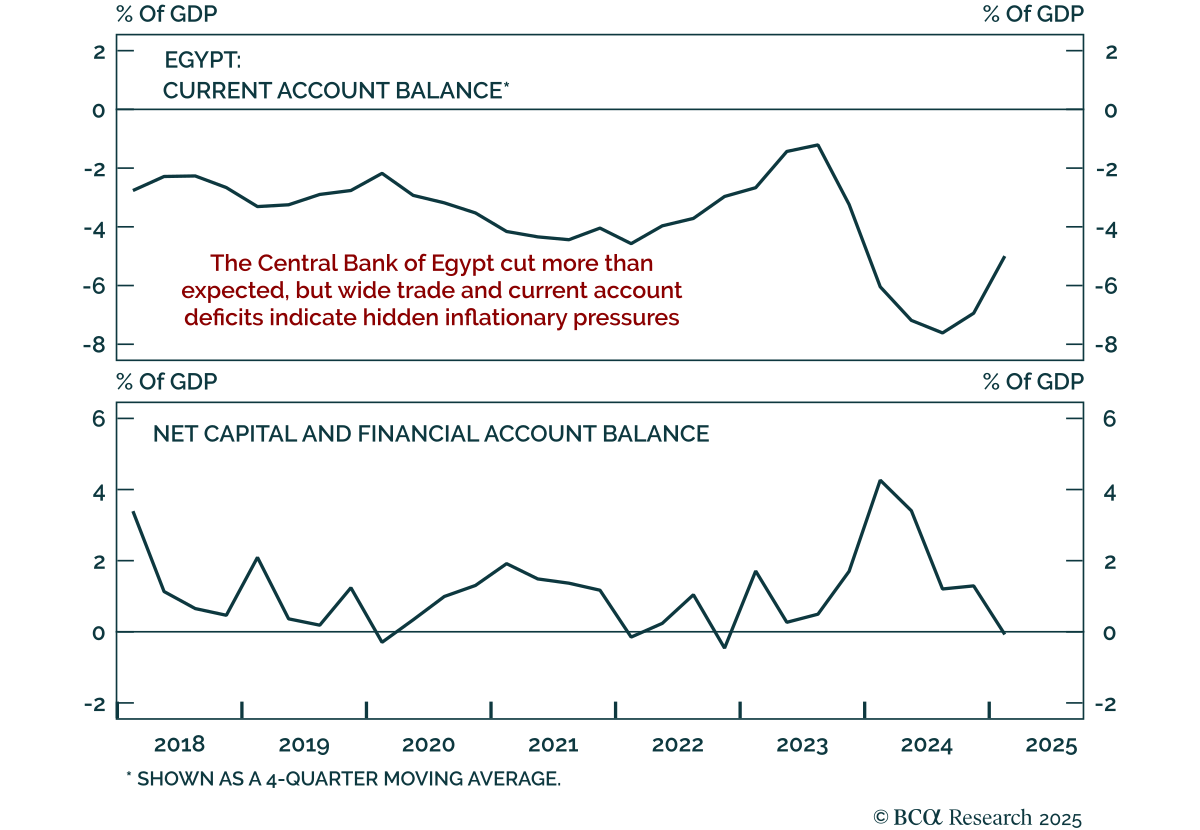
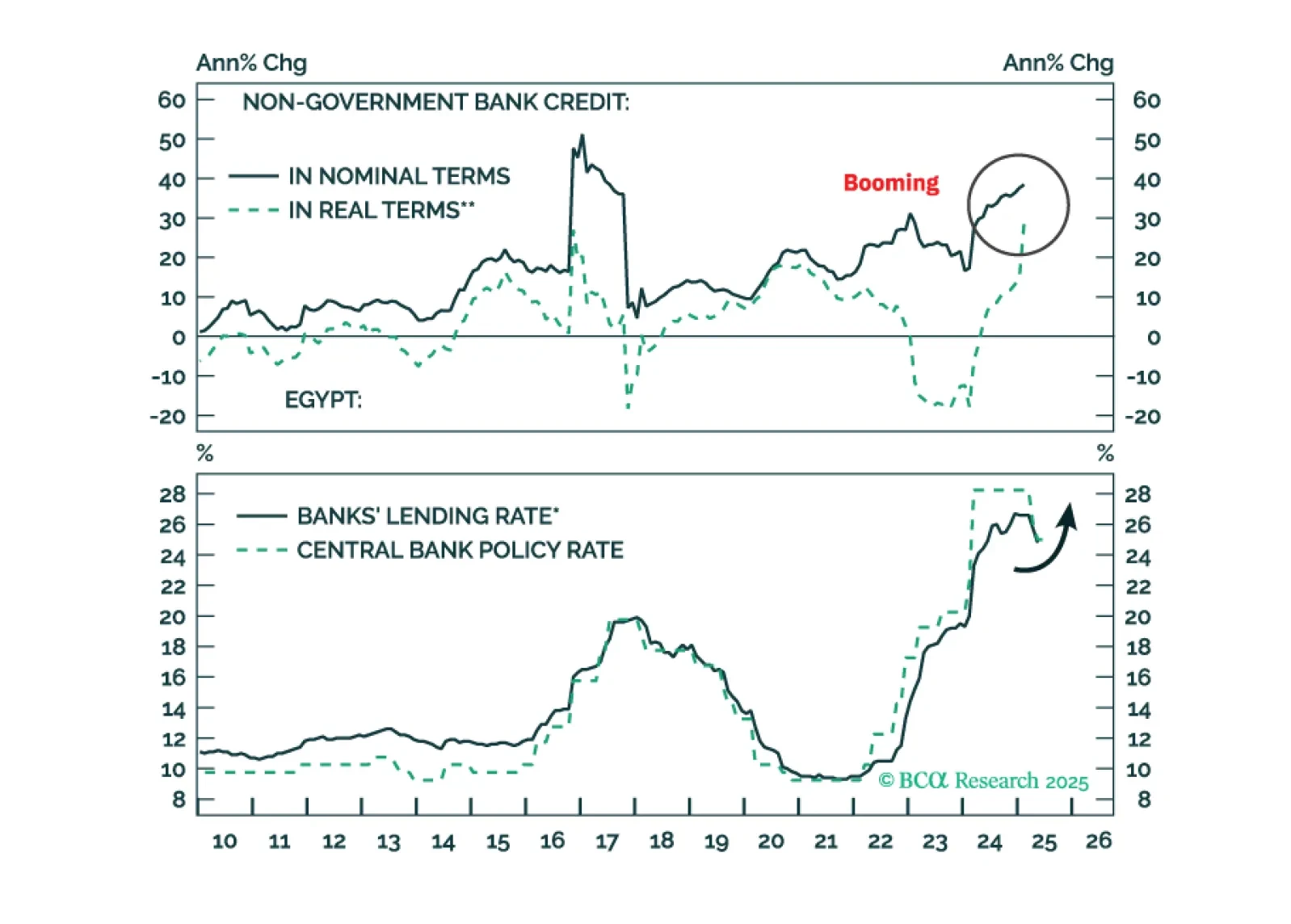
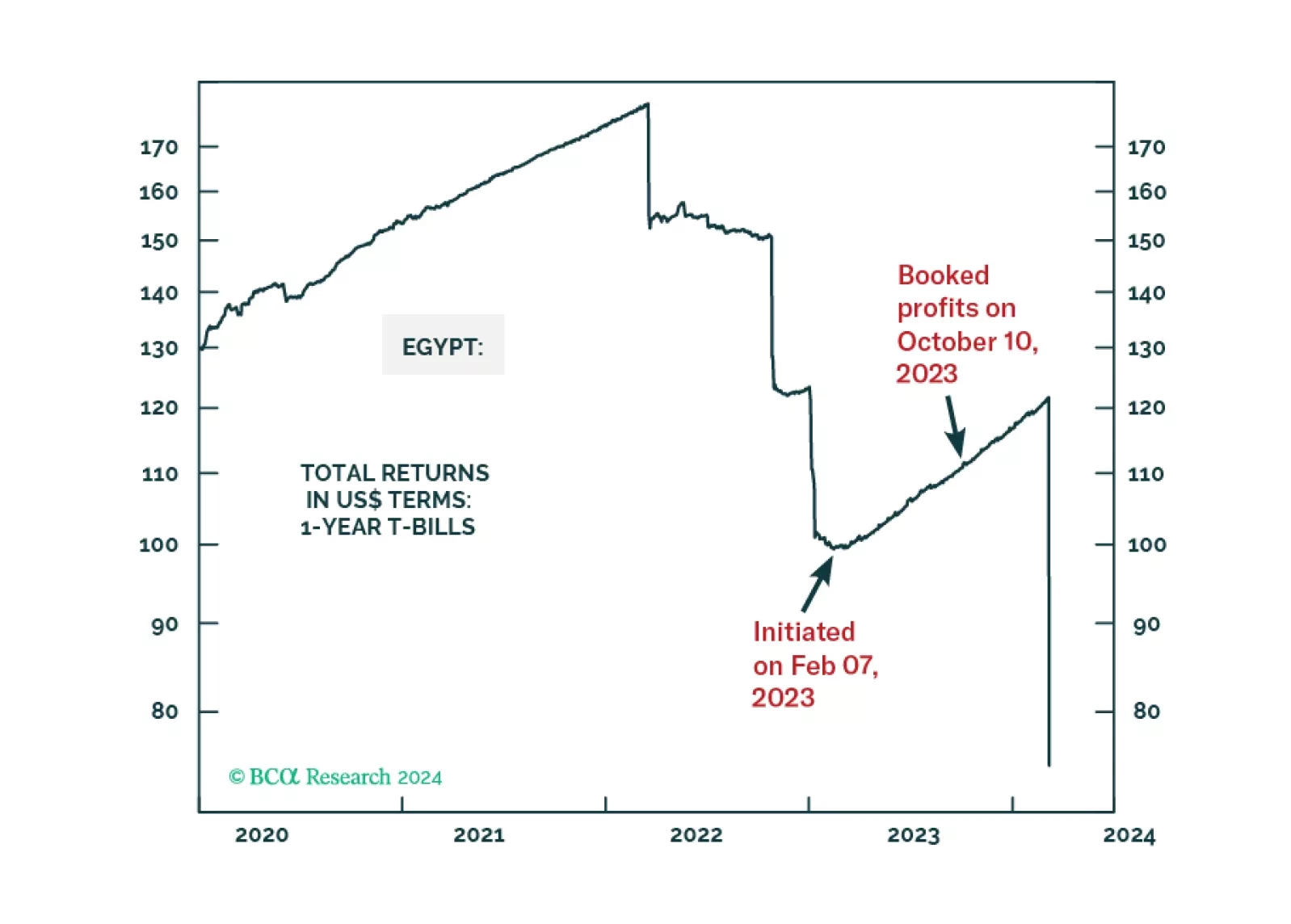
Executive Summary The Egyptian pound remains vulnerable to further devaluation due to a large external financing gap. Egyptian authorities are facing the “Impossible Trinity”. They cannot simultaneously determine the level of the exchange rate and set interest rates independently from the currency policy. Large unregistered capital flight is a voice of no-confidence in the exchange rate. Additionally, more foreign portfolio outflows are likely as Fed tightening lifts the US dollar and, in so doing, produces outflows from risky emerging markets like Egypt. In turn, odds are that Egypt will require another sizable loan from the IMF this year to plug its external financing gap. As a condition of financing, the IMF will require Egyptian authorities to devalue their currency once again. We maintain that in the long run, an optimal policy choice for Egypt is to meaningfully devalue the pound and allow for interest rates to fall. Unrecorded Capital Flight = No-Confidence Vote For The Currency! Bottom Line: We are downgrading Egyptian local currency bonds from overweight to underweight within an EM domestic bond portfolio. EM credit portfolios should have a neutral allocation on Egyptian sovereign credit. Continue to avoid the nation’s stock market. Feature The Egyptian pound remains vulnerable to further devaluation due to a large external financing gap. Despite authorities devaluing the currency by 14% and hiking interest rates by 100 bps on March 21, the currency is not yet cheap (Chart 1). Related Report Emerging Markets StrategyEgypt: Currency Devaluation Delayed, For Now Foreign investor sentiment quickly worsened following the selloff in global risk assets due to the repricing of the Fed’s policy and the sharp rise in commodity prices due to Russia’s invasion of Ukraine. We were caught off guard by the decision made by the government to devalue the currency. In our past report on Egypt on September 30 of last year, we argued that authorities would delay devaluing the currency by 6 to 9 months due to the socio-political risks associated with higher inflation and rising food prices. Back then, we did not foresee a Russia-Ukraine war of these proportions and the resulting surge in food prices (Chart 2). Even though on December 17 we recommended downgrading Russian stocks to underweight due to rising risks of military conflict, we stopped short of downgrading Egyptian fixed-income markets. Chart 1The Egyptian Pound Is Not Yet Cheap! Chart 2Egypt: Surging Food And Energy Prices That said, in the September report we argued that Egypt’s public debt is ultimately on an unsustainable trajectory, and Egyptian authorities would eventually be forced to devalue the exchange rate. The timing of devaluations has been and remains the name of the game in Egypt. Putting it all together, we recommend that investors use the post-devaluation decline in Egypt’s local bonds yields and any stability in the exchange rate in the coming weeks to downgrade local currency bonds from overweight to underweight within an EM domestic bond portfolio. EM credit portfolios should have a neutral allocation on Egyptian sovereign credit. “The Impossible Trinity” Egyptian authorities are facing the “Impossible Trinity” predicament. The “Impossible Trinity” stipulates that for any country that has an open capital account, authorities can control only one of two variables: either interest rates or the exchange rate. Since 2017, the Egyptian government has scrapped most capital controls, i.e., the nation’s capital account has become reasonably open. This entails that authorities cannot simultaneously determine the exchange rate and set interest rates independently from the currency policy. Given that the country has a managed currency peg with the US dollar, the Egyptian Central Bank (CBE) de facto does not have full control over interest rates. The CBE is forced to keep real interest rates much higher than warranted by domestic fundamentals to attract foreign capital. The latter is needed to finance their structural current account deficit and sustain the fixed currency regime. With inflation rising and the current account deficit widening (Chart 3), authorities must choose either to devalue the currency once more or hike interest rates further. Currency devaluation is politically undesirable because the cost of imports, especially food, will skyrocket anew. Meanwhile, hiking rates will depress domestic demand, nominal growth and render the public debt dynamics unsustainable. In the medium-to-long run, we believe authorities will eventually choose devaluation over higher interest rates. The reason is that high local rates will not only suppress domestic income growth and weigh on government revenues but will also increase the cost of debt servicing. Local currency borrowing makes up 80% of total public debt and higher domestic borrowing costs will severely worsen public debt dynamics (Chart 4). Chart 3Rising Inflation And A Widening CA Deficit Is Bad For The Pound Chart 4Egypt: High Public Debt Requires Low Interest Rates Although another currency devaluation and surging food prices are politically dangerous, household incomes can be supported by fiscal transfers, and the central bank can reduce interest rates after the devaluation, which will stimulate economic activity and lift household income. We discussed this trade-off between devaluation and higher interest rates in detail in the September 2021 report on Egypt. Bottom Line: Authorities will eventually have to choose between targeting either interest rates or the exchange rate. In the long run, high real interest rates and persistent economic malaise are less desirable than a one-off rise in costs of imported goods. That is why the government will likely opt to devalue the exchange rate again this year. Accumulating Devaluation Pressure Chart 5Egypt: Tourism And Natural Gas Exports Egypt’s balance-of-payments (BoP) remains under severe stress as foreign aid and assistance from Gulf countries and multilateral organizations are not sufficient to finance the current account deficit. The current account deficit of $20 billion (5% of GDP) as of Q3 2021 is set to widen. Falling tourism receipts from the current lack of Russian and Ukrainian tourists will hit overall exports, while natural gas net exports are still too small to counter the former (Chart 5). In addition, Egypt’s import bill will swell. The nation’s imports are primarily composed of staples and essential goods, like food, that are less sensitive to the business cycle. Also, the country has been the largest importer of Russian and Ukrainian grain. Having delayed grain purchases recently, the country will have to pay high prices and procure grain from international markets in the coming months. Critically, the net errors and omissions account from the country’s balance of payments recorded the largest unrecorded capital outflows as of the end of 2021 (Chart 6). Such unregistered capital flight is a voice of no-confidence in the exchange rate by the private domestic sector. Chart 6Unrecorded Capital Flight = No-Confidence Vote For The Currency! Further, foreign portfolio inflows could dry up as Fed tightening lifts the US dollar and produces outflows from risky emerging markets like Egypt. Foreign investors were holding 24% of outstanding local currency government bonds as of January 2022 (Chart 7). The stock of accumulated foreign portfolio inflows (holdings) was close to $US60 billion as of September 31, 2021 (Chart 8). Chart 7Foreign Investors' Holdings Of Local Bonds Chart 8Egypt: Stock Of Foreign Portfolio Investment Is High Odds are that Egypt will require additional external financing in 2022 beyond what has been pledged by bi- and multi-lateral creditors. Saudi Arabia and other Gulf states have pledged $23 billion in foreign loans, FX deposits and investments over the coming months. A sizable new IMF package will be needed to plug Egypt’s foreign funding gap. As a condition of financing, the IMF will require Egyptian authorities to devalue their currency once again. Bottom Line: Going forward, the government’s optimal policy choice is to meaningfully devalue the pound and allow for interest rates to fall. This will help stimulate domestic demand while also stabilize the public debt dynamics. Investment Recommendations Investors should use the post-devaluation drop in domestic bond yields and exchange rate stability in the coming weeks to downgrade local currency bonds from overweight to underweight within an EM domestic bond portfolio. EM credit portfolios should downgrade the allocation on Egyptian sovereign credit from overweight to neutral within an EM sovereign credit portfolio (Chart 9). Egyptian share prices in US dollars terms are breaking below the multi-year support line. More downside is likely. Chances are that this bourse will underperform the EM equity benchmark (Chart 10). Chart 9Egypt: Downgrade Sovereign Credit To Neutral Chart 10The Egyptian Bourse Is Breaking Down Andrija Vesic Associate Editor andrijav@bcaresearch.com