Equities
According to BCA Research’s European Investment Strategy service, even though Europe will continue to trail the US this year, the summer period will see a sharp recovery in the European service sector. Investors can take advantage of this rebound by…

Dear Client, Dhaval Joshi has started publishing the new BCA Research Counterpoint product, in which he will continue to apply his unique process to dig up original investment opportunities around the globe. I trust many of you will continue to read Dhaval’s excellent and thought-provoking work. I also hope to keep your readership as I take the helm of the European Investment Strategy product, where I will apply BCA’s time-tested method which emphasizes analysis of global liquidity and economic trends to forecast European market outcomes. Thank you for your continued trust and support. Best regards, Mathieu Savary Highlights The Eurozone’s economy lags the US’s because of weakness in the service sector. Poor vaccine rollouts and tighter fiscal policy explain this bifurcated outcome. Even though Europe will continue to trail the US this year, the summer period will see a sharp European recovery. Investors can take advantage of this rebound by buying the cyclical equities that have lagged during last year’s rally. Favor the French, Italian and Spanish equity markets over the German and Dutch markets. The Bank of England does not need to fight rising Gilt yields; favor the pound over the euro as the UK-German spread widens. The Norges Bank will be the first G-10 central bank to lift rates, which will hurt EUR/NOK. Fade any hawkish noise coming from the German election season. Feature The service sector constitutes the biggest drag on the Eurozone’s economy, which will cause European growth to trail that of the US further. The euro area’s fundamental problem is that it lags the US significantly on both vaccination and fiscal stimulus fronts. Nonetheless, by the summer, the European service sector will start catching up, which will favor a basket of sectors exposed to the economic re-opening that have lagged until now. The Service Sector Remains Under The Weather The consensus is correct to expect European growth to lag that of the US in 2021, even if the extent of the shortfall does not hit the 4% currently penciled in by Bloomberg. Chart 1The Service Sector Is the Problem
The Service Sector Is the Problem
The Service Sector Is the Problem
Unlike normal business cycles, the service sector is now Europe’s biggest handicap, while the manufacturing sector is performing in line with that of the US (Chart 1, top panel). On both sides of the Atlantic, industrial activity has benefited from the same set of positives in recent quarters. Goods purchases were the only outlet for pent-up demand built up in the first and second quarter of 2020. Extraordinarily accommodative global liquidity conditions and record-low interest rates boosted spending on big-ticket items, especially in light of the housing boom that has engulfed the globe. Finally, China’s rapid recovery fueled a swift rebound in the demand for natural resources, autos and machinery that benefited manufacturers the world over. Service activity did not enjoy a similar unified tailwind. Consequently, while the US Services PMI stands at a seven-year high, the Eurozone’s lingers at 45.7, in contraction territory (Chart 1, middle panel). The weaker confidence of European households sheds light on this bifurcated performance (Chart 1, bottom panel). Health and fiscal policies are the main headwinds in the Eurozone that have hurt its service sector and hampered the mood of its households, at least compared to the US. With regard to health policy, the poor vaccination rates on the European continent create the greatest problem. The vaccination effort has only reached 11.8, 11.1, 11.9 and 12.5 doses per 100 person in Germany, France, Italy and Spain respectively. In the US and the UK, authorities have already delivered more than 30 doses per 100 person (Chart 2). As a result, while infection and death per capita are rapidly declining in the US and in the UK, mortality is once again rising in France as well as in Italy and caseloads are increasing there and in Germany. Moreover, hospitalization rates and ICU usage in France, Germany, Italy or Portugal are once again trending up, and in some cases they are hitting threatening levels for the healthcare system. In response to these COVID-19 dynamics, governments in many major Eurozone countries are resorting to the re-imposition of restrictions. Italy has announced new lockdowns in half of its 20 regions while France just entered its third lockdown over the weekend. By contrast, the stringency of restrictions is set to ease in the UK and the US. In the US, limitations were already imposed or followed more laxly relative to the euro area (depending on the state) and mobility was improving (Chart 3). Chart 2Slow Vaccination In The Eurozone
Slow Vaccination In The Eurozone
Slow Vaccination In The Eurozone
Chart 3The Stringency Of Lockdowns Matter
The Stringency Of Lockdowns Matter
The Stringency Of Lockdowns Matter
Despite the lower mobility created by stricter restrictions in the Eurozone, the US government has opened the fiscal tap much more aggressively than European governments (Chart 4). Since the beginning of the crisis, the US fiscal help has reached 25% of GDP, while in Italy, Germany, France or Spain the budget deficits have swelled by a more modest 14%, 10%, 9% and 13% of GDP, respectively. True, European governments have also offered credit guarantees totaling EUR3 trillion euros, but these sums only have a very indirect impact on aggregate demand and should mostly be understood as liquidity insurance to prevent a liquidity crisis from morphing into a solvency crisis. Chart 4Tight Fists On The Continent
Summer Of ‘21
Summer Of ‘21
For the remainder of 2021, European fiscal policy is unlikely to be eased compared to the US. BCA Research’s Geopolitical strategy team anticipates the Biden government to add a further $2 trillion dollars of spending by the end of 2021, mostly in the form of long-term and infrastructure outlays, in addition to the $1.9 trillion recently legislated.While the European Union’s NGEU plan is an important step in the integration of European fiscal policy, its generous EUR750 billion envelope will be disbursed over five years. This implies a debt-based fiscal expansion of 1% per annum between 2021 and 2024 (the years of maximum disbursements). Individual state plans are also limited. Bottom Line: The European economy is lagging the US economy because of the inferior performance of its service sector. This disadvantage is the consequence of both a slower vaccine rollout that is negatively impacting mobility and a much more timid fiscal policy. Relief Is On Its Way The Eurozone’s service sector and domestic economic performance is nonetheless set to improve, despite the current health and fiscal policy deficiencies. First, the economy continues to adapt to its new socially distanced form. In the second quarter of 2020, the imposition of lockdowns caused the euro area’s quarterly GDP to collapse by 11%. The contribution to GDP of the retail, wholesale, artistic, entertainment, and hospitality sectors tumbled to -7.3%. In Q4 2020, as European governments were imposing equally stringent lockdowns, quarterly GDP growth fell to -0.1% and the contribution to growth of the same sectors only hit -0.54%. Second, the continental vaccination campaign is progressing. It is easy to worry that it will take a very long time to vaccinate the entire population, but the main reason to impose lockdowns is to preserve capacity in the healthcare system. Thus, the priority is to inoculate 50-year olds and above because they constitute 90% of hospitalizations. Through this aperture, even if the pace of vaccination remains tepid in Europe, the goal to decrease economic restrictions can reasonably be achieved by summer. Moreover, with Pfizer’s logistical issues corrected, the pace of vaccination can accelerate. Concerns remain over the population’s willingness to receive the vaccines, but these issues will fade as well. The current worries surrounding the AstraZeneca vaccines provide an example. The incidence of thromboembolic events is marginally higher than for the general population and the European Medicines Agency deemed the AstraZeneca vaccines safe, especially in light of the human costs of the disease it prevents. As caseloads and mortality rates decline in Israel, the UK and the US, even French elderlies will become more willing to receive their vaccines. Table 1Parsimonious But Constant Fiscal Stimulus…
Summer Of ‘21
Summer Of ‘21
Third, fiscal policy will remain easy. True, European government support is tepid compared to the US, but the continual drip of new policy measures shows that authorities are not intransigent (Table 1). In all likelihood, the various furlough and employment protection schemes implemented since the spring of 2020 are likely to remain in place this year even if lockdowns decrease. Their impact on employment was major and they contributed meaningfully to preserve household income (Chart 5). Finally, COVID-19 is a seasonal illness and summer is on its way in Europe. The experience of 2020, when vaccines and testing were much more limited than they are today, has taught us that in the summer months, this coronavirus spreads much less. Therefore, seasonal patterns will allow a relaxation of social distancing measures. Chart 5Furloughs Played A Crucial Role
Summer Of ‘21
Summer Of ‘21
In this context, service activity in the Eurozone will improve, which will boost GDP. European households, like their US counterparts, have accumulated significant excess savings (Chart 6). Furthermore, global manufacturing activity will remain robust, which will support employment and household income in the Eurozone. Hence, consumer confidence will improve and some of the EUR300 billion in excess savings will make its way into the economy. The service sector should be the prime beneficiary of this money because households have already fulfilled a large proportion of their pent-up demand for goods. What they now want to do is to go out, go to restaurants and spend their income on experiences. The rebound in the contribution to GDP of the retail and recreation sectors will be accretive to job and household income, unleashing a virtuous circle of activity (Chart 7). Chart 6European Are Building Their Nest Egg too
European Are Building Their Nest Egg too
European Are Building Their Nest Egg too
Chart 7Services Will Contribute Again to Growth
Services Will Contribute Again to Growth
Services Will Contribute Again to Growth
Bottom Line: In 2021, the euro area’s economy will further lag that of the US, but investors should nonetheless expect a robust uptick in service activity this summer. How To Play The Summer Recovery? Chart 8Buy The Laggards / Sell the Leaders
Summer Of ‘21
Summer Of ‘21
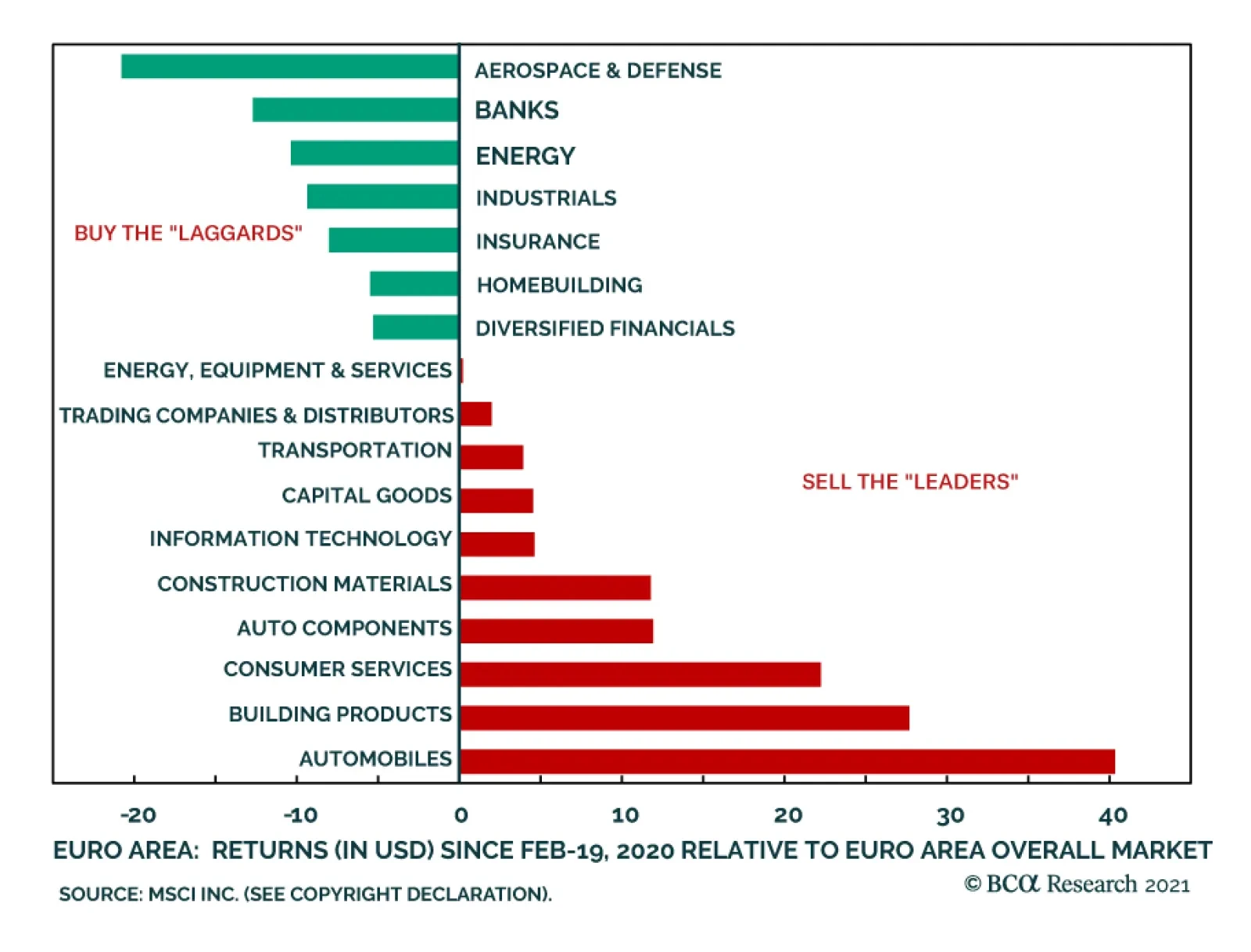
Five weeks ago, BCA Research’s US Equity Sector Strategy service designed a strategy to buy the laggards within a basket of sectors that should benefit from the recovery while selling the “back-to-work” stocks that had already priced in that recovery. This recommendation protects investors against potential hiccups in the re-opening trade and is simple to implement: sell/underweight the pro-cyclical sectors that stand above their February 19 relative peak and buy/overweight those that remain below their relative highs (Chart 8). In the Eurozone context, this strategy involves focusing on the cyclical sectors, and buying/overweighting these cyclical stocks that stand below their pre-COVID high relative to the MSCI benchmark while selling/underweighting those that have punched above this threshold. Chart 9 illustrates the sectors to favor and the ones to avoid using this methodology. In essence, not only should the “laggards” baskets experience a catch up in earnings, but also, the shift in sentiment should prompt a re-rating of relative valuations (Chart 10). Chart 9Who Are the Laggards And the Leaders?
Summer Of ‘21
Summer Of ‘21
This strategy makes sense beyond the COVID-19 dynamics. From a global perspective, the basket of sectors purchased (the laggards”) outperforms the former “leaders” after global bond yields increase (Chart 11, top panel). This relationship reflects the heavy representation of financials in the “laggards” basket while tech and the interest rates-sensitive automobile sector are key constituents of the “leaders” basket. Additionally, the former “leaders” are more exposed to the Chinese business cycle than the “laggards". Chart 10Relative Valuations will Adjust
Relative Valuations will Adjust
Relative Valuations will Adjust
Chart 11Macro Forces Favor The Laggards over the Leaders
Macro Forces Favor The Laggards over the Leaders
Macro Forces Favor The Laggards over the Leaders
The deceleration in the Chinese economy is a problem for the “leaders” relative performance (Chart 11, bottom panel). China’s credit impulse has rolled over as Beijing aims to prevent excess speculation in the real estate sector. Moreover, a regulatory tightening is taking place in the Middle Kingdom, which will further slow its economy. Already, the new orders-to-inventories ratio from the NBS PMI reflects the downside risk for the Chinese economy, which highlights the threat to the previous high-flying leaders. A strategy that favors the former “laggards” at the expense of the previous “leaders” also has implications for geographical allocation within euro area equities. As Table 2 shows, Italy, France and Spain over represent the “laggards” in their national benchmarks while the Netherlands and Germany overweight the “leaders”. On a net basis, the tech-heavy Netherlands is the country to avoid, with a 27% relative underweight for the “laggards”, while Spain and Italy should be favored, with their 24% and 22% overweight in the “laggards” relative to the “leaders”. Spain and Italy in particular will also benefit from a further narrowing in sovereign spreads that will boost the performance of their financial sector while the re-opening of trade continues. Additionally, investors should favor France at the expense of Germany. Table 2France, Italy, and Spain Over The Netherlands And Germany
Summer Of ‘21
Summer Of ‘21
Bottom Line: The economic re-opening favors the Eurozone cyclicals that still trade below their February 19 2020 relative highs as the expense of those cyclicals that have already overtaken their pre-COVID peaks. This means buying/overweighting the Banks, Insurance, Energy and Aerospace & Defense sectors at the expense of the IT, Automobiles and Building products sectors. It also implies a preference for Italian and Spanish equities, especially relative to Dutch equities. Country Focus: The BoE Follows the Fed, Not The ECB Last Thursday, the Bank of England followed in the Fed’s footprints, not the ECB’s. The BoE refrained from adding to its asset purchases, even if this year, 10-year Gilt yields are rising in line with the Treasuries and rapidly outpacing Bund yields. However, the BoE remains committed to keeping short rates at record lows and it keeps the window open for rate cuts if economic conditions ever warrant it. We agree with the Bank of England that the UK’s economic outlook has improved in recent months. The extension of both the furlough schemes and tax holidays, along with the rapid pace of vaccination in the British Islands point to robust growth in the coming quarters. Nonetheless, the picture is not without blemish. Specifically, the UK’s exports to the EU are collapsing in wake of Brexit. Moreover, the pace of vaccination in the UK is set to slow a bit over the coming months. These risks to the outlook are unlikely to topple the economy, because the vigor of the UK’s housing market is an important support to domestic demand. While the UK’s labor market remains frail, the strength of the RICS housing survey suggests that real wages will stay well bid (Chart 12). The increase in household income will cause consumption to accelerate sharply once lockdowns are eased. This could accentuate inflationary pressures this year, and cause inflation over the next few years to trend higher relative to the euro area. Chart 12UK Real Wages Have Upside
UK Real Wages Have Upside
UK Real Wages Have Upside
With this economic backdrop, the market’s pricing of the SONIA curve is appropriate. Over the past month, the OIS curve has steepened significantly (Chart 13). The BoE is comfortable with that pricing and considers the back up in interest rates to be reflective of stronger growth and not constraining of activity. In fact, financial conditions are roughly unchanged since the MPC’s last meeting, which highlights that rising risk asset prices have compensated for an appreciating pound and rising gilt yields. Chart 13SONIA Is Climbing Up, And The BoE Is Fine With It
SONIA Is Climbing Up, And The BoE Is Fine With It
SONIA Is Climbing Up, And The BoE Is Fine With It
Bottom Line: The SONIA curve will continue to shift higher relative to the EONIA curve. Consequently, the spread between Gilt and Bund yields will widen further and EUR/GBP will depreciate more over the coming six to nine months, especially because the pound keeps trading at a discount. Moreover, thanks to their domestic focus and lower sensitivity to the pound, UK mid-cap and small-cap stocks will outperform the FTSE-100. Country Focus: Norges Bank, First Out Of The Gate Chart 14The Norges Bank Will Raise Rates First
The Norges Bank Will Raise Rates First
The Norges Bank Will Raise Rates First
Last Thursday, Governor Øystein Olsen indicated that the Norges Bank would increase interest rates from zero later this year, which validates the message of the Norwegian swap curve. Looking at economic fundamentals, investors should not bet against this outcome. BCA’s Central Bank Monitor confirms that the Norges Bank will be the first central bank in the West to lift interest rates (Chart 14). It is the only one of our Monitors in “Tight Money Required” territory. The message from our Norges Bank Monitor reflects the prompt recovery of the Norwegian economy. Thanks to rebounding Brent prices and rapidly expanding production at the new Johan Sverdrup oil field (the largest in the North Sea), Norwegian nominal exports are growing at a double-digit pace. Meanwhile Norwegian retail sales are increasing at a 16% annual rate. Beyond some near-term COVID worries, consumer spending will remain robust because the strong employment component of the PMI points to solid job gains and a rapidly rising consumer confidence. Finally, Norwegian inflation is already above the central bank’s target of 2%, with core CPI at 2.05% and headline inflation at 3.3%. Chart 15A Weaker EUR/NOK ahead
A Weaker EUR/NOK ahead
A Weaker EUR/NOK ahead
Thanks to Norway’s economic performance, the krone remains one of the favorite currencies of BCA’s Foreign Exchange Strategy service. The global economic environment creates additional tailwind for the NOK. A continued global economic recovery will allow oil prices to rise further on a 12- to 18-month basis, which should lead to a weaker EUR/NOK (Chart 15). In a similar vein, the NOK is particularly sensitive to the USD dollar’s fluctuations. As a result, BCA’s negative cyclical stance toward the USD will create an important support for the NOK, even if the greenback’s countertrend bounce could last another quarter or so. Finally, along with the SEK, the NOK is the cheapest pro-cyclical currency in the G10, trading at a 5% discount to its fair value. Thus, the Norwegian krone should benefit greatly from continued risk taking this year. Bottom Line: The Norwegian krone remains one of the most attractive currencies in the world. The status of the Norges Bank as the front-runner to lift rates this year only amplifies the NOK’s appeal. A Few Words On Germany’s State Elections Chart 16German Party Polling
German Party Polling
German Party Polling
The defeat of Angela Merkel’s CDU party in the states of Baden-Wurttemberg and Rhineland-Palatinate highlights that the German electorate is moving slowly to the left. According to BCA’s Geopolitical Strategy Service, it is too early to tell whether a left-wing coalition will take power in Germany this fall. However, the marginal shift toward the SPD and the Green Party indicates that even the CDU will have to listen to the median voter’s demands (Chart 16). Practically, this means that German politics will push for more European integration and that ultimately, more fiscal stimulus will materialize in Europe over the coming years. As a result, investors should fade any hit to the euro or European assets caused by hawkish sounds made by CDU potential leaders during the campaign for the September federal election. Mathieu Savary, Chief European Investment Strategist Mathieu@bcaresearch.com Cyclical Recommendations Structural Recommendations Trades Closed Trades Currency Performance
Summer Of ‘21
Summer Of ‘21
Fixed Income Performance Government Bonds
Summer Of ‘21
Summer Of ‘21
Corporate Bonds
Summer Of ‘21
Summer Of ‘21
Equity Performance Major Stock Indices
Summer Of ‘21
Summer Of ‘21
Geographic Performance
Summer Of ‘21
Summer Of ‘21
Sector Performance
Summer Of ‘21
Summer Of ‘21
Highlights Portfolio Strategy China’s slowdown, a grinding higher US dollar, extremely overbought technicals and historically pricey valuations, all signal that the time is ripe to book profits and downgrade machinery to neutral. Recent Changes Lock in gains of 4.3% and downgrade the S&P construction machinery & heavy trucks index to neutral, today. Table 1
Pricing Power Update
Pricing Power Update
Feature While the Fed’s dots dovishly surprised market participants last week, the FOMC’s output and inflation projections were on the hawkish side. Adding the committee’s 2021 core PCE price inflation estimate to their real GDP forecast results in a roughly 9% nominal GDP estimate, assuming the PCE and GDP deflators approximate one another. Clearly, the Fed is in a bind as it tries to strike a delicate balance between short and long term rates. Our thesis, first posited on February 1, remains that the bond market will keep on testing the Fed’s resolve until the FOMC members start to “talk about talking about tapering”. An economy running on steroids buoyed both by ultra loose monetary and fiscal policies at a time when it is primed to reopen at full speed around Memorial Day is inherently inflationary. Under such a backdrop, the subsurface equity market’s response makes perfect sense. “Back-To-Work” stocks left “COVID-19 Winners” in the dust, small caps outperformed the Nasdaq 100, the Value Line Arithmetic Index and the RVRS1 exchange traded fund outshone the SPX and the S&P 495 trounced the S&P 5 (Chart 1). In other words, when growth is scarce as during last year’s recession investors flock to growth stocks, now that growth is abundant investors are cornering value stocks with the highest degree of operating leverage (top panel, Chart 1). While this deck reshuffling may go on temporary hiatus as the 10-year US Treasury yield pauses for breath, this sector rotation has cyclical staying power. Given this looming inflationary impulse context, today we update our Corporate Pricing Power Indicator (CPPI). Chart 2 shows that our CPPI has swung over 10 percentage points from the recent trough, accelerating north of 5%/annum pace. In fact, our diffusion index of the 60 selling price categories we track has vaulted to all-time highs (second panel, Chart 2). Chart 1Anatomy Of The Market
Anatomy Of The Market
Anatomy Of The Market
Chart 2Corporate Pricing Power Flexing Its Muscles
Corporate Pricing Power Flexing Its Muscles
Corporate Pricing Power Flexing Its Muscles
Wage inflation is also coming out of hibernation, with job switchers outpacing job stayers’ salary inflation, according to the latest Atlanta Fed wage growth trackers (third panel, Chart 2). Importantly, the most recent NFIB survey showed that small businesses have the hardest time filling job openings by finding qualified labor. Over the past three decades, this backdrop has been conducive to wage inflation (Chart 3), and if history at least rhymes, a pick-up in wage inflation is in the cards in the back half of the year (Chart 4). Our sense is that the economic reopening will by then be at full speed, further exacerbating wage pressures. Chart 3Inflation…
Inflation…
Inflation…
While profit margins are on the cusp of shaking off the remnants of the COVID-19 accelerated recession, sell-side analysts’ 12-month forward profit margin estimates show no signs of input cost pressures, at least not yet. The risk is that corporations may find it challenging to pass on these looming wage increases down the supply chain and all the way to the consumer in order to preserve margins (bottom panel, Chart 2). The jury is still out on who will eventually have to bear the brunt of inflationary pressures, especially in the context of rising fiscal deficits (i.e. personal current transfers). Drilling beneath the surface, our CPPI signals that genuine inflationary pressures are mounting as supply chains are strained causing shortages on a slew of manufacturing industries. As a reminder, we calculate industry group pricing power from the relevant CPI, PPI, PCE and commodity growth rates for each of the 60 industry groups we track. Table 2 also highlights shorter term pricing power trends and each industry's spread to overall inflation. Chart 4…Is Coming
…Is Coming
…Is Coming
Table 2Industry Group Pricing Power
Pricing Power Update
Pricing Power Update
While 68% of the industries we cover are outright lifting selling prices, half are doing so at a faster clip than overall inflation. With regard to pricing power trends, encouragingly only 30% of the industries we cover are in a downtrend (Table 2). Services industries mostly populate the bottom half of Table 2 with the usual suspects – airlines, air freight, hotels and movies & entertainment – that COVID-19 wreaked the most havoc to occupying the bottom four spots. Nevertheless, this is looking in the rearview mirror. The tide is slowly turning as a recent update from the TSA highlighted that passenger enplanements are perking up. Lumber has reached escape velocity and has sustained forest products atop our table with a meteoric year-over-year growth rate of 149%! Commodities populate nine out of the top ten spots and while gold has fallen down the ranks since our last update, it is still expanding at a near 10%/annum rate, despite the greenback’s year-to-date rise. Energy related commodities are on fire and peak oil inflation will hit in April/May due to base effects. Keep in mind that last spring WTI crude oil prices sank into a deeply negative print per bbl. While at first sight all seems upbeat in the commodity complex, beneath the surface some cracks are forming. This week, we revisit our number one macro risk for the back half of the year: China’s pending slowdown, and downgrade a deep cyclical capital goods sub-group to neutral. Gauging China’s Slowdown Cresting in Chinese data pushed us to downgrade the cyclical/defensive portfolio bent from overweight to neutral last month (third panel, Chart 5), and now we highlight yet another warning shot originating across the Pacific Ocean. Bloomberg’s compiled China High-Frequency Economic Activity Index (CHFEAI) has downshifted since peaking last December, warning that investors should keep their “China” guard up. The CSI 300 is following down the path of the CHFEAI (second panel, Chart 5), and the near-term risk is that the S&P 500 may be next in line (top panel, Chart 5), as it has closely tracked China, albeit with a slight lag, since COVID-19 hit, as we first showed in our December 21, 2020 Special Report. Tack on the absence of an SPX valuation cushion, and there are rising odds that select deep cyclical/highly levered/China exposed sectors will start to sniff out some China trouble. Taking cue from Chinese financial market data is also instructive. The MSCI China stock price index, its short-term momentum, net EPS revisions and 12-month forward EPS growth all troughed last spring. It is slightly unnerving that by all these metrics China’s stock market recovery is coming off the boil and may be a precursor to a soft-patch in the coming months (Chart 6). Chart 5Monitor China Closely
Monitor China Closely
Monitor China Closely
Chart 6What Are Chinese Stocks Sniffing Out?
What Are Chinese Stocks Sniffing Out?
What Are Chinese Stocks Sniffing Out?
Importantly, select commodities, especially ones that are hypersensitive to Chinese activity, appear exhausted and have likely hit, at least a temporary, zenith. While anecdotes of metal related scams and thefts are mushrooming especially catalytic converters mostly owing to rare earths soaring prices, we would not be surprised were bronze/copper statues to start disappearing and sold for scrap, as was prevalent in the mid-2000s commodity super cycle. Dr. Copper has more than doubled in the past year, is near all-time highs and already discounts a lot of good China recovery news (top panel, Chart 7). Historically, Google Trends searches for “commodity super cycle” have been closely correlated with cyclicals/defensives relative performance and the recent spike near all-time highs likely corroborates that the Chinese recovery is well advanced (Chart 8). Chart 7Glass Ceiling
Glass Ceiling
Glass Ceiling
Chart 8“Commodity Super Cycle” Hubris?
“Commodity Super Cycle” Hubris?
“Commodity Super Cycle” Hubris?
WTI crude oil prices have also jumped over $100/bbl after hitting the negative $37/bbl mark last April. In the mid-60s/bbl crude oil has likely hit a ceiling and will have a tough time surging past this long term resistance. Sentiment is as extreme as it was during the Desert Storm in the early 1990s, which is the last time the oil RSI jumped over 80 (Chart 9)! Chart 9Slippery Slope?
Slippery Slope?
Slippery Slope?
The Australian dollar, a commodity currency levered to China’s wellbeing, has also been on a tear since last March with AUDUSD rising from 0.55 to roughly 0.80. The Aussie is currently at the upper band of its range, since the Hawke/Keating government floated it in 1983, and facing stiff resistance. There are rising odds that AUDUSD is also sniffing out some China softness in the coming months (bottom panel, Chart 7). Finally, Chinese surveys and money aggregates data also signal that a garden variety slowdown will take root, especially post the 100-year Communist Party anniversary this summer. The Chinese manufacturing PMI is awfully close to the 50 expansion/contraction line, at a time when both M1 money supply has ticked lower and the total social financing impulse has rolled over (Chart 10). Tack on our sister’s China Investment Strategy’s recent estimate of a further steep deceleration in the latter and factors are falling into place for an engineered slowdown in China in the back half of the year (bottom panel, Chart 10). Bottom Line: China is on the cusp of a slowdown, remains a key macro risk to monitor, and thus we use this opportunity to book gains in a deep cyclical industrials sub-group and downgrade to neutral. Chart 10Keep Your China Guard Up
Keep Your China Guard Up
Keep Your China Guard Up
CAT Stalling? As China’s economic growth downshifts, we are compelled to book gains in machinery stocks and downgrade to neutral. This sub-surface industrials sector move comes on the heels of last week’s upgrade in the more domestically focused railroads, and does not affect the broad sector’s overweight stance. First, machinery stocks are extremely overbought by historical standards outpacing the SPX by 36% on a year-over-year basis. Valuations have also spiked: the relative price to sales ratio is back near par and trades at a 25% premium to the historical average (Chart 11). Such lopsided positioning is fraught with danger and could at least temporarily reverse in a violent fashion. Second, while the US dollar has been boosting the industry’s exports and adding to machinery P&L via positive translation gains, the greenback’s year-to-date appreciation will eat into profits, at the margin, in the back half of the year (second & middle panels, Chart 12). Chart 11Too Far Too Fast
Too Far Too Fast
Too Far Too Fast
Chart 12First Signs Of Cracks Appearing
First Signs Of Cracks Appearing
First Signs Of Cracks Appearing
Sell-side analysts have taken notice and net profit revisions have topped out. Similarly, our EPS growth macro models suggest that machinery stocks will struggle to outearn the SPX (Chart 12). Lastly, as China goes, so go machinery stocks. The latest Chinese manufacturing PMIs hooked down and any sustained weakness will weigh heavily on demand for US machinery new orders (fourth panel, Chart 12). Tack on the waning impulse of Chinese total social financing aggregates including BCA’s downbeat forecast, and the outlook for machinery end-demand darkens further (Chart 13). Nevertheless, before getting outright bearish on machinery stocks, there are a few offsetting factors. Commodity prices, while toppy, remain firm, and alleviate fears of a severe Chinese slowdown. Moreover, Chinese excavator sales are on a tear surging to a three year high. While China’s manufacturing PMI has petered out, both the global PMI and developed market PMIs are reaccelerating. As the global economy reopens, services PMIs will further boost the global composite PMIs (second & bottom panels, Chart 14). Chart 13Chart Of The Year Candidate
Chart Of The Year Candidate
Chart Of The Year Candidate
Finally, while our relative EPS growth models hover near the zero line, the same is also true for the sell side’s profit growth estimates and represent a modest hurdle for the industry to surpass (third panel, Chart 14). Netting it all out, China’s slowdown, a grinding higher US dollar, extremely overbought technicals and historically pricey valuations, all signal that the time is ripe to book profits and downgrade machinery to neutral. Chart 14Reasons Not To Turn Outright Bearish
Reasons Not To Turn Outright Bearish
Reasons Not To Turn Outright Bearish
Bottom Line: Downgrade the S&P construction machinery & heavy trucks index to neutral today for a relative gain of 4.3% since inception. The ticker symbols for the stocks in this index are: BLBG: S5CSTF – CAT, CMI, PCAR & WAB. Anastasios Avgeriou US Equity Strategist anastasios@bcaresearch.com Footnotes 1 The Reverse Cap Weighted U.S. Large Cap ETF (Ticker: RVRS) provides exposure to the companies in the S&P 500 index. However, while traditional market cap weighted indexes such as the S&P 500 weight companies inside the index by their relative market capitalization, RVRS does the opposite, weighting companies by the inverse of their relative market cap. By investing smallest-to-biggest, the fund is tilting investment exposure to the smaller end of the market cap spectrum within the large cap space. https://exponentialetfs.com/wp-content/uploads/2021/01/Reverse-ETF-Factsheet_2020.12.311.pdf Current Recommendations Current Trades Strategic (10-Year) Trade Recommendations
Overdose?
Overdose?
Size And Style Views February 24, 2021 Stay neutral cyclicals over defensives January 12, 2021 Stay neutral small over large caps June 11, 2018 Long the BCA Millennial basket The ticker symbols are: (AAPL, AMZN, UBER, HD, LEN, MSFT, NFLX, SPOT, ABNB, V). January 22, 2018 Favor value over growth
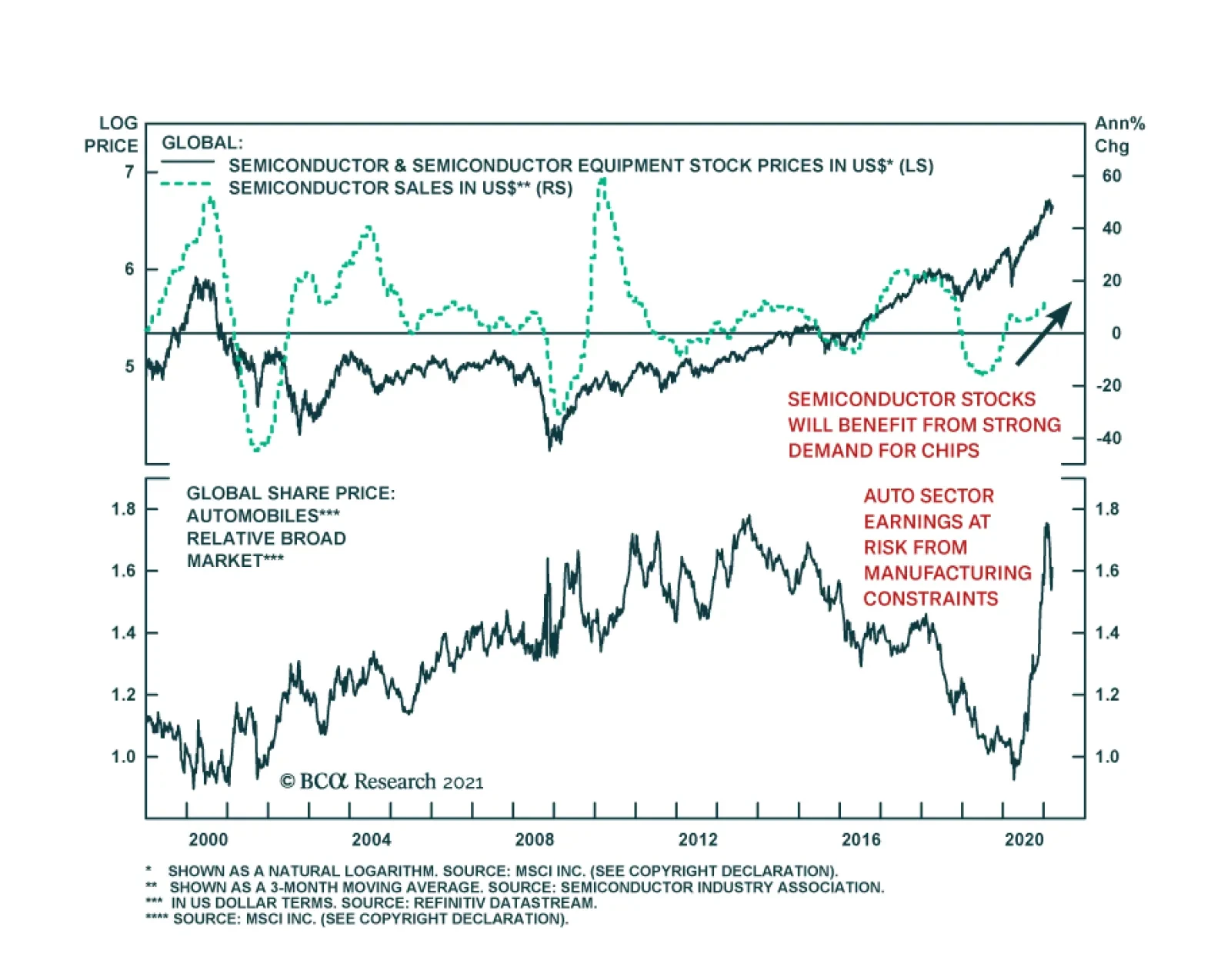
The global semiconductor shortage is weighing on production schedules of major industries. Last month, GM and Ford were forced to shutter some of their North American production because they do not have enough chips to manufacture cars. Now Samsung has…
Highlights The latest “dot plot” from the Fed reaffirmed the FOMC’s intention to keep rates near zero for at least the next two years, despite evidence that the US economy will recover from the pandemic much faster than expected. The Fed’s reluctance to telegraph any rate hikes stems in part from its conviction that the neutral rate of interest has declined. A lower neutral rate implies that monetary policy may not be as accommodative as widely believed. Whereas Fed officials have argued that the neutral rate has fallen due to structural factors outside their control, critics insist that the Fed’s own actions have painted it into a corner. By cutting rates at every opportunity, so the argument goes, the Fed has inflated a massive asset bubble. Moreover, low rates have encouraged governments and the private sector to take on more debt. All this has locked the Fed into a low interest-rate trap: Any attempt to tighten monetary policy would cause asset prices to plunge and debt-servicing costs to rise. This would result in financial distress and rising unemployment – the exact two things the Fed wants to avoid. While we disagree with the view that easier monetary policy has made things worse, we do agree that elevated asset prices and high debt levels limit the Fed’s room for maneuver. In this week’s report, we contend that the low interest-rate trap will likely be resolved through an extended period of easy money, ultimately culminating in significantly higher inflation starting by the middle of this decade. Growth Dots Up, Rate Dots Not The FOMC released its latest Summary of Economic Projections (aka the “dot plot”) this week. As widely anticipated, the Fed upgraded its view on growth following the passage of the $1.9 trillion American Rescue Plan Act. The Fed now expects real GDP to rise by 6.5% in the fourth quarter of 2021 from a year ago, up from its December 2020 estimate of 4.2%. The Fed also sees the unemployment rate falling to 4.5% by the fourth quarter of this year. Back in December, the Fed thought the unemployment rate would end this year at 5% (Chart 1). Chart 1The Fed Sees Faster Recovery, Same Rate Path
Is The Fed Locked Into A Low Interest-Rate Trap?
Is The Fed Locked Into A Low Interest-Rate Trap?
Chart 2The Fed Has Been Lowering Its Estimate Of The Neutral Rate
The Fed Has Been Lowering Its Estimate Of The Neutral Rate
The Fed Has Been Lowering Its Estimate Of The Neutral Rate
The Fed’s unemployment rate projection of 3.9% for 2022 is slightly below the “longer run” estimate of 4.0%. This suggests that the Fed believes the US will have reached full employment by the end of next year. Yet, despite the Fed’s sanguine view on the pace of the economic recovery, the median dot for the expected fed funds rate in 2023 remained at 0.1% (although seven members did pencil in a hike for that year, up from five last December). The median “longer run” dot stayed at 2.5%, with not a single Fed member putting in an estimate above 3%. The Fed regards this longer-run dot as its estimate of the neutral rate of interest – the interest rate consistent with full employment and stable inflation. When the Fed introduced the “dots” back in early 2012, its estimate of the neutral rate stood at 4.3%. It has been trending lower ever since (Chart 2). Explanations For The Falling Neutral Rate What accounts for the steady decline in the Fed’s estimate of the neutral rate in recent years? Fed officials have generally argued that structural forces have dragged down the equilibrium interest rate for the economy. These forces include slower trend growth, an aging population, the shift to a capital-lite economy, high levels of overseas savings, and as we recently discussed, increased income inequality. There is another interpretation, however. Rather than casting the Fed as a helpless observer responding to structural forces beyond its control, some commentators have argued that the Fed’s own actions explain why rates are so chronically low today. By cutting interest rates at every opportunity, so the argument goes, the Fed has inflated a massive asset bubble, stretching from equities to commercial real estate to cryptocurrencies. Moreover, low rates have encouraged governments and the private sector to take on more debt. Chart 3The Correlation Between Swings In Mortgage Rates And Housing Activity
The Correlation Between Swings In Mortgage Rates And Housing Activity
The Correlation Between Swings In Mortgage Rates And Housing Activity
All this has locked the Fed into a low interest-rate trap: Any attempt to tighten monetary policy would cause asset prices to plunge and debt-servicing costs to rise. This would result in financial distress and rising unemployment – the exact two things the Fed wants to avoid. The Fed Is Not The Culprit It is a provocative argument, but is the Fed really to blame? For the most part, the answer is “’no.” To see why, consider the counterfactual: Suppose the Fed did not cut rates. If rates had stayed elevated, the recovery in the cyclical sectors of the economy following the Global Financial Crisis would have been even slower. Housing, in particular, would have remained in the doldrums. Chart 3 shows that there is a strong correlation between housing activity and the 30-year mortgage rate. Lower home prices would have reduced spending via the wealth effect channel, while making it more difficult for banks to recapitalize their balance sheets. In addition, relatively high US rates would have put upward pressure on the dollar, leading to a larger trade deficit (Chart 4). All of this would have reduced aggregate demand. Chart 4The Dollar And The Trade Balance
The Dollar And The Trade Balance
The Dollar And The Trade Balance
Chart 5Rising Labor Share Of Income Occurring Alongside Labor Market Tightening
Rising Labor Share Of Income Occurring Alongside Labor Market Tightening
Rising Labor Share Of Income Occurring Alongside Labor Market Tightening
The share of national income flowing to workers tends to rise when the labor market tightens (Chart 5). A chronic shortfall in aggregate demand would have exacerbated income inequality. Since the poor spend more of every dollar of disposable income than the rich, this would have further dampened overall spending. The Fed has been like a doctor administering a life-saving medicine that comes with some notable side effects. These side effects include increased sensitivity of asset prices to changes in interest rates.1 They also include higher debt levels, at least in those sectors of the economy that had the ability to lever up in response to lower interest rates. Side Effect Triage How dangerous are these side effects? To the extent that today’s low policy rates stem from the fact that structural forces have depressed the neutral rate of interest, they are not especially dangerous at the moment. Yes, debt-servicing costs would balloon, and asset prices would tumble, if the Fed raised rates significantly. However, there’s no reason for the Fed to do that in a setting where the neutral rate is very low. The problem is that the neutral rate may rise over time. Baby boomers are leaving the labor force en masse. They accumulated a lot of wealth while working. According to the Federal Reserve, they currently own more than half of all US wealth (Chart 6). In fact, Americans over the age of 55 controlled 70% of household wealth as of the third quarter of 2020, up from 54% in 1989. As baby boomers retire, their consumption will no longer be backed by income. The resulting depletion of savings will push up the equilibrium rate of interest. Chart 6Baby Boomers Have Accumulated A Lot Of Wealth
Is The Fed Locked Into A Low Interest-Rate Trap?
Is The Fed Locked Into A Low Interest-Rate Trap?
While US fiscal policy will tighten next year, it will remain highly pro-cyclical by historic standards. BCA’s geopolitical strategists expect Congress to pass a $4 trillion spending bill this fall focusing on infrastructure, health care, and clean energy. They anticipate that only half of the bill will be financed through higher taxes. Big budget deficits will drain private-sector savings. There Will Be Political Pressure To Keep Rates Low Debt is not a major problem for governments when the interest rate they pay is below the growth rate of the economy. As we have discussed before, when trend GDP growth exceeds the borrowing rate, the more debt a government carries, the more fiscal support it can provide without putting the debt-to-GDP ratio on a runaway trajectory. If interest rates were to rise meaningfully, however, what had previously been a virtuous fiscal circle would become a vicious one. Needless to say, governments would resist such an outcome. Faced with the prospect of having to reallocate tax revenue from social programs to bondholders, politicians would put political pressure on central banks to refrain from raising rates. Central banks would probably oblige, at least initially. By keeping interest rates below their equilibrium level, central banks could engineer higher inflation – something they have been striving to do for quite some time. Higher inflation, in turn, could pave the way for an exit from the low interest-rate trap. Rising prices would lift nominal GDP, thereby reducing the debt-to-GDP ratio. As inflation rose, real rates would fall. This would provide relief to overextended private-sector borrowers. Once enough debt had been inflated away, central banks could bring interest rates to their equilibrium level. In the end, bondholders would suffer while borrowers would prosper. This leads us to our key macroeconomic conclusion: Today’s low interest-rate trap will likely be resolved through an extended period of easy money, ultimately culminating in significantly higher inflation. Investment Implications Equities face some near-term risks stemming from the recent rise in bond yields. Nevertheless, as we have argued in past reports, stocks will shrug off their losses provided that bond yields do not rise to a level that chokes off economic growth. With the Fed still on hold, we do not expect that to happen anytime soon. As such, our best bet is that the Goldilocks environment for risk assets – where growth is strong, inflation is contained, and monetary policy is accommodative – will last another two years. Investors operating on a 12-month horizon should continue to favor stocks over bonds. Within the fixed-income category, investors should overweight spread product relative to safer government bonds. Value stocks will lead the equity market higher over the next 12 months. The pandemic benefited growth names, especially in the tech realm. The cessation of lockdown measures will favor value names. Not only is value still exceptionally cheap in relation to growth, but traditional value sectors such as banks and energy companies have seen stronger upward earnings revisions than tech stocks since the start of the year (Chart 7). Chart 7 Earnings Revisions And Valuations Favor Value Stocks (I)
Earnings Revisions And Valuations Favor Value Stocks (I)
Earnings Revisions And Valuations Favor Value Stocks (I)
Chart 7Earnings Revisions And Valuations Favor Value Stocks (II)
Earnings Revisions And Valuations Favor Value Stocks (II)
Earnings Revisions And Valuations Favor Value Stocks (II)
Recent upgrades to economic growth forecasts have favored the US, which could help the dollar in the near term. Nevertheless, we expect the greenback to fall modestly over a 12-month horizon. The US trade deficit has ballooned in recent quarters, while the dollar remains overvalued on a purchasing power parity basis (Chart 8). Despite improving US growth prospects, real yield differentials have not moved significantly in favor of the dollar (Chart 9). Chart 8The Dollar Is Expensive Based On Its PPP Fair Value And Growing Trade Deficit (I)
The Dollar Is Expensive Based On Its PPP Fair Value And Growing Trade Deficit (I)
The Dollar Is Expensive Based On Its PPP Fair Value And Growing Trade Deficit (I)
Chart 8The Dollar Is Expensive Based On Its PPP Fair Value And Growing Trade Deficit (II)
The Dollar Is Expensive Based On Its PPP Fair Value And Growing Trade Deficit (II)
The Dollar Is Expensive Based On Its PPP Fair Value And Growing Trade Deficit (II)
Chart 9Real Yield Differentials Have Not Moved Significantly In Favor Of The Dollar (I)
Real Yield Differentials Have Not Moved Significantly In Favor Of The Dollar (I)
Real Yield Differentials Have Not Moved Significantly In Favor Of The Dollar (I)
Chart 9Real Yield Differentials Have Not Moved Significantly In Favor Of The Dollar (II)
Real Yield Differentials Have Not Moved Significantly In Favor Of The Dollar (II)
Real Yield Differentials Have Not Moved Significantly In Favor Of The Dollar (II)
Moreover, the growth outlook outside the US should improve later this year as more countries ramp up their vaccination campaigns. US growth should also come down from its highs due to the expiration of various stimulus measures. Meanwhile, China will continue to stimulate its economy, albeit at a slower pace. Jing Sima, BCA’s chief China strategist, expects the rate of credit expansion to fall by only 2-to-3 percentage points in 2021. The general government deficit should remain broadly stable at 8% of GDP this year, ensuring adequate fiscal support for growth. A strong Chinese economy will bolster the RMB and other EM currencies. Looking further ahead, the cyclical bull market in stocks will end when inflation rises so high that central banks are forced to tighten monetary policy. While this is not a near-term risk, it is a major danger for the middle of the decade and beyond. As we discussed last week, inflation is often slow to rise in response to an overheated economy, but when it does rise, it can do so precipitously. Investors looking to hedge long-term inflation risk should reduce duration exposure in fixed-income portfolios while favoring inflation-protected securities over nominal bonds. In addition to gold, they should own some property. The best inflation hedge is simply to buy a nice house financed with a high loan-to-value fixed-rate mortgage. In a few decades you will still own the nice house, but the value of the mortgage will be greatly reduced in real terms. Peter Berezin Chief Global Strategist pberezin@bcaresearch.com Footnotes 1 For example, suppose the earnings yield is 4% – as it approximately is now for global equities – and the real bond yield is zero, implying an equity risk premium (ERP) of 4%. A one percentage-point increase in real bond yields would require that stock prices fall by 20% in order to keep the ERP unchanged (e.g., the earnings yield would have to rise from 4/100=4% to 4/80=5%). In contrast, if the earnings yield were initially 7% and the real bond yield were 3%, stock prices would need to fall by only 12.5%, taking the earnings yield from 7/100=7% to 7/87.5=8%. Global Investment Strategy View Matrix
Is The Fed Locked Into A Low Interest-Rate Trap?
Is The Fed Locked Into A Low Interest-Rate Trap?
Special Trade Recommendations
Is The Fed Locked Into A Low Interest-Rate Trap?
Is The Fed Locked Into A Low Interest-Rate Trap?
Current MacroQuant Model Scores
Is The Fed Locked Into A Low Interest-Rate Trap?
Is The Fed Locked Into A Low Interest-Rate Trap?
Weekly Performance Update For the week ending Thu Mar 18, 2021 The Market Monitor displays the trailing 1-quarter performance of strategies based around the BCA Score. For each region, we construct an equal-weighted, monthly rebalanced portfolio consisting of the top 3 stocks per sector and compare it with the regional benchmark. For each portfolio, we show the weekly performance of individual holdings in the Top Contributors/Detractors table. In addition, the Top Prospects table shows the holdings that currently have the highest BCA Score within the portfolio. For more details, click the region headers below to be redirected to the full historical backtest for the strategy. BCA US Portfolio
Market Monitor (Mar 18, 2021)
Market Monitor (Mar 18, 2021)
Total Weekly Return BCA US Portfolio S&P500 TRI -0.69% -0.57% Top Contributors QFIN:US CCI:US MO:US HD:US YETI:US Weekly Return 29 bps 20 bps 18 bps 16 bps 13 bps Top Detractors NRG:US AM:US WES:US SCCO:US EXPI:US Weekly Return -47 bps -29 bps -27 bps -20 bps -13 bps Top Prospects TX:US UHAL:US SCCO:US QFIN:US IEP:US BCA Score 99.81% 96.69% 96.41% 91.77% 90.01% BCA Canada Portfolio
Market Monitor (Mar 18, 2021)
Market Monitor (Mar 18, 2021)
Total Weekly Return BCA Canada Portfolio S&P/TSX TRI -0.78% 0.03% Top Contributors NXE:CA LNF:CA QBR.A:CA SOY:CA CCA:CA Weekly Return 36 bps 29 bps 21 bps 17 bps 9 bps Top Detractors LNR:CA PXT:CA VII:CA CS:CA AND:CA Weekly Return -52 bps -36 bps -34 bps -22 bps -14 bps Top Prospects LNF:CA IFP:CA CFP:CA LNR:CA FTT:CA BCA Score 99.42% 97.99% 97.05% 96.99% 92.15% BCA UK Portfolio
Market Monitor (Mar 18, 2021)
Market Monitor (Mar 18, 2021)
Total Weekly Return BCA UK Portfolio FTSE 100 TRI 0.16% 0.73% Top Contributors DRX:GB FDEV:GB SMS:GB GLO:GB DNLM:GB Weekly Return 35 bps 21 bps 15 bps 12 bps 10 bps Top Detractors FDM:GB AO.:GB DGOC:GB AGRO:GB OXIG:GB Weekly Return -17 bps -16 bps -14 bps -14 bps -13 bps Top Prospects NLMK:GB SVST:GB GLTR:GB AGRO:GB BPCR:GB BCA Score 99.70% 98.75% 97.98% 96.47% 96.13% BCA Eurozone Portfolio
Market Monitor (Mar 18, 2021)
Market Monitor (Mar 18, 2021)
Total Weekly Return BCA EMU Portfolio MSCI EMU TRI 0.47% 0.66% Top Contributors QTCOM:FI PHH2:DE IPS:FR KESKOB:FI ZV:IT Weekly Return 22 bps 19 bps 15 bps 13 bps 12 bps Top Detractors ABIO:FR FSKRS:FI MONT:BE DLG:IT EDNR:IT Weekly Return -15 bps -13 bps -13 bps -11 bps -10 bps Top Prospects SOL:IT LOG:ES SOLV:BE STR:AT IPS:FR BCA Score 98.37% 97.42% 96.25% 95.24% 94.86% BCA Japan Portfolio
Market Monitor (Mar 18, 2021)
Market Monitor (Mar 18, 2021)
Total Weekly Return BCA Japan Portfolio TOPIX TRI 3.89% 4.35% Top Contributors 6486:JP 4980:JP 8336:JP 9401:JP 8739:JP Weekly Return 31 bps 26 bps 22 bps 20 bps 20 bps Top Detractors 6960:JP 9436:JP 8174:JP 9543:JP 8198:JP Weekly Return -4 bps -2 bps -2 bps 1 bps 1 bps Top Prospects 8198:JP 9436:JP 4966:JP 3291:JP 3167:JP BCA Score 99.15% 97.49% 95.99% 95.91% 95.06% BCA Hong Kong Portfolio
Image
Total Weekly Return BCA Hong Kong Portfolio Hang Seng TRI 4.28% 0.08% Top Contributors 867:HK 43:HK 327:HK 3369:HK 1378:HK Weekly Return 130 bps 39 bps 34 bps 24 bps 23 bps Top Detractors 1798:HK 6198:HK 185:HK 818:HK 1911:HK Weekly Return -9 bps -6 bps -4 bps -3 bps -2 bps Top Prospects 1378:HK 1866:HK 297:HK 1830:HK 3369:HK BCA Score 99.06% 98.58% 98.30% 97.90% 96.56% BCA Australia Portfolio
Market Monitor (Mar 18, 2021)
Market Monitor (Mar 18, 2021)
Total Weekly Return BCA Australia Portfolio S&P/ASX All Ord. TRI 1.87% 0.75% Top Contributors 360:AU ADO:AU ADH:AU PDN:AU SDG:AU Weekly Return 39 bps 38 bps 34 bps 23 bps 15 bps Top Detractors GRR:AU AQZ:AU AGL:AU PL8:AU REA:AU Weekly Return -25 bps -11 bps -7 bps -7 bps -6 bps Top Prospects GRR:AU BSE:AU PSQ:AU BFG:AU BLX:AU BCA Score 99.92% 99.89% 99.16% 99.15% 99.06%
Dear client, Next week, in lieu of our weekly report, I will be hosting a webcast on Thursday, March 25 at 10:00 am EDT and Friday March 26 at 9:00 am HKT. I look forward to your comments and questions during the webcast. Best regards, Chester Highlights During bear markets, counter-trend rallies in the dollar are capped around 4%. This time should be no different. Meanwhile, unless the Fed tightens policy to stem the increase in aggregate demand, inflation will rise and real short rates will drop. The relative equity performance of the US is critical for the dollar. Reserve diversification out of dollars has also started to place a natural ceiling against other developed market currencies. An attractive opportunity is emerging to short the AUD/CAD cross. Feature The 1.7% rise in the US dollar this year is reinvigorating the bull case. When presenting our key views last year, we highlighted that the DXY index was at risk of a 2-4% bounce.1 We reaffirmed this view in our January report: Sizing A Potential Dollar Bounce. At the time, the DXY index was at the 90 level, suggesting the rally should fizzle around 94. Therefore, the key question is whether the nascent rise in the DXY will punch through this level, or fade as we originally expected. The short-term case for the dollar remains bullish. The currency is much oversold. Meanwhile, real interest rates are moving in favor of the US, vis-à-vis a few countries. Third and interrelated, economic momentum in the US is quite strong, compared to other G10 countries. With the rising specter of a market correction, the dollar could also benefit from safe haven flows towards the US. The Federal Reserve’s meeting yesterday certainly reaffirmed that short-term rates will remain anchored near zero, at least until 2023. The Fed does not see inflation much above 2% a couple of years out. Nevertheless, a lot can change in the coming months. Cycles, Positioning And Interest Rates The dollar tends to move in long cycles, with the latest bull and bear markets lasting about a decade or so. In other words, the dollar is a momentum currency. As such, determining which regime you are in is critical to assessing the magnitude of any rally. This is certainly the case when sentiment remains overly dollar bearish, as now. During bear markets, counter-trend rallies in the dollar are capped around 4-6%. This was what happened in the early 2000s. In bull markets, such as after the financial crisis, the dollar achieves escape velocity, with more durable rallies well into the teens (Chart I-1). So far, the current rise still fits within the narrative of a healthy reset in a longer-term bear market. Chart I-1The Dollar Rally Is Still Benign
The Dollar Rally Is Still Benign
The Dollar Rally Is Still Benign
Long interest rates have also been moving in favor of the dollar, especially relative to the euro area, Japan, and even Sweden. Currencies are driven by real interest rate differentials, and higher US yields are bullish. With the Fed giving no indication it will prevent the curve from steepening further, US interest rates could keep gaping higher. However, currencies are about relative rate differentials, and the rise in US interest rates has not been in isolation. Rates in the UK, Australia and New Zealand, countries that have managed the COVID-19 crisis pretty well, are beginning to rise faster than in the US (Chart I-2). Chart I-2A Synchronized Rise In Global Yields
A Synchronized Rise In Global Yields
A Synchronized Rise In Global Yields
US Versus World Growth The rise in US interest rates has been justified by better economic performance. Whether looking at purchasing managers’ indices, economic surprise indices, or even GDP growth expectations, the US has had the upper hand (Chart I-3). The Fed expects US growth to hit 6.5% this year. This is well above what other central banks expect for their domestic economies. The ECB expects 4%, the BoJ expects 3.9%, and the BoC expects 4.6% (Table I-1). Chart I-3AThe US Leads In Growth This Year
The US Leads In Growth This Year
The US Leads In Growth This Year
Chart I-3BThe US Leads In Growth This Year
The US Leads In Growth This Year
The US Leads In Growth This Year
Table I-1The US Leads In Growth And Inflation This Year
Arbitrating Between Dollar Bulls And Bears
Arbitrating Between Dollar Bulls And Bears
However, economic dominance can be transient, especially in a world of flexible exchange rates. For one, a higher dollar will sap US growth via the export channel. This is especially the case since the starting point is an expensive currency. On a real effective exchange rate basis, the dollar is above its long-term mean (Chart I-4). Meanwhile, we expect the rest of the world to perform better as economies reopen. The services PMI in the US is already close to a cyclical high, similar to Sweden (Chart I-5). These are among the countries with the least stringent COVID-19 measures in the western hemisphere. This suggests that other economies, even manufacturing-centric ones, could see a coiled-spring rebound in growth as we put this pandemic behind us. Chart I-4The Dollar Is Expensive
The Dollar Is Expensive
The Dollar Is Expensive
Chart I-5The US Service PMI Is At A Cyclical High
The US Service PMI Is At A Cyclical High
The US Service PMI Is At A Cyclical High
The sweet spot for most economies is when growth is rising but inflation is low, allowing the resident central bank to keep policy dovish. However, it is an open question if the US can continue to boost spending, without a commensurate rise in inflation. The OECD estimates that the US output gap will close by 2022, with the $1.9-trillion fiscal package. This will put the US well ahead of any G10 country (Chart I-6). Unless the Fed tightens policy to stem the increase in aggregate demand, inflation will rise and real rates will drop (Chart I-7). Rising nominal rates and falling real yields will be anathema to the dollar. Chart I-6The US Output Gap Will Soon Close
The US Output Gap Will Soon Close
The US Output Gap Will Soon Close
Chart I-7Wages And Inflation Should Inch Higher
Wages And Inflation Should Inch Higher
Wages And Inflation Should Inch Higher
Equity Rotation And The Dollar A currency manager once noted that the most important variable to pay attention to when making FX allocations is relative equity performance. This might seem bizarre at first blush, but stands at the center of what an exchange rate is – a mechanism that equalizes rates of return across countries. As such while bond flows are important for exchange rates, equity flows matter as well. The relative equity performance of the US is critical for two reasons. First, the US equity market tends to do relatively better during bear markets. This was the case last year and during the 2008 crisis. Second, the outperformance of the US over the last decade has dovetailed with a dollar bull market (Chart I-8). It is rare to find a currency that has performed well both during equity bull and bear markets. If past is prologue, the near-term risks for the dollar are to the upside, especially if the market rally encounters turbulence as yields rise. The put/call ratio in the US is at a 5-year nadir. A move towards parity could violently pull up the DXY index (Chart I-9). However, a garden-variety 5-10% correction in the SPX should correspond to a shallow bounce in the DXY. This will also fit the pattern of bear market USD rallies, as we already highlighted in Chart I-1. Chart I-8US Equity Relative Performance And The Dollar
US Equity Relative Performance And The Dollar
US Equity Relative Performance And The Dollar
Chart I-9The Dollar Could Rise In ##br##A Market Reset
The Dollar Could Rise In A Market Reset
The Dollar Could Rise In A Market Reset
At the same time, any correction could usher in a violent rotation from cyclicals to defensives, especially if underpinned by higher interest rates. The performance of energy and financials are a leap ahead of other sectors in the S&P 500 this year. Importantly, they also massively outperformed during the February drawdown. Meanwhile, valuations are heavily elevated in the US compared to the rest of the world. This is true for growth sectors compared to value, and cyclicals compared to defensives. Throughout history, both exchange rates and valuations have tended to mean revert. Long-Term Dollar Outlook The 2020 pandemic was a one-in-a-hundred-year event. Coordinated fiscal and monetary stimuli have ushered in a new economic cycle. As a counter-cyclical currency, the dollar tends to do poorly (Chart I-10). This is because monetary stimulus provides more torque to economies levered to the global cycle. Once growth achieves escape velocity, the currencies of these more pro-cyclical economies benefit. The IMF projects that non-US growth should outpace US growth after 2021. Meanwhile, it is an open question that any rally in the dollar will be durable. The key driver behind the dollar increase in 2020 was a global shortage. Not only has the Fed extended its liquidity provisions to foreign central banks until September this year, the share of offshore US dollar debt issuance has fallen by a full 9 percentage points (Chart I-11). Simply put, the Fed is flooding the system with dollar liquidity at the same time that foreign entities are weaning themselves off it Chart I-10The IMF Expects Faster Growth Outside The US After 2021
The IMF Expects Faster Growth Outside The US After 2021
The IMF Expects Faster Growth Outside The US After 2021
Chart I-11Share Of US Dollar Debt ##br##Rolling Over
Arbitrating Between Dollar Bulls And Bears
Arbitrating Between Dollar Bulls And Bears
The reason behind this is balance-of-payment dynamics. The market has realized that ballooning twin deficits in the US come at a cost. For foreign issuers, it is the prospect of rolling over US-denominated debt at a much higher coupon rate. For bond investors, it is currency depreciation, especially if fiscal largesse becomes too “sticky,” and stokes inflation. As such, bond investors continue to avoid the US, despite rising rates (Chart I-12). Finally, reserve diversification out of dollars has started to place a natural ceiling on the US dollar, especially against other developed market currencies. Ever since the trend began to accelerate in 2015, the DXY has been unable to sustainably punch through the 100 level (Chart I-13). This will place a durable floor under developed market currencies in general and gold in particular. The Chinese RMB has also been gaining traction in global FX reserves. Chart I-12Little Appetite For US ##br##Treasurys
Little Appetite For US Treasurys
Little Appetite For US Treasurys
Chart I-13Reserve Diversification Has Been A Headwind For The Dollar
Reserve Diversification Has Been A Headwind For The Dollar
Reserve Diversification Has Been A Headwind For The Dollar
More specifically, the role of the USD/CNY exchange rate as a key anchor for emerging market currencies will rise, especially if the RMB remains structurally strong.2 The People’s Bank of China has massive foreign exchange reserves, worth about US$3.2 trillion. This means it can provide swap agreements that will almost cover the totality of EM foreign dollar debt. Swap agreements entail no exchange of currency, but are about confidence. The PBoC can instill this confidence in countries that have low and/or falling foreign exchange reserves. The dollar will remain the global reserve currency for years to come. However, a slow pivot towards reserve diversification will act as a structural headwind for the dollar. Housekeeping Chart I-14AUD/CAD Is Correlated To The VIX
Arbitrating Between Dollar Bulls And Bears
Arbitrating Between Dollar Bulls And Bears
We were stopped out of our CAD/NOK trade for a profit of 3.1%. The resilience of the US economy is benefiting the CAD more than the NOK for now. However, the Norges Bank confirmed it might be one of the first central banks to lift rates, as early as this year. We are both short USD/NOK and EUR/NOK and recommend sticking with these positions. Second, the growing spat between the EU and the UK could lead to more volatility in our short EUR/GBP position. Our target remains 0.8, but we are tightening stops to 0.865 to protect profits. The BoE left interest rates unchanged, but struck a constructive tone. This will bode well for cable, beyond near-term volatility. Third, our short USD/JPY position was stopped out amid the dollar rally. We are standing aside for now, but will reopen this trade later. Finally, a rise in volatility will boost the dollar, but also benefit short AUD/CAD positions. We are already short the AUD/MXN, but short AUD/CAD could be more profitable should market turmoil persist (Chart I-14). Chester Ntonifor Foreign Exchange Strategist chestern@bcaresearch.com Footnotes 1 Please see the Foreign Exchange Strategy Special Report, titled “2021 Key Views: Tradeable Themes,” dated December 4, 2020. 2 Please see Foreign Exchange Strategy Currency In-Depth Report, titled “Will The RMB Continue To Appreciate?,” dated February 26, 2021. Currencies U.S. Dollar Chart II-1USD Technicals 1
USD Technicals 1
USD Technicals 1
Chart II-2USD Technicals 2
USD Technicals 2
USD Technicals 2
Most data out of the US has been robust: Both PPI, import and export prices were in line with expectations for February. The PPI ex food and energy came in at 2.5% year-on-year. Empire manufacturing was robust at 17.4 in March, versus 12.1 last month. Housing starts and building permits came in a nudge below expectations in February, at 1421K and 1682K. The one disappointment was retail sales, which fell 3.3% year-on-year in February. The DXY index rose slightly this week. The FOMC remained dovish, without any revision to its median path of interest rate hikes. The markets disliked its reticence on rising long-bond yields. As such, equities are rolling over as yields continue to creep higher. Report Links: The Dollar Bull Case Will Soon Fade - March 5, 2021 Are Rising Bond Yields Bullish For The Dollar? - February 19, 2021 Portfolio And Model Review - February 5, 2021 The Euro Chart II-3EUR Technicals 1
EUR Technicals 1
EUR Technicals 1
Chart II-4EUR Technicals 2
EUR Technicals 2
EUR Technicals 2
Recent data from the euro area are mending: The ZEW expectations survey rose to 74 in March, from 69.6. For Germany, the improvement was better at 76.6 from 71.2. The trade balance remained at a healthy €24.2bn euro surplus in January. The euro fell by 0.6% amidst broad dollar strength. With the ECB committed to cap the rise in yields and rise in peripheral spreads, relative interest rates will move against the euro. Sentiment remains elevated, and so a healthy reset is necessary to wash out stale longs. Report Links: Portfolio And Model Review - February 5, 2021 On Japanese Inflation And The Yen - January 29, 2021 The Dollar Conundrum And Protection - November 6, 2020 The Japanese Yen Chart II-5JPY Technicals 1
JPY Technicals 1
JPY Technicals 1
Chart II-6JPY Technicals 2
JPY Technicals 2
JPY Technicals 2
Recent data from Japan has been mixed: Core machinery orders grew 1.5% year-on-year in January. Exports fell by 4.5% in January, while imports rose by 11.8%. This has shifted the adjusted trade balance to a deficit of ¥38.7bn yen. The Japanese yen fell by 0.4% against the US dollar this week, and remains the weakest G10 currency this year. Rising yields have seen Japanese investors stampede into overseas markets such as the UK, while pushing down the yen. We remain yen bulls, but will stand aside for now since it could still go lower in the short term. Report Links: The Dollar Bull Case Will Soon Fade - March 5, 2021 On Japanese Inflation And The Yen - January 29, 2021 The Dollar Conundrum And Protection - November 6, 2020 British Pound Chart II-7GBP Technicals 1
GBP Technicals 1
GBP Technicals 1
Chart II-8GBP Technicals 2
GBP Technicals 2
GBP Technicals 2
Recent data out of the UK have been weak: Industrial production and construction output fell by 4.9% and 3% year-on-year in January. Monthly GDP growth fell by 2.9% in January. Rightmove house prices rose 2.7% year-on-year in March. The pound fell by 0.4% against the dollar this week. It however remains the best performing currency this year. The BoE kept monetary policy on hold, but struck a hawkish tone as vaccination progresses, giving way to higher mobility in the summer. We remain long sterling via the euro. Report Links: Portfolio And Model Review - February 5, 2021 The Dollar Conundrum And Protection - November 6, 2020 Revisiting Our High-Conviction Trades - September 11, 2020 Australian Dollar Chart II-9AUD Technicals 1
AUD Technicals 1
AUD Technicals 1
Chart II-10AUD Technicals 2
AUD Technicals 2
AUD Technicals 2
Recent data in Australia was robust: Home prices rose by 3.6% in the fourth quarter. Modest home appreciation is welcome news by the RBA, given high-flying prices in its antipodean neighbor. The employment report was solid. There were 88.7K new jobs in February, all full-time. This pushed down the unemployment rate to 5.8% from 6.4%. The Aussie fell by 0.4% this week. The Australian recovery is fast approaching escape velocity, forcing the RBA to contain a more pronounced rise in long-bond yields. We remain long AUD/NZD. In the very near term, a market shakeout could pull the Aussie lower, favoring short AUD/CAD positions. Report Links: The Dollar Bull Case Will Soon Fade - March 5, 2021 Portfolio And Model Review - February 5, 2021 Australia: Regime Change For Bond Yields & The Currency? - January 20, 2021 New Zealand Dollar Chart II-11NZD Technicals 1
NZD Technicals 1
NZD Technicals 1
Chart II-12NZD Technicals 2
NZD Technicals 2
NZD Technicals 2
Recent data out of New Zealand was weak: Credit card spending fell by 10.6% year-on-year in January. Q4 GDP contracted by 1% both year-on-year and quarter-on-quarter. The current account remains in deficit at NZ$-2.7bn for Q4. The New Zealand dollar fell by 0.9% against the US dollar this week. The new rule to include house prices in setting monetary policy will be a logistical nightmare for the RBNZ. In trying to achieve financial stability, the RBNZ will have to forego some economic stability, especially if the country still requires accommodative settings. Confused messaging could also introduce currency volatility. Report Links: Portfolio And Model Review - February 5, 2021 Currencies And The Value-Versus-Growth Debate - July 10, 2020 Updating Our Balance Of Payments Monitor - November 29, 2019 Canadian Dollar Chart II-13CAD Technicals 1
CAD Technicals 1
CAD Technicals 1
Chart II-14CAD Technicals 2
CAD Technicals 2
CAD Technicals 2
There was a data dump in Canada this week: The economy added 259.2K jobs in February. This pushed down the unemployment rate from 9.4% to 8.2%. Wages also increased by 4.3% in February. The Nanos confidence index rose from 60.5 to 62.7 in the week of March 12. Housing starts rose by 246K in February, as expected. The BoC’s preferred measures of CPI came in close to the 2% target. Headline CPI was weaker at 1.1% in February. The Canadian dollar rose by 0.3% against the US dollar this week. The correction in oil prices could set the tone for the near-term performance of the loonie, despite robust domestic conditions. However, at the crosses, CAD should have upside. We took profits on our short CAD/NOK position this week. Report Links: Will The Canadian Recovery Lead Or Lag The Global Cycle? - February 12, 2021 Currencies And The Value-Versus-Growth Debate - July 10, 2020 More On Competitive Devaluations, The CAD And The SEK - May 1, 2020 Swiss Franc Chart II-15CHF Technicals 1
CHF Technicals 1
CHF Technicals 1
Chart II-16CHF Technicals 2
CHF Technicals 2
CHF Technicals 2
There was scant data out of Switzerland this week: Producer and import prices fell by 1.1% year-on-year in February. February CPI releases also suggest the economy remains in deflation. The Swiss franc fell by 0.4% against the US dollar this week. Safe-haven currencies continue to be sold as yields rise, making the Swiss franc the worst performing currency this year after the yen. This is welcome news for the SNB. We have been long EUR/CHF on this expectation, and recommend investors to stick with this trade. Report Links: Portfolio And Model Review - February 5, 2021 The Dollar Conundrum And Protection - November 6, 2020 On The DXY Breakout, Euro, And Swiss Franc - February 21, 2020 Norwegian Krone Chart II-17NOK Technicals 1
NOK Technicals 1
NOK Technicals 1
Chart II-18NOK Technicals 2
NOK Technicals 2
NOK Technicals 2
There was scant data out of Norway this week: The trade balance remained in surplus of NOK 25.1bn in February. The Norges bank kept interest rates on hold at 0%. The NOK fell by 1.2% against the dollar this week. The trigger was the selloff in oil prices. However, with the Norges bank signaling a rate hike later this year, placing it ahead of its G10 peers, there is little scope for the NOK to fall durably. Inflation in Norway is above target, and higher mobility later this year will benefit oil-rich Norway. We are long the Norwegian krone as a high-conviction bet against both the dollar and the euro. Report Links: Portfolio And Model Review - February 5, 2021 Revisiting Our High-Conviction Trades - September 11, 2020 A New Paradigm For Petrocurrencies - April 10, 2020 Swedish Krona Chart II-19SEK Technicals 1
SEK Technicals 1
SEK Technicals 1
Chart II-20SEK Technicals 2
SEK Technicals 2
SEK Technicals 2
Swedish data releases were a slight miss: Headline CPI came in at 1.4% in February. Core CPI came in at 1.2%. The unemployment rate remained at 8.9% in February. The Swedish krona fell by 0.8% against US dollar this week. Sweden is struggling to contain another wave of the pandemic and this has weighed on the currency this year. The saving grace for the economy has been a global manufacturing cycle that continues humming. Until Sweden is able to get past the pandemic, the currency will continue trading in a stop-and-go pattern. We remain long the SEK on cheap valuations and as a play on the global industrial cycle. Report Links: Revisiting Our High-Conviction Trades - September 11, 2020 Updating Our Balance Of Payments Monitor - November 29, 2019 Where To Next For The US Dollar? - June 7, 2019 Trades & Forecasts Forecast Summary Core Portfolio Tactical Trades Limit Orders Closed Trades
Highlights The Federal Reserve’s ultra-dovish stance is not the only reason for markets to cheer. The US is booming, China is unlikely to overtighten monetary and fiscal policy, and Europe remains a source of positive political surprises. Still, the cornerstone of this cycle’s wall of worry has been laid: Biden faces a series of foreign policy challenges, the US is raising taxes, China is tightening policy, and Europe’s stimulus is not large enough to qualify as a game changer for potential GDP growth. Stay the course by maintaining strategic pro-cyclical trades yet building up tactical hedges and safe-haven plays. Feature Chart 1US Stimulus, Chinese Tightening, German Vaccine Hiccups
US Stimulus, Chinese Tightening, German Vaccine Hiccups
US Stimulus, Chinese Tightening, German Vaccine Hiccups
The US is turning to tax hikes, China is returning to structural reforms, and Europe is bungling its vaccine rollout. Yet synchronized global debt monetization is nothing to underrate. Especially not in the context of a Great Power struggle that features a green energy race as well as a high-tech race. Governments are generating a cyclical growth boom and it is conceivably that their simultaneous pump-priming combined with a new capex cycle and private innovation could generate a productivity breakthrough. This upside risk is keeping global equity markets bullish even as it becomes apparent that construction has begun on this cycle’s wall of worry. The US dollar bounce should be watched closely in this context (Chart 1). After passing the $1.9 trillion American Rescue Plan Act, which consists largely but not entirely of short-term cash handouts (Chart 2), President Joe Biden’s policy agenda will now turn to tax hikes. Thus far the tax hike proposals are in line with Biden’s campaign literature (Table 1). It remains to be seen whether the market will “sell the news” that Biden is pivoting to tax hikes. After all, Biden was the most moderate of the Democratic candidates and his tax proposals only partially reverse President Trump’s tax cuts. Chart 2American Rescue Plan Act
Building Back … The Wall Of Worry
Building Back … The Wall Of Worry
Table 1Biden’s Tax Hike Proposals On The Campaign Trail
Building Back … The Wall Of Worry
Building Back … The Wall Of Worry
Nevertheless higher taxes symbolize a regime change in the US – it is very unlikely tax rates will go down anytime soon but they could go easily higher than expected in the coming decade – and the drafting process will bring negative surprises, as Treasury Secretary Janet Yellen highlighted by courting Europe to cooperate on a 12% minimum corporate tax and halt the global race to the bottom in taxes on multinational corporations. At the same time Biden’s foreign policy challenges are rising across the board: China is demanding a rollback of Trump’s policies: If Biden says yes, he will sacrifice hard-won American leverage on matters of national interest. If he says no, the Phase One trade deal will be null and void, as will sanctions on Iran and North Korea, and the new economic sanctions on Taiwan will expand beyond mere pineapples.1 Russia is recalling its US ambassador: Biden vowed to make Russia pay for alleged interference in the 2020 US election and sanctions are forthcoming.2 The real way to make Russia pay is to halt the construction of the Nordstream II natural gas pipeline, which reduces the leverage of eastern European democracies while increasing Germany’s energy dependence on Russia. But Germany is dead-set on that pipeline. If Biden levies sanctions the centerpiece of his diplomatic outreach to Europe will be further encouraged to chart an independent course from Washington (though the rest of Europe might cheer). North Korea is threatening to restart missile tests: North Korea is pouring scorn on the Biden administration for trying to restart negotiations.3 The North wants sanctions relief and it knows that Biden is willing to offer it but it may need to create an atmosphere of crisis first. China would be happy were that to happen as it could offer the US its good services on North Korea instead of concrete trade concessions. Iran is refusing to rejoin negotiations over the 2015 nuclear deal: Biden has about five months to arrange for the US and Iran to rejoin the 2015 nuclear deal. Beyond that he will enter into another long negotiation with the master negotiators, the Persians. But unlike President Obama from 2009-15, he will not have support from Russia and China … unless he sacrifices his doctrine of “extreme competition” from the get-go. It is not clear which of these challenges will be relevant to financial markets, or when. However, with US and global equities skyrocketing, it must be said that the geopolitical backdrop is not nearly as reassuring as the Federal Reserve, which announced on Saint Patrick’s Day that it will not hike interest rates until 2024 even in the face of a 6.5% growth rate and the prospect of an additional, yet-to-be passed $2 trillion in US deficit spending. Herein lies Biden’s first victory. He has stressed that boosting the American economy and middle class is critical to his foreign policy. He envisions the US regaining its global standing by defeating the virus, super-charging the economy, and then orchestrating a grand alliance of European and Asian democracies to write new global rules that will put pressure on China to reform its economy. “I say it to foreign leaders and domestic alike. It's never, ever a good bet to bet against the American people. America is coming back. The development, manufacturing, and distribution of vaccines in record time is a true miracle of science.”4 The pandemic and economic part of this agenda are effectively done and now comes the hard part: creating a grand alliance while China and Russia demonstrate to their neighbors the hard consequences of joining any new US crusade. The contradiction of Biden’s foreign policy is his desire to act multilaterally and yet also get a great deal done. The Europeans are averse to conflict with China and Russia. The Russians and Chinese are not inclined to do any great favors on Iran or North Korea. Nobody is opening up their economy – Biden himself is coopting Trump’s protectionism, if less brashly. Cooperation with Presidents Xi Jinping and Vladimir Putin on nuclear proliferation is possible – as long as Biden aborts his democracy agenda and his trade agenda. We continue with our pro-cyclical investment stance but have started building up hedges as we are convinced that geopolitical risk will deliver a rude awakening. This awakening will be a buying opportunity given the ultra-stimulating backdrop … unless it portends war in continental Europe or the Taiwan Strait. In the remainder of this report we highlight the takeaways from China’s National People’s Congress as well as recent developments in Germany. Our key views remain the same: China will not overtighten monetary/fiscal policy; Biden will be hawkish on China; Germany’s election may see an upset but that would be market-positive. China: No Overtightening So Far China concluded its National People’s Congress – the “Two Sessions” of legislation every year – and issued its 2021 Government Work Report. It also officially released the fourteenth five-year plan covering economic development for 2021-25. Table 2 shows the new plan’s targets as compared to the just expired thirteenth five-year plan that covered 2016-20. Table 2China’s Fourteenth Five Year Plan (2021-25)
Building Back … The Wall Of Worry
Building Back … The Wall Of Worry
For a full run-down of the National People’s Congress we recommend clients peruse BCA’s latest China Investment Strategy report. From a geopolitical point of view we would highlight the following takeaways: The Tech Race: China added a new target for strategic emerging industry value added as percent of GDP – it wants this number to reach 17% by 2025 but there is nothing solid to benchmark this against. The point is that by including such a target China is putting more emphasis on emerging industries, including: information technology, robotics, green energy, electric vehicles, 5G networks, new materials, power equipment, aerospace and aviation equipment, and others. China’s technological “Great Leap Forward” continues, with a focus on domestic production and upgrading the manufacturing sector that is bound to stiffen the competition with the United States. China’s removal of a target for service industry growth suggests that Beijing does not want de-industrialization to occur any faster – another reason for global trade tensions to stay high. Research and Development: For R&D spending, previous five-year plans set targets for the desired level. For example, over the last five years China vowed to increase annual R&D spending to 2.5% of GDP. A reasonable expectation for the coming five years would have been a 3% target of GDP. However, this time the government set a target of an annual growth rate of no less than 7% during 2021-2025. The point is that China is continuing to ascend the ranks in R&D spending relative to the US and West in coordination with the overarching goal of forging an innovative and high-tech economy. Unemployment: China has restored an unemployment rate target. In its twelfth five-year plan Beijing aimed to keep the urban surveyed unemployment rate below 5% but over the past five years this target vanished. Now China restored the target and bumped it up slightly to 5.5%. This target should not be hard to meet given the reported sharp decline in urban unemployment to 5.2% already. However, China’s unemployment statistics are notoriously unreliable. The real takeaway is that unemployment will be higher as trend growth slows, while social stability remains the Communist Party’s ultimate prize – and any reform or deleveraging process will occur within that context. The Green Energy Race: China re-emphasized its pledge to tackle climate change, aiming for peak carbon emissions by 2030 and carbon neutrality by 2060. However, no detailed action plans were mentioned. Presumably China will not loosen its enforcement of existing environmental targets. Most of these were kept the same as over the past five years, except for pollution (PM2.5 concentration). Previously the government sought to reduce PM2.5 concentration by 18%. Now the target is set at 10% aggregate reduction, which is lower, though further reduction will be difficult after a 43% drop since 2014. Overall, China has not loosened up its environmental targets – if anything, enforcement will strengthen, resulting in an ongoing regulatory headwind to “Old China” industries. Military Power: Last week we noted that the government’s goals for the military have changed in a way that reinforces themes of persistently high geopolitical tensions. The info-tech upgrades to the People’s Liberation Army were supposed to be met by 2020, with full “modernization” achieved by 2035. However, last October the government created a new deadline, the one-hundredth anniversary of the PLA in 2027 (“military centenary goal”). No specific measures or targets are given but the point is that there is a new deadline of serious importance – an importance that matches the party’s much-ballyhooed centennial on July 1 of 2021 and the People’s Republic’s centennial in 2049. The fact that this deadline is only six years away suggests that a rapid program of military reform and upgrade is beginning. The official defense spending growth target of 6.8% is only slightly bigger than last year’s 6.6% but these targets mask the significance of the announcement. The takeaway is that the Chinese military is preparing for an earlier-than-expected contingency with the United States and its allies. What about China’s all-important monetary, fiscal, and quasi-fiscal credit targets? There is no doubt that China is tightening policy, as we highlight in our updated China Policy Tightening Checklist (Table 3). But will China overtighten? Probably not, at least not judging by the Two Sessions, but the risk is not negligible. Table 3A Checklist For Chinese Policy Tightening
Building Back … The Wall Of Worry
Building Back … The Wall Of Worry
The government reiterated that money and credit growth should remain in a reasonable range in 2021, with “reasonable range” referring to nominal economic growth. Chinese economists estimate that the nominal growth rate will be around 8%-9% in 2021. The IMF projection is 8.1%, while latest OECD forecast is at 7.8%.5 Because China’s total private credit (total social financing) growth is inherently higher than M2 growth, we would use pre-pandemic levels as our benchmark for whether the government will tighten policy excessively: If total social financing growth plunges below 12%, then our view is disproved and Beijing is over-tightening (Chart 3). If M2 growth plunges below 8%, we can call it over-tightening. Anything above these benchmarks should be seen as reasonable and expected tightening, anything below as excessive. However, the Chinese and global financial markets could grow jittery at any time over the perennial risk of a policy mistake whenever governments try to prevent excessive leverage and bubbles. As for fiscal policy, the new quotas for local government net new bond issuance point to expected rather than excessive tightening. New bonds can be used to finance capital investment projects. The quota for total new bond issuance is 4.47 trillion CNY, down by 5.5% from last year. Though local governments may not use up all of the quota, the reduction is small. In fact, total local government bond issuance will be a whisker higher in 2021 than in 2020. The quota for net new bonds is only slightly below the 2020 level and much higher than the 2019 level. Therefore the chance of fiscal overtightening is small – and smaller than monetary overtightening. Chart 3China Policy Overtightening Benchmark
China Policy Overtightening Benchmark
China Policy Overtightening Benchmark
Chart 4China’s Real Budget Deficit Is Huge
Building Back … The Wall Of Worry
Building Back … The Wall Of Worry
China’s official budget balance is a fiction so we look at the IMF’s augmented net lending and borrowing, which reached a whopping -18.2 % of GDP in 2020. It is expected to decrease gradually to -13.8% by 2025. That level will be slightly higher than the pre-pandemic level from 2017-2019 (Chart 4).6 By contrast, China’s total augmented debt is expected to keep rising in the coming years and reach double the 2015 level by 2025. Efforts to constrain debt could lead to a larger debt-to-GDP ratio if growth suffers as a consequence, as our Global Investment Strategy points out. So China will tighten cautiously – especially given falling productivity, higher unemployment, and the threat of sustained pressure from the US and its allies. US-China: Biden As Trump-Lite Chinese and US officials will convene in Alaska on March 18-19. This is the first major US-China meeting under the Biden administration and global investors will watch closely to see whether tensions will drop. So far tensions have not fallen, highlighting a persistent and once again underrated risk to the global equity rally. Biden’s foreign policy team has not completed its review of China policy and Presidents Biden and Xi Jinping are trying to schedule a bilateral summit in April – so nothing concrete will be decided before then. Chart 5US-China: Beijing's Standing Offer
US-China: Beijing's Standing Offer
US-China: Beijing's Standing Offer
The Biden administration is setting up a pragmatic policy, offering areas to engage with China while warning that it will not compromise on democratic values or national interests. China would welcome the opportunity to work with the Americans on nuclear non-proliferation, namely North Korea and Iran, as this would expend US leverage on an area of shared interest while leaving China a free hand over its economic and technological policies. China at least partially enforced sanctions on these countries in response to President Trump’s demands during the trade war and official statistics suggest it continues to do so. Oil imports from Iran remain extremely low while Chinese business with North Korea is, on paper, nil (Chart 5). If this data is accurate then North Korea’s economy has not benefited from China’s stimulus and snapback. If true, then Pyongyang will offer partial concessions on its nuclear program in exchange for sanctions relief. At the moment, instead of staging any major provocations to object to US-Korean military drills, the North is using fiery language and threatening to restart missile tests. This suggests a diplomatic opening. But investors should be prepared for Pyongyang to stage much bigger provocations than missile tests. In March 2010, while the world focused on the financial crisis, the North Koreans torpedoed a South Korean corvette, the Chonan, and shelled some islands, at the risk of a war. The problem under the Trump administration was that Trump wanted a verifiable and durable deal of economic opening for denuclearization whereas the North Koreans wanted to play for time, reduce sanctions, study the data from their flurry of missile tests during the Obama and early Trump years, and see if Trump would get reelected before offering any concrete concessions. Trump’s stance was not really different from Bill Clinton’s but he tried to accelerate the timeline and go for a big win. By Trump’s losing the election North Korea bought four more years on the clock. Chart 6US-China: Biden Lukewarm On China
Building Back … The Wall Of Worry
Building Back … The Wall Of Worry
The Biden administration is willing to play for time if it gets concrete results in phases. This would keep North Korea at bay and retain a line of pragmatic engagement with Beijing. But if North Korea stages a giant provocation Biden will not hesitate to use threats of destruction like Clinton and Trump did. The American public is not much concerned about North Korea (or Iran) but is increasingly concerned about China, with a recent Gallup opinion poll showing that nearly 50% view China as America’s greatest enemy and Americans consistently overrate China’s economic power (Chart 6). Biden will not let grassroots nationalism run his policy. But it is true that he has little to gain politically from appearing to appease China. With progress at hand on the pandemic and economic recovery, Biden will devote more attention to courting the allies and attempting to construct his alliance of democracies to meet global challenges and to “stand up” to China and Russia. The allies, however, are risk-averse when it comes to confronting China. This is as true for the Europeans as it is for China’s Asian neighbors, who stand directly in its firing line. In fact, Europe’s total trade with China is equivalent to that of the US (Chart 7). The Europeans have said that they will pursue tougher trade enforcement through the World Trade Organization, which would tie the Biden administration’s hands. Biden and his cabinet officials insist that they will use the “full array” of tools at their disposal (e.g. tariffs and sanctions) to punish China for mercantilist trade policies. Chinese negotiators are said to be asking explicitly for Biden to roll back Trump’s policies. Some of these policies relate to trade and tech acquisition, others to strategic disputes. We doubt that Biden will compromise on the trade issues to get cooperation on North Korea and Iran. But he will have to offer major concessions if he wants durable denuclearization agreements on these rogue states. Otherwise it will be clear that his administration is mostly focused on competition with China itself and willing to sideline the minor nuclear aspirants. Our expectation is that Americans care about the China threat and the smaller threats will be used as pretexts with which to increase pressure and sanctions on China. Asian equities have corrected after going vertical, as expected. But contrary to our expectations geopolitics was not the cause (Chart 8). This selloff could eventually create a buying opportunity if the Biden administration is revealed to take a more dovish line on China, trade, and tech in exchange for progress on strategic disputes like North Korea. Any discount due to North Korean provocations in particular would be a buy. On Taiwan, however, China’s new 2027 military target underscores our oft-recited red flag. Chart 7EU Risk Averse On China
EU Risk Averse On China
EU Risk Averse On China
Chart 8Asian Equity Correction And GeoRisk Indicators
Asian Equity Correction And GeoRisk Indicators
Asian Equity Correction And GeoRisk Indicators
Bottom Line: Investors should stay focused on the US-China relationship. What matters is Biden’s first actions on tariffs and high-tech exports. So far Biden is hawkish as we anticipated. Investors should fade rumors of big new US-China cooperation prior to the first Biden-Xi summit. Any major North Korean aggression will create a buy-on-the-dips opportunity. Unless it triggers a war, that is – and the threshold for war is high given the Chonan incident in 2010. Germany: Markets Wake Up To Election Risk – And Smile This week’s election in the Netherlands delivered a fully expected victory to Prime Minister Mark Rutte’s liberal coalition. The German leadership ranks next to the Dutch in terms of governments that received an increase in popular support as a result of the COVID-19 crisis (Chart 9). However, in Germany’s case the election outcome is not a foregone conclusion. Chart 9German Leadership Saw Popularity Bounce
Building Back … The Wall Of Worry
Building Back … The Wall Of Worry
As we highlighted in our annual forecast, an upset in which a left-wing bloc forms the government for the first time since 2005 is likelier than the market expects. This scenario presents an upside risk for equities and bund yields since Germany would become even more pro-Europe, pro-integration, and proactive in its fiscal spending. In the current context that would be greeted warmly by financial markets as it would reinforce the cyclical rotation into the euro, industrials, and European peripheral debt. Incidentally, it would also reduce tensions with Russia and China – even as the Biden administration is courting Germany. Recent state elections confirm that the electorate is moving to the left rather than the right. In Baden-Wurttemberg, the third largest state by population and economic output, and a southern state, the Christian Democrats slipped from the last election (-2.9%), the Social Democrats slipped by less (-1.7%), the Free Democrats gained (2.2%), the Greens gained (2.3%), and the far-right Alternative for Germany saw a big drop (-5.4%). In the smaller state of Rhineland-Palatinate the results were largely the same although the Greens did even better (Tables 4A & 4B).7 In both cases the Christian Democrats saw the worst result since prior to the financial crisis while the Greens tripled their support in Baden and doubled their support in the Palatinate over the same time frame. Table 4AGerman State Elections Show Voters’ Leftward Drift Continues
Building Back … The Wall Of Worry
Building Back … The Wall Of Worry
Table 4BGerman State Elections Show Voters’ Leftward Drift Continues
Building Back … The Wall Of Worry
Building Back … The Wall Of Worry
To put this into perspective: Outgoing Chancellor Angela Merkel and her coalition have seen a net 6% increase in popular support since COVID-19. The coalition, led by the Christian Democratic Union and its Bavarian sister party, the Christian Social Union, still leads national opinion polling. What we are highlighting are chinks in the armor. The gap with the combined left-leaning bloc is less than 10% points (Chart 10). Chart 10German Party Polling
German Party Polling
German Party Polling
Merkel is a lame duck whose party has been in power for 17 years. She is struggling to find an adequate successor. Her current frontrunner for chancellor-candidate, Armin Laschet, is suffering in public opinion, especially after the state election defeats, while her previous successor was ousted last year. Other chancellor-candidates, like Friedrich Merz, Markus Söder, and Norbert Röttgen may find themselves to the right of the median voter, which has been shifting to the left. Merkel’s party’s handling of COVID-19 first received praise and now, in the year of the vote, is falling under pressure due to difficulties rolling out the vaccine. Even as conditions improve over the course of the year her party may struggle to recover from the damage, since the underlying reality is that Germany has suffered a recession and is beset by global challenges. While the Christian Democrats performed relatively well in the 2009 election, in the teeth of the global financial crisis, times have changed. Today the Social Democrats are no longer in free fall – ever since their Finance Minister Olaf Scholz led the charge for fiscal stimulus in 2019 – while third parties like the Free Democrats, Greens, and Die Linke all gained in 2009 and look to gain this year (Table 5). In today’s context it is even more likely that other parties will rise at the ruling party’s expense. Still, the Christian Democrats have stout support in polls and do not have to split votes with the far-right, which is in collapse. Table 5German Federal Election Results Show 2021 Could Throw Curveball For Ruling Party
Building Back … The Wall Of Worry
Building Back … The Wall Of Worry
Therein lies the real market takeaway: right-wing populism has flopped in Germany. The risk to the consensus view that Merkel will hand off the baton seamlessly to a successor and secure her party another term in leadership is that the establishment left will take power (the Greens in Germany are essentially an establishment party). Chart 11German Bunds Respond To Macro Shifts, State Elections
German Bunds Respond To Macro Shifts, State Elections
German Bunds Respond To Macro Shifts, State Elections
Near-term pandemic and economic problems have caused bund yields to fall and the yield curve to flatten so far this year (Chart 11). But that trend is unlikely to continue given the global and national outlook. Election uncertainty should work against this trend since the only possible uncertainty gives more upside to the fiscal outlook and bond yields. If the consensus view indeed comes to pass and the Christian Democrats remain in power, the election holds out policy continuity – at least on economic policy. Fiscal tightening would happen sooner under the Christian Democrats but it would not be aggressive or premature, at least not in the 2021-22 period. It is the current coalition that first loosened Germany’s belt – and it did so in 2019, prior to COVID-19. Germany’s and the EU’s proactive fiscal turn will have a major positive impact on growth prospects, at least cyclically, though it is probably too small thus far to create a structural improvement in potential growth. Fiscal thrust is negative over next two years even with the EU’s Next Generation Recovery Fund being distributed. A structural increase in growth is possible given that all of the major countries are simultaneously pursuing monetary and fiscal stimulus as well as big investments in technology and renewable energy that will help engender a new private capex cycle. But productivity has been on a long, multi-decade decline so it remains to be seen if this can be reversed. Geopolitically speaking, Germany’s and the EU’s policy shift arrived in the nick of time to deepen European integration before divisions revive. Integration is broadly driven by European states’ need to compete on a grand scale with the US, Russia, and China. But Putin, Brexit, and Mario Draghi demonstrate the more tactical pressures: Brexit discourages states from exiting, especially with ongoing trade disputes and the risk of a new Scottish independence referendum; Putin’s aggressive foreign policy drives eastern Europeans into the arms of the West; and the formation of a unity government in Italy encourages European solidarity and improves Italian growth prospects. The outlook for structural reforms is not hopeless. Prime Minister Draghi’s government has a good chance of succeeding at some structural reforms where his predecessors have failed. Meanwhile French President Emmanuel Macron is still favored to win the French election in 2022, which is good for French structural reform. The fact that the EU tied its recovery fund to reform is positive. Most importantly the green energy agenda is replacing budget cutting for the time being, which, again, is positive for capex and could create positive long-term productivity surprises. Of course, structural reform intensity slowed just prior to COVID, in Spain, France, and Italy. Once the recovery funds are spent the desire to persist with reform will wane. This is clear in Spain, which has rolled back some reforms and has a weak government that could dissolve any time, and Italy, where the Draghi coalition may not last long after funds are spent. If the global upswing persists and Chinese/EM growth improves, then Europe will benefit from a macro backdrop that enables it to persist with some structural reforms and crawl out of its liquidity trap. But if China/EM growth relapses then Europe will fall back into a slump. Thus it is a very good thing for Europe, the euro, and European equities that the US is engaged in an epic fiscal blowout and that China’s Two Sessions dampened the risk of overtightening. Incidentally, if the German government does shift, relations with Russia would improve on the margin. While US-Russia tensions will remain hot, German mediation could reduce Russia’s insecurity and lower geopolitical risks for both Russia and emerging Europe, which are very cheaply valued at present in part because they face a persistent geopolitical risk premium. Bottom Line: German politics will drive further EU integration whether the Christian Democrats stay in power or whether the left-wing parties manage a surprise victory. Europe will have to provide more fiscal stimulus but otherwise the global context is favorable for Europe. Investors should not be too pessimistic about short-term hiccups with the vaccine rollout. Investment Takeaways The US is stimulating, China is not overtightening, and German’s election risk is actually an upside risk for European and global risk assets. These points reaffirm a bullish cyclical outlook on global stocks and commodities and a bearish outlook on government bonds. It is especially positive for global beneficiaries of US stimulus excluding China, such as Canada and Mexico. It is also beneficial for industrial metals and emerging markets exposed to China over the medium term, after frenzied buying suffers a healthy correction. Any premium in European equities should be snapped up. However, the cornerstone has been laid for the wall of worry in this global economic cycle: the US is raising taxes, China is tightening policy, and Europe’s fiscal stimulus will probably fall short. Moreover a consensus outcome from the German election would be a harbinger of earlier-than-expected fiscal normalization. There is not yet a clear green light in US-China relations – on the contrary, our view that Biden would be hawkish is coming to pass. Biden faces foreign policy tests across the board and now is a good time to hedge against the inevitable return of downside risks given the remorseless increase in tensions between the Great Powers. Housekeeping A number of clients have written to ask follow-up questions about our contrarian report last week taking a positive view on cybersecurity stocks despite the tech selloff and a positive view on global defense stocks, especially in relation to cybersecurity. The main request is, Which companies offer the best value? So we teamed up with BCA’s new Equity Analyzer to highlight the companies that receive the best BCA scores utilizing a range of factors including value, safety, payout, quality, technicals, sentiment, and macro context – all relative to a universe of global stocks with a minimum market cap of $1 billion. The results are shown in the Appendix, which we hope will come in handy. Separately our tactical hedge, long US health care equipment versus the broad market, has stopped out at -5%. This makes sense in light of the pro-cyclical rotation. Health care equipment is still likely to outperform the rest of the US health care sector amid a policy onslaught of higher taxes, government-provided insurance, and pharmaceutical price caps. Matt Gertken Vice President Geopolitical Strategy mattg@bcaresearch.com Yushu Ma Research Associate yushu.ma@bcaresearch.com Appendix Appendix Table ABCA Research Equity Analyzer Casts Light On Best Defense And Cybersecurity Stocks
Building Back … The Wall Of Worry
Building Back … The Wall Of Worry
Appendix Table BBCA Research Equity Analyzer Casts Light On Best Defense And Cybersecurity Stocks
Building Back … The Wall Of Worry
Building Back … The Wall Of Worry
Appendix Table CBCA Research Equity Analyzer Casts Light On Best Defense And Cybersecurity Stocks
Building Back … The Wall Of Worry
Building Back … The Wall Of Worry
Footnotes 1 China is asking for export controls that have hamstrung Huawei and SMIC to be removed as well as for sanctions and travel bans on Communist Party members and students to be lifted. See Lingling Wei and Bob Davis, "China Plans To Ask U.S. To Roll Back Trump Policies In Alaska Meeting," Wall Street Journal, March 17, 2021, wsj.com; Helen Davidson, "Taiwanese urged to eat ‘freedom pineapples’ after China import ban," The Guardian, March 2, 2021, theguardian.com. 2 "Putin on Biden: Russian President Reacts To US Leader’s Criticism," BBC, March 18, 2021, bbc.com. 3 Pyongyang is likely to test a new, longer range intercontinental ballistic missile for the first time since its self-imposed missile test moratorium began in 2018 after President Trump’s summit with leader Kim Jong Un. See Lara Seligman and Natasha Bertrand, "U.S. ‘On Watch’ For New North Korean Missile Tests," Politico, March 16, 2021, politico.com. 4 See ABC News, "Transcript: Joe Biden delivers remarks on 1-year anniversary of pandemic", ABC News, Mar. 11, 2021, abcnews.com. 5 Please see IMF Staff, "World Economic Outlook Reports", IMF, Jan. 2021, imf.org and OECD Staff, "OECD Economic Outlook, Interim Report March 2021", OECD, March 9, 2021, oecd.org. 6 Please see IMF Asia and Pacific Dept, "People’s Republic of China : 2020 Article IV Consultation-Press Release; Staff Report; and Statement by the Executive Director for the People's Republic of China", IMF, Jan. 8, 2021, imf.org. 7 The other state elections coming up this year will coincide with the federal election on September 26, with one minor exception (Saxony-Anhalt). Opinion polls show the Christian Democrats slipping below the Greens in Berlin and the Social Democrats in Mecklenburg-Vorpommern. The Alternative for Germany is falling in all regions.
The pandemic-induced recession surely did hurt earnings, but it also served as a wakeup call to corporate executives as they scrambled to boost business efficiencies. The chart below is showing our proxy (using equally weighted industrials/materials/tech/health care/consumer staples and consumer discretionary) for the degree of operating leverage (DOL) for the broad US equity market. The current reading of just below 2 means that an additional 1% increase in sales translates into a nearly 2% increase in earnings. The fact that DOL has rebounded significantly over the past year from negative territory – where it spent the second half of 2019 likely due to capital misallocation brought by excessive share buybacks – also means that the transmission mechanism from top-to-bottom line growth has been unclogged as corporations cleared out the deadwood. Another message from the recovering US equity market DOL is that the current cycle is just getting started, which also supports our secular 2028 SPX 7000 target. Bottom Line: We remain cyclically and structurally bullish on the prospects of the broad equity market, but are keeping our guard up in the near-term.
Unclogging Earnings Pipes
Unclogging Earnings Pipes
Highlights The breadth of EM equity outperformance versus DM in H2 last year was poor. This outperformance was largely driven by EM TMT stocks. These EM TMT share prices are now facing challenges and are unlikely to provide leadership for the EM equity index going forward. Meanwhile, the fundamental backdrop of EM ex-TMT equities remains poor. Hence, the EM equity index will for now be in limbo. Feature Over the past year, the EM stock index has done very well in absolute terms and has slightly outperformed the global equity index. Yet, its relative outperformance versus the global equity benchmark has been largely due to TMT (technology, internet and catalog retail, and media and entertainment) stocks.1 The top panel of Chart 1 reveals that EM non-TMT stocks have not really outperformed their global peers. In contrast, EM TMT share prices had considerably outpaced their global counterparts until mid-February (Chart 1, bottom panel). However, odds are that EM TMT share prices will weaken both in absolute terms and relative to global TMT stocks (more on this below). The market-cap weight of EM TMT stocks in the EM MSCI equity benchmark has surged and it presently stands at 41%. This number is 42% for the US, 16% for the euro area and 17% for Japan. Until January, relative outperformance of US and EM stocks versus the global benchmark had been largely due to the outperformance of TMT stocks and their overwhelming weights in the US and EM equity indexes. Further, the EM equal-weight and small-cap stock indexes have failed to outperform their global peers, confirming the lack of breadth in EM outperformance (Chart 2). In brief, the EM stock index has by and large been a one-trick pony. Chart 1EM Outperformance Versus Global Has Been Entirely Due To TMT Stocks
EM Outperformance Versus Global Has Been Entirely Due To TMT Stocks
EM Outperformance Versus Global Has Been Entirely Due To TMT Stocks
Chart 2EM Equal-Weighted And Small Caps Have Not Outperformed
EM Equal-Weighted And Small Caps Have Not Outperformed
EM Equal-Weighted And Small Caps Have Not Outperformed
Can the EM equity index both rally in absolute terms and outperform DM stocks if its leaders – TMT companies – encounter challenges? We do not think so. The basis is that fundamentals outside TMT stocks remain lackluster. EM TMT Stocks There are a few reasons why EM TMT stocks will stay under selling pressure: Chart 3TMT Stocks Are Over-Extended
TMT Stocks Are Over-Extended
TMT Stocks Are Over-Extended
The overwhelming headwind for EM TMT stocks is the regulatory crackdown on platform companies in China. Alibaba and Tencent together make up 30% and 11.5% of the MSCI Chinese Investable and MSCI EM equity benchmarks, respectively. Regulatory pressures on them has been growing since October. The recent speech by President Xi implies that the regulatory clampdown is not over. We wrote about how antitrust regulation can affect share prices of these Chinese conglomerates in our November 26 report. US FAANGM stocks as well as Tencent have surged by more than 20-fold since early 2010. That is as much as the Nasdaq100 index during the 1990s (Chart 3). Alibaba and Meituan were listed in 2014 and 2018 respectively so they do not have a ten-year history. We are not suggesting that the share prices of Chinese platform companies will drop by 70% - as much as the Nasdaq 100 index did post its 2000 crest. Our point is that valuation excesses and overbought conditions in Chinese TMT stocks present material downside risk to their share prices when faced with the regulatory clampdown. In addition, rising US bond yields will continue to hurt high-multiples stocks around the world, which include EM TMT stocks, as we discussed in the February 25 Special Report. Technology companies TSMC and Samsung make up 6.6% and 4.3% of the MSCI EM benchmark, respectively. Their valuations are also lofty. Besides, local retail investors played a large role in rallies in both markets last year (Chart 4). It is hard to predict retail investor behavior, but last year’s stampede into stocks could give way to a period of retrenchment. There is another sign of a top for the EM technology and consumer discretionary stocks (Alibaba and Meituan together make 40% of the EM consumer discretionary market cap). Both EM technology (primarily semiconductors) and EM consumer discretionary (internet and catalog retail as well as autos) each make up 20% of the EM benchmark market cap – a threshold that often marks a major peak in their share prices (Chart 5). Chart 4Retail Investors Have Been Driving Korean And Taiwanese Share Prices
Retail Investors Have Been Driving Korean And Taiwanese Share Prices
Retail Investors Have Been Driving Korean And Taiwanese Share Prices
Chart 5EM Sectors Peak When They Reach 20% Of EM Benchmark
EM Sectors Peak When They Reach 20% Of EM Benchmark
EM Sectors Peak When They Reach 20% Of EM Benchmark
Historically, when the market cap of an EM equity sector reached 20% of the EM MSCI equity benchmark, that marked an apex of its absolute and relative outperformance. This was the case with EM banks in 2013, energy stocks in 2008, and technology in 2000. Within TMT stocks, dedicated EM equity portfolios should favor semiconductor producers versus platform companies. Semiconductor stocks are less expensive and their booming revenues will limit downside in their share prices (Chart 6). Bottom Line: The poor risk-reward profile of TMT stocks implies that the emerging Asian equity benchmark has for now passed the zenith of its relative outperformance against global stocks (Chart 7). Chart 6Asian Semiconductor Companies' Revenues Are Still Booming
Asian Semiconductor Companies' Revenues Are Still Booming
Asian Semiconductor Companies' Revenues Are Still Booming
Chart 7Emerging Asian Stocks Versus Global: A Period Of Underperformance Ahead
Emerging Asian Stocks Versus Global: A Period Of Underperformance Ahead
Emerging Asian Stocks Versus Global: A Period Of Underperformance Ahead
Beyond TMT The poor performance of non-TMT stocks has not been limited to the Latin America and EMEA bourses. Emerging Asian non-TMT stocks have also not outperformed their global peers. Chart 8No Bull Market In EM And China ex-TMT Stocks
No Bull Market In EM And China ex-TMT Stocks
No Bull Market In EM And China ex-TMT Stocks
Notably, in absolute terms EM ex-TMT share prices remain below their peak in 2018 (Chart 8, top panel). Besides, Chinese investable non-TMT stocks have not broken out of the trading range that has been in place since 2011 (Chart 8, bottom panel). The following will continue weighing on EM non-TMT stocks: The recovery in many EM economies outside North Asia has been lackluster. Household consumption and capital spending in EM (ex-China, Korea and Taiwan) have been much more subdued than those in the US. These countries are substantially lagging DM economies in vaccinations, delaying the economic normalization and warranting continued economic underperformance. Many EM economies outside North Asia are facing a negative fiscal thrust this year. Their banking systems remain saddled with NPLs and are reluctant to lend. The underperformance of EM (ex-China, Korea, Taiwan) bank stocks versus their global peers corroborates the notion that the monetary transmission mechanism is broken in many of these economies. Without recovery in bank credit, domestic demand will remain lackluster. Rising US bond yields have caused EM (ex-North Asia) local bond yields to spike and currencies to weaken (Chart 9). We expect more upside in US Treasury yields and a relapse in EM exchange rates. This is bad for their stock markets. Critically, the Chinese economy is now facing triple tightening and its growth will weaken in H2 2021: 1. Monetary and fiscal tightening: The credit and broad money (M3) impulses have already rolled over (Chart 10, top panel). Fiscal policy will also tighten relative to the unprecedented stimulus of last year. This represents a major risk to industrial metals that are very overbought (Chart 10, bottom panel). Chart 9EM (ex-China, Korea And Taiwan): Currencies, Rates And Stocks
EM (ex-China, Korea And Taiwan): Currencies, Rates And Stocks
EM (ex-China, Korea And Taiwan): Currencies, Rates And Stocks
Chart 10Peak Stimulus In China
Peak Stimulus In China
Peak Stimulus In China
The relapse in Taiwanese new orders of basic materials PMI heralds weakness in Chinese material stocks (Chart 11). 2. Regulatory tightening on banks and non-bank financial institutions: Authorities are planning to reinforce asset management regulation by the end of this year. This will limit how much these financial institutions can expand their balance sheets reinforcing a credit slowdown. 3. Property market tightening: Restrictions on both property purchases and property developers’ leverage will lead to a notable slump in real estate construction. Property stocks have formed a tapering wedge and a breakdown is likely (Chart 12, top panel). Besides, their off-shore corporate bond prices are gapping down (Chart 12, middle panel). Chart 11An Apex In Chinese Material Stocks
An Apex In Chinese Material Stocks
An Apex In Chinese Material Stocks
Chart 12Chinese Property Sector Is At Risk
Chinese Property Sector Is At Risk
Chinese Property Sector Is At Risk
Overall, Beijing’s ongoing policy tightening and resulting economic slowdown will weigh on China ex-TMT stocks that are dominated by banks and old-economy companies. Crucially, onshore small cap stocks have already relapsed suggesting that economic weakness might be broad-based (Chart 12, bottom panel). Bottom Line: Even though EM ex-TMT stocks offer reasonable multiples, their fundamentals remain unexciting. A Review Of Some Of Our Equity Recommendations Chart 13EM Versus Global: Relative Equity Performance
EM Versus Global: Relative Equity Performance
EM Versus Global: Relative Equity Performance
1. We recommend maintaining a neutral allocation to EM stocks in a global equity portfolio. EM relative performance will fluctuate but is likely to stay within a trading range between last May’s low and the recent highs (Chart 13). In regard to other regions, Europe and Japan should outperform the US as global value continues to outperform global growth in next 6-12 months. 2. Long global value / short Chinese investable value stocks. Global value will benefit from the reopening of economies in the US and Europe. Financials, which hold a large weight in the global value index, will be supported by rising global bond yields. Given that multiples on the value stocks are lower than growth stocks, rising bond yields will cause less damage to value stocks. Chinese investable value stocks are heavy in banks. The latter will suffer the consequences of the credit boom and capital misallocation in China. In a recent special report on China, we estimated that mainland banks have disposed – written-off and sold – RMB 9.4 trillion in loans since 2012, which is equivalent to 6.6% of all loans originated since January 2009 (when the credit boom commenced). In addition, banks’ NPL provisions remain very low at 3.4% of their loan book. In short, Chinese banks have dealt with only 10% of all loans originated since 2009, which is a small number given the magnitude and duration of this credit boom. Hence, we reckon that banks remain saddled with a large amount of NPLs that have not been provisioned for. Outside banks, Chinese investable value stocks will be at risk of ongoing triple policy tightening in China, as discussed above. Chart 14Long Chinese A Shares / Short Chinese Investable Index
Long Chinese A Shares / Short Chinese Investable Index
Long Chinese A Shares / Short Chinese Investable Index
3. Long Chinese A shares / short Chinese investable equity index (Chart 14). We recommended this strategy in a March 4 report discussing China’s structural strengths and weaknesses. The primary reason for this recommendation is that the A-share index2 is heavy in value stocks while the MSCI China investable index has a large weight in expensive new economy stocks. The global investment backdrop has shifted in favor of global value versus global growth stocks due to strong US growth and rising US bond yields. Hence, this strategy is consistent with our preference for global value over global growth stocks. Finally, this strategy will benefit from regulatory tightening on platform companies that have a large weight in the Investable index. Chart 15Favor Global Industrials Over Global Materials
Favor Global Industrials Over Global Materials
Favor Global Industrials Over Global Materials
4. We have strong conviction that global growth stocks will underperform global value but less conviction that EM growth will underperform EM value. The reasons are as follows: EM value is dominated by EM banks. Not only will Chinese banks suffer from the problems discussed above but also EM ex-China banks are facing many cyclical and structural challenges. Hence, they will benefit less than DM banks from rising bond yields. The EM value index has also considerable weight in energy and material stocks and is light on industrial equities compared to the DM value index. China’s tightening and the ensuing growth slowdown in H2 2021 will weigh more on global materials than on global industrials. Materials are very exposed to China’s construction and infrastructure. China accounts for about 55% of the world’s industrial metals consumption while the US accounts for 7-9%. By contrast, global industrial share prices are more diversified and Chinese demand does not dominate industrial goods to the same extent that it does with industrial metals. Therefore, strong growth in US and European demand and the impending slowdown in China favors global industrial stocks versus global materials. Industrial companies have a larger weight in the DM value index than in the EM value index. By contrast, the materials equity sector has a larger market cap share in the EM value index than in the global value index. In short, investors should favor global industrials versus global materials (Chart 15) over the coming 6-to-12 months and that leads us to have high conviction on the DM value index’s outperformance versus the EM value index. Finally, rising US bond yields will pressure US growth stocks that are heavy in platform companies/new economy stocks. The EM growth index has a large weight in semiconductor producers in Korea and Taiwan that have a better long-term outlook than platform companies. The basis is that TSMC and Samsung have technological advantages over their global peers in producing new, high-performance chips. Such technological advantages give them pricing power in addition to a solid volume expansion. While these Asian semiconductor stocks are very overbought and will likely correct along with global growth stocks, their long-term outlook is positive, and is superior to EM value plays. That is why we have a high conviction view on the underperformance of DM growth stocks relative to DM value ones, but have low conviction on the performance of EM growth versus EM value. Arthur Budaghyan Chief Emerging Markets Strategist arthurb@bcaresearch.com Footnotes 1 A TMT stock index refers to a market cap-weighted average of share prices of technology, internet and catalog retail, and media and entertainment. 2 Please note that this is a call for Shanghai- and Shenzhen-listed A shares not the CSI300 index which has a large weight in expensive growth stocks. Equities Recommendations Currencies, Credit And Fixed-Income Recommendations