Europe

Executive Summary EU Embargoes Russian Oil
Energy Cutoff Continues (GeoRisk Update)
Energy Cutoff Continues (GeoRisk Update)
The EU imposed an embargo on 90% of Russian oil imports, which will provoke retaliation. Russia will squeeze Europe’s economy ahead of critical negotiations over the coming 6-12 months. Russian gains on the battlefield in Ukraine point to a ceasefire later, but not yet – and Russia will need to retaliate against NATO enlargement. The Middle East and North Africa face instability and oil disruptions due to US-Iran tensions and Russian interference. China’s autocratic shift is occurring amid an economic slowdown and pandemic. Social unrest and internal tensions will flare. China will export uncertainty and stagflation. Inflation is causing disparate effects in South Asia – instability in Pakistan and Sri Lanka, and fiscal populism in India. Asset Initiation Date Return Long Brazilian Financials / Indian Equities (Closed) Feb 10/22 22.5% Bottom Line: Markets still face three geopolitical hurdles: Russian retaliation; Middle Eastern instability; Chinese uncertainty. Feature Global equities bounced back 6.1% from their trough on May 12 as investors cheered hints of weakening inflation and questioned the bearish consensus. BCA’s Global Investment Strategy correctly called the equity bounce. However, as BCA’s Geopolitical Strategy service, we see several sources of additional bad news. Throughout the Ukraine conflict we have highlighted two fundamental factors to ascertain regarding the ongoing macroeconomic impact: Will the war cut off the Russia-EU energy trade? Will the war broaden beyond Ukraine? Chart 1Russian-Exposed Assets Will Suffer More
Russian-Exposed Assets Will Suffer More
Russian-Exposed Assets Will Suffer More
In this report we update our views on these two critical questions. The takeaway is that the geopolitical outlook is still flashing red. The US dollar will remain strong and currencies exposed to Russia and geopolitical risk will remain weak (Chart 1). In addition, China’s politics will continue to produce uncertainty and negative surprises this year. Taken together, investors should remain defensive for now but be ready to turn positive when the market clears the hurdles we identify. The fate of the business cycle hangs in the balance. Energy Ties Eroding … Russia Will Retaliate Over Oil Embargo Chart 2AEU Embargoes Russian Oil
Energy Cutoff Continues (GeoRisk Update)
Energy Cutoff Continues (GeoRisk Update)
Europe is diversifying from Russian oil and natural gas. The European Union adopted a partial oil embargo on Russia that will cut oil imports by 90% by the end of 2022. It also removed Sberbank from the SWIFT banking communications network and slapped sanctions on companies that insure shipments of Russian crude. The sanctions will cut off all of Europe’s seaborne oil imports from Russia as well as major pipeline imports, except the Southern Druzhba pipeline. The EU made an exception for landlocked eastern European countries heavily dependent on Russian pipeline imports – namely Hungary, Slovakia, the Czech Republic, and Bulgaria (Chart 2A). Focus on the big picture. Germany changed its national policy to reduce Russian energy dependency for the sake of national security. From Chancellors Willy Brandt to Angela Merkel, Germany pursued energy cooperation and economic engagement as a means of lowering the risk of war with Russia. Ostpolitik worked in the Cold War, so when Russia seized Crimea in 2014, Merkel built the Nord Stream 2 pipeline. But Merkel’s policy failed to persuade Russia that economic cooperation is better than military confrontation – rather it emboldened President Putin, who viewed Europe as divided and corruptible. Chart 2BRussia Squeezes EU’s Natural Gas
Energy Cutoff Continues (GeoRisk Update)
Energy Cutoff Continues (GeoRisk Update)
Russia’s regime is insecure and feels threatened by the US and NATO. Russia believed that if it invaded Ukraine, the Europeans would maintain energy relations for the sake of preserving overall strategic stability. Instead Germany and other European states began to view Russia as irrational and aggressive and hence a threat to their long-term security. They imposed a coal ban, now an oil ban the end of this year, and a natural gas ban by the end of 2027, all formalized under the recently announced RePowerEU program. Russia retaliated by declaring it would reduce natural gas exports to the Netherlands and probably Denmark, after having already cut off Finland, Poland, and Bulgaria (Chart 2B). As a pretext Russia points to its arbitrary March demand that states pay for gas in rubles rather than in currencies written in contracts. This ruble payment scheme is being enforced on a country-by-country basis against those Russia deems “unfriendly,” i.e. those that join NATO, adopt new sanctions, provide massive assistance to Ukraine, or are otherwise adverse. Chart 3Russia Actively Cutting Gas Flows
Russia Actively Cutting Gas Flows
Russia Actively Cutting Gas Flows
Russia and Ukraine are already reducing natural gas exports through the Ukraine and Turkstream pipelines while the Yamal pipeline has been empty since May – and it is only a matter of time before flows begin to fall in the Nord Stream 1 pipeline to Germany (Chart 3). German government and industry are preparing to ration natural gas (to prioritize household needs) and revive 15 coal plants if necessary. Europe is attempting to rebuild stockpiles for the coming winter, when Russian willingness and capability to squeeze natural gas flows will reach a peak. The big picture is demonstrated by game theory in Diagram 1. The optimal situation for both Russia and the EU is to maintain energy exports for as long as possible, so that Russia has revenues to wage its war and Europe avoids a recession while transitioning away from Russian supplies (bottom right quadrant, each side receives four points). The problem is that this solution is not an equilibrium because either side can suffer a sudden shock if the other side betrays the tacit agreement and stops buying or selling (bottom left and top right quadrants). Diagram 1EU-Russia Standoff: What Does Game Theory Say?
Energy Cutoff Continues (GeoRisk Update)
Energy Cutoff Continues (GeoRisk Update)
The equilibrium – the decision sets in which both Russia and the EU are guaranteed to lose the least – is a situation in which both states reduce energy trade immediately. Europe needs to cut off the revenues that fuel the Russian war machine while Russia needs to punish and deter Europe now while it still has massive energy leverage (top left quadrant, circled). Once Europe diversifies away, Russia loses its leverage. If Europe does not diversify immediately, Russia can punish it severely by cutting off energy before it is prepared. Russian energy weaponization is especially useful ahead of any ceasefire talks in Ukraine. Russia aims for Ukrainian military neutrality and a permanently weakened Ukrainian state. To that end it is seizing territory for the Luhansk and Donetsk People’s Republics, seizing the southern coastline and strategic buffer around Crimea, and controlling the mouth of the Dnieper river so that Ukraine is forever hobbled (Map 1). Once it achieves these aims it will want to settle a ceasefire that legitimizes its conquests. But Ukraine will wish to continue the fight. Map 1Russian Invasion Of Ukraine, 2022
Energy Cutoff Continues (GeoRisk Update)
Energy Cutoff Continues (GeoRisk Update)
Russia will need leverage over Europe to convince the EU to lean on Ukraine to agree to a ceasefire. Something similar occurred in 2014-15 when Russia collaborated with Germany and France to foist the Minsk Protocols onto Ukraine. If Russia keeps energy flowing to EU, the EU not only gets a smooth energy transition away from Russia but also gets to keep assisting Ukraine’s military effort. Whereas if Russia imposes pain on the EU ahead of ceasefire talks, the EU has greater interest in settling a ceasefire. Finally, given Russia’s difficulties on the battlefield, its loss of European patronage, and potential NATO enlargement on its borders, Moscow is highly likely to open a “new front” in its conflict with the West. Josef Stalin, for example, encouraged Kim Il Sung to invade South Korea in 1950. Today Russia’s options lie in the Middle East and North Africa – the regions where Europe turns for energy alternatives. Not only Libya and Algeria – which are both inherently fertile ground for Russia to sow instability – but also Iran and the broader Middle East, where a tenuous geopolitical balance is already eroding due to a lack of strategic understanding between the US and Iran. Russia’s capabilities are limited but it likely retains enough influence to ignite existing powder kegs in these areas. Bottom Line: Investors still face a few hurdles from the Ukraine war. First, the EU’s expanding energy embargo and Russian retaliation. Second, instability in the Middle East and North Africa. Hence energy price pressures will remain elevated in the short term and kill more demand, thus pushing the EU and the rest of the world toward stagflation or even recession. War Contained To Ukraine So Far … But Russia To Retaliate Over NATO Enlargement At present Russia is waging a full-scale assault on eastern and southern Ukraine, where about half of Donetsk awaits a decision (Map 2). If Russia emerges victorious over Donetsk in the summer or fall then it can declare victory and start negotiating a ceasefire. This timeline assumes that its economic circumstances are sufficiently straitened to prevent a campaign to the Moldovan border.1 Map 2Russia May Declare Victory If It Conquers The Rest Of Donetsk
Energy Cutoff Continues (GeoRisk Update)
Energy Cutoff Continues (GeoRisk Update)
There are still ways for the Ukraine war to spill over into neighboring areas. For example, the Black Sea is effectively a Russian lake at the moment, which prevents Ukrainian grain from reaching global markets where food prices are soaring. Eventually the western maritime powers will need to attempt to restore freedom of navigation. However, Russia is imposing a blockade on Ukraine, has more at stake there than other powers, and can take greater risks. The US and its allies will continue to provide Ukraine with targeting information against Russian ships but this assistance could eventually provoke a larger naval conflict. Separately, the US has agreed to provide Ukraine with the M142 High Mobility Artillery Rocket System (HIMARS), which could lead to attacks on Russian territory that would prompt a ferocious Russian reaction. Even assuming that the Ukraine war remains contained, Russia’s strategic conflict with the US and the West will remain unresolved and Moscow will be eager to save face. Russian retaliation will occur not only on account of European energy diversification but also on account of NATO enlargement. Finland and Sweden are attempting to join NATO and as such the West is directly repudiating the Putin regime’s chief strategic demand for 22 years. Finland shares an 830 mile border with Russia, adding insult to injury. The result will be another round of larger military tensions that go beyond Ukraine and prolong this year’s geopolitical risk and uncertainty. Russia’s initial response to Finland’s and Sweden’s joint application to NATO was to dismiss the threat they pose while drawing a new red line. Rather than forbidding NATO enlargement, Russia now demands that no NATO forces be deployed to these two states. This demand, which Putin and other officials expressed, may or may not amount to a genuine Russian policy change. Russia’s initial responses should be taken with a grain of salt because Turkey is temporarily blocking Finland’s and Sweden’s applications, so Russia has no need to respond to NATO enlargement yet. But the true test will come when and if the West satisfies Turkey’s grievances and Turkey moves to admit the new members. If enlargement becomes inevitable, Russia will respond. Russia will feel that its national security is fundamentally jeopardized by Sweden overturning two centuries of neutrality and Finland reversing the policy of “Finlandization” that went so far in preventing conflict during the Cold War. Chart 4Military Balances Stacking Up Against Russia
Energy Cutoff Continues (GeoRisk Update)
Energy Cutoff Continues (GeoRisk Update)
Russia’s military options are limited. Russia has little ability to expand the war and fight on multiple fronts judging by the army’s recent performance in Ukraine and the Red Army’s performance in the Winter War of 1939. This point can be illustrated by taking the military balance of Russia and its most immediate adversaries, which add up to about half of Russian military strength even apart from NATO (Chart 4). Russian armed forces already demonstrated some pragmatism in April by withdrawing from Kyiv and focusing on more achievable war aims. Unless President Putin turns utterly reckless and the Russian state fails to restrain him, Russia will opt for defensive measures and strategic deterrence rather than a military offensive in the Baltics. Hence Russia’s military response will come in the form of threats rather than outright belligerence. However, these threats will probably include military and nuclear actions that will raise alarm bells across Europe and the United States. President Dmitri Medvedev has already warned of the permanent deployment of nuclear missiles in the Kaliningrad exclave.2 This statement points to only the most symbolic option of a range of options that will increase deterrence and elevate the fear of war. Otherwise Russia’s retaliation will consist of squeezing global energy supply, as discussed above, including by opening a new front in the Middle East and North Africa. Instability should be expected as a way of constraining Europe and distracting America. Higher energy prices may or may not convince the EU to negotiate better terms with Russia but they will sow divisions within and among the allies. Ultimately Russia is highly unlikely to sacrifice its credibility by failing to retaliate for the combination of energy embargo and NATO enlargement on its borders. Since its military options are becoming constrained (at least its rational ones), its economic and asymmetrical options will grow in importance. The result will be additional energy supply constraints. Bottom Line: Even assuming that the war does not spread beyond Ukraine – likely but not certain – global financial markets face at least one more period of military escalation with Russia. This will likely include significant energy cutoffs and saber-rattling – even nuclear threats – over NATO enlargement. China’s Political Situation Has Not Normalized China continues to suffer from a historic confluence of internal and external political risk that will cause negative surprises for investors. Temporary improvements in government policy or investor sentiment – centered on a relaxation of “Zero Covid” lockdowns in major cities and a more dovish regulatory tone against the tech giants – will likely be frustrated, at least until after a more dovish government stance can be confirmed in the wake of the twentieth national party congress in October or November this year. At that event, Chinese President Xi Jinping is likely to clinch another ten years in power and complete the transformation of China’s governance from single-party rule to single-person rule. This reversion to autocracy will generate additional market-negative developments this year. It has already embedded a permanently higher risk premium in Chinese financial assets because it increases the odds of policy mistakes, international aggression, and ultimately succession crisis. The most successful Asian states chose to democratize and expand free markets and capitalism when they reached a similar point of economic development and faced the associated sociopolitical challenges. But China is choosing the opposite path for the sake of national security. Investors have seen the decay of Russia’s economy under Putin’s autocracy and would be remiss not to upgrade the odds of similarly negative outcomes in China over the long run as a result of Xi’s autocracy, despite the many differences between the two countries. China’s situation is more difficult than that of the democratic Asian states because of its reviving strategic rivalry with the United States. US Secretary of State Antony Blinken recently unveiled President Biden’s comprehensive China policy. He affirmed that the administration views China as the US’s top strategic competitor over the long run, despite the heightened confrontation with Russia.3 The Biden administration has not eased the Trump administration’s tariffs or punitive measures on China. It is unlikely to do so during a midterm election year when protectionist dynamics prevail – especially given that the Xi administration will be in the process of reestablishing autocracy, and possibly repressing social unrest, at the very moment Americans go to the polls. Re-engagement with China is also prohibited because China is strengthening its strategic bonds with Russia. President Biden has repeatedly implied that the US would defend Taiwan in any conflict with China. These statements are presented as gaffes or mistakes but they are in fact in keeping with historical US military actions threatening counter-attack during the three historic Taiwan Strait crises. The White House quickly walks back these comments to reassure China that the US does not support Taiwanese independence or intend to trigger a war with China. The result is that the US is using Biden’s gaffe-prone personality to reemphasize the hard edge (rather than the soft edge) of the US’s policy of “strategic ambiguity” on Taiwan. US policy is still ambiguous but ambiguity includes the possibility that a president might order military action to defend Taiwan. US attempts to increase deterrence and avoid a Ukraine scenario are threatening for China, which will view the US as altering the status quo and penalizing China for Russia’s actions. Beijing resumed overflights of Taiwan’s air defense identification zone in the wake of Biden’s remarks as well as the decision of the US to send Senator Tammy Duckworth to Taiwan to discuss deeper economic and defense ties. Consider the positioning of US aircraft carrier strike groups as an indicator of the high level of strategic tensions. On January 18, 2022, as Russia amassed military forces on the Ukrainian border – and the US and NATO rejected its strategic demands – the US had only one publicly acknowledged aircraft carrier in the Mediterranean (the USS Harry Truman) whereas it had at least five US carriers in East Asia. On February 24, the day of Russia’s invasion of Ukraine, the US had at least four of these carriers in Asia. Even today the US has at least four carriers in the Pacific compared to at least two in Europe – one of which, notably, is in the Baltics to deter Russia from attacking Finland and Sweden (Map 3). The US is warning China not to take advantage of the Ukraine war by staging a surprise attack on Taiwan. Map 3Amid Ukraine War, US Deters China From Attacking Taiwan
Energy Cutoff Continues (GeoRisk Update)
Energy Cutoff Continues (GeoRisk Update)
Of course, strategic tensions are perennial, whereas what investors are most concerned about is whether China can secure its economic recovery. The latest data are still disappointing. Credit growth continues to falter as the private sector struggles with a deteriorating demographic and macroeconomic outlook (Chart 5). The credit impulse has entered positive territory, when local government bonds are included, reflecting government stimulus efforts. But it is still negative when excluding local governments. And even the positive measure is unimpressive, having ticked back down in April (Chart 6). Chart 5Credit Growth Falters Amid Economic Transition
Credit Growth Falters Amid Economic Transition
Credit Growth Falters Amid Economic Transition
Chart 6Silver Lining: Credit Impulse Less Negative
Silver Lining: Credit Impulse Less Negative
Silver Lining: Credit Impulse Less Negative
Bottom Line: Further monetary and fiscal easing will come in China, a source of good news for global investors next year if coupled with a broader policy shift in favor of business, but the effects will be mixed this year due to Covid policy and domestic politics. Taken together with a European energy crunch and Middle Eastern oil supply disruptions, China’s stimulus is not a catalyst for a sustainable global equity market rally this year. South Asia: Inflation Hammers Sri Lanka And Pakistan Since 2020 we have argued that the global pandemic would result in a new wave of supply pressures and global social unrest. High inflation is blazing a trail of destruction in emerging markets, notably in South Asia, where per capita incomes are low and political institutions often fragile. Chart 7South Asia: Surging Inflation
Energy Cutoff Continues (GeoRisk Update)
Energy Cutoff Continues (GeoRisk Update)
Sri Lanka has been worst affected (Chart 7). Inflation surged to an eye-watering 34% in April and is expected to rise further. Surging inflation has affected Sri Lanka disproportionately because its macroeconomic and political fundamentals were weak to begin with. The tourism-dependent Sri Lankan economy suffered a body blow from terrorist attacks in 2019 and the pandemic in 2020-21. Then 2022 saw a power struggle between Sri Lanka’s President Gotabaya Rajapaksa and members of the national assembly including Prime Minister (PM) Mahinda Rajapaksa. The crisis hit a crescendo when the country defaulted on external debt obligations last month. These events weigh on Sri Lanka’s ability to transition from a long civil war (1983-2009) to a path of sustained economic development. While the political crisis has seemingly stabilized following the appointment of new Prime Minister Ranil Wickremesinghe, we remain bearish on a strategic time horizon. This is mainly because the new PM is unlikely to bring about structural solutions for Sri Lanka’s broken economy. Moreover, Sri Lanka holds more than $50 billion of foreign debt, or 62% of GDP. Another country that has been dealing with political instability alongside high inflation in South Asia is Pakistan, where inflation hit a three-year high in April (see Chart 7 above). The latest twist in Pakistan’s never-ending cycle of political uncertainty comes from the ousted Prime Minister Imran Khan. The former PM, who commands an unusual popular support group due to his fame as a cricketer prior to entering politics, is demanding fresh elections and otherwise threatening to hold mass protests. Pakistan’s new coalition government and Prime Minister Shehbaz Sharif, who came to power amid parliamentary intrigues, are refusing elections and ultimatums. From a structural perspective Pakistan is characterized by a weak economy and an unusually influential military. Now it faces high inflation and rising food prices – indeed it is one of the countries that is most dangerously exposed to the Russia-Ukraine war as it depends on these two for over 70% of its grain imports. Bottom Line: MSCI Sri Lanka has underperformed the MSCI EM index by 58.3% this year to date. Pakistan has underperformed the same index by 41.6% over the same period. Against this backdrop, we remain strategic sellers of both bourses. Instability in these countries is also one of the factors behind our strategic assessment of India as a country with a growing domestic policy consensus. South Asia: India’s Fiscal Populism And Geopolitics Inflation is less rampant in India, although still troublesome. Consumer prices nearly jumped to an 8-year high in April (see Chart 7). With a loaded state election calendar due over the next 12-18 months, the jump in inflation naturally triggered a series of mitigating policy responses. Ban On Wheat Exports: India produces 14% of the world’s wheat and 11% of grains, and exports 5% and 7%, respectively. India’s exports could make a large profit in the context of global shortages. But Prime Minister Narendra Modi is entering into the political end of the business cycle, with key state elections due that will have an impact on the ruling party’s political standing two years before the next federal election. He fears political vulnerability if exports continue amid price pressures at home. The emphasis on food security is typical but also bespeaks a lack of commitment to economic reform. Chart 8India's Real Interest Rates Fall
India's Real Interest Rates Fall
India's Real Interest Rates Fall
Surprise Rate Hikes: The Reserve Bank of India (RBI) increased the policy repo rate by 40 basis points at an unscheduled meeting on May 4, thereby implementing its first rate hike since August 2018. With real rates in India lower than those in China or Brazil (Chart 8), the RBI will be forced to expedite its planned rate hikes through 2022. Tax Cuts On Fuel: India’s central government also announced steep cuts in excise duty on fuel. This is another populist measure that reduces political pressures but fails to encourage the private sector to adjust. These measures will help rein in inflation but the rate hikes will weigh on economic growth while the tax cuts will add to India’s fiscal deficit. Indeed, India is resorting to fiscal populism with key state elections looming. Geopolitical risk is less of a concern for India – indeed the Ukraine war has strengthened its bargaining position. In the short run, India benefits from the ability to buy arms and especially cheap oil from Russia while the EU imposes an embargo. But over the long run its economy and security can be strengthened by greater interest from the US and its allies, recently highlighted by the fourth meeting of the Quadrilateral Security Dialogue (Quad) and the launch of the US’s Indo-Pacific Economic Framework (IPEF). These initiatives are modest but they highlight the US’s need to replace China with India and ASEAN over time, a trend that no US administration can reverse now because of the emerging Russo-Chinese strategic alliance. At the same time, the Quad underscores India’s maritime interests and hence the security benefits India can gain from aligning its economy and navy with the other democracies. Bottom Line: Fiscal populism in the context of high commodity prices is negative for Indian equities. However, our views on Russia, the Middle East, and China all point to a sharper short-term spike in commodity prices that ultimately drives the world economy deeper into stagflation or recession. Therefore we are booking a 22.5% profit on our tactical decision to go long Brazilian financials relative to Indian equities. Matt Gertken Chief Geopolitical Strategist mattg@bcaresearch.com Ritika Mankar, CFA Editor/Strategist ritika.mankar@bcaresearch.com Chart 9Russia: GeoRisk Indicator
Russia: GeoRisk Indicator
Russia: GeoRisk Indicator
Chart 10Other Measures Of Russian Geopolitical Risk
Other Measures Of Russian Geopolitical Risk
Other Measures Of Russian Geopolitical Risk
Chart 11China: GeoRisk Indicator
China: GeoRisk Indicator
China: GeoRisk Indicator
Chart 12United Kingdom: GeoRisk Indicator
United Kingdom: GeoRisk Indicator
United Kingdom: GeoRisk Indicator
Chart 13Germany: GeoRisk Indicator
Germany: GeoRisk Indicator
Germany: GeoRisk Indicator
Chart 14France: GeoRisk Indicator
France: GeoRisk Indicator
France: GeoRisk Indicator
Chart 15Italy: GeoRisk Indicator
Italy: GeoRisk Indicator
Italy: GeoRisk Indicator
Chart 16Canada: GeoRisk Indicator
Canada: GeoRisk Indicator
Canada: GeoRisk Indicator
Chart 17Spain: GeoRisk Indicator
Spain: GeoRisk Indicator
Spain: GeoRisk Indicator
Chart 18Australia: GeoRisk Indicator
Australia: GeoRisk Indicator
Australia: GeoRisk Indicator
Chart 19Taiwan: GeoRisk Indicator
Taiwan: GeoRisk Indicator
Taiwan: GeoRisk Indicator
Chart 20Korea: GeoRisk Indicator
Korea: GeoRisk Indicator
Korea: GeoRisk Indicator
Chart 21Turkey: GeoRisk Indicator
Turkey: GeoRisk Indicator
Turkey: GeoRisk Indicator
Chart 22South Africa: GeoRisk Indicator
South Africa: GeoRisk Indicator
South Africa: GeoRisk Indicator
Chart 23Brazil: GeoRisk Indicator
Brazil: GeoRisk Indicator
Brazil: GeoRisk Indicator
Footnotes 1 Recent diplomatic flaps between core European leaders and Ukrainian President Volodymyr Zelensky reflect Ukraine’s fear that Europe will negotiate a “separate peace” with Russia, i.e. accept Russian territorial conquests in exchange for economic relief. 2 Dmitri Medvedev explicitly states ‘there can be no more talk of any nuclear-free status for the Baltic - the balance must be restored’ in warning Finland and Sweden joining NATO. Medvedev is suggesting that nuclear weapons will be placed in this area where Russia has its Kaliningrad exclave sandwiched between Poland and Lithuania. Guy Faulconbridge, ‘Russia warns of nuclear, hypersonic deployment if Sweden and Finland join NATO’, April 14, 2022, Reuters. 3 See Antony J Blinken, Secretary of State, ‘The Administration’s Approach to the People’s Republic of China’, The George Washington University, Washington D.C., May 26, 2022, state.gov. Additionally, see President Joe Biden’s remarks on China and getting involved military to defend Taiwan in a joint press conference with Japan’s Prime Minister Kishida Fumio. ‘Remarks by President Biden and Prime Minister Kishida Fumio of Japan in Joint Press Conference’, Akasaka Palace, Tokyo, Japan, May 23, 2022, whitehouse.gov. Strategic Themes Open Tactical Positions (0-6 Months) Open Cyclical Recommendations (6-18 Months) Regional Geopolitical Risk Matrix Section III: Geopolitical Calendar
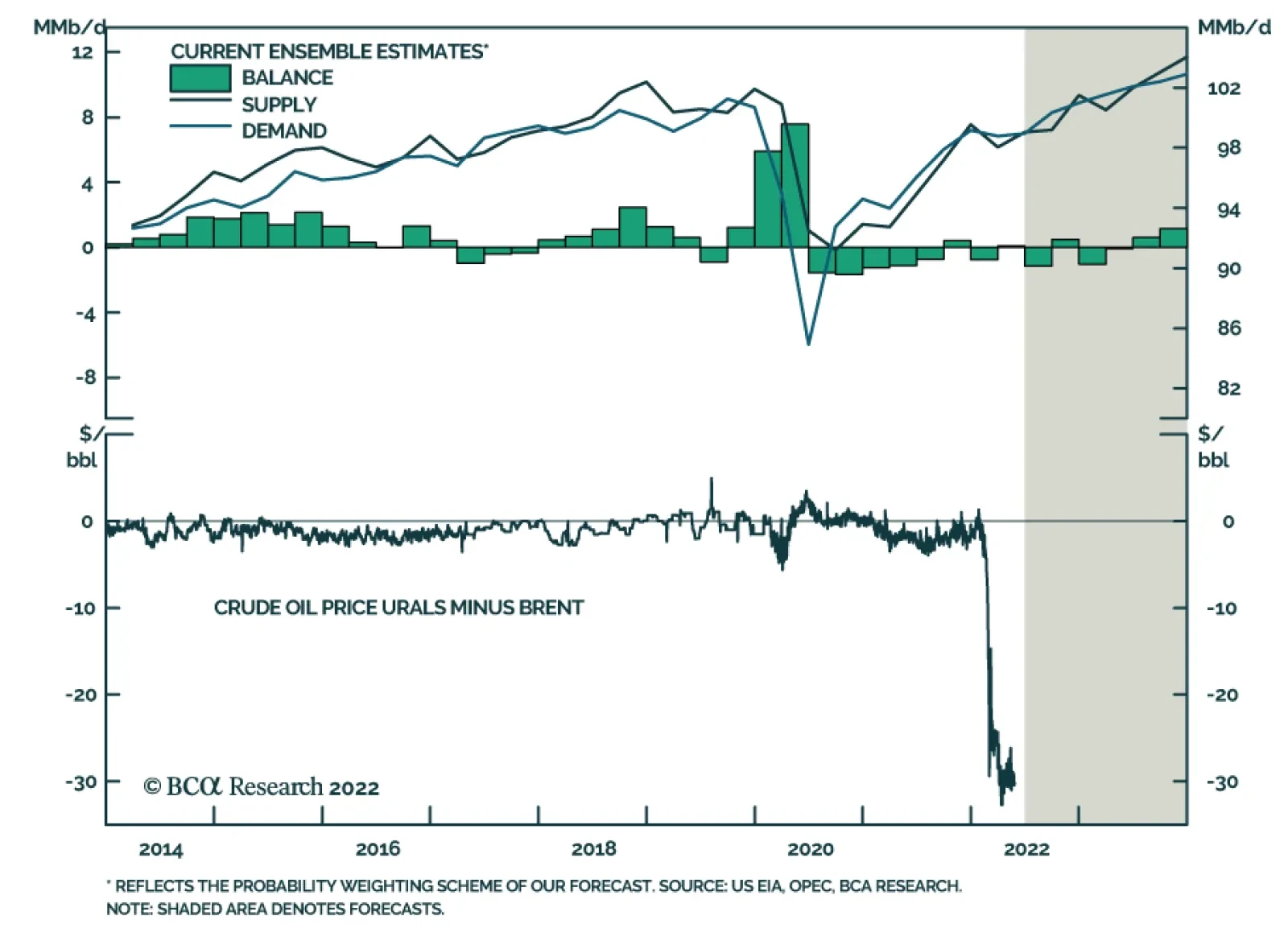
On Monday, EU leaders agreed to a sixth round of sanctions on Russia which includes a partial embargo on oil imports that will take full effect by the end of the year. The ban applies to crude oil and petroleum products delivered by sea – which account for…
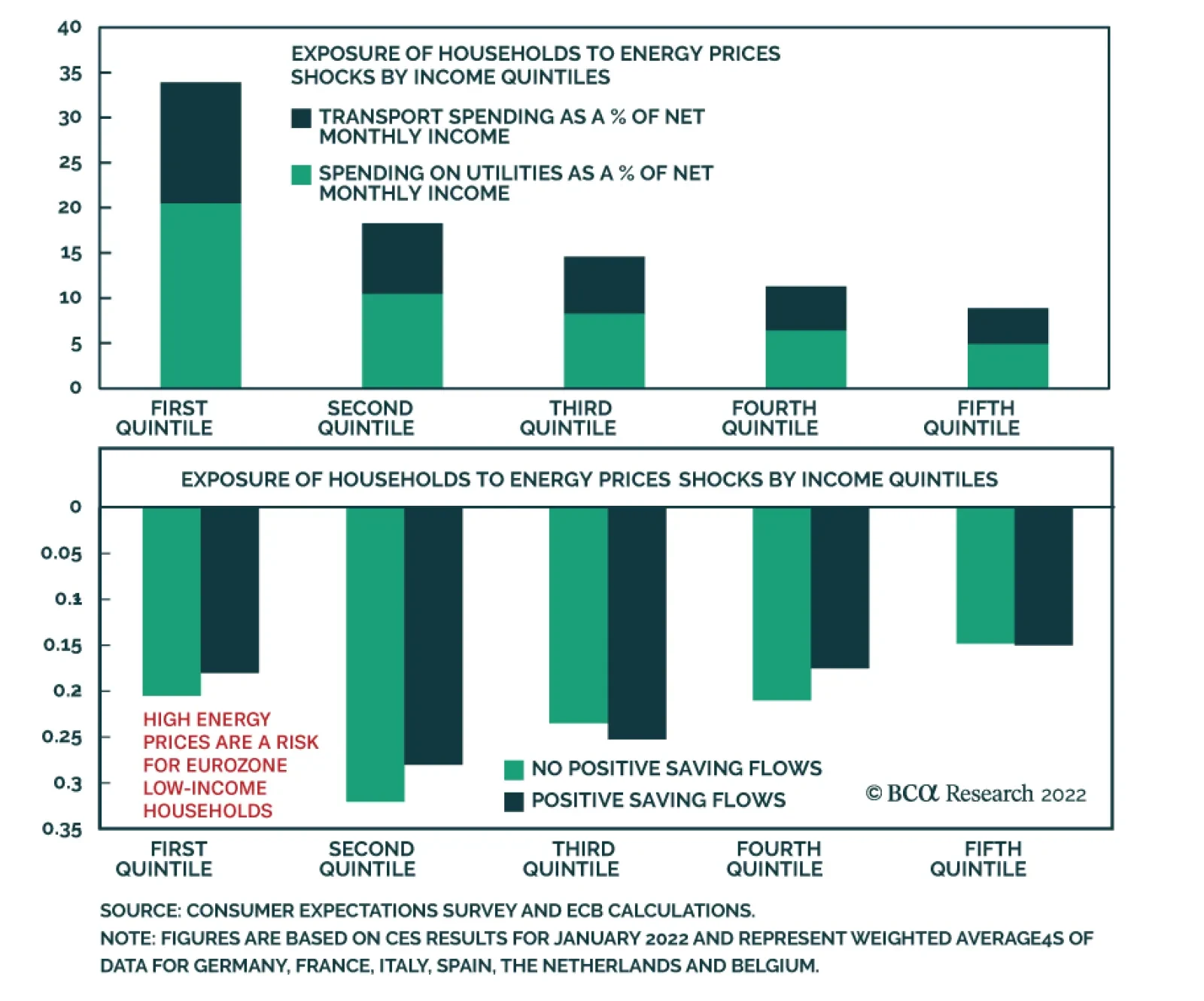
The EU agreement to embargo oil imports from Russia (see Market Focus) marks an escalation of economic warfare between Russia and the West. It raises the odds that Moscow will retaliate by incrementally cutting off its natural gas supplies to the EU. In…
Executive Summary European Spreads Have Cheapened Up More Than US Spreads
European Spreads Have Cheapened Up More Than US Spreads
European Spreads Have Cheapened Up More Than US Spreads
Corporate bond spreads in the US and Europe have widened since early April, with European credit taking a bigger hit because of worsening growth and inflation momentum. European corporate bond valuations look fairly cheap, both for investment grade and high-yield. This is true in absolute terms but also relative to the US, where spread valuations are more mixed. An easing of stagflation fears in Europe is a necessary condition for a valuation convergence with the US. The US investment grade credit curve is steep relative to the overall level of credit spreads, making longer-maturity corporates more attractive. Energy bonds offer the most compelling combination of valuation and fundamental support (from high oil prices) within US investment grade. Within US high-yield, Energy valuations look much less compelling after the recent outperformance. The best medium-term industry values in European credit are in investment grade Financials and high-yield Consumer Cyclicals & Non-Cyclicals. Bottom Line: Continue to favor both US high-yield and European investment grade corporates versus US investment grade. Stay neutral high-yield exposure on both sides of the Atlantic. Within Europe, stay up in quality within both investment grade and high-yield until near-term macro risks on growth & inflation subside. Feature Corporate bonds in the US and Europe have gone through a rough patch in recent weeks, underperforming government bonds in response to the “triple threat” of high inflation, tightening monetary policy and slowing growth momentum. European credit has taken the more severe hit compared to the US, with markets pricing in greater risk premia because of additional regional threats to growth (and inflation) from the Ukraine war. In this Special Report, jointly presented by BCA Research US Bond Strategy and Global Fixed Income Strategy, we assess credit spread valuations in US and European corporates after the latest selloff, across credit tiers, maturities and industry groups. Stay Cautious On US Corporate Bonds Chart 1US Credit Spreads
US Credit Spreads
US Credit Spreads
In a recent Special Report, we argued in favor of a relatively defensive allocation to US corporate bonds. Specifically, we advised investors to adopt an underweight (2 out of 5) allocation to US investment grade corporates and a neutral (3 out of 5) allocation to US high-yield. Our rationale was that a flat US Treasury curve signaled that we were in the middle-to-late stages of the economic recovery. Additionally, at the time, corporate bond spreads weren’t all that attractive compared to the average levels seen during the last Fed tightening cycle (Chart 1). Spreads have widened somewhat since we downgraded our allocation and, as such, we see some scope for spread tightening during the next few months as inflation rolls over and the Fed lifts rates by no more than what is already priced in the curve. That said, with the Fed in the midst of a tightening cycle, we think it’s unlikely that spreads can stay below average 2017-19 levels for any meaningful length of time. As a result, we maintain our current cautious allocation to US corporate bonds. US High-Yield Versus US Investment Grade The recent period of US corporate bond underperformance can be split into two stages based on the relative performance of investment grade and high-yield. US investment grade underperformed junk in the early stages of the selloff (between September and mid-March), as spread widening was driven by the Fed’s shift toward a more restrictive policy stance and not a meaningful uptick in the perceived risk of a recession and/or default wave (Chart 2A). Chart 2ACorporate Bond Excess Returns* Versus Duration-Times-Spread: September 27, 2021 To March 14, 2022
Looking For Opportunities In US & European Corporates After The Recent Selloff
Looking For Opportunities In US & European Corporates After The Recent Selloff
But recession and default fears started to ramp up in mid-March, and this caused high-yield to join the selloff (Chart 2B). In fact, US investment grade corporates managed to recoup some of their earlier losses while lower-rated junk bonds struggled to keep pace. Chart 2BCorporate Bond Excess Returns* Versus Duration-Times-Spread: March 14, 2022 To Present
Looking For Opportunities In US & European Corporates After The Recent Selloff
Looking For Opportunities In US & European Corporates After The Recent Selloff
We contend that the risk of a meaningful uptick in corporate defaults during the next 12 months is low. In fact, we estimate that the US high-yield default rate will fall to between 2.7% and 3.7% during the next year, well below the 5.2% currently priced into junk spreads. Going forward, we expect the US corporate bond landscape to be defined by increasingly restrictive monetary policy and a benign default outlook. As we noted in the aforementioned Special Report, this environment is reminiscent of the 2004-06 Fed tightening cycle when high-yield bonds performed much better than investment grade. Investors should maintain a preference for high-yield over investment grade within an otherwise defensive allocation to US corporate bonds. US Industry Groups Chart 3A shows the performance of US corporate bonds in the early stages of the recent selloff, but this time split by industry group. High-yield Energy sticks out as a strong outperformer, though we also notice that every high-yield sector performed better than its investment grade counterpart. Chart 3ACorporate Bond Excess Returns* Versus Duration-Times-Spread: September 27, 2021 To March 14, 2022
Looking For Opportunities In US & European Corporates After The Recent Selloff
Looking For Opportunities In US & European Corporates After The Recent Selloff
Chart 3B once again shows how the relative performance between investment grade and high-yield has flipped since mid-March, though we see that high-yield Energy, Transportation and Utilities have performed better than the rest of the index. Chart 3BCorporate Bond Excess Returns* Versus Duration-Times-Spread: March 14, 2022 To Present
Looking For Opportunities In US & European Corporates After The Recent Selloff
Looking For Opportunities In US & European Corporates After The Recent Selloff
Interestingly, despite the strong outperformance of high-yield Energy bonds, investment grade Energy credits performed mostly in line with other investment grade sectors. We believe this presents an excellent opportunity. The vertical axis of Chart 4A shows our measure of the risk-adjusted spread available in each investment grade industry group. Our risk-adjusted spread is the residual after adjusting for each sector’s credit rating and duration. The horizontal axis shows each sector’s Duration-Times-Spread as a simple measure of risk. Our model shows that Financials, Technology, Energy, Utilities, Communications and Basic Industry all stand out as attractive within the investment grade corporate bond universe. We identify the investment grade Energy sector as a particularly compelling buy. Chart 4AUS Investment Grade Corporate Sector Valuation
Looking For Opportunities In US & European Corporates After The Recent Selloff
Looking For Opportunities In US & European Corporates After The Recent Selloff
In a prior report, we demonstrated, unsurprisingly, that the oil price is an important determinant of whether Energy bonds perform better or worse than the rest of the corporate index. With our commodity strategists calling for the Brent crude oil price to average $122/bbl next year, this will provide strong support to Energy bond returns. Cheap starting valuations for investment grade Energy bonds make them look even more compelling. Chart 4B repeats our valuation exercise but for high-yield industry groups. Within high-yield, we find that Financials, Transportation, Communications and Consumer sectors stand out as attractive. Interestingly, high-yield Energy bonds now look slightly expensive compared to the rest of the junk bond universe, a result of the sector’s recent incredibly strong performance. Chart 4BUS High-Yield Corporate Sector Valuation
Looking For Opportunities In US & European Corporates After The Recent Selloff
Looking For Opportunities In US & European Corporates After The Recent Selloff
US Credit Curve We define the credit curve as the difference in option-adjusted spread between the “Long Maturity” and “Intermediate Maturity” sub-indexes for each investment grade credit tier, as defined by Bloomberg. We exclude high-yield from this analysis because very few high-yield bonds are classified as “Long Maturity”. To analyze the credit curve, we observe that credit curves tend to be steeper when credit spreads are tight, and vice-versa. This is because tight spreads indicate that the perceived near-term risk of default is low. As a result, short-maturity spreads tend to be lower than spreads at the long-end of the curve. Conversely, a wide spread environment indicates that the perceived near-term risk of default is high, and this risk will be more reflected in shorter maturity credits. Charts 5A, 5B and 5C show the slopes of the credit curves for Aa, A and Baa-rated securities. Immediately we notice that credit curves are positively sloped in each case, and also that each credit curve is somewhat steeper than would be predicted based on the average spread for the overall credit tier. Chart 5AAa-Rated Credit Curve
Looking For Opportunities In US & European Corporates After The Recent Selloff
Looking For Opportunities In US & European Corporates After The Recent Selloff
Chart 5BA-Rated Credit Curve
Looking For Opportunities In US & European Corporates After The Recent Selloff
Looking For Opportunities In US & European Corporates After The Recent Selloff
Chart 5CBaa-Rated Credit Curve
Looking For Opportunities In US & European Corporates After The Recent Selloff
Looking For Opportunities In US & European Corporates After The Recent Selloff
This strongly suggests that investors should favor long-maturity over short-maturity US investment grade corporate bonds. European Corporates Look Cheap Vs. US Equivalents – For Patient Investors Chart 6European Credit Spreads At Past 'Non-Crisis' Peaks
European Credit Spreads At Past 'Non-Crisis' Peaks
European Credit Spreads At Past 'Non-Crisis' Peaks
Turning to the euro area, the Bloomberg investment grade OAS and high-yield OAS currently sit at 167bps and 490bps, respectively (Chart 6). These levels are well below the peaks seen during the 2020 COVID recession and the 2011/12 European debt crisis, but are in line with the spread widening episodes in 2014/15 and 2018. Our preferred measure of credit spread valuation, 12-month breakeven spreads, show that European investment grade and high-yield spreads are in the 75th and 67th percentile of outcomes, respectively, dating back to the inception of the euro in 1998 (Chart 7).1 These are both higher compared to the breakeven percentile rankings for US investment grade (48%) and US high-yield (52%). The gap between the breakeven percentile rankings for investment grade bonds in the euro area versus the US is the widest seen over the past two decades. That gap reflects the fact that European economic growth has softened versus the US according to the S&P Global manufacturing PMIs, while European inflation has accelerated towards very elevated US levels (Chart 8). Chart 7European Spreads Have Cheapened Up More Than US Spreads
European Spreads Have Cheapened Up More Than US Spreads
European Spreads Have Cheapened Up More Than US Spreads
Chart 8European Corporate Underperformance Reflects Relative Growth & Inflation
European Corporate Underperformance Reflects Relative Growth & Inflation
European Corporate Underperformance Reflects Relative Growth & Inflation
Both of those trends are a product of the Ukraine war, which has led to a massive spike in European energy costs given the region's huge reliance on Russian energy supplies, particularly for natural gas. While the US has also suffered a massive increase in its own energy bills, the inflation spike has been higher in Europe, leading to a bigger drag on economic confidence and growth. Thus, the widening spread differential between corporate bonds in Europe relative to the US likely reflects a growth-related risk premium. Chart 9A Turning Point For European Corporate Bond Performance?
A Turning Point For European Corporate Bond Performance?
A Turning Point For European Corporate Bond Performance?
As euro area inflation has ratcheted higher, so have expectations of ECB monetary tightening. The euro area overnight index swap (OIS) curve now discounts 172bps over the next 12 months, a huge swing from the start of 2022 when markets were expecting the European Central Bank (ECB) to stand pat on the interest rate front. In comparison, markets are pricing in another 224bps of Fed tightening over the next 12 months, even after the Fed has already delivered 75bps of tightening since March. Importantly, the gap between our 12-month discounters, which measure one-year-ahead interest rate changes discounted into OIS curves, for the US and Europe has proven to be a reliable leading indicator – by around nine months - of the relative year-over-year excess returns (on a USD-hedged basis) of European and US corporate bonds, especially for investment grade (Chart 9). The fact that this is a leading relationship suggests that the upward repricing of ECB rate expectations seen so far in 2022 is not yet a reason to turn more cyclically negative on European corporate bonds versus the US. The earlier upward repricing of expected Fed tightening is the more relevant factor, and is signaling that both US investment grade and high-yield corporates should underperform European equivalents over at least the rest of 2022. BCA Research Global Fixed Income Strategy already has a recommended allocation along those lines, with an overweight to euro area investment grade and an underweight to US investment grade. While the trade has underperformed of late, the combined messages from the relative 12-month breakeven spread rankings (cheaper European valuations) and 12-month discounters (the Fed is further ahead in the tightening cycle) leads us to stick with that relative cross-Atlantic tilt. The main risk to that stance is any deterioration of the flow of energy supplies from Russia to Europe that results in a stagflationary outcome of a bigger growth slowdown with even faster inflation. That is a scenario that would make it difficult for the ECB to back down from its recent hawkish forward guidance, resulting in European corporate spreads incorporating an even wider risk premium. Given that near-term uncertainty, we are advocating that investors maintain no relative tilt on more growth-sensitive, and riskier, European high-yield relative to the US – stay neutral on both. Stay Up In Quality On European Corporates Looking at euro area corporate debt across credit ratings and maturity buckets, there are few compelling immediate valuation stories in absolute terms, although there are potential opportunities unfolding on a relative basis. Within investment grade, credit quality curves have steepened during the recent selloff, with lower-rated credit seeing larger spread widening (Chart 10). The gap between Baa-rated and A-rated European corporate spreads now sits at 52bps, right in the middle of the 25-75bps range since 2014. In high-yield, the gap between Ba-rated and B-rated credit spreads is 222bps, and the gap between B-rated and Caa-rated spreads is 370bps (Chart 11) – both are still below the previous peaks in those relationships seen in 2012, 2015 and 2020. Chart 10European IG Credit Quality Curve Can Steepen ##br##More
European IG Credit Quality Curve Can Steepen More
European IG Credit Quality Curve Can Steepen More
Chart 11European HY Credit Quality Curve Still Below Previous Peaks
European HY Credit Quality Curve Still Below Previous Peaks
European HY Credit Quality Curve Still Below Previous Peaks
For both investment grade and high-yield, there is still room for credit curves to steepen if European growth expectations continue to deteriorate. However, when looking at spread valuations across the credit quality spectrum, and across maturity buckets, euro area corporate spreads look much cheaper than US equivalents. In Chart 12, we show a snapshot of the current 12-month breakeven percentile rankings for individual credit quality tiers and maturity groups, for investment grade and high-yield in the euro area and US. The relative attractiveness of European credit relative to the US is evident, with European spreads now at higher percentile rankings across all quality tiers and maturity buckets. The largest gaps between 12-month breakeven percentile rankings are in the +10 year maturity bucket, the AAA-rated and AA-rated investment grade credit tiers, and the Ba-rated high-yield credit tier. This suggests any trades favoring European corporates versus the US should stay up in credit quality. Chart 12Corporate Spread Valuations By Maturity & Credit Rating Favor Europe
Looking For Opportunities In US & European Corporates After The Recent Selloff
Looking For Opportunities In US & European Corporates After The Recent Selloff
Comparing European & US Industry Spread Valuations When looking at the industry composition of the euro area and US corporate bond indices, there are a few major notable differences. Within investment grade, there is a greater concentration of Energy and Technology names in the US, while Financials are more represented in the European index (Chart 13). Those same three industries also have the largest relative weightings in the high-yield indices (Chart 14), although there is also a slightly larger weighting of high-yield Transportation companies in Europe compared to the US. This means that a bet on European credit versus the US is essentially a bet on European Financials versus US Energy and Technology. Chart 13Investment Grade Corporate Bond Market Cap Weights
Looking For Opportunities In US & European Corporates After The Recent Selloff
Looking For Opportunities In US & European Corporates After The Recent Selloff
Chart 14High-Yield Corporate Bond Market Cap Weights
Looking For Opportunities In US & European Corporates After The Recent Selloff
Looking For Opportunities In US & European Corporates After The Recent Selloff
When looking at the same sector metrics that were shown earlier in this report for the US – comparing risk-adjusted spreads to Duration-Times-Spread – we find some interesting cross-Atlantic valuation differentials. For investment grade in Europe (Chart 15), only Energy and Financials have positive risk-adjusted spread valuations (after controlling for duration and credit quality), while having the highest level of risk expressed via Duration-Times-Spread. This contrasts to the US where more sectors have positive risk-adjusted spreads - Energy, Financials, Utilities, Basic Industry and Communications. Investors should favor the latter three industries in the US relative to Europe. Chart 15Euro Area Investment Grade Corporate Sector Valuation
Looking For Opportunities In US & European Corporates After The Recent Selloff
Looking For Opportunities In US & European Corporates After The Recent Selloff
Within high-yield in Europe, Energy and Financials also offer positive risk-adjusted valuations, but so do Consumer Cyclicals and Consumer Non-Cyclicals (Chart 16). This lines up similarly to US high-yield valuations. The notable valuation gaps exist in Transportation and Communications, which look cheap in the US and expensive in Europe, creating potential cross-Atlantic relative value trade opportunities between those sectors (and within an overall neutral allocation to junk in both regions). Chart 16Euro Area High-Yield Corporate Sector Valuation
Looking For Opportunities In US & European Corporates After The Recent Selloff
Looking For Opportunities In US & European Corporates After The Recent Selloff
Ryan Swift US Bond Strategist rswift@bcaresearch.com Robert Robis, CFA Chief Fixed Income Strategist rrobis@bcaresearch.com Footnotes 1 12-month breakeven spreads measure the amount of spread widening that would be necessary to make the return on corporate bonds equal to that of duration-matched government bonds over a one-year horizon. The spread is calculated as a ratio of the index OAS and index duration for the relevant credit market. We look at the historical percentile ranking of that ratio to make a more “apples for apples” comparison of spreads that factors in index duration changes over time. Recommended Portfolio Specification Other Recommendations Treasury Index Returns Spread Product Returns
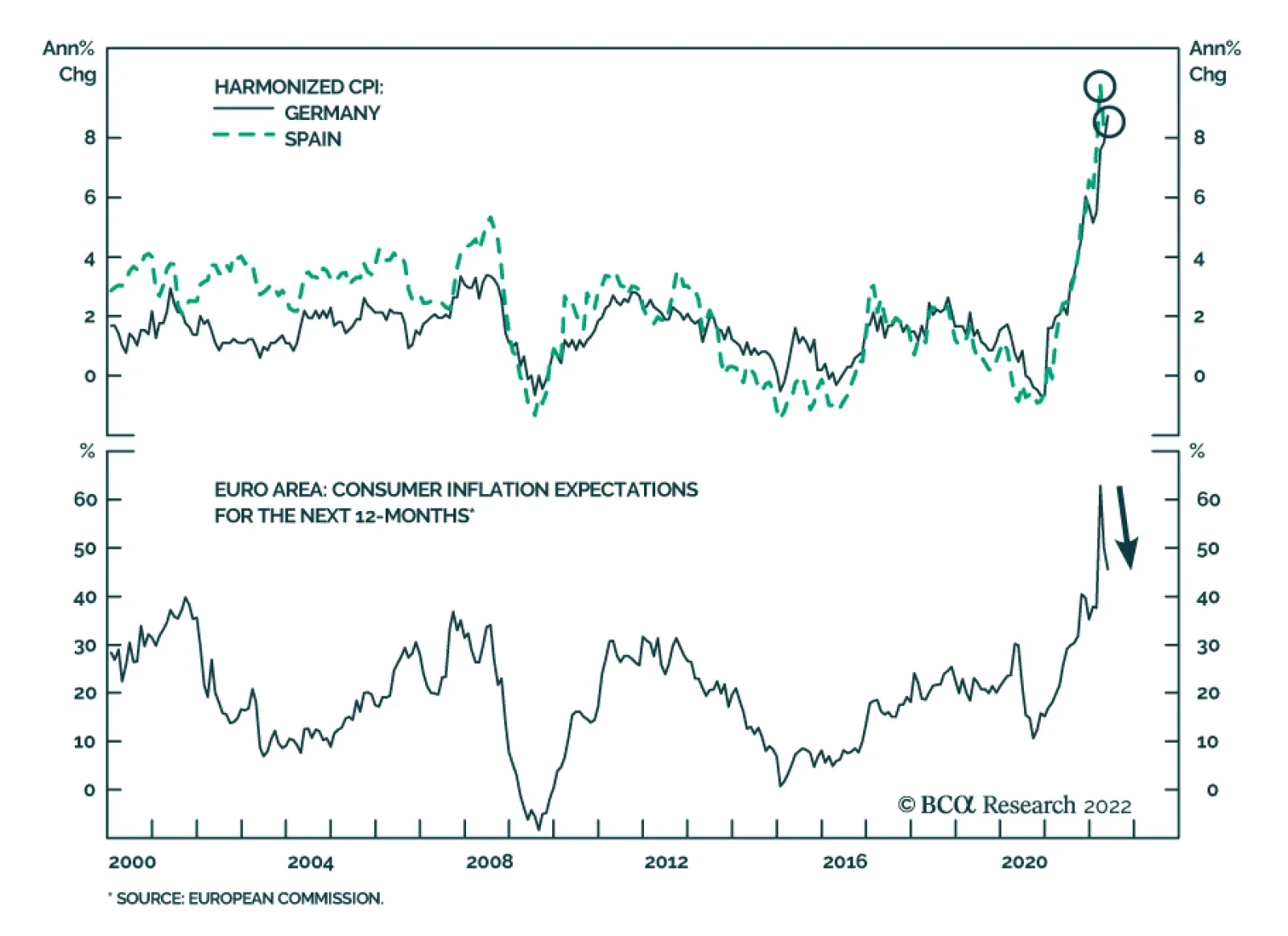
German HICP rose from 7.8% y/y to 8.7% y/y in May, exceeding expectations of 8.1% y/y. Accelerating goods prices led the increase, while services inflation eased in May. Notably, energy and food prices surged 38.3% y/y and 11.1% y/y, respectively. Food and…
Executive Summary Inflationary Pressures To Fade
Inflationary Pressures To Fade
Inflationary Pressures To Fade
The biggest problem for the European economy is surging inflation. Inflation has eroded household real disposable income and is hurting consumption. Inflation is set to roll over this summer, which should allow European economies to begin recovering in the fourth quarter of 2022. The ECB is likely to pause after exiting negative interest rates in Q3. European credit is becoming more attractive, but the risks to our view of European growth could still cause major problems for this asset class. Swiss stocks are vulnerable to a pullback relative to German ones. In France, President Emmanuel Macron is likely to get a legislative majority in June. Bottom Line: European growth should recover after inflation rolls over this summer. The peak in inflation will allow the ECB to pause after its deposit rate gets to zero. Despite this positive view, the large risks hanging over Europe suggest prudence is still warranted. European assets are rebounding in conjunction with the decline in risk aversion visible around global markets. The euro is catching a welcome bid too. However, as we wrote last week, while the conditions are falling in place to see a rally in Europe, too many risks continue to lurk in the background. Therefore, we maintain our conservative approach to European markets, and we still recommend a defensive portfolio. Related Report European Investment StrategyDon’t Be A Hero To shift to a less defensive stance, we want first to observe a peak in European inflation. Inflation represents the greatest problem for the European economy. If inflation continues to surge, the purchasing power of households will deteriorate further and the ECB will ratchet up its hawkish rhetoric, which will cause considerable mayhem in the European economy. A Reprieve For Europe? Only when the income suppressing impact of inflation recedes will European growth strengthen. Chart 1Paying More For The Same
Paying More For The Same
Paying More For The Same
Higher prices continue to hurt European consumption. As witnessed in the US, European retail sales are rising in nominal terms (Chart 1). However, households are not consuming more; they are spending more to purchase the same amount of goods, which is illustrated by the stagnation in retail sales volumes over the past twelve months. Households are not increasing the size of their consumption baskets, because their incomes are not keeping up with inflation. Unlike in the US, Eurozone households never saw their real disposable income spike during the pandemic because European governments focused on preserving jobs rather than distributing large handouts to households. As a result, European real disposable income began to lag its pre-pandemic trend (Chart 2). As the economy recovered, disposable income did not converge back to trend. Now that food and energy prices have spiked, the gap between real disposable income and its trend is only widening. Wages are not coming to the rescue either. The European labor market has been incapable of generating the same kind of wage growth that the US labor market has enjoyed. Even the recent uptick in negotiated wages is not as strong as it seems. German workers benefited from a one-off payment that caused wages to spike by 6.7%, elevating the Euro Area average to 2.8% from 1.6%. However, without that adjustment, German underlying wage growth fell from 3.9% to 1.6% (Chart 3), which means that the underlying European wage only rose by 2%. Chart 2Inflation Destroys Purchasing Power
Inflation Destroys Purchasing Power
Inflation Destroys Purchasing Power
Chart 3Not As Strong As It Seems
Not As Strong As It Seems
Not As Strong As It Seems
The distinction between one-off payments and underlying wages matters. As per Milton Friedman’s permanent income hypothesis, households are unlikely to shift their consumption pattern based on a temporary boost to income. They will save it, or in today’s case, use their one-off payment to cover their food and energy price increases. If today’s wage boost is not repeated, but inflation remains elevated, consumption will suffer. Europe’s tourism industry would be another major beneficiary from the peak in inflation. Prior to the pandemic, tourism contributed to 13%, 14% and 9% of the Italian, Spanish, and French economies, respectively. This sector was decimated during the pandemic after travel came to a halt. We are seeing positive signs emerge on this front. In the spring of 2021, nights spent at hotels were 80% below their spring 2019 levels for the Euro Area (Chart 4). As of March 2022, this variable is now between 15% and 30% below their March 2019 levels in Italy and France, respectively. Moreover, Google Mobility indices for the retail and recreation sectors have almost fully recovered (Chart 5). Thus, we can expect these trends to gather steam once inflation slows, because it will free up household disposable income. Europe’s periphery is particularly well placed to benefit from this eventual positive development. Chart 4Improving Tourism Sector
Improving Tourism Sector
Improving Tourism Sector
Chart 5Mobility Pick-Up
Mobility Pick-Up
Mobility Pick-Up
Positively, European inflation will peak soon. Commodity prices remain elevated, but commodity inflation has decelerated significantly. Hence, the commodity impulse is consistent with an imminent decline in Euro Area HICP (Chart 6). A simulation using BCA’s Commodity & Energy forecast for Brent, which also assumes that European natural gas prices will continue to hover around EUR100/MWh and that EUR/USD will hit 1.1 by year-end, confirms that energy inflation will swoon (Chart 7). Even if we assume a sudden surge in energy prices due to a Russian natural gas cutoff, energy inflation will recede in the second half of 2022 after spiking this summer. Chart 6Peak Inflation?
Peak Inflation?
Peak Inflation?
Chart 7Beware The Russia Cutoff Risk
Beware The Russia Cutoff Risk
Beware The Russia Cutoff Risk
Chart 8Less Pressure From The Consumer Of Last Resort
Less Pressure From The Consumer Of Last Resort
Less Pressure From The Consumer Of Last Resort
Beyond the energy market, global forces also point toward a peak in European inflation in the coming months. The surge in US goods consumption over the past 24 months was felt globally and generated inflationary pressures in Europe as well. However, US durable goods consumption is declining (Chart 8). As a result, this important driver of European inflation will recede. Bottom Line: European consumption will not recover until inflation peaks. Without a deceleration in inflation, household disposable income will remain weak and consumers will remain careful. The good news is that European inflation is still on track to begin its descent this summer, which will boost the prospect for consumer spending and tourism. ECB Update: A Fall Pause? In a blog post last Monday, ECB president Christine Lagarde confirmed that the central bank will lift interest rates in July and will push the deposit rate to zero by September. Chart 9Too Much Priced In
Too Much Priced In
Too Much Priced In
The economy is likely able to handle those two rate hikes. Our ECB monitor highlights the need to remove monetary accommodation in the Eurozone (Chart 9). Moreover, the German 2-/10-year yield curve has steepened this year, despite the hawkish shift in the ECB’s rhetoric, which confirms that monetary conditions are extremely accommodative. We expect the ECB to pause its rate hike campaign after exiting negative rates this fall to reassess economic conditions. Constraints on the ECB remain potent. If the central bank ignores these limiting factors, a policy mistake will ensue. Inflation is likely to decelerate by the end of the summer, which will undercut the hawks driving the consensus at the Governing Council today. Inflation is the factor pushing the ECB Monitor higher right now, not growth conditions (Chart 9, second panel). Thus, the case for lifting rates will weaken considerably when inflation slows. Growth is unlikely to have recovered enough by September to justify additional rate hikes after inflation slows. The expected improvement in consumption and household finances discussed earlier will be embryonic by the end of the summer and will not offer a clear case to lift rates further. Instead, the ECB will still have to juggle the tightening in financial conditions created by wider bond spreads in the European periphery and the impact of China’s slowdown on European exports. Meanwhile, capex is unlikely to strengthen meaningfully as long as global trade softens. As a result, we stay long the June 2023 Euribor futures. An extended pause after the September meeting will prevent the ECB from hiking rates as much as money markets expect over the coming twelve months (Chart 9, bottom panel). If the ECB goes ahead and continues to lift rates in the fall and early winter, the European economy will weaken considerably more and the previous rate hikes will have to be undone. Both scenarios are bullish for the June 2023 Euribor contract. Bottom Line: The ECB is likely to pause after pushing its deposit rate to zero in the third quarter in order to reassess economic conditions. Inflation is the main factor behind higher rates, and it will peak this summer. Meanwhile, the economy is still not strong enough to justify significantly higher interest rates. The market’s pricing in the ESTR curve is much too aggressive considering this context. Stay long June 2023 Euribor futures. Credit Update: Don’t Be A Hero Chart 10Cautious In Absolute Terms, Positive On Relative Performance
Cautious In Absolute Terms, Positive On Relative Performance
Cautious In Absolute Terms, Positive On Relative Performance
Credit markets are experiencing a second episode of spread widening this year. The first episode was triggered by the invasion of Ukraine by Russia. The current one reflects strong inflation, weaker growth prospects, and the ECB’s policy shift. Year-to-date, European investment grade and high-yield corporate bond option-adjusted spreads have widened by 74bps and 188bps, respectively (Chart 10, top panel). As we wrote last week, if the global economic situation were to stabilize, then European assets would be a buy at current levels. This is especially true for European credit. Beyond attractive valuations, corporate bond issuers’ balance sheets are in good shape and the default risk is low. However, the same risks that prevent us from being buyers of the euro and European stocks today also hang over the credit market. Specifically, a further deterioration of the energy flows between Russia and the EU and/or a policy mistake, whereby the ECB delivers the seven rate hikes priced in the overnight index swap market, would cause spreads to widen meaningfully from their current elevated levels. Therefore, we recommend investors remain on the sidelines and wait for a safer entry point over the coming weeks. Once inflation has peaked and stagflation/recession fears recede, then credit spreads will have ample room to narrow, especially if the ECB decides to pause after lifting the deposit rate to 0% (Chart 10, second panel). In the meantime, expected policy rate differentials are still supportive of an overweight on European credit relative to US credit (Chart 10, bottom panel). Bottom Line: European spreads are most likely peaking. However, the same risks that hang over EUR/USD and European equities prevent us from buying this asset class just yet. Swiss Stocks Are Getting Expensive Chart 11Swiss Stocks Getting Ahead Of Earnings
Swiss Stocks Getting Ahead Of Earnings
Swiss Stocks Getting Ahead Of Earnings
The defensive Swiss market has greatly outperformed its Euro Area counterpart this year. However, the recent bout of Swiss outperformance has been completely dissociated from the trend in Swiss EPS relative to those of the Euro Area (Chart 11). Now, Swiss equities are particularly expensive and sport multiples 45% greater than the P/E ratio of the Eurozone MSCI benchmark. This bifurcation between the relative performance of Swiss stocks and their relative earnings represents a trading opportunity. Specifically, Swiss shares look vulnerable against German ones, which have been seriously beaten down in recent years. Chart 12Priced For The Apocalypse
Priced For The Apocalypse
Priced For The Apocalypse
Swiss stocks have been re-rated on the back of many forces. First, the valuations of Swiss stocks relative to German ones have risen in tandem with the Eurozone’s headline and core inflation (Chart 12, top and second panel). Swiss relative valuations have also benefited from the significant tailwind created by higher 2-year rates in the Eurozone (Chart 12, third panel) and from the weakness in the euro (Chart 12, fourth panel). Finally, Swiss relative valuations seem to have already priced in a significant deterioration in European manufacturing activity, which would have lifted their appeal as a defensive play (Chart 12, bottom panel). We recommend selling Swiss stocks against German ones. We anticipate European inflation to peak this summer. Our ECB view is consistent with a decline in Germany’s 2-year bond yields. We also expect the euro to bottom and, even though we have written about a deterioration in European manufacturing activity, the recent explosion of Swiss multiples relative to German ones looks overdone. This trade may be seen as our first attempt to dip our toe into cyclical assets, even if we generally favor capital preservation over risk taking at this juncture. Bottom Line: The outperformance of Swiss equities is overextended and is already pricing in a dire outcome for European economies. Selling Swiss shares relative to German stocks is an attractive way to add tentatively some risk to a European portfolio. France Update: Likely Legislative Majority For Macron Chart 13French Polls Suggest Macron Will Get His Legislative Majority
Looking Beyond Europe’s Inflation Peak
Looking Beyond Europe’s Inflation Peak
President Emmanuel Macron’s political party, Renaissance (previously En Marche!), may surprise to the upside in this year’s legislative election. An aggregate of recent polls (Chart 13) suggests that the presidential coalition (which includes Renaissance and its allies) will obtain between 295 and 340 seats in the Assemblée Nationale, more than the 289 seats needed to achieve a majority. The odds of seeing an historically low voter turnout should also play in the French president’s favor. Chart 14Favor French Small-Caps & Avoid Consumer Stocks
Favor French Small-Caps & Avoid Consumer Stocks
Favor French Small-Caps & Avoid Consumer Stocks
Macron will not have to compromise to build a coalition in favor of his reform agenda, which bodes well for French productivity and trend growth. This election should not have an impact on French assets beyond that. We continue to recommend investors favor French small-caps, as they will benefit from an improvement in domestic consumer confidence and an eventual strengthening in the euro (Chart 14). Meanwhile, we still see more downside for French consumer stocks (Chart 14, bottom panel). Mathieu Savary, Chief European Strategist Mathieu@bcaresearch.com Jeremie Peloso, Editor/Strategist JeremieP@bcaresearch.com Tactical Recommendations Cyclical Recommendations Structural Recommendations
Listen to a short summary of this report. Executive Summary US Financial Conditions Have Tightened Significantly This Year
US Financial Conditions Have Tightened Significantly This Year
US Financial Conditions Have Tightened Significantly This Year
US financial conditions have tightened by enough that the Fed no longer needs to talk up interest rate expectations. If inflation decelerates faster than anticipated over the coming months, as we expect will be the case, the Fed’s messaging will soften further. Bond yields in the US and abroad are likely to fall over the next 6-to-12 months, even if they do rise over a longer-term horizon. Stay overweight stocks, favoring non-US equities over their US peers. We are closing our short 10-year Gilts trade, initiated at a yield of 0.85%, for a gain of 7.5%. We are also opening a new trade going long Canadian short-term interest rate futures versus their US counterparts. Investors expect Canadian rates to exceed US rates in 2024, which seems unlikely to us given that the Canadian housing market is much more sensitive to higher rates than the US market. Bottom Line: After having tightened significantly over the past seven months, financial conditions should loosen modestly during the remainder of the year. This should benefit risk assets. Fed Focused on Financial Conditions Chart 1Tighter Financial Conditions Will Hurt Growth
Tighter Financial Conditions Will Hurt Growth
Tighter Financial Conditions Will Hurt Growth
Like many central banks, the Fed sees financial conditions as a key driver of the real economy. While there are many financial conditions indices (FCIs), most include bond yields, credit spreads, equity prices, and the exchange rate as inputs. Higher bond yields, wider credit spreads, lower equity prices, and a strong currency all lead to tighter financial conditions and a weaker economy, and vice versa. Goldman’s US FCI is especially popular among market participants. It is calibrated so that 100 bps in tightening corresponds, all things equal, to a 100 basis-point decline in US real GDP growth over the subsequent four quarters. The Goldman FCI has tightened by 212 bps since the start of the year and by 225 points from its loosest level in November 2021. If the historic relationship between the FCI and the economy holds, the tightening in financial conditions would be enough to push US growth to a below-trend pace by the second quarter of 2023. In fact, the tightening in the Goldman FCI over the past 12 months already suggests that the manufacturing ISM will fall below 50 (Chart 1). Along the same lines, the Chicago Fed’s Adjusted National FCI, which measures financial conditions relative to current economic conditions, has moved slightly into restrictive territory. Aside from a brief period at the outset of the pandemic, the index has been consistently in expansionary territory since early 2013 (Chart 2). Chart 2The Chicago Fed Financial Conditions Index Has Moved Into Slightly Restrictive Territory
Are Financial Conditions Tight Enough?
Are Financial Conditions Tight Enough?
Other data are consistent with the message from the FCIs. Most notably, growth estimates for the US and for other major economies have come down over the past few months (Chart 3). Economic surprise indices have also fallen, especially in the US. Chart 3AGrowth Forecasts Have Softened As Economic Data Have Surprised To The Downside (I)
Growth Forecasts Have Softened As Economic Data Have Surprised To The Downside (I)
Growth Forecasts Have Softened As Economic Data Have Surprised To The Downside (I)
Chart 3BGrowth Forecasts Have Softened As Economic Data Have Surprised To The Downside (II)
Growth Forecasts Have Softened As Economic Data Have Surprised To The Downside (II)
Growth Forecasts Have Softened As Economic Data Have Surprised To The Downside (II)
Mission Accomplished? Chart 4The Fed Expects To Lift Rates Above Its Estimate Of Neutral
The Fed Expects To Lift Rates Above Its Estimate Of Neutral
The Fed Expects To Lift Rates Above Its Estimate Of Neutral
Given the recent tightening in financial conditions and weaker growth expectations, the Fed is likely to soften its tone. Already this week, Atlanta Fed President Raphael Bostic suggested that the Fed could pause raising rates in September in order to assess the impact of the Fed’s tightening campaign. The Fed minutes also conveyed a sense of flexibility and data-dependence about the timing and magnitude of future hikes once rates reach 2%. It’s worth stressing that the Fed expects rates to rise in 2023 to about 40 bps above its estimate of the terminal rate (Chart 4). Jawboning rate expectations higher would potentially undermine the Fed’s goal of achieving a soft landing for the economy. Inflation Will Dictate How Much Easing Lies Ahead There is a big difference between not wanting financial conditions to tighten further and wanting them to loosen. The Fed would only want to see an easing in financial conditions if inflation were to fall faster than expected. Chart 5 shows how the year-over-year change in the core PCE deflator would evolve over the remainder of the year depending on different assumptions about the month-over-month change in the deflator. The Fed would be able to reach its expectation of year-over-year core PCE inflation of 4.1% for end-2022 if the month-over-month change averages 0.33%. Monthly core PCE inflation averaged 0.3% in February and March and is expected to clock in at around the same level for April once the data is released tomorrow. Chart 5AUS Inflation Will Fall By More Than The Fed Expects If The Monthly Change In Core PCE Is Less Than 0.3% (I)
US Inflation Will Fall By More Than The Fed Expects If The Monthly Change In Core PCE Is Less Than 0.3% (I)
US Inflation Will Fall By More Than The Fed Expects If The Monthly Change In Core PCE Is Less Than 0.3% (I)
Chart 5BUS Inflation Will Fall By More Than The Fed Expects If The Monthly Change In Core PCE Is Less Than 0.3% (II)
US Inflation Will Fall By More Than The Fed Expects If The Monthly Change In Core PCE Is Less Than 0.3% (II)
US Inflation Will Fall By More Than The Fed Expects If The Monthly Change In Core PCE Is Less Than 0.3% (II)
Regardless of tomorrow’s data print, as we discussed last week, we expect the monthly inflation rate to average less than 0.3 in the back half of the year. If that happens, inflation will surprise to the downside relative to the Fed’s expectations. Consistent with the observation above, market-based inflation expectations have already declined. The 5-year TIPS inflation breakeven has fallen from 3.64% in March to 2.98% at present. The widely watched 5-year/5-year forward breakeven rate is back down to 2.29%, at the bottom of the Fed’s comfort zone of 2.3%-to-2.5% (Chart 6).1 The Citi US Inflation Surprise Index has also rolled over (Chart 7). Chart 6Market-Based Inflation Expectations Have Come Down Of Late
Market-Based Inflation Expectations Have Come Down Of Late
Market-Based Inflation Expectations Have Come Down Of Late
Chart 7The US Inflation Surprise Index Has Rolled Over
The US Inflation Surprise Index Has Rolled Over
The US Inflation Surprise Index Has Rolled Over
Financial Conditions Abroad Financial conditions indices in the other major developed economies have tightened somewhat less than in the US because equities represent a smaller share of household net worth abroad and also because most currencies have weakened against the US dollar (Chart 8). Nevertheless, with growth momentum having already deteriorated sharply, central banks are signaling a more balanced approach towards policy normalization. Chart 8Financial Conditions Have Tightened More In The US Than Elsewhere This Year
Are Financial Conditions Tight Enough?
Are Financial Conditions Tight Enough?
ECB: Wait and See? In a blog post published on Monday, Christine Lagarde observed that inflation expectations have risen from pre-pandemic levels, implying that real policy rates are currently lower than they were two years ago. In her mind, this warrants ending net purchases under the Asset Purchase Programme early in the third quarter. It also warrants raising the deposit rate by 25 bps at both the July and September meetings, bringing it back to zero from -0.5% at present. Beyond then, Lagarde was circumspect about what should be done, stressing the need for “gradualism, optionality and flexibility.” She noted that “The euro area is clearly not facing a typical situation of excess aggregate demand or economic overheating … Both consumption and investment remain below their pre-crisis levels, and even further below their pre-crisis trends.” She then added: “The outlook is now being clouded by the negative supply shocks hitting the economy … households’ expectations of their future financial situation dropped to their second-lowest level on record in March and remained close to that level in April.” The market expects the ECB to raise rates by 170 bps over the next 12 months, bringing the deposit rate to 1.2% by mid-2023 (Chart 9). BCA’s Global Fixed Income team, led by Rob Robis, foresees only 50 bps of tightening over the next 12 months. Chart 9Markets Expect Rates To Rise The Most In The Anglo-Saxon World
Are Financial Conditions Tight Enough?
Are Financial Conditions Tight Enough?
The UK, Canada, and Australia: Frothy Housing Markets Will Limit Rate Hikes The Bank of England (BoE) hiked rates by 90 bps over the past 12 months. The UK OIS curve is priced for another 140 bps of rate hikes over the next year. According to the BoE’s forecasting models, this would raise the unemployment rate by two percentage points while lowering inflation to below 2% within the next two-to-three years. In our opinion, that is more tightening than the BoE would like to see. BCA’s strategists expect the BoE to deliver only another 75 bps of hikes over the next year. Chart 10Buildup In Leverage And Frothy Housing Markets Pose A Challenge To Monetary Policy In Some Developed Market Countries
Buildup In Leverage And Frothy Housing Markets Pose A Challenge To Monetary Policy In Some Developed Market Countries
Buildup In Leverage And Frothy Housing Markets Pose A Challenge To Monetary Policy In Some Developed Market Countries
The Canadian economy has been quite strong, with the unemployment rate falling to 5.2% in April, the lowest since 1974. The Canadian OIS curve is discounting 195 bps of interest rate hikes over the next 12 months, substantially more than the 150 bps of tightening our fixed income team foresees. By mid-2024, investors expect Canadian policy rates to be about 25 bps above US rates. This seems unreasonable to us, and as of this week, we are expressing this view by going long the June 2024 3-month Canadian Bankers’ Acceptance (BAX) futures contract (BAM4) versus the corresponding 3-month US SOFR futures contract (SFRM4). A more liquid option is to simply go long the 10-year Canadian government bond versus the 10-year US Treasury note. At present, Canadian 10-year government bonds are yielding 5 bps more than their US counterparts. Unlike in the US, where household debt has fallen over the past 14 years, debt in Canada has risen, fueled by a massive housing boom (Chart 10). High indebtedness and the prevalence of variable rate/short-term fixed-rate mortgages will limit the ability of the BoC to raise rates. The Australian OIS curve is currently discounting 262 bps of rate hikes over the next year which, if realized, would take the cash rate to 3.3% – a level last seen in 2013 when the neutral rate in Australia was much higher by the RBA’s own reckoning. BCA’s fixed income strategists expect only 150 bps of tightening over the next 12 months. Japan: Yield Curve Control Will Continue Chart 11Japan: Long-Term Inflation Expectations Are Far Lower Than In The Rest Of The World
Japan: Long-Term Inflation Expectations Are Far Lower Than In The Rest Of The World
Japan: Long-Term Inflation Expectations Are Far Lower Than In The Rest Of The World
The Bank of Japan expects inflation excluding fresh food prices to remain at about 2% in the second half of 2022, but then to slow to 1.1% in the fiscal year starting April 2023. The Japan OIS curve is discounting almost no tightening over the next 12 months. Long-term inflation expectations are far lower in Japan than in any other major economy, which makes ultra-low rates a necessity for the foreseeable future (Chart 11). China: Outright Easing Chart 12Covid Restrictions Have Eased Only Modestly In China
Are Financial Conditions Tight Enough?
Are Financial Conditions Tight Enough?
China faces a trifecta of problems: A weakening housing market; slowing external demand for manufactured goods; and the ongoing threat of Covid-related lockdowns. Despite a steep drop in the number of new Covid cases over the past month, China’s lockdown index has only eased modestly, as the authorities continue to fret about the next outbreak (Chart 12). The leadership in Beijing has responded with policy easing. The PBoC lowered the 5-year loan prime rate by 15 bps last week, the largest such cut since 2019. This followed a cut in the floor rate for first-home mortgages that was announced on May 15. BCA’s China strategists believe these measures will arrest the deep contraction in the property market but will not spark a full-blown recovery due to the ongoing commitment of the government to the “three red lines” policy.2 In normal times, a Chinese real estate slump would be a cause of grave concern for global investors. These are not normal times, however. Public enemy number one these days is inflation. A weaker Chinese property market would curb commodity demand, thus helping to cool inflation. That would be a welcome development for global investors. Investment Conclusions Global financial conditions have tightened to the point that betting on ever-higher rates, at least for the next 12 months, no longer makes sense. If global inflation decelerates faster than anticipated during the remainder of the year, as we expect will be the case, central banks will dial back the hawkish rhetoric. We took partial profits on our short 10-year Treasury trade earlier this month (initiated at a yield of 1.45%). As of this week, consistent with the earlier decision of BCA’s fixed income strategists to upgrade UK Gilts, we are closing our short 10-year Gilt position (initiated at a yield of 0.85%) for a gain of 7.5%. The coming Goldilocks environment of falling inflation and supply-side led growth will buttress equities. We expect global stocks to rise 15%-to-20% over the next 12 months, with non-US markets outperforming the US. Looking further out, the fate of Goldilocks will rest on where the neutral rate of interest resides. If the neutral rate in the US turns out to be substantially lower than 2.5%, then any growth recovery will falter as the lagged effects of restrictive monetary policy work their way through the economy. Conversely, if the neutral rate turns out to be substantially higher than 2.5%, then inflation will reaccelerate as the economy overheats. Given the choice, we would wager on the latter outcome. Thus, while we expect global bond yields to decline over a 12-month horizon, we foresee them rising over a 2-to-5-year time frame. Similarly, while stocks will strengthen over the next 12 months, they are likely to encounter another bout of turbulence starting late next year or in 2024 as central banks initiate a second round of rate hikes. Peter Berezin Chief Global Strategist peterb@bcaresearch.com Follow me on LinkedIn Twitter Footnotes 1 The Federal Reserve targets an average inflation rate of 2% for the Personal Consumption Expenditures (PCE) index. The TIPS breakeven is based on the CPI index. Due to compositional differences between the two indices, CPI inflation has historically averaged 30-to-50 basis points higher than PCE inflation. This is why the Fed effectively targets a CPI inflation rate of 2.3%-to-2.5%. 2 The People’s Bank of China and the housing ministry issued a deleveraging framework for property developers in August 2020, consisting of a 70% ceiling on liabilities-to-assets, a net debt-to-equity ratio capped at 100%, and a limit on short-term borrowing that cannot exceed cash reserves. Developers breaching these “red lines” run the risk of being cut off from access to new loans from banks, while those who respect them can only increase their interest-bearing borrowing by 15% at most. Global Investment Strategy View Matrix
Are Financial Conditions Tight Enough?
Are Financial Conditions Tight Enough?
Special Trade Recommendations Current MacroQuant Model Scores
Are Financial Conditions Tight Enough?
Are Financial Conditions Tight Enough?
Executive Summary EU Surprises Carbon Market With Increased CO2 Emission Allowance Supply
EU Surprises Carbon Market With Increased CO2 Emission Allowance Supply
EU Surprises Carbon Market With Increased CO2 Emission Allowance Supply
The EU's failed foreign policy – premised on ever-deeper engagement with the Soviet Union and, after it collapsed, Russia – will drive its hot mess of an energy policy for years. In the short term, the EU's REPowerEU scheme proposed last week to fund the decoupling from Russia will lift its green-house gas (GHG) emissions, if the sale of €20 billion of EU Emission Trading System (ETS) allowances goes forward. Markets traded lower over the week, to make room for the higher ETS pollution-permit supply. This could increase the volume of allowances sales needed to reach the €20 billion target. Another €10 billion investment in natgas pipelines also will be funded. Longer-term, the acceleration of the EU's renewable-power build-out via so-called Projects of Common Interest (PCI) will get an €800 billion boost, with another round of funding to be proposed for early next year. EU funding will lift base metals and steel prices – raising the cost of the renewables build-out – and keep fossil-fuels well bid. Bottom Line: The REPowerEU scheme will increase volatility in the EU's ETS market, and add significant new demand to base metals and fossil-fuel markets. The propensity of EU policymakers to interfere in its ETS market makes it unattractive. We remain long the S&P GSCI index, and the COMT, XOP, XME and PICK ETFs expecting higher base metals, oil and gas prices. Tactically, we are getting long 4Q22 Brent calls struck at $120/bbl, anticipating an EU embargo of Russian oil imports. Feature Over the past three decades, foreign policy for the EU largely was set by Germany, the organization's most powerful economy. Successive generations of German politicians championed the idea that the West could bring the former Soviet Union – and later Russia – into the modern world of global trade through Ostpolitik, which had, at its core, a belief in the power of trade to effect political and economic change.1 This change-through-trade policy survived the Cold War, the collapse of the Soviet Union and rise of Russia from its ashes. It also survived Russia's first invasion of Ukraine in 2014. Indeed, following that invasion, Russia marked the completion of its Nord Stream 2 (NS2) natural gas pipeline – running parallel to NS1 – in September of last year. If NS2 were up and running now, it would have increased Russian gas flows into the EU and its revenue flows.2 As our Geopolitical Strategists noted, Germany even got the Biden administration to agree in summer 2021 to set aside any sanctions so that Germany could operate NS2 with Russia. Related Report Commodity & Energy StrategyDie Cast By EU: Inflation, Recession Risks Rise Yet Russia did not share the German commitment to economic engagement within a US-led liberal international order. Russia's second invasion of Ukraine in February was a bridge too far, and catalyzed the EU's response, again led by Germany, to de-couple from Russia in the energy sector. The EU's reversal of a failed foreign policy, which produced its dependence on Russian energy, leaves it with a hot mess of an energy policy that is evolving rapidly. In its wake, volatility in the EU carbon-trading market has ensued, along with the promise of an accelerated doubling-down on renewable-energy generation. Higher Emissions, Lower Emissions Prices Last week, the EU proposed its REPowerEU scheme, which is meant to enable the decoupling of the EU from Russian energy dependence by funding hundreds-of-billions-of-euros in new energy investments over coming years.3 Chart 1EU Surprises Carbon Market With Increased CO2 Emission Allowance Supply
EU Surprises Carbon Market With Increased CO2 Emission Allowance Supply
EU Surprises Carbon Market With Increased CO2 Emission Allowance Supply
In a history heavily laden with paradox, this new scheme will lift the EU's green-house gas (GHG) emissions – including CO2 – if the sale of €20 billion of EU Emission Trading System (ETS) allowances goes forward.4 So, in the breach, the EU is willing to significantly relax its environmental goals – the E in ESG – to begin undoing its failed foreign policy. Markets already are making room for this increased ETS pollution-permit supply, which, as allowances prices weaken, will require additional supplies to reach the €20 billion target (Chart 1). This will lead to higher coal and fossil fuel usage during Germany's hot-mess de-coupling with Russia. In addition to raising funds by selling pollution permits, the EU will invest another €10 billion in natgas pipelines. This will help counter the likely loss of Russian gas when it embargoes Russian oil imports, but will take time (a few years) to actually put in the ground.5 The additional pipe would address one of the EU's weakest energy links: the lack of pipeline capacity to transport liquified natural gas (LNG) inland once it arrives in Europe. Europe pushed hard to re-load natgas inventories ahead of the coming winter season, and appears to have made progress in this regard (Chart 2). Europe was a strong bid for LNG in the first four months of this year, according to Refinitiv reporting.6 LNG imports were up 58% over the first four months of this year, totaling 45.3mm MT. This kept European natgas prices elevated vs. Asia (Chart 3). Chart 2Europe Re-Loads Storage
One Hot Mess: EU Energy Policy
One Hot Mess: EU Energy Policy
Chart 3Europe Outbids Asia For LNG
One Hot Mess: EU Energy Policy
One Hot Mess: EU Energy Policy
The back-and-forth between the Asian and European markets will continue for the rest of this year, particularly going into the Northern Hemisphere's summer, when demand for natgas in Asia, in particular, will remain strong. REPowerEU Will Boost Base Metals Demand Longer term, the EU's REPowerEU proposal, if approved, will accelerate the EU's renewable-power build-out via so-called Projects of Common Interest (PCI). The proposal contains €800 billion to support new renewable-energy proposals, with another round of funding proposed for early next year. The doubling down by the EU on renewables will lift base metals and steel prices as soon as the REPowerEU program starts funding investments in renewable technology and short-term projects like pipeline buildouts (maybe sooner as hedges are placed). Given the tightness already apparent in the base metals markets, this will raise the price of critical materials – copper, aluminum, steel – and will, in the process, keep fossil-fuels well bid: large capital projects do not get done without a lot of diesel and gasoline being consumed.7 The EU is not alone in its desire to accelerate renewables investment: The US is funding a similar build-out, as is China, which will be accelerating its infrastructure and renewables investments. The constraint on all of these programs to build out renewables is low capex in base metals (Chart 4), and oil and gas (Chart 5). This has kept the level of supply from quickly responding to increased demand, which keeps these markets in sharp backwardations. Market tightness in metals and energy will be compounded by stronger bids from the three largest economic centers in the world – the EU, US and China.Chart 4Weak Capex Holds Base Metals Supply Growth Down …
One Hot Mess: EU Energy Policy
One Hot Mess: EU Energy Policy
Investment Implications Chart 5… And Oil + Gas Supply Growth
One Hot Mess: EU Energy Policy
One Hot Mess: EU Energy Policy
The EU's REPowerEU scheme is not a done deal, but we give it high odds of being adopted. It will increase volatility in the EU's ETS market, and add significant new demand to base metals and fossil-fuel markets. In terms of where to take risk, now that this proposal has been floated, we would avoid getting long carbon permits traded on the EU's ETS carbon market, given the propensity of policymakers to meddle excessively, which, in and of itself, is a risk that is difficult – if not impossible – to forecast. However, we do continue to favor being long the S&P GSCI index, and the COMT, XOP, XME and PICK ETFs expecting higher base metals, oil and gas prices. On a tactical basis, we are getting long 4Q22 Brent calls struck at $120/bbl at tonight's close, anticipating an EU embargo of Russian oil imports. Robert P. Ryan Chief Commodity & Energy Strategist rryan@bcaresearch.com Ashwin Shyam Research Analyst Commodity & Energy Strategy ashwin.shyam@bcaresearch.com Paula Struk Research Associate Commodity & Energy Strategy paula.struk@bcaresearch.com Commodities Round-Up Energy: Bullish US officials involved in negotiations to restore the Iran nuclear deal appear to be signaling US interests could be served by agreeing such a deal.8 Allowing Iran back into the market as a bona fide oil exporter would return ~ 1mm b/d or more to global crude markets by year-end. This would partly reverse the higher prices we expect in the wake of an EU to embargo Russian oil imports this week. Presently, oil markets are rallying as the necessity for Russia to shut in oil production post-embargo is discounted (Chart 6).9 That said, a deal to allow Iran back into export markets would dampen the move we expect in the wake of an EU embargo. The market will remain tight after a US-Iran deal, but this might be attractive to the Biden administration as mid-terms approach, and to the EU, as it also would reduce the funds available for Russia to wage war on Ukraine. On a tactical basis, we are getting long 4Q22 Brent calls struck at $120/bbl at tonight's close, anticipating the EU embargo. We will close this position out if the US and Iran reinstate the Joint Comprehensive Plan of Action (JCPOA), which would allow Iran to resume oil exports. Precious Metals: Bullish The World Platinum Investment Council (WPIC) projects a 2022 surplus of 627 koz, slightly lower than the previous forecast of 657k oz for this period. This year, strong automotive demand is expected to be offset by reductions in jewellery and industrial demand. Car manufacturers’ switch from Russian palladium to platinum – as they self-sanction – will bullish for platinum. Russia accounts for ~40% of global palladium mined output. The organization predicts lower mine supply caused primarily by supply-chain bottlenecks and COVID-19 restrictions. Nornickel, one of the world’s largest platinum miners is expected to reduce mined output on the back of supply-chain disruptions due to Russian sanctions. Base Metals: Bullish Iron ore prices rose on the wider than anticipated cut in China’s benchmark interest rate for mortgages on May 20th (Chart 7). The upcoming easing of lockdowns in Shanghai will further boost iron ore prices, as markets expect Chinese economic activity to pick up. However, if China sticks to its zero-COVID policy, lockdowns will continue to occur in different cities and regions. BCA’s Emerging Markets Strategy expects these ‘rolling lockdowns’ to last at least until the end of this year. This will affect manufacturing and steel production, primary iron ore demand drivers. Iron ore’s reliance on China’s economic health means price of the industrial metal will not meaningfully rise this year, barring a supply shortfall. Chart 6
Brent Prices Going Up
Brent Prices Going Up
Chart 7
BENCHMARK IRON ORE 62% FE, CFR CHINA (TSI) GOING DOWN
BENCHMARK IRON ORE 62% FE, CFR CHINA (TSI) GOING DOWN
Footnotes 1 Please see The Former Chancellor Who Became Putin’s Man in Germany, published by the New York Times 23 April 2022. This is an excellent precis of the history of German-Russian trade vis-à-vis the career of former German chancellor Gerhard Schröder, who held the office from 1998 – 2005. The deep energy relationship with Russia began in the late 1960s under the chancellorship of Willy Brandt. As much as 55% of Germany's gas needs were supplied by Russia prior to its invasion of Ukraine 24 February 2022. Now its Russian gas imports are closer to 20%; Germany and the EU are scrambling to eliminate any and all energy trade with Russia, beginning with reducing gas imports by two-thirds this year, and likely embargoing all oil imports by year-end. 2 Russia completes Nord Stream 2 construction, gas flows yet to start, published by reuters.com 10 September 2021. 3 Please see REPowerEU: A plan to rapidly reduce dependence on Russian fossil fuels and fast forward the green transition* published by the European Commission 18 May 2022. Energy accounted for 62% of the EU's Russian imports in 2021, just under €100 billion worth of gas (40%), oil (27%) and coal (46%), according to the European Commission's tally in In focus: Reducing the EU’s dependence on imported fossil fuels published 20 April 2022. In 2011, energy accounted for 77% of the EU's imports from Russia. 4 Please see Felix K. Chang's report Legacy of Ostpolitik: Germany's Russia Policy and Energy Security published by the Foreign Policy Research Institute in May 2014. This includes a summary of the paradoxical nature of Germany's Ostpolitik policy following Russia's first invasion of Ukraine. 5 Please see German economy minister expects EU embargo on Russian oil 'within days' -ZDF, published by reuters.com 23 May 2022. 6 Please see LNG momentum swinging back to Asia as Europe demand eases: Russell published by reuters.com on 24 May 2022. 7 Please see Tight Commodity Markets: Persistently High Inflation, which we published 24 March 2022. It is available at ces.bcaresearch.com. 8 Please see Analysis: Subtle shift in U.S. rhetoric suggests new Iran approach published by reuters.com 24 May 2022, and German economy minister expects EU embargo on Russian oil 'within days' -ZDF, published by reuters.com 23 May 2022. 9 Please see Oil, Natgas Prices Set To Surge, which we published last week. Investment Views and Themes Recommendations Strategic Recommendations Trades Closed in 2022 Summary of Closed Trades
Highlights The economic and financial market developments that have occurred over the past month are consistent with several of the risks that we identified in our recent reports. We warned in our April report that the outlook for equities had deteriorated meaningfully since the beginning of the year and recommended that investors maintain, at most, a very modest overweight toward stocks in a global multi-asset portfolio. We see the performance of the equity market over the past month as reflecting the beginning of the recession scare that we warned was coming. Still, several factors continue to suggest that this is indeed a scare, and not an actual recession. Section 2 of this month’s report reviews the US housing market for signs of an imminent recession. While a slowdown in the housing market is clearly underway, we do not yet see signs that this slowdown is recessionary. It remains an open question how forcefully Russia is willing to weaponize its natural gas exports in response to a seemingly imminent European embargo on Russian oil, and whether Russia will deploy this strategy now or later. For now, our base case view is that the euro area economy will slow and will probably contract in Q2, but it will avoid a debilitating energy-driven recession. China’s zero-tolerance COVID policy has failed to contain the disease, and it is now clear that more and more outbreaks will occur across the country over the coming months. Our base case view is that additional fiscal & monetary support is forthcoming if the spread of the disease progresses as we expect. We are likely to downgrade our outlook for global economic activity as well as our recommended allocation to risky assets if it does not materialize. Our profit margin warning indicators have deteriorated over the past month, and it is now our view that a contraction in S&P 500 margins is likely. Still, a major decline should be avoided, and we expect that S&P 500 earnings will grow at a low, single-digit rate over the coming year. We continue to recommend a marginally overweight stance towards risky assets over the coming 6-12 months, along with a neutral regional equity stance, a modestly overweight stance towards value over growth, an overweight stance towards small caps, a modestly short duration stance within a fixed-income portfolio, and short US dollar positions. Not Out Of The Woods Yet Chart I-1In May, Global Stocks Nearly Fell Into Bear Market Territory
In May, Global Stocks Nearly Fell Into Bear Market Territory
In May, Global Stocks Nearly Fell Into Bear Market Territory
May was a painful month for the equity market. Globally, stocks fell more than 4% in US$ terms, led by the US. May’s selloff pushed global stocks close to bear market territory relative to their early-January high (Chart I-1), a threshold that was breached in intra-day terms in the US last week. We warned in our April report that the outlook for equities had deteriorated meaningfully since the beginning of the year and recommended that investors maintain, at most, a very modest overweight toward stocks in a global multi-asset portfolio. In our view, the economic and financial market developments that occurred over the past month are consistent with several of the risk we identified in our recent reports. We continue to recommend that investors remain minimally overweight risky assets. Our view that investors should not be underweight risky assets hinges on three expectations: the avoidance of a US recession over the coming year, a continuation of Russian natural gas exports to key gas-reliant European countries, and the announcement from Chinese policymakers of either significant additional stimulus in its traditional form or income-support policies of the type that prevailed in developed economies in the early phase of the COVID-19 pandemic. Confirmation of these expectations is likely to push us to upgrade our recommended stance toward risky assets, especially if equities continue to sell off in response to growth fears. Conversely, we are likely to recommend downgrading risky assets to neutral or underweight if evidence mounts that our expectations are unlikely to materialize. A US Recession Scare Is Underway We noted in last month’s report that the US economy would likely avoid a recession over the coming year, but that a recession scare was quite likely. We emphasized a probable slowdown in the housing market as the locus of investors’ recessionary concern, and the US housing market data is indeed now surprising significantly to the downside (Chart I-2). We see the performance of the equity market over the past month as reflecting the beginning of the recession scare that we warned was coming. Chart I-3 highlights that the composition of the US equity selloff since the beginning of the year has looked quite unlike the growth-driven selloffs that occurred over the past decade, in that real bond yields have been a strong driver of the decline in stocks. By contrast, May’s decline has looked more like a typical growth scare, with real bond yields somewhat cushioning the impact of a significant rise in the equity risk premium. Chart I-2The US Housing Market Is Clearly Slowing
The US Housing Market Is Clearly Slowing
The US Housing Market Is Clearly Slowing
Chart I-3May’s Selloff Was Driven By Growth Fears, Not Rising Interest Rates
June 2022
June 2022
Chart I-4 highlights that it is not just the housing market that is worrying investors. The chart shows that the Conference Board’s US leading economic indicator (LEI) is slowing quite sharply, in line with previous episodes of a major growth scare. And while the weakest components of the LEI modestly improved on average in April, Chart I-5 highlights that the collapse in real wage growth alongside the recently severe underperformance of consumer stocks has fed concerns that high inflation has eroded household purchasing power – and that a contraction in real spending is imminent. Chart I-4A Serious US Growth Scare Is Underway
A Serious US Growth Scare Is Underway
A Serious US Growth Scare Is Underway
Chart I-5The Decline In Real US Wage Growth Has Caused A Major Selloff In Consumer Stocks
The Decline In Real US Wage Growth Has Caused A Major Selloff In Consumer Stocks
The Decline In Real US Wage Growth Has Caused A Major Selloff In Consumer Stocks
In Section 2 of this month’s report we provide further analysis supporting the view that the US housing market will not drive the US economy into recession. But we do continue to believe that a slowdown in housing activity is likely, and that concerns about a housing-driven recession will linger. Still, several factors continue to suggest that the US is experiencing a recession scare, and not an actual recession: The Atlanta Fed’s GDPNow model is currently predicting US real GDP growth that is only modestly below trend in Q2, and the overall estimate continues to be dragged significantly lower by a sizably negative contribution from the change in inventories (Chart I-6). Without this negative inventories effect, the Atlanta Fed’s model would be forecasting real annualized growth of over 3%. After having decelerated significantly in the second half of last year because of a broadening in consumer price inflation, Chart I-7 highlights that real personal consumption expenditures reaccelerated and real personal income ex-transfers stabilized in Q1. Chart I-6No Sign Of A Major Decline In Q2 Consumer Spending
June 2022
June 2022
Chart I-7Real Income Growth Is Stabilizing, And Real Consumer Spending Is Accelerating
Real Income Growth Is Stabilizing, And Real Consumer Spending Is Accelerating
Real Income Growth Is Stabilizing, And Real Consumer Spending Is Accelerating
US manufacturing industrial production surged in April, led by motor vehicle production (Chart I-8, panel 1). It is true that industrial production is a coincident indicator and thus does not necessarily argue against the idea that a recession is imminent. A pickup in vehicle production is encouraging, however, as it suggests that the 15% surge in the level of new car prices over the past year that contributed to the erosion in household real incomes may be set to reverse (panel 2). Chart I-8A Pickup In Auto Production Should Help Lower Car Prices And Improve Consumer Purchasing Power
A Pickup In Auto Production Should Help Lower Car Prices And Improve Consumer Purchasing Power
A Pickup In Auto Production Should Help Lower Car Prices And Improve Consumer Purchasing Power
Services spending is likely to improve, as deliveries of Pfizer’s Paxlovid antiviral drug continue to ramp up and vaccines are eventually approved for children under the age of six. Charts I-9A and I-9B highlight several real services spending categories that remain below their pre-pandemic levels, which in our view have been clearly linked to the pandemic and are not likely to be permanently lower. Americans have not likely stopped going to the gym, amusement parks, movies, live concerts, or the dentist, nor have their stopped needing to put elderly relatives in nursing care homes. They are also highly unlikely to stop traveling. There is some internal debate at BCA about the impact that working-from-home trends will have on the level of services spending, but we would note that essentially all of the spending categories shown in Charts I-9A and I-9B have exhibited uptrends that only appear to have been affected by consumer responses to the Delta and Omicron waves of the pandemic. Widely-available treatment options that reduce the fatality rate of the disease close to that of the flu are likely to be perceived by the public as an effective end of the pandemic, boosting spending on lagging categories of services spending. Chart I-9AAn Eventual End To The Pandemic…
June 2022
June 2022
Chart I-9B…Will Cause A Further Improvement In Services Spending
...Will Cause A Further Improvement In Services Spending
...Will Cause A Further Improvement In Services Spending
Based on high-frequency data from OpenTable, the number of seated diners in US restaurants is not exhibiting any major warning signs for US consumer spending (Chart I-10). Real spending in restaurants has been strongly correlated with overall real personal consumption expenditures over the past two decades, and thus Chart I-10 is not suggesting that a collapse in overall spending is imminent. Chart I-10High-Frequency Data Does Not Yet Show A Major Pullback In US Consumer Spending
High-Frequency Data Does Not Yet Show A Major Pullback In US Consumer Spending
High-Frequency Data Does Not Yet Show A Major Pullback In US Consumer Spending
As a final point concerning the risk of recession in the US, investors should note that the recent behavior of inflation expectations is encouraging and points to a potentially imminent peak in Fed hawkishness. Over the past few months, we have expressed our concern about the pace of increase in long-dated household inflation expectations. We highlighted last month that long-term market-based inflation expectations were also exhibiting some potential signs of becoming unanchored. However, Chart I-11 highlights that the momentum of long-dated household inflation expectations is now starting to flag, and that long-term market-based inflation expectations recently decreased in response to escalating growth fears. Chart I-12 clearly shows a slowing pace of core consumer prices, which will act to restrain further significant increases in long-dated inflation expectations. Chart I-11Long-Dated Inflation Expectations Point To A Potentially Imminent Peak In Fed Hawkishness
June 2022
June 2022
Chart I-12Core Inflation Momentum Is Clearly Slowing
Core Inflation Momentum Is Clearly Slowing
Core Inflation Momentum Is Clearly Slowing
Chart I-13 highlights that investors expect the Fed to raise the policy rate by the end of the year to a level even higher than what Jerome Powell implied during the Fed’s May press conference: a target range for the Fed funds rate of 2.5-2.75%, corresponding to two more 50 basis point hikes and three 25 basis point hikes during the FOMC’s September, November, and December meetings. Chart I-13Expectations For Fed Rate Hikes This Year Are Likely To Come Down If Inflation Continues To Moderate
June 2022
June 2022
It is likely that the market’s expectation for rate hikes this year will fall over the coming few months if the monthly pace of core inflation continues to slow. The Fed itself may soon signal a less intense pace of tightening than Powell recently implied – a perspective that we feel is supported by the minutes of the May FOMC meeting. That would allow the US economy to “digest” the recent adjustment in interest rates with less uncertainty about the economic outlook, which would lower the odds that a “mid-cycle slowdown” morphs into a full-blown recession. A Debilitating Energy-Driven Recession In Europe Is Not In The Cards, For Now The key issue pertaining to the European economic outlook remains the question of whether Europe’s imports of Russian natural gas will be interrupted. A European embargo of Russian oil now seems likely, which would likely cause Russian oil production to decline. Our Commodity & Energy strategy service now expects Brent oil to trade at $120/bbl on average for the remainder of the year, $5/bbl higher than current levels (Chart I-14). We agree with our Commodity & Energy Strategy team’s updated oil price forecast, but we have a different view about the odds that Russia will respond to a European oil embargo by cutting its natural gas exports to the EU. We still think this is a risk, not yet a likely event, although it may still occur later in the year. A full and immediate cutoff of natural gas exports to gas-dependent European countries such as Germany and Italy would not only destabilize the Russian economy by substantially reducing its current account surplus, it would also cause a severe recession in Europe through a combination of gas rationing to industries by government decree and surging energy prices (Chart I-15). Chart I-14A European Embargo Of Russian Oil Will Cause Brent To Rise To $120/bbl
A European Embargo Of Russian Oil Will Cause Brent To Rise To $120/bbl
A European Embargo Of Russian Oil Will Cause Brent To Rise To $120/bbl
Chart I-15A Full Cutoff Of Russian Natural Gas Would Cause A Severe European Recession
A Full Cutoff Of Russian Natural Gas Would Cause A Severe European Recession
A Full Cutoff Of Russian Natural Gas Would Cause A Severe European Recession
That could erode European voters’ willingness to provide military support for Ukraine, but it could instead backfire and galvanize European public opinion against Russia – and remove leverage that may be potentially used to secure a ceasefire agreement that will preserve its military gains in eastern Ukraine. Chart I-16Europe Is Replenishing Its Gas Storage, But It Cannot Yet Withstand A Full Cutoff
June 2022
June 2022
Russia may respond to an oil embargo by throttling the amount of natural gas exported to key European countries in a fashion that raises natural gas prices and prevents European countries from building up sufficient storage for the upcoming winter – a process that is underway but is far from complete (Chart I-16). But it remains an open question how forcefully Russia is willing to weaponize its natural gas exports, and whether it will deploy this strategy now or later. For now, our base case view is that the euro area economy will slow and will probably contract in Q2, but it will avoid a debilitating energy-driven recession. China: The Only Way Out Is Through Among the three pillars of the global economy – the US, China, and Europe – the last is arguably the least important. Today, the US and China are the core drivers of global demand, and we are therefore more concerned about the economic impact of China’s zero-tolerance COVID policy than we are about a slowdown or mild recession in Europe. Given how contagious the Omicron variant of COVID-19 has shown itself to be, and given how widespread recent outbreaks have been, it is now clear that China’s zero-tolerance policy has failed to contain the disease and that more and more outbreaks will occur across the country over the coming months. Despite public statements to the contrary, we suspect that Chinese policymakers are well aware of this situation, but are constrained by the consequences of removing the zero-tolerance policy. Recent studies suggest that China could face intensive care demand that is sixteen times existing capacity and upwards of 1.5 million deaths by removing the policy,1 roughly 1.5 times the cumulative amount of deaths that have occurred in the US during the pandemic. But the economic consequences of maintaining the zero-tolerance policy will also be severe, and therefore also likely represent a constraint on policymakers. Charts I-17 and I-18 show that China’s labor market and industrial sector have already slowed sharply over the past few months, at a pace and magnitude that is unlikely to be politically sustainable for much longer. In addition, Chart I-19 shows that China’s credit impulse fell meaningfully in April. Chart I-17China’s Labor Market Is Cratering…
China's Labor Market Is Cratering...
China's Labor Market Is Cratering...
Chart I-18…As Is Its Manufacturing Sector
... As Is Its Manufacturing Sector
... As Is Its Manufacturing Sector
Chart I-19More Fiscal & Monetary Support Will Be Needed In China Soon, If COVID-19 Cases Continue To Spread
More Fiscal & Monetary Support Will Be Needed In China Soon, If COVID-19 Cases Continue To Spread
More Fiscal & Monetary Support Will Be Needed In China Soon, If COVID-19 Cases Continue To Spread
This would be tolerable if the decline in activity was likely to be short-lived as it was at the very beginning of the pandemic, but we no longer see this as a probable outcome. We acknowledge that reported cases of COVID-19 have steadily declined in cities in the Yangtze River region, and we agree that the Shanghai lockdown may soon end for a time. But we doubt that this will mark the end of outbreaks in the region, or prevent major outbreaks from occurring in other parts of the country. If China cannot relax its zero-tolerance policy or tolerate the degree of economic weakness entailed by its continued application, then additional fiscal and monetary support is likely. While China’s leadership has stepped up its pro-growth policy measures, as evidenced by the recent cut in the 5-year loan prime rate, we strongly suspect that more support will be needed. This support may take the form of traditional stimulus via local government spending, or it may involve the introduction of income-support policies of the kind that prevailed in developed economies in the early phase of the COVID-19 pandemic. Chart I-20The Chinese Housing Market Is Slowing Significantly, Lowering The Risk Of Speculation From Income Support Policies
The Chinese Housing Market Is Slowing Significantly, Lowering The Risk Of Speculation From Income Support Policies
The Chinese Housing Market Is Slowing Significantly, Lowering The Risk Of Speculation From Income Support Policies
Chinese policymakers who are eager to prevent another significant releveraging of the economy and who want to avoid another major deterioration in housing affordability may perhaps be forgiven for seeing the developed economy experience with these programs as a poor roadmap to follow. House prices have exploded in most advanced economies during the pandemic, which has significantly contributed to a major decline in affordability. However, with the benefit of hindsight, Chinese policymakers would likely be able to recalibrate any income support program to avoid some of the excesses that occurred in DM countries, such as policies that caused aggregate disposable income to increase in the US and Canada during the pandemic. In addition, Chart I-20 highlights that the starting point for the Chinese property market is one in which house prices are seemingly poised to contract at the worst pace since late 2014 / early 2015. The latter suggests that Chinese policymakers have more ability to support household income without causing an explosion in house prices and speculative activity than DM policymakers did in 2020. Regardless of its form, it is the view of the Bank Credit Analyst service that China cannot avoid the provision of significant additional fiscal/monetary support if it maintains its zero-tolerance COVID policy for the remainder of the year given our assumption that potentially major outbreaks will continue. It is our base case view that additional support is forthcoming over the coming weeks and months if the spread of the disease progresses as we expect. We are likely to downgrade our outlook for global economic activity as well as our recommended allocation to risky assets if it does not materialize. US Corporate Profits In A Nonrecessionary Slowdown Scenario Chart I-21US Forward Earnings Very Rarely Fall While The Economy Continues To Expand
June 2022
June 2022
Chart I-3 highlighted that the US equity market selloff in May shifted from one that was strongly driven by rising real government bond yields to one in which a rising equity risk premium was the dominant driver. And yet, the chart showed that there has been no negative contribution to US stock prices from falling earnings expectations, with expected earnings having continued to rise since the beginning of the year. While it may seem counterintuitive to investors that forward earnings expectations are not falling in the middle of a major growth scare, Chart I-21 highlights that this is not abnormal. The chart highlights that forward earnings expectations rarely decline outside of the context of a recession, because actual earnings typically do not decline when the economy is expanding. This means that the potential for earnings to decline shows up as a rise in the equity risk premium during growth scares, which is what has generally occurred since the beginning of the year (excluding energy, forward EPS estimates have fallen slightly this year). In last month’s Section 2, we noted that nonrecessionary earnings declines almost always occur because of contractions in profit margins. We argued that risks to US equity margins might rise later this year. In fact, since we published our report last month, some of these risks have already materialized: our new profit margin warning indicator has jumped significantly (Chart I-22), and our sector profit margin diffusion index has fallen below the boom/bust line (Chart I-23). As such, it is now our view that a contraction in S&P 500 profit margins is likely over the coming year, which contrasts with analyst EPS growth expectations of 9.5% and sales per share growth expectations of 8% (meaning that analysts are currently forecasting a margin expansion). Chart I-22A Contraction In S&P 500 Profit Margins...
A Contraction In S&P 500 Profit Margins...
A Contraction In S&P 500 Profit Margins...
Chart I-23...Now Looks Likely
...Now Looks Likely
...Now Looks Likely
Will a likely contraction in profit margins cause an outright decline in earnings over the coming year? Investors should acknowledge that this is a risk, but for now our answer is no. Chart I-24For Now, A Severe Contraction In Margins Does Not Seem Probable
For Now, A Severe Contraction In Margins Does Not Seem Probable
For Now, A Severe Contraction In Margins Does Not Seem Probable
Taken at face value, our sector diffusion index shown in Chart I-23 suggests that profit margins are set to decline by 2 percentage points over the coming year, which would indeed imply a 7-8% contraction in earnings per share assuming 8% revenue growth. However, the index is much better at predicting inflection points in profit margins than the magnitude of the change; in several cases over the past three decades the model correctly predicted a decline in profit margins, but implied a much larger change in margins than what actually occurred. In addition, our model shown in Chart I-22 has yet to cross above the 50% mark into probable territory, and Chart I-24 highlights that net earnings revisions and net positive earnings surprises are falling but have not yet reached levels that would be consistent with a major margin decline. In sum, we expect that S&P 500 earnings will grow at a low, single-digit rate over the coming year given our expectation of a nonrecessionary slowdown scenario. This implies that US equity returns will be uninspiring over the coming year, but they will be likely be positive and will likely beat the returns offered from bonds. Investment Strategy Recommendations Considerable uncertainty remains about the global economic and financial market outlook, and there are several identifiable risks that would warrant an underweight stance towards risky assets were they to materialize. We agree that an aggressively overweight stance is not justified. Chart I-25Without A Recession, The US Equity Risk Premium Is Very Likely To Decline
Without A Recession, The US Equity Risk Premium Is Very Likely To Decline
Without A Recession, The US Equity Risk Premium Is Very Likely To Decline
However, the fact that corporate profits do not usually fall while the economy is expanding underscores why investors should be reluctant to significantly cut their risky asset exposure unless a recession appears likely. Without a recession, the US equity risk premium is very likely to decline (Chart I-25), meaning that 10-year Treasury yields closer to 4% or a significant contraction in profit margins would be required for US stocks to post negative returns over the coming 6-12 months. We would not rule out either of these outcomes, but we also do not think that they are probable. To conclude, it is fair to say that global investors are not out of the woods yet, but we continue to recommend a marginally overweight stance towards risky assets on the basis that the US will avoid a recession over the coming year, Russia is not yet likely to push Europe into a debilitating recession, and China will further ease fiscal & monetary policy to support growth. In addition to a modest overweight towards stocks in a multi-asset portfolio, we continue to recommend the following: A neutral regional equity stance, with global ex-US equities on upgrade watch in response to an improvement in the European economic outlook and further fiscal & monetary support in China. The recent passive outperformance of global ex-US stocks has occurred mainly because US stocks have fallen more than global stocks, which have “caught up” to mounting US and global growth fears. As such, ex-US stocks have outperformed for the wrong reasons, and investors should wait for durable signs of an improving global growth outlook and a falling US dollar before shifting in favor of a global ex-US equity stance. A modestly overweight stance towards value over growth stocks on the basis of better valuation. However, most of the pandemic-related outperformance of growth stocks has already reversed (Chart I-26), suggesting that the outperformance of value is getting late. An overweight stance toward global small-cap stocks over their large-cap peers, as they are now unequivocally inexpensive and have remained resilient as global growth fears have intensified (Chart I-27). Chart I-26Modestly Favor Value Stocks Due To Better Valuation, But The COVID Effects On Equity Style Have Mostly Reversed
Modestly Favor Value Stocks Due To Better Valuation, But The COVID Effects On Equity Style Have Mostly Reversed
Modestly Favor Value Stocks Due To Better Valuation, But The COVID Effects On Equity Style Have Mostly Reversed
Chart I-27Small Cap Stocks Have Recently Proven Resilient, And Are Extremely Cheap
Small Cap Stocks Have Recently Proven Resilient, And Are Extremely Cheap
Small Cap Stocks Have Recently Proven Resilient, And Are Extremely Cheap
A modestly short duration stance within a fixed-income portfolio. Short US dollar positions, as the dollar is clearly benefiting from growth fears that will wane. In addition, the US dollar is very expensive, and extremely overbought. Concerning our recommended duration stance, we acknowledge that a slower pace of rate hikes than what investors currently expect and a slowing pace of inflation would normally argue for a long duration stance. But we do not expect the Fed to stop raising interest rates unless a recession seems likely, and a slower but steady path of tightening, in conjunction with easing inflation, makes it more likely that the US economy will be able to “digest” the recent adjustment in rates without tipping into recession. This, in turn, increases the odds that the Fed funds rate will peak at a higher level than investors currently expect, which should ultimately push long-maturity yields higher rather than lower. On balance, this suggests that investors should be modestly short duration, even if long-maturity bond yields move temporarily lower over the coming few months. Long-duration positions are perhaps reasonable on a 0-3 month time horizon, but over a 6-12 month time horizon we continue to recommend a modestly short stance. Jonathan LaBerge, CFA Vice President The Bank Credit Analyst May 26, 2022 Next Report: June 30, 2022 II. Is The US Housing Market Signaling An Imminent Recession? The Fed’s hawkish shift over the past six months has caused a sharp increase in US interest rates. In this report we examine the US housing market for signs of an imminent recession, given the housing sector’s strong interest rate sensitivity. In addition to a severe contraction in real home improvement spending, there are several other housing-related indicators that are ostensibly pointing in a bearish direction. The growth in total home sales and the MBA mortgage application purchase index are already in negative territory, housing affordability has deteriorated meaningfully, and the National Association of Home Builders’ (NAHB) housing market index is falling sharply. However, the breadth of house prices and building permits, consumer surveys, housing equity sector relative performance, and the fact that mortgage rates have likely peaked for the year point to a more optimistic outlook for housing. At a minimum, they do not yet suggest that the current slowdown in housing-related activity is recessionary. Structural factors are also supportive of the pace of housing construction in the US. While a slowdown in the housing market is clearly underway, it is not occurring after a period of excessive housing construction. The opposite is true: the US and several other developed market economies have underbuilt homes over the past decade. This should limit the drag on economic growth from housing-related activity, and reduces the odds that a housing market slowdown will morph into a housing-driven US recession. Chart II-1The Fed's Hawkish Shift Has Caused An Extremely Sharp Rise In Interest Rates
The Fed's Hawkish Shift Has Caused An Extremely Sharp Rise In Interest Rates
The Fed's Hawkish Shift Has Caused An Extremely Sharp Rise In Interest Rates
The Fed’s hawkish shift over the past six months has caused US interest rates to rise at an extremely rapid pace. Panel 1 of Chart II-1 highlights that the spread between the US 2-year Treasury yield and the 3-month T-bill yield reached a 20-year high in early April of this year. Panel 2 shows that the two-year change in the 30-year mortgage rate will reach the highest level since the early 1980s by the end of this year if mortgage rates remain at their current level. Over the longer run, it is the level of interest rates that matters more than their change. However, changes in interest rates and other key financial market variables are also important drivers of economic activity, especially when they happen very rapidly. Given the speed of the recent adjustment in US interest rates, and the fact that the Fed funds rate will have likely reached the Fed’s neutral rate forecast by the end of this year, investors have understandably become concerned about the potential for a recession in the US. In this report we examine the US housing market for signs of an imminent recession, given the housing sector’s strong interest rate sensitivity. We conclude that while a slowdown in the housing market is clearly underway, several signs suggest that this slowdown is not recessionary. Investors should remain laser-focused on the pace of housing-related activity over the coming 6-12 months, but for now our assessment of the housing market is consistent with a modest overweight stance towards stocks within a multi-asset portfolio. A Brief Review Of The Housing Sector’s Contribution To Growth Table II-1 highlights the importance of the housing sector as a driver/predictor of US recessions. This table highlights that real residential investment is not a particularly important contributor to real GDP growth during nonrecessionary quarters, but it is the only main expenditure component exhibiting negative growth on average in the year prior to a recession.2 Table II-1Real Residential Investment Tends To Contract In The Year Prior To A Recession
June 2022
June 2022
When examining the contribution to economic growth from the housing sector, investors and housing market analysts often fully equate real residential investment with housing construction. In fact, while direct construction of housing units accounts for a sizeable portion of the contribution to growth from housing, it is just one of four components. This is an important point, as one of the often-overlooked elements of real residential investment has strongly leading properties and is currently providing a very negative signal about the housing sector. Chart II-2 breaks down what we consider as aggregate real “housing-related activity”, and Chart II-3 presents the contributions to annualized quarterly growth in housing activity from the four components. For the sake of completeness, we include personal consumption expenditures on furnishings and household equipment as part of housing-related activity, alongside the two main components of real residential investment: permanent site construction (including single and multi-family properties), and “other structures.” In reality, “other structures” is not predominantly accounted for by the construction of different types of residential properties; it is almost entirely composed of spending on home improvements and brokerage commissions on the sale of existing residential properties. Chart II-2Housing Construction Is An Important Part Of Residential Investment, But There Are Other Contributing Factors
June 2022
June 2022
Chart II-3Home Improvement Spending And Brokerage Commissions Also Drive Residential Investment
June 2022
June 2022
Aside from the link between existing home sales and the general demand for newly-built homes, the prominence of brokerage commissions in other residential structures investment helps explain why existing home sales are strongly correlated with real residential investment (Chart II-4, panel 1). Given that a distributed lag of monthly housing starts maps closely to permanent site construction (panel 2), starts and existing home sales explain a good portion of the contribution to growth from housing-related activity. Of the two remaining components of housing-related activity, Chart II-5 highlights that personal consumption expenditures on furniture and household equipment generally coincide with the pace of housing construction and new home sales. We take this to mean that the consumption component of housing-related activity is typically a derivative of the decision to build a new home or sell an existing one. Chart II-4Existing Home Sales Explain Commissions, And Housing Starts Explain Permanent Site Construction
Existing Home Sales Explain Commissions, And Housing Starts Explain Permanent Site Construction
Existing Home Sales Explain Commissions, And Housing Starts Explain Permanent Site Construction
Chart II-5The Pace Of Contraction In Home Improvement Spending Is Worrying
The Pace Of Contraction In Home Improvement Spending Is Worrying
The Pace Of Contraction In Home Improvement Spending Is Worrying
What is not coincident with construction and existing home sales is residential home improvement: Panel 2 of Chart II-5 highlights that it has strongly leading properties, and is currently contracting at its worst rate since the 2008 recession. Data on real home improvement spending is only available quarterly from 2002, so the ability to compare the current situation to previous housing market cycles is limited. But the pace of contraction is worrying and underscores that investors should be on the lookout for corroborating signs of a major contraction in the housing market. Is The Housing Data Sending A Recessionary Signal? In addition to the severe contraction in real home improvement spending shown in Chart II-5, there are several other housing-related indicators that are ostensibly pointing in a bearish direction. In particular, Chart II-6 highlights that both the growth in total home sales and the MBA mortgage application purchase index are already in negative territory, that housing affordability has deteriorated meaningfully, and that the National Association of Home Builders’ (NAHB) housing market index is falling sharply. However, there are also several signs pointing to a more optimistic outlook for housing, or at least indicating that the current slowdown in housing-related activity is not recessionary. We review these more optimistic indicators below. The Breadth Of House Prices And Building Permits In sharp contrast to previous periods of serious housing market weakness and/or recessionary periods, there is no sign yet of a major slowdown in US house price appreciation including cities with the weakest gains. In fact, Chart II-7 highlights that house prices have recently been reaccelerating on a very broad basis after having slowed in the second half of last year, which hardly bodes poorly for new home construction. Chart II-6A US Housing Sector Slowdown Is Certainly Underway
A US Housing Sector Slowdown Is Certainly Underway
A US Housing Sector Slowdown Is Certainly Underway
Chart II-7No Sign Yet Of A Major Deceleration In House Prices
No Sign Yet Of A Major Deceleration In House Prices
No Sign Yet Of A Major Deceleration In House Prices
It is true that US house price data is somewhat lagging, so it is quite likely that price weakness is forthcoming. However, there has been no sign of a major slowdown in prices through to March 2022, by which point 30-year mortgage rates had already risen 200 basis points from their 2021 low. More importantly, Chart II-8 highlights that a state-by-state diffusion index of authorized housing permits has done a very good job at leading the growth in permits nationwide, and is currently not pointing to a contraction in activity. Chart II-9 presents explanatory models for the growth in US housing starts and total home sales based on our state permits diffusion index, pending home sales, the change in mortgage rates, and housing affordability. The chart underscores that a contraction in housing activity is not what these variables would predict, even though starts and sales should be growing at a much more modest pace than what has prevailed on average over the past two years. Chart II-8Our Building Permits Diffusion Index Leads Housing Construction Activity, And Is Not Pointing To A Major Slowdown
Our Building Permits Diffusion Index Leads Housing Construction Activity, And Is Not Pointing To A Major Slowdown
Our Building Permits Diffusion Index Leads Housing Construction Activity, And Is Not Pointing To A Major Slowdown
Chart II-9Reliably Leading Indicators Of Construction And Home Sales Do Not Point To A Recessionary Outcome
Reliably Leading Indicators Of Construction And Home Sales Do Not Point To A Recessionary Outcome
Reliably Leading Indicators Of Construction And Home Sales Do Not Point To A Recessionary Outcome
Consumer Surveys The University of Michigan consumer survey shows that consumers feel it is the worst time to buy a home since the early-1980s (Chart II-10), which seems like a clearly negative sign for the housing market and an indication of the likely impact of tighter policy on housing-related activity. And yet, panel 2 highlights that this is the result of the fact that house prices in the US have surged during the pandemic, not that mortgage rates have risen too high. It is true that the number of survey respondents citing “interest rates are too high” is rising sharply, but this factor as a share of all “bad time to buy” reasons given is not meaningfully higher than it was in 2018, 2011, or 2006. It is clear that high prices are also the culprit for why consumers report that it is a bad time to buy large household durables and not that large household durables are unaffordable or that interest rates are too high (Chart II-11). Chart II-10Nearly The Worst Time To Buy A Home, Mostly Due To Prices (Not Interest Rates)
Nearly The Worst Time To Buy A Home, Mostly Due To Prices (Not Interest Rates)
Nearly The Worst Time To Buy A Home, Mostly Due To Prices (Not Interest Rates)
Chart II-11Same Story For Large Household Durables
Same Story For Large Household Durables
Same Story For Large Household Durables
It may seem counterintuitive for investors to see Charts II-10 and II-11 as in any way positive for the housing market. But, to us, the notion that elevated house prices are the main source of poor affordability supports the idea that a normalization of the housing market will occur through a combination of marginally lower demand, a slower pace of house price appreciation, and a sustained pace of housing market construction. This implies that existing home sales may be weaker than housing construction over the coming year, but the latter will help to support the contribution to overall economic growth from housing-related activity. Housing Sector Relative Performance Despite the significant slowdown in real home improvement spending and the recent decline in the NAHB’s housing market index, Chart II-12 highlights that home improvement retail and homebuilding stocks have not exhibited significantly negative abnormal returns over the past year – as they did in 1994/1995 and in the lead up to the global financial crisis. The chart, which presents a rolling 1-year “Jensen’s alpha” measure for both industries, attempts to capture the risk-adjusted performance of the industry versus the S&P 500. While the chart shows that both industries have generated negative alpha over the past year, the magnitude does not appear to be consistent with a recession. In the case of homebuilder stocks in particular, negative abnormal returns over the past year should have been meaningfully worse given the year-over-year change in mortgage rates. Chart II-13 highlights that homebuilder performance has not been cushioned by a deep valuation discount in advance of the rise in mortgage rates. Chart II-12Housing-Related Equity Sectors Are Not Warning Of A Housing-Driven Recession
Housing-Related Equity Sectors Are Not Warning Of A Housing-Driven Recession
Housing-Related Equity Sectors Are Not Warning Of A Housing-Driven Recession
Chart II-13Homebuilders Were Not Excessively Cheap Before Mortgage Rates Spiked
Homebuilders Were Not Excessively Cheap Before Mortgage Rates Spiked
Homebuilders Were Not Excessively Cheap Before Mortgage Rates Spiked
In short, the important takeaway for investors is that the relative performance of housing-related stocks is not yet consistent with a housing-led US recession. Mortgage Rates Are Not Restrictive, And Have Likely Peaked As we highlighted in Chart II-1, the two-year change in the US 30-year conventional mortgage rate will be the largest in history by the end of this year, save the Volcker era, if the mortgage rate remains at its current level. However, it is not just the change in interest rates that matters for economic activity, but rather also the level. Encouragingly, Chart II-14 highlights that the level of mortgage rates has not yet risen into restrictive territory relative to the economy’s underlying potential rate of growth. In addition, it appears that mortgage rates have overreacted to the expected pace of monetary tightening – and thus have likely peaked for this year. Two points support this view: First, panel 2 of Chart II-14 highlights that the 30-year mortgage rate is one standard deviation too high relative to the 10-year Treasury yield, underscoring that the former has overshot. And second, Chart II-15 highlights that the mortgage rate is still too high even after controlling for business cycle expectations, current coupon MBS yields, and bond & equity market volatility. Chart II-14Mortgage Rates Are Not Yet Restrictive, But Have Likely Peaked For The Year
Mortgage Rates Are Not Yet Restrictive, But Have Likely Peaked For The Year
Mortgage Rates Are Not Yet Restrictive, But Have Likely Peaked For The Year
Chart II-15No Matter How You Slice It, US Mortgage Rates Are Stretched
No Matter How You Slice It, US Mortgage Rates Are Stretched
No Matter How You Slice It, US Mortgage Rates Are Stretched
Structural Factors Supporting Housing Construction Chart II-16The US And Several Other DM Countries Have Underbuilt Homes Since The Global Financial Crisis
The US And Several Other DM Countries Have Underbuilt Homes Since The Global Financial Crisis
The US And Several Other DM Countries Have Underbuilt Homes Since The Global Financial Crisis
Our analysis above points to a scenario in which the housing market slows in a nonrecessionary fashion, supported by relatively buoyant construction activity. Structural factors, which are mostly a legacy of the global financial crisis, are also supportive of the pace of housing construction in the US and other developed market economies. We presented Chart II-16 in our June 2021 Special Report, which shows the most standardized measure of cross-country housing supply available for several advanced economies: the trend in real residential investment relative to real GDP over time. These series are all rebased to 100 as of 1997, prior to the 2002-2007 US housing market boom. The chart makes it clear that advanced economies generally fall into two groups based on this metric: those that have seen declines in real residential investment relative to GDP, especially after the global financial crisis (panel 1) and those that have experienced either an uptrend in housing construction relative to output or a flat trend (panel 2). The US, along with the euro area, the UK, and Japan, all belong to the first group, with commodity-producing and Scandinavian countries belonging to the second group. The point of the chart is that the US and most other major DM economies have seemingly experienced a chronic undersupply of homes in the wake of the global financial crisis, which should continue to support housing construction activity even if demand for housing is slowing because of a sharp increase in mortgage rates. Given that the trend in real residential investment to GDP is a somewhat crude metric of housing supply, Chart II-17 presents a more precise measure for the US. It shows the standardized trend in permanent site residential structures investment (both single- and multi-family) relative to both the US population and the number of households. The chart makes it clear that the US vastly overbuilt homes from the late-1990s to 2007, but also vastly underbuilt since 2008. Relative to the number of households, real permanent site residential structures investment is still half of a standard deviation below its long-term average – even after the surge in construction that occurred in 2020. Chart II-18 highlights a similar message: it shows that the US homeowner vacancy rate (the proportion of the housing stock that is vacant and for sale) was at a 66-year low at the end of the first quarter. Chart II-19 shows that the monthly supply of existing one-family homes on the market is also at a multi-decade low, but that the supply of new homes for sale spiked in April. Chart II-17More Precise Home Supply Measures Underscore That The US Needs To Build More Houses
More Precise Home Supply Measures Underscore That The US Needs To Build More Houses
More Precise Home Supply Measures Underscore That The US Needs To Build More Houses
Chart II-18The Homeowner Vacancy Rate Is Extremely Low
The Homeowner Vacancy Rate Is Extremely Low
The Homeowner Vacancy Rate Is Extremely Low
At first blush, this spike in the monthly supply of new homes relative to sales is quite concerning, as it has risen back to levels that prevailed in 2007. One point to note is that the increase in new home inventory relates to homes still under construction; the inventory of completed homes for sale remains quite low. In addition, from the perspective of a homebuilder, a rise in the monthly supply of new homes relative to home sales is only concerning if it translates into a significant increase in the amount of time to sell a completed home, as has historically been the case (Chart II-20). Chart II-19Existing Home Inventories Remain Low Relative To Sales...
Existing Home Inventories Remain Low Relative To Sales...
Existing Home Inventories Remain Low Relative To Sales...
Chart II-20...And Higher New Home Inventories Are Not Affecting Time-To-Sale Of Completed Homes
...And Higher New Home Inventories Are Not Affecting Time-To-Sale Of Completed Homes
...And Higher New Home Inventories Are Not Affecting Time-To-Sale Of Completed Homes
Chart II-20 highlights that a fairly significant divergence between these two series has emerged over the past decade. Despite roughly five-six months’ supply of new home inventory on average since 2012, the median number of months required to sell a new home rarely exceeded four. In early-2019 the monthly supply of new homes also spiked, and a relatively modest and nonrecessionary slowdown in housing starts was sufficient to prevent any meaningful rise in the amount of time required to sell a newly completed home. Notably, the models that we presented in Chart II-9 led the slowdown in total home sales and starts in late-2018/early-2019, and they are not pointing to a major contraction today. The key point for investors is that while a slowdown in the housing market is clearly underway, it is not occurring after a period of excessive housing construction. In fact, the opposite is true: despite a surge in construction during the pandemic, it remains below its historical average relative to the population and especially the number of households. This should act to limit the drag on economic growth from housing-related activity, and therefore reduces the odds that a housing market slowdown will morph into a housing-driven US recession. Investment Implications We noted in our May report that the inversion of the 2-10 yield curve has set a recessionary tone to any weakness in US macroeconomic data, and that a recession scare was likely. Recent negative housing market data surprises underscore that a slowdown in the US housing market is clearly underway, and that this will likely feed recessionary concerns for a time. Investors should continue to be highly focused on the evolution of US macro data when making asset allocation decisions over the coming 6-12 months, as the current economic and financial market environment remains highly uncertain. This should include a strong focus on the housing market, as consumer surveys highlight that the overall impact of falling real wages and high house prices could cause a more pronounced slowdown in housing-related activity than we expect – and that the change and level of interest rates would imply. Nevertheless, our analysis of the historical predictors of housing construction and sales points to the conclusion that the ongoing housing market slowdown is not likely to be recessionary in nature. This, in conjunction with the factors that we noted in Section 1 of our report, support maintaining a modest overweight towards stocks within a multi-asset portfolio over the coming 6-12 months. Jonathan LaBerge, CFA Vice President The Bank Credit Analyst III. Indicators And Reference Charts BCA’s equity indicators generally paint a pessimistic picture for stock prices. Our monetary indicator is at its weakest level in almost three decades, and our valuation indicator highlights that stocks are still expensive. Meanwhile, both our sentiment and technical indicators have broken down, and have not yet reached levels that would indicate an imminent reversal. Investors should be, at most, very modestly overweight stocks versus bonds over the coming year. Equity earnings will likely rise over the coming year if the US economy avoids a recession (as we expect), but analysts are pricing in too much growth over the coming year. A contraction in profit margins is now likely, signaling that earnings will grow at a low single-digit pace. Net earnings revisions are falling, but are not yet signaling a large enough decline in margins that would cause earnings to contract even in the face of positive revenue growth. Within a global equity portfolio, we recommend a neutral regional equity allocation. The recent passive outperformance of global ex-US stocks has occurred mainly because US stocks have fallen more than global stocks, which have “caught up” to mounting US and global growth fears. Investors should wait for durable signs of an improving global growth outlook and a falling US dollar before shifting in favor of a global ex-US equity stance. Within a fixed-income portfolio, long-duration positions are reasonable on a 0-3 month time horizon given that 10-year Treasurys are significantly oversold. But over a 6-12 month time horizon, we continue to recommend a modestly short stance. A slower but steady path of tightening, in conjunction with easing inflation, makes it more likely that the US economy will be able to “digest” the recent adjustment in rates without tipping into recession. This should ultimately push long-maturity yields higher rather than lower. Our composite technical indicator for commodity prices continues to highlight that commodities are overbought. Still, the geopolitical situation continues to favor higher energy prices, as a seemingly imminent European oil embargo against Russia will likely lower Russian oil production. Additional fiscal & monetary support in China is likely to cause a renewed rally in industrial metals, although they may fall in the nearer-term as COVID-19 cases continue to spread across China. We remain structurally bullish on industrial metals prices given that Russia’s aggression has sped up Europe’s decarbonization timeline. US and global LEIs remain in positive territory but have now rolled over significantly from very elevated levels. Our global LEI diffusion index is now rising, which may herald a stabilization in our global LEI. Manufacturing PMIs are falling in the US and globally, but have not yet fallen below the boom/bust line and are far from levels normally consistent with a recession. EQUITIES: Chart III-1US Equity Indicators
US Equity Indicators
US Equity Indicators
Chart III-2Willingness To Pay For Risk
Willingness To Pay For Risk
Willingness To Pay For Risk
Chart III-3US Equity Sentiment Indicators
US Equity Sentiment Indicators
US Equity Sentiment Indicators
Chart III-4US Stock Market Breadth
US Stock Market Breadth
US Stock Market Breadth
Chart III-5US Stock Market Valuation
US Stock Market Valuation
US Stock Market Valuation
Chart III-6US Earnings
US Earnings
US Earnings
Chart III-7Global Stock Market And Earnings: Relative Performance
Global Stock Market And Earnings: Relative Performance
Global Stock Market And Earnings: Relative Performance
Chart III-8Global Stock Market And Earnings: Relative Performance
Global Stock Market And Earnings: Relative Performance
Global Stock Market And Earnings: Relative Performance
FIXED INCOME: Chart III-9US Treasurys And Valuations
US Treasurys And Valuations
US Treasurys And Valuations
Chart III-10Yield Curve Slopes
Yield Curve Slopes
Yield Curve Slopes
Chart III-11Selected US Bond Yields
Selected US Bond Yields
Selected US Bond Yields
Chart III-1210-Year Treasury Yield Components
10-Year Treasury Yield Components
10-Year Treasury Yield Components
Chart III-13US Corporate Bonds And Health Monitor
US Corporate Bonds And Health Monitor
US Corporate Bonds And Health Monitor
Chart III-14Global Bonds: Developed Markets
Global Bonds: Developed Markets
Global Bonds: Developed Markets
Chart III-15Global Bonds: Emerging Markets
Global Bonds: Emerging Markets
Global Bonds: Emerging Markets
CURRENCIES: Chart III-16US Dollar And PPP
US Dollar And PPP
US Dollar And PPP
Chart III-17US Dollar And Indicator
US Dollar And Indicator
US Dollar And Indicator
Chart III-18US Dollar Fundamentals
US Dollar Fundamentals
US Dollar Fundamentals
Chart III-19Japanese Yen Technicals
Japanese Yen Technicals
Japanese Yen Technicals
Chart III-20Euro Technicals
Euro Technicals
Euro Technicals
Chart III-21Euro/Yen Technicals
Euro/Yen Technicals
Euro/Yen Technicals
Chart III-22Euro/Pound Technicals
Euro/Pound Technicals
Euro/Pound Technicals
COMMODITIES: Chart III-23Broad Commodity Indicators
Broad Commodity Indicators
Broad Commodity Indicators
Chart III-24Commodity Prices
Commodity Prices
Commodity Prices
Chart III-25Commodity Prices
Commodity Prices
Commodity Prices
Chart III-26Commodity Sentiment
Commodity Sentiment
Commodity Sentiment
Chart III-27Speculative Positioning
Speculative Positioning
Speculative Positioning
ECONOMY: Chart III-28US And Global Macro Backdrop
US And Global Macro Backdrop
US And Global Macro Backdrop
Chart III-29US Macro Snapshot
US Macro Snapshot
US Macro Snapshot
Chart III-30US Growth Outlook
US Growth Outlook
US Growth Outlook
Chart III-31US Cyclical Spending
US Cyclical Spending
US Cyclical Spending
Chart III-32US Labor Market
US Labor Market
US Labor Market
Chart III-33US Consumption
US Consumption
US Consumption
Chart III-34US Housing
US Housing
US Housing
Chart III-35US Debt And Deleveraging
US Debt And Deleveraging
US Debt And Deleveraging
Chart III-36US Financial Conditions
US Financial Conditions
US Financial Conditions
Chart III-37Global Economic Snapshot: Europe
Global Economic Snapshot: Europe
Global Economic Snapshot: Europe
Chart III-38Global Economic Snapshot: China
Global Economic Snapshot: China
Global Economic Snapshot: China
Jonathan LaBerge, CFA Vice President The Bank Credit Analyst Gabriel Di Lullo Research Associate Footnotes 1 Cai, J. . et al., Modeling Transmission Of SARS-CoV-2 Omicron in China, Nature Medicine. May 10, 2022. 2 This is aside from the contribution to growth from imports, which mechanically subtract from consumption and investment when calculating GDP.
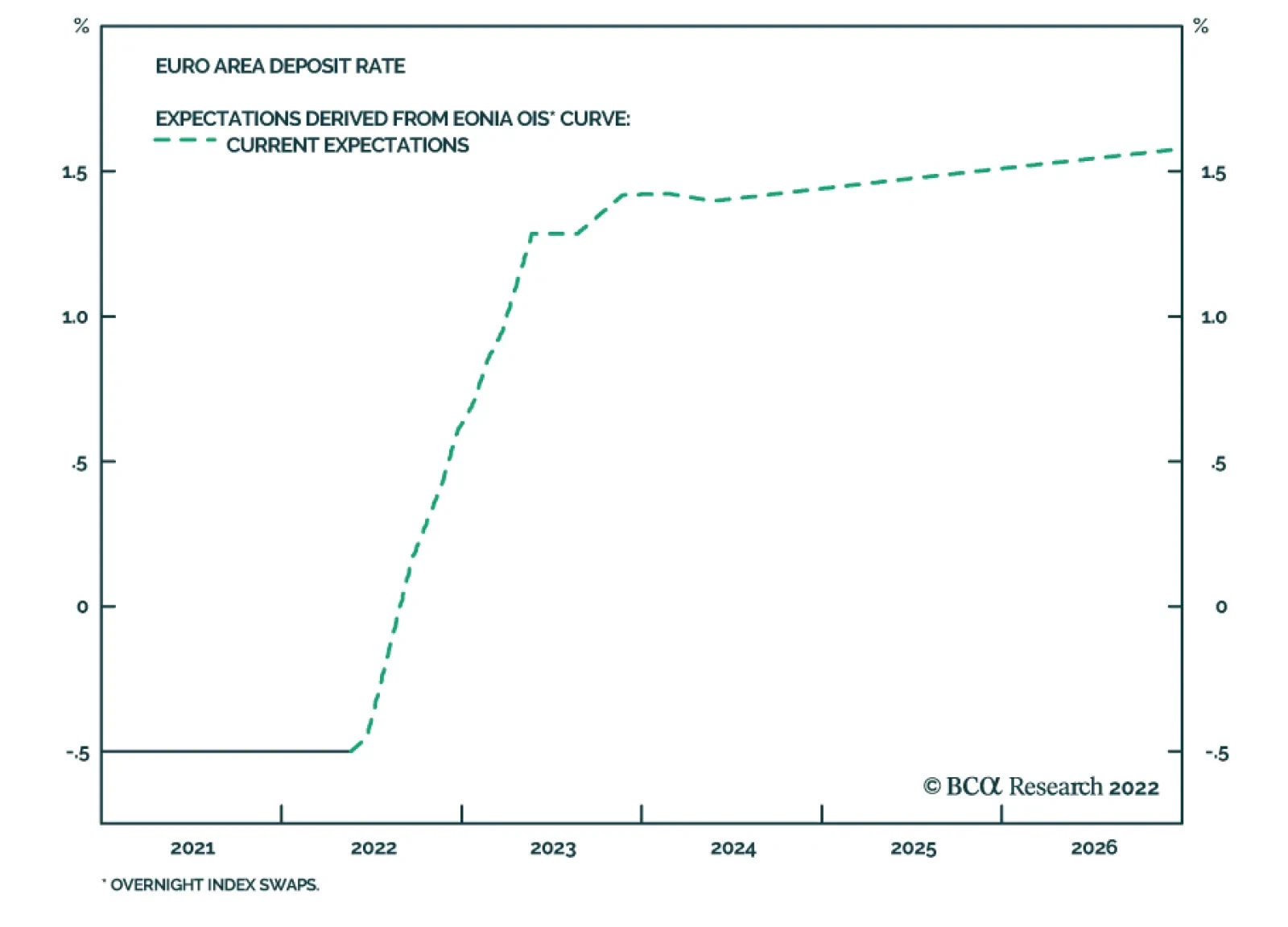
ECB President Christine Lagarde provided a clear signal that Eurozone policymakers are preparing to start raising interest rates this summer. In a blog post that was published on Monday, she wrote that “even when supply shocks fade, the disinflationary…