Financial Markets

As 2021 draws to a close, we thank you for your ongoing readership and support. We wish you and your loved ones a happy holiday season and all the best for a healthy and prosperous 2022. Highlights Over the coming three months, the odds are high that the Omicron variant of COVID-19 will disrupt economic activity in advanced economies, but the magnitude of the disruption will be heavily determined by the variant’s capacity to produce severe illness. For now, we remain of the view that the pandemic will recede in importance over the course of the next year. Relative to the assessment that we published in our 2022 Outlook report, the Omicron variant of COVID-19 has modestly raised the odds of a stagflationary outcome next year. Our base case view of above-trend growth and above-target inflation remains the most likely scenario for 2022. We do not think that the actual risk of a recession has risen significantly since we published our annual outlook, but we can envision a scenario in which Fed tightening causes investors to become fearful of a recession. The true risk of a monetary policy-induced recession over the coming 12-18 months will only rise if long-dated inflation expectations break above the range that prevailed prior to the Global Financial Crisis. Beyond 2022, the main risk to financial markets is that investors raise their longer-term interest rate expectations closer to the trend rate of economic growth. This would not be bad news for real economic activity, but it would imply meaningfully lower prices for financial assets that have benefited from low interest rates. We continue to advise that investors position themselves in line with the investment recommendations that we presented in our Outlook report. Over the coming year, investors should watch for the following when deciding whether to reduce exposure to risky assets: a breakout in long-dated inflation expectations, a significant flattening in the yield curve, or a rise in 5-year, 5-year forward US Treasury yields above 2.5%. Feature Our recently published 2022 Outlook report laid out the main macroeconomic themes that we see driving markets next year, as well as our cyclical investment recommendations.1 In this month’s report, we discuss the most relevant risks to our base case view in more depth, and update our fixed-income view in the wake of the December FOMC meeting. The Near-Term Risks Chart I-1DM Policymakers Are Afraid That Omicron Will Overwhelm The Medical System
DM Policymakers Are Afraid That Omicron Will Overwhelm The Medical System
DM Policymakers Are Afraid That Omicron Will Overwhelm The Medical System
Over the coming 0-3 months, the greatest risks to economic growth stem from the likely impact of the Omicron variant of COVID-19 on the medical system and the evolution of Europe’s energy crisis. News about the Omicron variant emerged just a few days prior to the publication of our annual outlook, and considerable uncertainty remains about its impact. Some early evidence suggests that the variant causes less severe disease, with a recent press release from South Africa’s largest private health insurance administrator suggesting that the risk of hospital admission was 29 percent lower for adults with the Omicron variant after adjusting for age, sex, underlying health conditions, and vaccine status. More recent studies from South Africa have suggested a much larger reduction in the severity of disease,2 but it is not yet clear whether these findings are applicable to advanced economies,given South Africa’s more recent vaccination campaign and higher proportion of a previously infected population. If Omicron turns out to result in 30 percent less hospitalizations, that only reduces the net impact on the medical system if the Omicron variant is no more than 1.5x as transmissible as the Delta variant. The sheer speed at which Omicron is spreading suggests it is far more contagious than this, the result in part to its ability to evade two-dose immunity. The potential for Omicron to quickly overwhelm available health system resources has alarmed authorities in several advanced economies, especially given that cases and hospitalizations have already trended higher in several countries even while Delta remained the dominant variant (Chart I-1). Additional restrictions on economic activity in the DM world appear to be likely over the coming weeks, and may be in effect until booster doses have been fully administered and/or Pfizer’s drug Paxlovid becomes widely available. For Europe, a worsening of the COVID situation has the potential to exacerbate the economic impact of the region’s ongoing energy crisis. Chart I-2 highlights that European natural gas prices have again exploded, reaching a new high that is fourteen times its pre-pandemic level. We noted in our Outlook report that European natural gas in storage is well below that of previous years, and Chart I-3 highlights that the gap in stored gas relative to previous years persists. This is occurring despite roughly average temperatures in central Europe over the past month (Chart I-4), underscoring that, barring atypically warmer temperatures, European natural gas prices are likely to remain elevated throughout the winter. Chart I-2Another Explosion In European Natural Gas Prices
Another Explosion In European Natural Gas Prices
Another Explosion In European Natural Gas Prices
Chart I-3
Chart I-5For Europe, COVID Is More Of A Problem Than Natural Gas Prices
For Europe, COVID Is More Of A Problem Than Natural Gas Prices
For Europe, COVID Is More Of A Problem Than Natural Gas Prices
Chart I-4
For now, it appears that the rise in COVID cases is having a more pronounced effect on the European economy than the energy price situation. Chart I-5 highlights that the flash December euro area manufacturing PMI fell only modestly, and that Germany’s manufacturing PMI actually rose in December. By contrast, the euro area services PMI fell over two points, reflecting the toll that recent pandemic control measures have taken on non-goods producing activity. Over the coming three months, the odds are high that the Omicron variant will disrupt economic activity in advanced economies to some degree, but the magnitude of the disruption will be heavily determined by the variant’s capacity to produce severe illness. Investors will have more information on hand in a few weeks by which to judge the extent of this risk. We will provide an update to our own assessment in our February report. Risks Over The Next Year In our Outlook report, we assigned a 60% chance to an above-trend growth and above-target inflation scenario next year, a 30% chance to a “stagflation-lite” scenario of growth at or below potential and inflation well above target, and a 10% chance of a recession. We present below our assessment of the risk that one of the latter two scenarios occurs in 2022. The Risk Of “Stagflation-Lite” Chart I-6Aside From Europe's Energy Crisis, Supply-Side Constraints Are Slowly Easing
Aside From Europe's Energy Crisis, Supply-Side Constraints Are Slowly Easing
Aside From Europe's Energy Crisis, Supply-Side Constraints Are Slowly Easing
The Omicron variant of COVID-19 has modestly raised the odds of a stagflationary outcome next year. Over the past few months, supply-side pressures have been modestly improving outside of Europe. Chart I-6 presents our new BCA Supply-Side Pressure Indicator, which measures the impact of supply-side restrictions across four categories: energy prices, shipping costs, the semiconductor shortage impact on automobile production, and labor availability. When we include all eleven components, the index has been trending higher of late, but trending flat-to-down after excluding European natural gas prices. While Omicron has the potential to reduce energy price pressure outside of Europe, it has the strong potential to cause a further increase in global shipping costs and postpone US labor market normalization. On the shipping cost front, we noted in our Outlook report that supply-side effects have been a significant driver of higher costs this year. The large rise in China/US shipping costs since late-June has been seemingly caused by the one-month closure of the Port of Yantian that began in late-May. While China has made enormous progress in vaccinating its population over the course of the year, and has prioritized the vaccination of workers in key industries, recent reports suggest that the Sinovac vaccine provides essentially no protection against contracting the Omicron variant of COVID-19. It is possible that Sinovac will offer protection against severe illness, but in terms of preventing transmission of the disease, Omicron has essentially returned China’s vaccination campaign back to square one. Chart I-7Further Price Increases May Seriously Slow Goods Spending
Further Price Increases May Seriously Slow Goods Spending
Further Price Increases May Seriously Slow Goods Spending
That fact alone makes it almost certain that China will maintain its zero-tolerance COVID policy for most of 2022, which significantly raises the risk of additional factory and port shutdowns – and thus even higher shipping costs and imported goods prices. One optimistic point is that these shutdowns are more likely to occur in mainland China than in Taiwan Province or Malaysia, two key semiconductor exporters. This is because these two regions have distributed doses of Pfizer’s vaccine, and thus presumably have the ability to provide three-dose mRNA protection to workers in crucial exporting industries (should policymakers choose to do so). Still, US consumer goods prices would clearly be impacted by even higher shipping costs, which would likely have the combined effect of slowing growth and raising prices. Chart I-7 highlights that the recent sharp deterioration in US households’ willingness to buy durable goods has been closely linked to higher goods prices, arguing that goods spending may slow meaningfully if prices rise further alongside renewed weakness in services spending. Omicron’s contagiousness may also exacerbate the ongoing US labor shortage. The shortage has occurred because of a surge in the number of retirees, difficult working conditions in several industries, and increased childcare requirements during the pandemic. The increase in the number of retirees has not happened for structural reasons; it has been driven by a sharp slowdown in the number of older Americans shifting from “retired” to “in the labor force”, which has occurred because of health concerns. None of these factors are likely to improve meaningfully while Omicron is raging, suggesting that services prices are likely to remain elevated or accelerate further even if services spending falls anew.
Chart I-8
To conclude on this point, we estimate that the odds of a stagflation-lite scenario have risen to 35% (from 30%), and the odds of our base-case scenario of above-trend growth and above-target inflation have fallen to 55% (Chart I-8). Still, our base-case view remains the most probable outcome, given that we do not believe the odds of a recession next year have risen. The Risk Of Recession We do not think that the actual risk of a recession has risen significantly since we published our annual outlook, but we can envision a scenario in which Fed tightening causes investors to become fearful of a recession. Such a scenario would have a material impact on cyclical investment strategy, and thus warrants a discussion. Following the December FOMC meeting, BCA’s baseline expectation is that a first Fed hike will occur in June 2022 and that rate increases will proceed at a pace of 25 basis points per quarter through the end of the year. BCA’s house view on this question is now in line with the view of The Bank Credit Analyst service, which published in a September Special Report that the Fed could hit its maximum employment objective as early as next summer.3 The Fed’s shift implies that the 2-year yield should rise to 1.85%, and the 10-year yield to 2.35%, by the end of next year (Chart I-9). Chart I-9A More Hawkish Fed Means A 2.35% 10-Year Yield Next Year
A More Hawkish Fed Means A 2.35% 10-Year Yield Next Year
A More Hawkish Fed Means A 2.35% 10-Year Yield Next Year
We doubt that US monetary policy will become economically restrictive next year. If the Omicron variant of COVID-19 causes a serious slowdown in economic activity, the Fed will ramp down its expectations for rate hikes. And if the Fed meets our baseline expectations for hikes next year in the context of above-trend economic growth, we do not believe that a 2.35% 10-year Treasury yield will be, in any way, limiting for economic activity. However, investors do not agree with our view about the boundary between easy and tight monetary policy, and may begin to fear a recession in response to Fed tightening next year. We noted in our Outlook report that we believe the neutral rate of interest (“R-star”) is likely higher that investors believe, but the fact remains that the Fed and market participants have judged, with deep conviction, that the neutral rate remains very low relative to the potential growth rate of the economy. Chart I-10 presents the fair value path of the 2-year Treasury yield based on our expectations for the Fed funds rate, alongside the actual 10-year Treasury yield. The chart highlights that the 2/10 yield curve could flatten significantly or even invert in the second half of 2022 if long-maturity yields rise only modestly in response to Fed tightening, which could occur if investors focus on the view that the neutral rate of interest is low and that Fed rate hikes will not prove to be sustainable. Based on two different measures of the yield curve, fixed-income investors believe that the current economic expansion is already 50-60% complete (Chart I-11), implying a recession at some point in the first half of 2023. Chart I-10The US Yield Curve Could Invert Next Year If Long-Maturity Yields Rise Only Marginally
The US Yield Curve Could Invert Next Year If Long-Maturity Yields Rise Only Marginally
The US Yield Curve Could Invert Next Year If Long-Maturity Yields Rise Only Marginally
Chart I-11More Than Half Of The Economic Expansion Has Already Occurred, According To The Yield Curve
More Than Half Of The Economic Expansion Has Already Occurred, According To The Yield Curve
More Than Half Of The Economic Expansion Has Already Occurred, According To The Yield Curve
Chart I-12A Serious Flattening In The Yield Curve Could Unnerve Stocks
A Serious Flattening In The Yield Curve Could Unnerve Stocks
A Serious Flattening In The Yield Curve Could Unnerve Stocks
If the yield curve were to flirt with inversion and investors began to price in the potential for a recession, it would cause significant financial market turmoil regardless of whether the risk of recession is real or not. Chart I-12 highlights that the S&P 500 fell 20% in late 2018 as the 2/10 yield curve flattened towards 20 basis points, in response to the economic impact of the China-US Trade War and the global impact of US tariffs on the auto industry. So it is possible that a “recessionary narrative” negatively impacts risky asset prices in the second half of 2022, even if an actual recession is ultimately avoided. Based on this, we would be much more inclined to reduce our recommended exposure to equities if the US 2/10 yield curve were to flatten below 30 basis points next year. In our view, the risk of a monetary policy-induced recession over the coming 12-18 months will only legitimately rise if long-dated inflation expectations break above the range that prevailed prior to the Global Financial Crisis. We noted in our Outlook report that this has not yet occurred for either household or market-based expectations, although it is a risk that cannot be ruled out. The odds of a breakout in long-dated inflation expectations will rise the longer that actual inflation remains elevated, and our inflation probability model suggests that core PCE inflation will remain well above 3% next year and potentially above 4% – although Chart I-13 highlights that the odds of the latter are falling. Chart I-13US Core Inflation Will Remain Well Above Target Next Year
US Core Inflation Will Remain Well Above Target Next Year
US Core Inflation Will Remain Well Above Target Next Year
A dangerous breakout in inflation expectations would raise the risk of a recession because of the Fed’s awareness of the “sacrifice ratio”, a very important economic concept that has been mostly irrelevant for the past 25 years. The sacrifice ratio is an estimate of the amount of output or employment that must be given up in order to reduce inflation by one percentage point. Table I-1 highlights some academic estimates of the sacrifice ratio, which have typically varied between 2-4% in output terms. For comparison purposes, real GDP has typically fallen no more than 2% on a year-over-year basis during most post-war US recessions. Real GDP growth fell 4% year-over-year in 2009, highlighting that the cost of reducing the rate of inflation by 1 percentage point is effectively a severe recession.
Chart I-
In his Senate testimony in late-November, Fed Chair Jay Powell noted that persistently high inflation threatens the economic recovery. He also implied that to reach its maximum employment goal, the Fed may need to act pre-emptively to tame inflation. This was implicit recognition of the sacrifice ratio, and should be seen as an expression of the Fed’s desire to avoid a scenario in which persistently high inflation causes inflation expectations to become unanchored (to the upside), as it would force the Fed to sacrifice economic activity in order to ensure price stability. By acting earlier to normalize monetary policy, the Fed hopes to keep inflation expectations well contained. Chart I-14Long-Dated Market-Based Inflation Expectations Are Not Out Of Control
Long-Dated Market-Based Inflation Expectations Are Not Out Of Control
Long-Dated Market-Based Inflation Expectations Are Not Out Of Control
For now, we see no signs that the Fed will fail to keep inflation expectations from rising dangerously. Chart I-14 highlights that long-dated market expectations for inflation have been falling over the past two months, and are essentially at the same level that they were on average in 2018. Given this, we maintain the 10% odds of recession that we presented in our Outlook report, although investors will need to monitor inflation expectations closely over the coming year to judge whether the risks of a monetary policy-induced recession are indeed rising. Risks Beyond The Next Year Beyond 2022, the main risk to risky asset prices is probably not overly tight monetary policy. Instead, the risk is that investors will come to the conclusion that the Fed funds rate will ultimately end up rising above what the Fed is currently projecting, and that the economy will be capable of tolerating interest rates that are closer to the prevailing rate of economic growth. This would not be bad news for real economic activity, but it would imply meaningfully lower prices for financial assets that have benefited from low interest rates. Chart I-15US Stocks Would Suffer Significant Losses If Interest Rates Rise Towards Potential Growth
US Stocks Would Suffer Significant Losses If Interest Rates Rise Towards Potential Growth
US Stocks Would Suffer Significant Losses If Interest Rates Rise Towards Potential Growth
Chart I-15 drives the point home by comparing the current S&P 500 forward P/E ratio to a “justified” P/E. Here, we calculate the justified P/E using the average ex-ante equity risk premium (ERP) since 1980, and real potential GDP growth as a stand-in for the real risk-free rate of interest. The chart highlights that US stocks would experience a 30% contraction in equity multiples should real long-maturity bond yields approach 2%. A decline in the ERP could potentially reduce losses for equity holders in a higher interest rate scenario, but it is very likely that the net effect would still be negative for stocks. We detailed in our Outlook report why we believe that the neutral rate of interest is higher than most acknowledge. We agree that R-star fell in the US for a time following the Global Financial Crisis (GFC), but we strongly question that it is as low as the Fed and investors believe. The neutral rate of interest fell during the first half of the last economic cycle because of a persistent period of household deleveraging and balance-sheet repair, which was a multi-year consequence of the financial crisis and the insufficient fiscal response to the 2008-09 recession. We highlighted in our Outlook report that US household balance sheets have been repaired, and that the household debt service ratio has fallen to mid-1960s levels. However, Chart I-16 highlights that even the corporate sector, which has leveraged itself significantly over the past decade, has seen its debt service ratio plummet. In a scenario in which long-maturity Treasury yields were to rise to 4%, we estimate that the debt service burden of the nonfinancial corporate sector would rise to its 70th-80th percentile historically. Chart I-16The US Corporate Sector Debt Service Burden Has Room To Rise
The US Corporate Sector Debt Service Burden Has Room To Rise
The US Corporate Sector Debt Service Burden Has Room To Rise
That would be a meaningful increase from current levels, but it would not be unprecedented, and thus would not render a 4% 10-year Treasury yield to be economically unsustainable. In addition, we strongly suspect that corporations would reduce their interest burden in such a scenario by issuing equity to retire debt. That would lower firms’ debt burden and reduce the economic impact of higher interest rates, although it would be additionally negative for equity investors given that this would dilute earnings per share. We argued in our Outlook report that a shift in investor expectations about the neutral rate of interest is unlikely to occur before the Fed begins to normalize monetary policy. Ryan Swift, BCA’s US Bond Strategist, presented further evidence of this perspective in a Special Report earlier this week.4 Ryan highlighted results from a recent academic paper, which showed that the entire decline in the 10-year Treasury yield since 1990 has occurred during three-day windows centered around FOMC meetings (Chart I-17). Ryan argued that this suggests investors change their neutral rate expectations in response to Fed interest rate decisions, rather than in response to independent macroeconomic factors that are distinct from monetary policy action. This argues that a shift in neutral rate expectations is unlikely before the Fed begins to lift interest rates in the middle of the year, and probably not until the Fed has raised rates a few times. We are thus unlikely to recommend that investors reduce their equity exposure in response to this risk until 5-year, 5-year forward Treasury yields break above 2.5% (the Fed’s long-run Fed funds rate projection), which is 80 basis points above current levels (Chart I-18). Chart I-17Fed Rate Decisions Drive Long-Maturity Bond Yields
Fed Rate Decisions Drive Long-Maturity Bond Yields
Fed Rate Decisions Drive Long-Maturity Bond Yields
Chart I-18We Will Consider Selling Stocks If Market-Based Neutral Rate Estimates Exceed 2.5%
We Will Consider Selling Stocks If Market-Based Neutral Rate Estimates Exceed 2.5%
We Will Consider Selling Stocks If Market-Based Neutral Rate Estimates Exceed 2.5%
Investment Conclusions We continue to advise that investors position themselves in line with the investment recommendations that we presented in our Outlook report. Over the following 12-months, we expect the following: Global stocks to outperform bonds Short-duration fixed-income positions to outperform long High-yield corporate bonds to outperform within fixed-income portfolios Value stocks to outperform growth Non-resource cyclicals to outperform defensives Small caps to outperform large A modest rise in commodity prices led by oil A decline in the US dollar However, our discussion of the risks to our views has highlighted three things for investors to monitor next year when deciding whether to reduce exposure to stocks (and risky assets more generally): A breakout in long-dated inflation expectations, as that would likely cause the Fed to raise interest rates more aggressively than it currently projects. A significant flattening in the yield curve, as that would indicate that investors ultimately expect existing Fed rate hike projections to prove recessionary. A rise in 5-year, 5-year forward US Treasury yields above 2.5%, as that would indicate that investors may be upwardly shifting their expectations for the neutral rate of interest. Over the shorter-term, our discussion also underscored that the Omicron variant will likely disrupt economic activity to some degree over the coming three months, and that the risks of a stagflation-lite scenario next year have modestly increased because of the likely maintenance of China’s zero-tolerance COVID policy. We continue to expect that the widespread rollout of booster doses, as well as the progressive availability of effective and safe antiviral drugs, will limit Omicron’s impact on economic activity to the first half of 2022, and that the pandemic will recede in importance next year on average in comparison to 2021. As noted above, this assessment will be monitored continually in response to the release of new information, and we will provide an update in our February report. Jonathan LaBerge, CFA Vice President The Bank Credit Analyst December 23, 2021 Next Report: January 27, 2022 II. Stock Buybacks – Much Ado About Nothing Dear Client, This month’s Special Report is a guest piece by Doug Peta, BCA Research’s Chief US Investment Strategist. Doug’s report examines the impact of US stock buybacks using a median bottom-up approach, and presents a different perspective of the value vs. growth distribution of buybacks than we did in our October Section 2. I trust you will find his report interesting and insightful. Jonathan LaBerge, CFA The Bank Credit Analyst Elected officials’ antipathy for buybacks is unfounded, … : For the companies that are the primary drivers of buyback activity, returning cash to shareholders is more likely to have a positive impact on employment and investment than retaining it. and the idea that they boost stock returns may be, as well, … : Over the last ten years, a cap-weighted bucket of large-cap stocks that most reduced their share counts underperformed the bucket that most increased their share counts by 2% annually. especially within the Tech sector, which has most enthusiastically executed them: Despite the success of Apple, which has seen its market cap soar since embarking on a deliberate strategy to shrink its shares outstanding, a strategy buying Tech’s biggest net reducers and selling its biggest net issuers would have generated sizable negative alpha over the last ten years. The problem is the relative profile of net buyers and net issuers: In general, companies that consistently buy back their own stock are mature companies that cannot earn an accretive return by redeploying the capital their incumbent business generates. Net issuers, on the other hand, are often young companies seeking fresh capital to realize their abundant growth opportunities. The next year is likely to see a pickup of share buybacks nonetheless, … : Our US Equity Strategy service’s Cash Yield Prediction Model points to increased buyback activity in 2022. … as management teams are wedded to them and buying back stock is the best use of capital for the mature companies executing them: Better to return cash to shareholders than to enter new business lines beyond the company’s area of expertise or embark on dubious acquisitions, even in the face of a potential 1% surtax. In Capitol Hill’s current polarized state, stock buybacks are in select company with the tech giants and China as issues that unite solons on both sides of the aisle. They are also a hot-button issue for some investors, who see them as telltale signs of a market kept aloft by sleight of hand. Although we do not think they’re worth getting worked up over – they do not promote the misallocation of capital and they may not actually boost stock prices – they come up repeatedly in client discussions and are likely to remain a feature of the landscape even if they are eventually subjected to a modest federal surtax. We have therefore joined with the BCA Equity Analyzer team to pore over its bottom-up database for insights into the buyback phenomenon. After ranking nearly 600 stocks in our large-cap universe in order of their rolling 12-month percentage change in shares outstanding across the last ten years, we were surprised to discover that the companies that most reduced their share count underperformed the companies that most grew it. We were also surprised to find that Tech was by far the worst performer among the six sectors with negative net issuance. Ultimately, the performance story seemed to boil down to Growth stocks’ extended recent edge over Value stocks. We present the data, our interpretation of it, and some future investment implications in this Special Report. Buybacks’ Bad Rap From Capitol Hill to the White House, prominent Washington voices bemoan buybacks. In a February 2019 New York Times opinion piece,5 Senators Sanders (I-VT) and Schumer (D-NY) argued that equity buybacks divert resources from productive investment in the narrow interest of boosting share prices for the benefit of shareholders and corporate executives. To counter the increasing popularity of buybacks, they proposed legislation that would permit buybacks only after several preconditions for investing in workers and communities had been met. Echoing their concerns, the White House's framework for the Build Back Better bill included a 1% surcharge on stock buybacks, “which corporate executives too often use to enrich themselves rather than investing in workers and growing the economy.” Chart II-1The Smallest Companies Sell Stock; The Largest Buy It Back
The Smallest Companies Sell Stock; The Largest Buy It Back
The Smallest Companies Sell Stock; The Largest Buy It Back
Buybacks’ opponents may mean well, but they seem to be missing an essential point: by and large, the companies that buy back their own stock lack enough attractive investment opportunities to absorb the cash their operations generate. Companies with more opportunities than cash don’t buy back stock; they issue it (and/or borrow) to get the capital to pursue them. The simple generalization that large, mature companies buy back shares while small, growing companies issue new ones is borne out by rolling 12-month percentage changes in shares outstanding by large-cap and small-cap companies (Chart II-1). On an equal-weighted basis, large-cap companies’ rolling share count was flat to modestly down for ten years before the pandemic drove net issuance. Adjusting for market cap, rolling net issuance has been uninterruptedly negative, shrinking by more than 2% per year, on average. The equally weighted small-cap population has been a net issuer to the tune of about 4% annually, with the biggest small-caps issuing even more, pushing the cap-weighted annual average to north of 6%. The bottom line is that large-cap companies in the aggregate have been modestly trimming their share counts, with the biggest companies retiring more than 2% of their shares each year, while small-cap companies are serial issuers, led by their largest (and presumably most bankable) constituents. We are investors serving investors, not policymakers, academics or editorial columnists charged with developing and evaluating public policy. Our mandate is bullish or bearish, not good or bad. We point out the flaws in the prevailing criticism of buybacks simply to make the point that buybacks are not an impediment to productive investment and that no one should therefore expect that productivity and income will rise if legislators or regulators restrict them. On the contrary, since we believe that buybacks represent an efficient allocation of capital, we would expect that successful attempts to limit them will hold back growth at the margin. The Buyback Calculus A company that buys back more of its shares than it issues reduces its share count. All else equal, a company with fewer shares outstanding will report greater earnings per share and a higher return on equity. Increased earnings per share (EPS) does not necessarily ensure a higher share price; if a company’s P/E multiple declines by more than EPS rises, its price will fall. Distributing retained earnings to shareholders reduces a company’s capital buffer against shocks and limits its ability to fund investment internally, but companies that embark on the most ambitious buyback campaigns likely face limited investment opportunities and have much more of a buffer than they could conceivably require. Revealed preferences suggest that management teams like buybacks. They have every interest in getting share prices higher to maximize the value of their own compensation, which typically contains an equity component that accounts for an increasing share of total compensation the more they rise in the company’s hierarchy. It is unclear, however, just how much their attachment to buybacks is founded on an expectation that buying back stock will boost its price. The opportunity to extend their tenure by pursuing a shareholder-friendly policy may well offer a stronger incentive. Do Buybacks Boost Share Prices? Returning cash to shareholders is widely perceived as good corporate governance. It increases the effective near-term yield on an equity investment and denies management the cash to pursue dubious expansion schemes or squander capital on lavish perquisites. It facilitates the reallocation of capital away from cash cows to more productive uses. Buybacks are squarely beneficial in theory, but are they good for investors in practice? (Please see the Box II-1 for a description of the methodology we followed to answer the empirical question.) Box II-1 Performance Calculation Methodology After separating stocks into large- and small-cap categories based on Standard & Poor’s market cap parameters for inclusion in the S&P 500 and the SmallCap 600 indexes, we ranked the constituents in each category in reverse order of their rolling 12-month percentage change in shares outstanding at the end of each month from 2011 through 2021. We then placed the top three deciles (the biggest reducers of their share counts) into the High Buybacks bucket and the bottom three deciles (the biggest net issuers) into the Low Buybacks bucket. We used the buckets to backtest a zero-net-exposure strategy of buying the stocks in the High bucket with the proceeds from shorting the stocks in the Low bucket, calling it the High-Minus-Low (“HML”) strategy. We computed two sets of HML results for the large-cap and small-cap universes. The first populated the buckets without regard for sector representation (“sector-agnostic”) and the second populated the buckets in line with the sector composition of the S&P 500 and SmallCap 600 Indexes (“sector-neutral”). We also track equal-weighted and cap-weighted versions of each HML bucket to gain a sense of performance differences between constituents by size. The experience of the last ten years fails to support the widely held view that stock buybacks boost share prices. Following a zero-net-exposure strategy of owning the top three deciles of large-cap companies ranked by the rolling 12-month percentage reduction of shares outstanding and shorting the bottom three deciles generated a modest positive annual return above 1% (Chart II-2). Small caps merely broke even, largely because their biggest share reducers sharply underperformed in Year 1 of the pandemic. On a cap-weighted basis, however, the large-cap strategy generated a negative annual return a little over 1% during the period, indicating that the largest companies pursuing buyback programs lagged their net issuer counterparts. For small caps, the cap-weighted strategy also lagged the equal-weighted strategy, albeit by a smaller margin. On a sector-neutral basis, the large-cap HML strategy roundly disappointed. The equal-weighted version was never able to do much more than break even, slipping into the red when COVID arrived, while the cap-weighted version continuously lagged it, shedding about 1.5% annually (Chart II-3). Though it was hit hard by the pandemic, the equal-weighted small-cap HML strategy managed to generate about 1% annually, and boasted a 3.5% annualized return for the eight years through 2019. Chart II-2Buybacks May Help A Company's Stock Price At The Margin ...
Buybacks May Help A Company's Stock Price At The Margin ...
Buybacks May Help A Company's Stock Price At The Margin ...
Chart II-3... But They Are Not An Exploitable Factor
... But They Are Not An Exploitable Factor
... But They Are Not An Exploitable Factor
Drilling down to the sector level offers some additional insights. While changes in shares outstanding vary across large-cap sectors, with six sectors reducing their shares outstanding and five expanding them, every small-cap sector has been a net issuer in every single year, ex-Discretionaries and Industrials in 2019 (Chart II-4). Relative sector capital needs are largely consistent regardless of market cap, however, with REITs, which distribute all their income to preserve their tax-free status, unable to expand without raising cash in the capital markets, and Utilities, Energy and traditional Telecom Services being capital-intensive industries (Table II-1). Many Tech niches are capital-light, and established Industrials and Consumer businesses often throw off cash.
Chart II-4
Chart II-
There is less large- and small-cap commonality in HML relative sector performance than in relative sector issuance. Away from Real Estate, Tech and Discretionaries, small-cap HML sector strategies generated aggregate positive returns, led by Communication Services and Energy (Chart II-5). For the large caps, most HML sector strategies produced negative alpha, though the four winners and the one modest loser (Financials) are among the six sectors that have net retired shares outstanding since 2012. Tech is the conspicuous exception, with its HML strategy yielding annualized losses exceeding 3%, contrasting with the sector’s enthusiastic buyback embrace.
Chart II-5
The Corporate Life Cycle Surprising as they may be on their face, negative cap-weighted ten-year HML returns do not mean that buybacks are counterproductive. We simply think they illustrate that net issuance activity follows from a company’s position in the corporate life cycle (Figure II-1). Investors have prized growth in the aftermath of the global financial crisis, and the companies with the best growth prospects are often younger companies just beginning to tap their addressable markets. They have a long pathway of market share capture ahead of them and need to raise capital to begin traveling it. Many of these strong growers populate the Low basket, especially in the Tech sector.
Chart II-
Chart II-
Companies that return cash to their owners via share repurchases are often more mature. Their operations are comfortably profitable and generate more than enough cash to sustain them. They have already captured all the market share they’re likely to gain in their primary business and may not have an outlet for its proceeds in a space in which they have a plausible competitive advantage. Lacking a clear path to bettering the returns from their main operations, they have been steadily accumulating cash for a long time. Through the lens of the Boston Consulting Group’s (BCG) growth share matrix,6 a successful business in the Maturity stage of the business life cycle is known as a Cash Cow. Cash Cows have gained considerable market share in their industry, affording them a competitive advantage based on scale, brand and experience, but little scope for growth because they have saturated a market that is itself mature (Figure II-2). BCG advises management teams with a portfolio of business lines to milk Cash Cows for capital to reinvest in high-share, high-growth-potential Stars or low-share, high-growth-potential Question Marks that could be developed into Stars. In the public markets, a mature large-cap company that retains its excess capital impedes its owners’ ability to redeploy that capital to faster growing investments, subverting the overall economy’s ability to redirect capital to its best uses. Walmart, Twentieth-Century Growth Darling Chart II-6From Young Turk To Respected Elder
From Young Turk To Respected Elder
From Young Turk To Respected Elder
Walmart fits the business life cycle framework to a T and has evolved into a textbook Cash Cow. It is a dominant player that executed its initial strategy so well that it has maxed out its share in the declining/stagnating brick-and-mortar retail industry. Its international attempts to replicate its domestic success have uniformly failed to gain traction, and it currently operates in fewer major countries than it's exited. Given Walmart’s star-crossed international experience and the dismal history of large corporate combinations, returning cash may be the optimal use of shareholder capital. Walmart began life as a public company in fiscal 1971 squarely in the Growth phase. It was profitable from the start and grew annual revenues by at least 25% for every one of its first 23 years of public ownership (Chart II-6, top panel). It was a modest issuer of shares during its Growth phase, conducting just one secondary common stock offering 12 years after its IPO and otherwise limiting growth in shares outstanding to acquisitions, management incentive awards and debt and preferred stock conversions. Once its revenue growth slipped into the low double-digits in the late nineties, it began retiring its shares at a deliberate pace (Table II-2). That retirement inaugurated a ramping up of Walmart’s annual payout ratio (Chart II-6, bottom panel) and cash yield (dividend yield plus buyback yield), underlining its transition from Growth to Maturity. Walmart’s 2010 admission into the S&P 500 Pure Value Index marked its ripening into full maturity, and it has been a Pure Value fixture since 2013. Today’s stolid icon is a far cry from the ambitious disruptor on display in its 1980 Annual Report:
Chart II-
Subsequent to year end, your Company’s directors authorized [a one-third] increase in the annual dividend[.] This continues your Company’s approach of distributing a portion of profits to our shareholders and utilizing the balance to fund our aggressive expansion program. [T]he decade of the ’70’s … has been a tremendous growth period for your Company. In January 1970, we … had 32 stores …, comprising less than a million square feet of retail space. In the next ten years, we added 258 … stores, … constructed and opened three new distribution facilities, and increased our retail space to 12.6 million square feet. During that same period of time, we increased our sales and earnings at an annual compounded rate well in excess of 40 percent. Reflecting upon the progress we have made in the ‘70’s makes it apparent that there is even more opportunity in the ‘80’s for your Company, and we are better positioned to maximize our opportunities … than ever before. The Exception That Proves The Rule Apple has shined so far in the twenty-first century much like Walmart did in the latter stages of the twentieth, growing its revenues and net income at compound annual rates exceeding 20% and 25%, respectively. Unlike Walmart, however, Apple hasn’t required a steady stream of capital to grow. While Walmart had to plow its earnings right back into the business to fund the acquisition and buildout of property to create stores, warehouses and distribution centers, Apple has simply had to make incremental improvements to its music players, phones and tablets while shoring up the moats around its virtual app and music marketplaces. As a result, cash and retained earnings began silting up on Apple’s balance sheet, lying fallow in short-term marketable securities and crimping a range of return metrics.
Chart II-
Beginning in its 2013 fiscal year, Apple embarked on a lengthy strategy of returning that cash to shareholders, buying back stock at a rate that has allowed it to reduce its shares outstanding by 37.5% in the space of nine years (Table II-3). It has reduced its retained earnings by more than $90 billion over that span and is on course to wipe them out completely in the fiscal year ending next September. Equity issuance in the form of incentive compensation augments Apple’s capital by about $5 billion per year, but if it continues to distribute more than 100% of its annual earnings in the form of dividends and repurchases, it could wipe out the rest of its recorded equity capital as well. Does this mean Apple is in danger of sliding into insolvency? Not in the least. The value of its assets dramatically exceeds the value of its liabilities, as evidenced by its nearly $3 trillion market cap and the top AAA credit rating Moody’s awarded it this week. Its reported book value is artificially suppressed by generally accepted accounting principles’ inability to value organically developed intellectual property (IP). Apple’s book value and that of other companies that generate similar IP, or benefit from internally generated moats, are dramatically undervalued. Takeaways For now, Apple is an anomaly when it comes to aggressively returning cash to shareholders while it is still in the Growth stage of its life cycle. Returning cash is typically the province of mature companies with steady operations that are unlikely to grow. It is generally good for the economy when those companies return excess cash to shareholders, freeing it up for more productive uses. If lawmakers or regulators manage to restrict the flow of capital from cash-cow companies to potential stars, we should expect activity to slow at the margin, not quicken. The experience of the last ten years suggests that companies that shrink their share counts do not outperform their counterparts that expand them. The trading strategy of shorting the biggest net share issuers to purchase the biggest net share reducers has produced negative returns. It is unclear if shareholders of companies who cannot redeploy their internally generated capital to augment the returns from their primary operations would be better served if their manager-agents retained the capital, though we suspect they would not. It seems inevitable that manager-agents with access to too much capital will eventually get into mischief. If buying back stock represents good corporate stewardship at mature companies, their shareholders should someday be rewarded for it. Given that the companies most suited to buying back stock tend to fit in the Value style box, the zero-net-exposure HML strategy may continue to accrue losses. Apple remains an outlier among Growth companies as an avid buyer of its stock; much more common are the S&P 500 Life and Multi-Line Insurer sub-industry groups, without which the S&P 500 Pure Value Index would have a hard time reaching a quorum (Table II-4). Their constituents have assiduously bought back their stock over the last ten years, albeit to no relative avail (Chart II-7). However, they should be better positioned once Value returns to favor and rising interest rates make investing their cash flow a more attractive proposition.
Chart II-
Chart II-7... But No One Else Seems To Want To
... But No One Else Seems To Want To
... But No One Else Seems To Want To
Doug Peta, CFA Chief US Investment Strategist III. Indicators And Reference Charts BCA’s equity indicators highlight that the “easy” money from expectations of an eventual end to the pandemic have already been made. Our technical, valuation, and sentiment indicators remain very extended, highlighting that investors should expect positive but modest returns from stocks over the coming 6-12 months. Our monetary indicator has retreated below the boom/bust line, although this mostly reflects the use of producer prices to deflate money growth. In nominal terms, the supply of money continues to grow. Still, the retreat in the indicator over the past year highlights that the monetary policy stance is likely to move in a tighter direction over the coming year, which is in line with the Fed’s recent hawkish shift. Forward equity earnings are pricing in a substantial further rise in earnings per share. Net earnings revisions and net positive earnings surprises are rolling over, but there is no meaningful sign of waning forward earnings momentum. Bottom-up analyst earning expectations remain too high, but stocks are likely to be supported by robust revenue growth over the coming year. Within a global equity portfolio, we continue to recommend that investors position for the underperformance of financial assets that are negatively correlated with long-maturity government bond yields. The US 10-Year Treasury Yield remains well below the fair value implied by a mid-2022 rate hike scenario, underscoring that a move higher over the coming year is quite likely. Commodity prices remain elevated, and our composite technical indicator highlights that they remain overbought. An eventual slowdown in US goods spending, coupled with eventual supply-chain normalization and the absence of a significant reflationary impulse from Chinese policy, could weigh on commodity prices at some point over the coming 6 months. We expect stronger metals prices in the back half of 2022. US and global LEIs remain very elevated but have started to roll over. Our global LEI diffusion index has declined very significantly, but this likely reflects the outsized impact of a few emerging market countries (whose vaccination progress is still lagging). Still-strong leading and coincident indicators underscore that the global demand for goods is robust, and that output is below pre-pandemic levels in most economies because of very weak services spending. The latter will recover significantly at some point over the coming year, as the severity of the pandemic wanes. EQUITIES: Chart III-1US Equity Indicators
US Equity Indicators
US Equity Indicators
Chart III-2Willingness To Pay For Risk
Willingness To Pay For Risk
Willingness To Pay For Risk
Chart III-3US Equity Sentiment Indicators
US Equity Sentiment Indicators
US Equity Sentiment Indicators
Chart III-4US Stock Market Breadth
US Stock Market Breadth
US Stock Market Breadth
Chart III-5US Stock Market Valuation
US Stock Market Valuation
US Stock Market Valuation
Chart III-6US Earnings
US Earnings
US Earnings
Chart III-7Global Stock Market And Earnings: Relative Performance
Global Stock Market And Earnings: Relative Performance
Global Stock Market And Earnings: Relative Performance
Chart III-8Global Stock Market And Earnings: Relative Performance
Global Stock Market And Earnings: Relative Performance
Global Stock Market And Earnings: Relative Performance
FIXED INCOME: Chart III-9US Treasurys And Valuations
US Treasurys And Valuations
US Treasurys And Valuations
Chart III-10Yield Curve Slopes
Yield Curve Slopes
Yield Curve Slopes
Chart III-11Selected US Bond Yields
Selected US Bond Yields
Selected US Bond Yields
Chart III-1210-Year Treasury Yield Components
10-Year Treasury Yield Components
10-Year Treasury Yield Components
Chart III-13US Corporate Bonds And Health Monitor
US Corporate Bonds And Health Monitor
US Corporate Bonds And Health Monitor
Chart III-14Global Bonds: Developed Markets
Global Bonds: Developed Markets
Global Bonds: Developed Markets
Chart III-15Global Bonds: Emerging Markets
Global Bonds: Emerging Markets
Global Bonds: Emerging Markets
CURRENCIES: Chart III-16US Dollar And PPP
US Dollar And PPP
US Dollar And PPP
Chart III-17US Dollar And Indicator
US Dollar And Indicator
US Dollar And Indicator
Chart III-18US Dollar Fundamentals
US Dollar Fundamentals
US Dollar Fundamentals
Chart III-19Japanese Yen Technicals
Japanese Yen Technicals
Japanese Yen Technicals
Chart III-20Euro Technicals
Euro Technicals
Euro Technicals
Chart III-21Euro/Yen Technicals
Euro/Yen Technicals
Euro/Yen Technicals
Chart III-22Euro/Pound Technicals
Euro/Pound Technicals
Euro/Pound Technicals
COMMODITIES: Chart III-23Broad Commodity Indicators
Broad Commodity Indicators
Broad Commodity Indicators
Chart III-24Commodity Prices
Commodity Prices
Commodity Prices
Chart III-25Commodity Prices
Commodity Prices
Commodity Prices
Chart III-26Commodity Sentiment
Commodity Sentiment
Commodity Sentiment
Chart III-27Speculative Positioning
Speculative Positioning
Speculative Positioning
ECONOMY: Chart III-28US And Global Macro Backdrop
US And Global Macro Backdrop
US And Global Macro Backdrop
Chart III-29US Macro Snapshot
US Macro Snapshot
US Macro Snapshot
Chart III-30US Growth Outlook
US Growth Outlook
US Growth Outlook
Chart III-31US Cyclical Spending
US Cyclical Spending
US Cyclical Spending
Chart III-32US Labor Market
US Labor Market
US Labor Market
Chart III-33US Consumption
US Consumption
US Consumption
Chart III-34US Housing
US Housing
US Housing
Chart III-35US Debt And Deleveraging
US Debt And Deleveraging
US Debt And Deleveraging
Chart III-36US Financial Conditions
US Financial Conditions
US Financial Conditions
Chart III-37Global Economic Snapshot: Europe
Global Economic Snapshot: Europe
Global Economic Snapshot: Europe
Chart III-38Global Economic Snapshot: China
Global Economic Snapshot: China
Global Economic Snapshot: China
Jonathan LaBerge, CFA Vice President The Bank Credit Analyst Footnotes 1 Please see The Bank Credit Analyst "OUTLOOK 2022: Peak Inflation – Or Just Getting Started?", dated December 1, 2021, available at bca.bcaresearch.com 2 Early assessment of the clinical severity of the SARS-CoV-2 Omicron variant in South Africa by Wolter et al., medRxiv preprint, December 21, 2021. 3 Please see The Bank Credit Analyst “The Return To Maximum Employment: It May Be Faster Than You Think”, dated August 26, 2021, available at bca.bcaresearch.com 4 Please see US Bond Strategy “The Fed In 2022”, dated December 21, 2021, available at bca.bcaresearch.com 5 Opinion | Schumer and Sanders: Limit Corporate Stock Buybacks - The New York Times (nytimes.com) Accessed December 17, 2021. 6 https://www.bcg.com/about/overview/our-history/growth-share-matrix Accessed December 19, 2021. EQUITIES:FIXED INCOME:CURRENCIES:COMMODITIES:ECONOMY:
Highlights Below-Benchmark Portfolio Duration: Bond investors should keep portfolio duration low in 2022. While the market’s pricing of the expected Fed liftoff date and initial pace of rate hikes is reasonable, terminal fed funds rate expectations are far too low. Own Treasury Curve Steepeners: The 2/10 Treasury slope will flatten by less than what is currently discounted in the forward curve in 2022. Investors should position for this by going long the 2-year note versus a duration-matched barbell consisting of cash and the 10-year note. Sell Short-Maturity TIPS: Investors should maintain a neutral allocation to long-maturity TIPS versus nominal Treasuries and an underweight allocation to short-maturity TIPS versus nominal Treasuries. We also recommend an outright short position in 2-year TIPS, as short-maturity real yields have a lot of upside in 2022. Overweight Corporate Bonds Versus Treasuries … For Now: We are overweight corporate bonds versus duration-matched Treasuries, for now, but expect to turn more defensive in the first half of 2022 once the yield curve sustainably moves into a flatter regime. Relative valuations suggest that investors should favor high-yield corporates over investment grade. Overweight Emerging Market Bonds Versus US Corporates: EM bonds offer an attractive spread advantage versus US corporates, and a weakening US dollar will help boost returns in 2022. A Maximum Overweight Allocation To Municipal Bonds: Municipal bonds offer exceptional value, especially at the long-end of the curve, and state & local government balance sheets are in excellent shape. Underweight Agency MBS: Agency Mortgage-Backed Securities don’t adequately compensate investors for the likely pace of refi activity in 2021. An up-in-coupon stance is also advisable to take advantage of rising bond yields. Feature BCA published its 2022 Outlook on December 1st. That report lays out the main macroeconomic themes that our strategists see driving markets next year. This Special Report explains how investors can profit from those themes in US fixed income markets. Specifically, we offer seven key US fixed income views for 2022. This report is limited to the seven key investment views, and only discusses Fed policy in the context of how it influences those views. Next week we will publish a more comprehensive “Fed In 2022” report that will delve into our outlook for the Fed next year. Outlook Summary First, a summary of the main economic views presented in BCA’s 2022 Outlook.1 On Economic Growth: The COVID-19 pandemic will recede in importance in 2022 allowing US economic growth to remain above trend. Sizeable household savings and wealth will support consumer spending, the composition of which will shift away from goods and towards services. Corporate capital expenditures also look set to surge. On Inflation: A transition in consumer spending from goods to services and an increase in labor supply will cause US inflation to fall in 2022, though it will remain above the Fed’s target. On Fed Policy: The first Fed rate hike will occur between June and December 2022, depending on the paths of inflation and inflation expectations during the next few months. Fed tightening will continue into 2023. On China and Emerging Markets: Further policy easing in H1 2022 will lead to a reacceleration in Chinese economic activity in the back half of the year. The BCA house view is negative on EM equities for now but will turn more bullish when clearer signs of Chinese policy easing emerge. Risks To The Outlook: The greatest risk to the outlook is that the spread of the Omicron variant leads to the re-imposition of public health measures that will weigh on economic activity. The effect of the Omicron variant remains uncertain, but increasingly widespread vaccination and the advent of anti-viral treatments should help mitigate any negative economic impacts. Key View #1: Below-Benchmark Portfolio Duration Bond investors should keep portfolio duration low in 2022, favoring the 2-year maturity over the 10-year. While the market’s pricing of the expected Fed liftoff date and initial pace of rate hikes is reasonable, terminal fed funds rate expectations are far too low. Our recommendation to keep portfolio duration low in 2022 stems directly from our assessment of Federal Reserve policy. Without going into too much detail – we will do that in next week’s “Fed In 2022” report – the Fed appears to have adopted a more hawkish reaction function during the past month. The Fed’s official forward guidance says that it will not lift rates until the labor market reaches “maximum employment”. However, Fed Chair Jay Powell weakened that commitment in recent Senate testimony. Powell said that persistently high inflation threatens the economic recovery and implied that to reach its maximum employment goal the Fed may need to act pre-emptively to tame inflation. To us, this means that the Fed’s “maximum employment” condition for lifting rates is no longer binding. The Fed will accelerate the pace of tapering when it meets this week and will start lifting rates between June and December of next year, depending on the interim trends in inflation and inflation expectations. After liftoff, Fed rate hikes will proceed at a predictable pace of 75-100 bps per year until economic growth slows significantly. We expect the fed funds rate to reach at least 2% before that occurs, consistent with survey estimates of the long-run neutral fed funds rate. Let’s compare our estimate of the future fed funds rate path with what is currently priced in the bond market (Chart 1). Chart 1The Market's Rate Expectations
The Market's Rate Expectations
The Market's Rate Expectations
Liftoff The overnight index swap (OIS) curve is priced for Fed liftoff in May 2022. This is a tad early compared to our projections, but not by much. Pace After liftoff, the OIS curve is priced for the fed funds rate to rise 79 bps during the subsequent 12 months. Again, this is roughly consistent with our own expectations that the Fed will deliver three or four 25 basis point rate hikes per year. Terminal Rate It is the market’s pricing of the endpoint of the next tightening cycle – the terminal fed funds rate – that disagrees significantly with our forecast. The OIS curve is priced for the funds rate to reach 1.5% in 2024 and then stabilize. This is too low. It is too low compared to the last tightening cycle when the fed funds rate reached 2.45% in 2019. It is also too low compared to survey estimates from market participants and primary dealers. The median respondent to the New York Fed’s Survey of Market Participants estimates that the long-run neutral fed funds rate is 2%. The median response to the same question from the Survey of Primary Dealers is 2.25% and the median FOMC participant pegs the long-run neutral rate at 2.5%. Meanwhile, the 5-year/5-year forward Treasury yield – a rough proxy for the long-run neutral interest rate that’s priced in the Treasury market – sits at only 1.73%. Historically, the 5-year/5-year forward yield converges with survey estimates of the long-run neutral rate as the Fed moves toward tightening (Chart 2). This means the 5-year/5-year forward Treasury yield has at least 27-52 bps of upside in 2022. Chart 25y5y Has Room To Rise
5y5y Has Room To Rise
5y5y Has Room To Rise
Treasury Yield Forecasts Chart 3Treasury Yield Forecasts
Treasury Yield Forecasts
Treasury Yield Forecasts
Chart 3 shows the 2-year, 5-year and 10-year Treasury yields along with the expected paths that are discounted in the forward curve for the next 12 months. The shaded regions in each panel represent our fair value estimates of where those yields will trade if the market moves to price-in our expected future path for the fed funds rate. The upper bound of the fair value range represents the most hawkish fed funds rate scenario that we think is feasible. It assumes that Fed liftoff occurs in June, that rate hikes proceed at a pace of 100 bps per year and that the fed funds rate levels-off at a terminal rate of 2.08% (8 bps above the lower-end of a 2%-2.25% target range). The lower bound of the fair value range represents the most dovish fed funds rate scenario that we think is feasible. It assumes that Fed liftoff occurs in December 2022, that rate hikes proceed at a pace of 75 bps per year and that the fed funds rate levels-of at a terminal rate of 2.08%. Chart 3 shows that the 10-year Treasury yield is well below even the lower-end of our fair value range. The 5-year Treasury yield is a bit too low compared to our target range and the 2-year yield is consistent with our fair value range, though at the very upper-end. The investment conclusions are obvious. Bond investors should keep portfolio duration low in 2022. They should avoid the 10-year maturity and allocate most funds to shorter maturities like the 2-year. It should be noted that we used a conservative 2.08% terminal rate estimate in the scenarios presented in Chart 3. This is at the low-end of most survey estimates. What’s more, the BCA Outlook makes a strong case that those survey estimates will be revised higher once it becomes apparent that interest rates will have to rise to well above 2% to contain inflation. We agree that survey estimates of the long-run fed funds rate are probably too low, but we don’t expect them to be revised higher in 2022. Upward terminal rate revisions are probably a story for 2023 or 2024, sometime after the Fed has delivered a few rate hikes and it becomes apparent that more will be needed to slow an overheating economy. Appendix A at the end of this report translates different fed funds rate scenarios into 12-month expected returns for every Treasury maturity. We show scenarios where the liftoff date varies between June 2022 and December 2022, where the pace of rate hikes varies between 75 bps and 100 bps per year and where the terminal fed funds rate varies between 2.08% and 2.58%. The 10-year Treasury note is projected to deliver negative returns in every scenario we tested. Meanwhile, the 2-year Treasury note is projected to deliver a small positive return in every single scenario. These results support our conclusion from Chart 3. Investors should maintain below-benchmark portfolio duration and favor short maturities over long maturities. Risks To The View The first risk to our bearish view on US Treasuries is a resurgence of the pandemic. The 10-year Treasury yield continues to track the “pandemic trade” in the stock market. That is, the 10-year yield rises when a basket of equities that benefit from economic re-opening outperforms a basket of equities that benefit from lockdowns, and vice-versa (Chart 4). So far, the news about the virulence of the Omicron COVID variant has been encouraging, and our base case scenario assumes a further easing of pandemic concerns over the course of 2022. The second risk to our view is that the Fed moves too aggressively toward rate hikes causing an abrupt tightening of financial conditions that weighs on economic growth and sends long-dated bond yields lower. The shaded region in Chart 5 shows that this exact dynamic played out in 2018. Fed rate hikes started to pressure the dollar higher and weigh on equities. This led to tighter financial conditions and slower economic growth. The impact of tighter financial conditions was not immediately evident in the bond market, but slower growth eventually caused the Fed to back away from rate hikes leading to a late-2018 peak in the 10-year yield. Chart 410yr Tracks The "Pandemic Trade"
10yr Tracks The "Pandemic Trade"
10yr Tracks The "Pandemic Trade"
Chart 5Watch Financial Conditions In 2022
Watch Financial Conditions In 2022
Watch Financial Conditions In 2022
Compared to the 2018 scenario, we see less risk of Fed over-tightening in 2022 mainly because the fed funds rate is starting out at a much lower level. However, it will be important to track financial conditions as the Fed moves toward liftoff. Undue tightening would cause us to reverse our positioning. Key View #2: Own Treasury Curve Steepeners The 2/10 Treasury slope will flatten by less than what is currently discounted in the forward curve in 2022. Investors should position for this by going long the 2-year note versus a duration-matched barbell consisting of cash and the 10-year note. We also recommend buying the 20-year bond versus a duration-matched barbell consisting of the 10-year note and 30-year bond as an attractive duration-neutral carry trade. The scenarios presented in the prior section show that the 2-year Treasury yield is priced within the bounds of our estimated fair value range while the 10-year Treasury yield looks too low. Logically, it makes sense to position for a steepening of the 2/10 Treasury curve to profit from this divergence. Chart 6 illustrates the implications of the prior section’s fair value estimates for different Treasury slopes. Our fair value range projects that the 2/10 Treasury slope will be between 38 bps and 89 bps in 12 months, above the 37 bps that is currently priced into the forward curve. The forward curve is also priced for too much flattening in the 2/5 Treasury slope, while the 5/10 slope is consistent with the lower end of our fair value range. The conclusion is that investors should implement 2/10 Treasury curve steepeners in 2022 on the expectation that the 2/10 slope will flatten by less than what is currently discounted in the forward curve. A comparison of the 5-year/5-year forward Treasury yield with a target range based on survey estimates of the long-run neutral fed funds rate also supports the case for 2/10 steepeners. Historically, an increase in the 5-year/5-year forward yield towards its target range corresponds with a steepening of the 2/10 slope (Chart 7). Bear-flattening moves in the 2/10 slope only occur when the 5-year/5-year forward is within its target band, as was the case in 2017/18. Given that the 5-year/5-year forward yield is currently well below its survey-derived target range, there is room for some 2/10 steepening as yields rise. Chart 6Treasury Slope Forecasts
Treasury Slope Forecasts
Treasury Slope Forecasts
Chart 7A Rising 5y5y Will Steepen The Curve
A Rising 5y5y Will Steepen The Curve
A Rising 5y5y Will Steepen The Curve
One way to position for a steeper 2/10 curve is to go long the 5-year Treasury note versus a duration-matched barbell consisting of the 2-year and 10-year notes. Presently, this trade looks very attractive. The 2/5/10 butterfly spread shows a significant yield advantage in the 5-year bullet over the 2/10 barbell, both in absolute terms and relative to our fair value model (Chart 8). While we view this as a good trade, we don’t think it’s the best way to position for 2/10 steepening. We prefer a position long the 2-year note versus a duration-matched barbell consisting of cash and the 10-year note. This trade gives you long exposure at the 2-year maturity instead of the 5-year maturity which will boost returns if the 2/5 slope steepens, as we anticipate it will (Chart 6, panel 2). Chart 8Curve Steepeners Are Cheap
Curve Steepeners Are Cheap
Curve Steepeners Are Cheap
In addition to our recommended 2/10 steepener, we advise clients to favor the 20-year bond versus a duration-matched barbell consisting of the 10-year note and 30-year bond. While we’d expect some flattening of the 10/30 slope in 2022, this trade should still perform well because of its huge carry advantage. The tables in Appendix A show that the 20-year bond earns a massive 12-month carry (income plus rolldown return) of 3.05% compared to 1.85% for the 10-year note and 1.80% for the 30-year bond. Key View #3: Sell Short-Maturity TIPS Chart 9TIPS Breakevens
TIPS Breakevens
TIPS Breakevens
Investors should maintain a neutral allocation to long-maturity TIPS versus nominal Treasuries and an underweight allocation to short-maturity TIPS versus nominal Treasuries. Other attractive positions include: an outright short position in 2-year TIPS, an inflation curve steepener (short 2yr TIPS/long 2yr nominal/long 10yr TIPS/short 10yr nominal), and a TIPS curve flattener (short 2yr TIPS/long 10yr TIPS). As noted at the beginning of this report, we see inflation trending down in 2022. Inflation will remain high enough for the Fed to feel comfortable lifting rates, but it won’t match the elevated readings that are currently discounted in TIPS. Interestingly, long-maturity TIPS breakeven inflation rates are roughly consistent with the Fed’s 2.3%-2.5% target range (Chart 9). The 5-year/5-year forward TIPS breakeven inflation rate is a bit too low, at 2.13%, and the 10-year TIPS breakeven inflation rate is currently 2.47%. With long-dated TIPS breakevens so close to the Fed’s target, we recommend a neutral allocation to long-maturity TIPS versus long-maturity nominal Treasuries heading into 2022. In our view, the mispricing in TIPS lies at the front-end of the curve. The 2-year TIPS breakeven inflation rate has risen to 3.23%, well above the Fed’s 2.3%-2.5% target range. This year’s surge in short-maturity TIPS breakevens has also resulted in a deeply inverted inflation slope (Chart 9, bottom panel). Table 1Regression of Monthly Changes In CPI Swap Rate Versus Monthly Changes In 12-Month Headline CPI Inflation (2010 - Present)
2022 Key Views: US Fixed Income
2022 Key Views: US Fixed Income
Short-maturity inflation expectations are highly sensitive to changes in CPI inflation, much more so than long-maturity expectations. In fact, monthly changes in the 2-year CPI swap rate are more than twice as sensitive to headline inflation than are monthly changes in the 10-year CPI swap rate (Table 1). This means that the cost of short-maturity inflation compensation will decline as inflation moderates in 2022. We recommend an underweight allocation to short-maturity TIPS versus short-maturity nominal Treasuries. We also think an outright short position in 2-year TIPS will be highly profitable in 2022. If we assume that the 2-year TIPS breakeven inflation rate falls to the middle of the Fed’s target range during the next 12 months, and additionally that the 2-year nominal Treasury yield converges with our fair value estimate using the scenario of a September Fed liftoff, 100 bps per year hike pace and 2.08% terminal rate, then we calculate that the 2-year TIPS yield will rise from its current -2.56% to -0.98% during the next 12 months (Chart 10). Chart 10A Lot Of Upside In Short-Maturity Real Yields Short 2-Year TIPS
A Lot Of Upside In Short-Maturity Real Yields Short 2-Year TIPS
A Lot Of Upside In Short-Maturity Real Yields Short 2-Year TIPS
Chart 10 also shows that the anticipated rise in the 2-year TIPS yield greatly outpaces the modest expected increase in the 10-year TIPS yield. This means that a position in 2/10 TIPS curve flatteners will turn a profit in 2022 (Chart 10, bottom panel). Key View #4: Overweight Corporate Bonds Versus Treasuries … For Now We are overweight corporate bonds versus duration-matched Treasuries, for now, but expect to turn more defensive in the first half of 2022 once the yield curve sustainably moves into a flatter regime. Relative valuations suggest that investors should favor high-yield corporates over investment grade. A key pillar of our corporate bond investment process is to split the economic cycle into three phases based on the slope of the yield curve (Chart 11). Phase 1 of the cycle is defined as the period from the end of the last recession until the 3-year/10-year Treasury slope breaks below 50 bps. Phase 2 of the cycle spans the period when the slope is between 0 bps and 50 bps. Phase 3 lasts from when the yield curve inverts until the start of the next recession. Chart 11The Three Phases Of The Economic Cycle
The Three Phases Of The Economic Cycle
The Three Phases Of The Economic Cycle
Our historical analysis shows that excess corporate bond returns versus duration-matched Treasuries tend to be strongest in Phase 1. They are usually positive, but much lower, in Phase 2 and are often negative in Phase 3 (Table 2). Table 2Corporate Bond Returns Across The Three Phases Of The Cycle
2022 Key Views: US Fixed Income
2022 Key Views: US Fixed Income
We have been firmly in Phase 1 since April 2020 and, as we would expect, excess corporate bond returns have been strong. However, we will not remain in Phase 1 much longer. The 3-year/10-year Treasury slope is currently 50 bps, right on the precipice between Phase 1 and Phase 2. We recommend an overweight allocation to corporate bonds versus Treasuries for now, but we will adopt a more defensive posture toward corporates once we transition into Phase 2. We expect this will happen sometime in the first half of 2022. Why Are We Not In Phase 2 Already? Chart 12Curve Flattening Is Overdone
Curve Flattening Is Overdone
Curve Flattening Is Overdone
The 3-year/10-year Treasury slope is hovering right around 50 bps. However, as is noted earlier in this report, we think that recent yield curve flattening is overdone and expect it to reverse somewhat in the coming months. Chart 12 shows the 3-year/10-year slope along with an expected fair value range. This range is based on a 100 bps Fed rate hike pace, a 2.08% terminal rate and varying the liftoff date between June 2022 and December 2022. This fair value range only breaks below 50 bps between March and September of next year. Given our yield curve view, we are positioned for one last period of strong corporate bond outperformance during the next few months. But we will turn more defensive once we judge that we have sustainably transitioned into a Phase 2 environment. Why Turn More Defensive In Phase 2? Chart 13IG Corporate Valuations
IG Corporate Valuations
IG Corporate Valuations
It’s correct to point out that excess corporate bond returns are still generally positive in Phase 2 environments, so ideally, we would remain overweight corporate bonds versus Treasuries throughout Phase 2. This makes sense theoretically, but strategically we think it will be wise to adopt a different approach this cycle. The main reason to err on the side of caution is that corporate bond valuations are extremely stretched. The 12-month breakeven spread for the investment grade corporate bond index is at its 6th percentile since 1995. This means that the investment grade corporate bond index has only been more expensive than today 6% of the time since 1995 (Chart 13). Tight spreads mean that expected returns will be modest, even in a favorable cyclical environment. In other words, we are not sacrificing much expected return by reducing exposure early in the cycle. Given that we can’t predict the start of the next Phase 3 period with exact precision, we think it makes sense to be more defensive this cycle. We will sacrifice some modest expected returns to ensure that we are well positioned for the next period of significant spread widening. Our corporate bond strategy is supported by an empirical study of historical returns. Table 3A shows average 12-month excess returns for the investment grade corporate bond index after certain combinations of the 3/10 Treasury slope and average index option-adjusted spread (OAS) are observed. Table 3B shows 90% confidence intervals for the averages presented in Table 3A.
Chart
Chart
The tables show that a strategy of remaining overweight corporate bonds versus Treasuries after the yield curve transitions into Phase 2 only works when the corporate index OAS is above 100 bps. A transition into Phase 2 portends negative excess corporate bond returns when the OAS is below 100 bps, as it is today. Favor High-Yield Over Investment Grade Chart 14HY Corporate Valuations
HY Corporate Valuations
HY Corporate Valuations
While investment grade corporate bonds look extremely expensive compared to history, high-yield corporate bonds look somewhat expensive, but much less so. The average High-Yield index OAS is 1 bp below its pre-COVID low, but investors still get a nice spread pickup for moving out of the Baa-rated credit tier and into the Ba-rated tier (Chart 14). Our prior research has shown that high-yield corporates tend to outperform duration-matched Treasuries when the excess index spread after accounting for default losses is above 100 bps.2 If we assume a minimum required excess spread of 100 bps and a 40% recovery rate on defaulted debt, we can calculate that the junk index is priced for a default rate of 3.4% during the next 12 months (Chart 14, bottom panel). All available evidence suggests that the default rate will come in below 3.4% during the next 12 months, leading to positive excess returns for high-yield corporate bonds. The default rate came in at 1.8% for the 12-month period ending in November and it has been dropping like a stone, consistent with the reading from our Default Rate Model (Chart 15). We also recently wrote about the exceptionally good health of corporate balance sheets.3 We expect the default rate will be in the mid-2% range in 2022, below what is priced into the junk index. Chart 15Corporate Defaults Will Stay Low In 2022
Corporate Defaults Will Stay Low In 2022
Corporate Defaults Will Stay Low In 2022
Junk’s valuation advantage leads us to recommend that investors maintain a preference for high-yield corporates over investment grade. We will turn more defensive on both investment grade and high-yield corporates once we transition into a Phase 2 environment, but we may still retain our preference for high-yield over investment grade at that time, as long as junk stays relatively cheap. Key View #5: Overweight Emerging Market Bonds Versus US Corporates Investment grade USD-denominated Emerging Market bonds (both sovereigns and corporates) will outperform US corporate bonds with the same credit rating and duration in 2022. EM bonds offer an attractive spread advantage versus US corporates, and 2022 returns will be boosted by a weakening US dollar. We see an opportunity in Emerging Market (EM) bonds for US investors in 2022. Note that we are only referring to investment grade EM bonds denominated in US dollars. We consider both investment grade USD-denominated EM sovereign bonds and investment grade USD-denominated EM corporate & quasi-sovereign bonds. EM Sovereigns Chart 16EM Sovereigns
EM Sovereigns
EM Sovereigns
EM sovereigns have modestly outperformed Treasuries so far this year (see Appendix B for a complete breakdown of year-to-date performance for different corporate bond sectors), and yet the sector remains attractively valued in the sense that the average index OAS has still not recovered its pre-COVID low (Chart 16). A look at recent performance trends shows that EM sovereigns outperformed credit rating and duration-matched US corporates in H2 2020 when the sector benefited from a huge yield advantage and a rapidly depreciating US dollar.4 This year, EM sovereigns lagged US corporates as the dollar strengthened. Looking ahead to 2022, we think that the recent bout of dollar strength is close to its end as the bond market has already moved to price-in an extremely hawkish Fed outlook at the front-end of the curve. A flat or depreciating dollar will benefit EM bonds in 2022, as will the yield advantage in EM sovereigns versus credit rating and duration-matched US corporates (Chart 16, panel 4). This yield advantage will only look more attractive as the Treasury curve flattens and the outlook for US corporate spreads deteriorates. At the country level, we see the best EM sovereign opportunities in Mexico, Russia, Chile, UAE, Qatar and Saudi Arabia. The bonds of all these countries outperformed credit rating and duration-matched US corporate bonds during the past 12 months, and they continue to offer a sizeable spread advantage (Chart 17).
Chart 17
EM Corporates & Quasi-Sovereigns The investment grade USD-denominated EM Corporate & Quasi-Sovereign index shows a similar relative return pattern to the EM Sovereign index, though overall performance has been better (Chart 18). We see that the index outperformed credit rating and duration-matched US corporates dramatically in H2 2020 when the dollar was under pressure. Relative returns have been more stable this year as the dollar has strengthened. Chart 18EM Corporates & Quasi-Sovereigns
EM Corporates & Quasi-Sovereigns
EM Corporates & Quasi-Sovereigns
EM corporates & quasi-sovereigns should continue to outperform credit rating and duration-matched US corporates in 2022. A weaker dollar will certainly help, but the main driver of outperformance will be the very attractive yield advantage (Chart 18, panel 4). Key View #6: A Maximum Overweight Allocation To Municipal Bonds Municipal bonds offer exceptional value, especially at the long-end of the curve, and state & local government balance sheets are in excellent shape. US bond investors should favor tax-exempt municipal bonds relative to both Treasuries and equivalently-rated corporate bonds. Long-maturity tax-exempt municipal bonds continue to be one the most attractively priced assets in the US fixed income space. As we discussed in a recent report, one big reason for the attractive valuation is that municipal bonds tend to pay premium coupon rates.5 This significantly reduces the duration risk in long-dated munis. The first two columns of Table 4 show the yield ratios and breakeven tax rates between different municipal bond sectors and duration-matched Treasury securities. We see that the breakeven tax rate – the tax rate that equalizes after-tax yields between the two sectors – is a mere 11% for 12-17 year general obligation munis. The breakeven tax rate between 12-17 year revenue munis and duration-matched Treasuries is only 3%, and the longest-maturity munis actually offer a before-tax yield advantage versus Treasuries! Table 4Muni/Treasury And Muni/Credit Yield Ratios
2022 Key Views: US Fixed Income
2022 Key Views: US Fixed Income
Table 4 shows that munis also offer excellent value compared to corporate bonds with the same credit rating and duration, especially at the long-end of the curve. Breakeven tax rates between munis and corporate credit range from 3% to 21% for maturities longer than 12 years. What’s even more impressive about municipal bonds is that their attractive valuations are buttressed by extremely high credit quality. State & local government balance sheets have received a huge boost from federal stimulus during the past two years, and this has sent net state & local government savings (revenues minus expenditures) surging into positive territory (Chart 19). But it’s not just federal stimulus that has aided state & local governments. Even if we exclude transfer payments altogether, we find that the difference between tax receipts and consumption expenditures is rising sharply relative to interest expense (Chart 19, panel 2). Ratings agencies have noticed the improvement in state & local government budgets and ratings upgrades have far outpaced downgrades during the past year (Chart 19, bottom panel). Chart 19State & Local Balance Sheets In Good Shape
State & Local Balance Sheets In Good Shape
State & Local Balance Sheets In Good Shape
Key View #7: Underweight Agency MBS Chart 20Poor MBS Performance Will Continue
Poor MBS Performance Will Continue
Poor MBS Performance Will Continue
Agency Mortgage-Backed Securities don’t adequately compensate investors for the likely pace of refi activity in 2021. An up-in-coupon stance is also advisable to take advantage of rising bond yields. We noted in a recent report that Agency Mortgage-Backed Securities have performed poorly in 2021.6 The main reason for the poor performance is that the compensation for prepayment risk embedded in MBS spreads (aka option cost) started the year at a very low level, but mortgage refinancing activity has been much higher than expected (Chart 20). The conventional 30-year MBS option cost has been rising, but it is still only back to where it was in 2019 (Chart 20, panel 2). This is not sufficiently attractive for us to advocate buying MBS. While rising bond yields will be a tailwind for refi activity in 2022, we still expect the pace of refinancings to be relatively strong because the rapid run-up in home prices has made it extremely enticing for households to tap the equity in their homes through cash-out refis. Within a recommended underweight allocation to MBS, we recommend that investors favor higher coupon securities over lower coupon ones. Higher-coupon MBS carry less duration than lower-coupon MBS and also wider OAS and greater convexity. This means that high-coupon MBS will outperform low-coupon MBS if bond yields rise in 2022, as we expect they will. Appendix A: Treasury Return Forecasts
Image
Image
Image
Image
Image
Image
Image
Image
Image
Image
Image
Image
Appendix B: US Bond Sector Year-To-Date Performance
Image
Image
Ryan Swift US Bond Strategist rswift@bcaresearch.com Footnotes 1 Please see The Bank Credit Analyst, “Outlook 2022: Peak Inflation – Or Just Getting Started?”, dated December 1, 2021. 2 Please see US Bond Strategy Weekly Report, “No Holding Back”, dated June 16, 2020. 3 Please see US Bond Strategy Weekly Report, “The Fed’s Inflation Problem”, dated November 23, 2021. 4 A weaker dollar tends to benefit USD-denominated EM bonds because it makes it easier for foreign issuers to service their dollar denominated debts. 5 Please see US Bond Strategy Weekly Report, “The Best & Worst Spots On The Yield Curve”, dated October 26, 2021. 6 Please see US Bond Strategy Weekly Report, “The Omicron Impact”, dated November 30, 2021. Recommended Portfolio Specification Other Recommendations Treasury Index Returns Spread Product Returns
Highlights 2022 will be a year of economic normalization. We hope that even if we can’t leave COVID behind, we will learn to live with it. Economic growth will remain strong, but it will be trending down towards its long-term average, while inflation will cool off somewhat on the back of the resolution of supply chain bottlenecks and waning pent-up demand. Monetary conditions will tighten, and 10-year rates will move up towards the 2-2.25% mark. Corporate profitability will return to trend. The likely deceleration in earnings growth and margin contraction will be driven by a combination of factors: A slowdown in top-line growth, a decline in corporate pricing power, and increases in labor and input costs. The US economy is firmly in the slowdown stage of the business cycle. However, growth is coming off high levels, and this phase is likely to be prolonged, and this is by no means a death knell for the bull market. Yet, during the slowdown, returns tend to be lower than during the recovery and expansion phases of the business cycle, and volatility is heightened. We expect an S&P 500 total return of just under 8% – the net result of robust revenue growth and some return compression from profit margins and equity multiples. Point estimates are difficult in finance, so we will characterize this return expectation as in the middle single digits. Overweight Small vs. Large for the following reasons: First, Small is expected to outperform in an environment of rising rates - A BCA view for 2022. Second, Small is cheap. Third, the profitability of Small has improved dramatically which attests to the ability of smaller companies to efficiently manage their operations even under duress. Last, while Small is trading with a 25% discount to Large on a forward PE basis, its earnings growth over the next 12 months is expected to be double of Large, 20% vs. 10%. We are neutral in our Growth/Value allocation, but we find the argument of rates rising and Value outperforming highly compelling. Our neutral position will be a great launching pad towards overweighting value stocks at the first whiff of rising long rates. In the meantime, we choose a selective exposure to value sectors by the means of our hand-picked cyclical themes. Overweight Cyclicals vs. Defensives as the pandemic will recede in importance in 2022: Every time COVID fears subside, Cyclicals outperform Defensives. Pent-up demand has not yet waned, hindered by supply shortages and shipping delays. Further, rising rates is an environment favorable for Cyclicals at the expense of Defensives. Within Cyclicals, we prefer the following sectors and themes: Consumers are flush with cash and there is strong pent-up demand for services and selected consumer goods like services: Overweight Hotels, Restaurants, Cruises, Amusement Parks, and Casinos, along with Commercial and Professional Services. Also, overweight Healthcare Equipment and Services which benefits from the backlog in elective procedures. New Capex Cycle: Businesses bring their supply chains back to the US and excess consumer demand has driven the need for expanded capacity. Capex intentions are on the rise. Overweight Construction and Engineering, Building Materials, and Capital Goods. New Credit Cycle: Early signs that both consumer and business lending is picking up. Rising rates will also lend a helping hand to Banks – overweight Overweight Energy as demand for oil is robust on the back of global recovery and chronic underinvestment in Capex. Underweight resource stocks, which are exposed to a slowdown in China. The US housing market should post a solid performance next year on the back of the structural demand tailwinds: Since GFC, around five million houses were underbuilt. This supply shortage also coincides with millennials, a cohort that has 11 million more people compared to the previous generation, starting families. Overweight Real Estate and Homebuilders Multi-year structural themes are Millennials, Generation Z, EV revolution, and Cybersecurity. 2022 will be a big year for the new technology themes. We are reading about gene editing, the metaverse, 3D printing, and cleantech. We will be sure to share what we learn in a series of Special Reports. Feature House Views Last Week, BCA published its annual outlook, a transcript of our yearly discussion with the firm’s long-time clients, Mr. X and his daughter, Ms. X. In this document, we discussed the major themes for 2022. Below are some of the main conclusions: The COVID-19 pandemic is likely to recede in importance next year. The effect of the recently discovered Omicron variant remains unknown, but we expect any negative economic impact that occurs to be limited to the first half of the year. A receding pandemic will lay the groundwork for a more normal labor market, prices, and the supply of both goods and services. We expect actual inflation will come in lower next year than what short-maturity inflation expectations currently suggest. Economic growth in advanced economies will be above trend for the year on average, and we expect the US and euro area output gaps to close in 2022. Any economic activity disrupted by Omicron in the first half of 2022 will likely shift into the second half of the year. Above-trend growth will be supported by easy monetary policy, a shift in spending from goods to services, and a sizeable amount of excess savings that will support overall consumer spending. A reacceleration in Chinese economic activity is more likely in the latter half of next year rather than in the coming six months.
Chart 0
Stocks will outperform bonds in 2022, but equity market returns will be in the single-digit territory – the net result of robust revenue growth and some return compression from profit margins and equity multiples. Equity market volatility may increase in the lead-up to US monetary policy tightening at the end of the year, but we expect only a moderate rise in long-maturity bond yields—which will not threaten economic activity or cause a major decline in equity multiples. Equity investors should favor small-cap over large-cap stocks in 2022. Small-cap stocks tend to outperform when bond yields are rising, and relative valuation levels are attractive. We generally favor cyclical sectors next year but stretched relative performance versus defensives means that we expect to rotate away from cyclicals at some point over the coming year. A window exists for value outperformance versus growth in 2022, in response to higher long-maturity government bond yields. We do recommend the former over the latter. Brent oil prices will average around $80-81/bbl next year, essentially flat from pre-Omicron levels. The US dollar may remain strong over the coming few months, depending on the extent of the economic impact from the Omicron variant. Beyond that, the dollar’s countercyclical nature, above-trend global growth, and overbought conditions suggest that investors should bet on a lower dollar. In this report, we will explore the implications of the above views for US Equities. 2022 Is A Year Of Normalization If 2021 passed under the banner of recovery, 2022 will be a year of economic normalization. We hope that even if we can’t leave COVID behind, we will learn to live with it, variants and all, and it will become less disruptive to the economy and our personal lives. As such, economic growth will remain strong, but it will be trending down towards its long-term average, while inflation will cool off somewhat on the back of the resolution of supply chain bottlenecks and waning pent-up demand. Monetary conditions will tighten, and 10-year rates will move up towards the 2-2.25% mark. US Economic Growth And Corporate Profitability Will Return To Trend The economy is expected to grow at a robust pace next year (7.3% nominal GDP growth), albeit slower than this year (Chart 1). After a growth surge on the back of the post-COVID recovery, the economy has entered the slowdown phase of the business cycle. Economic growth is poised to shift closer to its long-term trend in 2022. Corporate profitability is also expected to trend lower next year (Chart 2). While corporate earnings in 2021 have been impressive, this performance is unlikely to be repeated, as the unique circumstances of the pandemic and the recovery are giving way to more ordinary business conditions. Amid the pandemic and during the early innings of recovery, companies have cut costs aggressively, improved productivity, while lower interest rates have reduced debt servicing burdens, and a weaker dollar has boosted overseas earnings. As the economy restarted, sales growth surged, and corporate pricing power was on the rise thanks to significant pent-up demand for goods and services and consumers being flush with cash. Chart 1Economic Growth Will Return To Trend
Economic Growth Will Return To Trend
Economic Growth Will Return To Trend
Chart 2Sales Growth Is Poised To Slow
Sales Growth Is Poised To Slow
Sales Growth Is Poised To Slow
In 2022, earnings growth will return to trend (Chart 3). The likely deceleration in earnings growth and margin contraction (Chart 4) next year will be driven by a combination of factors: First and foremost, a slowdown in top-line growth, a decline in corporate pricing power, i.e., the ability of companies to raise prices, which has been diminished by consumers’ income increasing slower than inflation.
Chart 3
Chart 4Profit Margins Are Set To Compress
Profit Margins Are Set To Compress
Profit Margins Are Set To Compress
In the meantime, the tight labor market is putting upward pressure on wage growth (Chart 5). Labor costs are singlehandedly the largest expense, hovering around 50% of sales, dwarfing all the other expense items. Input costs are also on the rise with PPI soaring, cutting into corporate profitability (although we do expect PPI to decelerate) (Chart 6). Chart 5Wage Growth Is Accelerating
Wage Growth Is Accelerating
Wage Growth Is Accelerating
Chart 6Corporate Pricing Power Has Been Waning
Corporate Pricing Power Has Been Waning
Corporate Pricing Power Has Been Waning
In addition, there are a few minor expenses that are set to rise in 2022: Capex recovery will push up depreciation expense, interest expense is set to go up because of rising rates and corporate re-leveraging, and taxes are projected to increase, especially for the US multinationals exposed to the international minimum tax. And of course, there is also an appreciating dollar, diminishing the translated value of overseas profits. While each of these line items is minor, in concert they will have a noticeable adverse effect on corporate profitability. We provide analysis of the S&P 500 margins in Marginally Worse and Sector Margin Scorecard reports. 2022: Pedestrian Returns And Higher Volatility The US economy is firmly in the slowdown stage of the business cycle. However, growth is coming off high levels, and this phase is likely to be prolonged, and this is by no means a death knell for the bull market. Yet, during the slowdown, returns tend to be lower than during the recovery and expansion phases of the business cycle (Chart 7). Slowdowns are also usually accompanied by heightened volatility.
Chart 7
The TINA trade is still on – there are few inexpensive asset classes, and yield is hard to come by. With rates expected to rise, equities are still a more attractive alternative to bonds (Chart 8). Equities are real assets that do a good job protecting investments from rising prices (that is until inflation triggers tighter monetary policy). With rate hikes still a few quarters away, the party is continuing. There is still a lot of liquidity sloshing around looking for attractive corners of the market. This is manifested in positive equity inflows and a “buy-on-dips” mentality, which, so far, has precluded any major market corrections. Buybacks are on the rise – many corporations have had bumper profits and are returning cash to shareholders (Chart 9). This trend is exacerbated by the current administration’s hostility to M&A activity.
Chart 8
Chart 9Buybacks Are Reverting To The Pre-pandemic Level
Buybacks Are Reverting To The Pre-pandemic Level
Buybacks Are Reverting To The Pre-pandemic Level
Returns: Multiple Expansion Passes Baton To Earnings Growth Multiple expansion was a key driver of returns in 2020. In 2021, the baton was passed to earnings growth, which contributed 40% to realized returns this year (Chart 10). 2022 will be more like 2021 than 2020. Multiple expansion is highly unlikely as it tends to be a driver of returns during the recovery stage of the business cycle when the market anticipates economic rejuvenation. Furthermore, valuations are already elevated. When the S&P 500 is trading at over 21x forward earnings, the probability of negative returns over the next 12 months has historically been around 65% (Chart 11). While we believe that there are many factors supporting equities delivering positive returns next year, it is hard to be overly optimistic.
Chart 10
Chart 11
Hence, it will be earnings growth again that will rule the day in 2022, with a little help from dividends and buybacks. However, while earnings growth is a key driver of returns, it is expected to slow from the current levels, returning to its historical trend (Chart 12). The blockbuster returns of 2021 will be in the rear-view mirror. Chart 12Earnings Growth Is Slowing
Earnings Growth Is Slowing
Earnings Growth Is Slowing
Total Return Estimate: Mid-To-High Single Digits Above-trend economic growth and consumer price inflation point to revenue growth in the high single digits, and this would normally serve as a conservative estimate for earnings growth given that profit margins have been trending higher since the beginning of the 2009 economic recovery. However, margins are expected to compress in 2022, and earnings growth to decelerate. We proxy sales growth to nominal GDP growth of 7.6%. With margins expected to contract, the best scenario for the degree of operating leverage for the S&P 500 is a historical average of 0.96, translating sales growth into earnings growth of 7.3% (Table 1). For reference, sell-side analysts expect S&P 500 earnings to grow by 8% in 2022 (Chart 13). S&P 500 PE NTM stands at 20.5 which, historically, on average, is about three points below realized PE LTM in 12 months. We assume that PE LTM at the end of 2022 will be 25.6, or a 1.6% contraction from the 25.2 multiple today. Table 12022 S&P 500 Price Target And Total Return Estimate
2022 Key Views: US Equities
2022 Key Views: US Equities
Chart 13
With an average historical dividend yield of 2.2%, we get: (1+7.3%)*(1-1.6%)*(1+2.2%) = 7.9% - Total Return Estimate 4,591*(1+7.3%)*(1-1.6%) =~ 4,850 - Price Target We expect an S&P 500 total return of just under 8% – the net result of robust revenue growth and some return compression from profit margins and equity multiples. Point estimates are difficult in finance, so we will characterize this return expectation in the middle single digits. The rate of multiple contraction, earnings growth, and dividend yield in 2022 are just educated guesses. Sector And Styles Key Views Small Vs. Large Cap: It Is Finally A Small World 2021 was a tumultuous year for small caps. After a strong outperformance at the beginning of the year on the back of a recovery trade, this asset class has been languishing since March, with each new attempt for a prolonged rally failing (Chart 14). Over the year, small caps have become extremely cheap and unloved, trading at 16x forward earnings with a 25% discount to Large. The BCA Valuation Indicator for Small vs. Large is standing more than two standard deviations below its long-term average. So why was Small so unloved considering two blockbuster reporting seasons with earnings growth of more than 200%? Even on an annualized basis, since 2019 Small has delivered 47% annualized growth compared to 14% from Large (Chart 15). Moreover, smaller companies have been successful in repairing their balance sheets, which now look much healthier. Chart 14Small Had A Tumultuous Year
Small Had A Tumultuous Year
Small Had A Tumultuous Year
Chart 15
Small was out of favor as investors fretted about an economic slowdown (Chart 16), the Delta variant (along with the other Greeks), razor-thin margins, and the ability of smaller companies to navigate the economy, plagued with supply bottlenecks and labor shortages. Yet, we went overweight Small vs. Large back in October and are still sticking to our guns. First, Small, which has higher allocations to Cyclicals, such as Financials and Industrials, is expected to outperform in the environment of rising rates (Chart 17) - A BCA view for 2022. Second, in a market where most asset classes are exuberantly expensive, Small is cheap. Third, the profitability of Small has improved dramatically, which attests to the ability of smaller companies to efficiently manage their operations even under duress, as well as to pass costs on to their customers. Last, while Small is trading with a 25% discount to Large on a forward PE basis, its earnings growth over the next 12 months is expected to be double that of Large, 20% vs. 10%. The froth in expectations for the earnings growth of Small has also come down from its peak at 88% and now appears to be a low bar to clear. Chart 16Small Earnings Growth Expectations Are Reasonable And Profitability Has Rebounded
Small Earnings Growth Expectations Are Reasonable And Profitability Has Rebounded
Small Earnings Growth Expectations Are Reasonable And Profitability Has Rebounded
Chart 17Small Is Expected To Outperform In The Environment Of Rising Rates
Small Is Expected To Outperform In The Environment Of Rising Rates
Small Is Expected To Outperform In The Environment Of Rising Rates
What are the risks to this call? If economic growth disappoints, and the yield curve continues its relentless flattening, signifying a Fed policy mistake or the onset of another COVID Greek, Small is bound to underperform. Margins are narrow and continued cost pressures, especially surging labor costs, have the potential to dent small caps’ profitability. Yet, on a balance of probabilities of such an outcome vs. attractive valuations and fundamentals, this is a risk we are willing to take. Growth Vs. Value: Be Nimble The story of Growth vs. Value is similar to that of Large vs. Small. Value had a fantastic run as the pandemic started to recede, but then as worries about the Delta variant emerged, Growth took over yet again. Over the past year, Growth outperformed Value by 11%, and by 18% over just the last 26 weeks. As a result of such a strong run, Growth has become very expensive, trading at 29x forward multiples, which is a 80% premium to Value (which is trading at 16x). The Growth/Value BCA Valuation indicator is nearly 3 standard deviations above average, and from a statistical perspective, is 99% likely to mean revert. What makes this valuation discrepancy absurd is that both asset classes are bound to deliver roughly the same earnings growth over the next year, i.e., 10%. What is the deal? Just like Small vs. Large, this year, Value vs. Growth has been strongly linked to the 30-year Treasury yield (Chart 18). This has not always been the case in the past, but since the onset of the pandemic, very long-maturity bond yields have done a good job at explaining the relative performance of these asset classes. Growth is overweight Technology, which has been a star of the “work from home” theme. Further, falling long rates inflate the present value of cash flows and earnings of the growth stocks. In the meantime, Value is highly exposed to Financials, which have a hard time maintaining their profitability during times of falling rates and flattening yield curves. Apart from sector composition, Growth as an asset class has also become synonymous with quality, which comes to the rescue at times of heightened risk aversion and uncertainty. This is usually accompanied by falling rates. Indeed, profit margins for Growth are 7% higher than for Value. Since 2019, the annualized earnings growth of Growth is 14.4% compared to 9.8% for Value. The difference is even more dramatic for Sales growth: 6.5% for Growth vs. -1.1% for Value (Chart 19). Chart 18US Value Versus Growth Is Strongly Correlated With Interest Rates
US Value Versus Growth Is Strongly Correlated With Interest Rates (CHART 18)
US Value Versus Growth Is Strongly Correlated With Interest Rates (CHART 18)
Chart 19
However, while we observe that Growth is more reliable for churning out strong numbers, falling sales of Value indicate substantial pent-up demand for products and services. Value also thrives in the environment of robust economic growth and the steepening yield curve. We are currently neutral in our Growth/Value allocation, but we find the argument of rates rising and Value outperforming highly compelling. Our neutral position will be a great launching pad towards overweighting value stocks at the first whiff of rising long rates. In the meantime, we choose a selective exposure to value sectors by the means of our hand-picked cyclical themes. We have also retained some exposure to Growth by staying with our overweights to Technology and Pharma, as a means of protecting our portfolio from the kind of volatility we have experienced because of the Omicron scare and the Fed’s policy adjustments. Growth Is Robust And COVID Is Receding: Overweight Cyclicals Cyclical sectors have significantly outperformed Defensives this year (by 12%), benefiting from economic reopening and ubiquitous pent-up demand both from businesses and consumers. Despite a strong run and exceeding the pre-pandemic peak (Chart 20), Cyclicals have room to move higher when compared with the prevailing levels in 2010-2011, but that period reflected resource price levels that we are unlikely to see in the coming year. Yet, we expect further outperformance of Cyclicals in 2022. Chart 20Cyclicals/Defensives Performance Has Exceeded Pre-Pandemic Peak
Cyclicals/Defensives Performance Has Exceeded Pre-Pandemic Peak
Cyclicals/Defensives Performance Has Exceeded Pre-Pandemic Peak
Chart 21Cyclicals Rally When COVID Fears Reced
Cyclicals Rally When COVID Fears Reced
Cyclicals Rally When COVID Fears Reced
We do hope that the pandemic will recede in importance in 2022: Every time COVID fears subside, Cyclicals outperform Defensives (Chart 21). Pent-up demand has not yet waned, hindered by supply shortages and shipping delays. For many cyclical sectors, such as Consumer Discretionary, Financials, Real Estate, and Industrials, annualized sales growth from 2019 to 2021 is below historical levels, suggesting that there is room for catchup growth (Chart 22).
Chart 22
One of the cornerstones of the BCA outlook is that rates will rise. This is an environment favorable for Cyclicals. Defensive sectors tend to underperform when bond yields are rising, as many of them are heavily indebted and have somewhat fixed cash flows because of regulations (Utilities, Telecoms) or strong competition from cheaper substitutes (Pharma amid challenges from generics and biosimilars). Cyclicals are not that much more expensive than Defensives (22x vs. 19x forward earnings) and are trading with a 13% premium. The Cyclical/Defensive Valuations Indicator has come down from three to two standard deviations (Chart 23). Despite a modest valuations premium, earnings of Cyclical sectors are expected to grow at 25% while Defensives will only grow at 6% over the next 12 months. In short, Cyclicals are more attractive than Defensives as a group, but we prefer a granular approach and handpick cyclical sectors that we expect to thrive in the current macroeconomic environment and have favorable sales and earnings growth prospects. Later in the report, we will discuss some of our cyclical sector picks. Chart 23Relative Valuations Of Cyclicals Have Come Down But Are Still Rich
Relative Valuations Of Cyclicals Have Come Down But Are Still Rich
Relative Valuations Of Cyclicals Have Come Down But Are Still Rich
Despite Worries About Inflation, Consumers Still Have Money To Spend: Overweight Consumer Services The US government has supported consumers during the lockdowns with a series of helicopter cash drops to all Americans, enumerated in trillions of dollars. As a result, even nine months after the last cash disbursement, consumers are sitting on $2.3 trillion in excess savings (Chart 24). Extremely loose fiscal and monetary policy have lifted household net worth by 128% of GDP (Chart 25). And while consumers do indeed worry about inflation, expecting it to rise to 7.5% in 12 months, there is still plenty of dry powder sitting in their bank accounts. Chart 24Consumers And Businesses Have A Lot Of Dry Powder
Consumers And Businesses Have A Lot Of Dry Powder
Consumers And Businesses Have A Lot Of Dry Powder
Chart 25Household Wealth Has Soared
Household Wealth Has Soared
Household Wealth Has Soared
Consumer spending on goods has been above the pre-pandemic trend for months and has recently turned. In the meantime, spending on services is still below pre-pandemic levels, suggesting that there is plenty of pent-up demand (Chart 26). Specifically, spending on sports clubs, public transportation, personal care, medical services, and professional services are still below pre-pandemic levels. Pent-up demand will boost Consumer Services, and we recommend overweights to Hotels, Restaurants, Cruises, Amusement Parks, and Casinos, along with Commercial and Professional Services. Further, while pent-up demand for goods has generally been met, there are still pockets of demand out there due to shortages, such as for automobiles and selected consumer durables. We are also overweight Healthcare Equipment and Services which benefits from the backlog in elective procedures. Chart 26Spending On Services Is Still Below The Pre-pandemic Trend
Spending On Services Is Still Below The Pre-pandemic Trend
Spending On Services Is Still Below The Pre-pandemic Trend
New Capex Cycle: Overweight Industrials Industrials is another cyclical sector that we favor. Supply chain disruptions have demonstrated for many businesses that they need to bring their supply chains back to the US, launching the US Manufacturing Renaissance. Also, excess consumer demand has driven the need for expanded capacity. For months now, manufacturers have been inundated with orders (Chart 27). The industrial sector is also exposed to the restocking of inventories and is poised to benefit from the Infrastructure Bill. Therefore, Industrials will continue to benefit from the surge in capital expenditures, as evidenced by the sharp increase in US core capital goods orders. Capex intentions have been on the rise as well (Chart 28). Chart 27Producers Inundated With Orders And Need More Capacity
Producers Inundated With Orders And Need More Capacity
Producers Inundated With Orders And Need More Capacity
To profit from this emerging trend, we are overweight Construction and Engineering, Building Materials, and Capital Goods. Chart 28Surge In Capital Expenditure Will Benefit Industrials
Surge In Capital Expenditure Will Benefit Industrials
Surge In Capital Expenditure Will Benefit Industrials
New Credit Cycle: Overweight Banks 2021 was a blockbuster year for banks on the back of the booming M&A and IPO activity. However, to achieve sustainable profitability, they need to jumpstart the loan growth process. Both businesses and consumers have repaired their balance sheets, and the re-leveraging cycle is set to commence to finance Capex and higher price tag purchases like autos. There are early signs that lending is likely to pick up next year (Chart 29). According to JPM: “The customers who typically contribute to credit card loan growth are starting to spend the savings built up from the pandemic at a faster clip, suggesting they could be getting closer to taking on debt again.” Credit card spending is recovering (Chart 30). Chart 29Early Innings Of A New Credit Cycle
Early Innings Of A New Credit Cycle
Early Innings Of A New Credit Cycle
Chart 30Consumers Are Borrowing Again
Consumers Are Borrowing Again
Consumers Are Borrowing Again
While sell-side analysts anticipate that margins will decline, we believe that they may surprise on the upside: High operating leverage, improving pricing power, and growing demand for loans will contribute to strong profitability. Further, the BCA house view is 10-year rates rising to 2.0 – 2.25% in 2022, which will support net interest margins. Energy Sector Vs. Materials Energy profit margins are linked to underlying commodity prices. The BCA Commodity and Energy strategists’ view is that the medium-term supply/demand backdrop is highly supportive of the current energy pricing dynamics and that the oil price is expected to stay high, at around its current level, for the next two years. They also note that upside price risk is increasing going forward, due to inadequate Capex. Although the price of oil has risen above the break-even level, energy companies are reluctant to invest in Capex due to pressure from shareholder activists and newly found financial discipline (Chart 31). As a result, prices are likely to remain high until “high prices cure high prices.” In the meantime, energy producers are returning cash to shareholders – a unique bonus in the current world starved for yields. Oil demand is expected to stay robust on the back of the global economic recovery, especially with an increase in consumption by airlines that are resuming international travel. Case in point: ExxonMobil (XOM) “anticipates demand improvement in its downstream segment with a continued economic recovery.” Chart 31Chronic Underinvestment Is Driving Up Price Of Oil
Chronic Underinvestment Is Driving Up Price Of Oil
Chronic Underinvestment Is Driving Up Price Of Oil
Chart 32A Slowdown In China Is Hurting Demand For Raw Materials
A Slowdown In China Is Hurting Demand For Raw Materials
A Slowdown In China Is Hurting Demand For Raw Materials
Resource stocks, on the other hand, may not meaningfully outperform in 2022, at least not consistently – our views on China imply that metals and mining stocks may at least passively underperform in the first half of the year (Chart 32). US Housing Rally Still Has Legs To Run On The US housing market should post a solid performance next year on the back of the structural demand tailwinds: Since the GFC, around five million houses were underbuilt. This supply shortage also coincides with millennials, a cohort that has 11 million more people compared to the previous generation, starting families. The data is also reflective of the supply/demand mismatch with inventories of new and existing homes for sale, and the homeowner vacancy rate at all-time lows, and housing prices exploding higher. At the same time, US building permits are still below the two million SAAR print that historically marked previous housing cycle peaks (Chart 33). The implication is that the current housing boom still has room to go further, benefiting US homebuilders as they monetize the supply/demand mismatch. Homebuilder sentiment rose to a six-month high in November. Tack on the 80bps sell-off in the 30-year US Treasury yield that translates into more affordable mortgage rates for consumers, and there is little that can undercut the US housing market throughout 2022. We are bullish on both the Real Estate and Homebuilders sectors. However, we would be remiss not to mention risks to this call: The performance of the real estate market is highly dependent on the direction of the rates. If long rates rise substantially, this sector will be in the crosscurrents of housing shortages and less affordable mortgages. However, the 2-2.25% 10-year yield that BCA anticipates by end -2022 should not put a significant dent into house ownership affordability. Chart 33Housing Shortages Will Drive Multi-Year Outperformance of Real Estate And Homebuilders
Housing Shortages Will Drive Multi-Year Outperformance of Real Estate And Homebuilders
Housing Shortages Will Drive Multi-Year Outperformance of Real Estate And Homebuilders
Risks To The Outlook Rising rates are a key condition for our sector and style calls to pan out. However, if supply chain bottlenecks do not clear soon, inflation will not slow down meaningfully, and the US economy will enter a rising price-wage spiral. The Fed will realize that it is behind the curve and will start hiking rates aggressively, i.e., faster than the pace currently anticipated by the market. As a result, economic growth will disappoint, and the unemployment rate will rise. The yield curve will continue flattening with long rates staying range-bound or moving lower. In this scenario, Growth and Defensives will outperform, while Small, Value and Cyclicals will underperform. Multi-Year Structural Themes To finish, we want to remind clients of our long-term themes, which we expect to continue to pan out next year. Millennials Are Not Coming Of Age; They Are Already Here According to the US Census Bureau, millennials (born 1982 to 2000), are the US's largest living generation and represent more than one-quarter of the US population. This is a generation that is highly educated, and relatively unburdened by debt. While in the past, this generation was perceived as “forever young,” it is rapidly showing signs of maturing: Joining the labor force, starting families, and shopping for houses and cars, thereby pushing consumption up. However, millennials’ consumption basket is different, with an emphasis on new technology, homeownership, electric vehicles, and green energy. ETFs that capture the theme are MILN and GENY. Gen Z Is Coming Of Age And Has Money To Spend Generation Z in the US includes 62 million people born between 1997 and 2012. With $143B in buying power in the US alone, making up nearly 40% of all consumer sales, Gen Z wields increasing influence over consumer trends. This is the first generation of digital natives—they simply can’t remember the world without the internet. They are the early adopters of the new digital ways to bank, get medical treatments, and learn. Gen Z is joining the workforce and replacing retiring baby boomers. We have created a Gen Z basket with stocks representing fintech, investing and crypto, online gaming, quality-over-price, and some others. There are no ETFs just yet that capture this emerging theme. Cybersecurity Is A Must-Have Global digital transformation as well as rising geopolitical tensions create fertile ground for attacks by both cybercriminals and malicious state actors. The cyber defenses of most private and public companies are still ill-prepared, and the space is poised for robust growth since cybersecurity is a “must-have” for survival. This growing market has attracted a plethora of new cybersecurity players who provide cloud-based SaaS solutions and are well-versed in deploying AI and ML to counter cyber threats. While many of these companies are still young with relatively small capitalization, their potential is enormous. We recommend tactical and structural overweights to the theme. The following ETFs provide exposure to the theme: BUG, CIBR, and HACK. EV Revolution The auto industry is undergoing a major technological disruption. This process is expensive and perilous yet presents an enormous future earnings growth opportunity. And all the ingredients for success are in place: The proliferation of new technologies, government support, changing consumer preferences, and a surging US economy. This tide will lift all boats: Legacy and EV-only auto manufacturers and suppliers as well as EV ecosystem players. We are bullish on the sector on a 12-month investment horizon. ETFs are DRIV, IDRIV, KARS, BATT, and LIT. What We Are Researching For 2022 2022 will be a big year for the new technology themes. Some are brand new, while others have been around for a while. We are reading about gene editing, the metaverse, 3D printing, and cleantech. We will be sure to share what we learn in a series of Special Reports. Irene Tunkel Chief Strategist, US Equity Strategy irene.tunkel@bcaresearch.com Recommended Allocation
Highlights The risk to European stocks from higher yields is overstated for 2022. Not only do equities possess a valuation cushion compared to bonds, but also the stock returns/bond yields correlation remains positive. This positive correlation is only two decades old, and it is a consequence of the stabilization of inflation and inflation expectations, which caused bond yield changes to mostly reflect adjustment in anticipated economic activity. As long as the recent inflation upsurge peters off next year, the equity/yield correlation will remain positive in 2022. Despite this sanguine short-term view, the long-term outlook is fraught with risks because next year’s inflation decline will be temporary; inflation is on a secular uptrend. The equity returns/bond yield correlation will become negative toward the middle of the decade, which will create a major headwind for the secular returns of both stocks and bonds. Feature Extremely low yields and elevated valuations constitute a potentially toxic mix for the equity outlook next year. The logic is straightforward: if yields rise enough, nosebleed multiples will become unjustifiable and the stock market will crash. Chart 1Protection Against Higher Yields
Protection Against Higher Yields
Protection Against Higher Yields
The picture is more complex and instead, European equities are likely to withstand higher yields. To begin with, BCA Research’s US Bond strategists anticipate a modest rise in Treasury yields to 2.25% in 2022, and our Global Fixed-Income strategists foresee an even more limited increase in German rates. Moreover, as we showed in our 2022 Key Views piece published last week, European equities embed a large valuation cushion in the form of a significant premium in their dividend yield relative to Bund yields (Chart 1). The correlation between yields and equities is another facet that will impact the effect of higher yields on the equity bull market. For now, it is premature to conclude that the positive correlation between yields and the absolute performance of European equities is poised to turn negative again in 2022. However, over the next couple of years, such a correlation reversal will take place, because inflation expectations are increasingly likely to become unmoored to the upside. Stocks Like Higher Yields Over the past two decades, one of the major financial market paradoxes has been the relationship between equity prices and bonds yields. Since 1998, the weekly returns of the MSCI Euro Area equity benchmark have correlated positively with the change in 10-year German yields (Chart 2). However, prior to the late 1990s, changes in bond yields and stocks prices were negatively correlated. Chart 2For Two Decades, Bond Yields And Stocks Prices Have Moved Together
For Two Decades, Bond Yields And Stocks Prices Have Moved Together
For Two Decades, Bond Yields And Stocks Prices Have Moved Together
The key to the shifting relationship between stocks and bonds is the link between yields and economic activity. Stock returns have always been procyclical because earnings are the most important driver of equity returns (Chart 3). However, bond yields have become increasingly pro-cyclical over time. Today, Bund yields and the German LEI move in tandem, but, prior to 1986, their five-year rolling correlation was negative (Chart 4). Chart 3Stocks Follow Earnings Who Follow Growth
Stocks Follow Earnings Who Follow Growth
Stocks Follow Earnings Who Follow Growth
Chart 4Shifting Link Between Bunds And German Growth
Shifting Link Between Bunds And German Growth
Shifting Link Between Bunds And German Growth
The positive correlation between German growth and German yields sheds light on why the correlation between yields and stocks is now positive, but it does not explain why this positive link emerged in the late 1990s and not earlier. Financial asset prices reflect global phenomena. Stock indices in advanced economies overrepresent multinationals which are affected by global economic fluctuations. Meanwhile, capital is fungible and flows freely across borders. As a result, German bond yields are not the unique factor that matters to the correlation between equities and stock. Instead, the behavior of global yields and equities is critical. Chart 5Living In The Shadow Of The Asian Crisis
Living In The Shadow Of The Asian Crisis
Living In The Shadow Of The Asian Crisis
According to this logic, the correlation between global yields and global growth becomes important. As Chart 5 illustrates, the relationship between global bond returns and global economic activity became much closer around 1998 than it was prior to this date. The key turning point was the Asian crisis of 1997/98. Why was the Asian crisis so fundamental? It was the end state of the disinflationary trend started under Federal Reserve Chairman Paul Volker. After the Asian crisis, the region’s newly industrialized economies switched from chronic current account deficits to chronic surpluses, which added to the global supply of savings. Moreover, Asian economies became hypercompetitive because of severely devalued exchange rates, which limited pricing power around the world. Finally, the Chinese economy became a force to be reckoned with and its share of global trade expanded massively. Together, these forces amplified competitive pressure around the world and made every inflation uptick self-limiting. The impact of the shock is visible in the inflation data. As Chart 6 shows, core inflation in the US and in the G7 has been stable since 1998, capped near 2.5%, except for 2021. Additionally, after the Asian crisis, the volatility of core inflation collapsed among both the G7 and Eurozone economies (Chart 7). Chart 62.5%, A 20-Year Old Ceiling
2.5%, A 20-Year Old Ceiling
2.5%, A 20-Year Old Ceiling
Chart 71998: RIP CPI Volatility
1998: RIP CPI Volatility
1998: RIP CPI Volatility
The effect of this steady inflation was to stabilize inflation expectations. Thus, after 1998, the most important driver of bond price annual changes has been fluctuations in anticipated real economic activity, which explains why the relationship between global bond returns and the global LEI became much tighter afterward (Chart 5, on page 4). This result is crucial to understand the impact of higher yields for equities. It suggests that, if rising yields reflect improving economic growth, then the correlation between yields and stocks will remain positive and equities may climb higher along with mounting long-term interest rates. Bottom Line: Higher yields do not necessarily portend the end of the equity bull market. Stock prices and bond yields have been positively correlated since the Asian crisis of 1997/98 because fluctuating growth expectations drive most of the change in yields. As long as this remains the case, equities can handle higher yields. Can The Correlation Shift Sign Again? The correlation between equities and bonds is not static. There are threats that could restore both temporarily or permanently the negative correlation between changes in bond yields and stock returns that prevailed prior to 1998. A Temporary Correlation Shift? Since their March 2020 lows, 10-year yields have increased 94bps and 51bps in the US and Germany, respectively. Meanwhile, the MSCI Eurozone equity benchmark is up 78%. We are clearly not yet in an environment in which rising long-term interest rates hurt stocks. In the short term, the correlation between yield changes and equity returns may turn negative if yield moves into constraining territory—this is to say, if they rise enough to risk a recession. In more academic terms, this equates to rates moving above the neutral rate of interest, or r-star. Chart 8A Long Way To Go Before Policy Becomes Tight
A Long Way To Go Before Policy Becomes Tight
A Long Way To Go Before Policy Becomes Tight
There is little indication that interest rates are moving above this level in the short term. US and European policy rates remain well below Taylor rule estimates of equilibrium (Chart 8), which suggests that policies are still highly accommodative. The most worrisome signal comes from the slope of the yield curve. Since March 2021, the US 2-/10-year yield curve has flattened by 76bps to 81bps and, since October 2021, the same yield curve has flattened by 23bps to 35bps in Germany. Moreover, the 20-/30-year US yield curve became inverted in October 2021. These dynamics may indicate that policy is already on the verge of becoming too tight, even if only five interest rate hikes are expected in the US over the next two years. Chart 9Term Premia Are Still Negative
Term Premia Are Still Negative
Term Premia Are Still Negative
A curve flattening episode is the normal course of events when central banks become less accommodative; it is not a sign of impending doom. Instead, an inverted yield curve is the indication that the policy rate is above r-star. After all, if interest rates genuinely constrain growth, they will slow economic activity in the future, which will necessitate lower rates and generate a negative curve slope. We are not there yet. Moreover, the term-premium remains negative across major advanced economies, which suggests that a recessionary signal will come from a deeper yield-curve inversion than in the past (Chart 9). Chart 10Upside To The Terminal Rate
Upside To The Terminal Rate
Upside To The Terminal Rate
Another factor likely to allow yields to rise without killing the equity market is that the expected terminal rate of interest remains too low, as we wrote in our 2022 Key Views piece last week. Historically, it is common for the expected terminal rate to rise as central banks begin to lift interest rates, especially if the economy handles the first hikes well. Today, the expected terminal rate is below the levels that prevailed after the GFC, despite a much firmer economy unburdened by private sector deleveraging and excessive fiscal tightening (Chart 10). As such, we anticipate the expected terminal rate to increase, which will limit how quickly the yield curve will flatten next year even if the Fed elevates interest rates and the ECB aggressively downshifts its pace of asset purchases once the PEPP ends. Chart 11Long-Term Inflation Expectations Are Not A Concern, Yet
Long-Term Inflation Expectations Are Not A Concern, Yet
Long-Term Inflation Expectations Are Not A Concern, Yet
Under this aperture, the biggest risk for stocks remains inflation. Further acceleration in inflation, especially if it pushes the 5-year/5-year forward inflation breakeven rate above the Fed’s comfort zone (Chart 11), could hurt stocks. Essentially, investors would price in a shift in the monetary policy environment whereby risks of a severe tightening would increase. However, as we recently wrote, the odds are mounting that short-term inflation will soon peak. Oil inflation is ebbing, while transportation costs are declining and supply bottlenecks are beginning to ease. Moreover, money growth in the US and the Eurozone, which proved relevant variables to explain inflation this year, is also waning (Chart 12). Finally, a mounting number of global central banks are tightening policy, which implies that maximum accommodation is behind us (Chart 13) In this context, we expect the positive correlation between stock returns and yield changes to remain broadly positive. A short-term rise in yields could easily contribute to equity market volatility and may even cause a deeper stock market correction than any experienced since April 2020. However, this will prove to be a temporary phenomenon, and thus we remain buyers of the dip. Chart 12Slowing Money Supply Growth, At Last
Slowing Money Supply Growth, At Last
Slowing Money Supply Growth, At Last
Chart 13Global Policy Is Becoming Less Easy
Global Policy Is Becoming Less Easy
Global Policy Is Becoming Less Easy
A Longer-Term Correlation Shift? A shift in the long-term correlation between equity returns and bond yield changes is a much more meaningful risk to stocks than short-term changes. BCA expects inflation to peak in the short term, but this will only be part of a stop-and-go process. Inflation is on a structural uptrend and so, any decline in 2022 and early 2023 will morph into renewed pressure, after the global output gap becomes positive again by the end of next year. Chart 14A Deflationary Tailwind Is Gone
A Deflationary Tailwind Is Gone
A Deflationary Tailwind Is Gone
Many structural forces are moving away from deflationary to inflationary. True, technological progress remains a deflationary anchor. However, this downward pressure on inflation is no longer buttressed by a deepening of globalization (Chart 14). Moreover, because of the rise of populism around the world over the past five years, fiscal policy is unlikely to move back to the austere Washington Consensus that dictated governance from President Reagan up to the moment President Trump took power. Additionally, ageing across advanced economies and China, as well as the so-called “Great Resignation,” will constrain the expansion of the global supply side. This background suggests that the period of flat inflation that prevailed from 1998 to 2020 is ending. As a corollary, inflation expectations will embark on a multi-year upward drift. This process is likely to loosen the correlation between economic activity and yields. As a result, the period of positive correlation between yield changes and equity returns is in its last innings. This will represent a major difficulty for asset allocators over the next ten to twenty years, as it points to poor long-term real returns for both bonds and stocks. Bottom Line: The correlation between stock returns and bond yield changes is likely to remain positive in 2022, which implies that European stocks will eke out another year of positive returns, despite BCA’s house view that yields will rise. However, the long-term outlook is more problematic. The growing likelihood that inflation is making a secular upturn means that the two-decades old positive correlation between equity returns and bond yield change will become negative again around the middle of the decade. This shift will have a profound and deleterious impact on both stocks’ and bonds’ secular returns. Mathieu Savary, Chief European Strategist Mathieu@bcaresearch.com Tactical Recommendations
The Correlation Convolution
The Correlation Convolution
Cyclical Recommendations
The Correlation Convolution
The Correlation Convolution
Structural Recommendations
The Correlation Convolution
The Correlation Convolution
Closed Trades Currency Performance Fixed Income Performance Equity Performance
Highlights The helicopter drops are over, … : The economic impact payments and supplemental unemployment insurance benefits may have stopped, but their full impact has yet to be felt. … but fiscal and monetary policy will continue to support demand, … : US households are sitting on more than $2 trillion of excess pandemic savings. If they were to spend just half of their stash over the next two or three years, the economy would gain a steady tailwind. … and the macro backdrop will remain equity-friendly, … : Monetary policy will be less accommodative going forward but it will remain solidly supportive of markets and the economy across all of 2022. … so investors should stick around for one last round: Equities and spread product outperform when monetary policy is easy. As long as COVID-19 doesn’t spring a nasty surprise, the expansion will continue and risk assets will once again generate positive excess returns over Treasuries and cash. Feature BCA editors’ annual sit-down with Mr. and Ms. X provides a welcome opportunity to gather our thoughts for the coming year and review how this year’s calls panned out. Looking back to this time last year,1 our risk-friendly recommendations performed well as the rationale behind them proved to be sound. Financial markets thrived in the wake of monetary and fiscal policy measures intended to err on the side of providing too much accommodation. The policy efforts were massive, and their support for markets and the economy has yet to be fully exhausted; indeed, their lengthy half-life is a key pillar of our sanguine 2022 outlook. Unlike last December, investors cannot look forward to peak accommodation in the year ahead; the peak is behind us and monetary and fiscal stimulus will be throttled back. The Fed is currently deliberating how much to accelerate its taper timetable, with an eye toward gaining the flexibility to hike rates sooner than previously planned. The hawkish turn foreshadowed by Chair Powell two weeks ago in Congressional testimony unsettled markets somewhat, but it is important to note that monetary policy settings are merely on track to become less accommodative – they are nowhere near crossing the line to restrictive and will not approach it anytime soon. Investors can be certain that markets will enjoy ample policy support across all of 2022 and we expect that equities will still be in a bull market when Mr. and Ms. X return to discuss the outlook for 2023. We are on board with the BCA consensus as detailed in the Bank Credit Analyst’s 2022 outlook.2 Early indications suggest that the Omicron variant will not be enough of a threat to provoke a negative growth surprise and we expect that the pandemic will recede in importance as the year unfolds. As it fades, supply chains should become less snarled, easing the near-term pressures that have been pushing prices higher. We expect that markets are overestimating inflation in the near term and that growth will be robust in the US and other developed economies. Despite the dialing back of some accommodation, monetary policy will remain easy, supporting economic activity and market valuations. We foresee another year of solidly positive excess returns for risk assets. The Economy Is Firing On All Cylinders You wouldn’t necessarily know it to talk with investors, much less consumer confidence survey respondents, but aggregate demand is surging and ought to remain robust going forward. Households are in fantastic shape. Although their net worth growth slowed in the third quarter, its 13% annualized seven-quarter (1Q20 through 3Q21) pace is within a whisker of all-time highs (Chart 1). They have accumulated $2.3 trillion of excess savings since the pandemic began and have plenty of capacity to borrow to augment their spending power. Just about anyone who wants a job can have one: the ratio of job openings to unemployed workers is making new highs (Chart 2) and the share of people in the labor force filing initial jobless claims is approaching the all-time lows set before the pandemic (Chart 3). Chart 1The Wealth Effect Will Support Consumption
The Wealth Effect Will Support Consumption
The Wealth Effect Will Support Consumption
Chart 2More Jobs Than People Without Them ...
More Jobs Than People Without Them ...
More Jobs Than People Without Them ...
Businesses are on a solid financial footing, as well. Debt as a share of net worth is near the lower end of its typical range since the high yield bond market got going in the late ‘80s (Chart 4). Borrowing costs are scraping all-time lows (Chart 5) and profit margins are wide (Chart 6). Banks and fixed income asset managers are falling all over themselves to lend to businesses and will continue to do so while default rates remain low. Chart 3... And Almost No Layoffs
... And Almost No Layoffs
... And Almost No Layoffs
Chart 4Corporations Have Less Debt And More Equity, ...
Corporations Have Less Debt And More Equity, ...
Corporations Have Less Debt And More Equity, ...
Chart 5... But Debt Has Never Cost Less ...
... But Debt Has Never Cost Less ...
... But Debt Has Never Cost Less ...
Chart 6... And Profit Margins Are Wide
... And Profit Margins Are Wide
... And Profit Margins Are Wide
Financial conditions will remain highly accommodative despite the Fed’s and other major developed world central banks’ moves to make them less easy at the margin. Below-equilibrium policy rates will continue to encourage financed purchases of homes, autos and other durable goods and entice investment via low hurdle rates. If sovereign bond yields rise modestly in 2022 in line with our high-conviction base case, governments won’t feel any pressure to tighten the fiscal screws. That may nourish modern monetary theory fantasies to the ultimate detriment of public finances, but it should ensure that all three engines of domestic demand – households, businesses and government – will hum in 2022. Omicron has reminded everyone that the pandemic is not over, but the shadow it casts on public health and economic activity is set to shrink. Booster shots of the Pfizer vaccine apparently provide effective protection, and Omicron’s mutations will not allow it to evade Merck’s and Pfizer’s soon-to-be-approved antiviral pills. The availability of pills to treat those who contract COVID could possibly be a game-changer in terms of neutralizing its global threat. Distributing shelf-stable pills is vastly simpler than delivering vaccines that need to be transported at temperatures below -70 degrees Fahrenheit. The Earnings Bar Has Been Set Very Low Our constructive view would not translate into risk friendly investment strategy if asset prices already discounted it or were expecting something even better. Just as the economy is on a better path than consumers seem to perceive and investors believe can persist, S&P 500 earnings per share are poised to grow over the next four quarters by more than the bottom-up analyst consensus expects. As compared to the simple annualized run rate of last quarter’s earnings ($215.76, or $53.89 times 4), the analyst consensus is calling for effectively no growth ($215.87) over the four quarters through 3Q22. That is a surprising prediction based on two sets of empirical evidence. First, earnings typically rise outside of recessions (Chart 7). Second, analysts have consistently forecast that forward four-quarter earnings would top the run rate of the last reported quarter’s earnings for four decades (Chart 8). This year, though, analysts have repeatedly called for quarter-over-quarter declines in earnings (Table 1), only to have reported numbers shred their estimates by jaw-dropping margins, just as they have in all six full quarters since COVID-19 arrived (Chart 9). We interpret the phase shift in the magnitude of earnings beats as evidence that companies have surprised themselves by how much they’ve been able to increase efficiency and/or cut costs during the pandemic. Our interactions with the investment community suggest that it has also been surprised but views the gains as one-off events that are unlikely to continue. Chart 7Earnings Declines Outside Of Recessions Are Rare
Earnings Declines Outside Of Recessions Are Rare
Earnings Declines Outside Of Recessions Are Rare
Chart 8This Has Been An Odd Time To Expect 40-Year Lows In Earnings Growth
This Has Been An Odd Time To Expect 40-Year Lows In Earnings Growth
This Has Been An Odd Time To Expect 40-Year Lows In Earnings Growth
Table 1Grim Expectations
2022 Key Views: Stay For One More Round
2022 Key Views: Stay For One More Round
Expectations of sequentially declining earnings would fit if the economy were flirting with falling below stall speed, as it regularly did during the sluggish post-GFC expansion. But they are completely at odds with the Bloomberg economist consensus that GDP will grow at a 5% real annualized rate this quarter and 3.9% in calendar 2022 (Table 2). Over time, S&P 500 revenue growth should converge with nominal GDP growth, so the current expectations for around 10% and 7% annualized nominal GDP growth in 4Q21 and 2022, respectively, are a decent starting point for estimating S&P 500 revenue growth over those periods. While we expect that S&P 500 profit margins have peaked, we do not foresee a sharp decline in 2022, and operating leverage should ensure that high single-digit revenue growth will translate into healthy earnings gains.
Chart 9
Table 2Above-Trend Growth Ahead
2022 Key Views: Stay For One More Round
2022 Key Views: Stay For One More Round
Bottom Line: The S&P 500 should have no trouble topping consensus estimates that foresee next to no growth in earnings over the next four quarters. There is ample room for corporate earnings to surprise to the upside. Our Major Disagreement With Markets Differences of opinion make markets and our biggest one pertains to the future direction of interest rates. We think the widespread conviction that the Fed will be unwilling or unable to raise the fed funds above 2%, if that, lest it crush financial markets and the real economy is way off base. The majority of investors seem to have taken the decade between the crisis and the pandemic as evidence that rates will remain very low for very long. Many of them must be buying the longer end of the Treasury curve in anticipation that an expedited liftoff date is the first step on the path to the next recession (Chart 10). Chart 10The Bond Market Sees Ice, Not Fire
The Bond Market Sees Ice, Not Fire
The Bond Market Sees Ice, Not Fire
The risk asset selloff that ensued in December 2018 after the FOMC marched the fed funds rate up to 2.5% looms large in the markets’ minds and feeds the widespread view that an ambitious program of rate hikes will pull the rug out from under financial assets and the economy. Many investors have also been conditioned by the post-crisis decade to assume that inflation cannot exceed 2% for a sustained period. The market view is rooted in honest-to-goodness evidence, but we think it is of little relevance now, given the way the massive pandemic fiscal stimulus programs have altered the backdrop. In the space of thirteen months from March 2020 through March 2021, Congress passed bills injecting over $5 trillion of aid – 25% of a year’s GDP – into the economy. The Herculean effort contrasted sharply with the skittish disbursement of less than 5% of GDP on the Bush and Obama administrations’ watch from 2008 through 2010. The aftermath of the crisis demonstrated that even multiple rounds of QE do not by themselves trigger inflation, especially if demoralized households and businesses are disinclined to borrow money to consume or invest, and chastened banks are subjected to regulatory strictures forcing them to maintain sizable new capital buffers and discouraging them from making any but plain-vanilla loans to highly rated borrowers. The Bernanke Fed’s three rounds of QE presumably tamped down interest rates, but the cash that bought the Treasury and agency securities barely tiptoed into the wider world before the primary dealer banks sent it right back to the Fed as excess reserves. With banks hiding their QE money under the mattress, the money supply didn’t expand in any notable way after the crisis. Thanks to Congress’ series of 2020-21 helicopter drops, the money supply has been growing at rates that would make the late Paul Volcker’s head spin (Chart 11). Inflation is fiendishly more complicated than Milton Friedman’s always-and-everywhere dictum suggests, but there’s now a whole lot of money chasing a limited amount of goods, services and assets. We expect that a receding pandemic will allow greater quantities of goods and services to be produced, and that securities underwriters and their clients are hard at work ramping up asset supply, but inflation has far more of a chance to gain traction now than it did in the decade before the pandemic. Chart 11Bringing "Always And Everywhere" Back Into Vogue?
Bringing "Always And Everywhere" Back Into Vogue?
Bringing "Always And Everywhere" Back Into Vogue?
We therefore think the lower-for-longer and lower-for-ever crowd will find itself offsides at some point in the next few years. We do not think it will get its comeuppance in 2022, however, as we see long yields rising only modestly, with the 10-year Treasury yield ending next year at 2-2.25%. Though we expect the fed funds rate will end the upcoming hiking cycle well north of 2%, bringing about the end of the bull markets in equities and credit, and quite possibly inducing the next recession, we do not think markets will abandon their new-normal rates view by the end of next year. This story will be continued, likely with a greater sense of urgency, in our 2023 outlook. Investment Recommendations Consistent with the foregoing, we make the following recommendations for 2022: Overweight equities in multi-asset portfolios. Although they are not cheap, and may experience a turbulent ride in 2022 as inflation concerns wax and wane, COVID-19 infections periodically surge and the Fed tries to adjust its messaging and actions on the fly, stocks should continue to generate sizable positive excess returns over Treasuries and cash. Overweight cyclical sectors and underweight defensive sectors within equity portfolios. If we’re right to be constructive on the global economy, Energy, Industrials, Materials and Financials are better positioned to benefit than Health Care, Staples and Utilities. Overweight small-cap equities versus large-cap equities. The S&P 600 SmallCap Index has greater exposure to our cyclicals-over-defensives call and our US Equity Strategy colleagues highlight that its constituents are cheaper than the S&P 500’s and are projected to have better earnings growth. Adding small-cap exposure to equity portfolios aligns with our constructive view on the economy and markets. Underweight fixed income in multi-asset portfolios. Underweight Treasuries within bond portfolios. Maintain below-benchmark duration within bond portfolios. Though we do not expect the bond market to see things entirely our way next year, we think the long end of the yield curve will shift out somewhat. We therefore have little appetite for duration and Treasuries and expect spread product will outperform Treasuries and high-yield corporate bonds will outperform investment-grade corporates. Consider hybrid alternatives to traditional fixed income securities. When we roll out our multi-asset ETF portfolio next month, it will include a hybrid bucket of income-generating assets to help multi-asset investors seeking income find low-beta destinations with a fighting chance of generating positive real total returns. Doug Peta, CFA Chief US Investment Strategist dougp@bcaresearch.com Footnotes 1 Please see the December 14, 2020 US Investment Strategy Report, "2021 Key Views: It’s The Policy, Stupid." 2 Please see the December 2021 Bank Credit Analyst, "OUTLOOK 2022: Peak Inflation – Or Just Getting Started?"
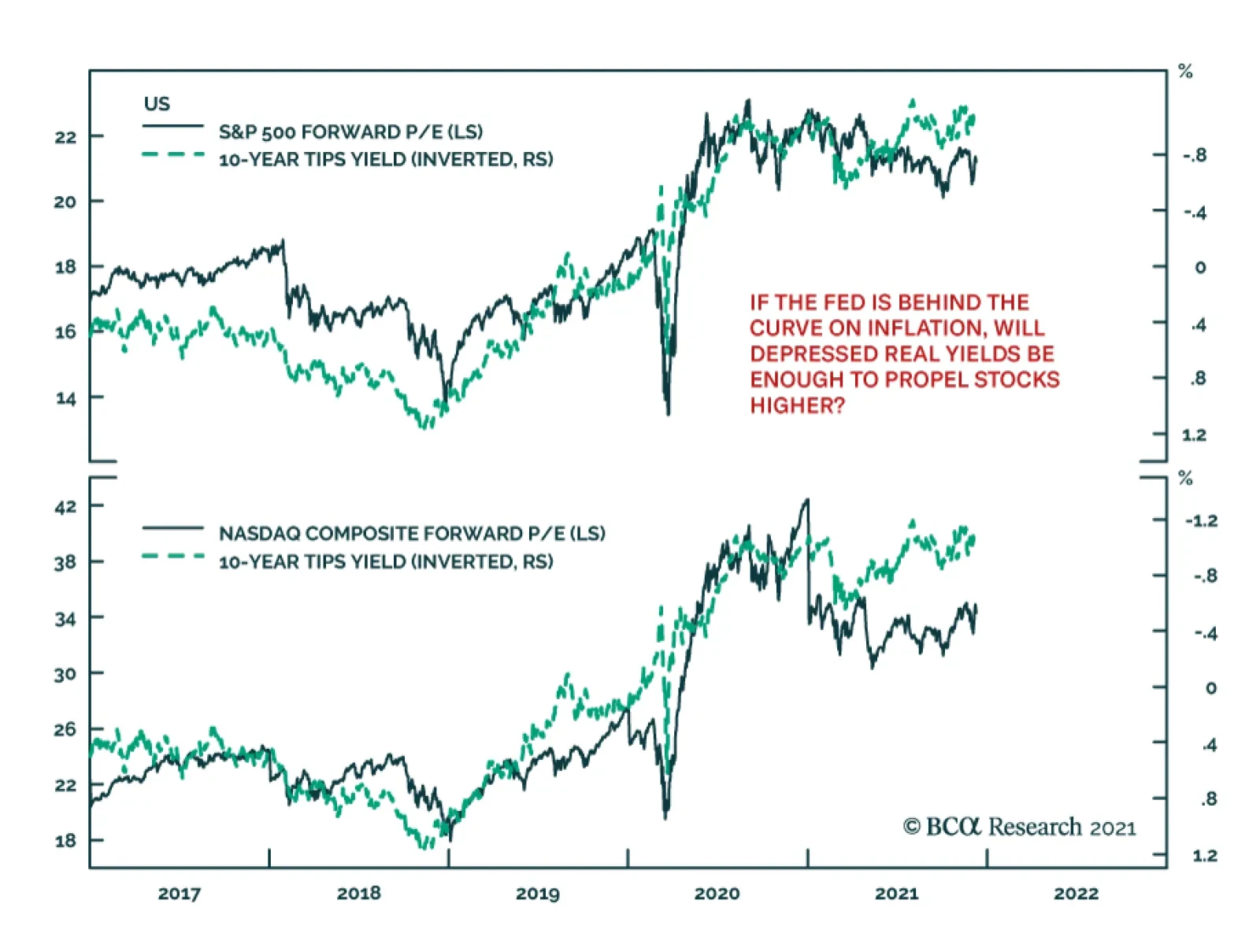
BCA Research’s base case is that while inflation is on a structural uptrend, price pressures will moderate next year before once again rising. However, there is no unanimity among BCA strategists on the near-term outlook (see The Numbers). A key risk to the…
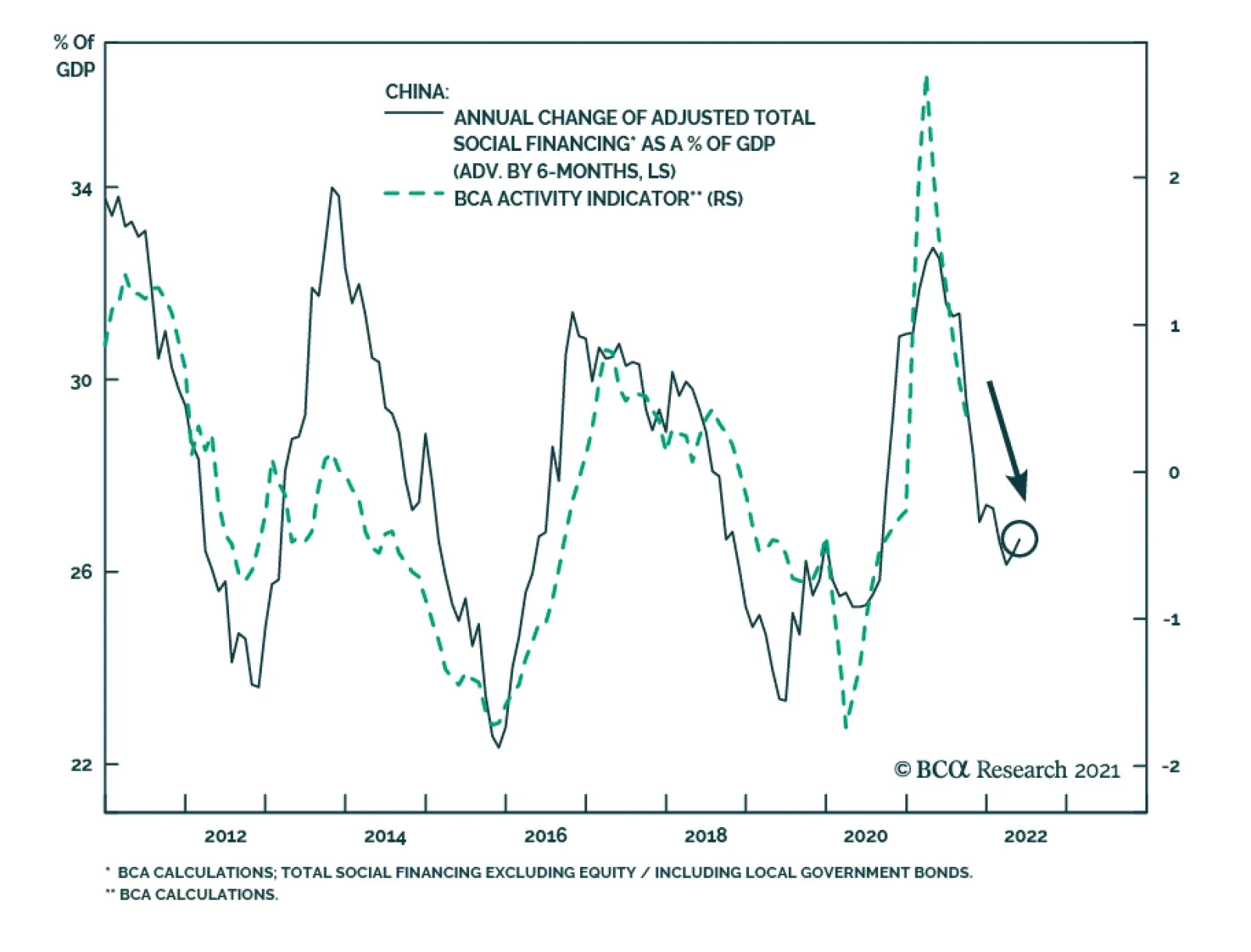
Although China’s credit data improved in November, it fell below expectations. Aggregate financing increased from CNY 1.6 trillion to CNY 2.6 trillion, slightly below the anticipated CNY 2.7 trillion. Although new yuan loans rose to CNY 1.3 trillion, they…
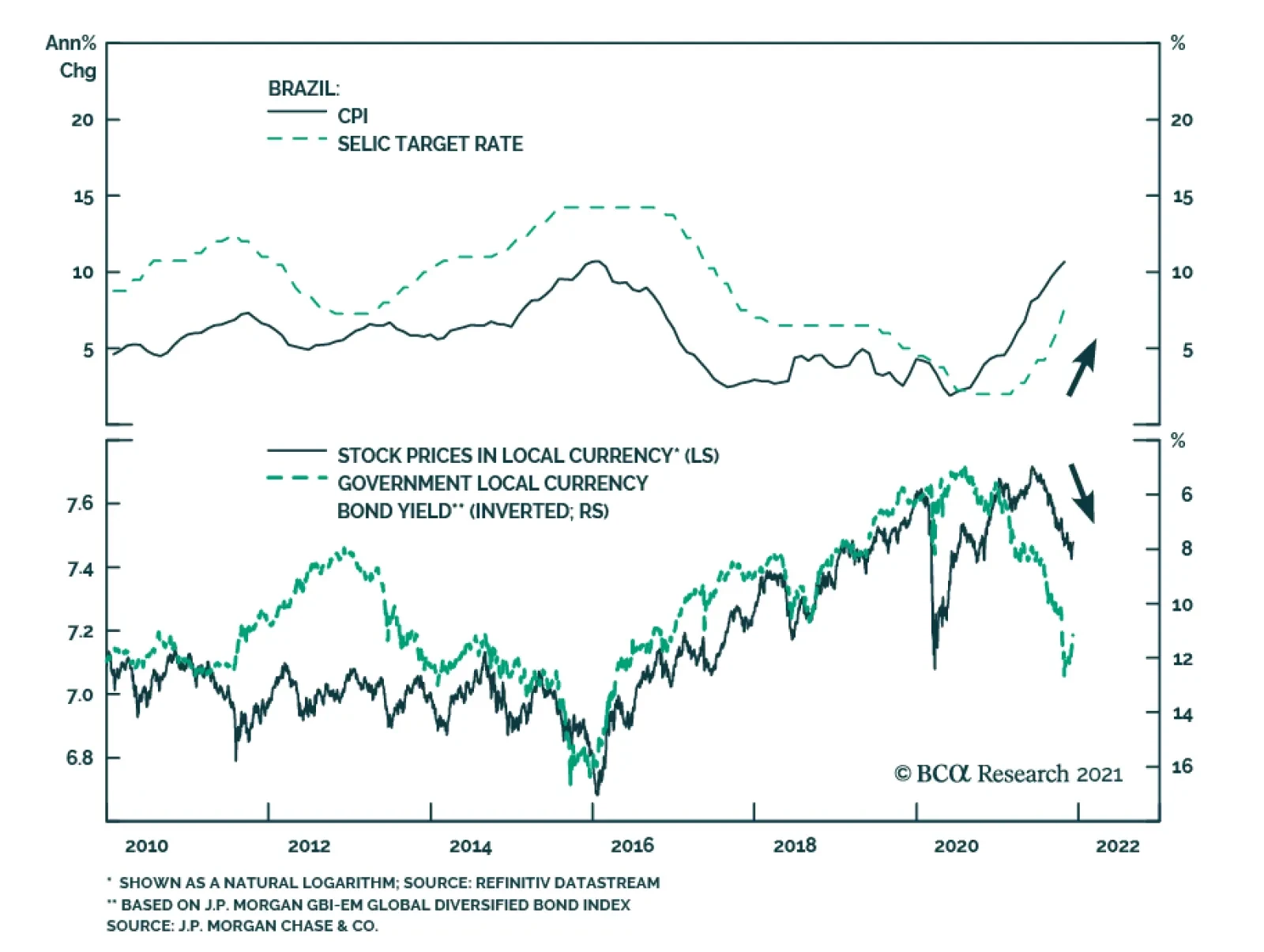
As expected, Brazil’s Central Bank lifted the benchmark Selic rate by 150 bps to 9.25% on Wednesday. This move brings the total increase since the beginning of the year to 725 bps. Policymakers also signaled that another rate hike is likely at its next policy…
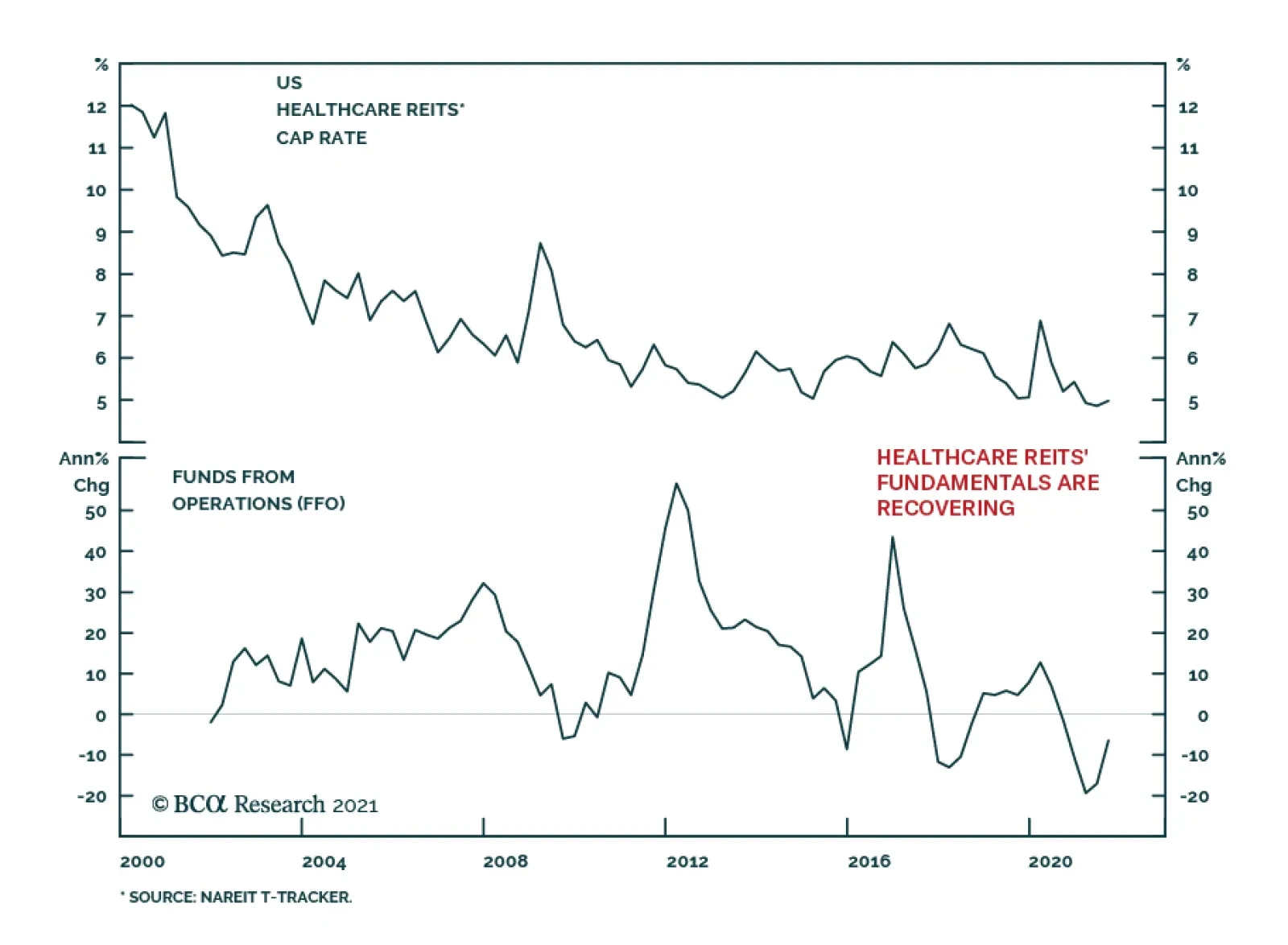
According to BCA Research’s Global Asset Allocation service, there is a structural long-term case to favor REITs within the healthcare sector. The real estate market is diverse. Each sector is driven by different dynamics, reacts differently to the…
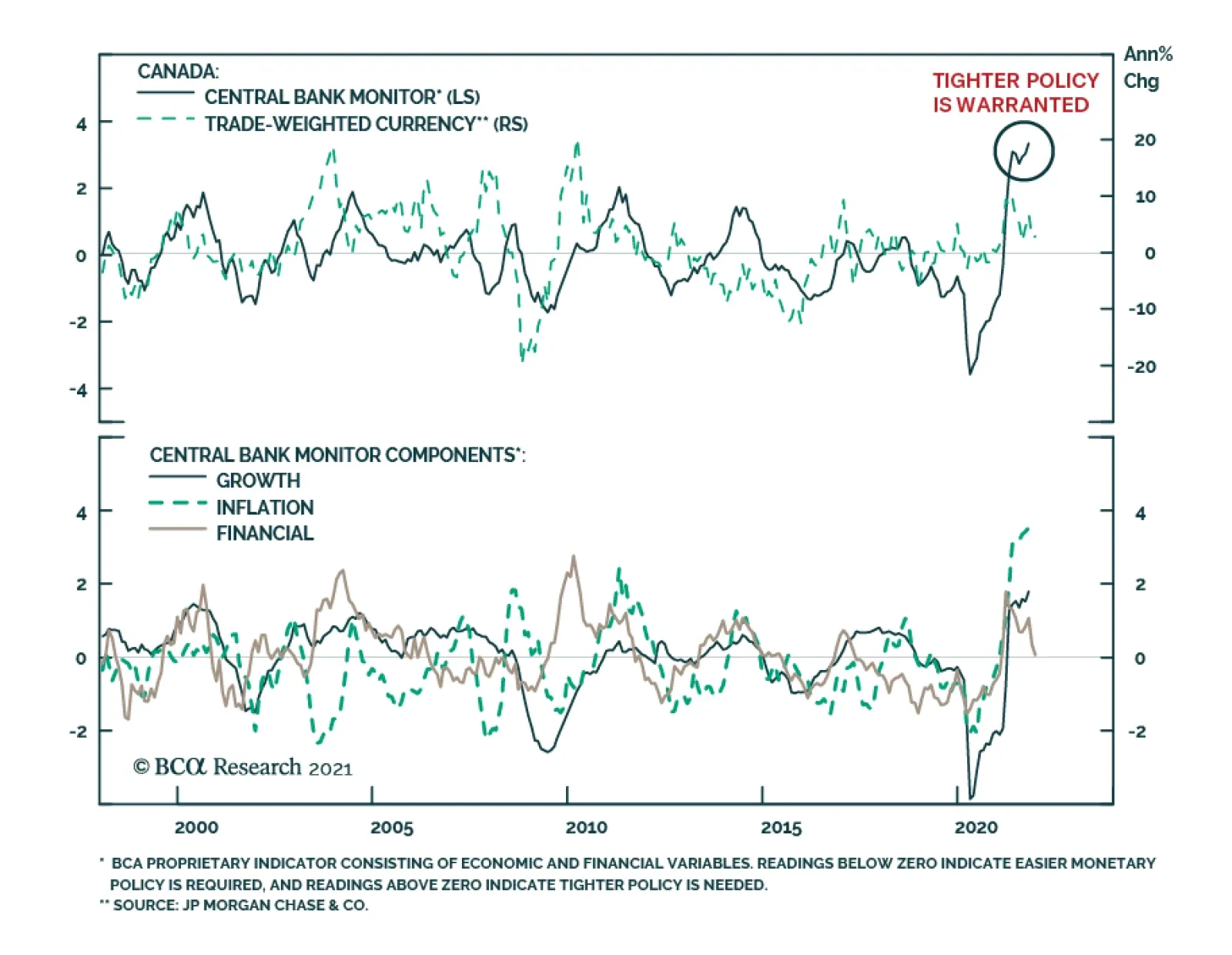
As expected, the Bank of Canada kept interest rates unchanged at its Wednesday meeting and remains in the reinvestment phase to maintain its holdings of Canadian government bonds stable. The post-meeting statement acknowledged that omicron and oil prices…