Sorry, you need to enable JavaScript to visit this website.
Skip to main content

Financial Markets

Decelerating nominal sales, a peaking credit cycle, and very high valuations - Indian stocks will not escape the carnage when risk assets globally begin to sell off.

The SEC has just approved bitcoin spot ETFs, but does bitcoin have any ‘intrinsic’ value? In this Special Report we explain why the answer is yes, how bitcoin compares with gold, and why the bitcoin price could ultimately head well north of $100,000.

The US manufacturing renaissance, spurred on by reshoring, automation, and government spending, is running its course but progress has slowed on the back of tight monetary conditions and the manufacturing recession. The deceleration of these positive trends weighs on the outlook for the Capital Goods industry group, impeding its performance over the short term. However, we reiterate that positive long-term trends for the industry remain intact. We downgrade Capital Goods to a tactical underweight. It remains a strategic overweight.

The commodity complex struggled last year with the Goldman Sachs Commodity Index falling by 12% despite the relatively favorable performance of other cyclical financial assets. Several factors contributed to this weakness. In the case of oil, an increase in…

In this note, we preview the Q4-2023 earnings season and share what we will be watching.

The Treasury curve bull steepened meaningfully on Friday with the 2-year yield falling by nearly 11 basis points versus the 3 basis point decline in the 10-year yield. A softer than anticipated US PPI release prompted this move. The unexpected 0.1% m/m…
After a tumultuous year, our Equity Analyzer team took stock on how the BCA Score faired globally. The indices are constructed for each region by selecting the top 10% of stocks with a market-cap above 1 billion USD according to their BCA Score. All indices…

In light of the hotter-than-expected US CPI report, we look at what interest rate currency investors should focus on. Our conclusion largely keeps our existing trades in place, as published in our outlook, a few weeks ago.

The combined US credit impulse and fiscal thrust indicator will likely relapse in 2024, heralding growth weakness. Stalling US sales volume and falling inflation, combined with sticky labor costs, will herald a non-trivial profit margin compression. The recent increase in Asian exports will likely prove to be a mid-cycle improvement rather than a cyclical recovery.

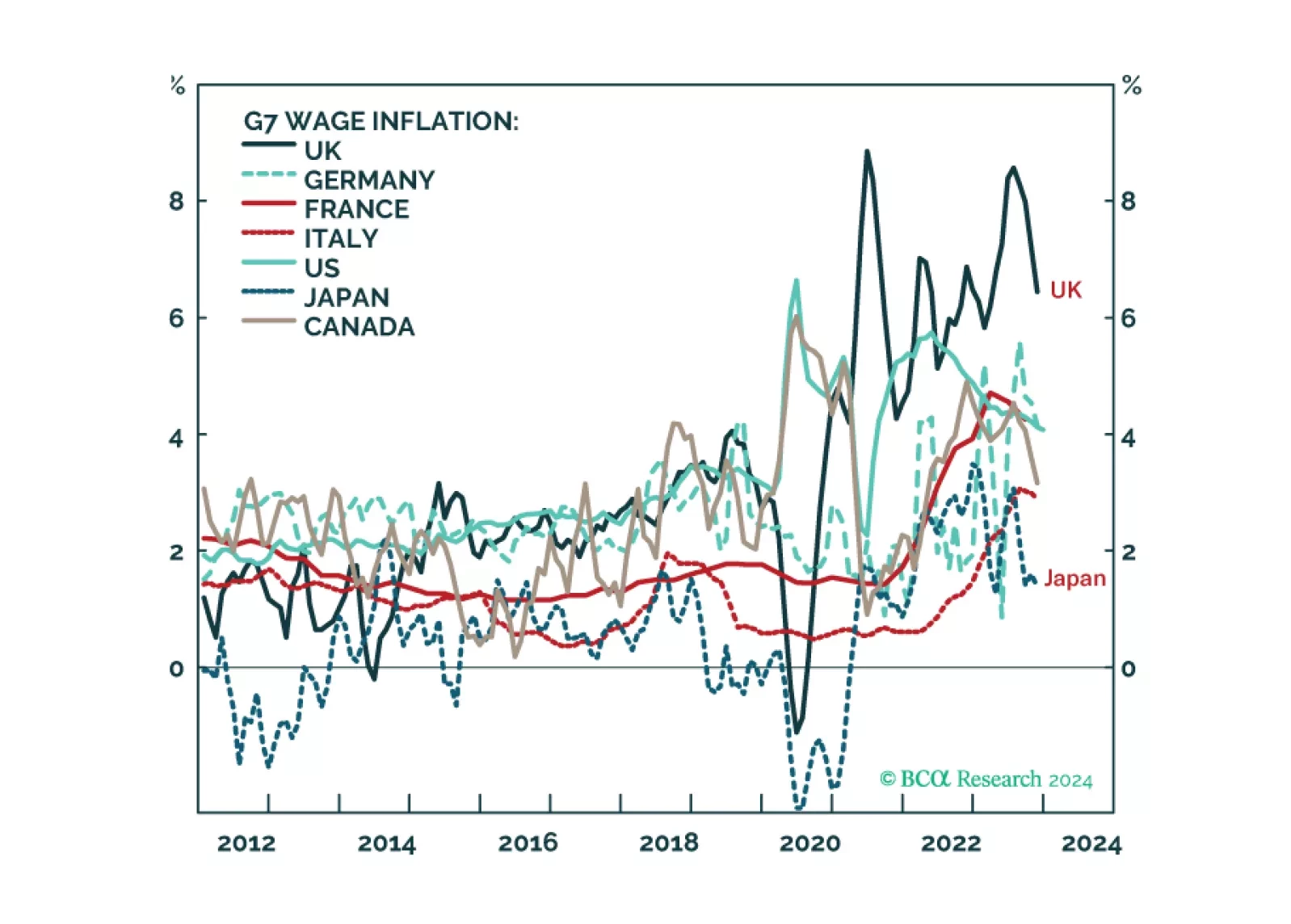
The Atlanta Fed’s US Wage Growth Tracker stalled at 5.2% in December, unchanged from November. Notably, after falling from a peak of 7.1% in June 2022, this indicator has stabilized at still-elevated levels in recent months. This dynamic raises the question…