Sorry, you need to enable JavaScript to visit this website.
Skip to main content

Hong Kong SAR

This Special Report assesses evidence of RMB’s involvement in global carry trades, examines its structural characteristics, and identifies key indicators of a potential unwind.

In this chartbook, we look at the balance of payments across DM and EM countries. The US does not fare well, but neither do a few other countries.

This week, we look at the sustainability of the HKD peg as the next whale to move markets, given what is happening to tariffs. After careful analysis, our bias is that it is here to stay. With the DXY dipping below 100, we are likely to see a rebound, which is actually bad news for the Hong Kong region of China, since it will tighten financial conditions. We have no new short-term trades, but if the peg broke, you want to be short HKD/JPY.

Cyclically-speaking, the risk of global indebtedness does not appear to be acute. There are several pockets of sizeable private sector debt risk, and it is possible that the next US/global recession will cause a more pronounced economic downturn in some of these countries. Over the next one-to-three years, these risks are likely to be idiosyncratic. With the possible exception of France’s corporate sector, private sector debt risks appear to be manageable in the US, euro area, and China, the main drivers of global economic activity. However, over the longer-term, there are several problems with global indebtedness that will eventually “come home to roost.” US government debt is now excessive, and we expect meaningful net interest pressure for the US government in three-to-four years, even if the US does not experience elevated structural inflation. In China, the government’s strong desire to avoid aggravating structural imbalances will lead to the limited and finely balanced use of fiscal and monetary policy to boost growth, which is not good news for China-related financial assets. On balance, our conclusions are generally consistent with a structural bear market in the US dollar that is likely to begin after the next US recession. It also speaks to the possible structural outperformance of euro area stocks within a global equity portfolio, and possibly a continuation of the structural bull market in gold – which would benefit mightily from the development of any fiscal risk premia in US assets. The global financial crisis of 2008-2009, as well as the subpar economic recovery that followed, demonstrated to global investors the threat posed by elevated private sector and government debt. There has been a substantial improvement in the risk of indebtedness in some sectors of some countries over the past 15 years, but the risks of excessive indebtedness have increased in other areas of the global economy. In this special report, we check in on the indebtedness risk of a list of major economies using the BIS’ credit to the nonfinancial sector database and examine whether these risks exist primarily in the household, non-financial corporate, or government sectors. We contextualize the indebtedness data from the BIS into a risk score using several risk factors (by sector and by country), based on how elevated a given sector’s risk factor is relative not only to its own history but also the history of other countries. The sector risk scores are presented on pages 24 to 29, and we present a synthesis of our analysis below.1 We conclude that, while there are limited cyclical implications of recent trends in global indebtedness, there are several problems that will eventually “come home to roost” – particularly in the US and China. This would be consistent with a structural bear market in the dollar and a long-term uptrend in the price of gold, and could point to structural euro area outperformance within a global equity portfolio. A Global Indebtedness Report Card Table II-1 presents the aggregate risk score for each country by sector that we examined in our report. Several themes are evident from Table II-1 and the tables shown on pages 24 to 29. Table II-1A Summary Of Our Debt Risk Scores By Country/Region And Sector May 2023 May 2023 Shifting Household Sector Indebtedness Risk Chart II-1Shifting Household Sector Indebtedness Shifting Household Sector Indebtedness Shifting Household Sector Indebtedness The risk of household sector indebtedness has rotated from countries like the US and Spain to several other countries/regions, including Hong Kong SAR, Australia, Canada, and Sweden (Chart II-1). These are relatively smaller countries/regions and thus theoretically pose less of a risk to global financial stability than excessive household sector debt in the US and select euro area economies did in 2008. Mainland China remains one important wildcard for investors to watch. Ostensibly, the risk of China’s household sector indebtedness is only moderate according to our risk score methodology, given that its household debt-to-GDP ratio is lower than in many other countries. However, it has grown at a very significant rate over the past decade. In addition, household disposable income is lower as a share of GDP in China than in most advanced economies, and China’s housing sector has experienced a significant shock over the past two years. The fact that interest rates in China are likely to remain comparatively low versus the pace of economic growth, and that China’s property market is stabilizing, suggest that a major debt crisis in China’s household sector is unlikely over the coming year. The recent property market crisis, however, serves as a reminder of the potential structural vulnerability posed by Chinese household sector debt, which would almost certainly cause a global recession were a major deleveraging event to occur. Chart II-2Elevated Corporate Sector Indebtedness In Hong Kong SAR, China, Sweden, And France Elevated Corporate Sector Indebtedness In Hong Kong SAR, China, Sweden, And France Elevated Corporate Sector Indebtedness In Hong Kong SAR, China, Sweden, And France Some Surprises From The Trend In Corporate Debt Some countries with elevated nonfinancial corporate sector debt risk scores will not be surprising to investors. Chart II-2 highlights that Hong Kong's corporate sector indebtedness is massive and that mainland China's nonfinancial corporate sector debt risk is also very elevated. Mainland China's corporate sector debt risk is concentrated in state-owned enterprises, reflecting the significant quasi-fiscal spending (mainly in the form of infrastructure investment) that has occurred over the past decade in support of economic stability. However, Sweden and France also have very elevated nonfinancial corporate sector debt risk, whose corporate sector scores closely mirror their risk scores from the shadow banking sector. “Shadow credit” references credit that is not provided by domestic banks. A rise in shadow credit appears to be the source of the increase in nonfinancial corporate sector indebtedness in both Sweden and France. Shadow credit poses a risk to financial stability because credit availability from nonbank entities could tighten rapidly in a crisis; it thus points to potentially outsized economic weakness in Sweden and France in a bad economic scenario. Based on the IMF’s stress test results, we continue to regard Sweden’s nonfinancial private sector as one of the riskiest in the developed world. Real Long-Term Risks From US Government Indebtedness Investor concerns about the rise in US government debt have prevailed for over a decade following the surge in the debt-to-GDP ratio that occurred following the global financial crisis. However, with interest rates having fallen to extremely low levels during the last economic expansion, the debt servicing burden of US government debt was minimal. The COVID-19 pandemic changed that reality in two ways. First, the fiscal response to the pandemic resulted in another surge in the debt-to-GDP ratio. Second, the surge in inflation that occurred in the latter half of the pandemic has caused both short-term interest rates and expectations for future interest rates to rise. We expect interest rates to fall meaningfully during the next US recession, so a US government debt crisis is not imminent. However, we doubt that the fed funds rate over the coming decade will be as low as it has been over the past ten years. Higher average interest rates point to net interest costs exceeding their early-1990s levels later this decade (Chart II-3), which could cause financial market participants to force fiscal adjustment via a crisis. Chart II-3The US Will Likely Face A Fiscal Reckoning By The End Of The Decade The US Will Likely Face A Fiscal Reckoning By The End Of The Decade The US Will Likely Face A Fiscal Reckoning By The End Of The Decade The US is not the only country with elevated government debt risks. China, the euro area (excluding Germany) and the UK also rank highly according to our aggregate risk score methodology, as does Canada – although this reflects our use of gross rather than net debt to facilitate international comparability (see page 27 for details). The recent mini fiscal crisis in the UK is a preview of what may occur in the US and other countries on a grander scale in three-to-four years, given our view that the next US recession is likely to be mild and that the neutral rate of interest in the US and euro area is not as low as many investors believed prior to the pandemic. China’s relatively elevated government debt risk score reflects a significant rise in local rather than central government debt over the past decade, but that too carries risks for China’s economy given the way Chinese economic policy is carried out. Admittedly, these risks are much more likely to pertain to the risk of economic stagnation rather than an acute crisis. The Presence of Fiscal Space As A Buffer Against Private Sector Indebtedness In several of the countries identified with excessive indebtedness, the debt is concentrated in either the private nonfinancial or the government sector. For example, in the case of Sweden, its very concerning private sector debt load is somewhat offset by a very low government debt risk score, suggesting the presence of fiscal space in Sweden that could allow its government to respond to any private sector deleveraging event. However, in a few countries/regions, debt appears to be elevated in both the private and public sector: chiefly in Hong Kong, mainland China, and France (Chart II-4). France is a core member of the euro area; a corporate sector debt crisis in France would have a meaningful impact on European economic activity, but China’s very sizeable debt load is obviously more concerning given the importance of China as one of the three pillars of the global economy. Chart II-4Less Fiscal Space In Hong Kong SAR And Mainland China Than Before Less Fiscal Space In Hong Kong SAR And Mainland China Than Before Less Fiscal Space In Hong Kong SAR And Mainland China Than Before Investment Conclusions There are no real cyclical investment conclusions to be drawn from our analysis of global indebtedness. There are several pockets of sizeable private sector debt risk, and it is possible that the next US/global recession will cause a more pronounced economic downturn in some of these countries. However, with the possible exception of France’s corporate sector, private sector debt risks appear to be manageable in the US, euro area, and China, the main drivers of global economic activity. China’s nonfinancial corporate sector is indeed extremely leveraged, but much of this debt resides on the balance sheet of state-owned enterprises and thus is unlikely to pose a cyclical economic risk due to government support – especially given recent incremental easing in China. Tight monetary policy in the US and euro area is a much more proximate risk to the business cycle and, as described in Section I of our report, we expect a recession in the US to begin at some point over the coming six-to-twelve months. However, our analysis of global indebtedness highlights several problems that will eventually “come home to roost”. US government debt is now excessive. The likely future path for interest rates implies meaningful net interest pressure on the government in three-to-four years, even if the US does not experience elevated structural inflation. And in China, the government’s strong desire to avoid aggravating structural imbalances will lead to the limited and finely balanced use of fiscal and monetary policy to boost growth. As we noted in last month’s report,2 that is not good news for China-related financial assets, as it implies that Chinese policymakers will remain reactive and that China will become a more insular economy with even broader state influence or control. The Xi administration’s paradigm shift implies a very different China than many investors became accustomed to between 2008 and 2014, and one that is far less likely to stimulate global economic growth. In short, this is not, and likely will not be, the China that you have been hoping for. On balance, these conclusions are generally consistent with a structural bear market in the US dollar that is likely to begin following the next US recession. It also speaks to the possible structural outperformance of euro area stocks within a global equity portfolio, and possibly a continuation of a structural bull market in gold – which would benefit mightily from the development of any fiscal risk premia in US assets. Finally, once the next US administration is in place and a new high in the servicing costs of US government debt is within sight, investors should structurally monitor the spread between 10- and 30-year US Treasury yields for signs of an abnormally steep curve. An aggressive shift into short-duration positions will be warranted in response to any true signs of a budding fiscal crisis in the US. Jonathan LaBerge, CFA Vice President The Bank Credit Analyst Private Nonfinancial Sector The countries/regions most at risk from elevated private non-financial sector debt are Hong Kong SAR, Sweden, mainland China, France, Canada, and the Netherlands (Table II-2). Across all of the metrics shown in Table II-2 that measure the risk of indebtedness, Hong Kong consistently ranks as the riskiest market. This is particularly true based on debt service measures, which show an extremely large amount of income “lost” to repaying debt. Unlike the case of mainland China, Hong Kong’s sharp rise in private sector indebtedness over the past two decades (and especially since 2009) has not occurred due to government efforts to stabilize economic activity. Hong Kong’s pegged exchange rate effectively imports US monetary policy, which has been extraordinarily easy since the global financial crisis – particularly for an economy that did not suffer the same shock to household balance sheets that occurred in the US. The source of the risk from Sweden’s indebtedness is somewhat different than is the case in Hong Kong. Sweden’s private sector debt-to-GDP level is meaningfully below Hong Kong’s, although that is mainly indicative of how extreme the latter is. More importantly, the pace of leveraging in Sweden’s private sector indebtedness has been somewhat slower than in Hong Kong and indeed a few other countries/regions (such as Japan, France, and mainland China); it ranks third after Canada based on the first of our two debt service proxies. However, based on our second DSR that uses a measure of equilibrium interest rates, Sweden appears to be much riskier. Table II-2High Private Nonfinancial Sector Debt Risk In Hong Kong SAR, Sweden, China, France, And Canada May 2023 May 2023 The Household Sector The countries/regions most at risk from elevated household sector debt are Hong Kong SAR, Australia, Canada, Sweden, and the Netherlands (Table II-3). Relative to Hong Kong’s total private sector debt, the household sector is not the dominant contributor. When compared across countries/regions, however, Hong Kong’s household sector debt-to-GDP ratio is among the most extreme. Australia, Canada, and the Netherlands rank worse than Hong Kong in terms of household sector debt-to-GDP, but both economies have recently seen meaningfully slower household debt growth than has occurred in Hong Kong. Aside from the Netherlands, euro area economies rank quite low on the list of household sector indebtedness risk and nontrivially lower than in the UK. The risk of indebtedness posed by the household sector in mainland China may be understated in Table II-3. This is because China’s household disposable income is smaller as a share of GDP than most of the other countries/regions shown in the table, which causes artificially lower debt ratios when scaled relative to GDP. Relative to developed market economies, Chinese interest rates are meaningfully below the prevailing pace of income or GDP growth, so we still suspect that China’s household sector debt service ratio is not extremely high. Investors should acknowledge, however, that the risk posed by China’s household sector leverage is probably larger than conventional debt-to-GDP measures would indicate. Table II-3High Household Debt Risk In Hong Kong SAR, Australia, Canada, Sweden, And The Netherlands May 2023 May 2023 The Nonfinancial Corporate Sector The countries/regions most at risk from elevated nonfinancial corporate sector debt are Hong Kong SAR, Sweden, France, mainland China, and Canada (Table II-4). Unlike in mainland China, where most nonfinancial corporate sector debt is held on the balance sheets of state-owned enterprises, Hong Kong’s corporate debt does not have the same defacto state backing and is enormously concentrated in the real estate and financial sectors. Hong Kong’s real estate sector does enjoy significant structural policy support from the government. It is also true that the region has been highly indebted for some time. But Table II-4 highlights that Hong Kong’s nonfinancial corporate sector is massively leveraged and is thus vulnerable to a permanent rise in US policy rates and/or a property market crisis in the region. Commercial Real Estate (CRE) debt constitutes a large portion of Sweden’s corporate debt. IMF stress tests of Sweden’s CRE sector show that the median interest rate coverage would drop below one in a severe scenario, resulting in 75% of firms with debt-at-risk.3 We continue to regard Sweden’s nonfinancial private sector as one of the riskiest in the developed world. France ranks surprisingly high on the list of nonfinancial corporate sector indebtedness, the result of an M&A boom in the years prior to the COVID-19 pandemic. Our debt service ratio calculations suggest that the servicing burden of this debt may be lower than the BIS’ DSR would suggest, but it is still elevated even based on our measures. This suggests that the French nonfinancial corporate sector should be closely watched over the coming year, especially if the ECB were to keep its policy rate in restrictive territory. Table II-4High Corporate Sector Debt Risk In Hong Kong SAR, Sweden, France, China, And Canada May 2023 May 2023 The Government Sector The countries/regions most at risk from elevated government sector debt based on the BIS’ gross government debt data are Italy, the US, Canada, the UK, and Spain (Table II-5). If Canada were removed from the list, China would be the fifth most vulnerable country according to our methodology. We show gross debt-to-GDP in Table II-5 because of the lack of reliable net debt measures for China, but gross debt measures have many drawbacks. Canada is an example, as its gross debt-to-GDP ratio suffers from two international comparability problems. First, Canadian general government debt statistics include sizeable accounts payable (20% of GDP). In addition, the Canadian government holds significant financial assets; Canada’s net debt is very low compared to other developed economies. The gross/net debt issue also impacts the government indebtedness risk score for Japan, although Japan’s net government debt is still extremely elevated (160% of GDP). Very elevated debt levels in Italy, especially in net debt terms, underscore why the effective neutral rate of interest is likely lower in the euro area than would be the case if the euro area was one political and economic entity. The extraordinary US fiscal response to the COVID-19 pandemic underscores that the US will likely face a fiscal reckoning in the latter half of the decade as net interest costs eventually exceed their early-1990 levels. It is impossible to come up with a precise estimate of when the US will face market pressure for fiscal reform, but our best guess is that it will occur at the tail end of the next US administration. Table II-5High Government Debt Risk In Italy, The US, The UK, And Spain May 2023 May 2023 The Total Nonfinancial Sector (Private Plus Government) The countries/regions most at risk from total nonfinancial sector debt (private plus government) are Hong Kong SAR, mainland China, Sweden, Canada, and France (Table II-6). As noted above, Canada’s rank in Table II-6 is likely overstated due to the country’s much lower net debt ratio, although it would still rank relatively high given very elevated private nonfinancial sector debt. We agree that private sector debt is typically more of an economic risk than public sector debt. It is important to examine total debt, however, as it reflects the combined risk of a private sector deleveraging event that the government of that country will struggle to respond to because of a lack of fiscal space. The fact that Hong Kong and mainland China top this list underscores the risk of long-term economic stagnation in the region, and partially explains why the Xi administration is focused on improving China’s financial resiliency. Sweden’s government debt risk score is extremely low, but the country’s very elevated private nonfinancial sector debt is large enough for total nonfinancial sector debt to show up at an elevated level (similar to Canada). France’s comparatively high levels of government debt, even when measured in net debt terms, underscore the economic risks to the country were its highly leveraged nonfinancial corporate sector to experience a crisis following a period of meaningfully tight euro area monetary policy. Table II-6High Total Debt Risk In Hong Kong SAR, China, Sweden, Canada, And France May 2023 May 2023 Non-Domestic Bank Credit To The Private Nonfinancial Sector The countries/regions most at risk from excessive non-domestic bank credit (“shadow banking”) are Sweden, Hong Kong SAR, France, Japan, and Canada (Table II-7). The risk posed by shadow credit is that debt provided by non-bank entities is very rarely amortized, meaning that it needs to be periodically rolled over. The other risk is that lending standards or credit availability from these entities is more discretionary than is the case for banks and thus could tighten rapidly during a crisis. Combined with non-amortized loans/bonds that need to be rolled over, high levels of credit provided by the “shadow banking” sector could result in larger or more frequent credit “crunches.” Generally speaking, the list of countries with high shadow banking risk matches those that show up as high risk for the private nonfinancial sector. Japan is an exception. Global investors should be attuned to any potential credit availability issues that arise in Japan should JGB yields eventually rise, potentially in response to the end of the BOJ’s yield curve control policy. Table II-7High Shadow Bank Risk In Sweden, Hong Kong SAR, France, Japan, And Canada May 2023 May 2023 Appendix: Debt Risk Measures Our debt risk score tables present five measures of debt risk for three individual sectors and two aggregate sectors over fourteen countries/regions. The five sectors include: Households Nonfinancial corporations Government The private nonfinancial sector (aggregate of households and nonfinancial corporations) The total nonfinancial sector (aggregate of households, nonfinancial corporations, and the government) We also examine the private nonfinancial sector focusing on debt that is not provided by domestic banks (“shadow banking”). Our methodology scales each measure of debt vulnerability for each country across the matrix of histories of all fourteen[1] countries/regions for that debt vulnerability measure using a percentile rank. In that way, we compare each country’s measure to a range of country histories, rather than only its own history. We scale these measures as scores from 0 (best / lest vulnerable) to 10 (worst / most vulnerable) and present the most recent observations in the tables included in this report. Our five measures include: The BIS[2] Credit-to-GDP Ratio: Ratio of total credit provided to the sector to GDP The BIS Debt Service Ratio: Ratio of debt payment estimate to gross disposable income (GDI). This measure is not available for the government sector, the overall nonfinancial sector, as well as for nonfinancial corporations for China and Hong Kong SAR. The BCA Credit-to-GDP Gap: Measure of Credit-to-GDP relative to its 10-year moving average The BCA Debt Service Ratio (Proxy 1): Ratio of debt payment estimate 1 to gross domestic product (GDP) The BCA Debt Service Ratio (Proxy 2): Ratio of debt payment estimate 2 to gross domestic product (GDP) We also include an Aggregate Debt Risk Score, which aggregates the scores of all debt vulnerability measures available by sector for each country using an equal weight approach. Our BCA Debt Service Ratios are calculated in the following manner: We estimate principal payment schedules of 18 years for households and of 10 years for nonfinancial corporations. We then estimate a principal payment component of the total debt payment by dividing the stock of debt by the debt maturity. We do not consider a principal payment in cases where debt is exclusively not amortized, such as government debt. We then compute the measure of debt interest payment by multiplying the overall stock of debt by an interest rate proxy. For our DSR proxy 1, we use the 10-year government bond yield as a measure of effective interest rate plus a spread of 1.75% for household sector debt and 1% for nonfinancial corporate sector debt. One exception applies to Hong Kong SAR, where we use US 10-year Treasury yields given Hong Kong’s pegged exchange rate. For our DSR proxy 2, we use an estimate of the equilibrium interest rate instead of 10-year government bond yields with the same household/corporate sector spread estimates. Our estimate considers the median 10-year nominal GDP growth rate as the equilibrium interest rate, with exceptions for euro area members, Hong Kong SAR, and mainland China. For euro area economies, we use euro area GDP rather than the individual country GDPs due to the commonality of monetary policy. For Hong Kong SAR we use US GDP rather than Hong Kong GDP given its pegged exchange rate and its importation of US monetary policy. For mainland China we use half of the estimated equilibrium interest rate, given that China has consistently maintained a large gap between domestic interest rates and the prevailing rate of nominal GDP growth. We then add the interest payment estimate to the principal payment estimate (when applicable) to obtain total debt payment. We then express these debt payments as a percent of GDP. Gabriel Di Lullo Research Analyst   Footnotes 1 Please see the appendix on pages 30 and 31 for a description of our debt score methodology. 2 Please see The Bank Credit Analyst "April 2023," dated March 30, 2023, available at bca.bcaresearch.com 3 Sweden’s Corporate Vulnerabilities: A Focus on Commercial Real Estate, IMF Working Paper, Selected Issues Paper No. 2023/024, March 21, 2023
The HK dollar is under an assault from rising US interest rates and a weak economy. To defend the exchange rate peg, the HKMA will continue to tighten liquidity, which will boost HK interest rates above those in the US across the entire yield curve. That will cause major damage to this economy and HK-domiciled companies' stocks. Downgrade the MSCI HK equity index within a global portfolio from neutral to underweight.

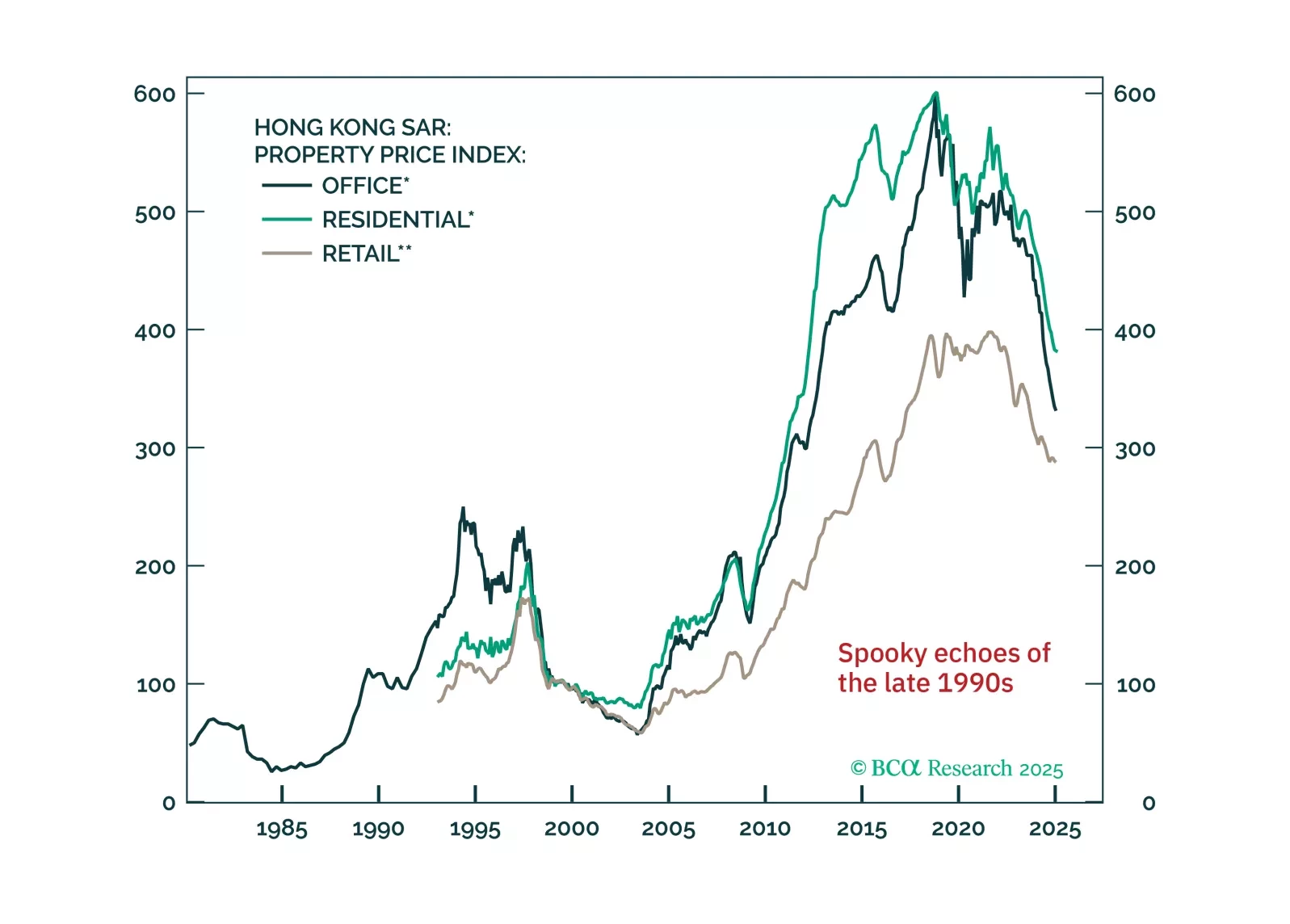
Executive Summary Liquidity Will Shrink Further In Hong Kong Liquidity Will Shrink Further In Hong Kong Liquidity Will Shrink Further In Hong Kong The HKD is facing its most critical test in several decades. While the peg is likely to survive (Feature Chart), the economic costs for Hong Kong SAR will be far reaching. Critically, monetary policy in Hong Kong SAR is being tailored behind a hawkish Fed, while economic ties with China increasingly warrant easier policy settings. This tug of war will be resolved via a reset in domestic spending and asset prices. Equity shares have been the first shoe to drop. Real estate values and consumer spending will be next. A hypothetical delinking of the peg will see the HKD depreciate since it is expensive on a real effective exchange rate basis. Longer term, the rising use of the RMB in Hong Kong SAR will render the peg a relic. It will also fit with China’s aims to internationalize the RMB. Bottom Line: The HKD peg is likely to survive in the near term, but the economic repercussions from maintaining the linked exchange-rate system will trigger a rethinking by the Hong Kong Monetary Authority (HKMA) and mainland authorities. Eventually, HKD could be replaced by the CNY. For now, HKD interest rates are slated to rise further, which will have ramifications for domestic spending and asset prices. Feature Chart 1HKD Has Been Tracking Interest Rates HKD Has Been Tracking Interest Rates HKD Has Been Tracking Interest Rates The Hong Kong dollar (HKD) has been trading on the weak side of its convertibility band since May. In theory, this suggests there is intense pressure for the peg to be delinked, which should lead to a much weaker exchange rate. In practice, interest rates in Hong Kong have failed to keep up with the surge in US rates, which has led to widening interest rate differentials between Hong Kong and the US. As a result, investors have embarked on a massive carry trade, funding USD purchases with HKDs (Chart 1). HKD’s weakness has raised questions about whether the exchange rate could face a crisis of confidence. This will be a severe blow to the HKMA whose sole role is currency stability, with the HKD being the underlying bedrock of Hong Kong’s financial system. In this report, we suggest that the HKD will survive this crisis, just as it has navigated previous shocks since 1983. The brunt of the adjustment will be domestic, first from Hong Kong equities, but spreading to real estate and consumer spending. Longer term, the HKD might become a relic as transactions in Hong Kong are increasingly conducted in RMB. Will The Peg Be Sustained? Historically, currency pegs more often than not fail. Specific to the HKD, the peg is facing its most critical test in decades but is likely to survive for a few reasons. First, every HKD that the region of Hong Kong has ever printed is backed by USD reserves, to the tune of 1.8 times. Quite simply, FX reserves are much higher than the Hong Kong monetary base (Chart 2). This suggests the HKMA’s “convertibility promise” remains credible. Second, Hong Kong also ranks favorably when looking at the ratio of broad money supply to FX reserves. Every 42.3 cents of broad money creation can be backed by foreign currency, a ratio much higher than China and on par with Singapore (Chart 3). With a monetary base fully backed by FX reserves and a broad money-to-FX reserve ratio largely in line with other linked exchange rate systems, our bias is that the peg will remain in place at least over a cyclical horizon (12-18 months). Chart 2In Theory, The HKMA Can Defend The Peg In Theory, The HKMA Can Defend The Peg In Theory, The HKMA Can Defend The Peg Chart 3The HKMA Ranks Favorably To The PBoC The HKMA Ranks Favorably To The PBoC The HKMA Ranks Favorably To The PBoC This credibility will come at a huge cost to the domestic economy, however. By having a fixed exchange rate system and an open capital account, Hong Kong has given up control over domestic monetary policy. Consequently, it must import monetary policy from the US. As interest rates rise in the US, demand for US dollar deposits from Hong Kong concerns goes up, putting downward pressure on the exchange rate. To maintain the convertibility ratio, the HKMA must drain the system of Hong Kong dollars to lift domestic interest rates. This is quite visible not only from the drop in foreign exchange reserves, but also the drawdown in the aggregate balance of domestic banks parked at the HKMA (Chart 4). From May 11 through August, the HKMA has absorbed a total of HKD 213 billion, shrinking the aggregate balance in the banking system by more than 60%. Chart 4Liquidity Will Shrink Further In Hong Kong Liquidity Will Shrink Further In Hong Kong Liquidity Will Shrink Further In Hong Kong Historically, the aggregate balance has had to drop much more to restore an equilibrium between interest rates in the US and Hong Kong SAR. The implication is that liquidity will continue to be drained from the system to ultimately defend the peg, and local interest rates will rise. There is one important caveat: Hong Kong SAR’s net international investment position stands at 580% of GDP, much higher than broad money supply. As such, the Hong Kong SAR does not have a solvency problem. What it faces is too much domestic liquidity, which is pushing HKD interest rates lower (Chart 5). Chart 5The HKD Is Facing A Liquidity, Rather Than A Solvency Crisis The Future Of The Hong Kong Dollar Peg The Future Of The Hong Kong Dollar Peg Ramifications Of The USD Peg When the HKD was tied to the US dollar in 1983, it made economic sense. Hong Kong SAR’s economy was more linked via trade to the US, compared to China (Chart 6). As such, stability vis-à-vis the US dollar was a vital appeal for traders, financiers, and all industries tied to the Hong Kong hub. Since then, there has been a tectonic shift in economic dependence. Exports to China now account for almost 60% of the total, while those to the US have fallen well below 8%. Quite simply, Hong Kong SAR still imports monetary policy from the US, while it is increasingly dependent on the Chinese economy. Nonetheless, there have been a few adjustments. The use of the RMB in Hong Kong SAR has been gradually gaining momentum. RMB deposits have risen to over HKD 800bn. As a share of narrow money supply (M1), it is almost 50% (Chart 7). There are also over 140 licensed banks in Hong Kong allowed to engage in RMB-based business. Chart 6Hong Kong And China Are Tied To The Hip Hong Kong And China Are Tied To The Hip Hong Kong And China Are Tied To The Hip Chart 7Hong Kong Is Transitioning Into A Defacto RMB System Hong Kong Is Transitioning Into A Defacto RMB System Hong Kong Is Transitioning Into A Defacto RMB System These links extend beyond just banking turnover. First introduced in 2014, the southbound trading links between China and Hong Kong SAR have become a major conduit for mainland investors to gain exposure to foreign firms. The China-Hong Kong stock connect has now handled over 2.6tn RMB in cumulative flows. This represented as high as 40% of the equity turnover in Hong Kong SAR (Chart 8). Capital account transactions have also been progressively relaxed, and the issuance of RMB bonds has been rising rapidly since 2008. Chart 8Lots Of Financial Links Between The HKD and RMB Lots Of Financial Links Between The HKD and RMB Lots Of Financial Links Between The HKD and RMB Hong Kong SAR’s strengthening ties with China comes with some good news. The increase in Chinese domestic liquidity is lowering the cost of capital for local enterprises. At the same time, it might also be fuelling very low domestic interest rates, forcing locals to chase higher rates elsewhere. This does not affect the peg if people sell the RMB to buy other currencies, including the dollar or maybe even the HKD. The bad news is that Hong Kong has now become a high-beta play on China as both economies are inexorably interlinked. Chart 9 shows that consumers in Hong Kong SAR tend to have much more volatile spending patterns compared to China, especially when economic growth is about to slow. One reason is that Hong Kong concerns are highly levered notably to the property market (Chart 10). For example, the debt service ratio in Hong Kong SAR sits at 32% of disposable income, much higher than China or other indebted economies (Chart 11). This makes the economy very vulnerable to rising interest rates. Chart 9Hong Kong Is Economically More Volatile Than China Hong Kong Is Economically More Volatile Than China Hong Kong Is Economically More Volatile Than China Chart 10Hong Kong Cannot Escape A Hard Landing (Part 1) Property Prices In Hong Kong Will Drop Property Prices In Hong Kong Will Drop Chart 11Hong Kong Cannot Escape A Hard Landing (Part 2) Hong Kong Cannot Escape A Hard Landing (Part 2) Hong Kong Cannot Escape A Hard Landing (Part 2) The bottom line is that as the HKMA withdraws domestic liquidity, this will reassert downward pressure on business activity and asset prices, particularly real estate. With private consumption a whopping 65% of GDP, household deleveraging will also prove to be a formidable headwind for domestic spending. Outside interest rates, Hong Kong SAR remains a trade hub. If global trade slows down meaningfully, this will lead to a deterioration in the current account. This triple whammy from slowing global trade, rising interest rates and consumer deleveraging could prove indigestible for Hong Kong assets. Policy Options Chart 12The Government Could Bail Out Hong Kong The Government Could Bail Out Hong Kong The Government Could Bail Out Hong Kong As highlighted above, the HKD peg will remain in place for the foreseeable future, but this will come at a huge cost. The advantage of the HKD peg is that the choice of the nominal anchor, the US dollar, renders it credible. As a financial hub, this is crucial for Hong Kong. Meanwhile, such an anchor also imposes fiscal discipline since government deficits cannot be monetized by money printing. In the case where the government tries to be profligate, the rise in inflation will lower real rates and lead to capital outflows. This will force the HKMA to sell US dollars and absorb local currency. Indeed, over the past several years, government debt in Hong Kong has been close to nil (Chart 12). The drawback of a fixed exchange-rate regime is that Hong Kong SAR has relinquished control over independent monetary policy. Such a union was justified when the economic cycles between the US and Hong Kong SAR were in sync, but now the region needs easier policy settings. The roadmap of the late 1990s could be what is in store for Hong Kong SAR. In short, the peg survived but the region went through a severe internal devaluation. During the Asian crisis, property prices fell by more than 60%. If that were to occur today, it would herald a prolonged period of high unemployment and stagnant wages to realign the region’s competitiveness with its trading partners. Hong Kong SAR stocks have already borne the brunt of an internal adjustment and are trading at very cheap multiples (Chart 13). The MSCI Hong Kong stock index is composed of mostly financials (47% of market cap) and property stocks (21% of market cap). As HKD rates are rising, loan growth in Hong Kong SAR is contracting and net interest margins have collapsed (Chart 14). This does not bode well for the near-term performance of financials. Chart 13Markets Have Already Discounted A Pessimistic Scenario For Hong Kong Shares Markets Have Already Discounted A Pessimistic Scenario For Hong Kong Shares Markets Have Already Discounted A Pessimistic Scenario For Hong Kong Shares Chart 14Banks In Hong Kong Are Facing A Tough ##br##Reckoning Banks In Hong Kong Are Facing A Tough Reckoning Banks In Hong Kong Are Facing A Tough Reckoning The good news is that similar to the late 1990s, banks are unlikely to go bust. Hong Kong SAR banks are well capitalized and delinquency rates are quite low, suggesting a banking crisis is unlikely to be a source of pain for the HKD peg (Chart 15). In fact, Hong Kong SAR banks rank favorably among their global peers in terms of capital adequacy (Chart 16). Chart 15Banks In Hong Kong Are Well Capitalized (Part 1) Banks In Hong Kong Are Well Capitalized (Part 1) Banks In Hong Kong Are Well Capitalized (Part 1) Chart 16Banks In Hong Kong Are Well Capitalized (Part 2) The Future Of The Hong Kong Dollar Peg The Future Of The Hong Kong Dollar Peg Specific to the currency, Hong Kong is also running recurring current account surpluses. This is boosting its FX reserves (Chart 17). That lends credibility to the peg in the near term. The bad news is that as the domestic economy slows down, and global trade comes close to a standstill, these surpluses could evaporate. One cost to Hong Kong is that the peg to the US dollar has made HKD incrementally expensive. Our model shows that the real effective exchange for HKD is about 2.5 standard deviations above fair value (Chart 18). Our view on the US dollar is that we could see depreciation over a 12-to-18-month horizon, but an overshoot in the near term is quite likely. A drop in the US dollar will help realign competitiveness in the HKD. Meantime, the market has also been pushing the currency towards the weaker side of its convertibility band. Chart 17Balance Of Payments Remain Favorable For The HKD Balance Of Payments Remain Favorable For The HKD Balance Of Payments Remain Favorable For The HKD Chart 18The HKD Is Expensive The HKD Is Expensive The HKD Is Expensive Longer term, as Hong Kong SAR continues to become more entwined with China, a peg to the CNY will make sense. This process will be the initial step in the region’s official embrace of the RMB system. That said, the process will be gradual since the US dollar remains very much a reserve currency, and the relevance of Hong Kong SAR as a financial center hinges upon easy access to the USD. What is more likely is that any re-pegging to the RMB will come many years down the road, when the yuan has become a fully convertible currency. The de-pegging of the HKD from the USD or adjusting the peg is as much a political discussion as an economic one. Political conditions for this change are not yet present given such a change will have major ramifications for the economy of Hong Kong SAR and will likely also reverberate through financial asset prices. One can imagine a scenario where HKD yields are forced to adjust to a new nominal anchor. Investors have been convinced through almost 30 years of history to treat the HKD as a proxy for the US dollar. That said, the economic pain associated with maintaining the HKD-USD peg will ensure authorities accelerate the use of RMBs in Hong Kong, with a goal of eventually adopting the yuan as the de facto currency. Adopting  a currency board akin to Singapore is another option that makes sense, especially since this would give the HKMA scope to link to cheaper currencies, such as the yen and euro. That said, this is unlikely to be politically palatable, especially for Beijing. A link to the yuan that already does this job makes sense. Finally, there is always the option to fully float the peg, but this would probably increase currency volatility. This is unlikely in the near term. The Goldilocks scenario for policymakers is when the US dollar eventually depreciates against major currencies, easing financial conditions for Hong Kong SAR concerns. This will dovetail nicely with the goals of the monetary authorities, maintain credibility while easing financial concerns for a very levered economy. Investment Conclusions The HKD peg will remain in place, but the financial dislocations will lead to significant internal devaluation in Hong Kong SAR. As US interest rates rise, the HKD will be under considerable pressure. The HKMA will have no choice but to allow HKD interest rates to rise. This will tip the property market and thrust the economy into deflation and a recession. Chinese bonds are the best hedge against this risk. Avoid property and financial shares for the time being. Were the peg to break today, the HKD will depreciate according to our valuation models. This suggests markets are right to push the HKD-linked rate towards the weaker end of the convertibility band. Despite the economic and financial pain, the HKMA will not abandon the peg. That means carry trades will continue to make money. Using the HKD as a funding currency still makes sense in the near term. In long run, the economic pain associated with maintaining the HKD-USD peg will make authorities in Beijing accelerate the use of the RMB in Hong Kong’s special administrative region. The eventual goal will be for Hong Kong SAR to adopt the yuan as its currency.   Chester Ntonifor Foreign Exchange Strategist chestern@bcaresearch.com Qingyun Xu, CFA Associate Editor  qingyunx@bcaresearch.com Trades & Forecasts Strategic View Cyclical Holdings (6-18 months) Tactical Holdings (0-6 months) Limit Orders Forecast Summary
Executive Summary Liquidity Will Shrink Further In Hong Kong Liquidity Will Shrink Further In Hong Kong Liquidity Will Shrink Further In Hong Kong The HKD is facing its most critical test in several decades. While the peg is likely to survive (Feature Chart), the economic costs for Hong Kong SAR will be far reaching. Critically, monetary policy in Hong Kong SAR is being tailored behind a hawkish Fed, while economic ties with China increasingly warrant easier policy settings. This tug of war will be resolved via a reset in domestic spending and asset prices. Equity shares have been the first shoe to drop. Real estate values and consumer spending will be next. A hypothetical delinking of the peg will see the HKD depreciate since it is expensive on a real effective exchange rate basis. Longer term, the rising use of the RMB in Hong Kong SAR will render the peg a relic. It will also fit with China’s aims to internationalize the RMB.​​​​​. Bottom Line: The HKD peg is likely to survive in the near term, but the economic repercussions from maintaining the linked exchange-rate system will trigger a rethinking by the Hong Kong Monetary Authority (HKMA) and mainland authorities. Eventually, HKD could be replaced by the CNY. For now, HKD interest rates are slated to rise further, which will have ramifications for domestic spending and asset prices. Feature Chart 1HKD Has Been Tracking Interest Rates HKD Has Been Tracking Interest Rates HKD Has Been Tracking Interest Rates The Hong Kong dollar (HKD) has been trading on the weak side of its convertibility band since May. In theory, this suggests there is intense pressure for the peg to be delinked, which should lead to a much weaker exchange rate. In practice, interest rates in Hong Kong have failed to keep up with the surge in US rates, which has led to widening interest rate differentials between Hong Kong and the US. As a result, investors have embarked on a massive carry trade, funding USD purchases with HKDs (Chart 1). HKD’s weakness has raised questions about whether the exchange rate could face a crisis of confidence. This will be a severe blow to the HKMA whose sole role is currency stability, with the HKD being the underlying bedrock of Hong Kong’s financial system. In this report, we suggest that the HKD will survive this crisis, just as it has navigated previous shocks since 1983. The brunt of the adjustment will be domestic, first from Hong Kong equities, but spreading to real estate and consumer spending. Longer term, the HKD might become a relic as transactions in Hong Kong are increasingly conducted in RMB. Will The Peg Be Sustained? Historically, currency pegs more often than not fail. Specific to the HKD, the peg is facing its most critical test in decades but is likely to survive for a few reasons. First, every HKD that the region of Hong Kong has ever printed is backed by USD reserves, to the tune of 1.8 times. Quite simply, FX reserves are much higher than the Hong Kong monetary base (Chart 2). This suggests the HKMA’s “convertibility promise” remains credible. Second, Hong Kong also ranks favorably when looking at the ratio of broad money supply to FX reserves. Every 42.3 cents of broad money creation can be backed by foreign currency, a ratio much higher than China and on par with Singapore (Chart 3). With a monetary base fully backed by FX reserves and a broad money-to-FX reserve ratio largely in line with other linked exchange rate systems, our bias is that the peg will remain in place at least over a cyclical horizon (12-18 months). Chart 2In Theory, The HKMA Can Defend The Peg In Theory, The HKMA Can Defend The Peg In Theory, The HKMA Can Defend The Peg Chart 3The HKMA Ranks Favorably To The PBoC The HKMA Ranks Favorably To The PBoC The HKMA Ranks Favorably To The PBoC This credibility will come at a huge cost to the domestic economy, however. By having a fixed exchange rate system and an open capital account, Hong Kong has given up control over domestic monetary policy. Consequently, it must import monetary policy from the US. As interest rates rise in the US, demand for US dollar deposits from Hong Kong concerns goes up, putting downward pressure on the exchange rate. To maintain the convertibility ratio, the HKMA must drain the system of Hong Kong dollars to lift domestic interest rates. This is quite visible not only from the drop in foreign exchange reserves, but also the drawdown in the aggregate balance of domestic banks parked at the HKMA (Chart 4). From May 11 through August, the HKMA has absorbed a total of HKD 213 billion, shrinking the aggregate balance in the banking system by more than 60%. Chart 4Liquidity Will Shrink Further In Hong Kong Liquidity Will Shrink Further In Hong Kong Liquidity Will Shrink Further In Hong Kong Historically, the aggregate balance has had to drop much more to restore an equilibrium between interest rates in the US and Hong Kong SAR. The implication is that liquidity will continue to be drained from the system to ultimately defend the peg, and local interest rates will rise. There is one important caveat: Hong Kong SAR’s net international investment position stands at 580% of GDP, much higher than broad money supply. As such, the Hong Kong SAR does not have a solvency problem. What it faces is too much domestic liquidity, which is pushing HKD interest rates lower (Chart 5). Chart 5The HKD Is Facing A Liquidity, Rather Than A Solvency Crisis The Future Of The Hong Kong Dollar Peg The Future Of The Hong Kong Dollar Peg Ramifications Of The USD Peg When the HKD was tied to the US dollar in 1983, it made economic sense. Hong Kong SAR’s economy was more linked via trade to the US, compared to China (Chart 6). As such, stability vis-à-vis the US dollar was a vital appeal for traders, financiers, and all industries tied to the Hong Kong hub. Since then, there has been a tectonic shift in economic dependence. Exports to China now account for almost 60% of the total, while those to the US have fallen well below 8%. Quite simply, Hong Kong SAR still imports monetary policy from the US, while it is increasingly dependent on the Chinese economy. Nonetheless, there have been a few adjustments. The use of the RMB in Hong Kong SAR has been gradually gaining momentum. RMB deposits have risen to over HKD 800bn. As a share of narrow money supply (M1), it is almost 50% (Chart 7). There are also over 140 licensed banks in Hong Kong allowed to engage in RMB-based business. Chart 6Hong Kong And China Are Tied To The Hip Hong Kong And China Are Tied To The Hip Hong Kong And China Are Tied To The Hip Chart 7Hong Kong Is Transitioning Into A Defacto RMB System Hong Kong Is Transitioning Into A Defacto RMB System Hong Kong Is Transitioning Into A Defacto RMB System These links extend beyond just banking turnover. First introduced in 2014, the southbound trading links between China and Hong Kong SAR have become a major conduit for mainland investors to gain exposure to foreign firms. The China-Hong Kong stock connect has now handled over 2.6tn RMB in cumulative flows. This represented as high as 40% of the equity turnover in Hong Kong SAR (Chart 8). Capital account transactions have also been progressively relaxed, and the issuance of RMB bonds has been rising rapidly since 2008. Chart 8Lots Of Financial Links Between The HKD and RMB Lots Of Financial Links Between The HKD and RMB Lots Of Financial Links Between The HKD and RMB Hong Kong SAR’s strengthening ties with China comes with some good news. The increase in Chinese domestic liquidity is lowering the cost of capital for local enterprises. At the same time, it might also be fuelling very low domestic interest rates, forcing locals to chase higher rates elsewhere. This does not affect the peg if people sell the RMB to buy other currencies, including the dollar or maybe even the HKD. The bad news is that Hong Kong has now become a high-beta play on China as both economies are inexorably interlinked. Chart 9 shows that consumers in Hong Kong SAR tend to have much more volatile spending patterns compared to China, especially when economic growth is about to slow. One reason is that Hong Kong concerns are highly levered notably to the property market (Chart 10). For example, the debt service ratio in Hong Kong SAR sits at 32% of disposable income, much higher than China or other indebted economies (Chart 11). This makes the economy very vulnerable to rising interest rates. Chart 9Hong Kong Is Economically More Volatile Than China Hong Kong Is Economically More Volatile Than China Hong Kong Is Economically More Volatile Than China Chart 10Hong Kong Cannot Escape A Hard Landing (Part 1) Property Prices In Hong Kong Will Drop Property Prices In Hong Kong Will Drop Chart 11Hong Kong Cannot Escape A Hard Landing (Part 2) Hong Kong Cannot Escape A Hard Landing (Part 2) Hong Kong Cannot Escape A Hard Landing (Part 2) The bottom line is that as the HKMA withdraws domestic liquidity, this will reassert downward pressure on business activity and asset prices, particularly real estate. With private consumption a whopping 65% of GDP, household deleveraging will also prove to be a formidable headwind for domestic spending. Outside interest rates, Hong Kong SAR remains a trade hub. If global trade slows down meaningfully, this will lead to a deterioration in the current account. This triple whammy from slowing global trade, rising interest rates and consumer deleveraging could prove indigestible for Hong Kong assets. Policy Options Chart 12The Government Could Bail Out Hong Kong The Government Could Bail Out Hong Kong The Government Could Bail Out Hong Kong As highlighted above, the HKD peg will remain in place for the foreseeable future, but this will come at a huge cost. The advantage of the HKD peg is that the choice of the nominal anchor, the US dollar, renders it credible. As a financial hub, this is crucial for Hong Kong. Meanwhile, such an anchor also imposes fiscal discipline since government deficits cannot be monetized by money printing. In the case where the government tries to be profligate, the rise in inflation will lower real rates and lead to capital outflows. This will force the HKMA to sell US dollars and absorb local currency. Indeed, over the past several years, government debt in Hong Kong has been close to nil (Chart 12). The drawback of a fixed exchange-rate regime is that Hong Kong SAR has relinquished control over independent monetary policy. Such a union was justified when the economic cycles between the US and Hong Kong SAR were in sync, but now the region needs easier policy settings. The roadmap of the late 1990s could be what is in store for Hong Kong SAR. In short, the peg survived but the region went through a severe internal devaluation. During the Asian crisis, property prices fell by more than 60%. If that were to occur today, it would herald a prolonged period of high unemployment and stagnant wages to realign the region’s competitiveness with its trading partners. Hong Kong SAR stocks have already borne the brunt of an internal adjustment and are trading at very cheap multiples (Chart 13). The MSCI Hong Kong stock index is composed of mostly financials (47% of market cap) and property stocks (21% of market cap). As HKD rates are rising, loan growth in Hong Kong SAR is contracting and net interest margins have collapsed (Chart 14). This does not bode well for the near-term performance of financials. Chart 13Markets Have Already Discounted A Pessimistic Scenario For Hong Kong Shares Markets Have Already Discounted A Pessimistic Scenario For Hong Kong Shares Markets Have Already Discounted A Pessimistic Scenario For Hong Kong Shares Chart 14Banks In Hong Kong Are Facing A Tough ##br##Reckoning Banks In Hong Kong Are Facing A Tough Reckoning Banks In Hong Kong Are Facing A Tough Reckoning The good news is that similar to the late 1990s, banks are unlikely to go bust. Hong Kong SAR banks are well capitalized and delinquency rates are quite low, suggesting a banking crisis is unlikely to be a source of pain for the HKD peg (Chart 15). In fact, Hong Kong SAR banks rank favorably among their global peers in terms of capital adequacy (Chart 16). Chart 15Banks In Hong Kong Are Well Capitalized (Part 1) Banks In Hong Kong Are Well Capitalized (Part 1) Banks In Hong Kong Are Well Capitalized (Part 1) Chart 16Banks In Hong Kong Are Well Capitalized (Part 2) The Future Of The Hong Kong Dollar Peg The Future Of The Hong Kong Dollar Peg Specific to the currency, Hong Kong is also running recurring current account surpluses. This is boosting its FX reserves (Chart 17). That lends credibility to the peg in the near term. The bad news is that as the domestic economy slows down, and global trade comes close to a standstill, these surpluses could evaporate. One cost to Hong Kong is that the peg to the US dollar has made HKD incrementally expensive. Our model shows that the real effective exchange for HKD is about 2.5 standard deviations above fair value (Chart 18). Our view on the US dollar is that we could see depreciation over a 12-to-18-month horizon, but an overshoot in the near term is quite likely. A drop in the US dollar will help realign competitiveness in the HKD. Meantime, the market has also been pushing the currency towards the weaker side of its convertibility band. Chart 17Balance Of Payments Remain Favorable For The HKD Balance Of Payments Remain Favorable For The HKD Balance Of Payments Remain Favorable For The HKD Chart 18The HKD Is Expensive The HKD Is Expensive The HKD Is Expensive Longer term, as Hong Kong SAR continues to become more entwined with China, a peg to the CNY will make sense. This process will be the initial step in the region’s official embrace of the RMB system. That said, the process will be gradual since the US dollar remains very much a reserve currency, and the relevance of Hong Kong SAR as a financial center hinges upon easy access to the USD. What is more likely is that any re-pegging to the RMB will come many years down the road, when the yuan has become a fully convertible currency. The de-pegging of the HKD from the USD or adjusting the peg is as much a political discussion as an economic one. Political conditions for this change are not yet present given such a change will have major ramifications for the economy of Hong Kong SAR and will likely also reverberate through financial asset prices. One can imagine a scenario where HKD yields are forced to adjust to a new nominal anchor. Investors have been convinced through almost 30 years of history to treat the HKD as a proxy for the US dollar. That said, the economic pain associated with maintaining the HKD-USD peg will ensure authorities accelerate the use of RMBs in Hong Kong, with a goal of eventually adopting the yuan as the de facto currency. Adopting  a currency board akin to Singapore is another option that makes sense, especially since this would give the HKMA scope to link to cheaper currencies, such as the yen and euro. That said, this is unlikely to be politically palatable, especially for Beijing. A link to the yuan that already does this job makes sense. Finally, there is always the option to fully float the peg, but this would probably increase currency volatility. This is unlikely in the near term. The Goldilocks scenario for policymakers is when the US dollar eventually depreciates against major currencies, easing financial conditions for Hong Kong SAR concerns. This will dovetail nicely with the goals of the monetary authorities, maintain credibility while easing financial concerns for a very levered economy. Investment Conclusions The HKD peg will remain in place, but the financial dislocations will lead to significant internal devaluation in Hong Kong SAR. As US interest rates rise, the HKD will be under considerable pressure. The HKMA will have no choice but to allow HKD interest rates to rise. This will tip the property market and thrust the economy into deflation and a recession. Chinese bonds are the best hedge against this risk. Avoid property and financial shares for the time being. Were the peg to break today, the HKD will depreciate according to our valuation models. This suggests markets are right to push the HKD-linked rate towards the weaker end of the convertibility band. Despite the economic and financial pain, the HKMA will not abandon the peg. That means carry trades will continue to make money. Using the HKD as a funding currency still makes sense in the near term. In long run, the economic pain associated with maintaining the HKD-USD peg will make authorities in Beijing accelerate the use of the RMB in Hong Kong’s special administrative region. The eventual goal will be for Hong Kong SAR to adopt the yuan as its currency.   Chester Ntonifor Foreign Exchange Strategist chestern@bcaresearch.com Qingyun Xu, CFA Associate Editor  qingyunx@bcaresearch.com
Executive Summary German GeoRisk Indicator German GeoRisk Indicator German GeoRisk Indicator Russia and Germany have begun cutting off each other’s energy in a major escalation of strategic tensions. The odds of Finland and Sweden joining NATO have shot up. A halt to NATO enlargement, particularly on Russia’s borders, is Russia’s chief demand. Tensions will skyrocket. China’s reversion to autocracy and de facto alliance with Russia are reinforcing the historic confluence of internal and external risk, weighing on Chinese assets. Geopolitical risk is rising in South Korea and Hong Kong, rising in Spain and Italy, and flat in South Africa. France’s election will lower domestic political risk but the EU as a whole faces a higher risk premium. The Biden administration is doubling down on its defense of Ukraine, calling for $33 billion in additional aid and telling Russia that it will not dominate its neighbor. However, the Putin regime cannot afford to lose in Ukraine and will threaten to widen the conflict to intimidate and divide the West. Trade Recommendation Inception Date Return LONG GLOBAL DEFENSIVES / CYCLICALS EQUITIES 2022-01-20 14.2% Bottom Line: Stay long global defensives over cyclicals. Feature Chart 1Geopolitical Risk And Policy Uncertainty Drive Up Dollar Geopolitical Risk And Policy Uncertainty Drive Up Dollar Geopolitical Risk And Policy Uncertainty Drive Up Dollar The dollar (DXY) is breaking above the psychological threshold of 100 on the back of monetary tightening and safe-haven demand. Geopolitical risk does not always drive up the dollar – other macroeconomic factors may prevail. But in today’s situation macro and geopolitics are converging to boost the greenback (Chart 1). Global economic policy uncertainty is also rising sharply. It is highly correlated with the broader trade-weighted dollar. The latter is nowhere near 2020 peaks but could rise to that level if current trends hold. A strong dollar reflects slowing global growth and also tightens global financial conditions, with negative implications for cyclical and emerging market equities. Bottom Line: Tactically favor US equities and the US dollar to guard against greater energy shock, policy uncertainty, and risk-aversion. Energy Cutoff Points To European Recession Chart 2Escalation With Russia Weighs Further On EU Assets Escalation With Russia Weighs Further On EU Assets Escalation With Russia Weighs Further On EU Assets Russia is reducing natural gas flows to Poland and Bulgaria and threatening other countries, Germany is now embracing an oil embargo against Russia, while Finland and Sweden are considering joining NATO. These three factors are leading to a major escalation of strategic tensions on the continent that will get worse before they get better, driving up our European GeoRisk indicators and weighing on European assets (Chart 2). Russia’s ultimatum in December 2021 stressed that NATO enlargement should cease and that NATO forces and weapons should not be positioned east of the May 1997 status quo. Russia invaded Ukraine to ensure its military neutrality over the long run.1 Finland and Sweden, seeing Ukraine’s isolation amid Russian invasion, are now reviewing whether to change their historic neutrality and join NATO. Public opinion polls now show Finnish support for joining at 61% and Swedish support at 57%. The scheduling of a joint conference between the country’s leaders on May 13 looks like it could be a joint declaration of their intention to join. The US and other NATO members will have to provide mutual defense guarantees for the interim period if that is the case, lest Russia attack. The odds that Finland and Sweden remain neutral are higher than the consensus holds (given the 97% odds that they join NATO on Predictit.org). But the latest developments suggest they are moving toward applying for membership. They fear being left in the cold like Ukraine in the event of an attack. Russia’s response will be critical. If Russia deploys nuclear weapons to Kaliningrad, as former President Dmitri Medvedev warned, then Moscow will be making a menacing show but not necessarily changing the reality of Russia’s nuclear strike capabilities. That is equivalent to a pass and could mark the peak of the entire crisis. The geopolitical risk premium would begin to subside after that. Related Report  Geopolitical StrategyLe Pen And Other Hurdles (GeoRisk Update) However, Russia has also threatened “military-political repercussions” if the Nordics join NATO. Russia’s capabilities are manifestly limited, judging by Ukraine today and the Winter War of 1939, but a broader war cannot entirely be ruled out. Global financial markets will still need to adjust for a larger tail risk of a war in Finland/Sweden in the very near term. Most likely Russia will retaliate by cutting off Europe’s natural gas. Clearly this is the threat on the table, after the cutoff to Poland and Bulgaria and the warnings to other countries. In the near term, several companies are gratifying Russia and paying for gas in rubles. But these payments violate EU sanctions against Russia and the intention is to wean off Russian imports as soon as possible. Germany says it can reduce gas imports starting next year after inking a deal with Qatar. Hence Russia might take the initiative and start reducing the flow earlier. Bottom Line: If Europe plunges into recession as a result of an immediate natural gas cutoff, then strategic stability between Russia and the West will become less certain. The tail risk of a broader war goes up. Stay cyclically long US equities over global equities and tactically long US treasuries. Stay long defense stocks and gold. Stay Short CNY At the end of last year we argued that Beijing would double down on “Zero Covid” policy in 2022, at least until the twentieth national party congress this fall. Social restrictions serve a dual purpose of disease suppression and dissent repression. Now that the state is doubling down, what will happen next? The economy will deteriorate: imports are already contracting at a rate of 0.1% YoY. The manufacturing PMI has fallen to 48.1  and the service sector PMI to 42.0, indicating contraction. Furthermore, social unrest could emerge, as lockdowns serve as a catalyst to ignite underlying socioeconomic disparities. Hence the national party congress is less likely to go smoothly, implying that investors will catch a glimpse of political instability under the surface in China as the year progresses. The political risk premium will remain high (Chart 3). Chart 3China's Confluence Of Domestic And Foreign Risk Weighs On Stocks And Currency China's Confluence Of Domestic And Foreign Risk Weighs On Stocks And Currency China's Confluence Of Domestic And Foreign Risk Weighs On Stocks And Currency While Chairman Xi Jinping is still likely to clinch another ten years in power, it will not be auspicious amid an economic crash and any social unrest. Xi could be forced into some compromises on either Politburo personnel or policy adjustments. A notable indicator of compromise would be if he nominated a successor, though this would not provide any real long-term assurance to investors given the lack of formal mechanisms for power transfer. After the party congress we expect Xi to “let 100 flowers bloom,” meaning that he will ease fiscal, regulatory, and social policy so that today’s monetary and fiscal stimulus can work effectively. Right now monetary and fiscal easing has limited impact because private sector actors are averse to taking risk. Easing policy to boost the economy could also entail a diplomatic charm offensive to try to convince the US and EU to avoid imposing any significant sanctions on trade and investment flows, whether due to Russia or human rights violations. Such a diplomatic initiative would only succeed, if at all, in the short run. The US cannot allow a deep re-engagement with China since that would serve to strengthen the de facto Russo-Chinese strategic alliance. In other words, an eruption of instability threatens to weaken Xi’s hand and jeopardize his power retention. While it is extremely unlikely that Xi will fall from power, he could have his image of supremacy besmirched. It is likely that China will be forced to ease a range of policies, including lockdowns and regulations of key sectors, that will be marginally positive for economic growth. There may also be schemes to attract foreign investment. Bottom Line: If China expands the range of its policy easing the result could be received positively by global investors in 2023. But the short-term outlook is still negative and deteriorating due to China’s reversion to autocracy and confluence of political and geopolitical risk. Stay short CNY and neutral Chinese stocks. Stay Short KRW South Koreans went to the polls on March 9 to elect their new president for a five-year term. The two top candidates for the job were Yoon Suk-yeol and Lee Jae-myung. Yoon, a former public prosecutor, was the candidate for the People Power Party, a conservative party that can be traced back to the Saenuri and the Grand National Party, which was in power from 2007 to 2017 under President Lee Myung-bak and President Park Geun-hye. Lee, the governor of the largest province in Korea, was the candidate for the Democratic Party, the party of the incumbent President Moon Jae-in. Yoon won by a whisker, garnering 48.6% of the votes versus 47.8% for Lee. The margin of victory for Yoon is the lowest since Korea started directly electing its presidents. President-elect Yoon will be inaugurated in May. He will not have control of the National Assembly, as his party only holds 34% of the seats. The Democratic Party holds the majority, with 172 out of 300 seats. The next legislative election will be in 2024, which means that President Yoon will have to work with the opposition for a good two years before his party has a chance to pass laws on its own. President-elect Yoon was the more pro-business and fiscally restrained candidate. His nomination of Han Duck-soo as his prime minister suggests that, insofar as any domestic policy change is possible, he will be pragmatic, as Han served under two liberal administrations. Yoon’s lack of a majority and nomination of a left-leaning prime minister suggest that domestic policy will not be a source of uncertainty for investors through 2024. Foreign policy, by contrast, will be the biggest source of risk for investors. Yoon rejects the dovish “Moonshine” policy of his predecessor and favors a strong hand in dealing with North Korea. “War can be avoided only when we acquire an ability to launch pre-emptive strikes and show our willingness to use them,” he has argued. North Korea responded by expanding its nuclear doctrine and resuming tests of intercontinental ballistic missiles with the launch of the Hwasong-17 on March 24 – the first ICBM launch since 2017. In a significant upgrade of North Korea’s deterrence strategy, Kim Yo Jong, the sister of Kim Jong Un, warned on April 4 that North Korea would use nuclear weapons to “eliminate” South Korea if attacked (implying an overwhelming nuclear retaliation to any attack whatsoever). Kim Jong Un himself claimed on April 26 that North Korea’s nuclear weapons are no longer merely about deterrence but would be deployed if the country is attacked. President-elect Yoon welcomes the possibility of deploying of US strategic assets to strengthen deterrence against the North. The hawkish turn is not surprising considering that North-South relations failed to make any substantive improvements during President Moon’s five-year tenure as a pro-engagement president. South Koreans, especially Yoon’s supporters, are split on whether inter-Korean dialogue should be continued. They are becoming more interested in developing their own nuclear weapons or at the very least deploying US nuclear weapons in South Korea. Half of South Korean voters support security through alliance with the US, while a third support security through the development of independent nuclear weapons. The nuclear debate will raise tensions on the peninsula. An even bigger change in South Korea’s foreign policy is its policy towards China. President-elect Yoon has accused President Moon of succumbing to China’s economic extortion. Moon had established a policy of “three No’s,” meaning no to additional THAAD missiles in South Korea, no to hosting other US missile defense systems, and no to joining an alliance with Japan and the United States. By contrast, Yoon’s electoral promises include deploying more THAAD and joining the Quadrilateral Dialogue (US, Japan, Australia, India). Polls show that South Koreans hold a low opinion of all of their neighbors but that China has slipped slightly beneath Japan and North Korea in favorability. Even Democratic Party voters feel more negative towards China. While negative attitudes towards China are not unique to Korea, there is an important difference from other countries: the Korean youth dislike China the most, not the older generations. Negative sentiment is less tied to old wounds from the Korean war and more related to ideology and today’s grievances. Younger Koreans, growing up in a liberal democracy and proud of their economic and cultural success, have been involved in campus clashes against Chinese students over Korean support for Hong Kong democrats. Negative attitudes towards China among the youth should alarm investors, as young people provide the voting base for elections to come, and China is the largest trading partner for Korea. Korea’s foreign policy will hew to the American side, at risk to its economy (Chart 4). Chart 4South Korean Geopolitical Risk Rising Under The Radar South Korean Geopolitical Risk Rising Under The Radar South Korean Geopolitical Risk Rising Under The Radar President-elect Yoon’s policies towards North Korea and China will increase geopolitical risk in East Asia. The biggest beneficiary will be India. Both Korea and Japan need to find a substitute to Chinese markets and labor, which have become less reliable in recent years. South Korea’s newly elected president is aligned with the US and West and less friendly toward China and Russia. He faces a rampant North Korea that feels emboldened by its position of an arsenal of 40-50 deliverable nuclear weapons. The North Koreans now claim that they will respond to any military attack with nuclear force and are testing intercontinental ballistic missiles and possibly a nuclear weapon. The US currently has three aircraft carriers around Korea, despite its urgent foreign policy challenges in Europe and the Middle East. Bottom Line: Stay long JPY-KRW. South Korea’s geopolitical risk premium will remain high. But favor Korean stocks over Taiwanese stocks. Stay Neutral On Hong Kong Stocks Hong Kong’s leadership change will trigger a new bout of unrest (Chart 5). Chart 5Hong Kong: More Turbulence Ahead Hong Kong: More Turbulence Ahead Hong Kong: More Turbulence Ahead On April 4, Hong Kong’s incumbent Chief Executive, Carrie Lam, confirmed that she would not seek a second term but would step down on June 30. John Lee, the current chief secretary of Hong Kong, became the only candidate approved to run for election, which is scheduled to be held on May 8. With the backing of the pro-Beijing members in the Election Committee, Lee is expected to secure enough nominations to win the race. Lee served as security secretary from when Carrie Lam took office in 2017 until June 2021. He firmly supported the Hong Kong extradition bill in 2019 and National Security Law in 2020, which provoked historic social unrest in those years. He insisted on taking a tough security stance towards pro-democracy protests. With Lee in power, Hong Kong will face more unrest and tougher crackdowns in the coming years, which will likely bring more social instability. Lee will provoke pro-democracy activists with his policy stances and adherence to Beijing’s party line. For example, his various statements to the news media suggest a dogmatic approach to censorship and political dissent. With the adoption of the National Security Law, Hong Kong’s pro-democracy faction is already deeply disaffected. Carrie Lam was originally elected as a popular leader, with notable support from women, but her popularity fell sharply after the passage of the extradition bill and National Security Law, as well as her mishandling of the Covid-19 outbreak. Her failure to handle the clashes between the Hong Kong people and Beijing damaged public trust in government. Trust never fully recovered when it took another hit recently from the latest wave of the pandemic. Putting another pro-Beijing hardliner in power will exacerbate the trend. Hong Kong equities are vulnerable not merely because of social unrest. During the era of US-China engagement, Hong Kong benefited as the middleman and the symbol that the Communist Party could cooperate within a liberal, democratic, capitalist global order. Hence US-China power struggle removes this special status and causes Hong Kong financial assets to contract mainland Chinese geopolitical risk. As a result of the 2019-2020 crackdown, John Lee and Carrie Lam were among a list of Hong Kong officials sanctioned by the US Treasury Department and State Department in 2020. Now, after the Ukraine war, the US will be on the lookout for any Hong Kong role in helping Russia circumvent sanctions, as well as any other ways in which China might further its strategic aims by means of Hong Kong. Bottom Line: Stay neutral on Hong Kong equities. Favor France Within European Equities French political risk will fall after the presidential election, which recommits the country to geopolitical unity with the US and NATO and potentially pro-productivity structural reforms (Chart 6). France is already a geopolitically secure country so the reduction of domestic political risk should be doubly positive for French assets, though they have already outperformed. And the Russia-West conflict is fueling a risk premium regardless of France’s positive developments. Chart 6France's Domestic Political Risk Will Subside But Russian War Will Keep Geopolitical Risk Elevated France's Domestic Political Risk Will Subside But Russian War Will Keep Geopolitical Risk Elevated France's Domestic Political Risk Will Subside But Russian War Will Keep Geopolitical Risk Elevated The French election ended with a solid victory for the political establishment as we expected. President Emmanuel Macron gaining 58% of the vote to Marine Le Pen’s 42%. Macron beat his opinion polling by 4.5pp while Le Pen underperformed her polls by 4.5pp. A large number of voters abstained, at 28%, compared to 25.5% in 2017. The regional results showed a stark divergence between overseas or peripheral France (where Marine Le Pen even managed to get over half of the vote in several cases) and the core cities of France (where Macron won handily). Macron had won an outright majority in every region in 2017. Macron did best among the young and the old, while Le Pen did best among middle-aged voters. But Macron won every age group except the 50 year-olds, who want to retire early. Macron did well among business executives, managers, and retired people, but Le Pen won among the working classes, as expected. Le Pen won the lowest paid income group, while Macron’s margin of victory rises with each step up the income ladder. Macron’s performance was strong, especially considering the global context. The pandemic knocked several incumbent parties out of power (US, Germany) and required leadership changes in others (Japan, Italy). The subsequent inflation shock now threatens to cause another major political rotation in rapid succession, leaving various political leaders and parties vulnerable in the coming months and years (Australia, the UK, Spain). Only Canada and now France marked exceptions, where post-pandemic elections confirmed the country’s leader. The Ukraine war constitutes yet another shock but it helped Macron, as Le Pen had objective links and sympathies with Russian President Vladimir Putin. Macron’s timing was lucky but his message of structural reform for the sake of economic efficiency still resonates in contemporary France, where change is long overdue – at least compared with Le Pen’s proposal of doubling down on statism, protectionism, and fiscal largesse. The French middle class was never as susceptible to populism as the US, UK, and Italy because it had been better protected from the ravages of globalization. Populism is still a force to be reckoned with, especially if left-wing populists do well in the National Assembly, or if right-wing populists find a fresher face than the Le Pen dynasty. But the failure of populism in the context of pandemic, inflation, and war suggests that France’s political establishment remains well fortified by the economic structure and the electoral system. Whether Macron can sustain his structural reforms depends on legislative elections to be held on June 12-19. Early projections are positive for his party, which should keep a majority. Macron’s new mandate will help. Le Pen’s National Rally and its predecessors may perform better than in the past but that is not saying much as their presence in the National Assembly has been weak. Bottom Line: France is geopolitically secure and has seen a resounding public vote for structural reform that could improve productivity depending on legislative elections. French equities can continue to outperform their European peers over the long run. Our European Investment Strategy recommends French equities ex-consumer stocks, French small caps over large caps, and French aerospace and defense.   Favor Spanish Over Italian Stocks Chart 7Italian And Spanish Political Risk Will Rise But Favor Spanish Stocks Italian And Spanish Political Risk Will Rise But Favor Spanish Stocks Italian And Spanish Political Risk Will Rise But Favor Spanish Stocks What about Spain? It is still a “divided nation” susceptible to a rise in political risk ahead of the general election due by December 10, 2023 (Chart 7). In the past few months, a series of strategic mistakes and internal power struggles have led to a significant decline in the popularity of Spain’s largest opposition party, the People’s Party. Due to public infighting and power struggle, Pablo Casado was forced to step down as the leader of the People’s Party on February 23, as requested by 16 of the party’s 17 regional leaders. It is yet to be seen if the new party leader, Alberto Nunez Feijoo, can reboot People’s Party. The far-right VOX party will benefit from the People Party’s setback. The latter’s misstep in a regional election (Castile & Leon) gave VOX a chance to participate in a regional government for the very first time. Hence VOX’s influence will spread and it will receive greater recognition as an important political force. Meanwhile the ruling Socialist Worker’s Party (PSOE) faces anger from the public amid inflation and high energy prices. However, Spanish Prime Minister Pedro Sanchez’s decision to send offensive military weapons to Ukraine is widely supported among major parties, including even his reluctant coalition partner, Unidas Podemos. The People’s Party’s recent infighting gives temporary relief to the ruling party. The Russia-Ukraine issue caused some minor divisions within the government but they are not yet leading to any major political crisis, as nationwide pro-Ukraine sentiment is largely unified. The Andalusia regional election, which is expected this November, will be a check point for Feijoo and a pre-test for next year’s general election. Andalusia is the most populous autonomous community in Spain, consisting about 17% of the seats in the congress (the lower house). The problem for Sanchez and the Socialists is that the stagflationary backdrop will weigh on their support over time. Bottom Line: Spanish political risk is likely to spike sooner rather than later, though Spanish domestic risk it is limited in nature. Madrid faces low geopolitical risk, low energy vulnerability, and is not susceptible to trying to leave the EU or Euro Area. Favor Spanish over Italian stocks. Stay Constructive On South Africa The political and economic status quo is largely unchanged in South Africa and will remain so going into the 2024 national elections. Fiscal discipline will weaken ahead of the election, which should be negative for the rand, but the global commodity shortage and geopolitical risks in Russia and China will probably overwhelm any negative effects from South Africa’s domestic policies. Rising commodity prices have propped up the local equity market and will bring in much-needed revenue into the local economy and government coffers. But structural issues persist. Low growth outcomes amid weak productivity and high unemployment levels will remain the norm. The median voter is increasingly constrained with fewer economic opportunities on the horizon. Pressure will mount on the ruling African National Congress (ANC), fueling civil unrest and adding to overall political risk (Chart 8). Chart 8South Africa's Political Status Quo Is Tactically Positive For Equities And Currency South Africa's Political Status Quo Is Tactically Positive For Equities And Currency South Africa's Political Status Quo Is Tactically Positive For Equities And Currency Almost a year has passed since the civil unrest episode of 2021. Covid-19 lockdowns have lifted and the national state of disaster has ended, reducing social tensions. This is evident in the decline of our South Africa GeoRisk indicator from 2021 highs. While we recently argued that fiscal austerity is under way in South Africa, we also noted that fiscal policy will reverse course in time for the 2024 election. In this year’s fiscal budget, the budget deficit is projected to narrow from -6% to -4.2% over the next two years. Government has increased tax revenue collection through structural reforms that are rooting out corruption and wasteful expenditure. But the ANC will have to tap into government spending to shore up lost support come 2024. Already, the ANC have committed to maintaining a special Covid-19 social-grant payment, first introduced in 2020, for another year. This grant, along with other government support, will feature in 2024 and possibly beyond. Unemployment is at 34.3%, its highest level ever recorded. The ANC cannot leave it unchecked. The most prevalent and immediate recourse is to increase social payments and transfers. Given the increasing number of social dependents that higher unemployment creates, government spending will have to increase to address rising unemployment. President Cyril Ramaphosa is still a positive figurehead for the ANC, but the 2021 local elections showed that the ANC cannot rely on the Ramaphosa effect alone. The ANC is also dealing with intra-party fighting. Ramaphosa has yet to assert total control over the party elites, distracting the ANC from achieving its policy objectives. To correct course, Ramaphosa will have to relax fiscal discipline. To this outcome, investors should expect our GeoRisk indicator to register steady increases in political risk moving into 2024. The only reason to be mildly optimistic is that South Africa is distant from geopolitical risk and can continue to benefit from the global bull market in metals. Bottom Line: Maintain a cyclically constructive outlook on South African currency and assets. Tight global commodity markets will support this emerging market, which stands to benefit from developments in Russia and China. Investment Takeaways Stay strategically long gold on geopolitical and inflation risk, despite the dollar rally. Stay long US equities relative to global and UK equities relative to DM-ex-US. Favor global defensives over cyclicals and large caps over small caps. Stay short CNY, TWD, and KRW-JPY. Stay short CZK-GBP. Favor Mexico within emerging markets. Stay long defense and cyber security stocks. We are booking a 5% stop loss on our long Canada / short Saudi Arabia equity trade. We still expect Middle Eastern tensions to escalate and trigger a Saudi selloff.   Matt Gertken Chief Geopolitical Strategist mattg@bcaresearch.com Jesse Anak Kuri Associate Editor Jesse.Kuri@bcaresearch.com Yushu Ma Research Analyst yushu.ma@bcaresearch.com Guy Russell Senior Analyst GuyR@bcaresearch.com Footnotes 1   The campaign in the south suggests that Ukraine will be partitioned, landlocked, and susceptible to blockade in the coming years. If Russia achieves its military objectives, then Ukraine will accept neutrality in a ceasefire to avoid losing more territory. If Russia fails, then it faces humiliation and its attempts to save face will become unpredictable and aggressive. Strategic Themes Open Tactical Positions (0-6 Months) Open Cyclical Recommendations (6-18 Months) Regional Geopolitical Risk Matrix Geopolitical Calendar
Highlights We reformatted and added three sections to our existing trade tables: strategic themes, cyclical asset allocations and tactical investment recommendations. An extensive audit of our current trade book shows that our country and sector allocation recommendations have been successful. Of the eight open trades in our book, six have so far generated positive returns. We now recommend closing three out of the eight positions, based on a review of the original basis and subsequent performance of our trades. We have also added one cyclical and two tactical trades. We will look for opportunities to propose new trades to our book in the coming months. Feature In this week's report, we introduce our newly formatted trade tables (on Page 15), which include the following: Strategic themes (structural views beyond 18 months) Cyclical asset allocations within Chinese financial markets (in the next 6 to 18 months) Tactical trades (investment recommendations for the next 0 to 6 months) We revisited the original basis and subsequent performance of our open trades as part of an audit of our trade book. We maintain five of the eight trades and will add one cyclical and two tactical trades. Our new features and the rationale for retaining or closing each trade are presented below. Strategic Themes The new Strategic Themes section now includes the following market relevant structural forces: President Xi Jinping’s “common prosperity” policy initiative, which is intended to narrow the nation’s wealth gap; a demographic shift of a shrinking population by 2025; and secular disputes between the US and China (Table 1). Table 1 Introducing New Trade Tables Introducing New Trade Tables These structural aspects will have a macro impact on China’s policy landscape, economy and financial markets. Investors should consider whether the themes point toward a reflationary policy bias; whether they will have a medium- to long-term effect on corporate earnings; and whether these themes will, on a structural basis, warrant higher/lower risk premiums for owning Chinese stocks. Cyclical Equity Index Allocation Recommendations (Relative To MSCI All Country World) Table 2 is a summary of our cyclical recommendations for Greater China equity indexes. We recommend the following equity index allocations within a global equity portfolio, for the next 6 to 18 months: Table 2 Introducing New Trade Tables Introducing New Trade Tables Underweight MSCI China (Chinese investable stocks). Underweight MSCI China A Onshore (Chinese onshore or A-share stocks). Neutral stance on MSCI Hong Kong Index. Overweight MSCI Taiwan Index. Chart 1Chinese Stocks Substantially Underperformed Global Equities Chinese Stocks Substantially Underperformed Global Equities Chinese Stocks Substantially Underperformed Global Equities Our recommendation to underweight MSCI China Index and MSCI China A Onshore Index were extremely successful in 2021 (Chart 1). We will continue to maintain an underweight stance for the time being, based on our concern that the current policy easing measures will be insufficient to revive China’s slowing economy. We expect policy stimulus to step up in the coming months and economic growth to start improving by mid-2022. However, corporate profits are set to disappoint in the first half of the year. This implies that Chinese share prices will remain volatile with substantial downside risks. Chinese investable stocks are in oversold territory and will likely rebound in the near term in both absolute and relative terms (discussed in the Tactical Recommendations section on Page 14) (Chart 2). Nonetheless, on a cyclical basis, they face challenges both from the impact of a slowing economy on earnings growth and ongoing regulatory and geopolitical risks. Our model suggests high odds (70%) of a considerable earnings contraction in Chinese investable stocks in the next 6 to 12 months. We recommend investors upgrade their allocation to the MSCI Hong Kong Index from underweight to neutral within a global equity portfolio. The MSCI Hong Kong equity index appears to be very cheap compared with global equities (Chart 3). Chart 2Chinese Investable Stocks Are Oversold Chinese Investable Stocks Are Oversold Chinese Investable Stocks Are Oversold Chart 3MSCI HK Equities Are Cheap MSCI HK Equities Are Cheap MSCI HK Equities Are Cheap The MSCI Hong Kong equity index includes Hong Kong-domiciled companies and not mainland issuers listed in Hong Kong. Rising US Treasury yields will be a headwind to Hong Kong-domiciled company stock performance because the HKD is pegged to the USD and therefore Hong Kong bond yields tend to follow the direction of bond yields in the US. Chart 4MSCI HK Index Is Defensive In Nature MSCI HK Index Is Defensive In Nature MSCI HK Index Is Defensive In Nature However, an offsetting factor is that due to composition changes over time, the MSCI Hong Kong equity index has become much more defensive and tends to perform better than the emerging Asian and EM equity benchmarks during turbulent times (Chart 4). The weight of insurance companies and diversified financials account for over 40% of the MSCI Hong Kong Index, compared with property stocks, which take up 20% of the equity market cap. The insurance and diversified financials subsectors are less vulnerable to escalating short-term interest rates compared with property stocks. During risk-off phases, the defensive nature in the MSCI Hong Kong Index will support its performance relative to the some of the more industrial- and tech-heavy EM and global equity indexes. We maintain an overweight stance on the MSCI Taiwan Index relative to global equities. The trade (see discussion in the Cyclical Equity And Sector Trades section) has brought an impressive 40% rate of return since its inception in 2019. Cyclical Recommended Asset Allocation (Within Chinese Onshore Assets) Image We recommend an underweight position in equities in China’s onshore multi-asset portfolios (Table 3). Chinese onshore stocks are not cheap and will likely underperform onshore government bonds as the economy struggles to regain its footing. Chart 5Total Returns In Chinese Onshore Stocks Have Barely Kept Up With Onshore GB Total Returns In Chinese Onshore Stocks Have Barely Kept Up With Onshore GB Total Returns In Chinese Onshore Stocks Have Barely Kept Up With Onshore GB Chart 5 shows that in the past decade total returns in Chinese onshore stocks have barely kept up with that in onshore long-duration government bonds. During policy easing cycles Chinese onshore stocks generated positive excess returns over government bonds, however, the outperformance has been extremely volatile and very brief. Given that we do not expect Beijing to allow a significant overshoot in stimulus this year, there is a good chance that the returns in Chinese onshore stocks will underperform onshore government bonds. Cyclical Equity And Sector Trades Our rationale for retaining or closing each trade is described below. Chart 6Chinese Onshore Stocks Outperformance Has Been Passive Chinese Onshore Stocks Outperformance Has Been Passive Chinese Onshore Stocks Outperformance Has Been Passive Long China A-Shares/Short Chinese Investable Stocks (Maintain) We initiated this trade in March 2021. The recommendation has been our most successful trade, generating a 40+% return since then (Chart 6). China’s internet platform giants have a large weight in the MSCI Investable index and they remain vulnerable (Chart 7). Although China’s antitrust regulations may have passed the peak of intensity, they will not be rolled back and multiple compression in these stocks will likely continue in 2022. In contrast, the A-share index is heavily weighted in value stocks. The trade is in line with our view that the global investment backdrop has shifted in favor of global value versus growth stocks due to an above-trend US expansion and climbing US bond yields in the next 6 to 12 months. The relative ratio between China A-shares and investable stocks is overbought and will likely pull back in the near term (Chart 8). However, the cyclical and structural outlook continues to favor onshore stocks versus the investable universe. Chart 7Sizable Underperformance In Investable Consumer Discretionary Stocks Sizable Underperformance In Investable Consumer Discretionary Stocks Sizable Underperformance In Investable Consumer Discretionary Stocks Chart 8A Near-Term Pullback In Relative Ratio Is Likely A Near-Term Pullback In Relative Ratio Is Likely A Near-Term Pullback In Relative Ratio Is Likely Long CSI500/Short Broad A-Share Market (Maintain) The CSI500 index, which comprises 500 SMID-cap companies, has outperformed the broad A-share market by 32% since mid-February (Chart 9). We think the outperformance in SMID stocks has not fully run its course. Historically, SMID-caps tend to outperform large caps in the late phase of an economic recovery and the valuation premia in small cap stocks remains near decade lows (Chart 10). In addition, the government’s increasing efforts to support small- and medium-sized corporates will help to shore up confidence in those companies. Therefore, SMID will probably continue to outperform large cap stocks this year. Chart 9A Low Valuation Premia And More Policy Support Will Help Lift Prices Of SMID-Caps A Low Valuation Premia And More Policy Support Will Help Lift Prices Of SMID-Caps A Low Valuation Premia And More Policy Support Will Help Lift Prices Of SMID-Caps Chart 10SMID-Caps Tend To Outperform Large-Caps In Late Business Cycle SMID-Caps Tend To Outperform Large-Caps In Late Business Cycle SMID-Caps Tend To Outperform Large-Caps In Late Business Cycle Long MSCI Taiwan Index/Short MSCI All Country World (Maintain) The MSCI Taiwan equity index has consistently outperformed global equities since mid-2019, mostly driven by the rally in Taiwanese semiconductor stocks. Global chip supply shortages since the COVID pandemic have further boosted the sector’s outperformance (Chart 11). Furthermore, Chart 12 highlights improvements in the cyclical case for Taiwanese stocks as an aggregate. Panels 1 & 2 show an uptick in the new export orders component of Taiwanese manufacturing PMI. The new export orders component has historically coincided with both Taiwanese exports to China and the relative Taiwanese manufacturing PMI on a cyclical basis. As such, the economic fundamentals also support a continued outperformance in Taiwanese stocks. Chart 11A Great Run In MSCI Taiwan Equity Index And Semis A Great Run In MSCI Taiwan Equity Index And Semis A Great Run In MSCI Taiwan Equity Index And Semis Chart 12Exports To China, 12-Month Forward EPS, And Relative Stock Prices: All Likely To Improve Exports To China, 12-Month Forward EPS, And Relative Stock Prices: All Likely To Improve Exports To China, 12-Month Forward EPS, And Relative Stock Prices: All Likely To Improve Long Chinese Onshore Industrial Stocks/Short MSCI China A Index (Maintain) This trade, initiated in September last year, has brought a slightly positive return as of today. Our view was based on improving manufacturing investment and policy support for the sector, even though China’s business cycle had already peaked. Chart 13China Onshore Industrials Closely Track Economic Fundamentals China Onshore Industrials Closely Track Economic Fundamentals China Onshore Industrials Closely Track Economic Fundamentals While we maintain the trade for now, we will monitor credit growth in Q1 to assess whether to close the trade. The sector’s performance is highly correlated with our BCA China Activity Index and the Li Keqiang Leading Indicator (Chart 13). A bottoming in both indicators in mid-2022 would suggest that investors should maintain the trade. The caveat, however, is that the sector’s valuations have already become extreme, indicating that the bar may be higher for the sector to outperform even when economic fundamentals improve in 2H22. We will watch for signs of an overshoot in stimulus in the coming three to six months. Conversely, credit growth in Q1 that is at or below expectations will warrant closing this trade. Long Domestic Semiconductor Sector/Short Global Semiconductor Benchmark (Close) Replace with: Long Domestic Semiconductor Sector/Short MSCI China A Onshore The trade has been our biggest loser since its inception in August 2020. Although Chinese onshore semiconductor stocks outperformed the broad A-share market by a large margin, they have underperformed their global peers (Chart 14). Thus, we are closing the trade and replacing it with long Chinese onshore semis relative to the broad A-share market. We remain bullish on Chinese semi stocks, on both a structural and cyclical basis. Secular pressures from the US and the West to curb the advancement of Chinese technology will encourage China’s authorities to double down on supporting state-led technology programs. Moreover, prices of Chinese onshore semis have plummeted since November last year, bringing their lofty valuations closer to long-term trend and providing a better cyclical risk-reward profiles for these stocks (Chart 15). Chart 14Chinese Onshore Semis Underperformed Global... Chinese Onshore Semis Underperformed Global... Chinese Onshore Semis Underperformed Global... Chart 15...But Outperformed Domestic Broad Market ...But Outperformed Domestic Broad Market ...But Outperformed Domestic Broad Market Long Domestic Consumer Discretionary/Short Broad A-Share Market (Close) Chart 16A Trend Reversal In Chinese Onshore Consumer Discretionary Stocks Performance A Trend Reversal In Chinese Onshore Consumer Discretionary Stocks Performance A Trend Reversal In Chinese Onshore Consumer Discretionary Stocks Performance We placed the trade in May 2020 when China’s economy and household discretionary consumption showed a strong rebound from the deep slump in Q1 2020. As strength waned in the country’s domestic demand for housing, housing-related durable goods and automobiles, the sector’s relative performance also started to dwindle from its peak in the fall of last year (Chart 16). Going forward, even though China’s economy will start to improve on a cyclical basis, domestic consumer discretionary sector will face non-trivial headwinds. The performance of its subsectors, such as hotels, restaurants, and services, will remain subdued due to China’s zero tolerance COVID policy that leads to frequent lockdowns and travel restrictions (Chart 17). Moreover, the internet and direct-marketing retail subsectors are facing tighter regulations, which lowers the sector’s profitability and valuations (Chart 18). Chart 17Domestic COVID Flareups Pose Significant Threat To Chinese Consumer Services Sector Performance Domestic COVID Flareups Pose Significant Threat To Chinese Consumer Services Sector Performance Domestic COVID Flareups Pose Significant Threat To Chinese Consumer Services Sector Performance Chart 18Online Retailing Also Faces Regylatory Pressures Online Retailing Also Faces Regylatory Pressures Online Retailing Also Faces Regylatory Pressures Short Hong Kong 10-Year Government Bond/Long US 10-Year Treasury (Maintain) In the past decade, Hong Kong's 10-year government bond yield has been consistently below that of the US, even though Hong Kong has an exchange rate pegged to the US dollar and its monetary policy is directly tied to that of the US. Chart 19The US-HK Yield Gap Should Widen In The Coming Months The US-HK Yield Gap Should Widen In The Coming Months The US-HK Yield Gap Should Widen In The Coming Months The US-Hong Kong 10-year yield spread has substantially narrowed since early 2020 when the US Fed aggressively cut its policy rate. In the coming 6-12 months, however, the spread will likely widen given that the Fed will start to normalize rates (Chart 19, top panel). Chart 19 (bottom panel) highlights that the relative total return profile of the trade (in unhedged terms) trends higher over time due to the carry advantage. Although cyclically the relative total return will likely reverse to its trend line and argues for a short stance on US Treasury, we think it is too early to close the trade. The USD will likely remain strong in the near term, and we have yet to turn positive on Chinese and Hong Kong assets over a 6 to 18-mont time horizon. Therefore, we maintain this trade until the USD starts to weaken, and foreign investment flows into China and Hong Kong shows sustainable momentum. Long USD-CNH (Close) We are closing this trade, which we initiated in May 2020 when tensions between the US and China were rising. The trade has lost more than 10% since its inception because the RMB exchange rate was boosted in 2021 by China’s record current account surplus, wide interest rate differentials and speculation that tension between the US and China would abate. Chart 20A Weaker USD Will Prevent Sizable RMB Depreciation A Weaker USD Will Prevent Sizable RMB Depreciation A Weaker USD Will Prevent Sizable RMB Depreciation We expect all three favorable conditions supporting the RMB to start reversing in 1H22, suggesting downward pressure on the RMB. However, over a longer period of 6 to 18 months the US dollar also has the potential to trend lower, preventing the RMB from any sizable depreciation (Chart 20). The dollar strength in the past year has been the result of both speculative flows into the US dollar based on rising interest rate expectations and portfolio inflows into the US equity markets.  In the next 6 to 18 months, however, our Foreign Exchange Strategist Chester Ntonifor predicts that the dollar could begin a paradigm shift, whereby any actions by the Fed could eventually lead to a weakening of the US dollar. Higher rates than the market expects will initially boost the US dollar, but will also undermine the US equity market leadership, reversing the substantial portfolio inflows from recent years. On the flip side, fewer rate hikes will severely unwind higher rate expectations in the US relative to other developed markets. Chester further predicts that the DXY could touch 98 in the near term but will break below 90 in the next 12-18 months. Tactical Recommendations (0-6 months) We are initiating two tactical trades to go long on the MSCI China Index and MSCI Hong Kong Index relative to global equities. Relative to global stocks, Chinese investable equities are very oversold and offer value. In addition, while US tech stocks are entering a rollercoaster phase due to higher bond yields in the US, Chinese tech stocks will also fall but by a lesser degree because China’s monetary policy cycle is less affected by the Fed’s policy decisions. In other words, Chinese investable stocks may passively outperform global equities. Nonetheless, as noted in our previous reports, Chinese investable stocks face both cyclical and structural challenges. Hence the overweight stance on these stocks is strictly a tactical play rather than a cyclical one. We favor the MSCI Hong Kong Index versus global equities for similar reasons as Chinese investable stocks. The Hong Kong equity index is also technically oversold. Since the composition of the index has become more defensive, it will likely outperform in risk-off phases. In addition, if the US dollar rallies in the near term, share prices of Hong Kong-domiciled companies will materially outperform.   Jing Sima China Strategist jings@bcaresearch.com Strategic View Cyclical Recommendations Tactical Recommendations
Tech stocks led the Hang Seng higher on Thursday, pushing the index up 3.1%. The improvement was broad-based with all but three constituents of the Tech index rising on the day. Meituan was the top performer, gaining nearly 10%. Does the utter collapse in…

Related Topics