Indonesia
Indonesian equity outperformance was predicated on an unprecedented trade windfall, including coal exports. As that fades, both the stocks and the currency are highly vulnerable.
Executive Summary Favor ASEAN And The Philippines
Favor ASEAN And The Philippines
Southeast Asia is suffering from fading macro and geopolitical tailwinds but there are still investment opportunities on a relative basis. The peace dividend, globalization dividend, and demographic dividend are all eroding and will continue to erode, though there are relative winners and losers. The Philippines and Thailand are most secure; the Philippines and Indonesia are least dependent on trade; and the Philippines and Vietnam have the highest potential GDP growth. Geopolitical risk premiums have risen for Russia, Eastern Europe, China, and will rise for the Middle East. This leaves ASEAN states as relatively attractive emerging markets. Trade Recommendation Inception Date Return LONG PHILIPPINES / EM EQUITIES 2022-05-12 LONG ASEAN / ACW EQUITIES 2022-05-12 Bottom Line: ASEAN’s geopolitical outlook is less ugly than many other emerging markets. Cyclically, go long ASEAN versus global equities and long Philippine equities versus EM. Feature Chart 1Hypo-Globalization A Headwind For Trading States
Hypo-Globalization A Headwind For Trading States
The Philippines elected its second “strongman” leader in a row on May 9, provoking the usual round of editorials about the death of liberalism. Investors know well by now that such political narratives do as much to occlude economic reality as to clarify it. Still, there is a fundamental need to understand the changing global political order since it will ultimately impact the investment landscape. If the global order stabilizes – e.g. US-Russia and US-China relations normalize – then trade and investment may recover from recent shocks. A new era of “Re-Globalization” could ensue. Asia Pacific would be a prime beneficiary as it is full of trading economies (Chart 1). Related Report Geopolitical StrategySecond Quarter Outlook 2022: When It Rains, It Pours By contrast, if Great Power Rivalry escalates further, then trade and investment will suffer, the current paradigm of Hypo-Globalization will continue, and East Asia’s frozen conflicts from 1945-52 will thaw and heat up. Asian states will have to shift focus from trade to security and their economies will suffer relative to previous expectations. How will Southeast Asia fare in this context? Will it fall victim to great power conflict, like Eastern Europe? Or will it keep a balance between the great powers and extract maximum benefits? Three Dividends Three dividends have underpinned Southeast Asia’s growth and prosperity in recent decades: 1. Peace Dividend – A relative lack of war and inter-state conflict. 2. Globalization Dividend – Advantageous maritime geography and access to major economies. 3. Demographic Dividend – Young demographics and strong potential GDP growth. All three of these dividends are eroding, so the macro and geopolitical investment case for ASEAN has weakened relative to twenty years ago. Nevertheless in a world where Russia, China, and the Gulf Arab markets face a higher and persistent geopolitical risk premium, ASEAN still offers attractive investment opportunities, particularly if the most geopolitically insecure countries are avoided. Peace Dividend Favors The Philippines And Thailand Since the end of the US and Chinese wars with Vietnam, military conflicts in Southeast Asia have been low intensity. Lack of inter-state conflict encouraged economic prosperity and security complacency. The five major Southeast Asian nations saw military spending decline since the 1990s and only Vietnam spends more than 2% of GDP (Chart 2). Chart 2Peace Brought Prosperity
Southeast Asia: Favor The Philippines
Unfortunately that is about to change. China has large import dependencies, an insufficient tradition of sea power, and feels hemmed in by its geography and the US alliance system. Beijing’s solution is to build and modernize its navy and prepare for potential conflict with the US, particularly over Taiwan. The result is rising tension across East Asia, including in Southeast Asia and the South China Sea. The ASEAN states fear China will walk over them, China fears they will league with the US against China, and the US tries to get them to do exactly that. Hence ASEAN’s defense spending has not kept up with its geopolitical importance and will have to rise going forward. Consider the following: Vietnam risks conflict with China. Vietnam has the most capable and experienced naval force within ASEAN due to its sporadic conflicts with China. Its equipment is supplied mainly by Russia, pitting it squarely against China’s Soviet or Soviet-inspired equipment. But Russia-China ties are tightening, especially after Russia’s divorce with Europe. While Vietnam will not reject Russia, it is increasingly partnering with the United States. The pandemic added to the Vietnamese public’s distrust of China, which is ancient but has ramped up in recent years due to clashes in the South China Sea. While Vietnam officially maintains that it will never host the US military, it is tacitly bonding with the US as a hedge against China. Yet Vietnam does not have a mutual defense treaty with the US, so it is vulnerable to Chinese military aggression over time. Indonesia distances itself from China. Rising security tensions are also forcing Indonesia to change its strategy toward China. Indonesia lacks experience in naval warfare and is not a claimant in the territorial disputes in the South China Sea. It is reluctant to take sides due to its traditionally non-aligned diplomatic status, its military culture of prioritizing internal stability (which is hard to maintain across thousands of islands), and China’s investment in its economy. However, China is encroaching on Indonesia’s exclusive economic zone and Indonesia has signaled its displeasure through diplomatic snubs and high-profile infrastructure contracts. Indonesia is trying to bulk up its naval and air capabilities, including via arms purchases from the West. Malaysia distances itself from China. Malaysia and the Philippines have the weakest naval forces and both face pressure from China’s navy and coast guard due to maritime-territorial disputes. But while the Philippines gets help from the US and its allies and partners, Malaysia has no such allies. Traditionally it was non-aligned. Instead it utilizes economic statecraft, as it has often done against more powerful countries. It recently paused Chinese economic projects in the country to conduct reviews and chose Ericsson over Huawei to build the 5G network. Ongoing maritime and energy disputes will motivate defense spending. The Philippines preserves alliance with United States. Outgoing President Rodrigo Duterte tried but failed to strengthen ties with China and Russia. Beijing continued to swarm the Philippines’ economic zone with ships and threaten its control of neighboring rocks and reefs. Ultimately Duterte renewed his country’s Visiting Forces Agreement with the US in July 2021. The newly elected President “Bong Bong” Marcos is even less likely to try to pivot away from the US. Instead the Philippines will work with the US to try to deter China. Thailand preserves alliance with United States. Thailand is the most insulated from the South China Sea disputes and often acts as mediator between China and other ASEAN states. However, Thailand is also a formal US defense ally and assisted with logistics during the Korean and Vietnamese wars. While US military aid was suspended after the 2014 military coup, non-military aid from the US continued. The State Department certified Thailand’s return to democracy in 2019, relations were normalized, and the annual Cobra Gold exercise resumed in 2020. The US’s hasty normalization shows Thailand’s importance to its regional strategy. On their own, the ASEAN states cannot counter China – they are simply outgunned (Chart 3). Hence their grand strategy of balancing Chinese trade relations with American security relations. Chart 3Outgunned By China
Southeast Asia: Favor The Philippines
Chart 4Opinion Shifts Against China
Southeast Asia: Favor The Philippines
In recent decades, with the US divided and distracted, they sought to entice China through commercial deals, in hopes that it would reduce its encroachments on the high seas. This strategy failed, as China’s expansion of economic and military influence in the region is driven by China’s own imperatives. Beijing’s lack of transparency about Covid-19 also sowed distrust. As a result, public opinion became more critical of China and defensive of national sovereignty (Chart 4). Southeast Asia will continue trading with China but changing public opinion, the US-China clash, and tensions in the South China Sea will inject greater geopolitical risk into this once peaceful and prosperous region. Military weakness will also lead the ASEAN states to welcome the US, EU, Japan, and Australia into the region as economic and security hedges against China. This trend risks inflaming regional tensions in the short run – and China may not be deterred over the long run, since its encroachments in the region are driven by its own needs and insecurities. Decades of under-investment in defense will result in ASEAN rearmament, which will weigh on fiscal balances and potentially economic competitiveness. Investors should not take the past three decades of peace for granted. Bottom Line: Vietnam (like Taiwan) is in a geopolitical predicament where it could provoke China’s wrath and yet lacks an American security guarantee. The Philippines and Thailand benefit from American security guarantees. Indonesia and Malaysia benefit from distance from China. All of these states will attempt to balance US and China relations – but in the future that means devoting more resources to national security, which will weigh on fiscal budgets and take away funds from human capital development. Waning Globalization Dividend Favors Indonesia And The Philippines All the ASEAN states rely heavily on both the US and China for export markets. This reliance grew as trade recovered in the wake of the global pandemic (Chart 5). Now global trade is slowing down cyclically, while US-China power struggle will weigh on the structural globalization process, penalizing the most trade-dependent ASEAN states relative to their less trade-dependent neighbors. So far US-China economic divorce is redistributing US-China trade in a way that is positive for Southeast Asia. China is rerouting exports through Vietnam, for example, while the US is shifting supply chains to other Asian states (Chart 6). The US will accelerate down this path because it cannot afford substantively to reengage with China’s economy for fear of strengthening the Russo-Chinese bloc. Chart 5Trade Rebounded But Hypo-Globalization Will Force Domestic Reliance
Trade Rebounded But Hypo-Globalization Will Force Domestic Reliance
Chart 6ASEAN’s Exports To US Surge Ahead Of China’s
ASEAN's Exports To US Surge Ahead Of China's
Hence the US will become more reliant on Southeast Asian exporters. Whatever the US stops buying from China will have to be sourced from other countries, so countries that export a similar basket of goods will benefit from the switch. Comparing the types of goods that China and ASEAN export to the US, Thailand is the closest substitute for China, whereas Malaysia is the farthest (Chart 7). That is not to say that Malaysia will suffer from US-China divorce. It is already ahead of China in exporting high-tech goods to the US, which is the very reason its export profile is so different. In 2020, 58% of Malaysia’s exports to the US are high-tech versus 35% for China’s. At the same time, Southeast Asian exports to China may not grow as fast as expected – cyclically China’s economy may accelerate on the back of current stimulus efforts, but structurally China is pursuing self-sufficiency and import substitution via a range of industrial policies (“Made in China 2025,” “dual circulation,” etc). These policies aim to make Chinese industrials competitive with European, US, Japanese, and Korean industrials. But they will also make China more competitive with medium-tech and fledging high-tech exports from Southeast Asia. Thus while China will keep importing low value products and commodities, such as unrefined ores, from Southeast Asia, imports of high-tech products will be limited due to China’s preference for indigenous producers. US export controls will also interfere with ASEAN’s ability to export high-tech goods to China. (In order to retain their US trade, in the face of Chinese import substitution, ASEAN states will have to comply with US export controls at least partially.) Even the low-to-medium tech goods that China currently imports from Southeast Asia may not grow as fast in the coming years as they have in the past. The ten provinces in China with the lowest GDP per capita exported a total of $129 billion to the world in 2020, whereas China’s imports from the top five ASEAN states amounted to $154 billion USD in 2020 (Chart 8). If Beijing insists on creating a domestic market for its poor provinces’ exports, then Southeast Asian exports to China will suffer. China might do this not only for strategic sufficiency but also to avoid US and western sanctions, which could be imposed for labor, environmental, human rights, or strategic reasons. Chart 7The US Sees Thailand And Vietnam As Substitutes For China
Southeast Asia: Favor The Philippines
Chart 8China Threatens ASEAN With Import Substitution
Southeast Asia: Favor The Philippines
Chart 9Trade Rebound Increased Exposure To US, China
Trade Rebound Increased Exposure To US, China
China, unlike the US during the 1990s and 2000s, cannot afford to open up its doors and become a ravenous consumer and importer of all Asia’s goods. This would be a way to buy influence in the region, as the US has done in Latin America. But China still has significant domestic development left to do. This development must be done for the sake of jobs and income – otherwise the Communist Party will face sociopolitical upheaval. Malaysia, Vietnam, and Thailand are the most vulnerable to China’s dual circulation strategy because of their sizeable exports to China, which stand at 12%, 15% and 7.6% of GDP respectively (Chart 9). Even though the Southeast Asian states have formed into a common market, and have joined major new trade blocs such as the CPTPP and RCEP, they will not see unfettered liberalization within these agreements – and they will not be drawn exclusively into China’s orbit. Instead they will face a China that wishes to expand export market share while substituting away from imports. The US and India, which are not part of these new trade blocs, will still increase their trade with ASEAN, as they will seek to substitute ASEAN for China, and ASEAN will be forced to substitute them for China. Thus globalization will weaken into regionalization and will not provide as positive of a force for Southeast Asia as it did over the 1980s-2000s. Going forward, the new paradigm of Hypo-Globalization will weigh on trade-dependent countries like Malaysia, Vietnam, and Thailand relative to their neighbors. Within this cohort, Malaysia and the Philippines will benefit from selling high-tech goods to the US, while Thailand and Vietnam will benefit from selling low- and mid-tech goods. China will remain a huge and critical market for ASEAN states but its autarkic policies will drive them to pursue other markets. Those with large and growing domestic markets, like Indonesia and the Philippines, will weather hypo-globalization better than their neighbors. Vietnam, Malaysia, and Thailand are all extremely dependent on foreign trade and hence vulnerable if international trade linkages weaken. Bottom Line: Global trade is likely to slow on a cyclical basis. Structurally, Hypo-Globalization is the new paradigm and will remove a tailwind that super-charged Southeast Asian development over the past several decades. Indonesia and the Philippines stand to suffer least and benefit most. Potential Growth Dividend Favors The Philippines And Vietnam Countries that can generate endogenous growth will perform the best under hypo-globalization. Indonesia, the Philippines, and Vietnam have the largest populations within ASEAN. But we must also take into account population growth, which contributes directly to potential GDP growth. A domestic market grows through population growth and/or income growth. For example, China benefitted from its growing population but now must switch to income generation as its population growth is stagnating. In Southeast Asia, the Philippines, Malaysia, and Indonesia have the highest population growth, while Thailand has the lowest. Thai population growth is even weak compared to China. The total fertility rate reinforces this trend – it is highest in Philippines but lowest in Thailand (Chart 10). A population that is too young or too old needs significant support that diverts resources away from the most productive age group. Philippines and Indonesia have the lowest median age, while Thailand has the highest. The youth of Indonesia and Philippines will come of age in the next decade, augmenting labor force and potential GDP growth. By contrast, Vietnam and especially Thailand, like China, will be weighed down by a shrinking labor force in the coming decade (Chart 11). Chart 10Fertility Rates Robust In ASEAN
Southeast Asia: Favor The Philippines
Chart 11Falling Support Ratio Weighs On Thailand, Vietnam
Southeast Asia: Favor The Philippines
Hence Indonesia and Philippines will prosper while Thailand, and to some extent Vietnam, lack the ability to diversify away from trade through domestic market growth. Malaysia sits in the middle: it is trade dependent and has the smallest population, but it has a young and growing population, and its labor force is still growing. Yet falling population growth is not a disaster if productivity and income growth are high. Productivity trends often contrast with population trends: Indonesia had the weakest productivity growth despite having a large, young, and growing population, while Vietnam had the strongest growth, despite a population slowdown. In fact Vietnam has the strongest productivity growth in Southeast Asia, at a 5-year, pre-pandemic average of 6.3%, followed by the Philippines (Chart 12A). By comparison China’s productivity growth averaged between 3%-6.6%, depending on the data source. Chart 12AProductivity And Potential GDP
Productivity And Potential GDP
Chart 12BProductivity And Potential GDP
Productivity And Potential GDP
Chart 13Capital Formation Favors Philippines
Capital Formation Favors Philippines
Productivity growth adds to labor force growth to form potential GDP. In 2019, Philippines had the highest potential GDP growth at 6.9%, followed by the Vietnam at 6.8%, Indonesia at 5.6%, Malaysia at 3.9% and Thailand at 2.3%. In comparison China’s potential GDP growth was 3.6%-5.9%, again depending on data. Thailand is undoubtedly the weakest from both a population and productivity standpoint, while the Philippines has strength in both (Chart 12B). Countries invest in their economies to increase productivity. In 2019, Vietnam recorded the highest growth in grossed fixed capital formation at around 10.6%, followed by Indonesia at 6.9%, Philippines at 6.3%, and Thailand at 2.2%. Gross fixed capital formation has rebounded from the contractions countries suffered during the pandemic lockdowns in 2020 (Chart 13). Bottom Line: The Philippines has strong potential GDP growth, but Indonesia is not far behind as it invests in its economy. Vietnam has the highest investment and productivity growth, but its demographic dividend is waning. Malaysia is slightly better than Thailand because it has a growing population, but it has stopped investing and it is as trade dependent as Thailand. Thailand is weak on all accounts: it is trade dependent, has a shrinking population, and has a low potential GDP growth. Investment Takeaways Bringing it all together, ASEAN is witnessing the erosion of key dividends (peace, globalization, and demographics). Yet it offers attractive investment opportunities on a relative basis, given the permanent step up in geopolitical risk premiums for other major emerging markets like Russia, eastern Europe, China, and (soon) the Gulf Arab states (Charts 14A & 14B). Indeed the long under-performance of ASEAN stocks as a bloc, relative to global stocks, has recently reversed. As investors recognize China’s historic confluence of internal and external risks, they increasingly turn to ASEAN despite its flaws. Chart 14AASEAN Will Continue To Outperform China
ASEAN Will Continue To Outperform China
The US and China will use rewards and punishments to try to win over ASEAN states as strategic and economic partners. Those that have a US security guarantee, or are most distant from potential conflict, will see a lower geopolitical risk premium. Chart 14BASEAN Will Continue To Outperform China
ASEAN Will Continue To Outperform China
Chart 15Favor The Philippines
Favor The Philippines
The Philippines is the most attractive Southeast Asian market based on our criteria: it has an American security guarantee, domestic-oriented growth, and high productivity. Populism in the Philippines has come with productivity improvements and yet has not overthrown the US alliance. Philippine equities can outperform their emerging market peers (Chart 15). Indonesia is the second most attractive – it does not have direct territorial disputes with China, maintains defense ties with the West, is not excessively trade reliant, and keeps up decent productivity growth. It is vulnerable to nationalism and populism but its democracy is effective overall and the regime has maintained general political stability after near-dissolution in 1998. Thailand is geopolitically secure but lacking in potential growth. Vietnam has high potential growth but is geopolitically insecure over the long run. Investors should only pursue tactical investments in these markets. We maintain our long-term favorable view of Malaysia, although it is trade dependent and productivity has weakened. In future reports we will examine ASEAN markets in greater depth and with closer consideration of their domestic political risks. Jesse Anak Kuri Associate Editor Jesse.Kuri@bcaresearch.com Matt Gertken Chief Geopolitical Strategist mattg@bcaresearch.com Strategic Themes Open Tactical Positions (0-6 Months) Open Cyclical Recommendations (6-18 Months) Regional Geopolitical Risk Matrix
The recent outperformance of Indonesian stocks has masked a budding macro issue in the country: a deteriorating balance of payments. Capital inflows into the country are dwindling at a time when the current account balance is set to slip back into deficit,…
Executive Summary Indonesia’s Balance Of Payments Will Be Under Pressure
Indonesia's Balance Of Payments Will Be Under Pressure
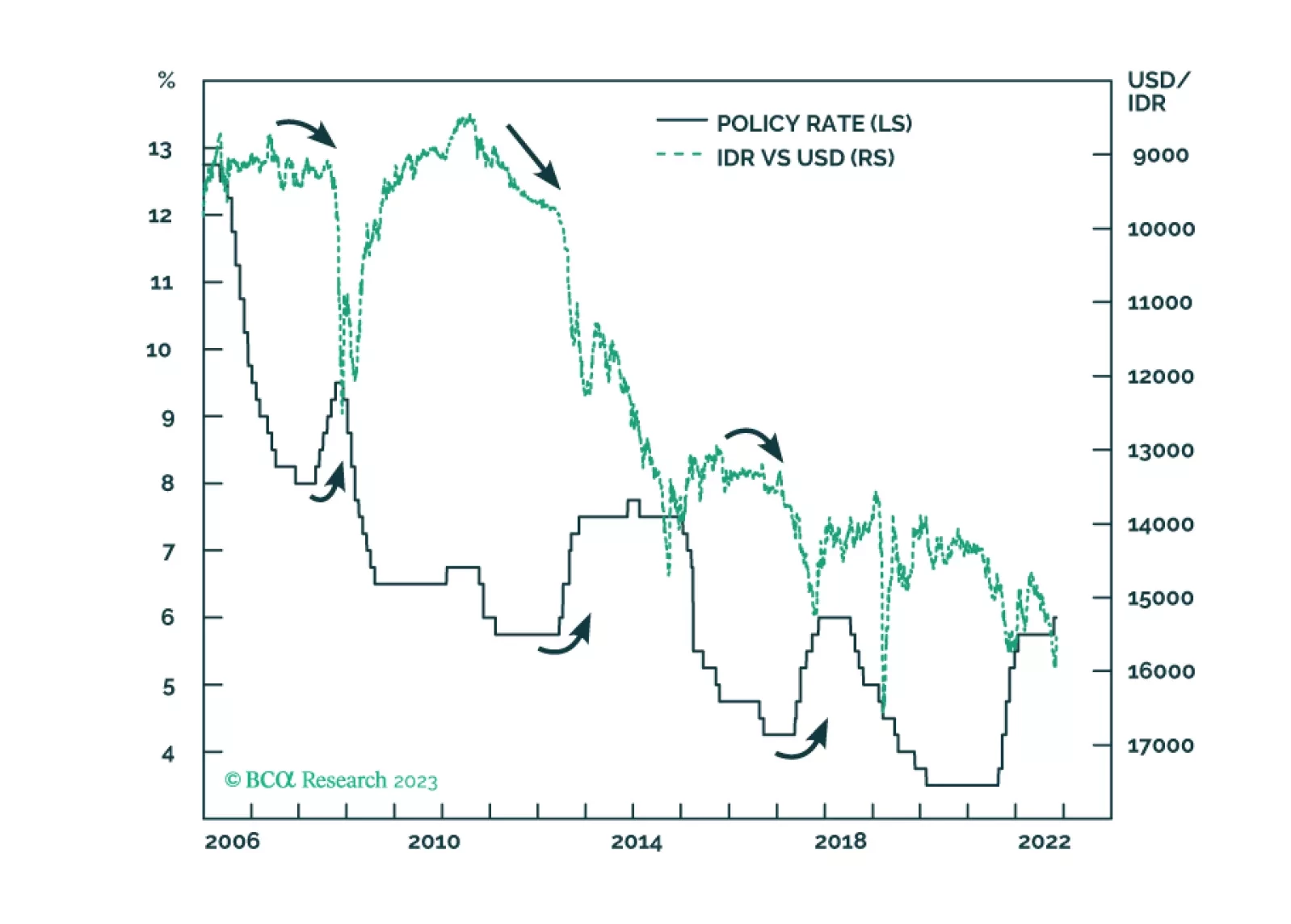
Indonesian domestic demand is struggling in the face of tight policy settings. High real borrowing costs are constraining credit growth, and hurting non-financial sectors. Monetary authorities have shown little intention to reduce borrowing costs by any good measure, and remain focussed on exchange rate stability. This is a major policy dilemma that the authorities need to break free from before this bourse can embark on a sustainable bull market. Indonesia’s only bright spot since the pandemic, its external accounts, will be deteriorating. Capital inflows will dwindle at a time when the current account balance is set to slip back into deficit. This will put downward pressure on the rupiah, which in turn raises the risk of policy error as the central bank might be tempted to raise rates in a bid to stabilize the currency. Doing so would hurt economic growth and stock prices. Bottom Line: Currency investors should stay short the rupiah versus the US dollar. Equity investors should wait for relative weaknesses before considering an upgrade in EM and Emerging Asian portfolios. Investors should stay underweight Indonesia in EM local currency bond portfolios. Sovereign EM credit investors, however, should continue to overweight Indonesia. Feature In the past few months, Indonesian stocks have rallied to a pandemic-era high. They have outperformed their emerging market peers as well, albeit from a very low level (Chart 1). Could this mean that Indonesia’s decade-long underperformance is finally coming to an end? We are not convinced. The nation’s equity index in US dollar terms will find it hard to advance to new highs anytime soon. Absolute return investors, therefore, should not chase this bourse up. In terms of relative performance, odds are that some of the recent gains might be lost. The recent outperformance had more to do with investors fleeing Chinese stocks and Indonesia has been one of the major beneficiaries of this rotation (Chart 2). Meanwhile, Indonesia’s policy setting remains quite restrictive. Its external tailwinds are receding as well, which is making the rupiah vulnerable. Chart 1Indonesian Stocks Are Still Not Geared For A Sustainable Bull Market
Indonesian Stocks Are Still Not Geared For A Sustainable Bull Market
Chart 2Much of The Indonesian Outperformance Had To Do With Investors Leaving China
Much of The Indonesian Outperformance Had To Do With Investors Leaving China
That said, given Indonesia’s drawn-out equity underperformance since early 2013, this bourse’s relative bear market versus the EM benchmark is late. As such, following near-term weaknesses, asset allocators should consider upgrading this bourse from underweight to neutral in EM and Emerging Asian baskets. Domestic bond investors should stay underweight Indonesian local currency bonds in EM and Emerging Asian portfolios. Sovereign credit investors, however, should remain overweight Indonesia. Persistent Domestic Headwinds The recovery in Indonesian domestic demand has been quite slow over the past two years. The top panel of Chart 3 shows that the economy is still struggling. Two years into the pandemic, consumer confidence and retail sales volume are well below pre-pandemic levels. One reason for the muted consumer sentiment is meagre growth in household income. Nominal wage growth has stalled, sapping consumer demand. Wage growth in real terms (deflated by headline CPI) is shrinking outright (Chart 3, bottom panel). Weakness is palpable on the supply side as well. The capacity utilization rate for both manufacturing and other industries remains well below pre-pandemic levels (Chart 4, top two panels), despite the fact that Indonesia’s manufacturing exports have been very strong over the past year (details to come). This underscores the extent of the weakness in domestic demand. Chart 3Consumer Confidence Is Low As Household Income Is Moribund
Consumer Confidence Is Low As Household Income Is Moribund
Chart 4Low Capacity Utilization And Labor Usage Points To Poor Domestic Demand
Low Capacity Utilization And Labor Usage Points To Poor Domestic Demand
Chart 5Fiscal Support Is In Short Supply
Fiscal Support Is In Short Supply
In line with low capacity utilization, labor usage has also been consistently below par since the onset of the pandemic (Chart 4, bottom panel). That means hiring has been restrained and workers have had little bargaining power, which explains why nominal wage growth has halted. The restrictive macro policy is also exerting a considerable drag on economic recovery. Indonesia’s fiscal stance is rather tight. The government is planning to rein in the fiscal deficit this year to 4.3% of GDP from a revised 4.7% deficit last year. As such, the IMF estimates that the cyclically adjusted fiscal thrust will be a negative 0.9% of potential GDP this year, and a further negative 0.6% next year (Chart 5). Monetary policy, as we have repeatedly asserted, has remained extremely restrictive for the past six to seven years. Interest rates are prohibitively high.Banks’ lending rates, for instance, have consistently stayed above nominal GDP growth rate since 2012. That will likely be the case going forward as well given the muted growth outlook. If one looks at real bank lending rates (deflated by core CPI) vis-à-vis real GDP, the picture looks even more grim (Chart 6). Such high borrowing costs, which continued for a decade, have been a major headwind for the country’s non-financial sectors. Stock prices of non-financial firms as well as those of SMEs – which had to endure chronically high financing costs − have been in a decade-long bear market in absolute terms. By contrast, banks benefited from the high lending rates, and their share prices have rallied to their pre-pandemic highs (Chart 7). Chart 6Borrowing Costs Have Been Persistently High Relative To The Economy's Growth Rate...
Borrowing Costs Have Been Persistently High Relative To The Economy's Growth Rate...
Chart 7...Hurting Stocks Of Non-Financial Firms And SMEs, While Benefitting Banks
...Hurting Stocks Of Non-Financial Firms And SMEs, While Benefitting Banks
Chart 8Exorbitant Borrowing Costs Have Led To A Stagnation In Credit Penetration
Exorbitant Borrowing Costs Have Led To A Stagnation In Credit Penetration
Very high real interest rates is one reason Indonesia’s credit penetration, at 34% of GDP, is unusually low for an economy at this stage of development. The ratio has not risen at all in the past 10 years. In fact, it has headed lower recently (Chart 8). This is not a sign of a healthy, recovering economy. As such, for Indonesian stocks to have a sustainable bull market, one of the macro imperatives is that the real borrowing cost needs to decline considerably. Yet, Indonesian monetary authorities have shown little intention to reduce real rates by any meaningful measure. The main reasons behind this hawkish stance on the part of the central bank has had to do with (i) the country’s persistent current account deficit over the past decade, and (ii) the central bank’s mandate of exchange rate stability. Indonesia needed to offer consistently high real rates to attract enough foreign capital so that it can finance its current account deficits, and thereby have a stable rupiah. Yet, that policy has created distortions elsewhere. Persistently high real rates have led to a steady drop in non-financial firms’ return on equity. That, in turn, discouraged foreign equity inflows but encouraged international fixed-income inflows into Indonesia. This is not surprising as equity investors dislike high real rates, while debt investors prefer it. The reliance on foreign debt inflows, in turn, incentivized the authorities to keep real interest rates persistently high − even in periods when growth was rather timid and inflation undershot the central bank’s target. This is a major distortion that the Indonesian economy needs to break free from before this bourse can embark on a sustainable bull market. Incidentally, a bill to expand the central bank’s mandate to include growth and employment was introduced to parliament last year. If passed, the bill-turned-law would allow Bank Indonesia to set interest rates more in line with domestic economic conditions, rather than just focussing on currency stability. Chart 9Inflation Is Inching Up From Very Low Levels
Inflation Is Inching Up From Very Low Levels
Discussions on the bill, however, have been delayed in Parliament, and it is not clear when, or if, it will be passed. Meanwhile, Bank Indonesia has begun to tighten policy on the margin by draining excess liquidity from the system. More worryingly, the central bank could begin to raise rates in the next couple of months as it fears inflation will creep up due to rising global commodity prices (Chart 9). Outflows from the bond market might also encourage the central bank to raise rates in an attempt to stem them (details in the next section). Receding External Tailwinds In contrast to Indonesia’s lack of domestic recovery, the country’s external sector was the star performer over the past year or two. Yet, in the next few quarters, it’s the external sector that will likely be a threat to the nation’s growth. This is because Indonesia’s exports are set to shrink and its balance of payments is set to deteriorate. These factors could threaten the rupiah stability, which would then force the central bank to raise rates / tighten liquidity prematurely in a bid to support the rupiah. Tighter policy would be a major headwind for growth, and would hobble stock prices. Indonesian exports grew remarkably over the past two years, which helped to push the country’s current account balance into surplus for the first time in a decade (Chart 10, top panel). A closer look, however, will reveal that much of it had to do with surging exports to China – which doubled to $55 billion in two years (Chart 11). Chart 10Indonesia's Balance Of Payments Will Be Under Pressure
Indonesia's Balance Of Payments Will Be Under Pressure
Chart 11Improvements In The Current Account Were Mostly Due to A Surge In Exports To China
Improvements In The Current Account Were Mostly Due to A Surge In Exports To China
That said, much of the improvements in the current account could unravel going forward: Some of the export windfalls accrued to Indonesia when China banned Australian coal imports in 2020 and switched to Indonesian coal instead. But more recently, a decelerating economy in China has led to slowing electricity generation. The latter has always had a direct bearing on Indonesian coal exports volume – which is now shrinking (Chart 12, top panel). China’s electricity demand and production will slump further due to COVID lockdowns of enterprises and pending weakness in its exports. Chart 12Export Windfalls Are Ending As Chinese Growth Wanes
Export Windfalls Are Ending As Chinese Growth Wanes
Chinese thermal coal prices have been falling in recent months from the sky-high levels of late 2021, and could fall further by the end of the year as China keeps increasing its own coal output and its electricity generation drops (Chart 12, bottom panel). All these will weigh on Indonesian export earnings in the months to come. For its part, the Indonesian government has restricted coal exports by mandating that miners set aside 25% of their output for local sales as part of their “domestic market obligation.” The government has also banned shipments of some palm oil ingredients for an indefinite period – in an apparent attempt to check domestic food price inflation. Palm oil is the second largest Indonesian export after coal, and together they make up 22% of total export revenues. Indonesia is a large net crude and refined petroleum importer. Global crude prices will likely stay elevated due to sanctions on Russia. This will be a negative for the country’s trade balance. Chart 13Dwindling Goods Demand In The Developed World Will Hurt Indonesian Manufacturing Exports
Dwindling Goods Demand In The Developed World Will Hurt Indonesian Manufacturing Exports
Moving beyond commodities, Indonesian manufacturing exports − which are as large as its’ commodities exports in US dollar terms − will also likely get hurt. A crucial reason for that is a slowing China. Chinese manufacturing imports are set to weaken in the next several months as that economy is entering a soft patch. That usually is an adverse development for Indonesian exports to China (Chart 13, top panel). In fact, Indonesia’s overall manufacturing exports will also likely slow. Falling household goods demand in developed countries will curtail manufacturing exports from Asia, including Indonesia. Notably, early signs of an impending slowdown in Indonesian manufacturing exports often appear in Chinese data − given the heft of the Chinese economy and its trade links in Asia and beyond (Chart 13, bottom panel). More generally, global trade will likely slow going forward, which is a negative for those economies that have relied on an export windfall over the past couple of years. Essentially, the days of boyant current account balances are numbered for Indonesia. A slipping current account balance could spell larger problems for Indonesia as the country’s financial account surplus has been steadily eroding. From a high of $37 billion annually in 2019, it dropped to just $12 billion by the end of 2021. Much of that drop is due to a fall in net debt inflows – the type of capital inflows Indonesia strives to attract by keeping real interest rates very high (Chart 10, middle panel). Chart 14Falling Real Bond Yields In Indonesia Will Keep Foreign Debt Investors At Bay
Falling Real Bond Yields In Indonesia Will Keep Foreign Debt Investors At Bay
Critically, the country has not been able to attract much FDI either despite passing an Omnibus Law to boost new investments and create jobs a couple of years back (Chart 10, bottom panel). Chart 14 shows that foreign investor holdings of Indonesian government debt has shrunk materially from almost $80 billion in early 2020 to less than $60 billion now. In terms of their share in total bonds outstanding, the drop is even more remarkable: from 40% of the total to just 18%. Foreign bond purchases clearly react to the ebbs and flows of Indonesian real yields on offer (Chart 14, bottom panel). Given that Indonesian inflation will likely go up from the current very low levels − putting a downward pressure on the real yields available – foreign investors could continue to shun Indonesian bonds. Indonesian policymakers might also worry as such. That apprehension could prompt Bank Indonesia to raise rates preemptively in a bid to attract debt inflows and stabilize the currency. If so, higher real rates would add to the existing policy headwinds for the domestic economy. Growth will suffer; and markets will sell off. Investment Conclusions The Currency: The rupiah remains vulnerable as the Indonesian balance of payments is set to deteriorate. A slipping current account balance amid receding capital inflows will be putting downward pressures on the rupiah. Stay short the rupiah versus the US dollar. Domestic Bonds: Indonesian bond yields have fallen massively relative to their EM counterparts, and are at 10-year lows in relative terms. As such, the nation’s local currency bonds have little more room to benefit from relative yield compression. The rupiah is also vulnerable. We went underweight Indonesian domestic bonds in November last year, and that recommendation remains in place (Chart 15). Sovereign Credit: Absolute return investors should reduce their exposure as the rupiah weaknesses going forward could lead to widening credit spreads, and result in negative total returns in US dollar terms (Chart 16). Chart 15Stay Underweight Indonesian Domestic Bonds In An EM Bond Portfolio
Stay Underweight Indonesian Domestic Bonds In An EM Bond Portfolio
Chart 16Absolute Return Investors Should Reduce Exposure To Indonesian Sovereign Credit
Absolute Return Investors Should Reduce Exposure To Indonesian Sovereign Credit
Asset allocators, however, should stay overweight Indonesia in an EM credit basket. This market has transitioned itself into a defensive one over the past several years – thanks to years of orthodox fiscal and monetary policies and low debt. Hence, given that a period of risk-off is around the corner – during which Indonesian credit tends to outperform as it did in 2015 and 2020 − it makes sense to stay overweight this market. Stocks: Absolute return investors should not chase this bourse up. Asset allocators should wait for relative weaknesses before considering an upgrade from underweight to neutral in EM and Emerging Asian portfolios. Rajeeb Pramanik Senior EM Strategist rajeeb.pramanik@bcaresearch.com
Indonesia’s domestic demand is struggling to recover in the face of a very tight policy setting. Domestic consumption and consumer confidence are languishing well below pre-pandemic levels. Real borrowing costs for the private sector are of the order of 10%.…
Highlights Indonesian domestic demand is struggling to recover in the face of a very tight policy settings. Exceptionally high real borrowing costs continue to hurt non-financial sectors. This will hurt banks too as credit is stymied and NPLs rise. Equity investors should fade the rebound and stay underweight Indonesia in an EM equity portfolio. Indonesia’s external accounts will deteriorate, as the Chinese slowdown weighs on resource prices. Softening commodity prices will herald a weakness in the rupiah. Currency investors should consider going short the rupiah versus the US dollar. Domestic bond investors should tactically downgrade Indonesia from neutral to underweight within an EM bond portfolio. Sovereign EM credit investors, however, should stay overweight Indonesia. Feature Chart 1Indonesian Stock Rebound Will Be Short-Lived
Indonesian Stock Rebound Will Be Short-Lived
After years of underperformance, Indonesian stocks have rebounded in absolute terms and inched up relative to the EM benchmark (Chart 1). Could this be the beginning of a sustainable outperformance? Our research indicates that the answer is no. The Indonesian economy is still struggling. Domestic demand remains lackluster, hamstrung as it is by very high real interest rates and a tight fiscal stance. A flexing export sector, the sole source of strength so far, is set to dissipate as well. Weaker exports will weigh on the nation's financial markets. A budding softness in EM financial markets – emanating from a slowing China and rising US bond yields – will be yet another headwind for Indonesian assets over the next several months. Investors therefore should fade the current rebound and remain underweight this bourse in EM equity portfolios. EM domestic bond portfolios should consider downgrading this market from neutral to underweight relative to its EM peers. Currency investors may consider shorting the rupiah versus the US dollar. Sovereign EM credit investors, however, should stay overweight Indonesia in an EM US dollar bond portfolio. Straightjacketed The main drag to Indonesia’s economic recovery is coming from prohibitively high interest rates in the country. Real borrowing costs for the private sector, of the order of 10% (Chart 2, top panel), are extremely restrictive for any economy to handle, let alone one trying to recover from a debilitating recession. The real rates in Indonesia are also much higher than anywhere else in Asia – for both the private sector as well as for the government (Chart 2, bottom panel). Chart 2The Economy Is Struggling In the Face Of Very High Real Interest Rates
The Economy Is Struggling In the Face Of Very High Real Interest Rates
Chart 3Absence Of Fiscal Support Is Making The Recovery Harder
Absence Of Fiscal Support Is Making The Recovery Harder
The fiscal stance does not appear to be very supportive either. The government is planning to rein in the fiscal deficit next year to 4.8% of GDP from an expected 5.7% this year. The IMF projects that the cyclically- adjusted fiscal thrust in 2022 will be a negative 0.8% of potential GDP, and a further negative 1.5% in 2023 (Chart 3). The consequence of such restrictive settings is that domestic consumption and consumer confidence are languishing well below pre-pandemic levels (Chart 4). Consistently, loan demand is also very weak. Bank credit for both consumption and production purposes (both working capital and term loans) have barely risen after having shrunk outright last year (Chart 5). Chart 4Domestic Demand Is Soft As Consumer Confidence Remains Low
Domestic Demand Is Soft As Consumer Confidence Remains Low
Chart 5All Types Of Bank Credit Are Weak
All Types Of Bank Credit Are Weak
Chart 6Disinflationary Pressures Are Entrenched In The Economy
Disinflationary Pressures Are Entrenched In The Economy
Weak domestic demand is reinforcing deflationary forces. Inflation has been undershooting the lower band of the central bank target for almost two years now. Core and trimmed mean CPI measures have been averaging below 1% over the past year. Headline CPI is below the lower target band despite high oil and food prices (Chart 6, top panel). At the same time, nominal wages are barely rising (Chart 6, bottom panel). Hence, household income growth is subdued, which is sapping consumer demand. Notably, the very high real interest rates in Indonesia today are an outcome of monetary policy falling behind the disinflation curve. In the 2000s, the country’s consumer price inflation would often flare up to double digits, and the central bank used to keep interest rates consistently high. Over the past 10 years or so, however, inflationary pressures have gradually given way to deflationary forces. Even though the central bank has reduced its policy rate, it has not reduced it sufficiently enough to offset the drop in inflation. As a result, real interest rates have risen. Banks, on their part, also refused to fully pass along the rate cuts accorded by the central bank. As such, banks’ lending rates to the private sector, in both nominal and real terms, remained much higher compared to their peers elsewhere in Asia (Chart 2, above). Part of the reason why the central bank has fallen behind the disinflation curve has to do with the exchange rate stability and Indonesia’s dependence on foreign debt capital inflows. The country needs to offer high real rates to continue to attract enough foreign capital so that it can finance the current account deficit. As long as the central bank has rupiah stability (as a means for price stability) as its mandate, it will not reduce real interest rates. Incidentally, a bill to include economic growth and employment within the central bank’s mandate was submitted to Parliament earlier this year. Discussion over the bill, however, has been delayed. This means that elevated real interest rates will prevail for now in Indonesia, hampering economic growth. Fading Bright Spot Chart 7The Surge In Exports Has Been All About Commodity Prices, Not Increasing Volumes
The Surge In Exports Has Been All About Commodity Prices, Not Increasing Volumes
In contrast to domestic demand, Indonesia’s exports did phenomenally well over the past few quarters. That said, there are signs that those heady days are coming to an end: The main reason exports did so well is that commodity prices went vertically up. Export volumes, on the other hand, stayed quite low. This is also evident in the case of coal and palm oil – Indonesia’s two main export items (Chart 7). Since it’s not the volume that drove up the export revenues, the latter is vulnerable to the whims of global commodity prices – of which Indonesia is a price-taker. And commodity prices, in general, have already begun to soften. China is by far the largest destination for Indonesian exports (22% of total), and demand in the Middle Kingdom has been among main reasons behind the recent surge in Indonesian exports. Yet, the fact that China’s credit and money impulses have turned negative is a major concern for Indonesian exports going forward. If history is of any guide, negative impulses will cause a contraction in Indonesian exports over the next year or so (Chart 8). Odds are therefore that the country’s trade surplus will roll over and the current account balance will slip back to a deficit (Chart 9, top panel). Chart 8Negative Chinese Credit And Money Impulses Will Cause Indonesian Exports To Shrink
Negative Chinese Credit And Money Impulses Will Cause Indonesian Exports To Shrink
Chart 9Indonesia's Trade And Current Account Balances Have Peaked
Indonesia's Trade And Current Account Balances Have Peaked
Chart 10A Slowing Chinese Credit & Fiscal Impulse Is Always A Bad Omen For The Rupiah
A Slowing Chinese Credit & Fiscal Impulse Is Always A Bad Omen For The Rupiah
Meanwhile, Indonesia’s financial account is struggling to stay in surplus as capital inflows have dwindled significantly over the past couple of years (Chart 9, middle panel). FDI inflows are also showing few signs of revival (Chart 9, bottom panel). This indicates that Indonesia’s envisioned reforms, under the ‘Omnibus bill’, are yet to gain much traction and produce meaningful improvements in the economy’s structural backdrop. All in all, the outlook for the country’s external accounts is much less sanguine in the months ahead. That will not bode well for the rupiah, which has benefitted from robust external accounts so far. A material drop in Chinese credit and fiscal impulse has never been positive for the Indonesian currency. In the months ahead, therefore, the path of least resistance for the rupiah appears to be down (Chart 10, top panel). The link is via commodity prices (Chart 10, bottom panel). Notably, most capital inflows into Indonesia are in the form of debt capital inflows. Equity inflows are paltry. The reason is straightforward: foreign bond investors like the extremely high real rates that the country has been offering, whereas the equity investors do not. Yet, in the past couple of years, even debt capital inflows have subsided (Chart 9, middle panel). Should foreign investors turn nervous about the rupiah outlook due to falling commodity prices and/or rising US interest rates, those debt inflows would further subside. Deteriorating capital inflows would cause further weakness in the rupiah in a self-fulfilling prophecy. Domestic Bonds Chart 11Indonesian Domestic Bonds' Outperformance Is Late
Indonesian Domestic Bonds' Outperformance Is Late
Indonesian local currency bonds have significantly outperformed their EM counterparts over the past several months (Chart 11, top panel). We have been positive on Indonesian domestic bonds. Going forward, however, the nation’s local bonds will find it difficult to rally in absolute terms and will likely underperform their EM peers. One reason for this is that, given Indonesian yields are already close to post-pandemic lows, it will be harder for them to fall much more. The relative performance of domestic bonds versus their EM peers will also be beset by a vulnerable rupiah – as explained above. The bottom panel of Chart 11 shows that periods of a weaker rupiah are usually associated with Indonesia underperforming overall EM domestic bonds. This is because foreign investors (who hold 21% of Indonesian local bonds) usually head for the exit once the rupiah begins to depreciate. Finally, as was explained in our report last week, various EM assets classes are in for a period of volatility – prompted by a deepening slowdown in China and rising US bond yields. Periods of EM stress do not augur well for Indonesian local bonds’ relative performance vis-à-vis their EM brethren. This is because the relative yield differential of Indonesia with that of EM widens in such periods – as occurred during the 2013 taper tantrum, the 2015 EM slowdown, and the 2020 pandemic (Chart 11, bottom panel). Since another EM risk-off period is around the corner, investors will be well advised to book profits on Indonesian domestic bonds’ recent outperformance and tactically downgrade this market to underweight in an EM domestic bond portfolio. Sovereign Credit Unlike the case of local currency bonds, Indonesia's sovereign credit has metamorphosed into a defensive market over the past several years. Investors now consider Indonesian sovereign credit to be among the safest within EM. This is an upshot of low public debt, including very low foreign currency public indebtedness, and years of orthodox fiscal and monetary policies. Chart 12Indonesian Sovereign Bonds Now Outperform During Risk-Off Periods
Indonesian Sovereign Bonds Now Outperform During Risk-Off Periods
In previous risk-off periods (such as the GFC in 2008 and the taper tantrum in 2013), Indonesian sovereign credit would typically underperform their EM counterparts. Yet, in more recent episodes (such as the EM slowdown in 2015 and the COVID-19 pandemic in 2020), Indonesian sovereign credit massively outperformed the EM benchmark. These recent instances suggest that during the oncoming risk-off period investors should stay overweight Indonesian sovereign credit in an EM basket. Notably, the regime change in Indonesia’s sovereign credit characteristics has led to its relative performance (versus overall EM) being decoupled from the rupiah (Chart 12). While the rupiah remains a cyclical currency, the significant improvement in sovereign creditworthiness has turned Indonesian credit markets into a defensive play within EM. Therefore, a weakness in the rupiah in the months ahead will not jeopardize its relative performance. Share Prices Chart 13Indonesian Bank Stocks Failed To Break Out, While Non-Banks Keep Falling
Indonesian Bank Stocks Failed To Break Out, While Non-Banks Keep Falling
The Indonesian equity market is structurally beset by an uneven playing field, where the country’s banking sector has benefitted at the expense of all others. This is a consequence of banks maintaining high real lending rates as well as very wide net interest rate margins for far too long. The outcome is evident in financial and non-financial sectors’ diverging performance over the past decade (Chart 13). Given that the bull market in bank stocks has been contingent on banks’ net interest margins (NIM), any reduction therein will hurt bank stocks (Chart 14). At the same time, maintaining current lending rates and net interest margins will continue to hurt non-financial sectors (i.e., borrowers). In other words, for non-financial sectors to benefit, it will have to come at the expense of banking sector. Since banks and the rest of the stock market have very similar weights in this bourse, this dynamic will make it hard for this market to rally overall in a sustainable manner. Notably, bank stocks have failed to breach their pre-pandemic highs. This is despite net interest margins being quite elevated. The reason is that high real borrowing costs in a weak economy not only discourage credit off-take, but also threaten to raise NPLs further. Indonesian bank stocks are quite expensive as well: their ‘price/book value’ ratio is 2.6 while that of their EM counterparts is 1.1. As such, they will be hard pressed to have another sustainable rally. The other half of Indonesian equity markets, non-financials, are expectedly doing worse in the face of persistently high borrowing costs. So are the small cap stocks – where non-financial firms make up 85% of the market cap (Chart 13, bottom two panels). Notably, since Indonesia is a commodity producer, Indonesian stock prices usually do well during periods of rising commodity prices. Yet, headwinds emanating from weak domestic demand prevented Indonesia from benefitting much from high commodity prices this past year (Chart 15). Going forward, with the dissipating commodity tailwind, the Indonesian market will likely falter anew. Chart 14Any Fall In The Elevated Net Interest Margins Will Hurt Bank Stocks
Any Fall In The Elevated Net Interest Margins Will Hurt Bank Stocks
Chart 15Extremely Restrictive Real Rates Prevented Indonesia From Benefitting From High Commodity Prices
Extremely Restrictive Real Rates Prevented Indonesia From Benefitting From High Commodity Prices
Furthermore, a period of overall EM volatility is also a negative for Indonesian stocks’ absolute and relative performances. Investment Conclusions An impending relapse in commodity prices will herald a weakness in the rupiah. Currency investors should consider going short the rupiah versus the US dollar. In view of the likely weakness in the rupiah, dedicated EM local currency bond portfolios should pare back their exposure to Indonesia and tactically downgrade this market from neutral to underweight. Expected softness in domestic demand in the face of high real rates, faltering commodity prices and an impending volatility in EM assets - all entail that investors should stay underweight this bourse in an EM equity portfolio. Finally, given the new defensive stature of Indonesian sovereign credit, asset allocators should stay overweight Indonesia in dedicated EM US dollar bond portfolios. Rajeeb Pramanik Senior EM Strategist rajeeb.pramanik@bcaresearch.com Footnotes
Highlights The surge in energy prices going into the Northern Hemisphere winter – particularly coal and natgas prices in China and Europe – will push inflation and inflation expectations higher into the end of 1Q22 (Chart of the Week). Over the medium-term, similar excursions into the far-right tails of price distributions will become more frequent if capex in hydrocarbon-based energy sources continues to be discouraged, and scalable back-up sources of energy are not developed for renewables. It is not clear China will continue selectively relaxing price caps for some large electricity buyers, which came close to bankrupting power utilities this year and contributed to power shortages. The current market set-up favors long commodity index products like the S&P GSCI and the COMT ETF. We remain long both. Higher energy and metals prices also will work in favor of long-only commodity index exposure over the medium term. Longer-term supply-chain issues will be sorted out. Still, higher costs will be needed to incentivize production of the base metals required to decarbonize electricity production globally, and to keep sufficient supplies of fossil fuels on hand to back up renewable generation. This will cause inflation to grind higher over time. Feature Back in February, we were getting increasingly bullish base metals on the back of surging demand from China. Most other analysts were looking for a slowdown.1 The metals rally earlier this year drew attention away from the fact that China had fundamentally altered its energy supply chain, when it unofficially banned imports of Australian thermal coal. It also altered global energy flows and will, over the winter, push inflation higher in the short run. Building new supply chains is difficult under the best of circumstances. But last winter had added dimensions of difficulty: A La Niña drawing arctic weather into the Northern Hemisphere and driving up space-heating demand; flooding in Indonesia, which limited coal shipments to China; and a manufacturing boom that pushed power supplies to the limit. Over the course of this year, Chinese coal inventories fell to rock-bottom levels and set off a scramble for liquified natural gas (LNG) to meet space-heating and manufacturing demand last winter (Chart 2).2 Chart of the WeekEnergy-Price Surge Will Lift Inflation
Energy-Price Surge Will Lift Inflation
Chart 2Coal Shortage China
China Power Outages: Another Source Of Downside Risk Coal Shortage China
While this was evolving, the volume of manufactured exports from China was falling (Chart 3), even while the nominal value of these exports was rising in USD terms (Chart 4). This is a classic inflationary set-up: More money chasing fewer goods. This is occurring worldwide, as supply-chain bottlenecks, power rationing and shortages, and falling commodity inventories keep supplies of most industrial commodities tight. China's export volumes peaked in February 2021, and moved lower since then. This likely persists going forward, given the falloff of orders and orders in hand (Chart 5). Chart 3Volume Of China's Exports Falls …
Inflation Surges, Slows, Then Grinds Higher
Chart 4… But The Nominal USD Value Rises
Inflation Surges, Slows, Then Grinds Higher
Chart 5China's Official PMIs, Export And In-Hand Orders Weaken
Inflation Surges, Slows, Then Grinds Higher
Space-heating and manufacturing in China are both heavily reliant on coal. Space-heating north of the Huai River is provided for free, or is heavily subsidized, from coal-fired boilers that pump heat to households and commercial establishments. This is a practice adopted from the Soviet Union in the 1950s and expanded until the 1980s, according to Fan et al (2020).3 Manufacturing pulls its electricity from a grid that produces 63% of its power from coal. China's coal output had been falling since December 2020, which complicated space heating and electricity markets, where prices were capped until this week. This meant electricity generators could not recover skyrocketing energy costs – coal in particular – and therefore ran the risk of bankruptcy.4 The loosening of price caps is now intended to relieve this pressure. Competition For Fuels Will Continue Europe was also hammered over the past year by a colder-than-normal winter brought on by a La Niña event, which sharply drew natgas inventories. The cold weather lingered into April-May, which slowed efforts to refill storage, and set off a scramble to buy up LNG cargoes (Chart 6). Chart 6The Scramble For Natgas Continues
Inflation Surges, Slows, Then Grinds Higher
This competition has lifted global LNG prices to record levels, and continues to drive prices higher. Longer-term, the logic of markets – higher prices beget higher supply, and vice versa – virtually assures supply chains will be sorted out. However, the cost of energy generally will have to increase to incentivize production of the base metals needed to pull off the decarbonization of electricity production globally, and to keep sufficient supplies of fossil fuels on hand to back up renewable generation. This will cause inflation to grind higher over time. Decarbonization is a strategic agenda for leading governments, especially China and the European Union. China is fully committed to renewables for fear of pollution causing social unrest at home and import dependency causing national insecurity abroad. In the EU, energy insecurity is also an argument for green policy, which is supported by popular opinion. The US has greater energy security than these two but does not want to be left behind in the renewable technology race – it is increasing government green subsidies. The current set of ruling parties will continue to prioritize decarbonization for the immediate future. Compromises will be necessary on a tactical basis when energy price pressures rise too fast, as with China’s latest measures to restart coal-fired power production. The strategic direction is unlikely to change for some time. Investment Implications Over time, a structural shift in forward price curves for oil, gas and coal – e.g., a parallel shift higher from current levels – will be required to incentivize production increases. This would provide hedging opportunities for the producers of the fuels used to generate electricity, and the metals required to build the infrastructure needed by the low-carbon economies of the future. We continue to expect markets to remain tight on the supply side, which will make backwardation – i.e., prices for prompt-delivery commodities trade higher than those for deferred delivery – a persistent feature of commodities for the foreseeable future. This is because inventories will remain under pressure, making commodity buyers more willing to pay up for prompt delivery. The current market set-up favors long commodity index products like the S&P GSCI and the COMT ETF. We remain long both, given our expectation. Over the short term, inflation will be pushed higher by the rise in coal and gas prices. Robert P. Ryan Chief Commodity & Energy Strategist rryan@bcaresearch.com Commodities Round-Up Energy: Bullish According to the Energy Information Administration (EIA), industrial consumption of natgas in the US is on track to surpass its five-year average this year. Over the January-July period, US natgas consumption average 22.4 BCF/d, putting it 0.2 BCF/d over its five-year average (2016-2020). US industrial consumption of natgas peaked in 2018-19 at just over 23 BCF/d, according to the EIA (Chart 7). The EIA expects full-year 2021 industrial consumption of natgas to be 23.1 BCF/d, which would tie it with the previous peak levels. Base Metals: Bullish Following a sharp increase in refined copper usage in China last year resulting from a surge in imports, the International Copper Study Group (ICSG) is expecting a 5% decline this year on the back of falling imports. Globally, the ICSG expects refined copper consumption to be unchanged this year, and rise 2.4% in 2022. Refined copper production is expected to be 25.9mm MT next year vs. 24.9mm MT this year. Consumption is forecast to grow to 25.6mm MT next year, up to 700k MT from the 24.96mm MT usage expected this year. Precious Metals: Bullish Lower-than-expected job growth in the US pushed gold prices higher at the end of last week on the back of expectations the Fed will continue to keep policy accessible as employment weakened. All the same, gold prices remain constrained by a well-bid USD, which continues to act as a headwind, and only minimal weakening of the 10-year US bond yield, which dipped slightly below the 1.61% level hit earlier in the week (Chart 8). Ags/Softs: Neutral This week's USDA World Agricultural Supply and Demand Estimates (WASDE) were mostly neutral for grains and bearish for soybeans. Global ending bean stocks are expected to rise almost 5.4% in the USDA's latest estimate for ending stocks in the current crop year, finishing at 104.6mm tons. Corn and rice ending stocks were projected to rise 1.4% and less than 1%, ending the crop year at 301.7mm tons and 183.6mm tons, respectively. According to the department, global wheat ending stocks are the lone standout, expected to fall 2.1% to 277.2mm tons, the lowest level since the 2016/17 crop year. Chart 7
Inflation Surges, Slows, Then Grinds Higher
Chart 8
Uncertainty Weighs On Gold
Footnotes 1 Please see Copper Surge Welcomes Metal Ox Year, which we published on February 11, 2021. It is available at ces.bcaresearch.com. 2 China’s move to switch to Indonesian coal at the beginning of this year to replace Aussie coal was disruptive to global markets. As argusmedia.com reported, this was compounded by weather-related disruptions in Indonesian exports earlier this year. It is worthwhile noting, weather-related delays returned last month, with flooding in Indonesia's coal-producing regions again are disrupting coal shipments. We expect these new trade flows in coal will take a few more months to sort out, but they will be sorted. 3 Please see Maoyong Fan, Guojun He, and Maigeng Zhou (2020), " The winter choke: Coal-Fired heating, air pollution, and mortality in China," Journal of Health Economics, 71: 1-17. 4 In August and September, the South China Morning Post reported coal-powered electric generators petitioned authorities to relax price caps, because they faced bankruptcy from not being able to recover the skyrocketing cost of coal. Please see China coal-fired power companies on the verge of bankruptcy petition Beijing to raise electricity prices, published by scmp.com on September 10, 2021. This month, Shanxi Province, which provides about a third of China's domestically produced coal, was battered by flooding, which forced authorities to shut dozens of mines, according to the BBC. Please see China floods: Coal price hits fresh high as mines shut published by bbc.co.uk on October 12, 2021. Power supplies also were lean because of the central government's so-called dual-circulation policies to reduce energy consumption and the energy intensity of manufacturing. This is meant to increase self-reliance of the state. Please see What is behind China’s Dual Circulation Strategy? Published by the European think tank Bruegel on September 7, 2021. Investment Views and Themes Strategic Recommendations
Highlights The rapid spread of the COVID-19 delta variant in Asia will re-focus precious metals markets anew on the possibility of another round of lockdowns and the implications for demand, particularly in Greater China and India, which account for 33% and 12% of global physical demand for gold (Chart of the Week).1 Regulatory crackdowns across various sectors in China will continue to roil markets over coming months. Policy uncertainty around these crackdowns is elevated in local financial markets, and could spill into global markets. This will support the USD at the margin, which creates a headwind for gold and silver prices. Ambiguous and contradictory signaling from Fed officials following the July FOMC meeting re its $120-billion-per-month bond-buying program also adds uncertainty to precious-metals and general commodity forecasts. Despite this uncertainty, we remain bullish gold and silver. More efficacious jabs will become available, which will support the global economic re-opening, particularly in EM economies. In DM economies, vaccination uptake likely increases as risks become more apparent. We continue to expect gold to trade to $2,000/oz and silver to trade to $30/oz this year. Feature Markets once again are focused on the possibility lockdowns will follow rising COVID-19 infections and deaths, as the delta variant – the most contagious variant to date – spreads through Asia and elsewhere. Chart of the WeekCOVID-19 Delta Variant Rampages
Uncertainty Checks Gold's Recovery
Chart 2COVID-19 Infections, Deaths Rising
Uncertainty Checks Gold's Recovery
Infection and death rates are moving higher globally (Chart 2). COVID-19 infections are still rising in 78 countries. Based on the latest 7-day-average data, the countries reporting the most new infections daily are the US, India, Indonesia, Brazil, and Iran. The countries reporting the most deaths each day are Indonesia, Brazil, Russia, India, and Mexico. Globally, more than 42% of infections were in Asia and the Middle East, where ~ 1mm new infections are reported every 4 days. We expect more efficacious jabs will become available, which will support the global economic re-opening, particularly in EM economies. In DM economies, vaccination uptake likely increases as risks become more apparent. China's Regulatory Crackdown Markets also are contending with a regulatory crackdowns across multiple sectors in China, which is part of a years-long reform process initiated by the Politburo.2 Industries ranging from internet, property, education, healthcare to capital markets will have new rules imposed on them under China's 14th Five-Year Plan as part of this process. Our colleagues in BCA's China Investment Service note the pace of regulatory tightening will not moderate in the near term, as policymakers transition from an annual planning cycle focused on setting economic growth targets to a multi-year planning horizon. "This allows policymakers to have a higher tolerance for near-term distress in exchange for long-term benefits," according to our colleagues. The overarching goal of this reform process is to introduce more social equality in the society. Of immediate import for precious metals markets is the potential for spillover effects outside China arising from the policy uncertainty that already is emanating from that market. Uncertainty boosts the USD and gold. This makes its effect uncertain. In our most recent modeling of gold prices, we have found strong two-way feedback between US and Chinese policy uncertainty.3 We also find that broad real foreign exchange rates for the USD and RMB exert a negative influence on gold prices, while higher economic uncertainty pushes gold prices higher (Chart 3). In addition, across markets – Chinese and US economic policy uncertainty – have similar effects, suggesting economic uncertainty across these markets has a similar effect as domestic uncertainty at home (Chart 4).4 Chart 3Domestic Uncertainty, Real FX Rates Strongly Affect Gold Prices...
Domestic Uncertainty, Real FX Rates Strongly Affect Gold Prices...
Chart 4...As Do Cross-Border Uncertainty, Real FX Rates
...As Do Cross-Border Uncertainty, Real FX Rates
This is yet another reason to pay close attention to PBOC and Fed policy innovations and surprises: they affect each other in similar ways within and across borders. Fed Officials Add Uncertainty Following the FOMC meeting at that end of last month, various Fed officials expressed their views of Chair Jerome Powell's post-meeting remarks, or again resumed their campaigns to begin tapering the US central bank's bond-buying program. Chair Powell's remarks reinforced the data-dependency of the Fed in directing its bond buying and monetary accommodation. He emphasized the need to see solid improvement in the jobs picture in the US before considering any lift-off of rates. As to the Fed's bond-buying program, this, too, will depend on progress on reducing unemployment in the US. Powell also reiterated the Fed views the current inflation in the US as transitory, a point that was emphasised by Fed Governor Lael Brainard two days after Powell's presser. Some very important Fed officials, most notably Fed Vice Chair Richard Clarida, are staking out an early position on what will get them to consider reducing the Fed's current accommodative policies, chiefly an "overshoot" of PCE inflation, the Fed's favored gauge, above 3%. Other Fed officials are urging strong action now: St. Louis Fed President James Bullard is adamant that tapering of the Fed's bond-buying program needed to begin in the Autumn and should be done early next year. Bullard is supported by Governor Christopher Waller. The Fed's bond-buying program is more than a year old. Beginning in July 2020, the Fed started buying $80 billion of Treasurys and $40 billion of mortgage-backed securities every month, or ~ $1.6 trillion so far. This lifted the Fed's balance sheet to ~ $8.3 trillion. Thinking about this as a commodity, that's a lot of asset supply removed from the Treasury and MBS market, which likely explains the high cost of the underlying debt instruments (i.e., their low interest rates). It is understandable why the gold market would get twitchy whenever Fed officials insist the winddown of this program must begin forthwith and be done in relatively short order. The loss of that steady stream of buying could send interest rates higher quickly, possibly raising nominal and real interest rates in the process, which, given the sensitivity of gold prices to US real rates would be bearish (Chart 5). While it is impossible to know when the tapering of the Fed's asset-purchase program will end, these occasional choruses of its imminent inauguration add to uncertainty in the US, which also depresses precious metals prices, as Chart 5 indicates. A larger issue attends this topic: economic policy uncertainty is not contained within national borders. Above, we noted there is a two-way feedback between US and China economic policy uncertainty. There also is a long-term relationship in levels of economic policy uncertainty re China and Europe, which makes sense given the trading relationship between these states. Changes in the two measures of economic policy uncertainty exhibit strong co-movement (Chart 6). Chart 5Taper Talk Makes Precious Metals Markets Twitchy
Taper Talk Makes Precious Metals Markets Twitchy
Chart 6Economic Policy Uncertainty Goes Across National Borders
Uncertainty Checks Gold's Recovery
Investment Implications The increase in COVID-19 infection and re-infection rates, and death rates, is forcing commodity markets to reevaluate demand projections and the likelihood of continued monetary accommodation globally. This ultimately affects the prospects for commodity prices. Conflicting interpretations of the state of local and the global economies increases uncertainty across markets, especially precious metals, which are exquisitely sensitive to even a hint of a change in policy. This uncertainty is compounded when top officials at systematically important central banks provide sometimes-contradictory interpretations of the state of their economies. Despite this uncertainty we remain bullish gold and silver, expecting efficacious vaccines to become more widely available, which will allow the global recovery to regain its footing. We are less sanguine about the prospects for the winding down of the massive monetary accommodation globally, particularly that of the US, where data-dependent policymakers still feel compelled to provide almost-certain policy prescriptions in an increasingly uncertain world.This is a fundamental factor driving global uncertainty. We remain long gold expecting it to trade to $2,000/oz this year, and long silver, expecting it to hit $30/oz. Robert P. Ryan Chief Commodity & Energy Strategist rryan@bcaresearch.com Ashwin Shyam Research Associate Commodity & Energy Strategy ashwin.shyam@bcaresearch.com Commodities Round-Up Energy: Bullish While US crude oil inventories rose 3.6mm barrels in the week ended 30 July 2021 gasoline stocks fell 5.3mm barrels, contributing to an overall decline in crude and product inventories in the US of 1.2mm barrels, according to the US EIA's latest tally (Chart 7). US crude and product stocks have been falling throughout the COVID-19 pandemic, and now stand ~ 13% below year earlier levels at 1.7 billion barrels. Crude oil stocks, at 439mm barrels, are just over 15% below year-ago levels. This reflects the decline in US domestic production, which is down 7.1% y/y and now stands at 11.2mm b/d. US refined-product demand, however, is up close to 9% over the January-July period y/y, and stands at 21.2mm b/d. Base Metals: Bullish Workers at the world's largest copper mine, Escondida in Chile, are in government-mediated talks with management that end on Saturday to see if they can avert a strike. There is a chance talks could be extended five days beyond that date, under Chilean law. The mine is majority owned by BHP. Workers at a Codelco-owned mine also voted to strike and will enter government-mediated talks as well. These potential strikes most likely explain why copper prices have been holding relatively steady as other commodities have come under pressure, as markets reassess the odds of a demand slowdown brought about by surging COVID-19 infections, which are hitting Asian markets particularly hard (Chart 8). Chart 7
Uncertainty Checks Gold's Recovery
Chart 8
Copper Prices Recovering
Footnotes 1 We flagged this risk in our July 8, 2021 report entitled Assessing Risks To Our Commodity Views, which is available at ces.bcaresearch.com. 2 Please see Pricing A Tighter Regulatory Grip published on August 4, 2021 by our China Investment Strategy. It is available at cis.bcaresearch.com. 3 We measure this using Granger-Causality tests. 4 These broad real FX rates are handy explanatory variables, in that they combine two very important factors affecting gold prices – inflation and broad FX trade-weighted indexes. Additional modelling also suggests these broad real FX rates for the USD and RMB coupled with US real 2- and 5-year rates also provide good explanatory models for gold prices. Investment Views and Themes Strategic Recommendations Tactical Trades Commodity Prices and Plays Reference Table Trades Closed in 2021 Summary of Closed Trades
Image
In a recent report on Indonesia, our Emerging Markets Strategy team pointed out a structural shift in the Indonesian USD bond market. Indonesian sovereign USD bonds are now considered among the safest within the EM universe. This was evident early last…
Highlights Indonesian domestic demand is struggling amid tight policy setting. Exports will weaken too, as the Chinese money and credit impulses have rolled over. Slowing Chinese impulses are negative for the rupiah as well. An impending change in the central bank mandate will also add to currency weakness. This warrants that equity investors stay short/underweight this market. Foreign investors in local currency bonds should downgrade Indonesia from overweight to neutral within an EM portfolio. Sovereign (USD) bond investors, however, should stay overweight given the orthodox fiscal policy. Feature Economic recovery in Indonesia is underwhelming. Stocks will therefore continue to be weak in absolute terms and underperform their EM peers (Chart 1). The main cause of the tepid recovery is very tight monetary and fiscal policies being pursued by the authorities. Even though the policy rate has been reduced over the past year, bank lending rates have not budged much – especially after adjusting for inflation. Borrowing costs in real terms remain around 10% – a very steep rate for an economy that is struggling, and much higher than in other ASEAN countries (Chart 2). Chart 1Indonesian Stocks Are Relapsing Again...
Indonesia: Stay Bond Bullish, Stock Bearish
Chart 2...As The Economy Is Struggling In The Face Of Very High Real Interest Rates...
Indonesia: Stay Bond Bullish, Stock Bearish
Chart 3...And An Elusive Fiscal Support
Indonesia: Stay Bond Bullish, Stock Bearish
Making matters worse, fiscal support has also been mediocre. At 15% year over year, fiscal spending growth has not been nearly enough to offset the effects of debilitating lockdowns. What’s more, the goal of the finance minister’s proposed budget is to narrow the fiscal deficit from its current 6.5% to 5.7% of GDP for 2021; and to 4.8% of GDP in 2022. What this entails is that the cyclically-adjusted fiscal thrust over the next year and a half will be a negative 1.3% of GDP, as per the IMF projections (Chart 3). To put it differently, the economy does not have much to look forward to in terms of fiscal backing. As expected, such restrictive policy is proving to be too onerous for the economy to overcome: More than a year after the pandemic hit, retail sales volumes are still contracting. Low levels of consumer confidence indicate that they remain wary of spending. Vehicle sales are well below the pre-pandemic levels. So is vehicle production. (Chart 4). Consistently, loan demand is also very weak. Bank credit for both consumption and production purposes (for both working capital and capital investment purposes) is shrinking (Chart 5). Chart 4Both Consumption And Production Levels Remain Very Weak...
Indonesia: Stay Bond Bullish, Stock Bearish
Chart 5...Amid A Contraction In Bank Credit For All Activities...
Indonesia: Stay Bond Bullish, Stock Bearish
Chart 6...Leading To Disinflationary Pressures Taking Hold...
Indonesia: Stay Bond Bullish, Stock Bearish
In terms of vaccination, Indonesia still has a long way to go. As of May 19, only 8.5% of the population have gotten their first vaccine shot, and only 3.4% have gotten both doses. That means it will be several months before the economy can fully re-open. Weak domestic demand has enabled disinflationary pressures to take hold. Core CPI continues to move down and is undershooting at 1.2%, well below the central bank’s target of 2% to 4% (Chart 6, top panel). The GDP deflator is in outright deflation (Chart 6, bottom panel). Furthermore, the economic impact of the new Omnibus Law, which the parliament passed late last year, will take time to bear fruit. While the net effect of the new law will be positive for the economy in the long run, it’s unlikely to have a material bearing over the next year or so. We have detailed some salient features of the law in Box 1. Box 1 Salient Features Of Indonesia Omnibus Law, 2020 The stated goal of the Omnibus Law is to boost investments and create jobs by streamlining the rules and simplifying the licensing process. These new laws should incentivize entrepreneurs and investors to invest more in the country. Notably, Indonesia’s capital spending relative to economic output has already been quite high – averaging at 32% of GDP over the past decade. This is lower than only China and India. That said, the bulk of that capex has been spent on building (75%), rather than on plants and machinery (10%). The Omnibus Law has now made it easier for foreigners to invest in the country in all but six industries. That should improve the quality of capital expenditures. It should also boost FDI inflows into the country, which have faltered in the past five years. All this will be a net positive for the economy and for stock markets over the next few years. But it will take considerable time for the authorities to implement all the provisions of this wide-ranging law effectively. As such, there is unlikely to be any major market impact over the coming months. Some of the salient features of the law are: The corporate income tax rate has been lowered from the current 25% to 22% in 2022, and to 20% beginning in 2025. A sovereign wealth fund has been created with about US$ 5.1 billion to attract investments and support the economy. The number of industries that was barred from receiving foreign investments has been reduced from over 300 to just 6 (gambling, chemical weapons, industrial chemicals, illegal drugs, endangered fish and corals). Foreigners can now own 100% of equity in these crucial sectors: Health, Energy and Mineral Resources, Transportation, Telecommunications and IT, Trading, Construction, Plantation and Agriculture. The hiring process of foreign workers in Indonesia has been eased. Violators of competition laws will be subject to unlimited fines now (so far capped at about $ 180,000), but rarely a prison sentence. Entrepreneurs will not need any minimum amount of capital (so far about $3,500) to start a limited liability company anymore. Besides, in the case of micro and small businesses, such companies can be established by just one person. Employers now can terminate employees with a 14-day written notice, and without prior labor court approvals – the latter was the case so far. Termination entitlements have also been reduced to about half the previous levels. Minimum wage requirements based on sectors/industries have been abolished; and new requirements based on provinces/cities have been introduced. There will also be no fine for entrepreneurs who are late in paying wages. A new social security program (Job Loss Security) has been created wherein Indonesian employees will receive a monthly cash benefit for six months. Bond Bullish Tight monetary and fiscal policies, weak domestic demand, and undershooting inflation – this is a bullish cocktail for domestic bonds. As expected, bonds are outperforming domestic stocks in total return terms (Chart 7). Local investors should stay long bonds, and overweight bonds over stocks in a balanced portfolio. For foreign investors of Indonesian local currency bonds, however, the matter is more nuanced. This is because a major part of the Indonesian domestic bond returns emanates from rupiah returns. Even the relative return (versus the EM benchmark) is highly reliant on the rupiah performance (Chart 8). Chart 7...And Producing A Bullish Backdrop For Bonds Versus Equities
Indonesia: Stay Bond Bullish, Stock Bearish
Chart 8Yet, Foreign Investors In Domestic Bonds Should Be Wary Of The Currency Risk
Indonesia: Stay Bond Bullish, Stock Bearish
Going forward, the rupiah outlook is less sanguine. That means foreign investors in local currency bonds should consider paring back their allocations to Indonesia. Currency Risks Part of the reason for a less sanguine rupiah outlook is a structural issue in Indonesia. The other part is a cyclical one. Chart 9Very High Real Rates In Indonesia Have Discouraged Equity Investors
Indonesia: Stay Bond Bullish, Stock Bearish
The bulk of the portfolio inflows that Indonesia has been able to attract over the past decade is in the form of debt inflows, rather than equity inflows (Chart 9). The reason is simple: high real interest rates attract fixed income investors but discourage equity investors due to their negative impact on economic growth and corporate profitability. But this has also created an unhealthy dependence on debt inflows: it has incentivized the authorities to keep real interest rates high – so that they can continue to attract enough financing for the government and defend the currency. In addition, the central bank (Bank Indonesia) also has little incentive to reduce interest rates anyway. That’s because the current mandate of the central bank stipulates price stability, via securing exchange rate stability as its sole objective. Lowering interest rates can make local bonds less attractive for foreign fixed income investors, prompting them to dump bonds and thereby cause a currency sell-off. Since that will jeopardize its mandate, the central bank is reluctant to cut rates. The economy, on the other hand, clearly needs lower real rates to help it grow out of the recession and a weaker currency could help kickstart the recovery. This has put the authorities in a bind as the central bank’s current mandate means they are unlikely to facilitate this. That mandate, however, can change soon. The government has introduced a new parliamentary bill for expanding the central bank objective to include economic growth and employment, in addition to price stability. Given the president himself backs the new bill, odds are that it will be passed by parliament sooner rather than later. Chart 10A Slowing Credit And Fiscal Impulse In China Is A Bad Omen For Rupiah
Indonesia: Stay Bond Bullish, Stock Bearish
If the bill is passed, it will send signals to the markets that the days of maintaining very high real rates are likely over. This will surely prompt some foreign investors in domestic bonds to head for the exit, causing a sell-off in the rupiah and pushing up bond yields. This warrants a cautious approach on the part of foreign bond investors at the moment. Notably, the share of foreign investors’ holdings of Indonesian domestic bonds, at 23%, is one of the highest in EM. In addition, foreign investors also have a cyclical reason to be wary of the rupiah in the months ahead. China’s credit and fiscal impulse has rolled over decisively. Odds are that in the near future, it will have a negative impact on several commodity prices and currencies of commodity-producing countries, including the rupiah (Chart 10). Sovereign Credit All in all, a questionable outlook for the rupiah has made the job of international fixed income investors more complicated. We provide the following observations to help guide them through the nuances: In the case of Indonesian sovereign USD bonds, the ebbs and flows of the excess return (versus US Treasury) are highly dependent on the rupiah’s strength. If and when the rupiah weakens, the excess returns are also expected to decelerate. Chart 11Indonesian Sovereign Excess Returns Will Likely Decelerate But Not Contract
Indonesia: Stay Bond Bullish, Stock Bearish
That said, the excess returns are unlikely to turn negative in the months ahead. If history is any guide regarding excess returns turning negative, it would require a 10%+ sell-off in the rupiah – an unlikely event (Chart 11). Besides, Indonesian sovereign spreads will also stay tight given the country’s fiscal orthodoxy. Thus, despite limited potential gains, it still makes sense for absolute return investors to stay long Indonesian sovereign credit for now. Similarly for asset allocators, it makes sense to stay overweight Indonesian sovereign credit in an EM credit portfolio. A possible EM growth wobble (arising from the Chinese growth deceleration) could prove to be a tailwind for Indonesia’s relative performance. This is because investors now deem Indonesian bonds as one of the safest within the EM space – an upshot of pursuing years of orthodox policies. Chart 12Indonesian Sovereign Bonds Now Outperform EM During Risk-Off Periods
Indonesia: Stay Bond Bullish, Stock Bearish
This was evident in early 2020 when Indonesian sovereign credit massively outperformed their EM peers during the COVID-19 related risk-off phase (Chart 12, top and middle panels). In the past, Indonesia typically underperformed during such risk-off phases (e.g. GFC in 2008 and taper tantrum in 2013). A corollary to this regime change is that Indonesia’s relative sovereign credit performance (versus overall EM) has decoupled from the rupiah – another departure from the past. While the rupiah remains a cyclical currency, the significant improvement in the country’s creditworthiness has turned it into a defensive play within EM credits. Hence, a moderate fall in the rupiah is not a risk factor for relative performance (Chart 12, bottom panel). The bottom line is that it makes sense for both absolute return investors and asset allocators to stay bullish on Indonesian sovereign credit. Stock Bearish The only area of the economy that has shown some promise so far is exports – which have recovered above pre-pandemic levels. This is mainly due to a surge in commodity prices, which led to an impressive 25% year-on-year growth in Indonesia’s exports to China – the destination of 22% of the country’s exports. Indonesia’s exports to China consist of mainly mineral products and base metals which make up 30%, and 25% of total exports to China respectively. But as alluded to earlier, the recent weakness in the Chinese credit and monetary impulses indicate that Chinese imports in general, and commodity imports in particular, will likely slump going forward. Historically, a slowdown in Chinese credit and monetary impulses did not augur well for Indonesian exports (Chart 13). What’s more, those weakening impulses will also likely lead to lower commodity prices ahead. Since Indonesia is a commodity producer, Indonesian stock prices usually benefit when global commodity prices rise. But this time the headwinds emanating from tight domestic policies have been too severe for them to benefit much from the commodity price surge (Chart 14). In any case, a dissipating commodity tailwind will just add to the woes of Indonesian stocks. Chart 13A Roll Over In Chinese Money And Credit Impulse Will Weaken Indonesian Exports...
Indonesia: Stay Bond Bullish, Stock Bearish
Chart 14...And Soften Commodity Prices, Which Is Bearish For Indonesian Stocks
Indonesia: Stay Bond Bullish, Stock Bearish
The bearish sentiment in the Indonesian equity market is palpable. It’s hardly a surprise that the country has witnessed incessant net equity outflows since the beginning of the year. Bottom-up analysts are paring back their earnings forecast for Indonesian stocks. Chart 15 shows that every month, more firms are facing a downward revision in their expected earnings than the number of firms facing an upward revision. This is in contrast with the overall EM, where a higher number of firms is seeing an upward revision. Bank stocks, the sole engine of this bourse for the past seven years, are facing a headwind – as contracting bank credit is set to hurt their earnings. Banks are also staring at rising non-performing loans. This is because many borrowers will fail to honor their repayment obligations in the face of a prohibitively high real borrowing cost amid weak income and revenues. Rising NPLs will force the banks to make higher loan loss provisions, which will diminish banks’ earnings further. Sensing the inevitable, bank stocks failed to breach the previous (pre-pandemic) highs and have begun to fall in absolute terms (Chart 16). They are also underperforming the rest of the EM banks. Notably, Indonesian bank stocks are also quite expensive compared to their EM counterparts. Their growth and earnings outlook certainly do not warrant a hefty 130% premium at this moment. Investors should brace for a sizeable correction in Indonesian bank share prices. Chart 15Analysts Are Paring Back Indonesian Stocks' Earnings Forecasts
Indonesia: Stay Bond Bullish, Stock Bearish
Chart 16Bank Stocks Are Breaking Down As Bank Credit Is Shrinking And NPLs Are Rising
Indonesia: Stay Bond Bullish, Stock Bearish
Stock prices of Indonesian non-financial firms and small caps, which are on the receiving end of very high real borrowing costs, are also not in a position to rise given the subdued economy. In fact, those stocks are also breaking down in a well-established downward channel (Chart 17 and Chart 18). Chart 17Bear Markets Have Resumed For Non-Financial Stocks And...
Indonesia: Stay Bond Bullish, Stock Bearish
Chart 18...Small Caps As They Struggle With High Borrowing Costs And Low Growth
Indonesia: Stay Bond Bullish, Stock Bearish
The bottom line is that the underperformance of Indonesian stocks has further to run. Investment Conclusions Subdued growth in this economy and an impending relapse in commodity prices will herald a weakness in the rupiah. A probable change in the central bank’s mandate to target growth and employment besides inflation will exacerbate the exchange rate weakness. This calls for staying underweight Indonesian stocks in an EM equity portfolio for now. In the case of dedicated EM sovereign bond (dollar-denominated) portfolios, asset allocators should stay overweight Indonesia. However, in the case of EM local currency bond portfolios, an expected currency volatility warrants that investors pare back their exposure to Indonesia and downgrade this market from overweight to neutral relative to its EM peers. Rajeeb Pramanik Senior EM Strategist rajeeb.pramanik@bcaresearch.com

