Sorry, you need to enable JavaScript to visit this website.
Skip to main content

Internet Software and Services

Cybersecurity is a strategic investment theme, which looks particularly interesting in light of the trade war and heightened geopolitical tensions. It is less exposed to tariffs than other industries and, if anything, benefits from geopolitical tensions as customers seek protection from international cyberattacks and cybercrime. The industry’s fundamentals are improving, while valuations are moderating. A recent pullback presents an attractive entry point into the theme. 

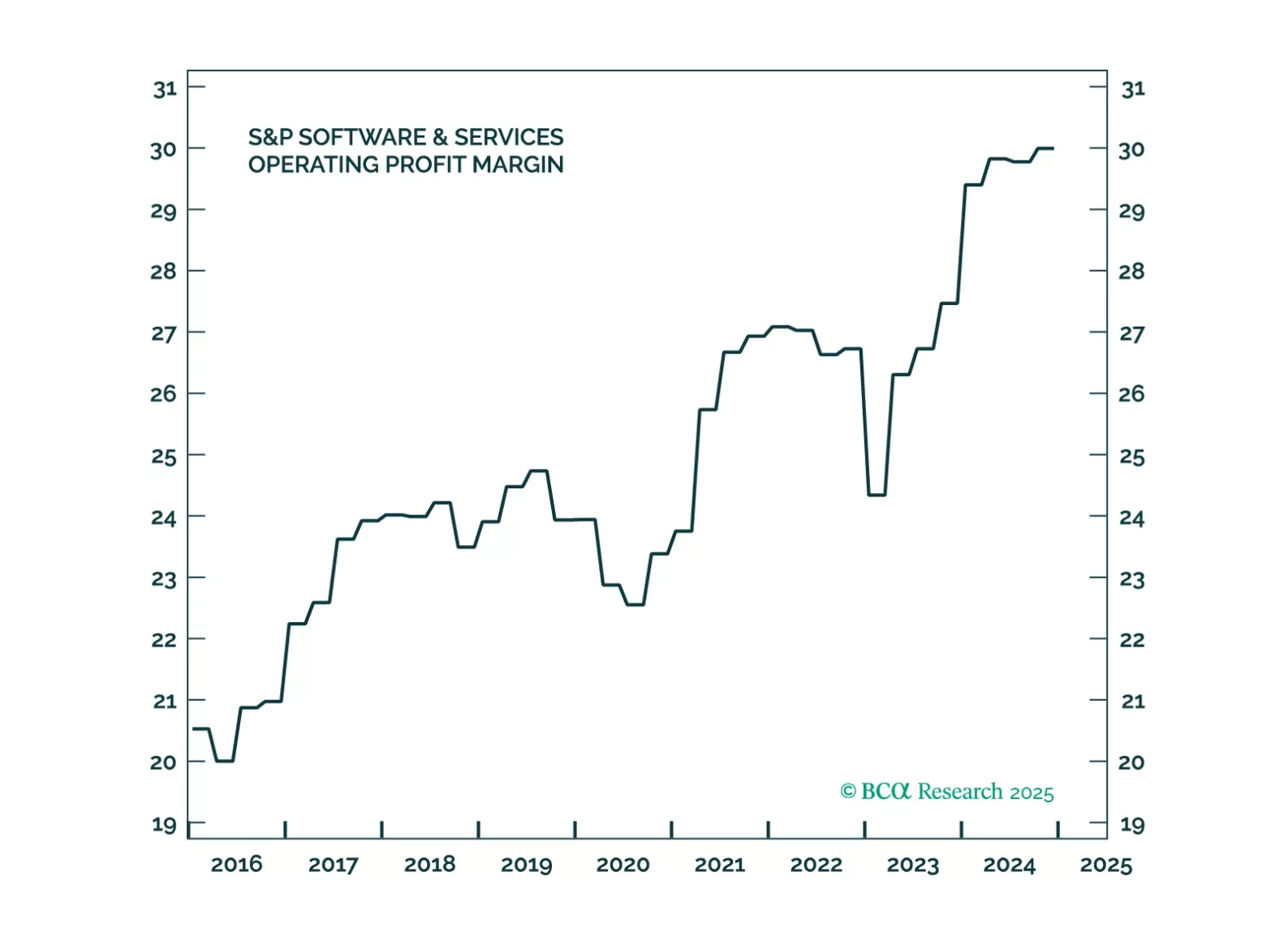
GAI is a double-edged sword for S&S. Companies without GAI applications find that GAI crowds out their offering from IT budgets. In contrast, companies with GAI offering find that high inference costs make new products less lucrative than the cloud-subscription model that has propelled their margins to all-time highs. The effect of DeepSeek on the industry is generally positive, as it will help it lower costs of GAI-based software products. 

BCA Research is proud to announce a new feature to help clients get the most out of our research: an Executive Summary cover page on each of the BCA Research Reports. We created these summaries to help you quickly capture the main points of each report through an at-a-glance read of key insights, chart of the day, investment recommendations and a bottom line. For a deeper analysis, you may refer to the full BCA Research Report. Executive Summary The Software and Services Industry is undergoing a fundamental transformation in its business model catalyzed by a momentous migration of software applications to the cloud and broad-based digitization of the economy. This shift is accompanied by displacement of the traditional on-prem license and support model with a more lucrative cloud-based subscription model.  While on-prem software sales are contracting, cloud revenue is growing in double digits. As a result, the industry enjoys spectacular margins and earnings growth. Its earnings have also proven to be resilient across the business cycle because software and IT services increase companies’ productivity in good times and bad. Rising rates are a headwind, but a temporary one. Margins Will Continue To Expand Margins Are To Continue Expanding Margins Are To Continue Expanding Bottom Line: The Software and Services industry group is an all-weather industry with resilient earnings and strong growth throughout the business cycle. It is also in the epicenter of technological innovation: Migration to the cloud and digital transformation enhance the industry’s growth and profitability.  We continue recommending both a tactical and a structural overweight. Feature Performance Technology stocks found themselves in the eye of this month’s market rout. After falling 19% from its peak, the NASDAQ is now firmly in correction territory. The Technology sector is down 11%, while the Software and Services industry group is down 10% (Chart 1). In the “Are We There Yet?” report published last week, we posited that it is not yet the right time to bottom fish: While the Technology sector appears oversold, macroeconomic headwinds from the imminent monetary tightening and a slowdown in demand for technology goods and services may prolong the pain. The interplay of valuations and fundamentals for the sector is not yet favorable. While we are underweight the Technology sector, thanks to our underweight positions in Semiconductors and Hardware and Equipment, we remain overweight Software and Services (S&S). In this report, we will conduct a “deep dive” into S&S and reevaluate our positioning (Table 1). Although S&S is down more than 10% from the peak,  it has outperformed the S&P 500 by 88% since 2011 (Chart 2). The million-dollar question we will try to answer is whether this outperformance continues over the tactical and structural time horizons. Chart 1Software And Services Outperformed Other Tech Industries Software And Services: On The Seventh Cloud Software And Services: On The Seventh Cloud Chart 2S&S Outperformed The S&P 500 By 88% Over The Past 10 Years S&S Outperformed The S&P 500 By 88% Over The Past 10 Years S&S Outperformed The S&P 500 By 88% Over The Past 10 Years Table 1Performance Software And Services: On The Seventh Cloud Software And Services: On The Seventh Cloud Sneak Preview: We maintain our overweight of the Software and Services sector thanks to positive market trends, the all-weather nature of the industry, and resilient earnings. Industry Group Composition The Software And Services Industry Group Is Top Heavy The S&P 500 Software and Services industry group is the largest in the Technology sector and is 48% of the sector market cap. The industry group is split between Software, which is about two-thirds of its market cap, and IT Services, which is one-third (Chart 3). Just like other technology industries, it is dominated by one of the FAANGs+M, Microsoft in this case, which makes up 42% of the industry group index weight. The top 10 constituents out of 36 comprise 80% of the industry’s weight (Table 2). During the current pullback, the S&S industry group has fallen by more than 10%, cushioned by the performance of its larger players. But this masks the pain of the smaller and less profitable constituents, which have fallen by more than 30% (Chart 4). Chart 3Software Dwarfs IT Services Software And Services: On The Seventh Cloud Software And Services: On The Seventh Cloud Chart 4Some Smaller Constituents Have Fallen More Than 15% YTD Software And Services: On The Seventh Cloud Software And Services: On The Seventh Cloud Table 2S&S Industry Is Dominated By A Handful Of Successful Companies Software And Services: On The Seventh Cloud Software And Services: On The Seventh Cloud However, market dominance runs much deeper than just market capitalization: Microsoft, Adobe, Salesforce, and Oracle account for 87% of the Software Industry revenue, while Visa, Mastercard, Accenture, and PayPal generate 42% of the IT Services industry revenue. Larger industry players are also more profitable thanks to the high operating leverage the industry enjoys. Clearly, just a few companies drive sales and earnings growth, valuations, and performance. On the bright side, these are some of the most successful US technology companies, and their size is their competitive moat. We believe that the industry group is in “good hands.” Key Trends Cloud Migration Following the success of offshoring the US manufacturing base to China that allowed corporations to reduce labor costs, companies are now experimenting with outsourcing other key infrastructure elements. This time, however, the migration is happening to digital cloud platforms. Instead of investing in pricey servers and other hardware assets, corporations have the choice of going with Software-as-a-Service (SaaS), Platform-as-a-Service (PaaS), or Infrastructure-as-a-Service (IaaS) solutions offered by the tech titans. Not only are cloud solutions more cost-effective, but they also offer the convenience and flexibility to scale corporate hardware infrastructure by simply purchasing more or less computational power. COVID-19 lockdowns and the migration of the white-collar workforce towards remote work have motivated companies to transition their technology and operations to the cloud, and have acted as a catalyst for “digital offshoring.” Digital Transformation Digital transformation is in many ways similar to cloud migration. Essentially, it represents broader software penetration into the US economy. Whether it is a manufacturing production or customer relationship management process, wider adoption of software allows for a more efficient business solution via automation and process optimization. Airbnb and Uber are the poster children of digital transformation. While some industries have already undergone digital transformation, there are notable areas which lag behind. For instance, banks’ failure to modernize their digital infrastructure to speed up transactions and to increase overall user convenience has arguably led to the development of the crypto space as an alternative to the slow-evolving traditional financial institutions. The broader implication is that there are still major sectors in the economy that are yet to ramp up automation and increase efficiencies via digital transformation, meaning that there is a healthy demand pipeline for the tech companies. Types Of Software And Services Companies Software: Migration To The Cloud Is A Key Driver Of Growth In the past, classifying software companies was a relatively straightforward exercise: They were divided into system software vs. application software. System software included such categories as operating systems for PCs, and other hardware and database software. Application software covered Enterprise Resource Planning (ERP), Customer Relationship Management (CRM), Communications and Collaborations, etc. However, over time, the industry landscape has changed, first by the mergers that blurred the distinction across these lines, and lately, thanks to ubiquitous migration to the cloud model and digitization of the economy. Therefore, it is most practical to classify software companies by their type of business model, i.e., legacy license and support model, or cloud-based, or hybrid.  Pure cloud-first: These companies derive 100% of their sales from the cloud model – Salesforce.com (CRM), ServiceNow (Now), and Twilio (TWLO) are among the biggest winners. Cloud/license hybrid: These are companies that derive 50%+ of their sales from the cloud, such as Microsoft (MSFT), Atlassian (TEAM), Autodesk (ADSK), and Adobe (ADBE). Legacy license and support model (aka On-Premises): Constellation Software (CSU), Citrix Systems (CTSX) – these companies are likely to struggle to grow organically. Types Of Cloud Application Services The cloud-based business model in turn can be classified under three different types of service: Software-as-a-Service (SaaS), Infrastructure-as-a-Service (IaaS), or Platform-as-a-Service (PaaS). Software-as-a-Service: Customers configure and access a web-based application operated by a SaaS provider over the internet. Salesforce.com, Workday (DAY), ServiceNow, and Oracle are some of the most established players. Infrastructure-as-a-Service: This service gives customers access to virtual storage and servers over the internet, enabling them to develop and run any application just as if it were running in their own data center. Amazon’s AWS, Microsoft’s Azure, and IBM are the key competitors in this space. Platform-as-a-Service: This service occupies a middle ground between SaaS and IaaS, i.e. between a full-fledged app that can be used “out-of-the-box” and a “raw server and storage” instance, making the customer responsible for installing and configuring its own “full stack.” PaaS offerings tend to be less standardized. Salesforce.com, Microsoft, and Oracle are the leaders. IDC projects the continued strength of this segment and expects it to grow at an annualized rate of 29.7% over the next five years. The following table from Microsoft presents a perfect explanation of the different software service models (Table 3). Table 3Differences In Cloud Computing Service Models Software And Services: On The Seventh Cloud Software And Services: On The Seventh Cloud License And Support Vs. Cloud Subscription Model Growth Rates Broad-based migration to the cloud is shifting the industry’s revenue composition, with accelerating bifurcation between cloud and on-prem models: Cloud subscription revenue is replacing the traditional license and support model. As a result, legacy on-prem revenue has recently been contracting, and once the last of the legacy enterprise applications are retired, it will be fully replaced by cloud revenue. According to estimates by CFRA,1  the software industry grew by 4% in 2021, with a 22% year-on-year increase in cloud subscription revenue, which now constitutes 37% of total industry revenue, and a 3% decline in traditional software revenue. The surge in cloud growth is likely to continue, thanks to the accelerating pace of digital transformation. This trend is also promulgated by some of the largest players, such as Microsoft, whose cloud subscription revenue now constitutes more than half of the overall revenue and is an engine of growth in the software space. Strong cloud revenue growth is not just a function of recruiting new users but is also supported by the proliferation of new cloud apps and upgrades to the existing ones.  Importantly, the cloud subscription model is also more profitable than the license model, whose EBITDA margins rarely exceed 40%. Cloud-based services take longer to become profitable but have much higher operating leverage: Once profitable, cloud and hybrid companies often have operating margins around 50-60%.  Software is one of the most resilient technology industries, performing equally well in a growing economy and during downturns: Subscription pricing is sticky, and switching costs are high. As a result, companies, which derive a large share of their revenue from the cloud, have stable and predictable sales. Once clients are onboarded, cloud providers may also be able to exercise their pricing power. IT Services IT services is a smaller segment of the Software and Services industry group and is a hodge-podge of different companies that provide a wide range of services from IT consulting to FinTech. The following is a brief description of the key categories: IT Consulting: The S&P 500 IT Consulting companies are Accenture, Gartner, and Cognizant.  Companies offer Professional advice in IT, management, HR, logistics, and many others. Since the pandemic, these companies’ key focus is on assisting their clients with digital transformation and improving companies’ operations. This industry is one of the key beneficiaries of accelerated migration to the cloud and has enjoyed exponential growth over the past decade. Its revenue stream is highly resilient, as even during economic downturns, clients are seeking advice on the best ways to navigate an uncertain market environment. Outsourcing: Companies such as ADP and Paychex provide HR and business services solutions for mid-sized and small companies. Their services cover payroll, benefits, retirement, and insurance services.   This industry has been growing its sales and profits at a healthy clip over the past few years. Now it is focused on modernizing itself by moving its own operations to the cloud and deploying Artificial Intelligence to improve operations. These companies are also undergoing digital transformation and are moving towards the SaaS model. Financial Transaction Services: This is a FinTech industry that includes card and payment processors, such as Visa, Mastercard, and PayPal, and each of these players operates their own proprietary payment networks.  Digital payments and the wide acceptance of e-commerce drive this space. Lately, these companies have been at the forefront of the adoption of digital currencies as viable payment options. Payment companies are among the earliest adopters of the cloud, and their business model is best described as Transaction-processing-as-a-service. These are highly profitable companies that consistently generate an operating margin above 60%. Key Industry Drivers Software Enhances Productivity And Improves Profitability Broadly speaking, the Software and Services industry group is considered a defensive holding owing to the resiliency of its earnings (Chart 5). Software enhances productivity: During economic downturns, it helps reduce costs, and during expansions, it helps overcome capacity constraints and labor shortages. While pandemic labor shortages and lockdowns produced a spike in productivity, more recently it has been falling, which has warranted a year-over-year increase in software investment (Chart 6). Chart 5S&S Earnings Are Resilient Across The Business Cycle S&S Earnings Are Resilient Across The Business Cycle S&S Earnings Are Resilient Across The Business Cycle Chart 6Investing In Software Improves Productivity Investing In Software Improves Productivity Investing In Software Improves Productivity Further, both labor shortages and rising wages are prompting companies to redesign their operations to contain costs and preserve margins. To do so, many are accelerating investments in Capex and automation, much of which is achieved through investment in software and IT services, replacing both labor and capital.  According to CFRA, “software is no longer used to manage a means of production, but rather IS means of production .” Software-related Capex is not only garnering a larger slice of tech spending budgets but also of the overall Capex pie (Chart 7). Chart 7Share Of Software In Overall Capex Has Been Rising Steadily Share Of Software In Overall Capex Has Been Rising Steadily Share Of Software In Overall Capex Has Been Rising Steadily Macroeconomic Backdrop Imminent Rate Hikes Tighter monetary policy and runaway inflation are at the fore of investors’ minds and, arguably, a cause of the current market rout.  Software stocks have outperformed the other long-duration technology stocks. To gauge the reaction of S&S to the upcoming rate hike, we have repeated an exercise we conducted for the Technology sector last week – historical performance of the industry six months before and after the first rate hike (Chart 8).   Clearly, industry returns fall two to three months before the first rate hike, but eventually recover once a new monetary regime is priced in. The year-to-date correction of the software stocks is textbook behavior. Chart 8S&S Underperforms Before The First Rate Hike Software And Services: On The Seventh Cloud Software And Services: On The Seventh Cloud Software And Services Is A Global Industry – Beware Of A Strong Dollar The Technology sector is one of the most global sectors in the S&P 500 and derives 40% of sales from abroad; similarly, Software and Services has a broad international footprint. As US rates trend higher, and the interest rate differential favors the US vs. other countries, the USD is likely to appreciate further. With a stronger dollar, products of US software firms are more expensive to foreigners, which may have a dampening effect on demand. The US firms’ profitability has also been hit by an unfavorable translation from foreign currency back to the USD. Historically, the path of the dollar and the returns of S&S were inversely correlated (Chart 9). Chart 9Historically, Stronger Dollar Has Been A Headwind For The Industry Historically, Stronger Dollar Has Been A Headwind For The Industry Historically, Stronger Dollar Has Been A Headwind For The Industry The redeeming grace is that, as we mentioned before, software subscription revenue is sticky, and switching costs for customers are high. As such, we expect the adverse effect on demand to be minor. Fundamentals Sales Growth According to Grandview Research , the business software and services market is expected to grow at a compound annualized rate of 11.3% from 2021 to 2028. This strong growth is underpinned by the robust pace of enterprise application cloud migration and digital transformation, which see no end in sight. The street expects the Software and Services industry to grow on par with the Technology sector at just under 20% over the next 12 months, and growth is slowing off high levels.  The pandemic has shifted forward some of the spending on software, as companies rushed to adjust to remote work.  However, the industry continues to grow at a healthy clip (Chart 10). Chart 10Sales Growth Is Slowing Sales Growth Is Slowing Sales Growth Is Slowing Labor Costs Are Contained For Now The S&S companies first and foremost rely on the talent and ingenuity of their workforce to deliver cutting-edge technological solutions. Wages are one of the largest expenses in the industry. Recent increases in salaries accompanied by labor shortages and “the great resignation” are bound to cut into the margins of these companies. So far, software and services companies have been able to counter the trend (Chart 11) by deploying creative solutions, offering their employees a wide range of perks, and throwing their net wide in search of talent by offering remote work.   Chart 11Industry Labor Costs Have Been Contained Industry Labor Costs Have Been Contained Industry Labor Costs Have Been Contained Resilient Earnings Growth For the reasons discussed above, S&S earnings growth is remarkably resilient and stable throughout the business cycle (Chart 12). Currently, earnings expectations of S&S over the next 12 months exceed growth expectations for both the Technology sector and the S&P 500. Over the next 12 months, S&S earnings are expected to grow at 14% compared to 8.6% for the S&P 500 (Table 4). Chart 12S&S EPS Growth Bests The Tech Sector And The S&P 500 S&S EPS Growth Bests The Tech Sector And The S&P 500 S&S EPS Growth Bests The Tech Sector And The S&P 500 Table 4Earnings Growth Vs. Valuations Software And Services: On The Seventh Cloud Software And Services: On The Seventh Cloud Despite the slowdown in sales growth and the pick-up in labor costs, EBITDA margins have exceeded the previous peak, and are projected to trend higher towards 40% over the course of the year (Chart 13). Expecting a growth slowdown, analysts have been revising earnings expectations down for S&S companies, but by now the downgrading process has run its course, and the bar is set low (Chart 14). Chart 13Margins Will Continue To Expand Margins Will Continue To Expand Margins Will Continue To Expand Chart 14Downgrades Are Bottoming Downgrades Are Bottoming Downgrades Are Bottoming   Valuations Since the S&S industry group’s earnings are expected to grow faster than the earnings of the Tech sector and the S&P 500, it is not surprising that it trades with a 44% premium to the S&P 500 on a forward earnings basis – a steep mark-up. The current correction has taken some froth off the industry’s valuations , with multiples contracting by 3.9 points. Even after the correction, the sector appears overvalued (Chart 15). Adjusting for expected 12-month EPS growth, S&S appears more attractively valued and trades with a discount both to tech and the broad market (Table 4). It is also important to note that the industry group is home to a plethora of quite a few smaller companies, which tend to be more expensive and more volatile: Chart 16 plots companies’ forward earnings multiples against their weight in the industry group.   Chart 15Valuations Are Still Dear... Valuations Are Still Dear... Valuations Are Still Dear... Chart 16Significant Valuation Dispersion Among The Constituents Software And Services: On The Seventh Cloud Software And Services: On The Seventh Cloud Technicals Recently, the BCA Technical Indicator has moved into the oversold territory, indicating investor capitulation. This means that this bar is cleared, and from a technical standpoint alone, Software and Services is a buy (Chart 17). Chart 17... But Technicals Indicate That S&S Is Oversold ... But Technicals Indicate That S&S Is Oversold ... But Technicals Indicate That S&S Is Oversold Investment Implications We are both tactically and structurally bullish on the Software and Services industry group. Tactically Bullish The Software and Services industry group is an all-weather industry with an unprecedented combination of both earnings resiliency and strong growth throughout the business cycle. It is also undergoing a fundamental transformation in its business model catalyzed by a ubiquitous shift in software applications to the cloud, accompanied by displacement of the traditional on-prem license and support model with a more lucrative subscription model. The industry is expected to grow earnings in double digits and expand margins, unhindered by rising labor costs. Rising rates are certainly a headwind, but hopefully a temporary one. Froth has come off valuations, and a new monetary regime is gradually getting priced in. According to the technical indicator, the sector is oversold. On balance, we have a positive outlook on the industry group (Table 5) and maintain our overweight position. Table 5Software And Services Scorecard Software And Services: On The Seventh Cloud Software And Services: On The Seventh Cloud Structurally Bullish Our long-held belief is that the broader push to the cloud, augmented reality, AI, cybersecurity, and autonomous driving, which are all software dependent, are not fads but are here to stay. Software and Services are at the epicenter of technological innovation and are home to some of the best American companies.   Irene Tunkel Chief Strategist, US Equity Strategy irene.tunkel@bcaresearch.com     Footnotes 1     CFRA, Industry Surveys, Software, July 2021 Recommended Allocation
Stick With This Juggernaut Stick With This Juggernaut Software stocks have been on a tear. This defensive-tech index has bested the SPX by 34% year-to-date, and in absolute terms is up a whopping 45%. While such a breakneck pace is clearly unsustainable, and a short-term breather is in order, software stocks have been high-flying as they are trying to satisfy investors’ insatiable appetite for cloud exposure. True, some recent IPO activity is reminiscent of the dotcom bubble excesses (re:BIGC doubled in a mere 5 trading days) as investors are scrambling to gain any cloud exposure at any price. Circling back to the S&P software index, encouragingly this has been a capex-led advance, as software outlays now capture a larger slice of corporate budgets (top panel). As a result, software stocks have rallied along side swelling profits (second panel). Granted, valuations are trading at a large premium versus the broad market, however, the 12-month forward P/E is hovering near the historical average and way below the 1990s peak (middle panel). When corrected for the long-term growth rate, the relative P/E/G ratio is near parity and below the historical mean (bottom & fourth panels).   Bottom Line: While software stocks have run too far too fast, appear expensive to the naked eye and a near-term breather is needed, the earnings-led advance keeps us on the cyclically bullish side. The ticker symbols for the stocks in the S&P software index are: BLBG: S5SOFT – MSFT, ADBE, CRM, ORCL, INTU, NOW, ADSK, ANSS, SNPS, CDNS, FTNT, PAYC, CTXS, NLOK, TYL. ​​​​​​​
Overweight The latest MSFT report was very robust and surprised to the upside on nearly every metric, and helped push the S&P software index to uncharted territory. Nevertheless, we do not want to overstay our welcome and a number of yellow flags compel us to further increase the trailing stop to the 37% relative return mark. As we went to press this position was generating alpha to the tune of 46%, since inception. First, software capex has been slowing over the course of 2019 both in absolute and relative terms (top & bottom panels). Second, M&A activity is running out of fuel, and is at the margin diluting a previously bullish backdrop (second panel). Third, despite the heavyweight status this tech subgroup enjoys, the Standard & Poor’s has recently added two newcomers to the software index, NOW and PAYC, further lifting the index’s market cap weight within the tech sector and the SPX. As we highlighted in an Insight two weeks ago, the S&P software index alone accounts for 18% of the entire SPX return since December 24, 2018. This concentration represents another yellow flag. Bottom Line: Remain overweight the S&P software index, but tighten the trailing stop to the 37% relative return mark. The ticker symbols for the stocks in this index are: BLBG – S5SOFT: MSFT, ADBE, CRM, ORCL, INTU, NOW, ADSK, ANSS, SNPS, CDNS, NLOK, FTNT, CTXS, PAYC. Lift Off! Lift Off!  
Taking The Cloud To New Heights Taking The Cloud To New Heights Overweight (High-conviction) S&P software index heavyweight Microsoft reported results this week that reflect the themes underpinning our high-conviction overweight recommendation on the sector. Companies are actively deploying capex on software at an increasing rate (second panel) while the secular trends of cloud computing and SaaS are lifting software companies in general and, with its ubiquitous suite of products, Microsoft in particular. We expect today’s GDP release to confirm the trend of the past several quarters that investment in software is on a secular uptrend. The outsized growth in software is revealed in forward growth estimates versus the S&P 500; while the earnings of the broad market have been under pressure, software is soaring (third panel). Further, it is not just earnings growth that is driving the relative share price outperformance as inter- and intra-industry M&A has taken off (bottom panel), another secular theme that we expect to power the S&P software index to new relative highs. Bottom Line: We reiterate our high-conviction overweight recommendation on the S&P software index. The ticker symbols for the stocks in this index are: BLBG: S5SOFT – MSFT, ORCL, ADBE, CRM, INTU, ADSK, RHT, CDNS, SNPS, ANSS, SYMC, CTXS, FTNT.
While the broad tech sector is on an even keel with the SPX, software EPS are racing at twice the speed of the broad market, roughly 14%. The software profit juggernaut is intact and our U.S. Equity Strategy team reiterates its high-conviction overweight…
Highlights The renaming of telecommunication services and reallocation of some tech and consumer discretionary stocks ends a long run of a purely domestic, defensive GICS1 sector. Our initial recommendation is underweight for the newly minted S&P communication services sector. Interactive media & services, formerly (mostly) internet software & services, is moving from tech to communication services where it promises to be the core revenue and profit driver of the sector. However, regulatory risk, a rapid pace of change with extremely low switching costs and currency exposure in a very international sector keep us on the fence. We are initiating coverage on the S&P interactive media & services index with a neutral recommendation. Feature Several Indexes Have Found New Homes At the market's close last Friday, investors welcomed a new (rather, a renamed) GICS1 sector to the industry taxonomy: the S&P communication services sector (Table 1). The change had long been overdue as the progenitor sector, telecommunication services, had been hollowed down to three companies and represented approximately 2% of the S&P 500. Further, finding homes for various new media and technology companies had left a hodgepodge of consumer discretionary and information technology subsectors that bore little resemblance to their respective peers. In short, we welcome the new taxonomy. Table 1Classification Changes New Lines Of Communication New Lines Of Communication However, this change brings a good deal of uncertainty with it. The most recent GICS1 change was the reallocation of real estate (mostly REITs) from a financials sub-index to their own GICS1 classification; this change involved a relatively simple carve-out. The creation of communication services includes carve-outs as well as stock-by-stock changes for a brand new index with a core sub-index, interactive media & services, that we initiate coverage on later in this report. Importantly, the reshuffling dilutes an up-to-recently pure-play safe haven index. Previously, telecommunications services was an ultra-low beta, high-dividend yielding, zero currency-exposed prototypical defensive index. Communication services will be dominated by relatively high beta, low dividend yielding and heavily international stocks. In more detail, it morphs into a roughly 45% deep cyclical, 37.5% early cyclical and 17.5% defensive index. MSCI has proposed classifying communication services as cyclical, with no new defensive offset, meaning the market has lost a GICS1 defensive sector. Further, we estimate roughly 20% of the communication services index is value-oriented, a fairly drastic change from the 100% value-oriented former telecommunication services index. Now approximately 60% will be growth-oriented and the balance a blend of the two. One would presume that adding many new stocks to the sector would alleviate telecommunication services' lack of breadth (two companies split 95% of the market cap weight roughly evenly). However, the sheer dominance of Alphabet and Facebook, which will combine to represent approximately 40% of the S&P communication services sector, means that the absence of breadth is being replaced with less absence of breadth (Chart 1). Chart 1Before... And After New Lines Of Communication New Lines Of Communication Further impacting the cyclicality of the new index is the source of revenues. Telecommunication services revenues are relatively inelastic as the service they provide is very much a consumer staple. Communication services in general and interactive media & services in particular have much more volatile revenue profiles, relying heavily on ad sales (Facebook & Google) or consumer discretionary spending (Netflix & Disney). We have not covered the index that includes Facebook and Alphabet, so we have been de facto at a benchmark allocation. As detailed in the following section, we are not changing that recommendation with our initiation of coverage. Our telecom services recommendation remains underweight (though obviously now a subsector within communication services). Our recommendations on the other material industries moving into communication services (movies & entertainment and cable & satellite, collectively the media indexes) are similarly remaining unchanged at a benchmark allocation. Bottom Line: The net result is that we are negatively biased on the new S&P communication services sector and our initial recommendation is underweight. For investors seeking tech exposure we continue to recommend the S&P software and S&P tech hardware, storage & peripherals tech sub-indexes that are high-conviction overweights. Please see the housekeeping section at the end of this report for more details. Interactive Media & Services - Breaking Out? The new interactive media & services index broadly matches the former internet software & services index (that used to be a subsector of the information technology GICS1 sector), but with a twist. Facebook & Alphabet comprised more than 90% of the old index and will command a similar share of the new. However, eBay has found a new home alongside Amazon in the consumer discretionary index, swapping places with TripAdvisor. Meanwhile, Akamai and Verisign are moving to a new index, internet services & infrastructure. Still, the vast majority of the index was, and remains, weighted to two companies. Accordingly, and in the absence of new forward looking data, we will be basing much of our analysis on the old internet software & services index and extrapolating it to the new interactive media & services. It comes as no shock to market observers that the internet services & software index has been gaining share of the S&P 500 as its component stocks have been roaring ahead. In fact, the streak of outperformance has been uninterrupted from the beginning of 2017 until very recently (Chart 2). The usual conclusion is that this is the result of a dramatic surge in valuation. While it is true that the internet services & software index trades at a hefty valuation multiple from an absolute perspective, the valuation has in fact declined relative to the broad market since the beginning of 2017 (Chart 3). Underlying the meteoric rise in market share of the internet software & services stocks without a corresponding relative valuation increase has been a step higher in relative earnings. As shown in Chart 4, earnings growth in this index has vaulted higher in the past five years, dramatically outpacing the growth in the share price for most of the past three years. Chart 2Rising Prices Amidst... Rising Prices Amidst... Rising Prices Amidst... Chart 3... Falling Valuations ... Falling Valuations ... Falling Valuations Chart 4EPS Growth Has Outpaced Price EPS Growth Has Outpaced Price EPS Growth Has Outpaced Price A key differentiator between this index and virtually every other index we cover is the source of revenues and earnings, namely advertising. Despite years of acquisitions and organic R&D building non-advertising businesses, last year saw 86% of Alphabet's revenues derived from advertising. The number is even larger at Facebook, where nearly all of its revenues are generated through selling advertising placements. This revenue quite obviously comes with a high margin and extremely high operating leverage. As such, the past decade of economic expansion has been excellent for the index. In fact, Facebook's entire history as a public company has been in the midst of a bull market. The elevated degree of cyclicality of internet software & services profits largely explains the earnings outperformance in the expansion to date, though clearly presents a risk to relative profitability when the cycle turns. Profit Growth Has A Long Runway... Consumer confidence, which is still pushing up against multi-decade highs, combined with online's growing share of advertising dollars, will continue to drive revenue growth of interactive media & services well ahead of the broad market. Such historically high consumer confidence is supported by generationally low unemployment (Charts 5 and 6). In other words, as long as everyone who wants a job has a job, interactive media & services revenues are relatively secure. Chart 5Ad Revenues Are Solid... Ad Revenues Are Solid... Ad Revenues Are Solid... Chart 6... When Jobs Are Plenty ... When Jobs Are Plenty ... When Jobs Are Plenty A rebuttal to that bullish thesis that has grown more common since Facebook issued downbeat guidance in July that subsequently knocked more than $130 billion of market cap off the stock (it has since fallen even further) is that growth is decelerating and margins are tightening considerably. Google too has been downplaying cresting EPS growth rates. We counter with the argument we postulated in our mid-summer analysis of the impact of regulatory reform on the technology sector that negativity coming from management at these firms may be sandbagging to defray some of the elevated regulatory scrutiny into their outrageous profitability.1 Further, the sell side does not appear to believe the guidance; current estimates for revenue growth at Facebook & Google for the next three years are a 20% and 17% compounded annual growth rate (CAGR), respectively, or three times as high as the broad market. Nevertheless, even the always-optimistic sell side is calling for EPS growth rates that trail revenue growth, implying the message of declining profitability is hitting home; Facebook and Google have three-year EPS CAGRs of 16% and 12%, respectively. Under the watchful eye of regulators across the world, both firms are investing heavily in safety & security that each has flagged as a significant headwind to margins. While these growth rates are a far cry from earlier profitability, they broadly match the current S&P 500 long-term EPS growth rate of 16%. ...But Three Key Risks Keep Us On The Fence The declining profitability of the sector brings us to the first of three key risks that prevent us from turning positive on interactive media & services: regulation. In the previously noted analysis of regulatory reform on the tech sector,2 our colleagues in BCA's Geopolitical Strategy service noted that both concentration and privacy concerns should present significant sources of apprehension for investors. We would certainly agree. The stock market reaction to regulation (or regulatory action in the form of fines) has thus far been muted, but that does not put us completely at ease. We are conscious that an antitrust breakup of Google or a privacy/data sharing/first amendment issue action against Facebook or Twitter could be potentially business model-breaking. Accordingly, we weigh this against the index's spectacular profitability. With respect to our second key risk, we are reminded of a quote from Donald Rumsfeld in 2002: "there are things we know we know. We also know there are known unknowns; that is to say we know there are some things we do not know. But there are also unknown unknowns -- the ones we don't know we don't know". At BCA, we are neither technologists nor trend experts. Accordingly, there is a great deal of potential changes in consumer tastes or technology that we are unaware of that could deliver the same fate to Facebook and/or Google as the fallen tech giants of the past. In an environment where switching costs appear to be close to nil, this is particularly risky. This could come about either from within Silicon Valley where Schumpeter's creative destruction process is alive and well (keep in mind Google did not exist prior to 1998 and Facebook was born in 2004), or even from China that apparently has jumped ahead of the U.S. in terms of AI capabilities. Some early signs are worrying. A survey from the Pew Research Center last month said that 26% of respondents had deleted the Facebook app from their phone in the past year.3 While the core Facebook application is just one of several of the company's properties, recent news that the founders of Instagram, Facebook's second largest social media network, were exiting amidst internal turmoil reinforces our fears. We are unable to put our finger on how social media tastes or the technology used to consume content will change, but we are confident that any change will be both rapid and unpredictable. Chart 7U.S. Dollar Risk U.S. Dollar Risk U.S. Dollar Risk Our third risk is also the biggest: the U.S. dollar. One of BCA's key views for the next year is the appreciation of the U.S. dollar; we have been flagging this as the key source of risk to our otherwise sanguine view on the broad U.S. equity market in general and the heavily international tech sector (the early-cyclical semi and semi equipment sectors are the most exposed and we are underweight both4) in particular. Overseas sales for Facebook and Google represented 51% and 53% of overall sales, respectively, in 2017 and both companies have indicated growth outside North America will outpace domestic sales. Google's recent rumored foray into China is not only encouraging more government scrutiny of the search giant, but it would also exacerbate the EPS sensitivity to forex fluctuations. As long as the U.S. dollar is appreciating, the translation of foreign sales and profits to the home currency will further dampen EPS growth (Chart 7). In the context of the elevated valuations these companies share, combined with the empirical reactions when earnings or guidance have disappointed in the past, any headwinds to growth may drive a valuation derating. Bottom Line: Innovation and supportive macro trends are likely to keep driving profit growth in interactive media & services that, though slower than in the past, still outpaces the broad market. However, three key risks keep us on the sidelines: a renewed regulatory focus, rapid unpredictable changes in tastes & technology and an appreciating U.S. dollar that threatens to sap growth in the key foreign segments. We are initiating coverage with a neutral rating. The tickers in this index are BLBG: S5INMS - GOOG, GOOGL, FB, TWTR, TRIP. Housekeeping Items With the exception of the new neutral recommendation on interactive media & services, we are not changing any recommendations on any other sector with this report. However, in accordance with the GICS changes, we are shifting a number of sectors today. First, we are renaming telecommunication services to communication services; telecom services remains an underweight subsector under the new banner. We are moving four indexes from consumer discretionary to communication services: advertising (overweight), cable & satellite (neutral), movies & entertainment (neutral) and publishing (neutral). Though the new sector has one overweight subsector (advertising) and one underweight subsector (telecom services), the much greater weight of the latter subsector biases our recommendation on the communication services sector to underweight. Within consumer discretionary, our recommendation prior to this change was underweight. As we are moving only neutral- and overweight-recommended subsectors out of the larger index, our underweight recommendation for consumer discretionary is unchanged (modestly more negative, especially if we consider our recent intra-housing market sub sector swap5). Chris Bowes, Associate Editor chrisb@bcaresearch.com 1 Please see BCA U.S. Equity Strategy Special Report, "Is The Stock Rally Long In The FAANG?" dated August 1, 2018, available at uses.bcaresearch.com. 2 Ibid. 3 Pew Research Center http://www.pewresearch.org/fact-tank/2018/09/05/americans-are-changing-their-relationship-with-facebook/ 4 Please see BCA U.S. Equity Strategy Weekly Report, "Party Like It's 2004!" dated September 17, 2018, available at uses.bcaresearch.com. 5 Please see BCA U.S. Equity Strategy Weekly Report, "Indurated," dated September 24, 2018, available at uses.bcaresearch.com. Current Recommendations
Highlights The regulatory or "stroke of pen" risk is rising on FAANG stocks - Facebook, Apple, Amazon, Netflix, and Google; The U.S. anti-trust regulatory framework was designed to curb anti-competitive actions but has evolved to focus mostly on consumer welfare and prices; A shift toward the original regulatory regime would threaten the FAANGs, particularly Google and Amazon; A trade war hit to tech earnings could be the catalyst for a more general selloff today - but this is not our base case; For now, the market will view regulatory risk as noise and tech stocks will likely enter a blow-off phase; We remain neutral, preferring S&P software and hardware while underweighting semiconductors. Feature "I don't know what Twitter is up to." Rep. Devin Nunes (R-California), Chairman of the House Intelligence Committee, July 29, 2018 "I have stated my concerns with Amazon long before the Election. Unlike others, they pay little or no taxes to state & local governments, use our Postal System as their Delivery Boy (causing tremendous loss to the U.S.), and are putting many thousands of retailers out of business." President Donald J. Trump, March 29, 2018 "If we will not endure a king as a political power, we should not endure a king over the production, transportation, and sale of any of the necessities of life. If we would not submit to an emperor, we should not submit to an autocrat of trade, with power to prevent competition and to fix the price of any commodity." Senator John Sherman, 1890 Social media companies have had a terrible week, with Twitter falling 21% on July 27th and Facebook 19% on July 26th. Facebook posted weaker than expected earnings, but investors appeared to be particularly concerned with a miss in monthly active users. The shortfall in active users may have been affected by the new EU privacy rules, which came into force in May. Twitter's fall from grace came even though its revenues were up 24% on the year, with a record profit of $100 million. However, its effort to delete "bots" and suspicious user accounts brought its user total down to 335 million, from 336 million, prompting fears that the platform was slowing down. Twitter's and Facebook's enormous price volatility, despite decent earnings figures, reveals that investors are jittery about the performance of technology stocks, epitomized by the so-called FAANGs - Facebook, Apple, Amazon, Netflix, and Google. They are right to be, given that there are three broad risks to these companies: The next big thing: Before Facebook, there was MySpace. It is not inconceivable that new platforms - for instance, ones that emphasize privacy or that redistribute a portion of advertising revenue with users - could replace current market leaders. Revenue model: Although they are perceived to be cutting-edge technology companies, social media firms generate vast amount of their revenue through advertising. Facebook and Google have captured 25% of global media advertising revenues.1 At some point, Internet companies will reach a ceiling on this revenue as the attrition rate of local newspapers slows, as foreign markets introduce local alternatives (RenRen or Weibo in China, VKontakte in Russia), and as non-tariff barriers to trade begin impacting their international expansion (China's Internet Security Law). Regulation: Finally, regulatory pressure could grow for a number of reasons. First, European concerns regarding user privacy could migrate to the U.S. where a majority of voters already believe that tech companies need greater oversight (Chart 1). In fact, Americans now see tech companies as having as pernicious an influence as energy companies (Chart 2). Second, the U.S. approach to anti-trust problems could evolve away from the current paradigm that focuses on delivering lower prices to consumers. Third, President Trump and his conservative allies could target social media companies with perceived liberal bias for purely political reasons. Chart 1Majority Of Americans Want Tech Regulated Is The Stock Rally Long In The FAANG? Is The Stock Rally Long In The FAANG? Chart 2Tech And Energy Companies Now In Same Boat Is The Stock Rally Long In The FAANG? Is The Stock Rally Long In The FAANG? We have no particular insight into the competitive landscape of social media, web browsing, and Internet retail industries, so we will leave the first two threats to the experts in the field. Instead, we will focus in this report on the third threat, the "stroke of pen" regulatory risk. From Standard Oil To The Chicago School - America's Anti-Trust Framework Today's anti-trust regulatory framework has significantly deviated from the original intent behind the 1890 Sherman Act. As Lina M. Khan argues in "Amazon's Antitrust Paradox," "Congress enacted antitrust laws to rein in the power of industrial trusts, the large business organizations that had emerged in the late nineteenth century. Responding to a fear of concentrated power, antitrust sought to distribute it."2 Railroad construction in the late nineteenth century, largely financed by the municipal debt of farm-belt states, evolved from a shrewd capex investment in a new technology to a mania. To boost sagging profits, railroad barons fixed their prices to reduce competition. State anti-trust laws that emerged out of this era, the so-called "Granger laws," sought to curb monopolistic behavior by giving states control over railroad operations. These state laws ultimately coalesced into federal legislation, the 1890 Sherman Act. No trust had a larger impact on the U.S. legal and regulatory infrastructure than the case of Standard Oil in the early twentieth century.3 Although the company faced criticism in the immediate aftermath of the 1880s recession - particularly from the famous muckraking journalist Henry Demarest Lloyd - the dam broke for Standard Oil when the oil-price bubble popped in Kansas in 1904. A Standard Oil subsidiary - the Prairie Oil and Gas Company - decided to purchase oil by a specific gravity test, forcing some of the Kansas oil from the market. At the time, the oil boom in Kansas had turned many into stockholders in some prospecting company. When oil prices fell, so did the fortunes of these locals. The shock of the price collapse radicalized Kansas politics at the turn of the twentieth century. An idea for a state-owned oil refinery picked up steam in the state despite being labeled socialist. Ultimately, Kansas' delegation in the U.S. House of Representatives requested that the Secretary of Commerce investigate the causes of the low price of crude oil in the state. After several disastrous performances of Standard Oil executives on witness stands and in testimony, the federal government filed a petition against the company in November 1906. A large fine followed in August 1907. The 1890 Sherman Act and subsequent anti-trust policies were grounded in the theory of economic structuralism. "This view holds that a market dominated by a very small number of large companies is likely to be less competitive than a market populated with many small- and medium-sized companies." Through the 1960s, courts blocked mergers - both horizontal and vertical - and policed markets not only for size, or effect on consumer welfare, but also for conflicts of interest.4 In the 1970s and 1980s, however, the Chicago School approach gained prominence. The Chicago School rested on "faith in the efficiency of markets, propelled by profit-maximizing actors."5 While economic structuralists believed that the structure of an industry leads to market outcomes, Chicago School saw structure as the outcome of market dynamics, which themselves are sacrosanct. Chicago School adherents focused primarily on price dynamics and consumer welfare, ignoring how economic structures could create barriers to entry and thus uncompetitive markets. The most influential economist behind the Chicago School was Robert Bork, who asserted in his highly influential The Antitrust Paradox that the "only legitimate goal of antitrust is the maximization of consumer welfare."6 That said, his definition of consumer welfare was incredibly broad and revealed a clear corporate, if not a pro-monopoly, bias.7 The influential Chicago School ultimately impacted the Supreme Court, which declared in 1979 that "Congress designed the Sherman Act as a 'consumer welfare prescription.'"8 The Reagan Administration subsequently rewrote the 1968 merger guidelines to shift the focus purely to consumer welfare in the form of preventing monopolistic price increases and output restrictions. The government also stopped bringing anti-trust cases under the 1936 Robinson-Patman Act, which prohibits price discrimination by retailers among producers and vice versa. Bottom Line: The U.S. anti-trust regulatory framework was designed to curb broad anti-competitive actions of trusts. As Lina Khan discusses in her seminal article, these actions "include not only cost but also product quality, variety, and innovation."9 However, through subsequent regulatory evolution, the Chicago School has taken hold of the U.S. anti-trust process, solely focusing on consumer welfare and prices. We can draw two immediate conclusions from this historical overview of U.S. anti-trust policy. First, the laws on the books have not changed since World War Two. Despite the laws remaining the same, the theory of how to apply them in courts of law has dramatically changed, as economic structuralism gave way to the Chicago School's focus on prices and consumer welfare. If President Reagan and the courts could change how these laws are administered in the 1980s, then so can subsequent administrations and courts in the future. Second, a long period of slow growth, income inequality, and economic volatility - such as the 1870s-80s - can produce a political impetus for anti-trust policy. This was certainly the case for Standard Oil in 1911, which became a nation-wide boogeyman despite most of its transgressions occurring in the farm belt states. While the U.S. has not experienced a recession in almost a decade, it will eventually - and besides, income inequality is a prominent theme once again and a potential source of consumer discontent.10 A narrative could emerge - particularly if politically expedient - that growth has been unequally distributed between the old economy and the twenty-first century technology leaders. Will FAANGs Be De-FAANGed? At BCA Research, we are neither regulatory nor policy experts. As such, we do not have insight into current regulatory activity involving social media companies, Google, or Amazon. The preceding section merely illustrates that the federal government's approach to the anti-trust process could change. Indeed, the Obama administration signaled that its approach could become more active. One quantitative approach that investors can use to assess the risk of anti-trust legislation is the Herfindahl-Hirschman Index (HHI). It is the most commonly accepted measure of market concentration, used by the Department of Justice in assessing whether a particular market is controlled by a single firm.11 Chart 3 shows our reconstruction of the HHI for the present-day era, with three examples from the past. Chart 3Market Concentration By Industry And Eras Is The Stock Rally Long In The FAANG? Is The Stock Rally Long In The FAANG? The 1911 refined petroleum sector harkens back to the aforementioned Standard Oil case; The 2001 Internet browser market refers to the United States v. Microsoft Corp that led to the June 2000 decision (later reversed on appeal) to break-up the software giant; The 1983 telecommunication sector illustrates the HHI for the telecom market at the time of the AT&T divestiture. The data is clear: of the five FAANG companies, only Google reaches a concerning level on the HHI measure. This has already made it a target of European authorities. On the other hand, competition within both streaming (Netflix, Amazon) and social networks (Facebook) appears relatively healthy. However, social networks could be at risk of European-style privacy protections. The EU General Data Protection Regulation (GDPR), which came into force on May 2018, imposes considerable compliance burdens on any company handling user data. California has already signed its own version of the law - the Consumer Privacy Act - which will go into effect in January 2020. These laws give consumers the right to know what information companies are collecting about them and what companies that data is being shared with. They also allow consumers to ask technology companies to delete their data or not to sell it. While tech companies are likely to fight the new California law, we believe the writing is on the wall. The EU is by some measures the largest consumer market on the planet. California is certainly the largest U.S. market. It is unlikely that the momentum behind consumer protection will change, especially with the EU and California taking the lead. Given that advertising revenue is crucial to the business model of social media companies and Google, a significant uptick in privacy regulation could hurt their bottom line. On the other hand, as we discuss below, the new regulatory rules create massive barriers to entry for small firms looking to replace the tech giants. Furthermore, many of the targeted social media companies have run afoul of President Trump in particular and the broader conservative movement in general. As such, privacy advocates - who tend to lean left - and conservatives, who feel that their commentators are being silenced by Silicon Valley, could form a classic "bootleggers and abolitionists" coalition against the FAANGs (Chart 4). Finally, there is the question of Amazon. We do not construct an HHI for Amazon's place in the retail market because E-commerce only accounts for about 9.5% of total U.S. retail sales (Chart 5). Amazon has been leading the charge, but it still accounts for just under half of that 9.5% total figure (Chart 6). Chart 4Conservatives Distrust Tech Companies Is The Stock Rally Long In The FAANG? Is The Stock Rally Long In The FAANG? Chart 5E-Commerce: Steady Increase In Market Share E-Commerce: Steady Increase In Market Share E-Commerce: Steady Increase In Market Share Chart 6Amazon Dominates Is The Stock Rally Long In The FAANG? Is The Stock Rally Long In The FAANG? Amazon's strength is that, in the current anti-trust framework, it conforms fully to the "consumer welfare" priorities elucidated by the Chicago School. Amazon, by and large, lowers prices for consumers. However, several of its practices could be seen as predatory in the more expansive, economic structuralist, approach.12 In addition, President Trump has reserved most of his Twitter scorn on the firm, particularly because CEO Jeff Bezos owns the liberal-leaning Washington Post. Bottom Line: Investors are correct to fret that the "stroke of pen" risk is rising when it comes to FAANG companies. Google scores considerably higher than either Standard Oil or Microsoft on the Department of Justice HHI. Social media companies are already under the microscope by conservative legislators and voters, who perceive them to be biased. Liberals, on the other hand, support toughened-up privacy rules that could undermine the business model of social media companies. Amazon's market dominance is overstated. However, several of its business practices could come under greater scrutiny if any administration should revert back to the original reading of the 1890 Sherman Law. Technology Stocks Have Brought The S&P 500 Up; Could They Bring It Down? It is now a well-worn understanding that the reason why the S&P 500 has performed well is largely due to the performance of a few (enormous) technology stocks (see Chart 7 and Table 1) who have seen both earnings and valuation multiples expand amid one of the longest economic growth phases in history. The preceding section certainly suggests that frothy valuations and the rising regulatory impetus imply that future upside potential is swamped by downside risk. Chart 7FAANG Stocks + Microsoft Have##br## Dramatically Outperformed... FAANG Stocks + Microsoft Have Dramatically Outperformed... FAANG Stocks + Microsoft Have Dramatically Outperformed... Table 1...Generating 50% Of The##br## 2018 S&P 500 Return! Is The Stock Rally Long In The FAANG? Is The Stock Rally Long In The FAANG? If this negative scenario is what actually plays out in the market, the implications could be more severe than in the past. Indexed fund inflows have replaced actively managed fund outflows, as our colleagues in BCA's Global ETF Strategy recently pointed out (Chart 8).13 Considering the rise of these few technology stocks and their increasing weight in the S&P 500 and, necessarily, in the majority of ETFs, more people than ever before are invested in technology stocks, whether they know it or not. Accordingly, the performance of these stocks has become material to the household balance sheet, which is a driver of consumption and, hence, the economy. Thus, it may not be hyperbole to say the economy depends to some extent on Amazon maintaining a high valuation multiple. Chart 8ETF Inflows Offset Actively Managed Outflows ETF Inflows Offset Actively Managed Outflows ETF Inflows Offset Actively Managed Outflows Adding some weight to this thesis is the mounting concern over a global trade war. The technology sector in general is by far the most international (as defined by foreign-sourced revenues) of GICS 1 sectors. More specifically, the top three semiconductor & semiconductor equipment companies (INTC, NVDA & TXN), which collectively represent more than 50% of the weight of that index, generate on average only 17% of their revenues in the U.S. Moreover, the more dangerous and lasting trade risk emanates from the U.S.-China showdown, which centers on the technology sector. Should the worst trade outcomes occur, it is not unreasonable to see impaired technology earnings being the catalyst for a more general sell-off. We recommend underweight positions in both the S&P semiconductors and S&P semiconductor equipment indexes. We Think Not Despite the foregoing, we think a more likely scenario is actually a blow-off phase where technology stocks accelerate rather than decline in an increasingly restrictive regulatory environment. In a recent report analyzing sector performance in the last stages of the bull market, we noted that across seven iterations dating back to the 1960's, the information technology sector delivered a median 14% outperformance relative to the S&P 500 (Table 2).14 And, while returns in these stocks have been excellent this year, their gains seem modest compared to the performance in the 1999-2000 iteration. Table 2Tech Stocks Are Strong Late Cycle Performers Is The Stock Rally Long In The FAANG? Is The Stock Rally Long In The FAANG? Underpinning our expectations is the recent stock reactions to regulatory actions. Beginning with Facebook, in the week of March 26, 2018, the firm was hit with severely negative headlines. First, the Cambridge Analytica scandal pointed out that the firm may be caught on the wrong side of EU GDPR rules, followed by the firm being investigated for an EU antitrust suit for the online ad market; the stock fell 15% from the week prior. However, within two months, the stock had fully recovered and a further two months later the stock was up 18% from its starting point. Recently the stock has fallen significantly on the back of very weak guidance; the company noted that revenue growth would decelerate and operating margins would fall to the mid-30% range from the current mid-40% range. It is not unreasonable to think management may be sandbagging earnings growth to defray some of the elevated regulatory scrutiny into its outrageous profitability. Google too has seen negative regulatory headlines, having been hit with a $5 billion fine in the EU for abusing the dominance of the Android mobile operating system in July this year. The stock responded by closing higher and then rose a further 10% in the following two weeks. Overall, we think the market views regulatory risk as noise. For now. But What About The Earnings? Do They Matter? While the earnings implications of yet-to-be-proposed regulatory changes are unknowable, we believe even the pursuit of an answer is a red herring. As shown by Chart 9, the market does not appear to care about next year's earnings as valuation multiples have little consistency with either themselves or the broad market. The implication is that near-term earnings are of relatively little importance, at least compared to the long-term growth outlook. Chart 9Tech Valuations Are Meaningless Tech Valuations Are Meaningless Tech Valuations Are Meaningless Further, these companies are a collection of businesses that are not necessarily cohesive. For example, Facebook includes Instagram, WhatsApp and Oculus while Amazon Web Service is a non-retail business that delivers half of Amazon's profit. A reasonable case could be made that breaking up these companies into their components could actually unlock considerable value. Lastly, new regulation, particularly with respect to privacy and data protection, is likely to create significant barriers for new entrants as compliance costs will be relatively more onerous for those companies with fewer resources. Thus, incoming privacy legislation may neuter the impact of any anti-trust legislation. Be Wary With Technology But For The Right Reasons We fully expect more regulation to remain a significant part of the conversation with respect to FAANG stocks and further expect that conversation to promote higher than normal volatility in the sector. However, we also expect the market to mostly look through this risk; buying the dip has thus far been the right approach to headline risk in technology. We think there are better reasons to remain cautious with technology. As noted above, they are heavily international and a strengthening U.S. dollar will be a headwind to 2019 earnings to a greater extent than to the broad market (please see our June 4th Weekly Report for more details). Supporting the dollar, BCA expects higher interest rates in 2018 on the back of rising inflation. Overall, we prefer old tech (S&P software and S&P technology hardware, storage & peripherals, both which are high-conviction overweights) that is levered to our synchronized global capex upcycle theme. It also boasts high cash flow and low valuations. We are less sanguine about technology early cyclicals (S&P semiconductors and S&P semiconductor equipment) which we rate as underweight. Net, we think risks are balanced in the tech sector and maintain a neutral recommendation for the S&P information technology sector. BCA Geopolitical Strategy Housekeeping In light of several announcements regarding China's efforts to ease up on economic policy, we are closing several of our trades: Short China-exposed S&P 500 Companies versus U.S. financials and telecoms - opened on May 30 for a 7.13% gain; Long DXY - opened on January 31 for a 5.85% gain; Short GBP/USD - opened on February 14 for a 6.21% gain; Long Indian equities / short Brazilian equities - opened on March 6 for a 27.54% gain. Long French industrial equities / short German industrial equities - opened on May 16 for a 2.21% gain. We still believe that Chinese structural reforms will continue, weighing on domestic and global growth. In the face of ongoing U.S. fiscal stimulus, the interplay between the two major economies will therefore continue to produce a dollar-bullish environment. However, the dollar's stretched positioning and the Chinese reflation narrative could hurt the greenback while reflating global risk assets in the near term. We will therefore look for an opportunity to reassert our negative EM view. Over the next two weeks, our reports will focus on Chinese stimulus and ongoing structural reforms. Marko Papic, Senior Vice President Chief Geopolitical Strategist marko@bcaresearch.com Chris Bowes, Associate Editor U.S. Equity Strategy chrisb@bcaresearch.com 1 Please see WARC, "Mobile is the world's second-largest ad medium," dated November 30, 2017, available at warc.com. 2 Please see Lina M. Khan, "Amazon's Antitrust Paradox," The Yale Law Journal 126:710 (2017). 3 Please see Steven L. Piott, The Anti-Monopoly Persuasion (Westport, Connecticut: Greenwood Press, 1985). 4 Khan 718. 5 Khan 719. 6 Please see Robert H. Bork, The Antitrust Paradox: A Policy at War with Itself (New York: Free Press, 1978). 7 By Bork's broad definition of "consumer welfare," even Jeff Bezos is a consumer whose rights have to be protected by anti-trust policy. "Those who continue to buy after a monopoly is formed pay more for the same output, and that shifts income from them to the monopoly and its owners, who are also consumers. This is not dead-weight loss due to restriction of output but merely a shift in income between two classes of consumers. The consumer welfare model, which views consumers as a collectivity, does not take this income effect into account," Bork, 32, our emphasis. 8 Please see Reiter v. Sonotone Corp., 442 U.S. 330, 342 (1979). 9 Khan 737. 10 Please see BCA Geopolitical Strategy Special Report, "Populism Blues: How And Why Social Instability Is Coming To America," dated June 9, 2017, available at gps.bcaresearch.com. 11 Please see The U.S. Department of Justice, "Herfindahl-Hirschman Index," available at justice.gov. 12 Please see Olivia LaVecchia and Stacy Mitchell, "Amazon's Stranglehold: How the Company's Tightening Grip Is Stifling Competition, Eroding Jobs, and Threatening Communities," Institute for Local Self-Reliance, dated November 2016, available at ilsr.org. 13 Please see BCA Global ETF Strategy Special Report, "Do ETF Flows Lead Currencies?" dated April 18, 2018, available at etf.bcaresearch.com. 14 Please see BCA U.S. Equity Strategy Special Report, "Portfolio Positioning For A Late Cycle Surge," dated May 22, 2018, available at uses.bcaresearch.com.
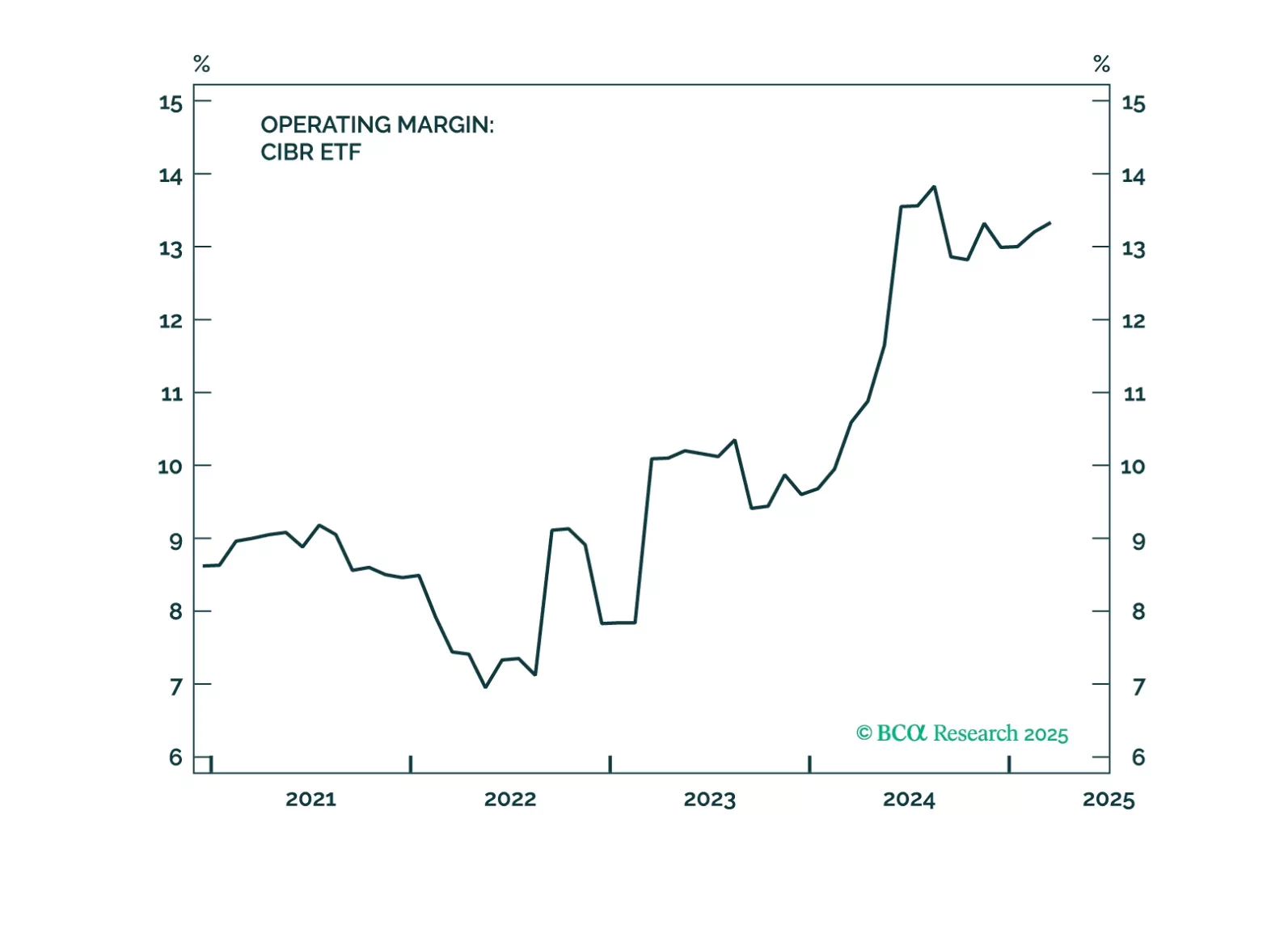
Dear Client, Over the next three weeks, much of BCA’s Geopolitical Strategy team will be traveling in Australia, New Zealand, and Asia. As such, we are taking this week off from publication and will return to our regular schedule next week. In lieu of our regular missive, we are sending you the following Special Report, penned by our colleagues in the BCA Technology Sector Strategy. The report, originally published on May 16, tackles “The Coming Robotics Revolution” in an innovative way that aligns with our own views. Clients often ask us what will be the political consequences of the revolution in artificial intelligence and robotics. Our answers are controversial because we strongly disagree with the conventional, Terminator-inspired, doom and gloom. Brian Piccioni and Paul Kantorovich agree with us, which is reassuring given that they understand the technology behind robotics far better than we do. I hope you enjoy the enclosed report and encourage you to seek out the insights of our Technology Sector Strategy. Kindest Regards, Marko Papic, Senior Vice President Chief Geopolitical Strategist Feature "The amount of technology coming at us in the next five years is probably more than we've seen in the last 50" Mark Franks, Director Of Global Automation at General Motors, Bloomberg News, April 2017 There is good reason to believe we are at the cusp of a Robot Revolution which will have a dramatic impact on our economy. Robots have been around for decades or centuries, depending on the definition. Past robots were either fixed in place, as in the case of factory robots, or supervised by operators that are near the robot, or connected through telemetry. In contrast, the robots that are coming will not be fixed in place, and will be able to perform their functions without a human operator. This opens up massive markets for robots in industry (cutting lawns, cleaning windows, delivering parcels, etc.) and, most significantly, consumer applications. Part 1: Robots - Industrial Revolution To Early 21st Century The term "robot" can have different meanings. The most basic definition is "a device that automatically performs complicated and often repetitive tasks,"1 a definition which encompasses a broad range of machines: from the Jacquard Loom,2 which was invented over 200 years ago, on to Numerically Controlled (NC) mills and lathes, pick and place machines used in the manufacture of electronics, Autonomous Vehicles (AVs), and even homicidal robots from the future such as the Terminator. For much of history, most of the labor force was involved with the production of food: over 50% of the U.S. labor force was involved in agriculture until the late 1800s (Chart 1). Agriculture has benefitted immensely from automation as inventions such as the McCormick Reaper (a wheat cutting machine pulled by horses), the cotton gin, and other mechanical systems displaced human effort. Steam and then internal combustion-powered tractors, which can be viewed as "robotic horses," accelerated the process, as engines delivered much more power more cost effectively than mechanical devices (Chart 2). This massively improved productivity: within 20 years from 1830 to 1850, the labor to produce 100 bushels of wheat dropped from 250-300 to 75-90 hours, and by 1955 it only took 6 ½ hours of labor for a net reduction of 97.5% in 125 years.3 Chart 1Farm Workers Were Disrupted In The Late 19th Century The Coming Robotics Revolution The Coming Robotics Revolution Chart 2...And So Were Horses The Coming Robotics Revolution The Coming Robotics Revolution In other words there is nothing new about automation displacing workers while improving productivity, nor is a rapid displacement unprecedented. The industrial revolution was about replacing human craft labor with capital (i.e. machines), which did high-volume work with better quality and productivity. This freed humans for work which had not yet been automated, along with designing, producing, and maintaining the machinery. Automation Frightens People Although automation is nothing new, it has always engendered anxiety among workers. The anxiety boils down to concern for continued employment as well as fear of the technology itself. We discuss below why Artificial Intelligence (AI) does not present the sort of threat to humanity or even employment that seems to be the consensus view at the moment. Will Robots Become Self-Aware? We have covered the topic of Artificial Intelligence/Deep Learning as it relates to sentient/self-aware machines in some detail in our October 18, 2016 Special Report on Artificial Intelligence. In summary, most of the discussion surrounding AI is misinformation. Although AI uses algorithms called "artificial neural networks," which are extremely useful for solving certain classes of problems, these are nothing like biological neural networks. There is no reason whatsoever to believe AI technology in its current form can become sentient, or even meaningfully intelligent, and that will not change with increased computing power. Furthermore, whether or not AI can arise to the level of a threat, there is no current or imagined power source which could keep a rampaging robot active for more than a few hours. The Terminator would have been much less threatening if he required frequent recharging. Will Robots Make Human Workers Irrelevant? Automation in agriculture occurred rapidly enough to be felt by workers at the time - and yet there were no marauding hordes of unemployed hay cutters or cowboys. Improved productivity meant markets were opened which did not previously exist, and unemployed agricultural workers moved to factory work. Media coverage of automation tends to focus on the potential job losses without mentioning the fact that the economy and its workers adapt, and overall living standards generally improve (Chart 3). Technology has displaced entire classes of jobs very rapidly in the recent past, and many products such as smartphones would be extremely difficult to assemble if the work was done by hand. Box 1 provides several other examples. Yet as is usual for many things that have happened multiple times in the past, we are told "this time is different." Chart 3The Industrial Revolution Led To A Vast Improvement In Living Standards The Industrial Revolution Led To A Vast Improvement In Living Standards The Industrial Revolution Led To A Vast Improvement In Living Standards Box 1 Automation Displaced Entire Classes Of Jobs In The Recent Past, But Brought Enormous Benefits Before calculators and word processors were available, writing and mathematical calculations were done manually. Machines such as calculators and type writers enhanced productivity, eliminating many such jobs. Software applications such as Microsoft Word and Excel further accelerated this process. Not that long ago, welding was entirely a manual job but now most welding in factories is done by robots: you can usually tell a human weld on a mass produced product by its poor quality. Robots in the modern factory have freed up workers for other roles in the economy just as the massive loss of agricultural jobs in the 20th century did. Many modern electronic products such as smartphones would be extremely difficult to assemble if the work was done by hand, as the components are so small they require microscopes to manipulate. Even if it were possible to hand assemble a smartphone, it would take hours of manual labor to produce, and the quality would be very poor. The use of automation means that smartphones cost a few hundred dollars instead of a few thousand dollars and are affordable enough to be a mass market item. Some of the anxiety around automation-related job losses centers on the possibility that this time, robots will displace workers from the service and white-collar sectors. BCA's European Investment Strategy service has written about the potential for AI to replace jobs involving tasks that require specialized education and training, such as calculating credit scores or insurance premiums, or managing stock portfolios.4 Recent developments in AI (specifically deep learning algorithms) have allowed computers to solve pattern recognition problems that they could not previously solve. However, we do not believe AI in its current form poses a widespread risk to white collar employment for the following reasons: Both service-sector and white collar employees have been subject to replacement through automation already, and the economy has adapted: ATMs are robot bank tellers, self-checkout lanes are robot checkout kiosks, and "smart" gas and electric meters that can be read remotely replace human meter readers. The legal profession has been transformed by Google searches and the accounting business by accounting software. These tools allow certain clients to avoid the use of a lawyer or accountant altogether (for example in setting up a corporation or doing bookkeeping), or allow a firm to employ less skilled workers for the task. We can offer numerous other examples of white collar jobs which have been fully or partially automated over the past couple decades. In addition, recall that AI produces high probability answers which turn out to be wrong, and it requires a lot of subject specific training. Both of these are intrinsic to the implementation of the algorithm. In contrast, humans generally are much better at assigning confidence to decisions and train very rapidly because they have cross-expertise AI lacks. An implementation of AI has to meet BOTH of the following conditions to be successful: There has to be a lot of subject-specific data available A high probability assigned to a wrong answer is either inconsequential or can be easily overruled by a human It is also important to note that although AI may reduce the demand for accountants, insurance agents, credit analysts and other skilled professionals, these are exactly the sort of people that can handle retraining. Part 2: What Makes Upcoming Robots Revolutionary Upcoming robots will be different because they will not be confined to the factory floor. We believe this is a key transition point, and that the next 20 years or so will see as dramatic a change from robotics as was caused by the Internet. Factory robots have improved immensely due to cheaper and more capable control and vision systems. Early robots performed very specific operations under carefully controlled conditions -an assembly robot which encountered a misaligned component would simply install it that way, resulting in a defective product. Eventually vision systems were developed which allowed robots to adjust to varying conditions. As camera and computing costs continue to decline, vision systems are becoming more elaborate and useful, as they gather and process more information to make increasingly complex decisions. As these systems evolve, the abilities of robots to move around their environment while avoiding obstacles will improve, as will their ability to perform increasingly complex tasks. Mobile robots will likely rely on AI to make many decisions. In order to be cost effective, for many years AI will likely be hosted in cloud data centers. This is especially the case for consumer robots, which will have to be highly capable and yet cost effective. We discuss the implications for cloud services providers in more detail in Part 3: Investment Implications. We May Be Entering A 'Virtuous Cycle' In Robotics Improvements to one domain of robotic applications can be generally applied to others. Robotics technology is concurrently moving forward on many fronts ranging from the aforementioned vacuum cleaners, lawnmowers, and logistics robots, to medical orderlies,5 farm tractors,6 mining equipment,7 transport trucks,8 and cargo ships.9 Despite enormous differences in cost and value added, all of these applications are solving essentially the same problem. As with any other technological revolution, advances between different fields in robotics will be adapted, borrowed, extended and enhanced. This, in turn, creates opportunities for ever more applications, creating a virtuous cycle (Diagram 1). Diagram 1Robotics Will Enter Into A Virtuous Cycle The Coming Robotics Revolution The Coming Robotics Revolution There are few tasks which cannot be automated, but there is a definite cost-benefit tradeoff for each one. For example, a golf course may consider spending $25,000 for a robotic lawnmower, however costs were closer to $70 - $90,000 in 2015,10 and installed cost is even higher.11 Because the incremental cost of the machines is comprised of electronics, which will drop in price rapidly, it is probably a matter of another 2 or 3 years before the price moves to the point where mass adoption by groundskeepers begins. The same improvements to industrial lawnmowers will lead to more useable, albeit still pricy, consumer models which will probably enter mass market adoption 5 to 10 years from now. The same argument can be made for almost any manual chore ranging from cleaning the carpet to delivering parcels. We predict the virtuous cycle for robots will span several decades. As the cost of automation drops, better solutions will be developed, resulting in 'early retirement' of dated but otherwise fully functional robotic systems. This is the opposite of the Feature Saturation phenomenon currently present in the smartphone and PC industries - though feature saturation will eventually hit robots as well. A Self-Driving Car Is A Robot The most important robotics technology, from a macroeconomic perspective, is the rapidly advancing field of Autonomous Vehicles (AVs). The automobile industry is a significant part of the global economy, so changes in this industry will have profound implications. We covered AVs in detail in our April 8, 2016 Special Report. Due to technical and legal obstacles that must be overcome, a vehicle which can safely travel from point to point on major roads and city streets without driver intervention is probably 20 years away, +/- 5 years. The macro impact, however, will occur much sooner than that, due to the technologies developed on the way to full AVs. Vehicles are already offering features such as forward collision warning, autobrake, lane departure warning, lane departure prevention, adaptive headlights, and blind spot detection.12 Although we have only touched the surface, robotics are being applied across many industries, making even seemingly modest advances significant when measured in aggregate, as small changes in one industry are quickly adapted by other industries. It is noteworthy that this transition will likely occur during a period where demographic shifts, in particular in the most developed economies, signal the potential for labor shortages, or at least increasing cost of labor (Chart 4).13, 14 Robots may be showing up in the nick of time to improve both the economy and quality of life in the developed world. Chart 4Advances In Robotics Will Counter Adverse##br## Demographic Trends Advances In Robotics Will Counter Adverse Demographic Trends Advances In Robotics Will Counter Adverse Demographic Trends Part 3: Investment Implications The semiconductor industry has stagnated as the PC and smartphone markets entered a largely replacement-driven era (Chart 5). Although it may not be evident until the virtuous cycle is fully engaged, robotics represents another up-leg in demand for semiconductors and therefore should result in a significant improvement to industry growth rates. There is little opportunity for startup semiconductor companies nowadays due to the high costs of developing a new chip. Well positioned, established, semiconductor companies will be the primary beneficiaries of the robotics revolution. Large firms that attempt to fit their existing product offering into the industry (e.g. by remaining PC or mobile-phone centric) will fall behind. Winners System on a Chip (SoC) Vendors: Robotics hardware will more likely be implemented as "System on a Chip" (SoC) as this provides the greatest functionality with lowest cost and power consumption. SoCs generally consist of a variety of Intellectual Property (IP) "cores" which may be licensed from third parties. Typically, IP cores consist of a microprocessor and various specialized subsystems, depending on the application. Robotics SoCs are likely to include Digital Signal Processing (DSP) or Image Processing cores to process sensor data. SoC vendors who target or encourage robot development, such as Overweight-rated Texas Instruments, are likely to be favored by early movers in the space.15 We believe it is a matter of time before Graphics Processors (GPUs) currently used in AI/Deep Learning are replaced by processors specifically designed for AI, which will be cheaper and more power efficient.16 This is one of the reasons for our Underweight rating on Nvidia. Semiconductor Foundries, Mixed Signal and Automotive Semiconductor Vendors: This environment will favor the merchant semiconductor foundries which manufacture most SoCs. In addition, firms with "mixed signal" expertise will experience increased demand for motor controls, sensor interfaces, etc. As robotics features are added to automobiles, demand for automotive semiconductors should outpace that in other sectors. A significant degree of commonality in the parts and systems used in advanced automobiles will be used in other mobile robots, so "automotive" semiconductor demand should significantly outpace automobile sales. Sensor Vendors: Robots need a variety of sensors, depending on the application. Unlike factory floor robots which can make do with cameras, mobile robots will require advanced radar, ultrasound, laser scanning and other sensor types in order to provide redundancy and cope with weather and other related issues. Important sensors on prototype AVs are currently made in low volumes and are extremely expensive. Due to the number of sensors involved, we believe there is significant opportunity for companies offering aggressive cost reduction in sensor technology. Wireless Equipment and Service Providers: Most robotic systems will include some degree of wireless connectivity and participate in the "Internet of Things" (IoT). This will present challenges and opportunities for wireless equipment and service providers,17, 18 as networks will have to adapt to increased upload bandwidth (from robot to carrier) as well as novel billing schemes. Coverage will also have to be expanded to accommodate AVs as it is non-existent or spotty in large stretches of North American roadways. Not being able to check Facebook between two cities is one thing, losing your robot driver is much more serious. Our recent downgrade of Cisco to Underweight19 may appear inconsistent with the analysis above. However, the company's valuation is extremely elevated and revenues are declining (Chart 6). Any benefit Cisco will derive from investment into wireless infrastructure is several years out, and open-source hardware initiatives are gaining momentum.20 For that reason, we see the risks as outweighing the opportunities at the moment for the company. Chart 5Long Replacement Cycles Mean Slower ##br##Semiconductor Sales Long Replacement Cycles Mean Slower Semiconductor Sales Long Replacement Cycles Mean Slower Semiconductor Sales Chart 6Cisco's Stock Price Is Close To Tech Bubble##br## Levels Despite Declining Revenue Cisco's Stock Price Is Close To Tech Bubble Levels Despite Declining Revenue Cisco's Stock Price Is Close To Tech Bubble Levels Despite Declining Revenue Cloud Service Providers: Most robots will be on line and some will likely use cloud services to offload computational effort and minimize cost. A relatively "dumb" robotic lawnmower which offloads control to a shared computational resource in the cloud would probably be cheaper than a much more capable fully autonomous system. This will increase demand for cloud services, however the challenge of declining margins (due to increased competition in the space) will offset cloud services revenue growth somewhat in the long term. On balance, Overweight-rated Microsoft and Alphabet/Google, as well as Amazon, stand to benefit. Chart 7Eastman Kodak Tried To Ignore The Shift ##br##To Digital Cameras Eastman Kodak Tried To Ignore The Shift To Digital Cameras Eastman Kodak Tried To Ignore The Shift To Digital Cameras Losers We believe companies who ignore the robotics revolution will find themselves at a significant competitive disadvantage. This is not unprecedented in the technology sector: Digital Equipment Corporation (DEC) and Kodak vanished because their business models could not accommodate an obvious shift in their core markets (Chart 7). Similarly Intel and Microsoft completely missed the smartphone revolution. As we noted in our April 8, 2016 Special Report on AVs, the frequency and severity of crashes will decrease dramatically which will lead to reduced insurance rates, fewer repairs, and less money spent on accident related healthcare and rehabilitation. The economic losses of automobile crashes were estimated $871 billion in the US in 201021 and even a modest reduction in the frequency and severity of collisions due to partial automation would have a significant economic impact. "Dumb" Auto Parts Manufacturers: Fewer collisions will result in fewer repairs to people or vehicles. Auto parts manufacturers will fall into two camps: those with significant expertise in robotics will prosper, while those without such expertise will fall behind as the demand for replacement components (fenders, bumpers, doors, windshields, etc.) will decline. AVs are also likely to include advanced diagnostic and service reminder systems which will result in more timely service, reducing wear and tear on internal components as well. The Auto Insurance Industry: While it is doubtful robotics will ever eliminate auto accidents, the rate might be reduced to such a level that the auto-insurance industry, worth $157 billion in the US alone,22 will be much smaller in 20 years than it is today. This will be offset to a degree by greater demands for product liability insurance for AVs and robots in general. Brian Piccioni, Vice President Technology Sector Strategy brianp@bcaresearch.com Paul Kantorovich, Research Analyst paulk@bcaresearch.com 1 http://www.merriam-webster.com/dictionary/robot 2 http://www.computersciencelab.com/ComputerHistory/HistoryPt2.htm 3 https://www.agclassroom.org/gan/timeline/farm_tech.htm 4 Please see European Investment Strategy Special Report, "Female Participation: Another Mega-Trend," dated April 6, 2017, available at eis.bcaresearch.com. 5 http://www.tomsguide.com/us/Forth-Valley-Royal-Robots-Serco-Medicine,news-7124.html 6 http://modernfarmer.com/2013/04/this-tractor-drives-itself/ 7 http://www.asirobots.com/mining/ 8 http://www.theaustralian.com.au/business/powering-australia/rio-rolls-out-the-robot-trucks/story-fnnnpqpy-1227090421535 9 http://www.bloomberg.com/news/articles/2014-02-25/rolls-royce-drone-ships-challenge-375-billion-industry-freight 10 http://techon.nikkeibp.co.jp/english/NEWS_EN/20141210/393619/ 11 http://www.golfcourseindustry.com/article/do-robotic-mowers-dream-of-electric-turf/ 12 http://www.iihs.org/iihs/topics/t/crash-avoidance-technologies/topicoverview 13 http://gbr.pepperdine.edu/2010/08/preparing-for-a-future-labor-shortage/ 14 http://www.imf.org/external/pubs/ft/fandd/2013/06/das.htm 15 http://www.ti.com/corp/docs/engineeringChange/robotics.html 16 Please see Technology Sector Strategy Weekly Report, "Google - AI And Cloud Strategy," dated April 25, 2017, available at tech.bcaresearch.com. 17 http://www.fiercemobileit.com/press-releases/gartner-says-internet-things-will-transform-data-center 18 http://www.computerworld.com/article/2886316/mobile-networks-prep-for-the-internet-of-things.html 19 Please see Technology Sector Strategy Weekly Report, "Networking Equipment Update ," dated March 28, 2017, available at tech.bcaresearch.com. 20 http://www.businessinsider.com/att-white-box-test-should-scare-cisco-juniper-2017-4 21 http://www.nhtsa.gov/About+NHTSA/Press+Releases/2014/NHTSA-study-shows-vehicle-crashes-have-$871-billion-impact-on-U.S.-economy,-society 22 http://www.bloomberg.c/bw/articles/2014-09-10/why-self-driving-cars-could-doom-the-auto-insurance-industry

Related Topics