Sorry, you need to enable JavaScript to visit this website.
Skip to main content

Iran

Executive Summary The Ukraine war reinforces our key view that commodity producers will use their geopolitical leverage this year. The market is growing complacent again about Russian risks. Iran is part of the same dynamic. If US-Iran talks fail, as we expect, the Middle East will destabilize and add another energy supply risk on top of the Russian risk. The Ukraine war also interacts with our other two key views for 2022: China’s reversion to autocracy and the US’s policy insularity. Both add policy uncertainty and weigh on risk sentiment. The war also reinforces our strategic themes for the 2020s: Great Power Rivalry, Hypo-Globalization, and Populism/Nationalism. Stagflation Cometh Stagflation Cometh Stagflation Cometh Trade Recommendation Inception Date Return Cyclically Long Global Defensives Versus Cyclicals 2022-01-20 10.8% Bottom Line: Tactically stay long global defensives and large caps. Cyclically stay long gold, US equities, aerospace/defense, and cyber security. Feature In our annual outlook, “The Gathering Storm,” we argued that the post-pandemic world economy would destabilize due to intensifying rivalry among the leading nations. We argued that China’s reversion to autocracy, US domestic divisions, and Russia’s commodity leverage would produce a toxic brew for global investors in 2022. By January 27 it was clear to us that Russia would invade Ukraine, so the storm was arriving sooner than we thought, and we doubled down on our defensive and risk-averse market positioning. We derived these three key views from new cyclical trends and the way they interact with our underlying strategic themes – Great Power Rivalry, Hypo-Globalization, and Populism/Nationalism (Table 1). These themes are mutually reinforcing, rooted in solid evidence over many years, and will not change easily. Table 1Three Geopolitical Strategic Themes Second Quarter Outlook 2022: When It Rains, It Pours Second Quarter Outlook 2022: When It Rains, It Pours Related Report  Geopolitical Strategy2022 Key Views: The Gathering Storm The Ukraine war reinforces them: Russia took military action to increase its security relative to the US and NATO; the West imposed sanctions that reduce globalization with Russia and potentially other states; Russian aggression stemmed from nationalism and caused a spike in global prices that will spur more nationalism and populism going forward. In this report we examine how these trends will develop in the second quarter and beyond. We see stagflation taking shape and recommend investors prepare for it by continuing to favor defensive sectors, commodities, and value plays. Checking Up On Our Russia View For 2022 Our third key view for 2022 – that oil producers like Russia and Iran possessed immense geopolitical leverage and would most likely use it – is clearly the dominant geopolitical trend of the year, as manifested in the Russian invasion of Ukraine.1 Russia first invaded Ukraine in 2014 and curtailed operations after commodity prices crashed. It launched a new and larger invasion in 2022 when a new commodity cycle began (Chart 1). Facing tactical setbacks, Russia has begun withdrawing forces from around the Ukrainian capital Kyiv. But it will redouble its efforts to conquer the eastern Donbas region and the southern coastline. The coast is the most strategic territory at stake (Map 1). Chart 1Russia's Commodity-Enabled Aggression Russia's Commodity-Enabled Aggression Russia's Commodity-Enabled Aggression Map 1Russian Invasion Of Ukraine, 2022 Second Quarter Outlook 2022: When It Rains, It Pours Second Quarter Outlook 2022: When It Rains, It Pours The most decisive limitation on Russia’s military effort would come from a collapse of commodity exports or prices, which has not happened yet. Europe continues to buy Russian oil and natural gas, although it is debating a ban on the $4.4 billion worth of coal that it imports. With high energy prices making up for a drop in export volumes, Russian armed forces can still attempt a summer and fall campaign (Chart 2). The aim would be to conquer remaining portions of Donetsk and Luhansk, the “land bridge” to Crimea, and potentially the stretch of land between the Dnieper river and eastern Moldova, where Russian troops are already stationed. Chart 2Russia’s War Financing Second Quarter Outlook 2022: When It Rains, It Pours Second Quarter Outlook 2022: When It Rains, It Pours Ukraine’s military neutrality is the core Russian objective. Ukraine is offering neutrality in exchange for security guarantees in the current ceasefire talks. Hence a durable ceasefire is possible if the details of neutrality are agreed – Ukraine forswears joining NATO and hosting foreign military infrastructure while accepting limitations on military exercises and defense systems. The security guarantees that Ukraine demands are mostly symbolic, as the western powers that would be credible guarantors are already unwilling to use military force against Russia (e.g. the US, UK, NATO members). However, Russia’s withdrawal from Kyiv will embolden the Ukrainians, so we do not expect a durable ceasefire in the second quarter. Global investors will be mistaken if they ignore Ukraine in the second quarter, at least until core problems are resolved. What matters most is whether the war expands beyond Ukraine: The likelihood of a broader war is low but not negligible. So far the Russian regime is behaving somewhat rationally: Moscow attacked a non-NATO member to prevent it from joining NATO; it limited the size of the military commitment; and it is now accepting reality and withdrawing from Kyiv while negotiating on Ukrainian neutrality. But a major problem emerges if Russia’s military fails in the Donbas while Ukraine reneges on offers of neutrality. Any ceasefire could fall apart and the war could re-escalate. Russia could redouble its attacks on the country or conduct a limited attack outside of Ukraine to trigger a crisis in the western alliance. Moreover, if sanctions keep rising until Russia’s economy collapses, Moscow could become less rational. Finland and Sweden have seen a shift of public opinion in favor of joining NATO. Any intention to do so would trigger a belligerent reaction from Russia. These governments are well aware of the precarious balance that must be maintained to prevent war, so war is unlikely. But if their stance changes then Russia will threaten to attack. Russia would threaten to bomb these states since it cannot now credibly threaten invasion by land (Charts 3A & 3B). Chart 3ANordic States Joining NATO Would Trigger Larger War Second Quarter Outlook 2022: When It Rains, It Pours Second Quarter Outlook 2022: When It Rains, It Pours ​​​​​ Chart 3BNordic States Joining NATO Would Trigger Larger War Second Quarter Outlook 2022: When It Rains, It Pours Second Quarter Outlook 2022: When It Rains, It Pours ​​​​​​ The Black Sea is vulnerable to “Black Swan” events or military spillovers. Russia is re-concentrating its military efforts in the Donbas and land bridge to Crimea. Russia could expand its offensive to Odessa and the Moldovan border. Or Russia could attempt to create a new norm of naval dominance in the Black Sea. Or ships from third countries could hit mines or become casualties of war. For these and other reasons, investors should not take on additional risk in their portfolios on the basis that a durable ceasefire will be concluded quickly. Russia’s position is far too vulnerable to encourage risk-taking. Moscow could escalate tensions to try to save face. It is also critical to ensure that Russia and Europe maintain their energy trade: Neither side has an interest in total energy cutoff. Russia needs the revenue to finance its war and needs to discourage Europe from fulfilling its pledges to transition rapidly to other sources and substitutes. Europe needs the energy to avoid recession, maintain some tie with Russia, and enable its energy diversification strategy. So far natural gas flows are continuing (Chart 4). Chart 4Natural Gas Flows Continuing (So Far) Natural Gas Flows Continuing (So Far) Natural Gas Flows Continuing (So Far) ​​​​​​ Chart 5Global Oil Supply/Demand Balance Global Oil Supply/Demand Balance Global Oil Supply/Demand Balance ​​​​​​ However, risks to energy trade are rising. Russia is threatening to cut off energy exports if not paid in rubles, while the EU is beginning to entertain sanctions on energy. Russia can reduce oil or gas flows incrementally to keep prices high and prevent Europe from rebuilding stockpiles for fall and winter. Partial energy cutoff is possible. Europe’s diversification makes Russia’s predicament dire. Substantial sanction relief is highly unlikely, as western powers will want to prevent Russia from rebuilding its economy and military. Russia could try to impose significant pain on Europe to try to force a more favorable diplomatic solution. A third factor that matters is whether the US will expand its sanction enforcement to demand strict compliance from other nations, at pain of secondary sanctions: Secondary sanctions are likely in the case of China and other nations that stand at odds with the US and help Russia circumvent sanctions. In China’s case, the US is already interested in imposing sanctions on the financial or technology sector as part of its long-term containment strategy. While the Biden administration’s preference is to control the pace of escalation with China, and thus not to slap sanctions immediately, nevertheless substantial sanctions cannot be ruled out in the second quarter. Secondary sanctions will be limited in the case of US allies and partners, such as EU members, Turkey, and India. Countries that do business with Russia but are critical to US strategy will be given waivers or special treatment. Russia is not the only commodity producer that enjoys outsized geopolitical leverage amid a global commodity squeeze. Iran is the next most critical producer. Iran is also critical for the stability of the Middle East. In particular, the consequential US-Iran talks over whether to rejoin the 2015 nuclear deal are likely to come to a decision in the second quarter. Chart 6Failure Of US-Iran Talks Jeopardizes Middle East Oil Supply Failure Of US-Iran Talks Jeopardizes Middle East Oil Supply Failure Of US-Iran Talks Jeopardizes Middle East Oil Supply If the US and Iran agree to a strategic détente, then regional tensions will briefly subside, reducing global oil disruption risks and supply pressures. Iran could bring 1.3 million barrels per day of oil back online, adding to President Biden’s 1 million per day release of strategic petroleum reserves. The combination would amount to 2.3% of global demand and more than cover the projected quarterly average supply deficit, which ranges from 400k to 900k barrels per day for the rest of 2022 (Chart 5). If the US and Iran fail to agree, then the Middle East will suffer another round of instability, adding a Middle Eastern energy shock on top of the Russian shock. Not only would Iran’s 1.3 million barrels per day be jeopardized but so would Iraq’s 4.4 million, Saudi Arabia’s 10.3 million, the UAE’s 3.0 million, or the Strait of Hormuz’s combined 24 million per day (Chart 6). This gives Iran leverage to pursue nuclear weaponization prior to any change in US government that would strengthen Israel’s ability to stop Iran. We would not bet on an agreement – but we cannot rule it out. The Biden administration can reduce sanctions via executive action to prevent a greater oil shock, while the Iranians can accept sanction relief in exchange for easily reversible moves toward compliance with the 2015 nuclear deal. But this would be a short-term, stop-gap measure, not a long-term strategic détente. Conflict between Iran and its neighbors will revive sooner than expected after the deal is agreed, as Iran’s nuclear ambitions will persist. OPEC states are already producing more oil rapidly, suggesting no quick fix if the US-Iran deal falls apart. While core OPEC states have 3.5 million barrels per day in spare capacity to bring to bear, a serious escalation of tensions with Iran would jeopardize this solution. Finally, if commodity producers have geopolitical leverage, then commodity consumers are lacking in leverage. This is clear from Europe’s inability to prevent Russia’s attack or ban Russian energy. It is clear from the US’s apparent unwillingness to give up on a short-term deal with Iran. It is clear from China’s inability to provide sufficient monetary and fiscal stimulus as it struggles with Covid-19. Turkey, Egypt, and Pakistan are geopolitically significant importers of Russian and Ukrainian grain that are likely to face food insecurity and social unrest. We will address this issue below under our Populism/Nationalism theme. Bottom Line: Investors should not be complacent. Russia’s military standing in Ukraine is weak, but its ability to finance the war has not yet collapsed, which means that it will escalate the conflict to save face. What About Our Other Key Views For 2022? Our other two key views for 2022 are even more relevant in the wake of the Ukraine re-invasion. China’s reversion to autocracy is a factor in China’s domestic and foreign policy: Domestically China needs economic and social stability in the advance of the twentieth national party congress, when President Xi Jinping hopes to clinch 10 more years in power. In pursuit of this goal China is easing monetary and fiscal policy. However, with depressed animal spirits, a weakening property sector, and high debt levels, monetary policy is proving insufficient. Fiscal policy will have to step up. But even here, inflation is likely to impose a limitation on how much stimulus the authorities can utilize (Chart 7). Chart 7China Stimulus Impaired By Inflation China Stimulus Impaired By Inflation China Stimulus Impaired By Inflation ​​​​​​ Chart 8Chinese Supply Kinks To Persist Due To Covid-19 Chinese Supply Kinks To Persist Due To Covid-19 Chinese Supply Kinks To Persist Due To Covid-19 China is also trying but failing to maintain a “Covid Zero” policy. The more contagious Omicron variant of the virus is breaking out and slipping beyond the authorities’ ability to suppress cases of the virus to zero. Shanghai is on lockdown and other cities will follow suit. China will attempt to redouble its containment efforts before it will accept the reality that the virus cannot be contained. Chinese production and shipping will become delayed and obstructed as a result, putting another round of upward pressure on global prices (Chart 8). Stringent pandemic restrictions could trigger social unrest. China is ripe for social unrest, which is why it launched the “Common Prosperity” program last year to convince citizens that quality of life will improve. But this program is a long-term program that will not bring immediate relief. On the contrary, the economy is still suffering and the virus will spread more widely, as well as draconian social restrictions. The result is that the lead up to the national party congress will not be as smooth as the Xi administration had hoped. Global investors will remain pessimistic toward Chinese stocks. In foreign affairs, China’s reversion to autocracy is reinforced by Russia’s clash with the West and the need to coordinate more closely. Xi hosted Putin in Beijing on February 4, prior to the invasion, and the two declared that their strategic partnership ushers in a “new era” of “multipolarity” and that their cooperation has “no limits,” which really means that military cooperation is not forbidden. China agreed to purchase an additional 10 billion cubic meters of Russian natural gas over 30-years. While this amount would only replace 3% of Russian natural gas exports to Europe, it would mark a 26% increase in Russian exports to China. More importantly it acts as a symbol of Chinese willingness to substitute for Europe over time. There is a long way to go for China to replace Europe as a customer (Chart 9). But China knows it needs to convert its US dollar foreign exchange reserves, vulnerable to US sanctions, into hard investments in supply security within the Eurasian continent. Chart 9Long Way To Go For China NatGas Imports To Replace EU Second Quarter Outlook 2022: When It Rains, It Pours Second Quarter Outlook 2022: When It Rains, It Pours China is helping Russia circumvent sanctions. China’s chief interest is to minimize the shock to its domestic economy. This means keeping Russian energy and commodities flowing. China could also offer military equipment for Russia. The US has expressly warned China against taking such an action. China could mitigate the blowback by stipulating that the assistance cannot be used in Ukraine. This would be unenforceable but would provide diplomatic cover. While China is uncomfortable with the disturbance of the Ukraine war – it does not want foreign affairs to cause even larger supply shocks. At the same time, China does not want Russia to lose the war or Putin’s regime to fall from power. If Russia loses, Taiwan and its western allies would be emboldened, while Russia could pursue a détente with the West, leaving China isolated. Since China faces US containment policy regardless of what happens in Russia, it is better for China to have Putin making an example out of Ukraine and keeping the Americans and Europeans preoccupied. Chart 10China Strives To Preserve EU Trade Ties China Strives To Preserve EU Trade Ties China Strives To Preserve EU Trade Ties China must also preserve ties with Europe. Diplomacy will likely succeed in the short run since Europe has no interest or desire to expand sanctions to China. The Biden administration will defer to Europe on the pace of sanctions – it is not willing or able to force Europe to break with China suddenly. Eventually Europe and China may sever relations but not yet – China has a powerful incentive to preserve them (Chart 10). China will also court India and other powers in an attempt to hedge its bets on Russia while weakening any American containment. Beyond the party congress, China will be focused on securing the economic recovery and implementing the common prosperity agenda. The first step is to maintain easy monetary and fiscal policy. The second step is to “let 100 flowers bloom,” i.e. relaxing social and regulatory controls to try to revive entrepreneurship and animal spirits, which are heavily depressed. Xi will have the ability to do this after re-consolidating power. The third step will be to try to stabilize economic relations with Europe and others (conceivably even the US temporarily, though no serious détente is likely). The remaining key view for 2022 is that the Biden administration’s domestic focus will be defensive and will invite foreign policy challenges. The Ukraine war vindicates this view but the question now is whether Biden has or will change tack: The Biden administration is focused on the midterm elections and the huge risk to the Democratic Party’s standing. Biden has not received a boost in opinion polls from the war. He is polling even worse when it comes to handling of the economy (Chart 11). While he should be able to repackage his budget reconciliation bill as an energy security bill, his thin majorities in both houses make passage difficult. Chart 11Biden And Democrats Face Shellacking In Midterm Election Second Quarter Outlook 2022: When It Rains, It Pours Second Quarter Outlook 2022: When It Rains, It Pours Biden’s weak standing – with or without a midterm shellacking – raises the prospect that Republicans could take back the White House in 2024, which discourages foreign nations from making any significant concessions to the United States in their negotiations. They must assume that partisanship will continue to contaminate foreign policy and lead to abrupt policy reversals. In foreign policy, the US remains reactive in the face of Russian aggression. If Russia signs a ceasefire, the US will not sabotage it to prolong Russian difficulties. Moreover Biden continues to exempt Europe and other allies and partners from enforcing the US’s most severe sanctions for fear of a larger energy shock. Europe’s avoidance of an energy ban is critical and any change in US policy to try to force the EU to cut off Russian energy is unlikely. China will not agree to structural reform or deep concessions in its trade negotiations, knowing that former President Trump could come back. The Biden administration’s own trade policy toward China is limited in scope, as the US Trade Representative Katherine Tai admitted when she said that the US could no longer aim to change China’s behavior via trade talks. Biden’s only proactive foreign policy initiative, Iran, will not bring him public kudos if it is achieved. But American inconstancy is one of the reasons that Iran may walk away from the 2015 nuclear deal. Why should Iran’s hawkish leaders be expected to constrain their nuclear program and expose their economy to future US sanctions if they can circumvent US sanctions anyway, and Republicans have a fair chance of coming back into power as early as January 2025? Biden’s unprecedented release of strategic petroleum reserves will not be able to prevent gasoline prices from staying high given the underlying supply pressures at home and abroad. This is especially true if the Iran talks fail as we expect. Even if inflation abates before the election, it is unlikely to abate enough to save his party from a shellacking. That in turn will weaken the global impression of his administration’s staying power. Hence Biden will focus on maintaining US alliances, which means allowing Europe, India, and others to proceed at a more pragmatic and dovish pace in their relations with Russia and China. Bottom Line: China’s reversion to autocracy and America’s policy insularity suggest that global investors face considerable policy uncertainty this year even aside from the war in Europe. Checking Up On Our Strategic Themes For The 2020s Russia’s invasion strongly confirmed our three strategic themes of Great Power Rivalry, Hypo-Globalization, and Populism/Nationalism. These themes are mutually reinforcing: insecurity among the leading nation-states encourages regionalization rather than globalization, while populism and nationalism encourage nations to pursue economic and security interests at the expense of their neighbors. First, the Ukraine war confirms and exacerbates Great Power Rivalry: Chart 12China And Russia Both Need To Balance Against US Preponderance Second Quarter Outlook 2022: When It Rains, It Pours Second Quarter Outlook 2022: When It Rains, It Pours Russia’s action vindicates the “realist” school of international relations (in which we count ourselves) by forcing the world to wake up to the fact that nations still care primarily about national security defined in material ways, such as armies, resources, and territories. The paradox of realism is that if at least one of the great nations pursues its national self-interest and engages in competition for security, then all other nations will be forced to do the same. If a nation neglects its national security interests in pursuit of global economic engagement and cooperation, then it will suffer, since other nations will take advantage of it to enhance their security. Hence, as a result of Ukraine, nations will give a higher weight to national security relative to economic efficiency. The result will be an acceleration of decisions to use fiscal funds and guide the private economy in pursuit of national interests – i.e. the Return of Big Government. Since actions to increase deterrence will provoke counteractions for the same reason, overall insecurity will rise. For example, the US and China will take extra precautions in case of future sanctions and war. But these precautions will reduce trust and cooperation and increase the probability of war over the long run. For the same reason, China cannot reject Russia’s strategic overture – it cannot afford to alienate and isolate Russia. China and Russia have a shared interest in countering the United States because it is the only nation that could conceivably impose a global empire over all nations (Chart 12). The US could deprive Beijing and Moscow of the regional spheres of influence that they each need to improve their national security. This is true not only in Ukraine and Taiwan but in other peripheral areas such as Belarus, the Caucasus, Central Asia, and Southeast Asia. China has much to gain from Russia. Russia is offering China privileged overland access to Russian, Central Asian, and Middle Eastern resources and markets. This resource base is vital to China’s strategic needs, given its import dependency and vulnerability to US maritime power (Chart 13). Chart 13China’s Maritime Vulnerability Forces Eurasian Strategy, Russian Alliance Second Quarter Outlook 2022: When It Rains, It Pours Second Quarter Outlook 2022: When It Rains, It Pours Investors should understand Great Power Rivalry in a multipolar rather than bipolar sense. As Russia breaks from the West, investors are quick to move rapidly to the bipolar Cold War analogy because that is what they are familiar with. But the world today has multiple poles of political power, as it did for centuries prior to the twentieth. While the US is the preponderant power, it is not hegemonic. It faces not one but two revisionist challengers – Russia and China. Meanwhile Europe and India are independent poles of power that are not exclusively aligned with the US or China. For example, China and the EU need to maintain economic ties with each other for the sake of stability, and neither the US nor Russia can prevent them from doing so. The same goes for India and Russia. China will embrace Russia and Europe at the same time, while hardening its economy against US punitive measures. India will preserve ties with Russia and China, while avoiding conflict with the US and its allies (the maritime powers), whom it needs for its long-term strategic security in the Indian Ocean basin. Ultimately bipolarity may be the end-game – e.g. if China takes aggressive action to revise the global order like Russia has done – but the persistence of Sino-European ties and Russo-Indian ties suggest we are not there yet. Second, the Ukraine war reinforces Hypo-Globalization: Since the pandemic we have argued that trade would revive on the global economic snapback but that globalization – the deepening of trade integration – would ultimately fall short of its pre-2020 and pre-2008 trajectory. Instead we would inhabit a new world of “hypo-globalization,” in which trade flows fell short of potential. So far the data support this view (Chart 14). Chart 14Globalization Falling Short Of Potential Second Quarter Outlook 2022: When It Rains, It Pours Second Quarter Outlook 2022: When It Rains, It Pours The Ukraine war has strengthened this thesis not only by concretely reducing Russia’s trajectory of trade with the West – reversing decades of integration since the fall of the Soviet Union – but also by increasing the need for nations to guard against a future Chinese confrontation with the Western world. Trust between China and the West will further erode. China will need to guard against any future sanctions, and thus diversify away from the US dollar and assets, while the US will need to do a better job of deterring China against aggression in Asia, and will thus have to diversify away from Chinese manufacturing and critical resources like rare earths. While China and Europe need each other now, the US and China are firmly set on a long-term path of security competition in East Asia. Eventually either the US or China will take a more aggressive stance and Europe will be forced to react. Since Europe will still need US support against a decaying and aggressive Russia, it will likely be dragged into assisting the US against China. Third, the Ukraine war reflects and amplifies Populism/Nationalism: Populism and nationalism are not the same thing but they both stem from the slowing trend of global income growth, the rise of inequality, the corruption of the elite political establishments, and now the rise in inflation. Nations have to devote more resources to pacifying an angry populace, or distracting that populace through foreign adventures, or both. The Ukraine war reflects the rise in nationalism. First, the collapse of the Soviet Union ushered in a period in which Moscow lost control of its periphery, while the diverse peoples could pursue national self-determination and statehood. The independence and success of the Baltic states depended on economic and military cooperation with the West, which eroded Russian national security and provoked a nationalist backlash in the form of President Putin’s regime. Ukraine became the epicenter of this conflict. Ukraine’s successful military resistance is likely to provoke a dangerous backlash from Moscow until either policy changes or the regime changes. American nationalism has flared repeatedly since the fall of the Soviet Union, namely in the Iraq war. The American state has suffered economically and politically for that imperial overreach. But American nationalism is still a potent force and could trigger a more aggressive shift in US foreign policy in 2024 or beyond. European states have kept nationalism in check and tried to subsume their various nationalist sentiments into a liberal and internationalist project, the European Union. The wave of nationalist forces in the wake of the European debt crisis has subsided, with the exception of the United Kingdom, where it flowered in Brexit. The French election in the second quarter will likely continue this trend with the re-election of President Emmanuel Macron, but even if he should suffer a surprise upset to nationalist Marine Le Pen, Europe’s centripetal forces will prevent her from taking France out of the EU or euro or NATO (Chart 15). Over the coming decade, nationalist forces will revive and will present a new challenge to Europe’s ruling elites – but global great power competition strongly supports the EU’s continued evolution into a single geopolitical entity, since the independent states are extremely vulnerable to Russia, China, and even the US unless they unite and strengthen their superstructure. Chart 15Macron Favored, Le Pen Would Be Ineffective Macron Favored, Le Pen Would Be Ineffective Macron Favored, Le Pen Would Be Ineffective In fact the true base of global nationalism is migrating to Asia. Chinese and Indian nationalism are very potent forces under President Xi Jinping and Prime Minister Narendra Modi. Xi is on the verge of clinching another ten years in power while Modi is still favored for re-election in 2024, so there is no reason to anticipate a change anytime soon. The effects are various but what is most important for investors is to recognize that as China’s potential GDP has fallen over the past decade, the Communist Party has begun to utilize nationalism as a new source of legitimacy, and this is expressed through a more assertive foreign policy. President Xi is the emblem of this shift and it will not change, even if China pursues a lower profile over certain periods to avoid provoking the US and its allies into a more effective coalition to contain China. Chart 16Food Insecurity Will Promote Global Unrest, Populism Food Insecurity Will Promote Global Unrest, Populism Food Insecurity Will Promote Global Unrest, Populism The surge in global prices will destabilize regimes that lack food security and contribute to new bouts of populism and nationalism. Turkey is the most vulnerable due to a confluence of political, economic, and military risks that will unsettle the state. But Egypt is vulnerable to an Arab Spring 2.0 that would have negative security implications for Israel and add powder to the Middle Eastern powder keg. Pakistan is already witnessing political turmoil. Investors may overlook any Indonesian unrest due to its attractiveness in a world where Russia and China are scaring away western investment (Chart 16). All three of these strategic themes are mutually reinforcing – and they tend to be inflationary over the long run. Great powers that redouble the pursuit of national interest – through defense spending and energy security investments – while simultaneously being forced to expand their social safety nets to appease popular discontent, will drive up budget deficits, consume a lot of natural resources, and purchase a lot of capital equipment. They will also more frequently engage in economic or military conflicts that constrain supply (Chart 17). Chart 17War And Preparation For War Are Inflationary War And Preparation For War Are Inflationary War And Preparation For War Are Inflationary Bottom Line: The Ukraine war is a powerful confirmation of our three strategic themes. It is also a confirmation that these themes have inflationary macroeconomic implications. Investment Takeaways Chart 18Global Investors Still Flee To US For Safety Global Investors Still Flee To US For Safety Global Investors Still Flee To US For Safety Now that great power rivalry is intensifying immediately and rapidly, and yet China’s and Europe’s economies are encountering greater difficulties, we expect stagflation to arrive sooner rather than later. High headline and core inflation, the Ukraine war, tacit Chinese support for Russia, persistent Chinese supply kinks, US and EU sanctions, US midterm elections, and a potential US-Iran diplomatic breakdown will all weigh on risk sentiment in the second quarter. In Ukraine, Russia’s position is too weak to give comfort for investors, who should continue to favor defensive over cyclical equities and US stocks over global stocks. Russia’s break with the West, and the West’s use of sanctions to prevent Russia from accessing its foreign exchange reserves, has raised new questions about the global currency reserve system and the dollar’s status within that system. Over the coming years China will redouble the efforts it began in the wake of the Great Recession to reduce its dependency on US dollar assets within its reserve basket, while also recycling new current account surpluses into non-dollar assets. However, the evidence does not suggest that King Dollar will suffer a structural breakdown. First, the world lacks alternative safe-haven assets to US Treasuries – and net foreign purchases of US bonds rose in the face of the Ukraine war (Chart 18). Second, the return of war to Europe will weaken the perceived long-term security of European currency and government bonds relative to US counterparts. Even if the Ukraine war is contained in the short run, as we expect, Russia is in structural decline and will remain a disruptive player for some time. We are not at all bearish on the euro or European bonds but we do not see the Ukraine war as increasing their value proposition, to put it lightly. The same logic extends to Japanese bonds, since China, like Russia, is an autocratic and revisionist state that threatens to shake up the security order in its neighborhood. Japan is relatively secure as a nation and we are bullish on the yen, but China’s de facto alliance with Russia weakens Japan’s security outlook over the very long run, especially relative to the United States. Thus, on a cyclical basis the dollar can depreciate, but on a structural basis the US dollar will remain the dominant reserve currency. The US is not only the wealthiest and most secure country in the world but also the largest oil producer. Meanwhile Chinese potential growth, domestic political stability, and foreign relations are all worsening. The US-Iran talks are the most critical geopolitical dynamic in the second quarter aside from Russia’s clash with the West. The fate of the 2015 nuclear deal will be decided soon and will determine whether an even bigger energy shock begins to emanate from the Middle East. We would not bet on a new US-Iran deal but we cannot rule it out. Any deal would be a short-term, stop-gap deal but would prevent an immediate destabilization of the Middle East this year. As such it would reduce the risk of stagflation. Since we expect the deal to fail, we expect a new energy shock to emerge. We see stagflation as more likely than the BCA House View. It will be difficult to lift productivity in an environment of geopolitical and political uncertainty combined with slowing global growth, rising interest rates, and a worsening commodity shock (Chart 19). We will gladly revise this stance if Biden clinches an Iran deal, China relaxes its Covid Zero policy and stabilizes domestic demand, Russia and Europe maintain energy trade, and commodity prices fall to more sustainable levels for global demand. Chart 19Stagflation Cometh Stagflation Cometh Stagflation Cometh Strategically we remain long gold, overweight US equities, overweight UK equities, long British pound and Japanese yen, long aerospace/defense stocks and cyber security stocks. We remain short Chinese renminbi and Taiwanese dollar and short emerging European assets. Our short Chinese renminbi trade and our short Taiwanese versus Korean equity trade are our worst-performing recommendations. However, the above analysis should highlight – and the Ukraine war should underscore – that these two economies face a fundamentally negative geopolitical dynamic. Both Chinese and Taiwanese stocks have been underperforming global peers since 2021 and our short TWD-USD trade is in the money. While we do not expect war to break out in Taiwan this year, we do expect various crisis events to occur, particularly in the lead up to the crucial Taiwanese and American 2022 midterms and 2024 presidential election. We also expect China to depreciate the renminbi when inflation peaks and commodity prices subside. Cyclically we remain long North American and Latin American oil producers and short Middle Eastern producers, based on our pessimistic read of the Iran situation. The Americas are fundamentally better protected from geopolitical risks than other regions, although they continue to suffer from domestic political risks on a country-by-country basis. Cyclically we continue to take a defensive positioning, overweighting defensive sectors and large cap equities.   Matt Gertken Chief Geopolitical Strategist mattg@bcaresearch.com   Footnotes 1      That the Russian threat fell under our third key view for 2022 implies that we did not get our priorities straight. However, consider the timing: shortly after publishing our annual outlook on December 15, the Russians issued an ultimatum to the western powers demanding that NATO stop expanding toward Russia. Diplomats from Russia and the West met on January 12-13 but Russia’s demands were not met. We upgraded the odds that Russia would invade Ukraine from 50% to 75% on January 27. Shuttle diplomacy ensued but failed. Russia invaded on February 24. Strategic Themes Open Tactical Positions (0-6 Months) Open Cyclical Recommendations (6-18 Months) Regional Geopolitical Risk Matrix "Batting Average": Geopolitical Strategy Trades () Section II: Special (EDIT this Header) Section III: Geopolitical Calendar
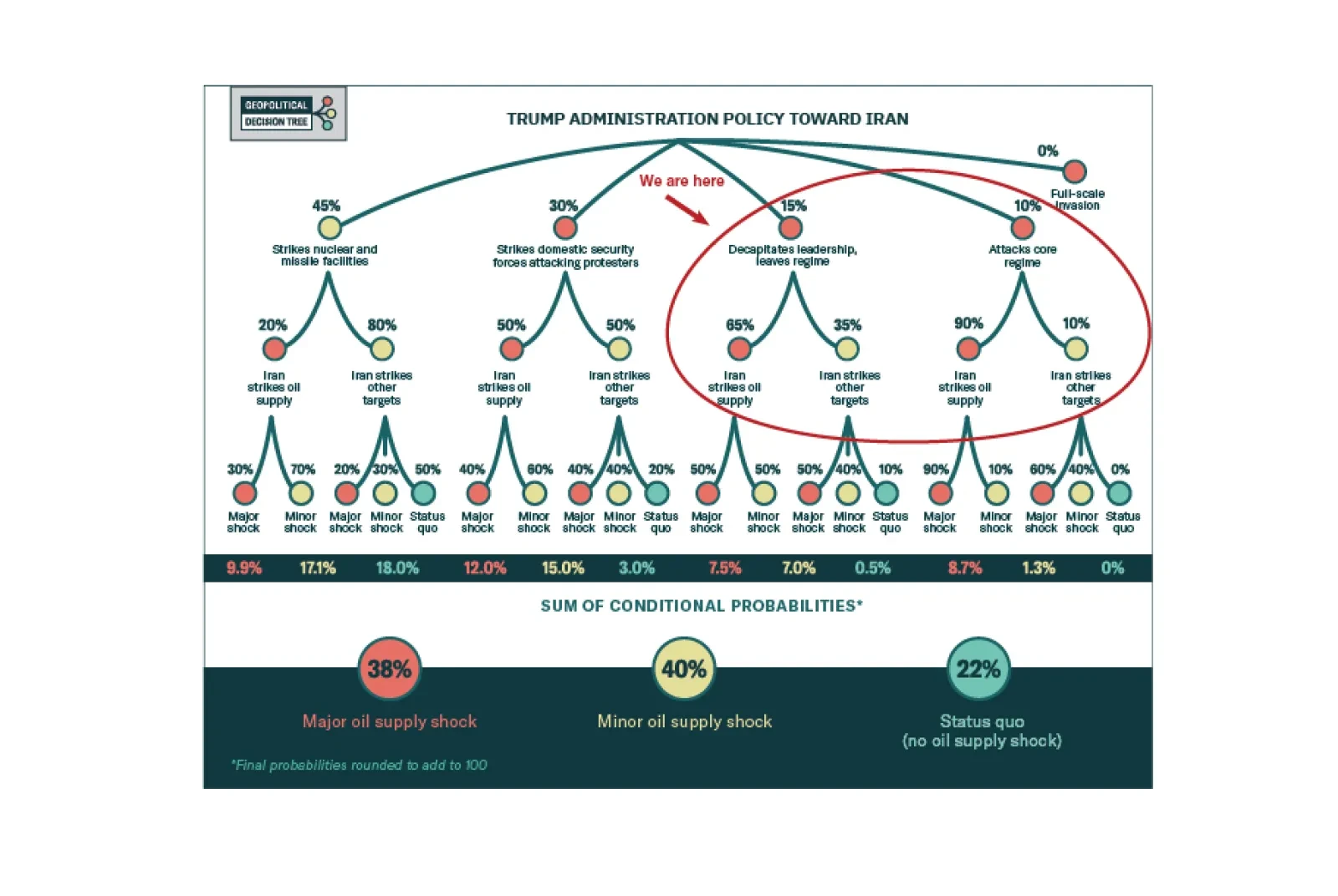
Executive Summary Failure Of Iran Deal Tightens Oil Supply Failure Of Iran Deal Tights Oil Supply Failure Of Iran Deal Tights Oil Supply The US and Iran suspended their attempt to negotiate a nuclear deal on March 11. Countries often get cold feet before major agreements but there are good reasons to believe this suspension will be permanent. A confirmed failure to restore the US-Iran strategic détente will lead to Middle Eastern instability. Iran will be on a trajectory to achieve nuclear weapons in a few years while Israel and the US will have to underscore their red lines against weaponization. The Strait of Hormuz will come under threat again. The immediate impact on oil prices should be positive: sanctions will continue to hinder Iran’s exports, while Iranian conflict with its neighbors will sharply increase the odds of oil disruptions caused by militant actions. Not to mention the Russia-induced energy supply shock. However, a decisive move by the Gulf Arab states to boost crude production would counteract the effect of Iranian sanctions and drive oil down. The Gulf Arabs will be more inclined to coordinate with the Biden administration as long as the Iran deal is ruled out. Thus oil volatility is the main implication beyond any short term oil spike.     Trade Recommendation Inception Date Return Long Gold (Strategic) 2019-12-06 36.8% Bottom Line: Go long US equities relative to global; long US and Canadian stocks versus Saudi and UAE stocks. Stay long XOP ETF, S&P GSCI index, and COMT ETF for exposure to oil prices and backwardation in oil forward curves. Feature The current Iran talks would have restored Joint Comprehensive Plan of Action (JCPA), which created a strategic détente between the US and Iran. Iran froze its nuclear program while the US lifted sanctions. President Barack Obama negotiated the deal in 2015, without congressional approval, while President Donald Trump nullified it in 2018, arguing that it did not restrict Iran’s ballistic missile development or support for regional militant groups. Chart 1Bull Market In Iran Tensions Will Be Super-Charged Bull Market In Iran Tensions Will Be Super-Charged Bull Market In Iran Tensions Will Be Super-Charged Since then there has been a bull market in Iran tensions (Chart 1), a secret war in which sporadic militant attacks, assassinations, and acts of sabotage occurred but neither side pursued open confrontation. These attacks can be significant, as with the Iran-backed attack on the Abqaiq refinery in Saudi Arabia, which took 6mm b/d of oil-processing capacity offline briefly in September 2019. The implication of this trend is energy supply disruption. Now the trend will be super-charged in the context of a global energy shortage. If no US-Iran détente is achieved, the Middle East will be set on a new trajectory of conflict, or at least a nuclear arms race and aggressive containment strategy. Since Trump turned away from the US-Iran détente and reimposed sanctions on Iran we have given a 40% chance of large-scale military conflict, according to our June 2019 decision tree (Diagram 1). The basis for such a conflict is Iran’s likelihood of obtaining nuclear arms and the need of Israel, its Arab neighbors, and the US to prevent that from happening. Diagram 1US-Iran Conflict: Critical Juncture In Our Decision Tree US-Iran Talks Break Down US-Iran Talks Break Down Between now and then, tit-for-tat military exchanges will increase, posing risks to oil supply in the short and medium run. Without a major diplomatic breakthrough that halts Iran’s nuclear weaponization, a bombing campaign against Iran will be the likeliest long-term consequence, due to the fateful logic of Israel’s strategic predicament (Diagram 2). Diagram 2Over Medium Term, Unilateral Israeli Military Action Is Possible US-Iran Talks Break Down US-Iran Talks Break Down Why Rejoining The US-Iran Deal Was Unlikely Under the Biden administration’s new plan, Iran would have frozen its nuclear program once again while Biden would have relaxed US “maximum pressure” sanctions on Iran, opening the way for foreign investment and the development of Iran’s energy sector and economy. The basis for a deal was the belief among some US policymakers that engagement with Iran would open up its economy, reducing regional war risks (especially in Iraq), expanding global energy supply, and fomenting pro-democratic sentiment in Iran. Also the Washington military-industrial complex wanted to reduce the US’s commitment to the Middle East and arrange a grand strategic “pivot to Asia” so as to counter the rise of China. Up till August 2021, we viewed a deal as likely, but that view changed when Iran’s hawkish or hardline faction came back into the presidency. Biden had a very small window of opportunity to negotiate with outgoing Iranian President Hassan Rouhani, who negotiated the original 2015 deal and whose administration fell apart after President Trump withdrew from the deal. When the hawkish Iranian faction took back power, this opportunity slipped. Iran’s hawks were vindicated for having opposed détente with the US in the first place. Since then we have argued that strategic tensions would escalate, for the following reasons: The Iranians could not trust the Americans, since they knew that any new deal could be torn up as early as January 20, 2025 if the Republican Party took back the White House. Indeed, former Vice President Mike Pence recently confirmed this view explicitly. The Iranians were not compelled to agree to the deal because high oil prices ensured that they could export oil regardless of US sanctions (Chart 2). The US no longer has the diplomatic credibility to galvanize a coalition that includes the Russians and Chinese to isolate Iran, like it did back in 2014-15. Chart 2Iranians Not Compelled To A Deal, Can Circumvent Sanctions Iranians Not Compelled To A Deal, Can Circumvent Sanctions Iranians Not Compelled To A Deal, Can Circumvent Sanctions As for Iran’s weak economy spurring social unrest and forcing Supreme Leader Ayatollah Ali Khamenei to agree to a deal, the US has had maximum pressure sanctions in place since 2019 and it has not produced that effect. Yes, Iran is ripe for social unrest, but the regime is consolidating power under the hardliners rather than taking any risky course of opening up and reform that could foment pro-democratic and pro-western demands for change. With oil revenues flowing in, the regime will be more capable of suppressing domestic opposition. The Americans could not trust the Iranians because they knew that they would ultimately pursue nuclear weapons regardless of any short-term revival of the 2015 deal. The Iranians have a stark choice between North Korea, which achieved nuclear weaponization and now has a powerful guarantee of future regime survival, and countries like Ukraine and Libya, which gave up nuclear weapons or programs only to be invaded by foreign armies. Moreover the Iranian nuclear deal lacked popular support, even among Obama Democrats back in 2015, not to mention today in the wake of the deal’s cancellation. The deal’s provisions would have begun expiring in 2025 under any conditions. The Israelis and Gulf Arabs opposed the deal. The Russians also switched to opposing the deal and made new demands at the last minute as a result of the US sanctions imposed on Russia in the wake of its invasion of Ukraine. The Russians do not have an interest in Iran obtaining a nuclear weapon and they supported the 2015 deal and the 2021-22 renegotiation while demanding their pound of flesh in the form of Ukraine. But they also know that Israel and the US will use military force to prevent Iran from getting the bomb, so they are not compelled to join any agreement. Crippling US sanctions over Ukraine likely caused them to interfere with the deal. Our pessimistic view is now confirmed, with the suspension of talks. True, informal talks will continue, diplomacy could somehow revive, and it is still possible for a deal to come together. But given our fundamental points above, we would give any durable diplomatic solution a low probability, say 5%. That means that the US and Iran will not engage, which means Iran will re-activate its regional militant proxies and begin pursuing nuclear weaponization. Iran has a powerful incentive to increase regime security before the dangerous leadership succession that looms over the nearly 83 year-old Khamenei and the threatening possibility of a Republican’s reelection in 2024. At present, it is unknown which side of the Iran nuclear deal talks suspended them. While the Iranians were not compelled by an international coalition to join the deal as they were in 2015, we cannot ignore the possibility the suspension in talks arises from a deal being reached between the US and core OPEC 2.0 producers (Saudi Arabia, the UAE, and Kuwait). Very simply, such a deal would entail that the Arab states increase output, to ease the global shortage, in return for the US walking away from the flawed Iran deal and pledging to work with Israel and the Gulf Arabs to contain Iran. Israel and the Gulf Arabs are increasingly aligned in their goal of countering Iran under the Abraham Accords, negotiated in 2020 by the Trump administration. If the US and Gulf states agreed, then the Gulf states are likely to increase production to ease the global shortage and prolong the business cycle, meaning that oil prices could fall rather than rise as their next move. Either way they will remain volatile as a result of global developments. What Next? Escalation In The Middle East The Iranians have made substantial nuclear progress since 2018, despite Israeli attempts at sabotaging critical facilities. Today Iran stands on the brink of achieving “breakout” levels of highly enriched uranium – levels at which it is possible to construct a nuclear device (Table 1). Table 1Iran Will Reach ‘Breakout’ Nuclear Capability US-Iran Talks Break Down US-Iran Talks Break Down The suspension of talks means the Iranians will soon reach breakout capacity, which will splash across global headlines. This news will rattle global financial markets as it will point to a nuclear arms race in the most volatile of regions. There is a gap of one-to-two years between breakout uranium enrichment and deliverable nuclear weapon, according to most experts.1 However, it is much easier to monitor nuclear programs than missile programs, which means western intelligence will lose visibility when it comes to knowing precisely when Iran will obtain a functional nuclear warhead that it can mount on a ballistic missile. The Iranians are skillful at ballistic missiles. The clock will start ticking once nuclear breakout is achieved and the Israelis and Americans will be forced to respond by underscoring their red line against weaponization. Starting right away, Israel and the US will need to demonstrate publicly that they have a “military option” to prevent Iran from achieving nuclear weaponization. They will refrain from immediate military action but will seek to re-establish a credible threat through shows of force. They will also redouble their efforts to use special operations and cyber attacks to set back the Iranian programs. The Iranians will seek to deter them from attacking and will want to highlight the negative consequences. The US-Iran talks were not only about the nuclear program but also about a broader strategic détente. The Iranians will no longer rein in their regional militant proxies, whether the militias in Iraq or the Houthis in Yemen or Hezbollah in Lebanon. In effect we are now looking at a major escalation of militant attacks in the Middle East at a time when oil is already soaring. In many cases the express intent of the Iran-backed groups will be to threaten oil supply to demonstrate the leverage that they have to intimidate the US and its allies and discourage them from applying too much pressure too quickly. Bottom Line: On top of the current oil shock, we are about to have a higher risk premium injected into oil from Middle Eastern proxy conflict involving Iran. If OPEC does not act quickly to boost production then financial markets face additional commodity price pressures, on top of the existing Russia-induced supply shock. Commodity And Energy Implications Our Commodity & Energy Strategist, Bob Ryan, outlines the following implications for the oil market: In BCA Research's oil supply-demand balances, while we recognized the Geopolitical Strategy view that the US-Iran deal would not materialize, nevertheless we assumed that Iran would return up to 1.3mm b/d of production by 2H22, which would have been available for export markets. This would have given a significant boost to oil supply as the market continues to tighten. Chart 3Failure Of Iran Deal Tights Oil Supply Failure Of Iran Deal Tights Oil Supply Failure Of Iran Deal Tights Oil Supply The failure of these barrels to return to the market will result in an oil-price increase of about $15/bbl in 2023, based on our modeling (Chart 3). We can expect backwardations to increase in Brent and WTI, as demand for precautionary inventories increases. The modelled prices include the oil risk premium of ~USD 9/bbl in H2 2022 and USD 5/bbl in 2023. Relative to 2021, we expect core- OPEC - KSA, UAE and Kuwait – and total US crude supply to increase by 1.7 mmb/d and 0.65 mmb/d respectively in 2022. Compared to 2022, core-OPEC supply will level off in 2023, and will increase by 0.6 mmb/d for total US. If the US has a deal with core OPEC, then, based on the reference production levels agreed by OPEC 2.0 in July 2021, core OPEC’s production capacity could cover a large bit of the volumes markets are short (Table 2). This is due to lower monthly additions of output that was supposed to be returned to markets – now above 1mm b/d – and the lost Iranian output (Table 2). Table 2OPEC 2.0 Reference Production Levels US-Iran Talks Break Down US-Iran Talks Break Down Per the OPEC 2.0 reference production schedule released following the July 2021 meeting in Vienna, Saudi Arabia’s output is free to go to 11.5mm b/d by May, the UAE's to 3.5mm b/d, and Kuwait's to just under 3mm b/d. Iraq also could raise output, but its output is variable and it will lie at the center of the new escalation in military tensions, so we do not count it as core OPEC 2.0 production. Assuming these numbers are consistent with actual capacity for core OPEC 2.0, that means Saudi Arabia could lift production by ~ 1.1mm b/d, UAE by ~ 0.5m b/d, and Kuwait by close to 0.3mm b/d. That’s almost 2mm b/d. These reference-production levels might be on the high side of what core OPEC 2.0 is able or willing to do. But they would be close to covering most of the deficit resulting from less-than-anticipated return of 400k b/d from OPEC 2.0 producers beginning last August ( ~ 1.2mm b/d). Most of Iran’s lost output also would be covered. More than likely, these barrels will find their way to market "under the radar" (i.e., smuggled out of Iran) over the next year or so. This was one reason our geopolitical strategists did not view Iran as sufficiently pressured to sign a deal. US shale-oil output will be increasing above the 0.9 mm b/d that we forecast last month for 2022, and the 0.5mm b/d we expect next year, given the sharp price rally prompted by the Russian invasion of Ukraine. Our Commodity & Energy Strategy service will be updating our estimate next week when we publish new supply-demand balances and price forecasts. Releases from the Strategic Petroleum Reserves of the US and OECD are available to tide the market over for brief periods due to Middle East shocks or sanctions on Russian oil. Releases from the Strategic Petroleum Reserves of the US and OECD are available to tide the market over for brief periods due to Middle East shocks or sanctions on Russian oil. Over time, a significant share of these displaced Russian barrels will find their way to China, and the volumes being displaced will be re-routed to other Asian and western buyers. Investment Takeaways One of our key geopolitical views for 2022 is that oil producers have enormous strategic leverage, specifically Russia and Iran. The Ukraine war and now the suspension of US-Iran détente bears out this view. It is highly destabilizing for global politics and economy. One of our five black swans for 2022 is that Israel could attack Iran – this is a black swan because it is highly unlikely on such a short time frame. However, if the US-Iran deal cannot be salvaged, then the clock is ticking to a time when Israel and/or the US will have to decide whether to prevent Iran from going nuclear or instead choose containment strategy as with North Korea. Yet the Iran dilemma is less stable than the Korean dilemma because the Israelis are committed to preventing weaponization. The Israelis will not act unilaterally until the last possible moment, when all other options to prevent weaponization are exhausted, as the operation would be extremely difficult and they need American military assistance. If diplomacy fails on Iran, the two options for the future are a major war or a nuclear arms race in the Middle East. The latter would involve an aggressive containment strategy. The global economy faces a major new risk to energy supply as a result of this material increase in Middle East tensions. A stagflationary outcome is much more likely. Europe’s energy security will be far more vulnerable now as it tries to diversify away from Russia but faces a more volatile Middle East (Chart 4). Undoubtedly Russia and Iran recognize their tremendous leverage. China, India, and other resource imports face a larger energy shock if the Gulf Arabs do not boost production promptly. They certainly face greater volatility. China’s policy support for the economy will remain lackluster in an environment in which inflation continues to threaten economic stability. China’s internal stability was already at risk and now it will have to scramble to secure energy supplies amid a global price shock and looming Middle Eastern instability. China has no choice but to accept Russia’s decision to cut ties with the West and lash itself to China as a strategic ally for the foreseeable future (Chart 5). Chart 4The EU’s Two-Pronged Energy Insecurity US-Iran Talks Break Down US-Iran Talks Break Down ​​​​​ Chart 5China's Energy Insecurity China's Energy Insecurity China's Energy Insecurity ​​​​​ Chart 6AGo Long US And Canada / Short Saudi And UAE Go Long US And Canada / Short Saudi And UAE Go Long US And Canada / Short Saudi And UAE ​​​​​ Chart 6BGo Long US And Canada / Short Saudi And UAE Go Long US And Canada / Short Saudi And UAE Go Long US And Canada / Short Saudi And UAE ​​​​​ Geopolitical Strategy recommends investors go long US equities relative to global equities on a strategic basis. We also recommend long US / short UAE equities and long Canadian / short Saudi equities (Charts 6A and 6B). Chart 7Worst Case Oil Risk In Historical Context US-Iran Talks Break Down US-Iran Talks Break Down Unlike Ukraine, the onset of a new Middle East crisis may not come with “shock and awe.” Weeks or months may pass before Iran reaches nuclear breakout. But make no mistake, if diplomacy fails, Iran will ignite a nuclear race and activate its militant proxies, while its enemies will increase sabotage, rattle sabers, and review military options. The Iranians will not be afraid to threaten the Strait of Hormuz, their other nuclear option (Chart 7). A total blockage of Hormuz is not by any means imminent. But war becomes more likely if Iran achieves nuclear breakout and diplomacy continues to fail.   Matt Gertken Chief Geopolitical Strategist mattg@bcaresearch.com Robert P. Ryan Chief Commodity & Energy Strategist rryan@bcaresearch.com Footnotes 1      See Ariel Eli Levite, “Can a Credible Nuclear Breakout Time With Iran Be Restored?” Carnegie Endowment for International Peace, June 24, 2021, carnegieendowment.org. See also Simon Henderson, “Iranian Nuclear Breakout: What It Is and How to Calculate It,” Washington Institute for Near East Policy, Policy Watch 3457, March 24, 2021, washingtoninstitute.org.   Strategic Themes Open Tactical Positions (0-6 Months) Open Cyclical Recommendations (6-18 Months) Regional Geopolitical Risk Matrix
Executive Summary Risk Premium Abates, But Does Not Disappear Oil Risk Premium Abates, But Still Remains Oil Risk Premium Abates, But Still Remains The risk premium in crude oil and natural gas prices is abating, and we expect that to continue. In the immediate aftermath of Russia's invasion, Brent crude oil traded close to $105/bbl on Thursday. At the urging of China's Xi Jinping, Russian President Vladimir Putin suggested he is prepared to enter negotiations with Ukraine in Minsk to discuss the latter's neutrality. Whether Ukraine is amenable to negotiations framed in this manner remains to be seen. Nothing has changed in supply-demand balances for oil or natgas. Markets are tight, and more supply is needed. In this highly fluid situation, we project Brent crude oil will average $100.00/bbl in 1Q22; $90.30/bbl in 2Q22; $85.00/bbl in 3Q22; and $85.00/bbl in 4Q22 (see Chart). Our estimate for 2023 Brent averages $85.00/bbl. Upside risk dominates in the near term. We expect the Kingdom of Saudi Arabia (KSA), the United Arab Emirates (UAE), and Kuwait, the only members of OPEC 2.0 with the capacity to increase and sustain higher production, to lift output by 1.75mm b/d. The Iran nuclear deal likely gets a boost from the Russian invasion, which will hasten the return of ~ 1.0mm b/d of production in 2H22, perhaps sooner. We also expect the US, and possibly the OECD, to release strategic petroleum reserves, but, as typically is the case, this will have a fleeting impact on markets and pricing. These supply increases will return prices closer to our base case forecast, which we raise slightly to $85/bbl from 2H22 to end-2023. If we fail to see an increase in core-OPEC production, or the US shales, or if Iranian barrels are not returned to export markets, oil prices have a good chance of moving to $140/bbl, as can be seen in the accompanying Chart. Bottom Line: We remain long commodity-index exposure (S&P GSCI and the COMT ETF), along with equity exposure to oil and gas producers via the XOP ETF.  
Executive Summary Oil-Price Risk Skewed Upward Scenarios For Oil Prices Scenarios For Oil Prices The $10-$15/bbl risk premium in Brent prices will dissipate over the next month. Russia's best outcome is to follow the off-ramp offered by the US. President Biden's call to KSA's King Salman last week will result in higher oil output from the Kingdom, the UAE and Kuwait, in return for deeper US defense commitments. The Biden administration and Iran are in a hurry to get a deal done: The US wants lower oil prices, and Iran needs the revenue. Our Brent forecasts for 2022 and 2023 are revised slightly to $81.50 and $79.75/bbl, respectively, reflecting supply-demand adjustments. Price risks are tilted to the upside: A miss on any of the above assumptions will keep prices above $90/bbl, and push them higher. Bottom Line: Oil demand will remain robust this year and next.  To keep prices from surging from current levels into demand-destruction territory, additional supply is needed.  Most of this will come from KSA, the UAE and the US shale-oil producers.  We expect prices to fall from current prompt levels this year and next.  This will support sovereign budgets and oil producers' free cashflow goals.  We remain long the XOP ETF. Feature The $10-$15/bbl risk premium in Brent crude oil prices will dissipate, as the following supply-side events are ticked off: 1)   Russia gets on the off-ramp offered by the US last week to de-escalate the threat of another invasion of Ukraine by withdrawing its troops from the border;1 2)   OPEC 2.0's core producers – the Kingdom of Saudi Arabia (KSA), the United Arab Emirates (UAE), and Kuwait – increase supply in return for deeper US security commitments; 3)   Iran restores its remaining 1.0 – 1.2mm b/d of production to the market, following the restoration of its nuclear deal with Western powers; and 4)   US shale-oil producers step up production in response to higher WTI prices. Politics, Then Economics The first three assumptions above are political in nature, requiring a bargain be struck among contending interests to resolve. We do not believe Russia's endgame is to jeopardize its future oil and gas exports to the West, particularly to the EU (Chart 1). The US is warning that another invasion of Ukraine will put the use of the Nord Stream 2 pipeline to deliver gas to Germany at risk.2 It also is worthwhile noting NATO is aligned with the US on this stance. Russia derived 40-50% of its budget revenues from oil and gas production, and ~ 67% of its export revenue from oil and gas over the decade ended in 2020.3 Of course, only President Putin can determine whether oil and gas sales can be diversified enough – e.g., via higher shipments to China – to offset whatever penalties the West imposes. But, in a game-theoretic sense, the stakes are very high, and taking the US off-ramp is rational. Chart 1Russia's Critical Exports: Oil + Gas Lower Oil Prices On The Way Lower Oil Prices On The Way We expect the second assumption to play out in the near term, following US President Joe Biden's call to KSA's King Salman last week. The outreach stressed the US commitment to defend KSA and, presumably, its close allies in the Gulf (the UAE and Kuwait).4 KSA already has increased its production to 10.15mm b/d under the OPEC 2.0 agreement to restore 400k b/d beginning in August 2021. We estimate the coalition had fallen behind on this effort by ~ 1mm b/d, as only KSA, the UAE and Kuwait presently have the capacity to lift production and sustain it (Table 1). KSA's reference production level agreed at OPEC 2.0's July 2021 meeting will rise to 11.5mm b/d in June, up 500k b/d from its current level (Table 2). This means KSA could flex into another 850k b/d between now and the end of May; and another 500k b/d after that. The UAE's and Kuwait's reference production levels will rise 330k and 150k b/d in June to 3.5mm b/d and 3.0mm b/d, respectively. Markets will need these incremental volumes as demand continues to recover and non-core OPEC 2.0 production continues to fall (Chart 2). Table 1BCA Global Oil Supply - Demand Balances (MMb/d, Base Case Balances) To Dec23 Lower Oil Prices On The Way Lower Oil Prices On The Way Table 2Baseline Increases For Core OPEC 2.0 Lower Oil Prices On The Way Lower Oil Prices On The Way Our third assumption reflects our reading of the signaling by Iran over the past few weeks, which indicate growing confidence a deal with the US to restore the Joint Comprehensive Plan of Action (JCPOA) is in the offing.5 The politics here converge with the economics: the Biden Administration wants to increase oil supply ahead of mid-term elections in the US to keep gasoline prices under control; Iran needs to increase its revenues. Both sides get an immediate need satisfied. However, the risks to KSA and its Gulf allies will increase as Iran's revenues grow, because it will be able to fund proxy-war operations against the Gulf states. This is why deepening the US defense commitment to the region is critical to KSA and its allies. The last assumption reflects our view US E+P companies are being incentivized to lift production by high prompt and deferred prices. We continue to expect these companies – particularly those in the US shales, where the majority of the production increase will occur – to husband their capital resources closely, and to continue to prioritize shareholder interests. As capital availability declines – primarily due to reduced investor interest in investing in hydrocarbon production – these firms will have to focus on reducing operating costs and increasing productivity over the next decade to fund growth. Relative to 2021, we expect US oil production to increase 0.85mm b/d this year and by 0.53mm b/d in 2023 relative to this year, as producers respond to higher prices (Chart 3). Chart 2Increased Core OPEC 2.0 Production Becoming Critical Lower Oil Prices On The Way Lower Oil Prices On The Way Chart 3US Oil Production Will See Another Up Leg US Oil Production Will See Another Up Leg US Oil Production Will See Another Up Leg Supply-Demand Balances Are Tight Global oil demand growth this year is reduced slightly in our balances – going to 4.5mm b/d from 4.8mm b/d, mostly reflecting our assessment of slowing growth as central banks remove monetary accommodation. We lifted next year's growth estimate slightly, to 1.7mm b/d. These estimates still leave our growth expectations above the major data providers, the highest of which is OPEC's 4.2mm b/d estimate. We continue to expect DM demand to level off this year and next, and EM demand to retake its position as the global demand growth engine (Chart 4). The supply side remains tight, with average global crude oil and liquid fuels production estimated at 101.5mm b/d for 2022 and 102.8mm b/d for next year. With demand expected to average 101.5mm b/d this year and 103.2mm b/d next year, markets will remain balanced but tight (Chart 5). This means inventories will continue to be strained, leaving little in the way of a cushion to absorb unexpected supply losses (Chart 6).  Chart 4EM Demand Retakes Growth-Engine Role EM Demand Retakes Growth-Engine Role EM Demand Retakes Growth-Engine Role Chart 5Markets Remain Balanced But Tight... Markets Remain Balanced But Tight... Markets Remain Balanced But Tight... Chart 6...Keeping Pressure On Inventories ...Keeping Pressure On Inventories ...Keeping Pressure On Inventories Markets Remain Balanced But Tight Our supply-demand analysis indicates markets will remain balanced but tight, with inventories under pressure until supply increases. This will predispose markets to higher price volatility, as low inventories force prices to ration supply. This will increase the backwardation in the Brent and WTI curves, which will bolster the convenience yield in both of these markets (Chart 7).6 We expect implied volatility to remain elevated, as a result (Chart 8). Chart 7Backwardation Will Keep Convenience Yield Elevated Lower Oil Prices On The Way Lower Oil Prices On The Way Chart 8High Volatility Will Persist High Volatility Will Persist High Volatility Will Persist Because of these low inventory values, Brent prices for 2022 are higher than our previous estimate. By 2023, the effects of increased supply from KSA, UAE, Kuwait – albeit a marginal increase – and the US kick in to reduce prices. As supply increases, the risk premium currently embedded in Brent prices will decline, pushing them to our forecasted levels for 2022 and 2023 of $81.50/bbl and $79.75/bbl, respectively. For 1H22, we expect Brent prices to average $87.20/bbl, and in 2H22 we're forecasting a price of $75.80/bbl on the back of increased production. Next year, higher output will keep prices close to $80/bbl, with 1H23 Brent averaging $79.85 and 2H23 averaging $79.70/bbl. Word Of Caution Our analysis is predicated on strong assumptions regarding the incentives of oil producers taking a rational view of the need for stability and supply in markets. The bottom panel of Chart 9 provides an indication of how tenuous markets are if our assumptions are mistaken, and core OPEC 2.0 does not increase production, Iranian barrels are not returned to the market, or the US shale supply response is less vigorous than we expect. The highest price trajectory occurs when all of our assumptions prove wrong, which takes Brent prices above $140/bbl by the end of 2023. It goes without saying this is non-trivial. But we'll say it anyway: This is non-trivial. We can reasonably expect feedback loops in such a case – e.g., US and Canadian production kicks into high gear, and once-idled North Sea are brought back into service. However, this takes time, and will cause demand destruction on a global scale. Chart 9Scenarios For Oil Prices Scenarios For Oil Prices Scenarios For Oil Prices   Investment Implications Oil markets will remain tight and volatile until additional supplies are forthcoming. We are expecting core OPEC 2.0 to lift output by 3.2mm b/d this year, and for the US Lower 48 production to average 9.8mm b/d. The US production increase will be led by higher shale-oil output, which we expect to average 7.4mm b/d this year and 7.8mm b/d in 2023. Given the tight markets we expect, we remain long the XOP ETF, and commodity index exposure in the form of the S&P GSCI and the COMT ETF, an optimized version of the S&P GSCI.   Robert P. Ryan Chief Commodity & Energy Strategist rryan@bcaresearch.com Ashwin Shyam Research Associate Commodity & Energy Strategy ashwin.shyam@bcaresearch.com   Commodities Round-Up Energy: Bullish Marketed volumes of US natural gas are expected to hit a record high of just under 107 Bcf/d next year as prices stabilize close to $4/MMBtu, in the EIA's latest estimate. This is up from just over 104 Bcf/d of marketed production this year, which itself was a 3 Bcf/d increase over 2021 levels. Almost all of this will come from the Lower 48 (97%). We expect US LNG exports to increase on the back of rising production and further investment in export terminals. Most of this will be shipped to Europe, in our estimation, as EU states seek to diversify LNG sources in the wake of the Russia-Ukraine standoff currently underway. LNG imports accounted for roughly one-fifth of all natural gas supplied to the UK and EU-27 in 2020, according to the EIA, which notes, "Growing volumes of flexible LNG supplies, primarily from the United States, contributed to the notable increases in LNG imports to Europe from 2019 to 2021." Wide price differentials can be expected to support the flow of LNG to Europe from the US (Chart 10). Base Metals: Bullish Iron ore prices took a hit after China’s National Development and Reform Commission (NDRC) stated its intentions to stabilize iron ore markets, crack down on speculation and false price disclosures after prices in 2022 rallied sharply last week.  Authorities believe price strength is coming from speculation and hoarding, which is adding to inflationary pressures.  However, fundamental factors have been, and likely will keep iron ore prices buoyed.  Based on past steel inventory levels and seasonal patterns, steel production will increase and more than double current inventory levels by end-March. Monetary policy easing, and the push by China’s steel industry to become carbon-neutral over the next five years are additional fundamental factors supporting iron ore prices. Precious Metals: Bullish The January print for US CPI jumped 7.5% year-on-year, beating estimates as headline inflation rose to a 40-year high.  Markets are expecting around five interest increases this year (Chart 11).  BCA’s US Bond Strategy expects rate hikes will be around 100 – 125 bps this year.  Gold prices initially fell on the possibility of increasing rate hikes and a hawkish Fed, but in the second half of last week settled at subsequently higher prices on each day.  Apart from increased inflation demand, this was likely due to markets’ fear of the possibility of an ultra-hawkish Fed, which could tighten US financial conditions and see a rotation out of US equity markets into safe-haven assets or into other markets ex-US, both of which will be bullish for gold. Chart 10 Lower Oil Prices On The Way Lower Oil Prices On The Way Chart 11 US Policy Rate Expectations Going Up US Policy Rate Expectations Going Up         Footnotes 1     Please see Background Press Call by a Senior Administration Official on the President’s Call with Russian President Vladimir Putin, released by the US White House on February 12, 2022. 2     Please see Long-Term EU Gas Volatility Will Increase, which we published on February 3, 2022 for further discussion.  The EU is a huge market for Russia supplies Germany with 65% of its gas.  Approximately 78% of total natural gas exports (pipeline + LNG) from Russia went to the EU in 2020. 3    Please see Russia’s Unsustainable Business Model: Going All In on Oil and Gas, published on January 19, 2021 by the Hague Centre for Strategic Studies (HCSS). 4    Please see Readout of President Joseph R. Biden, Jr.’s Call with King Salman bin Abdulaziz Al-Saud of Saudi Arabia, released on February 7, 2022. The readout noted, " issues of mutual concern, including Iranian-enabled attacks by the Houthis against civilian targets in Saudi Arabia." Energy security also was discussed, which we read as code for a deal to increase production in return for a deepening of US defense commitments. This line is followed closely by Gulf media – e.g., It took Biden a year to realize Saudi Arabia’s vital regional role, published by arabnews.com on February 13, 2022, which notes: "If Putin decides to invade Ukraine, the Saudis are the only ones who could help relieve the unsteady oil markets by pumping more crude, being the largest crude exporter in the OPEC oil production group. The White House emphasized that both leaders further reiterated the commitment of the US and Saudi Arabia in ensuring the stability of global energy supplies. 5    Please see Iran 'is in a hurry' to revive nuclear deal if its interests secured -foreign minister, published by reuters.com on February 14, 2022. 6    Please see our November 4, 2021 report entitled Despite Weaker Prices Crude Oil Backwardation Will Persist for additional discussion of convenience yields and volatility.   Investment Views and Themes Strategic Recommendations Trades Closed in 2021 Image  
Highlights Our top five “black swan” risks for 2022: Social unrest in China; Russian invasion of all of Ukraine; unilateral Israeli strikes on Iran; a cyber attack that goes kinetic; and a failure of OPEC 2.0. Too early to buy the dip on Russian assets: President Biden says Putin will probably “move in” and re-invade Ukraine, Russian embassy staff have been evacuating Ukraine, the US and UK have been providing more arms to Ukraine, and the US is warning of a semiconductor embargo against Russia. Talks resume in Geneva on Friday. Tactically investors should take some risk off the table, especially if linked to Russia and Europe.  Stay short the Russian ruble and EM Europe; stay short the Chinese renminbi and Taiwanese dollar; stay long cyber security stocks; and be prepared for oil volatility. Convert tactical long equity trades to relative trades: long large caps versus small caps, long defensives versus cyclicals, and long Japanese industrials versus German industrials. Feature Chart 1Recession Probability And Yield Curve Recession Probability And Yield Curve Recession Probability And Yield Curve The 2/10-year yield curve is flattening and now stands at 79 bps, while the implied probability of a recession over the next 12 months troughed at 5.9% in April 2021, and as of December 2021 stood at 7.7% (Chart 1). Apparently stagflation and recession are too high of a probability to constitute a “black swan” risk for this year. Black swans are not only high impact but also low probability. In this year’s annual “Five Black Swan” report, the last of our 2022 outlook series, we concentrate on impactful but unlikely events. These black swans emerge directly from the existing themes and trends in our research – they are not plucked at random. The key regions are highlighted in Map 1. Chart Black Swan #1: Major Social Unrest Erupts In China China’s financial problems are front and center risks for investors this year. They qualify as a “Gray Rhino” rather than “Black Swan” risk.1 It is entirely probable that China’s financial and property sector distress will negatively impact Chinese and global financial markets in 2022. What investors are not expecting is an eruption of social unrest in China that fouls up the twentieth national party congress this fall and calls into question the Communist Party’s official narrative that it is handling the pandemic and the underlying economic transition smoothly. Social unrest is a major risk around the world in the face of the new bout of inflation. Most of the democracies have already changed governments since the pandemic began, recapitalizing their political systems, but major emerging markets – Russia, India, Turkey, Brazil – have not done so. They have seen steep losses of popular support for both political leaders and ruling parties. There is little opinion polling from China and people who are surveyed cannot speak openly. It is possible that the government’s support has risen given its minimization of deaths from the pandemic. But it is also possible that it has not. Beijing’s policies over the past few years have had a negative impact on the country’s business elite and foreign relations. There are disgruntled factions within China, though the current administration has a tight grip over the main organs of power. Since President Xi is trying to clinch his personal rule this fall, sending China down a path of autocracy that proved disastrous under Chairman Mao Zedong, it is possible he will face surprise resistance. China’s economic growth is decelerating, clocking in at a 4.0% quarter-on-quarter growth rate at the end of last year. While authorities are easing policy to secure the recovery, there is a danger of insufficient support. Private sentiment will remain gloomy, as reflected by weak money velocity and a low propensity to spend among both businesses and households (Chart 2). The government will continue to be repressive in the lead up to the political reshuffle. At least for the first half of the year the economy will remain troubled. Structurally China is ripe for social unrest. It suffers from high income inequality and low social mobility, comparable to the US and Brazil, which are both struggling with political upheaval (Chart 3). Chart 2China's Private Sector Still Depressed China's Private Sector Still Depressed China's Private Sector Still Depressed ​​​​​ Chart 3 ​​​​​​ In addition China is keeping a stranglehold over Covid-19. This “Zero Covid” policy minimizes deaths but suppresses economic activity. Strict policy has also left the population with a very low level of natural immunity and the new Omicron variant is even more contagious than other variants. Hence the regime is highly likely to double down to prevent an explosive outbreak. The service side of the economy will continue to suffer if strict lockdowns are maintained, exacerbating household and business financial difficulties (Chart 4). Yet in other countries around the world, government decisions to return to lockdowns have sparked unrest. Chart 4Zero Covid Policy: Not Sustainable Beyond 2022 Zero Covid Policy: Not Sustainable Beyond 2022 Zero Covid Policy: Not Sustainable Beyond 2022 China’s “Misery Index” (unemployment plus inflation) is rising sharply. While misery is ostensibly lower than that of other emerging markets, China’s unemployment data is widely known to be unreliable. If we take a worst-case scenario, looking at youth unemployment and fuel prices, misery is a lot higher (Chart 5). The youth, who are having the hardest time finding jobs, are also the most likely to protest if conditions become intolerable (Chart 6). Of course, if social unrest is limited to students, it will lack support among the wider populace. But it is inflation, not youth activism, that is the reason for China’s authorities to be concerned, as inflation is a generalized problem that affects workers as well as students. Chart 5China's Misery Index Is Higher Than It Looks China's Misery Index Is Higher Than It Looks China's Misery Index Is Higher Than It Looks ​​​​​ Chart 6China's Troubled Youth China's Troubled Youth China's Troubled Youth Why would protesters stick their necks out knowing that the Communist Party will react ferociously to any sign of instability during President Xi Jinping’s political reshuffle? True, mainland Chinese do not have the propensity to political activism that flared up in protests in Hong Kong in recent years. Also the police state will move rapidly to repress any unrest. Yet the entire focus of Xi Jinping’s administration, since 2012, has been the restoration of political legitimacy and prevention of popular discontent. Xi has cracked down on corruption, pollution, housing prices, education prices, and has announced his “Common Prosperity” agenda to placate the low and middle classes.2 The regime has also cracked down on the media, social media, civil society, and ideological dissent to prevent political opposition from taking root. If the government were not concerned about social instability, it would not have been adopting these policies. Disease, often accompanied by famines or riots, has played a role in the downfall of six out of ten dynasties, so Beijing will not be taking risks for granted (Table 1). Table 1Disease And Downfall Of Chinese Dynasties Five Black Swans For 2022 Five Black Swans For 2022 Social instability would have a major impact as it would affect China’s stability and global investor sentiment toward China. Western democracies would penalize China for violations of human rights, leaving China even more isolated. Bottom Line: Investors should stay short the renminbi and neutral Chinese equities. Foreign investors should steer clear of Chinese bonds in the event of US sanctions. After the party congress this fall there will be an opportunity to reassess whether Xi Jinping will “let a hundred flowers bloom,” thus improving the internal and external political and investment environment, but this is not at all clear today. Black Swan #2: Russia Invades All (Not Just Part) Of Ukraine US-Russia relations are on the verge of total collapse and Russian equities have sold off, in line with our bearish recommendations in reports over the past two years. Russia’s threat of re-invading Ukraine is credible. Western nations are still wishy-washy about the counter-threat of economic sanctions, judging by German Chancellor Olaf Scholz’s latest comments, and none are claiming they will go to war to defend Ukraine.3 Russia is looking to remove the threat of Ukraine integrating militarily and economically with the West. The US and UK are providing Ukraine with defense weaponry even as Russia specifically demands that they cease to do so. President Putin may choose short-term economic pain for long-term security gain. The consensus view is that if Russia does invade, it will undertake a limited invasion. But what if Russia invades all of Ukraine? To be clear, a full invasion is unlikely because it would be far more difficult and costly for Russia. It would go against Putin’s strategy of calculated risk and limited conflict. Table 2 compares Russia and Ukraine in size and strength, alongside a comparison of the US and Iraq in 2002. This is not a bad comparison given that Ukraine’s and Iraq’s land area and active military personnel are comparable. Table 2Russia-Ukraine Balance Of Power 2022 Compared To US-Iraq 2002 Five Black Swans For 2022 Five Black Swans For 2022 Russia would be biting off a much bigger challenge than the US did. Ukraine’s prime age population is 2.5 times larger than Iraq’s in 2002, and its military expenditure is three times bigger. The US GDP and military spending were 150 and 250 times bigger than Iraq’s, while Russia’s GDP and military spending are about ten times bigger than Ukraine’s today. Iraq was not vital to American national security, whereas Ukraine is vital to Russia; Russia has more at stake and is willing to take greater risks. But Ukraine is in better shape to resist Russian occupation than Iraq was to resist American. The point is that the US invasion went smoothly at first, then got bogged down in insurgency, and ultimately backfired both in political and geopolitical terms. Russia would be undertaking a massive expense of blood and treasure that seems out of proportion with its goal, which is to neutralize Ukraine’s potential to become a western defense ally and host of “military infrastructure.” However, there are drawbacks to partial invasion. The remainder of the Ukrainian state would be unified and mobilized, capable of integrating with the western world, and willing to support a permanent insurgency against Russian troops in eastern Ukraine. Russia has forces in Belarus, Crimea, and the Black Sea, as well as on Ukraine’s eastern border, giving rise to fears that Russia could attempt a three-pronged invasion of the whole country. In short, it is conceivable that Russian leaders could make the Soviet mistake of overreaching in the military aims, or that a war in eastern Ukraine could inadvertently expand into the west. If Russia tries to conquer all of Ukraine, the global impact will be massive. A war of this size on the European continent for the first time since World War II would shake governments and populations to their bones. The borders with Poland, Romania, the Baltic states, Slovakia, Hungary, Finland and the Black Sea area would become militarized (Map 2). Chart NATO actions to secure its members and fortify their borders would exacerbate tensions with Russia and fan fears of a wider war. Trade flows would become subject to commerce destruction, affecting even neutral nations, including in the Black Sea. Energy supplies would tighten further, sending Russia and probably Europe into recession. The disruption to business and travel across eastern Europe would be deep and lasting, not only due to sanctions but also due to a deep risk-aversion that would affect foreign investors in the former Soviet Union and former Warsaw Pact. Germany would be forced to quit sitting on the fence, as it would be pressured by the US and the rest of Europe to stand shoulder to shoulder in the face of such aggression. Finland and Sweden would be much more likely to join NATO, exacerbating Russia’s security fears. Russia would suffer a drastic loss of trade, resulting in recession, and its currency collapse would feed inflation (Chart 7). Chart 7Inflation Poses Long-Term Threat To Putin Regime Inflation Poses Long-Term Threat To Putin Regime Inflation Poses Long-Term Threat To Putin Regime Ultimately the consequences would be negative for the Putin regime and Russia as a result of recession and international isolation. But in the short run the Russian people would rally around the flag and support a war designed to prevent NATO from stationing missiles on their doorstep. And their isolation would not be total, as they would strengthen ties with China and conduct trade via proxy states in the former Soviet Union. Bottom Line: A full-scale invasion of all of Ukraine is highly unlikely because it would be so costly for Russia in military, economic, and political terms. But the probability is not zero, especially because a partial re-invasion could lead to a larger war. While global investors would react in a moderate risk-off matter to a limited war in eastern Ukraine, a full-scale war would trigger a massive global flight to safety as it would call into question the entire post-WWII peace regime in Europe. Black Swan #3: Israel Attacks Iran The “bull market in Iran tensions” continues as there is not yet a replacement for the 2015 nuclear deal that the US abrogated. Our 2022 forecast that the UAE would get caught in the crossfire was confirmed on January 17 when Iran-backed Houthi rebels expanded their range of operations and struck Abu Dhabi (Map 3). The secret war is escalating and US-led diplomacy is faltering. Chart Iran is not going to give up its nuclear program. North Korea achieved nuclear arms and greater military security and is now developing first and second strike capabilities. Meanwhile Ukraine, which faces another Russian invasion, exemplifies what happens to regimes that give up nuclear arms (as do Libya and Iraq). Iran appears to be choosing the North Korean route. While we cannot rule out a minor agreement between President Biden and Iranian President Ebrahim Raisi, we can rule out a substantial deal that halts Iran’s nuclear and missile progress. Here’s why: Any day now Iran could reach nuclear “breakout capacity,” with enough highly enriched uranium to construct a nuclear device (Table 3).4 Table 3Iran’s Violations Of 2015 Nuclear Deal Since US Exit Five Black Swans For 2022 Five Black Swans For 2022 Within Iran’s government, the foreign policy doves have been humiliated and kicked out of office while the hawks are fully in control. No meaningful agreement can be reached before 2024 because of the risk that the US will change ruling parties again and renege on any promises. Iran is highly incentivized to make rapid progress on its nuclear program now. The US will not be able to lead the P5+1 coalition to force Iran to halt its program because of its ongoing struggles with Russia and China. China is striking long-term cooperation deals with Iran. Israel has a well-established record of taking unilateral action, specifically against regional nuclear programs, known as the “Begin Doctrine.”5 Israel’s threats are credible on this front, although Iran is a much greater operational challenge than Iraq or Syria. Iran’s timeline from nuclear breakout to deliverable nuclear weapon is 12-24 months.6 Iran’s missile program is advanced. Missile programs cannot be monitored as easily as nuclear activity, so foreign powers base the threshold on nuclear capability rather than missile capability. Iran had a strong incentive to move slowly on its nuclear and missile programs in earlier years, to prevent US and Israeli military interference. But as it approaches breakout capacity it has an incentive to accelerate its tempo to a mad dash to achieve nuclear weaponization before the US or Israel can stop it. Now that time may have come. The Biden administration is afraid of higher oil prices and Israeli domestic politics are more divided and risk-averse than before. And yet Iran’s window might close in 2025, as the US could turn aggressive again depending on the outcome of the 2024 election. Hence Iran has an incentive to make its dash now. The US and Israel will restate their red lines against Iranian nuclear weaponization and brandish their military options this year. But the Biden administration will be risk-averse since it does not want to instigate an oil shock in an election year. Israel is more likely than the US to react quickly and forcefully since it is in greatest danger if Iran surprises the world with rapid weaponization. Here are the known constraints on unilateral Israeli military action: Limited Israeli military capability: Israel would have to commit a large number of aircraft, leaving its home front exposed, and even with US “bunker buster” bombs it may not penetrate the underground Fordow nuclear facility.7 Limited Israeli domestic support: The Israeli public is divided on whether to attack Iran. The post-Netanyahu government recently came around to endorsing the US’s attempt to renegotiate the nuclear deal. Limited US support: Washington opposes Israeli unilateralism that could entangle the US into a war. Israel cannot afford to alienate the US, which is its primary security guarantor. Iranian instability: The Iranian regime is under economic distress due to “maximum pressure” sanctions. It is vulnerable to social unrest, not least because of its large youth population. These constraints have been vitiated in various ways, which is why we raise this Israeli unilateralism as a black swan risk: Where there’s a will, there’s a way: If Israel believes its existence will be threatened, it will be willing to take much greater operational risks. It has already shown some ability to set back Iran's centrifuge program beyond the expected.8 Israeli opinion will harden if Iran breaks out: If Iran reaches nuclear breakout or tests a nuclear device, Israeli opinion will harden in favor of military strikes. Prime Minister Naftali Bennett has an incentive to take hawkish actions before he hands the reins of government over to a partner in his ruling coalition as part of a power-sharing agreement. The ruling coalition is so weak that a collapse cannot be ruled out. US opposition could weaken: Biden will have to explore military options if talks fail and Iran reaches nuclear breakout capacity. Once the midterms are over, Israel may have even more freedom to act, while a gridlocked Biden may be looking to shift his focus to foreign policy. Iranian stability: Iran’s social instability has not resulted in massive unrest or regime fracture despite years of western sanctions and a global recession/pandemic. Yet now energy prices are rising and Iran has less reason to believe sanction regimes will be watertight. From Israeli’s point of view, even regime change in Iran would not remove the nuclear threat once nuclear weapons are obtained. Finally, while Israel cannot guarantee that military strikes would successfully cripple Iran’s nuclear program and prevent weaponization, Israel cannot afford not to try. It would be a worse outcome to stand idly by while Iran gets a nuclear weapon than to attack and fail to set that program back. Hence the likeliest outcome over the long run is that Iran pursues a nuclear weapon and Israel attacks to try to stop it, even if that attack is likely to fail (Diagram 1). Diagram 1Game Theory: Will Israel Attack Iran? Five Black Swans For 2022 Five Black Swans For 2022 Bottom Line: A unilateral Israeli strike is unlikely but would have a massive impact, as 21% of global oil and 26% of natural gas flows through the Strait of Hormuz, and conflict could disrupt regional energy production and/or block passage through the strait itself. Black Swan #4: Cyber Attacks Spill Into Real World Investors are very aware of cyber security risks – it holds a respectable though not commanding position in the ranks of likely crisis events (Table 4). Our concern is that a cyber attack could spill over into the real world, impairing critical infrastructure, supply chains, and/or prompting military retaliation. Table 4Cyber Events Underrated In Consensus View Of Global Risks Five Black Swans For 2022 Five Black Swans For 2022 Russian attacks on US critical infrastructure by means of ransomware gangs disrupted a US fuel pipeline, meat-packing plant, and other critical infrastructure in 2021. Since then the two countries have engaged in negotiations over cyber security. The Russian Federal Security Bureau has cracked down on one of the most prominent gangs, REvil, in a sign that the US and Russia are still negotiating despite the showdown over Ukraine.9 Yet a re-invasion of Ukraine would shatter any hope of cooperation in the cyber realm or elsewhere. Russia is already using cyberattacks against Ukraine and these activities could expand to Ukraine’s partners if the military conflict expands. Should the US and EU impose sweeping sanctions that damage Russia’s economy, Russia could retaliate, not only by tightening energy supply but also by cyber attacks. Any NATO partners or allies would be vulnerable, though some states will be more reactive than others. Interference in the French election, for example, would be incendiary. The key question is: if Russia strikes NATO states with damaging cyber attacks, at what point would it trigger Article V, the mutual defense clause? There are no established codes of conduct or red lines in cyber space, so the world will have to learn each nation’s limits via confrontation and retaliation. Similar cyber risks could emerge from other conflicts. China is probably not ready to invade Taiwan but it has an interest in imposing economic costs on the island ahead of this fall’s midterm elections. Taiwan’s critical role in the semiconductor supply chain means that disruptions to production would have a global impact. Israel and the US have already used cyber capabilities to attack Iran and set back its nuclear program. These capabilities will be necessary as Iran approaches breakout capacity. Yet Iran could retaliate in a way that disrupts oil supplies. North Korea began a new cycle of provocations last September, accelerated missile tests over the past four months, and is dissatisfied with the unfinished diplomatic business of the Trump administration. In the wake of the last global crisis, 2010, it staged multiple military attacks against South Korea. South Korea may be vulnerable due to its presidential elections in May. The semiconductor or electronics supply chain could be interrupted here as well as in Taiwan. Bottom Line: There is no code of conduct in cyber space. As geopolitical tensions rise, and nations test the limits of their cyber capabilities, there is potential for critical infrastructure to be impaired. This could exacerbate supply chain kinks or provoke kinetic responses from victim nations. Black Swan #5: OPEC 2.0 Falls Apart The basis of the OPEC 2.0 cartel is Russian cooperation with Saudi Arabia to control oil supply and manage the forward price curve. Backwardation, when short-term prices are higher than long-term, is ideal for these countries since they fear that long-term prices will fall. In a world where Moscow and Riyadh both face competition from US shale producers as well as the green energy revolution, cooperation makes sense. Yet the two sides do not trust each other. Cooperation broke down both in 2014 and 2020, sending oil prices plunging. Falling global demand ignited a scramble for market share. Interestingly, Russian military invasions have signaled peak oil price in 1979, 2008, and 2014. Russia, like other petro-states, has greater room for maneuver when oil revenues are pouring in. But high prices also incentivize production, disincentivize cartel discipline, and trigger reductions in global demand (Chart 8). Chart 8Russian Invasions And Oil Price Crashes Russian Invasions And Oil Price Crashes Russian Invasions And Oil Price Crashes Broadly speaking, Saudi oil production rose modestly during times of Russian military adventures, while overall OPEC production was flat or down, and Russian/Soviet production went up (Chart 9). Chart 9Saudi And OPEC Oil Production During Russian Military Adventures Saudi And OPEC Oil Production During Russian Military Adventures Saudi And OPEC Oil Production During Russian Military Adventures Since 2020, we have held that OPEC 2.0 would continue operating but that the biggest risk would come in the form of a renewed US-Iran nuclear deal that freed up Iranian oil exports. In 2014, the Saudis increased production in the face of the US shale threat as well as the Iranian threat. This scenario is still possible in 2022 but it has become a low-probability outcome. Even aside from the Iran dynamic, there is some probability that Russo-Saudi cooperation breaks down as global growth decelerates and new oil supply comes online. Bottom Line: The world’s inflation expectations are elevated and closely linked to oil prices. Yet oil prices hinge on an uneasy political agreement between Russia and Saudi Arabia that has fallen apart twice before. If Russia invades Ukraine, or if US withdraws sanctions on Iran, for example, then Saudi Arabia could make a bid to expand its market share and trigger price declines in the process. Two Bonus Black Swans: Turkey And Venezuela Turkey lashes out: Our Turkish Political Capital Index shows deterioration for President Recep Erdogan’s political capital across a range of variables (Table 5). With geopolitical pressures increasing, and domestic politics heating up ahead of the 2023 elections, Erdogan’s behavior will become even more erratic. His foreign policy could become aggressive, keeping the lira under pressure and/or weighing on European assets. Table 5Turkey: Erdogan’s Political Capital Wearing Thin Five Black Swans For 2022 Five Black Swans For 2022 Venezuela’s Maduro falls from power: Venezuelan regime changes often follow from military coups. These coups do not only happen when oil prices collapse – sometimes the army officers wait to be sure prices have recovered. Coup-throwers want strong oil revenues to support their new rule. An unexpected change of regimes would affect the oil market due to this country’s giant reserves. Bottom Line: Turkey’s political instability could result in foreign aggression, while Venezuela’s regime could collapse despite the oil price recovery. Investment Takeaways We are booking profits on our tactical long trades on large caps and defensive sectors. We will convert these to relative trades: long large caps over small caps, and long defensives over cyclicals. We also recommend converting our tactical long Japan trade into long Japanese industrials / short German industrials equities. If US-Russia diplomacy averts a war we will reconsider.     Matt Gertken Vice President Geopolitical Strategy mattg@bcaresearch.com   Footnotes 1      “Gray Rhino” is a term coined by author Michele Wucker to describe large and probable risks that people neglect or avoid. For more, see thegrayrhino.com. 2     Xi Jinping recently characterized the “common prosperity” agenda as follows: “China has made it clear that we strive for more visible and substantive progress in the well-rounded development of individuals and the common prosperity of the entire population. We are working hard on all fronts to deliver this goal. The common prosperity we desire is not egalitarianism. To use an analogy, we will first make the pie bigger, and then divide it properly through reasonable institutional arrangements. As a rising tide lifts all boats, everyone will get a fair share from development, and development gains will benefit all our people in a more substantial and equitable way.” See World Economic Forum, “President Xi Jinping’s message to The Davos Agenda in full,” January 17, 2022, weforum.org. 3     Chancellor Scholz, when asked whether Germany would avoid using the Nord Stream II pipeline if Russia re-invaded Ukraine, said, "it is clear that there will be a high cost and that all this will have to be discussed if there is a military intervention against Ukraine.” He was speaking with NATO Secretary-General Jens Stoltenberg. See Hans Von Der Burchard, “Scholz: Germany will discuss Nord Stream 2 penalties if Russia attacks Ukraine,” Politico, January 18, 2022, politico.eu. 4     For the Begin Doctrine, see Meir Y. Soloveichik, “The Miracle of Osirak,” Commentary, April 2021, commentary.org. 5     The estimate of 12-24 months to mount a nuclear warhead on a missile has been cited by various credible sources, including David Albright and Sarah Burkhard, “Highlights of Iran’s Perilous Pursuit of Nuclear Weapons,” Institute for Science and International Security, August 24, 2021, isis-online.org, and Eric Brewer and Nicholas L. Miller, “A Redline for Iran?” Foreign Affairs, December 23, 2021, foreignaffairs.com. 6     See Edieal J. Pinker, Joseph Szmerekovsky, and Vera Tilson, “Technical Note – Managing a Secret Project,” Operations Research, February 5, 2013, pubsonline.informs.org, as well as “What Can Game Theory Tell Us About Iran’s Nuclear Intentions?” Yale Insights, March 17, 2015, insights.som.yale.edu.  7     See Josef Joffe, “Increasingly Isolated, Israel Must Rely On Nuclear Deterrence,” Strategika 35 (September 2016), Hoover Institution, hoover.org. 8     The sabotage of the Iran Centrifuge Assembly Center at the Natanz nuclear facility in July 2020 “set back Iran’s centrifuge program significantly and continues to do so,” according to David Albright, Sarah Burkhard, and John Hannah, “Iran’s Natanz Tunnel Complex: Deeper, Larger Than Expected,” Institute for Science and International Security, January 13, 2022, isis-online.org. For a recent positive case regarding Israel’s capabilities, see Mitchell Bard, “Military Options Against Iran,” Jewish Virtual Library, American-Israeli Cooperative Enterprise, January 2022, jewishvirtuallibrary.org.  9     For the FSB and REvil, see Chris Galford, “Russian FSB arrests members of REvil ransomware gang following attacks on U.S. infrastructure,” Homeland Preparedness News, January 18, 2022, homelandprepnews.com. For the Colonial Pipeline and JBS attacks, and other ransomware attacks, see Jonathan W. Welburn and Quentin E. Hodgson, “How the United States Can Deter Ransomware Attacks,” RAND Blog, August 9, 2021, rand.org. Strategic Themes Open Tactical Positions (0-6 Months) Open Cyclical Recommendations (6-18 Months)
Highlights Geopolitical conflicts point to energy price spikes and could add to inflation surprises in the near term. However, US fiscal drag and China’s economic slowdown are both disinflationary risks to be aware of.  Specifically, energy-producers like Russia and Iran gain greater leverage amid energy shortages. Europe’s natural gas prices could spike again. Conflict in the Middle East could disrupt oil flows.    President Biden’s $1.75 trillion social spending bill is a litmus test for fiscal fatigue in developed markets. It could fail, and even assuming it passes it will not prevent overall fiscal drag in 2022-23. However, it is inflationary over the long run. China’s slowdown poses the chief disinflationary risk. But we still think policy will ease to avoid an economic crash ahead of the fall 2022 national party congress.  We are closing this year’s long value / short growth trade for a loss of 3.75%. Cyclical sectors ended up being a better way to play the reopening trade. Feature Equity markets rallied in recent weeks despite sharp upward moves in core inflation across the world (Chart 1). Inflation is fast becoming a popular concern and we see geopolitical risks that could drive headline inflation still higher in the short run. We also see underrated disinflationary factors, namely China’s property sector distress and economic slowdown.     Several major developments have occurred in recent weeks that we will cover in this report. Our conclusions: Biden’s domestic agenda will pass but risks are high and macro impact is limited. Congress passed Biden’s infrastructure deal and will probably still pass his signature social spending bill, although inflation is creating pushback. Together these bills have little impact on the budget deficit outlook but they will add to inflationary pressures.  Energy shortages embolden Russia and Iran. Winter weather is unpredictable, the energy crisis may not be over. But investors are underrating Russia’s aggressive posture toward the West. Any conflict with Iran could also cause oil disruptions in the near future. US-China relations may improve but not for long. A bilateral summit between Presidents Joe Biden and Xi Jinping will not reduce tensions for very long, if at all. Climate change cooperation is an insufficient basis to reverse the cold war-style confrontation over the long run. Chart 1Inflation Rattles Policymakers Inflation Rattles Policymakers Inflation Rattles Policymakers The investment takeaway is that geopolitical tensions could push energy prices still higher in the short term. Iran and Russia need to be monitored. However, China’s economic slowdown will weigh on growth. China poses an underrated disinflationary risk to our views. US Congress: Bellwether For Fiscal Fatigue While inflation is starting to trouble households and voters, investors should bear in mind that the current set of politicians have long aimed to generate an inflation overshoot. They spent the previous decade in fear of deflation, since it generated anti-establishment or populist parties that threatened to disrupt the political system. They quietly built up an institutional consensus around more robust fiscal policy and monetary-fiscal coordination. Now they are seeing that agenda succeed but are facing the first major hurdle in the form of higher prices. They will not simply cut and run. Inflation is accompanied by rising wages, which today’s leaders want to see – almost all of them have promised households a greater share of the fruits of their labor, in keeping with the new, pro-worker, populist zeitgeist. Real wages are growing at 1.1% in the US and 0.9% across the G7 (Chart 2). Even more than central bankers, political leaders are focused on jobs and employment, i.e. voters. Yet the labor market still has considerable slack (Chart 3). Almost all of the major western governments have been politically recapitalized since the pandemic, either through elections or new coalitions. Almost all of them were elected on promises of robust public investment programs to “build back better,” i.e. create jobs, build infrastructure, revitalize industry, and decarbonize the energy economy. Thus while they are concerned about inflation, they will leave that to central banks, as they will be loathe to abandon their grand investment plans.  Chart 2Higher Wages: Real Or Nominal? Higher Wages: Real Or Nominal? Higher Wages: Real Or Nominal? Still, there will be a breaking point at which inflation forces governments to put their spending plans on hold. The US Congress is the immediate test of whether today’s inflation will trigger fiscal fatigue and force a course correction.      Chart 3Policymakers Fear Populism, Focus On Employment Policymakers Fear Populism, Focus On Employment Policymakers Fear Populism, Focus On Employment President Biden’s $550 billion infrastructure bill passed Congress last week and will be signed into law around November 15. Now he is worried that his signature $1.75 trillion social spending bill will falter due to inflation fears. He cannot spare a single vote in the Senate (and only three votes in the House of Representatives). Odds that the bill fails are about 35%. Democratic Party leaders will not abandon the cause due to recent inflation prints. They see a once-in-a-generation opportunity to expand the role of government, the social safety net, and the interests of their constituents. If they miss this chance due to inflation that ends up being transitory then they will lose the enthusiastic left wing of the party and suffer a devastating loss in next year’s midterm elections, in which they are already at a disadvantage.   Biden’s social bill is also likely to pass because the budget reconciliation process necessary to pass the bill is the same process needed to raise the national debt limit by December 3. A linkage of the two by party leaders would ensure that both pass … and otherwise Democrats risk self-inflicting a national debt default. The reconciliation bill is more about long-term than short-term inflation risk. The bill does not look to have a substantial impact on the budget outlook: the new spending is partially offset by new taxes and spread out over ten years. The various legislative scenarios look virtually the same in our back-of-the-envelope budget projections (Chart 4). Chart 4 However, given that the output gap is virtually closed, this bill combined with the infrastructure bill will add to inflationary pressures. The fiscal drag will diminish by 2024, not coincidentally the presidential election year 2024, not coincidentally the presidential election year. The deficit is not expected to increase or decrease substantially between 2023 and 2024. From then onward the budget deficit will expand. The increased government demand for goods and services and the increased disposable income for low-earning families will add to inflationary pressures. Other developed markets face a similar situation: inflation is picking up, but big spending has been promised and normalizing budgets will marginally weigh on growth in the next few years (Chart 5). True, growth should hold up since the private economy is rebounding in the wake of the pandemic. But politicians will not be inclined to renege on campaign promises of liberal spending in the face of fiscal drag. The current crop of leaders is primed to make major public investments. This is true of Germany, Japan, Canada, and Italy as well as the United States. It is partly true in France, where fiscal retrenchment has been put on hold given the presidential election in the spring. The effect will be inflationary, especially for the US where populist spending is more extravagant than elsewhere. Chart 5 The long run will depend on structural factors and how much the new investments improve productivity. Bottom Line: A single vote in the US Senate could derail the president’s social spending bill, so the US is now the bellwether for fiscal fatigue in the developed world. Biden is likely to pass the bill, as global fiscal drag is disinflationary over the next 12 months. Yet inflation could stay elevated for other reasons. And this fiscal drag will dissipate later in the business cycle. Russia And Iran Gain Leverage Amid Energy Crunch The global energy price spike arose from a combination of structural factors – namely the pandemic and stimulus. It has abated in recent weeks but will remain a latent problem through the winter season, especially if La Niña makes temperatures unusually cold as expected. Rising energy prices feed into general producer prices, which are being passed onto consumers (Chart 6). They look to be moderating but the weather is unpredictable.   There is another reason that near-term energy prices could spike or stay elevated: geopolitics. Tight global energy supply-demand balances mean that there is little margin of safety if unexpected supply disruptions occur. This gives greater leverage to energy producers, two of which are especially relevant at the moment: Russia and Iran.      Russia’s long-running conflict with the West is heating up on several fronts, as expected. Russia may not have caused the European energy crisis but it is exacerbating shortages by restricting flows of natural gas for political reasons, as it is wont to do (Chart 7). Moscow always maintains plausible deniability but it is currently flexing its energy muscles in several areas: Chart 6Energy Price Depends On Winter ... And Russia/Iran! Energy Price Depends On Winter ... And Russia/Iran! Energy Price Depends On Winter ... And Russia/Iran! Ukraine: Russia has avoided filling up and fully utilizing pipelines and storage facilities in Ukraine, where the US is now warning that Russia could stage a large military action in retaliation for Ukrainian drone strikes in the still-simmering Russia-Ukraine war.    Belarus: Russia says it will not increase the gas flow through the major Yamal-Europe natural gas pipeline in 2022 even as Belarus threatens to halt the pipeline’s operation entirely. Belarus, backed by Russia, is locked in a conflict with Poland and the EU over Belarus’s funneling of migrants into their territory (Chart 8). The conflict could lead not only to energy supply disruptions but also to a broader closure of trade and a military standoff.1 Russia has flown two Tu-160 nuclear-armed bombers over Belarus and the border area in a sign of support. Moldova: Russia is withholding natural gas to pressure the new, pro-EU Moldovan government. Chart 7 Chart 8 Russia’s main motive is obvious: it wants Germany and the EU to approve and certify the new Nord Stream II pipeline. Nord Stream II enables Germany and Russia to bypass Ukraine, where pipeline politics raise the risk of shortages and wars. Lame duck German Chancellor Angela Merkel worked with Russia to complete this pipeline before the end of her term, convincing the Biden administration to issue a waiver on congressional sanctions that could have halted its construction. However, two of the parties in the incoming German government, the Greens and the Free Democrats, oppose the pipeline. While these parties may not have been able to stop the pipeline from operating, Russia does not want to take any chances and is trying to force Germany’s and the EU’s hand. The energy crisis makes it more likely that the pipeline will be approved, since the European Commission will have to make its decision during a period when cold weather and shortages will make it politically acceptable to certify the pipeline.2 The decision will further drive a wedge between Germany and eastern EU members, which is what Russia wants. EU natural gas prices will likely subside sometime next year and will probably not derail the economic recovery, according to both our commodity and Europe strategists. A bigger and longer-lasting Russian energy squeeze would emerge if the Nord Stream II pipeline is not certified. This is a low risk at this point but the next six months could bring surprises. More broadly, the West’s conflict with Russia can easily escalate from here. First, President Vladimir Putin faces economic challenges and weak political support. He frequently diverts popular attention by staging aggressive moves abroad. There is no reason to believe his post-2004 strategy of restoring Russia’s sphere of influence in the former Soviet space has changed. High energy prices give him greater leverage even aside from pipeline coercion – so it is not surprising that Russia is moving troops to the Ukraine border again. Growing military support for Belarus, or an expanded conflict in Ukraine, are likely to create a crisis now or later.   Second, the US-Germany agreement to allow Nord Stream II explicitly states that Russia must not weaponize natural gas supply. This statement has had zero effect so far. But when the energy shortage subsides, the EU could pursue retaliatory measures along with the United States. Of course, Russia has been able to weather sanctions. But tensions are already escalating significantly.  After Russia, Iran also gains leverage during times of tight energy supplies. With global oil inventories drawing down, Iran is in the position to inflict “maximum pressure” on the US and its allies, a role reversal from the 2017-20 period in which large inventories enabled the US to impose crippling sanctions on Iran after pulling out of the 2015 nuclear deal (Chart 9). Iran is rapidly advancing on its nuclear program and a new round of diplomatic negotiations may only serve to buy time before it crosses the “breakout” threshold of uranium enrichment capability as early as this month or next. In a recent special report we argued that there is a 40% chance of a crisis over Iran in the Middle East. Such a crisis could ultimately lead to an oil shock in the Persian Gulf or Strait of Hormuz.  Chart 9Now Iran Can Use 'Maximum Pressure' Now Iran Can Use 'Maximum Pressure' Now Iran Can Use 'Maximum Pressure' Bottom Line: Russia’s natural gas coercion of Europe could keep European energy prices high through March or May. More broadly Russia’s renewed tensions with the West confirm our view that oil producers gain geopolitical leverage amid the current supply shortages. Iran also gains leverage and its conflict with the US could lead to global oil supply disruptions anytime over the next 12 months. Until Nord Stream II is certified and a new Iranian nuclear agreement is signed, there are two clear sources of potential energy shocks. Moreover in today’s inflationary context there is limited margin of safety for unexpected supply disruptions regardless of source. Xi’s Historical Rewrite China continues to be a major source of risk for the global economy and financial markets in the lead-up to the twentieth national party congress in fall 2022. While Chinese assets have sold off this year, global risk assets are still vulnerable to negative surprises from China.  The five-year political reshuffle in 2022 is more important than usual since President Xi Jinping was originally supposed to step down but will instead stick around as leader for life, like China’s previous strongmen Mao Zedong and Deng Xiaoping.3 Xi’s rejection of term limits became clear in 2017 and is not really news. But Xi will fortify himself and his faction in 2022 against any opposition whatsoever. He is extremely vigilant about any threats that could disrupt this process, whether at home or abroad.  The Communist Party’s sixth plenary session this week highlights both Xi’s success within the Communist Party and the sensitivity of the period. Xi produced a new “historical resolution,” or interpretation of the party’s history, which is only the third such resolution. A few remarks on this historical resolution are pertinent: Mao’s resolution: Chairman Mao wrote the first such resolution in 1945 to lay down his version of the party’s history and solidify his personal control. It is naturally a revolutionary leftist document. Deng’s revision of Mao: General Deng Xiaoping then produced a major revision in 1981, shortly after initiating China’s economic opening and reform. Deng’s interpretation aimed to hold Mao accountable for “gross mistakes” during the Cultural Revolution and yet to recognize the Communist Party’s positive achievements in founding the People’s Republic. His version gave credit to the party and collective leadership rather than Mao’s personal rule. Two 30-year periods: The implication was that the party’s history should be divided into two thirty-year periods: the period of foundations and conflict with Mao as the party’s core and the period of improvement and prosperity with Deng as the core. Jiang’s support of Deng: Deng’s telling came under scrutiny from new leftists in the wake of Tiananmen Square incident in 1989. But General Secretary Jiang Zemin largely held to Deng’s version of the story that the days of reform and opening were a far better example of the party’s leadership because they were so much more stable and prosperous.4 Xi’s reaction to Jiang and Deng: Since coming to power in 2012, Xi Jinping has shown an interest in revising the party’s official interpretation of its own history. The central claim of the revisionists is that China could never have achieved its economic success if not for Mao’s strongman rule. Mao’s rule and the Communist Party’s central control thus regain their centrality to modern China’s story. China’s prosperity owes its existence to these primary political conditions. The two periods cannot be separated.  Xi’s synthesis of Deng and Mao: Now Xi has written himself into that history above all other figures – indeed the communique from the Sixth Plenum mentions Xi more often than Marx, Mao, or Deng (Chart 10). The implication is that Xi is the synthesis of Mao and Deng, as we argued back in 2017 at the end of the nineteenth national party congress. The synthesis consists of a strongman who nevertheless maintains a vibrant economy for strategic ends. Chart 10 What are the practical policy implications of this history lesson? Higher Country Risk: China’s revival of personal rule, as opposed to consensus rule, marks a permanent increase in “country risk” and political risk for investors. Autocratic governments lack institutional guardrails (checks and balances) that prevent drastic policy mistakes. When Xi tries to step down there will probably be a succession crisis. Higher Macroeconomic Risk: China is more likely to get stuck in the “middle-income trap.” Liberal or pro-market economic reform is de-emphasized both in the new historical resolution and in the Xi administration’s broader program. Centralization is already suppressing animal spirits, entrepreneurship, and the private sector.  Higher Geopolitical Risk: The return to autocracy and the withdrawal from economic liberalism also entail a conflict with the United States, which is still the world’s largest economy and most powerful military. The US is not what it once was but it will put pressure on China’s economy and build alliances aimed at strategic containment. Bottom Line: China is trying to escape the middle-income trap, like Taiwan, Japan, and South Korea, but it is trying to do so by means of autocracy, import substitution, and conflict with the United States. These other Asian economies improved productivity by democratizing, embracing globalization, and maintaining a special relationship with the United States. China’s odds of succeeding are low. China will focus on power consolidation through fall 2022 and this will lead to negative surprises for financial markets.    China Slowdown: The Disinflationary Risk While it is very unlikely that Xi will face serious challenges to his rule, strange things can happen at critical junctures. Therefore the regime will be extremely alert for any threats, foreign or domestic, and will ultimately prioritize politics above all other things, which means investors will suffer negative surprises. The lingering pandemic still poses an inflationary risk for the rest of the world while the other main risk is disinflationary:    Inflationary Risk – Zero COVID: The “Covid Zero” policy of attempting to stamp out any trace of the virus will still be relevant at least over the next 12 months (Chart 11). Clampdowns serve a dual purpose since the Xi administration wants to minimize foreign interference and domestic dissent before the party congress. Hence the global economy can suffer more negative supply shocks if ports or factories are closed.  Inflationary Risk – Energy Closures: The government is rationing electricity amid energy shortages to prioritize household heating and essential services. This could hurt factory output over the winter if the weather is bad. Disinflationary Risk – Property Bust: The country is still flirting with overtightening monetary, fiscal, and regulatory policies. Throughout the year we have argued that authorities would avoid overtightening. But China is still very much in a danger zone in which policy mistakes could be made. Recent rumors suggest the government is trying to “correct the overcorrection” of regulatory policy. The government is reportedly mulling measures to relax the curbs on the property sector. We are inclined to agree but there is no sign yet that markets are responding, judging by corporate defaults and the crunch in financial conditions (Chart 12). Chart 11 Chart 12China Has Not Contained Property Turmoil China Has Not Contained Property Turmoil China Has Not Contained Property Turmoil Evergrande, the world’s most indebted property developer, is still hobbling along, but its troubles are not over. There are signs of contagion among other developers, including state-owned enterprises, that cannot meet the government’s “three red lines.” 5 Credit growth has now broken beneath the government’s target range of 12%, though money growth has bounced off the lower 8% limit set for this year (Chart 13). China is dangerously close to overtightening.   China’s economic slowdown has not yet been fully felt in the global economy based on China’s import volumes, which are tightly linked to the combined credit-and-fiscal-spending impulse (Chart 14). The implication is that recent pullbacks in industrial metal prices and commodity indexes will continue. Chart 13China Tries To Avoid Over-Tightening China Tries To Avoid Over-Tightening China Tries To Avoid Over-Tightening Chart 14China Slowdown Not Yet Fully Felt China Slowdown Not Yet Fully Felt China Slowdown Not Yet Fully Felt ​​​​​​​Until China eases policy more substantially, it poses a disinflationary risk and a strong point in favor of the transitory view of global inflation.    It is difficult for China to ease policy – let alone stimulate – when producer prices are so high (see Chart 6 above). The result is a dangerous quandary in which the government’s regulatory crackdowns are triggering a property bust yet the government is prevented from providing the usual policy support as the going gets tough. Asset prices and broader risk sentiment could go into free fall. However, the party has a powerful incentive to prevent a generalized crisis ahead of the party congress. So we are inclined to accept signs that property curbs and other policies will be eased. Bottom Line: The full disinflationary impact of China’s financial turmoil and economic slowdown has yet to be felt globally.     Biden-Xi Summit Not A Game Changer As long as inflation prevents robust monetary and fiscal easing, Beijing is incentivized to improve sentiment in other ways. One way is to back away from the regulatory crackdown in other sectors, such as Big Tech. The other is to improve relations with the United States. A stabilization of US ties would be useful before the party congress since President Xi would prefer not to have the US interfering in China’s internal affairs during such a critical hour. No surprise that China is showing signs of trying to stabilize the relationship.   The US is apparently reciprocating. Presidents Biden and Xi also agreed to hold a virtual bilateral summit next week, which could lead to a new series of talks. The US Trade Representative also plans to restart trade negotiations. The plan is to enforce the Phase One trade deal, issue waivers for tariffs that hurt US companies, and pursue new talks over outstanding structural disputes. The Phase One trade deal has fallen far short of its goals in general but on the energy front it is doing well. China will continue importing US commodities amid global shortages (Chart 15). Chart 15 Chart 15 The summit alone will have a limited impact. Biden had a summit with Putin earlier this year but relations could deteriorate tomorrow over cyber-attacks, Ukraine, or Belarus. However, there is some basis for the US and China to cooperate next year: Iran. Xi is consolidating power at home in 2022 and probably wants to use negotiations to keep the Americans at bay. Biden is pivoting to foreign policy in 2022, since Congress will not get anything done, and will primarily focus on halting Iran’s nuclear program. If China assists the US with Iran, then there is a basis for a reduction in tensions. The problem is not only Iran itself but also that China will not jump to enforce sanctions on Iran amid energy shortages. And China is not about to make sweeping structural economic concessions to the US as the Xi administration doubles down on state-guided industrial policy. Meanwhile the US is pursuing a long-term policy of strategic containment and Biden will not want to be seen as appeasing China ahead of midterm elections, especially given Xi’s reversion to autocracy. What about cooperation on climate change? The US and China also delivered a surprise joint statement at the United Nations climate change conference in Scotland (COP26), confirming the widely held expectation that climate policy is an area of engagement. These powers and Europe have a strategic interest in reducing dependency on Middle Eastern oil (Chart 16). Climate talks will begin in the first half of next year. However, climate cooperation is not significant enough alone to outweigh the deeper conflicts between the US and China. Moreover climate policy itself is somewhat antagonistic, as the EU and US are looking at applying “carbon adjustment fees” to carbon-intensive imports, e.g. iron and steel exports from China and other high-polluting producers (Chart 17). While the EU and US are not on the same page yet, and these carbon tariffs are far from implementation, the emergence of green protectionism does not bode well for US-China relations even aside from their fundamental political and military disputes. Chart 16 Bottom Line: Some short-term stabilization of US-China relations is possible but not guaranteed. Markets will cheer if it happens but the effect will be fleeting. Chinese assets are still extremely vulnerable to political and geopolitical risks.   Chart 17 Investment Takeaways Gold can still go higher. Financial markets are pricing higher inflation and weak real rates. Gold has been our chief trade to prepare both for higher inflation and geopolitical risk. We are closing our long value / growth equity trade for a loss of 3.75%. We are maintaining our long DM Europe / short EM Europe trade. This trade has performed poorly due to the rally in energy prices and hence Russian equities. But while energy prices may overshoot in the near term, investors will flee Russian equities as geopolitical risks materialize. We are maintaining our long Korea / short Taiwan trade despite its being deeply in the red. This trade is valid over a strategic or long-term time horizon, in which a major geopolitical crisis and/or war is likely. Our expectation that China will ease policy to stabilize the economy ahead of fall 2022 should support Korean equities.   Matt Gertken Vice President Geopolitical Strategy mattg@bcaresearch.com       Footnotes 1     Over the past year President Alexander Lukashenko’s repression of domestic unrest prompted the EU to impose sanctions. Lukashenko responded by organizing an immigration scheme in which Middle Eastern migrants are flown into Belarus and funneled into the EU via Poland. The EU is threatening to expand sanctions while Belarus is threatening to cut off the Yamal-Europe pipeline amid Europe’s energy crisis. See Pavel Felgenhauer, “Belarus as Latest Front in Acute East-West Standoff,” Jamestown Foundation, November 11, 2021, Jamestown.org. 2     Both Germany and the EU must approve of Nord Stream II for it to enter into operation. The German Federal Network Agency has until January 8, 2022 to certify the project. The Economy Ministry has already given the green light. Then the European Commission has two-to-four months to respond. The EU is supposed to consider whether the pipeline meets the EU’s requirement that gas transport be “unbundled” or separated from gas production and sales. This is a higher hurdle but Germany’s clout will be felt. Hence final approval could come by March 8 or May 8, 2022. The energy crisis will put pressure for an early certification but the EU Commission may take the full time to pretend that it is not being blackmailed. See Joseph Nasr and Christoph Steitz, “Certifying Nord Stream 2 poses no threat to gas supply to EU – Germany,” Reuters, October 26, 2021, reuters.com. 3    Xi is not serving for an “unprecedented third term,” as the mainstream media keeps reporting. China’s top office is not constant nor were term limits ever firmly established. Each leader’s reign should be measured by their effective control rather than technical terms in office. Mao reigned for 27 years (1949-76), Deng for 14 years or more (1978-92), Jiang Zemin for 10 years (1992-2002), and Hu Jintao for 10 years (2002-2012).  4    See Joseph Fewsmith, “Mao’s Shadow” Hoover Institution, China Leadership Monitor 43 (2014), and “The 19th Party Congress: Ringing In Xi Jinping’s New Age,” Hoover Institution, China Leadership Monitor 55 (2018), hoover.org.  5    Liability-to-asset ratios less than 70%, debt-to-equity less than 100%, and cash-to-short-term-debt ratios of more than 1.0x.   Strategic View Open Tactical Positions (0-6 Months) Open Cyclical Recommendations (6-18 Months) Open Trades & Positions  Image
Highlights Short-term inflation risk will escalate further if politics causes new supply disruptions. Long-term inflation risk is significant as well. There is a distinct risk of a geopolitical crisis in the Middle East that would push up energy prices: the US’s unfinished business with Iran. The primary disinflationary risk is China’s property sector distress. However, Beijing will strive to maintain stability prior to the twentieth national party congress in fall 2022. South Asian geopolitical risks are rising. The Indo-Pakistani ceasefire is likely to break down, while Afghani terrorism will rebound. Book gains on our emerging market currency short targeting “strongman” regimes. Feature Chart 1 Investors are underrating the risk of a global oil shock. This was our geopolitical takeaway from the BCA Conference this year. Investors are focused on the risk of inflation and stagflation, always with reference to the 1970s. The sharp increase in energy prices due to the Arab Oil Embargo of 1973 and the Iranian Revolution of 1979 are universally cited as aggravating factors of stagflation at that time. But these events are also given as critical differences between the situation in the 1970s and today. Unfortunately, there could be similarities. From a strictly geopolitical perspective, the risk of a conflict in the Middle East is significant both in the near term and over the coming year or so. The risk stems from the US’s unfinished business with Iran. More broadly, any supply disruption would have an outsized impact as global energy inventories decline. OPEC’s spare capacity at present can cover a 5 million barrel shock (Chart 1). In this week’s report we also provide tactical updates on China, Russia, and India. Geopolitics And The 1970s Inflation Chart 2Wage-Price Spiral, Stagflation In 1970s Wage-Price Spiral, Stagflation In 1970s Wage-Price Spiral, Stagflation In 1970s Fundamentally the stagflation of the 1970s occurred because global policymakers engendered a spiral of higher wages and higher prices. The wage-price spiral was exacerbated by a falling dollar, after President Nixon abandoned the gold standard, and a commodity price surge (Chart 2). Monetary policy clearly played a role. It was too easy for too long, with broad money supply consistently rising relative to nominal GDP (Chart 3). Central banks including the Federal Reserve were focused exclusively on employment. Policymakers saw the primary risk to the institution’s credibility as recession and unemployment, not inflation. Fear of the Great Depression lurked under the surface. Fiscal policy also played a role. The size of the US budget deficit at this time is often exaggerated but there is no question that they were growing and contributed to the bout of inflation and spike in bond yields (Chart 4). The reason was not only President Johnson’s large social spending program, known as the “Great Society.” It was also Johnson’s war – the Vietnam war. Chart 3Central Banks Focused On Employment, Not Prices, In 1970s Central Banks Focused On Employment, Not Prices, In 1970s Central Banks Focused On Employment, Not Prices, In 1970s On top of this heady mix of inflationary variables came geopolitics. The Yom Kippur war in 1973 prompted Arab states to impose an embargo on Israel’s supporters in the West. The Arab embargo cut off 8% of global oil demand at the time. Oil prices skyrocketed, precipitating a deep recession (Chart 5). Chart 4Johnson's 'Great Society' And Vietnam War Spending Johnson's 'Great Society' And Vietnam War Spending Johnson's 'Great Society' And Vietnam War Spending The embargo came to a halt in spring of 1974 after Israeli forces withdrew to the east of the Suez Canal. The oil shock exacerbated the underlying inflationary wave that continued throughout the decade. The Iranian revolution triggered another oil shock in 1979, bringing the rise in general prices to their peak in the early 1980s, at which point policymakers intervened decisively. Chart 5Arab Oil Embargo And Iranian Revolution Arab Oil Embargo And Iranian Revolution Arab Oil Embargo And Iranian Revolution There is an analogy with today’s global policy mix. Fear of the Great Recession and deflation rules within policymaking circles, albeit less so among the general public. The Fed and the European Central Bank have adjusted their strategies to pursue an average inflation target and “maximum employment.” Chart 6Wage-Price Spiral Today? Wage-Price Spiral Today? Wage-Price Spiral Today? ​​​​​​ The Biden administration is reviving big government with a framework agreement of around $1.2 trillion in new deficit spending on infrastructure, green energy, and social programs likely to pass Congress before year’s end. In short, the macro and policy backdrop are changing in a way that is reminiscent of the 1970s despite various structural differences between the two periods. It is too early to declare that a wage-price spiral has developed but core inflation is rising and investors are right to be concerned about the direction and potential for inflation surprises down the road (Chart 6). These trends would not be nearly as concerning if they were not occurring in the context of a shift in public opinion in favor of government versus markets, labor versus capital, onshoring versus offshoring, and protectionism versus free trade. Investors should note that the last policy sea change (in the opposite direction) lasted roughly 30-40 years. The global savings glut – shown here as the combined current account balances of the world’s major economies – has begun to decline, implying that a major deflationary force might be subsiding. Asian exporters apparently have substantial pricing power, as witnessed by rising export prices, although they have yet to break above the secular downtrend of the post-2008 period (Chart 7). Chart 7Hypo-Globalization Is Inflationary Hypo-Globalization Is Inflationary Hypo-Globalization Is Inflationary A commodity price surge is also underway, of course, though it is so far manageable. The US and EU economies are less energy-intensive than in the 1970s and there is considerable buffer between today’s high prices and an economic recession (Chart 8). Chart 8Wage-Price Spiral Today? Wage-Price Spiral Today? Wage-Price Spiral Today? The problem is that there is a diminishing margin of safety. Furthermore, a crisis in the Middle East is not far-fetched, as there is a concrete and distinct reason for worrying about one: the US’s unresolved collision course with Iran. A crisis in the Persian Gulf would greatly exacerbate today’s energy shortages. Iran: The Risk Of An Oil Shock Iran now says it will rejoin diplomatic talks over its nuclear program in late November. This development was expected, and is important, but it masks the urgent and dangerous trajectory of events that could blow up any day now. It is emphatically not an “all clear” sign for geopolitical risk in the Persian Gulf. The US is hinting, merely hinting, that it is willing to use military force to prevent Iran from going nuclear. The Iranians doubt US appetite for war and have every reason to think that nuclear status will guarantee them regime survival. Thus the Iranians are incentivized to use diplomacy as a screen while pursuing nuclear weaponization – unless the US and Israel make a convincing display of military strength to force Iran back to genuine diplomacy. A convincing display is hard to do. A secret war is taking place, of sabotage and cyber-attacks. On October 26 a cyber-attack disrupted Iranian gas stations. But even attacks on nuclear scientists and facilities have not dissuaded the Iranians from making progress on their nuclear program yet. Iran does not want to be attacked but it knows that a ground invasion is virtually impossible and air strikes alone have a poor record of winning wars. The Iranians have achieved 60% highly enriched uranium and are expected to achieve nuclear breakout capacity – the ability to make a nuclear device – sometime between now and December (Table 1). The IAEA no longer has any visibility in Iran. The regime’s verified production of uranium metal can only be used for the construction of a warhead. Recent technical progress may be irreversible, according to the Institute for Science and International Security.1 If that is true then the upcoming round of diplomatic negotiations is already doomed. Table 1Iran’s Compliance With Nuclear Deal And Time Until Breakout (Oct 2021) Bad Time For An Oil Shock! (GeoRisk Update) Bad Time For An Oil Shock! (GeoRisk Update) American policymakers seem overconfident in the face of this clear nuclear proliferation risk. This is strange given that North Korea successfully manipulated them over the past three decades and now has an arsenal of 40-50 nuclear weapons. The consensus goes as follows: Regime instability: Americans emphasize that the Iranian regime is unstable, lacks genuine support, and faces a large and restive youth population. This is all true. Indeed Iran is one of the most likely candidates for major regime instability in the wake of the COVID-19 shock. Chart 9AIran's Economy Sees Inflation Spike ... Iran's Economy Sees Inflation Spike ... Iran's Economy Sees Inflation Spike ... ​​​​​​ Chart 9B... Yet Some Green Shoots Are Rising ... Yet Some Green Shoots Are Rising ... Yet Some Green Shoots Are Rising However, popular protest has not had any effect on the regime over the past 12 years. Today the economy is improving and illicit oil revenues are rising (Chart 9). A new nationalist government is in charge that has far greater support than the discredited reformist faction that failed on both the economic and foreign policy fronts (Chart 10). The sophisticated idea that achieving nuclear breakout will somehow weaken the regime is wishful thinking.  If it provokes US and/or Israeli air strikes, it will most likely see the people rally around the flag and convince the next generation to adopt the revolutionary cause.2 If it does not provoke a war, then the regime’s strategic wisdom will be confirmed. American military and economic superiority: Americans tend to think that Iran will back down in the face of the US’s and Israel’s overwhelming military and economic superiority. It is true that a massive show of force – combined with the sale of specialized weaponry to Israel to enable a successful strike against extremely hardened nuclear facilities – could force Iran to pause its nuclear quest and go back to negotiations. Yet the US’s awesome display of military power in both Iraq and Afghanistan ended in ignominy and have not deterred Iran, just next door, after 20 years. Nor have American economic sanctions, including “maximum pressure” sanctions since 2019. The US is starkly divided, very few people view Iran as a major threat, and there is an aversion to wars in the Middle East (Chart 11). The Iranians could be forgiven for doubting that the US has the appetite to enforce its demands. Chart 10 ​​​​​​ Chart 11 ​​​​​​ In short the US is attempting to turn its strategic focus to China and Asia Pacific, which creates a power vacuum in the Middle East that Iran may attempt to fill. Meanwhile global supply and demand balances for energy are tight, with shortages popping up around the world, giving Iran greater leverage. From an investment point of view, a crisis is likely in the near term regardless of what happens afterwards. A crisis is necessary to force the US and Iran to return to a durable nuclear deal like in 2015. Otherwise Iran will reach nuclear breakout and an even bigger crisis will erupt, potentially forcing the US and Israel (or Israel alone) to take military action. Diplomatic efforts will need to have some quick and substantial victories in the coming months to convince us that the countries have moved off their collision course. A conflict with Iran will not necessarily go to the extreme of Iran shutting down the Strait of Hormuz and cutting off 21% of the world’s oil and 26% of liquefied natural gas (Chart 12). If that happens a global recession is unavoidable. It would more likely involve lesser conflicts, at least initially, such as “Tanker War 2.0” in the Persian Gulf.3 Or it could involve a flare-up of the ongoing proxy war by missile and drone strikes, such as with the Abqaiq attack in 2019 that knocked 5.7 million barrels per day offline overnight. The impact on oil markets will depend on the nature and magnitude of the event. Chart 12 What are the odds of a military conflict? In past reports we have demonstrated that there is a 40% chance of conflict with Iran. The country’s nuclear program is at a critical juncture. The longer the world goes without a diplomatic track to defuse tensions, the more investors should brace for negative surprises. Bottom Line: There is a clear and present danger of a geopolitical oil shock. The implication is that oil and LNG prices could spike in the coming zero-to-12 months. The implication would be a dramatic “up then down” movement in global energy prices. Inflation expectations should benefit from simmering tensions but a full-blown war would cause an extreme price spike and global recession. China: The Return Of The Authoritative Person Another reason that today’s inflation risk could last longer than expected is that China’s government is likely to backpedal from overtightening monetary, fiscal, and regulatory policy. If this is true then China will secure its economic recovery, the global recovery will continue, commodity prices will stay elevated, and the inflation expectations and bond yields will recover. If it is not true then investors will start talking about disinflation and deflation again soon. We are not bullish on Chinese assets – far from it. We see China entering a property-induced debt-deflation crisis over the long run. But over the 2021-22 period we have argued that China would pull back from the brink of overtightening. Our GeoRisk Indicator for China highlights how policy risk remains elevated (see Appendix). So far our assessment appears largely accurate. The government has quietly intervened to prevent the troubled developer Evergrande from suffering a Lehman-style collapse. The long-delayed imposition of a nationwide property tax is once again being diluted into a few regional trial balloons. Alibaba founder Jack Ma, whom the government disappeared last year, has reappeared in public view, which implies that Beijing recognizes that its crackdown on Big Tech could cause long-term damage to innovation. At this critical juncture, a mysterious “authoritative” commentator has returned to the scene after five years of silence. Widely believed to be Vice Premier Liu He, a Politburo member and Xi Jinping confidante on economic affairs, the authoritative person argues in a recent editorial that China will stick with its current economic policies.4 However, the message was not entirely hawkish. Table 2 highlights the key arguments – China is not oblivious to the risk of a policy mistake. Table 2Messages From China’s ‘Authoritative Person’ On Economic Policy (2021) Bad Time For An Oil Shock! (GeoRisk Update) Bad Time For An Oil Shock! (GeoRisk Update) Readers will recall that a similar “authoritative Person” first appeared in the People’s Daily in May 2016. At that time, the Chinese government had just relented in the face of economic instability and stimulated the economy. It saw a 3.5% of GDP increase in fiscal spending and a 10.0% of GDP increase in the credit impulse from the trough in 2015 to the peak in 2016. The authoritative person was explaining that the intention to reform would persist despite the relapse into debt-fueled growth. So one must wonder today whether the authoritative person is emerging because Beijing is sticking to its guns (consensus view) or rather because it is gradually being forced to relax policy by the manifest risk of financial instability. To be fair, a recent announcement on government special purpose bonds does not indicate major fiscal easing. If local governments accelerate their issuance of new special purpose bonds to meet their quota for the year then they are still not dramatically increasing the fiscal support for the economy. But this announcement could protect against downside growth risks. The first quarter of 2022 will be the true test of whether China will remain hawkish. Going forward there are two significant dangers as we see it. The first is that policymakers prove ideological rather than pragmatic. An autocratic government could get so wrapped up in its populist campaign to restrain high housing costs that it refuses to slacken policies enough and causes a crash. The second danger is that inflation stays higher for longer, preventing authorities from easing policy even when they know they need to do so to stabilize growth. The second danger is the bigger of the two risks. As for the first risk, ideology will take a backseat to necessity. Xi Jinping needs to secure key promotions for his faction in the top positions of the Communist Party at the twentieth national party congress in 2022. He cannot be sure to succeed if the economy is in free fall. A self-induced crash would be a very peculiar way of trying to solidify one’s stature as leader for life at the critical hour. Similarly China cannot maintain a long-term great power competition with the United States if it deliberately triggers property deflation and financial turmoil. It can and will continue modernizing and upgrading its military, e.g. developing hypersonic missiles, even if it faces financial turmoil. But it will have a much greater chance of neutralizing US regional allies and creating a regional buffer space if its economic growth is stable. Ultimately China cannot prevent financial instability, economic distress, and political risk from rising in the coming years. There will be a reckoning for its vast imbalances, as with all countries. It could be that this reckoning will upset the Xi administration’s best-laid plans for 2022. But before that happens we expect policy to ease. A policy mistake today would mean that very negative economic outcomes will arrive precisely in time to affect sociopolitical stability ahead of the party congress next fall. We will keep betting against that. Bottom Line: China’s “authoritative” media commentator shows that policymakers are not as hawkish as the consensus holds. The main takeaway is that policymakers will adjust the intensity of their reform efforts to maintain stability. This is standard Chinese policymaking and it is more important than usual ahead of the political rotation in 2022. Otherwise global inflation risk will quickly give way to deflation risk as defaults among China’s property developers spread and morph into broader financial and economic instability. Indo-Pakistani Ceasefire: A Breakdown Is Nigh India and Pakistan agreed to a ceasefire along the line of control in February 2021. While the agreement has held up so far, a breakdown is probably around the corner. It was never likely to last for long. Over the short run, the ceasefire made sense for both countries: COVID-19 Risks: The first wave of the pandemic had abated but COVID-19-related risks loomed large. India had administered less than 15 million vaccine doses back then and Pakistan only 100,000. Dangerous Transitions Were Underway: With America’s withdrawal from Afghanistan in the works, Pakistan was fully focused on its western border. India was pre-occupied with its eastern front, where skirmishes with Chinese troops forced it to redirect some of its military focus. As we now head towards the end of 2021, these constraints are no longer binding. COVID-19 Risks Under Control: The vaccination campaign in India and Pakistan has gathered pace. More than 50% of India’s population and 30% of Pakistan’s have been given at least one dose. Pakistan’s Ducks Are Lined-up In Afghanistan: America’s withdrawal from Afghanistan has been completed. Afghanistan is under Taliban’s control and Pakistan has a better hold over the affairs of its western neighbor. One constraint remains: India and China remain embroiled in border disputes. Conciliatory talks between their military commanders broke down a fortnight ago. Winter makes it nearly impossible to undertake significant operations in the Himalayas but a failure of coordination today could set up a conflict either immediately or in the spring. While India may see greater value in maintaining the ceasefire than Pakistan, India has elections due in key northern states in 2022. India’s northern states harbor even less favorable views of Pakistan than the rest of India. Hence any small event could trigger a disproportionate response from India. Bottom Line: While it is impossible to predict the timing, a breakdown in the Indo-Pakistani ceasefire may materialize in 2022 or sooner. Depending on the exact nature of any conflict, a geopolitically induced selloff in Indian equities could create a much-needed consolidation of this year’s rally and ultimately a buying opportunity. Russia, Global Terrorism, And Great Power Relations Part of Putin’s strategy of rebuilding the Russian empire involves ensuring that Russia has a seat at the table for every major negotiation in Eurasia. Now that the US has withdrawn forces from Afghanistan, Russia is pursuing a greater role there. Most recently Russia hosted delegations from China, Pakistan, India, and the Taliban. India too is planning to host a national security advisor-level conference next month to discuss the Afghanistan situation. Do these conferences matter for global investors? Not directly. But regional developments can give insight into the strategies of the great powers in a world that is witnessing a secular rise in geopolitical risk. Chart 13 China, Russia, and India have skin in the game when it comes to Afghanistan’s future. This is because all three powers have much to lose if Afghanistan becomes a large-scale incubator for terrorists who can infiltrate Russia through Central Asia, China through Xinjiang, or India through Pakistan. Hence all three regional powers will be constrained to stay involved in the affairs of Afghanistan. Terrorism-related risks in South Asia have been capped over the last decade due to the American war (Chart 13). The US withdrawal will lead to the activation of latent terrorist activity. This poses risks specifically for India, which has a history of being targeted by Afghani terrorist groups. And yet, while China and Russia saw the Afghan vacuum coming and have been engaging with Taliban from the get-go, India only recently began engaging with Taliban. The evolution of Afghanistan under the Taliban will also influence the risk of terrorism for the rest of the world. In the wake of the global pandemic and recession, social misery and regime failures in areas with large youth populations will continue to combine with modern communications technology to create a revival of terrorist threats (Chart 14). Chart 14 American officials recently warned of the potential for transnational attacks based in Afghanistan to strike the homeland within six months. That risk may be exaggerated today but it is real over the long run, especially as US intelligence turns its strategic focus toward states and away from non-state actors. India, Europe, and other targets are probably even more vulnerable than the United States. If Russia and China succeed in shaping the new Afghanistan’s leadership then the focus of militant proxies will be directed elsewhere. Beyond terrorism, if Russia and China coordinate closely over Afghanistan then India may be left in the cold. This would reinforce recent trends in which a tightening Russo-Chinese partnership hastens India’s shift away from neutrality and toward favoring the US and the West in strategic matters. If these trends continue to the point of alliance formation, then they increase the risk that any conflicts between two powers will implicate others. Bottom Line: Afghanistan is now a regional barometer of multilateral cooperation on counterterrorism, the exclusivity of Russo-Chinese cooperation, and India’s strategic isolation or alignment with the West. Investment Takeaways It is too soon to play down inflation risks. We share the BCA House View that they will subside next year as pandemic effects wane. But we also see clear near-term risks to this view. In the short run (zero to 12 months), a distinct risk of a Middle Eastern geopolitical crisis looms. A gradual escalation of tensions is inflationary whereas a sharp spike in conflict would push energy prices into punitive territory and kill global demand. Over the next 12 months, China’s economic and financial instability will also elicit policy easing or fiscal stimulus as necessary to preserve stability, as highlighted by the regime’s mouthpiece. Obviously stimulus will not be utilized if the economic recovery is stable, given elevated producer prices. In a future report we will show that Russia is willing and able to manipulate natural gas prices to increase its bargaining leverage over Europe. This dynamic, combined with the risk of cold winter weather exacerbating shortages, suggests that the worst is not yet over. Geopolitical conflict with Russia will resume over the long run. Stay long gold as a hedge against both inflation and geopolitical crises involving Iran, Taiwan/China, and Russia. Maintain “value” plays as a cheap hedge against inflation. Book a profit of 2.5% on our short trade for currencies of emerging market “strongmen,” Turkey, Brazil, and the Philippines. Our view is still negative on these economies. Stay long cyber-security stocks. Over the long run, inflation risk must be monitored. We expect significant inflation risk to persist as a result of a generational change in global policy in favor of government and labor over business and capital. But the US is maintaining easy immigration policy and boosting productivity-enhancing investments. Meanwhile China’s secular slowdown is disinflationary. The dollar may remain resilient in the face of persistently high geopolitical risk. The jury is still out.   Matt Gertken Vice President Geopolitical Strategy mattg@bcaresearch.com   Ritika Mankar, CFA Editor/Strategist ritika.mankar@bcaresearch.com Footnotes 1      David Albright and Sarah Burkhard, "Iran’s Recent, Irreversible Nuclear Advances," Institute for Science and International Security, September 22, 2021, isis-online.org. 2     Ray Takeyh, "The Bomb Will Backfire On Iran," Foreign Affairs, October 18, 2021, foreignaffairs.com. 3     See Aaron Stein and Afshon Ostovar, "Tanker War 2.0: Iranian Strategy In The Gulf," Foreign Policy Research Institute, August 10, 2021, fpri.org. 4     "Ten Questions About China’s Economy," Xinhua, October 24, 2021, news.cn.     Section II: Appendix: GeoRisk Indicator China China: GeoRisk Indicator China: GeoRisk Indicator Russia Russia: GeoRisk Indicator Russia: GeoRisk Indicator United Kingdom UK: GeoRisk Indicator UK: GeoRisk Indicator Germany Germany: GeoRisk Indicator Germany: GeoRisk Indicator France France: GeoRisk Indicator France: GeoRisk Indicator Italy Italy: GeoRisk Indicator Italy: GeoRisk Indicator Canada Canada: GeoRisk Indicator Canada: GeoRisk Indicator Spain Spain: GeoRisk Indicator Spain: GeoRisk Indicator Taiwan Taiwan-Province of China: GeoRisk Indicator Taiwan-Province of China: GeoRisk Indicator Korea Korea: GeoRisk Indicator Korea: GeoRisk Indicator Turkey Turkey: GeoRisk Indicator Turkey: GeoRisk Indicator Brazil Brazil: GeoRisk Indicator Brazil: GeoRisk Indicator Australia Australia: GeoRisk Indicator Australia: GeoRisk Indicator South Africa South Africa: GeoRisk Indicator South Africa: GeoRisk Indicator Section III: Geopolitical Calendar
Highlights The fourth quarter will be volatile as China still poses a risk of overtightening policy and undermining the global recovery. US political risks are also elevated. A debt default is likely to be averted in the end. Fiscal stimulus could be excessive. There is a 65% chance that taxes will rise in the New Year. A crisis over Iran’s nuclear program is imminent. Oil supply disruptions are likely. A return to diplomacy is still possible but red lines need to be underscored. European political risks are comparatively low, although they cannot go much lower, Russia still poses threats to its neighbors, and China’s economic wobbles will weigh on European assets. Our views still support Mexican equities and EU industrials over the long run but we are booking some gains in the face of higher volatility. Feature Our annual theme for 2021 was “No Return To Normalcy” and events have borne this out. The pandemic has continued to disrupt life while geopolitics has not reverted to pre-Trump norms. Going forward, the pandemic may subside but the geopolitical backdrop will be disruptive. This is primarily due to Chinese policy, unfinished business with Iran, and the struggle among various nations to remain stable in the aftermath of the pandemic. Chart 1Delta Recedes With Vaccinations Delta Recedes With Vaccinations Delta Recedes With Vaccinations Chart 2Global Recovery Marches On Global Recovery Marches On Global Recovery Marches On Chart 3Global Labor Markets On The Mend Global Labor Markets On The Mend Global Labor Markets On The Mend The underlying driver of markets in the fourth quarter will be the fact that the COVID-19 pandemic is waning as vaccination campaigns make progress (Chart 1). New cases of the Delta variant have rolled over in numerous countries and in US states that are skeptical toward vaccines. Global growth will still face crosswinds. US growth rates are unlikely to be downgraded further while Europe’s growth has been upgraded. However, forecasters are likely to downgrade Chinese growth expectations in the face of the government’s regulatory onslaught against various sectors and property sector instability (Chart 2). Barring a Chinese policy mistake, the global composite PMI is likely to stabilize. Labor markets will continue healing (Chart 3). The tug of war between unemployment and inflation will continue to give way in favor of inflation, given that wage pressures will emerge, stimulus-fueled household demand will be strong, and supply shortages will persist. Central banks will try to normalize policy but will not move aggressively in the face of any new setbacks to the recovery. Will China Spoil The Recovery? Maybe. Chinese policy and structural imbalances pose the greatest threat to the global economic recovery both in the short and the long run. The immediate risk to the recovery is clear from our market-based Chinese growth indicator, which has not yet bottomed (Chart 4). The historic confluence of domestic political and geopolitical risks in China is our key view for the year. China is attempting to make the economic transition that other East Asian states have made – away from the “miracle” manufacturing phase of growth toward something more sustainable. But there are two important differences: China is making its political and economic system less open and free (the opposite of Taiwan and South Korea) and it is confronting rather than befriending the United States. The Xi administration is focused on consolidating power ahead of the twentieth national party congress in fall 2022. Xi is attempting to stay in power beyond the ten-year limit that was in place when he took office. On one hand he is presenting a slate of socioeconomic reforms – dubbed “common prosperity” – to curry popular favor. This agenda represents a tilt from capitalism toward socialism within the context of the Communist Party’s overarching idea of socialism with Chinese characteristics. On the other hand, Xi is cracking down on the private sector – Big Tech, property developers – which theoretically provides the base of power for any political opposition. The crackdowns have caused Chinese equities to collapse relative to global and have reaffirmed the long trend of underperformance of cyclical sectors relative to defensives within Chinese investable shares (Chart 5, top panel). Chart 4China Threatens To Spoil The Party China Threatens To Spoil The Party China Threatens To Spoil The Party In terms of financial distress, so far only high-yield corporate bonds have seen spreads explode, not investment grade. But current policies force property developers to liquidate their holdings, pay off debts, and raise cash while forcing banks to cut bank on loans to property developers and homebuyers. (Not to mention curbs on carbon emissions and other policies squeezing industrial and other sectors.) Chart 5Beijing Could Easily Trigger Global Market Riot Beijing Could Easily Trigger Global Market Riot Beijing Could Easily Trigger Global Market Riot If these policies are not relaxed then property developers will continue to struggle, property prices will fall, credit tightening will intensify, and local governments will be starved of revenue and forced to cut back on their own spending. Yet the government’s signals of policy easing are so far gradual and behind the curve. If policy is not relaxed, then onshore equities will sell off (as well as offshore) and credit spreads will widen more generally (Chart 5, bottom panel). Broad financial turmoil cannot be ruled out in the fourth quarter. Ultimately, however, China will be forced to do whatever it takes to try to secure the post-pandemic recovery. Otherwise it will instigate a socioeconomic crisis ahead of the all-important political reshuffle in fall 2022. That would be the opposite of what Xi Jinping needs as he tries to consolidate power. Chinese households have stored their wealth, built up over decades of economic success, in the housing sector (Chart 6). Economic instability could translate to political instability. Chart 6Beijing Will Provide Bailouts And Stimulus … Or Face Political Instability Fourth Quarter Outlook: So Much For Normalcy! Fourth Quarter Outlook: So Much For Normalcy! Investors often ask how the government can ease policy if doing so will further inflate housing prices, which hurts the middle class and is the opposite of the common prosperity agenda. High housing prices are the biggest of the three “mountains” that are said to be crushing the common folks and weighing on Chinese birthrates and fertility (the other two are high education and medical costs). The answer is that while policymakers want to cap housing prices and encourage fertility, they must prevent a general collapse in prices and economic and financial crisis. There is no evidence that suppressing housing prices will increase fertility or birthrates – if anything, falling fertility is hard to reverse and goes hand in hand with falling prices. Rather, evidence from the US, Japan, South Korea, Thailand, and other countries shows that a bursting property bubble certainly does not increase fertility or birthrates (Charts 7A and 7B). Chart 7AEconomic Crash Not A Recipe For Higher Fertility Economic Crash Not A Recipe For Higher Fertility Economic Crash Not A Recipe For Higher Fertility Chart 7BEconomic Crash Not A Recipe For Higher Fertility Economic Crash Not A Recipe For Higher Fertility Economic Crash Not A Recipe For Higher Fertility Bringing it all together, investors should not play down negative news and financial instability emerging from China. There are no checks and balances on autocrats. Our China Investment Strategy has a high conviction view that policy stimulus is not forthcoming and regulatory curbs will not be eased. The implication is that China’s government could make major policy mistakes and trigger financial instability in the near term before changing its mind to try to preserve overall stability. At that point it could be too late. Will Countries Add More Stimulus? Yes. Chart 8Global Monetary Policy Challenges Global Monetary Policy Challenges Global Monetary Policy Challenges With China’s stability in question, investors face a range of crosswinds. Central banks are struggling with a surge in inflation driven by stimulus-fueled demand and supply bottlenecks. The global output gap is still large but rapid economic normalization will push inflation up further if kinks are not removed (Chart 8). A moderating factor in this regard is that budget deficits are contracting in 2022 and coming years – fiscal policy will shift from thrust to drag (Chart 9). However, the fiscal drag is probably overstated as governments are also likely to increase deficit spending on the margin. The US is certainly likely to do so. But before considering US fiscal policy we must address the immediate question: whether the US will default on national debt. Treasury Secretary Janet Yellen has designated October 18 as the “X-date” at which the Treasury will run out of extraordinary measures to make debt payments if Congress does not raise the statutory debt ceiling. There is presumably a few weeks of leeway after this date but markets will grow very jittery and credit rating agencies will start to downgrade the United States, as Standard & Poor’s did in 2011. Chart 9Global Fiscal Drag Rears Its Head Fourth Quarter Outlook: So Much For Normalcy! Fourth Quarter Outlook: So Much For Normalcy! Democrats have full control of Congress and can therefore suspend the debt ceiling through a party-line vote. They can do this through regular legislation, if Republicans avoid raising a filibuster, though that requires Democrats to make concessions in a back-room deal with Republicans. Or they can compromise the filibuster, though that requires convincing moderate Democrats who support the filibuster that they need to make an exception to preserve the faith and credit of the US. Or they can raise the debt ceiling via budget reconciliation, though this would run up against the time limit and so far Senate Leader Chuck Schumer claims to refuse this option. While the odds of a debt default are not zero, the Democrats have the power to avoid it and will also suffer the most in public opinion if it occurs. Therefore the debt limit will likely be suspended at the last minute in late October or early November. Investors should expect volatility but should view it as short-term noise and buy on dips – i.e. the opposite of any volatility that stems from Chinese financial turmoil. Congress is likely to pass Biden’s $550 billion bipartisan infrastructure bill (80% subjective odds). It is also likely to pass a partisan social welfare reconciliation bill over the coming months (65% subjective odds). The full impact on the deficit of both bills should range from $1.1-$1.6 trillion over ten years. This will not be enough to prevent the fiscal drag in 2022 but it will provide for a gradually expanding budget deficit over the course of the decade (Chart 10). Chart 10New Fiscal Stimulus Will Reduce Fiscal Drag On Margin Fourth Quarter Outlook: So Much For Normalcy! Fourth Quarter Outlook: So Much For Normalcy! The reconciliation package will be watered down and late in coming. Investors will likely buy the rumor and sell the news. If reconciliation fails, markets may cheer, as it will also include tax hikes and pose the risk of pushing up inflation and hastening Fed rate hikes. Elsewhere governments are also providing “soft budgets.” The German election results confirmed our forecast that the government will change to left-wing leadership that will be able to boost domestic investment but not raise taxes. This is due to the inclusion of at least one right-leaning party, most likely the Free Democrats. Fiscal deficits will go up. Germany has a national policy consensus on most matters of importance and thus can pass some legislation. But the new coalition will be ideologically split and barely have a majority in the Bundestag, so controversial or sweeping legislation will be unlikely. This outcome is positive for German markets and the euro. Looking at popular opinion toward western leaders and their ruling coalitions since the outbreak of COVID-19, the takeaway is that the Europeans have the strongest political capital (Chart 11). Governments are either supported by leadership changes (Italy, Germany) or likely to be supported in upcoming elections (France). The UK does not face an election until 2024, unless an early election is called. This seems doubtful to us given the government’s strong majority. Chart 11DM Shifts In Popular Opinion Since COVID-19 Fourth Quarter Outlook: So Much For Normalcy! Fourth Quarter Outlook: So Much For Normalcy! Chart 12EM Shifts In Popular Opinion Since COVID-19 Fourth Quarter Outlook: So Much For Normalcy! Fourth Quarter Outlook: So Much For Normalcy! After all, Canada called an early election and it became a much riskier affair than the government intended and did not increase the prime minister’s political capital. Spain is far more likely to see tumult and an early election. Japan’s election in November will not bring any surprises: as we have written, Kishidanomics will be Abenomics by a different name. The implication is that after November, most developed markets will be politically recapitalized and fiscal policy will continue to be accommodative across the board. In emerging markets, popular opinion has been much more damning for leaders, calling attention to our expectation that the aftershocks of the global pandemic will come in the form of social and political instability (Chart 12). Russia has a record of pursuing more aggressive foreign policy to distract from its domestic ills. The next conflict could already be emerging, with allegations that it is deliberately pushing up natural gas prices in Europe to try to force the new German government to certify and operate the NordStream II pipeline. The Americans are already brandishing new sanctions. Chart 13Stary Neutral Dollar For Now Stary Neutral Dollar For Now Stary Neutral Dollar For Now Brazil and Turkey both face extreme social instability in the lead-up to elections in 2022 and 2023. India has been the chief beneficiary of today’s climate but it also faces an increase in political and geopolitical risk due to looming state elections and its increasing alliance with the West against China. Putting it all together, the US is likely to stimulate further and pump up inflation expectations. Europe is politically stable but Russia disrupt it. Other emerging markets, including China, will struggle with economic, political, and social instability. This is an environment in which the US dollar will remain relatively firm and the renminbi will depreciate – with negative effects on EM currencies more broadly (Chart 13). Annual Views On Track Our three key views for 2021 are so far on track but face major tests in the fourth quarter: 1. China’s internal and external headwinds: If China overtightens policy and short-circuits the global economic recovery, then its domestic political risks will have exceeded even our own pessimistic expectations. We expect China to ease fiscal policy and do at least the minimum to secure the recovery. Investors should be neutral on risky assets until China provides clearer signals that it will not overtighten policy (Chart 14). 2. Iran is the crux of the US pivot to Asia: A crisis over Iran is imminent since Biden did not restore the 2015 nuclear deal promptly upon taking office. Any disruption of Middle Eastern energy flows will add to global supply bottlenecks and price pressures. Brent crude oil prices will see upside risks relative both to BCA forecasts and the forward curve (Chart 15). Chart 14Wait For China To Relax Policy Wait For China To Relax Policy Wait For China To Relax Policy Chart 15Expect A Near-Term Crisis Over Iran Expect A Near-Term Crisis Over Iran Expect A Near-Term Crisis Over Iran The reason is that Iran is expected to reach nuclear “breakout” capability by November or December (i.e. obtain enough highly enriched uranium to make a nuclear device). The Biden administration is focused on diplomacy and so far hesitant to impose a credible threat of war to halt Iranian advances. Israel’s new government has belatedly admitted that it would be a good thing for the US and Iran to rejoin the 2015 nuclear deal – if not, it supports a global coalition to impose sanctions, and finally a military option as a last resort. Biden will struggle to put together a global coalition as effective as Obama did, given worse relations with China and Russia. The US and Israel are highly likely to continue using sabotage and cyberattacks to slow Iran’s nuclear and missile progress. Chart 16Pivot To Asia Runs Through Iran Pivot To Asia Runs Through Iran Pivot To Asia Runs Through Iran Chart 17Europe: A Post-Trump Winner? Depends On China Europe: A Post-Trump Winner? Depends On China Europe: A Post-Trump Winner? Depends On China Thus the Iranians are likely to reach breakout capability at which point a crisis could erupt. The market is not priced for the next Middle East crisis (Chart 16). Incidentally, any additional foreign policy humiliation on top of Afghanistan could undermine the Biden administration more broadly, in both domestic and foreign policy. 3. Europe benefits most from a post-pandemic, post-Trump world: Europe is a cyclical economy and is also relatively politically stable in a world of structurally rising policy uncertainty and geopolitical risk. We thought it stood to benefit most from the global recovery and the passing of the Trump administration. However, China’s policy tightening has undermined European assets and will continue to do so. Therefore this view is largely contingent on the first view (Chart 17). Investment Takeaways Strategically we maintain a diversified portfolio of trades based on critical geopolitical themes: long gold, short China/Taiwan, long developed markets, long aerospace/defense, long rare earths, and long value over growth stocks. Taiwanese equities have continued to outperform despite bubbling geopolitical tensions. We maintain our view that Taiwan is overpriced and vulnerable to long-term semiconductor diversification as well as US-China conflict. Our rare earths basket, which focuses on miners outside China, has been volatile and stands to suffer if China’s growth decelerates. But global industrial, energy, and defense policy will continue to support rare earths and metals prices. Russian tensions with the West have been manageable over the course of the year and emerging European stocks have outperformed developed European peers, contrary to our recommendation. However, fundamental conflicts remain unresolved and the dispute over the recently completed Nord Stream II pipeline to Germany could still deal negative surprises. We will reassess this recommendation in a future report. We are booking gains on the following trades: long Mexico (8%), long aerospace and defense in absolute terms (4%), long EU industrials relative to global (4%), and long Italian BTPs relative to bunds (0.2%).   Matt Gertken Vice President Geopolitical Strategy mattg@bcaresearch.com   Appendix: GeoRisk Indicator China China: GeoRisk Indicator China: GeoRisk Indicator Russia Russia: GeoRisk Indicator Russia: GeoRisk Indicator United Kingdom UK: GeoRisk Indicator UK: GeoRisk Indicator Germany Germany: GeoRisk Indicator Germany: GeoRisk Indicator France France: GeoRisk Indicator France: GeoRisk Indicator Italy Italy: GeoRisk Indicator Italy: GeoRisk Indicator Canada Canada: GeoRisk Indicator Canada: GeoRisk Indicator Spain Spain: GeoRisk Indicator Spain: GeoRisk Indicator Taiwan Taiwan: GeoRisk Indicator Taiwan: GeoRisk Indicator Korea Korea: GeoRisk Indicator Korea: GeoRisk Indicator Turkey Turkey: GeoRisk Indicator Turkey: GeoRisk Indicator Brazil Brazil: GeoRisk Indicator Brazil: GeoRisk Indicator Australia Australia: GeoRisk Indicator Australia: GeoRisk Indicator Appendix: Geopolitical Calendar
Highlights An Iran crisis is imminent. We still think a US-Iran détente is possible but our conviction is lower until Biden makes a successful show of force. Oil prices will be volatile. Fiscal drag is a risk to the cyclical global macro view. But developed markets are more fiscally proactive than they were after the global financial crisis. Elections will reinforce that, starting in Germany, Canada, and Japan. The Chinese and Russian spheres are still brimming with political and geopolitical risk. But China will ease monetary and fiscal policy on the margin over the coming 12 months. Afghanistan will not upset our outlook on the German and French elections, which is positive for the euro and European stocks. Feature Chart 1Bull Market In Iran Tensions Biden's Show Of Force (GeoRisk Update) Biden's Show Of Force (GeoRisk Update) Iran is now the most pressing geopolitical risk in the short term (Chart 1). The Biden administration has been chastened by the messy withdrawal from Afghanistan and will be exceedingly reactive if it is provoked by foreign powers. Nuclear weapons improve regime survivability. Survival is what the Islamic Republic wants. Iran is surrounded by enemies in its region and under constant pressure from the United States. Hence Iran will never ultimately give up its nuclear program, as we have maintained. Chart 2Biden Unlikely To Lift Iran Sanctions Unilaterally Biden's Show Of Force (GeoRisk Update) Biden's Show Of Force (GeoRisk Update) However, Supreme Leader Ali Khamenei could still agree to a deal in which the US reduces economic sanctions while Iran allows some restrictions on uranium enrichment for a limited period of time (the 2015 nuclear deal’s key provisions expire from 2023 through 2030). This would be a stopgap measure to delay the march into war. The problem is that rejoining the 2015 deal requires the US to ease sanctions first, since the US walked away from the deal in 2018. Iran would need domestic political cover to rejoin it. Biden has the executive authority to ease sanctions unilaterally but after Afghanistan he lacks the political capital to do so (Chart 2). So Biden cannot ease sanctions until Iran pares back its nuclear activities. But Iran has no reason to pare back if the US does not ease sanctions. Iran is now enriching some uranium to a purity of 60%. Israeli Defense Minister Benny Gantz says it will reach “nuclear breakout” capability – enough fissile material to build a bomb – within 10 weeks, i.e. mid-October. Anonymous officials from the Biden administration told the Associated Press it will be “months or less,” which could mean September, October, or November (Table 1). Table 1Iran Nearing "Breakout" Nuclear Capability Biden's Show Of Force (GeoRisk Update) Biden's Show Of Force (GeoRisk Update) Meanwhile the new Iranian government of President Ebrahim Raisi, a hardliner who is tipped to take over as Supreme Leader once Ali Khamenei steps down, is implying that it will not rejoin negotiations until November. All of these timelines are blurry but the implication is that Iran will not resume talks until it has achieved nuclear breakout. Israel will continue its campaign of sabotage against the regime. It may be pressed to the point of launching air strikes, as it did against nuclear facilities in Iraq in 1981 and Syria in 2007 under what is known as the “Begin Doctrine.” Chart 3Israel Cannot Risk Losing US Security Guarantee Biden's Show Of Force (GeoRisk Update) Biden's Show Of Force (GeoRisk Update) The constraint on Israel is that it cannot afford to lose America’s public support and defense alliance since it would find itself isolated and vulnerable in its region (Chart 3). But if Israeli intelligence concludes that the Iranians truly stand on the verge of achieving a deliverable nuclear weapon, the country will likely be driven to launch air strikes. Once the Iranians test and display a viable nuclear deterrent it will be too late. Four US presidents, including Biden, have declared that Iran will not be allowed to get nuclear weapons. Biden and the Democrats favor diplomacy, as Biden made clear in his bilateral summit with Israeli Prime Minister Naftali Bennett last week. But Biden also admitted that if diplomacy fails there are “other options.” The Israelis currently have a weak government but it is unified against a nuclear-armed Iran. At very least Bennett will underscore red lines to indicate that Israel’s vigilance has not declined despite hawkish Benjamin Netanyahu’s fall from power. Still, Iran may decide it has an historic opportunity to make a dash for the bomb if it thinks that the US will fail to support an Israeli attack. The US has lost leverage in negotiations since 2015. It no longer has troops stationed on Iran’s east and west flanks. It no longer has the same degree of Chinese and Russian cooperation. It is even more internally divided. Iran has no guarantee that the US will not undergo another paroxysm of nationalism in 2024 and try to attack it. The faction that opposed the deal all along is now in power and may believe it has the best chance in its lifetime to achieve nuclear breakout. The only reason a short-term deal is possible is because Khamenei may believe the Israelis will attack with full American support. He agreed to the 2015 deal. He also fears that the combination of economic sanctions and simmering social unrest will create a rift when he dies or passes the leadership to his successor. Iran has survived the Trump administration’s “maximum pressure” sanctions but it is still vulnerable (Chart 4). Chart 4Supreme Leader Focuses On Regime Survival Supreme Leader Focuses On Regime Survival Supreme Leader Focuses On Regime Survival Moreover Biden is offering Khamenei a deal that does not require abandoning the nuclear program and does not prevent Iran from enhancing its missile capabilities. By taking the deal he might prevent his enemies from unifying, forestall immediate war, and pave the way for a smooth succession, while still pursuing the ultimate goal of nuclear weaponization. Bringing it all together, the world today stands at a critical juncture with regard to Iran and the unfinished business of the US wars in the Middle East. Unless the US and Israel stage a unified and convincing show of force, whether preemptively or in response to Iranian provocations, the Iranians will be justified in concluding that they have a once-in-a-generation opportunity to pursue the bomb. They could sneak past the global powers and obtain a nuclear deterrent and regime security, like North Korea did. This could easily precipitate a war. Biden will probably continue to be reactive rather than proactive. If the Iranians are silent then it will be clear that Khamenei still sees the value in a short-term deal. But if they continue their march toward nuclear breakout, as is the case as we go to press, then Biden will have to make a massive show of force. The goal would be to underscore the US’s red lines and drive Iran back to negotiating table. If Biden blinks, he will incentivize Iran to make a dash for the bomb. Either way a crisis is imminent. Israel will continue to use sabotage and underscore red lines while the Iranians will continue to escalate their attacks on Israel via militant proxies and attacks on tankers (Map 1). Map 1Secret War Escalates In Middle East Biden's Show Of Force (GeoRisk Update) Biden's Show Of Force (GeoRisk Update) Bottom Line: After a crisis, either diplomacy will be restored, or the Middle East will be on a new war path. The war path points to a drastically different geopolitical backdrop for the global economy. If the US and Iran strike a short-term deal, Iranian oil will flow and the US will shift its strategic focus to pressuring China, which is negative for global growth and positive for the dollar. If the US and Iran start down the war path, oil supply disruptions will rise and the dollar will fall. Implications For Oil Prices And OPEC 2.0 The probability of a near-term conflict is clear from our decision tree, which remains the same as in June 2019 (Diagram 1). Diagram 1US-Iran Conflict: Critical Juncture In Our Decision Tree Biden's Show Of Force (GeoRisk Update) Biden's Show Of Force (GeoRisk Update) Shows of force and an escalation in the secret war will cause temporary but possibly sharp spikes in oil prices in the short term. OPEC 2.0 remains intact so far this year, as expected. The likelihood that the global economic recovery will continue should encourage the Saudis, Russians, Emiratis and others to maintain production discipline to drain inventories and keep Brent crude prices above $60 per barrel. OPEC 2.0 is a weak link in oil prices, however, because Russians are less oil-dependent than the Gulf Arab states and do not need as high of oil prices for their government budget to break even (Chart 5). Periodically this dynamic leads the cartel to break down. None of the petro-states want to push oil prices up so high that they hasten the global green energy transition. Chart 5OPEC 2.0 Keeps Price Within Fiscal Breakeven Oil Price Biden's Show Of Force (GeoRisk Update) Biden's Show Of Force (GeoRisk Update) Chart 6Oil Price Risks Lie To Upside Until US-Iran Deal Occurs Oil Price Risks Lie To Upside Until US-Iran Deal Occurs Oil Price Risks Lie To Upside Until US-Iran Deal Occurs As long as OPEC 2.0 remains disciplined, average Brent crude oil prices will gradually rise to $80 barrels per day by the end of 2024, according to our Commodity & Energy Strategy (Chart 6). Imminent firefights will cause prices to spike at least temporarily when large amounts of capacity are taken offline. Global spare capacity is probably sufficient to handle one-off disruptions but an open-ended military conflict in the Persian Gulf or Strait of Hormuz would be a different story. After the next crisis, everything depends on whether the US and Israel establish a credible threat and thus restore diplomacy. Any US-Iran strategic détente would unleash Iranian production and could well motivate the Gulf Arabs to pump more oil and deny Iran market share. Bottom Line: Given that any US-Iran deal would also be short-term in nature, and may not even stabilize the region, some of the downside risks are fading at the moment. The US and China are also sucking in more commodities as they gear up for great power struggle. The geopolitical outlook is positive for oil prices in these respects. But OPEC 2.0 is the weak link in this expectation so we expect volatility. Global Fiscal Taps Will Stay Open Markets have wavered in recent months over softness in the global economic recovery, COVID-19 variants, and China’s policy tightening. The world faces a substantial fiscal drag in the coming years as government budgets correct from the giant deficits witnessed during the crisis. Nevertheless policymakers are still able to deliver some positive fiscal surprises on the margin. Developed markets have turned fiscally proactive over the past decade. They rejected austerity because it was seen as fueling populist political outcomes that threatened the established parties. Note that this change began with conservative governments (e.g. Japan, UK, US, Germany), implying that left-leaning governments will open the fiscal taps further whenever they come to power (e.g. Canada, the US, Italy, and likely Germany next). Chart 7Global Fiscal Taps Will Stay Open Biden's Show Of Force (GeoRisk Update) Biden's Show Of Force (GeoRisk Update) Chart 7 updates the pandemic-era fiscal stimulus of major economies, with light-shaded bars highlighting new fiscal measures that are in development but have not yet been included in the IMF’s data set. The US remains at the top followed by Italy, which also saw populist electoral outcomes over the past decade. Chart 8US Fiscal Taps Open At Least Until 2023 US Fiscal Taps Open At Least Until 2023 US Fiscal Taps Open At Least Until 2023 The Biden administration is on the verge of passing a $550 billion bipartisan infrastructure bill. We maintain 80% subjective odds of passage – despite the messy pullout from Afghanistan. Assuming it passes, Democrats will proceed to their $3.5 trillion social welfare bill. This bill will inevitably be watered down – we expect a net deficit impact of around $1-$1.5 trillion for both bills – but it can pass via the partisan “budget reconciliation” process. We give 50% subjective odds today but will upgrade to 65% after infrastructure passes. The need to suspend the debt ceiling will raise volatility this fall but ultimately neither party has an interest in a national debt default. The US is expanding social spending even as geopolitical challenges prevent it from cutting defense spending, which might otherwise be expected after Afghanistan and Iraq. The US budget balance will contract after the crisis but then it will remain elevated, having taken a permanent step up as a result of populism. The impact should be a flat or falling dollar on a cyclical basis, even though we think geopolitical conflict will sustain the dollar as the leading reserve currency over the long run (Chart 8). So the dollar view remains neutral for now. Bottom Line: The US is facing a 5.9% contraction in the budget deficit in 2022 but the blow will be cushioned somewhat by two large spending bills, which will put budget deficits on a rising trajectory over the course of the decade. Big government is back. Developed Market Fiscal Moves (Outside The US) Chart 9German Opinion Favors New Left-Wing Coalition Biden's Show Of Force (GeoRisk Update) Biden's Show Of Force (GeoRisk Update) Fiscal drag is also a risk for other developed markets – but here too a substantial shift away from prudence has taken place, which is likely to be signaled to investors by the outperformance of left-wing parties in Germany’s upcoming election. Germany is only scheduled to add EUR 2.4 billion to the 25.6 billion it will receive under the EU’s pandemic recovery fund, but Berlin is likely to bring positive fiscal surprises due to the federal election on September 26. Germany will likely see a left-wing coalition replace Chancellor Angela Merkel and her long-ruling Christian Democrats (Chart 9). The platforms of the different parties can be viewed in Table 2. Our GeoRisk Indicator for Germany confirms that political risk is elevated but in this case the risk brings upside to risk assets (Appendix). Table 2German Party Platforms Biden's Show Of Force (GeoRisk Update) Biden's Show Of Force (GeoRisk Update) While we expected the Greens to perform better than they are in current polling, the point is the high probability of a shift to a new left-wing government. The Social Democrats are reviving under the leadership of Olaf Scholz (Chart 10). Tellingly, Scholz led the charge for Germany to loosen its fiscal belt back in 2019, prior to the global pandemic. Chart 10Germany: Online Markets Betting On Scholz Biden's Show Of Force (GeoRisk Update) Biden's Show Of Force (GeoRisk Update) Chart 11Canada: Trudeau Takes A Calculated Risk Biden's Show Of Force (GeoRisk Update) Biden's Show Of Force (GeoRisk Update) In June, the cabinet approved a draft 2022 budget plan supported by Scholz that would contain new borrowing worth EUR 99.7 bn ($119 billion). This amount is not included in the chart above but it should be seen as the minimum to be passed under the new government. If a left-wing coalition is formed, as we expect, the amount will be larger, given that both the Social Democrats and the Greens have been restrained by Merkel’s party. Canada turned fiscally proactive in 2015, when the institutional ruling party, the Liberals, outflanked the more progressive New Democrats by calling for budget deficits instead of a balanced budget. The Liberals saw a drop in support in 2019 but are now calling a snap election. Prime Minister Trudeau is not as popular in general opinion as he is in the news media but his party still leads the polls (Chart 11). The Conservatives are geographically isolated and, more importantly, are out of step with the median voter on the key issues (Table 3). Table 3Canada: Liberal Agenda Lines Up With Top Voter Priorities Biden's Show Of Force (GeoRisk Update) Biden's Show Of Force (GeoRisk Update) Nevertheless it is a risky time to call an election – our GeoRisk Indicator for Canada is soaring (Appendix). Granting that the Liberals are very unlikely to fall from power, whatever their strength in parliament, the key point is that parliament already approved of CAD 100 billion in new spending over the coming three years. Any upside surprise would give Trudeau the ability to push for still more deficit spending, likely focused on climate change. Chart 12Japan: Suga Will Go, LDP Will Stimulate Japan: Suga Will Go, LDP Will Stimulate Japan: Suga Will Go, LDP Will Stimulate Japanese politics are heating up ahead of the Liberal Democrats’ leadership election on September 29 and the general election, due by November 28. Prime Minister Yoshihide Suga’s sole purpose in life was to stand in for Shinzo Abe in overseeing the Tokyo Olympics. Now they are done and Suga will likely be axed – if he somehow survives the election, he will not last long after, as his approval rating is in freefall. The Liberal Democrats are still the only game in town. They will try to minimize the downside risks they face in the general election by passing a new stimulus package (Chart 12). Rumor has it that the new package will nominally be worth JPY 10-15 trillion, though we expect the party to go bigger, and LDP heavyweight Toshihiro Nikai has proposed a 30 trillion headline number. It is extremely unlikely that the election will cause a hung parliament or any political shift that jeopardizes passage of the bill. Abenomics remains the policy setting – and consumption tax hikes are no longer on the horizon to impede the second arrow of Abenomics: fiscal policy. Not all countries are projecting new spending. A stronger-than-expected showing by the Christian Democrats would result in gridlock in Germany. Meanwhile the UK may signal belt-tightening in October. Bottom Line: Germany, Canada, and Japan are likely to take some of the edge off of expected fiscal drag next year. Emerging Market Fiscal Moves (And China Regulatory Update) Among the emerging markets, Russia and China are notable in Chart 7 above for having such a small fiscal stimulus during this crisis. Russia has announced some fiscal measures ahead of the September 19 Duma election but they are small: $5.2 billion in social spending, $10 billion in strategic goals over three years, and a possible $6.8 billion increase in payments to pensioners. Fiscal austerity in Russia is one reason we expect domestic political risk to remain elevated and hence for President Putin to stoke conflicts in his near abroad (see our Russian risk indicator in the Appendix). There are plenty of signs that Belarussian tensions with the Baltic states and Poland can escalate in the near term, as can fighting in Ukraine in the wake of Biden’s new defense agreement and second package of military aid. China’s actual stimulus was much larger than shown in Chart 7 above because it mostly consisted of a surge in state-controlled bank lending. China is likely to ease monetary and fiscal policy on the margin over the coming 12 months to secure the recovery in time for the national party congress in 2022. But China’s regulatory crackdown will continue during that time and our GeoRisk Indicator clearly shows the uptick in risk this year (Appendix). Chart 13China Expands Unionization? China Expands Unionization? China Expands Unionization? The regulatory crackdown is part of a cyclical consolidation of Xi Jinping’s power as well as a broader, secular trend of reasserting Communist Party and centralization in China. The latest developments underscore our view that investors should not play any technical rebound in Chinese equities. The increase in censorship of financial media is especially troubling. Just as the government struggles to deal with systemic financial problems (e.g. the failing property giant Evergrande, a possible “Lehman moment”), the lack of transparency and information asymmetry will get worse. The media is focusing on the government’s interventions into public morality, setting a “correct beauty standard” for entertainers and limiting kids to three hours of video games per week. But for investors what matters is that the regulatory crackdown is proceeding to the medical sector. High health costs (like high housing and education costs) are another target of the Xi administration in trying to increase popular support and legitimacy. Central government-mandated unionization in tech companies will hurt the tech sector without promoting social stability. Chinese unions do not operate like those in the West and are unlikely ever to do so. If they did, it would compound the preexisting structural problem of rising wages (Chart 13). Wages are forcing an economic transition onto Beijing, which raises systemic risks permanently across all sectors. Bottom Line: Political and geopolitical risk are still elevated in China and Russia. China will ease monetary and fiscal policy gradually over the coming year but the regulatory crackdown will persist at least until the 2022 political reshuffle. Afghanistan: The Refugee Fallout September 2021 will officially mark the beginning of Taliban’s second bout of power in Afghanistan. Will Afghanistan be the only country to spawn an outflux of refugees? Will the Taliban wresting power in Afghanistan trigger another refugee crisis for Europe? How is the rise of the Taliban likely to affect geopolitics in South Asia? Will Afghanistan Be The Last Major Country To Spawn Refugees? Absolutely not. We expect regime failures to affect the global economy over the next few years. The global growth engine functions asymmetrically and is powered only by a fistful of countries. As economic growth in poor countries fails to keep pace with that of top performers, institutional turmoil is bound to follow. This trend will only add to the growing problem of refugees that the world has seen in the post-WWII era. History suggests that the number of refugees in the world at any point in time is a function of economic prosperity (or the lack thereof) in poorer continents (Chart 14). For instance, the periods spanning 1980-90 and 2015-20 saw the world’s poorer continents lose their share in global GDP. Unsurprisingly these phases also saw a marked increase in the number of refugees. With the world’s poorer continents expected to lose share in global GDP again going forward, the number of refugees in the world will only rise. Chart 14Refugee Flows Rise When Growth Weak In Poor Continents Biden's Show Of Force (GeoRisk Update) Biden's Show Of Force (GeoRisk Update) Citizens of Syria, Venezuela, Afghanistan, South Sudan, and Myanmar today account for two-thirds of all refugees globally. To start with, these five countries’ share in global GDP was low at 0.8% in the 1980s. Now their share in global GDP is set to fall to 0.2% over the next five years (Chart 15). Chart 15Refugee Exporters Hit All-Time Low In Global GDP Share Biden's Show Of Force (GeoRisk Update) Biden's Show Of Force (GeoRisk Update) Per capita incomes in top refugee source countries tend to be very low. Whilst regime fractures appear to be the proximate cause of refugee outflux, an economic collapse is probably the root cause of the civil strife and waves of refugee movement seen out of the top refugee source countries. Another factor that could have a bearing is the rise of multipolarity. Shifting power structures in the global economy affect the stability of regimes with weak institutions. Instability in Afghanistan has been a direct result of the rise and the fall of the British and Russian empires. American imperial overreach is just the latest episode. If another Middle Eastern war erupts, the implications are obvious. But so too are the implications of US-China proxy wars in Southeast Asia or Russia-West proxy wars in eastern Europe. Bottom Line: With poorer continents’ economic prospects likely to remain weak and with multipolarity here to stay, the world’s refugee problem is here to stay too. Is A Repeat Of 2015 Refugee Crisis Likely In 2021? No. 2021 will not be a replica of 2015. This is owing to two key reasons. First, Afghanistan has long witnessed a steady outflow of refugees – especially at the end of the twentieth century but also throughout the US’s 20-year war there. The magnitude of the refugee problem in 2021 will be significantly smaller than that in 2015. Secondly, voters are now differentiating between immigrants and refugees with the latter entity gaining greater acceptance (Chart 16). Chart 16DM Attitudes Permissive Toward Refugees Biden's Show Of Force (GeoRisk Update) Biden's Show Of Force (GeoRisk Update) Chart 17Refugees Will Not Change Game In German/French Elections Biden's Show Of Force (GeoRisk Update) Biden's Show Of Force (GeoRisk Update) Concerns about refugees will gain some political traction but it will reinforce rather than upset the current trajectory in the most important upcoming elections, in Germany in September and France next April. True, these countries feature in the list of top countries to which Afghan refugees flee and will see some political backlash (Chart 17). But the outcome may be counterintuitive. In the German election, any boost to the far-right will underscore the likely underperformance of the ruling Christian Democrats. So the German elections will produce a left-wing surprise – and yet, even if the Greens won the chancellorship (the true surprise scenario, looking much less likely now), investors will cheer the pro-Europe and pro-fiscal result. The French election is overcrowded with right-wing candidates, both center-right and far-right, giving President Macron the ability to pivot to the left to reinforce his incumbent advantage next spring. Again, the euro and the equity market will rise on the status quo despite the political risk shown in our indicator (Appendix). Of course, immigration and refugees will cause shocks to European politics in future, especially as more regime failures in the third world take place to add to Afghanistan and Ethiopia. But in the short run they are likely to reinforce the fact that European politics are an oasis of stability given what is happening in the US, China, Brazil, and even Russia and India. Bottom Line: 2021 will not see a repeat of the 2015 refugee crisis. Ironically Afghan refugees could reinforce European integration in both German and French elections. The magnitude of the Afghan crisis is smaller than in the past and most Afghan refugees are likely to migrate to Pakistan and Iran (Chart 17). But more regime failures will ensure that the flow of people becomes a political risk again sometime in the future. What Does The Rise Of Taliban Mean For India? The Taliban first held power in Afghanistan from 1996-2001. This was one of the most fraught geopolitical periods in South Asia since the 1970s. Now optimists argue that Taliban 2.0 is different. Taliban leaders are engaging in discussions with an ex-president who was backed by America and making positive overtures towards India. So, will this time be different? It is worth noting that Taliban 2.0 will have to function within two major constraints. First, Afghanistan is deeply divided and diverse. Afghanistan’s national anthem refers to fourteen ethnic groups. Running a stable government is inherently challenging in this mountainous country. With Taliban being dominated by one ethnic group and with limited financial resources at hand, the Taliban will continue to use brute force to keep competing political groups at bay. Chart 18Taliban In Line With Afghanis On Sharia Biden's Show Of Force (GeoRisk Update) Biden's Show Of Force (GeoRisk Update) At the same time, to maintain legitimacy and power, the Taliban will have to support aligned political groups operating in Afghanistan and neighboring Pakistan. Second, an overwhelming majority of Afghani citizens want Sharia law, i.e. a legal code based on Islamic scripture as the official law of the land (Chart 18). Hence if the Taliban enforces a Sharia-based legal system in Afghanistan then it will fall in line with what the broader population demands. It is against this backdrop that Taliban 2.0 is bound to have several similarities with the version that ruled from 1996-2001. Additionally, US withdrawal from Afghanistan will revive a range of latent terrorist movements in the region. This poses risks for outside countries, not least India, which has a long history of being targeted by Afghani terrorist groups. The US will remain engaged in counter-terrorism operations. To complicate matters, India’s North has an even more unfavorable view of Pakistan than the rest of India. With the northern voter’s importance rising, India’s administration may be forced to respond more aggressively to a terrorist event than would have been the case about a decade ago. It is also possible that terrorism will strike at China over time given its treatment of Uighur Muslims in Xinjiang. China’s economic footprint in Afghanistan could precipitate such a shift. Bottom Line: US withdrawal from Afghanistan is bound to add to geopolitical risks as latent terrorist forces will be activated. India has a long history of being targeted by Afghani terrorist movements. Incidentally, it will take time for transnational terrorism based in Afghanistan to mount successful attacks at the West once again, given that western intelligence services are more aware of the problem than they were in 2000. But non-state actors may regain the element of surprise over time, given that the western powers are increasingly focused on state-to-state struggle in a new era of great power competition.   Matt Gertken Vice President Geopolitical Strategy mattg@bcaresearch.com Ritika Mankar, CFA Editor/Strategist ritika.mankar@bcaresearch.com   Section II: GeoRisk Indicator China China: GeoRisk Indicator China: GeoRisk Indicator Russia Russia: GeoRisk Indicator Russia: GeoRisk Indicator United Kingdom UK: GeoRisk Indicator UK: GeoRisk Indicator Germany Germany: GeoRisk Indicator Germany: GeoRisk Indicator France France: GeoRisk Indicator France: GeoRisk Indicator Italy Italy: GeoRisk Indicator Italy: GeoRisk Indicator Canada Canada: GeoRisk Indicator Canada: GeoRisk Indicator Spain Spain: GeoRisk Indicator Spain: GeoRisk Indicator Taiwan Taiwan: GeoRisk Indicator Taiwan: GeoRisk Indicator Korea Korea: GeoRisk Indicator Korea: GeoRisk Indicator Turkey Turkey: GeoRisk Indicator Turkey: GeoRisk Indicator Brazil Brazil: GeoRisk Indicator Brazil: GeoRisk Indicator Australia Australia: GeoRisk Indicator Australia: GeoRisk Indicator Section III: Geopolitical Calendar
Highlights Commodity markets will face growing supply challenges over the next decade as the US and China prepare for war, if only to deter war. Chinese President Xi Jinping's push for greater self-reliance at home and supply chain security abroad is reinforced by the West’s focus on the same interests. The erosion of a single rules-based global trade system increases the odds of economic and even military conflict. The competition for security is precipitating a reforging of global supply chains and a persistent willingness to use punitive measures, which can escalate into boycotts, embargoes, and even blockades (i.e. not only Huawei). The risk of military engagements will rise, particularly along global chokepoints and sea lanes needed to transport vital commodities. Import dependency and supply chain risk are powerful drivers of decarbonization efforts, especially in China. On net, geopolitical trends will keep the balance of commodity-price risks tilted to the upside. Commodity and Energy Strategy remains long commodity index exposure on a strategic basis via the S&P GSCI and the COMT ETF.  Note: Even in the short term, a higher geopolitical risk premium is warranted in oil prices due to US-Iran conflict. Feature The Chinese Communist Party (CCP) under President Xi Jinping has embarked on a drive toward autarky, or economic self-sufficiency, that has enormous implications, especially for global commodities. Beijing believes it can maintain central control, harness technology, enhance its manufacturing prowess, and grow at a reasonable rate, all while bulking up its national security. The challenge is to maintain social stability and supply security through the transition. China lives in desperate fear of the chaos that reigned throughout most of the twentieth and twenty-first centuries, which also enabled foreign domination (Chart 1). The problem for the rest of the world is that Chinese nationalism and assertive foreign policy are integral aspects of the new national strategy. They are needed to divert the public from social ills and deter foreign powers that might threaten China’s economy and supply security. Chart 1China Fears Any Risk Of Another ‘Century Of Humiliation’ US-China: War Preparation Pushes Commodity Demand US-China: War Preparation Pushes Commodity Demand The chief obstacle for China is the United States, which remains the world leader even though its share of global power and wealth is declining over time. The US is formally adopting a policy of confrontation rather than engagement with China. For example, the Biden administration is co-opting much of the Trump administration's agenda. Infrastructure, industrial policy, trade protectionism, and the “pivot to Asia” are now signature policies of Biden as well as Trump (Table 1).1 Table 1US Strategic Competition Act Highlights Return Of Industrial Policy, Confrontation With China US-China: War Preparation Pushes Commodity Demand US-China: War Preparation Pushes Commodity Demand Many of these policies are explicitly related to the strategic aim of countering China’s rise, which is seen as vitiating the American economy and global leadership. Biden’s Trump-esque policies are a powerful indication of where the US median voter stands and hence of long-term significance (Chart 2). Thus competition between the US and China for global economic, military, and political leadership is entering a new phase. China’s drive for self-reliance threatens the US-led global trade system, while the US’s still-preeminent geopolitical power threatens China’s vital lines of supply. Chart 2US Public’s Fears Are China-Centric US-China: War Preparation Pushes Commodity Demand US-China: War Preparation Pushes Commodity Demand Re-Ordering Global Trade The US’s and China’s demonstrable willingness to use tariffs, non-tariff trade barriers, export controls, and sanctions cannot be expected to abate given that they are locked in great power competition (Chart 3). More than likely, the US and China will independently pursue trade relations with their respective allies and partners, which will replace the mostly ineffective World Trade Organization (WTO) framework. The WTO is the successor to the rules-based and market-oriented system known as the General Agreement on Tariffs and Trade (GATT), which was formed following World War II. The GATT’s founders shared a strong desire to avoid a repeat of the global economic instability brought on by World War I, the Great Crash of 1929, and the retreat into autarky and isolationism that led to WWII. Chart 3US and China Imposing Trade Restrictions US and China Imposing Trade Restrictions US and China Imposing Trade Restrictions This inter-war period saw domestically focused monetary policies and punishing tariffs that spawned ruinous bouts of inflation and deflation. Minimizing tariffs, leveling the playing field in trading markets, and reducing subsidization of state corporate champions were among the GATT's early successes. The WTO, like the GATT before it, has no authority to command a state to change its economy or the way it chooses to organize itself. At its inception the GATT's modus vivendi was directed at establishing a rules-based system free of excessive government intrusion and regulation. If governments agreed to reduce their domestic favoritism, they could all improve their economic efficiency while avoiding a relapse into autarky and the military tensions that go with it.2 The prime mover in the GATT's founding and early evolution – the USA – firmly believed that exclusive trading blocs had created the groundwork for economic collapse and war. These trading blocs had been created by European powers with their respective colonies. During the inter-war years the revival of protectionism killed global trade and exacerbated the Great Depression. After WWII, Washington was willing to use its power as the global hegemon to prevent a similar outcome. Policymakers believed that European and global economic integration would encourage inter-dependency and discourage protectionism and war. The fall of the Soviet Union reinforced this neoliberal Washington Consensus. Countries like India and China adopted market-oriented policies. The WTO was formed along with a range of global trade deals. Ultimately the US and the West cleared the way for China to join the trading bloc, hoping that the transition from communism to capitalism would eventually be coupled with social and even political liberalization. The world took a very different turn as the United States descended into a morass of domestic political divisions and foreign military adventures. China seized the advantage to expand its economy free of interference from the US or West. The West failed to insist that liberal economic reforms keep pace.3 Moreover, when China joined the WTO in 2001, the organization was in a state of "regulatory stalemate," which made it incapable of dealing with the direct challenges presented by China.4 Today President Xi has consolidated control over the Communist Party and directs its key economic, political, and military policymaking bodies. He has deepened party control down to the management level of SOEs – hiring and firing management. SOEs have benefited from Xi’s rule (Chart 4). But now the West is also reasserting the role of the state in the economy and trade, which means that punitive measures can be brought to bear on China’s SOEs. Chart 4State-Owned Enterprises Benefit From Xi Administration State-Owned Enterprises Benefit From Xi Administration State-Owned Enterprises Benefit From Xi Administration What Comes After The WTO? The CCP has shown no interest in coming around to the WTO's founding beliefs of government non-interference in the private sector. For example, it is doubling down on subsidization and party control of SOEs, which compete against firms in other WTO member states. Nor has the party shown any inclination to accept a trade system based on the GATT/WTO founding members' Western understanding of the rule of law. These states represent market-based economies with long histories of case law for settling disputes. Specifically, China’s fourteenth five-year plan and recent policies re-emphasize the need to upgrade the manufacturing sector rather than rebalancing the economy toward household consumption. The latter would reduce imbalances with trade deficit countries like the US but China is wary of the negative social consequences of too rapidly de-industrializing its economy. It wants to retain its strategic and economic advantage in global manufacturing and it fears the social and political consequences of fully adopting consumer culture (Chart 5). Chart 5China’s Economic Plans Re-Emphasize Manufacturing, Not Consumption US-China: War Preparation Pushes Commodity Demand US-China: War Preparation Pushes Commodity Demand The US, EU, and Japan have proposed reform measures for the WTO aimed at addressing “severe excess capacity in key sectors exacerbated by government financed and supported capacity expansion, unfair competitive conditions caused by large market-distorting subsidies and state owned enterprises, forced technology transfer, and local content requirements and preferences.”5 But these measures are unlikely to succeed. China disagrees with the West’s characterization. In 2018-19, during the trade war with the US, Beijing contended that WTO members must “respect members’ development models.” China formally opposes “special and discriminatory disciplines against state-owned enterprises in the name of WTO reform.”6 In bilateral negotiations with the US this year, China’s first demand is that the US not to oppose its development model of “socialism with Chinese characteristics” (Table 2). Table 2China’s Three Diplomatic Demands Of The United States (2021) US-China: War Preparation Pushes Commodity Demand US-China: War Preparation Pushes Commodity Demand Yet it is hard for the US not to oppose this model because it involves Beijing using the state’s control of the economy to strengthen national security strategy, namely by the fusion of civil and military technology. Going forward, the Biden administration will violate the number one demand that Chinese diplomats have made: it will attempt to galvanize the democracies to put pressure on China’s development model. China’s demand itself reflects its violation of the US primary demand that China stop using the state to enhance its economy at the expense of competitors. If a breakdown in global trading rules is replaced by the US and China forming separate trading blocs with their allies and partners, the odds of repeating the mistakes of the inter-bellum years of 1918-39 will significantly increase. Tariff wars, subsidizing national champions, heavy taxation of foreign interests, non-tariff barriers to trade, domestic-focused monetary policies, and currency wars would become more likely. China’s Strategic Vulnerability The CCP has delivered remarkable prosperity and wealth to the average Chinese citizen in the 43 years since it undertook market reforms, and especially since its accession to the WTO in 2001 (Chart 6). China has transformed from an economic backwater into a $15.4 trillion (2020) economy and near-peer competitor to the US militarily and economically.7 This growth has propelled China to the top of commodity-importing and -consuming states globally for base metals and oil. We follow these markets closely, because they are critical to sustaining economic growth, regardless of how states are organized. Production of and access to these commodities, along with natural gas, will be critical over the next decade, as the world decarbonizes its energy sources, and as the US and China address their own growth and social agendas while vying for global hegemony. Decarbonization is part of the strategic race since all major powers now want to increase economic self-sufficiency and technological prowess. Chart 6CCPs Remarkable Success In Growing Chinas Economy CCPs Remarkable Success In Growing Chinas Economy CCPs Remarkable Success In Growing Chinas Economy Over recent decades China has become the largest importer of base metals ores (Chart 7) and the world's top refiner of many of these metals. In addition, it is the top consumer of refined metal (Chart 8). Chart 7China Is World’s Top Ore Importer US-China: War Preparation Pushes Commodity Demand US-China: War Preparation Pushes Commodity Demand Chart 8China Is Worlds Top Refined Metal Consumer China Is Worlds Top Refined Metal Consumer China Is Worlds Top Refined Metal Consumer By contrast, the US is not listed among ore importers or metals consumers in the Observatory of Economic Complexity (OEC) databases we used to map these commodities. This reflects not only domestic supplies but also the lack of investment and upgrades to the US's critical infrastructure over 2000-19.8 Going forward, the US is trying to invest in “nation building” at home. An enormous change has taken shape in strategic liabilities. In the oil market, the US went from being the world's largest importer of oil in 2000, accounting for more than 24% of imports globally, to being the largest oil and gas producer by 2019, even though it still accounted for more than 12% of the world's imports (Chart 9). In 2000, China accounted for ~ 3.5% of the world's oil imports and by 2019 it was responsible for nearly 21%. China is far behind per capita US energy consumption, given its large population, but it is gradually closing the gap (Chart 10). Overall energy consumption in China is much higher than in the US (Chart 11). Chart 9US Oil Imports Collapse As Shale Production Grows US-China: War Preparation Pushes Commodity Demand US-China: War Preparation Pushes Commodity Demand Chart 10Energy Use Per Capita In China Far From US Levels... Energy Use Per Capita In China Far From US Levels... Energy Use Per Capita In China Far From US Levels... Chart 11China Is World’s Largest Primary Energy Consumer US-China: War Preparation Pushes Commodity Demand US-China: War Preparation Pushes Commodity Demand China's impressive GDP growth in the twenty-first century is primarily responsible for China's stunning growth in imports and consumption of oil (Chart 12) and copper (Chart 13), which we track closely as a proxy for the entire base-metals complex. Chart 12Global Oil Demand Forecast Remains Steady Chinas GDP Drives Oil Consumption, Imports Global Oil Demand Forecast Remains Steady Chinas GDP Drives Oil Consumption, Imports Global Oil Demand Forecast Remains Steady Chinas GDP Drives Oil Consumption, Imports Chart 13Global Oil Demand Forecast Remains Steady Chinas GDP Drives Refined Copper Consumption And Ore Imports Global Oil Demand Forecast Remains Steady Chinas GDP Drives Refined Copper Consumption And Ore Imports Global Oil Demand Forecast Remains Steady Chinas GDP Drives Refined Copper Consumption And Ore Imports China’s importance in these markets points to an underlying strategic weakness, which is its dependency on imports. This in turn points to the greatest danger of the breakdown in US-China relations and the global trade system. The Road To War? China is extremely anxious about maintaining supply security in light of these heavy import needs. Its pursuit of economic self-sufficiency, including decarbonization, is driven by its fear of the US’s ability to cut off its key supply lines. China’s first goal in modernizing its military in recent years was to develop a naval force capable of defending the country from foreign attack, particularly in its immediate maritime surroundings. Historically China suffered from invaders across the sea who took advantage of its weak naval power to force open its economy and exploit it. Today China is thought to have achieved this security objective. It is believed to have a high level of capability within the “first island chain” that surrounds the coast, from the Korean peninsula to the Spratly Islands, including southwest Japan and Taiwan (Map 1).9 China’s militarization of the South China Sea, suppression of Hong Kong, and intimidation of Taiwan shows its intention to dominate Greater China, which would put it in a better strategic position relative to other countries. Map 1China’s Navy Likely Achieved Superiority Within The First Island Chain US-China: War Preparation Pushes Commodity Demand US-China: War Preparation Pushes Commodity Demand China’s capability can be illustrated by comparing its naval strength to that of the United States, the most powerful navy in the world. While the US is superior, China would be able to combine all three of its fleets within the first island China, while the US navy would be dispersed across the world and divided among a range of interests to defend (Table 3). China would also be able to bring its land-based air force and missile firepower to bear within the first island chain, as opposed to further abroad.10 Table 3China’s Naval Growth Enables Primacy Within First Island Chain US-China: War Preparation Pushes Commodity Demand US-China: War Preparation Pushes Commodity Demand In this sense China is militarily capable of conquering Taiwan or other nearby islands. President Xi Jinping had in fact ordered China’s armed forces be capable of doing so by 2020.11 Taiwan continues to be the most significant source of insecurity for the regime. True, a military victory would likely be a pyrrhic victory, as Taiwan’s wealth and tech industry would be destroyed, but China probably has the raw military capability to defeat Taiwan and its allies within this defined space. However, this military capability needs to be weighed against economic capability. If China seized military control of Taiwan, or Okinawa or other neighboring territories, the US, Japan, and their allies would respond by cutting off China’s access to critical supplies. Most obviously oil and natural gas. China’s decarbonization has been impressive but the reliance on foreign oil is still a fatal strategic vulnerability over the next few years (Chart 14). China is rapidly pursuing a Eurasian strategy to diversify away from the Middle East in particular. But it still imports about half its oil from this volatile region (Chart 15). The US navy is capable of interdicting China’s critical oil flows, a major inhibition on China’s military ambitions within the first island chain. Chart 14Chinas Energy Diversification Still Leaves Vulnerabilities Chinas Energy Diversification Still Leaves Vulnerabilities Chinas Energy Diversification Still Leaves Vulnerabilities Of course, if the US and its allies ever blockaded China, or if China feared they would, Beijing could be driven to mount a desperate attack to prevent them from doing so, since its economic, military, and political survival would be on the line. Chart 15China Still Dependent On Middle East Energy Supplies China Still Dependent On Middle East Energy Supplies China Still Dependent On Middle East Energy Supplies The obvious historical analogy is the US-Japan conflict in WWII. Invasions that lead to blockades will lead to larger invasions, as the US and Japan learned.12 However, the lesson from WWII for China is that it should not engage the US navy until its own naval power has progressed much further. In the event of a conflict, the US would be imposing a blockade at a distance from China’s naval and missile forces. When it comes to the far seas, China’s naval capabilities are extremely limited. Military analysts highlight that China lacks a substantial naval presence in the Indian Ocean. China relies on commercial ports, where it has partial equity ownership, for ship supply and maintenance (Table 4). This is no substitute for naval basing, because dedicated military facilities are lacking and host countries may not wish to be drawn into a conflict. Table 4China’s Network Of Part-Owned Ports Across The World: Useful But Not A Substitute For Military Bases US-China: War Preparation Pushes Commodity Demand US-China: War Preparation Pushes Commodity Demand Further, Beijing lacks the sea-based air power necessary to defend its fleets should they stray too far. And it lacks the anti-submarine warfare capabilities necessary to defend its ships.13 These capabilities are constantly improving but at the moment they are insufficient to overthrow US naval control of the critical chokepoints like the Strait of Hormuz or Strait of Malacca. While China’s naval power is comparable to the US’s Asia Pacific fleet (the seventh fleet headquartered in Japan), it is much smaller than the US’s global fleet and at a much greater disadvantage when operating far from home. China’s navy is based at home and focused on its near seas, whereas US fleet is designed to operate in the far seas, especially the Persian Gulf, which is precisely the strategic area in question (Chart 16).14 China is gradually expanding its navy and operations around the world, so over time it may gain the ability to prevent the US from cutting off its critical supplies in the Persian Gulf. But not immediately. The implication is that China will have to avoid direct military conflict with the United States until its military and naval buildup has progressed a lot further. Chart 16China’s Navy At Huge Disadvantage In Distant Seas US-China: War Preparation Pushes Commodity Demand US-China: War Preparation Pushes Commodity Demand Meanwhile Beijing will continue diversifying its energy sources, decarbonizing, and forging supply chains across Eurasia via the Belt and Road Initiative. What could go wrong? We would highlight a few risks that could cause China to risk war even despite its vulnerability to blockade: Chart 17China’s Surplus Of Males Undergirds Rise In Nationalism US-China: War Preparation Pushes Commodity Demand US-China: War Preparation Pushes Commodity Demand Domestic demographic pressure. China is slated to experience a dramatic bulge in the male-to-female ratio over the coming decade (Chart 17).15 A surfeit of young men could lead to an overshoot of nationalism and revanchism. This trend is much more important than the symbolic political anniversaries of 2027, 2035, and 2049, which analysts use to predict when China’s military might launch a major campaign. Domestic economic pressure. China’s turn to nationalism reflects slowing income growth and associated social instability. An economic crisis in China would be worrisome for regional stability for many reasons, but such pressures can lead nations into foreign military adventures. Domestic political pressure. China has shifted from “consensus rule” to “personal rule” under Xi Jinping. This could lead to faulty decision-making or party divisions that affect national policy. A leadership that carefully weighs each strategic risk could decay into a leadership that lacks good information and perspective. The result could be hubris and belligerence abroad. Foreign aggression. Attempts by the US or other powers to arm China’s neighbors or sabotage China’s economy could lead to aggressive reaction. The US’s attempt to build a technological blockade shows that future embargoes and blockades are not impossible. These could prompt a war rather than deter it, as noted above. Foreign weakness. China’s capabilities are improving over time while the US and its allies lack coordination and resolution. An opportunity could arise that China’s strategists believe they cannot afford to miss. Afghanistan is not one of these opportunities, but a US-Iran war or another major conflict with Russia could be. The breakdown in global trade is concerning because without an economic buffer, states may resort to arms to resolve disputes. History shows that military threats intended to discourage aggressive behavior can create dilemmas that incentivize aggression. The behavior of the US and China suggests that they are preparing for war, even if we are generous and assume that they are doing so only to deter war. Both countries are nuclear powers so they face mutually assured destruction in a total war scenario. But they will seek to improve their security within that context, which can lead to naval skirmishes, proxy wars, and even limited wars with associated risks of going nuclear. Investment Takeaways The pursuit of the national interest today involves using fiscal means to create more self-sufficient domestic economies and reduce international supply risks. Both China and the West are engaged in major projects to this end, including high-tech industrialization, domestic manufacturing, and decarbonization. These trends are generally bullish for commodities, even though they include trends like military modernization and naval expansion that could well be a prelude to war. War itself leads to commodity shortages and commodity price inflation, but of course it is disastrous for the people and economies involved. Fortunately, strategic deterrence continues to operate for the time being. The underlying geopolitical trend will put commodity markets under continual pressure. A final urgent update on oil and the Middle East: The US attempt to conduct a strategic “pivot” to Asia Pacific faces a critical juncture. Not because of Afghanistan but because of Iran. The Biden administration will have trouble unilaterally lowering sanctions on Iran after the humiliating Afghanistan pullout. The new administrations in both Iran and Israel are likely to establish red lines and credible threats. A higher geopolitical risk premium is thus warranted immediately in global oil markets. Beyond short-term shows of force, everything depends on whether the US and Iran can find a temporary deal to avoid the path to a larger war. But for now short-term geopolitical risks are commodity-bullish as well as long-term risks.   Robert P. Ryan Chief Commodity & Energy Strategist rryan@bcaresearch.com Matt Gertken Vice President Geopolitical Strategy mattg@bcaresearch.com   Footnotes 1     There are also significant differences between Biden and Trump in other areas such as redistribution, immigration, and social policy. 2     See Ravenhill, John (2020), Regional Trade Agreements, Chapter 6 in Global Political Economy, which he edited for Oxford University Press, particularly pp. 156-9. 3    “As time went by, the United States realized that Communism not only did not retreat, but also further advanced in China, with the state-owned economy growing stronger and the rule of the Party further entrenched in the process." See Henry Gao, “WTO Reform and China Defining or Defiling the Multilateral Trading System?” Harvard International Law Journal 62 (2021), p. 28, harvardilj.org.  4    See Mavroidis, Petros C. and Andre Sapir (2021), China and the WTO, Why Multilateralism Still Matters (Princeton University Press) for discussion.  See also Confronting the Challenge of Chinese State Capitalism published by the Center for Strategic & International Studies 22 January 2021. 5    Gao (2021), p. 19. 6    Gao (2021), p. 24. 7     Please see China's GDP tops 100 trln yuan in 2020 published by Xinhuanet 18 January 2021. 8    We excluded 2020 because of the COVID-19 pandemic's effects on supply and demand for these ores, metals and crude oil. 9    See Captain James Fanell, “China’s Global Navy Strategy and Expanding Force Structure: Pathway To Hegemony,” Testimony to the US House of Representatives, May 17, 2018, docs.house.gov. 10   Fanell (2018), p. 13. 11    He has obliquely implied that his vision for national rejuvenation by 2035 would include reunification with Taiwan. Others suggest that the country’s second centenary of 2049 is the likely deadline, or the 100th anniversary of the People’s Liberation Army. 12    The US was a major supplier of oil to Japan, and in 1941 it froze Japan's assets in the US and shut down all oil exports, in response to Japan's military incursion into China in the Second Sino-Japanese War of 1937-45.  Please see Anderson, Irvine H. Jr. (1975), "The 1941 De Facto Embargo on Oil to Japan: A Bureaucratic Reflex," Pacific Historical Review, 44:2, pp. 201-231.  13   See Jeffrey Becker, “Securing China’s Lifelines Across the Indian Ocean,” China Maritime Report No. 11 (Dec 2020), China Maritime Studies Institute, digital-commons.usnwc.edu. 14   See Rear Admiral Michael McDevitt, “Becoming a Great ‘Maritime Power’: A Chinese Dream,” Center for Naval Analyses (June 2016), cna.org. 15   For discussion see Major Tiffany Werner, “China’s Demographic Disaster: Risk And Opportunity,” 2020, Defense Technical Information Center, discover.dtic.mil.  

BCA's Iran Conflict Dashboard

Real-time charts on the Hormouz crisis, energy, and macro risk.

View Dashboard

Related Topics