Sorry, you need to enable JavaScript to visit this website.
Skip to main content

Labor Market

The messaging from the minutes of the ECB’s January meeting was similar to the Fed. Although Governing Council members noted that “for the first time in many meetings, the risks to reaching the inflation target were seen as broadly balanced or at least…
Canada’s January CPI release shows price pressures cooling last month. Headline CPI eased to 2.9%y/y from 3.4%y/y in December, below expectations of 3.3%y/y. Furthermore, month-over-month inflation fell for the first time since May 2020. Headline CPI has…
The US Conference Board’s Leading Economic Index (LEI) fell by 0.4% m/m in January, following a 0.1% m/m drop in December – disappointing expectations of a milder decline. This marks the 23rd consecutive monthly decrease and has pushed down the index to its…

Households have ramped up their cash holdings since the end of 2019, but the absence of an empirical link between cash and consumption leads us to believe that we’ve modestly overestimated the risk of consumer-driven overheating.

The UK inflation release for January came in slightly softer than anticipated. Both headline and core CPI were unchanged on year-over-year basis at 4.0% and 5.1%, respectively – below expectations of slight accelerations. The 0.6% m/m decline in the headline…
BCA Research’s Global Investment Strategy service’s revised forecast is centered on a recession starting in late 2024 or early 2025. The strong pace of US growth has continued into early 2024. Preliminary estimates from the Atlanta Fed’s GDPNow model…
The latest Canadian data suggest that although demand is cooling down, the Canadian economy is not in freefall. The unemployment rate fell for the first time since December 2022, declining by 0.1 percentage points to 5.7%, compared to consensus…

Easier financial conditions, rising home prices, rebounding consumer sentiment, and a stabilization in manufacturing activity all augur well for near-term US growth prospects. An unsustainably low savings rate is a key risk to the US economic outlook. Our revised forecast is centered on a recession starting in late 2024 or early 2025.

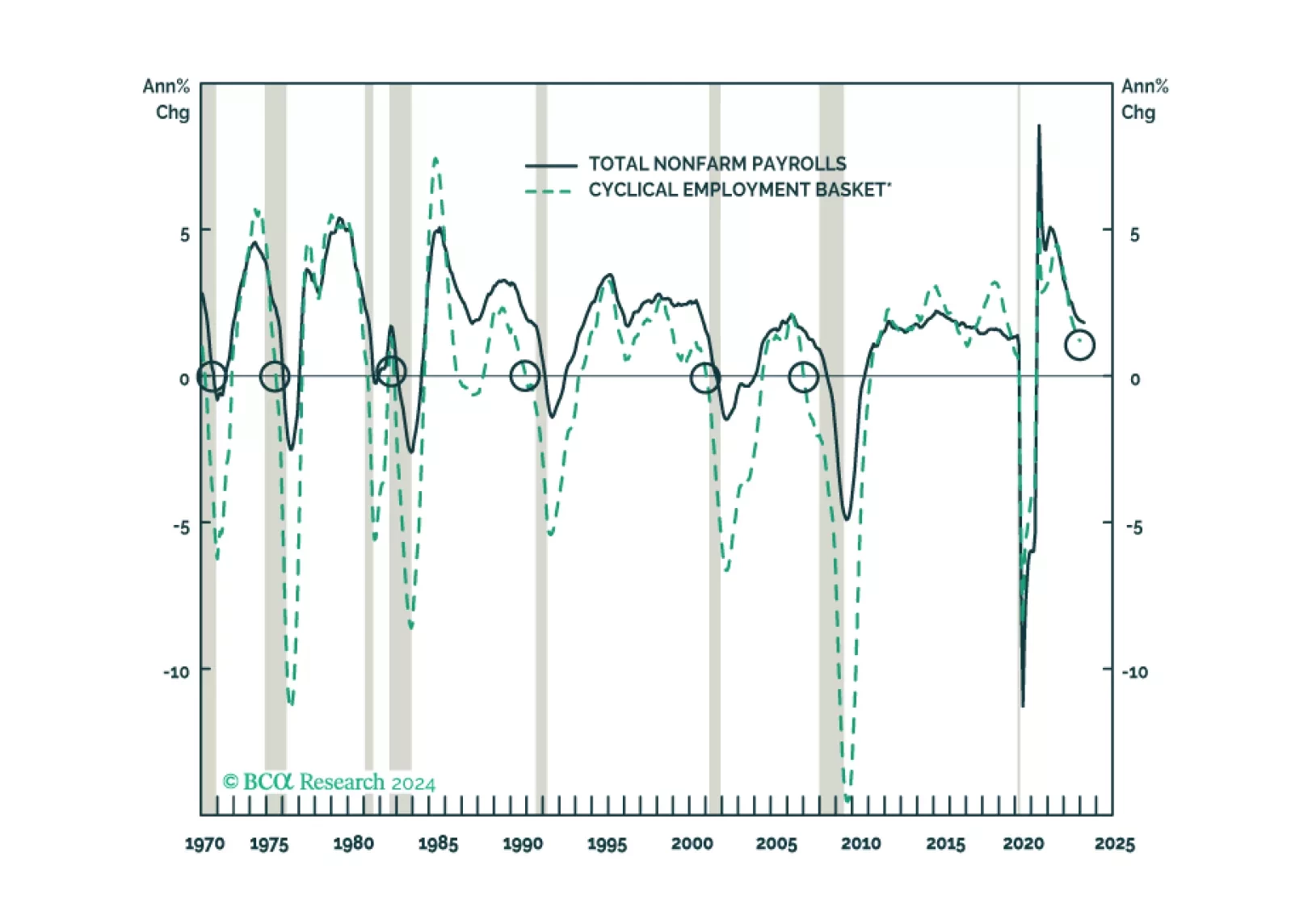
Last Friday’s blockbuster US employment report is among the recent data releases that have focused investors’ attention on the possibility that resilient economic conditions will reduce the magnitude of Fed easing this year. Markets are now priced for roughly…
After having surged in the second half of 2021 and early 2022, the Atlanta Fed’s Wage Growth Tracker peaked in mid-2022 and has since been on a general downtrend. The latest reading of 5.0% in January is a continuation of this process, marking the lowest pace…