Special Report
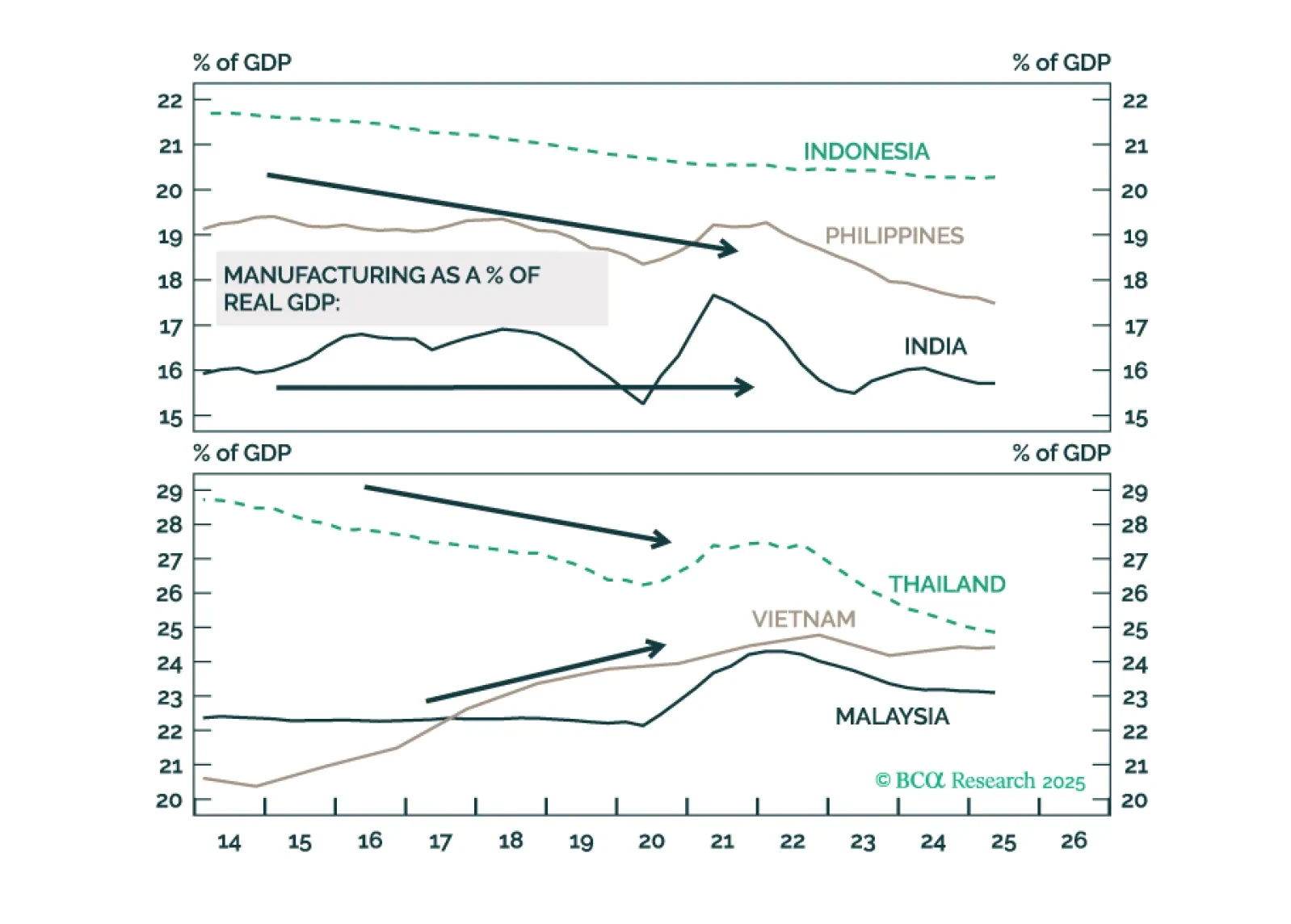
Executive Summary Favor ASEAN And The Philippines Southeast Asia is suffering from fading macro and geopolitical tailwinds but there are still investment opportunities on a relative basis. The peace dividend, globalization dividend, and demographic dividend are all eroding and will continue to erode, though there are relative winners and losers. The Philippines and Thailand are most secure; the Philippines and Indonesia are least dependent on trade; and the Philippines and Vietnam have the highest potential GDP growth. Geopolitical risk premiums have risen for Russia, Eastern Europe, China, and will rise for the Middle East. This leaves ASEAN states as relatively attractive emerging markets. Trade Recommendation Inception Date Return LONG PHILIPPINES / EM EQUITIES 2022-05-12 LONG ASEAN / ACW EQUITIES 2022-05-12 Bottom Line: ASEAN’s geopolitical outlook is less ugly than many other emerging markets. Cyclically, go long ASEAN versus global equities and long Philippine equities versus EM. Feature Chart 1Hypo-Globalization A Headwind For Trading States The Philippines elected its second “strongman” leader in a row on May 9, provoking the usual round of editorials about the death of liberalism. Investors know well by now that such political narratives do as much to occlude economic reality as to clarify it. Still, there is a fundamental need to understand the changing global political order since it will ultimately impact the investment landscape. If the global order stabilizes – e.g. US-Russia and US-China relations normalize – then trade and investment may recover from recent shocks. A new era of “Re-Globalization” could ensue. Asia Pacific would be a prime beneficiary as it is full of trading economies (Chart 1). Related Report Geopolitical StrategySecond Quarter Outlook 2022: When It Rains, It Pours By contrast, if Great Power Rivalry escalates further, then trade and investment will suffer, the current paradigm of Hypo-Globalization will continue, and East Asia’s frozen conflicts from 1945-52 will thaw and heat up. Asian states will have to shift focus from trade to security and their economies will suffer relative to previous expectations. How will Southeast Asia fare in this context? Will it fall victim to great power conflict, like Eastern Europe? Or will it keep a balance between the great powers and extract maximum benefits? Three Dividends Three dividends have underpinned Southeast Asia’s growth and prosperity in recent decades: 1. Peace Dividend – A relative lack of war and inter-state conflict. 2. Globalization Dividend – Advantageous maritime geography and access to major economies. 3. Demographic Dividend – Young demographics and strong potential GDP growth. All three of these dividends are eroding, so the macro and geopolitical investment case for ASEAN has weakened relative to twenty years ago. Nevertheless in a world where Russia, China, and the Gulf Arab markets face a higher and persistent geopolitical risk premium, ASEAN still offers attractive investment opportunities, particularly if the most geopolitically insecure countries are avoided. Peace Dividend Favors The Philippines And Thailand Since the end of the US and Chinese wars with Vietnam, military conflicts in Southeast Asia have been low intensity. Lack of inter-state conflict encouraged economic prosperity and security complacency. The five major Southeast Asian nations saw military spending decline since the 1990s and only Vietnam spends more than 2% of GDP (Chart 2). Chart 2Peace Brought Prosperity Unfortunately that is about to change. China has large import dependencies, an insufficient tradition of sea power, and feels hemmed in by its geography and the US alliance system. Beijing’s solution is to build and modernize its navy and prepare for potential conflict with the US, particularly over Taiwan. The result is rising tension across East Asia, including in Southeast Asia and the South China Sea. The ASEAN states fear China will walk over them, China fears they will league with the US against China, and the US tries to get them to do exactly that. Hence ASEAN’s defense spending has not kept up with its geopolitical importance and will have to rise going forward. Consider the following: Vietnam risks conflict with China. Vietnam has the most capable and experienced naval force within ASEAN due to its sporadic conflicts with China. Its equipment is supplied mainly by Russia, pitting it squarely against China’s Soviet or Soviet-inspired equipment. But Russia-China ties are tightening, especially after Russia’s divorce with Europe. While Vietnam will not reject Russia, it is increasingly partnering with the United States. The pandemic added to the Vietnamese public’s distrust of China, which is ancient but has ramped up in recent years due to clashes in the South China Sea. While Vietnam officially maintains that it will never host the US military, it is tacitly bonding with the US as a hedge against China. Yet Vietnam does not have a mutual defense treaty with the US, so it is vulnerable to Chinese military aggression over time. Indonesia distances itself from China. Rising security tensions are also forcing Indonesia to change its strategy toward China. Indonesia lacks experience in naval warfare and is not a claimant in the territorial disputes in the South China Sea. It is reluctant to take sides due to its traditionally non-aligned diplomatic status, its military culture of prioritizing internal stability (which is hard to maintain across thousands of islands), and China’s investment in its economy. However, China is encroaching on Indonesia’s exclusive economic zone and Indonesia has signaled its displeasure through diplomatic snubs and high-profile infrastructure contracts. Indonesia is trying to bulk up its naval and air capabilities, including via arms purchases from the West. Malaysia distances itself from China. Malaysia and the Philippines have the weakest naval forces and both face pressure from China’s navy and coast guard due to maritime-territorial disputes. But while the Philippines gets help from the US and its allies and partners, Malaysia has no such allies. Traditionally it was non-aligned. Instead it utilizes economic statecraft, as it has often done against more powerful countries. It recently paused Chinese economic projects in the country to conduct reviews and chose Ericsson over Huawei to build the 5G network. Ongoing maritime and energy disputes will motivate defense spending. The Philippines preserves alliance with United States. Outgoing President Rodrigo Duterte tried but failed to strengthen ties with China and Russia. Beijing continued to swarm the Philippines’ economic zone with ships and threaten its control of neighboring rocks and reefs. Ultimately Duterte renewed his country’s Visiting Forces Agreement with the US in July 2021. The newly elected President “Bong Bong” Marcos is even less likely to try to pivot away from the US. Instead the Philippines will work with the US to try to deter China. Thailand preserves alliance with United States. Thailand is the most insulated from the South China Sea disputes and often acts as mediator between China and other ASEAN states. However, Thailand is also a formal US defense ally and assisted with logistics during the Korean and Vietnamese wars. While US military aid was suspended after the 2014 military coup, non-military aid from the US continued. The State Department certified Thailand’s return to democracy in 2019, relations were normalized, and the annual Cobra Gold exercise resumed in 2020. The US’s hasty normalization shows Thailand’s importance to its regional strategy. On their own, the ASEAN states cannot counter China – they are simply outgunned (Chart 3). Hence their grand strategy of balancing Chinese trade relations with American security relations. Chart 3Outgunned By China Chart 4Opinion Shifts Against China In recent decades, with the US divided and distracted, they sought to entice China through commercial deals, in hopes that it would reduce its encroachments on the high seas. This strategy failed, as China’s expansion of economic and military influence in the region is driven by China’s own imperatives. Beijing’s lack of transparency about Covid-19 also sowed distrust. As a result, public opinion became more critical of China and defensive of national sovereignty (Chart 4). Southeast Asia will continue trading with China but changing public opinion, the US-China clash, and tensions in the South China Sea will inject greater geopolitical risk into this once peaceful and prosperous region. Military weakness will also lead the ASEAN states to welcome the US, EU, Japan, and Australia into the region as economic and security hedges against China. This trend risks inflaming regional tensions in the short run – and China may not be deterred over the long run, since its encroachments in the region are driven by its own needs and insecurities. Decades of under-investment in defense will result in ASEAN rearmament, which will weigh on fiscal balances and potentially economic competitiveness. Investors should not take the past three decades of peace for granted. Bottom Line: Vietnam (like Taiwan) is in a geopolitical predicament where it could provoke China’s wrath and yet lacks an American security guarantee. The Philippines and Thailand benefit from American security guarantees. Indonesia and Malaysia benefit from distance from China. All of these states will attempt to balance US and China relations – but in the future that means devoting more resources to national security, which will weigh on fiscal budgets and take away funds from human capital development. Waning Globalization Dividend Favors Indonesia And The Philippines All the ASEAN states rely heavily on both the US and China for export markets. This reliance grew as trade recovered in the wake of the global pandemic (Chart 5). Now global trade is slowing down cyclically, while US-China power struggle will weigh on the structural globalization process, penalizing the most trade-dependent ASEAN states relative to their less trade-dependent neighbors. So far US-China economic divorce is redistributing US-China trade in a way that is positive for Southeast Asia. China is rerouting exports through Vietnam, for example, while the US is shifting supply chains to other Asian states (Chart 6). The US will accelerate down this path because it cannot afford substantively to reengage with China’s economy for fear of strengthening the Russo-Chinese bloc. Chart 5Trade Rebounded But Hypo-Globalization Will Force Domestic Reliance Chart 6ASEAN’s Exports To US Surge Ahead Of China’s Hence the US will become more reliant on Southeast Asian exporters. Whatever the US stops buying from China will have to be sourced from other countries, so countries that export a similar basket of goods will benefit from the switch. Comparing the types of goods that China and ASEAN export to the US, Thailand is the closest substitute for China, whereas Malaysia is the farthest (Chart 7). That is not to say that Malaysia will suffer from US-China divorce. It is already ahead of China in exporting high-tech goods to the US, which is the very reason its export profile is so different. In 2020, 58% of Malaysia’s exports to the US are high-tech versus 35% for China’s. At the same time, Southeast Asian exports to China may not grow as fast as expected – cyclically China’s economy may accelerate on the back of current stimulus efforts, but structurally China is pursuing self-sufficiency and import substitution via a range of industrial policies (“Made in China 2025,” “dual circulation,” etc). These policies aim to make Chinese industrials competitive with European, US, Japanese, and Korean industrials. But they will also make China more competitive with medium-tech and fledging high-tech exports from Southeast Asia. Thus while China will keep importing low value products and commodities, such as unrefined ores, from Southeast Asia, imports of high-tech products will be limited due to China’s preference for indigenous producers. US export controls will also interfere with ASEAN’s ability to export high-tech goods to China. (In order to retain their US trade, in the face of Chinese import substitution, ASEAN states will have to comply with US export controls at least partially.) Even the low-to-medium tech goods that China currently imports from Southeast Asia may not grow as fast in the coming years as they have in the past. The ten provinces in China with the lowest GDP per capita exported a total of $129 billion to the world in 2020, whereas China’s imports from the top five ASEAN states amounted to $154 billion USD in 2020 (Chart 8). If Beijing insists on creating a domestic market for its poor provinces’ exports, then Southeast Asian exports to China will suffer. China might do this not only for strategic sufficiency but also to avoid US and western sanctions, which could be imposed for labor, environmental, human rights, or strategic reasons. Chart 7The US Sees Thailand And Vietnam As Substitutes For China Chart 8China Threatens ASEAN With Import Substitution Chart 9Trade Rebound Increased Exposure To US, China China, unlike the US during the 1990s and 2000s, cannot afford to open up its doors and become a ravenous consumer and importer of all Asia’s goods. This would be a way to buy influence in the region, as the US has done in Latin America. But China still has significant domestic development left to do. This development must be done for the sake of jobs and income – otherwise the Communist Party will face sociopolitical upheaval. Malaysia, Vietnam, and Thailand are the most vulnerable to China’s dual circulation strategy because of their sizeable exports to China, which stand at 12%, 15% and 7.6% of GDP respectively (Chart 9). Even though the Southeast Asian states have formed into a common market, and have joined major new trade blocs such as the CPTPP and RCEP, they will not see unfettered liberalization within these agreements – and they will not be drawn exclusively into China’s orbit. Instead they will face a China that wishes to expand export market share while substituting away from imports. The US and India, which are not part of these new trade blocs, will still increase their trade with ASEAN, as they will seek to substitute ASEAN for China, and ASEAN will be forced to substitute them for China. Thus globalization will weaken into regionalization and will not provide as positive of a force for Southeast Asia as it did over the 1980s-2000s. Going forward, the new paradigm of Hypo-Globalization will weigh on trade-dependent countries like Malaysia, Vietnam, and Thailand relative to their neighbors. Within this cohort, Malaysia and the Philippines will benefit from selling high-tech goods to the US, while Thailand and Vietnam will benefit from selling low- and mid-tech goods. China will remain a huge and critical market for ASEAN states but its autarkic policies will drive them to pursue other markets. Those with large and growing domestic markets, like Indonesia and the Philippines, will weather hypo-globalization better than their neighbors. Vietnam, Malaysia, and Thailand are all extremely dependent on foreign trade and hence vulnerable if international trade linkages weaken. Bottom Line: Global trade is likely to slow on a cyclical basis. Structurally, Hypo-Globalization is the new paradigm and will remove a tailwind that super-charged Southeast Asian development over the past several decades. Indonesia and the Philippines stand to suffer least and benefit most. Potential Growth Dividend Favors The Philippines And Vietnam Countries that can generate endogenous growth will perform the best under hypo-globalization. Indonesia, the Philippines, and Vietnam have the largest populations within ASEAN. But we must also take into account population growth, which contributes directly to potential GDP growth. A domestic market grows through population growth and/or income growth. For example, China benefitted from its growing population but now must switch to income generation as its population growth is stagnating. In Southeast Asia, the Philippines, Malaysia, and Indonesia have the highest population growth, while Thailand has the lowest. Thai population growth is even weak compared to China. The total fertility rate reinforces this trend – it is highest in Philippines but lowest in Thailand (Chart 10). A population that is too young or too old needs significant support that diverts resources away from the most productive age group. Philippines and Indonesia have the lowest median age, while Thailand has the highest. The youth of Indonesia and Philippines will come of age in the next decade, augmenting labor force and potential GDP growth. By contrast, Vietnam and especially Thailand, like China, will be weighed down by a shrinking labor force in the coming decade (Chart 11). Chart 10Fertility Rates Robust In ASEAN Chart 11Falling Support Ratio Weighs On Thailand, Vietnam Hence Indonesia and Philippines will prosper while Thailand, and to some extent Vietnam, lack the ability to diversify away from trade through domestic market growth. Malaysia sits in the middle: it is trade dependent and has the smallest population, but it has a young and growing population, and its labor force is still growing. Yet falling population growth is not a disaster if productivity and income growth are high. Productivity trends often contrast with population trends: Indonesia had the weakest productivity growth despite having a large, young, and growing population, while Vietnam had the strongest growth, despite a population slowdown. In fact Vietnam has the strongest productivity growth in Southeast Asia, at a 5-year, pre-pandemic average of 6.3%, followed by the Philippines (Chart 12A). By comparison China’s productivity growth averaged between 3%-6.6%, depending on the data source. Chart 12AProductivity And Potential GDP Chart 12BProductivity And Potential GDP Chart 13Capital Formation Favors Philippines Productivity growth adds to labor force growth to form potential GDP. In 2019, Philippines had the highest potential GDP growth at 6.9%, followed by the Vietnam at 6.8%, Indonesia at 5.6%, Malaysia at 3.9% and Thailand at 2.3%. In comparison China’s potential GDP growth was 3.6%-5.9%, again depending on data. Thailand is undoubtedly the weakest from both a population and productivity standpoint, while the Philippines has strength in both (Chart 12B). Countries invest in their economies to increase productivity. In 2019, Vietnam recorded the highest growth in grossed fixed capital formation at around 10.6%, followed by Indonesia at 6.9%, Philippines at 6.3%, and Thailand at 2.2%. Gross fixed capital formation has rebounded from the contractions countries suffered during the pandemic lockdowns in 2020 (Chart 13). Bottom Line: The Philippines has strong potential GDP growth, but Indonesia is not far behind as it invests in its economy. Vietnam has the highest investment and productivity growth, but its demographic dividend is waning. Malaysia is slightly better than Thailand because it has a growing population, but it has stopped investing and it is as trade dependent as Thailand. Thailand is weak on all accounts: it is trade dependent, has a shrinking population, and has a low potential GDP growth. Investment Takeaways Bringing it all together, ASEAN is witnessing the erosion of key dividends (peace, globalization, and demographics). Yet it offers attractive investment opportunities on a relative basis, given the permanent step up in geopolitical risk premiums for other major emerging markets like Russia, eastern Europe, China, and (soon) the Gulf Arab states (Charts 14A & 14B). Indeed the long under-performance of ASEAN stocks as a bloc, relative to global stocks, has recently reversed. As investors recognize China’s historic confluence of internal and external risks, they increasingly turn to ASEAN despite its flaws. Chart 14AASEAN Will Continue To Outperform China The US and China will use rewards and punishments to try to win over ASEAN states as strategic and economic partners. Those that have a US security guarantee, or are most distant from potential conflict, will see a lower geopolitical risk premium. Chart 14BASEAN Will Continue To Outperform China Chart 15Favor The Philippines The Philippines is the most attractive Southeast Asian market based on our criteria: it has an American security guarantee, domestic-oriented growth, and high productivity. Populism in the Philippines has come with productivity improvements and yet has not overthrown the US alliance. Philippine equities can outperform their emerging market peers (Chart 15). Indonesia is the second most attractive – it does not have direct territorial disputes with China, maintains defense ties with the West, is not excessively trade reliant, and keeps up decent productivity growth. It is vulnerable to nationalism and populism but its democracy is effective overall and the regime has maintained general political stability after near-dissolution in 1998. Thailand is geopolitically secure but lacking in potential growth. Vietnam has high potential growth but is geopolitically insecure over the long run. Investors should only pursue tactical investments in these markets. We maintain our long-term favorable view of Malaysia, although it is trade dependent and productivity has weakened. In future reports we will examine ASEAN markets in greater depth and with closer consideration of their domestic political risks. Jesse Anak Kuri Associate Editor Jesse.Kuri@bcaresearch.com Matt Gertken Chief Geopolitical Strategist mattg@bcaresearch.com Strategic Themes Open Tactical Positions (0-6 Months) Open Cyclical Recommendations (6-18 Months) Regional Geopolitical Risk Matrix