Monetary

Highlights A blue wave will likely supercharge the dollar’s downtrend in 2021. The key beneficiaries of this decline will be the much undervalued Scandinavian currencies, as well as those of commodity-producing countries. The initial knee-jerk reaction from the dollar could be positive as inflation lags the improvement in aggregate demand. Our trading model continues to recommend shorting the dollar. This simple three-factor model has outperformed the DXY index by over 300% since 1980. We were stopped out of our short NZD/CAD trade. This is a portfolio hedge. Look to reinstate. Feature The US political landscape is becoming more dollar bearish. This is because a blue wave will likely supercharge fiscal spending and allow for a partial repeal of the Trump tax cuts. Both will boost aggregate demand, without an equivalent offset from higher US interest rates. As we explain below, this is negative for the greenback. As a key reflator for the global economy, a lower US dollar will lead to an outperformance of non-US bourses, lifting animal spirits abroad and in a virtuous cycle, pressuring the dollar even lower. From a technical perspective, the dollar remains very oversold, having declined in almost a straight line since last March. While we continue to expect a dollar bounce, we had initially highlighted in previous reports it will be technical in nature, capped at around 2%-4%. Given this week’s news, chances of a technical bounce remain high, but the amplitude will be much more muted than we initially expected. This dovetails nicely with our trading model, which is politically agnostic, and continues to recommend shorting the dollar for the month of January. Implications Of A Blue Sweep It has been clear since the US election campaign began that Democratic leaders have been more aggressive in their demands for a greater government role in the economy. As such, a blue wave should widen the US budget deficit by much more than was expected under a Republican Senate. All things equal, a wider budget deficit is negative for the greenback. All things equal, a wider budget deficit is negative for the greenback (Chart I-1).1 Higher aggregate demand (via higher government spending) should allow the US output gap to close faster than would have otherwise been the case. This should begin to put upward pressure under domestic inflation. If the Federal Reserve chooses to allow an inflation overshoot, this will depress US real rates further and hurt the dollar in the process. There is a well-established relationship between real interest rate differentials and the greenback (Chart I-2). Chart I-1The Dollar And Budget Deficits
The Dollar And Budget Deficits
The Dollar And Budget Deficits
Chart I-2The Dollar And Real Interest Rates
The Dollar And Real Interest Rates
The Dollar And Real Interest Rates
The US continues to run a large current account deficit, meaning domestic savings have been insufficient to finance investment. A higher budget deficit is likely to widen the current account deficit, assuming private-sector savings do not rise significantly. To finance the shortfall in spending, foreign investors might require a higher risk premium on US assets via higher yields and/or a lower exchange rate. With the Federal Reserve effectively capping nominal yields, a lower exchange rate will be needed to entice foreign investors. A reason behind the dollar’s decline last year has been a stampede out of the Treasury market by foreign investors (Chart I-3). Chart I-3A Dearth Of Foreign Investors
A Dearth Of Foreign Investors
A Dearth Of Foreign Investors
Part of the Biden campaign pledge has also been to raise both corporate and personal income taxes. The US currently enjoys favorable corporate taxes relative to its G10 and BRICS peers (Chart I-4). Higher taxes would lower the return on capital for US investments. Our US Equity Strategists reckon the hit to the technology and health care sectors from a change in the tax rate will be particularly acute, in an order of magnitude of about 13.5% and 13.1% of earnings-per-share, respectively. Inflows into US equities exploded higher last year on the back of low rates and the higher weighting of technology and health care sectors in US bourses (Chart I-5). A reversal of these flows will hurt the dollar. This will occur at a time when expected returns on US equities are particularly low, compared to those in Europe and Japan (Chart I-6). Chart I-4Biden's Tax Plan In Perspective
The Dollar In A Blue Wave
The Dollar In A Blue Wave
Chart I-5US Equity Inflows Have Been Strong
US Equity Inflows Have Been Strong
US Equity Inflows Have Been Strong
Chart I-6ALow Expected Return On US Equities
The Dollar In A Blue Wave
The Dollar In A Blue Wave
Chart I-6BBetter Expected Returns On Eurozone Equities
The Dollar In A Blue Wave
The Dollar In A Blue Wave
Chart I-6CBetter Expected Returns On Japanese Equities
The Dollar In A Blue Wave
The Dollar In A Blue Wave
Is COVID-19 A Red Herring? Chart I-7A Covid-19 Growth Scare?
A Covid-19 Growth Scare?
A Covid-19 Growth Scare?
The analysis above suggests the outlook for the dollar should be bearish. Then why has the greenback been rebounding since the unveiling of a blue sweep? There are two reasons. First, the dollar was already very oversold, suggesting the short-term reward/risk from shorting the currency was not very favorable. Second, inflation is a lagging economic variable, so any impact from fiscal stimulus will first be on real growth, with inflation rising much later. Therefore, fiscal stimulus in the US will likely boost US economic performance relative to its peers in the short term. Meanwhile, as we navigate the winter season in the northern hemisphere, a new wave of infections has taken root. This will likely lead to a widespread deterioration in economic conditions, as economies enter more stringent lockdowns. Around the G10, various measures of lockdowns are being implemented, with particularly restrictive measures in the UK and Canada where new cases are close to record highs. Infection trends remain favorable in Australia and New Zealand, probably due to previous localized lockdowns (Chart I-7). However, with new, more infectious strains being first spotted in the UK and then South Africa, the bar is very low for a worldwide-renewed infection wave. The impact on currency markets is two-fold. First, the dollar is a counter-cyclical currency and so will benefit from safe-haven flows that will erupt with any renewed relapse in growth. With the dollar having traded inversely neck-in-neck with the S&P 500, any equity correction will provide a much healthy catalyst for a dollar bounce (Chart I-8). Any bounce in the USD should be faded as robust global growth in 2021 is expected. More directly, the impact for currency markets will be through relative economic growth. The improvement in the December Purchasing Managers’ Index was more favorable outside the US, particularly in Sweden, Canada, and the UK. That said, the greenback has undershot the trend dictated by the relative economic performance between the US and the rest of the G10 (Chart I-9). Should the US quickly bridge the gap between herd immunity (through vaccinations) and the spread of the virus, US economic growth could gain the upper hand. Chart I-8The Dollar And Markets
The Dollar And Markets
The Dollar And Markets
Chart I-9The Dollar And Relative Growth
The Dollar And Relative Growth
The Dollar And Relative Growth
Ultimately, the near-term potential impact from COVID-19 will be much less than economies endured in the first half of 2020. The main reason is that the vaccine rollout is accelerating, with many other candidates in the pipeline. This will allow for robust global growth in 2021, which will ease safe-haven flows into the US dollar. Thus, any bounce in the USD should be faded rather than leaned into, as we have been arguing since October of last year.2 FX Trading Model Chart I-10BCA FX Trading Model
BCA FX Trading Model
BCA FX Trading Model
How does our trading model feel about a blue sweep? It is agnostic, given that none of the inputs are directly driven by US politics. The one area where US politics could affect the model is through real rates, but as we have argued, this is a slow-moving process. More importantly, the model serves as a rules-based approach in trading foreign exchange. In short, three criteria drive the model:3 A macroeconomic variable that captures the most important relative price between any two currencies: the real interest rate. A valuation measure that captures dislocation in a currency pair relative to its own history. A key assumption is stationarity, meaning the currency cross will mean-revert back to fair value over time. A sentiment indicator. The key assumption here is that the dollar is a momentum currency. This very simplistic approach has outperformed a buy-and-hold DXY portfolio by 325% since 1980 (Chart I-10). Given the encouragement from this initial result, we will be releasing part two of the model in the coming weeks. The FX market is likely to become more volatile and provide more opportunities. For now, the model recommends shorting the DXY for the month of January, driven by long positions in the Swedish krona, Swiss franc, and Japanese yen. Less favorable currencies are the Australian and New Zealand dollars (Chart I-11). Such a barbell strategy of some high-beta currencies, together with some safe havens, might be just what the doctor ordered. In our FX portfolio, we prefer to stick with trades at the crosses. So far, our trading recommendations have benchmarked favorably against the model recommendations (Chart I-12). We will build on this success in future iterations. Chart I-11Long = Greater Than 0; Short = Less Than 0
The Dollar In A Blue Wave
The Dollar In A Blue Wave
Chart I-12Man Versus BCA Machine
The Dollar In A Blue Wave
The Dollar In A Blue Wave
Housekeeping Our portfolio has benefited tremendously from the overall short dollar position we have been recommending since 2019. However, in light of possible volatility in the coming weeks, we are tightening stop-losses on a few of our profitable trades. We hold a basket of Scandinavian currencies against both the dollar and the euro. Tighten the stop loss to a 2% loss from initiation, given recent gains. Stay long silver versus gold but tighten the stop loss to 75 to lock in some profits. Our long yen portfolio hedge has performed quite well. Tighten the stop loss from 110 to 105. We were stopped out of our short NZD/CAD trade for a loss of 1.8%. Stand aside for now, with a view to re-establish later. We are still short NZD versus AUD. Tighten the stop loss to 1.02. In our view, the FX market is likely to uncover many macro opportunities as the year unfolds. Stay tuned. Chester Ntonifor Foreign Exchange Strategist chestern@bcaresearch.com Footnotes 1 Please see Foreign Exchange Strategy Weekly Report, “The Dollar And The Budget Deficit: From Theory To Practice,” dated August 14, 2020. 2 Please see Foreign Exchange Strategy Weekly Report, “Tail Risks In FX Markets,” dated October 2, 2020. 3 Please see Foreign Exchange Strategy Weekly Report, “Building A Protector Currency Portfolio,” dated February 7, 2020. Currencies U.S. Dollar Chart II-1USD Technicals 1
USD Technicals 1
USD Technicals 1
Chart II-2USD Technicals 2
USD Technicals 2
USD Technicals 2
Recent data in the US have been robust: The final read of the Markit Manufacturing PMI was 57.1 in December, compared to a prior reading of 56.5. The ISM manufacturing index came in at a very robust 60.7 for the month of December, well above expectations. The trade balance in the US remained near cycle lows at -$68.1bn for November. The DXY index fell slightly this week. It is becoming quite clear that December was a robust month for economic data, both in the US and abroad. As a result, the US dollar, which is a counter-cyclical currency, depreciated modestly. With the prospect of higher fiscal stimulus in the US, but an accommodative Federal Reserve, lower real rates should keep a cap on the dollar. Report Links: The Dollar Conundrum And Protection - November 6, 2020 The Dollar In A Market Reset - October 30, 2020 A Few Market Observations - October 23, 2020 The Euro Chart II-3EUR Technicals 1
EUR Technicals 1
EUR Technicals 1
Chart II-4EUR Technicals 2
EUR Technicals 2
EUR Technicals 2
Recent data from the euro area have held up: The Markit Manufacturing Index remained at the 55 level for the month of December (from 55.5 to 55.2). Producer prices continue to deflate at 2% per year, but the November decline compares favorably to the 5% year-on-year drop in May last year. Core CPI remained flat at 0.2% in December. The euro appreciated by 0.2% against the US dollar this week. The dominant theme in markets remains a broad-based dollar decline, with the euro being the key liquid beneficiary of this move. Most of Europe has managed to flatten the infection curve for Covid-19, which should allow economic momentum to improve further. Report Links: The Dollar Conundrum And Protection - November 6, 2020 Addressing Client Questions - September 4, 2020 On The DXY Breakout, Euro, And Swiss Franc - February 21, 2020 The Japanese Yen Chart II-5JPY Technicals 1
JPY Technicals 1
JPY Technicals 1
Chart II-6JPY Technicals 2
JPY Technicals 2
JPY Technicals 2
Recent data from Japan has been quite disappointing: Cash earnings fell by 2.2% for the month of November. The key driver was a 10.3% decline in overtime pay and 22.9% decline in bonus payments. The Jibun manufacturing PMI was relatively flat at the 50 boom/bust level in December. On a positive note, vehicle sales improved by 7.4% year-on-year in December. It is becoming more evident that a replacement cycle in Japanese autos in underway. The Japanese yen depreciated by 0.7% against the US dollar this week. The key theme this week was a rise in US bond yields, which made the allure of Japanese fixed income less attractive. With Japanese yields anchored at 0%, rising global yields make Japan fixed income returns attractive, but the currency a short in a global portfolio. We are long the Japanese yen and are tightening stops to protect profits. Report Links: The Dollar Conundrum And Protection - November 6, 2020 The Near-Term Bull Case For The Dollar - February 28, 2020 Building A Protector Currency Portfolio - February 7, 2020 British Pound Chart II-7GBP Technicals 1
GBP Technicals 1
GBP Technicals 1
Chart II-8GBP Technicals 2
GBP Technicals 2
GBP Technicals 2
Recent data in the UK have been mixed: The Markit Manufacturing PMI printed a final 57.5 for December. Mortgage approvals continue to inflect higher, with 105K submissions absorbed in November. UK services remain in recession. The Markit services PMI came in at 49.4 in December, from 49.9 last month. The British pound was flat this week. The Brexit imbroglio is now behind us, and the UK must now contend with the uncomfortable combination of rising Covid-19 cases and a new relationship with the EU. This has prevented the pound from fully celebrating an end to uncertainty. Our roadmap remains valuation, as we see the pound as cheap versus both the dollar and euro, hence our short EUR/GBP position. Report Links: The Dollar Conundrum And Protection - November 6, 2020 Revisiting Our High-Conviction Trades - September 11, 2020 Updating Our Balance Of Payments Monitor - November 29, 2019 Australian Dollar Chart II-9AUD Technicals 1
AUD Technicals 1
AUD Technicals 1
Chart II-10AUD Technicals 2
AUD Technicals 2
AUD Technicals 2
Recent data in Australia have been solid: Building approvals improved 2.6% month-on-month in November. The trade balance remains at a healthy surplus of A$5bn in November. While imports expanded 10% month-on-month, exports remained a healthy 3% over the October print. The Australian dollar appreciated by 1.2% against the US dollar this week. The AUD continues to benefit from favorable terms-of-trade, not only from high iron ore prices, but from the looming shortage of readily available liquefied natural gas (LNG) as Japan and Korea enter unusually cold weather. This is bullish the AUD. Report Links: An Update On The Australian Dollar - September 18, 2020 On AUD And CNY - January 17, 2020 Updating Our Balance Of Payments Monitor - November 29, 2019 New Zealand Dollar Chart II-11NZD Technicals 1
NZD Technicals 1
NZD Technicals 1
Chart II-12NZD Technicals 2
NZD Technicals 2
NZD Technicals 2
There was scant data out of New Zealand this week: CoreLogic house prices expanded by 11.1% year-on-year in December. The New Zealand dollar appreciated by 1.1% against the US dollar this week. The kiwi has been on fire in recent weeks, driven not only by the unwinding of expectations of negative rates by the RBNZ, but also by rising terms of trade as agricultural prices recover. We have been fading the kiwi rally, and were offside on our short NZD/CAD trade for a cumulative loss 1.8% loss this week. We are standing aside for now. Report Links: Currencies And The Value-Versus-Growth Debate - July 10, 2020 Updating Our Balance Of Payments Monitor - November 29, 2019 Place A Limit Sell On DXY At 100 - November 15, 2019 Canadian Dollar Chart II-13CAD Technicals 1
CAD Technicals 1
CAD Technicals 1
Chart II-14CAD Technicals 2
CAD Technicals 2
CAD Technicals 2
Recent data from Canada have held up: The Markit manufacturing PMI came in at 57.9 in December, an increase from the prior read of 55.8. The trade balance remains in a deficit of $C3.34bn for November, in line with the previous month. The Canadian dollar appreciated by 0.8% against the US dollar this week. There was good news on the oil front that boosted the loonie. Saudi Arabia agreed to absorb cuts of 1 million barrels a day, allowing a more fervent rebalancing of the oil market. This boosted petrocurrencies, including the loonie. Report Links: Currencies And The Value-Versus-Growth Debate - July 10, 2020 More On Competitive Devaluations, The CAD And The SEK - May 1, 2020 A New Paradigm For Petrocurrencies - April 10, 2020 Swiss Franc Chart II-15CHF Technicals 1
CHF Technicals 1
CHF Technicals 1
Chart II-16CHF Technicals 2
CHF Technicals 2
CHF Technicals 2
Recent data from Switzerland have been mixed: The manufacturing PMI came in at 58 in December, well above expectations of 54.3 and a prior reading of 55.2. Switzerland remains in deflation. Core CPI came in at -0.4% in December versus expectations of -0.2%. Headline CPI was even more negative at -0.8%. The Swiss franc depreciated by 0.4% against the US dollar this week. There is no doubt that the strong franc is exerting deflationary pressures into the Swiss economy. This is evident not only from tradeable prices, but also from domestic inflation. Encouragingly, the manufacturing sector is picking up, which is providing a valve for less intervention by the SNB. We are long EUR/CHF on grounds that the franc is too strong versus the euro. Report Links: The Dollar Conundrum And Protection - November 6, 2020 On The DXY Breakout, Euro, And Swiss Franc - February 21, 2020 Currency Market Signals From Gold, Equities And Flows - January 31, 2020 Norwegian Krone Chart II-17NOK Technicals 1
NOK Technicals 1
NOK Technicals 1
Chart II-18NOK Technicals 2
NOK Technicals 2
NOK Technicals 2
There was scant data out of Norway this week: The DNB/NIMA manufacturing PMI was flat at 51.9 in December. The Norwegian krone surged by 1.44% against the US dollar this week as the best performing G10 currency. Given the lack of economic data, the key narrative was the oil deal where the Saudis curtailed production. As our top pick for currency outperformance this year, this is much welcomed news. Stay long NOK versus both the USD and EUR. Report Links: Revisiting Our High-Conviction Trades - September 11, 2020 A New Paradigm For Petrocurrencies - April 10, 2020 Building A Protector Currency Portfolio - February 7, 2020 Swedish Krona Chart II-19SEK Technicals 1
SEK Technicals 1
SEK Technicals 1
Chart II-20SEK Technicals 2
SEK Technicals 2
SEK Technicals 2
Recent data from Sweden have been robust: The Swedbank/Silf manufacturing PMI surged from 59.1 to 64.9. The Swedish krona rose by 0.7% against the US dollar this week. Sweden is in a sweet spot, where low interest rates are emboldening risk taking and a robust global manufacturing cycle is keeping Swedish supply chains busy. With this virtuous cycle slated to continue, this would continue to be a boost for the krona. Report Links: Revisiting Our High-Conviction Trades - September 11, 2020 Updating Our Balance Of Payments Monitor - November 29, 2019 Where To Next For The US Dollar? - June 7, 2019 Trades & Forecasts Forecast Summary Core Portfolio Tactical Trades Limit Orders Closed Trades
Highlights Further fiscal easing is likely in the US now that the Democrats are set to take control of the US Senate following Tuesday’s runoff elections in Georgia. With the end of the pandemic in sight, a growing chorus of commentators, including none other than Larry Summers, are sounding the alarm over fears that fiscal policy could end up being too stimulative. In the short term, the risk that economies will overheat due to excessive fiscal support is low. There is still too much labor market slack, the bulk of any stimulus checks will be saved, and the short-run Phillips curve remains quite flat. Looking beyond the next two years, fiscal policy could indeed turn out to be inflationary. Political populism is rising. Central banks, fearful of the zero lower-bound constraint on interest rates, want higher inflation. Falling interest rates have also made it easier for governments to run larger budget deficits. We estimate that the US can run a primary budget deficit that is more than 2% of GDP larger than at the start of 2019, while still achieving a stable debt-to-GDP ratio. The “fiscal envelope” has increased significantly in other major economies as well. Ironically, in a world where interest rates are below the trend growth in GDP, a higher debt-to-GDP ratio permits larger budget deficits. Investors should remain overweight stocks relative to bonds over a cyclical 12-month horizon, favoring “value stocks” which will benefit more from steeper yield curves and the dismantling of lockdown measures. Financial markets will face a period of extreme turbulence in a couple of years once inflation begins to accelerate. A Race Against Time The past few weeks have seen a race between the virus, which continues to infect people at an alarming rate, and efforts to vaccinate the most vulnerable members of society. So far, the virus has the upper hand. Chart 1Tracking The Progress In Global Vaccination Rates
Fiscal Stimulus: How Much Is Too Much?
Fiscal Stimulus: How Much Is Too Much?
The “UK strain” has become more prevalent around the world.1 By some estimates it is 70% more contagious than the original virus that emerged in Wuhan, China. Another, potentially even more dangerous strain, has surfaced in South Africa and has spread to South America. The early evidence suggests that the recently approved vaccines will be effective in fighting the UK strain. Unfortunately, there is not enough data to judge whether this is also true for the South African strain. Right now, only 0.2% of the world’s population has been inoculated, but that number will rise rapidly over the coming months (Chart 1). Assuming that existing vaccines are effective against the myriad virus strains, the infection rate should fall precipitously by the middle of the year. Georgia Runoffs Will Lead To Even More Stimulus Governments eased fiscal policy significantly last year in response to the unfolding crisis (Chart 2). At the worst point of the pandemic in April, US real disposable income was up 14% year-over-year (Chart 3). Transfers to households fell sharply following the expiration of the CARES Act, but are set to rise again thanks to the recently completed stimulus deal. Chart 2Fiscal Policy In 2020: Governments Eased Significantly In Response To The Unfolding Crisis
Fiscal Stimulus: How Much Is Too Much?
Fiscal Stimulus: How Much Is Too Much?
The victory by both Democratic candidates in the Georgia Senate runoff races on Tuesday moves the political configuration in Washington even further towards fiscal easing. Having gained control of the Senate, the Democrats will now be able to use the “reconciliation process” to pass a budget that boosts spending on health care, education, infrastructure, and the environment. Granted, reconciliation requires that any extra spending be offset by additional revenue measures over a 10-year budgetary horizon. Thus, corporate taxes will probably rise. Nevertheless, the combination of more spending and higher corporate taxes will still produce a net boost to aggregate demand. This is partly because any revenue measures are likely to be backloaded. It is also because raising corporate taxes will not reduce investment by very much. The experience from the Trump tax cuts revealed that the main consequence of lowering corporate tax rates was to lower corporate tax receipts. The touted boost to corporate investment from lower taxes never materialized. In fact, outside of the energy sector – which benefited from an unrelated recovery in crude oil prices – US corporate capex grew more slowly between Q4 of 2016 and Q4 of 2019 than it did over the preceding three years (Chart 4). Chart 3Personal Income Jumped Early On In The Pandemic
Personal Income Jumped Early On In The Pandemic
Personal Income Jumped Early On In The Pandemic
Chart 4No Evidence That Trump Corporate Tax Cuts Boosted Investment
Fiscal Stimulus: How Much Is Too Much?
Fiscal Stimulus: How Much Is Too Much?
For stock market investors, the prospect of higher taxes will take some of the bloom off the rose from additional fiscal stimulus. That said, the impact will vary considerably across equity sectors. Cyclical stocks such as industrials and materials will benefit from stimulus-induced economic growth. Banks will also gain because stronger growth will suppress loan losses, while leading to steeper yield curves, thus raising net interest margins in the process. Value stocks have more exposure to banks and deep cyclicals, and hence we remain positive on them. Small caps also have more exposure to these sectors, but are starting to look increasingly pricey. Stimulus: How Much Is Enough? Chart 5Commercial Bankruptcies Are Well Contained
Fiscal Stimulus: How Much Is Too Much?
Fiscal Stimulus: How Much Is Too Much?
Fiscal stimulus helped avert the cascade of business failures that normally accompany recessions. Despite a tick up in bankruptcies among large companies shortly after the pandemic began, 16% fewer companies filed for bankruptcy in the first 11 months of 2020 compared to the same period in 2019 (Chart 5). Overall bankruptcy filings, which include personal bankruptcies, have fallen to a 35-year low according to Epiq AACER. The pipeline for bankruptcies also looks fairly narrow. Junk bond prices have been rebounding and consumer loan delinquency rates have been trending down (Table 1). Table 1Personal Loan Delinquencies Have Also Been Trending Lower
Fiscal Stimulus: How Much Is Too Much?
Fiscal Stimulus: How Much Is Too Much?
Generous fiscal transfers have allowed households to accumulate plenty of savings, which should help propel future spending. Chart 6 shows that accumulated US household savings are about $1.5 trillion above their pre-pandemic trend. We estimate that the combination of increased savings, rising home prices, and a surging stock market pushed up household net worth by $8 trillion in Q4 alone, leaving it 11% above Q4 2019 levels. In comparison, household net worth fell by over 15% during the Great Recession. Chart 6Households Have Accumulated Lots Of Savings, Which Should Help Propel Future Spending
Households Have Accumulated Lots Of Savings, Which Should Help Propel Future Spending
Households Have Accumulated Lots Of Savings, Which Should Help Propel Future Spending
Little Risk Of Near-Term Fiscal Overheat With the prospect of a vaccine-led economic recovery in sight, a growing chorus of commentators are sounding the alarm over fears that fiscal policy could end up being too stimulative. In an interview with Bloomberg Television, Larry Summers contended that President Trump’s attempt to increase the size of stimulus checks from $600 per person to $2000 was “a serious mistake” that risked overheating the economy. Summers argued for a more streamlined approach that prioritized aid to state and local governments and increased funding for Covid testing and vaccine deployment. Despite Larry’s admonition, we see little risk that loose fiscal policy will cause any major economy to overheat in the near term, even if the Senate does enact more stimulus. For one thing, recent stimulus proposals have emphasized direct transfers to households. Unlike most other types of spending, across-the-board stimulus checks will go mainly into savings. The New York Fed has estimated that less than 30% of the direct stimulus payments in the CARES Act were used for consumption, with 36% saved and 35% used to pay down debt. Consistent with past experience, households expect to spend only about one-third of the forthcoming stimulus checks according to CivicScience, a market research firm (Chart 7). Chart 7How Will Americans Spend Their Second Stimulus Check?
Fiscal Stimulus: How Much Is Too Much?
Fiscal Stimulus: How Much Is Too Much?
Chart 8Employment-To-Population Ratios Remain Well Below Pre-Pandemic Levels
Employment-To-Population Ratios Remain Well Below Pre-Pandemic Levels
Employment-To-Population Ratios Remain Well Below Pre-Pandemic Levels
Moreover, there is still plenty of labor market slack. Chart 8 shows the employment-to-population ratio for prime-aged workers remains well below pre-pandemic levels across the OECD. In a best-case scenario, it will take a couple more years for employment levels to return to normal. Long-term inflation expectations are also well anchored, implying that the short-run Phillips curve is quite flat. In simple English, this means that a temporary burst of stimulus is unlikely to trigger an inflationary price-wage spiral. Some decline in budget deficits is also likely after the pandemic ends. The Hutchins Center at Brookings expects the fiscal package passed by the US Congress in December to boost GDP by 7% in the first quarter. However, it expects the four-quarter moving average in the fiscal contribution to growth to turn negative in the third quarter, and stay that way right through 2022 (Chart 9). Likewise, in its most recent forecasts, the IMF projected a negative fiscal impulse in the major advanced economies in 2021-22 (Chart 10). Chart 9Budget Deficits Set To Decline, But Remain High By Historic Standards (Part I)
Fiscal Stimulus: How Much Is Too Much?
Fiscal Stimulus: How Much Is Too Much?
Chart 10Budget Deficits Set To Decline, But Remain High By Historic Standards (Part II)
Fiscal Stimulus: How Much Is Too Much?
Fiscal Stimulus: How Much Is Too Much?
Long-Term Fiscal Picture Is More Inflationary Granted, a negative fiscal impulse simply means that the structural budget deficit is declining over time. In absolute terms, the IMF expects budget deficits to remain quite large by historic standards, even if they do come down from their pandemic peak. Remember, it is the level of the budget deficit that helps determine the level of demand throughout the economy. Economies overheat when the level of aggregate demand exceeds the level of aggregate supply. If private-sector demand recovers more quickly than budget deficits come down, overall demand will rise. As such, it is certainly possible that excessively easy fiscal policy will contribute to an inflationary overshoot once labor market slack has been fully absorbed in two-to-three years. Politically, such an overshoot seems quite plausible. Populism is rising both on the left and the right. It is noteworthy that the Republican candidates in Tuesday’s runoff Senate races supported President Trump’s call for boosting the size of stimulus checks. The same goes for Senators Lindsey Graham of South Carolina and Marco Rubio of Florida. Rubio is widely considered an early front-runner for the 2024 Republican presidential nomination. Economically, the case for bigger budget deficits has also become more appealing. Real interest rates are negative across the major economies. Low interest rates allow governments to take on more debt without having to make large interest payments. Indeed, the Japanese government today receives more interest than it pays by virtue of the fact that more than half of its debt was issued at negative rates. Persistent worries about the zero lower-bound constraint also encourage central banks to pursue policies that could fuel inflation, such as refraining from tightening monetary policy in response to looser fiscal policy. The current level of policy rates gives central banks almost no scope to cut rates in response to an adverse economic shock. If inflation were to rise, central banks would be able to bring real rates even further into negative territory should economic conditions warrant it. The Paradox Of Debt Sustainability When r Is Less Than g One might think that today’s high debt-to-GDP ratios would force governments to slash deficits to keep debt from spiraling out of control. However, things are not so straightforward in a world of ultra-low interest rates. As Appendix A shows, the primary budget balance that is consistent with a stable debt-to-GDP ratio can be expressed as:
Fiscal Stimulus: How Much Is Too Much?
Fiscal Stimulus: How Much Is Too Much?
Where p is the primary budget balance (the difference between tax receipts and non-interest spending, expressed as a share of GDP), r is the real interest rate, and g is the growth rate of the economy. Notice that when r is less than g, a higher debt-to-GDP ratio corresponds to a larger primary budget deficit (i.e., a more negative p). In other words, by taking on more debt, governments would not only be able to raise spending or cut taxes, but they would also have enough money left over to pay the additional interest on the debt. And they could do all this without putting the debt-to-GDP ratio on an unsustainable upward trajectory. Chart 11More Space For Bigger Budget Deficits In The US...
More Space For Bigger Budget Deficits In The US...
More Space For Bigger Budget Deficits In The US...
What sort of funky magic allows this to happen? The answer is that even a small percentage increase in debt will correspond to a large increase in the absolute stock of debt when debt levels are elevated to begin with. If interest rates are low, most of the additional debt can go into financing a larger primary deficit instead of higher interest payments. One can see this point with a simple example. Suppose that initially, debt is 50, GDP is 100, and hence the debt-to-GDP ratio is 50%. Let us also assume that the primary deficit is 1% of GDP, the interest rate is 2%, and GDP grows at 4%. Next year, debt will be 50+50*0.02+1=52 while GDP will be 100*1.04=104. Hence, the debt-to-GDP ratio will remain 52/104=50%. Now rerun the same example but assume that debt is initially equal to 100, implying an initial debt-to-GDP ratio of 100%. In that case, it is simple to verify that the debt-to-GDP ratio would fall to 103/104≈99% the following year if the primary deficit remained at 1% of GDP. The primary deficit would have to rise to 2% of GDP to keep the debt-to-GDP stable – double what it was in the first example. The level of the US primary budget deficit that is consistent with a stable debt-to-GDP ratio has risen from 0.8% of GDP at the start of 2019 to 3.1% today if one uses the Congressional Budget Office’s estimate of trend growth and the 10-year TIPs yield as a proxy for the real interest rate (Chart 11). A similar trend is visible abroad (Chart 12). Chart 12... As Well As In Other Major Economies
Fiscal Stimulus: How Much Is Too Much?
Fiscal Stimulus: How Much Is Too Much?
Investment Conclusions Thanks to the drop in interest rates, governments today have more scope to run larger budget deficits than they did in the past. This suggests that the sort of fiscal tightening that impeded the recovery following the Great Recession is unlikely to reoccur. The combination of above-trend growth and continued low rates will buoy equities in 2021. Investors should remain overweight stocks relative to bonds over a cyclical 12-month horizon, favoring “value stocks” which will benefit both from steeper yield curves and the dismantling of lockdown measures. Financial markets will face a period of extreme turbulence in a couple of years as unemployment approaches pre-pandemic levels and central banks begin to contemplate raising interest rates. A higher debt burden allows for a larger budget deficit when r is less than g, but requires a bigger budget surplus when r rises above g. If debt-saddled governments are unable or unwilling to tighten fiscal policy, they may end up applying political pressure on central banks to keep rates artificially low in order to suppress interest payments. As such, excessively easy monetary policy could trigger a bout of inflation. With that in mind, investors should maintain below-benchmark duration exposure in fixed-income portfolios, favor inflation protected-securities over nominal bonds, and hold other inflation hedges such as gold and farmland. Cryptocurrencies could potentially serve as an inflation hedge, but given the recent run up in bitcoin prices, we would avoid this area of the market for the time being. Appendix AThe Arithmetic Of Debt Sustainability
Fiscal Stimulus: How Much Is Too Much?
Fiscal Stimulus: How Much Is Too Much?
Peter Berezin Chief Global Strategist peterb@bcaresearch.com Footnotes 1 A number of SARS-CoV-2 variants are circulating globally. The WHO reported this week that the UK variant of Covid-19 has spread to 40 other countries. Initial research suggests that the UK strain is more transmissible, but is characterized by unchanged disease severity compared to the original virus. The South African strain is also believed to be more contagious and was detected in six other countries. Some have raised concerns about the high number of mutations found in the South African variant. Research is ongoing to determine the potential consequences of the emerging variants on the speed of transmission, disease severity, ability to evade detection, and the efficacy of current treatments and vaccines. Please see Antony Sguazzin, “South Africa Virus Strain More Transmissible, Not More Severe,” Bloomberg, January 7, 2021; Gabriele Steinhauser, “The New Covid-19 Strain in South Africa: What We Know,” The Wall Street Journal, January 6, 2021; “Weekly epidemiological update - 5 January 2021,” World Health Organization; and “Emerging SARS-CoV-2 Variants,” Centers for Disease Control and Prevention, updated January 3, 2021. Global Investment Strategy View Matrix
Fiscal Stimulus: How Much Is Too Much?
Fiscal Stimulus: How Much Is Too Much?
Special Trade Recommendations
Fiscal Stimulus: How Much Is Too Much?
Fiscal Stimulus: How Much Is Too Much?
Current MacroQuant Model Scores
Fiscal Stimulus: How Much Is Too Much?
Fiscal Stimulus: How Much Is Too Much?
Highlights Markets largely ignored the uproar at the US Capitol on January 6 because the transfer of power was not in question. Democratic control over the Senate, after two upsets in the Georgia runoff, is the bigger signal. US fiscal policy will become more expansive yet the Federal Reserve will not start hiking rates anytime soon. This is a powerful tailwind for risk assets over the short and medium run. Politics and geopolitics affect markets through the policy setting, rather than through discrete events, which tend to have fleeting market impacts. The current setting, in the US and abroad, is negative for the US dollar. The implication is positive for emerging market stocks and value plays. Go long global stocks ex-US, long emerging markets over developed markets, and long value over growth. Cut losses on short CNY-USD. Feature Chart 1Market's Muted Response To US Turmoil
Market's Muted Response To US Turmoil
Market's Muted Response To US Turmoil
Scenes of mayhem unfolded in the US Capitol on January 6 as protesters and rioters flooded the building and temporarily interrupted the joint session of Congress convened to count the Electoral College votes. Congress reconvened later and finished the tally. President-elect Joe Biden will take office at noon on January 20. Financial markets were unperturbed, with stocks up and volatility down, though safe havens did perk up a bit (Chart 1). The incident supports our thesis that the US election cycle of 2020 was a sort of “Civil War Lite” and that the country is witnessing “Peak Polarization,” with polarization likely to fall over the coming five years. The incident was the culmination of the past year of pandemic-fueled unrest and President Trump’s refusal to concede to the Electoral College verdict. Trump made a show of force by rallying his supporters, and apparently refrained from cracking down on those that overran Congress, but then he backed down and promised an orderly transfer of power. The immediate political result was to isolate him. Fewer Republicans than expected contested the electoral votes in the ensuing joint session; one Republican is openly calling for Trump to be forced into resignation via the 25th amendment procedure for those unfit to serve. The electoral votes were promptly certified. Vice President Mike Pence and other actors performed their constitutional duties. Pence reportedly gave the order to bring out the National Guard to restore order – hence it is possible that Pence and Trump’s cabinet could activate the 25th amendment, but that is unlikely unless Trump foments rebellion going forward. Vandals and criminals will be prosecuted and there could also be legal ramifications for Trump and some government officials. Do Politics And Geopolitics Affect Markets? The market’s lack of concern raises the question of whether investors need trouble themselves with politics at all. Philosopher and market guru Nassim Nicholas Taleb tweeted the following: If someone, a year ago, described January 6, 2021 (and events attending it) & asked you to guess the stock market behavior, admit you would have gotten it wrong. Just so you understand that news do not help you understand markets.1 This is a valid point. Investors should not (and do not) invest based on the daily news. Of course, many observers foresaw social unrest surrounding the 2020 election, including Professor Peter Turchin.2 Social instability was rising in the data, as we have long shown. When you combined this likelihood with the Fed’s pause on rate hikes, and a measurable rise in geopolitical tensions between the US and other countries, the implication was that gold would appreciate. So if someone had told you a year ago that the US would have a pandemic, that governments would unleash a 10.2% of global GDP fiscal stimulus, that the Fed would start average inflation targeting, that a vaccine would be produced, and that the US would have a contested election on top of it all, would you have expected gold to rise? Absolutely – and it has done so, both in keeping with the fall in real interest rates plus some safe-haven bonus, which is observable (Chart 2). Chart 2Gold Price In Excess Of Fall In Real Rates Implies Geopolitical Risk
Gold Price In Excess Of Fall In Real Rates Implies Geopolitical Risk
Gold Price In Excess Of Fall In Real Rates Implies Geopolitical Risk
The takeaway is that policy matters for markets while politics may only matter briefly at best. Which brings us back to the implications of the Trump rebellion. What Will Be The Impact Of The Trump Rebellion? We have highlighted that this election was a controversial rather than contested election – meaning that the outcome was not in question after late November when the court cases, vote counts, and recounts were certified. This was doubly true after the Electoral College voted on December 14. The protests and riots yesterday never seriously called this result into question. Whatever Trump’s intentions, there was no military coup or imposition of martial law, as some observers feared. In fact the scandal arose from the President’s hesitation to call out the National Guard rather than his use of security forces to prevent the transfer of power, as occurs during a coup. This partially explains why the market traded on the contested election in December 2000 but not in 2020 – the result was largely settled. The Biden administration now has more political capital than otherwise, which is market-positive because it implies more proactive fiscal policy to support the economic recovery. Trump’s refusal to concede gave Democrats both seats in the Georgia Senate runoffs, yielding control of Congress. Household and business sentiment will revive with the vaccine distribution and economic recovery, while the passage of larger fiscal stimulus is highly probable. US fiscal policy will almost certainly avoid the mistake of tightening fiscal policy too soon. Taken with the Fed’s aversion to raising rates, greater fiscal stimulus will create a powerful tailwind for risk assets over the next 12 months. The primary consequence of combined fiscal and monetary dovishness is a falling dollar. The greenback is a counter-cyclical and momentum-driven currency that broadly responds inversely to global growth trends. But policy decisions are clearly legible in the global growth path and the dollar’s path over the past two decades. Japanese and European QE, Chinese devaluation, the global oil crash, Trump’s tax cuts, the US-China trade war, and COVID-19 lockdowns all drove the dollar to fresh highs – all policy decisions (Chart 3). Policy decisions also ensured the euro’s survival, marking the dollar’s bottom against the euro in 2011, and ensuring that the euro could take over from the dollar once the dollar became overbought. Today, the US’s stimulus response to COVID-19 – combined with the Fed’s strategic review and the Democratic sweep of government – marked the peak and continued drop-off in the dollar. Chart 3Euro Survival, US Peak Polarization, Set Stage For Rotation From USD To EUR
Euro Survival, US Peak Polarization, Set Stage For Rotation From USD To EUR
Euro Survival, US Peak Polarization, Set Stage For Rotation From USD To EUR
Chart 4China's Yuan Says Geopolitics Matters
China's Yuan Says Geopolitics Matters
China's Yuan Says Geopolitics Matters
The Chinese renminbi is heavily manipulated by the People’s Bank and is not freely exchangeable. The massive stimulus cycle that began in 2015, in reaction to financial turmoil, combined with the central bank’s decision to defend the currency marked a bottom in the yuan’s path. China’s draconian response to the pandemic this year, and massive stimulus, made China the only major country to contribute positively to global growth in 2020 and ensured a surge in the currency. The combination of US and Chinese policy decisions has clearly favored the renminbi more than would be the case from the general economic backdrop (Chart 4). Getting the policy setting right is necessary for investors. This is true even though discrete political events – including major political and geopolitical crises – have fleeting impacts on markets. What About Biden’s Trade Policy? Trump was never going to control monetary or fiscal policy – that was up to the Fed and Congress. His impact lay mostly in trade and foreign policy. Specifically his defeat reduces the risk of sweeping unilateral tariffs. It makes sense that global economic policy uncertainty has plummeted, especially relative to the United States (Chart 5). If US policy facilitates a global economic and trade recovery, then it also makes sense that global equities would rise faster than American equities, which benefited from the previous period of a strong dollar and erratic or aggressive US fiscal and trade policy. Trump’s last 14 days could see a few executive orders that rattle stocks. There is a very near-term downside risk to European and especially Chinese stocks from punitive measures, or to Emirati stocks in the event of another military exchange with Iran (Chart 6). But Trump will be disobeyed if he orders any highly disruptive actions, especially if they contravene national interests. Beyond Trump’s term we are constructive on all these bourses, though we expect politics and geopolitics to remain a headwind for Chinese equities. Chart 5Big Drop In Global Policy Uncertainty
Big Drop In Global Policy Uncertainty
Big Drop In Global Policy Uncertainty
US tensions with China will escalate again soon – and in a way that negatively impacts US and Chinese companies exposed to each other. Chart 6Geopolitical Implications Of Biden's Election
Geopolitical Implications Of Biden's Election
Geopolitical Implications Of Biden's Election
The cold war between these two is an unavoidable geopolitical trend as China threatens to surpass the US in economic size and improves its technological prowess. Presidents Xi and Trump were merely catalysts. But there are two policy trends that will override this rivalry for at least the first half of the year. First, global trade is recovering– as shown here by the Shanghai freight index and South Korean exports and equity prices (Chart 7). The global recovery will boost Korean stocks but geopolitical tensions will continue to brood over more expensive Taiwanese stocks due to the US-China conflict. This has motivated our longstanding long Korea / short Taiwan recommendation. Chart 7Global Economy Speaks Louder Than North Korea
Global Economy Speaks Louder Than North Korea
Global Economy Speaks Louder Than North Korea
Chart 8China Wary Of Over-Tightening Policy
China Wary Of Over-Tightening Policy
China Wary Of Over-Tightening Policy
Chart 9Global Stock-Bond Ratio Registers Good News
Global Stock-Bond Ratio Registers Good News
Global Stock-Bond Ratio Registers Good News
Second, China’s 2020 stimulus will have lingering effects and it is wary of over-tightening monetary and fiscal policy, lest it undo its domestic economic recovery. The tenor of China’s Central Economic Work Conference in December has reinforced this view. Chart 8 illustrates the expectations of our China Investment Strategy regarding China’s credit growth and local government bond issuance. They suggest that there will not be a sharp withdrawal of fiscal or quasi-fiscal support in 2021. Stability is especially important in the lead up to the critical leadership rotation in 2022.3 This policy backdrop will be positive for global/EM equities despite the political crackdown on General Secretary Xi Jinping’s opponents will occur despite this supportive policy backdrop. The global stock-to-bond ratio has surged in clear recognition of these positive policy trends (Chart 9). Government bonds were deeply overbought and it will take several years before central banks begin tightening policy. What About Biden’s Foreign Policy? Chart 10OPEC 2.0 Cartel Continues (For Now)
Accommodative US Monetary Policy, Tighter Commodity Markets Will Stoke Inflation OPEC 2.0 Cartel Continues (For Now)
Accommodative US Monetary Policy, Tighter Commodity Markets Will Stoke Inflation OPEC 2.0 Cartel Continues (For Now)
Iran poses a genuine geopolitical risk this year – first in the form of an oil supply risk, should conflict emerge in the Persian Gulf, Iraq, or elsewhere in the region. This would inject a risk premium into the oil price. Later the risk is the opposite as a deal with the Biden administration would create the prospect for Iran to attract foreign investment and begin pumping oil, while putting pressure on the OPEC 2.0 coalition to abandon its current, tentative, production discipline in pursuit of market share (Chart 10). Biden has the executive authority to restore the 2015 nuclear deal (Joint Comprehensive Plan of Action). He is in favor of doing so in order to (1) prevent the Middle East from generating a crisis that consumes his foreign policy; (2) execute an American grand strategy of reviving its Asia Pacific influence; (3) cement the Obama administration’s legacy. The Iranian President Hassan Rouhani also has a clear interest in returning to the deal before the country’s presidential election in June. This would salvage his legacy and support his “reformist” faction. The Supreme Leader also has a chance to pin the negative aspects of the deal on a lame duck president while benefiting from it economically as he prepares for his all-important succession. The problem is that extreme levels of distrust will require some brinkmanship early in Biden’s term. Iran is building up leverage ahead of negotiations, which will mean higher levels of uranium enrichment and demonstrating the range of its regional capabilities, including the Strait of Hormuz, and its ability to impose economic pain via oil prices. Biden will need to establish a credible threat if Iran misbehaves. Hence the geopolitical setting is positive for oil prices at the moment. Beyond Iran, there is a clear basis for policy uncertainty to decline for Europe and the UK while it remains elevated for China and Russia (Chart 11). Chart 11Relative Policy Uncertainty Favors Europe and UK Over Russia And China
Relative Policy Uncertainty Favors Europe and UK Over Russia And China
Relative Policy Uncertainty Favors Europe and UK Over Russia And China
The US international image has suffered from the Trump era and the Biden administration’s main priorities will lie in solidifying alliances and partnerships and stabilizing the US role in the world, rather than pursuing showdown and confrontation. However, it will not be long before scrutiny returns to the authoritarian states, which have been able to focus on domestic recovery and expanding their spheres of influence amid the US’s tumultuous election year. Chart 12GeoRisk Indicators Say Risks Underrated For These Bourses
GeoRisk Indicators Say Risks Underrated For These Bourses
GeoRisk Indicators Say Risks Underrated For These Bourses
The US will not seek a “diplomatic reset” with Russia, aside from renegotiating the New START treaty. The Democrats will seek to retaliate for Russia’s extensive cyberattack in 2021 as well as for election interference and psychological warfare in the United States. And while there probably will be a reset with China, it will be short-lived, as outlined above. This situation contrasts with that of the Atlantic sphere. The Biden administration is a crystal clear positive, relative to a second Trump term, for the European Union. The EU and the UK have just agreed to a trade deal, as expected, to conclude the Brexit process, which means that the US-UK “special relationship” will not be marred by disagreements over Ireland. European solidarity has also strengthened as a result of the pandemic, which highlighted the need for collective policy responses, including fiscal. Thus the geopolitical risks of the new administration are most relevant for China/Taiwan and Russia. Comparing our GeoRisk Indicators, which are market-based, with the relative equity performance of these bourses, Taiwanese stocks are the most vulnerable because markets are increasingly pricing the geopolitical risk yet the relative stock performance is toppy (Chart 12). The limited recovery in Russian equities is also at risk for the same reason. Only in China’s case has the market priced lower geopolitical risk, not least because of the positive change in US administration. We expect Biden and Xi Jinping to be friendly at first but for strategic distrust to reemerge by the second half of the year. This will be a rude awakening for Chinese stocks – or China-exposed US stocks, especially in the tech sector. Investment Takeaways Chart 13Global Policy Shifts Drive Big Investment Reversals
Global Policy Shifts Drive Big Investment Reversals
Global Policy Shifts Drive Big Investment Reversals
The US is politically divided. Civil unrest and aftershocks of the controversial election will persist but markets will ignore it unless it has a systemic impact. The policy consequence is a more proactive fiscal policy, resulting in virtual fiscal-monetary coordination that is positive both for global demand and risk assets, while negative for the US dollar. The Biden administration will succeed in partially repealing the Trump tax cuts, but the impact on corporate profit margins will be discounted fairly mechanically and quickly by market participants, while the impact on economic growth will be more than offset by huge new spending. Sentiment will improve after the pandemic – and Biden has not yet shown an inclination to take an anti-business tone. The past decade has been marked by a dollar bull market and the outperformance of developed markets over emerging markets and growth stocks like technology over value stocks like financials. Cyclical sectors have traded in a range. Going forward, a secular rise in geopolitical Great Power competition is likely to persist but the macro backdrop has shifted with the decline of the dollar. Cyclical sectors are now poised to outperform while a bottom is forming in value stocks and emerging markets (Chart 13). We recommend investors go strategically long emerging markets relative to developed. We are also going long global value over growth stocks. We are not yet ready to close our gold trade given that the two supports, populist fiscal turn and great power struggle, will continue to be priced by markets in the near term. We are throwing in the towel on our short CNY-USD trade after the latest upleg in the renminbi, though our view continues to be that geopolitical fundamentals will catch yuan investors by surprise when they reassert themselves. We also recommend preferring global equities to US equities, given the above-mentioned global trends plus looming tax hikes. Matt Gertken Vice President Geopolitical Strategy mattg@bcaresearch.com Footnotes 1 January 6, 2020, twitter.com. 2 See Turchin and Andrey Korotayev, "The 2010 Structural-Demographic Forecast for the 2010-2020 Decade: A Retrospective Assessment," PLoS ONE 15:8 (2020), journals.plos.org. 3 Not to mention that 2021 is the Communist Party’s 100th anniversary – not a time to make an unforced policy error with an already wobbly economy.
Highlights 2021 Model Bond Portfolio Broad Allocations: Translating our 2021 global fixed income Key Views into recommended positioning within our model bond portfolio results in the following conclusions: target a relatively aggressive level of overall portfolio risk, while maintaining a moderately below-benchmark duration exposure alongside overweight allocations to lower-quality global corporate credit, and inflation-linked debt, versus nominal government bonds. Specific Allocation Changes: We are increasing credit spread risk in the US by upgrading our recommended overall US high-yield allocation to overweight, focused on B- and Caa-rated credit tiers, while downgrading US investment grade corporates to neutral. We are also reducing the size of our underweights in euro area corporates and shifting the overall allocation to emerging market USD-denominated credit to overweight. Feature Happy New Year! Just before our holiday break last month, we published our 2021 “Key Views” report, outlining the thematic implications of the BCA 2021 Outlook for global bond markets.1 In this follow-up report, we translate those themes into specific investment recommendations and changes to the allocations in the Global Fixed Income Strategy (GFIS) model bond portfolio. The main takeaways are that the expected global backdrop of improving economic growth momentum, a reduction in coronavirus uncertainty as vaccines are distributed, highly accommodative monetary policy and a weakening US dollar will all provide an additional reflationary lift to global financial markets after a strong H2/2020. That means moderately higher global government bond yields (led by US Treasuries) along with outperformance of growth-related spread product like corporate bonds – specifically in the riskier credit segments like US high-yield and emerging markets (Table 1). Table 1GFIS Model Bond Portfolio Recommended Positioning For The Next Six Months
Our Model Bond Portfolio Strategy For 2021: Leaning Into Reflation
Our Model Bond Portfolio Strategy For 2021: Leaning Into Reflation
A Review Of The 2020 Model Bond Portfolio Performance Before we look ahead to discuss the details of the changes to our model bond portfolio for 2021, we need to take a final look back at the performance of the portfolio in 2020. Chart 12020 Performance: A Positive Year After A Volatile Start
2020 Performance: A Positive Year After A Volatile Start
2020 Performance: A Positive Year After A Volatile Start
Last year, the model bond portfolio delivered a total return (hedged into US dollars) of 5.9%, which outperformed its custom benchmark index by +20bps (Chart 1).2 That moderately solid return was not delivered without some volatility over the course of the year, particularly during the global market tumult last February and March. Over the full year, the government bond portion of the portfolio underperformed the custom benchmark index by -70bps while the spread product segment outperformed by +90bps. The government bond underperformance occurred entirely in the first quarter of the year, as we began 2020 with a recommended below-benchmark global duration stance and an underweight overall allocation to government bonds versus spread product. For a portfolio that is intended to reflect our strategic investment recommendations, the COVID-19 market volatility in Q1/2020 forced us to change our allocations more frequently and aggressively than usual. In early March, we moved to an overweight recommendation on government bonds and underweight on spread product (particular corporate debt) while also shifting the portfolio duration to above-benchmark. That was a large flip from a pro-risk portfolio construction to a defensive one, but which helped claw back some of the severe underperformance in the month of February as government bonds yields plunged and corporate credit spreads surged higher. After the dramatic easing of monetary policy by the major global central banks in March, most notably the US Federal Reserve’s decision to begin buying corporate bonds, we reverted back to a pro-risk stance by upgrading US investment grade credit and Ba-rated high-yield to overweight – positions that were maintained for the rest of 2021. Those US corporate bond exposures alone accounted for essentially all of the spread product outperformance of our model bond portfolio in 2020 (Table 2). Table 2GFIS Model Bond Portfolio Full Year 2020 Overall Return Attribution
Our Model Bond Portfolio Strategy For 2021: Leaning Into Reflation
Our Model Bond Portfolio Strategy For 2021: Leaning Into Reflation
In terms of specific country exposures (Chart 2), our underweight stance on US Treasuries (both in allocation and duration exposure) early in 2020 severely hurt the government bond portion of the portfolio (-76bps of underperformance versus the benchmark). This dwarfed the 2020 outperformance from other countries like Italy (+11bps), Japan (+17bps), and the UK (+5bps). Importantly, our move to allocate out of nominal government bonds to inflation-linked debt in the US, Italy and Canada back in June was a positive contributor on the year, boosting the overall portfolio outperformance by a combined +25bps. Chart 2GFIS Model Bond Portfolio Full Year 2020 Government Bond Performance Attribution
Our Model Bond Portfolio Strategy For 2021: Leaning Into Reflation
Our Model Bond Portfolio Strategy For 2021: Leaning Into Reflation
Within spread product (Chart 3), the biggest gains outside of US investment grade came from UK investment grade (+18bps), euro area investment grade (+12bps) and US CMBS (+11bps). The biggest drags on performance came from underweights in euro area high-yield (-23bps) and US B-rated high-yield (-17bps), as we maintained a relatively cautious stance on those sectors even during the sharp rally in the latter half of 2020 given the lingering risks from COVID-19 and US election year uncertainty. In the end, 2020 proved to be an outstanding year for taking any kind of credit risk, as the majority of spread product sectors in our model bond portfolio universe strongly outperformed government debt. Chart 3GFIS Model Bond Portfolio Full Year 2020 Spread Product Performance Attribution By Sector
Our Model Bond Portfolio Strategy For 2021: Leaning Into Reflation
Our Model Bond Portfolio Strategy For 2021: Leaning Into Reflation
In the end, 2020 proved to be an outstanding year for taking any kind of credit risk, as the majority of spread product sectors in our model bond portfolio universe strongly outperformed government debt (Chart 4). Given our overweight stance toward credit, the year ended on a strong note, with the portfolio delivering +16bps of outperformance in Q4/2020 – the details of which can be found in the Appendix on pages 19-23. Chart 4Ranking The Winners & Losers From The GFIS Model Bond Portfolio Universe In 2020
Our Model Bond Portfolio Strategy For 2021: Leaning Into Reflation
Our Model Bond Portfolio Strategy For 2021: Leaning Into Reflation
Top-Down Bond Market Implications Of Our Key Views As a reminder, the main fixed income investment themes from our 2021 Key Views report were the following: Global growth will accelerate over the course of 2021 as COVID-19 vaccines are distributed and economic confidence improves in response. Longer-term global nominal bond yields should see some upward pressure as growth picks up, with US Treasury yields rising the most. Global real bond yields will stay deeply negative with on-hold central banks actively seeking an inflation overshoot. The US dollar will remain soft in 2021, providing an additional reflationary impulse to the global economy. Lower-quality global credit should outperform against a backdrop that will prove positive for risk assets: easy money policies, improving growth momentum and a reduction in virus-related uncertainty. We now present the specific fixed income investment recommendations that derive from those themes, described along the following lines: overall portfolio risk, overall duration exposure, country allocations within government bonds, yield curve allocations within countries, and corporate credit allocations by country and credit rating. Overall Portfolio Duration Exposure: MODERATELY BELOW BENCHMARK Our Global Duration Indicator, comprised of leading economic growth variables, is already signaling that the direction of global bond yields will be higher in 2021 (Chart 5). Successful distribution of COVID-19 vaccines should eventually add additional upward momentum to global growth as confidence improves later in the year. Even if the vaccine rollout does not go as smoothly as expected, that would put pressure for fiscal stimulus policy responses – especially in the US - that can help sustain economic recoveries. Chart 5Global Bond Yields Will Drift Higher In 2021
Global Bond Yields Will Drift Higher In 2021
Global Bond Yields Will Drift Higher In 2021
Chart 6Stay Below-Benchmark On Overall Duration Exposure
Stay Below-Benchmark On Overall Duration Exposure
Stay Below-Benchmark On Overall Duration Exposure
However, with major central banks like the Fed and ECB likely to keep policy rates unchanged in 2021, so as not to impede a recovery in inflation, any upward lift to bond yields will be moderate and driven overwhelmingly by rising longer-term inflation expectations and not a repricing of future monetary policy tightening. That means developed market yield curves should bearishly steepen, in general, as front-end yields remain anchored. We shifted to a below-benchmark overall portfolio duration stance back at the end of last October, equal to just over 0.5 years of duration versus the custom benchmark index (Chart 6). We are comfortable maintaining that position, in that size, while maintaining a bearish steepening bias to yield curve exposure across all countries in the model portfolio. Government Bond Country Allocation: OVERWEIGHT LOW YIELD BETA MARKETS, OVERWEIGHT PERIPHERAL EUROPE, UNDERWEIGHT THE US In more normal times, we would let our expectations of monetary policy changes guide our recommended government bond country allocations. Yet in 2021, we see almost no chance for any meaningful change in the monetary policy bias of any developed market central bank. Thus, we continue to rely on a “yield beta” framework for making fixed income country allocation decisions in our model bond portfolio. In 2021, we see almost no chance for any meaningful change in the monetary policy bias of any developed market central bank. We expect the largest increase in developed market bond yields in 2021 to occur in the US, thus we recommend favoring countries that have a lower sensitivity to changes in US Treasury yields (i.e. the “yield beta”). The obvious candidates are government bonds in Japan and core Europe, where inflation expectations are likely to see less upward pressure than in the US – especially if the US dollar weakens further (Chart 7). Thus, we begin 2021 by maintaining our existing overweight positions in Germany and France. Chart 7Favor Government Bond Markets Less Correlated To UST Yields In 2021
Favor Government Bond Markets Less Correlated To UST Yields In 2021
Favor Government Bond Markets Less Correlated To UST Yields In 2021
The UK has been transitioning from a high-beta to low-beta bond market in recent years and we do not see that trend turning in 2021. The Bank of England (BoE) will maintain a dovish policy bias this year as the UK economy begins adjusting to the post-Brexit world and a stronger pound will dampen inflation pressures. We also begin 2021 by staying overweight UK gilts in our model portfolio. We anticipate that the Italy-Germany government bond spread will converge to the lower Spain-Germany spread in 2021. Chart 8Stay Overweight Italian Government Bonds
Stay Overweight Italian Government Bonds
Stay Overweight Italian Government Bonds
Australia and Canada are two countries where a high yield beta to US Treasuries would make them ideal underweight candidates in a global bond portfolio this year. However, the Reserve Bank of Australia (RBA) and Bank of Canada (BoC) have instituted aggressive quantitative easing (QE) programs that are designed to dampen increases in government bond yields. As a result of these opposing forces on Australian and Canadian bond yields, we begin 2021 with a neutral allocation to both countries. However, we may shift either or both to an underweight stance if we sense any wavering of the commitment of the RBA or BoC to their QE programs amid improving economic growth. We also expect further declines in the risk premia for Italian government bond yields in 2021. The combination of aggressive ECB government bond purchases, which includes greater buying of BTPs than in years past, and signs of a somewhat more supportive backdrop of fiscal unity within the European Union (the €750bn Recovery Fund) reduce both the sovereign credit risk and “redenomination risk” of a potential euro breakup. We anticipate that the Italy-Germany government bond spread will converge to the lower Spain-Germany spread in 2021 – an outcome that last occurred in 2016 (Chart 8). We are not only maintaining our long-held overweight stance on Italy in our model portfolio, we are increasing the size of the allocation to begin 2021. Inflation-Linked Bond Allocations: MAINTAIN EXPOSURE IN THE US, ITALY AND CANADA; ADD A NEW ALLOCATION TO FRANCE Chart 9Stay Overweight Global Inflation-Linked Bonds
Stay Overweight Global Inflation-Linked Bonds
Stay Overweight Global Inflation-Linked Bonds
Inflation-linked bonds had a strong relative performance versus nominal government debt across the developed markets during the second half of 2020, with breakevens widening even in countries with low realized inflation like France and Australia. Dovish central banks, the reflationary impacts of rising commodity prices (also fueled by US dollar weakness), and the V-shaped recovery in global economic growth from the 2020 COVID-19 recession have all played a role in helping lift breakevens from the depressed levels seen last spring. None of those factors is expected to change during at least the first half of 2021, thus allocations to inflation-linked bonds are still justified in several countries. We are adding a new position in French inflation-linked bonds versus nominal French bonds with breakevens below our model-implied fair value. Our fair value models for 10-year inflation breakevens show that valuations are no longer unequivocally cheap in most countries, but only in Australia do breakevens look much too high relative to underlying fundamental drivers (Chart 9). US TIPS breakevens are approaching levels that would appear “expensive”, defined as at least one standard deviation above fair value, but we still see additional upside as the model implied fair value is also rising. We currently have recommended allocations to inflation-linked bonds in the US, Italy and Canada in our model portfolio, and we are maintaining those positions as we begin 2021. We are adding a new position in French inflation-linked bonds versus nominal French bonds with breakevens below our model-implied fair value. Spread Product Allocation: OVERWEIGHT GLOBAL CORPORATES VERSUS GOVERNMENT BONDS, FOCUSED ON US HIGH-YIELD AND EM Our expectation of a combination of improving global economic growth and persistent reflationary monetary policies is a very positive backdrop for global spread product, most notably corporate bonds. However, valuations across the global corporate debt spectrum are not universally cheap after the strong H2/2020 performance. Thus, we are maintaining only a moderate overall overweight stance on spread product versus government bonds in our model bond portfolio, equal to 5% of the portfolio (Chart 10). At the same time, we recommend taking more relative spread risk within that moderate overweight allocation. This is the way we are balancing the competing forces of a pro-risk backdrop and increasingly stretched valuations in many sectors. The biggest change we are making to the credit side of our model bond portfolio is downgrading US investment grade corporate exposure to neutral while upgrading US high-yield to overweight. As we discussed in our 2021 Key Views report, spread valuation measures are more stretched for higher-rated US investment grade corporate debt compared to junk bonds. Chart 10A Moderate Recommended Overweight To Global Spread Product In 2021
Our Model Bond Portfolio Strategy For 2021: Leaning Into Reflation
Our Model Bond Portfolio Strategy For 2021: Leaning Into Reflation
Combined with a monetary liquidity backdrop that supports the performance of riskier assets like high-yield (Chart 11), we anticipate that US high-yield will be a relatively strong performer within the US credit markets in 2021. Chart 11Upgrade Lower Rated US High-Yield To Overweight
Upgrade Lower Rated US High-Yield To Overweight
Upgrade Lower Rated US High-Yield To Overweight
When looking at the relationship between spread valuation (using our preferred metric of 12-month breakeven spreads) and risk (using a standard measure like duration-times-spread), the lower rated credit tiers of US high-yield stand out as having the most attractive risk/valuation tradeoff (Chart 12). Thus, we are focusing our shift to an overweight stance on US high-yield in our model bond portfolio by increasing the allocations to the B-rated and Caa-rated tiers. Chart 12Comparing Value (Breakeven Spreads) With Risk (Duration Times Spread)
Our Model Bond Portfolio Strategy For 2021: Leaning Into Reflation
Our Model Bond Portfolio Strategy For 2021: Leaning Into Reflation
Outside the US, we are also adding additional spread product exposure by increasing the weightings to euro area high-yield and emerging market USD-denominated sovereign debt. However, we are still maintaining a relatively higher allocation to US high-yield over euro area equivalents, and emerging market USD-denominated corporate debt over sovereigns. The biggest change we are making to the credit side of our model bond portfolio is downgrading US investment grade corporate exposure to neutral while upgrading US high-yield to overweight. Finally, we are entering 2021 with the same relative tilt within US mortgage-backed securities (MBS) we maintained during the latter half of 2020, with an overweight stance on agency commercial MBS and an underweight on agency residential MBS. Overall Portfolio Risk: AGGRESSIVE The net impact of all the changes made to our portfolio allocations is to boost the estimated tracking error – the relative portfolio volatility versus that of the benchmark – from 31bps to 73bps (Chart 13). This is a significant increase in the usage of our portfolio “risk budget”, but the tracking error is still below our self-imposed limit of 100bps. Chart 13Taking A More Aggressive Posture On Overall Portfolio Risk
Taking A More Aggressive Posture On Overall Portfolio Risk
Taking A More Aggressive Posture On Overall Portfolio Risk
Chart 14Boosting Portfolio Yield Through Selective Overweights
Boosting Portfolio Yield Through Selective Overweights
Boosting Portfolio Yield Through Selective Overweights
After maintaining a cautious stance on overall portfolio risk levels in the latter half of 2020, given the persistent uncertainties over the spread of COVID-19 and the US presidential election, we now deem it appropriate to be more aggressive within our model bond portfolio allocations. The pro-risk positioning changes will also boost the overall yield of the model bond portfolio. The greater allocations to riskier spread product sectors leave the portfolio with a yield that begins 2021 modestly higher than that of the benchmark index (Chart 14). Portfolio Scenario Analysis For The Next Six Months After making the shifts to our model bond portfolio allocations, which can all be seen in the tables on pages 24-25, we now turn to scenario analysis to determine the return expectations for the portfolio for the first half of 2021. Table 2AFactor Regressions Used To Estimate Spread Product Yield Changes
Our Model Bond Portfolio Strategy For 2021: Leaning Into Reflation
Our Model Bond Portfolio Strategy For 2021: Leaning Into Reflation
Table 2BEstimated Government Bond Yield Betas To US Treasuries
Our Model Bond Portfolio Strategy For 2021: Leaning Into Reflation
Our Model Bond Portfolio Strategy For 2021: Leaning Into Reflation
On the credit side of the portfolio, we use risk-factor-based regression models to forecast future yield changes for global spread product sectors as a function of four major factors - the VIX, oil prices, the US dollar and the fed funds rate (Table 2A). For the government bond side of the portfolio, we avoid using regression models and instead use a yield-beta driven framework, taking forecasts for changes in US Treasury yields and translating those in changes in non-US bond yields by applying a historical yield beta (Table 2B). For our scenario analysis over the next six months, we use a base case scenario plus two alternate “tail risk” scenarios, based on the following descriptions and inputs: Base Case The current surge of global COVID-19 cases gives way to increased distribution of vaccines. The result is a steady improvement in global growth. Some additional fiscal stimulus is delivered in the US and the larger countries of Europe. Central banks keep their foot on the monetary accelerator with realized inflation moving only modestly higher. The US Treasury curve bear steepens as US inflation expectations continue drifting higher. The VIX index reaches 23, the US dollar depreciates by -5%, oil prices climb +10% and the fed funds rate remains at 0%. Optimistic Scenario The global distribution of COVID-19 vaccines goes smoothly and rapidly, while the current surge in COVID-19 cases fades in the early weeks of 2021. Global growth quickly accelerates on the back of soaring consumer & business confidence. Global fiscal stimulus surprises to upside, while central banks remain super-dovish even as inflation perks up. The US Treasury curve bear-steepens substantially as US inflation expectations steadily increase. The VIX index falls to 18, the US dollar depreciates by -10% in a pro-risk/pro-growth move, oil prices climb +20% and the fed funds rate remains at 0%. Pessimistic Scenario The vaccine rollout is slower than expected, with COVID-19 restrictions remaining in place for longer. Policymakers deliver inadequate new fiscal and monetary stimulus measures to support underwhelming growth. The US Treasury curve bull-flattens as US inflation breakevens plunge. The VIX index soars to 35, the US dollar appreciates by +5%, oil prices plunge -20% and the fed funds rate remains at 0%. The excess return scenarios for the model bond portfolio, using the above inputs in our simple quantitative return forecast framework, are shown in Table 3A. The US Treasury yield assumptions are shown in Table 3B. For the more visually inclined, we present charts showing the model inputs and Treasury yield projections in Chart 15 and Chart 16, respectively. Table 3AGFIS Model Bond Portfolio Scenario Analysis For The Next Six Months
Our Model Bond Portfolio Strategy For 2021: Leaning Into Reflation
Our Model Bond Portfolio Strategy For 2021: Leaning Into Reflation
Table 3BUS Treasury Yield Assumptions For The 6-Month Forward Scenario Analysis
Our Model Bond Portfolio Strategy For 2021: Leaning Into Reflation
Our Model Bond Portfolio Strategy For 2021: Leaning Into Reflation
Chart 15Risk Factor Assumptions For The Scenario Analysis
Risk Factor Assumptions For The Scenario Analysis
Risk Factor Assumptions For The Scenario Analysis
Chart 16US Treasury Yield Assumptions For The Scenario Analysis
US Treasury Yield Assumptions For The Scenario Analysis
US Treasury Yield Assumptions For The Scenario Analysis
The model bond portfolio is expected to deliver an excess return over its performance benchmark during the next six months of +50bps in the base case and +78bps in the optimistic scenario, but is projected to underperform by -37bps in the pessimistic scenario. These are larger expected relative returns than witnessed during the latter half of 2020, consistent with the larger tracking error we are taking entering 2021. Robert Robis, CFA Chief Fixed Income Strategist rrobis@bcaresearch.com Footnotes 1 Please see BCA Global Fixed Income Strategy Weekly Report, "2021 Key Views: Vaccination, Reflation, Rotation," dated December 17, 2020, available at gfis.bcarsearch.com. 2 Our model bond portfolio custom benchmark index is the Bloomberg Barclays Global Aggregate Index, but with allocations to global high-yield corporate debt and USD-denominated emerging market debt replacing very high quality spread product (i.e. AA-rated). We believe this to be more indicative of the typical internal benchmark used by global multi-sector fixed income managers. Appendix Appendix Chart 1Q4/2020 GFIS Model Bond Portfolio Performance
Our Model Bond Portfolio Strategy For 2021: Leaning Into Reflation
Our Model Bond Portfolio Strategy For 2021: Leaning Into Reflation
Appendix Table 1GFIS Model Bond Portfolio Q4/2020 Overall Return Attribution
Our Model Bond Portfolio Strategy For 2021: Leaning Into Reflation
Our Model Bond Portfolio Strategy For 2021: Leaning Into Reflation
Appendix Chart 2GFIS Model Bond Portfolio Q4/2020 Government Bond Performance Attribution
Our Model Bond Portfolio Strategy For 2021: Leaning Into Reflation
Our Model Bond Portfolio Strategy For 2021: Leaning Into Reflation
Appendix Chart 3GFIS Model Bond Portfolio Q4/2020 Spread Product Performance Attribution By Sector
Our Model Bond Portfolio Strategy For 2021: Leaning Into Reflation
Our Model Bond Portfolio Strategy For 2021: Leaning Into Reflation
Appendix Chart 4Ranking The Winners & Losers From The GFIS Model Bond Portfolio In Q4/2020
Our Model Bond Portfolio Strategy For 2021: Leaning Into Reflation
Our Model Bond Portfolio Strategy For 2021: Leaning Into Reflation
Recommendations The GFIS Recommended Portfolio Vs. The Custom Benchmark Index
Our Model Bond Portfolio Strategy For 2021: Leaning Into Reflation
Our Model Bond Portfolio Strategy For 2021: Leaning Into Reflation
Duration Regional Allocation Spread Product Tactical Trades Yields & Returns Global Bond Yields Historical Returns
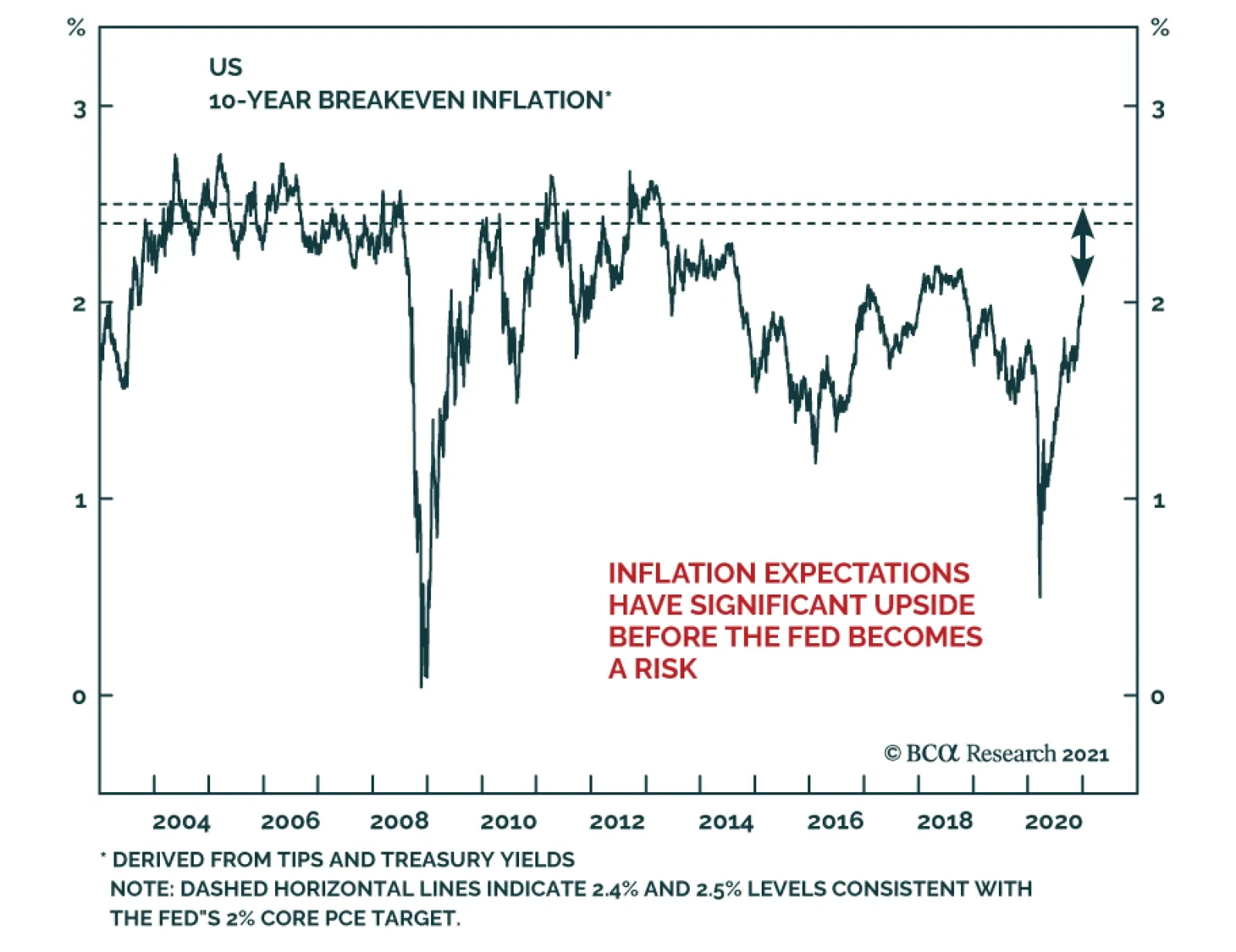
According to BCA Research’s Global Asset Allocation Strategy service, a rapid rollout of vaccines means that the economy should be on track to return to near-normality by the second half of 2021. Therefore, the key thing for investors to think about is what…
This is US Bond Strategy’s final report of the year. Our regular publication schedule will resume on January 5th with our Portfolio Allocation Summary for January 2021. We wish you a happy, healthy and prosperous new year. Highlights Interest Rate Policy: The Fed has given us a checklist of three criteria that must be met before it will lift rates off the zero bound. After those criteria are met, the pace of the eventual rate hike cycle will be determined by how quickly inflation expectations move back to “well-anchored” levels. We don’t expect Fed liftoff in 2021. Balance Sheet Policy: The Fed will only increase the pace or lengthen the maturity of its asset purchases if the economy or risk assets undergo a significant negative shock in 2021. Absent that, Fed communications in late-2021 will increasingly focus on the eventual tapering of asset purchases. Given the current vague guidance about when tapering will start, a scaled-down repeat of the 2013 Taper Tantrum is possible in late-2021 or 2022. Emergency Lending Facilities: The Fed will not undertake efforts to subvert Congress and re-establish its emergency lending facilities in 2021. However, the absence of the facilities will not have a negative impact on financial markets. Fiscal/Monetary Coordination: Looking beyond 2021, we see the lines between fiscal and monetary policy continuing to blur. The Fed will be increasingly incentivized to dip its toes into the fiscal arena and fiscal policymakers will let it. Feature Chart 1An Eventful Year
An Eventful Year
An Eventful Year
It would be an understatement to say that 2020 was a busy year for the Federal Reserve. The Fed cut rates to the zero bound when the recession struck in March. It also exploded its balance sheet to fresh all-time highs and rolled out brand-new emergency lending facilities to support flagging credit markets (Chart 1). Then, to top it all off, the Fed concluded a Strategic Review of its monetary policy strategy in August and officially adopted an Average Inflation Target. This report touches on the market implications of 2020’s big Fed moves, but its focus is on what the Fed is likely to do in 2021. The first three sections discuss how we see the Fed’s interest rate policy, balance sheet policy and emergency lending facilities evolving next year. The final section considers a longer time horizon as it discusses what might be the next frontier for monetary policy: increased cooperation between monetary and fiscal authorities. Interest Rate Policy With the fed funds rate at its effective lower bound, bond investors will spend 2021 trying to determine the eventual start date and magnitude of the next tightening cycle. This will be especially complicated because the Fed’s adoption of an Average Inflation Target means that old models of its reaction function must be discarded. We discussed the implications of the move toward Average Inflation Targeting in a September Special Report.1 To quickly recap, the Fed made three main changes that will influence our outlook for interest rate policy in 2021. First, the Fed edited its Statement on Longer-Run Goals and Monetary Policy Strategy to include a new interpretation of its price stability mandate. The new Statement reads: In order to anchor longer-term inflation expectations at [2 percent], the Committee seeks to achieve inflation that averages 2 percent over time, and therefore judges that, following periods when inflation has been running persistently below 2 percent, appropriate monetary policy will likely aim to achieve inflation moderately above 2 percent for some time.2 Second, the Fed modified its Statement on Longer-Run Goals and Monetary Policy Strategy to signal that it will rely less on labor market indicators to forecast future inflation. In its old Statement, the Fed talked about minimizing “deviations of employment from the Committee’s assessments of its maximum level.” The revised Statement talks about mitigating “shortfalls of employment from the Committee’s assessment of its maximum level.” In other words, the Fed is saying that it will be less inclined to view an unemployment rate below its estimated natural level (NAIRU) as a signal that inflation is about to accelerate. The Fed’s adoption of an Average Inflation Target means that old models of its reaction function must be discarded. Finally, at the September FOMC meeting, the Fed translated the changes it made to its Statement on Longer-Run Goals and Monetary Policy Strategy into more explicit guidance about when it will consider lifting rates off the zero bound. That guidance is as follows: … it will be appropriate to maintain this target range until labor market conditions have reached levels consistent with the Committee’s assessments of maximum employment and inflation has risen to 2 percent and is on track to moderately exceed 2 percent for some time.3 The Timing Of Liftoff Table 1A Checklist For Liftoff
The Fed In 2021
The Fed In 2021
Digging into the new guidance, we identify three criteria for lifting rates off the zero bound (Table 1). First, the unemployment rate must reach levels consistent with the Committee’s assessments of NAIRU. Currently, those estimates range from 3.5% to 4.5% (Chart 2). Practically, we view this as the least important of the three criteria. NAIRU estimates are revised based on what happens with inflation, and the Fed has already acknowledged that it is now less inclined to view a sub-NAIRU unemployment rate as an inflationary signal. In short, if inflation were to rise sustainably above 2% with the unemployment rate still at 5%, the Fed would simply revise up its NAIRU estimates and begin the rate hike cycle. Chart 2Criteria For Lifting Rates
Criteria For Lifting Rates
Criteria For Lifting Rates
The Fed’s second criterion for lifting rates is also the most specific. Inflation must rise to 2 percent before the Fed will consider hiking rates. In a recent speech, Fed Vice-Chair Richard Clarida said he interprets this to mean that 12-month PCE inflation must be at least 2% before the Fed will consider hiking (Chart 2, bottom panel).4 This is helpful for bond investors. We can be certain that no rate hikes will occur at least until 12-month PCE inflation reaches 2%. Finally, the Fed also wants to be certain that inflation is “on track to moderately exceed 2 percent for some time.” This means that the event of 12-month PCE reaching 2% won’t automatically lead to a rate increase. The Fed must also view inflation gains as sustainable. This will likely become an issue in the first half of 2021 when we know that base effects will push 12-month PCE sharply higher, possibly even above 2%. However, we also know that those gains will be short lived.5 Of course, the Fed also knows about the impact of base effects and it will look past any temporary jump in inflation in H1 2021. More generally, while we advise investors to not pay much attention to the Fed’s NAIRU estimates, the unemployment rate will play a role in the Fed’s determination of whether above-2% inflation is sustainable. That is, the Fed is more likely to view above-2% inflation as sustainable if the unemployment rate is 4% than it is if the unemployment rate is 6%. What Does The Market Think? The bond market has been quick to price-in the big shift in the Fed’s interest rate guidance. At present, the overnight index swap curve is priced for a single 25 basis point rate hike in mid-2023 and only one more by mid-2024 (Chart 3). We see a good chance that the Fed’s three liftoff criteria are met before then, a view that forms the basis of our below-benchmark portfolio duration recommendation for 2021.6 In addition, the New York Fed’s Survey of Market Participants shows that only 43% of respondents expect liftoff before the end of 2023 and only 31% before the end of 2022 (Table 2A). This is further evidence that bond yields have room to rise if it looks like the Fed’s three liftoff criteria will be met in 2022 or the first half of 2023. Finally, the New York Fed’s survey shows that market participants understand the Fed’s three liftoff criteria and that differences in opinion about the timing of liftoff reflect differences in views about the economic outlook, not differences in understanding the Fed’s reaction function. The bulk of survey respondents think that the unemployment rate will be between 3.5% and 4.2% (consistent with the Fed’s NAIRU estimates) and that 12-month PCE inflation will be between 2.2% and 2.5% at the time of liftoff (Table 2B). Chart 3The Fed May Lift Rates Sooner Than Markets Expect
The Fed May Lift Rates Sooner Than Markets Expect
The Fed May Lift Rates Sooner Than Markets Expect
Table 2ALiftoff Expectations
The Fed In 2021
The Fed In 2021
Table 2BMarkets Understand The Fed’s Guidance
The Fed In 2021
The Fed In 2021
The Pace Of Tightening And Why We’re Watching Inflation Expectations We’ve seen the three criteria upon which the Fed will condition its decision to hike rates off the zero bound. But the timing of liftoff is not the only thing that bond investors need to consider. We also need to get a sense of how quickly rate hikes will proceed once the next tightening cycle begins. According to the Fed’s interest rate guidance, even after liftoff the Fed will seek to maintain accommodative monetary conditions until it has achieved its price stability goal under its new Average Inflation Target. Recall that this goal is defined as achieving “inflation that averages 2 percent over time”. This is somewhat vaguer than the Fed’s liftoff guidance. Over what time period should we seek to hit average 2% inflation? One option is to start calculating the average when the new regime was adopted in August. In that case, average PCE inflation is running at 0.96%, well below 2%. Alternatively, we could calculate average inflation since the Fed last cut rates to zero in March 2020 (1.50%) or average inflation since the Fed cut rates to zero in December 2008 (1.43%). The point is that the Fed has not given us a clearly defined target. Differences in opinion about the timing of liftoff reflect differences in views about the economic outlook. For this reason, it’s important for bond investors to understand why the Fed has shifted to an Average Inflation Target. The reason has to do with trying to re-anchor inflation expectations. Box 1 shows an example of an Expectations-Augmented Phillips Curve, the Fed’s go-to framework for thinking about inflation. As the accompanying quote from Janet Yellen explains, the Fed thinks about inflation’s long-run trend as being driven by expectations. Shocks to economic slack and import prices can cause inflation to deviate from its long-run trend, but expectations drive the trend itself. This makes it critical for a central bank to keep expectations well anchored near its inflation target. Box 1The Expectations-Augmented Phillips Curve (aka The Fed’s Inflation Model)
The Fed In 2021
The Fed In 2021
This is the underlying rationale for the Fed’s Average Inflation Target. The Fed has observed that inflation expectations have been too low in recent years. In the Fed’s model, this signals that inflation’s long-run trend has shifted down. In order to get expectations back up to target, the Fed understands that it will probably need to accept a period of above-target inflation. Since economic agents have just experienced a long period of sub-2% inflation, it will probably require a significant period of above-2% inflation before their expectations sustainably shift higher.7 To sum it all up, the Fed will seek to keep monetary conditions accommodative, and thus supportive for risk assets, until inflation expectations are deemed to be re-anchored. At that point, monetary policy will shift to a neutral or restrictive stance and risk asset performance will be challenged. But don’t just take our word for it. Here is what Vice-Chair Clarida said in a recent speech (referenced above): It is important to note, however, that the goal of the new framework is to keep inflation expectations well anchored at 2 percent, and, for this reason, I myself plan to focus more on indicators of inflation expectations themselves – especially survey-based measures – than I will on the calculation of an average rate of inflation over any particular window of time. It is clear that inflation expectations will dictate the eventual pace of Fed tightening. But the question of what measure of inflation expectations to track remains unresolved. Measures of inflation expectations fall into three main categories: Market-based measures Survey measures Trend measures Market-based measures are derived from inflation-linked bonds. Specifically, we derive TIPS breakeven inflation rates for different time horizons by taking the difference between a nominal yield and TIPS yield of the same maturity. In this publication, we often refer to the 10-year and 5-year/5-year forward TIPS breakeven inflation rates and have found that a range of 2.3% to 2.5% has historically been consistent with periods when inflation expectations were deemed “well anchored” (Chart 4A). One potential issue with using market-based measures of inflation expectations is that TIPS prices can sometimes move around for reasons unrelated to changing inflation expectations. That is, regulations or broader portfolio diversification concerns could change the risk premium an investor is willing to accept from TIPS, even if that investor’s underlying inflation view is unchanged. Academics have made attempts to solve this problem by using affine term structure models to decompose yields into various components. Chart 4B presents one such model from D’Amico, Kim and Wei (DKW).8 The DKW model splits the TIPS breakeven inflation rate (or inflation compensation) into an inflation expectation, a liquidity premium that compensates investors for the lower liquidity in TIPS compared to nominal Treasuries and an inflation risk premium that represents the extra compensation investors require to take inflation risk. We are skeptical of the usefulness of affine term structure models. In general, these models have too few inputs to reliably generate the components they purport to measure. However, the Fed clearly pays some attention to the DKW decomposition. If a future increase in TIPS breakeven inflation rates is driven entirely by movement in the liquidity or inflation risk premium components, it would be reasonable to question whether the Fed will react. Chart 4AInflation Expectations: Market-Based Measures
The Fed In 2021
The Fed In 2021
Chart 4BA Decomposition Of TIPS##br## Breakevens
The Fed In 2021
The Fed In 2021
Survey measures of inflation expectations are exactly that: Responses from surveys, usually of professional forecasters or households (Chart 4C). One drawback of survey measures compared to market-based measures is that they are updated less frequently. Another is that survey respondents, particularly households, may only be able to distinguish very large swings in prices. That said, the Fed tracks a wide range of survey measures and they were even singled out by Vice-Chair Clarida as being particularly important in the above quote. Trend inflation measures are statistical measures of the trend in the actual PCE or CPI inflation data. Chart 4D shows both a very simple trend measure, the 10-year annualized rate of change, and a slightly more complex trend measure based on an exponential smoothing rule. Academics have developed even more complex trend inflation measures.9 The logic behind these measures is that expectations tend to adapt only slowly to changes in the actual inflation data. Chart 4CInflation Expectations: Survey Measures
The Fed In 2021
The Fed In 2021
Chart 4DInflation Expectations: Trend Measures
The Fed In 2021
The Fed In 2021
Finally, we should point out a relatively new measure that the Fed will be using to track inflation expectations going forward. It is called the Common Inflation Expectations Index and it is a composite of 21 different survey and market-based inflation measures (Chart 4E), no trend inflation measures are included.10 Chart 4EIntroducing The Common Inflation Expectations Index
The Fed In 2021
The Fed In 2021
To summarize, the Fed has given us a checklist of three criteria that must be met before it will lift rates off the zero bound. After those criteria are met, the pace of the eventual rate hike cycle will be determined by how quickly inflation expectations move back to levels that are considered “well anchored”. Once that happens, the Fed will no longer have an incentive to keep monetary conditions accommodative and risk asset performance will be challenged. Charts 4A-4E in this report provide a wide array of different measures of inflation expectations to monitor. We will keep an eye on all of them, but in particular, we will track the Common Inflation Expectations Index’s progress back to 2.1% and the 5-year/5-year forward TIPS breakeven inflation rate’s progress back to a range of 2.3%-2.5%. While we don’t expect the Fed’s rate hike criteria to be met in 2021, a 2022 liftoff is possible if the COVID vaccine spurs a rapid economic recovery. However, we do expect that, in 2021, the market will start to price-in an earlier liftoff date and quicker pace of tightening than is currently discounted, thus pushing bond yields higher. The Financial Conditions Wildcard Chart 5Financial Conditions
Financial Conditions
Financial Conditions
Our base case view is that the eventual pace of Fed tightening will be determined by inflation expectations. However, there is one wildcard that could cause the Fed to abandon its inflation expectations goal and tighten policy earlier. That wildcard is financial conditions. Presently, financial asset valuations are a mixed bag (Chart 5). Corporate bond spreads are tight, but not at all-time expensive levels. Equity P/E ratios are very elevated, but equities don’t look expensive compared to bonds. If these valuations stay relatively stable, the Fed will continue to rely on inflation expectations to guide the pace of tightening. However, if inflation expectations take a long time to rise, it is conceivable that such a long period of low interest rates could lead to historically stretched financial asset valuations. In short, if inflation doesn’t return within the next couple of years, the Fed may have to tighten policy to take the wind out of an asset bubble that might otherwise burst and lead to an economic recession. We stress that we are not yet close to this point and that the bar for the Fed to abandon its inflation goal will be very high, but we would place financial conditions alongside inflation expectations as the two most important variables to monitor to assess the eventual pace of Fed tightening. Balance Sheet Policy With the funds rate pinned at zero and the Fed’s interest rate guidance essentially set in stone, changes to the pace and composition of asset purchases are the principal tool that the Fed will use to provide more or less immediate monetary accommodation in 2021. The Fed is currently purchasing $80 billion of Treasuries and $40 billion of Agency MBS each month, with Treasury purchases spread out across the yield curve. If this pace and distribution of Treasury purchases is maintained in 2021, the Fed will end up purchasing less and less of the Treasury flow. The Treasury Department has a stated policy goal of increasing the average maturity of the outstanding debt and it has been pursuing that goal by raising the amount of coupon issuance at the expense of bills. The Treasury has already given us its planned coupon issuance schedule for Q4 2020 and Q1 2021. Chart 6 shows that net Fed coupon purchases will gradually decline as a percentage of gross issuance, assuming the Treasury follows through with its plan and the Fed’s balance sheet policy is unchanged. Chart 6The Path For Treasury Supply And Fed Demand
The Fed In 2021
The Fed In 2021
Can The Fed Do More? … Will The Fed Do More? It is possible that the Fed will use its balance sheet to provide more monetary easing in 2021. There are two ways it could do this. First, it could simply increase the monthly pace of asset purchases. Alternatively, it could keep the same pace of purchases but shift Treasury buying toward the long-end of the curve. The idea here would be to prevent long-dated yields from rising too quickly. One or both of these changes could happen in 2021, but only if the economy experiences a negative growth shock or risk asset prices (equities and corporate credit) fall significantly. In that case, the Fed will want to be seen as responding to a negative shock, but absent that, the Committee seems comfortable with its current balance sheet strategy. Chart 7Rate-Sensitive Sectors Have Recovered
Rate-Sensitive Sectors Have Recovered
Rate-Sensitive Sectors Have Recovered
Some have suggested that, even if the economic recovery stays on track, the Fed will try to use its balance sheet to lean against rising long-maturity bond yields. We doubt this. First, it is not obvious that the Fed would be able to stop the 10-year Treasury yield from rising to a range of, say, 1.25% to 1.5% by increasing bond purchases in that maturity range by a few billion dollars. As long as the Fed’s interest rate guidance is unchanged, the market’s interest rate expectations will continue to exert a powerful influence on bond yields across the entire curve. Unless the Fed announces a cap on long-dated bond yields, and pledges to buy enough securities to enforce that cap, we are skeptical about the effectiveness of just changing the quantity of asset purchases. Second, it is also not clear that a 10-year Treasury yield between 1.25% and 1.5%, in the context of a steepening yield curve and improving economic growth, would be a problem for either the economy or risk assets. In fact, these sorts of environments tend to be very positive for risk asset performance.11 It is only when the Fed is shifting to a more restrictive monetary policy stance and the yield curve is flattening that bond yields start to exert a negative influence on the economy and risk assets. Even if the Fed is not worried about a moderate bear-steepening of the Treasury curve, a case could be made for providing more easing right now in order to spur a quicker recovery. This question was posed to Chair Powell several times at the last FOMC press conference. In response, Powell noted that the sectors of the economy that are most sensitive to interest rates – residential investment and consumer spending on durable goods – have already recovered (Chart 7). The lagging sectors of the economy – particularly consumer spending on services – cannot recover until the COVID vaccine is widely distributed, irrespective of the level of interest rates. In our view, this is an acknowledgement that the Fed does not see much value in trying to provide further accommodation through the balance sheet channel. All in all, our base case scenario is that the Fed will maintain its current pace and maturity distribution of asset purchases throughout 2021. However, it will increase the pace and/or lengthen the maturity if there is a significant shock to the economy and/or financial markets. Later in 2021, if the recovery stays on track, Fed communications will increasingly take up the issue of when it will be appropriate to taper its pace of asset purchases. The Exit From Asset Purchases And The Possibility Of A Taper Tantrum Chart 8Remember The Taper Tantrum
Remember The Taper Tantrum
Remember The Taper Tantrum
The Fed has already given us a timeline for how it will wind down its asset purchases. According to the minutes from the November FOMC meeting, most participants support a timeline where the Fed will start tapering its pace of asset purchases sometime before the first rate hike. It will then begin lifting interest rates and will stop purchases altogether sometime after that. At the December FOMC meeting, the Fed gave us additional guidance on when it will start the tapering process. Unfortunately, this guidance is quite vague and only confirms the fact that tapering will start before the liftoff date. Specifically, the Fed said that tapering will begin when “substantial further progress has been made toward the Committee’s maximum employment and price stability goals.” Because the guidance around the timing of the tapering process is quite vague, we think it’s possible that it could sneak up on investors and lead to a sharp upward re-adjustment in rate hike expectations, and thus a bond sell-off. In essence, a tamer version of the 2013 Taper Tantrum is possible in late-2021 or 2022. On May 22, 2013, Fed Chair Ben Bernanke explained the Fed’s plan to eventually start tapering its asset purchases. Because investors took this to mean that the rate hike cycle would start much sooner than anticipated, the bond market underwent a sharp re-adjustment. The market quickly went from pricing-in only 35 bps of rate hikes over the next 24 months to 116 bps, and Treasury returns fell precipitously as a result (Chart 8). The Fed has learned a few lessons about communications since then, and it will do its best to keep market expectations aligned with its own strategy. However, unless firmer guidance is provided about when tapering will begin, the risk of a hawkish surprise around the tapering announcement remains. Bottom Line: The Fed will only increase the pace or lengthen the maturity of its asset purchases if the economy or risk assets undergo a significant negative shock in 2021. Absent that, Fed communications in late-2021 will increasingly focus on the eventual tapering of asset purchases. Given the current vague guidance about when tapering will start, a scaled-down repeat of the 2013 Taper Tantrum is possible in late-2021 or 2022. Emergency Lending Facilities In addition to cutting rates to zero and massively scaling up the size of its balance sheet, the Fed also responded to the COVID recession by launching a slew of emergency lending facilities, some re-treads from the financial crisis and some brand new. Facilities to support the corporate bond market (The Primary and Secondary Market Corporate Credit Facilities) and the Municipal Liquidity Facility were particularly successful at capping bond spreads versus Treasuries, even if their actual usage was quite low. In fact, corporate bond spreads peaked on the very day that the Fed announced its corporate credit facilities in March (Chart 1). More recently, however, Treasury Secretary Steve Mnuchin refused to authorize the continuation of most of the Fed’s emergency lending facilities beyond the end of the year. We wrote in November that, even with the Treasury taking back the funds used to set up the facilities, the Fed could re-launch them in 2021 if incoming Treasury Secretary Janet Yellen provides her approval.12 However, a late addition to the recently passed fiscal stimulus package appears to prohibit the re-authorization of the facilities without Congressional approval. At the time of publishing, we have not been able to see the details of the new provision, so there remains some uncertainty about what the Fed can and cannot do in this regard. Credit spreads are no longer trading at distressed levels, primary issuance markets are functioning properly, and the Fed’s facilities have hardly been used at all. Nonetheless, while the new bill raises interesting questions about Fed independence in the long-run, we doubt that markets will respond negatively to the absence of the Fed’s emergency facilities in 2021. Credit spreads are no longer trading at distressed levels, primary issuance markets are functioning properly, and the Fed’s facilities have hardly been used at all (Table 3). Table 3Usage Of The 2020 Federal Reserve Emergency Lending Facilities
The Fed In 2021
The Fed In 2021
In short, we don’t see the Fed going out of its way to re-establish the facilities in 2021 because it will become clear that they are no longer needed. The Next Regime Shift In Fed Policy: Fiscal/Monetary Coordination The adoption of an Average Inflation Target represents a major regime shift in Federal Reserve policy. In the final section of this report, we expand our horizon beyond 2021 and speculate about what the next major regime shift for the Fed might be. The 2020 recession made two things crystal clear. First, traditional fiscal policy becomes essentially impotent once interest have been reduced to the zero-lower-bound. Once there, Fed policy is most impactful when it focuses on lending to the private sector. Lending to the private sector through an emergency lending facility is an act that blurs the distinction between monetary and fiscal policy. This was made abundantly clear by Congress’ recent push to legislate the Fed’s activities in this arena. Second, it is difficult for fiscal policy to act quickly enough during an economic downturn. While the CARES act was delivered in a timely manner, it has taken many months to pass a follow-up bill. The Fed’s independence allows it to act immediately when it is economically necessary, while Congress’ increasing polarization makes swift action a challenge. If we take these two observations to their logical conclusion, and throw in the strong chance that the traditional channels of monetary policy will be increasingly blocked in the future as rates bump up against zero, it seems to us that the strict separation of responsibilities between fiscal and monetary policymakers will fade over time. More specifically, greater time spent at the zero-lower-bound will incentivize the Fed to get more and more creative with its quasi-fiscal private lending facilities. Further, Congress will be more than happy to allow this encroachment as it finds itself unable to respond effectively in times of crisis. Of course, this will also lead to periodic push-back as some members of Congress fret about the Fed’s over-reach, but we expect this push-back will be the exception rather than the rule. Greater time spent at the zero-lower-bound will incentivize the Fed to get more and more creative with its quasi-fiscal private lending facilities. In fact, the best idea might be for fiscal and monetary policymakers to join together proactively to craft programs that can be deployed during the next recession. One example of such an idea was recently presented by Julia Coronado and Simon Potter.13 Coronado and Potter’s idea relies on the use of instant payment processing technology (which the Fed is already working on) to create digital accounts at the Federal Reserve for every household. Once those accounts are in place, the federal government could issue Recession Insurance Bonds, zero coupon bonds with some pre-determined face value, and grant one bond to every household in the country. Then, during the next economic downturn, the Fed could decide to do a “people’s QE” where it buys all the Recession Insurance Bonds leaving every household with a direct cash payment equal to the face value of the bond. This scheme directly addresses the two main problems we named earlier. It is fiscal policy, not monetary policy, so it can still be effective at the zero-lower-bound. Also, Congress can take its time to deliberate on the bill that authorizes the creation of the Recession Insurance Bonds, as this can be done proactively during a period of economic recovery. Then, the Fed can use its ability to move quickly during the next downturn to “activate” the bonds and deliver the fiscal stimulus that Congress actually passed years earlier. While likely not a story for 2021, we see increased cooperation between monetary and fiscal policymakers as the next big regime shift for the Fed. Ryan Swift US Bond Strategist rswift@bcaresearch.com Footnotes 1 Please see US Bond Strategy / Global Fixed Income Strategy Special Report, “A New Dawn For US Monetary Policy”, dated September 1, 2020, available at usbs.bcaresearch.com 2 https://www.federalreserve.gov/monetarypolicy/guide-to-changes-in-statement-on-longer-run-goals-monetary-policy-strategy.htm 3 https://www.federalreserve.gov/monetarypolicy/files/monetary20200916a1.pdf 4 https://www.federalreserve.gov/newsevents/speech/clarida20201116a.htm 5 For a more complete discussion of our 2021 inflation outlook please see “BCA Outlook 2021: A Brave New World”, dated November 30, 2020, available at bca.bcaresearch.com 6 Please see US Bond Strategy Special Report, “2021 Key Views: US Fixed Income”, dated December 15, 2020, available at usbs.bcaresearch.com 7 This is the theory of adaptive expectations and we use it to model changes in the 10-year TIPS breakeven inflation rate. For further details please see US Bond Strategy Weekly Report, “How Are Inflation Expectations Adapting?”, dated February 11, 2020, available at usbs.bcaresearch.com 8 https://www.federalreserve.gov/econres/notes/feds-notes/tips-from-tips-update-and-discussions-20190521.htm 9 Fed Governor Lael Brainard references several of these trend measures in this recent speech: https://www.federalreserve.gov/newsevents/speech/brainard20201021a.htm&…; 10 More details on how this aggregate measure is constructed can be found here: https://www.federalreserve.gov/econres/notes/feds-notes/index-of-common-inflation-expectations-20200902.htm 11 For more details on how corporate credit performs during different yield curve environments please see US Bond Strategy Special Report, “2021 Key Views: US Fixed Income”, dated December 15, 2020, available at usbs.bcaresearch.com 12 Please see US Bond Strategy Weekly Report, “Preparing For A Dark Winter … But Do Markets Care?”, dated November 24, 2020, available at usbs.bcaresearch.com 13 https://www.piie.com/publications/policy-briefs/reviving-potency-monetary-policy-recession-insurance-bonds
Highlights Global growth will accelerate over the course of 2021 as COVID-19 vaccines are distributed and economic confidence improves in response. Longer-term global bond yields see some upward pressure as growth picks up, but global real yields will stay negative with on-hold central banks actively seeking an inflation overshoot. Maintain below-benchmark overall global duration exposure, and position for steeper government bond yield curves and wider inflation breakevens. The rise in global bond yields we anticipate will be relatively moderate, with US Treasury yields rising the most. Underweight the US in global bond portfolios, and favor countries where yields have a lower sensitivity to rising US yields (core Europe, Japan, UK). Also overweight Peripheral European debt given supportive monetary and fiscal policies that are helping to reduce credit risk (Italy, Spain, Portugal). The US dollar will remain soft in 2021, providing an additional reflationary impulse to the global economy. Overweight global inflation-linked bonds versus nominal government debt. Lower-quality global credit should outperform against a backdrop that will prove positive for risk assets: easy money policies, improving growth momentum and a reduction in virus-related uncertainty. Upgrade US high-yield to overweight through higher allocations to lower rated credit tiers, while downgrading US investment grade, where valuations are far less compelling, to neutral. Favor US corporates versus euro area equivalents, of all credit quality, based off less attractive euro area spread valuations. Within US$-denominated emerging market debt, favor corporates over sovereigns. Feature Dear Client, This report, detailing our global fixed income investment outlook for next year, will be our last for 2020. Please join me for a webcast this coming Friday, December 18 at 10:00 AM EST (3:00 PM GMT, 4:00 PM CET, 11:00 PM HKT) where I will discuss the outlook followed by a Q&A session. Best wishes for a very safe, healthy and prosperous 2021. We’ve all earned that after a difficult 2020 that none of us will soon forget. Rob Robis, Chief Global Fixed Income Strategist BCA Research’s Outlook 2021 report, “A Brave New World”, outlining the main investment themes for next year based on the collective wisdom of our strategists, was sent to all clients in late November.1 In this report, we discuss the broad implications of those themes for the direction of global fixed income markets in 2021. In a follow-up report to be published in the first week of the New Year, we will translate those themes into specific recommended allocations and weightings within our model bond portfolio framework. A Summary Of The 2021 BCA Outlook The tone of the BCA 2021 Outlook was generally positive, with conclusions that are supportive for the outperformance of risk assets relative to safe havens like government bonds (Chart 1). Chart 1How To Play Recovery & Reflation In 2021
2021 Key Views: Vaccination, Reflation, Rotation
2021 Key Views: Vaccination, Reflation, Rotation
Global growth will strengthen over the course of next year, after an initial soft patch related to the late-2020 COVID-19 economic restrictions in Europe and the US. Economic confidence will improve as the COVID-19 vaccines become more widely distributed, at a time of ongoing substantial monetary and fiscal stimulus in most important countries. A major release of pent-up demand is likely, fueled by the surge in private sector savings in the US and Europe after households and businesses cut back on spending because of the pandemic. The lingering impact of China’s substantial fiscal and credit stimulus in 2020 will still be felt throughout the world for most of 2021, even with Chinese authorities likely to begin curtailing the expansion of credit around mid-year. The tremendous amount of global spare capacity created by the virus and associated economic restrictions will keep inflation subdued in most countries. Thus, both monetary and fiscal policymakers will be under no pressure to pre-emptively tighten policy. The pace of monetary/fiscal stimulus will inevitably slow on a rate-of-change basis after the massive ramp up of government spending, income support, loan guarantees and central bank asset purchases. However, policymakers are expected to pull any and all of those levers once again in the event of a severe pullback in economic growth or a major bout of financial market turbulence. After a wild 2020 in a US election year, geopolitical uncertainty is expected to recede a bit next year. Although US-China tensions will remain elevated even under the incoming Biden administration, European politics are expected to be a tailwind for financial markets. A UK-EU Brexit deal is expected to be reached given economic realities, increased fiscal cooperation within the EU will support fiscally weaker countries like Italy, and the threat of the US imposing tariffs on Europe will disappear after Donald Trump leaves office. Our Four Main Key Views For Global Fixed Income Markets In 2021 The following are the main implications for global fixed income investment strategy based off the conclusions from the 2020 BCA Outlook: Key View #1: Maintain below-benchmark overall global duration exposure, and position for steeper government bond yield curves and wider inflation breakevens. Chart 2COVID-19 Lockdowns Will Not Last Forever
COVID-19 Lockdowns Will Not Last Forever
COVID-19 Lockdowns Will Not Last Forever
COVID-19 was the elephant in the room for financial markets in 2020, influencing sentiment whenever cases flared up or subsided. Yet the impact diminished steadily since the first wave of the virus stretched beyond China in the spring. The broad span of global risk assets – equities, corporate credit, industrial commodities – has performed very well during the current, and much larger, surge in cases occurring in the US and Europe. One big reason for this is that investors now understand that lockdowns, and the associated drag on economic growth, do not last forever. In addition, investors know that policymakers in most countries will react to any sharp downturn in economic confidence with more fiscal and monetary stimulus to help offset the negative growth impact of the lockdowns. In Europe, many European governments enacted harsh national lockdowns in a bid to “flatten the curve” during the latest surge. This has helped successfully reduce the growth rate of new cases and hospitalizations (Chart 2). This will eventually lead to an easing of restrictions, and a recovery in economic activity, in early 2021. While US case numbers are also surging, the response by governments has been much less widespread, and severe, compared to Europe. There is little political appetite (even with a new president) for another wave of harsh restrictions along the lines of what took place last spring. Some slowing of economic activity is inevitable because of increased regional restrictions in large states like California and New York, as is already evident in some late-2020 data. However, any downturn should not be expected to last long with the growth rate of US COVID-19 hospitalizations having already peaked. The big game-changer, of course, is the introduction of COVID-19 vaccines which have already begun to be distributed in the UK and US. While there are uncertainties related to the operational logistics of a worldwide vaccine rollout, including whether enough people will voluntarily choose to be vaccinated to achieve herd immunity on a global scale, the very high announced efficacy levels of the various vaccines mean that an end of the pandemic is now achievable. Investors should see through the current surge in COVID-19 cases, and any short-term hiccup in economic growth, and focus on the bigger picture of the introduction of the vaccine and the positive implications for global economic confidence in 2021. Growth has already been holding up well in the US and China in the final months of 2020, with both manufacturing and services PMIs remaining solidly above the 50 line indicating expanding activity. As the euro area lockdowns begun to ease up, growth there will catch up, which already appears to be underway with the sharp uptick in the December PMI data (Chart 3). Those three regions account for one-half of worldwide GDP, so that is already a solid footing for global growth entering 2021. A sustained improvement in the pace of global economic activity is important, as it is becoming increasingly harder for governments to sustain the extreme levels of policy stimulus delivered in 2020. In China, policymakers are starting to rotate their focus away from aggressive stimulus and fighting deflation back to the cautious risk management approach to credit expansion that was in place prior to COVID-19. BCA Research’s China strategists expect the latest Chinese credit cycle to peak by mid-2021, with the credit impulse set to decline in the second half of the year (Chart 4). Combined with the tightening of monetary conditions through a strengthening yuan and higher local interest rates, some slowing of Chinese growth is inevitable. Although given the lags between stimulus and growth, the impact is more likely to be felt toward year-end and into 2022 – good news for much of the global economy that still relies heavily on exporting to China as an engine of growth. Chart 3A Growth Recovery Without Inflation
A Growth Recovery Without Inflation
A Growth Recovery Without Inflation
Chart 4China Stimulus Will Peak Out By Mid-2021
China Stimulus Will Peak Out By Mid-2021
China Stimulus Will Peak Out By Mid-2021
Overall global fiscal policy is on track to be less supportive in 2021. The latest estimates from the IMF show that the “fiscal thrust”, or the change in the cyclically-adjusted primary budget balance relative to potential GDP, in most developed economies will turn negative next year (Charts 5A and 5B). Such a swing is inevitable given the sheer magnitudes of the fiscal stimulus measures first introduced to combat the economic damage from COVID-19 that will not be repeated in 2021. By the same token, less fiscal stimulus will be necessary if overall global growth improves, especially if vaccines can be successfully distributed to much of the world. Chart 5ANegative Fiscal Thrust In 2021 …
Negative Fiscal Thrust In 2021 ...
Negative Fiscal Thrust In 2021 ...
Chart 5B… But Governments Will Spend More If Needed
... But Governments Will Spend More If Needed
... But Governments Will Spend More If Needed
What does all this mean for global government bond yields? We believe that it signals a continuation of the trends seen towards the end of 2020 – a slow grind higher in longer-term yields, led by better growth and rising inflation expectations, but without any need to discount a move to tighter monetary policy because of a sustained overshoot of realized inflation. The current economic projections of the Fed, ECB, Bank of England (BoE), Bank of Canada (BoC) and Reserve Bank of Australia (RBA) all show that policymakers there expect unemployment rates to remain above pre-pandemic levels to at least 2023 (Chart 6). At the same time, central banks are also projecting inflation to be below their target levels/ranges over that same period. In response, the forward guidance from these central banks has been very dovish, with policy interest rates expected to remain at current levels at or near 0% for at least the next two to three years. Interest rate markets have taken the hint, with a very low expected path for rates over the next few years discounted in overnight index swap curves. Chart 6Central Banks Projecting A Slow Return To Full Employment
2021 Key Views: Vaccination, Reflation, Rotation
2021 Key Views: Vaccination, Reflation, Rotation
Chart 7Markets Expect Years Of Negative Real Policy Rates
Markets Expect Years Of Negative Real Policy Rates
Markets Expect Years Of Negative Real Policy Rates
The implication of this is that central banks are projecting a sustained, multi-year period where policy rates will remain below forecasted inflation (Chart 7). Or put more simply, central banks are consistently signaling that negative real interest rates will persist for a long time. This means that one of the most oft-discussed “oddities” of global bond markets in 2020 - the persistence of negative real long term bond yields in most major economies, most notably in the US Treasury market, even as inflation expectations increase – is unlikely to disappear in 2021. Those negative real yields reflect, to a large part, the expectation that real global policy rates will stay persistently negative (Chart 8). At some point in 2021, markets could challenge this dovish guidance from central banks that could temporarily push up both future interest rate expectations and longer-term real yields, especially in the US. However, it is more likely that central banks will not validate that move higher in yields for fears of pre-emptively short-circuiting an economic recovery. Such a hawkish shift could be more plausibly delivered in 2022 at the earliest, with the Fed the most likely candidate to change its guidance. Summing up all of the above points with regards to our recommendations on overall management of government bond portfolios, we arrive at the following conclusions (Chart 9): Chart 8Rising Inflation Breakevens With Stable Negative Real Yields
Rising Inflation Breakevens With Stable Negative Real Yields
Rising Inflation Breakevens With Stable Negative Real Yields
Chart 9Moderately Higher Global Bond Yields In 2021
Moderately Higher Global Bond Yields In 2021
Moderately Higher Global Bond Yields In 2021
Duration exposure should be set below-benchmark. Our forward-looking Duration Indicator, comprised of leading economic indicators and economic expectations data, is strongly signaling that global yields should head higher in 2021. Position for a bearish steepening of yield curves. This will be driven more by rising longer-term inflation expectations, as the short-ends of yield curves will remain anchored by dovish on-hold central banks. Key View #2: Underweight the US in global bond portfolios, and favor countries where yields have a lower sensitivity to rising US yields Moving beyond the overall global duration view, there are significant country allocation decisions that derive from our outlook for 2021. First and foremost, we recommend underweighting US Treasuries in global bond portfolios, as we anticipate the biggest increase in developed market bond yields next year to occur in the US. We expect the benchmark 10-year Treasury yield to rise to the 1.25% to 1.5% range sometime in 2021. This move will come mostly through higher inflation expectations. The 10-year TIPS breakeven inflation rate is expected to reach the 2.3-2.5% range that we have long considered to be consistent with the market pricing in the Fed sustainably achieving its 2% inflation goal. Any additional Treasury yield increases beyond our 2021 forecast range would require the Fed to shift to a more hawkish stance signaling future rate hikes. With the Fed now operating with an Average Inflation Target framework, allowing for temporary overshoots of inflation after periods when inflation was below the Fed’s 2% target, the hurdle for such a shift in Fed guidance is much higher than in previous years. The Fed has also changed the nature of its forward guidance compared to years past, signaling that any future monetary tightening will only occur once actual inflation has sustainably returned to the 2% target. That means that the Fed will no longer pre-emptively choose to hike rates on merely a forecast of higher inflation – it will first need to see a sustained period of higher inflation materialize before considering any tightening. Thus, any move beyond our expected 1.25% to 1.5% range on US Treasuries would require a hawkish signal by the Fed that it intends to begin removing monetary accommodation through rate hikes. Under the Average Inflation Target framework, that will not happen in 2021 but could happen the following year if inflation stays at or above 2% over the course of next year. Turning to other countries, we recommend favoring bond markets with a lower historical “yield beta” to US Treasuries. In other words, we prefer overweighting counties where government bond yields are typically less correlated to changes in Treasury yields. We show those historical yield betas, using 10-year yields, in Chart 10. Importantly, the betas are calculated only for periods when Treasury yields are moving higher. We call this “upside beta”, which is a useful tool to identify which bond markets are more sensitive to selloffs in the US Treasury market. Chart 10Favor Lower Beta Government Bond Markets In 2021
Favor Lower Beta Government Bond Markets In 2021
Favor Lower Beta Government Bond Markets In 2021
The highest “upside beta” countries among the major developed markets are Australia, Canada and New Zealand, while the lowest “upside beta” countries are Germany, France and Japan. The UK is in the middle of those two groupings, although the trend over the past few years suggests that it is transitioning from a high-beta to low-beta country. Note that for all countries shown, the upside yield betas are below one, indicating that no market should be expected to see a bigger rise in yields than the US. Strictly based on our forecast of higher Treasury yields and calculated yield betas, we would recommend more overweight allocations to markets in the lower-beta group and more underweight allocations to the higher-beta group. We are comfortable recommending overweights to the lower-beta group of Germany, France, Japan and the UK. Although among the higher-beta group, we are reluctant to recommend underweighting all three countries because of the policy choices of their central banks. The RBA, BoC and Reserve Bank of New Zealand (RBNZ) have all enacted aggressively large quantitative easing (QE) programs in 2020 as a way to provide additional monetary stimulus after cutting policy rates to near-0%. The BoC stands out as being extremely aggressive on QE with its balance sheet expanding more than three-fold on a year-over-year basis (Chart 11). Chart 11More Divergence In The Pace Of Global QE
More Divergence In The Pace Of Global QE
More Divergence In The Pace Of Global QE
None of these three central banks has discussed slowing the pace of purchases anytime soon. In the case of the RBA and RBNZ, they have gone as far as signaling the role of QE in dampening their bond yields to help stem the appreciation of their currencies. They may have limited success in driving down yields further, however. Measures of bond valuation like the term premium, which typically move lower when QE accelerates, have bottomed out across the developed markets even as central banks have absorbed a greater share of the stock of government debt in 2020 (Chart 12). Yet even if QE can no longer drive yields lower, it can limit how much yields can increase when under cyclical upward pressure. For this reason, we do not expect government bond yields in Australia, Canada or New Zealand to behave in line their historical higher yield beta that would make them clear underweight candidates in a period of rising US Treasury yields, as we expect. Net-net, we recommend that investors focus underweights solely on US Treasuries within global government bond portfolios. This suggests that yield spreads between Treasuries and other bond markets should continue to widen, as has been the case over the final few months of 2020 (Chart 13). We recommend neutral allocations to Australia, Canada and New Zealand, while overweighting core Europe, Japan and the UK. Chart 12More QE Is Less Impactful In Pushing Down Bond Yields
More QE Is Less Impactful In Pushing Down Bond Yields
More QE Is Less Impactful In Pushing Down Bond Yields
Chart 13US Treasuries Will Continue To Underperform In 2021
US Treasuries Will Continue To Underperform In 2021
US Treasuries Will Continue To Underperform In 2021
We also are maintaining our overweight recommendation on Italian and Spanish government debt, which was one of our most successful calls of 2020. We view those markets more as a credit spread story versus core Europe, rather than a directional yield instrument like US Treasuries or German Bunds. On that basis, the spread of Italian and Spanish yields versus German yields has room to compress even further, as both are strongly supported by ECB bond purchases. Also, the introduction of the European Union’s €750bn Recovery Fund is a strong signal of greater fiscal co-operation within Europe – another important factor that has helped reduce the risk premium (credit spread) on Italy and Spain. When looking at the yields currently on offer in the developed world, Italy and Spain offer very attractive yields in a global low-yield environment (Table 1). Stay overweight. Table 1Developed Market Bond Yields, Both Unhedged & Hedged Into USD
2021 Key Views: Vaccination, Reflation, Rotation
2021 Key Views: Vaccination, Reflation, Rotation
Key View #3: Overweight global inflation-linked bonds versus nominal government debt We have discussed the importance of rising inflation expectations as a core driver of the rise in global bond yields that we expect in 2021. This has been in the context of improving global growth, reduced spare economic capacity and central banks staying very dovish, all of which are necessary ingredients to boost depressed inflation expectations. A weaker US dollar will also play a significant role in that boost to inflation expectations and bond yields that we expect next year. The decline in the greenback seen in the latter half of 2020 has been driven by the typical factors (Chart 14): Chart 14More Negatives Than Positives For The USD
More Negatives Than Positives For The USD
More Negatives Than Positives For The USD
The Fed’s aggressive rate cuts, dating back to 2019, have reduced much of the relative interest rate attractiveness of the US dollar Accelerating global growth after the sharp worldwide plunge in growth in Q2/2020 benefitted non-US economies more, eliciting a standard decline in the “anti-growth” US dollar Uncertainty and risk aversion declined after the initial COVID-19 shock at the start of 2020, easing the safe haven demand for dollars. Looking ahead, rate differentials continue to point to additional downward pressure on the US dollar, even with the moderate rise in longer-term US Treasury yields that we expect next year. Risk aversion and uncertainty should also decline in a dollar-bearish fashion with the US presidential election behind us and the COVID-19 vaccine ahead of us. Improving global growth should also be supportive of more dollar weakness, especially as Europe recovers from the current lockdown-driven slowdown. A weaker US dollar is a key variable to trigger faster global inflation through the link between the currency and global traded goods prices. On a rate-of-change basis, a weakening US dollar has a strong negative correlation to the growth rate of world export prices and commodity prices (Chart 15). Thus, more USD weakness in 2021 will lift realized global inflation through commodities and traded goods prices, especially against a backdrop of faster global growth. Chart 15Global Reflation Through A Weaker USD
Global Reflation Through A Weaker USD
Global Reflation Through A Weaker USD
Chart 16Stay Overweight Global Inflation-Linked Bonds In 2021
Stay Overweight Global Inflation-Linked Bonds In 2021
Stay Overweight Global Inflation-Linked Bonds In 2021
BCA Research’s commodity strategists expect oil prices to move higher next year on the back of an improving demand/supply balance, with the benchmark Brent price of oil averaging $63/bbl over the course of 2021. A weaker USD could provide additional upside to that forecast, giving a further lift to realized inflation rates around the world. To position for this boost to inflation via a weaker dollar and rising commodity prices, we recommend that fixed-income investors continue holding a core allocation to inflation-linked bonds versus nominal government debt. We have maintained that recommendation since last spring after the collapse of global breakeven inflation rates that left breakevens very undervalued according to our fair value models (Chart 16).2 The valuation case is far less compelling now after the steady climb in breakevens over the latter half of 2020, with only French and Japan breakevens below fair value. However, given our expected backdrop of improving global growth and highly accommodative global monetary policy, breakevens are likely to continue to climb to more expensive levels. Our preferred allocations are to US and French inflation-linked bonds, while we would be cautious on Australian inflation-linked bonds which appear extremely overvalued on our models. Key View #4: Within an overweight allocation to global corporate debt, overweight US high-yield versus US investment grade and favor all US corporates versus euro area equivalents. Global corporate bond markets have enjoyed a spectacular rally over the final three quarters of 2020 after the huge pandemic related selloff of last February and March. The benchmark index yields for investment grade corporates in the US, euro area and UK have all fallen back below pre-COVID levels, while index yields for high-yield in the same three regions are back at the pre-COVID lows (Chart 17). The story is similar on a credit spread basis. The benchmark index option-adjusted spread (OAS) for investment grade corporates is only 11bps away from the pre-COVID low in the US and 4bps from the pre-COVID low in the euro area, with the UK spread now slightly below the pre-pandemic low (Chart 18). High-yield spreads still have some more room to compress with US, euro area and UK junk index spreads 67bps, 68bps and 110bps above the pre-pandemic low, respectively. Chart 17Corporate Bond Yields Falling To New Lows
Corporate Bond Yields Falling To New Lows
Corporate Bond Yields Falling To New Lows
Chart 18Corporate Bond Spreads Approaching Pre-COVID Lows
Corporate Bond Spreads Approaching Pre-COVID Lows
Corporate Bond Spreads Approaching Pre-COVID Lows
Supportive monetary policy has played a huge role in the global credit rally. Central banks have used their balance sheets aggressively to help ease financial conditions, including the direct buying of corporate bonds by the Fed, ECB and BoE. Looking ahead to 2021, it is clear that credit markets are still benefitting from loose monetary policy while also enjoying a tailwind from better global growth. The global high-yield default rate is rolling over and the US default rate has clearly peaked (Chart 19). There is now less of a need for direct buying of corporates by central banks with credit markets seeing major investor inflows with a robust pace of corporate bond issuance. Corporate bond markets can now walk on their own with the support of central bank crutches. This means that investors should pivot away from the more cautious “buy what the central banks are buying” approach that we had advocated for much of 2020 and be more selectively aggressive. First and foremost, that means increasing allocations to US high-yield corporate debt, both out of US investment grade and euro area corporates. Default-adjusted spreads in the US, which measure the high-yield index OAS net of realized default losses, will look far more attractive as the US default rate peaks (Chart 20). If the US default rate moves back below 5% over the next year from the current 8% rate, the US default-adjusted spread will climb back into positive territory. This will compare more favorably to the default-adjusted spread for euro area high-yield, which has been higher because the euro area default rate did not suffer a major spike this year despite the sharp downturn in euro area growth back in the spring. Chart 19Easy Money Policies Supporting Global Credit
Easy Money Policies Supporting Global Credit
Easy Money Policies Supporting Global Credit
Chart 20High-Yield Looks More Attractive With Fewer Defaults In 2021
High-Yield Looks More Attractive With Fewer Defaults In 2021
High-Yield Looks More Attractive With Fewer Defaults In 2021
US high-yield also looks most attractive using our preferred metric of pure spread valuation, the 12-month breakeven spread. This measures the amount of spread widening that must occur over a one year period for corporate debt to have the same return as a duration-matched position in government bonds. We compare this “spread cushion” to its own history in a percentile ranking to determine if spreads look relatively attractive. Within US corporate debt, the 12-month breakeven spread for investment grade credit is down to the 5th percentile, suggesting virtually no room for additional spread tightening (Chart 21). For US high-yield credit, the 12-month breakeven spread is still relatively elevated at the 60th percentile level, suggesting more room for spread compression. Within euro area corporates, the 12-month breakeven percentile rankings for investment grade and high-yield are at the 27th and 28th percentile, respectively, suggesting a more limited scope for spread compression compared to US high-yield (Chart 22). Chart 21Move Down In Quality Within US Corporates
Move Down In Quality Within US Corporates
Move Down In Quality Within US Corporates
Chart 22No Compelling Value In Euro Area Corporates
No Compelling Value In Euro Area Corporates
No Compelling Value In Euro Area Corporates
When comparing the 12-month breakeven spreads of all corporate debt in the US, euro area and UK, broken down by credit tier, to a more pure measure of spread risk - duration times spread – the attractiveness of lower-rated US junk bonds is most compelling (Chart 23). In particular, US B-rated and Caa-rated junk spreads offer very high 12-month breakeven spreads relative to spread risk. Chart 23Comparing Value (Breakeven Spreads) With Risk (Duration Times Spread)
2021 Key Views: Vaccination, Reflation, Rotation
2021 Key Views: Vaccination, Reflation, Rotation
Adding it all up, it is clear that lower-rated US high-yield debt offers an attractive value proposition for 2021. This is especially true given the positive global growth and monetary policy backdrop. The annual growth rate of the combined balance sheets of the Fed, ECB, BoE and Bank of Japan has been an excellent leading indicator of the excess return of US high-yield US Treasuries (Chart 24). The surge in balance sheet growth of 2020 is pointing to strong US high-yield bond performance versus Treasuries, and an outperformance of lower-rated US high-yield, in 2021. Chart 24Upgrade US High-Yield To Overweight
Upgrade US High-Yield To Overweight
Upgrade US High-Yield To Overweight
Chart 25Within EM USD Credit, Favor Corporates Over Sovereigns
Within EM USD Credit, Favor Corporates Over Sovereigns
Within EM USD Credit, Favor Corporates Over Sovereigns
This leads us to shift to an overweight stance on US high-yield, while downgrading US investment grade to neutral, as our key global spread product recommendation for 2020. Within other corporate credit markets, we recommend only a neutral allocation to euro area corporate credit, given the relatively less attractive valuations. Finally, within the emerging market US dollar denominated universe, we continue to recommend an overweight stance on corporates versus sovereigns, as the former will benefit more in 2021 from the lagged effect of Chinese credit stimulus and central bank balance sheet expansion in 2020 (Chart 25). Robert Robis, CFA Chief Fixed Income Strategist rrobis@bcaresearch.com Footnotes 1 Please see BCA Research The Bank Credit Analyst, "Outlook 2021: A Brave New World", dated November 30, 2020, available at bca.bcaresearch.com. 2 Our breakeven inflation models use the growth rate of oil prices in local currency terms and a long-term moving average of realized inflation as the inputs. Recommendations Spread Product Tactical Trades Yields & Returns Global Bond Yields Historical Returns
Highlights Below-Benchmark Portfolio Duration: The economic recovery will continue (and even accelerate) in 2021. Meanwhile, the Fed’s forward interest rate guidance is already as dovish as it will get. Keep portfolio duration below-benchmark in 2021, targeting a level of 1.25% to 1.5% for the 10-year Treasury yield. Overweight TIPS Versus Nominal Treasuries: We remain overweight TIPS versus nominal Treasuries for the time being but are actively looking for an opportunity to get tactically underweight. This opportunity could emerge in the first half of 2021 when core and trimmed mean inflation re-converge and when the 10-year TIPS breakeven inflation rate looks expensive on our model. Own Nominal Yield Curve Steepeners, Real Yield Curve Steepeners And Inflation Curve Flatteners: The nominal yield curve will continue to trade directionally with yields. Therefore, higher yields will coincide with a steeper nominal curve in 2021. Rising inflation and the Fed’s new Average Inflation Target both argue for a flatter inflation curve in 2021. We also recommend a real yield curve steepener as a high octane play on both a steeper nominal curve and flatter inflation curve. Overweight Spread Product Versus Treasuries: We see the economy as entering what we call “Phase 1” of the economic cycle in 2021, an environment of above-trend growth, low inflation and accommodative monetary policy. This is an environment where spread product typically performs very well relative to Treasuries. Move Down In Quality Within Corporates: Investment grade corporates will outperform Treasuries in 2021, but the potential for further spread compression is limited. Junk spreads have more room to tighten, and the Ba credit tier looks particularly attractive from a risk/reward perspective A Maximum Overweight Allocation To Municipal Bonds: Tax-exempt municipal bonds offer the best opportunity in the US fixed income space. Investors should adopt a maximum overweight allocation, and in particular, they should shift some allocation out of investment grade corporates and into Munis with the same credit rating and duration, but with a greater after-tax yield. Feature BCA published its 2021 Outlook on November 30. That report lays out the main macroeconomic themes that our strategists see driving markets next year. This Special Report explains how investors can profit from those themes in US fixed income markets. Specifically, we offer six key US fixed income views for 2021. This report is limited to the six key investment views listed on page 1, and only discusses Fed policy in the context of how it influences those views. Next week we will publish a more comprehensive “Fed In 2021” report that will delve into our outlook for the Fed next year. Outlook Summary First, a brief summary of the main economic views presented in BCA’s 2021 Outlook:1 The third wave of COVID infections will be a drag on economic activity in 2020 Q4 and 2021 Q1, but inventory re-stocking and the large build-up of household savings will prevent the US economy from falling into a double-dip recession. Ultimately, the vaccine roll-out will cause US GDP to grow well above trend in 2021. Inflation is likely to spike in the first half of 2021 due to base effects and the re-opening of some service sectors that were shuttered during the pandemic. But this initial surge will dissipate in the second half of the year. The wide output gap that opened in 2020 will persist in 2021 and will prevent a broad-based acceleration in consumer prices. The Fed’s forward interest rate guidance is as dovish as it will get. A large portion of the Outlook is devoted to considering longer-run economic and political trends that were accelerated by the global policy response to COVID-19. Specifically, rising populism, heavier corporate regulation and a greater appetite for MMT-like taxing and spending policies. The ultimate outcome of these trends will be significantly higher inflation, on the order of 3% to 5%, in the second half of the decade. Key View #1: Below-Benchmark Portfolio Duration Chart 1Treasury Yields In 2020
2021 Key Views: US Fixed Income
2021 Key Views: US Fixed Income
The economic recovery will continue (and even accelerate) in 2021. Meanwhile, the Fed’s forward interest rate guidance is already as dovish as it will get. Keep portfolio duration below-benchmark in 2021, targeting a level of 1.25% to 1.5% for the 10-year Treasury yield. Our recommendation to maintain below-benchmark portfolio duration rests on two key pillars. The first is BCA’s view that the economic recovery will continue in 2021 and will even accelerate once enough of the population has received the COVID vaccine. The second pillar is our view that the Federal Reserve’s reaction function is as dovish as it will get. In other words, having already laid out the conditions that must be in place for it to begin the next rate hike cycle, the Fed will not undertake further efforts to guide interest rates lower in the face of economic recovery. Chart 1 provides a bit more context for our assessment of Fed policy. This year, economic growth and inflation expectations troughed in March and moved rapidly higher throughout the summer. Bond yields, however, stayed relatively flat between March and August. The reason is that, even as the economic outlook improved, the Fed was steadily guiding markets towards a dramatic shift in its forward interest rate guidance. Specifically, the adoption of an Average Inflation Target – a pledge to allow a moderate overshoot of the 2% inflation target to make up for past downside misses. The result of the Fed’s dovish shift is that the increase in inflation expectations between March and August was entirely offset by falling real yields (Chart 1, panel 3), leaving nominal yields close to unchanged. However, the Fed made its Average Inflation Target official at the Jackson Hole Symposium in August. Then, in September, it formalized its forward rate guidance by promising not to lift rates off the zero bound until inflation reaches 2% and is expected to moderately overshoot for a while. These events changed the dynamic in the bond market. The Fed is no longer trying to guide markets towards a more dovish reaction function. That reaction function is now officially in place, and presumably in the market price. Indeed, nominal bond yields have risen in concert with improving economic conditions since August, and we expect that trend to continue in 2021. Our Golden Rule of Bond Investing states that we should set portfolio duration by considering our own expectations for future changes in the fed funds rate relative to what is already priced in the yield curve. Appendix A at the end of this report shows that the Golden Rule once again performed well in 2020. Looking ahead, the market is currently pricing-in one full 25 basis point rate hike by mid-2023 and then only one more by mid-2024 (Chart 2). We see high odds that inflation could sustainably reach 2% – the Fed’s stated criteria for lifting off the zero bound – before that, necessitating some Fed tightening in 2022. Chart 2Market Priced For Liftoff In 2023
2021 Key Views: US Fixed Income
2021 Key Views: US Fixed Income
How High Could Yields Go In 2021? To answer this question, we first look at the 5-year/5-year forward Treasury yield relative to survey estimates of the longer-run equilibrium fed funds rate. In theory, long-dated forward yields should be relatively insulated from near-term shifts in the policy rate and should settle near levels consistent with estimates of the equilibrium fed funds rate. In practice, we find that the 5-year/5-year forward Treasury yield does settle near these levels, but only during periods of global economic recovery when investors are presumably more inclined to envision the closing of the output gap and an eventual neutralizing of monetary policy. Notice that during the past two global growth upturns, 2013/14 and 2017/18, the 5-year/5-year forward Treasury yield peaked close to survey estimates of the long-run equilibrium fed funds rate from the New York Fed’s Survey of Market Participants and the Survey of Primary Dealers (Chart 3A). If the same thing happens next year, the 5-year/5-year forward Treasury yield will rise to a range of roughly 2% to 2.25%, 54 bps to 79 bps above current levels. Chart 3AHow High Can Yields Rise?
2021 Key Views: US Fixed Income
2021 Key Views: US Fixed Income
Chart 3BLess Upside In 10y Than In 5y5y
2021 Key Views: US Fixed Income
2021 Key Views: US Fixed Income
We see less upside next year for the benchmark 10-year yield than for the 5-year/5-year forward. Long-dated forward rates are not mathematically influenced by the near-term outlook for the policy rate, but the yield on the 10-year Treasury note embeds those expectations. Since it is unlikely that inflation will be strong enough to prompt a Fed rate hike in 2021, the yield curve will steepen as the economic outlook improves and the 10-year yield will rise by less than the 5-year/5-year forward. Looking at Chart 3B, next year’s bond market moves will look a lot more like 2013/14 than like 2017/18. The Fed kept rates at zero in 2013/14. This led to yield curve steepening and caused the 10-year Treasury yield to peak at a level well below survey estimates of the long-run equilibrium fed funds rate. In contrast, the Fed was hiking rates in 2017/18. This led to a flatter yield curve and caused the 10-year yield to peak at around the same level as the 5-year/5-year forward. All in all, while we could see the 5-year/5-year forward Treasury yield reach a range of 2% to 2.25% next year, we expect the 10-year Treasury yield to reach a range of 1.25% to 1.5%. Will The Fed Use Its Balance Sheet To Stop Treasury Yields From Rising? By far, the most common disagreement we’ve received from clients on our call for higher bond yields is that the Fed will simply use its balance sheet to prevent any increase in long-maturity yields. We don’t see this as having a meaningful impact. For one, the Fed will only take significant steps to ease monetary policy if it looks like the economic recovery is under threat. This would require a large tightening of financial conditions, meaning significantly lower stock prices and wider corporate bond spreads. We don’t see a 1.25% to 1.5% 10-year Treasury yield in the context of a steepening yield curve, low inflation and improving economic growth as likely to cause such an event. Granted, the Fed could take more minor actions, like keeping the same pace of purchases but shifting them further out the curve, but a significant tightening of financial conditions is likely required for them to increase the monthly pace of bond buying. Second, even if the Fed does decide to ramp up the pace of bond buying (either overall or only at the long-end of the curve), if it keeps the same forward interest rate guidance, then bond yields will be driven by the market’s perceived progress toward the conditions that would prompt the start of the next tightening cycle. It won’t matter how many bonds the Fed buys in the meantime. Our Golden Rule of Bond Investing has a strong track record that it achieves by focusing only on changes in the fed funds rate relative to expectations. It does not consider asset purchases at all, and we are also inclined to view them more as a distraction. Key View #2: Overweight TIPS Versus Nominal Treasuries Chart 4Adaptive Expectations Model
2021 Key Views: US Fixed Income
2021 Key Views: US Fixed Income
We remain overweight TIPS versus nominal Treasuries for the time being but are actively looking for an opportunity to get tactically underweight. This opportunity could emerge in the first half of 2021 when core and trimmed mean inflation re-converge and when the 10-year TIPS breakeven inflation rate looks expensive on our model. TIPS breakeven inflation rates fell dramatically when the COVID crisis struck in March, but they then rebounded just as quickly and are now near fair value according to our Adaptive Expectations Model (Chart 4). Our model forecasts the future 12-month change in the 10-year TIPS breakeven inflation rate based on where the rate currently sits relative to several different measures of actual CPI inflation. Right now, our model is looking for a 12 basis point decline in the 10-year breakeven rate during the next year, but this forecast will rise if CPI prints strongly in the coming months, which is exactly what we expect. Chart 5Expect Higher Inflation In H1 2021
2021 Key Views: US Fixed Income
2021 Key Views: US Fixed Income
As noted in the above Outlook Summary, base effects and the re-opening of some service sectors will cause inflation to jump in the first half of 2021. A good way to see this is to look at the gap between 12-month core and trimmed mean CPI (Chart 5). Core inflation fell dramatically in March and April and is now in the process of bouncing back. Meanwhile, trimmed mean inflation measures were much more stable in the spring because they filtered out those sectors that experienced huge negative inflation prints during quarantine. We think the gap between core and trimmed mean CPI is a good guidepost for our TIPS strategy. As long as the gap remains wide, we see upside risks to inflation. However, once the gap closes, that will signal that the “snapback phase” from re-opening the economy is over and that inflation pressures will moderate in line with the wide output gap. Shelter inflation is one of the components of inflation that is most sensitive to the output gap, and it has already been rolling over in line with the rising unemployment rate (Chart 5, bottom panel). Overall, our TIPS strategy in 2021 is to remain overweight TIPS versus nominal Treasuries for the time being. However, we are actively looking for an opportunity to get tactically short TIPS versus nominals. This could occur sometime in the first half of 2021 when core and trimmed mean inflation have re-converged and when (hopefully) the 10-year TIPS breakeven inflation rate looks more expensive on our model. Key View #3: Own Nominal Yield Curve Steepeners, Real Yield Curve Steepeners and Inflation Curve Flatteners Chart 62/5/10 Butterfly Spread Valuation
2021 Key Views: US Fixed Income
2021 Key Views: US Fixed Income
The nominal yield curve will continue to trade directionally with yields. Therefore, higher yields will coincide with a steeper nominal curve in 2021. Rising inflation and the Fed’s new Average Inflation Target both argue for a flatter inflation curve in 2021. We also recommend a real yield curve steepener as a high octane play on both a steeper nominal curve and flatter inflation curve. Nominal Yield Curve With the funds rate pinned at zero and the Fed unlikely to actually lift it until 2022 (at the earliest), it is quite clear that the slope of the nominal yield curve will continue to trade directionally with yields as we head into 2021. That is, with volatility at the front-end of the curve completely suppressed, the yield curve will steepen when yields rise and flatten when they fall. In that context, we recommend complementing our below-benchmark portfolio duration view with nominal yield curve steepeners. Our preferred way to implement a nominal yield curve steepener is to buy the 5-year Treasury note and short a barbell consisting of the 2-year note and 10-year note. Allocations to the 2-year and 10-year should be weighted so that the duration of the 2/10 barbell matches that of the 5-year note. As we have explained in prior research, this sort of position is designed to profit from 2/10 yield curve steepening and it has worked well during the past few months (Chart 6).2 The one problem with this 5 over 2/10 trade is that it is not cheap. The 5-year yield is below the yield on the 2/10 barbell (Chart 6, panel 3) and the 5-year bullet looks expensive on our fair value model (Chart 6, bottom panel). However, we should also note that the 5-year looked much expensive during the last period of zero-bound rates in 2012. Given today’s very similar policy environment, we could see the 5-year yield getting even more expensive in 2021. Inflation Curve Chart 7Favor Inflation Curve Flatteners...
2021 Key Views: US Fixed Income
2021 Key Views: US Fixed Income
Our second recommended yield curve position relates to the inflation curve, either the TIPS breakeven inflation curve or the CPI swap curve. Here, we recommend owning inflation curve flatteners for two reasons. First, short-maturity inflation expectations are more sensitive to the actual inflation data than long-maturity expectations. We saw a prime example of this relationship in 2020. The 2-year CPI swap rate plunged into negative territory when inflation fell in March while the 10-year CPI swap rate held relatively stable in comparison (Chart 7). Subsequently, the 2-year CPI swap rate rose much more quickly than the 10-year rate this summer as inflation rebounded. Looking ahead, with inflation biased higher in the first half of 2021, we should see greater upside in short-maturity inflation expectations than in long-maturity ones. The Fed’s adoption of an Average Inflation Target is the second reason to favor inflation curve flatteners. If the Fed is ultimately successful at achieving an overshoot of its 2% inflation target, it will mean that the Fed will be attacking its inflation target from above rather than from below for the first time since the 1980s. Logically, the inflation curve should be inverted in this sort of environment. This means that the inflation curve still has a lot of room to flatten from current levels (Chart 7, bottom panel). Real Yield Curve Chart 8...And Real Yield Curve Steepeners
2021 Key Views: US Fixed Income
2021 Key Views: US Fixed Income
The Fisher Equation tells us that real yields are simply the difference between nominal yields and inflation expectations. Viewed that way, it is easy to see that – all else equal – a steeper nominal curve will lead to a steeper real yield curve. Meanwhile, a flatter inflation curve will also lead to a steeper real yield curve. In that sense, a real yield curve steepener is just a combination of the nominal curve steepener and inflation curve flattener that we already mentioned (Chart 8). As inflation rises, it will pressure short-dated inflation expectations higher relative to long-dated ones. This will exert bull-steepening pressure on the real yield curve. Meanwhile, investors starting to price-in eventual rate hikes will lead to nominal yield curve steepening. This will exert bear-steepening pressure on the real yield curve. With that in mind, a real yield curve steepener is a high conviction position for us in 2021. We have less conviction on the outright direction for real yields, though we suspect that long-maturity real yields have already troughed for the cycle. Key View #4: Overweight Spread Product Versus Treasuries We see the economy as entering what we call “Phase 1” of the economic cycle in 2021, an environment of above-trend growth, low inflation and accommodative monetary policy. This is an environment where spread product typically performs very well relative to Treasuries. Most spread sectors will likely end the year having underperformed duration-equivalent Treasuries in 2020. However, this simple fact obscures the actual pattern of spread movements that was witnessed during the year. Spreads widened sharply when COVID struck but they peaked on March 23, the same day that the Federal Reserve announced its slew of emergency lending facilities.3 Spread product has been outperforming Treasuries since then (see Appendix B), a trend we expect will continue in 2021. The phase of the economic cycle when the economy is just emerging from a recession is typically one where risk assets perform well. The principal reason to expect spread product outperformance to continue is that the phase of the economic cycle when the economy is just emerging from a recession is typically one where risk assets perform well. It tends to be an environment where economic activity is growing at an above-trend pace, but inflation is still low and monetary conditions are accommodative. This is the perfect environment for credit spreads to tighten. The slope of the yield curve is a useful variable for summarizing the above macro conditions and we often use it to define three phases of the economic cycle (Chart 9): Chart 9The Three Phases Of The Cycle
2021 Key Views: US Fixed Income
2021 Key Views: US Fixed Income
Phase 1 is defined as the time between the end of the last recession and when the 3-year/10-year Treasury slope flattens to below 50 bps. Phase 2 is defined as when the 3-year/10-year Treasury slope is between 0 bps and 50 bps. Phase 3 is defined as the time between when the 3-year/10-year Treasury slope turns negative and the start of the next recession. As we are just now emerging from recession and the 3-year/10-year slope is above 50 bps and steepening, we see the economy as being firmly in Phase 1 of the cycle. Historically, this phase has been the best one for spread product returns relative to duration-matched Treasuries (Table 1). Table 1Corporate Bond Performance In Different Phases Of The Cycle
2021 Key Views: US Fixed Income
2021 Key Views: US Fixed Income
The main risk to this view of spread product is that we are not yet emerging from the recession and the corporate default rate may have another leg higher. Our sense, however, is that the default rate has already peaked. Gross leverage (the ratio between total corporate debt and pre-tax corporate profits) and job cut announcements are two variables that correlate very tightly with the default rate (Chart 10). Starting with leverage, net earnings revisions – a leader profit indicator – have already troughed and the corporate financing gap has turned negative (Chart 11). A negative financing gap means that the corporate sector has sufficient retained earnings to cover its capital expenditures. In other words, most firms are flush with cash and they won’t need to issue more debt in the coming quarters. Further, job cut announcements have come down sharply during the past few months (Chart 11, bottom panel). Chart 10The Default Rate Correlates With Gross Leverage And Job Cuts
2021 Key Views: US Fixed Income
2021 Key Views: US Fixed Income
Chart 11Firms Have Enough Cash
2021 Key Views: US Fixed Income
2021 Key Views: US Fixed Income
The above trends in corporate profits, corporate debt and job cut announcements are consistent with what we’re already seeing on the default front. The US corporate sector was experiencing upwards of 20 default events per month back in May, June and July. But only seven defaults occurred in November, following five in October and six in September (Chart 12). Chart 12The Default Rate Has Peaked
2021 Key Views: US Fixed Income
2021 Key Views: US Fixed Income
The bottom line is that the macro environment of above-trend growth, low inflation and accommodative monetary policy is one where we should expect spread product to outperform Treasuries. Relative valuation dictates which spread sectors we prefer over other ones, and the next two Key Views address this issue. Key View #5: Move Down In Quality Within Corporates Investment grade corporates will outperform Treasuries in 2021, but the potential for further spread compression is limited. Junk spreads have more room to tighten, and the Ba credit tier looks particularly attractive from a risk/reward perspective. As noted in the previous section, the macroeconomic environment is one where spread product should flourish. However, valuation in certain sectors could limit how much further spread tightening is possible. In particular, valuation looks to be a constraint for investment grade corporates. In absolute terms, investment grade corporate spreads look like they still have some room to compress (Chart 13). The overall index spread is 12 bps above its pre-COVID level. The Aa, A and Baa-rated spreads are 16 bps, 11 bps and 13 bps above, respectively. Only seven defaults occurred in November, following five in October and six in September. However, valuation looks much worse in risk-adjusted terms. Chart 14 shows the 12-month breakeven spread, i.e. the spread widening required for the sector to underperform Treasuries on a 12-month investment horizon. In addition, we re-weight the overall corporate index to ensure that it maintains a constant credit rating distribution over time, and we show all breakeven spreads as percentile ranks relative to their own histories. For example, a reading of 8% for the Baa credit tier means that the 12-month breakeven spread for the Baa credit tier has only been lower than it is today 8% of the time since our data begin in 1995. Chart 13IG Spreads Still Above ##br##Pre-COVID levels
2021 Key Views: US Fixed Income
2021 Key Views: US Fixed Income
Chart 14IG Looks More Expensive In Risk-Adjusted Terms
2021 Key Views: US Fixed Income
2021 Key Views: US Fixed Income
Adding it all up, we think there is scope for investment grade corporates to modestly outperform Treasuries in 2021, but there are also more attractively priced sectors that investors may want to consider. Municipal bonds are one particularly attractive alternative to investment grade corporates (we discuss our view on municipal bonds in the next section), but investors are also advised to pick-up additional spread by moving down in quality within the corporate credit space. High-Yield corporate bonds have significantly more scope for tightening than their investment grade counterparts, with the overall junk index spread still 69 bps above its pre-COVID level (Chart 15). Within junk, the Ba credit tier looks like the best place to camp out from a risk/reward perspective. The incremental spread offered by Ba-rated junk bonds compared to Baa-rated corporates is elevated compared to history, 111 bps above its 2019 low (Chart 15, panel 2). In contrast, the additional spread pick-up you get from moving into the lower junk tiers (B & Caa) is more in line with typical historical levels (Chart 15, bottom 2 panels). Chart 15Ba-Rated Bonds Look Best
2021 Key Views: US Fixed Income
2021 Key Views: US Fixed Income
Another reason to be cautious about chasing the extra spread in the B-rated and below credit tiers is that the High-Yield index is pricing-in a fairly rapid decline in the default rate for the next 12 months (Chart 16). If we assume a 25% recovery rate and target an excess spread of 150 bps above default losses,4 then we calculate a spread-implied default rate of 3.1%. That is, we should only expect junk bonds to outperform duration-matched Treasuries if the default rate comes in below 3.1% during the next 12 months. This would represent a steep decline of 5.3% from the 8.4% default rate we just witnessed during the past 12 months, but this sort of big drop in the default rate would not be out of line with what typically happens when the economy emerges from recession. For example, in the last recession, the 12-month default rate peaked at 14.6% in November 2009 and then fell to 3.6% by November 2010, a decline of 11%! Chart 16Spread-Implied Default Rate
2021 Key Views: US Fixed Income
2021 Key Views: US Fixed Income
All in all, we view the Ba-rated credit tier as the sweet spot within corporate credit in terms of offering the best combination of risk and reward. We also expect the default rate to fall quickly enough that the lower-rated junk credit tiers will outperform Treasuries, but the risk here is greater and the potential additional compensation is not historically elevated. Investment grade corporate spreads will remain tight, but have limited room to compress further. Investors are advised to look at Ba-rated corporates and municipal bonds instead. Key View #6: A Maximum Overweight Allocation To Municipal Bonds Tax-exempt municipal bonds offer the best opportunity in the US fixed income space. Investors should adopt a maximum overweight allocation, and in particular, they should shift some allocation out of investment grade corporates and into Munis with the same credit rating and duration, but with a greater after-tax yield. At present, we think that tax-exempt municipal bonds represent the best opportunity in US fixed income. Muni spreads have certainly tightened since March, but valuation remains attractive relative to both Treasuries and investment grade corporates. First, let’s consider value relative to Treasuries (Chart 17). Spreads between Aaa-rated municipal bonds and maturity-matched Treasuries are elevated compared to history across the entire yield curve. 2-year Munis even offer a 3 bps yield pick-up over 2-year Treasuries before adjusting for the tax advantage. Further out the curve, value is worst at the 5-year part of the curve where the breakeven effective tax rate between Munis and Treasuries is 42%, slightly above the top marginal tax rate of 37%. But value improves again for longer maturities. The breakeven effective tax rate between 10-year Munis and Treasuries is 24% and it is a mere 10% for 30-year bonds.5 Next, we can look at relative value between Munis and credit. This is where the attractiveness of munis really stands out (Chart 18). After controlling for credit rating and duration, municipal revenue bonds offer a yield advantage over the Bloomberg Barclays Credit Index across the entire yield curve, before any adjustment is made for the municipal tax exemption. General Obligation (GO) Munis only offer a before-tax yield advantage over credit beyond the 12-year maturity point, but the GO Muni/credit spread is nonetheless historically elevated for all maturity buckets. Chart 17Muni/Treasury Yield Spreads
2021 Key Views: US Fixed Income
2021 Key Views: US Fixed Income
Chart 18Munis Versus Credit
2021 Key Views: US Fixed Income
2021 Key Views: US Fixed Income
This is all well and good, but it could easily be countered that municipal bonds only offer such attractive valuations because the COVID recession has been an historically challenging period for state & local government balance sheets. If this period leads to a spate of downgrades and defaults, then municipal bonds no longer look cheap. All this is true, but we think investors’ worst fears in this regard will not be realized. For one thing, state & local governments have been very quick to clamp down on spending and cut employment (Chart 19). Coming out of the last recession, Muni/Treasury yield spreads had almost fully recovered by the time that state & local government austerity began. Also, state budgets were in pretty good shape heading into the COVID downturn, with all-time high Rainy Day Fund balances (Chart 19, bottom panel). Chart 19State & Local Austerity Has Begun
2021 Key Views: US Fixed Income
2021 Key Views: US Fixed Income
We recommend that investors take advantage of historically attractive municipal bond spreads by adopting a maximum overweight allocation. In particular, investors should shift allocation out of investment grade rated corporate bonds, where valuations are stretched, and into municipal bonds that offer the same credit rating and duration with a greater yield pick-up. Finally, Chart 20 shows the spread between different municipal bond sectors and the Bloomberg Barclays US Credit Index. We match the credit rating and duration in each case, but we make no adjustments for the municipal tax exemption. The message from Chart 20 is that the yield advantage in investment grade Munis is broad based, with the exception of the Electric sector. We also see that attractive valuations do not extend to high-yield Munis, which appear expensive relative to High-Yield Credit. Chart 20Municipal Bond Sector Valuation
2021 Key Views: US Fixed Income
2021 Key Views: US Fixed Income
Appendix A: The Golden Rule Of Bond Investing Our Golden Rule of Bond Investing says that we should determine what change in the fed funds rate is priced into the overnight index swap curve for the next 12 months, and then decide whether the Fed will deliver a hawkish or dovish surprise relative to that expectation. We contend that if the Fed delivers a hawkish surprise, then a below-benchmark portfolio duration positioning will pay off. Conversely, if the Fed delivers a dovish surprise, then an above-benchmark portfolio duration positioning will profit. Chart A1 shows how the Golden Rule has performed in every calendar year going back to 1990. We include year-to-date performance for 2020. In 31 years of historical data, our Golden Rule performed well in 23. It provided the wrong recommendation in 8 years, though 3 of those years were during the zero-lower-bound period between 2009 and 2015 when 12-month rate expectations were essentially pinned at zero.6 Chart A1The Golden Rule's Track Record
2021 Key Views: US Fixed Income
2021 Key Views: US Fixed Income
At the beginning of this year, the market was priced for 13 bps of rate cuts in 2020. The funds rate actually fell by 146 bps, leading to a dovish surprise of 133 bps. Based on a historical regression, we would expect a dovish surprise of 133 bps to coincide with a Treasury index yield that falls by 81 bps. In actuality, the index yield fell by 122 bps, more than our Golden Rule predicted. Chart A2 shows how close changes in the Treasury index yield have been to our Golden Rule’s prediction in each of the past 31 years. This regression between the change in Treasury index yield and the monetary policy surprise is the main source of error in our Treasury return forecasts. Chart A2Treasury Index Yield Changes Versus Fed Funds Surprises
2021 Key Views: US Fixed Income
2021 Key Views: US Fixed Income
Based on our expected -81 bps index yield change, we would have expected the Treasury index to deliver 6.5% of total return in 2020 and to outperform cash by 5.5%. In actuality, the index earned 7.9% of total return and outperformed cash by 7%. Charts A3 and A4 show how index total and excess returns have performed relative to our Golden Rule’s expectations in each of the past 31 years. Chart A3Treasury Index Total Returns Versus The Golden Rule’s Predictions
2021 Key Views: US Fixed Income
2021 Key Views: US Fixed Income
Chart A4Treasury Index Excess Returns Versus The Golden Rule’s Predictions
2021 Key Views: US Fixed Income
2021 Key Views: US Fixed Income
Appendix B: Spread Product Performance In 2020 Table B1Spread Product Year-To-Date Performance
2021 Key Views: US Fixed Income
2021 Key Views: US Fixed Income
Table B2Performance Since March 23 Announcement Of Emergency Fed Facilities
2021 Key Views: US Fixed Income
2021 Key Views: US Fixed Income
Ryan Swift US Bond Strategist rswift@bcaresearch.com Footnotes 1 Please see The Bank Credit Analyst, “Outlook 2021: A Brave New World”, dated November 30, 2020, available at bca.bcaresearch.com 2 Please see US Bond Strategy Special Report, “Bullets, Barbells And Butterflies”, dated July 25, 2017, available at usbs.bcaresearch.com 3 We discussed these facilities in detail in two Special Reports published jointly this year with our US Investment Strategy team. US Investment Strategy / US Bond Strategy Special Report, “Alphabet Soup: A Summary Of The Fed’s Anti-Virus Measures”, dated April 14, 2020 and US Investment Strategy / US Bond Strategy Special Report, “Alphabet Soup Part 2: Shocked And Awed”, dated July 28, 2020. Both reports available at usbs.bcaresearch.com 4 Our research has shown that this is the minimum excess spread investors should require to be confident that junk bonds will outperform duration-matched Treasuries. For more details please see US Bond Strategy Weekly Report, “No Holding Back”, dated June 16, 2020, available at usbs.bcaresearch.com 5 The breakeven effective tax rate is the effective tax rate that makes the after-tax muni yield the same as the Treasury yield. If the investor’s personal tax rate is above the breakeven effective tax rate, they will get an after-tax yield pick-up from owning the municipal bond over the Treasury. 6 We say the Golden Rule “worked” if a dovish surprise coincided with positive Treasury index excess returns versus cash, or if a hawkish surprise coincided with negative Treasury excess returns versus cash. Recommended Portfolio Specification
Highlights With a vaccine already rolling out in the UK and soon in the US, investors have reason to be optimistic about next year. Government bond yields are rising, cyclical equities are outperforming defensives, international stocks hinting at outperforming American, and value stocks are starting to beat growth stocks (Chart 1). Feature President Trump’s defeat in the US election also reduces the risk of a global trade war, or a real war with Iran. European, Chinese, and Emirati stocks have rallied since the election, at least partly due to the reduction in these risks (Chart 2). However, geopolitical risk and global policy uncertainty have been rising on a secular, not just cyclical, basis (Chart 3). Geopolitical tensions have escalated with each crisis since the financial meltdown of 2008. Chart 1A New Global Business Cycle
A New Global Business Cycle
A New Global Business Cycle
Chart 2Biden: No Trade War Or War With Iran?
Biden: No Trade War Or War With Iran?
Biden: No Trade War Or War With Iran?
Chart 3Geopolitical Risk And Global Policy Uncertainty
Geopolitical Risk And Global Policy Uncertainty
Geopolitical Risk And Global Policy Uncertainty
Chart 4The Decline Of The Liberal Democracies?
The Decline Of The Liberal Democracies?
The Decline Of The Liberal Democracies?
Trump was a symptom, not a cause, of what ails the world. The cause is the relative decline of the liberal democracies in political, economic, and military strength relative to that of other global players (Chart 4). This relative decline has emboldened Chinese and Russian challenges to the US-led global order, as well as aggressive and unpredictable moves by middle and small powers. Moreover the aftershocks of the pandemic and recession will create social and political instability in various parts of the world, particularly emerging markets (Chart 5). Chart 5EM Troubles Await
EM Troubles Await
EM Troubles Await
Chart 6Global Arms Build-Up Continues
Global Arms Build-Up Continues
Global Arms Build-Up Continues
We are bullish on risk assets next year, but our view is driven largely from the birth of a new economic cycle, not from geopolitics. Geopolitical risk is rapidly becoming underrated, judging by the steep drop-off in measured risk. There is no going back to a pre-Trump, pre-Xi Jinping, pre-2008, pre-Putin, pre-9/11, pre-historical golden age in which nations were enlightened, benign, and focused exclusively on peace and prosperity. Hard data, such as military spending, show the world moving in the opposite direction (Chart 6). So while stock markets will grind higher next year, investors should not expect that Biden and the vaccine truly portend a “return to normalcy.” Key View #1: China’s Communist Party Turns 100, With Rising Headwinds Investors should ignore the hype about the Chinese Communist Party’s one hundredth birthday in 2021. Since 1997, the Chinese leadership has laid great emphasis on this “first centenary” as an occasion by which China should become a moderately prosperous society. This has been achieved. China is deep into a structural economic transition that holds out a much more difficult economic, social, and political future. Chart 7China: Less Money, More Problems
China: Less Money, More Problems
China: Less Money, More Problems
The big day, July 1, will be celebrated with a speech by General Secretary Xi Jinping in which he reiterates the development goals of the five-year plan. This plan – which doubles down on import substitution and the aggressive tech acquisition campaign – will be finalized in March, along with Xi’s yet-to-be released vision for 2035, which marks the halfway point to the “second centenary,” 2049, the hundredth birthday of the regime. Xi’s 2035 goals may contain some surprises but the Communist Party’s policy frameworks should be seen as “best laid plans” that are likely to be overturned by economic and geopolitical realities. It was easier for the country to meet its political development targets during the period of rapid industrialization from 1979-2008. Now China is deep into a structural economic transition that holds out a much more difficult economic, social, and political future. Potential growth is slowing with the graying of society and the country is making a frantic dash, primarily through technology acquisition, to boost productivity and keep from falling into the “middle income trap” (Chart 7). Total debt levels have surged as Beijing attempts to make this transition smoothly, without upsetting social stability. Households and the government are taking on a greater debt load to maintain aggregate demand while the government tries to force the corporate sector to deleverage in fits and starts (Chart 8). The deleveraging process is painful and coincides with a structural transition away from export-led manufacturing. Beijing likely believes it has already led de-industrialization proceed too quickly, given the huge long-term political risks of this process, as witnessed in the US and UK. The fourteenth five-year plan hints that the authorities will give manufacturing a reprieve from structural reform efforts (Chart 9). Chart 8China Struggles To Dismount Debt Bubble
China Struggles To Dismount Debt Bubble
China Struggles To Dismount Debt Bubble
Chart 9China Will Slow De-Industrialization, Stoking Protectionism
China Will Slow De-Industrialization, Stoking Protectionism
China Will Slow De-Industrialization, Stoking Protectionism
Chart 10China Already Reining In Stimulus
China Already Reining In Stimulus
China Already Reining In Stimulus
A premature resumption of deleveraging heightens domestic economic risks. The trade war and then the pandemic forced the Xi administration to abandon its structural reform plans temporarily and drastically ease monetary, fiscal, and credit policy to prevent a recession. Almost immediately the danger of asset bubbles reared its head again. Because the regime is focused on containing systemic financial risk, it has already begun tightening monetary policy as the nation heads into 2021 – even though the rest of the world has not fully recovered from the pandemic (Chart 10). The risk of over-tightening is likely to be contained, since Beijing has no interest in undermining its own recovery. But the risk is understated in financial markets at the moment and, combined with American fiscal risks due to gridlock, this familiar Chinese policy tug-of-war poses a clear risk to the global recovery and emerging market assets next year. Far more important than the first centenary, or even General Secretary Xi’s 2035 vision, is the impending leadership rotation in 2022. Xi was originally supposed to step down at this time – instead he is likely to take on the title of party chairman, like Mao, and aims to stay in power till 2035 or thereabouts. He will consolidate power once again through a range of crackdowns – on political rivals and corruption, on high-flying tech and financial companies, on outdated high-polluting industries, and on ideological dissenters. Beijing must have a stable economy going into its five-year national party congresses, and 2022 is no different. But that goal has largely been achieved through this year’s massive stimulus and the discovery of a global vaccine. In a risk-on environment, the need for economic stability poses a downside risk for financial assets since it implies macro-prudential actions to curb bubbles. The 2017 party congress revealed that Xi sees policy tightening as a key part of his policy agenda and power consolidation. In short, the critical twentieth congress in 2022 offers no promise of plentiful monetary and credit stimulus (Chart 11). All investors can count on is the minimum required for stability. This is positive for emerging markets at the moment, but less so as the lagged effects of this year’s stimulus dissipate. Chart 11No Promise Of Major New Stimulus For Party Congress 2022
No Promise Of Major New Stimulus For Party Congress 2022
No Promise Of Major New Stimulus For Party Congress 2022
Not only will Chinese domestic policy uncertainty remain underestimated, but geopolitical risk will also do so. Superficially, Beijing had a banner year in 2020. It handled the coronavirus better than other countries, especially the US, thus advertising Xi Jinping’s centralized and statist governance model. President Trump lost the election. Regardless of why Trump lost, his trade war precipitated a manufacturing slowdown that hit the Rust Belt in 2019, before the virus, and his loss will warn future presidents against assaulting China’s economy head-on, at least in their first term. All of this is worth gold in Chinese domestic politics. Chart 12China’s Image Suffered In Spite Of Trump
2021 Key Views: No Return To Normalcy
2021 Key Views: No Return To Normalcy
Internationally, however, China’s image has collapsed – and this is in spite of Trump’s erratic and belligerent behavior, which alienated most of the world and the US’s allies (Chart 12). Moreover, despite being the origin of COVID-19, China’s is one of the few economies that thrived this year. Its global manufacturing share rose. While delaying and denying transparency regarding the virus, China accused other countries of originating the virus, and unleashed a virulent “wolf warrior” diplomacy, a military standoff with India, and a trade war with Australia. The rest of Asia will be increasingly willing to take calculated risks to counterbalance China’s growing regional clout, and international protectionist headwinds will persist. The United States will play a leading part in this process. Sino-American strategic tensions have grown relentlessly for more than a decade, especially since Xi Jinping rose to power, as is evident from Chinese treasury holdings (Chart 13). The Biden administration will naturally seek a diplomatic “reset” and a new strategic and economic dialogue with China. But Biden has already indicated that he intends to insist on China’s commitments under Trump’s “phase one” trade deal. He says he will keep Trump’s sweeping Section 301 tariffs in place, presumably until China demonstrates improvement on the intellectual property and tech transfer practices that provided the rationale for the tariffs. Biden’s victory in the Rust Belt ensures that he cannot revert to the pre-Trump status quo. Indeed Biden amplifies the US strategic challenge to China’s rise because he is much more likely to assemble a “grand alliance” or “coalition of the willing” focused on constraining China’s illiberal and mercantilist policies. Even the combined economic might of a western coalition is not enough to force China to abandon its statist development model, but it would make negotiations more likely to be successful on the West’s more limited and transactional demands (Chart 14). Chart 13The US-China Divorce Pre-Dates And Post-Dates Trump
The US-China Divorce Pre-Dates And Post-Dates Trump
The US-China Divorce Pre-Dates And Post-Dates Trump
Chart 14Biden's Grand Alliance A Danger To China
Biden's Grand Alliance A Danger To China
Biden's Grand Alliance A Danger To China
The Taiwan Strait is ground zero for US-China geopolitical tensions. The US is reviving its right to arm Taiwan for the sake of its self-defense, but the US commitment is questionable at best – and it is this very uncertainty that makes a miscalculation more likely and hence conflict a major tail risk (Chart 15). True, Beijing has enormous economic leverage over Taiwan, and it is fresh off a triumph of imposing its will over Hong Kong, which vindicates playing the long game rather than taking any preemptive military actions that could prove disastrous. Nevertheless, Xi Jinping’s reassertion of Beijing and communism is driving Taiwanese popular opinion away from the mainland, resulting in a polarizing dynamic that will be extremely difficult to bridge (Chart 16). If China comes to believe that the Biden administration is pursuing a technological blockade just as rapidly and resolutely as the Trump administration, then it could conclude that Taiwan should be brought to heel sooner rather than later. Chart 15US Boosts Arms Sales To Taiwan
2021 Key Views: No Return To Normalcy
2021 Key Views: No Return To Normalcy
Chart 16Taiwan Strait Risk Will Explode If Biden Seeks Tech Blockade
2021 Key Views: No Return To Normalcy
2021 Key Views: No Return To Normalcy
Bottom Line: On a secular basis, China faces rising domestic economic risks and rising geopolitical risk. Given the rally in Chinese currency and equities in 2021, the downside risk is greater than the upside risk of any fleeting “diplomatic reset” with the United States. Emerging markets will benefit from China’s stimulus this year but will suffer from its policy tightening over time. Key View #2: The US “Pivot To Asia” Is Back On … And Runs Through Iran Most likely President-elect Biden will face gridlock at home. His domestic agenda largely frustrated, he will focus on foreign policy. Given his old age, he may also be a one-term president, which reinforces the need to focus on the achievable. He will aim to restore the Obama administration’s foreign policy, the chief features of which were the 2015 nuclear deal with Iran and the “Pivot to Asia.” The US is limited by the need to pivot to Asia, while Iran is limited by the risk of regime failure. A deal should be agreed. The purpose of the Iranian deal was to limit Iran’s nuclear and regional ambitions, stabilize Iraq, create a semblance of regional balance, and thus enable American military withdrawal. The US could have simply abandoned the region, but Iran’s ensuing supremacy would have destabilized the region and quickly sucked the US back in. The newly energy independent US needed a durable deal. Then it could turn its attention to Asia Pacific, where it needed to rebuild its strategic influence in the face of a challenger that made Iran look like a joke (Chart 17). Chart 17The "Pivot To Asia" In A Nutshell
The "Pivot To Asia" In A Nutshell
The "Pivot To Asia" In A Nutshell
It is possible for Biden to revive the Iranian deal, given that the other five members of the agreement have kept it afloat during the Trump years. Moreover, since it was always an executive deal that lacked Senate approval, Biden can rejoin unilaterally. However, the deal largely expires in 2025 – and the Trump administration accurately criticized the deal’s failure to contain Iran’s missile development and regional ambitions. Therefore Biden is proposing a renegotiation. This could lead to an even greater US-Iran engagement, but it is not clear that a robust new deal is feasible. Iran can also recommit to the old deal, having taken only incremental steps to violate the deal after the US’s departure – manifestly as leverage for future negotiations. Of course, the Iranians are not likely to give up their nuclear program in the long run, as nuclear weapons are the golden ticket to regime survival. Libya gave up its nuclear program and was toppled by NATO; North Korea developed its program into deliverable nuclear weapons and saw an increase in stature. Iran will continue to maintain a nuclear program that someday could be weaponized. Nevertheless, Tehran will be inclined to deal with Biden. President Hassan Rouhani is a lame duck, his legacy in tatters due to Trump, but his final act in office could be to salvage his legacy (and his faction’s hopes) by overseeing a return to the agreement prior to Iran’s presidential election in June. From Supreme Leader Ali Khamenei’s point of view, this would be beneficial. He also needs to secure his legacy, but as he tries to lay the groundwork for his power succession, Iran faces economic collapse, widespread social unrest, and a potentially explosive division between the Iranian Revolutionary Guard Corps and the more pragmatic political faction hoping for economic opening and reform. Iran needs a reprieve from US maximum pressure, so Khamenei will ultimately rejoin a limited nuclear agreement if it enables the regime to live to fight another day. In short, the US is limited by the need to pivot to Asia, while Iran is limited by the risk of regime failure. A deal should be agreed. But this is precisely why conflict could erupt in 2021. First, either in Trump’s final days in office or in the early days of the Biden administration, Israel could take military action – as it has likely done several times this year already – to set back the Iranian nuclear program and try to reinforce its own long-term security. Second, the Biden administration could decide to utilize the immense leverage that President Trump has bequeathed, resulting in a surprisingly confrontational stance that would push Iran to the brink. This is unlikely but it may be necessary due to the following point. Third, China and Russia could refuse to cooperate with the US, eliminating the prospect of a robust renegotiation of the deal, and forcing Biden to choose between accepting the shabby old deal or adopting something similar to Trump’s maximum pressure. China will probably cooperate; Russia is far less certain. Beijing knows that the US intention in Iran is to free up strategic resources to revive the US position in Asia, but it has offered limited cooperation on Iran and North Korea because it does not have an interest in their acquiring nuclear weapons and it needs to mitigate US hostility. Biden has a much stronger political mandate to confront China than he does to confront Iran. Assuming that the Israelis and Saudis can no more prevent Biden’s détente with Iran than they could Obama’s, the next question will be whether Biden effectively shifts from a restored Iranian deal to shoring up these allies and partners. He can possibly build on the Abraham Accords negotiated by the Trump administration smooth Israeli ties with the Arab world. The Middle East could conceivably see a semblance of balance. But not in 2021. The coming year will be the rocky transition phase in which the US-Iran détente succeeds or fails. Chart 18Oil Market Share War Preceded The Last US-Iran Deal
Oil Market Share War Preceded The Last US-Iran Deal
Oil Market Share War Preceded The Last US-Iran Deal
Chart 19Still, Base Case Is For Rising Oil Prices
Still, Base Case Is For Rising Oil Prices
Still, Base Case Is For Rising Oil Prices
Chart 20Biden Needs A Credible Threat
Biden Needs A Credible Threat
Biden Needs A Credible Threat
The lead-up to the 2015 Iranian deal saw a huge collapse in global oil prices due to a market share war with Saudi Arabia, Russia, and the US triggered by US shale production and Iranian sanctions relief (Chart 18). This was despite rising global demand and the emergence of the Islamic State in Iraq. In 2021, global demand will also be reviving and Iraq, though not in the midst of full-scale war, is still unstable. OPEC 2.0 could buckle once again, though Moscow and Riyadh already confirmed this year that they understand the devastating consequences of not cooperating on production discipline. Our Commodity and Energy Strategy projects that the cartel will continue to operate, thus drawing down inventories (Chart 19). The US and/or Israel will have to establish a credible military threat to ensure that Iran is in check, and that will create fireworks and geopolitical risks first before it produces any Middle Eastern balance (Chart 20). Bottom Line: The US and Iran are both driven to revive the 2015 nuclear deal by strategic needs. Whether a better deal can be negotiated is less likely. The return to US-Iran détente is a source of geopolitical risk in 2021 though it should ultimately succeed. The lower risk of full-scale war is negative for global oil prices but OPEC 2.0 cartel behavior will be the key determiner. The cartel flirted with disaster in 2020 and will most likely hang together in 2021 for the sake of its members’ domestic stability. Key View #3: Europe Wins The US Election Chart 21Europe Won The US Election
Europe Won The US Election
Europe Won The US Election
The European Union has not seen as monumental of a challenge from anti-establishment politicians over the past decade as have Britain and America. The establishment has doubled down on integration and solidarity. Now Europe is the big winner of the US election. Brussels and Berlin no longer face a tariff onslaught from Trump, a US-instigated global trade war, or as high of a risk of a major war in the Middle East. Biden’s first order of business will be reviving the trans-Atlantic alliance. Financial markets recognize that Europe is the winner and the euro has finally taken off against the dollar over the past year. European industrials and small caps outperformed during the trade war as well as COVID-19, a bullish signal (Chart 21). Reinforcing this trend is the fact that China is looking to court Europe and reduce momentum for an anti-China coalition. The center of gravity in Europe is Germany and 2021 faces a major transition in German politics. Chancellor Angela Merkel will step down at long last. Her Christian Democratic Union is favored to retain power after receiving a much-needed boost for its handling of this year’s crisis (Chart 22), although the risk of an upset and change of ruling party is much greater than consensus holds. Chart 22German Election Poses Political Risk, Not Investment Risk
German Election Poses Political Risk, Not Investment Risk
German Election Poses Political Risk, Not Investment Risk
However, from an investment point of view, an upset in the German election is not very concerning. A left-wing coalition would take power that would merely reinforce the shift toward more dovish fiscal policy and European solidarity. Either way Germany will affirm what France affirmed in 2017, and what France is on track to reaffirm in 2022: that the European project is intact, despite Brexit, and evolving to address various challenges. The European project is intact, despite Brexit, and evolving to address various challenges. This is not to say that European elections pose no risk. In fact, there will be upsets as a result of this year’s crisis and the troubled aftermath. The countries with upcoming elections – or likely snap elections in the not-too-distant future, like Spain and Italy – show various levels of vulnerability to opposition parties (Chart 23). Chart 23Post-COVID EU Elections Will Not Be A Cakewalk
Post-COVID EU Elections Will Not Be A Cakewalk
Post-COVID EU Elections Will Not Be A Cakewalk
Chart 24Immigration Tailwind For Populism Subsided
Immigration Tailwind For Populism Subsided
Immigration Tailwind For Populism Subsided
The chief risks to Europe stem from fiscal normalization and instability abroad. Regime failures in the Middle East and Africa could send new waves of immigration, and high levels of immigration have fueled anti-establishment politics over the past decade. Yet this is not a problem at the moment (Chart 24). And even more so than the US, the EU has tightened border enforcement and control over immigration (Chart 25). This has enabled the political establishment to save itself from populist discontent. The other danger for Europe is posed by Russian instability. In general, Moscow is focusing on maintaining domestic stability amid the pandemic and ongoing economic austerity, as well as eventual succession concerns. However, Vladimir Putin’s low approval rating has often served as a warning that Russia might take an external action to achieve some limited national objective and instigate opposition from the West, which increases government support at home (Chart 26). Chart 25Europe Tough On Immigration Like US
Europe Tough On Immigration Like US
Europe Tough On Immigration Like US
Chart 26Warning Sign That Russia May Lash Out
Warning Sign That Russia May Lash Out
Warning Sign That Russia May Lash Out
Chart 27Russian Geopolitical Risk Premium Rising
Russian Geopolitical Risk Premium Rising
Russian Geopolitical Risk Premium Rising
The US Democratic Party is also losing faith in engagement with Russia, so while it will need to negotiate on Iran and arms reduction, it will also seek to use sanctions and democracy promotion to undermine Putin’s regime and his leverage over Europe. The Russian geopolitical risk premium will rise, upsetting an otherwise fairly attractive opportunity relative to other emerging markets (Chart 27). Bottom Line: The European democracies have passed a major “stress test” over the past decade. The dollar will fall relative to the euro, in keeping with macro fundamentals, though it will not be supplanted as the leading reserve currency. Europe and the euro will benefit from the change of power in Washington, and a rise in European political risks will still be minor from a global point of view. Russia and the ruble will suffer from a persistent risk premium. Investment Takeaways As the “Year of the Rat” draws to a close, geopolitical risk and global policy uncertainty have come off the boil and safe haven assets have sold off. Yet geopolitical risk will remain elevated in 2021. The secular drivers of the dramatic rise in this risk since 2008 have not been resolved. To play the above themes and views, we are initiating the following strategic investment recommendations: Long developed market equities ex-US – US outperformance over DM has reached extreme levels and the global economic cycle and post-pandemic revival will favor DM-ex-US. Long emerging market equities ex-China – Emerging markets will benefit from a falling dollar and commodity recovery. China has seen the good news but now faces the headwinds outlined above. Long European industrials relative to global – European equities stand to benefit from the change of power in Washington, US-China decoupling, and the global recovery. Long Mexican industrials versus emerging markets – Mexico witnessed the rise of an American protectionist and a landslide election in favor of a populist left-winger. Now it has a new trade deal with the US and the US is diversifying from China, while its ruling party faces a check on its power via midterm elections, and, regardless, has maintained orthodox economic policy. Long Indian equities versus Chinese – Prime Minister Narendra Modi has a single party majority, four years on his political clock, and has recommitted to pro-productivity structural reforms. The nation is taking more concerted action in pursuit of economic development since strategic objectives in South Asia cannot be met without greater dynamism. The US, Japan, Australia, and other countries are looking to develop relations as they diversify from China. Matt Gertken Vice President Geopolitical Strategy mattg@bcaresearch.com
This week, we present the BCA Central Bank Monitors Chartbook, detailing our set of proprietary indicators measuring the cyclical forces influencing future monetary policy decisions. The Chartbook has previously been published by BCA Research Global Fixed Income Strategy but, starting today, will be jointly published with BCA Research Foreign Exchange Strategy twice per year. Given how expectations of monetary policy changes influence both bond yields and currencies, we see the Chartbook as a useful forum for cross-market analysis of fixed income and foreign exchange. We have Monitors for ten major developed market economies and, currently, all are below the zero line, indicating the need for continued easy global monetary policy (Charts 1A & 1B). The Monitors are all trending higher, however, as global growth and financial markets have steadily recovered from the brutal collapse spurred by the first wave of COVID-19 earlier this year. The recovery in the Monitors is consistent with two of BCA’s highest conviction views for 2021 – rising global bond yields, led by the US, but with additional weakness in the counter-cyclical US dollar. The compression in the US interest rate advantage this year is sufficient to allow for some upside, without derailing the dollar bear market. Chart 1ALess Easy Money Required...
Less Easy Money Required...
Less Easy Money Required...
Chart 1B...Given The Rebound From Depressed Levels
...Given The Rebound From Depressed Levels
...Given The Rebound From Depressed Levels
An Overview Of The BCA Research Central Bank Monitors The BCA Research Central Bank Monitors are composite indicators that include data that have historically been correlated to changes in interest rates. The economic data series used to construct the Monitors are not the same for every country, but the list of indicators generally measure the same things (i.e. manufacturing cycles, domestic demand strength, commodity prices, labor market conditions, financial conditions). The data series are standardized and combined to form the Monitors. Readings above the zero line for each Monitor indicate pressures for central banks to raise interest rates, and vice versa. Through the nexus between growth, inflation, and market expectations of future interest rate changes, the Monitors do exhibit broad correlations to government bond yields in the major developed markets (Charts 2A & 2B). Chart 2AA Rebound In Our CB Monitors...
A Rebound In From Our CB Monitors...
A Rebound In From Our CB Monitors...
Chart 2B...Suggesting Bond Yields Should Creep Higher
...Suggesting Bond Yields Should Creep Higher
...Suggesting Bond Yields Should Creep Higher
The Monitors do also exhibit steady correlations to currencies, although not in the same consistent fashion as with bond yields. For example, the Fed Monitor is typically negatively correlated to the US dollar, while the Reserve Bank of Australia (RBA) Monitor is positively correlated to the Australian dollar. We present charts showing the links between the Monitors and bond yields (and foreign exchange rates) in the individual country sections of this Chartbook. Previously, the country coverage for the Monitors has included the US, euro area, UK, Japan, Canada, Australia, New Zealand and Sweden. In this report, we introduce new Monitors for Norway and Switzerland – countries with relatively small government bond markets but with actively traded currencies. We have also revamped the individual component lists of the existing Monitors to include a broader range of economic and inflation data, as well as adding more measures of financial conditions like equity prices or corporate credit spreads. The latter is critical as policymakers have increasingly realized the importance of financial conditions as a key transmission mechanism of monetary policy to the real economy. Within each country, we have aggregated the various data series within the Monitors into sub-groupings covering economic, inflation and financial conditions indicators. The weightings of each bucket vary by country, based on the strength of historical correlations of the Monitors to actual changes in policy interest rates. Disaggregating the Monitors this way offers an additional layer of analysis by helping describe central bank reaction functions (i.e. some central banks respond more strongly to economic growth, others to inflation or financial conditions). None of the Monitors is indicating a need for policymakers to turn more hawkish. At the moment, the common signal from the Monitors is that there is diminished pressure to ease global monetary policies compared to mid-2020. At the same time, none of the Monitors is indicating a need for policymakers to turn more hawkish. There are growing divergences between the individual Monitors, though, which are creating more interesting opportunities for relative bond and currency trades and portfolio allocations – as we discuss throughout the pages of this Chartbook. Fed Monitor: Less Pressure For More Easing Our Fed Monitor has rebounded sharply during the latter half of 2020 on the back of improving US economic growth momentum and booming financial markets. However, it is not yet signaling a need for the Fed to begin moving to a less accommodative policy stance (Chart 3A). The US economy has recovered impressively from the COVID-19 recession, with real GDP expanding at an annualized 33% pace in Q3 and the ISM Manufacturing index reaching a two-year high in October. Rapid growth also fueled a recovery in the labor market, with the US unemployment rate falling from a peak of 14.7% in April to 6.7% in November. It will take a few years for the US economy to return to full employment, given the severity of this year’s recession. The IMF estimates that the US output gap will not be effectively closed until 2023, thus a sustained return of US inflation to the Fed’s 2% target will take time to develop (Chart 3B). Chart 3AUS: Fed Monitor
US: Fed Monitor
US: Fed Monitor
Chart 3BAn Improving US Economic Backdrop
BCA Central Bank Monitor Chartbook: Recovery & Reflation
BCA Central Bank Monitor Chartbook: Recovery & Reflation
Chart 3CThe US Dollar Is Countercyclical
The US Dollar Is Countercyclical
The US Dollar Is Countercyclical
The recovery in the Fed Monitor has been led primarily by the financial and growth components (Chart 3C). The inflation components will be more relevant to time the start of the Fed’s next rate hiking cycle. The Fed’s recent shift to an Average Inflation Targeting framework means that US monetary policy will not be tightened based on a forecast of higher inflation, as the Fed has done in past cycles. This means that both US growth and inflation will be allowed to accelerate in 2021 without a pre-emptive hawkish response from the Fed. The result: additional downward pressure on the counter-cyclical US dollar, which tends to weaken when the Fed Monitor is rising (bottom panel). The current surge in US COVID-19 cases represents a near-term downside risk to US growth momentum, as evidenced by a string of softer data prints in November. Another round of fiscal stimulus and, more importantly, the start of the vaccine distribution process will give a bigger lift to economic confidence and growth – and US bond yields - in the first half of 2021. We recommend an underweight strategic allocation to US Treasuries within global government bond portfolios (Chart 3D). Chart 3DUpside For Treasury Yields
Upside For Treasury Yields
Upside For Treasury Yields
BoE Monitor: Subdued Inflation Requires A Dovish Stance Our Bank of England (BoE) Monitor has rebounded sharply from the Q2 collapse, but remains well below zero indicating the ongoing need for easy UK monetary policy (Chart 4A). To that end, the BoE increased the size of its Gilt quantitative easing (QE) program by £150bn last month. However, the central bank chose to not cut the Bank Rate from 0.1% into negative territory, despite many public flirtations with such a move by BoE officials in recent months. Both the output gap and unemployment gap show high levels of excess capacity in the UK economy that are projected to take years to unwind according to the IMF and OECD (Chart 4B). UK real GDP grew by 15.5% on a quarter-on-quarter basis in Q3, a big reversal from the -19.8% plunge in Q2, but more recent domestic data has softened with the UK under national lockdowns to fight a surge in COVID-19 cases. UK headline CPI inflation is threatening to dip into deflation, even with a soft pound. Chart 4AUK: BoE Monitor
UK: BoE Monitor
UK: BoE Monitor
Chart 4BUK Excess Capacity Will Take Years To Unwind
BCA Central Bank Monitor Chartbook: Recovery & Reflation
BCA Central Bank Monitor Chartbook: Recovery & Reflation
Chart 4CLingering Weakness In UK Inflation Components
Lingering Weakness In UK Inflation Components
Lingering Weakness In UK Inflation Components
Looking at the details of our BoE Monitor, all three main sub-components remain below the zero line, but with some diverging trends (Chart 4C). The inflation components remain very weak, but the growth components have almost rebounded back to the pre-pandemic level. The financial components have also recovered sharply thanks in no small part to the BoE’s highly accommodative monetary policy. The BoE Monitor has historically been positively correlated to the momentum of the UK currency, and the trade-weighted pound appears to have outperformed the weakness in the Monitor (bottom panel). The near term direction of the pound, however, is completely linked to the final stage of the UK-EU Brexit negotiations. A no-deal Brexit would likely see the gap between the momentum of the pound and our BoE Monitor close via a sharp fall in the currency. If a trade agreement is reached, however, we would expect the convergence to happen via a rising Monitor catching up to a firming currency, driven by a likely improvement in portfolio inflows. With COVID-19 vaccines already starting to be administered in the UK, a “peaceful” resolution to the Brexit saga could give the UK economy a solid lift in 2021 – especially with the UK government preparing a big fiscal impulse. Our BoE Monitor currently indicates little upward pressure on 10-year Gilt yields. Our BoE Monitor currently indicates little upward pressure on 10-year Gilt yields (Chart 4D). Given the lack of UK inflation, and with the BoE taking down a large share of new Gilt issuance via QE, UK bond yields will lag the rise in global bond yields that we expect in the first half of 2021, even if there is good news on Brexit. We continue to recommend an overweight stance on UK Gilts. Chart 4DExpect UK Gilts To Lag Behind As Global Bond Yields Rise
Expect UK Gilts To Lag Behind As Global Bond Yields Rise
Expect UK Gilts To Lag Behind As Global Bond Yields Rise
ECB Monitor: Price Deflation Leads To Asset Reflation Our European Central Bank (ECB) Monitor is in “easy money required” territory, but has rebounded significantly from the lows seen earlier in 2020 (Chart 5A). The ECB delivered on that easing message at the December policy meeting, increasing the size of its Pandemic Emergency Purchase Program by €500bn to €1.85tn and extending the end-date of the program from June 2021 to March 2022. The central bank also extended the maturity date for its offer of heavily discounted funding (at rates as low as -1%) for bank lending to June 2022. The ECB needed to deliver another round of easing because the euro area has fallen back into deflation. Year-over-year headline CPI inflation reached -0.3% in November, while core inflation was not much further behind at +0.2% (Chart 5B). With much of Europe now under increased economic restrictions due to the latest surge in COVID-19 cases, the near-term downside risks to euro area growth could push inflation even deeper into negative territory in the coming months. Chart 5AEuro Area: ECB Monitor
Euro Area: ECB Monitor
Euro Area: ECB Monitor
Chart 5BLots Of Slack In The Eurozone
BCA Central Bank Monitor Chartbook: Recovery & Reflation
BCA Central Bank Monitor Chartbook: Recovery & Reflation
Chart 5CThe Euro Is Too Strong For The Economy
The Euro Is Too Strong For The Economy
The Euro Is Too Strong For The Economy
Looking at the breakdown of our ECB Monitor, there is a very large divergence between the components. The inflation components are at the most depressed levels since the turn of the century, while the growth components have rebounded sharply (Chart 5C). The financial conditions components have now surged above the zero line, suggesting pressure on the ECB to tighten policy from robust European financial markets. Of course, booming markets are a direct result of the ECB’s dovish monetary stance, which includes the rapid expansion of its balance sheet and significant purchases of riskier sovereign bonds in Italy, Spain and even Greece. The ECB realizes that it cannot cut policy interest rates any further into negative territory without harming the ability of the fragile European banking system to earn profits. This effective floor on nominal policy rates, combined with deepening price deflation, has boosted real European interest rates. The result is a steadily climbing euro, even as the ECB has continued to signal a continued dovish policy bias and an aggressive expansion of its balance sheet. The weakening trend for the US dollar that we expect in 2021 will leave the ECB little choice but to continue doing what it has been doing – more asset purchases, more cheap funding for bank lending and extending the time duration of all its easing programs in an effort to keep European financial markets aloft while also limiting the damage from an appreciating euro. The introduction of a COVID-19 vaccine should provide a lift to growth, but inflation is likely to remain very subdued without a weaker euro. Inflation is likely to remain very subdued without a weaker euro. The depressed level of the ECB Monitor suggests that there is additional scope for lower euro area bond yields (Chart 5D), although the impact will not be the same for all countries in the region. Deeply negative German and French bond yields will likely not decline much in 2021, although they will not rise much either even as US Treasury yields move higher, making them good defensive overweights in a global bond portfolio. At the same time, Italian and Spanish bond yields will continue to grind lower as ECB buying and more European fiscal co-operation help further reduce the risk premium on Peripheral Europeans - stay overweight. Chart 5DEuropean Yields Should Lag The US
European Yields Should Lag The US
European Yields Should Lag The US
BoJ Monitor: Fighting Deflation, Once Again Our Bank of Japan (BoJ) Monitor has rebounded from the recent low but is still well below zero, indicating that easier monetary policy is required (Chart 6A). That will be hard for the BoJ to deliver, however - policy rates are already negative, the BoJ’s balance sheet has blown up to 128% of GDP, and a more dovish forward guidance is impossible as most market participants already believe the BoJ will keep rates untouched for years. Japan’s economic recovery is currently at near-term risk from a particularly sharp increase in COVID-19 cases, although Japan’s labor market did not suffer much from the pandemic-induced plunge in growth earlier this year (Chart 6B). Nonetheless, while the unemployment rate remains below the OECD’s estimate of full employment (4.1%), there remains significant excess capacity in Japan according the IMF output gap estimates, with headline CPI inflation now in mild deflation. Chart 6AJapan: BoJ Monitor
Japan: BoJ Monitor
Japan: BoJ Monitor
Chart 6BSignificant Excess Capacity In Japan
BCA Central Bank Monitor Chartbook: Recovery & Reflation
BCA Central Bank Monitor Chartbook: Recovery & Reflation
Chart 6CJapanese Equities Have Bolstered Financial Conditions
Japanese Equities Have Bolstered Financial Conditions
Japanese Equities Have Bolstered Financial Conditions
The individual elements of the BoJ Monitor show a large divergence between the growth and inflation components, which are very depressed, and the more stable financial component (Chart 6C). The latter reflects the outstanding performance of Japanese equities in recent months, with some benchmark indices reaching levels last seen in the mid-1990s. The continued steady expansion of the BoJ’s balance sheet is clearly helping to underwrite easy financial conditions in Japan. While the BoJ is reaching some operational constraints with its asset purchases, owning nearly one-half of all JGBs and three-quarters of all Japanese equity ETF’s, the central bank has no choice but to continue buying assets to support financial conditions. Cutting policy interest rates deeper into negative territory is a non-starter given the negative impact sub-0% rates have had on the profitability of Japanese banks. The inability of the BoJ to further ease Japanese monetary policy is boosting real rates and supporting the yen. The historical correlation between the BoJ Monitor and the yen has not been as consistent as that seen in other countries, but since the 2008 financial crisis a deteriorating BoJ Monitor has tended to coincide with a rising yen – given the lower bound of policy rates. The inability of the BoJ to further ease Japa-nese monetary policy is boosting real rates and supporting the yen. The weakness of our BoJ Monitor indicates that Japanese Government Bond (JGB) yields should fall significantly (Chart 6D). However, the BoJ’s Yield Curve Control policy, with the central bank buying enough bonds to keep the 10yr JGB yield around 0%, is preventing JGB yields from plunging to the deeply negative yield levels seen in core Europe. This policy-induced stability of Japanese yields actually makes JGBs a defensive bond market when US Treasury yields are rising. Thus, we recommend an overweight stance on JGBs given our view that US bond yields have more upside. Chart 6DPolicy Will Keep JGB Yields Stable
Policy Will Keep JGB Yields Stable
Policy Will Keep JGB Yields Stable
BoC Monitor: No Choice But To Stay Ultra-Dovish Our Bank of Canada (BoC) Monitor has seen a much weaker rebound off the lows than some of our other Central Bank Monitors, indicating that the BoC cannot lay off the monetary gas pedal (Chart 7A). The BoC has already been aggressive in easing policy earlier this year, cutting the Bank Rate to 0.25%, initiating several liquidity facilities and quickly ramping up bond purchases. The central banks now owns around 40% of all Government of Canada bonds outstanding, from a starting point of essentially 0% before the pandemic, and has started to shift its purchases to longer maturity bonds in order to suppress risk-free yields and lower borrowing costs for households and business. While Canada did see a sharp recovery in GDP growth in Q3 – rising 8.9% on a non-annualized, quarter-on-quarter basis following the -11.3% drop in Q2 – the level of real GDP is still -5.2% lower than Q3 2019 levels. The BoC has already significantly revised down its estimates of potential growth for 2020-22 by nearly one full percentage point due to the various negative shocks including COVID-19. Inflation remains weak because of significant economic slack – the BoC forecasts that CPI inflation will remain below its target until 2022 (Chart 7B). Chart 7ACanada: BoC Monitor
Canada: BoC Monitor
Canada: BoC Monitor
Chart 7BCanada: BoC Monitor
BCA Central Bank Monitor Chartbook: Recovery & Reflation
BCA Central Bank Monitor Chartbook: Recovery & Reflation
Chart 7CWeaker Growth Is Holding Down Our BoC Monitor
Weaker Growth Is Holding Down Our BoC Monitor
Weaker Growth Is Holding Down Our BoC Monitor
Within the details of our BoC Monitor, the weakness in the overall indicator is clearly driven by the depressed level of the growth components (Chart 7C). Heavy containment measures to fight the spread of COVID-19, combined with uneven recoveries in different sectors, have weighed on the Canadian economy. At the same time, the financial conditions components have been relatively stable, even with the rapid expansion of the BoC’s balance sheet. The Canadian dollar has clearly outperformed its typical positive correlation to the BoC Monitor (bottom panel), as the “loonie” has benefitted from rising global commodity prices and the overall depreciation of the US dollar. Both of those trends are likely to remain in place in 2021 as global growth gains upward momentum, which should keep the Canadian dollar well supported – and also force the BoC to stay dovish to prevent an even greater rise in the currency. We currently recommend a neutral stance on Canadian government bonds within global fixed income portfolios. In more normal times, a backdrop of accelerating economic growth and rising commodity prices would typically push Canadian yields higher and justify an underweight stance – particular given the relatively high historical “yield beta” of Canada to changes in US bond yields (Chart 7D). However, with the BoC forced to stay aggressive with its QE program to dampen Canadian yields and suppress the rising Canadian dollar, Canadian government bonds are likely to outperform their normal high-beta status as US Treasury yields continue to drift higher in 2021. Chart 7DAn Aggressive BoC Will Hold Down Canadian Yields
An Aggressive BoC Will Hold Down Canadian Yields
An Aggressive BoC Will Hold Down Canadian Yields
RBA Monitor: Not Out Of The Woods Yet Our Reserve Bank of Australia (RBA) monitor remains in “easier policy required” territory despite a strong rebound after bottoming in April (Chart 8A). Since our last update, the RBA has slashed the official cash rate once more to 0.1%, largely in an effort to contain the surging Australian dollar. The unemployment gap in Australia has staged a tentative recovery but is set to remain elevated and recover only gradually going forward, according to the IMF’s forecast (Chart 8B). The RBA actually sees unemployment ticking up slightly in the near term as the eligibility conditions for the JobSeeker program tighten. Inflation, meanwhile, will have a tough time reaching the target 2-3% band in the absence of wage price pressures. Chart 8AAustralia: RBA Monitor
Australia: RBA Monitor
Australia: RBA Monitor
Chart 8BA Lot Of Slack In The Australian Economy
BCA Central Bank Monitor Chartbook: Recovery & Reflation
BCA Central Bank Monitor Chartbook: Recovery & Reflation
Chart 8CFinancial Conditions In Australia Call For Tightening
Financial Conditions In Australia Call For Tightening
Financial Conditions In Australia Call For Tightening
Breaking down our RBA monitor into its constituent growth, inflation, and financial conditions components, we see a sharp rebound led by financial conditions which, taken in isolation, are calling for tighter monetary policy (Chart 8C). This comes as no surprise with the RBA growing its balance sheet at an unprecedented rate. The growth component, meanwhile, has been driven by rebounding consumer and business sentiment data with Australia benefitting from Chinese reflation. We are also beginning to see a divergence in the historically tight correlation between the RBA monitor and the trade-weighted Australian dollar, as investors pile into the growth-sensitive currency with the Fed reflating the global economy. For its part, the RBA has tried to combat this by reiterating its support for its QE program and leaving the door open to further bond-buying. We can see the RBA’s core problem summarized in Chart 8D. The rise in Australian bond yields has cornered the RBA towards a more dovish tilt. Although RBA Governor Lowe has ruled out negative rates, the RBA has some bullets remaining, including shifting its purchases to the long-end of the curve. With that in mind, we feel confident reiterating our neutral stance on Australian sovereign debt. Chart 8DAustralian Yields Have Outpaced Our RBA Monitor
Australian Yields Have Outpaced Our RBA Monitor
Australian Yields Have Outpaced Our RBA Monitor
RBNZ Monitor: Between A Rock And A Hard Place Our Reserve Bank of New Zealand (RBNZ) monitor has rebounded slightly but is still calling for easing (Chart 9A). While the RBNZ has held its official cash rate steady at 0.25% since our last update, it has expanded its large-scale asset purchase (LSAP) program to a whopping NZD 100bn. Unemployment and output gaps indicate a good deal of slack in the New Zealand economy, with the output gap set to recover slightly faster than the unemployment gap, according to IMF forecasts (Chart 9B). Although inflation momentarily breached the 2% mark, it is expected to remain subdued as spare capacity and low tradables inflation weigh on the overall measure. Chart 9ANew Zealand: RBNZ Monitor
New Zealand: RBNZ Monitor
New Zealand: RBNZ Monitor
Chart 9BNZ Inflation Is Set To Subside
BCA Central Bank Monitor Chartbook: Recovery & Reflation
BCA Central Bank Monitor Chartbook: Recovery & Reflation
Chart 9CThe Appreciating NZD Is A Problem
The Appreciating NZD Is A Problem
The Appreciating NZD Is A Problem
As with neighboring Australia, financial conditions have led the rebound in the RBNZ monitor while the growth component has ticked up slightly and the inflation component remains subdued (Chart 9C). However, one of the variables in our model, house prices, has recently leapt to the forefront of the monetary policy discussion in New Zealand, with the government asking the RBNZ to cool the rapidly heating market. The RBNZ has responded by reinstating loan-to-value ratio restrictions but we cannot expect the bank to turn hawkish anytime soon, given recent appreciation in the New Zealand dollar, which not only hurts export competitiveness but also threatens import price inflation. Going forward, political pressure on the RBNZ will prevent it from taking an overly accommodative stance and has made it unlikely that the bank will go into negative rate territory next year. The momentum in NZ yields has largely kept pace with our RBNZ monitor despite the dramatic spike last month (Chart 9D). The RBNZ will increasingly have to find ways to suppress both bond yields and the New Zealand dollar without stimulating the housing market. Given these opposing forces, yields will likely move sideways, supporting our neutral stance on NZ sovereign debt. Chart 9DYields Have Kept Pace With Our RBNZ Monitor
Yields Have Kept Pace With Our RBNZ Monitor
Yields Have Kept Pace With Our RBNZ Monitor
Riksbank Monitor: Sluggish Recovery Ahead Our Riksbank monitor has rebounded but is still calling for easier policy (Chart 10A). Given the bank’s fraught relationship with negative rates and the associated financial stability concerns, it will likely deliver further stimulus in the form of asset purchases, which it has recently ramped up to SEK 700bn while also promising to step up the pace of purchases in the next quarter. Both output and unemployment gaps indicate slack in the Swedish economy, with OECD and IMF estimates pointing towards a gradual recovery (Chart 10B). While GDP in the third quarter did come out stronger than expected, it was likely just a temporary development. After failing to contain surging infections, the Swedish government has finally decided to impose restrictions, which will limit the recovery until we start to see mass immunization. The Riksbank does not expect inflation to be sustainably close to 2% until 2023. Chart 10ASweden: Riksbank Monitor
Sweden: Riksbank Monitor
Sweden: Riksbank Monitor
Chart 10BSweden Is Set For A Slow Recovery
BCA Central Bank Monitor Chartbook: Recovery & Reflation
BCA Central Bank Monitor Chartbook: Recovery & Reflation
Chart 10CThe Rallying Swedish Krona Is A Concern For The Riksbank
The Rallying Swedish Krona Is A Concern For The Riksbank
The Rallying Swedish Krona Is A Concern For The Riksbank
Looking at the components of the Riksbank monitor, all of them are currently below zero, implying a need for easier policy (Chart 10C). The growth component rebounded strongly on the back of improving exports and sentiment data. On the currency side, we have seen strong appreciation in the trade-weighted Krona this year, far exceeding the levels implied by our Riksbank monitor. This could dampen export growth in the small, open economy, making it a prime concern for policymakers. While the Riksbank monitor fell drastically, Swedish government bond yields remained largely rangebound this year, with the 10-year yield hovering around zero (Chart 10D). The bottom line is that yields for the most part are reflecting expectations of a policy rate stuck at 0%, that the Riksbank is unwilling to cut and cannot afford to hike. Chart 10DSwedish Yields Have Remained Rangebound
Swedish Yields Have Remained Rangebound
Swedish Yields Have Remained Rangebound
Norges Bank Monitor: On A Recovery Path Our Norges Bank Monitor is improving from very depressed levels, but still remains well below the zero line. This is signaling that continued monetary accommodation is still needed, but emergency settings are no longer appropriate (Chart 11A). Consistent with the message from the Monitor, Norges Bank governor Øystein Olsen has pledged to keep interest rates at zero for the next couple of years, before a gradual rise begins. The central bank also continues to extend emergency F-loans to commercial banks at 0%, to encourage much needed lending to Norwegian firms. The rebound in Q3 mainland GDP (which excludes oil & gas production) was the strongest on record. The unemployment rate has also declined from a high of 10.4% to 3.9% for the month of November. That said, there was a small tick up in November, a sign that the second wave of COVID-19 engulfing the euro area is beginning to bite into Norwegian growth. Underlying inflation remains above well above target, while headline inflation is slowly rebounding. But given that the output gap is expected to remain wide into 2021, these trends should flatten, rather than accelerate (Chart 11B). Chart 11ANorway: Norges Bank Monitor
Norway: Norges Bank Monitor
Norway: Norges Bank Monitor
Chart 11BNorwegian Inflation Is At Target
BCA Central Bank Monitor Chartbook: Recovery & Reflation
BCA Central Bank Monitor Chartbook: Recovery & Reflation
Chart 11CThe Norwegian Krone Tracks The Monitor
The Norwegian Krone Tracks The Monitor
The Norwegian Krone Tracks The Monitor
The key improvement in our Norges Bank Monitor has come from the growth component, which is very close to the zero line (Chart 11C). Not surprisingly, the Monitor shows a very tight correlation with the trade-weighted currency, suggesting the latter is an important valve in adjusting monetary conditions. As an oil-producing economy, the drop in the krone cushioned the crash in oil prices. A recovery will benefit the krone. The correlation between the Monitor and Norwegian bond yields has become more robust (Chart 11D). This suggest yields in Norway should participate as global yields modestly grind higher. Within a global bond portfolio, our default stance is neutral, as the market is thinly traded. Chart 11DNorwegian Yields Should Modestly Track Higher
Norwegian Yields Should Modestly Track Higher
Norwegian Yields Should Modestly Track Higher
SNB Monitor: More Currency Weakness Needed Our Swiss National Bank (SNB) Monitor has shown very tepid improvement, as the SNB has maxed out its policy options (Chart 12A). Interest rates have been at -0.75% since 2015, making the currency channel the only valve to ease monetary conditions. To achieve this, the central has been heavily expanding its balance sheet via the accumulation of foreign assets and reserves. Switzerland has seen a less powerful rebound in Q3 GDP at 7.2%, compared to the euro zone where growth stood at 12.5%. Meanwhile, Q4 data is likely to disappoint as Switzerland was hit harder by the second COVID-19 wave. Labor market tightness has eased, with the unemployment rate at a 2020 high of 3.4%. This will continue to suppress inflationary pressures, which are now the weakest since the 2008 Global Financial Crisis (Chart 12B). Chart 12ASwitzerland: SNB Monitor
Switzerland: SNB Monitor
Switzerland: SNB Monitor
Chart 12BThe Swiss Economy Is Deflating
BCA Central Bank Monitor Chartbook: Recovery & Reflation
BCA Central Bank Monitor Chartbook: Recovery & Reflation
Chart 12CThe Swiss Franc Is Too Strong
The Swiss Franc Is Too Strong
The Swiss Franc Is Too Strong
Looking at the components of our SNB Monitor, both growth and inflation are anchoring down the indicator. The message is that Switzerland needs a weaker currency, especially relative to its trading partners (Chart 12C). This concern is repeatedly echoed by SNB governor Thomas Jordan. As such, the Swiss franc should lag other European currencies, including the euro and Swedish krona. The SNB Monitor does a good job at capturing shifts in Swiss bond yields. Constrained by the lower bound, they were not really able to fall when the pandemic was raging in March. By the same token, they should lag any modest increase in global bond yields, as suggested by the Monitor (Chart 12D). Like Norway, our default stance on Swiss bonds is neutral in a global portfolio, given low market liquidity. Chart 12DSwiss Yields Should Lag The Global Upswing
Swiss Yields Should Lag The Global Upswing
Swiss Yields Should Lag The Global Upswing
Robert Robis, CFA Chief Fixed Income Strategist rrobis@bcaresearch.com Ray Park, CFA Research Analyst ray@bcaresearch.com Shakti Sharma Research Associate shaktiS@bcaresearch.com Chester Ntonifor Foreign Exchange Strategist chestern@bcaresearch.com