Monetary
As tensions from the US-China trade war abate, investors are starting to refocus on economic fundamentals. This year, Chinese policymakers will maintain their tight grip on local government spending and bank lending, and will continue to fine-tune policies…

Highlights The recently signed Phase One deal is positive for China and global equity markets as it brings a temporary truce to the trade war. However, China is unlikely to change its current policy trajectory to create additional domestic demand to consume $200 billion in new imports from the US. China is likely to meet the commitment only half way in the next two years, and meet the 2020 import target from the US by a redistribution of its purchases overseas. The RMB will modestly appreciate in the next three to six months. On the monetary policy front, there is no sign of further monetary easing from the PBoC. We continue to recommend an overweight stance towards Chinese stocks in the next six months, relative to the global benchmark. Feature Economic data released last week, including Q4 GDP growth, December industrial production, fixed-asset investment and trade data, all suggest that the Chinese economy bottomed before the end of 2019. The Phase One trade deal between China and the US marks a significant de-escalation in a two-year trade war. The RMB appreciated by 1.4% against the greenback since the beginning of the year, pushing USD-CNY firmly below the key psychological 7 mark. The performance of equities in China’s onshore and offshore markets confirms that the economy has bottomed. Since December 11, 2019, Chinese cyclical sectors have outperformed defensives and both the investable and domestic markets have broken above their respective 200-day moving averages versus global stocks (Chart 1A and 1B). Chart 1ABoth Onshore And Offshore Equities Signal A Bottoming In China's Economy
Both Onshore And Offshore Equities Signal A Bottoming In China's Economy
Both Onshore And Offshore Equities Signal A Bottoming In China's Economy
Chart 1BCyclicals Have Significantly Outperformed Defensives Lately
Cyclicals Have Significantly Outperformed Defensives Lately
Cyclicals Have Significantly Outperformed Defensives Lately
We continue to recommend a cyclical long stance on Chinese stocks. We expect pro-growth policy support to accelerate in the first quarter, economic recovery to further solidify, and the Phase One trade deal to reduce economic and financial market volatility until the November 2020 US presidential election. All of these factors should support an outperformance in Chinese stocks relative to their global peers. Some Inconvenient Truth To The Truce China’s commitment to purchase an additional $200 billion in goods from the US was more than market participants anticipated. We do not think China will honor this commitment to its full extent. Moreover, we also do not think this will change China’s domestic economic policy trajectory for 2020. Details in Chapter 6 of the Phase One trade agreement titled “Expanding Trade”1 include: In the next 2 years, China is committed to purchase an additional $200 billion worth of goods and services from the US, from the 2017 baseline. The additional $200 billion amount is split over the next two years: China will need to add no less than $77 billion of imports from the US in 2020, and $123 billion in 2021. This amounts to a 41% increase in 2020 and a 66% increase in 2021, from the 2017 baseline of $186 billion (Chart 2). The text from Chapter 6 of the Phase One deal also specifies that, between January 2020 and December 2021, China will add a total of $77.7 billion in purchases of manufactured goods (including aircraft components), $32 billion in agricultural products, $52.4 billion in energy and $37.9 billion in services from the US (Chart 3). Chart 2Phase One Trade Deal Sets An Ambitious Import Target For The Next Two Years
Phase One Trade Deal Sets An Ambitious Import Target For The Next Two Years
Phase One Trade Deal Sets An Ambitious Import Target For The Next Two Years
Chart 3Chinese Imports Of Agro And Energy Goods From The US Likely To See The Biggest Increase In 2020 From 2019
Chinese Imports Of Agro And Energy Goods From The US Likely To See The Biggest Increase In 2020 From 2019
Chinese Imports Of Agro And Energy Goods From The US Likely To See The Biggest Increase In 2020 From 2019
China’s annual import growth from the US in 2017 was the highest one in the past ten years. If we assume that China will simply add $200 billion of new imports in the next two years from the US to this high starting point, it will need to boost domestic demand to accommodate at least a 4-6% increase in total imports in the next two years from 2019.2 In contrast, growth in China’s total imports in 2019 contracted by 3% from 2018, and averaged at only 2% in the last five years. In other words, in 2020 and 2021, even if China does not increase imports from other countries, just the commitment from purchases of US goods alone would require a sizable boost in China’s domestic demand. However, the assumption above is overly simplified and optimistic. Even though Chinese leadership may have shifted their policy priority from financial deleveraging to supporting economic growth this year, we do not think they will fully abandon the battle against systemic risks in the financial sector. Therefore, China is unlikely to significantly deviate from its current policy trajectory and stimulate aggressively to create additional domestic demand to consume the agreed $200 billion in new imports from the US. It is equally unlikely that China will absorb the $200 billion additional imports from the US, at the expense of its domestic production. A more plausible approach, which is our base case scenario, is that China will meet a large portion of the 2020 import target before November, to show good faith. After the US presidential election, China will face the challenge of either a re-escalation from the Phase Two trade talk with a re-elected President Trump, or a new US president with his/her own political agenda. In either case, at this point China is unlikely to have the intention to meet the import target for 2021. Chart 4China Likely To Shift Agro And Energy Import Suppliers To The US
Managing Expectations
Managing Expectations
In 2020, to absorb a $77 billion additional imports from the US, China will likely shift some of its imports, such as agriculture and energy products, from other countries to suppliers in the US. China currently imports $150 billion of agriculture goods and $298 billion of energy related products on an annual basis, so the pie is large enough to absorb some of increased import commitments by shifting the sources of imports (Chart 4). The same logic goes for the manufactured goods category in the trade agreement, which includes cars, airplanes, steel, industrial machinery, and so on.3 China is likely to choose to shift its import suppliers of these goods to the US, while increasing its own share of intermediate goods supplies to the US manufacturers. Almost all of the eight subcategories under the manufactured goods category in the Phase One trade agreement are deeply integrated in the global supply chain. For example, foreign value-added share accounts for 23% of the total output value of the US automobile industry.4 In other words, if a “Made in America” car is worth $20,000, $4,600 is produced by foreign suppliers of intermediate goods. Since China has been the leading source of this foreign value-added in the US automobile industry, a sizeable slice of these additional imports will likely benefit Chinese manufacturers. In this scenario, we expect an increase in bilateral trade between China and the US in 2020, at the expense of other players in the global supply chain. Lastly, while this is not our base case scenario, it is possible the Phase One trade agreement was set up for failure, if China is simply hoping to delay the imposition of additional tariffs as part of a gamble that President Trump will not be re-elected. In this scenario, China might not make any meaningful additional purchases from the US even in 2020 (while claiming that they will be made closer to the election), implying that bilateral trade between China and the US will only revert to its historical average this year, at best. Bottom Line: Chinese policymakers are unlikely willing to alter their existing policy trajectory when accommodating more imports of US goods. China will, at best, reshuffle its supply chain to absorb a portion of the commitment before November 2020. The RMB And Monetary Policy: A Refocus On The Economic Fundamentals As tensions from the US-China trade war abate, investors are starting to refocus on economic fundamentals. The RMB has appreciated by 1.4% against the USD since the beginning of this year (Chart 5). The recent appreciation in the currency is a reversal to its fair value, which reflects an ongoing economic recovery (Chart 6). In the next three to six months, the improvement in China’s economic fundamentals and market sentiment should support a continuation in the RMB’s reversal to its structural trend. Chart 5USD/CNY Has Durably Fallen Below 7
USD/CNY Has Durably Fallen Below 7
USD/CNY Has Durably Fallen Below 7
Chart 6The Recent Appreciation In RMB Is A Reversal To Its Fair Value
The Recent Appreciation In RMB Is A Reversal To Its Fair Value
The Recent Appreciation In RMB Is A Reversal To Its Fair Value
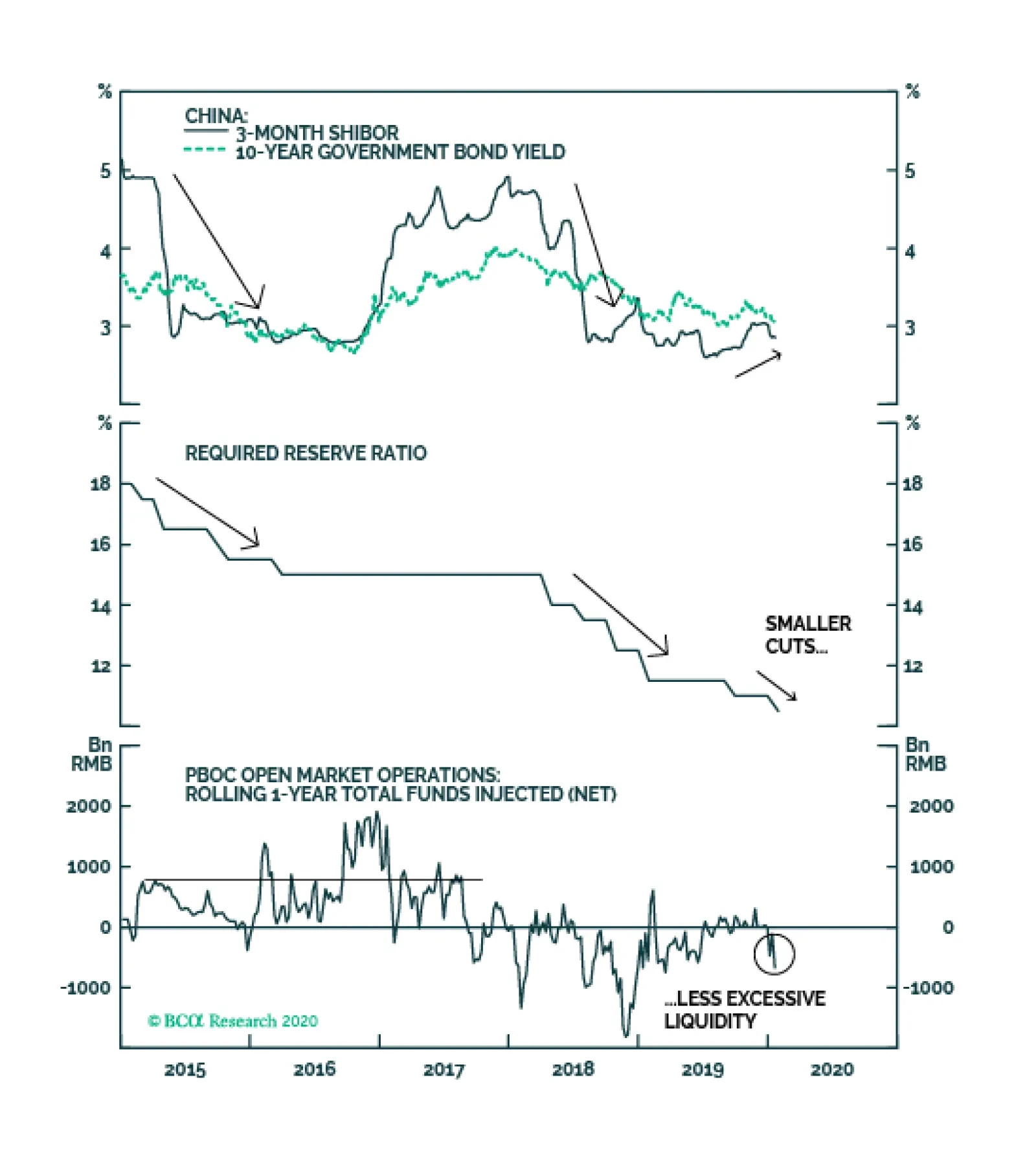
But Chinese leadership’s cautious approach to boosting domestic demand will also cap the upside potential in the RMB appreciation. We think Chinese policymakers will maintain their tight grip this year on local government spending and bank lending, and will continue to fine-tune policies based on economic conditions. This will limit the magnitude in both the stimulus and economic recovery. Baring a major re-escalation in the trade war, the RMB should oscillate within a relatively narrow band through the third quarter of this year. For that reason, the PBoC is unlikely to intervene in the RMB exchange rate by significantly altering its monetary stance (Chart 7). The 3-month interbank lending rate, China’s de facto policy rate, remains low compared with the 2015-16 easing cycle. There is no sign that the PBoC will allow the rate to fall much more. The recent bank reserve requirement ratio (RRR) rate cut provides additional liquidity to the interbank system, but on a net basis liquidity does not seem excessive (Chart 8). Chart 7PBoC Unlikely To Alter Monetary Policy To Intervene RMB Exchange Rate This Year
PBoC Unlikely To Alter Monetary Policy To Intervene RMB Exchange Rate This Year
PBoC Unlikely To Alter Monetary Policy To Intervene RMB Exchange Rate This Year
Chart 8No Sign Of Meaningful Monetary Easing From PBoC
No Sign Of Meaningful Monetary Easing From PBoC
No Sign Of Meaningful Monetary Easing From PBoC
Historically, the 3-month interbank lending rate only falls significantly and durably when the PBoC places consecutive RRR rate cuts (in both 2015 and mid-2018) and/or keeps net fund injections positive through the open market for a prolonged period (such as in the 2015/16 easing cycle). Chart 8 suggests the current monetary environment does not indicate that such an extremely easy stance is in place, as PBoC net fund injections through the open market remain negative. Furthermore, neither the 3-month interbank lending rate nor the 10-year government bond yield has fallen below its most recent lows in the third quarter of last year. Bottom Line: While the current environment supports a stronger RMB, the upside potential in RMB appreciation is capped by a modest scale of economic recovery. There is no sign that the PBoC is easing its monetary stance by lowering the policy rate. Investment Conclusions We have been cyclically overweight Chinese stocks on the basis of a bottoming in the economy in the first quarter of 2020, and the likelihood of an eventual trade deal. These two factors were confirmed in the past two weeks. Last week’s small selloffs in both onshore and offshore Chinese equity markets were likely technical corrections and pre-Chinese New Year profit taking, rather than a fundamental shift in investors’ sentiment towards Chinese stocks (Chart 9). We expect Chinese stocks to resume an upward trajectory after the Chinese New Year. Chart 9Small Corrections Following A 14% Gain Since Dec 2019
Small Corrections Following A 14% Gain Since Dec 2019
Small Corrections Following A 14% Gain Since Dec 2019
Chart 10Offshore Stocks Still Showing More Upside Potential Than Onshore
Offshore Stocks Still Showing More Upside Potential Than Onshore
Offshore Stocks Still Showing More Upside Potential Than Onshore
China’s economic conditions and corporate earnings should continue to improve, with investable stocks showing more upside potential than their domestic counterparts (Chart 10). As growth supporting measures continue to work their way through the economy and solidify an economic recovery, China’s leadership may pull back the scale of the stimulus in the second half of the year. Therefore, the relative outperformance in both markets may be front loaded and subsequently subside in the second half of 2020. Jing Sima China Strategist jings@bcaresearch.com Footnotes 1 https://assets.bwbx.io/documents/users/iqjWHBFdfxIU/rVaHxDBUtdew/v0 2 China’s total imports of goods and services in 2019 was $2604 billion, including $168 billion imports from the US. If China was to fully meet the $200 billion target of additional imports from the US, assuming no change to imports from other countries in 2020 from 2019, China’s total imports would jump to $2699 billion in 2020 and $2745 billion in 2021. 3 The eight subcategories of Manufacturing Goods listed in the Annex 6.1 of the Phase One Trade agreement include: Industrial Machinery, Electrical Equipment and Machinery, Pharmaceutical Products, Aircraft, Vehicles, Optical and Medical Instruments, Iron and Steel, Other Manufactured Goods including solar-grade polysilicon and other organic and inorganic chemicals, hardwood lumber, integrated circuits (manufactured in US), and chemical products. 4 WIOD Data, 2016 release and OECD Input-Output Tables (IOTs), 2015 release. Cyclical Investment Stance Equity Sector Recommendations
Highlights We continue to have a positive view on global equities over the next 12 months, but see heightened risks of a near-term correction. Despite dwindling spare capacity, government bond yields are still lower today than they were shortly after the financial crisis. Many investors argue that bond yields cannot rise much because asset values would plunge if yields rose sharply, while debt burdens would quickly become unsustainable. We disagree. We think there is greater scope for yields to rise than is widely believed. Investors should maintain below-benchmark duration in fixed-income portfolios, favoring inflation-linked over nominal bonds and positioning for steeper yield curves. Gold should also do well next year. As long as bond yields are rising in response to stronger growth, as will be the case for the next two years, equities will fare well. The stock market will buckle, however, once stagflation sets in around 2022. Stocks Need To Work Off Overbought Conditions Before Moving Higher Again In last week’s report, entitled “Time For A Breather,” we downgraded our tactical three-month view on global equities from overweight to neutral on the grounds that stocks had run up too hard, too fast. Net long positions in equity futures among asset managers and levered funds are now at levels that have historically preceded corrections (Chart 1). Chart 1Stocks Are At A Heightened Risk Of A Correction
Stocks Are At A Heightened Risk Of A Correction
Stocks Are At A Heightened Risk Of A Correction
Chart 2Breadth Is Quite Narrow
Breadth Is Quite Narrow
Breadth Is Quite Narrow
Chart 3The Equity Risk Premium Is Fairly High, Especially Outside The US
The Equity Risk Premium Is Fairly High, Especially Outside The US
The Equity Risk Premium Is Fairly High, Especially Outside The US
The rally has been lopsided, characterized by very narrow breadth. The top five stocks in the S&P 500 (Apple, Microsoft, Alphabet, Amazon, and Facebook) now comprise 18% of market cap, a higher share than in the late 1999/early 2000s (Chart 2). As my colleague, Anastasios Avgeriou, has pointed out, Apple’s $30 billion one day market cap gain on January 9th was greater than the market cap of the median stock in the S&P 500 index. Despite our near-term concerns, we continue to maintain a positive 12-month view on global equities. Easier financial conditions, a turn in the global inventory cycle, modestly looser fiscal policy in the UK and euro area, and re-upped fiscal/credit stimulus in China should all support global growth this year. Faster growth, in turn, will lift corporate earnings. The equity risk premium also remains quite high, particularly outside the US (Chart 3). A Fragile Trade Truce A de-escalation in the trade war should provide a further tailwind to equities. The “phase one” agreement signed on Wednesday features a commitment by China to purchase an additional $200 billion in US goods and services over the next two years relative to 2017 levels. In return, the US will halve tariffs, to 7.5%, on the $120 billion tranche in Chinese imports and suspend any further tariff hikes. No firm schedule exists to begin “phase two” talks, and at this point, it is quite likely that no negotiations will take place until after the US presidential election. Nevertheless, the tail risk of an out-of-control trade war has receded for the time being, which is positive for stocks. Better Chinese Trade Data Adding to growing optimism over the global economy and diminished trade tensions, Chinese trade data surprised on the upside this week. Exports rose 7.6% in December, well above the consensus estimate of 2.9%. Imports surged 16.3%, easily surpassing the consensus estimate of 9.6%. While base effects explain some of the improvement, the overall tone of the trade data is consistent with the strengthening Chinese PMIs and improvement in industrial production and retail sales (Chart 4). Chart 4Chinese Trade Data Is Improving
Chinese Trade Data Is Improving
Chinese Trade Data Is Improving
Chart 5Better News Out Of China Has Propelled The Yuan Higher Versus The US Dollar
Better News Out Of China Has Propelled The Yuan Higher Versus The US Dollar
Better News Out Of China Has Propelled The Yuan Higher Versus The US Dollar
Better news out of China has pushed the yuan to the strongest level against the US dollar since last summer (Chart 5). The Chinese currency is the most important driver of other EM currencies. If the yuan continues to strengthen, as we expect, EM assets – particularly EM stocks and local-currency bonds – should do well this year. How High Can Bond Yields (Realistically) Go? Despite rising over the past few months, global government bond yields are lower today than they were shortly after the financial crisis ended (Chart 6). The decline in yields has occurred alongside dwindling spare capacity. In most countries, the unemployment rate today is below 2007/08 lows (Chart 7). Many investors argue that bond yields cannot rise much from current levels because asset values would plunge if yields rose sharply, while debt burdens would quickly become unsustainable. If such an unfortunate turn of events were to occur, central bankers would have to shelve any tightening plans, just as Jay Powell had to do in late 2018. Chart 6Bond Yields Are Lower Today Than They Were After The Great Recession
Bond Yields Are Lower Today Than They Were After The Great Recession
Bond Yields Are Lower Today Than They Were After The Great Recession
Chart 7Unemployment Rates Are Below Their Pre-Recession Lows In Most Economies
Bond Yields: How High Is Too High?
Bond Yields: How High Is Too High?
Convexity Fears One argument often heard these days is that asset prices have become hypersensitive to changes in interest rates. There is some basis for thinking this. As Box 1 explains, the relationship between asset returns and interest rates tends to be “convex,” meaning that any given change in interest rates will have a bigger effect on returns if rates are low to begin with, as they are today. The effect is particularly pronounced for long duration assets such as long-term bonds, equities, or real estate. Nevertheless, while the theoretical presence of convexity in asset returns is crystal clear, many commentators overstate its practical importance. As Chart 8 shows, the average maturity of government debt stands at seven years. At that level of maturity, the effects of convexity tend to be quite small.1 Chart 8Average Debt Maturity Is Below 10 Years In Most Countries
Bond Yields: How High Is Too High?
Bond Yields: How High Is Too High?
Granted, the overall stock of debt has increased in relation to GDP. However, much of that additional debt has been absorbed by central banks, reducing the amount of government debt available for the private sector. What about equities? The ratio of stock market capitalization-to-GDP has risen to 59%, up from a low of 24% in 2009, and close to its 2000 highs (Chart 9). Does that mean that stocks will sink if yields rise from current levels? Not necessarily. Remember that the discount rate is not the only thing that affects the present value of a stream of income. The expected growth rate of that income also matters. In fact, in the standard dividend discount model, it is simply the difference between the discount rate and the growth rate of dividends that determines how much a stock is worth. If higher bond yields coincide with rising growth expectations, stock prices do not need to fall at all. Chart 9Equity Market Cap Is Approaching Previous Highs
Equity Market Cap Is Approaching Previous Highs
Equity Market Cap Is Approaching Previous Highs
Chart 10 shows that the monthly correlation between equity returns and bond yields remains as high as ever. This suggests that favorable economic news, to the extent that it leads investors to revise up the expected growth rate for earnings, usually more than compensates for a rising discount rate (Chart 11). Chart 10Correlation Between Equity Returns And Bond Yields Remains High
Correlation Between Equity Returns And Bond Yields Remains High
Correlation Between Equity Returns And Bond Yields Remains High
Chart 11Earnings Estimates Tend To Move In Sync With Swings In Bond Yields
Earnings Estimates Tend To Move In Sync With Swings In Bond Yields
Earnings Estimates Tend To Move In Sync With Swings In Bond Yields
So why are so many investors worried that higher bond yields will undercut stocks? The answer has less to do with convexity and more to do with the fear that bond yields will reach a level that chokes off growth. The combination of a rising discount rate and a falling growth rate would be toxic for equities and other risk assets. Debt Worries Likewise, it is not so much that corporate bond investors are worried that rising yields will cause interest payments to swell. After all, interest costs are still quite low as a share of cash flows for most firms (Chart 12). Rather, the fear is that higher yields will imperil growth, causing those cash flows to evaporate. Government debt is also much less of a problem than often assumed, at least in countries that issue bonds in their own currencies. The standard rule for debt sustainability says that the debt-to-GDP ratio will always converge to a stable level if the interest rate is below the growth rate of the economy.2 This is easily the case in almost all economies today (Chart 13). Chart 12US Corporate Sector: Interest Payments Are Not A Worry
US Corporate Sector: Interest Payments Are Not A Worry
US Corporate Sector: Interest Payments Are Not A Worry
Chart 13Bond Yield Minus GDP Growth: Please Mind The Gap
Bond Yields: How High Is Too High?
Bond Yields: How High Is Too High?
The only places where central banks are severely constrained in raising rates are in economies such as Canada, Sweden, and Australia where debt-financed housing bubbles have formed (Chart 14). However, even in these countries, the quality of mortgage underwriting has generally been strong, implying that a banking crisis would likely be avoided. Chart 14Canada, Sweden, And Australia Stand Out As Having Very Frothy Housing Markets
Canada, Sweden, And Australia Stand Out As Having Very Frothy Housing Markets
Canada, Sweden, And Australia Stand Out As Having Very Frothy Housing Markets
It’s Really About The Neutral Rate The discussion above suggests that the main constraint to higher bond yields is the economy itself. If bond yields rise enough, the interest rate-sensitive sectors of the economy will weaken, and a recession will ensue. As long as bond yields are rising in response to stronger growth, as will be the case for the next two years, equities will be fine. Unfortunately, no one knows where the neutral rate – the interest rate demarcating the boundary between expansionary and contractionary monetary policy – really lies. Chart 15Rising Labor Share Of Income Occurring Alongside Labor Market Tightening
Rising Labor Share Of Income Occurring Alongside Labor Market Tightening
Rising Labor Share Of Income Occurring Alongside Labor Market Tightening
Slower trend growth has probably reduced the neutral rate, as has the shift to a more “capital-lite” economy. On the flipside, other forces have probably raised the neutral rate over the past few years. A tighter labor market has increased workers’ share of national income (Chart 15). Since workers spend more of every dollar of income than companies, this has raised aggregate demand. Fiscal policy has also been loosened, while elevated asset prices have likely incentivized some spending that would otherwise not have taken place. Even though we do not know the exact value of the neutral rate, we do know that the unemployment rate has been falling in most countries for the past 10 years, a period during which bond yields were generally higher than today. This suggests that monetary policy remains in expansionary territory. True, global growth did slow in 2018, just as the Fed was raising rates. However, this probably had more to do with the natural ebb and flow of the global manufacturing cycle, exacerbated by the Chinese deleveraging campaign and the brewing trade war. If global growth recovers this year, as we expect, estimates of the neutral rate will rise. This will allow equity prices to increase even in an environment of modestly higher bond yields. Inflation Is Coming… Eventually While stronger economic growth will lift bond yields this year, the big move in yields will only come when inflation breaks out. Core inflation tends to track unit labor costs (Chart 16). Unit labor cost inflation has remained range-bound for most of the recovery in the United States, which explains the failure of inflation to take flight. Unit labor cost inflation has been even more moribund elsewhere. Chart 16Core Inflation Tends To Track Unit Labor Costs
Core Inflation Tends To Track Unit Labor Costs
Core Inflation Tends To Track Unit Labor Costs
Chart 17Correlation Between Labor Market Slack And Wage Growth Remains Intact
Bond Yields: How High Is Too High?
Bond Yields: How High Is Too High?
Looking out, barring a major surge in productivity, rising wage growth should lead to accelerating unit labor cost inflation, first in the US and then in the rest of the world, which will translate into higher price inflation. We doubt that such a price-wage spiral will erupt this year. If anything, US wage growth has leveled off recently, with the year-over-year change in average hourly earnings falling back below the 3% mark. Nevertheless, the long-term correlation between labor market slack and wage growth remains intact (Chart 17). As wage growth reaccelerates, unit labor cost inflation will drift higher, setting the stage for a period of rising price inflation. Investors should maintain below-benchmark duration in global fixed-income portfolios, favoring inflation-linked over nominal bonds and positioning for steeper yield curves. Gold should also do well next year. As long as bond yields are rising in response to stronger growth, as will be the case for the next two years, equities will be fine. The stock market will buckle, however, once stagflation sets in around 2022. Box 1 Asset Prices And Interest Rates: The Role Of Convexity
Bond Yields: How High Is Too High?
Bond Yields: How High Is Too High?
Peter Berezin Chief Global Strategist peterb@bcaresearch.com Footnotes 1Assuming semi-annual compounding, the price of a 10-year bond with a 5% coupon rate falls by 7.9% if the yield increases from 1% to 2%, which is only slightly higher than the 7.6% decline that would be incurred if the yield increases from 4% to 5%. 2One might add that if the interest rate is below the growth rate of the economy, a higher starting point for the debt stock will allow for more debt issuance without leading to a higher debt-to-GDP ratio. As we have shown before, the steady-state debt-to-GDP ratio can be expressed as p/(r-g), where r is the interest rate, g is trend GDP growth, and p is the primary (i.e., non-interest) budget balance. Thus, for example, if the government wanted to achieve a stable debt-to-GDP ratio of 50% and r-g is -2%, it would need to run a primary budget deficit of 0.5*0.02=1% of GDP. However, if the government targeted a stable debt-to-GDP ratio of 200%, it could run a primary budget deficit of 2*0.02=4% of GDP. Global Investment Strategy View Matrix
Bond Yields: How High Is Too High?
Bond Yields: How High Is Too High?
MacroQuant Model And Current Subjective Scores
Bond Yields: How High Is Too High?
Bond Yields: How High Is Too High?
Strategic Recommendations Closed Trades
Highlights Global Investment Strategy View Matrix
Time For A Breather
Time For A Breather
Receding trade tensions; diminished risks of a hard Brexit; reduced odds of a victory for Elizabeth Warren in the US presidential elections; liquidity injections by most major central banks; and improved sentiment about the state of the global economy all helped push stocks higher late last year. Some clouds have formed over the outlook since the start of the year, however. The December US ISM manufacturing index fell to the lowest level since 2009, while the PMIs in the euro area, UK, and Japan gave up some of their November gains. The conflict between the US and Iran also flared up. Although tensions have abated in recent days, BCA’s geopolitical strategists worry that the détente may not last. The US is seeking to shift its military focus towards East Asia in order to counter China’s ascendency. They argue that this could create a dangerous power vacuum in the Middle East. Stock market sentiment is quite bullish at the moment, which makes equities more vulnerable to any disappointing news. While we are maintaining our positive 12-month view on global equities and high-yield credit in anticipation that global growth will rebound convincingly later this year, we are downgrading our tactical 3-month view to neutral. Ho Ho Ho After handing investors a sack of coal last Christmas, Santa was back to his true self this past holiday season. Global equities rose 3.4% in December, finishing the year off with a stellar fourth quarter which saw the MSCI All-Country World index surge by 8.6%. Five forces helped push stocks higher: 1) Receding trade tensions; 2) Diminished risks of a hard Brexit; 3) Reduced odds of a victory for Elizabeth Warren in the US presidential elections; 4) Liquidity injections by the Fed, ECB, and the People’s Bank of China; and arguably most importantly 5) Improved sentiment about the state of the global economy. Tarrified No More Trade tensions subsided sharply after China and the US reached a “Phase One” agreement. The deal prevented tariffs from rising on December 15th on $160 billion of Chinese imports. It also rolls back the tariff rate from 15% to 7.5% on about $120 billion in imports that have been subject to levies since September (Chart 1). Chart 1The Evolution Of The US-China Trade War
The Evolution Of The US-China Trade War
The Evolution Of The US-China Trade War
In addition, the Trump Administration allowed the November 13th deadline on European auto tariffs to lapse. This suggests that the US is unlikely to impose tariffs under the Section 232 investigation of auto imports. The auto sector has been at the forefront of the global manufacturing slowdown, so any good news for that industry is welcome. To top it all off, the US House of Representatives ratified the USMCA, the successor to NAFTA, on December 19th. We expect it to be signed into law in the first quarter of this year. Brexit Risks Fading... Chart 2The Majority Of British Voters Aren't Keen On Brexit
The Majority Of British Voters Aren't Keen On Brexit
The Majority Of British Voters Aren't Keen On Brexit
Boris Johnson’s commanding victory in the UK elections has given him the votes necessary to push a withdrawal bill through parliament by the end of the month. The British government will then seek to negotiate a free trade agreement by the end of the year. A “no-deal” Brexit is unacceptable to the majority of British voters (Chart 2). As such, the Johnson government will have no choice but to strike a deal with the EU. ... While Trump Gains On the other side of the Atlantic, President Trump’s re-election prospects improved late last year despite (and perhaps because of) the ongoing impeachment process. There is an uncanny correlation between the probability that betting markets assign to a Trump victory and the value of the S&P 500 (Chart 3). Chart 3An Uncanny Correlation
An Uncanny Correlation
An Uncanny Correlation
Chart 4Who Will Win The 2020 Democratic Nomination?
Time For A Breather
Time For A Breather
It certainly has not hurt market sentiment that Elizabeth Warren’s poll numbers have been dropping recently (Chart 4). Warren’s best hope was to squeeze out Bernie Sanders as soon as possible, thereby leaving the far-left populist lane all to herself. That dream appears to have been dashed, which suggests that even if Trump loses, a centrist like Joe Biden could emerge as president. An Uneasy Truce It remains to be seen how President Trump’s decision to assassinate General Qassem Soleimani, a top Iranian commander, will affect the election outcome. A YouGov/HuffPost poll taken over the weekend revealed that 43% of Americans approved of the airstrike against Soleimani compared to 38% that disapproved.1 History suggests that the public’s patience for war will quickly wear thin if it results in American casualties or significantly higher gasoline prices. Neither side has an incentive to allow the conflict to spiral out of control. Foreign minister Mohammad Javad Zarif tweeted on Tuesday shortly after Iran lobbed missiles at two US military bases that Iran had “concluded” its retaliatory strike, adding that “We do not seek escalation or war.” Despite claims on Iranian public television that 80 “American terrorists” were killed in the attacks, no US troops were harmed. This suggests that the Iranians may be putting on a show for domestic consumption. The US economy is less vulnerable to spikes in oil prices than in the past. Nevertheless, plenty of things could still go wrong. BCA’s geopolitical team, led by Matt Gertken, has argued that the US is seeking to shift its military focus towards East Asia in order to counter China’s ascendency. This could create a dangerous power vacuum in the Middle East. There is also a risk that President Trump overplays his hand. Contrary to the President’s claims, Soleimani was quite popular in Iran (Chart 5). If Trump begins to mock the Iranian leadership’s feeble response, Iran will have no choice but to take more aggressive action. Chart 5Soleimani Was More Popular In Iran Than Trump Claims
Time For A Breather
Time For A Breather
Chart 6US Economy Is Less Vulnerable To Spikes In Oil Prices Than In The Past
US Economy Is Less Vulnerable To Spikes In Oil Prices Than In The Past
US Economy Is Less Vulnerable To Spikes In Oil Prices Than In The Past
One thing that could embolden Trump is that the US economy is less vulnerable to spikes in oil prices than in the past. US oil output reached as high as 12.9 mm b/d in 2019, allowing the country to become a net exporter of oil for the first time in history (Chart 6). Any increase in oil prices would incentivize further domestic production, which would help bring prices back down. The US economy has also become less energy intensive – it takes less than half as much oil to produce a unit of GDP today than it did in the early 1980s. Finally, unlike in the past, the Fed will not need to raise rates in response to higher oil prices due to the fact that inflation expectations are currently well anchored. In fact, as we discuss below, we expect the Fed and other central banks to continue to provide a tailwind for growth over the course of 2020. The Fed’s “It’s Not QE” QE Program The jump in overnight lending rates in mid-September torpedoed the Federal Reserve’s efforts to shrink its balance sheet. Thanks to a steady stream of Treasury bill purchases since then, the Fed’s asset holdings have swelled by over $400 billion, reversing more than half of the decline observed since early 2018 (Chart 7). Chart 7Fed's Asset Holdings Are Growing Anew
Fed's Asset Holdings Are Growing Anew
Fed's Asset Holdings Are Growing Anew
Chart 8The Fed's Balance-Sheet Expansion Helped Fuel The Dot-Com Bubble
The Fed's Balance-Sheet Expansion Helped Fuel The Dot-Com Bubble
The Fed's Balance-Sheet Expansion Helped Fuel The Dot-Com Bubble
The Fed has insisted that its latest intervention does not amount to a new QE program, stressing that it is buying short-term securities rather than long-dated bonds. In so doing, it is simply creating bank reserves, rather than seeking to suppress the term premium by altering the maturity structure of the private sector’s holdings of government debt. Nevertheless, even such straightforward interventions have proven to be powerful signaling tools. By growing its balance sheet, a central bank is implicitly promising to keep monetary policy very accommodative. It is worth remembering that the run-up in the NASDAQ in 1999 coincided with a significant balance-sheet expansion by the Fed in response to Y2K fears, which came on the heels of three “insurance cuts” in 1998 (Chart 8). Gentle Jay Paves The Way Chart 9Inflation Expectations Remain Muted
Inflation Expectations Remain Muted
Inflation Expectations Remain Muted
In 2000, the Fed moved quickly to reverse the liquidity injection it had orchestrated the prior year. We do not expect such a reversal anytime soon. Moreover, unlike in 2000, when the Federal Reserve kept raising rates – ultimately bringing the Fed funds rate up to 6.5% in May 2000 – the Fed is likely to stay on hold this year. The Fed’s ongoing strategic policy review is poised to move the central bank even closer towards explicitly adopting an average inflation target of 2% over the course of a business cycle. Since inflation tends to fall during recessions, this implies that the Fed will seek to target an inflation rate somewhat higher than 2% during expansions. Realized core PCE inflation has averaged only 1.6% since the recession ended. Both market-based and survey-based measures of long-term inflation expectations remain downbeat (Chart 9). This suggests that the bar for raising rates this year is quite high. More Monetary Easing In The Euro Area And China Chart 10Chinese Monetary Easing Should Help Global Growth Bottom Out
Chinese Monetary Easing Should Help Global Growth Bottom Out
Chinese Monetary Easing Should Help Global Growth Bottom Out
The ECB resumed its QE program in November after a 10-month hiatus. While the current pace of €20 billion in monthly asset purchases is well below the prior pace of €80 billion, the central bank did say it would continue buying assets for “as long as necessary” to bring inflation up to its target. The language harkens back to Mario Draghi’s 2012 “whatever it takes” pledge, this time applied to the ECB’s inflation mandate. Not to be outdone, the People’s Bank of China cut the reserve requirement ratio by 50 basis points last week, a move that will release RMB 800 billion ($US 115 billion) of fresh liquidity into the banking system. Historically, cuts in reserve requirements have led to faster credit growth and ultimately, to stronger economic growth both in China and abroad (Chart 10). The PBOC has also instructed lenders to adopt the Loan Prime Rate (LPR) as the new benchmark lending rate. The LPR currently sits 20bps below the old benchmark rate (Chart 11). Hence, the PBOC’s order amounts to a stealth rate cut. Our China strategists expect further reductions in the LPR over the next six months. In addition, the crackdown on shadow bank lending seems to be subsiding, which bodes well for overall credit growth later this year (Chart 12). Chart 11China: Stealth Monetary Easing
China: Stealth Monetary Easing
China: Stealth Monetary Easing
Chart 12Crackdown On Shadow Banking In China Is Easing
Crackdown On Shadow Banking In China Is Easing
Crackdown On Shadow Banking In China Is Easing
Rising Economic Confidence Chart 13Recession Fears Amongst Economists Began To Gather Steam At The Start Of Last Year
Recession Fears Amongst Economists Began To Gather Steam At The Start Of Last Year
Recession Fears Amongst Economists Began To Gather Steam At The Start Of Last Year
Chart 14The Wider Public Was Also Worried About A Downturn
The Wider Public Was Also Worried About A Downturn
The Wider Public Was Also Worried About A Downturn
At the start of 2019, nearly half of US CFOs thought the economy would be in a recession by the end of the year. Similarly, two-thirds of European CFOs and four-fifths of Canadian CFOs expected their respective economies to succumb to recession. Professional economists were equally dire (Chart 13). Households also became increasingly worried about a downturn. Google searches for “recession” spiked to near 2009-highs last summer (Chart 14). The mood has certainly improved since then. According to the latest Duke CFO survey, optimism about the economic outlook has increased. More importantly, CFO optimism about the prospects for their own firms has risen to the highest level in the 18-year history of the survey (Chart 15). Chart 15CFOs Have Become More Optimistic Of Late
CFOs Have Become More Optimistic Of Late
CFOs Have Become More Optimistic Of Late
Show Me The Money Going forward, global growth needs to accelerate in order to validate the improved confidence of CFOs and investors alike. We think that it will, thanks to the lagged effects from the easing in financial conditions in 2019, a turn in the global inventory cycle, a de-escalation in the trade war, easier fiscal policy in the UK and euro area, and re-upped fiscal/credit stimulus in China. For now, however, the economic data remains mixed. On the positive side, household spending is still robust across most of the world, a fact that has been reflected in the resilience of service-sector PMIs (Chart 16). Chart 16AThe Service Sector Has Remained Resilient (I)
The Service Sector Has Remained Resilient (I)
The Service Sector Has Remained Resilient (I)
Chart 16BThe Service Sector Has Remained Resilient (II)
The Service Sector Has Remained Resilient (II)
The Service Sector Has Remained Resilient (II)
Chart 17US Wage Growth Has Picked Up, Especially At The Bottom Of The Income Distribution
Time For A Breather
Time For A Breather
Chart 18US Housing Backdrop Is Solid
US Housing Backdrop Is Solid
US Housing Backdrop Is Solid
The US consumer, in particular, is showing little signs of fatigue. The Atlanta Fed GDPNow estimates that real personal consumption grew by 2.4% in the fourth quarter, having increased at an average annualized pace of 3% in the first three quarters of 2019. Both a strong labor market and housing market have buoyed US consumption. Payrolls have risen by an average of 200K per month for the past six months, double what is necessary to keep up with labor force growth. This week’s strong ADP release – which featured a 29K jump in jobs in goods-producing industries in December, the best since April – suggests that today’s jobs report will remain healthy. In addition, wage growth has picked up, particularly at the bottom of the income distribution (Chart 17). Residential construction has also been strong. Homebuilder sentiment reached the best level since June 1999 (Chart 18). Global Manufacturing: Too Early To Call The All-Clear The outlook for manufacturing remains the biggest question mark in the global economy. The US ISM manufacturing index dropped to 47.2 in December, its lowest level since June 2009. The composition of the report was poor, with the new orders-to-inventory ratio dropping close to recent lows. Chart 19Other US Manufacturing Gauges Are Not As Weak As The ISM
Other US Manufacturing Gauges Are Not As Weak As The ISM
Other US Manufacturing Gauges Are Not As Weak As The ISM
We would discount the ISM report to some extent. The regional Fed manufacturing indices have not been nearly as disappointing as the ISM (Chart 19). The Markit PMI, which tracks US manufacturing activity better than the ISM, clocked in at a respectable 52.4 in December, down only slightly from November’s reading of 52.6. Nevertheless, it is hard to be excited about the near-term outlook for US manufacturing, especially in light of Boeing’s decision to suspend production of the 737 Max temporarily. Most estimates suggest that the production halt will reduce real US GDP growth by 0.3%-to-0.5% in the first quarter. The euro area manufacturing PMI gave up some of its November gains, falling to 46.3 in December. While the index is still above its September low of 45.7, it has been under 50 for 11 straight months now. The UK and Japanese PMI also retreated. Chinese manufacturing has shown clearer signs of bottoming out. Despite dipping in December, the private sector Caixin manufacturing PMI remains near its 2017 highs. The official PMI published by the National Bureau of Statistics is less upbeat, but still managed to come in slightly above 50 in December. The production subcomponent reached the highest level since August 2018. Reflecting the positive trend in the Chinese economy, Korean exports to China rose by 3.3% in December, the first positive growth rate in 14 months (Chart 20). Taiwan’s exports have also rebounded. The manufacturing PMI rose above 50 in both economies in December. In Taiwan’s case, this was the first time the PMI moved into expansionary territory since September 2018. On balance, we continue to expect global manufacturing to recover in 2020. This is in line with our observation that global manufacturing cycles typically last three years, with 18 months of weaker growth followed by 18 months of stronger growth (Chart 21). That said, the weakness in European and US manufacturing (at least judged by the ISM) is likely to give investors pause. Chart 20Some Positive Signs Emerging From Korea And Taiwan
Time For A Breather
Time For A Breather
Chart 21A Fairly Regular Three-Year Manufacturing Cycle
A Fairly Regular Three-Year Manufacturing Cycle
A Fairly Regular Three-Year Manufacturing Cycle
Investment Conclusions We turned bullish on stocks in late 2018, having temporarily moved to the sidelines during the summer of that year. Global equities have gained 25% since our upgrade. We see another 10% of upside for 2020, led by European and EM bourses. Despite its recent gains, the real value of the MSCI All-Country World Index is only 3% above its prior peak in January 2018. The 12-month forward PE ratio of 16.3 is still somewhat lower than it was back then. The valuation picture is even more enticing if we compare equity earnings yields with bond yields, which is tantamount to computing a rough equity risk premium (ERP). The global ERP remains quite high by historic standards, especially outside the US where earnings yields are higher and bond yields are generally lower (Chart 22). Chart 22The Equity Risk Premium Is Fairly High, Especially Outside The US
The Equity Risk Premium Is Fairly High, Especially Outside The US
The Equity Risk Premium Is Fairly High, Especially Outside The US
Chart 23Stock Market Sentiment Is Quite Bullish
Stock Market Sentiment Is Quite Bullish
Stock Market Sentiment Is Quite Bullish
Nevertheless, sentiment is quite positive towards stocks at the moment (Chart 23). Elevated bullish sentiment, against the backdrop of ongoing uncertainty about the outlook for global manufacturing and an uneasy truce between the US and Iran, poses a near-term headwind to risk assets. As such, while we are maintaining our positive 12-month view on global equities and high-yield credit, we are downgrading our tactical 3-month view to neutral for the time being. We do not regard this as a major realignment of our views; we will turn tactically bullish again if stocks dip about 5% from current levels. Peter Berezin Chief Global Strategist peterb@bcaresearch.com Footnotes 1 Ariel Edwards-Levy, “Here's What Americans Think About Trump's Iran Policy,” TheHuffingtonPost.com (January 6, 2020). MacroQuant Model And Current Subjective Scores
Time For A Breather
Time For A Breather
Strategic Recommendations Closed Trades
Highlights The consensus view seems to be that equities have to cool off in 2020, even if the danger has passed: Recession fears have dissipated as the yield curve has returned to its normal upward-sloping orientation and US-China trade tensions have abated, but equity return expectations are modest following last year’s bonanza. We agree that a bear market is unlikely, but expect a better year than the consensus, … : Bull markets tend to sprint to the finish line, and if the next recession won’t start before the middle of 2021, 2020 should be another strong year for the S&P 500. … even if earnings growth is uninspiring: Multiples almost always expand when the Fed eases from an already accommodative position, and they expand a lot provided the Fed isn’t easing in response to a market bust or financial crisis. We expect that an inflation revival will take the consensus by surprise, but not this year: We think rising inflation will induce the Fed to bring the curtain down on the expansion and the equity bull market, but not until 2021 at the earliest. Feature We spent the last full week before the holidays meeting with clients and prospects on the west coast. As they look ahead to 2020, investors don’t see any major storm clouds on the horizon, but they sense that stocks have run about as far as they can. We agree with the view that neither a recession nor a bear market awaits, but we expect equities will comfortably outdistance bonds and cash. Forced to take a stand on whether the S&P 500 will beat or fall short of the typical consensus expectation for mid-to-high-single-digit gains,1 we would happily bet the over. As we detailed in our last two publications in December, our optimistic take stems from the deliberately reflationary policy being pursued by the Fed and other major central banks. Restoring inflation expectations to its desired range is job number one for the Fed, and its open commitment to doing so ensures that risk assets will have the monetary policy wind at their back for an extended period. The European Central Bank and the Bank of Japan want to rekindle inflation as well, and can be counted upon to maintain easy policy settings. The rest of the world’s central banks will continue to take their cue from their more influential peers, as no one wants the export headwind of a strong currency in a low-growth environment. Earnings growth has been the primary driver of the 11-year-old equity bull market, not multiple expansion. In our base-case scenario, easy monetary policy will encourage multiple expansion, while a less threatening trade climate, and a modest revival in Chinese aggregate demand, will boost economic activity, especially outside of the US. The modest global acceleration provoked by a pickup in Chinese imports will support earnings growth, so that both equity drivers, earnings and multiples, will be moving in the right direction. We anticipate that at least half of the current bull market’s remaining upside will come from multiple expansion, however. Dismaying as it might be for investors with a value bent, our bull thesis is built on the view that today’s fully-to-somewhat-richly-valued stocks will become overvalued before this market cycle is complete. A Stealth Earnings Boom Skeptics of the efficacy of extraordinarily accommodative monetary policy have decried the current bull market as “manipulated,” fed by monetary steroid injections that have inflated asset prices at the cost of undermining the real economy’s future prospects. The data flatly contradict the skeptics’ claims: since the end of February 2009, consensus forward four-quarter S&P 500 earnings expectations have grown at an annualized rate of 9.6% (Chart 1, middle panel), while the forward multiple has expanded at a 4.6% pace (Chart 1, bottom panel). Growth in forward earnings estimates has accounted for two-thirds of the 14.6% annualized appreciation in the S&P 500 (Chart 1, top panel); multiple expansion has only contributed a third. Chart 1A Great Decade For Earnings
A Great Decade For Earnings
A Great Decade For Earnings
Chart 2DM Growth Has Been Weak
DM Growth Has Been Weak
DM Growth Has Been Weak
Positioning for a valuation overshoot does not inspire as much confidence as positioning for robust earnings growth. US economic growth has been lackluster since the crisis (Chart 2, top panel), and it’s been downright anemic in Europe (Chart 2, middle panel) and Japan (Chart 2, bottom panel). Few investors foresaw potent earnings growth against that macro backdrop, as aggregate corporate revenue growth ought to converge with nominal GDP growth over time. Only margin expansion could deliver S&P 500 earnings growth above and beyond a meager 4% revenue growth base. As early as 2011, US corporate profit margins looked quite stretched (Chart 3), making further expansion seem improbable. After adjusting for the secular decline in effective corporate income tax rates, corporations’ growing share of national income, the expansion of the high-margin financial sector and the secular decline in debt service costs,2 however, history suggested that profit margins still had room to grow. It would be 2018 before they would peak, thanks in part to the 40% cut in the top marginal corporate income tax rate, and the plunge in debt service costs (Chart 4). Compensation is corporations’ single largest expense, though, and the inexorable decline in labor's share of profits was the key driver (Chart 5). Since China’s entry into the WTO, real wages have failed to keep up with productivity gains (Chart 6), dramatizing the shift of profit share from labor to capital. Chart 3Never Say Die Margin Growth, Nourished On...
Never Say Die Margin Growth, Nourished On...
Never Say Die Margin Growth, Nourished On...
Chart 4... Rock-Bottom Rates ...
... Rock-Bottom Rates ...
... Rock-Bottom Rates ...
Chart 5... And Labor's Woes
... And Labor's Woes
... And Labor's Woes
Chart 6Globalization Has Helped Corporate Profits
Globalization Has Helped Corporate Profits
Globalization Has Helped Corporate Profits
Profit margins contracted across the first three quarters of 2019, with per-share revenue growth topping per-share earnings growth by an average of three percentage points. We expect that real unit labor costs will rise as the pendulum swings back in labor’s direction in line with an extremely tight job market and a slowdown in outsourcing as globalization loses momentum. Revived activity in the rest of the world can offset some margin pressure from a rising wage bill, however, especially if it helps push the dollar lower. And rising wages aren’t all bad for profits, as rising household income leads to rising consumption, and rising consumption boosts corporate revenue growth. In our base-case 2020 scenario, S&P 500 earnings will grow despite accelerating wage growth. Multiples And The Monetary Policy Cycle Although the S&P 500’s forward multiple is already elevated (Chart 7), the historical relationship between monetary policy and equity multiples argues that re-rating is more likely than de-rating going forward. We divide the fed funds rate cycle (Chart 8) into four phases based on the direction of the fed funds rate (higher or lower) and the state of monetary policy (easy or tight). We are currently in Phase IV, when the Fed has most recently eased policy while policy settings were already accommodative. If margins have finally peaked, multiple expansion will have to assume a bigger role in supporting the bull market. Chart 7Elevated But Not Worrisome
Elevated But Not Worrisome
Elevated But Not Worrisome
Chart 8The Fed Funds Rate Cycle
The Conventional Wisdom
The Conventional Wisdom
Since consensus earnings estimates began to be compiled in 1979, forward multiples have shrunk when the Fed hikes rates and expanded when it cuts them (Table 1). The empirical results align with intuition and arithmetic: investors should become stingier when the rate used to discount future earnings rises, and more generous when that rate falls. While we believe that the mid-cycle rate cuts are finished and that the fed funds rate will fall no further over the rest of this bull market, continued multiple expansion does not require continued rate cuts. Phase IV usually ends with an extended stretch when the Fed holds the funds rate at its trough level, but forward multiples do not peak until the final stages of the phase. Making the intuition-and-arithmetic statement more exact, investors become more generous when rates fall, and remain that way until a rate hike is a sure bet. Table 1A Consistent Inverse Relationship
The Conventional Wisdom
The Conventional Wisdom
Away from the last two Phase IVs, when the Fed cut rates in response to the duress issuing from the end of the dot-com mania and the financial crisis, re-rating gains have been significantly larger. Table 2 details the changes in multiples in each Phase IV episode over the last 40 years. Away from the grinding de-rating following the dot-com bust, and the slow re-rating accompanying the tepid post-crisis recovery, multiples have expanded at better than a 17% annualized rate. Voluntary cuts like last summer’s, made when policy is already easy, independent of the imperative to nurse a post-crisis economy back to health, have been awfully good for investors. Table 2Voluntary Cuts Turbocharge Multiples
The Conventional Wisdom
The Conventional Wisdom
There have been only two instances when the starting multiple has been as high as it was at the start of the latest run of rate cuts. As noted above, conditions in the spring of 2001, when the NASDAQ was a year into its eventual two-and-a-half-year slide, and a recession had just begun, bear little resemblance to conditions today. The fall of 1998, when the Fed delivered a rapid-fire 75 basis points of easing to protect the economy from the potential ramifications of Long Term Capital Management’s failure, looks a lot more like last summer. It is not our base case that the latest round of insurance cuts will push forward multiples to dot-com levels, but they do have scope to expand. The Inflation Timetable It remains our high-conviction view that inflation expectations will not return to the Fed’s target levels quickly. Their path has seemed to provide a nearly perfect real-life case study supporting the adaptive expectations framework, which posits that the recent past exerts a powerful influence on near-term expectations about the future. Inflation is way down the list of investors’ concerns because it has been dormant ever since the crisis, just as it was in the mid-‘60s once memories of high postwar inflation had faded. It conversely remained an acute fear for more than a decade after the Volcker Fed turned the tide in the early ‘80s (Chart 9). Multiples have really surged when the Fed has provided discretionary accommodation outside of periods of distress. The slow but meaningful rise in the trimmed mean PCE (Chart 10, top panel) and CPI series3 (Chart 10, bottom panel) should pull core PCE and core CPI higher over time. In the near term, however, the absence of upward momentum in several leading inflation indicators will likely stretch “over time” beyond the first half of the year, if not the whole year. As tight as the labor market is, unit labor costs have not been able to break out of the range that’s contained them for the last five years (Chart 11, top panel); the New York Fed’s Underlying Inflation Gauge has pulled a disappearing act after a seemingly decisive breakout in mid-2018 (Chart 11, middle panel); and the share of small businesses planning price increases has come off the late 2018 boil (Chart 11, bottom panel). Chart 9Recency Bias In Action
Recency Bias In Action
Recency Bias In Action
Chart 10Inflation's Not Dead, ...
Inflation's Not Dead, ...
Inflation's Not Dead, ...
Chart 11... But It's Still Hibernating
... But It's Still Hibernating
... But It's Still Hibernating
Investment Implications We spent the holidays reading up on the history of strikes in the United States and believe a shift in the balance of negotiating power from management to labor may be stirring, as a two-part Special Report will soon explore. Such a shift would render wages much more sensitive to a lack of labor market slack. Upward wage pressure could then filter into consumer prices either via a cost-push or demand-pull framework, as corporations either seek to defend margins from higher input costs or try to implement opportunistic price hikes. Cost-push or demand-pull, many investors seem to be dismissing the potential for an inflation revival, especially the ones we met in northern California, where the deeply held consensus view asserts that looming job destruction from artificial intelligence makes broad wage growth all but impossible. Inflation is not an immediate concern, but we expect it will ultimately spell the end of the bull market and the expansion. Allocating a generous share of long-maturity Treasury exposures to TIPS is an excellent way to protect a portfolio against its eventual re-emergence. We advise investors to maintain at least an equal weight allocation to equities to profit from our view that ongoing multiple expansion will surprise to the upside. Risk-friendly positioning remains appropriate, as long as intensifying US-Iran tensions or other geopolitical conflicts don’t negate the positive impact of reflationary monetary policy. Doug Peta, CFA Chief US Investment Strategist dougp@bcaresearch.com Footnotes 1 The ten buy- and sell-side strategists surveyed in Barron’s 2020 Outlook, published December 16th, called for an average gain of 4%. 2 Please see the October 2012 BCA Special Report, “Are US Corporate Profit Margins Really All That High?” available at www.bcaresearch.com. 3 Trimmed-mean inflation series operate like figure skating judging in the Olympics – the top and bottom readings are thrown out, and the mean is calculated from the remaining scores.
Feature Recommended Allocation
Monthly Portfolio Update: Counting The Milestones
Monthly Portfolio Update: Counting The Milestones
Since BCA published its 2020 Outlook,1 and the December GAA Monthly Portfolio Update,2 nothing has happened to make us fundamentally change our views. We see the global manufacturing cycle rebounding over the coming quarters, but major central banks remaining dovish. This combination of accelerating growth and easy monetary policy should be positive for risk assets. We accordingly continue to recommend an overweight on equities versus bonds, prefer the more cyclical euro zone and EM equity markets over the US, and selectively like credit (particularly the riskier end of the US junk bond universe). In the 2020 Outlook, we laid out a series of milestones that would indicate how our scenario is playing out: whether we need to reconsider it, or whether we should be adding further to risk (Table 1). Here is how those milestones are progressing. Table 1Milestones For The 2020 Outlook
Monthly Portfolio Update: Counting The Milestones
Monthly Portfolio Update: Counting The Milestones
Chinese growth. Total Social Financing picked up in November (CNY1.75 trillion versus CNY619 billion the previous month) and the most recent hard data (notably retail sales and industrial production) showed improvement. But the momentum of credit creation and activity generally remain weak (Chart 1). We expect that Chinese growth will begin to accelerate in early 2020, due to the lagged effect of monetary stimulus in the first half of last year, and easier fiscal policy. Moreover, December’s annual Central Economic Work Conference pointed to greater government emphasis on growth stability.3 The clampdown on shadow banking also seems to be easing (Chart 2). However, we need to see further signs of Chinese growth accelerating before, for example, we become more bullish on Emerging Markets and commodities. Chart 1Chinese Credit And Activity Remain Weak
Chinese Credit And Activity Remain Weak
Chinese Credit And Activity Remain Weak
Chart 2Clampdown On Shadow Banking Easing?
Clampdown On Shadow Banking Easing?
Clampdown On Shadow Banking Easing?
Trade war. The last-minute agreement to cancel the December 15 rise in US tariffs on Chinese imports represents the “ceasefire” we expected, rather than “phase one” of a more profound agreement. It is still unclear whether previous tariffs will be rolled back (Chart 3). China’s supposed promise to increase imports of US agricultural products from $10 billion a year to $40 billion-$50 billion seems unrealistic. Progress on more fundamental topics such as China’s subsidies for state-owned companies seems far off. For now, President Trump has done enough to minimize the negative impact on the US economy in an election year. But there remains a possibility that trade war reemerges as a risk during 2020. Chart 3How Far The Rollback?
How Far The Rollback?
How Far The Rollback?
Progress against these milestones suggests that our current asset allocation recommendation structure – moderately risk-on, but with hedges against downside risk – is appropriate for now. Global growth. Data confirming the rebound in the manufacturing cycle remain mixed. Economic surprises have generally been positive in the euro zone, but have slipped in the US and Japan, and remain soft in the Emerging Markets (Chart 4). In Germany, the manufacturing PMI slipped back to 43.7 in December, but the Ifo and ZEW surveys both rebounded (Chart 5). There is, however, still little sign that the weakness in manufacturing is spilling over into consumption and services. In Germany, unemployment remains at a record low and wages are strong. In the US, wage growth continues to trend up, and there is no indication in the weekly initial claims data that companies are starting to lay off workers at more than the seasonally normal pace (Chart 6). Market indicators of the cycle are also showing some positive signs. Among commodities, the price of copper – the most cyclical metal – has begun to rise. Chinese cyclical stocks are outperforming defensives. But the US dollar has not yet showed any significant depreciation (Chart 7). Chart 4Economic Surprises Mixed
Economic Surprises Mixed
Economic Surprises Mixed
Chart 5Germany Showing Signs Of Bottoming
Germany Showing Signs Of Bottoming
Germany Showing Signs Of Bottoming
Chart 6No Problems In The Labor Market
No Signs Of Weakening Labor Market No Problems In The Labor Market
No Signs Of Weakening Labor Market No Problems In The Labor Market
Chart 7Some Positive Signs From The Markets
Some Positive Signs From The Markets
Some Positive Signs From The Markets
US politics. President Trump’s approval rating has picked up slightly – we warned that its slipping might cause him to get aggressive on trade or foreign policy (Chart 8). Markets might worry at the possibility of “President Warren” given her focus on increased regulation of industries such as finance, energy, and technology. But she has fallen a little in the polls. Even in liberal California (where the primary will be unusually early next year – March 3), she is only level with Biden and Sanders in opinion polls. Our geopolitical strategists see US politics as one of the key geopolitical risks this year,4 but the risk seems subdued for now. Chart 8Trump’s Approval Rating Stable To Rising
Monthly Portfolio Update: Counting The Milestones
Monthly Portfolio Update: Counting The Milestones
Fed tightening. Expansions usually end when inflation rises, either causing the Fed to raise rates to choke it off, or with the Fed ignoring the inflation and allowing debt and asset bubbles to form. Any signs, therefore, that inflation, or inflation expectations, are rising would signal that we are truly in the “end game”. For now, there are no such signs. US inflation is likely to soften over the next six months, as a result of the economic slowdown and strong dollar. And TIPS breakevens imply the market believes the Fed will miss its inflation target by an average of 80-90 BPs a year over the next decade (Chart 9). The Fed is likely to sound very dovish over the coming year. The review of its monetary policy framework, probably to be announced in July, may result in some sort of “catch-up” policy: under this, if inflation undershoots the Fed’s target, the target automatically rises the following year.5 Its efforts to support the repo market, including short-term Treasury securities purchases of $60 billion a month, will increase the Fed’s balance-sheet, and represent a “mini-QE” (Chart 10). The Fed is likely to be reluctant to turn more hawkish ahead of the presidential election. These dovish moves – and continued accommodative policies from the ECB and Bank of Japan – mean that monetary policy will be supportive for risk assets throughout 2020. Chart 9Inflation Remains Subdued
Inflation Expectations Driven By Oil Inflation Remains Subdued
Inflation Expectations Driven By Oil Inflation Remains Subdued
These milestones suggest, therefore, that our current asset allocation recommendation structure – moderately risk-on, but with hedges (long cash and gold) against downside risk – is appropriate for now. Chart 10A "Mini-QE"?
A Mini-"QE"?
A Mini-"QE"?
Equities: We shifted last month to an underweight on US equities, with an overweight on the euro zone, and neutral on Emerging Markets. The US tends to underperform during upswings in the global manufacturing cycle (Chart 11). Europe looks attractive because of its heavy weighting in sectors we like such as Financials, Autos and Capital Goods. Europe’s returns will also be boosted by the appreciation in the euro and pound that we expect (our equity recommendations assume no currency hedging). For EM, we would turn more positive if we saw a clear pickup in Chinese credit and economic growth. Chart 11US Underperforms When Growth Picks Up
US Underperforms When Growth Picks
US Underperforms When Growth Picks
Chart 12Fed Won't Cut As The Market Expects
Fed Won't Cut As The Market Expects
Fed Won't Cut As The Market Expects
Fixed Income: Our positive view on global growth implies that long-term rates will rise. We see the US Treasury 10-year yield reaching 2.5% by mid-2020. The market still expects the Fed to cut rates once over the next 12 months. If it stays on hold, as we expect, that slight hawkish surprise would be compatible with a moderate rise in rates (Chart 12). Core euro zone rates might rise by a little less, perhaps by 30-40 BPs, and Japanese government bond yields by 10-15 BPs. We, therefore, continue to recommend a small underweight on duration and an overweight on TIPS which look particularly cheaply valued. Within credit, our preferences are for European investment grade (not as expensive as in the US, and with the ECB buying corporate debt again) and the lower end of the US junk-bond universe (since CCC-rated bonds missed out on 2019’s rally). In a rebounding global economy, the US dollar should depreciate, particularly since it looks somewhat over-valued, and with speculative positions long the dollar. Currencies: In a rebounding global economy, the US dollar should depreciate, particularly since it looks somewhat over-valued (Chart 13), and with speculative positions long the dollar (Chart 14). But its performance is likely to vary depending on the currency pair. Our FX strategists expect the dollar to weaken to 1.18 against the euro and 1.40 against the pound over the next 12 months, and even more against currencies such as the NOK, SEK, and AUD.6 But the dollar is likely to strengthen against the yen (an even more counter-cyclical currency) and against currencies in EM, where central banks will continue to cut rates and inject liquidity aggressively to support their economies. Chart 13Dollar Looks Expensive...
Dollar Looks Expensive...
Dollar Looks Expensive...
Chart 14...And Speculators Are Long
Monthly Portfolio Update: Counting The Milestones
Monthly Portfolio Update: Counting The Milestones
Commodities: Supply in the oil market remains tight, with OPEC deepening its production cuts to 1.7 million barrels/day. The crude oil price was held down in 2019 by weakening demand, which should recover along with the cycle in 2020 (Chart 15). Our energy strategists expect Brent to average $67 a barrel in 2020 (compared to $66 now), with WTI $4 lower. Metal prices could rise in 2020 as Chinese growth recovers and the US dollar depreciates – the two most important factors that drive them (Chart 16). Given the uncertainty over both, we remain neutral for now, but would turn more positive (including on commodity-related assets, such as Australian or EM equities) if we see clear signs of their moving in the right direction. We see gold as a good downside hedge in a world of ultra-low interest rates, especially since central banks may allow inflation to overshoot over the coming years. Chart 15Supply/Demand Balance Points To Higher Oil Price
Markets Will Tighten In 2020 Supply/Demand Balance Points To Higher Oil Price
Markets Will Tighten In 2020 Supply/Demand Balance Points To Higher Oil Price
Chart 16Metals Are Driven By The Dollar And China
Metals Are Driven By The Dollar And China
Metals Are Driven By The Dollar And China
Garry Evans, Senior Vice President Chief Global Asset Allocation Strategist garry@bcaresearch.com Footnotes 1 Please see "Outlook 2020: Heading Into The End Game," dated 22 November 2019, available at bca.bcaresearch.com. 2 Please see "GAA Monthly Portfolio Update: How To Position For The End Game," dated 2 December 2019, available at gaa.bcaresearch.com. 3 Please see China Investment Strategy Weekly Report, "A Year-End Tactical Upgrade," dated 18 December 2019, available at cis.bcaresearch.com 4 Please see Geopolitical Strategy "Strategic Outlook: 2020 Key Views: The Anarchic Society," dated 6 December 2019, available at gps.bcaresearch.com 5 For example, if the Fed's inflation target is 2% but inflation is only 1.7% one year, the target would automatically rise to 2.3% the following year. 6 Please see Foreign Exchange Strategy, "2020 Key Views: Top Trade Ideas," dated December 13, 2019, available at fes.bcaresearch.com GAA Asset Allocation
As 2019 draws to a close, we thank you for your ongoing readership and support. We wish you and your loved ones a happy holiday season and all the best for a healthy and prosperous 2020. Highlights We explore the principal risks to our optimistic 2020 outlook. Trade and the 2020 US Presidential election remain potential landmines. A stronger dollar would tighten global financial conditions and be deflationary. Credit market tremors would end buybacks. Stronger-than-expected inflation would force a cycle-ending Federal Reserve tightening. Weaker-than-expected inflation would first allow for larger bubbles to form at the expense of a more painful recession and deeper a bear market down the road. Hedging against those risks warrants overweighting cash, TIPs and gold. Feature Chart I-1Timing is Ripe For A Recovery
Timing is Ripe For A Recovery
Timing is Ripe For A Recovery
As always, this year’s visit from Ms. and Mr. X was thought-provoking and generated diverse investment ideas.1 While we did not share Mr. X’s fears, his caution may be justified because an aging business cycle, elevated equity multiples and extremely expensive government bonds do not mesh with pro-risk portfolio positioning. With this in mind, we will explore the greatest risks to our positive market outlook, which include politics, the US dollar, problems in the credit market, a quicker resumption of inflation and lower inflation. The Central Scenario To understand how these five risks affect our central thesis, let’s review the key views and themes that underpin our bullish outlook. BCA expects global economic activity to recover in 2020. First, the global inventory contraction is advanced, which increases the chance that the manufacturing cycle will track its usual pattern of an 18-month decline followed by an 18-month acceleration (Chart I-1). Secondly, Chinese policymakers are putting a floor under domestic economic activity and the stabilization in credit growth and the climbing fiscal impulse already augur well for global growth (Chart I-2). Thirdly, global liquidity is in a major upswing, thanks to easing by central banks around the world (Chart I-3). Finally, the trade détente between the US and China agreed last week reduces the odds of a destructive trade war. Chart I-2China's Policy Turnaround
China's Policy Turnaround
China's Policy Turnaround
Chart I-3Easing Abound!
Easing Abound!
Easing Abound!
US monetary policy will remain accommodative next year. US inflation will remain subdued in the first half of 2020 in response to both the global growth slowdown underway since mid-2018 and the lagged effect of a stronger dollar. Moreover, Fed policy will remain sensitive to inflation expectations. According to BCA’s US Bond Strategy’s model, it could take an extended overshoot in realized inflation before inflation expectations move back to the 2.3% to 2.5% range consistent with achieving a 2% inflation target (Chart I-4). Thus, the Fed will remain on pause for all of 2020. BCA’s positive outlook depends on both China and the US respecting their trade truce. In this context, the dollar will depreciate. The USD is a countercyclical currency and typically suffers when global economic activity rebounds, especially if inflation remains tame (Chart I-5). This behavior is due to the low share of the US economy dedicated to manufacturing and exports, which makes the US less sensitive to global trade and industrial activity. Moreover, when the world economy strengthens, safe-haven flows that boost the dollar in times of duress reverse, which accentuates the selling pressure on the USD. Chart I-4Realized Inflation Will Guide Expectations
Realized Inflation Will Guide Expectations
Realized Inflation Will Guide Expectations
Chart I-5The Dollar Won't Respond Well To Stronger Global Growth
The Dollar Won't Respond Well To Stronger Global Growth
The Dollar Won't Respond Well To Stronger Global Growth
Global bond prices will be another victim of an improving economic outlook. Global safe-haven securities are extremely expensive and investors are too bullish toward this asset class (Chart I-6). This puts government bonds at risk in the face of positive economic surprises. However, the upside in Treasury yields will be capped between 2.25 and 2.5% because the Fed will be cautious about lifting rates. This move will likely be led by inflation expectations. As a result, we favor TIPs over nominal Treasurys. Chart I-6Safe-Haven Yields Have Upside
Safe-Haven Yields Have Upside
Safe-Haven Yields Have Upside
Chart I-7Investors Aren't Feeling Exuberant About Earnings Growth
Investors Aren't Feeling Exuberant About Earnings Growth
Investors Aren't Feeling Exuberant About Earnings Growth
Equities will outperform bonds. The S&P 500 is trading at 18-times forward earnings and 2.3-times sales. However, those elevated multiples are due to depressed risk-free rates. Long-term growth expectations embedded in stock prices are only 1%, toward the bottom of this series’ historical distribution (Chart I-7). Therefore, investors are not particularly optimistic on the long-term prospects of per-share earnings. This lack of euphoria implies that stocks are not as expensive as bonds, and that if yields climb because of improving global economic activity, then equities will outperform bonds. Moreover, with a backdrop of easy money and no recession forecast until 2022, the timing still favors positive returns for equities in the coming 12 to 18 months (Table I-1). Table I-1The End Game Can Be Rewarding
January 2020
January 2020
Finally, we favor European equities over US stocks. This regional slant is as much a reflection of the better value offered by European stocks as it is of their sector composition. European stocks are trading at a forward PE of 14, implying an equity risk premium of 846 basis points versus 546 basis points in the US. Moreover, our preference for industrials, energy and financials favors European equities (Table I-2). Additionally, European banks are our favorite equity bet worldwide because they trade at a price-to-book ratio of only 0.6 and the drivers of their return on tangible equity are perking up (Chart I-8). Table I-2Europe: Overweight In The Right Sectors
January 2020
January 2020
Chart I-8Brightening Prospects For Euro Area Banks
Brightening Prospects For Euro Area Banks
Brightening Prospects For Euro Area Banks
Risk 1: Politics BCA’s positive outlook depends on both China and the US respecting their trade truce. However, the two countries are long-term rivals and the rising geopolitical power of China relative to the US will cause tensions to escalate in the coming decades (Chart I-9). This also suggests that China and the US are highly unlikely to ever have an agreement that fully covers intellectual property transfers. Chart I-9China/US Tensions Are Structural
China/US Tensions Are Structural
China/US Tensions Are Structural
The US could still renege on the “Phase One” deal. President Trump faces an election in 2020 and the majority of Democratic hopefuls are also hawkish on China. If Trump’s low approval rating does not improve soon (Chart I-10), he could become a more war-like president, in the hope that electors will rally around the flag. A renewed trade war would hurt business sentiment and undermine consumer spending (Chart I-11). A bellicose approach to international relations, especially on trade, would spark another spike in global policy uncertainty that will hurt global capex intentions. Meanwhile, companies could cut employment, which would weigh on household incomes. A rising unemployment rate could also hurt household confidence, reinforcing the slowdown in consumer spending. This would guarantee an earlier recession. Stocks would decline along with global government bond yields. Chart I-10President Trump Can Still Make It
January 2020
January 2020
Chart I-11Households On The Edge
Households On The Edge
Households On The Edge
The US election creates an additional political risk. Democratic candidates are touting higher corporate taxes, a wealth tax, a greater regulatory burden, antitrust actions, and so on. These policies are worrisome to corporate leaders and business owners. For the time being, our Geopolitical Strategy team favors a Trump victory in 2020 (Chart I-12).2 However, if his odds deteriorate significantly, then business executives would likely curtail capex and hiring. This could also result in a US recession that would invalidate our central scenario for 2020. Chart I-12Our Model Still Favors President Trump
January 2020
January 2020
Risk 2: A Strong Dollar A strong US dollar would hurt growth. A continued dollar rally would counteract a large proportion of the easing in liquidity conditions created by accommodative central banks around the world. The dollar affects the global cost of capital. Both advanced economies and emerging markets have USD-denominated foreign currency debt totaling around $6 trillion each. A strong USD raises the cost of servicing this large debt load, which could force borrowers to curtail their spending. A continued dollar rally would counteract a large proportion of the easing in liquidity conditions created by accommodative central banks around the world. Despite our conviction that the US dollar will depreciate in 2020, the following factors may invalidate our thesis: The USD still possesses the highest carry in the G10. When the dollar is supported by some of the highest interest rates in the G10, it often continues to rally (Chart I-13). Chart I-13The Dollar Offers An Elevated Carry
The Dollar Offers An Elevated Carry
The Dollar Offers An Elevated Carry
The global growth rebound may be led by the US. If the US leads the rest of the world higher, then rates of return in the US would climb quicker than in the rest of the world. The resulting capital inflows would bid up the dollar. The shortage of USDs in offshore markets may flare up again. The September seize-up in the repo market was a reminder that because of the Basel III rules, global banks have a strong appetite for high-quality collateral and reserves. This generates substantial demand for the USD, which could put upward pressure on its exchange rate. The US dollar is a momentum currency. Among the G10 currencies, the USD responds most strongly to the momentum factor (Chart I-14).3 The dollar’s strength in the past 18 months could initiate another wave of appreciation. The dollar may not be as expensive as suggested by purchasing power parity (PPP) models. According to PPP estimates, the trade-weighted dollar is 24.2% overvalued. However, according to behavioral effective exchange rate models (BEER), the dollar may be trading closer to its fair value (Chart I-15). Chart I-14The Dollar Is A Momentum Currency
January 2020
January 2020
Chart I-15Is The Dollar Expensive?
Is The Dollar Expensive?
Is The Dollar Expensive?
Why are the five items listed above risks for the dollar, but not our central scenario? Regarding the dollar’s carry, in 1985, 1999, and 2006, the US still offered some of the highest short-term interest rates among advanced economies, nevertheless the dollar began to depreciate. In those three instances, an acceleration in foreign economic activity relative to the US was the key culprit behind the USD’s weakness. In 2020, we expect foreign economies to lead the US higher. Since mid-2018, the manufacturing sector has been at the center of the global slowdown. But now, inventory and monetary dynamics point towards a re-acceleration in manufacturing activity. The US was the last nation to be hit by the growth slowdown; it will also be the last to reap a dividend from the recovery. The marginal buyers of US equities have been US firms. On the danger created by the dollar and the collateral shortage, the Fed is tackling the lack of excess reserves head-on by injecting $60 billion per month of reserves via its asset purchases. Moreover, the US fiscal deficit, which is tabulated to reach $1.1 trillion in 2020, will add a similar amount of dollars to the pool of high-quality collateral around the world, especially as the US current account deficit is widening anew. On the momentum tendency of the USD, the dollar’s momentum seems to be petering off. A move in the Dollar Index below 96 would indicate a major change in the trend for the DXY. Finally, estimates of a currency’s fair value based on BEER fluctuate much more than those based on PPP. If the global growth pick-up allows foreign neutral rates to increase relative to the US over the coming 12 to 24 months, then the dollar’s BEER equilibrium will likely converge toward PPP, putting downward pressure on the USD. Risk 3: Credit Market Tremors A credit market selloff is not our base case, but it would be damaging to risk assets. A deterioration in credit quality would be the main culprit behind a widening in credit spreads. Our Corporate Health Monitor already shows that the credit quality of US firms is worsening (Chart I-16). Moreover, the return on capital of the US corporate sector is rapidly deteriorating. Accentuating these risks, US profit margins have begun to decline because a tight labor market is exerting an upward pull on real unit labor costs (Chart I-17). Furthermore, the near-total disappearance of covenants in new corporate bond issuance increases the risks to lenders and will likely depress recovery rates when a default wave emerges. Chart I-16Deteriorating Fundamentals For US Corporates
Deteriorating Fundamentals For US Corporates
Deteriorating Fundamentals For US Corporates
Chart I-17A Tight Labor Market Is Biting Into Margins
A Tight Labor Market Is Biting Into Margins
A Tight Labor Market Is Biting Into Margins
Widening credit spreads would signal a darkening economic outlook. Historically, wider spreads have been an excellent leading indicator of recessions (Chart I-18). Wider spreads have a reflexive relationship with the economy: they reflect anticipation of rising defaults by investors, but they also represent a price-based measure of lenders’ willingness to extend credit. Therefore, wider spreads force open the underlying cracks in the economy by depriving funds to weak borrowers. The resulting deterioration in capex and hiring would prompt a decline in consumer confidence and spending, ultimately leading to a recession. Chart I-18Widening Spreads Foreshadow Recessions
Widening Spreads Foreshadow Recessions
Widening Spreads Foreshadow Recessions
Chart I-19Who Is Buying Stocks? Businesses!
Who Is Buying Stocks? Businesses!
Who Is Buying Stocks? Businesses!
US equities may prove to be even more sensitive to the health of the credit market than in previous cycles. The marginal buyers of US equities have been US firms, which have engaged in equity retirements totaling $16.5 trillion since 2010. Since that date, pension plans, foreigners and households have sold a total of $7.7 trillion in US equities (Chart I-19). Both internally generated cash flows and borrowings have allowed for a decline in the equity portion of funding among US firms. Therefore, a weak credit market would hurt equities because a recession would depress firms’ free cash flows and hamper the capacity of firms to buy back their shares. Finally, the tendency of US firms to borrow to buy back their shares means that newly issued debt has not been matched by as much asset growth as in previous cycles. Therefore, borrowing is not backed by the same degree of collateral as in past cycles. If the credit market seizes up, then default and recovery rates will suffer even more than suggested by our corporate health monitor. The VIX will blow up and equities could suffer. Higher US inflation is potentially the most important downside risk for next year. While a widening in credit spreads would have a profound impact on stocks, it is unlikely to materialize when the Fed conducts a very accommodative monetary policy and global growth recovers. Risk 4: Higher Inflation Chart I-20The US Labor Market Is Tight
The US Labor Market Is Tight
The US Labor Market Is Tight
Higher US inflation is potentially the most important downside risk for next year as it would catalyze the aforementioned dangers. Inflation could surprise to the upside because the labor market is tight. At 3.5%, the unemployment rate is well below equilibrium estimates that range between 4.1% and 4.6%. Small firms are increasingly citing their inability to find qualified labor as the biggest constraint to expand production. In the Conference Board Consumer Confidence survey, the number of households reporting that jobs are easily procured is near a record high relative to those preoccupied by poor job prospects. Finally, the voluntary quit rate is at 2.3%, a near record high (Chart I-20). Core PCE remains at only 1.6% year-on-year, but investors should recall the experience of the late 1960s. Through the 1960s, the labor market was tight, yet core inflation remained between 1% and 2%. However, in 1966, inflation suddenly accelerated to 4% before peaking near 7% in 1970. Some inflation dynamics warrant close monitoring. The three-month annualized rate of service inflation excluding rent of shelter has already surged to 4.5% and the same metric for medical care inflation stands at 5.9%. A continued tightening in the labor market could solidify a broadening of these trends because a rising employment-to-population ratio for prime-age workers points toward stronger salaries and ultimately higher domestic demand (Chart I-21). A very weak dollar would also allow this scenario to develop. Chart I-21Household Income Growth Will Accelerate
January 2020
January 2020
A sudden flare in inflation would prompt an abrupt tightening in liquidity conditions that would be lethal for the economy. An out of the blue surge in CPI would likely cause a swift reassessment of inflation expectations by households and investors. Under these circumstances, the Fed could tighten monetary policy much faster than we currently envision. If interest rate markets are forced to price in a prompt removal of monetary accommodation, Treasury yields could easily spike above 3.5% by year end, which would hurt both the economy and the expensive equity market. If realized inflation turns out weaker than we expect in 2020, then central banks will maintain accommodative policies beyond next year. For now, this scenario remains a tail risk because the recent economic slowdown will probably continue to act as a dampener on US inflation in the first half of the year. Additionally, we do not expect the USD to collapse by 40% and fan inflation and inflation expectations, as occurred from 1985 to 1987. Instead, inflation expectations are much better anchored than they were in either the 1960s or 1980s, decreasing the risk that the Fed will suddenly have to tighten policy. Risk 5: Weaker-Than-Expected Inflation Chart I-22An Aggressive BoJ Did Not Achieve Inflation
An Aggressive BoJ Did Not Achieve Inflation
An Aggressive BoJ Did Not Achieve Inflation
The last risk is paradoxical, but it is the one with the highest probability. It is paradoxical because it involves greater upside for stocks next year than we currently anticipate, but at the expense of a much deeper bear market in the future. The labor market may be tight, but Japan’s experience cautions us against extrapolating that inflation is necessarily around the corner. In Japan, the unemployment rate has been below 3.5% since 2014 and minimal domestically generated inflation has emerged. Inflation excluding food and energy remains at a paltry 0.7% year-on-year, even as the Bank of Japan has kept the policy rate at -0.1% and expanded its balance sheet from 20% of GDP in 2008 to 102% today (Chart I-22). If realized inflation turns out weaker than we expect in 2020, then central banks will maintain accommodative policies beyond next year. Central banks are currently toying with their inflation targets, discussing allowing inflation overshoots and displaying deep paranoia in the face of deflation. By weighing on inflation expectations, low realized inflation would nail policy rates around the world at currently depressed levels or even lower. Chart I-23Bubbles Destroy Long-Term Return On Capital
Bubbles Destroy Long-Term Return On Capital
Bubbles Destroy Long-Term Return On Capital
In this context, bond yields would have even more limited upside than we envision and risk assets could experience higher multiples than today. In other words, we would have a perfect scenario for another stock market bubble. Vulnerability would escalate as valuations balloon and the perceived risk of monetary tightening dissipates from both investors’ and economic agents’ minds. Elevated asset valuations portend lower long-term expected returns (Chart I-23) and a larger share of the capital stock would become misallocated. Ultimately, the stimulative impact of such a bubble would create its own inflationary pressures. Consumers and companies would accumulate more debt and cyclical spending would rise (Chart I-24). In the end, the Fed would raise rates more aggressively, but the economy would be more vulnerable to those higher rates. Chart I-24Higher Cyclical Spending Creates Vulnerabilities
Higher Cyclical Spending Creates Vulnerabilities
Higher Cyclical Spending Creates Vulnerabilities
Therefore, we would see a larger recession and, because assets are more expensive, a greater decline in prices. This would be extremely destabilizing for the global economy, potentially much more so than if a recession were to emerge today. Moreover, since the resulting slump would be yet another balance-sheet recession, it would likely entail a lack of capacity by central banks to reflate their economies. Conclusion The scenarios above are all risks to our benign view for 2020. The first four represent downside threats for assets next year, but the last one (weaker-than-expected inflation) entails upside potential to our forecast next year with significantly more painful results down the line. These risks are important to consider when protecting our portfolio, which has a pro-cyclical bias. It is overweight stocks, underweight bonds, and favors cyclical equities as well as foreign bourses at the expense of the US. BCA’s Global Asset Allocation service recently published an article on safe havens, which studied the profile of risk assets under various circumstances.4 Treasurys normally are the best safe haven, however, at current levels of yields, this benefit will be small compared with previous cycles. Instead, we favor an overweight position in cash, TIPs and gold. The best defense against short-term gyrations is to think about long-term strategic asset allocation. In this regard, this month’s Special Report – co-authored with BCA’s Equity, Geopolitical and Foreign Exchange Strategists, and Marko Papic, Chief Strategist at Clocktower Group – discusses our top sector calls for the upcoming decade. Mathieu Savary Vice President The Bank Credit Analyst December 20, 2019 Next Report: January 30, 2020 II. Top US Sector Investment Ideas For The Next Decade Every decade a dominant theme captures investors’ imaginations and morphs into a bubble. Massive speculation typically propels the relevant asset class into the stratosphere as investors extrapolate the good times far into the future and go on a buying frenzy. Chart II-1 shows previous manic markets starting with the Nifty Fifty, gold bullion, the Nikkei 225, the NASDAQ 100, crude oil and most recently the FAANGs. Chart II-1Manias: An Historical Roadmap
Manias: An Historical Roadmap
Manias: An Historical Roadmap
What will be the dominant themes of the next decade? How should investors capitalize on some of these big trends? The purpose of this Special Report is to identify and provoke a healthy debate on the prevailing investment themes for the 2020s and to speculate on what the key US sector beneficiaries and likely losers may be. Theme #1: De-Globalization Picks Up Steam The first investment theme for the upcoming decade is the “apex of globalization” or “de-globalization”. We have written about this theme extensively at BCA Research and it is the mega-theme of our sister Geopolitical Strategy (GPS) service. Odds are high that countries will continue looking inward as the US adopts a more aggressive trade policy, China’s trend growth slows, and US-China strategic tensions intensify. The small cap preference is a secular view with a time horizon that spans the next decade. Chart II-2 shows that we are at the conclusion of a period of tranquility. Pax Americana underpinned globalization as much as Pax Britannica before it. The US is in a relative decline after decades of geopolitical stability allowed countries like China to rise to “great power” status and rivals like Russia to recover from the chaos of the 1990s. Chart II-2De-globalization Has Commenced
De-globalization Has Commenced
De-globalization Has Commenced
De-globalization has become the consensus since the election of Donald Trump. But Trump is not the prophet of de-globalization; he is its acolyte. Globalization is ending because of structural factors, not cyclical ones. Three factors stand at the center of this assessment, outlined in our 2014 Special Report, “The Apex Of Globalization – All Downhill From Here”: multipolarity, populism and protectionism. Events have since confirmed this view. One final long-term playable investment idea from the apex of globalization is a structural bull market in defense stocks. The three pillars of globalization are the free movement of goods, capital, and people across national borders. We expect to see marginally less of each in the future. Investment Implication #1: Profit Margin Peak The most profound and provocative investment implication from de-globalization is that SPX profit margins have peaked and will likely come under intense pressure, especially for US conglomerates that – on a relative basis to international peers – most enthusiastically embraced globalization. Chart II-3 shows reconstructed S&P 500 profits and sales data back to the late-1920s. Historically, corporate profit margins and globalization (depicted as global trade as a percentage of GDP) have been positively correlated. Chart II-3Profit Margin Trouble
Profit Margin Trouble
Profit Margin Trouble
As countries are more outward looking, trade flourishes and openness to trade allows the free flow of capital to take advantage of profit-maximizing projects. Following the Great Recession and similar to the Great Depression, trade has suffered and trade barriers have risen. The Sino-American trade war has accelerated the inward movement of countries, including Korea and Japan, and has had negative knock-on effects on trade as evidenced by the now two-year old global growth deceleration. China’s response to President Trump’s election was to redouble its pursuit of economic self-sufficiency, which meant a crackdown on corporate debt and a fiscal boost to household consumption. Trump’s tariffs then damaged sentiment and trade between the two countries. Any deal reached prior to the 2020 US election will remain in doubt among global investors. The longer the trade war remains unresolved, the deeper the cracks will be in the foundations of the global trading system. We are especially worried for the S&P interactive media & services index that includes GOOGL and FB. Such a backdrop is negative for profit margins, as inward looking countries prevent capital from being allocated most efficiently. Moreover, the uprooting of supply chains due to the trade war hurts margins and the redeployment of equipment in different jurisdictions will do the same at a time when final demand is suffering a setback. In addition, rising profit margins are synonymous with wealth accruing to the top 1% of US families and vice versa. This relationship dates back to the late-1920s, as far back as our dataset goes. Using Piketty and Saez data, which exclude capital gains, it is clear that profit margin expansion exacerbates income inequality (top panel, Chart II-4). Chart II-4Heightened Risk Of Wealth Re-distribution
Heightened Risk Of Wealth Re-distribution
Heightened Risk Of Wealth Re-distribution
Expanding margins lead to higher profits. Because families at the top of the income distribution are often business owners, income disparities are the widest when margins are in overshoot territory. Eventually this income chasm comes to a head and generates political discontent. Populism has emerged on both the right and left wings of the US political spectrum – and since the rise of Trump, even Republicans complain about inequality and the excesses of “corporate welfare” and laissez-faire capitalism. Because inequality is extreme – relative to America’s developed peers – and political forces are mobilizing against it, the probability of wealth re-distribution is rising in the coming decades (middle panel, Chart II-4). Labor’s share of national income has nowhere to go but higher in coming years and that is negative for profit margins, ceteris paribus (bottom panel, Chart II-4). Buy or add software stock exposure on any weakness with a 10-year investment time horizon. Drilling beneath the surface, the three secular US equity sector/factor implications of the apex of globalization paradigm shift are: prefer small caps over large caps prefer value over growth overweight the pure-play BCA Defense Index Investment Implication #2: Small Is Beautiful Chart II-5It's A Small World After All
It's A Small World After All
It's A Small World After All
While a small cap bias is contrary to the cyclical US Equity Strategy view of preferring large caps to small caps, the issue is timing: the small cap preference is a secular view with a time horizon that spans the next decade. The small versus large cap share price ratio’s ebbs and flows persist over long cycles. Small caps outshined large caps uninterruptedly from 1999 to 2010. Since then large caps have had the upper hand (Chart II-5). Were the apex of globalization theme to gain traction in the 2020s, small caps should reclaim the lead from large caps, especially in the wake of the next US recession. Similar to the death of the global banking model, companies with global footprints will suffer the most, especially compared with domestically focused outfits. One way to explore this theme is via domestic versus global sector preference. But a more investable way to position for this sea change, is to buy small caps (or microcaps) at the expense of large caps (or mega caps). Small caps are traditionally domestically geared compared with large caps that have significantly more foreign sales exposure. The closest ETF ticker symbols resembling this trade is long IWM:US/short SPY:US. Investment Implication #3: Buy Value At The Expense Of Growth Similar to the size bias, the style bias also moves in secular ways. Value outperformed growth from the dot com bust until the GFC. Since then growth has crushed value, even temporarily breaking below the year 2000 relative trough. This breakneck pace of appreciation for growth stocks is clearly unsustainable and offers long-term oriented investors a compelling entry point near two standard deviations below the historical mean (Chart II-6). Chart II-6Value Has The Upper Hand Versus Growth
Value Has The Upper Hand Versus Growth
Value Has The Upper Hand Versus Growth
Financials populate value indexes, a similarity with small cap outfits. Traditionally, financials are a domestically focused sector with export exposure registering at half of the S&P’s average 40% level of internationally sourced revenues. On the flip side, tech stocks sit atop the growth table and they garner 60% of their revenue from abroad. This value over growth style preference will pay handsome dividends if the de-globalization theme becomes more mainstream as countries become more hawkish on trade and the Sino-American war continues to erect barriers to trade that took decades to lift. We have created a basket of ten stocks that we think will be driven over the long term by the demographic rise of the Millennial. The caveat? President Trump's recent short-term deal with China could set back the de-globalization theme. But our geopolitical strategists do not anticipate it to be a durable deal, and they also expect the trade war to resume in some way, shape or form in 2021-22, regardless of the outcome of the US election. The closest ETF ticker symbols resembling this trade is long IVE:US/short IVW:US. Investment Implication #4: Defense Fortress Chart II-7Stick With Pure-play Defense Stocks
Stick With Pure-play Defense Stocks
Stick With Pure-play Defense Stocks
One final long-term playable investment idea from the apex of globalization is a structural bull market in defense stocks (Chart II-7). The US Equity Sector service's October 2016 “Brothers In Arms” Special Report drew parallels with the late nineteenth century period of European rearmament, and the American and Soviet arms race of the 1960s.5 These movements were greatly beneficial to the aerospace and defense industry. Currently, the move by several countries to adopt more independent foreign policies, i.e. to move away from collaboration and cooperation toward isolationism and self-sufficiency, entails an accompanying arms race. Table II-1
January 2020
January 2020
China’s challenge to the regional political status quo motivates a boost to defense spending globally. In fact, SIPRI data on global military spending by 2030 (Table II-1) increases our conviction that this trade will succeed on a five-to-ten year horizon. Beyond the global arms race, two additional forces are at work underpinning pure-play defense contractors. A global space race with China, India and the US wanting to have manned missions to the moon, and the rise of global cybersecurity breaches. Defense companies are levered to both of these secular forces and should be prime sales and profit beneficiaries of rising space budgets and increasing cybersecurity combat budgets. The ticker symbols for the stocks in the pure-play BCA defense index are: LMT, RTN, NOC, GD, HII, AJRD, BWXT, CW, MRCY. Theme #2: Tech Sector Regulation, US Enacts Privacy Laws The second long-term geopolitical theme that we are exploring is the regulatory or “stroke of pen” risk that is rising on FAANG stocks – Facebook, Apple, Amazon, Netflix, and Google. These companies were this decade’s undisputed stock market winners. The US anti-trust regulatory framework was designed to curb broad anti-competitive actions of trusts. As Lina Khan discusses in her seminal article, these actions “include not only cost but also product quality, variety, and innovation.” However, through subsequent regulatory evolution, the Chicago School has focused the US anti-trust process on consumer welfare and prices. If President Reagan and the courts could change how anti-trust laws were administered in the 1980s, so too can future administrations and courts. Today the US Congress, on both sides of the aisle, is looking into regulatory tightening, while the judicial system will take longer to change its approach. Moreover, the impetus for tougher anti-trust policy is here. It comes from a long period of slow growth, income inequality, and economic volatility – such as in the 1870s-80s. This was certainly the case for Standard Oil in 1911, which became a nation-wide boogeyman despite most of its transgressions occurring in the farm belt states. Today, income inequality is a prominent political theme and source of consumer discontent. A narrative is emerging – which will be super-charged during the next recession – that growth has been unequally distributed between the old economy and the twenty-first century technology leaders. While there are a few ESG related ETFs, we would rather explore this theme’s investment implications of sectors to avoid in the coming decade. With regard to privacy, the news is equally grim for large tech outfits. The EU General Data Protection Regulation (GDPR), which came into force on May 2018, imposes compliance burdens on any company handling user data. In the US, California has signed its own version of the law – the Consumer Privacy Act – which will go into effect in January 2020. These laws give consumers the right to know what information companies are collecting about them and who that data is shared with. They also allow consumers to ask technology companies to delete their data or not to sell it. While tech companies are likely to fight the new California law, and the US court system is a source of uncertainty, we believe the writing is on the wall. The EU is by some measures the largest consumer market on the planet. California is certainly the largest US market. It is unlikely that the momentum behind consumer protection will change, especially with the EU and California taking the lead. The odds of a federal privacy law, following in the footsteps of the Consumer Privacy Act, are also rising. Investment Implication #5: Shun Interactive Media & Services Stocks These risks introduce a severe overhang for FAANG stocks. We are especially worried for the S&P interactive media & services index that includes GOOGL and FB. Chart II-8Regulation Will Squeeze Tech Margins
Regulation Will Squeeze Tech Margins
Regulation Will Squeeze Tech Margins
Tack on the threat of federal regulation and this represents another major headwind for profits and margins that are extremely elevated for these near monopolies. Given that advertising revenue is crucial to the business model of social media companies (GOOGL and FB included), a significant uptick in privacy regulation will likely hurt their bottom line. With regard to profit margins, tech stocks in general command a profit margin twice as high as the SPX. Specifically, FB and GOOGL enjoy margins that are 500 basis points higher than the broad tech sector (Chart II-8)! This is unsustainable and they will likely serve as easy prey for policymakers. Our view does not necessarily call for breaking up these monopolies. The US will have to weigh the economic consequences of anti-trust policy in a context of multipolarity in which China’s national tech champions are emerging to compete with American companies for global market share. Nevertheless, increased regulation is inevitable and some forced sales of crown jewel assets may take place. Moreover, the threat of a breakup will lurk in the background, creating uncertainty until key legislative and judicial battles have already been fought. That will take years. Finally, we doubt the tech sector will be left alone to “self-regulate” its incumbents and negotiate a price on consumers’ privacy. More likely, a new privacy law will loom, serving as a negative catalyst for profit growth. Uncertainty will weigh on the S&P interactive media & services relative performance. The ticker symbols to short/underweight the S&P interactive media & services index are an equally weighted basket of GOOGL and FB (they command a 98% market cap weight in the index). Theme #3: SaaS, Artificial Intelligence, Augmented Reality And Autonomous Driving Are Not Fads The third big theme that will even outlive the upcoming decade is the proliferation of software as a service (SaaS). The move to cloud computing and SaaS, the wider adoption of artificial intelligence, machine learning, autonomous driving and augmented reality are not fads, but enjoy a secular growth profile. In the grander scheme of things today’s world is surrounded by software. Millions of lines of code go even into gasoline powered automobiles, let alone electric vehicles. Autonomous driving is synonymous with software, the Internet of Things (IoT) needs software, the space race depends on software, modern manufacturing and software are closely intertwined, phone calls for quite some time have been a software solution, and the list goes on and on. This tidal effect is hard to reverse and is already embedded in workflows across industries. Opportunities to penetrate health care and financial services more deeply remain unexplored and it is difficult to envision another competing industry unseating “king software”. These secular trends are not only productivity enhancing, but will also most likely prove recession-proof. When growth is scarce investors flock to any source of growth they can come by and we are foreseeing that when the next recession arrives, investors will likely seek shelter in pure play SaaS firms. Investment Implication #6: Software Is Eating The World Chart II-9Software Is Eating The World
Software Is Eating The World
Software Is Eating The World
Buying software stocks for the long haul seems like a bulletproof investment idea. But the recent stellar performance of software stocks has moved valuations to overshoot territory. Our recommended strategy is to buy or add software stock exposure on any weakness with a 10-year investment time horizon. All of these secular trends have pushed capital outlays on software into a structural uptrend. Software related capex is not only garnering a larger slice of the tech spending budgets but also of the overall capex pie. If it were not for software capex, the contraction in non-residential investment in recent quarters would have been more severe (Chart II-9). Private sector software capex is near all-time highs as a share of total outlays. Government investment in software is also reaccelerating at the fastest pace since the tech bubble. When productivity gains are anemic, both the business and government sectors resort to software upgrades in order to boost productivity. Cyber security is another more recent source of software related demand as governments around the globe are taking such risks extremely seriously (bottom panel, Chart II-9). Given this upbeat demand backdrop and ongoing equity retirement, software stocks are primed to grow into their pricey valuations. Finally, this long-term trade will also serve as a hedge to the short/underweight position we recommend in the S&P interactive media & services index. The closest ETF ticker symbol resembling the S&P software index is IGV:US. Theme #4: Millennials Already Are The Largest Cohort And Will Dominate Spending The fourth long-term theme we anticipate to gain traction in the 2020s is the demographic rise of the Millennial generation. Much has been made of preparing for the arrival of the Millennial generation, accompanied by well-worn stereotypes of general "failure to launch" as they reach adulthood. However, "arrival" is a misnomer as this age cohort is already the largest and "failure" is simply untrue. According to the US Census Bureau, Millennials are the US’s largest living generation. Millennials (or Echo Boomers) defined as people aged 18 to 37 (born 1982 to 2000), now number more than 80mn and represent more than one quarter of the US’s population. Baby Boomers (born 1946 to 1964) number about 75mn. Stealthily becoming the largest age group in the US over the last few years, Millennials per-year-birth-rate peaked at 4.3mn in 1990. Surprisingly, the pace matched that of the post-war Baby Boom peak-per-year-birth-rate in 1957 - the per-year average over the period was higher for the Baby Boomers (Chart II-10). Chart II-10Millennials Are The Largest Cohort
Millennials Are The Largest Cohort
Millennials Are The Largest Cohort
This gap is now set to grow rapidly as the death rate of Baby Boomers accelerates. What is more, the largest one-year age cohort is only 25 years old, thus, Millennials will be the dominant generation for many years. It is unclear how these “kids” will impact the market as they become the most important consumers, borrowers and investors, but make no mistake: this is a seismic shift in economic power and it is here to stay. The Echo Boom is a big, generational demographic wave. A difficult and painful delay has not tempered its looming importance. Finally, this wave of echo-boomers is educated, relatively unburdened by debt (please see BOX in the June 11, 2018 Special Report on demystifying the student debt load as it pertains to Millennials), and as they inevitably “grow up”, form new households and have kids. They will borrow, spend, earn, but not necessarily save and invest to the same extent as the Boomers. And this will be an important long-term theme going forward. Near term, we might already be seeing signs of their arrival and firms have begun to pivot accordingly. Investment Implication #7: Buy The BCA Millennials Equity Basket Millennials will boost consumption spending in a number of different ways. The relatively unburdened Millennial cohort will be entering prime home acquisition age soon and this should underpin the long-term prospects of the US housing market and related industries. Furthermore, Millennials consume differently from their parents; social media, online shopping and smart phones are not the consumption categories of the Baby Boomers. With this in mind, we have created a basket of ten stocks that we think will be driven over the long term by the demographic rise of the Millennial. We note that these stocks are heavily weighted to the technology and consumer discretionary sectors, which is logical as Millennial consumption habits tend to be discretionary focused and technology-based. Beginning with consumer discretionary, we are highlighting AMZN, NFLX and SPOT as core holdings in our Millennials basket. AMZN’s heft dwarfs consumer discretionary indexes but it could fall in several categories; the acquisition of Whole Foods makes it a Millennials-focused consumer staples retailer and its cloud computing web services segment is a tech leader. NFLX and SPOT represent the means by which Millennials consume media, by streaming movies and music over the internet. The idea of owning physical media is rapidly becoming an anachronism. The home ownership theme noted in this report leads us to add HD and LEN to the basket. Millennials are “doers” and are set to be the dominant DIYers in the next few years, making HD a logical choice. LEN, as the nation’s largest home builder, should benefit from the Millennials coming of age into home buyers. We are also adding TSLA to our basket as a lone clean tech-oriented equity. TSLA capitalizes on the increasing shift to clean energy of Millennials (the key reason why no traditional energy companies have a spot in our basket). Chart II-11Buy BCA's Millennial Equity Basket
Buy BCA's Millennial Equity Basket
Buy BCA's Millennial Equity Basket
The technology stocks in our Millennials basket are AAPL, UBER (which replaces FB as of today) and MSFT, together representing more than 9% of the total value of the S&P 500. AAPL’s inclusion in the list is predictable as the leading domestic purveyor of devices on which Millennials consume media content. FB is a predictable holding, with more than half of all Americans being monthly active users, dominated by the Millennial cohort. It has served our basket well since inception, but today we are compelled to remove it and replace it with UBER. UBER is a Millennial favorite and the epitome of the sharing economy. In reality UBER is a logistics company and while it is losing money, it is eerily reminiscent of AMZN in its early days. Maybe UBER will dominate all means of transportation and its ease of use will propel it to a mega cap in the coming decade. Our inclusion of MSFT is based on its leadership in cloud computing, a rapidly growing industry. We expect the connectivity and mobile computing demands of Millennials will accelerate. The last stock we are adding to our basket is also the only financial services equity. Though avid consumers, Millennials have shown an aversion to cash, preferring card payment systems, including both debit and credit-based. Accordingly, we are adding the leader in both of these, V, to our Millennials basket (Chart II-11). Investors seeking long-term exposure to stocks lifted by the supremacy of the Millennial generation should own our Millennial basket (AAPL, AMZN, UBER, HD, LEN, MSFT, NFLX, SPOT, TSLA, V). We would not hesitate to add other sharing economy stocks, including Airbnb, to this basket should they become investable in the near future. Theme #5: ESG Becomes Mainstream Investors are increasingly looking at allocating assets based on environmental, social, and governance (ESG) considerations, and this mini-theme has the potential to become a big trend in the 2020s. There are a number of factors that underpin ESG investing. First, Millennials are climate conscious and given that they already are the largest cohort in the US they will not only dominate spending, but also influence election results. Moreover, via social media Millennials can sway public opinion and participate in the ESG conversation. Second, ECB President Christine Lagarde recent speech to the Economic and Monetary Affairs Committee of the European Parliament is a must read.6 If the ECB were to explicitly focus on climate change policy as part of its monetary policy operations then this is a game changer. Green investment financing including “green bonds” could become mainstream. Keep in mind that as reported in the FT, “the European Parliament has declared a climate emergency; the new European Commission (EC) has taken office on a promise of an imminent “green new deal”, and Commission president Ursula von der Leyen has vowed to accelerate emissions cuts.” Last week, the EC released “The European Green Deal” with a pretty aggressive time table. The EC president said “The green deal is Europe’s man on the moon moment” and presented 50 policies slated to get rolled by 2022 to meet revamped climate goals. The implication is that once ESG takes center stage at a number of these institutions, it will be easier to become mainstream and propagate the world over. Third, large institutional investors are starting to adopt an ESG mindset, especially pension plans. These investors with trillions of dollars at their disposal can not only disfavor fossil fuel investment, but also undertake investments in “green projects” via private and public equity markets. Banks are also moving in the “greening of finance” direction and given that they are the pipelines of the global plumbing system, swift adoption will go a long way in taking ESG mainstream. Finally, the electric vehicle (EV) proliferation is another key driver on how the ESG theme will play out in the 2020s. As a reminder, in the US 50% of all energy consumption is gasoline related linked to automobiles. While battery technology still has limitations, EV is no longer a fad as the German and Japanese automakers are starting to make inroads on TSLA. These car manufacturers do not want to be left out, especially if this shift toward EV becomes mainstream in the 2020s. The Chinese are not far behind on the EV manufacturing front, however government policy can really become a game changer. If a number of countries and/or California mandate a large share of all new vehicles sold be EV, then the investment implications will be massive. Investment Implication #8: Avoid Fossil Fuels, Gambling, Alcohol And Tobacco… While there are a few ESG related ETFs, we would rather explore this theme’s investment implications of sectors to avoid in the coming decade. We are believers that ESG criteria will continue to gain in importance in institutional investment management decisions. Accordingly, we would tend to avoid ‘sin stocks’, including gambling, tobacco and alcohol; demand for their services is unlikely to decline but investment weightings should mean that share prices will underperform. Further, we think a clean energy shift will mean energy stocks will likely continue to be long-term underperformers (Chart II-12). Final Thoughts On The US Dollar In this report, we tried to focus on the upcoming decade’s big themes that we expect to play out, and centered our recommendations on US equities/sectors. We do not want to neglect some macroeconomic variables that tend to mean revert over time. Specifically, the US dollar, interest rates and most importantly US indebtedness, will also be key drivers of investment theses in the 2020s. Currently, debt is rising faster than nominal GDP growth with the government and non-financial business debt-to-GDP profiles on an unsustainable path (second panel, Chart II-13). Chart II-12Areas To Avoid As ESG Becomes Mainstream
Areas To Avoid As ESG Becomes Mainstream
Areas To Avoid As ESG Becomes Mainstream
Chart II-13Unsustainable Debt Profiles
Unsustainable Debt Profiles
Unsustainable Debt Profiles
Granted, the saving grace has been generationally low interest rates as the debt service ratios have fallen (top panel, Chart II-13). However, if the four decade bull market in Treasurys is over, or may end definitively with the next US recession sometime in the early 2020s, then rising interest rates are the only mechanism to concentrate CEOs’ and politicians’ minds. On the dollar front, Chart II-14 highlights the ebbs and flows of the trade-weighted US dollar since it floated in the early-1970s. The DXY index has moved in six-to-ten year bull and bear markets. The most recent trough was during the depths of the Great Recession, while the (tentative?) peak was in late-2016. If history repeats, eventually the dollar will mean revert lower in the 2020s, especially given the fiscal profligacy of the current administration that may continue into 2024, assuming President Trump gets re-elected next November. Chart II-14Greenback's Historical Ebbs And Flows
Greenback's Historical Ebbs And Flows
Greenback's Historical Ebbs And Flows
The US dollar remains the reserve currency of the world today, but that exorbitant privilege is clearly fraying on the edges as the balance-of-payments dynamics are heading in the wrong direction. Over the next five years, the US Congressional Budget Office (CBO) estimates that the US budget deficit will swell to 4.8% of GDP. Assuming the current account deficit widens a bit then stabilizes (usually happens when global growth improves), this will pin the twin deficits at 8% of GDP. This assumes no recession, which would have the potential to swell the deficit even further. The US saw its twin deficits swell to almost 13% of GDP following the financial crisis, but the difference then was that in the wake of the commodity boom the dollar was cheap (and commodity currencies overvalued). The subsequent shale revolution also greatly cushioned the US trade deficit. Shale productivity remains robust and US output will continue to rise, but the low-hanging fruit has already been plucked. Chart II-15Twin Deficits Will Weigh On The US Dollar
Twin Deficits Will Weigh On The US Dollar
Twin Deficits Will Weigh On The US Dollar
For one reason or another, foreign central banks are diversifying out of dollars. If due to the changing landscape in trade, this is set to continue. If it is an excuse to shy away from the rapidly rising US twin deficits, this will continue as well. In a nutshell, there has been hardly a time in recent history when the twin deficits in the US were rising and the dollar was in a secular uptrend (Chart II-15). Another dollar-negative force is its expensiveness. By rising 35% since its trough, the USD has sapped the competitiveness of the US manufacturing sector, which is accentuating the American trade deficit outside of the commodity sector. If the ESG trend ends up hurting oil prices, the US current account will follow the widening deficit in manufactured products. Moreover, the US is lagging Europe on the green revolution. Either the US will have to import green technologies, or the US government will have to provide more subsidies to the private sector. Either way, both of these dynamics will hurt the US current account deficit further. Historically, the currency market is the main vehicle to correct such imbalances. The apex of globalization will also hurt the greenback. In a world where all the markets are integrated, borrowers in EM nations often use the reserve currency to issue liabilities at a lower cost. This boosts the demand by EM central banks for US dollar reserves to protect domestic banking systems funded in USD. Moreover, some countries like China implement pegs (both official and unofficial) to the US dollar in order to maintain their competitiveness and export their production surpluses to the US. To do so they buy US assets. If the global economy becomes more fragmented and the Sino-US relationship continues to deteriorate structurally as we expect, then these sources of demand for the dollar will recede. Overlay the widening US current account deficit, and you have the perfect recipe for a depreciating trade-weighted US dollar. Finally, the US is likely to experience more inflation than the rest of the world following the next recession. The US economy has a smaller capital stock as a share of GDP than Europe or Japan, and American demographics are much more robust. This means that the neutral rate of interest is higher in the US than in other advanced economies. As a result, the Fed will have an easier time generating inflation by cutting real rates than both the ECB and the BoJ. Higher inflation will ultimately erode the purchasing power of the dollar and prove to be a structurally negative force for the USD. Anastasios Avgeriou US Equity Strategist Matt Gertken Geopolitical Strategist Marko Papic Chief Strategist, Clocktower Group Chester Ntonifor Foreign Exchange Strategist Mathieu Savary Vice President The Bank Credit Analyst III. Indicators And Reference Charts With a breakthrough in trade talks and Fed officials changing their language to suggest that policy will remain accommodative until inflation meaningfully overshoots 2%, the S&P 500 decisively broke out. Because it eases global financial conditions and boosts the profit outlook, the recent breakdown in the dollar should fuel the equity rally. Tactically, the S&P 500 may have overshot the mark, but on a cyclical basis, stronger growth and an easy Fed will propel US and global stocks higher. Our Revealed Preference Indicator (RPI) remains cautious towards equities. The RPI combines the idea of market momentum with valuation and policy measures. However, our Willingness-to-Pay (WTP) indicator for the US and Japan continues to improve. In Europe, this indicator has finally hooked up. The WTP indicator tracks flows, and thus provides information on what investors are actually doing, as opposed to sentiment indexes that track how investors are feeling. This broad-based improvement therefore bodes well for equities. Moreover, the pickup in Europe suggests that European stocks are increasingly ripe to outperform their US counterparts. Global yields have turned higher but they remain at exceptionally stimulating levels. Moreover, money and liquidity growth remains very strong as global central banks have adopted strongly dovish slants. Additionally, a Fed that will allow inflation to overshoot before tightening policy is adding to this supportive monetary backdrop. As a result, our Monetary Indicator remains at extremely elevated levels. Furthermore, our Composite Technical Indicator is still flashing a buy signal. Finally, our BCA Composite Valuation index is suggesting that stocks are expensive, but not so much as to cancel out the supportive monetary and technical backdrop. As a result, our Speculation Indicator remains in the neutral zone. 10-year Treasurys yields are becoming slightly less expensive, however, they are no bargain. Moreover, our Composite Technical Indicator is quickly moving away from overbought territory but has yet to flash oversold conditions, indicating that yields are roughly half way through their move. The strengthening of the Commodity Index Advance/Decline line and higher natural resource prices further confirm the upside for yields. Therefore, the current setup argues for a below-benchmark duration in fixed-income portfolios. Small signs that global growth is bottoming, such as the stabilization in the global PMIs, the pick-up in the German ZEW and IFO surveys, or the acceleration in Singapore’s container throughput growth, point to a worsening outlook for the counter-cyclical US dollar. Moreover, the dollar trades at a large premium of 24% relative to its purchasing-power parity equilibrium. Additionally, our Composite Technical Indicator is quickly deteriorating after having formed a negative divergence with the Greenback’s level. Since the dollar is a momentum currency, this represents a dark omen for the USD. In fact, we continue to believe that a breakdown in the dollar will be the clearest signal that global growth is rebounding for good. EQUITIES: Chart III-1US Equity Indicators
US Equity Indicators
US Equity Indicators
Chart III-2Willingness To Pay For Risk
Willingness To Pay For Risk
Willingness To Pay For Risk
Chart III-3US Equity Sentiment Indicators
US Equity Sentiment Indicators
US Equity Sentiment Indicators
Chart III-4Revealed Preference Indicator
Revealed Preference Indicator
Revealed Preference Indicator
Chart III-5US Stock Market Valuation
US Stock Market Valuation
US Stock Market Valuation
Chart III-6US Earnings
US Earnings
US Earnings
Chart III-7Global Stock Market And Earnings: Relative Performance
Global Stock Market And Earnings: Relative Performance
Global Stock Market And Earnings: Relative Performance
Chart III-8Global Stock Market And Earnings: Relative Performance
Global Stock Market And Earnings: Relative Performance
Global Stock Market And Earnings: Relative Performance
FIXED INCOME: Chart III-9US Treasurys And Valuations
US Treasurys And Valuations
US Treasurys And Valuations
Chart III-10Yield Curve Slopes
Yield Curve Slopes
Yield Curve Slopes
Chart III-11Selected US Bond Yields
Selected US Bond Yields
Selected US Bond Yields
Chart III-1210-Year Treasury Yield Components
10-Year Treasury Yield Components
10-Year Treasury Yield Components
Chart III-13US Corporate Bonds And Health Monitor
US Corporate Bonds And Health Monitor
US Corporate Bonds And Health Monitor
Chart III-14Global Bonds: Developed Markets
Global Bonds: Developed Markets
Global Bonds: Developed Markets
Chart III-15Global Bonds: Emerging Markets
Global Bonds: Emerging Markets
Global Bonds: Emerging Markets
CURRENCIES: Chart II-16US Dollar And PPP
US Dollar And PPP
US Dollar And PPP
Chart II-17US Dollar And Indicator
US Dollar And Indicator
US Dollar And Indicator
Chart II-18US Dollar Fundamentals
US Dollar Fundamentals
US Dollar Fundamentals
Chart II-19Japanese Yen Technicals
Japanese Yen Technicals
Japanese Yen Technicals
Chart II-20Euro Technicals
Euro Technicals
Euro Technicals
Chart II-21Euro/Yen Technicals
Euro/Yen Technicals
Euro/Yen Technicals
Chart II-22Euro/Pound Technicals
Euro/Pound Technicals
Euro/Pound Technicals
COMMODITIES: Chart II-23Broad Commodity Indicators
Broad Commodity Indicators
Broad Commodity Indicators
Chart II-24Commodity Prices
Commodity Prices
Commodity Prices
Chart III-25Commodity Prices
Commodity Prices
Commodity Prices
Chart III-26Commodity Sentiment
Commodity Sentiment
Commodity Sentiment
Chart III-27Speculative Positioning
Speculative Positioning
Speculative Positioning
ECONOMY: Chart III-28US And Global Macro Backdrop
US And Global Macro Backdrop
US And Global Macro Backdrop
Chart III-29US Macro Snapshot
US Macro Snapshot
US Macro Snapshot
Chart III-30US Growth Outlook
US Growth Outlook
US Growth Outlook
Chart III-31US Cyclical Spending
US Cyclical Spending
US Cyclical Spending
Chart III-32US Labor Market
US Labor Market
US Labor Market
Chart III-33US Consumption
US Consumption
US Consumption
Chart III-34US Housing
US Housing
US Housing
Chart III-35US Debt And Deleveraging
US Debt And Deleveraging
US Debt And Deleveraging
Chart III-36US Financial Conditions
US Financial Conditions
US Financial Conditions
Chart III-37Global Economic Snapshot: Europe
Global Economic Snapshot: Europe
Global Economic Snapshot: Europe
Chart III-38Global Economic Snapshot: China
Global Economic Snapshot: China
Global Economic Snapshot: China
Mathieu Savary Vice President The Bank Credit Analyst Footnotes 1 Please see The Bank Credit Analyst "OUTLOOK 2020: Heading Into The End Game," dated November 22, 2019, available at bca.bcaresearch.com 2 Please see Geopolitical Strategy Special Report "US Election 2020: Civil War Lite," dated November 22, 2019, available at gps.bcaresearch.com 3 Please see Foreign Exchange Strategy Special Report "Riding The Wave: Momentum Strategies In Foreign Exchange Markets," dated December 8, 2017, available at fes.bcaresearch.com 4 Please see Global Asset Allocation Special Report "Safe Haven Review: A Guide To Portfolio Protection In The 2020s," dated October 29, 2019, available at gaa.bcaresearch.com. 5 Please see US Equity Strategy Special Report "Brothers In Arms," dated October 31, 2016, available at uses.bcaresearch.com 6 https://www.imf.org/en/News/Articles/2019/09/04/sp090419-Opening-Statement-by-Christine-Lagarde-to-ECON-Committee-of-European-Parliament
Highlights Mega-theme 1: A hypersensitivity to higher interest rates. Overweight equities versus bonds until 10-year bond yields rise 75 bps. At which point, switch into bonds. Mega-theme 2: Europe conquers its disintegration forces. Overweight European currencies, and underweight core European bonds within a fixed income portfolio. Mega-theme 3: Non-China exposed investments outperform structurally. Overweight non-China plays, underweight materials and resources, and underweight commodity currencies. Mega-theme 4: The rise of blockchain and alternative energy. Overweight alternative energy, underweight oil and gas, and underweight financials. Feature Feature ChartUnderweight Materials And Resources In The 2020s
Underweight Materials And Resources In The 2020s
Underweight Materials And Resources In The 2020s
“Study the past if you would divine the future” – Confucius To paraphrase Confucius, we must study the mega-themes of the 2010s if we are to identify the mega-themes of the 2020s. From an economic, financial, and political perspective, the mega-themes of the past decade were: ‘universal QE’; Europe’s threatened disintegration; China becoming the world’s ‘stimulator of last resort’; and the decentralization of information, which threatened the established hierarchies in politics and society. These mega-themes of the 2010s point the way to four mega-themes for the 2020s: A hypersensitivity to higher interest rates. Europe conquers its disintegration forces. Non-China exposed investments outperform structurally. The rise of blockchain and alternative energy. Mega-Theme 1: A Hypersensitivity To Higher Interest Rates The 2010s was the decade of ‘universal QE’. One after another, the world’s major central banks bought trillions of dollars of government bonds (Chart I-2). Yet for all its apparent mystique, QE is nothing more than a signalling mechanism – signalling that central banks intend to keep policy interest rates depressed for a long time. Thereby, QE depresses long-term bond yields – which themselves are nothing more than the expected path of policy interest rates. Chart I-2The 2010s Was The Decade Of 'Universal QE'
The 2010s Was The Decade Of 'Universal QE'
The 2010s Was The Decade Of 'Universal QE'
Something else happens. Close to the lower bound of interest rates, bonds become riskier investments. As holders of Swiss bonds discovered in 2019, low-yielding bonds become a ‘lose-lose’ proposition: prices can no longer rise much, but they can fall a lot. The upshot is that all long-duration assets become risky, and the much higher return required on formerly riskier assets – such as equities – collapses to the feeble return offered on equally-risky bonds. 'Universal QE' has boosted the valuation of all risky assets. Ten years ago, when the global 10-year bond yielded 3.5 percent, equities offered a prospective 10-year return of 9 percent (per annum). Today, when the bond is yielding around 1.5 percent, equities are offering a paltry 3 percent (Chart I-3 and Chart I-4). Meaning that while the present value of the 10-year bond is up around 20 percent, the present value of equities has surged by 60 percent.1 Chart I-3Equities Are Offering A Paltry 3 Percent Return
Equities Are Offering A Paltry 3 Percent Return
Equities Are Offering A Paltry 3 Percent Return
Chart I-4The Return Offered By Equities Has Collapsed To The Feeble Return Offered By Bonds
The Return Offered By Equities Has Collapsed To The Feeble Return Offered By Bonds
The Return Offered By Equities Has Collapsed To The Feeble Return Offered By Bonds
This exponential dynamic has applied to all risky assets in the 2010s. Most notably, real estate prices have sky-rocketed: Shenzhen 325 percent; Beijing 285 percent; Berlin 125 percent; Bangkok 120 percent; San Francisco 90 percent; Los Angeles 85 percent; Sydney 75 percent; and so on. From 2010 to 2020, the value of global real estate surged from an estimated $160 trillion to $300 trillion.2 The market value of equities also doubled from $35 trillion to $70 trillion.3 But global GDP grew by less than a third from $66 trillion to $85 trillion.3 The upshot is that in 2010 the value of real estate plus equities stood at 2.9 times GDP, whereas in 2020 it stands at 4.5 times GDP. Now add in the aforementioned exponentiality of risk-asset valuations at low bond yields. In 2010, a 1 percent rise in yields required a 10 percent decline in present values, whereas in 2020 it might require a 30 percent decline. In 2010, this meant a decline equivalent to 29 percent of global GDP, but in 2020 it means a decline equivalent to a staggering 135 percent of global GDP.4 So mega-theme 1 for the early 2020s is that any monetary policy tightening – in response to, say, wage inflation fears – will unleash a massive deflationary impulse into the economy from falling stock and real estate prices. This deflationary sledgehammer will annihilate the inflationary peanut, and almost certainly trigger the next major recession. But the good news is that it is unlikely to be a 2020 story, as all the major central banks are in ‘wait-and-see’ mode. Structural recommendation: Overweight equities versus bonds until 10-year bond yields rise 75 bps. At which point, switch into bonds. Mega-Theme 2: Europe Conquers Its Disintegration Forces In sub-atomic physics, a nucleus disintegrates when the electrostatic forces pulling it apart becomes stronger than the nuclear forces holding it together. Using the nucleus as a metaphor for Europe, two of the forces pulling it apart have weakened, while one of the forces holding it together has strengthened. We now know that Europe’s biggest rebel – the UK – is leaving the European Union in 2020. In the sub-atomic metaphor, the UK has become a free radical which will try and attach itself to the largest attractive body it can find. But in losing its most wayward member the European nucleus has, by definition, become more cohesive. A second destructive force has been the economic divergences between the ‘core’ and ‘periphery’ European member states. But over the past decade, these divergences have narrowed substantially. Relative to Germany, unit labour costs have declined by 25 percent in Spain, and 15 percent in Italy. More convergence is needed, but the economic forces pulling the European nucleus apart are much weaker in 2020 than they were in 2010 (Chart I-5). Chart I-5The Economic Divergence Between Europe's Core And Periphery Has Narrowed
The Economic Divergence Between Europe's Core And Periphery Has Narrowed
The Economic Divergence Between Europe's Core And Periphery Has Narrowed
Meanwhile, a force holding the European nucleus together has strengthened. In 2010, the Target2 banking imbalance stood at €0.3 trillion; in 2020, it stands close to €1.5 trillion. In simple terms, this means Germany’s exposure to ‘Italian euro’ assets has surged via the ECB’s massive purchases of Italian BTPs. At the same time, Italian investors have parked their cash in German banks, meaning they are owed ‘German euros’ (Chart I-6). Chart I-6Europe’s Target2 Banking Imbalance Stands Close To €1.5 Trillion
2020s Key Views: Four Mega-Themes For The 2020s
2020s Key Views: Four Mega-Themes For The 2020s
With such a massive Target2 imbalance, the biggest casualty of the euro’s disintegration would be Germany, whose 2008 recession would look like a stroll in the park. Giving Germany a huge incentive to become more conciliatory to its partners, for example on the use of fiscal stimulus. The best way to play mega-theme 2 is through the currency and bond markets. European equity markets are plays on their dominant sectors, and as we are about to see, many of the sectors over-weighted in Europe face structural headwinds. Structural recommendation: Overweight European currencies, and underweight core European bonds within a fixed income portfolio. Mega-Theme 3: Non-China Exposed Investments Outperform Structurally The 2010s was the decade when China became the global ‘stimulator of last resort’. Prior to the 2010s, the credit impulse in China was inconsequential compared to the credit impulses in the US and Europe. But in the 2010s the tables turned. The credit impulses in the US and Europe became inconsequential, as the amplitude of China’s waves of stimulus swamped all others (Chart I-7). Chart I-7In The 2010s, China Became The Global 'Stimulator Of Last Resort'
In The 2010s, China Became The Global 'Stimulator Of Last Resort'
In The 2010s, China Became The Global 'Stimulator Of Last Resort'
China became the global stimulator of last resort because in 2010 its indebtedness was significantly less than in other major economies. But today, China’s indebtedness has overtaken the others, and is levelling off at a point that has proved to be a reliable upper bound (Chart I-8). Chart I-8China's Indebtedness Is Reaching Its Upper Bound
China's Indebtedness Is Reaching Its Upper Bound
China's Indebtedness Is Reaching Its Upper Bound
An upper bound to indebtedness exists because further debt creates mal-investments whose returns are lower than the cost of the debt. And as indebtedness approaches the upper bound, each wave of stimulus loses potency compared to the preceding wave. For example, in 2011 China’s nominal GDP growth accelerated to 20 percent, but in 2017 it accelerated to 10 percent. In the financial markets, China’s waves of stimulus enabled short bursts of countertrend outperformance within the structural bear market in materials and resources – sectors which feature large in European markets. However, as Chinese stimulus loses its potency in the 2020, the structural bear markets in China-exposed investments will re-establish (Chart I-1). Structural recommendation: Overweight non-China plays, underweight materials and resources, and underweight commodity currencies. Mega Theme 4: The Rise Of Blockchain And Alternative Energy Historian Niall Ferguson describes history as a perpetual oscillation between periods dominated by centralized hierarchies and periods dominated by decentralized networks. And quite often, he says, the switch is enabled by a revolutionary new technology. For example, the advent of the printing press in the mid-15th century catalysed the Protestant Reformation and turbocharged the Renaissance by unleashing a decentralization of knowledge, information, and news. Sound familiar? In the early-21st century the internet has similarly decentralized the production and consumption of knowledge, information, and news. And the new networked age has threatened the established hierarchies in politics and society, fuelled populism, and disrupted many sectors in the economy. Yet Ferguson points out that it is futile (as well as Luddite) to resist such shifts from hierarchical structures towards decentralized networks. In the 2020s the decentralization baton will pass from the internet to the blockchain. Just as the internet decentralizes information, the blockchain decentralizes intermediation and trust functions. Hence, the blockchain will be maximally disruptive to any economic sector whose raison d’être is intermediation and trust – most notably finance and law. The blockchain will be maximally disruptive to any economic sector whose raison d’être is intermediation and trust – most notably finance and law. By the end of the decade, you will no longer need a bank to intermediate your excess savings to a borrower. And you will no longer need a lawyer to oversee a change of ownership. The blockchain will do these for you just as securely and much more cost effectively. One consequence is that the nature of the world’s energy requirements will change. The blockchain is very energy intensive, but unlike the internal combustion engine, the energy does not have to be portable. Hence, there will be a structural shift towards energy in the form of ‘moving electrons’ and away from energy in the form of the ‘chemical bonds’ in fossil fuels. This will be a boon for the alternative energy sector at the expense of oil and gas (Chart I-9). Chart I-9Underweight Oil And Gas In The 2020s
Underweight Oil And Gas In The 2020s
Underweight Oil And Gas In The 2020s
We will cover this mega-theme in more detail in a Special Report next year. Structural recommendation: Overweight alternative energy, underweight oil and gas, underweight financials. And with that, it’s time to sign off for this year and for this decade. I do hope that you have found the past decade’s reports insightful, sometimes provocative, but always enjoyable. We promise to continue in the same vein in the 2020s. It just remains for me and the team to wish you a happy new year and a happy new decade! Fractal Trading System* The Conservatives won a surprise landslide victory in the UK election last week, but fractal structures suggest that some of the market euphoria is now overdone. Specifically, the 30 percent rally in UK homebuilders through the last 65 days is vulnerable to a short-term countertrend move. Accordingly, this week’s recommended trade is short UK homebuilders / long UK oil and gas. Set the profit target at 9 percent with a symmetrical stop-loss. Chart I-10UK: Homebuilders Vs. Oil and Gas
UK: Homebuilders Vs. Oil and Gas
UK: Homebuilders Vs. Oil and Gas
In other trades, short MSCI AC World versus the global 10-year bond was closed at its 2.5 percent stop-loss, leaving three trades in comfortable profit, one neutral, and one in loss. When the fractal dimension approaches the lower limit after an investment has been in an established trend it is a potential trigger for a liquidity-triggered trend reversal. Therefore, open a countertrend position. The profit target is a one-third reversal of the preceding 13-week move. Apply a symmetrical stop-loss. Close the position at the profit target or stop-loss. Otherwise close the position after 13 weeks. Use the position size multiple to control risk. The position size will be smaller for more risky positions. * For more details please see the European Investment Strategy Special Report “Fractals, Liquidity & A Trading Model,” dated December 11, 2014, available at eis.bcaresearch.com. Dhaval Joshi Chief European Investment Strategist dhaval@bcaresearch.com Footnotes 1 In simple terms, if the 10-year yield declines by 2 percent, a 2 percent a year lower return for 10 years requires the present value to rise by 2 percent times 10, which equals 20 percent. In the case of equities, the equivalent calculation is 6 percent times 10, which equals 60 percent. 2 Source: Savills 3 Source: Thomson Reuters 4 2.9 times 10 percent equals 29 percent, 4.5 times 30 percent equals 135 percent. Fractal Trading System
2020s Key Views: Four Mega-Themes For The 2020s
2020s Key Views: Four Mega-Themes For The 2020s
2020s Key Views: Four Mega-Themes For The 2020s
2020s Key Views: Four Mega-Themes For The 2020s
Cyclical Recommendations Structural Recommendations
2020s Key Views: Four Mega-Themes For The 2020s
2020s Key Views: Four Mega-Themes For The 2020s
2020s Key Views: Four Mega-Themes For The 2020s
2020s Key Views: Four Mega-Themes For The 2020s
2020s Key Views: Four Mega-Themes For The 2020s
2020s Key Views: Four Mega-Themes For The 2020s
2020s Key Views: Four Mega-Themes For The 2020s
2020s Key Views: Four Mega-Themes For The 2020s
Trades Closed Trades Asset Performance Currency & Bond Equity Sector Country Equity
Dear Clients, In our final publication of the year, we bring you a recap of this past week’s significant events in Sino-US relations and the key messages from the Central Economic Work Conference. Accordingly, we are upgrading our tactical stance towards Chinese stocks from neutral to overweight. Our publishing schedule will resume on January 9, 2020 with our monthly Macro and Market Review. Our China Investment Strategy team wishes you a happy holiday season and a prosperous New Year! Best regards, Jing Sima, China Investment Strategist Highlights We are upgrading our tactical call on Chinese stocks from neutral to overweight. Recent developments in the Chinese investable equity market point to a risk-on sentiment. The fact the US and China have reached an agreement likely marks the beginning of a truce, which could potentially last through the US presidential election in November 2020. The CEWC statement from last week reinforces our view that China's leadership feels the urgency to stabilize the economy now outweighs the desire to continue financial deleveraging. Feature Signals from the Chinese investable equity market have titled in a bullish direction. This shift is accompanied by two modestly bullish developments: First, the annual China Economic Work Conference (CEWC) concluded on December 12 with support for a more reflationary stance for the coming year. Then, a day later, the US and Chinese officials confirmed they have agreed on a Phase One trade deal. The combination of these developments provides a sufficient basis to upgrade our tactical (0-3 month) stance on Chinese stocks from neutral to overweight (within a global equity portfolio), to be consistent with our bullish cyclical (6-12 month) stance. Equity Market Signals Have Become Bullish In our previous reports, we highlighted that the relative performance of some sectors in the Chinese investable equity market reflects China’s policy direction and financial market conditions, supporting our bullish/bearish calls on Chinese stocks. Recently, two of the three equity market telltale signs that we have been watching have turned favorable for a bullish view on Chinese stocks (Chart 1A and 1B): Chart 1ACountercyclical Sector Stock Performance Points To Improvement In Economic Activity
Countercyclical Sector Stock Performance Points To Improvement In Economic Activity
Countercyclical Sector Stock Performance Points To Improvement In Economic Activity
Chart 1BThe Breakdown Of Defensive Stocks Suggests A Return Of Risk-On Sentiment
The Breakdown Of Defensive Stocks Suggests A Return Of Risk-On Sentiment
The Breakdown Of Defensive Stocks Suggests A Return Of Risk-On Sentiment
Chart 1A (top panel) shows that the relative performance of investable utility stocks have broken down, signifying that market participants anticipate the slowdown in China’s economy will soon bottom. Investable healthcare stocks have not breached their 200-day trend, but are headed in that direction (Chart 1A, bottom panel). Key equity market signs have turned supportive for a bullish tactical call on Chinese stocks. Cyclical stocks are outperforming defensives in both China’s onshore and offshore markets, reflecting improved investor sentiment towards China’s economic outlook (Chart 1B). Bottom Line: Key equity market signs have turned supportive for a bullish call on Chinese stocks for the next 0 to 3 months. Phase One Trade Deal: Unimpressive But Pragmatic Adding to this bullish shift in equity market signals was the first of two positive fundamental improvements over the past week. The US and China reached agreement on a Phase One deal just a few days before the 15% tariff increase on $160 billion of Chinese export goods to the US was scheduled to come into effect. Reportedly, the two sides agreed to pause the 15% tariff scheduled for December 15 and lower the tariff on about $120 billion of Chinese imports to 7.5%. However, the 25% tariffs on the first $250 billion of Chinese imports will remain in place (Chart 2). Chart 2Tariff Rollbacks Unimpressive...
Tariff Rollbacks Unimpressive...
Tariff Rollbacks Unimpressive...
Chart 3...But China's Promise To Buy American Goods Helps Trump Claim Victory
...But China's Promise To Buy American Goods Helps Trump Claim Victory
...But China's Promise To Buy American Goods Helps Trump Claim Victory
In return, China agrees to, in the next two years, boost imports of American goods and services by a total of $200 billion from their levels in 2017 (Chart 3). While no specific number has been confirmed from the Chinese side, in a news conference, Chinese officials said that China “will expand imports of some agriculture products currently in urgent need, such as pork and poultry.” Given that both sides picked low hanging fruit in the Phase One deal, the tougher issues to be discussed in Phase Two could lead to a breakdown in negotiations, which potentially could unravel the Phase One tariff rollbacks. Nevertheless, the agreement serves an interim purpose for both President Trump and President Xi: it allows Trump to claim a short-term political victory on his trade negotiations with China, and gives Xi some breathing space to focus on domestic economic challenges. Bottom Line: While the Phase Two negotiations, when commencing, will be a risk to the Phase One trade deal, the current agreement likely marks the beginning of a truce, which could potentially last through the November’s presidential election in 2020. CEWC: Reinforcing Reflationary Bias For 2020 In addition to the trade deal, another bullish factor for stocks is the fact that Chinese policymakers will proactively fine-tune economic policy to mitigate the impact from the US tariffs that remain in effect and to ensure stable economic growth in the coming year. President Xi at last week’s Central Economic Work Conference (CEWC) urged that Chinese policymakers must “make contingency plans” to combat challenges from both domestic and external environment. At the three-day annual CEWC this year, Chinese central and local government officials set the direction and strategy of China’s economic policy for the coming year. The meeting also reveals the challenges Chinese policymakers are facing, and the areas they will likely mobilize monetary resources to tackle. Investors can therefore benefit from insights into both the direction and constraints of China’s near-term policy framework. We highlight four investment-relevant messages from this year’s CEWC: A Greater Emphasis On Growth Stability The tone from this year’s CEWC reflects an urgency to stabilize the economy and meet growth targets. The tone from this year’s CEWC reflects an urgency to stabilize the economy and meet growth targets. The statement from the meeting mentioned “stability” 31 times, compared with 22 in 2018.1 The statement also reiterated the importance of doubling GDP and per capita income by 2020. This suggests that a growth imperative remains the top priority and reinforces the leadership’s reflationary policy stance for next year. We previously projected that the Chinese government would allow a lower GDP growth target for 2020, between 5.5 and 6.0%. However, we think growth targets to be set at next March’s National People’s Congress (NPC) are more likely to be in a “reasonable range” (verbiage used in the CEWC statement) between 5.8 and 6.2%. As noted in our December 11 report,2 the Chinese economy needs to increase by 6% in 2020 to double its size from the 2010 level in real terms. While China’s real GDP statistics are suspiciously smooth and largely invalid when it comes to equity market pricing, the deviation between market expectations and the actual GDP growth target range set at NPC can help investors gauge how much more (or less) ammunition Chinese policymakers are willing to deploy to support the economy in that year. China is falling short of its target to double real urban per capita income next year from 10 years ago (Chart 4). Nominal wage and salary per capita growth has experienced a sharp drop since the third quarter of 2018 and probably contributed to the subdued appetite for consumption (Chart 5). Chart 4Household Income: Rural Overshooting; Urban Falling Short
Household Income: Rural Overshooting; Urban Falling Short
Household Income: Rural Overshooting; Urban Falling Short
Chart 5Wage Growth Only Started Stabilizing Recently
Wage Growth Only Started Stabilizing Recently
Wage Growth Only Started Stabilizing Recently
To meet the target, urban per capita income will need to grow at an above-real GDP rate of 10% in 2020, almost doubling the growth in 2018 and 2019. Given the still weak domestic economic conditions, we are not optimistic that China will be able to double the growth rate of urban income per capita in 2020 from 2019. Additionally, income typically lags economic activity. Even if China’s economic slowdown bottoms in the first quarter of 2020, it is unlikely we will see significant improvement in income until a few quarters later. Therefore, we think policymakers will likely focus on overall economic and employment growth stability, and poverty reduction through improving rural income in 2020 (Chart 4, top panel). A Shift In Policy Priorities The new year marks the final year of the “Three Major Battles” against financial deleveraging, poverty elimination, and pollution. In this year’s CEWC statement, for the first time in three years, the order of the battles has been rearranged with financial deleveraging ranked behind poverty reduction and environment protection. The PBoC will stay on a mild rate-cutting cycle throughout next year. The shift in policy priorities suggests that the pressure to deleverage has greatly eased. Banks’ asset balance sheets will expand at a faster rate, while the pace of reduction in shadow banking will likely continue to moderate (Chart 6). The description of monetary policy stance was amended to “maintaining a flexible and appropriate monetary policy” from last year’s “appropriately loose or tight.” The change points to a more dovish tone, confirming our assessment that the PBoC will stay on a mild rate-cutting cycle to lower corporate funding costs throughout the next year3 (Chart 7). Chart 6In 2020, Expect Faster Bank Balance Sheet Expansion
In 2020, Expect Faster Bank Balance Sheet Expansion
In 2020, Expect Faster Bank Balance Sheet Expansion
Chart 7The PBoC's Rate-Cutting Cycle Will Continue Next Year
The PBoC's Rate-Cutting Cycle Will Continue Next Year
The PBoC's Rate-Cutting Cycle Will Continue Next Year
At this stage, we do not anticipate the Chinese policymakers will entirely abandon financial risk containment or significantly loosen financial regulations. Rather, we think the reduced pressure on deleveraging and lowering of funding costs will provide moderate support for the private sector, specifically small- and medium-sized enterprises. A slew of new policies announced before the CEWC, including an adjustment to some of the parameters in the Macro-Prudential Assessment (MPA) framework to encourage lending to the private sector,4 will help strengthen the impact of PBoC’s countercyclical measures. A Bigger Fiscal Push This year’s CEWC statement indicated policymakers will continue to fine-tune a proactive fiscal policy, but unlike last year, the meeting did not specify further cuts to taxes. The statement suggests fiscal support to the economy will mainly focus on infrastructure, and listed transportation, urban and rural development, and the 5G networks to be the government’s main investment projects next year. Chart 8Local Governments Have Borrowed More Than They Spent
Local Governments Have Borrowed More Than They Spent
Local Governments Have Borrowed More Than They Spent
In 2019, infrastructure investment was subdued, despite increased quotas for local government special-purpose bond issuance. Our research shows that local government infrastructure expenditures in 2019 have consistently lagged behind their borrowing (Chart 8). The gap between local government infrastructure funding deficit and borrowing has only started flattening in the third quarter of this year. The delayed conversion from borrowing to spending means local governments have accumulated more spending power for 2020. In order to encourage local governments to speed up spending, the central government is also likely to further loosen up project restrictions. A bigger fiscal push by the central government, coupled with a frontloading of 2020 local government special-purpose bond issuance, will likely boost infrastructure spending to around 10% in the first two quarters, doubling the growth in the first eleven months of 2019.5 More robust fiscal stimulus will lead to an increase in the debt load of local governments, but Chinese policymakers are caught between a rock and a hard place and therefore must choose the least risky tools to stimulate the economy. In our view, local government bonds are still a better option over local government financing vehicles (LGFVs) or other illicit channels. Social Housing Gets Another Boost Surprisingly,6 last week’s CEWC statement again emphasized the importance of shantytown renovation (Chart 9). While this implies there would likely be a significant monetary boost to social housing in the coming year, the statement also indicated that policymakers would not want property prices to dramatically change in either direction. Even though local governments have been granted more flexibility to fine-tune their local housing policies, we think the possibility of a broad-based regulatory easing in the housing market remains low in 2020. Therefore, government subsidies in social housing in 2020 will unlikely to lead to another property market boom like that of 2016. Chart 9Social Housing Gets Another Fiscal Boost
Social Housing Gets Another Fiscal Boost
Social Housing Gets Another Fiscal Boost
If the scale of the cyclical policy support in 2020 is still moderate, then we think the stimulus may delay, but not entirely derail China’s progress in structural rebalancing, particularly if the current financial regulations remain in place. The CEWC statement also mentioned deepening reforms of state-owned enterprises (SOEs), and a “three-year SOE reform executive plan”, which we will be closely monitoring in the coming year. Last year’s reference to “striving for stronger, better and larger state assets” was replaced this year by “accelerating the reform of SOEs and optimization of SOE resource allocation”, implying there will be a greater emphasis on the quality and efficiency of SOEs’ assets. These plans can potentially impact SOE profit margins and accelerate the pace of industry consolidation among SOEs. The statement also dedicated a lengthy and detailed segment to "promoting high-quality development", covering topics ranging from the reform of the agricultural supply side to accelerating the implementation of regional development strategies. Further details are expected after next March’s NPC in Beijing. At that time, we will have a Special Report to consider some of the strategic and regional planning initiatives discussed at the meeting and their market implications. Bottom Line: The past week’s CEWC reinforces our view, that the Chinese leadership’s urgency to stabilize the economy has shifted to overweigh the desire to continue financial deleveraging. Monetary policy will only moderately loose further, but fiscal stimulus may overshoot in the first half of 2020. Investment Conclusions We have been cyclically overweight Chinese stocks on the basis of a bottoming in the economy in the first quarter of 2020, and the likelihood of an eventual trade deal. Tactically however, we have been more cautious because of the potential for further near-term downside in the economic data, and the uncertainty surrounding the timing and nature of a trade deal. While the tariff reduction in the trade deal announced last week is somewhat disappointing, the combination of a trade agreement, bullish equity market signals, and the positive messages from last week’s CEWC warrant an upgrade to our tactical stance on Chinese stocks from neutral to overweight. As such, our cyclical and tactical calls are now both aligned in favor of Chinese stocks within a global equity portfolio. As a final point, we noted in last week's report that there are decent odds that all of the outperformance of Chinese stocks in 2020 will be frontloaded in the first half of the year. In the new year, we look forward to providing an ongoing assessment of whether Chinese economic growth has more or less potential upside than we currently expect, along with the attendant investment implications of our analysis. Stay tuned! Jing Sima China Strategist jings@bcaresearch.com Footnotes 1 http://www.gov.cn/xinwen/2019-12/12/content_5460670.htm http://www.xinhuanet.com/english/2019-12/12/c_138626531.htm 2 Please see China Investment Strategy Weekly Report "2020 Key Views: Four Themes For China In The Coming Year," dated December 11, 2019, available at cis.bcaresearch.com 3, 5 Please see China Investment Strategy Weekly Report "Questions From The Road: Timing The Turn," dated November 20, 2019, available at cis.bcaresearch.com 4 http://www.gov.cn/premier/2019-12/14/content_5461147.htm 6 In our last week’s China Investment Strategy 2020 Outlook report, we had projected less monetary support to this sector in 2020. Cyclical Investment Stance Equity Sector Recommendations
This is the final report of the year from BCA’s Global Fixed Income and US Bond Strategies. Our regular publication schedule will resume on January 7, 2020. We wish you a happy, healthy and prosperous new year. Highlights Interest Rate Policy: The Fed’s next interest rate move will be a hike, but it probably won’t occur until 2021. It will not occur until either long-maturity TIPS breakeven inflation rates reach our target band of 2.3%-2.5% or financial asset valuations reach extreme levels. We provide several indicators to monitor to assess the timing of the next Fed hike. Balance Sheet Policy: The era of balance sheet shrinkage is over. The Fed will continue to grow its balance sheet in 2020, and will also tweak regulations to make banks more indifferent between holding Treasury securities and reserves. Strategic Review: The exact form of any new policy strategy is uncertain, but we expect the Fed to make an announcement in mid-2020 that makes it clear that it will explicitly target above-2% inflation for some unspecified period of time in order to re-anchor inflation expectations and make up for past inflation misses. Feature Last week, both our Global Fixed Income Strategy and US Bond Strategy services published their key fixed income views for 2020.1 Those reports presented investment ideas that we think will be profitable next year, but only discussed Fed policy to the extent that it informs those views. This Special Report delves into exactly what we expect to see from the US Federal Reserve in 2020. Specifically, we consider what the Fed will do with its interest rate and balance sheet policies in 2020, and also what might result from the Fed’s ongoing strategic review. Interest Rate Policy The final FOMC meeting of 2019 took place last week, and we learned that the Fed’s reaction function underwent a significant dovish shift between the September and December meetings. Currently, only 4 FOMC participants expect to lift rates in 2020 while the remaining 13 expect the funds rate to stay in its present range between 1.5% and 1.75% (Chart 1). Back in September, 9 participants thought the fed funds rate would be above 1.75% by the end of 2020. Chart 1Fed Will Stay On Hold In 2020, Market Still Priced For Cuts
Fed Will Stay On Hold In 2020, Market Still Priced For Cuts
Fed Will Stay On Hold In 2020, Market Still Priced For Cuts
The yield curve is still discounting a slight decline in the funds rate next year, and the Fed will of course deliver more rate cuts if economic growth deteriorates. However, given our positive global growth outlook for 2020, we think rate cuts are unlikely.2 Rather, we expect a flat fed funds rate next year followed by rate hikes in 2021. The Fed’s reaction function underwent a significant dovish shift between the September and December meetings. If our economic view pans out, then getting a sense of what will be required for the Fed to lift rates is the most pressing monetary policy issue. On that front, we continue to believe that inflation expectations and financial conditions are the two most important factors to monitor.3 Recent remarks from Fed officials have only strengthened our conviction in that view. Inflation Expectations & The Fed’s Phillips Curve Model Last week, when Chair Powell was asked what it will take to lift rates again, he said that he wants to see “a significant move up in inflation that’s also persistent”. This scripted response reveals a lot about the Fed’s reaction function in 2020, and about the importance of inflation expectations. To see why, let’s consider the Expectations-Augmented Phillips Curve, the typical model that the Fed uses to assess trends in inflation. An example of this sort of model, taken from a 2015 Janet Yellen speech, is presented in Box 1.4 Box 1The Fed's Inflation Model
The Fed In 2020
The Fed In 2020
According to the Fed’s model, core inflation is determined by: (i) inflation expectations, (ii) resource utilization and (iii) relative import prices. But inflation expectations are especially important because they determine inflation’s long-run trend. As explained by former Chair Yellen: Chart 2The Importance Of Inflation Expectations
The Importance Of Inflation Expectations
The Importance Of Inflation Expectations
… economic slack, changes in imported goods prices, and idiosyncratic shocks all cause core inflation to deviate from its longer-term trend that is ultimately determined by long-run inflation expectations. This is what Chair Powell means when he says he wants to see a “persistent” move up in inflation. He wants to make sure that inflation expectations return to levels that are consistent with the Fed’s target in order to re-anchor inflation’s long-run trend. The widespread consensus that the “Phillips Curve is flat” makes inflation expectations even more important in the minds of Fed policymakers. When people say that the “Phillips Curve is flat”, they mean that there is very little relationship between resource utilization and inflation. In other words, the coefficient b4 in Box 1 is very small. Logically, if the relationship between resource utilization and inflation is weak, then expectations become an even more important driver of core inflation. As Fed Vice Chair Richard Clarida recently said:5 A flatter Phillips Curve makes it all the more important that inflation expectations remain anchored at levels consistent with our 2 percent inflation objective. Simply put, the Fed needs to see a re-anchoring of inflation expectations before it lifts rates. Our sense is that this will be achieved when both the 10-year and 5-year/5-year forward TIPS breakeven inflation rates reach a range between 2.3% and 2.5%. We are not yet close to those levels. The 10-year and 5-year/5-year forward TIPS breakeven rates currently sit at 1.71% and 1.79%, respectively (Chart 2). Meanwhile, household survey measures from the University of Michigan and the New York Fed also show very low inflation expectations (Chart 2, bottom 2 panels). With all this in mind, the big question for monetary policy is how long will it take for inflation expectations to rise back to “well anchored” levels? Will it occur next year, or not until 2021? How Long Until Inflation (And Inflation Expectations) Return To Target? Chart 3High Inflation No Longer A Worry
The Fed In 2020
The Fed In 2020
We have long held the view that inflation expectations adapt only slowly to changes in the actual inflation data.6 In other words, inflation expectations are low today because actual inflation has been consistently below the Fed’s target for much of the past decade. This makes it very difficult for people to believe that inflation will be high in the future. In fact, when asked what CPI inflation is likely to average over the next 10 years, most forecasters think it will be in a range between 2% and 2.5%, consistent with the Fed’s target.7 This is similar to what forecasters thought in 2004 when TIPS breakeven rates were well-anchored within our target band (Chart 3). The main difference between 2004 and today is that in 2004 a sizeable minority thought inflation might average above 2.5% over the next 10 years. Now, almost nobody expects a significant overshoot of the Fed’s inflation target, and a sizeable minority think inflation will undershoot. The lesson we take from these survey responses is that in order for TIPS breakeven inflation rates to reach our 2.3%-2.5% target, more people need to expect a significant overshoot of the Fed’s 2% inflation target. This will only happen if actual inflation rises to the Fed’s target, or above, and stays there for a significant period of time. Long enough to bring the fear of high inflation back to the forefront of investors’ minds. To further quantify this notion, our Adaptive Expectations Model of the 10-year TIPS breakeven inflation rate pegs current fair value for the 10-year breakeven at 1.94% (Chart 4). The model’s fair value is primarily determined by the 10-year rate of change in core CPI, meaning that a prolonged period of year-over-year core inflation near (or above) the Fed’s target will be required before our model’s fair value pushes above 2.3%. So how long will it take before core inflation is sustainably running at, or above, the Fed’s target? While we expect core inflation to continue along its slow upward trend. It probably won’t be high enough to push long-maturity TIPS breakevens into our target range until 2021, or late-2020 at the earliest. Chart 4Adaptive Expectations Model
Adaptive Expectations Model
Adaptive Expectations Model
Chart 5Trimmed Means Are Rising...
Trimmed Means Are Rising...
Trimmed Means Are Rising...
At present, core PCE inflation is running at a year-over-year rate of 1.59%, considerably below the Fed’s 2% target. One point in favor of rising core inflation is that trimmed mean price measures are accelerating more quickly than core measures (Chart 5). This will tend to drag core inflation higher over time. However, there is still a long way to go before core inflation reaches the Fed’s target and many leading inflation indicators have moderated this year (Chart 6): Chart 6...But Many Headwinds Remain
...But Many Headwinds Remain
...But Many Headwinds Remain
Unit labor cost growth rebounded in the past few quarters, but has yet to break out of its post-crisis range (Chart 6, top panel). The New York Fed’s Underlying Inflation Gauge rolled over sharply in 2019 (Chart 6, panel 2). NFIB surveys of planned and reported price increases have also turned down (Chart 6, bottom 2 panels). Considering the main components of core inflation, we find that the strong month-over-month core inflation prints of June, July and August were driven mostly by accelerating goods prices (Chart 7). Goods inflation has reversed course since then, and should continue to be a drag on core inflation going forward. This is because core goods inflation follows import price inflation with a long lag, and some import price deflation is already baked in (Chart 8). Chart 7CPI Components
CPI Components
CPI Components
Chart 8Expect Some Import Price Deflation
Expect Some Import Price Deflation
Expect Some Import Price Deflation
On the flipside, we have also seen core services inflation (excluding shelter and medical care) inflect higher during the past six months (Chart 7, panel 4). Continued strength in this component is essential if overall core inflation is going to move up. Shelter is the largest component of core inflation and we expect it to trend sideways as we head into 2020. The rental vacancy rate has flattened off at a low level, and the Apartment Market Tightness Index is just barely in net tightening territory (Chart 9). Neither indicator is sending a strong signal in either direction. Chart 9Shelter Inflation Trending Sideways
Shelter Inflation Trending Sideways
Shelter Inflation Trending Sideways
All in all, we see core inflation and TIPS breakeven rates moving slowly higher in 2020. But it will take some time before inflation is strong enough to push long-maturity breakeven rates into our target range of 2.3%-2.5%. Given the importance placed on re-anchoring inflation expectations, the Fed won’t hike rates again until our TIPS breakeven target is met. We don’t expect this to occur until 2021, or late-2020 at the earliest. The Financial Conditions Wildcard Chart 10The Importance Of Financial Conditions
The Importance Of Financial Conditions
The Importance Of Financial Conditions
We mentioned above that the Fed’s interest rate policy will be determined by two factors: inflation expectations and financial conditions. In a perfect world, financial market valuations will stay at reasonable levels and inflation expectations will determine the timing of the next Fed rate hike. However, we must also consider what is likely to happen if it takes a very long time for inflation expectations to reach our target. The longer it takes, the longer that monetary conditions will be accommodative, and any extended period of easy money could lead to an asset bubble. Eventually, if valuations look bubbly enough, there may be a case for the Fed to sacrifice a bit on its inflation target and attempt to deflate a potentially de-stabilizing bubble in financial markets. This is not just a hypothetical situation. As Governor Lael Brainard remarked last December:8 The last several times resource utilization approached levels similar to today, signs of overheating showed up in financial-sector imbalances rather than in accelerating inflation. With greater focus on financial stability than in the past, it is conceivable that we could eventually see Fed tightening to head off an asset bubble. But we are not close to such bubbly conditions yet (Chart 10). The Financial Conditions component of our Fed Monitor is close to neutral, and while corporate bond spreads are tighter than average, they are well above the lows seen in the mid-2000s. Meanwhile, the S&P 500’s forward multiple is not yet back to its early-2018 level, let alone the highs of the late 1990s (Chart 10, bottom panel). Bottom Line: The Fed’s next interest rate move will be a hike, but it probably won’t occur until 2021. It will not occur until either long-maturity TIPS breakeven inflation rates reach our target band of 2.3%-2.5% or financial asset valuations reach extreme levels. Balance Sheet Policy 2019 was a tumultuous year for the Fed’s balance sheet policy. At the start of the year, the Fed was continuing the process of balance sheet shrinkage that started in October 2017. The goal was never to return the Fed’s balance sheet to its pre-crisis size. Policymakers had already decided that they would shift permanently to a floor system of monetary policy implementation. A floor system is one where the central bank supplies more reserves to the banking system than are demanded, pushing interest rates down toward a floor that is set by the Fed. In this case, the floor is the Fed’s overnight reverse repo facility (ON RRP). Using this facility, the Fed agrees to borrow any excess cash at the ON RRP rate in return for a security from the Fed’s balance sheet as collateral. To implement this policy correctly, the Fed’s balance sheet must remain large so that bank reserves are plentiful. The Fed thought that it was supplying more reserves than the banking system demanded, but banks found themselves hoarding liquidity for a few days in September. Everything was going smoothly until September when this strategy hit a snag. The Fed thought that it was supplying more reserves than the banking system demanded, but banks found themselves hoarding liquidity for a few days in September. The result was that the fed funds rate shot higher, and actually printed outside the Fed’s target band for one day (Chart 11).9 Chart 11The Fed Briefly Lost Control Of Rates In September
The Fed Briefly Lost Control Of Rates In September
The Fed Briefly Lost Control Of Rates In September
Clearly, the Fed had actually not been supplying the banking system with more reserves than it wanted, otherwise overnight liquidity would have remained plentiful throughout September. Even more vexing is that surveys of primary dealers and market participants all showed that reserve supply was comfortably above demand (Chart 12), even though this turned out not to be the case. Chart 12The Fed Was Blindsided
The Fed Was Blindsided
The Fed Was Blindsided
Though there are many questions that still need to be answered, the Fed quickly took action and intervened in the repo market to increase the daily reserve supply. It also re-started T-bill purchases at a rate of $60 billion per month, ending the period of balance sheet shrinkage. Then just last week, the Fed announced a program of term repo agreements that will increase overnight liquidity heading into the volatile year-end period. After all that, the Fed’s balance sheet is once again growing as we head into 2020. But there is much uncertainty about how the balance sheet will evolve during the next 12 months. A Two-Pronged Strategy In 2020 the Fed will attack its balance sheet problems on two fronts. 1) Increase Reserve Supply First, it will purchase T-bills in order to increase the supply of reserves. Chart 13 shows how the Fed’s securities holdings and bank reserves will evolve in the first half of 2020, assuming that the Fed buys $60 billion of T-bills per month. We also assume that maturing MBS roll over into Treasury securities and that currency in circulation grows at a rate of 5% per year. Table 1 gives a breakdown of what the Fed’s balance sheet looks like today and what it will look like at the end of June, according to our assumptions. Chart 13The Fed's Balance Sheet Over Time
The Fed's Balance Sheet Over Time
The Fed's Balance Sheet Over Time
But increasing the reserve supply will be a bit more difficult than that. For one thing, Table 1 shows that the Treasury Department’s General Account at the Fed is expected to grow by another $106 billion. All else equal, this will drain $106 billion of reserve supply. The Treasury depleted its cash holdings down to $130 billion in August, as it took extraordinary measures to stay under the debt ceiling. But now that the debt ceiling has been suspended until July 2021, the Treasury has been re-building its cash stores, targeting a level of $410 billion. Table 1Fed’s Balance Sheet: Projections
The Fed In 2020
The Fed In 2020
Second, Table 1 assumes that Fed repos stay flat at $213 billion. But if the Fed decides to extricate itself from the repo market in the first half of 2020 then, all else equal, reserve supply will shrink by $213 billion. So far the Fed has provided very little guidance about its future presence in the repo market, but we expect it to err on the side of caution. That is, the Fed will not completely unwind its repo operations until it is confident that reserve supply is comfortably above demand. What we can say for certain is that the Fed will try to increase the reserve supply in early-2020. Then, at some point during the year, it will decide that the reserve supply is high enough and it will shift to purchasing only enough securities to keep pace with growth in non-reserve liabilities, holding reserve supply flat. It is unknown when that shift will occur, but whenever it does, the Fed’s balance sheet will still be growing, just more slowly. We can say decisively that the era of balance sheet shrinkage is over. At some point in 2020 the Fed will probably also introduce a standing repo facility. This will act as the mirror image of the current ON RRP, providing a ceiling on interest rates. The facility will promise to supply overnight cash at a stated rate in return for Treasury collateral. If reserve supply is sufficiently high, then the standing repo facility is irrelevant. It would merely be a safety measure in case of periods like last September when reserve demand spiked. 2) Decrease Reserve Demand Other than increasing reserve supply, the Fed will also take steps in 2020 to reduce the amount of reserves demanded by the banking sector. It will do this by tweaking some banking regulations that possibly encouraged banks to hoard reserves in September. The Liquidity Coverage Ratio is the regulation that requires banks to hold enough high-quality liquid assets (HQLA) to cover 30 days of cash outflows in a stressed scenario. Bank reserves and Treasury securities both count as HQLAs, as do other fixed income securities with a haircut. In theory, the Liquidity Coverage Ratio shouldn’t prevent banks from swapping reserves for Treasuries in the repo market. But banks also undergo frequent internal stress testing, in preparation for the Fed’s periodic stress tests, and those internal tests may place a premium on reserves over Treasuries. It is very likely that, in 2020, the Fed will take steps to make banks increasingly indifferent between holding reserves and Treasury securities. This should reduce overall reserve demand and make cash more freely available in the overnight repo market. Investment Implications With all that said, we place very little importance on the Fed’s balance sheet policy in terms of what it means for asset returns. Our longstanding view is that asset purchases were only an effective policy tool because they reinforced the Fed’s forward guidance about changes in the funds rate. In fact, any perceived correlation between changes in the size of the Fed’s balance sheet and financial asset prices is only because balance sheet policy was moving in the same direction as interest rate policy. That is, during the past few years, periods of Fed asset purchases have always coincided with easier interest rate policy and periods of balance sheet shrinkage have always coincided with tighter interest rate policy. It is the interest rate policy that determines movements in asset prices, not the balance sheet. Finally, in 2019, we witnessed a period when balance sheet policy diverged from interest rate policy and we were able to test our thesis. Between December 2018 and July 2019, the Fed was shrinking its balance sheet but also easing its forward rate guidance and preparing for rate cuts. Outstanding bank reserves fell by $124 billion, but the expected 12-month change in the fed funds rate fell from +11 bps to -88 bps. It is very likely that, in 2020, the Fed will take steps to make banks increasingly indifferent between holding reserves and Treasury securities. What happened during this period? Bond yields declined and the dollar depreciated (Chart 14). Meanwhile, risk asset prices shot higher (Chart 15). In other words, markets behaved as you would expect if the Fed were easing policy, clearly taking their cues from interest rate policy not the balance sheet. Chart 14Rates Policy Trumps Balance Sheet Part I
Rates Policy Trumps Balance Sheet Part I
Rates Policy Trumps Balance Sheet Part I
Chart 15Rates Policy Trumps Balance Sheet Part II
Rates Policy Trumps Balance Sheet Part II
Rates Policy Trumps Balance Sheet Part II
Bottom Line: The era of balance sheet shrinkage is over. The Fed will continue to grow its balance sheet in 2020, and will also tweak regulations to make banks more indifferent between holding Treasury securities and reserves. But more importantly, the Fed’s balance sheet policy is now completely de-linked from its interest rate policy. That being the case, investors should largely ignore trends in the Fed’s balance sheet and focus on interest rate policy as the main driver of asset returns. The Fed’s Strategic Review The Fed is currently undertaking a strategic review of its monetary policy strategy, tools and communications practices. Chair Powell has said that he expects the review to be completed by the middle of 2020, and it is likely that some important changes will be announced. According to the Fed, the review is taking place because “the US economy appears to have changed in ways that matter for the conduct of monetary policy.” Specifically, the Fed believes that the neutral fed funds rate – the rate consistent with stable inflation – is structurally lower. The Fed is concerned that this increases the risk of the fed funds rate being pinned at its effective lower bound (ELB), making it more difficult to consistently hit its inflation target. The review is about considering different strategies and tools that the Fed could use to more consistently hit its 2% inflation target in the future, but the 2% target itself is not up for discussion. The Fed has already decided that 2% inflation is most consistent with its price stability mandate. Policy Strategy Chart 16A Big Miss
A Big Miss
A Big Miss
One thing that’s clear is that most Fed participants agree that some changes to policy strategy are necessary. There is widespread concern about the fact that the Fed has not hit its inflation target during the past decade. The Fed officially adopted a 2% target for PCE inflation in January 2012, but inflation has not come close to those levels since. Headline and core PCE have increased at average annual rates of only 1.3% and 1.6%, respectively, since 2012 (Chart 16). At the July and September FOMC meetings, the Fed discussed several different strategies that could make it easier to hit its inflation target. Most of the proposals fall into the category of “makeup strategies”, strategies where the Fed tries to make up for a period of below-2% inflation by targeting above-2% inflation for a stretch of time. In theory, most Fed members agree that such strategies make sense. From the September FOMC minutes:10 Because of the downside risk to inflation and employment associated with the ELB, most participants were open to the possibility that the dual-mandate objectives of maximum employment and stable prices could be best served by strategies that deliver inflation rates that over time are, on average, equal to the Committee’s longer-run objective of 2 percent. Promoting such outcomes may require aiming for inflation somewhat above 2 percent when the policy rate was away from the ELB, recognizing that inflation would tend to be lower than 2 percent when the policy rate was constrained by the ELB. The main problem with these sorts of makeup strategies is what Fed Governor Lael Brainard calls the time-inconsistency problem.11 For example, if inflation has been running well below – or above – target for a sustained period, when the time arrives to maintain inflation commensurately above – or below – 2 percent for the same amount of time, economic conditions will typically be inconsistent with implementing the promised action. In other words, when it comes time to deliver on its past promises, the Fed may not want to. But if it fails to deliver, it makes any future promises less impactful. Governor Brainard thinks that this problem can be mitigated by adopting a more flexible approach. That is, rather than following a strict rule that says that the Fed must aim for average inflation of 2 percent over a specific timeframe, it could simply opportunistically change its target inflation range based on the circumstances. She gives the following example: For instance, following five years when the public has observed inflation outcomes in the range of 1-1/2 to 2 percent, to avoid a decline in expectations, the Committee would target inflation outcomes in a range of, say, 2 to 2-1/2 percent for the subsequent five years to achieve inflation outcomes of 2 percent on average overall. We think it is very likely that something similar to Brainard’s plan will be announced when the review is completed in 2020. There is widespread consensus that the Fed should temporarily target an overshoot of its 2 percent inflation target to ensure that inflation expectations stay anchored near target levels. Opportunistically shifting the inflation target to 2%-2.5% on a temporary basis seems like the easiest way to communicate that goal. ELB Tools In addition to potential changes to policy strategy, the Fed has also been talking about potential policy tools that could be deployed the next time that interest rates reach the ELB. Policymakers took up this question in detail at the October FOMC meeting and generally agreed that the combination of forward guidance and asset purchases had been effective at delivering policy accommodation at the lower bound. Now that the committee is comfortable with these tools, we would expect them to be deployed very quickly the next time that the fed funds rate reaches zero. In all likelihood, if the funds rate reaches zero again, the Fed will quickly announce a round of asset purchases and pledge to keep rates on hold until some economic outcome – likely related to inflation – is met. The Fed also discussed the possibility of cutting rates into negative territory, but there is very little appetite for negative rates policy in the US. From the October FOMC minutes:12 All participants judged that negative interest rates currently did not appear to be an attractive monetary policy tool in the United States. Participants commented that there was limited scope to bring the policy rate into negative territory, that the evidence on the beneficial effects of negative interest rates abroad was mixed, and that it was unclear what effects negative rates might have on the willingness of financial intermediaries to lend and on the spending plans of households and businesses. If, during the next ELB phase, the combination of forward rate guidance and asset purchases does not appear to be working quickly enough, we think it’s most likely that the Fed will follow the Bank of Japan and simply extend these policies further out the yield curve. For example, the Fed would set a cap on some intermediate-maturity Treasury yield (say the 2-year yield), and pledge to buy as many securities as necessary to keep the yield below that cap. This potential tool was discussed at the October FOMC meeting, and it received a more favorable response than the negative rates policy. Results Of The Strategic Review The exact form of any new policy strategy is uncertain, but we expect the Fed to make an announcement in mid-2020 that makes it clear that it will explicitly target above-2% inflation for some unspecified period of time in order to re-anchor inflation expectations and make up for past inflation misses. This will make it even more important to use inflation expectations as our guide for detecting shifts in Fed policy, rather than the actual inflation data. In many ways, the Fed’s reaction function has already moved toward targeting expectations. The results of the 2020 strategic review will make that even more explicit. There is less urgency to announce any potential new tools for conducting policy at the ELB, and we do not expect much in that regard. Other than some ideas for further study. Ryan Swift US Bond Strategist rswift@bcaresearch.com Footnotes 1 Please see Global Fixed Income Strategy Special Report, “2020 Key Views: Delay Of Reckoning”, dated December 10, 2019, available at gfis.bcaresearch.com and US Bond Strategy Special Report, “2020 Key Views: US Fixed Income”, dated December 10, 2019, available at usbs.bcaresearch.com 2 For details on BCA’s economic outlook for 2020 please see The Bank Credit Analyst, “Outlook 2020: Heading Into The End Game”, dated November 22, 2019, available at bca.bcaresearch.com 3 Please see US Bond Strategy Weekly Report, “The New Battleground For Monetary Policy”, dated March 26, 2019, available at usbs.bcaresearch.com 4 https://www.federalreserve.gov/newsevents/speech/yellen20150924a.htm 5 https://www.federalreserve.gov/newsevents/speech/clarida20190926a.htm 6 Please see US Bond Strategy Weekly Report, “Adaptive Expectations In The TIPS Market”, dated November 20, 2018, available at usbs.bcaresearch.com 7 CPI inflation runs about 0.4%-0.5% above PCE inflation, so the Fed’s 2% PCE target translates to a 2.4%-2.5% target for CPI. 8 https://www.federalreserve.gov/newsevents/speech/brainard20181207a.htm 9 This September episode is discussed in detail in the US Bond Strategy Weekly Report, “What’s Up In US Money Markets?”, dated September 24, 2019, available at usbs.bcaresearch.com 10 https://www.federalreserve.gov/monetarypolicy/fomcminutes20190918.htm 11 https://www.federalreserve.gov/newsevents/speech/brainard20191126a.htm 12 https://www.federalreserve.gov/monetarypolicy/files/fomcminutes20191030.pdf