Monetary

Highlights The world remains mired in a manufacturing recession. As such, it is still too early to put on fresh pro-cyclical trades. Focus on the crosses rather than outright U.S. dollar bets. Two new trade ideas: sell EUR/NOK and buy GBP/JPY. Also consider selling the gold/silver ratio. Feature Currency markets tend to trade into and out of various regimes. This means that to be an effective FX manager, you have to be extremely fluid. For example, interest rate differentials might dominate FX moves during a particular period, pivoting your job to a central bank monitor. Other times, flows dominate, perhaps even equity flows, like when a disruptive technology is developed in a specific market. The outperformance of U.S. equities, specifically technology stocks, is a case in point. Balance-of-payments dynamics usually matter mostly at critical turning points, making them not very useful as timing indicators. The exorbitant privilege of the U.S. dollar we discussed a fortnight ago is also a case in point. But more often than not, being able to identify whether the investment climate is about to become more hostile or not could be the key difference between being a successful FX manager or a relic. There has been no shortage of news for investors to digest over the last few days, from the Brexit imbroglio, to the Fed, to the drone attacks in Saudi Arabia and finally to U.S. President Donald Trump’s possible impeachment. But the most perplexing (and perhaps the most important) has been the German manufacturing flash PMI print for the month of September of 41.4, the lowest in over a decade (Chart I-1). If the country with the “cheapest currency” cannot manage to pull itself out of a manufacturing recession, then the message to the periphery is clearly that they have an impending problem. In short, our contention that the euro was close to a bottom might be offside by a few months, based on the latest manufacturing data release (Chart I-2). Chart I-1A Eurozone Manufacturing Recession
A Eurozone Manufacturing Recession
A Eurozone Manufacturing Recession
Chart I-2The Euro Needs Stronger Growth
The Euro Needs Stronger Growth
The Euro Needs Stronger Growth
Which FX Regime? Chart I-3A Recession Will Be Dollar Bullish
A Few Trade Ideas
A Few Trade Ideas
The performance of the dollar since the 10/2 yield curve inverted is instructive. So far, we are tracking both the 2005 and 1998 roadmaps, meaning the window for cautious optimism on risk assets could still pan out (Chart I-3). Specifically, the dollar tends to rally during recessions but the window before the dollar bull market takes hold can be quite long. In both 2006 and 1998, the dollar eventually catapulted higher, but it took longer than 12 months. Having an accurate recession probability-timing model is therefore crucial for strategy. Historically, domestic flows have been a very timely indicator, since repatriation by residents occurs during episodes of severe capital flight. In 2005, domestic individuals were deploying funds outside the U.S., which suggested patience before positioning for dollar strength. This made sense, since the return on capital was higher outside the U.S. with the EM and commodity bull market in full swing. More often than not, FX markets tend to favor regions with the highest return on capital. These tend to be the most difficult to bet against, but potentially the most potent blindside at turning points. If economic data continues to deteriorate due to much larger endogenous factors, a defensive strategy is clearly warranted. One way to tell will be an emerging divergence between our leading indicators and actual underlying data as is occurring so far in September. On the flip side, any specter of positive news could light a fire under sectors, currencies and countries that have borne the brunt of the slowdown. Both are highly risky bets. For now, we prefer to focus on the crosses rather than outright U.S. dollar bets. Sell EUR/NOK Sometimes, the best ideas are the simplest ones. The Norges bank is the most hawkish G-10 central bank, while the European Central Bank restarted QE at its latest meeting. This is a powerful catalyst for a short EUR/NOK trade: The dollar tends to rally during recessions but the window before the dollar bull market takes hold can be quite long. The slowdown in the euro zone has been concentrated in the manufacturing sector, but the deflationary impulse is starting to shift to other parts of the economy. Euro area overall core CPI continues to blast downwards, which has historically been a bad omen for the euro (Chart I-4). We expect euro zone inflation expectations to eventually rise, in part helped by the recovery in oil prices (Chart I-5), but this will also benefit the Norwegian krone. EUR/NOK has historically tracked the performance of relative stock prices between Europe and Norway, but a gaping wedge opened up in 2018 (Chart I-6). This divergence is unsustainable. In short, it is a bet on oil fields in Norway versus European banks. The ECB’s tiering of reserves might prevent euro zone banks from teetering over the edge, but unless the manufacturing recession ends soon and firms start to borrow to invest, banks will continue to have a demand problem. Meanwhile, the flareup in the Middle East means that oil prices will remain bid in the near term. This should favor Norwegian equities over those in the euro zone, and be negative for EUR/NOK (Chart I-7). 10-year German bunds are yielding -0.57% while the yield pickup on Norwegian bonds is a positive carry of 1.8%, despite liquidity concerns. In their latest policy meeting, Central Bank Governor Øystein Olsen stressed that Norway had much more fiscal room to maneuver in the event of a downturn, meaning the supply of Norwegian paper could increase, easing the liquidity premium. Chart I-4Deflation Remains Predominant In The Eurozone
Deflation Remains Predominant In The Eurozone
Deflation Remains Predominant In The Eurozone
Chart I-5A Rise In Oil Prices Will Help Inflation Expectations
A Rise In Oil Prices Will Help Inflation Expectations
A Rise In Oil Prices Will Help Inflation Expectations
Chart I-6Stocks And Currencies: An Unsustainable Divergence
Stocks And Currencies: An Unsustainable Divergence
Stocks And Currencies: An Unsustainable Divergence
Chart I-7Higher Oil is Negative ##br##For EUR/NOK
Higher Oil is Negative For EUR/NOK
Higher Oil is Negative For EUR/NOK
Bottom Line: Sell EUR/NOK at 9.937. Buy GBP/JPY Last week’s Special Report made the case for a cyclical recovery in the U.K., even though structural factors remain a headwind. This week, we are re-attempting to buy cable versus the yen: Most importantly, the Bank of England stood pat at its latest policy meeting while the Bank of Japan is likely to introduce more stimulus or stronger guidance. Real interest rate differentials favor a stronger pound. Most importantly, the Bank of England stood pat at its latest policy meeting while the Bank of Japan is likely to introduce more stimulus or stronger guidance (Chart I-8). Chart i-8A Tactical Bounce In GBP/JPY Is Likely
A Tactical Bounce In GBP/JPY Is Likely
A Tactical Bounce In GBP/JPY Is Likely
Chart I-9The Benefit Of A Weaker Pound
The Benefit Of A Weaker Pound
The Benefit Of A Weaker Pound
Speculators are very short the pound while they have been covering their short bets on the yen, as the investment environment has become more uncertain. The fall in the pound should begin to improve the U.K.’s balance-of-payment dynamics relative to Japan (Chart I-9). Bottom Line: Buy GBP/JPY at 132.6. Concluding Thoughts We continue to track various indicators for the dollar, from interest rate differentials, balance-of-payment dynamics, valuations, portfolio flows and positioning – and none of them are sending a bullish signal at the moment. Global growth remains in a funk, which has been supercharging dollar bulls. However, long-dollar bets remain susceptible should global growth stabilize. Our strategy is to continue focusing on the crosses until categorical evidence emerges that global growth has bottomed. In our trading portfolio, we continue to favor the NOK, SEK, petrocurrencies and the AUD. So far, these trades have been implemented at the crosses to limit downside risk, should our view on the dollar be offside. We intend to eventually start placing outright dollar bets once evidence emerges that global growth has bottomed and the world has skidded a recession. Chester Ntonifor, Foreign Exchange Strategist chestern@bcaresearch.com Currencies U.S. Dollar Chart II-1USD Technicals 1
USD Technicals 1
USD Technicals 1
Chart II-2USD Technicals 2
USD Technicals 2
USD Technicals 2
Recent data in the U.S. have been relatively strong: The Markit flash manufacturing PMI rebounded to 51 in September from 50.3. Flash services PMI increased to 50.9. The Chicago Fed national activity index increased to 0.1 from -0.4 in August. The Richmond Fed manufacturing index fell to -9 in September from 1. The Conference Board consumer confidence fell to 125.1 in September from 135.1. On the housing front, home prices grew by 0.4% month-on-month in July. Mortgage applications decreased by 10% for the week ended September 20th, but new home sales increased by 7% month-on-month in August. Initial jobless claims increased to 213,000 for the week ended September 20th. Annualized GDP growth was unchanged at 2% quarter-on-quarter in Q2. Trade deficit of goods was little changed at $72.8 billion. Headline and core PCE increased to 2.4% and 1.9% quarter-on-quarter, respectively in Q2. The DXY index appreciated by 0.6% this week. The recent data from the U.S. have been holding up quite well compared with the rest of the world. Net speculative positions on the greenback remain elevated due to U.S. relative strength. While we see dollar resilience in the near term, declining net foreign purchases of U.S. securities, diminishing interest rate differentials and the plunging bond-to-gold ratio all suggest the path of least resistance for the dollar is down. Report Links: Preserving Capital During Riot Points - September 6, 2019 Has The Currency Landscape Shifted? - August 16, 2019 USD/CNY And Market Turbulence - August 9, 2019 The Euro Chart II-3EUR Technicals 1
EUR Technicals 1
EUR Technicals 1
Chart II-4EUR Technicals 2
EUR Technicals 2
EUR Technicals 2
Recent data in the euro area continue to deteriorate: The Markit flash manufacturing and services PMIs for the euro area both fell to 45.6 and 52, respectively in September. In France, the Markit flash manufacturing PMI fell to 50.3; services PMI decreased to 51.6. In Germany, the manufacturing PMI collapsed to 41.4; services PMI fell to 52.5. German IFO current assessment increased to 98.5 in September. However, the IFO expectations fell to 90.8. Monetary supply (M3) grew by 5.7% year-on-year in August. German Gfk consumer confidence nudged up to 9.9 in October. The EUR/USD fell by 0.8% this week. The recent data from the euro area has unfortunately showed no signs of global growth bottoming. The manufacturing PMI in Germany is now at its lowest level since the Great Financial Crisis. A major concern faced by investors is that weak activity in manufacturing may have already begun to infiltrate the service sectors. That said, the services PMIs in major economies, though falling, still remain in expansionary territory above 50. Report Links: Battle Of The Central Banks - June 21, 2019 EUR/USD And The Neutral Rate Of Interest - June 14, 2019 Take Out Some Insurance - May 3, 2019 Japense Yen Chart II-5JPY Technicals 1
JPY Technicals 1
JPY Technicals 1
Chart II-6JPY Technicals 2
JPY Technicals 2
JPY Technicals 2
Recent data in Japan have been negative: National headline inflation fell from 0.5% year-on-year to 0.3% year-on-year in August. Core inflation was unchanged at 0.6% year-on-year. The Markit flash manufacturing PMI fell to 48.9 in September from 49.3. Services PMI also fell to 52.8 from 53.3. The leading index and coincident index were both little changed at 93.7 and 99.7, respectively, in July. The USD/JPY has been flat this week. Japanese exports have been weak, weighed by the global trade war and manufacturing slowdown. However, accordingly to the BoJ, domestic demand has remained firm, and capex also continues to increase. Moreover, the consumption tax hike next month will probably have a marginal impact compared with previous tax hikes. In a speech this week, BoJ Governor Haruhiko Kuroda emphasized that the central bank will ease without hesitation if the economy loses momentum. Report Links: Has The Currency Landscape Shifted? - August 16, 2019 Portfolio Tweaks Into Thin Summer Trading - July 5, 2019 Battle Of The Central Banks - June 21, 2019 British Pound Chart II-7GBP Technicals 1
GBP Technicals 1
GBP Technicals 1
Chart II-8GBP Technicals 2
GBP Technicals 2
GBP Technicals 2
There is little data from the U.K. this week: Mortgage approvals decreased slightly to 42,576 in August from 43,303 in July. The GBP/USD fell by 1.4% this week. British Prime Minister Boris Johnson has now lost his majority in Westminster after large profile defections from the so-called rebels, thus another election is highly likely by year-end. Besides, a further delay of Brexit is almost certain. We have downgraded the probability for a no-deal Brexit. We remain positive on the pound and are buying GBP/JPY this week. Report Links: United Kingdon: Cyclical Slowdown Or Structural Malaise? - September 20, 2019 Battle Of The Central Banks - June 21, 2019 A Contrarian View On The Australian Dollar - May 24, 2019 Australian Dollar Chart II-9AUD Technicals 1
AUD Technicals 1
AUD Technicals 1
Chart II-10AUD Technicals 2
AUD Technicals 2
AUD Technicals 2
Recent data in Australia have been mixed: The preliminary commonwealth manufacturing PMI fell to 49.4 in September from 50.9 in August. On the other hand, the services PMI rebounded to 52.5 from 49.1, back to above-50 expansionary territory. Consumer confidence increased to 110.1 from 109.3 this week. The AUD/USD fell by 1% this week. Reserve Bank of Australia Governor Philip Lowe commented on Tuesday that the Australian economy is picking up, and is now at a “gentle turning point.” The previous rate cuts have allowed the property markets in big cities like Sydney and Melbourne to regain some strength, but will likely take longer to flow through the whole economy. In terms of monetary policy, Governor Lowe reiterated his commitment to ease monetary conditions when needed, though he did not signal an imminent move for next week. Australia has a large beta to global shifts as a small, open economy. Should the global manufacturing recession come to an end, the positive fundamentals will continue to lift the Australian economy through the rest of the year and into 2020. Report Links: A Contrarian View On The Australian Dollar - May 24, 2019 Beware Of Diminishing Marginal Returns - April 19, 2019 Not Out Of The Woods Yet - April 5, 2019 New Zealand Dollar Chart II-11NZD Technicals 1
NZD Technicals 1
NZD Technicals 1
Chart II-12NZD Technicals 2
NZD Technicals 2
NZD Technicals 2
Recent data in New Zealand have been negative: Imports increased by NZ$30 million to NZ$5.69 billion in August, while exports fell by NZ$830 million to NZ$4.13 billion. The total trade deficit widened from NZ$700 million to NZ$1.57 billion. The NZD/USD appreciated by 1% initially, then plunged after the Reserve Bank of New Zealand’s policy meeting, returning flat this week. As widely expected, the RBNZ kept its official cash rate unchanged at 1% this Wednesday while signaling that there is more scope to ease if necessary amid a global slowdown. The market is currently pricing an 80% probability of a rate cut for the next policy meeting in November, reflecting weak business confidence. We are playing the kiwi weakness through the Australian dollar and Swedish krona, which are 1.9% and 1.95% in the money, respectively. Report Links: USD/CNY And Market Turbulence - August 9, 2019 Where To Next For The U.S. Dollar? - June 7, 2019 Not Out Of The Woods Yet - April 5, 2019 Canadian Dollar Chart II-13CAD Technicals 1
CAD Technicals 1
CAD Technicals 1
Chart II-14CAD Technicals 2
CAD Technicals 2
CAD Technicals 2
Recent data in Canada have been resilient: Bloomberg Nanos confidence increased to 57.4 this week from 56.7. Retail sales increased by 0.4% month-on-month in July, lower than the expectations of a 0.6% monthly growth. The USD/CAD has been flat this week. Oil prices have been on a wild ride this year. Since the drone attack a fortnight ago, Saudi Arabia has claimed that it is recovering faster than expected, beating its own targets. Brent crude oil spot prices have fallen by 6% from their September 16th peak, while Western Canada Select (WCS) oil prices have dropped by 12.3%, dampening the loonie’s upside potential. Report Links: Preserving Capital During Riot Points - September 6, 2019 Portfolio Tweaks Into Thin Summer Trading - July 5, 2019 On Gold, Oil And Cryptocurrencies - June 28, 2019 Swiss Franc Chart II-15CHF Technicals 1
CHF Technicals 1
CHF Technicals 1
Chart II-16CHF Technicals 2
CHF Technicals 2
CHF Technicals 2
Recent data in Switzerland have been mostly negative: The trade balance narrowed to CHF 1.2 billion in August from CHF 2.6 billion in July. Credit Suisse survey expectations came in at -15.4 in September, up from the last reading of -37.5 in August. The USD/CHF has been flat this week. As a small, open economy, Switzerland belongs to those countries with highest foreign trade-to-GDP share. The trade balance in August has been the lowest since January 2018, with lower exports of main goods including chemical and pharmaceutical products. Among trading partners, exports to Germany, Italy, and France all declined, reflecting the recent manufacturing slowdown in Europe. That said, we remain positive on the safe-haven Swiss franc during the risk-off period amid trade war uncertainties, Brexit chaos, Middle-East tensions, and more recently, the Trump Impeachment imbroglio. Report Links: What To Do About The Swiss Franc? - May 17, 2019 Beware Of Diminishing Marginal Returns - April 19, 2019 Balance Of Payments Across The G10 - February 15, 2019 Norwegian Krone Chart II-17NOK Technicals 1
NOK Technicals 1
NOK Technicals 1
Chart II-18NOK Technicals 2
NOK Technicals 2
NOK Technicals 2
There is scant data from Norway this week: The unemployment rate increased to 3.8% in July, 0.6 percentage points higher than in April, accordingly to the recent Labour Force Survey. The USD/NOK appreciated by 0.5% this week. The Norges Bank, the one and only hawkish central bank among the G-10, raised its interest rate by 25 basis points to 1.5% last week. Since last September, the Norges Bank has hiked rates four times in total, resulting in a one-percentage-point increase in rates. The central bank stated that “the Norwegian economy has been solid; Employment has risen; Capacity utilization appears to be somewhat above a normal level; Inflation is close to target.” A higher interest rate would also help take the wind out of skyrocketing house prices and household debt levels. In addition, the central bank lowered its projection path for the krone, stating that the factors it outlined, including weaker activity in the petroleum sector, would probably keep weighing on the krone in the years ahead. Report Links: Portfolio Tweaks Into Thin Summer Trading - July 5, 2019 On Gold, Oil And Cryptocurrencies - June 28, 2019 Currency Complacency Amid A Global Dovish Shift - April 26, 2019 Swedish Krona Chart II-19SEK Technicals 1
SEK Technicals 1
SEK Technicals 1
Chart II-20SEK Technicals 2
SEK Technicals 2
SEK Technicals 2
Recent data in Sweden have been negative: Consumer confidence fell to 90.6 in September. PPI yearly growth fell from 2% in July to 1.4% in August. Trade balance shifted to a deficit of SEK 5.4 billion in August. USD/SEK has been flat this week. We are closely monitoring the Swedish foreign trade as a leading indicator for global growth. The Swedish trade balance has shifted to a deficit for the first time this year. However, compared to last August, the deficit was narrowed by SEK 2.6 billion. Year to date, the Swedish trade surplus amounted to SEK 27 billion. Notably, the trade in goods with non-EU countries resulted in a surplus of SEK 6.6 billion, while the trade with EU resulted in a deficit of SEK 12 billion. Report Links: Where To Next For The U.S. Dollar? - June 7, 2019 Balance Of Payments Across The G10 - February 15, 2019 A Simple Attractiveness Ranking For Currencies - February 8, 2019 Trades & Forecasts Forecast Summary Core Portfolio Tactical Trades Limit Orders Closed Trades
Highlights U.S. growth will soon rebound thanks to robust drivers of domestic activity, and strengthening money and credit trends. The U.S. Federal Reserve will maintain an easing bias and will expand its balance sheet again. A growing Fed balance sheet will catalyze an underlying improvement in global liquidity conditions and boost the global economy. Brexit, China and Iran are key risks. The dollar will depreciate, bond yields will rise further and silver will outperform gold. Equities will surpass bonds on both cyclical and structural investment horizons. Financials and energy are more attractive than tech and healthcare. Thus, Europe is becoming increasingly appealing relative to the U.S. Feature Global equities are only 5% below their January 2018 all-time highs and the S&P 500 is close to breaking out above its July 2019 record. Meanwhile, yields are rebounding and value stocks are crushing momentum plays. Are these trends durable? Global growth is the key. If economic activity around the world can stabilize and ultimately improve, then stocks will break out and bond prices will suffer in the coming year. Otherwise, these recent financial market developments will undo themselves. Even if current activity remains weak, the outlook for global growth is looking up, despite trade wars, Brexit, Middle East tensions and problems in the interbank market. Therefore, we continue to favor stocks over bonds, because the backup in yields has further to go. If the dollar weakens, our pro-risk stance will only strengthen. U.S. Growth Drivers Are Healthy Chart I-1Recession Indicators Are Flashing A Yellow Flag
Recession Indicators Are Flashing A Yellow Flag
Recession Indicators Are Flashing A Yellow Flag
The U.S. is near the end of a potent mid-cycle slowdown, but a recession will be avoided. Current conditions support an improvement in U.S. activity next year, even if key recessionary indicators, such as the yield curve and the annual rate of change of the Leading Economic Indicator, are still sending muddy signals (Chart I-1). U.S. growth will intensify because of five fundamental factors that will ultimately push the LEI higher and force the yield curve to re-steepen: A budding housing rebound, robust household spending, a stabilizing manufacturing sector, limited inflationary pressures, and a pick-up in money and credit trends. Housing The housing market has stabilized, buoyed by strong household formation, decent affordability, passing of the shock created by the cap in state and local tax deductions, and a 110-basis point collapse in mortgage yields since November 2018. Housing market indicators are finally catching up with leading variables, such as mortgage applications. In the past nine months, the NAHB housing market index has recovered nearly two-thirds of its decline since December 2018. Building permits and housing starts are at their highest levels since 2007, despite a significant fall last year. Even existing home sales have increased by 11% since December and are tracking the stimulation offered by lower borrowing costs (Chart I-2). Chart I-2The Housing Recovery Is Real
The Housing Recovery Is Real
The Housing Recovery Is Real
Residential investment should soon boost economic activity after curtailing the level of GDP by 1% over the past six quarters. Moreover, rebounding housing activity implies that policy is not constraining growth. The real estate sector is historically the most sensitive to monetary conditions. Households Are Still Doing Well Core U.S. real retail sales continue to grow at a more than 4% annual pace and the Atlanta Fed GDPNow model forecasts a healthy 3.1% annual rise in consumer spending in the third quarter. This resilience is particularly impressive in the face of economic uncertainty and an ISM Manufacturing index below the 50 boom-bust line. Strong balance sheets are crucial to households. After 12-years of deleveraging, household debt has contracted by 37 percentage points to 99% of disposable income. Consequently, debt-servicing costs only represent 10% of disposable income, the lowest level in more than 45 years. Moreover, the household savings rate is a healthy 7.9% of after-tax income, which is particularly high in the context of the highest net worth ever and the lowest debt-to-asset ratio since 1985. Household income creates an additional support to consumption. Real disposable income is expanding at a 3% annual rate, despite slowing job creation. A tight labor market explains this apparent paradox. The employment-to-population ratio for prime-age workers is our favorite measure of labor market slack, and it has escalated to 79.7%, a level consistent with the 2.9% pace of annual growth in wages and salary (Chart I-3). The UAW strike at GM, the quits-rate at an 18-year high, and the difficulties small firms face to find qualified workers, all suggest that wages (and thus, consumption) will remain well underpinned (Chart I-3, bottom panel). Improving Manufacturing Outlook Manufacturing activity is set to rebound, despite the weakness in the ISM Manufacturing index. Recent industrial production numbers have already improved. Monthly IP expanded at a 0.6% monthly pace in August, but as recently as April, it was shrinking at a -0.6% rate. U.S. monetary conditions will continue to support asset prices and worldwide economic activity for the coming 18 months or so. The car sector will soon bottom. Weak auto production has been a primary diver of the recent global manufacturing slowdown. The automotive component of GDP contracted at a stunning 29.1% annual rate in the second quarter. However, U.S. light-vehicle sales are essentially flat. This dichotomy implies that the automobile sector’s inventories are contracting briskly (Chart I-4). Chart I-3A Tight Labor Market Supports Consumption
October 2019
October 2019
Chart I-4Will Auto Production Rebound Soon?
Will Auto Production Rebound Soon?
Will Auto Production Rebound Soon?
Capex should also recover. Last quarter, investment in structures and equipment subtracted from GDP growth. Before this, capex intentions had fallen significantly, now, the Philly Fed’s capital expenditure component is trying to stabilize. Capex must stop falling if global manufacturing is to strengthen. Limited Inflationary Pressures Inflationary pressures remain muted in the U.S., which supports growth in two ways. First, muted inflation allows the Fed to maintain accommodative monetary conditions. In the absence of crippling debt-servicing costs, easy policy guarantees a continued expansion. Secondly, low inflation keeps real income growth higher and increases the welfare of households. At 2.4%, core CPI is perky, but will soon roll over. Core goods prices have been driving fluctuations in aggregate core prices in the past three years, while service sector inflation has been stable at 2.7% during this period. Goods inflation will soon weaken for the following reasons: Chart I-5The Trade War Is Masking The Economy's Deflationary Tendencies
The Trade War Is Masking The Economy's Deflationary Tendencies
The Trade War Is Masking The Economy's Deflationary Tendencies
Soft global economic activity will drive down global inflation. Inflation lags real activity and proxies for the global economy, such as Singapore’s GDP, point to weaker core CPI in the OECD (Chart I-5). This weakness will act as a drag on U.S. inflation because U.S. goods prices have a large international component. U.S. import prices peaked 15 months ago and they normally lead goods inflation by roughly a year and a half. The strength in the broad trade-weighted dollar, which has climbed by nearly 15% in the past 18 months to an all-time high, will hurt goods prices. U.S. capacity utilization declined through 2019 and remains well below the 80% level that historically causes core goods prices to overheat. The White House’s tariffs on China are boosting inflation but this effect will prove transitory. The tariffs are pushing up inflation for goods touched by the levies, while unaffected goods are experiencing deflation (Chart I-5, bottom panel). Given that tariffs have a one-off impact and that inflation expectations are hovering near record lows, inflation for tariffed-goods will converge toward the underlying trend in non-tariffed goods. Stronger Money And Credit Trends Money and credit trends indicate that the recent slump will not translate into a recession. Moreover, improving U.S. private-sector liquidity conditions argues that the mid-cycle slowdown is ending. Chart I-6Liquidity Indicators Point To A Growth Rebound
Liquidity Indicators Point To A Growth Rebound
Liquidity Indicators Point To A Growth Rebound
U.S. broad money is recovering. After falling to 0.9% last November, U.S. real M2 growth is expanding at a 3% annual rate, a pace in keeping with the end of mid-cycle slowdowns. Moreover, money is also accelerating relative to credit issuance, which historically has pointed to quicker industrial activity. Similarly, our U.S. financial liquidity index is rapidly escalating, a development that normally precedes turning points in the ISM manufacturing (Chart I-6) index. Credit activity is also picking up. Corporate bond issuance is firming and, according to the Fed’s Senior Loan Officer Survey, demand for loans is rebounding across the board. The yield collapse is boosting credit growth across the G-10. Gold is outperforming bonds, which confirms that a mid-cycle slowdown occurred. If inflation is not a problem, then the yellow metal always underperforms bonds ahead of recessions. However, before mid-cycle slumps, gold consistently outperforms bonds (Chart I-7). Chart I-7Bonds Outperform Gold Ahead Of Recession
Bonds Outperform Gold Ahead Of Recession
Bonds Outperform Gold Ahead Of Recession
More Fed Easing Imminent U.S. monetary conditions will continue to support asset prices and worldwide economic activity for the coming 18 months or so. The Fed will ease policy further and is a long way from tightening. Last week, the Federal Open Market Committee (FOMC) curtailed the fed funds target rate by 25 basis points to 2%. Additionally, while the median projection shows that Fed members expect no more rate cuts for at least the next 18 months, the reality is more subtle. Among 17 FOMC members, 7 expect to cut the fed funds rate by another 25 basis points by year end, and 8 foresee a lower policy rate in late 2020. The greenback is very expensive and will decline as global liquidity conditions improve. We are still on track for three 25-basis-point rate cuts this year. The Fed remains highly data dependent and is particularly sensitive to depressed inflation expectations. This means the Fed is acutely aware of the danger created by a sudden tightening in financial conditions. If by year-end the market has not moved away from discounting another cut in 2019, the FOMC will likely deliver this easing. Otherwise, financial conditions could suddenly tighten, which would hurt inflation expectations and the economic outlook. If global growth does not recover in early 2020, the Fed would probably cut rates an additional time in the first quarter, which would validate the current 12-month pricing in the OIS curve. Chart I-8Not Enough Excess Reserves
Not Enough Excess Reserves
Not Enough Excess Reserves
The Fed will again increase the size of its balance sheet. Interbank markets have boxed the FOMC into adding welcomed stimulus to the global economy. Allowing commercial bank excess reserves to grow anew will have a greater positive impact for global growth compared with rate cuts alone. Last month, we highlighted the risks to the repo market created by the combination of the dwindling of excess reserves, the bloated securities inventory of primary dealers financed via repo transactions, and the growth in the issuance of Treasurys.1 These risks materialized last week, when the Secured Overnight Financing Rate (SOFR) suddenly spiked above 5% (Chart I-8). To calm the market, the Fed injected $75 billion each day last week starting Tuesday to bring repo rates closer to the Interest Rate on Excess Reserves (IOER). But this is not a long-term solution. Chart I-9Higher Excess Reserves Will Hurt The Dollar And Boost Global Growth
Higher Excess Reserves Will Hurt The Dollar And Boost Global Growth
Higher Excess Reserves Will Hurt The Dollar And Boost Global Growth
Paradoxically, the crystallization of the repo market tensions is good news for the global economy because it will force the Fed to again expand its balance sheet as soon as next month. The supply of funds to the repo market needs to increase permanently, which means that banks’ excess reserves must re-expand. As we showed last month, higher excess reserves will hurt the U.S. dollar, lift EM exchange rates and boost global PMIs (Chart I-9). Higher excess reserves ease global liquidity conditions. The money injected will find its way to the rest of the world. The dollar trades 25% above its long-term, fair-value estimate of purchasing power parity. Therefore, a growing fiscal deficit indirectly financed by a larger Fed balance sheet will lead to a larger U.S. current account deficit, which in turn, will lift global FX reserves. As a result, the Fed’s custodial holdings of securities on behalf of other central banks will rise. Thus, global dollar-based liquidity will stop contracting relative to the stock of U.S. dollar-denominated foreign currency debt it supports (Chart I-10). Higher excess reserves will also ease global financial conditions. By boosting dollar-based liquidity, a larger Fed balance sheet will dampen offshore dollar interest rates. Moreover, rising excess reserves depreciate the greenback, which further cuts the cost of credit for foreign entities borrowing in U.S. dollars. This phenomenon is especially significant for EM. Therefore, we should see an easing of EM financial conditions, which are heavily dependent on EM exchange rates. Historically, looser EM financial conditions lead to stronger global growth (Chart I-11). Chart I-10High-Powered Liquidity Set To Improve
High-Powered Liquidity Set To Improve
High-Powered Liquidity Set To Improve
Chart I-11Easier EM FCI Should Lead To Faster Growth
Easier EM FCI Should Lead To Faster Growth
Easier EM FCI Should Lead To Faster Growth
Risks: The U.K., China And Iran While the outlook generally points to a rebound in global growth, which will create a positive environment for risk assets, the situations in the U.K., China, and Iran should be closely monitored. The U.K. Brexit remains a potential danger for the world even though our base case calls for a benign outcome. U.K. Prime Minister Boris Johnson’s gambit to push for a No-Deal Brexit to force the EU to make concessions could result in a miscalculation. Such a turn of events would plunge a European economy – already damaged by weak global trade – into recession. The dollar would strengthen and global financial conditions would tighten. Global growth would take another hit. Chart I-12U.K.: No Clear Winner Ahead Of A Potential Election
U.K.: No Clear Winner Ahead Of A Potential Election
U.K.: No Clear Winner Ahead Of A Potential Election
Following this week’s Supreme Court unanimous ruling against Johnson’s decision to prorogue Parliament, No-Deal carries a less than 10% probability. Johnson lacks a majority in a Parliament staunchly against a hard Brexit and he is unable to call an election prior to the October 31st deadline to leave the EU. Therefore, a delay is the most likely outcome, which will allow the EU and the U.K. to reach a deal on the Irish backstop that Parliament can then ratify. Ultimately, the U.K. needs another election to break the current logjam, which could materialize in November or December. However, the Remain vote is split between Labour, Lib Dems, and the SNP, but the Brexit vote is not nearly as divided. (Chart I-12). Hence, Brexit will remain a risk lurking in the background even if it does not morph into a full-blown assault on global growth. China Chart I-13Chinese Stimulus Remains Too Tepid To Move The Needle
Chinese Stimulus Remains Too Tepid To Move The Needle
Chinese Stimulus Remains Too Tepid To Move The Needle
China’s economic activity continues to soften. In August, industrial production and fixed-asset investment decelerated to 4.4% and 5.5%, respectively. Moreover, total social financing growth slowed on an annual basis and overall Chinese credit flows decreased as a share of GDP (Chart I-13). Chinese policy reflation remains too tepid to undo the drag created by trade uncertainty and the weakness in the marginal propensity to spend (Chart I-13, bottom panel). Sino-U.S. trade tensions have significantly decreased in recent months, but they will remain an important source of uncertainty for China and the world. China and the U.S. will again hold high-level talks next month, U.S. President Donald Trump has again postponed some of the tariff increases, and China is again buying mid-Western soybeans and pork. But last Friday’s cancelation of U.S. farm visits by Chinese officials reminds us that the situation is very fluid. Ultimately, China and the U.S. are long-term geopolitical rivals. Trump may be constrained by the 2020 election, but China could still drive a hard bargain. Hence, it is prudent to expect a stop-and-go pattern in the negotiations. Chart I-14Deflation Unleashes A Vicious Circle Of Higher Real Borrowing Costs
Deflation Unleashes A Vicious Circle Of Higher Real Borrowing Costs
Deflation Unleashes A Vicious Circle Of Higher Real Borrowing Costs
A weak China will sow the seeds of its own recovery. In addition to the negative effect on capex intentions and credit demand of trade uncertainty, Beijing faces deteriorating employment and producer price inflation of -0.8% (Chart I-14, top panel). As PPI inflation becomes more negative, heavily indebted corporate borrowers face rising real interest rates (Chart I-14, bottom panel). This higher cost of debt weakens an already vulnerable economy, unleashing a vicious circle. Chinese policymakers are unlikely to tolerate this situation for much longer. The cumulative 400-basis point cuts in the reserve requirement ratio since April 2018 are steps in the right direction, but are not yet enough. The dovish change to the Politburo’s and State Council’s language indicates that greater stimulus is forthcoming. Thus, credit expansion, local government special bonds issuance and fiscal stimulus will become even more prevalent in the final quarter of 2019. This policy should noticeably goose economic activity in 2020, which will help global growth accelerate. Iran Tensions are re-flaring and a spike in oil prices would threaten the fragile global economy. However, this remains a risk, not a central case. In the July issue of The Bank Credit Analyst, we warned that tensions with Iran were the greatest visible risk to global growth and risk assets.2 This danger came into focus last week with the drone attacks on the Khurais oil field and Abqaiq oil processing facility in Saudi Arabia, which curtailed global oil supply by an unprecedented 5.7 million bbl/day, or 5.5% of global demand. Unsurprisingly, Brent prices quickly surged by 12% to $68/bbl. Chart I-15Higher Energy Efficiency Makes The World More Robust
Higher Energy Efficiency Makes The World More Robust
Higher Energy Efficiency Makes The World More Robust
A durable spike in oil prices would push the global economy into a recession, especially while the global economy is already on weak footing. Chief U.S. Equity Strategist Anastasios Avgeriou reminded his clients3 that according to a seminal 2011 paper by Prof. James D. Hamilton, a doubling of oil prices preceded all but one of the post-war recessions.4 However, an oil-induced recession would likely be shallow because the oil intensity of the global economy has significantly declined in the past 30 years (Chart I-15). Moreover, global fiscal authorities would respond forcefully to an economic contraction, which would also limit the impact of the shock. There is a low likelihood that oil will double by year-end. It would require Brent prices to surge to $100/bbl. Saudi Arabia has already stated that production will return to pre-crisis levels in the coming days and not a single shipment will be missed. This promise implies further inventory drawdowns. Aramco also expects to achieve maximum output by late November. Moreover, higher oil prices will encourage further activity in the U.S. shale patch. Consequently, oil prices are unlikely to surge by another $35/bbl in the next three months. However, Brent prices could climb to $75/bbl next year, because while oil demand is set to recover, investors must also embed a greater risk premium against Saudi supply disruptions. A military conflict with Iran is a tail risk, but if it were to materialize, crude prices would surge by $35/bbl or more in an instant. According to Matt Gertken, BCA’s Chief Geopolitical strategist, the appetite for such a conflict is low in the U.S.5 President Trump has isolationist instincts and does not want to be mired in another conflict. Investment Implications The Dollar The dollar has significant downside. The greenback is very expensive and will decline as global liquidity conditions improve (Chart I-16). These dynamics reflect the countercyclical nature of the dollar and also lead to strong greenback momentum, both on the way up and down. The dollar would weaken in response to improving global growth and liquidity conditions, the lower dollar would ease global financial conditions, further stimulating the global economy. A virtuous circle could then emerge. Chart I-16Increasing Financial Liquidity Will Hurt The Greenback
Increasing Financial Liquidity Will Hurt The Greenback
Increasing Financial Liquidity Will Hurt The Greenback
Repatriation flows will also move from a tailwind to a headwind for the greenback. Prompted by both rising risk aversion and the Trump tax cuts, U.S. economic agents have repatriated $461 billion in the past 18 months. This has created powerful support for the USD (Chart I-17). The effect of the tax cut is vanishing and rising global growth will incentivize U.S. households and firms to buy foreign assets more levered to the global business cycle. In the process, they will sell the dollar. Chart I-17Repatriation Will Not Support The Dollar For Much Longer
Repatriation Will Not Support The Dollar For Much Longer
Repatriation Will Not Support The Dollar For Much Longer
The euro will continue to behave as the anti-dollar, a consequence of the pair’s plentiful market liquidity. Moreover, the euro trades at a 17% discount to its purchasing power parity equilibrium. After last week’s rate cut and QE announcement, the European Central Bank has no more room to ease. Instead, the recent fall in peripheral bond spreads is loosening European financial conditions, which is boosting European growth prospects. This makes the euro more attractive. Bonds And Precious Metals Safe-haven yields will have significant upside in the coming 12 to 18 months. As we highlighted last month, bonds are so expensive, overbought and over-owned that they suffer from an extremely elevated probability of negative cyclical returns (Chart I-18, left and right panels). Moreover, excess reserves will once again grow when the Fed re-starts to expand its balance sheet. Higher excess reserves lead to a steeper yield curve slope (Chart I-19). Short rates have limited downside, therefore, the curve can only steepen via higher 10-year yields. Chart I-18AValuation And Technicals Point Toward Higher Yields In 12 Months (I)
Valuation And Technicals Point Toward Higher Yields In 12 Months (I)
Valuation And Technicals Point Toward Higher Yields In 12 Months (I)
Chart I-18BValuation And Technicals Point Toward Higher Yields In 12 Months (II)
Valuation And Technicals Point Toward Higher Yields In 12 Months (II)
Valuation And Technicals Point Toward Higher Yields In 12 Months (II)
Chart I-19Fed Purchases Will Steepen The Curve
Fed Purchases Will Steepen The Curve
Fed Purchases Will Steepen The Curve
Short-term dynamics are more complex. Treasury yields have climbed by 21 basis points since their September 3rd low, mostly on the back of decreasing trade tensions. In previous mid-cycle slowdowns, bond price tops only emerged after the ISM bottomed. We are not there yet. We expect substantial short-term volatility in yields in view of the unpredictable Sino-U.S. negotiations and the current lack of pick-up in global growth. During this transition process, cyclical investors should use bond rallies such as the current one to build below-benchmark duration positions in their fixed-income portfolios. Within precious metals, we continue to prefer silver to gold. We have favored precious metals since late June,6 but higher bond yields are negative for gold. However, central banks are maintaining a dovish bias aimed at lifting inflation breakevens back to their historical norm of 2.3% to 2.5%. This process increases the chance that the economy will overheat late next year. For the next 12 months, rising inflation expectations, not higher real rates, will push up bond yields. Combined with a weaker dollar, this configuration is mildly bullish for gold. Silver has a higher beta and more industrial uses than gold, which will allow for a period of outperformance if global growth increases. In this context, the silver-to-gold ratio, which stands at its 6th percentile since 1970, is an attractive mean-reversion play (Chart I-20). Chart I-20The Silver-Gold Ratio Is A Bargain
The Silver-Gold Ratio Is A Bargain
The Silver-Gold Ratio Is A Bargain
Equities Investors should continue to favor stocks relative to bonds in the next year. Equities perform well up to six months before a recession starts (Table I-1). Moreover, our monetary and technical indicators are upbeat (see Section III). Additionally, sentiment surveys do not show rampant investor complacency (see Section III), which limits risks from a contrarian perspective. Meanwhile, yields have upside, which implies an outperformance of stocks versus bonds. Table I-1The S&P 500 Doesn’t Peak Until Six Months Before A Recession
October 2019
October 2019
The short-term picture is more complex. P/E ratio expansion powered 90% of the S&P 500’s gains since it bottomed in December 24, 2018, and according to our model, U.S. operating earnings will contract for at least eight more months (Chart I-21). Thus, if yields mount through the rest of the year, multiples will likely contract. The S&P 500 is set to continue to churn over that time frame. Chart I-21U.S. Profits Still Have Downside
U.S. Profits Still Have Downside
U.S. Profits Still Have Downside
In this context, strategy dictates investors focus on internal stock market dynamics. Namely, investors should favor financials and energy at the expense of tech and healthcare for the following reasons: Rising bond yields lift financials’ net interest margins. They also hurt multiples for tech stocks, which carry a large percentage of their intrinsic value in long-term cash flows and their terminal value. Thus, rising yields correlate with an outperformance of financials relative to tech (Chart I-22). Moreover, financials’ valuations and technicals are very depressed relative to tech, while comparative earnings estimates are equally morose (Chart I-23). Finally, our U.S. Equity Strategy team expects buybacks by financials to increase significantly.7 Chart I-22If Yields Rise, Financials Will Beat Tech
If Yields Rise, Financials Will Beat Tech
If Yields Rise, Financials Will Beat Tech
Chart I-23Valuations, Technicals And Sentiment Favor Financials Over Tech
Valuations, Technicals And Sentiment Favor Financials Over Tech
Valuations, Technicals And Sentiment Favor Financials Over Tech
Rising yields also hurts healthcare stocks. Additionally, the rising popularity of Democratic progressives like Senator Elizabeth Warren requires investors embed a risk premium in the price of healthcare stocks (Chart I-24). The progressives want to nationalize healthcare insurance and compress healthcare profit margins, from drugs to hospitals. Chart I-24The Rise Of The Progressives Requires A Risk Premium In Health Care Stocks
October 2019
October 2019
We have used energy stocks as a hedge against rising tensions in the Middle East. Now, our U.S. Equity Strategy colleagues have become more positive on this sector. Energy valuations and technicals are very attractive relative to the S&P 500 (Chart I-25).8 Energy stocks will outperform if global growth recovers and lifts global bond yields These sectoral recommendations argue investors should soon begin to favor European relative to U.S. stocks. Financials and energy are overrepresented in European equities while tech and healthcare are large overweight’s in the U.S. (Table I-2). Moreover, European activity is more sensitive to global economic momentum than the U.S. Thus, when global yields rally and the world economy stabilizes, European stocks will outperform their U.S. counterparts (Chart I-26). Additionally, European banks trade at 0.6-times book value which makes them the ultimate value play, one highly geared to easier European financial conditions and higher yields. Chart I-25Energy Is A Compelling Buy
Energy Is A Compelling Buy
Energy Is A Compelling Buy
Table I-2Overweighting Europe Is Consistent With Our Sectoral Recommendations
October 2019
October 2019
Chart I-26Europe Will Soon Outperform The U.S.
Europe Will Soon Outperform The U.S.
Europe Will Soon Outperform The U.S.
Chart I-27Long-Term Investors Should Favor Stocks Over Bonds
Long-Term Investors Should Favor Stocks Over Bonds
Long-Term Investors Should Favor Stocks Over Bonds
These sectoral biases are also consistent with value stocks outperforming growth equities. However, as Xiaoli Tang from BCA’s Global Asset Allocation service argues in Section II, the value-versus-growth question is a complex one that needs to be differentiated across geographies and equity size. Finally, long-term investors should also favor stocks over bonds. According to BCA Chief Global Strategist Peter Berezin, global stocks at their current valuations offer an expected 10-year real return of 4.2%. By historical standards, these are not elevated returns, but they are still much more generous than government bonds. Based on their dividend yields, U.S., Japanese and European equities need to fall by 18%, 28% and 40% before underperforming bonds on a 10-year basis, respectively.9 This is a large margin of safety (Chart I-27). We prefer foreign stocks with their more attractive valuations and local-currency expected returns. Additionally, the dollar is expensive and will weaken in a 5- to 10-year investment horizon. Mathieu Savary Vice President The Bank Credit Analyst September 26, 2019 Next Report: October 31, 2019 II. Value? Growth? It Really Depends! Investors should pay particular attention to definition and methodology when evaluating value versus growth strategies, both academically and in practice. Value investors should focus on non-U.S. markets, especially the emerging market small-cap universe. Growth investors should focus on large caps, especially the U.S. large-cap universe. Small-cap investors should focus on value. Large- and mid-cap investors should not be making bets between value and growth strategically. Tactical style rotation should be done only when valuation spreads reach extreme levels. GAA remains neutral on value versus growth, but prefers to use sector positioning (cyclicals versus defensives, financials versus tech and health care) and country positioning (euro area versus U.S.) to implement style tilts. Investing by way of style is as old as investing itself. Value versus growth has been one of the most frequently asked questions among our clients of late, particularly given the sharp style reversal in recent weeks. In this report, we attempt to answer some of the most often-asked questions on value versus growth. We have arranged these questions into five separate sections: First, we look at 93 years of history of the Fama-French value and growth portfolios to see how value, growth, and size have interacted over time, because academics have mostly used the Fama-French framework. Second, we look at how comparable U.S. style indices are, including the S&P, the Russell and the MSCI, since practitioners mostly use these commercial indices as their benchmarks. Third, we investigate if international markets share the same value-growth performance cycles as the U.S., using the MSCI suite of value-growth indices (since MSCI is the only index provider that produces value-growth indices for each market under its global coverage). Fourth, we investigate if pure exposure to value and growth can actually improve the value-growth performance spread by comparing the pure style indices from the S&P and the Russell to their standard counterparts. Finally, we present the GAA approach to style tilts in a section on our investment conclusions. 1. Is It True That Value Outperforms Growth In The Long Run? There has been overwhelming academic evidence supporting the existence of the value premium.10 Academically, the “value premium”, also known as the HML (high minus low) factor premium, or the value outperformance, is defined as the return differential between the cheapest stocks and the most expensive. Even though Fama and French used book-to-price as the sole valuation criterion,11 many researchers have combined book-to-price with other valuation measures such as earnings-to-price, sales-to-price, dividend yield,12 and so on. There is also academic evidence suggesting that “value outperformance is almost non-existent among large-cap stocks.”13 What is more, in 2014 Fama and French caused a huge stir by publishing “A Five-Factor Asset Pricing Model” working paper demonstrating that “HML is a redundant factor” because “the average HML return is captured by the exposure of the HML to other factors” (such as size, profitability, and investment pattern) based on U.S. data from 1963 to 2013.14 Asset owners and allocators should pay special attention when selecting benchmarks for value and growth. For non-quant practitioners, especially the long-only investors, value and growth are two separate investment styles, even though the style classification shares the same principle as the academic “value factor.” Their definitions vary, as evidenced by how S&P Dow Jones, FTSE Russell, and MSCI define their value and growth indexes (see next section on page 7). In general, value stocks are cheap, with lower-than-average earnings growth potential, while growth stocks have higher-than-average earnings growth potential but are very expensive. The indices published by commercial index providers do not have very long histories, however. Fortunately, Fama and French also provide value-growth-size portfolios on their publicly available website.15 Table II-1 shows that for 93 years, from July 1926 to June 2019, U.S. value portfolios in both large-cap and small-cap buckets based on the well-known Fama-French approach have returned more than their growth counterparts, no matter whether the portfolios are equal-weighted or market-cap-weighted. Most strikingly, equal-weighted small-cap value outperformed its growth counterpart by over 10% a year in absolute terms, and has more than doubled the risk-adjusted return compared to its growth counterpart. Table II-1Fama-French Value-Growth-Size Portfolio Performance*
October 2019
October 2019
Some media reports have claimed that value stocks are “less volatile” because they are on average “larger and better-established companies.”16 This may be true for some specific time periods. For the 93 years covered by Fama and French, however, this common belief is not supported. In fact, value portfolios in both the large- and small-cap universes have consistently had higher volatility than growth portfolios, no matter how the components are weighted. The excess returns, however, have more than offset the higher volatilities in three out of four pairs, with the exception being market cap-weighted large-cap growth, which has a slightly higher risk-adjusted return due to much lower volatility than its value counterpart. From a very long-term perspective, the value outperformance does come from taking higher risk. Further investigation shows that the superior long-run outperformance of value relative to growth came mostly in the first 80 years of Fama and French’s 93-year sample. In more recent years since 2007, however, value has underperformed growth significantly in three out of the four Fama-French value-growth pairs, with the equal-weighted small-cap value-growth pair being the sole exception, as shown in Table II-2. Even though the equal-weighted small-cap value has still outperformed its growth counterpart in the most recent period, the hit ratio drops to 54% compared to 76% in the first 80 years, while the magnitude of average calendar-year outperformance drops to a meager 1.3%, compared to 12.5% in the first 80 years. Table II-2The Fight Between Value And Growth*
October 2019
October 2019
Statistical analysis is sensitive to the time period chosen. How have value and growth been performing over time? Chart II-1 shows the long-term dynamics among value, growth, and size. The following conclusions are clear: Chart II-1Fama-French Value-Growth-Size Peformance Dynamics*
Fama-French Value-Growth-Size Peformance Dynamics*
Fama-French Value-Growth-Size Peformance Dynamics*
Value investors should favor small caps over large caps, while growth investors should do the opposite, favoring large caps over small caps, albeit with much less potential success (Chart II-1, panel 1). Small-cap investors should favor value stocks over growth stocks (panel 2). Value outperformance in the large-cap space (panel 3) is much weaker than in the small-cap space (panel 2). Fama and French define small and large caps based on the median market cap of all NYSE stocks on CRSP (Center for Research In Security Prices), then use the NYSE median size to split NYSE, AMEX and NASDAQ (after 1972) into a small-cap group and a large-cap group. The value and growth split is based on book-to-price, with stocks in the lowest 30% classified as growth, and the highest 30% as value. Interestingly, small-cap value and small-cap growth account for only a very small portion of the entire universe, as shown in Charts II-2A and II-2B. Value stocks’ average market cap is about half of that of growth stocks, in both the large- and small-cap universes (panel 3 in Charts II-2A and II-2B). Again, this does not support some media claims that value stocks are larger and better-established companies. However, it does add further support to the claim that all investors should favor small-cap value stocks. Unfortunately, “small-cap value” is a very small universe. As of June 2019, the CRSP total U.S. equity market cap was $26.2 trillion, with small-cap value accounting for only 1.5% (about $383 billion); even large-cap value comprises only a relatively small weight, 13% (US$3.5 trillion). Chart II-2ASmall-Cap Value-Growth Portfolios*
Small-Cap Value Growth Portfolios
Small-Cap Value Growth Portfolios
Chart II-2BLarge-Cap Value-Growth Portfolios*
Large-Cap Value Growth Portfolios
Large-Cap Value Growth Portfolios
The U.S. market is dominated by large-cap growth stocks with a heavy weight of 56% (US$14.7 trillion, as of June 2019). This is encouraging because academic research does show that the value premium among large caps is weak. But the large-cap value weakness mostly started from 2007, after 80 years of strength relative to large-cap growth (Chart II-1, panel 3). The Fama-French approach is widely used in academic research, partly due to its long history from 1926. For non-quant practitioners, especially long-only investors, however, commercial indexes from FTSE Russell, S&P Dow Jones, and MSCI are more often used as performance benchmarks. In this report, we study a series of commercial value-growth indexes in the U.S. and globally to shed light on value-growth dynamics, and how asset allocators can incorporate them into their decision-making processes. 2. Not All U.S. Style Indexes Are Created Equal Three major index providers have style indices. They are FTSE Russell (which launched the industry’s first set of value-growth indexes in 1987), S&P Dow Jones, and MSCI. MSCI is the only provider that has a full suite of value-growth indices for all individual markets under coverage. While all three provide “standard” style indices that include the full component of the parent index, the FTSE Russell and the S&P Dow Jones also provide “pure” style indices. There are two major differences between “standard” and “pure” style indices: 1) the standard indices are market-cap weighted, while the “pure” indices are weighted based on style score. 2) Standard value and standard growth have overlapping components, while pure value and pure growth do not share any common components. We prefer to use sector and country positioning to implement style tilts tactically. Other than book-to-price, the value variable used by the Fama-French approach, the three providers have added different variables in the determination of value and growth, as shown in Table II-3. This also reflects the evolution of the industry’s understanding on value and growth. For example, when MSCI first launched its style index in 1997, it used only book-to-price, but changed its approach in May 2003 to the current “multi-factor two-dimension” framework. Table II-3Value-Growth Index Criteria
October 2019
October 2019
Because of the differences in index construction methodology, value-growth indices for the U.S. have behaved differently. The S&P 500, the Russell 1000, and the MSCI standard (large and mid-cap) indices are widely followed institutional benchmarks, with back-tested history dating to the 1970s. Chart II-3 shows the relative value/growth performance dynamics from the three index providers, together with that from Fama and French (market value-weighted, to be consistent with the approach from the index providers). One can observe the following: Chart II-3Which Value/Growth?
Which Value/Growth?
Which Value/Growth?
None of the three pairs looks exactly like Fama-French’s market-cap value-weighted value/growth. This raises the question of how historical analysis based on the long history of Fama-French value/growth portfolios can be applied to the commercial indices. In the first cycle from 1975 to February 2000, all three index pairs made a round trip, with flat performance between value and growth. Also, even though the S&P 500 and Russell 1000 were more closely correlated with one another than with the MSCI, the three were quite similar. In the current cycle that began in February 2000, however, Russell value/growth has rebounded much more strongly than the other two. But in the down period that started in 2007, the three indices performed in line with each other, as shown in Table II-4. Table II-4U.S. Style Index Performance*
October 2019
October 2019
In addition, the difference between S&P and Russell does not just lie between the S&P 500 and the Russell 1000. It actually exists in every market-cap segment, as shown in Chart II-4. Unfortunately, MSCI does not provide history from 1975 for the detailed cap segments. In the current cycle since February 2000, S&P value rebounded the least between 2000 and 2006. Why? Chart II-4Know Your Benchmark
Know Your Benchmark
Know Your Benchmark
Further investigation reveals some interesting observations, as shown in Chart II-5. Chart II-5Value/Growth: Russell Vs. S&P
Value/Growth: Russell Vs. S&P
Value/Growth: Russell Vs. S&P
At the aggregate level, the S&P 1500, the Russell 3000 and their respective style indices have performed largely in line with one another in the most recent cycle starting from February 2000 (Chart II-5, panel 4), reflecting the industry trend of index convergence. In different market cap segments, however, the divergence is still prominent, especially in the small-cap space (panel 1). The S&P 600 has consistently outperformed the Russell 2000 in both the value and growth categories. In addition to different style factors, this consistency also reflects different universes, size distribution, and sector exposure, as explained in an earlier GAA Special Report on small caps.17 Managers with Russell 2000 as their performance benchmark could simply beat it by doing a total-return-performance swap between the Russell 2000 and the S&P 600. Bottom Line: Asset owners and allocators should pay special attention when selecting benchmarks for value and growth. 3. How Have Value And Growth Performed Globally? MSCI is the only index provider that also produces value-growth indices for each equity market under its global coverage, using the same methodology. Unfortunately, only the “standard” (i.e., large- and mid-cap) universe has a long history, dating from December 1974. Charts II-6A and II-6B show the value/growth dynamics in major DM and EM markets. The relative performance of MSCI DM value versus growth shares a similar pattern to that of the U.S. in the latest cycle since 2000, but looks very different in the period before 2000 (Chart II-6A). The ratio of EM large- and mid-cap value versus growth did not peak until February 2012, about five years after the peak of its DM peer (Chart II-6B, panel 1). On the other hand, EM small-cap value has resumed its outperformance versus growth since early 2016 after having peaked around the same time as its large-cap counterpart. Chart II-6AIs Value Dead In DM?
Is Value Dead In DM?
Is Value Dead In DM?
Chart II-6BIs Value Dead In EM?
Is Value Dead In EM?
Is Value Dead In EM?
The global value/growth dynamics also show that the “value outperforming growth” effect is more prominent in the small-cap space. But why has small value also underperformed small growth in most DM markets? Our explanation is that the EM universe is much less efficient than the DM universe because there are not many quant funds dedicated to the EM small-cap space – in addition to the fact that, in general, EM small caps are much smaller than those in DM markets. This is also in line with our finding that, in general, factor premia are more prominent in the EM universe.18 Bottom Line: Value premium is more prominent in non-U.S. markets, especially the EM small-cap universe. 4. Do Pure Style Indices Improve Performance? Both S&P Dow Jones and FTSE Russell provide pure-value and pure-growth indices. Unlike the standard value-growth indices, which target about 50% of the parent market cap, the pure-style indices include only stocks with the strongest value and growth characteristics. There is no overlap between the two. In theory, the pure-style indices should outperform the standard-style indices because of their concentrated exposure to style factors. How do they do in reality? Table II-5 shows that in terms of absolute return, this is indeed the case for 14 out of the 18 pairs of indices from S&P and Russell for the period between 1998 and 2019. However, the higher returns from greater exposure to style factors have largely come from much higher volatility in 17 out of the 18 pairs. Pure style has higher volatility than standard style in general, the only exception being the Russell mid-cap value space. As such, on a risk-adjusted basis, pure style is not necessarily better. Table II-5Purer Is Not Necessarily Better
October 2019
October 2019
Charts II-7A and II-7B show the different performance dynamics for the S&P and Russell families of style indices. For the S&P indices, pure growth has outperformed standard growth for the entire period in all three market-cap segments, but only the S&P 500 pure value outperformed its standard counterpart. Therefore, more concentrated exposure to style characteristics has improved the value-growth spread only in the large-cap space, but it has actually worsened the value-growth spread in the mid- and small-cap universes (Chart II-7A). Chart II-7AS&P Pure Styles*
S&P Pure Styles*
S&P Pure Styles*
Chart II-7BRussell Pure Styles*
Russell Pure Styles*
Russell Pure Styles*
For the Russell indices, it’s clear that there were a lot more tech stocks in its pure-growth indices leading up to the 2000 tech bubble, because pure growth shot up significantly more than the standard growth before the bubble burst, and also crashed more severely following it. Overall, only in the small-cap space did the value-growth spread improve by the more concentrated exposure to style factors. However, this improvement was not because of the outperformance of the pure-style relative to the standard indices. In fact, both pure value and pure growth in the small-cap universe underperformed their standard counterparts, but pure growth performed even worse (Chart II-7B and Table II-5). 5. Investment Conclusions Value and growth can mean very different things and behave very differently. Investors should pay special attention to the definitions and methodologies when evaluating style indices or strategies, both academically and in practice. Depending on an investor’s mandate, the following is recommended: Value investors should focus on non-U.S. markets, especially the emerging market small-cap universe. Growth investors should focus on large caps, especially the U.S. large-cap space. Small-cap investors should focus on value. Large-and mid-cap investors should not make bets between value and growth strategically. Tactical style rotation should be done only when valuation spreads reach extreme levels. Price-to-book is the only common variable used in the determination of value and growth by academics and practitioners. Its track record as a systematic return predictor has been poor, as shown in panel 2 of Charts II-8A and II-8B. Another factor we have a long history for is dividend yield. Its predictive power is even worse than that of price-to-book (panel 3). Chart II-8AValuation Is A Poor Timing Tool In The U.S.
Valuation Is A Poor Timing Tool In The U.S.
Valuation Is A Poor Timing Tool In The U.S.
Chart II-8BValuation Is A Poor Timing Tool Globally
Valuation Is A Poor Timing Tool
Valuation Is A Poor Timing Tool
Many factors have been used in conjunction with price-to-book by both academics and practitioners to time the rotation between value and growth. However, the results have been mixed. Regression models that correctly predicted in the past may not work in the future. For example, a regression model based on valuation spread and earnings-growth spread using data from January 1982 to October 1999 successfully predicted the rebound of value outperformance starting in early 2000,19 but the universal suffering of value funds over the past several years implies that this model may have given many false signals. Chart II-9 demonstrates how difficult it is to use regression models as a timing tool for value and growth rotation. A simple regression is conducted between value and growth return differentials (subsequent 60-month returns) and relative price-to-book. For data from December 1974 to July 2019, the r-squared for the MSCI world is 0.38 and for the U.S. it is 0.09. In hindsight, both models predicted the value outperformance starting in early 2000. However, the gaps between actual value and fitted value started to open, long before 2000. By late 1998, the gaps were already wider than the previous cycle lows, yet they continued to widen as value continued to underperform growth until February 2000. Chart II-9How Good Is The Fit?
How Good Is The Fit?
How Good Is The Fit?
What should investors currently do, based on these models? The gaps are large, but not as large as in early 2000. At which point should investors start to shift into value given its more than 12 years of underperformance? We have often written that we prefer to use sector and country positioning to implement style tilts.20, 21 This preference has not changed. Value and growth indices have sector tilts that change over time. Currently, the S&P Dow Jones large- and mid-cap value indices have a clear overweight in financials but an underweight in tech and health care compared to their growth counterparts (Table II-6). Table II-6Sector Bets In Value And Growth Indices*
October 2019
October 2019
Chart II-10Prefer Sector And Country Positioning To Style
Prefer Sector and Country Positioning To Style Tilts
Prefer Sector and Country Positioning To Style Tilts
We have been neutral on value and growth, but would likely change this view if we change our country equity allocation between the U.S. and the euro area, and our equity sector allocation between cyclicals and defensives as well as between financials and information technology (Chart II-10). Xiaoli Tang Associate Vice President Global Asset Allocation III. Indicators And Reference Charts The S&P 500 will continue to churn this year. U.S. stocks have rebounded sharply through the month of September, yet, sentiment is neutral. Nonetheless, for now, stocks are likely to find it hard to meaningfully break above their July highs. Short-term momentum oscillators are overbought and U.S. profits still have downside. Because this year’s equity rally has been nearly entirely driven by multiples, this leaves equities vulnerable to any back-up in yields. As yields have not priced in any pick-up in growth, potential positive economic surprises are more likely to lift yields than stock prices. However, if growth disappoints, weak rates will cushion to blow to expected earnings. In line with this picture, our Revealed Preference Indicator (RPI) continues to shun stocks. The RPI combines the idea of market momentum with valuation and policy measures. It provides a powerful bullish signal if positive market momentum lines up with constructive readings from the policy and valuation measures. Conversely, if strong market momentum is not supported by valuations and policy, investors should lean against the market trend. Global growth remains the biggest problem for stocks. Until the global economy finds a floor, the outlook for profits will be poor and our RPI will argue against buying equities. The outlook for next year remains constructive for stocks. Our Willingness-to-Pay (WTP) indicator for the U.S. and Japan is markedly improving. However, it continues to deteriorate in Europe. The WTP indicator tracks flows, and thus provides information on what investors are actually doing, as opposed to sentiment indexes that track how investors are feeling. Global yields remain very depressed at highly stimulatory levels. Moreover, money growth has picked up around the world, and global central banks are cutting rates and expanding their balance sheets again. As a result, our Monetary Indicator remains at its most accommodative level since early 2015. Furthermore, our Composite Technical Indicator might not be improving anymore but it is still very much in constructive territory. Therefore, unlike four years ago, equities are more likely to avoid the headwind created by their overvaluation, especially as our BCA Composite Valuation index continues to improve. 10-year Treasurys may have cheapened a bit since last month, but they remain very expensive. Moreover, when current overvaluation levels are met by our technical indicator being as massively overbought as it is today, safe-haven bonds experience significant price declines over the following 12 months. That being said, the timing of a backup in yields is uncertain. If previous mid-cycle slowdowns are any guide, yields might need to wait for a bottom in the global manufacturing PMIs before rising freely. Nonetheless, the current setup argues against adding to long-duration bets. On a PPP basis, the U.S. dollar is only growing more expensive and the U.S. current account is deteriorating anew. For now, weak global manufacturing activity has helped the dollar stay well bid. However, our Composite Technical Indicator has lost momentum and has formed a negative divergence with the Greenback’s level. This means that the dollar is highly vulnerable to any stabilization in growth. In fact, we would argue that the USD might prove to be the best variable to evaluate whether global growth is forming a durable bottom or not. EQUITIES: Chart III-1U.S. Equity Indicators
U.S. Equity Indicators
U.S. Equity Indicators
Chart III-2Willingness To Pay For Risk
Willingness To Pay For Risk
Willingness To Pay For Risk
Chart III-3U.S. Equity Sentiment Indicators
U.S. Equity Sentiment Indicators
U.S. Equity Sentiment Indicators
Chart III-4Revealed Preference Indicator
Revealed Preference Indicator
Revealed Preference Indicator
Chart III-5U.S. Stock Market Valuation
U.S. Stock Market Valuation
U.S. Stock Market Valuation
Chart III-6U.S. Earnings
U.S. Earnings
U.S. Earnings
Chart III-7Global Stock Market And Earnings: Relative Performance
Global Stock Market And Earnings: Relative Performance
Global Stock Market And Earnings: Relative Performance
Chart III-8Global Stock Market And Earnings: Relative Performance
Global Stock Market And Earnings: Relative Performance
Global Stock Market And Earnings: Relative Performance
FIXED INCOME: Chart III-9U.S. Treasurys And Valuations
U.S. Treasurys And Valuations
U.S. Treasurys And Valuations
Chart III-10Yield Curve Slopes
Yield Curve Slopes
Yield Curve Slopes
Chart III-11Selected U.S. Bond Yields
Selected U.S. Bond Yields
Selected U.S. Bond Yields
Chart III-1210-Year Treasury Yield Components
10-Year Treasury Yield Components
10-Year Treasury Yield Components
Chart III-13U.S. Corporate Bonds And Health Monitor
U.S. Corporate Bonds And Health Monitor
U.S. Corporate Bonds And Health Monitor
Chart III-14Global Bonds: Developed Markets
Global Bonds: Developed Markets
Global Bonds: Developed Markets
Chart III-15Global Bonds: Emerging Markets
Global Bonds: Emerging Markets
Global Bonds: Emerging Markets
CURRENCIES: Chart III-16U.S. Dollar And PPP
U.S. Dollar And PPP
U.S. Dollar And PPP
Chart III-17U.S. Dollar And Indicator
U.S. Dollar And Indicator
U.S. Dollar And Indicator
Chart III-18U.S. Dollar Fundamentals
U.S. Dollar Fundamentals
U.S. Dollar Fundamentals
Chart III-19Japanese Yen Technicals
Japanese Yen Technicals
Japanese Yen Technicals
Chart III-20Euro Technicals
Euro Technicals
Euro Technicals
Chart III-21Euro/Yen Technicals
Euro/Yen Technicals
Euro/Yen Technicals
Chart III-22Euro/Pound Technicals
Euro/Pound Technicals
Euro/Pound Technicals
COMMODITIES: Chart III-23Broad Commodity Indicators
Broad Commodity Indicators
Broad Commodity Indicators
Chart III-24Commodity Prices
Commodity Prices
Commodity Prices
Chart III-25Commodity Prices
Commodity Prices
Commodity Prices
Chart III-26Commodity Sentiment
Commodity Sentiment
Commodity Sentiment
Chart III-27Speculative Positioning
Speculative Positioning
Speculative Positioning
ECONOMY: Chart III-28U.S. And Global Macro Backdrop
U.S. And Global Macro Backdrop
U.S. And Global Macro Backdrop
Chart III-29U.S. Macro Snapshot
U.S. Macro Snapshot
U.S. Macro Snapshot
Chart III-30U.S. Growth Outlook
U.S. Growth Outlook
U.S. Growth Outlook
Chart III-31U.S. Cyclical Spending
U.S. Cyclical Spending
U.S. Cyclical Spending
Chart III-32U.S. Labor Market
U.S. Labor Market
U.S. Labor Market
Chart III-33U.S. Consumption
U.S. Consumption
U.S. Consumption
Chart III-34U.S. Housing
U.S. Housing
U.S. Housing
Chart III-35U.S. Debt And Deleveraging
U.S. Debt And Deleveraging
U.S. Debt And Deleveraging
Chart III-36U.S. Financial Conditions
U.S. Financial Conditions
U.S. Financial Conditions
Chart III-37Global Economic Snapshot: Europe
Global Economic Snapshot: Europe
Global Economic Snapshot: Europe
Chart III-38Global Economic Snapshot: China
Global Economic Snapshot: China
Global Economic Snapshot: China
Mathieu Savary Vice President The Bank Credit Analyst Footnotes 1 Please see The Bank Credit Analyst Section I, “September 2019,” dated August 29, 2019, available at bca.bcaresearch.com 2 Please see The Bank Credit Analyst Section I, “July 2019,” dated June 27, 2019, available at bca.bcaresearch.com 3 Please see U.S. Equity Strategy Weekly Report, “The Oil Factor,” dated September 23, 2019, available at uses.bcaresearch.com 4 J. D. Hamilton, "Historical Oil Shocks," NBER Working Paper No. 16790. 5 Please see Geopolitical Strategy Special Report "Policy Risk, Uncertainty Cloud Oil Price Forecast," dated September 19, 2019, available at gps.bcaresearch.com 6 Please see The Bank Credit Analyst Section I, “July 2019,” dated June 27, 2019, available at bca.bcaresearch.com 7 Please see U.S. Equity Strategy Weekly Report, “The Great Rotation,” dated September 16, 2019, available at uses.bcaresearch.com 8 Please see U.S. Equity Strategy Weekly Report, “The Oil Factor,” dated September 23, 2019, available at uses.bcaresearch.com 9 Please see Global Investment Strategy Special Report, “TINA To The Rescue?,” dated August 23, 2019, available at gis.bcaresearch.com 10 Antti Ilmanen, Ronen Israel, Tobias J. Moskowitz, Ashwin Thapar, Franklin Wang, “Factor Premia and Factor Timing: A Century of Evidence,” AQR Working Paper, July 2, 2019. 11 Eugene F. Fama and Kenneth R. French, “Common risk factors in the return on stocks and bonds,” Journal of Financial Economics, 33 (1993). 12 Clifford Asness, Andrea Frazzini, Ronen Israel and Tobias Moskowitz, “Fact, Fiction, and Value Investing,” The Journal of Portfolio Management, Vol. 42 No.1, Fall 2015. 13 Ronen Israel and Tobias J. Moskowitz, “The Role of Shorting, Firm Size and Time on Market Anomalies,” Journal of Financial Economics, Vol 108, Issue 2, May 2013 14 Eugene F. Fama and Kenneth R. French, “A Five-Factor Asset Pricing Model,” Working Paper, University of Chicago, September 2014. 15 Fama-French value-growth-size portfolios. 16 Mark P. Cussen, “Value or growth Stocks: Which are Better?” Investopedia, Jun 25, 2019. 17 Please see Global Asset Allocation Special Report titled “Small Cap Outperformance: Fact or Myth?” dated April 7, 2017, available at gaa.bcaresearch.com. 18 Please see Global Asset Allocation Special Report titled, “Is Smart Beta A Useful Tool In Global Asset Allocation?” dated July 8, 2016, available at gaa.bcaresearch.com. 19 Clifford S. Asness, Jacques A Friedman, Robert J. Krail and John M Liew, “Style Timing: Value versus Growth,” The Journal of Portfolio Management, Spring 2000. 20 Please see Global Asset Allocation Quarterly Portfolio Outlook, “Quarterly - March 2016,” dated March 31, 2016, and available at gaa. bcaresearch.com. 21 Please see Global Asset Allocation Quarterly Portfolio Outlook, “Quarterly - April 2019,” dated April 1, 2019 available at gaa.bcaresearch.com.
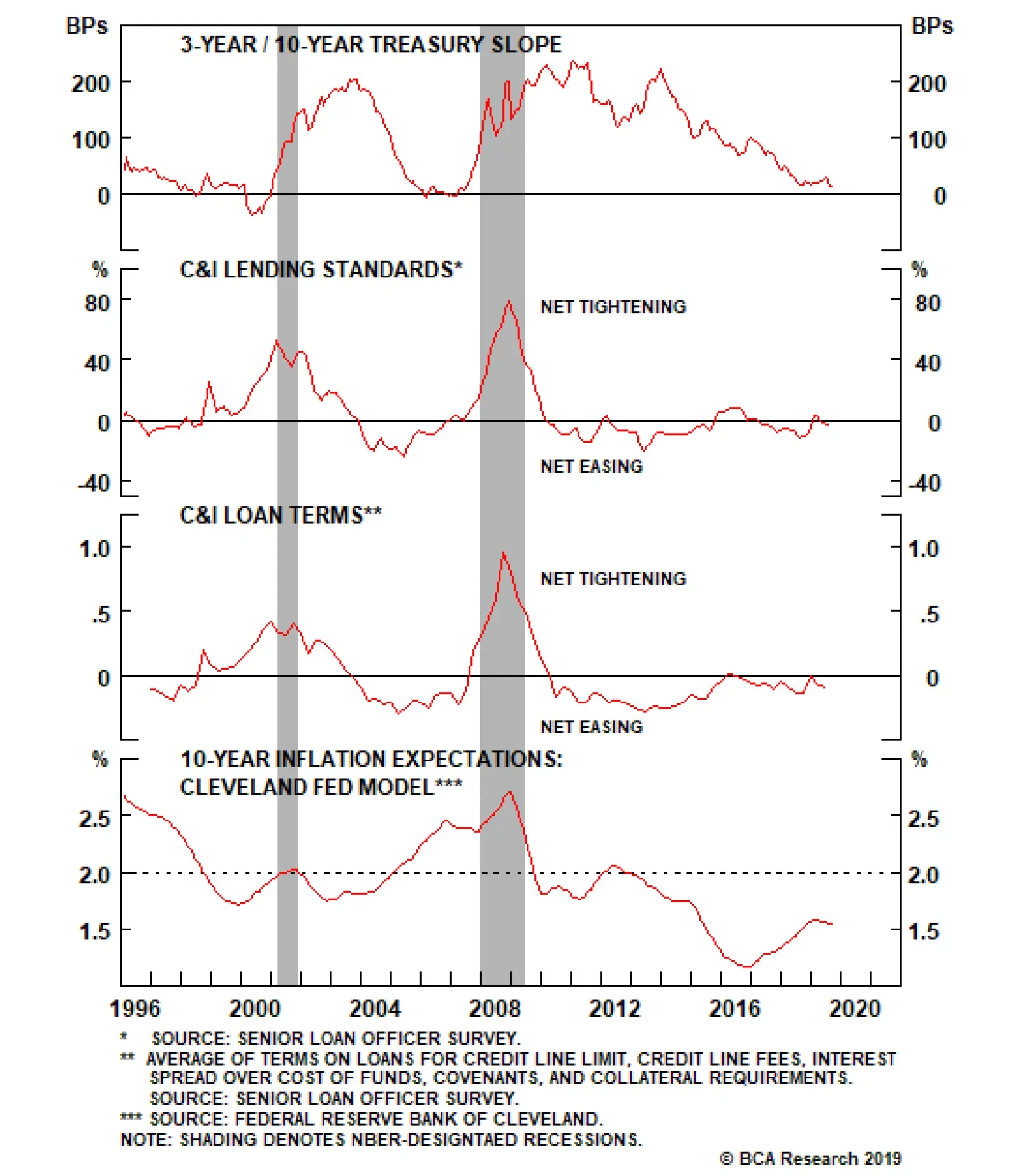
C&I lending standards and loan terms are both in “net easing” territory and, crucially, inflation expectations are extremely depressed. Low inflation expectations mean that the Fed must ensure that monetary policy stays accommodative until inflation…
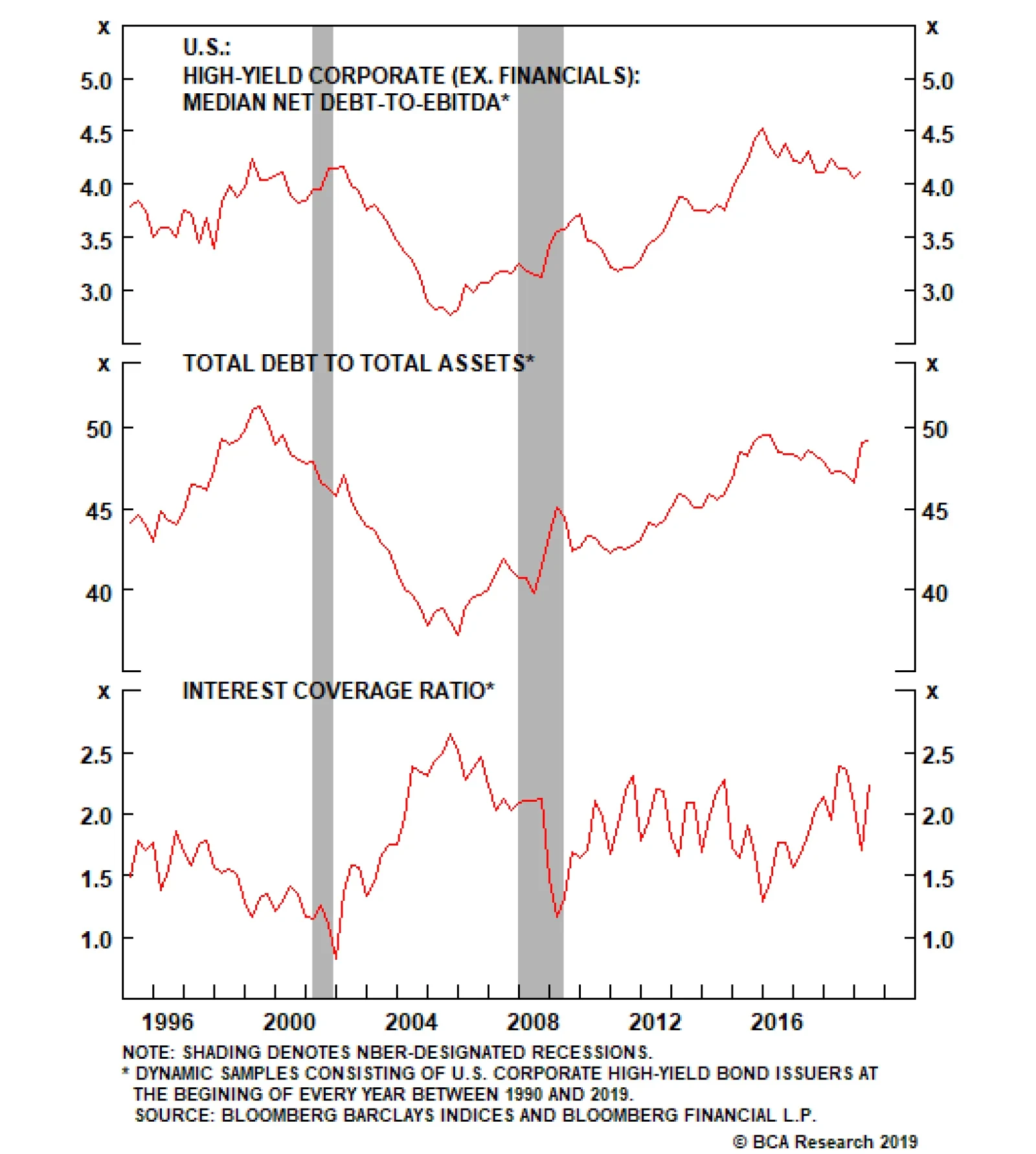
Our research has demonstrated that corporate bond excess returns versus Treasuries tend to be highest early in the recovery when the yield curve is steep. On the flipside, we’ve also shown that an inverted yield curve is often a good signal to scale back…
Highlights Monetary Policy: The Fed wants to maintain accommodative financial conditions, and will therefore deliver another rate cut this year if it is expected by the market. This creates a supportive environment for spread product. Ultimately, stronger global growth will lead rate expectations higher over the next 12 months. Keep portfolio duration low. Money Markets & Fed Balance Sheet: Investors shouldn’t worry about last week’s chaotic action in money markets, and should pay less attention to the Fed’s balance sheet policy in general. Yes, the Fed will start growing its balance sheet again in the coming months, but this is much less important than what it decides to do with the fed funds rate. Global Economy: Leading indicators suggest that the global manufacturing downturn is near a trough, but the coincident PMI data have not yet bottomed. Treasury yields won’t move significantly higher until the Global Manufacturing PMI reverses course. Feature Chart 1Fed Dots Versus Market Expectations
Fed Dots Versus Market Expectations
Fed Dots Versus Market Expectations
Fed Chairman Jerome Powell had his work cut out for him at last week’s FOMC press conference. First, he had to craft a coherent message about the Fed’s reaction function following a meeting where three voting members dissented from the committee’s decision to lower the funds rate by 25 bps. One dissenter, St. Louis Fed President James Bullard, wanted a 50 bps reduction. The other two, Boston Fed President Eric Rosengren and Kansas City Fed President Esther George, preferred to leave rates unchanged. Not only that, but Powell also had to field questions about the recent turmoil in money markets. Turmoil that caused the overnight repo rate to spike and the effective fed funds rate to briefly print outside the Fed’s target band (see section titled “Repo Madness” below). Chart 2Tracking Financial Conditions
Tracking Financial Conditions
Tracking Financial Conditions
How did he perform? On all accounts we give the Chairman top marks. He managed to articulate a reaction function that didn’t commit to any near-term policy action, but most importantly, he did so in a way that prevented a sharp tightening of financial conditions. As we have argued in past reports, Chairman Powell’s most important job is to ensure that financial conditions remain accommodative so that the economic recovery can continue for long enough to bring long-dated inflation expectations back up to target.1 Chart 2 shows that, even after a tricky Fed meeting, financial conditions remain significantly more accommodative than they were earlier in the month: Credit spreads are tighter (Chart 2, panel 2) The yield curve has un-inverted (Chart 2, panel 3) TIPS breakeven inflation rates have widened (Chart 2, panel 4) The trade-weighted dollar has weakened (Chart 2, bottom panel) All this with only 7 out of 17 FOMC participants agreeing with the market’s assessment that one more 25 bps rate cut before year-end will be appropriate (see Chart 1). All in all, Powell did exactly what he needed to do. Investment Implications Table 1What's Priced In For The Rest Of 2019?
What's Up In U.S. Money Markets?
What's Up In U.S. Money Markets?
As mentioned above, the market is priced for roughly one more 25 bps rate cut before the end of the year. More specifically, the fed funds futures market is split 50/50 on whether that rate cut occurs at the October or December FOMC meeting (Table 1). The market currently sees only a 4% chance of a rate cut at both meetings, and zero chance of no rate cut at all. We think the market’s view of the next two FOMC meetings is roughly correct, though we would not discount the possibility that global economic data improve enough that further rate cuts are avoided (see section titled “Still Searching For A Bottom” below). Ideally, the Fed wants the economic data to lead rate expectations higher so that it can avoid cutting rates without shocking the market and tightening financial conditions. Conversely, if the market starts to fully price-in an October rate cut in the next few weeks, then the Fed will likely deliver. This reaction function is extremely supportive for credit spreads, and we recommend sticking with an overweight allocation to spread product versus Treasuries. Chart 3Treasury Returns Track Rate Expectations
Treasury Returns Track Rate Expectations
Treasury Returns Track Rate Expectations
As for portfolio duration, we continue to abide by our Golden Rule framework.2 If the Fed delivers less than the 57 bps of easing that the market expects over the next 12 months, then the Bloomberg Barclays Treasury index will likely underperform a position in cash (Chart 3). We see better odds of zero or one rate cut over that timeframe, and therefore recommend a below-benchmark duration stance. Bottom Line: The Fed wants to maintain accommodative financial conditions, and will therefore deliver another rate cut this year if it is expected by the market. This creates a supportive environment for spread product. Ultimately, stronger global growth will lead rate expectations higher over the next 12 months. Keep portfolio duration low. Repo Madness What Happened? Chart 4What Happened Here?
What Happened Here?
What Happened Here?
As mentioned above, overnight U.S. interest rates spiked dramatically last week, grabbing headlines and causing many to question the stability of financial markets. The commotion peaked last Tuesday when the overnight general collateral repo rate closed at just under 7% and the effective fed funds rate ended the day above the upper limit of the Fed’s target band (Chart 4). Why Did This Happen? Chart 5Looking For The Culprit
Looking For The Culprit
Looking For The Culprit
The turmoil’s proximate cause is that dealer banks found themselves short of cash. They therefore scrambled to borrow in money markets, driving overnight rates higher. Dealer banks were short on cash for a number of reasons. Many corporations withdrew funds to pay tax bills, and there was an unusually large amount of Treasury issuance in September, along with few redemptions (Chart 5). Dealer banks must purchase Treasury debt at auction, and of course require cash on hand to do so. But setting the proximate cause aside, the more important question is: Why don’t dealer banks have sufficient cash to weather such periods, which are bound to occur from time to time? The answer to this question has to do with the quantity of reserves being supplied to the banking system, which is ultimately a result of the Fed’s balance sheet policy. The Fed’s Balance Sheet & The Supply Of Bank Reserves Table 2Simplified Fed Balance Sheet
What's Up In U.S. Money Markets?
What's Up In U.S. Money Markets?
Table 2 shows an abridged version of the Fed’s balance sheet as of last Wednesday, September 18. Notice that the Fed’s securities holdings appear on the asset side of the balance sheet, while the Fed’s liabilities include: (i) currency in circulation, (ii) the Treasury department’s cash account and (iii) bank reserves. Reserves are a liability on the Fed’s balance sheet, but appear as an asset on the consolidated balance sheet of the U.S. banking system. In other words, the banking system’s supply of liquid reserves is always equal to the Fed’s assets less the amount of currency in circulation and the Fed’s other “non-reserve liabilities”. Put simply, if dealer banks don’t have enough cash, it is because the Fed is not holding enough securities. Chart 6The Fed's Balance Sheet Over Time
The Fed's Balance Sheet Over Time
The Fed's Balance Sheet Over Time
In fact, the Fed has been steadily draining the supply of bank reserves since 2014 (Chart 6). Initially, it did so passively by keeping its securities holdings constant and allowing reserves to decline by the amount of increase in currency-in-circulation and other “non-reserve liabilities”. Then, between October 2017 and July of this year, it actually shrank its portfolio, causing reserves to leave the system even more quickly. In August, the Fed returned to a policy of keeping its securities holdings constant, slowing the rate of decline in bank reserves. It is also worth mentioning that the rate of decline in bank reserves was recently exacerbated by a sharp increase in the Treasury department’s cash holdings (Chart 6, bottom panel). The Treasury department needed to rebuild its cash balance after having run it down in advance of the last debt ceiling deadline. Like currency-in-circulation, the Treasury department’s cash holdings are a liability on the Fed’s balance sheet. All else equal, an increase in the Treasury’s cash holdings leads to a decline in the supply of bank reserves. Next Steps Chart 7The Fed's Floor System
The Fed's Floor System
The Fed's Floor System
This year the Fed has been navigating through a process of “balance sheet normalization” where it seeks to reduce its asset holdings while still supplying enough bank reserves to ensure the effective operation of monetary policy. The Fed has already decided to operate monetary policy using a “floor system”, in contrast to the “corridor system” it employed prior to the financial crisis. In a corridor system, the Fed keeps the supply of bank reserves scarce, and then engages in daily repo transactions to ensure that it supplies just enough bank reserves to prevent the overnight rate from breaking through the top of its target range. In contrast, to operate a floor system the Fed must supply more reserves than the banking system demands. The excess supply of reserves forces the overnight rate down toward a floor set by the Fed’s overnight reverse repo facility (ON RRP). Essentially, the Fed sets the ON RRP rate at a level near the bottom of its target range, and pledges to pay that rate to any banks with excess cash (Chart 7). The fact that interest rates broke out above the top-end of the Fed’s target band last week suggests that the Fed is not supplying enough reserves to effectively operate its floor system. This means that we should consider the Fed’s “balance sheet normalization” process complete. In the coming weeks the Fed will roll out a plan to start growing its securities portfolio. It will do this by purchasing Treasuries with a maturity structure that roughly matches that of the outstanding debt load. The pace of Treasury purchases will either be set equal to the estimated rate of growth in non-reserve liabilities, a pace that would keep the supply of bank reserves flat and one that the Fed calls “organic growth”. Alternatively, the Fed might decide that the supply of reserves needs to rise for a time before leveling off. In that case, it would purchase Treasuries at a somewhat faster pace for a few months, before settling into an “organic growth” regime. The Fed will probably also roll out a standing repo facility in the coming months, with a rate set close to the upper-end of its target band. This will act as the mirror image of the current ON RRP, essentially capping the upside in interest rates by agreeing to lend overnight cash at a stated rate. The supply of bank reserves necessary for the Fed to maintain effective control of interest rates is much higher than during the pre-crisis.period It will take at least a few weeks for the Fed to roll out its new balance sheet strategy and standing repo facility. In the meantime, the New York Fed will transact daily in the repo markets to ensure that enough reserves are supplied. This action represents a temporary return to a corridor system. Once the Fed starts growing its Treasury holdings again, it will be able to resume its floor system and the daily repo transactions will not be necessary. Some have probably already noted that the supply of bank reserves necessary for the Fed to maintain effective control of interest rates is much higher than during the pre-crisis period (see Chart 6). This is purely the result of the new post-crisis regulatory environment (see Box). Box - New Regulations Mean Banks Want More Reserves Two new regulations, specifically, have increased the amount of reserves that banks wish to hold. The first is the liquidity coverage ratio (LCR). The LCR mandates that banks hold sufficient high-quality liquid assets (HQLA) to cover 30 days of cash outflows in a stressed scenario. Bank reserves qualify as HQLAs, as do Treasury securities. Some other securities can also count as HQLAs after a haircut is applied. While banks can opt to hold Treasuries instead of reserves and still maintain compliance with the LCR. A St. Louis Fed report from March showed that large U.S. banks are using reserves to cover 20% - 65% of their net outflows.3 The second relevant regulation is the resolution plan, or living will, that large banks are now forced to file with regulators. While the criteria here are more opaque, banks must demonstrate to regulators that they have enough short-term liquidity to cover demands from counterparties and other stakeholders in the event of material financial distress. Regulators likely put a greater emphasis on reserves than Treasury securities during such stress tests, since during a period of financial turmoil there may be doubts about how quickly a bank can convert a Treasury security into cash in the repo market. Is This The Return Of QE? The answer really depends on how you want to define QE. If you want to call any increase in the Fed’s securities holdings QE, then yes the Fed will soon re-start QE. If you want to define QE as an expansion in the supply of bank reserves, then the Fed might briefly engage in QE for a few months, before reverting to an “organic growth” policy that keeps the reserve supply stable. In any event, unless you are active in money markets, we would advise investors to pay much less attention to the Fed’s balance sheet policy. The goal of its balance sheet policy is to ensure that interest rates remain within its target band, and the Fed will move that target band around independently of what is happening with its balance sheet. Changes in the Fed’s target interest rates are what matter for financial markets. Still Searching For A Bottom For reasons articulated in prior reports – notably, accommodative financial conditions and resolute service sector growth – we remain convinced that the current global manufacturing slowdown is near a trough.4 However, we must also point out that the 10-year U.S. Treasury yield tends to track the broad swings in the Global Manufacturing PMI, and a significant rebound in the 10-year yield is unlikely without a corresponding PMI upswing (Chart 8). Chart 8No PMI Rebound Yet...
No PMI Rebound Yet...
No PMI Rebound Yet...
Chart 9...But Leading Indicators Are Hooking Up
...But Leading Indicators Are Hooking Up
...But Leading Indicators Are Hooking Up
On that note, September Flash PMI data for the U.S. and Eurozone were released yesterday, and were at best a mixed bag. The Eurozone Manufacturing PMI fell from 47.0 in August to 45.6 in September (Chart 8, bottom panel) while its U.S. counterpart ticked higher from 50.3 to 51.0 (Chart 8, panel 3). In general, it is too early to say that the global PMI data have bottomed, especially with the CRB Raw Industrials index – a broad commodities benchmark – still in free fall (Chart 8, panel 2). Global Leading Economic Indicators paint a somewhat rosier picture than the PMIs. In fact, our Global LEI appears to have bottomed, and should eventually lead the Global PMI higher if prior correlations hold (Chart 9). We also observe that the U.S. economic data are once again beating expectations, an occurrence that usually corresponds with higher yields (Chart 9, bottom panel). In general, it is too early to say that the global PMI data have bottomed. Bottom Line: Leading indicators suggest that the global manufacturing downturn is near a trough, but the coincident PMI data have not yet bottomed. Treasury yields won’t move significantly higher until the Global Manufacturing PMI reverses course. Ryan Swift, U.S. Bond Strategist rswift@bcaresearch.com Footnotes 1 Please see U.S. Bond Strategy Weekly Report, “Act As Appropriate”, dated August 27, 2019, available at usbs.bcaresearch.com 2 Please see U.S. Bond Strategy Special Report, “The Golden Rule Of Bond Investing”, dated July 24, 2018, available at usbs.bcaresearch.com 3 https://www.stlouisfed.org/on-the-economy/2019/march/banks-demand-reserves-face-liquidity-regulations 4 Please see U.S. Bond Strategy / Global Fixed Income Strategy Weekly Report, “Where’s The Positive Carry In Bond Markets?”, dated August 20, 2019, available at usbs.bcaresearch.com Fixed Income Sector Performance Recommended Portfolio Specification
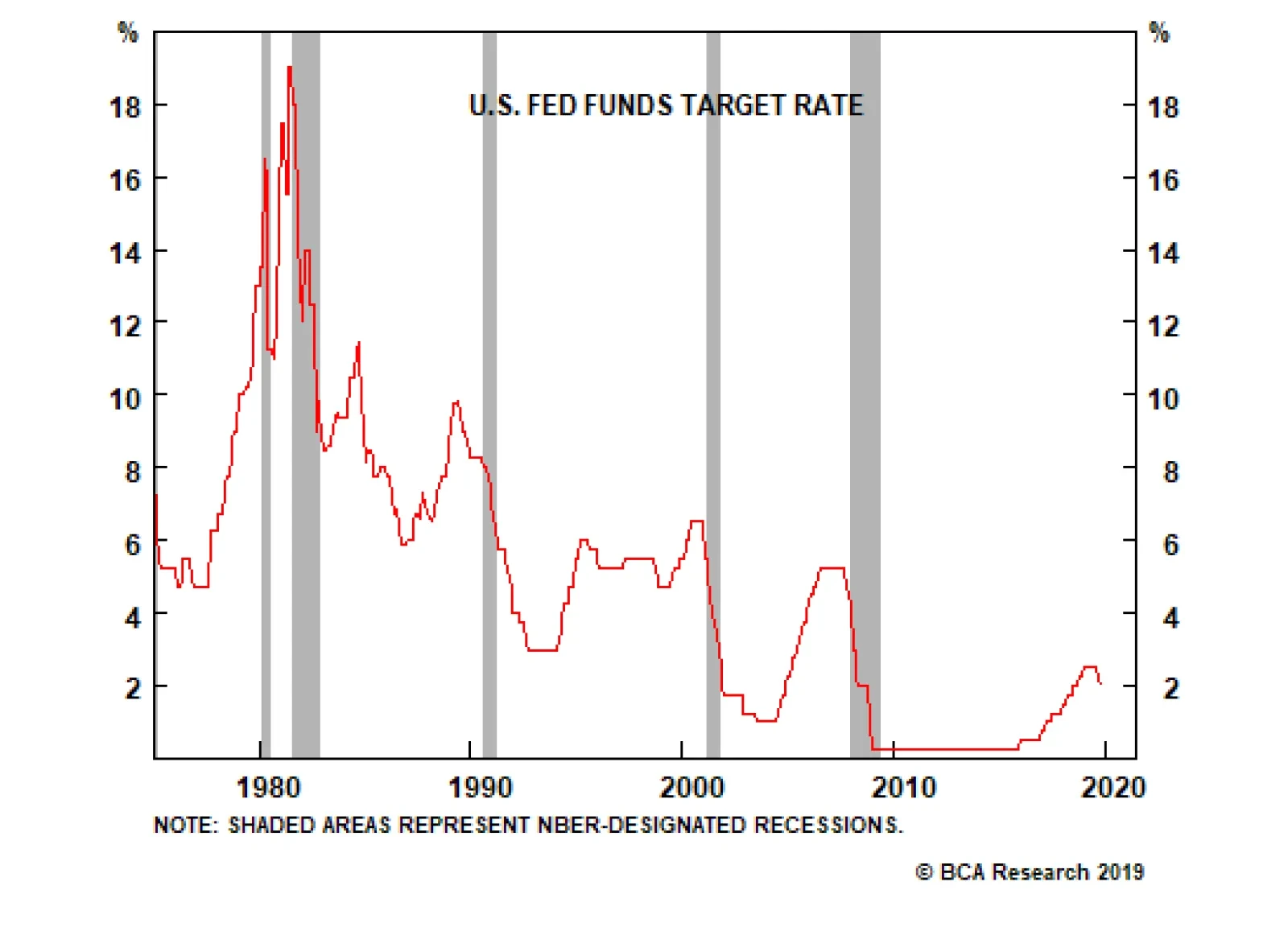
The September projections show two cuts in 2019, no rate change in 2020, one rate hike in 2021, and one rate hike in 2022. Seven out of 17 participants penciled in a projected third cut for 2019. While it is far from a done deal, an additional rate cut in…
Dear Client, Owing to BCA’s 40th Annual Investment Conference in New York City next week, we will not be publishing a report on Friday, September 27. We will return to our regular publishing schedule on Friday, October 4, when we will be sending out our quarterly Strategy Outlook. Best regards, Peter Berezin, Chief Global Strategist Highlights The spike in oil prices underscores the vulnerability of key Saudi oil facilities. The fact that OPEC spare capacity is on the low side is an added source of concern. Fortunately, if oil prices do rise again, the impact on the global economy will be mitigated by the following: 1) the amount of oil necessary to produce one unit of real GDP is much lower than in the past; 2) oil prices are currently nowhere near restrictive levels; 3) higher oil prices will boost investment in the energy sector; and 4) unlike in the past, central banks will not need to hike rates to quell oil-induced inflationary pressures. The Federal Reserve is likely to cut rates once more in October and then keep rates on hold through 2020. The Fed will also begin expanding the size of its balance sheet to alleviate tensions in funding markets. Investors should remain overweight equities relative to bonds and start tilting exposure towards EM assets and cyclical stocks later this year. Feature All Aboard The Crude Oil Roller Coaster Chart 1A Price For The Books
A Wild Ride For Oil Prices
A Wild Ride For Oil Prices
After gapping up by nearly 20% to $72/barrel on Monday morning – the biggest one-day spike in history – Brent oil prices have retreated to the $64-$65 range, representing a markup of around 7% over last Friday’s close (Chart 1). The near-term direction of oil prices will be governed by how quickly the Saudis are able to restore lost output. Brent fell by over $3/barrel on Tuesday following news reports quoting key Saudi sources saying that state-run Saudi Aramco would be able to bring production back to normal in the next two-to-three weeks. Bob Ryan, BCA’s chief commodity strategist, is skeptical of this reassurance. He notes that the drone attacks destroyed highly sophisticated “one-of-a-kind” equipment that had been specially built for the Abqaiq facility. Beyond the near-term impact, the longer-term question is whether Sunday’s pre-dawn strike is the start of a new violent trend. The fact that much of Saudi Arabia’s oil infrastructure is densely concentrated in the eastern part of the country makes it vulnerable to further attacks. The proliferation of drone technologies is also a source of concern since such devices can be used to wreak significant havoc at minimal cost. Chart 2Limited Availability Of Spare Capacity To Offset Outages
A Wild Ride For Oil Prices
A Wild Ride For Oil Prices
Chart 3Key Strategic Petroleum Reserves
Key Strategic Petroleum Reserves
Key Strategic Petroleum Reserves
Iran’s apparent involvement in the attack further complicates matters. As Matt Gertken, BCA’s chief geopolitical strategist, has argued, the drone strike may have been orchestrated by hardliners in Iran who regard President Rouhani’s efforts to restart negotiations with the United States as evidence of appeasement (some of these hardliners are also profiting from the sanctions by smuggling crude out of the country). President Trump’s decision to sack John Bolton over Bolton’s opposition to making any deal with the Iranians may have created a sense of urgency among the hardliners. In this respect, attacking Iran would probably give the hardliners what they want. All this has occurred at a time when OPEC spare capacity – the difference between what the cartel is capable of producing and what it is actually producing – is below its historic average (Chart 2). Crude oil reserves have also been trending lower within the OECD. Saudi Arabia’s own reserves have fallen by over 40% since peaking in 2015 (Chart 3). Oil And The Economy: How Big A Risk? While a major spike in oil prices is not our base case, it cannot be ruled out completely. If the price of crude were to increase significantly, how much damage would this do to the global economy? History is certainly not encouraging: Every single U.S. recession since 1970 has been preceded by a large jump in oil prices (Chart 4). Chart 4Oil Spikes And Recessions
Oil Spikes And Recessions
Oil Spikes And Recessions
Chart 5The Global Economy Is Less Oil Intensive
The Global Economy Is Less Oil Intensive
The Global Economy Is Less Oil Intensive
The fact that we are dealing with a potential supply disruption only makes things worse. It is one thing if oil prices are rising in response to stronger global growth; it is quite another if prices rise at a time, such as the present, when global growth is under pressure. Despite these concerns, there are four reasons to be optimistic that higher oil prices will not precipitate a major global economic downturn. First, the global economy is less reliant on oil than in the past. Chart 5 shows that the amount of oil necessary to produce one unit of real GDP has fallen by half since 1990. Second, oil prices are still quite low by historic standards. Even after this week’s jump, Brent is still 24% below where it was last October (Chart 6). In real terms, both Brent and WTI are more than 60% below their 2008 highs. Chart 6Oil Prices Are Well Off Their 2008 Peak
Oil Prices Are Well Off Their 2008 Peak
Oil Prices Are Well Off Their 2008 Peak
Third, if oil prices do stay elevated, this will encourage investment in the oil patch, which will eventually bring prices back down. It is worth remembering that rising oil prices reduce aggregate demand in part by shifting wealth from oil consumers, who tend to spend most of their disposable income, to oil producers, who are often inclined to save the windfall from higher oil prices in such entities as sovereign wealth funds. However, if higher oil prices cause producers to expand production, the positive “investment effect” could offset much of the negative “consumption effect” on aggregate demand. Ironically, this means that a transfer of production from easily accessible oil deposits, such as those in Saudi Arabia, to less accessible shale or deep-sea deposits has the effect of increasing overall energy-sector capital spending, even if it does entail a loss of average efficiency. Fourth, higher oil prices today are unlikely to dislodge long-term inflation expectations. This represents a critical difference between the 1970s, 80s, and early 90s when central banks often felt the need to hike rates in the face of rising oil prices (Chart 7). These days, central banks are more likely to see oil price increases – especially those due to supply-side disruptions – as negative income shocks. Such shocks warrant looser, rather than tighter, monetary policy. Chart 7Core Inflation No Longer Driven By Oil Prices
Core Inflation No Longer Driven By Oil Prices Core Inflation No Longer Driven By Oil Prices
Core Inflation No Longer Driven By Oil Prices Core Inflation No Longer Driven By Oil Prices
FOMC Cuts Rates As Expected This brings us to this week’s Fed meeting. As widely expected, the Fed cut rates by 25 basis points. It also lowered the projected policy rate path. Compared to the Summary of Economic Projections released in June – which suggested no rate change in 2019, one rate cut in 2020, and one rate hike in 2021 – the median dots in the September Summary of Economic Projections released this week show two cuts in 2019, no rate change in 2020, one rate hike in 2021, and one rate hike in 2022. Seven out of 17 participants penciled in a projected third cut for 2019. Judging from the tone of his post-meeting press conference, Jay Powell, dressed in his trademark bipartisan purple tie, was likely among those advocating for further easing. While it is far from a done deal, an additional rate cut in October appears more likely than not. In total, we expect 75 basis points in cuts, equivalent to the amount of easing orchestrated during both the 1995/96 and 1998 mid-cycle slowdowns (Chart 8). The Fed appears to be using these two episodes as a template for its current thinking. Chart 8Will The Fed Follow The 1990s Template Of 75 Bps Of Mid-Cycle Easing?
Will The Fed Follow The 1990s Template Of 75 Bps Of Mid-Cycle Easing?
Will The Fed Follow The 1990s Template Of 75 Bps Of Mid-Cycle Easing?
The Fed is also likely to start expanding the size of its balance sheet starting in November. The spike in funding rates this week, while not at all related to the sort of counterparty risk that prevailed during the financial crisis, still underscored the fact that bank reserves are becoming increasingly scarce. To the extent that the Fed creates bank reserves when it purchases assets, this would help alleviate funding pressures. We are assuming that rate cuts beyond 75 basis points in total are possible. However, this would require a significant deceleration in U.S. growth, which looks unlikely. Real personal consumption spending is on track to increase by 3.1% in Q3, according to the Atlanta Fed’s GDPNow (Chart 9). While business capex spending continues to be weighed down by the manufacturing recession, rays of light are emerging. Industrial production rose by 0.6% in August, well above the consensus forecast of 0.2%. Despite an ongoing drag from the auto sector, manufacturing output rose by a solid 0.5%. Chart 9Inventories And Net Exports Have Subtracted From Growth
A Wild Ride For Oil Prices
A Wild Ride For Oil Prices
Chart 10Easier Financial Conditions Will Boost Global Growth
Easier Financial Conditions Will Boost Global Growth
Easier Financial Conditions Will Boost Global Growth
Globally, the growth picture remains shaky. Looking out, the sharp easing in financial conditions should boost activity (Chart 10). The nascent de-escalation in trade tensions, if sustained, should also help. As such, we continue to expect global growth to stabilize in the coming months and accelerate into year-end. Investment Conclusions Oil prices are likely to rise over the next 12 months. Geopolitical tensions could contribute to any upward pressure on the price of crude, but most of the increase in prices will probably be driven by stronger global growth. If global growth does pick up, the dollar will probably weaken (Chart 11). A weaker dollar will further boost oil prices, along with other commodity prices (Chart 12). Chart 11The Dollar Is A Countercyclical Currency
The Dollar Is A Countercyclical Currency
The Dollar Is A Countercyclical Currency
Chart 12A Weaker Dollar Bodes Well For Commodities
A Weaker Dollar Bodes Well For Commodities
A Weaker Dollar Bodes Well For Commodities
Stronger global growth, rising commodity prices, and a weaker dollar will hurt safe-haven government bonds but boost stocks. EM and cyclical equity sectors should gain disproportionately. Peter Berezin, Chief Global Strategist Global Investment Strategy peterb@bcaresearch.com Strategy & Market Trends MacroQuant Model And Current Subjective Scores
A Wild Ride For Oil Prices
A Wild Ride For Oil Prices
Strategic Recommendations Closed Trades
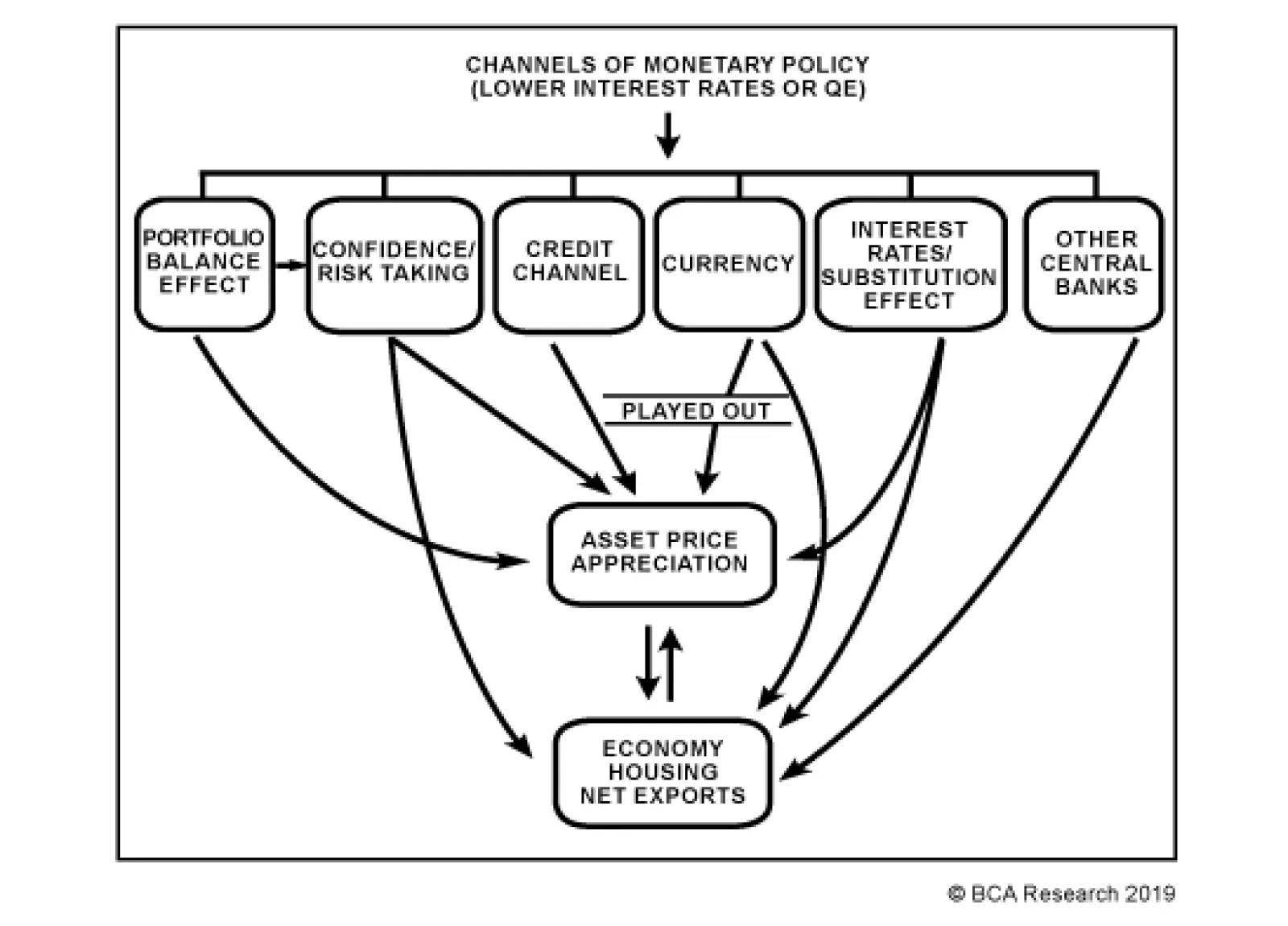
The cut in the ECB’s deposit facility rate from -0.4% to -0.5% was in line with market consensus, as was the resumption of quantitative easing. Investors did not foresee that the ECB would embark on open-ended bond purchases however, with the plan…
Dear Client, Owing to BCA’s 40th Annual Investment Conference at the Grand Hyatt in New York City next week, there will be no report on Wednesday, September 25. We will return to our regular publication schedule on Wednesday, October 2. I look forward to meeting China Investment Strategy clients in person at our conference. Please do not hesitate to say hello. Best regards, Jing Sima China Strategist Highlights China’s economy should bottom as a result of the pickup in credit that occurred earlier this year, but the circumstances surrounding the ongoing slowdown are unprecedented in nature. This raises the risk that policymakers will have to do more in order to stabilize growth. Optimism surrounding recent Chinese policy announcements is misguided. For now, Chinese policymakers are not upping the pace of stimulus, which underscores the risk to our forecast that growth will soon stabilize. A more meaningful shot of reflation will occur in the coming few months if the economy slows further, but policymakers will be reactive rather than proactive. Barring a successful (even if temporary) trade deal, we expect more weakness in the RMB as a passive source of reflation to aid the economy. But currency devaluation is a double-edged sword, and cannot be counted on to single-handedly stabilize China’s economy. Over a 6-12 month time horizon, investors should continue to overweight Chinese stocks versus the global benchmark in currency hedged terms, but the risk of further underperformance over the near-term is high. Feature Chinese economic growth continues to weaken. The Caixin manufacturing PMI for August, along with the New Export Orders component of the manufacturing PMI released by China’s National Bureau of Statistics, registered small gains in August from July. However, any hopes pinned on this being an emerging sign of turnaround in the Chinese economy soon faded. A slew of August data showed continued sluggishness in exports, an even worse domestic-demand picture, and further deflation in ex-factory producer prices. Most importantly, we continue to witness “half-measured” stimulus. In explaining past and existing economic weakness, many investors point to the trade war with the U.S. However, Charts 1 and 2 serve as an important reminder that domestic weakness predates U.S. protectionism. The trade war tensions and tariffs are magnifying this weakness, but China’s slowdown is, at its core, policy driven. Chart 1Weakness In Chinese Economy Predates The Trade War...
Weakness In Chinese Economy Predates The Trade War...
Weakness In Chinese Economy Predates The Trade War...
Chart 2…And Has Been A Byproduct Of Financial De-Risking Campaign
...And Has Been A Byproduct Of Financial De-risk Companion
...And Has Been A Byproduct Of Financial De-risk Companion
Given this, investors should be more focused on identifying signs of a major reversal in policy. So far Chinese policymakers have been firmly holding their line in keeping credit growth somewhat in check. Policy-Induced Economic Stabilization: A Tough Forecast To Make Our baseline view is that the current scale of stimulus should be sufficient to stop economic growth from decelerating further. Two factors support our baseline view: The direct impact from tariffs on the Chinese economy is limited. Growth in China’s exports to the U.S. in 2019 is likely to be somewhere close to a 9% contraction, down from the 10.8% increase registered in 2018. Based on a simple calculation with all else being equal, this is likely to shave 1.6 percentage points off China’s total export growth and 0.3 percentage points off nominal GDP growth in 2019. This is not trivial, but arguably not devastating to China’s aggregate economy either. There is anecdotal evidence suggesting some Chinese exports have been re-routed to peripheral countries such as Vietnam and Taiwan in order to avoid the U.S. import tariffs on Chinese goods (Chart 3). This suggests that real growth in Chinese exports to the U.S. could be stronger than the current data suggests. Chart 3Exports Finding Alternative Routes?
Exports Finding Alternative Routes?
Exports Finding Alternative Routes?
Chart 4Bottoming in the economy In Sight?
Bottoming in the economy In Sight?
Bottoming in the economy In Sight?
Credit growth has picked up since the beginning of this year. Based on the historical relationship between China’s credit impulse (measured by the 12-month change in BCA’s adjusted total social financing as a percentage of nominal GDP) and domestic demand, the economy should bottom out at some point before the end of the year (Chart 4). Although, import growth, a key measure of China’s domestic demand, remains in deep contraction, some of its components that usually lead industrial activities are showing signs of improvement (Chart 5). Chart 5Early Signs of Improved Domestic Demand
Early Signs of Improved Domestic Demand
Early Signs of Improved Domestic Demand
Chart 6Manufacturing Investment Growth In Contraction
Manufacturing Investment Growth In Contraction
Manufacturing Investment Growth In Contraction
However, our level of confidence that the existing stimulus will be sufficient to stabilize economic growth is lower than it otherwise would be. This is due to the fact that the challenges facing the Chinese economy are unprecedented in nature. For one, the indirect impact of the trade war on China’s economy through business sentiment and manufacturing investment has yet to be fully revealed in the data. As Chart 6 shows, manufacturing investment is already deteriorating, particularly in export-intensive sectors. The ultimate impact on investment from the trade war is still uncertain, and can pose significant downside risks to the Chinese economy in the coming year. More importantly, as Chart 7 suggests, a weak credit impulse will at best lead to a very subdued economic recovery even if growth does indeed bottom. In terms of the link between policy and the economy, Chart 8 points out a key difference between the current slowdown and previous down cycles: Monetary conditions have been ultra-loose for more than a year, but current economic conditions remain on a downward trend – much more so than in the previous cycles. This huge gap and lag in economic response to monetary stance can only be explained by an impaired policy transmission mechanism. An expansionary monetary stance has not proportionally translated into credit expansion or economic recovery. This challenges the effectiveness and timeliness of future monetary loosening in terms of its ability to revive the Chinese economy. Chart 7Current Pace Of Credit Growth Will Lead To A Fragile Recovery, At Best
Current Pace Of Credit Growth Will Lead To A Fragile Recovery, At Best
Current Pace Of Credit Growth Will Lead To A Fragile Recovery, At Best
Chart 8An Impaired Monetary Policy Transmission
An Impaired Monetary Policy Transmission
An Impaired Monetary Policy Transmission
The scale and timing of the current stimulus measures have been “behind the curve.” Therefore, the historical relationship between China’s credit impulse and the turning points in the economy may not apply to the current cycle. Bottom Line: China’s economy should bottom as a result of the pickup in credit that occurred earlier this year, but the circumstances surrounding the ongoing slowdown are unprecedented in nature. This raises the risk that policymakers will have to do more in order to stabilize growth. An Unusually Prudent Policy Bias For some, the recent slew of announcements on upcoming stimulus qualified as a major shift in policy bias. Our analysis suggests otherwise. The bank reserve requirement ratio (RRR) cuts announced late in August have been among the most cited policy announcements, with the PBoC stating that the new cuts will release RMB 900 billion of fresh liquidity.1 In our view, this measure is more about maintaining liquidity in China’s large commercial banks than adding to it (on a net basis). Chart 9RRR Cuts May Not Be That Stimulative
RRR Cuts May Not Be That Stimulative
RRR Cuts May Not Be That Stimulative
Chart 9 shows that, in previous episodes of meaningful RMB depreciation against the U.S. dollar, in order to prevent the RMB from falling at an undesirable pace, PBoC has had to intervene in the spot market by selling U.S. dollars. The selling of U.S. dollars in this round of RMB depreciation has been much more muted than in 2015-2016, but we suspect some intervention has taken place following each bout of escalation in the trade war. This has had a liquidity tightening effect on banks, as selling central bank foreign-exchange reserves reduces liquidity in the banking system. It is very likely that following the PBoC’s defense of the RMB in the last two months, the RRR cuts were a measure aimed at preventing a liquidity crunch ahead of the September tax season. If true, this hardly qualifies as net new stimulus for the economy. There were also two important announcements that came out of the September 5th State Council meeting: The entire 2019 quota for local government special project bonds must be issued by the end of September, and all money raised from the bonds must be disbursed to projects by the end of October. This too is not exactly “stimulative,” as over 90% of the 2019 local government special-project bond quota has already been issued. This leaves less than 10% of the quota outstanding, an 80% decline from what was issued last September. On a quarterly basis, special-bond issuance in the third quarter of 2019 will end up being 30% lower than the same period last year. It was also announced that, in order to meet the local needs for construction of key projects, part of 2020’s special bonds quota will be allocated in advance to ensure that the funds are available for use at the beginning of next year.2 While the announcement did not indicate how much in the way of special-purpose bonds local governments are allowed to frontload through the remainder of this year, we maintain our view that this is not a policy shift towards materially larger stimulus than we have seen so far this year: Without an additional quota, local government special-purpose bond issuance would essentially fall to zero in the fourth quarter as the 2019 target would be hit by the end of September. Thus, the frontloading of next year’s bond issuance will only “fill the gap” between now and year-end. As special-purpose bond issuance only accounts for 15% of total funding for local governments’ infrastructure spending, the new measure alone is unlikely to meaningfully accelerate investment growth.3 We have noted in previous reports that in order for local governments to accelerate spending within the current fiscal budget framework, one of three things must occur: more direct funding from the central government, an acceptance by policymakers of more shadow bank lending, or a larger quota for bond issuance. So far we have not seen any of the above-mentioned shifts in policy. Chart 10Local Governments Tightening Belt This Year
Local Governments Tightening Belt This Year
Local Governments Tightening Belt This Year
The only positive sign for local government spending has been a pickup in land sales in Q2, which makes up more than 70% of local government revenues. But, it is far from making up the shortfalls in local governments’ budgets (Chart 10). Local governments are facing considerable fiscal pressure as annual tax revenue growth has fallen to near zero. Critically, the government’s regulatory stance on local government budgets has continued to tighten: Local governments have been ordered by the Ministry of Finance to liquidate state-owned assets to fund their budget deficits this year.4 This austerity measure is also being met with explicit reiteration from the Ministry of Finance on the central government not bailing out local governments, and that local government officials are held responsible for their own borrowing and spending.5 Bottom Line: Optimism surrounding recent Chinese policy announcements is misguided. For now, Chinese policymakers are not upping the pace of stimulus, which underscores the risk to our forecast that growth will soon stabilize. A more meaningful shot of reflation will occur in early 2020 if the economy slows further in Q4, but policymakers will most likely continue their reactive approach rather than proactive. RMB Depreciation: A Plus Or Peril? The RMB’s renewed depreciation since August initially raised fears among global investors that an uncontrolled decline might occur, but these fears have subsided over the past several weeks. Even though the USD-CNY exchange rate has broken the psychological 7 threshold, it is not forming a linear downward trend. Unlike after the August 2015 devaluation, it appears that the PBoC can successfully enact countercyclical measures to guide the RMB’s value higher following each large depreciation (Chart 11). Chart 11PBoC Not Panicking Over RMB Depreciation
PBoC Not Panicking Over RMB Depreciation
PBoC Not Panicking Over RMB Depreciation
Fears of uncontrolled capital outflows following the depreciation are also abating. We presented a dashboard for monitoring short-term capital outflows from China in our March 20 Special Report,6 and an update of these indicators suggests that China’s heightened capital controls are holding – i.e., outflows have not escalated as they did in 2015 (Chart 12). Chart 12No Major Capital Outflow
No Major Capital Outflow
No Major Capital Outflow
Chart 13RMB Depreciation Partially Offsets Tariffs
RMB Depreciation Partially Offsets Tariffs
RMB Depreciation Partially Offsets Tariffs
Thus, the conclusion is that Chinese policymakers appear to be in control of the currency. The reduced risk of an uncontrolled decline has allowed policymakers to (passively) provide meaningful stimulus to the domestic economy via depreciation. Indeed, the RMB has not only depreciated against the USD, but also against many Asian currencies including direct trade competitors such as Vietnam and Taiwan (Chart 13). This is helping offset the negative impact of U.S. tariffs on Chinese exporters. But currency devaluation can come with a price tag – in particular for corporations that have borrowed heavily in U.S. dollar-denominated debt. We estimate that $440 billion of U.S. dollar debt will be maturing over the coming two years, for Chinese companies and banks in the aggregate.7 A 12% depreciation in the RMB since April 2018 means that debt servicing costs will be 12% higher for unhedged debtors. This is particularly painful for real estate and financial services companies, two of the largest holders of U.S. dollar-denominated loans, and the weakest sectors in the current economic downturn. Most importantly, while currency devaluation ease the slowdown, it cannot be counted on to stabilize Chinese economic activity on its own. For example, while our earnings recession model suggests that the decline in the RMB since May has reduced the odds of a major decline in economic activity by roughly 20%, the model also shows that such an event is still highly probable (current odds are roughly at 70%). Bottom Line: Barring a successful (even if temporary) trade deal, we expect more weakness in the RMB as a passive source of reflation to aid the economy. But currency devaluation is a double-edged sword, and cannot be counted on to single-handedly stabilize China’s economy if a further slowdown occurs. An Update On Corporate Earnings Against a backdrop of what may turn out to be insufficient policy support, the earnings picture is providing one modest positive for equity investors. While the growth rate in investable earnings per share has slowed significantly over the past year (Chart 14), it has merely fallen to zero and not deeply into negative territory, as what seemingly occurred in 2015-2016. In our view, the risk of a similar collapse in earnings per share (EPS) has been an important factor weighing on Chinese investable equities’ relative performance since June 2018. In reality, a closer examination of MSCI China Index earnings reveals that a huge decline in EPS this year was never really a threat, because the apparent collapse in 2015-2016 did not actually transpire. Changes to the composition in the MSCI China Index that took effect in November 2015 and June 2016 had the effect of depressing index EPS, due to the sizeable inclusion of a set of richly valued stocks. Chart 15 presents BCA’s calculation of “break-adjusted” EPS for Chinese investable stocks, which shows that EPS growth bottomed out at -10% in late-2016, as opposed to the -28% implied by the unadjusted series. Chart 14Investable EPS Has Yet To Contract Meaningfully
Investable EPS Has Yet To Contract Meaningfully
Investable EPS Has Yet To Contract Meaningfully
Chart 15The Potential Downside For Earnings Is Less Than Many Fear
The Potential Downside For Earnings Is Less Than Many Fear
The Potential Downside For Earnings Is Less Than Many Fear
Chart 16A Cyclical Recovery In Earnings Has Not Yet Begun
A Cyclical Recovery In Earnings Has Not Yet Begun
A Cyclical Recovery In Earnings Has Not Yet Begun
The existence of less downside potential for earnings is certainly positive for investable stocks at the margin, but it does not alter the outlook for equity fundamentals over the coming year. We have shown in several previous reports that there is a strong and reliable link between investable EPS growth and China’s coincident economic activity,8 and the continued slowing in the latter does not suggest that a bottom in earnings is imminent. In addition, Chart 16 highlights that while net earnings revisions have recovered from their early-year lows, they remain in negative territory and have stopped rising over the past few weeks. Twelve-month forward EPS momentum, also presented on a break-adjusted basis, is modestly negative, and has recently weakened (panel 2). Bottom Line: The downside risk to earnings for Chinese investable equities is less than many investors fear. But absent stronger credit growth, it remains too early to confidently project a cyclical earnings recovery. Investment Conclusions The historical relationship between credit growth and economic activity suggests that the latter should soon stabilize, which is our base case view for the coming few months. Still, the risk of a further, meaningful deceleration in growth is elevated, given the unprecedented circumstances surrounding the ongoing slowdown. For equity investors, less potential downside risks to earnings than previously feared is a positive at the margin, but the fundamental outlook still hinges on a durable pickup in economic activity. Over a 6-12 month time horizon, this implies that one of two scenarios will unfold: The economy will stabilize in response to the easing that has already occurred (i.e. our base case view). The economy slows further in the near-term, prompting a more significant policy response that leads to an even sharper pickup in activity. Chart 17Investable Stocks: An Overshoot To The Downside?
Investable Stocks: An Overshoot To The Downside?
Investable Stocks: An Overshoot To The Downside?
In the first scenario, investable stocks have probably overshot to the downside versus the global benchmark and thus will very likely outperform from current levels. Near-term performance is likely to be flat-to-down, as investors await hard evidence of a sequential improvement in growth (Chart 17). In the second scenario, investable stocks are at potentially acute near-term risk, but will likely eventually outperform global stocks once activity begins to pick up sharply. In this scenario, the outperformance of Chinese equities will commence later, but would likely still occur by the tail end of our cyclical investment horizon (6-12 months). As a final point, we are not ruling out the possibility of a temporary trade deal between the U.S. and China, as both sides have the incentive to avoid a further escalation and are now showing goodwill towards constructive negotiations. This may change our tactical view on Chinese stocks, but our cyclical view remains focused on China’s domestic policy and economic fundamentals. Jing Sima China Strategist JingS@bcaresearch.com Footnotes 1 PBC Official: The RRR Cut Aims at Bolstering Real Economy, September 6, 2019 2 China to accelerate the issuance and use of special local government bonds to catalyze effective investment, China State Council, September 4, 2019 3 Please see Emerging Markets Strategy Special Report, “Chinese Infrastructure Investment: A Ramp-Up Ahead?”, dated August 1, 2019, available at ems.bcaresearch.com 4 China’s Local Governments Sell Assets to Make Up for Revenue Loss, Caixin, September 3, 2019 5 http://www.mof.gov.cn/zhengwuxinxi/caizhengxinwen/201909/t20190906_3382239.htm?mc_cid=eb2b199651&mc_eid=9da16a4859 6 Please see China Investment Strategy Special Report, “Monitoring Chinese Capital Outflows”, dated March 20, 2019, available at cis.bcaresearch.com 7 Please see Emerging Markets Strategy Special Report, “China’s Foreign Debt, And A Secret Weapon”, dated September 12, 2019, available at ems.bcaresearch.com 8 Please see China Investment Strategy Weekly Report, “Threading A Stimulus Needle (Part 2):Will Proactive Fiscal Policy Lose Steam?”, dated July 24, 2019, available at cis.bcaresearch.com Cyclical Investment Stance Equity Sector Recommendations
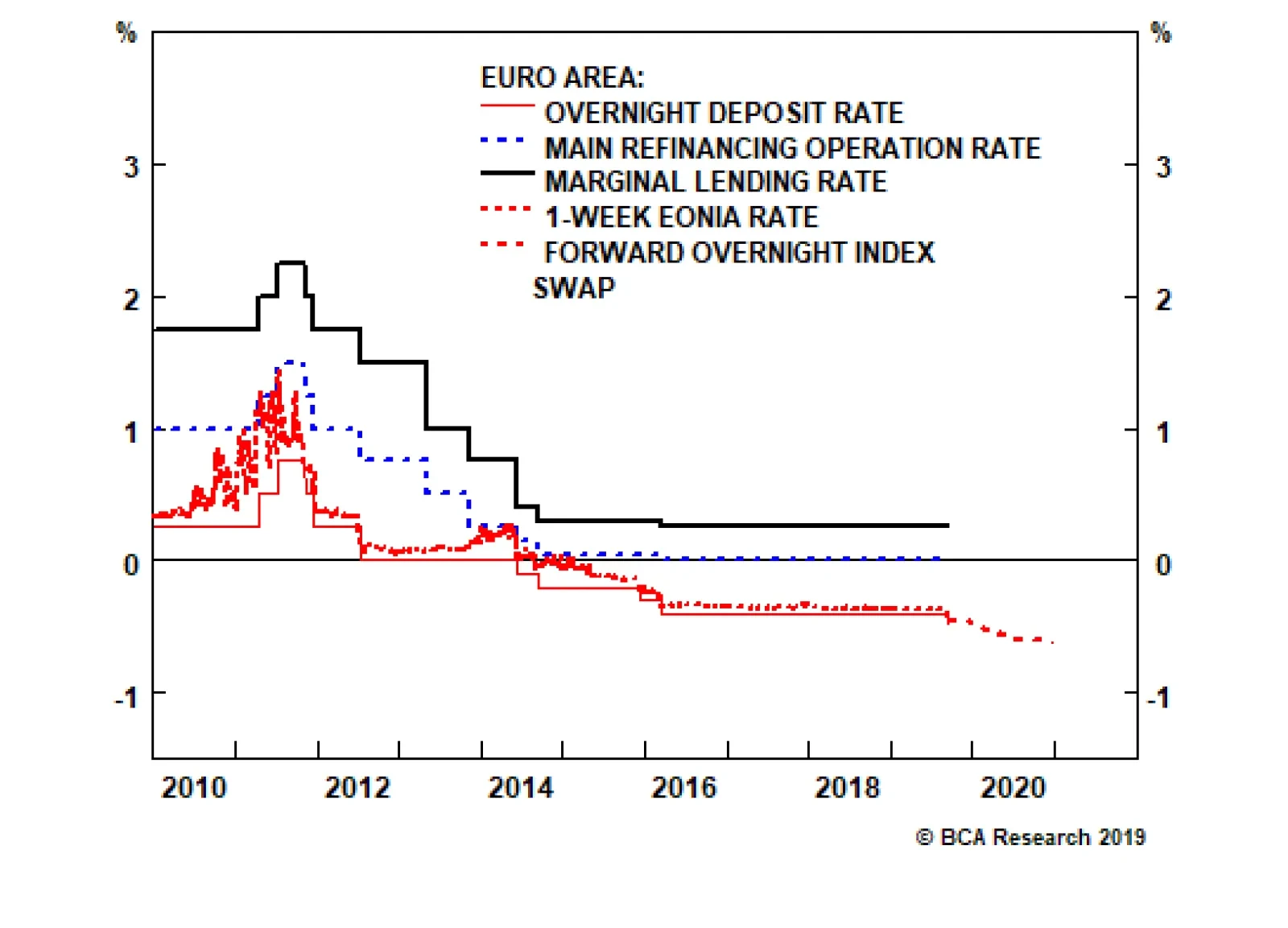
Short-term interest rates were cut, but only through a modest -10bp reduction in the overnight deposit rate. The Asset Purchase Program (APP) was restarted, but only at a pace of €20bn per month. These new initiatives fell short of the consensus forecast of a…