Money Trends / Liquidity

Executive Summary Chinese Onshore Stock Prices And Earnings Are Set To Deteriorate
Chinese Onshore Stock Prices And Earnings Are Set To Deteriorate
Chinese Onshore Stock Prices And Earnings Are Set To Deteriorate
Macro fundamentals indicate that for the time being there is no basis to overweight Chinese onshore stocks (in both absolute terms and relative to global stocks) given the outlook for profit growth contraction in 1H22. We are reluctant to shift our stance on Chinese domestic stocks to overweight in the next 6 to 12 months due to the following non-trivial risks: a subdued recovery in China’s economic activity, a deceleration in fiscal impulse in 2H22, a re-focus on reducing carbon emissions, as well as higher US bond yields and tighter global liquidity conditions. Despite a sharp drop in January, valuations in Chinese onshore stocks are still neutral in absolute terms, and only slightly cheaper than global stocks. As such, Chinese onshore stocks offer little valuation buffer in the wake of any negative surprises. Bottom Line: We maintain our underweight stance on Chinese onshore stocks (in both absolute terms and relative to global equities) due to non-trivial risks in the coming year. Feature China’s stock markets was very weak in the first month of 2022. The domestic equity market tumbled by 8% in January, while the offshore market dropped by 3%. We discussed our view on Chinese investable stocks in last week’s report and recommended that investors go long on investable value stocks versus growth stocks. This week’s report focuses on the onshore market. While we expect the economy to stabilize by mid-year on the back of increased policy support, we are reluctant to move to a cyclical overweight in the next 6 to 12 months, in both absolute terms and relative to their global peers. Near-term challenges in economic fundamentals will continue to weigh on Chinese domestic stocks. Over a cyclical time frame, the main risks to a bullish view on Chinese stocks are fourfold: a potentially subdued economic recovery; a sharp deceleration in fiscal impulse in the second half of the year; a re-acceleration in de-carbonization efforts; as well as higher bonds yields in the US and tighter global financial conditions. Chinese onshore stocks are not as deeply discounted as their offshore peers and, therefore, are less able to counter any negative surprises. Macroeconomics Matter Chart 1Weak Economic Fundamentals Undermine Stock Performance
Weak Economic Fundamentals Undermine Stock Performance
Weak Economic Fundamentals Undermine Stock Performance
China’s economic fundamentals still drive corporate earnings and the country’s domestic stock performance, despite an escalation in monetary policy easing (Chart 1). Current macro fundamentals do not provide a legitimate support for investors to overweight Chinese stocks. The domestic stock market’s rocky start to 2022 underscores extremely fragile sentiment and heightened anxiety among investors. Credit growth bottomed in October last year but has not shown any signs of a strong rebound. Corporate demand for credit remains in the doldrums while turmoil in the housing market has disincentivized households from taking mortgages (Chart 2). The real economy, which in previous business cycles lagged credit growth by about six to nine months, has not responded to policy easing measures. Housing market indicators in January deteriorated further (Chart 3). Moreover, the nation’s counter-COVID measures have disrupted a recovery in the service sector and private consumption. Chart 2Demand For Loans Remains Weak
Demand For Loans Remains Weak
Demand For Loans Remains Weak
Chart 3Housing Sales Weakened Further In January
Housing Sales Weakened Further In January
Housing Sales Weakened Further In January
Chart 4Chinese Onshore Stock EPS Is Set To Deteriorate
Chinese Onshore Stock EPS Is Set To Deteriorate
Chinese Onshore Stock EPS Is Set To Deteriorate
The financial market is forward looking and macro policies have become more market friendly. However, Chart 4 suggests that China's onshore corporate profits are set to deteriorate in the coming six months or so, and investors will likely react negatively to any further weakness in China’s measures of economic activity. Bottom Line: At the moment, China’s domestic economic fundamentals do not support an overweight stance in Chinese stocks. Mindful Of Cyclical Risks Chinese authorities have prioritized stimulating growth through countercyclical measures in 2022. However, we are reluctant to move to a cyclical overweight stance because we see four significant risks to turning bullish towards Chinese stocks (in both absolute and relative terms) in the next 6 to 12 months. These scenarios not only threaten the performance of Chinese stocks relative to global equities but could also prevent Chinese stocks’ absolute performance from trending higher. A subdued recovery in China’s economic activity. When policymakers wait too long to decisively stimulate the economy, business and consumer sentiment as well as the economy can remain downbeat for a prolonged period. For example, in the 2014/15 business cycle, monetary policy started to ease in early 2015, but policymakers hesitated to back down from supply-side reforms. As a result, the economy did not bottom until Q1 2016. Business activity and the financial markets reached their lows only after the authorities opened the “flood irrigation” to the economy by massively stimulating the housing sector (Chart 5). Arguably China’s economy is in a better shape now than in 2014/15 and the ongoing economic slowdown is not the result of a four-year downtrend in industrial activity as was the case prior to 2015’s economic slump (Chart 6). The drop in the A-share market in January was nothing compared with the turmoil in the financial markets seven years ago. Chart 5Economic Activity Picked Up In Q1 2016 Following A Massive Stimulus
Economic Activity Picked Up In Q1 2016 Following A Massive Stimulus
Economic Activity Picked Up In Q1 2016 Following A Massive Stimulus
Chart 6China's Economy In General Is In A Better Shape Now Than In 2014/15...
China's Economy In General Is In A Better Shape Now Than In 2014/15...
China's Economy In General Is In A Better Shape Now Than In 2014/15...
On the other hand, the housing market, which is estimated to account for about 29% of China’s economy, is currently decelerating at the same pace as in 2014/15. Growth in home sales and new projects dropped to their 2015 lows, while real estate inventories are comparable to the 2015 highs (Chart 7). Furthermore, property developers and consumers are even more indebted than during the 2014/15 cycle (Chart 8). Chart 7...But Downward Momentum In Property Market Comparable To 2015
...But Downward Momentum In Property Market Comparable To 2015
...But Downward Momentum In Property Market Comparable To 2015
Chart 8Chinese Real Estate Developers And Households Are More Leveraged Now Than In 2015
Chinese Real Estate Developers And Households Are More Leveraged Now Than In 2015
Chinese Real Estate Developers And Households Are More Leveraged Now Than In 2015
Chart 9Policymakers Will Have To Allow Significant Re-leveraging To Revive The Housing Market
Policymakers Will Have To Allow Significant Re-leveraging To Revive The Housing Market
Policymakers Will Have To Allow Significant Re-leveraging To Revive The Housing Market
As noted in a previous report, unless regulators are willing to initiate more aggressive policy boosts as in 2015/16, the ongoing easing measures will not be sufficient to revive sentiment in the property market. Thus, the property market downtrend will likely extend through 2022 (Chart 9). The IMF recently revised its 2022 growth projection for China from 5.6% to 4.8%. It attributed the sharp downgrade to China’s protracted financial stress in the housing sector and pandemic-induced disruptions related to a zero-tolerance COVID-19 policy. A sub-5% economic expansion in 2022, although still an improvement from the 4.5% average annual rate in 2H21, is subdued and below China’s potential growth. Such a weak economic recovery will weigh on investor sentiment towards Chinese stocks in the coming year. A deceleration in fiscal impulse in 2H22. The impulse in fiscal stimulus - without any intervention - will fall sharply in the second half of the year. The Ministry Of Finance has approved a quota of RMB1.46 trillion in local government special purpose bonds (SPBs), which accounts for more than one-third of the yearly SPB quota, to be issued in Q1 this year. Chart 10Large Amount Of Local Government Debts Due In 2H22
Chinese Onshore Stocks: How Much Upside?
Chinese Onshore Stocks: How Much Upside?
However, the frontloading of SPBs also means that the fiscal impulse will slow significantly in 2H22. Our geopolitical strategists have noted that a total of RMB2.7 trillion worth of local government bonds (LGB) will reach maturity this year, with RMB2.2 trillion coming due after June 2022 (Chart 10). The number of maturing LGBs in 2H22 will be only slightly smaller than those in all of 2021; in 2021 42% of LGBs issued were re-financing bonds to pay off existing local government debts, undermining real fiscal support for the economy. Furthermore, authorities have not loosened their grip on implicit local government debts (Chart 11). These so-called shadow banking debts through local government financing vehicles (LGFVs) are an important source of funding for investments in infrastructure projects. If the central government does not reverse its efforts to curb hidden debts while explicit fiscal stimulus also wanes, then we will likely see a sharp deceleration in fiscal support in 2H22. Lastly, we think Chinese policymakers are still serious about preventing “flood irrigation” type of stimulus, and will not opt for it unless the economic slowdown is much sharper. In Q1 2019 stock prices jumped sharply, boosted by an above-expectation pace of local government SPB issuance and credit expansion. However, following the public spat between Premier Li Keqiang and the PBoC over whether the January 2019 credit spike represented “flood irrigation-style” stimulus, policymakers quickly scaled back credit expansion in Q2 and onshore stock prices ended the year 5% lower than in Q1 (Chart 12). Chart 11Authorities Have Kept Tight Grip On Shadow Banking Activity
Authorities Have Kept Tight Grip On Shadow Banking Activity
Authorities Have Kept Tight Grip On Shadow Banking Activity
Chart 12Policymakers Scaled Back Stimulus And Took The Wind Out Of Onshore Stocks In 2019
Policymakers Scaled Back Stimulus And Took The Wind Out Of Onshore Stocks In 2019
Policymakers Scaled Back Stimulus And Took The Wind Out Of Onshore Stocks In 2019
Carbon emission reduction targets are still viable. In the current 14th Five-Year Plan (2021-2025), the cumulative targets reduction in energy consumption intensity is 13.5%.1 Last year’s energy crisis slowed the de-carbonization process and energy consumption intensity fell by 2.7% in 2021, missing the official annual target of 3%. To meet the de-carbonization target by 2025, energy consumption intensity will have to be lowered by at least 2.7% per year in the next four years. If energy- and carbon-intensive infrastructure activity picks up sharply in 1H22, then policymakers will have to renew their vigilance to constrain carbon-intensive activities later this year. The de-carbonization target has become a key parameter for assessing the performance of local governments, and meeting de-carbonization targets is particularly important given the rotation of local officials will be completed in late 2022. Furthermore, the initiative to reduce energy intensity reflects China’s commitment to move to a green economy. Given the important political events in both China and the US in the fall of 2022, meeting the annual de-carbonization target will be an important projection of China’s international image and will likely play a role in US-China negotiations. Chart 13Prior To The Pandemic, Chinese Stocks Had Little Correlation With US Treasury Yields
Prior To The Pandemic, Chinese Stocks Had Little Correlation With US Treasury Yields
Prior To The Pandemic, Chinese Stocks Had Little Correlation With US Treasury Yields
Higher bond yields in the US and tighter global liquidity conditions. Historically, Chinese onshore stocks have exhibited a loose cyclical correlation with US government bond yields (Chart 13). Nonetheless, if US bond yields rise more than global investors expect and to a level that is economically restrictive, then capital expenditures and household consumption in the US will weaken. This, in turn, will weigh down global trade and Chinese exports of manufactured goods. Against the backdrop of escalating US bond yields, Chinese onshore stocks may passively outperform their US counterparts because China’s A-share market is heavily weighted in value stocks. However, A-share prices in absolute terms will not be immune to heightened volatility in the global financial markets. The risk-off sentiment across global bourses will discourage portfolio flows into emerging economies including China. On a monthly basis, foreign portfolio net inflows account for less than 1% of the onshore equity market trading volume, but in recent years foreign portfolio inflows have increasingly influenced China’s onshore market sentiment and prices (Chart 14). China’s domestic household savings will not provide much support to stock prices this year. Chinese households have increasingly invested in the domestic equity market in the past few years, given that the authorities have been vigilant in containing price inflation in the property market.2 While we think Chinese consumers will continue rotating investment from property to financial market, household savings growth has fallen sharply since mid-2021, which means there have been less available funds to invest in the stock market (Chart 15). Chart 15Chinese Households' Quickly Diminishing Dry Powder
Chinese Households' Quickly Diminishing Dry Powder
Chinese Households' Quickly Diminishing Dry Powder
Chart 14Foreign Investors Have Become More Influential In The Chinese Onshore Market
Foreign Investors Have Become More Influential In The Chinese Onshore Market
Foreign Investors Have Become More Influential In The Chinese Onshore Market
Bottom Line: For the time being, the significant risks described above make us reluctant to turn bullish on Chinese stocks in both absolute and relative terms. Investment Conclusions There are few upsides related to Chinese onshore stocks in the next 6 to 12 months. However, there are two risks to our underweight stance on Chinese onshore stocks: First, we cannot rule out the possibility that Chinese policymakers will go “all in” for economic stability and allow a significant credit overshoot. In this scenario, a strong pickup in credit growth will produce a rebound in profit growth and support share prices in absolute terms and relative to global equities. Secondly, recent gyrations in global financial markets, coupled with China’s sluggish domestic economy, have triggered shakeouts in the onshore equity markets. The pullback in stock prices has helped to shed some excesses in Chinese stock valuations. Chart 16In Very Optimistic Scenario Chinese Stocks Would Have Some Upside Potential Vs. Global
In Very Optimistic Scenario Chinese Stocks Would Have Some Upside Potential Vs. Global
In Very Optimistic Scenario Chinese Stocks Would Have Some Upside Potential Vs. Global
If the stimulus in the next 6 to 12 months returns Chinese corporate profit growth to their 2021 peaks, then Chinese stock prices (in absolute terms) will also approach or go back to their early-2021 highs. Chart 16 highlights that reverting to these levels would imply a return of about 10-15% for domestic stocks in both absolute and relative price terms. We think China’s potential to command a higher multiple than global stocks is capped, barring a major structural improvement in earnings growth. However, Chart 16 (bottom panel) shows that Chinese onshore stocks at their height early last year were still cheaper than their global counterparts. Therefore, in a scenario where Beijing does “whatever it takes” to stimulate its economy, we will have no strong reasons to argue against a return of domestic forward multiples and a strong earnings growth back to levels seen in early-2021. Jing Sima China Strategist jings@bcaresearch.com Footnotes 1 Energy consumption intensity refers to energy consumption per unit of GDP. 2 There was a sharp jump in demand in 2020 for investment products from households; mutual funds in China raised money at a record pace, bringing in over 2 trillion yuan ($308 billion), which is more than the total amount in the previous four years. Strategic Themes Cyclical Recommendations Tactical Recommendations
BCA Research is proud to announce a new feature to help clients get the most out of our research: an Executive Summary cover page on each of the BCA Research Reports. We created these summaries to help you quickly capture the main points of each report through an at-a-glance read of key insights, chart of the day, investment recommendations and a bottom line. For a deeper analysis, you may refer to the full BCA Research Report. Executive Summary China’s Property Bust To Dwarf Japan’s
China Geopolitical Outlook 2022
China Geopolitical Outlook 2022
China’s confluence of internal and external risks will continue to weigh on markets in 2022. Internally China’s property sector turmoil is one important indication of a challenging economic transition. The Xi administration will clinch another term but sociopolitical risks are underrated. Externally China faces economic and strategic pressure from the US and its allies. The US is distracted with other issues in 2022 but US-China confrontation will revive beyond that. China will strengthen relations with Russia and Iran, though it will not encourage belligerence. It needs their help to execute its Eurasian strategy to bypass US naval dominance and improve its supply security over the long run. China will ease monetary and fiscal policies in 2022 but it has no interest in a massive stimulus. Policy easing will be frontloaded in the first half of the year. Featured Trade: Strategically stay short the renminbi versus an equal-weighted basket of the dollar and the euro. Stay short TWD-USD as well. Recommendation INCEPTION Date Return SHORT TWD / USD 2020-06-11 0.5% SHORT CNY / EQUAL-WEIGHTED BASKET OF EURO AND USD 2021-06-21 -3.9% Bottom Line: Beijing is easing policy to secure the post-pandemic recovery, which is positive for global growth and cyclical financial assets. But structural headwinds will still weigh on Chinese assets in 2022. China’s Historic Confluence Of Risks Global investors continue to clash over China’s outlook. Ray Dalio, founder of Bridgewater Associates, recently praised China’s “Common Prosperity” plan and argued that the US and “a lot of other countries” need to launch similar campaigns of wealth redistribution. He warned about the US’s 2024 elections and dismissed accusations of human rights abuses by saying that China’s government is a “strict parent.”1 By contrast George Soros, founder of the Open Society Foundations, recently warned against investing in China’s autocratic government and troubled property market. He predicted that General Secretary Xi Jinping would fail to secure another ten years in power in the Communist Party’s upcoming political reshuffle.2 Geopolitics can bring perspective to the debate: China is experiencing a historic confluence of internal (political) and external (geopolitical) risk, unlike anything since its reform era began in 1979. At home it is struggling with the Covid-19 pandemic and a difficult economic transition that began with the Great Recession of 2008-09. Abroad it faces rising supply insecurity and an increase in strategic pressure from the United States and its allies. The implication is that the 2020s will be an even rockier decade than the 2010s. In the face of these risks the Chinese Communist Party is using the power of the state to increase support for the economy and then repress any other sources of instability. Strict “zero Covid” policies will be maintained for political reasons as much as public health reasons. Arbitrary punitive measures will put pressure on the business elite and foreigners. The geopolitical outlook is negative over the long run but it will not worsen dramatically in 2022 given America’s preoccupation with Russia, Iran, and midterm elections. Bottom Line: Global investor sentiment toward China will remain pessimistic for most of the year – but it will turn more optimistic toward foreign markets, especially emerging markets, that sell into China. China’s Internal Risks Chart 1China's Demographic Cliff
China's Demographic Cliff
China's Demographic Cliff
By the end of 2021, China accounted for 17.7% of global economic output and 12.1% of global imports. However, the secular slowdown in economic growth threatens to generate opposition to the single-party regime, forcing the Communist Party to seek a new base of political legitimacy. Most countries saw a drop in fertility rates in the third quarter of the twentieth century but China’s “one child policy” created a demographic cliff (Chart 1). At first this generated savings needed for national development. But now it leaves China with excess capacity and insufficient household demand. Across the region, falling fertility rates have led to falling potential growth and falling rates of inflation. Excess savings increased production relative to consumption and drove down the rate of interest. The shift toward debt monetization in the US and Japan, in the post-pandemic context, is now threatening this trend with a spike in inflation. China is also monetizing debt after a decade of deflationary fears. But it remains to be seen whether inflation is sustainable when fertility remains below the replacement rate over the long run, as is projected for China as well as its neighbors (Chart 2). China’s domestic situation is fundamentally deflationary as a result of chronic over-investment over the past 40 years. China’s gross fixed capital formation stands at 43% of GDP, well above the historic trend of other major countries for the past 30 years (Chart 3). Chart 2Will Inflation Decouple From Falling Fertility?
Will Inflation Decouple From Falling Fertility?
Will Inflation Decouple From Falling Fertility?
Chart 3Over-Investment Is Deflationary, Not Inflationary
China Geopolitical Outlook 2022
China Geopolitical Outlook 2022
Like other countries, China financed this buildup of fixed capital by means of debt, especially state-owned corporate debt. While building a vast infrastructure network and property sector, it also built a vast speculative bubble as investors lacked investment options outside of real estate. The growth in property prices has tracked the growth in private non-financial sector debt. The downside is that if property prices fall, debt holders will begin a long and painful process of deleveraging, just like Japan in the 1990s and 2000s. Japan only managed to reverse the drop in corporate investment in the 2010s via debt monetization (Chart 4). Chart 4Japan’s Property Bust Coincided With Debt Deleveraging
China Geopolitical Outlook 2022
China Geopolitical Outlook 2022
Chart 5China's Debt Growth Halts
China's Debt Growth Halts
China's Debt Growth Halts
Looking at the different measures of Chinese debt, it is likely that deleveraging has begun. Total debt, public and private, peaked and rolled over in 2020 at 290% of GDP. Corporate debt has peaked twice, in 2015 and again in 2020 at around 160% of GDP. Even households are taking on less debt, having gone on a binge over the past decade (Chart 5). In short China is following the Japanese and East Asian growth model: the stark drop in fertility and rise in savings created a huge manufacturing workshop and a highly valued property sector, albeit at the cost of enormous private and considerable public debt. If the private sector’s psychology continues to shift in favor of deleveraging, then the government will be forced to take on greater expenses and fund them through public borrowing to sustain aggregate demand, maximum employment, and social stability. The central bank will be forced to keep rates low to prevent interest rates from rising and stunting growth. China’s policymakers are stuck between a rock and a hard place. New regulations aimed at controlling the property bubble (the “three red lines”) precipitated distress across the sector, emblematized by the failure of the world’s most indebted property developer, Evergrande. Other property developers are looking to raise cash and stay solvent. Property prices peaked in 2015-16 and are now dropping, with third-tier cities on the verge of deflation (Chart 6). Chart 6China's Property Crisis Weighs On Construction
China's Property Crisis Weighs On Construction
China's Property Crisis Weighs On Construction
As the property bubble tops out, Chinese policymakers are looking for new sources of productivity and growth. Chart 7Productivity In Decline
China Geopolitical Outlook 2022
China Geopolitical Outlook 2022
Productivity growth is subsiding after the export and property boom earlier in the decade, in keeping with that of other Asian economies. And sporadic initiatives to improve governance, market pricing, science, and technology have not succeeded in lifting total factor productivity (Chart 7). The initial goal of the Xi administration’s reforms, to rebalance the economy away from manufacturing toward services, has stumbled and will continue to face headwinds from the financial and real estate sectors that powered much of the recent growth in services (Chart 8). Chart 8China’s Structural Transition Falters
China Geopolitical Outlook 2022
China Geopolitical Outlook 2022
Indeed the Communist Party is rediscovering the value of export-manufacturing in the wake of the pandemic, which led to a surge in durable goods orders as global consumers cut back on services and businesses initiated a new cycle of capital expenditures (Chart 9). The party encouraged the workforce to shift out of manufacturing over the past decade but is now rethinking that strategy in the face of the politically disruptive consequences of deindustrialization in the US and UK – such that the state can be expected to recommit to supporting manufacturing going forward (Chart 10). Policymakers are emphasizing economic self-sufficiency and “dual circulation” (import substitution) as solutions to the latent socioeconomic and political threat posed by disillusioned former manufacturing workers. Chart 9China Turns Back To Exports
China Turns Back To Exports
China Turns Back To Exports
Chart 10De-Industrialization Will Be Halted
De-Industrialization Will Be Halted
De-Industrialization Will Be Halted
Even beyond ex-manufacturing workers, the country’s economic transition risks generating social instability. The middle class, defined as those who consume from $10 to $50 per day in purchasing power parity terms, now stands at 55% of total population, comparable to where it stood when populist and anti-populist political transformations occurred in Turkey, Thailand, and Brazil (Chart 11). China’s middle class may not be willing or able to intervene into the political process, but the government is still concerned about the long-term potential for discontent. Otherwise it would not have launched anti-corruption, anti-pollution, and anti-industrial measures in recent years. These measures vary in effectiveness but they all share the intention to boost the government’s legitimacy through social improvements and thus fall in line with the new mantra of “common prosperity.” For decades the ruling party claimed that the “principle contradiction” in society arose from a failure to meet the people’s “material needs,” but beginning in 2021 it emphasized that the principle contradiction is the people’s need for a “better life.” Real wages continue to grow but the pace of growth has downshifted from previous decades. The bigger problem is the stark rise in inequality, here proxied by skyrocketing housing prices. Hong Kong’s inequality erupted into social unrest in recent years even though it has a much higher level of GDP per capita than mainland China (Chart 12). In major cities on the mainland, housing prices have outpaced disposable income over the past two decades. Youth unemployment also concerns the authorities. Chart 11Social Instability A Genuine Risk
China Geopolitical Outlook 2022
China Geopolitical Outlook 2022
Bottom Line: The Chinese regime faces historic social and political challenges as a result of a difficult structural economic transition. The ongoing emphasis on “common prosperity” reveals the regime’s fear of social instability. The underlying tendency is deflationary, though Beijing’s use of debt monetization introduces a long-term inflationary risk that should be monitored. Chart 12Causes Of Hong Kong Unrest Also Present In China
Causes Of Hong Kong Unrest Also Present In China
Causes Of Hong Kong Unrest Also Present In China
China’s External Risks Geopolitically speaking, China’s greatest challenge throughout history has been maintaining domestic stability. Because China is hemmed in by islands that superior foreign powers have often used as naval bases, it is isolated as if it is a landlocked state. A stark north-south division within its internal geography and society creates inherent political tension, while buffer regions are difficult to control. Hence foreign powers can meddle with internal affairs, undermine unity and territorial integrity, and exploit China’s large labor force and market. However, in the twenty-first century China has the potential to project power outward – as long as it can maintain internal stability. Power projection is increasingly necessary because China’s economy increasingly depends on imports of energy, leaving it vulnerable to western maritime powers (Chart 13). Beijing’s conversion of economic into military might has also created frictions with neighbors and aroused the antagonism of the United States, which increasingly seeks to maintain the strategic anchor in the western Pacific that it won in World War II. Chart 13Import Dependency A Strategic Security Threat
Import Dependency A Strategic Security Threat
Import Dependency A Strategic Security Threat
As China’s influence expands into East Asia and the rest of Asia, conflicts with the US and its allies are increasingly likely, especially over critical sea lines of communication, including the Taiwan Strait. China’s reinforcement of its manufacturing prowess will also provoke the United States, while the US’s erratic attempts to retain its strategic position in Asia Pacific will threaten to contain China. Yet the US cannot concentrate exclusively on countering China – it is distracted by internal politics and confrontations with Russia and Iran, especially in 2022. China will strengthen relations with Russia and Iran. As an energy importer, China would prefer that neither Russia nor Iran take belligerent actions that cause a global energy shock. But both Moscow and Tehran are essential to China’s Eurasian strategy of bypassing American naval dominance to reduce its supply insecurity. And yet, in 2022 specifically, the US and China are both concerned about maintaining positive domestic political dynamics due to the midterm elections and twentieth national party congress. This includes a desire to reduce inflation. Hence both would prefer diplomacy over trade war, with regard to each other, and over real war, with regard to Ukraine and Iran. So there is a temporary overlap in interests that will discourage immediate confrontation. China might offer limited cooperation on Iranian or North Korean nuclear and missile talks. But the same domestic political dynamics prevent a significant improvement in US-China relations, as neither side will grant trade concessions in 2022, and the underlying strategic tensions will revive over the medium and long run. Bottom Line: China faces historic external risks stemming from import dependency and conflict with the United States. In the short run, the US conflicts with Russia and Iran might lead to energy shocks that harm China’s economy. Japan never recovered its rapid growth rates after the 1973 Arab oil embargo. In the long run, while Washington has little interest in fighting a war with China, its strategic competition will focus on galvanizing allies to penalize China’s economy and to substitute away from China, in favor of India and ASEAN. China’s Macro Policy In 2022: Going “All In” For Stability In last year’s China Geopolitical Outlook, we maintained our underweight position on Chinese equities and warned that Beijing’s policy tightening posed a significant risk to global cyclical assets – and yet we concluded that policymakers would avoid overtightening policy to the extent of spoiling the global recovery. This view prevailed over the course of 2021. Policymakers tightened monetary and fiscal policy in the first half of the year, then started loosening up in the summer. Chinese equities crashed but global equities powered through the year. In December 2020, at the Central Economic Work Conference, policymakers stated that China would “maintain necessary policy support for economic recovery and avoid sharp turns in policy” in 2021. In the event they did the minimal necessary, though they did avoid sharp turns. For 2022, the key word is “stability.” At the Central Economic Work Conference last month, the final communique mentioned “stability” or “stabilize” 25 times (Table 1). Hence the main objective of Chinese policymakers this year is to prioritize both economic and social stability ahead of the twentieth national party congress. Authorities will avoid last year’s tight policies. Table 1Key Chinese Policy Guidance 2021-22
China Geopolitical Outlook 2022
China Geopolitical Outlook 2022
China’s quarterly GDP growth slipped to just 4% in Q4 2021, from rapid recovery growth of 18.3% in Q1 2021. Considering the low base effect of 2020, the average growth of 2020 and 2021 ranged from 5-5.5% (Chart 14). This growth rate is in line with the pre-pandemic trajectory of 2015-2019. In Jan 2022, the IMF cut China’s 2022 growth forecast to 4.8%, while the World Bank lowered its forecasts to 5.1%. Considering the two-year average growth and government’s goal of “all in for stability,” we see an implicit GDP target of 5-5.5%. Chart 14Breakdown Of China’s GDP Growth
China Geopolitical Outlook 2022
China Geopolitical Outlook 2022
Does this target matter? Although China stopped announcing explicit GDP growth targets, understanding the implicit target helps investors predict the turning point in macro policy. Due to robust global demand, net exports are now making a sizable contribution to GDP growth. However, due to the high base effect of 2021, there is limited room for exports to grow in 2022. Hence economic growth has to rely on final consumption expenditure and gross capital formation. Yet as a result of policy tightening, gross capital formation’s contribution to GDP has decreased significantly, from positive in H1 2021 to a rare negative contribution to GDP in the second half. At the same time, the contribution from final consumption expenditure also slipped over the course of 2021, due to worsening Covid conditions, one of the three pressures stated by the government. What does that mean? It means that loosening up macro policies is the pre-condition for stabilizing growth and the economy. Just like the officials said (see Table 1), the Chinese economy is “facing triple pressure from demand contraction, supply shocks, and weakening expectations,” so that “all sides need to take the initiative and launch policies conducive to economic stability.” Bottom Line: It is reasonable to expect accommodative fiscal and monetary policies in 2022, at least until the party congress ends. In fact, authorities have already started to make these adjustments since Q4 2021. China Avoids Monetary Overtightening Credit growth can be seen as an indicator for gross capital formation. In the second half of 2021, China’s total social financing (total private credit) growth plunged below 12% (Chart 15), the threshold we identified for determining whether authorities overtightened policy. Correspondingly, gross capital formation’s contribution to GDP dropped into the negative zone (see Chart 14 above). However, money growth did not dip below the threshold, and authorities are now trying to boost credit growth. Starting from December 2021, the market has seen marginally positive news out of the People’s Bank of China: December 15, 2021: The PBOC conducted its second reserve requirement ratio (RRR) cut in 2021. The 50 bps cut was expected to release $188 billion in liquidity to support the real economy. December 20, 2021: The PBOC conducted its first interest rate cut since April 2020 by cutting 1-Year LPR by 5 bps on December 20 (Chart 16). Chart 15China's Money And Credit Growth Hits Pain Threshold
China's Money And Credit Growth Hits Pain Threshold
China's Money And Credit Growth Hits Pain Threshold
Chart 16China Monetary Policy Easing
China Monetary Policy Easing
China Monetary Policy Easing
January 17, 2022: The PBOC cut the interest rate on medium-term lending facility (MLF) loans and 7-day reverse repurchase (repos) rate both by 10 bps. January 20, 2022: The PBOC further lowered the 1-year LPR by 10 basis points and cut the 5-year LPR by 5 basis points, the first cut since April 2020. Chart 17China Policy Easing Will Boost Import Volumes
China Policy Easing Will Boost Import Volumes
China Policy Easing Will Boost Import Volumes
The timing and size of the last two rate cuts came as a surprise to the market, signaling more comprehensive easing than was expected (confirming our expectations).3 The market saw a clear turning point: Chinese authorities are now fully aware of the need to loosen up monetary policy to counter intensifying downward pressure on the economy. Incidentally, the fine-tuning of the different lending facilities suggests the government aims to lower borrowing costs and stimulate the market without over-heating the property sector again. PBOC officials claim there is still some space for further cuts, though narrower now, when asked about if there is any room to further cut the RRR and interest rates in Q1. They added that the PBOC should “stay ahead of the market curve” and “not procrastinate.”4 Recent movements have validated this point. Going forward, M2 growth should stay above 8%. Total social financing growth should move up above our “too tight” threshold, although weak sentiment among private borrowers could force authorities to ease further to ensure that credit growth picks up. If the government is still committed to fighting housing speculation, as before, then we could see a smaller adjustment to the 5-Year LPR in the future. Otherwise the government is taking its foot off the brake for stability reasons, at least temporarily. Bottom Line: China will keep easing monetary policy in 2022, at least in the first half. This will result in an improvement in Chinese import volumes and ultimately emerging market corporate earnings, albeit with a six-to-12-month lag (Chart 17). China Avoids Fiscal Overtightening China will also avoid over-tightening fiscal policy in 2022. In December the government stressed the need to “maintain the intensity of fiscal spending, accelerate the pace, and moderately advance infrastructure investment.” In 2021, local government bond issuance did not pick up until the second half of the year. Considering the time lag of construction projects, it was too late for local government investment to stimulate the economy. By Q3 2021, local government bond issuance had just completed roughly 70% of the annual quota. By comparison, in 2018-2020, local governments all completed more than 95% of the annual quota by the end of September each year (Chart 18A). Chart 18AChina: No Pause In Local Bond Issuance In H1 2022
China Geopolitical Outlook 2022
China Geopolitical Outlook 2022
Chart 18BChina: No Pause In Local Bond Issuance In H1 2022
China Geopolitical Outlook 2022
China Geopolitical Outlook 2022
There are several reasons behind the slow pace last year. The central government refused to pre-approve and pre-authorize the quota for bond issuance at the beginning of the year in 2021, in order to restore discipline after the massive 2020 stimulus measures. The quota was not released until after the Two Sessions in March, which means local government bond issuance did not pick up until April 2021, causing a 3-month vacuum in local government fiscal support (see Chart 18B). In contrast, for 2019 and 2020, the central government pre-authorized the bond issuance quota ahead of time to try to provide fiscal support evenly throughout the year. Starting from 2020, the central government strengthened supervision and evaluation of local government investment projects, again to instill discipline. Previously local governments could easily issue general-purpose bonds and the funds were theirs to spend. But now local governments are required to increase the transparency of their investment projects and mainly finance these projects via special-purpose bonds, i.e. targeted money for authorized projects (Table 2). In 2021 local governments were less willing to issue bonds. At the April 2021 Politburo meeting, the central government vowed to “establish a disposal mechanism that will hold local government officials accountable for fiscal and financial risks.” This triggered risk-aversion. Beijing wanted to prevent a growth “splurge” in the wake of its emergency stimulus, like what happened in 2008-11. The fiscal turning point came in the second half of the year. The central government called for accelerating local government bond issuance several times from July to October. The pace significantly picked up in the second half of 2021 and Q4 accounted for a significant portion of annual issuance (Chart 18). As a result, fixed asset investment and fiscal impulse should pick up in Q1 2022. Thus, unlike last year, authorities are trying to avoid a sharp drop in the fiscal impulse. The Ministry of Finance has already frontloaded 1.46 trillion yuan ($229 billion) from the 2022 special purpose bonds quota. This amount is part of the 2022 annual local government bond issuance quota, with the rest to be released at the Two Sessions in March. Pulling these funds forward indicates the rising pressure to stabilize economic growth in Q1 this year. That being said, investors should differentiate easing up fiscal policy and “flood-like” stimulus in the past. The government still claims it will “contain increases in implicit local government debts.” In fact, pilot programs to clean up implicit debts have already started in Shanghai and Guangdong. This means, China will not reverse past efforts on curbing hidden debts. Hence fiscal support will be more tightly controlled in future, like water taps in the hands of the central government. The risk of fiscal tightening is backloaded in 2022. The tremendous amount of local government bonds issued in Q4 2021 will start to kick in early 2022. These will combine with the frontloaded special purposed bonds. Fiscal impulse should tick up in Q1. However, fiscal impulse might decelerate in the second half. A total of $2.7 trillion yuan worth of local government bonds will reach maturity this year, with $2.2 trillion yuan reaching maturity after June 2022 (Table 3). This means that in the second half, local governments will need to issue more re-financing bonds to prevent insolvency risk, thus undermining fiscal support for the economy. And this last point underscores the threat of economic and financial instability that China faces over the long run. Table 2Breakdown Of China Local Government Bond Issuance
China Geopolitical Outlook 2022
China Geopolitical Outlook 2022
Bottom Line: Stability is the top priority in 2022. China will continue to easy up monetary and fiscal policy in H1, to combat the economic downward pressure ahead of the twentieth national party congress (Chart 19). Policy tightening risk is backloaded. Structural reforms will likely subside for now until the Xi administration re-consolidates power for the next ten years. Table 3China: Local Government Debt Maturity Schedule
China Geopolitical Outlook 2022
China Geopolitical Outlook 2022
Chart 19Policy Support Expected For 20th Party Congress
Policy Support Expected For 20th Party Congress
Policy Support Expected For 20th Party Congress
Note: An error in an earlier version of this report has been corrected. Chinese fixed asset investment in Chart 19 is growing at 0.1%, not 57.6% as originally shown. The chart has been adjusted. Matt Gertken Chief Geopolitical Strategist mattg@bcaresearch.com Yushu Ma Research Associate yushu.ma@bcaresearch.com Footnotes 1 See Bei Hu and Bloomberg, “Ray Dalio thinks the U.S. needs more of China’s common prosperity drive to create a ‘fairer system,’” Fortune, January 10, 2022, fortune.com. 2 See George Soros, “China’s Challenges,” Project Syndicate, January 31, 2022, project-syndicate.org. 3 The 5-year LPR had remained unchanged after the December 2021 cut. At that time, only the 1-Year LPR was cut by 5bps. Furthermore, the different magnitudes of the January 20 LPR cut also have some implications. The 1-Year LPR mostly affects new and outstanding loans, short-term liquidity loans of firms, and consumer loans of households. In comparison, the 5-Year LPR has a larger impact, affecting the borrowing costs of total social financing, including mortgage loans, medium- to long-term investment loans, etc. The MLF rate was cut by 10 basis points on January 17; in theory the LPR should also be cut by the same size. However, the 5-Year LPR adjustments was very cautious and was only cut by 5 bps, smaller than the MLF cut and the 1-Year LPR cut. The 5-year LPR serves as the benchmark lending rate for mortgage loans. 4 To combat the negative shock caused by the initial outburst of COVID-19, altogether China lowered the MLF and 1-year LPR by 30 bps and 5-year LPR by 15 bps in H1 2020. This also suggests that there is still room for future interest rate cuts or RRR cuts in the coming months. Strategic Themes Open Tactical Positions (0-6 Months) Open Cyclical Recommendations (6-18 Months)
Dear client, In lieu of our weekly bulletin next week, I will be hosting a webcast on Friday, January 28 at 11:00 am EST, to discuss recent dollar trends. I hope you all tune in. Kind regards, Chester Ntonifor Highlights While not often discussed, it is well known that the dollar is expensive. It is true that valuations tend to matter less until they trigger a tipping point. Such inflections usually coincide with huge external imbalances, especially generated by an overvalued exchange rate. The US dollar could be stepping into such a paradigm - the DXY is 1.5 standard deviations above fair value, at the same time as the goods trade deficit is hitting record lows, and real interest rates are deeply negative. More importantly, there has been limited precedence to such a dollar configuration. Historically, it has required much higher real interest rates, or an improving balance of payments backdrop, to justify such lofty valuations. Our trading model shows that selling a currency when it is expensive and buying it when it is cheap generates excess returns over time. Within our valuation ranking, the cheapest currencies are JPY, SEK and NOK. On a terms-of-trade basis, the AUD stands out as a winner. Feature Chart 1High Dollar Valuation And Ultra-Low Real Rates Is Unprecedented
High Dollar Valuation And Ultra-Low Real Rates Is Unprecedented
High Dollar Valuation And Ultra-Low Real Rates Is Unprecedented
Valuations usually get little respect when it comes to medium-term currency movements. This has been especially the case over the last few years, where the macroeconomic environment has been by far the biggest driver of the US dollar. The bull market in the dollar from 2011 to 2020 coincided with higher real interest rates in the US, relative to the rest of the developed world. In fact, since 2008, no developed market central bank has been able to hike rates by more than 200bps, except for the US Federal Reserve. Our report last week focused on why aggressive interest rate increases by the Federal Reserve could be bullish for the US dollar in the short term, but eventually set the stage for depreciation. In this report, we argue that valuations will also become a more important factor for currency strategy over the next 1-2 years (Chart 1). The Dollar And The External Balance The framework to understand currencies and the external balance is straightforward - a rising trade deficit (imports > exports) requires a lower exchange rate to boost competitiveness in the manufacturing sector, or less spending to reduce the trade deficit. Reduced domestic spending is unlikely in most developed economies, given ample pent-up demand and loose fiscal policy. Therefore, the natural adjustment mechanism for countries running wide trade deficits will have to be the exchange rate. Within a broad spectrum of developed and emerging market currencies, the US dollar stands out as overvalued on a real effective exchange rate basis (Chart 2A and 2B). It is true that valuations tend to matter less until they trigger a tipping point. Such inflections usually occur with a shift in animal spirits, coinciding with huge external imbalances.
Chart 2
Chart 2
In the US, these imbalances are already starting to trigger a shift. The US trade deficit is deteriorating, with the goods deficit hitting a record low of -$98bn in November. Over the last few years, it has become increasingly difficult to fund this widening trade deficit via foreign purchases of US Treasuries (Chart 3). Meanwhile, as we highlighted last week, substantial equity inflows over the last few years have started to roll over. In a nutshell, the basic balance in the US (the sum of the current account and foreign direct investment) is deteriorating at an accelerated pace (Chart 4). The US current account deficit for Q3 came in at -$214.8 billion, the widest in over a decade. This has reversed a lot of the improvement in the basic balance since the Global Financial Crisis. The dollar tends to decline on a multi-year basis when the basic balance peaks and starts deteriorating. Chart 4Deteriorating Balance Of Payments Dynamics US Balance Of Payments
Deteriorating Balance Of Payments Dynamics US Balance Of Payments
Deteriorating Balance Of Payments Dynamics US Balance Of Payments
Chart 3It Is Becoming Increasingly Difficult To Fund The Widening Deficit
It Is Becoming Increasingly Difficult To Fund The Widening Deficit
It Is Becoming Increasingly Difficult To Fund The Widening Deficit
Fiscal policy is likely to become tighter in the next couple of years, easing the domestic spending constraint for the exchange rate. That said, fiscal policy will remain loose compared to pre-pandemic levels and relative to underlying employment conditions. This has historically led to a deterioration in the external balance and pulled the real effective exchange rate of the dollar down (Chart 5). Chart 5The Dollar And The Budget Deficit
The Dollar And The Budget Deficit
The Dollar And The Budget Deficit
Real Interest Rates And The Dollar It is remarkable that at a time when real rates are the most negative in the US, the dollar is as overvalued as it has been in decades on a simple PPP model. This is a perfect mirror image of the dollar configuration at the start of the bull market in 2010, where the dollar was cheap and real rates were more supportive (Chart 1). According to economic theory, a currency should adjust to equalize returns across countries. This is a no-arbitrage condition. In the early 80s, an overvalued dollar was supported by very positive real rates. The subsequent dollar declines thereafter also coincided with falling real interest rates. In fact, over the last decade, it has been an anomaly that the dollar is so strong despite relative real interest rates being so negative (Chart 6). Our view remains that the terminal interest rate for the US should be higher than what is currently discounted in the 10-year Treasury yield. According to the overnight index swap curve, the Fed will not hike interest rates past 1.75%. This is much lower than past cycles and will keep real interest rates low. This does not justify an expensive greenback. Our shorter-term interest rate model also shows the DXY as slightly expensive, even though short-term interest rates have moved in favor of the dollar over the past year (Chart 7). Chart 6The Level Of Relative Real Yields Also Matters
The Level Of Relative Real Yields Also Matters
The Level Of Relative Real Yields Also Matters
Chart 7Our Timing Model Suggests ##br##A Pullback
Our Timing Model Suggests A Pullback
Our Timing Model Suggests A Pullback
Other Considerations While real effective exchange rates and purchasing power parity models are among our favorite valuation gauges, they are not foolproof. Countries with structurally higher inflation (and so a higher real effective exchange rate), could also have higher productivity. According to the Balassa-Samuelson Hypothesis, competitiveness in the tradeable goods sector will boost wages across all sectors of the economy, leading to higher prices. This argument particularly resonates with proponents that suggest the US is a fast-growing economy, and so will tend to run a current account deficit, like Australia during the commodity boom of the early 2000s. Meanwhile, the US earns more on its overseas assets than it spends on its liabilities, suggesting that the funding gap will eventually close. Unfortunately, the overvaluation of the dollar has not been due to higher relative productivity in the US, especially when compared to other economies. Across a broad spectrum of developed and emerging market economies, the dollar is expensive according to our productivity models. The Chinese RMB (which is much overvalued on a PPP basis) is closer to fair value when productivity is taken into consideration (Chart 8).
Chart 8
Meanwhile, the sizeable US deficit is not completely offset by its positive investment balance (Chart 9). This is occurring at a time when many faster growing countries (such as China for example) are generating current account surpluses (Chart 10A and 10B). In a nutshell, whether one looks at relative price levels, relative productivity trends, or relative real returns on government assets, the dollar is expensive. Chart 9The Positive Income Balance Has Not Helped The Us Investment Position
The Positive Income Balance Has Not Helped The Us Investment Position
The Positive Income Balance Has Not Helped The Us Investment Position
Chart 10
Chart 10
Conclusion Last summer, we introduced a trading model for FX valuation enthusiasts. We used both our in-house purchasing power parity models (PPP) and our intermediate-term timing models as valuation tools. Since the 2000s, both valuation models have outperformed a buy-and-hold currency strategy with much lower volatility (Chart 11). Currency valuation tends to matter over the longer term, while the macro environment tends to dominate short-term currency trading. Given that the dollar has been overvalued for the last three to five years, the above analysis suggests we might be entering this “longer-term” tipping point where valuations will start to matter more going forward. Within our valuation ranking, the cheapest currencies are JPY, SEK and NOK. On a terms-of-trade and productivity basis, the AUD stands out as a winner. This is being reflected in a record-high basic balance surplus (Chart 12). In our trade tables, we went long AUD at 70 cents, and will upgrade this to a high conviction bet on signs that currency volatility is ebbing. Chart 11A Trading Rule Solely Based On Valuation
A Trading Rule Solely Based On Valuation
A Trading Rule Solely Based On Valuation
Chart 12AUD And Balance Of Payments
AUD And Balance Of Payments
AUD And Balance Of Payments
Chester Ntonifor Foreign Exchange Strategist chestern@bcaresearch.com Trades & Forecasts Strategic View Tactical Holdings (0-6 months) Forecast Summary
Highlights The most important question is whether the Fed will hike interest rates by more than what is currently discounted in markets, or less. More hikes will trigger a set of cascading reactions. US bond yields will initially jump, boosting the dollar. But this process could also undermine growth stocks, and the US equity market leadership. Equity portfolio flows have been more important in financing the US trade deficit, than Treasury purchases, since 2020. Hence, a reversal in these flows will undermine a key pillar of support for the dollar. On the flip side, less rate hikes will severely unwind higher interest rate expectations in the US vis-a-vis other developed markets, especially in the euro area and Japan. This means we could be witnessing a shift in the dollar, where upside is capped, and downside is substantial. Feature Chart 1The Dollar In 2021
The Dollar In 2021
The Dollar In 2021
The two most important drivers of the dollar over the last few months have been the spread between US interest rates and other developed markets, as well as the relative performance of US equities (Chart 1). Rising interest rate expectations in the US have led to substantial speculative flows into the US dollar. The outperformance of the US equity market has also coincided with notable portfolio inflows into US equities in 2021. This cocktail of macro drivers has pinned the US dollar in a quandary. If rates rise substantially in the US, and that undermines the US equity market leadership, the dollar could suffer. If US rates rise by less than what the market expects, record high speculative positioning in the dollar will surely reverse. The Dollar And The Equity Market The traditional relationship between the dollar and the equity market was negative for most of the first half of the pandemic. Monetary easing by the Federal Reserve stimulated global financial conditions setting the stage for an epic bull market. The correlation between the S&P 500 and the DXY index was a near perfect inverse correlation for much of 2020 (Chart 2). Chart 3US Equity Portfolio Inflows Have Been Substantial Since 2020
US Equity Portfolio Inflows Have Been Substantial Since 2020
US Equity Portfolio Inflows Have Been Substantial Since 2020
Chart 2The Dollar In ##br##2020
The Dollar In 2020
The Dollar In 2020
The big change in 2021 is that this correlation has shifted, as the Fed has pivoted on monetary policy. This means that investors have been betting on higher stock prices in the US, as well as higher interest rates. In short, portfolio flows into US equities have surged (Chart 3). For the long-duration US equity market, higher interest rates could push it to a tipping point, where it starts to underperform other developed market bourses. This will reverse these equity portfolio flows, hurting the dollar in the process. Profits, Interest Rates And The Dollar The key driver of equity markets is profits in the short run, with valuation starting to matter over the longer run. This in turn becomes the key driver of cross-border equity flows. These flows help dictate currency movements. For much of the previous decade, US profits did much better than overseas earnings. For this reason, the US equity market outperformed, pulling the dollar up, as foreign equity purchases accelerated (Chart 4). The post-pandemic era has seen inflation rising across the world, changing the paradigm for US profits. High inflation, and consequently, higher bond yields, have been synonymous with an underperformance of US profits (Chart 5). Banks profit from higher rates, as they benefit from rising net interest margins. Materials, energy, and industrial stocks, benefit from higher inflation via rising commodity prices that boost their pricing power. In a nutshell, rising inflation tends to be better for value stocks and cyclicals, sectors that are underrepresented in the US. This means portfolio flows into US equities, one of the key drivers of the capital account surplus, could be on the cusp of a substantial reversal. Chart 4The Dollar And Relative Profits
The Dollar And Relative Profits
The Dollar And Relative Profits
Chart 5Bond Yields And Relative Profits
Relative Profits And Bond Yields
Relative Profits And Bond Yields
Second, valuation in the US has become extended as interest rates have fallen. More importantly, US valuations have been more sensitive to changes in interest rates, compared to other developed markets (Chart 6). This is because the US stock market has become increasingly overweight long duration sectors, like technology and healthcare. Higher rates will undermine the valuation premium these sectors command. This will cause the US equity market to derate relative to other cyclical bourses. Chart 6Relative Multiples And Bond Yields
Relative Multiples And Bond Yields
Relative Multiples And Bond Yields
The key point is that the US equity market has been the darling of the last decade, and leadership is at risk from higher rates, via a reset in both relative valuation and relative profits. So, while the US market could perform well in 2022, higher rates could undermine its relative performance to overseas bourses. This will curtail equity portfolio inflows, as capital tends to gravitate to markets with higher expected returns. The Dollar And Relative Interest Rates Over the long term, bond flows are the overarching driver of the currency market. Most market participants expect the Fed to be among the most hawkish in 2022. This is clear in the pricing of the Eurodollar versus Euribor December 2022 contract, or just the relative path of two-year US bond yields versus other markets. This in turn has helped drive speculative positioning in the US dollar towards record highs (Chart 7). Correspondingly, US Treasury inflows have accelerated in recent months, even though real interest rates have not risen that much (Chart 8). In level terms, the trade deficit (that hit a record low of -US$80bn in November) is being helped financed by renewed foreign interest in US Treasurys. Chart 8Interest Rates And Treasury Flows
Interest Rates And Treasury Flows
Interest Rates And Treasury Flows
Chart 7Record Dollar Speculative Positions
Record Dollar Speculative Positions
Record Dollar Speculative Positions
We see two major contradictions in the pricing of US interest rates, relative to other developed markets. First, rising inflation is a global phenomenon and not specific to the US. If inflation proves sticky, other central banks will turn a tad more hawkish to defend their policy mandates. If inflation subsides, the Fed might not be as aggressive in tightening policy as the market expects. This will unwind speculative long positions in the dollar. It will also slow portfolio inflows into US Treasuries. Second, the reality is that outside the ECB and the BoJ, most other developed market central banks have already tightened monetary policy ahead of the Fed. The ability of any central bank to tighten policy will depend on the health of the labor market, and the potential for a wage inflation spiral. One data point that has caught our attention is the participation rate across G10 economies - it is notable that the US has one of the lowest participation rates (Chart 9A). Given that many countries have seen their participation rate recover to pre-pandemic levels, it suggests upside in the US rate. This will be especially the case if fiscal stimulus, which could wane, has been a key reason why the US participation rate has stayed low. In a nutshell, the low participation rate in the US could be a reason the Fed lags market expectations for aggressive rate increases this year. On the flip side, a higher participation rate in places like Canada, Norway, and Australia, could allow their central banks to normalize policy faster than the market expects. There has been a loose correlation between relative changes in the participation rate, and relative changes in inflation across G10 economies (Chart 9B). Chart 9BThe US Relative Participation Rate And Relative Inflation
The US Relative Participation Rate And Relative Inflation
The US Relative Participation Rate And Relative Inflation
Chart 9AUS Labor Force Participation Is Low, But Improving
US Labor Force Participation Is Low, But Improving
US Labor Force Participation Is Low, But Improving
Finally, relative monetary policy tends to be driven by relative growth. US growth remains robust but has been rolling over relative to other developed markets (Chart 10). This is occurring at a time when China is easing monetary policy, which tends to buffet non-US growth. Higher non-US growth could also tip the bond and currency market narrative that the Fed will tighten much faster than other G10 central banks. Chart 10Non-US Growth Is Improving, Relative To US Growth
Non-US GROWTH Is Improving, Relative To US Growth
Non-US GROWTH Is Improving, Relative To US Growth
Conclusion The above analysis suggests we could be entering a paradigm shift in the dollar, where any response by the Fed could eventually trigger the same outcome. Higher rates than the market expects will initially boost the US dollar. But this process will also undermine the US equity market leadership, reversing substantial portfolio inflows in recent years. On the flip side, fewer rate hikes will severely unwind higher rate expectations in the US vis-a-vis other developed markets. Our concluding thoughts from our 2022 outlook, which are consistent with our views herein, were as follows: The DXY could touch 98 in the near term but will break below 90 over the next 12-18 months. An attractiveness ranking reveals the most appealing currencies are JPY, SEK, and NOK, while the least attractive are USD and NZD. Policy convergence will be a key theme at the onset of 2022. Stay long EUR/GBP and AUD/NZD as a play on this theme. Look to buy a currency basket of oil producers versus consumers. We went long the AUD at 70 cents. Terms of trade are likely to remain a tailwind for the Australian dollar. The AUD will benefit specifically in a green revolution. Chester Ntonifor Foreign Exchange Strategist chestern@bcaresearch.com Trades & Forecasts Strategic View Tactical Holdings (0-6 months) Forecast Summary
Highlights We introduce a novel concept called the ‘wealth impulse’, which describes the counterintuitive relationship between wealth and economic growth. To the extent that GDP growth is impacted by wealth, the impact comes not from the level of wealth or from the change in wealth, but from the change in the increase in wealth – which we define as the wealth impulse. The global wealth impulse has entered a downcycle, which tends to last 1-2 years. Previous downcycles in the wealth impulse in 2010-11, 2013-14, and 2018-19 all coincided with US economic growth falling to, or remaining at, below-trend. A similar pattern could emerge through 2022-23. Previous downcycles in the wealth impulse also coincided with strong down-legs in the 30-year T-bond yield. This supports our view that while the long bond yield could rise by a further 40-50 bps, the recent spike in yields is simply a tactical countertrend move within a broader structural downtrend, which remains intact. Fractal trading watchlist: Bitcoin, the euro, EUR/CZK, semiconductors, and Polish 10-year bonds. Feature Feature ChartThe 'Wealth Impulse' Has Peaked
The 'Wealth Impulse' Has Peaked
The 'Wealth Impulse' Has Peaked
The post-pandemic synchronized boom in global house prices and global stock markets has caused an unprecedented windfall in household wealth. Albeit, it is a windfall that is highly concentrated in the top fraction of the world’s households. Many commentators claim that this unprecedented wealth windfall will boost economic growth in 2022-23 through the so-called ‘wealth effect’. However, these claims belie a basic misunderstanding about how wealth impacts economic growth. In this short Special Report, we introduce a novel concept called the ‘wealth impulse’, which describes the true relationship between wealth and economic growth. Using this concept of the wealth impulse we explain why, somewhat counterintuitively, wealth will be a headwind rather than a tailwind to growth in 2022-23 (Chart I-1). It Is The ‘Impulse’ Of Wealth That Drives Growth, And The Impulse Has Peaked In accounting terms, wealth is a stock. By contrast, GDP is a change in a stock, or flow, meaning that GDP growth is a change in a flow. It follows that, to the extent that GDP growth is impacted by wealth, it must also come from the change in the flow of wealth: in other words, not from the level of wealth and not from the change in wealth, but from the change in the increase in wealth. We define this as the ‘wealth impulse’ (Charts 1-2-Chart 1-5) Chart I-2The Level Of Real Estate Wealth Has Surged…
The Level Of Real Estate Wealth Has Surged...
The Level Of Real Estate Wealth Has Surged...
Chart I-3…But The Impulse Is Fading
...But The Impulse Is Fading
...But The Impulse Is Fading
Chart I-4The Level Of Stock Market Wealth Has Surged…
The Level Of Stock Market Wealth Has Surged...
The Level Of Stock Market Wealth Has Surged...
Chart I-5...But The Impulse Is Fading
...But The Impulse Is Fading
...But The Impulse Is Fading
To be clear, your stock of wealth will also generate a flow through dividends, rents, and interest income. And the higher the level of your wealth, the larger this flow will be – Bill Gate’s flow is much larger than Joe Sixpack’s flow. But given that these income flows are dwarfed by the capital gains flows, they will play second fiddle for all-important spending growth. If all of this sounds somewhat convoluted, let’s illuminate the concept with a simple example. Say that your starting wealth of $1000 increased by $100 in 2020, and by another $100 in 2021. In this case, you have effectively gained a constant additional ‘capital gain’ flow to your income flow. Let’s say you spent a constant tenth of these capital gain flows. What would be the growth in your spending? The counterintuitive answer is zero. As there is no change in these capital gain flows, the wealth impulse would be zero, and there would be no growth in your spending: it would be $10 in 2020 and $10 in 2021. To get economic growth from the wealth effect, the increase in your wealth in 2021 would have to be greater than the $100 increase in 2020. Let’s say the increase was $150. In this case, the wealth impulse would be 50 percent and your spending would grow from $10 to $15.1 Now let’s say that after this $150 increase in 2021, your wealth increased by $200 in 2022. Given that the 2022 increase was greater than the 2021 increase, the wealth impulse would be positive, and your spending would grow. But what about the rate of growth? The counterintuitive answer is that economic growth would slow, because the wealth impulse has declined to 33 percent (200/150) in 2022 from 50 percent (150/100) in 2021. To the extent that GDP growth is impacted by wealth, it must come from the change in the increase in wealth, which we define as the ‘wealth impulse’. Finally, let’s say that your wealth increased by a further $150 in 2023. In this case, the wealth impulse would turn negative, to -25 percent (150/200). The counterintuitive thing is that, despite an increase in wealth, your spending would contract. In fact, this is precisely what is happening in the real world. The wealth impulse peaked in the second half of 2021, and has entered a downcycle. Significantly, downcycles in the wealth impulse tend to last 1-2 years, and end up in deeply negative territory. Hence, contrary to what the commentators are claiming, the ‘wealth effect’ tailwind to growth is already fading, and is highly likely to become a headwind through 2022-23. Creating A Composite Wealth Impulse By far the largest component of household wealth is real estate, meaning the value of our homes. Significantly, through the past decade, global real estate prices have become highly synchronized and correlated. Hence, we can derive a real estate wealth impulse from a reliable monthly US house price index, such as the S&P/Case-Shiller Home Price Index. One rejoinder is that real estate wealth should be measured net of the mortgage debt that is owed on our homes. However, as the wealth impulse is a change of a change in wealth, and the mortgage debt changes very slowly, it does not really matter whether we calculate the impulse from gross or net real estate wealth. Either way, the impulse is fading. The wealth impulse peaked in the second half of 2021, and has entered a downcycle. The other significant component of household wealth comes from the exposure to equities. Hence, we can derive an equity wealth impulse using a broad equity index such as the MSCI All Country World. Significantly, the equity wealth impulse also peaked in 2021 and has already fallen to zero. We can then create a ‘composite’ wealth impulse which combines real estate and equities in the three to one proportion that households hold these two main assets. Unsurprisingly, this composite wealth impulse is also fading fast (Chart I-6). Chart I-6The Composite Wealth Impulse Has Peaked
The Composite Wealth Impulse Has Peaked
The Composite Wealth Impulse Has Peaked
One final issue relates to the periodicity of calculating the wealth impulse. All the analysis so far has related to the 1-year impulse: that is, the 1-year change in the 1-year increase in wealth. This periodicity should match the time that it takes for wealth changes to impact household behaviour. Based on theoretical and empirical evidence, the optimal periodicity is indeed around a year – especially as we also assess the change in our incomes and taxes over a year. But what if households react faster to the change in their wealth? We can address this by looking at the 6-month wealth impulse: that is, the 6-month change in the 6-month increase in wealth. These 6-month impulses for both real estate wealth and composite wealth are already deeply in negative territory (Chart I-7 and Chart I-8). Chart I-7The 6-Month Real Estate Wealth Impulse Has Turned Negative
The 6-Month Real Estate Wealth Impulse Has Turned Negative
The 6-Month Real Estate Wealth Impulse Has Turned Negative
Chart I-8The 6-Month Composite Wealth Impulse Has Turned Negative
The 6-Month Composite Wealth Impulse Has Turned Negative
The 6-Month Composite Wealth Impulse Has Turned Negative
What Does A Wealth Impulse Downcycle Mean? There are several drivers of economic growth and the wealth impulse is a marginal player amongst these drivers. Still, while the wealth impulse may not be the overarching cause of growth, it does have the potential to amplify the growth cycle in either direction. Downcycles in the wealth impulse have coincided with strong down-legs in the 30-year T-bond yield. In this regard, it is notable that in the post-GFC era, upcycles in the wealth impulse have coincided with accelerations in US economic growth. Whereas downcycles in the wealth impulse through 2010-11, 2013-14, and 2018-19 have all coincided with growth falling to, or remaining at, below-trend. A similar pattern could emerge through 2022-23, in stark contrast to what many commentators are predicting (Chart I-9). Chart I-9Wealth Impulse Downcycles Coincide With Fading Or Sub-Par Growth
Wealth Impulse Downcycles Coincide With Fading Or Sub-Par Growth
Wealth Impulse Downcycles Coincide With Fading Or Sub-Par Growth
Unsurprisingly, the post-GFC downcycles in the wealth impulse have also coincided with strong down-legs in the 30-year T-bond yield. This supports our view that while the long bond yield could rise by a further 40-50 bps, the recent spike in yields is simply a tactical countertrend move. The broader structural downtrend in the long bond yield remains intact (Chart I-10). Chart I-10Wealth Impulse Downcycles Coincide With Down-Legs In The 30-Year T-Bond Yield
Wealth Impulse Downcycles Coincide With Down-Legs In The 30-Year T-Bond Yield
Wealth Impulse Downcycles Coincide With Down-Legs In The 30-Year T-Bond Yield
Fractal Trading Watchlist From this week, we are pleased to introduce a new section: a fractal trading ‘watchlist’, which will highlight investments that are approaching, but not yet at, points of fractal fragility that presage upcoming turning points. This will help to prepare future trades. In the starting watchlist, we highlight potential upcoming buying opportunities for bitcoin, the trade-weighted euro, and EUR/CZK, and an upcoming selling opportunity for semiconductors versus technology. Catching our eye this week though is the very aggressive sell-off in Polish government bonds relative to their peers. Inflation has surged everywhere, including in Poland, but the inflation rate in Poland remains below that in the US. This means that the massive underperformance of Polish bonds seems overdone, confirmed by an extremely fragile 260-day fractal structure (Chart I-11). Chart I-11The Underperformance Of Polish Bonds Is Overdone
The Underperformance Of Polish Bonds Is Overdone
The Underperformance Of Polish Bonds Is Overdone
Accordingly, the recommended trade would be to overweight Polish 10-year bonds versus US 10-year T-bond (or German 10-year bunds), setting the profit-target and symmetrical stop-loss at 8 percent. Fractal Trading Watch List
Fractal Trading Watch List
Fractal Trading Watch List
Fractal Trading Watch List
Fractal Trading Watch List
Fractal Trading Watch List
Fractal Trading Watch List
Fractal Trading Watch List
Fractal Trading Watch List
Dhaval Joshi Chief Strategist dhaval@bcaresearch.com Footnotes 1 In practice, your income flow might also rise slightly. Assuming a yield of 2 percent on your $1000 initial wealth, and a 10 percent growth rate, your income flows would evolve from $20 to $22 (in 2020) to $24.2 (in 2021), equalling a $2.2 rise in 2021. But these would be dwarfed by the capital gain flows of $100 and $150, equalling a $50 rise in 2021. Admittedly, the propensity to spend income flows is higher than the propensity to spend capital gain flows, but assuming we spend half our income flow versus a tenth of our capital gain flow, the increase in the capital gain flow would still drive the growth in spending ($5 versus $1.1). Fractal Trading System Fractal Trades
Image
6-Month Recommendations Structural Recommendations Closed Fractal Trades Indicators To Watch - Bond Yields Chart II-1Indicators To Watch - Bond Yields - ##br##Euro Area
Indicators To Watch - Bond Yields - Euro Area
Indicators To Watch - Bond Yields - Euro Area
Chart II-2Indicators To Watch - Bond Yields - Europe Ex Euro Area
Indicators To Watch - Bond Yields - Europe Ex Euro Area
Indicators To Watch - Bond Yields - Europe Ex Euro Area
Chart II-3Indicators To Watch - ##br##Bond Yields - Asia
Indicators To Watch - Bond Yields - Asia
Indicators To Watch - Bond Yields - Asia
Chart II-4Indicators To Watch - Bond Yields - Other Developed
Indicators To Watch - Bond Yields - Other Developed
Indicators To Watch - Bond Yields - Other Developed
Indicators To Watch - Interest Rate Expectations Chart II-5Indicators To Watch - Interest Rate Expectations
Indicators To Watch - Interest Rate Expectations
Indicators To Watch - Interest Rate Expectations
Chart II-6Indicators To Watch - Interest Rate Expectations
Indicators To Watch - Interest Rate Expectations
Indicators To Watch - Interest Rate Expectations
Chart II-7Indicators To Watch - Interest Rate Expectations
Indicators To Watch - Interest Rate Expectations
Indicators To Watch - Interest Rate Expectations
Chart II-8Indicators To Watch - Interest Rate Expectations
Indicators To Watch - Interest Rate Expectations
Indicators To Watch - Interest Rate Expectations
Highlights Our three strategic themes over the long run: (1) great power rivalry (2) hypo-globalization (3) populism and nationalism. The implications are inflationary over the long run. Nations that gear up for potential conflict and expand the social safety net to appease popular discontent will consume a lot of resources. Our three key views for 2022: (1) China’s reversion to autocracy (2) America’s policy insularity (3) petro-state leverage. The implications are mostly but not entirely inflationary: China will ease policy, the US will pass more stimulus, and energy supply may suffer major disruptions. Stay long gold, neutral US dollar, short renminbi, and short Taiwanese dollar. Stay tactically long global large caps and defensives. Buy aerospace/defense and cyber-security stocks. Go long Japanese and Mexican equities – both are tied to the US in an era of great power rivalry. Feature Chart 1US Resilience
US Resilience
US Resilience
Global investors have not yet found a substitute for the United States. Despite a bout of exuberance around cyclical non-US assets at the beginning of 2021, the year draws to a close with King Dollar rallying, US equities rising to 61% of global equity capitalization, and the US 30-year Treasury yield unfazed by inflation fears (Chart 1). American outperformance is only partly explained by its handling of the lingering Covid-19 pandemic. The US population was clearly less restricted by the virus (Chart 2). But more to the point, the US stimulated its economy by 25% of GDP over the course of the crisis, while the average across major countries was 13% of GDP. Americans are still more eager to go outdoors and the government has been less stringent in preventing them (Chart 3).
Chart 2
Chart 3Social Restrictions Short Of Lockdown
Social Restrictions Short Of Lockdown
Social Restrictions Short Of Lockdown
Going forward, the pandemic should decline in relevance, though it is still possible that a vaccine-resistant mutation will arise that is deadlier for younger people, causing a new round of the crisis. The rotation into assets outside the US will be cautious. Across the world, monetary and credit growth peaked and rolled over this year, after the extraordinary effusion of stimulus to offset the social lockdowns of 2020 (Chart 4). Government budget deficits started to normalize while central banks began winding down emergency lending and bond-buying. More widespread and significant policy normalization will get under way in 2022 in the face of high core inflation. Tightening will favor the US dollar, especially if global growth disappoints expectations. Chart 4Waning Monetary And Credit Stimulus
Waning Monetary And Credit Stimulus
Waning Monetary And Credit Stimulus
Chart 5Global Growth Stabilization
Global Growth Stabilization
Global Growth Stabilization
Global manufacturing activity fell off its peak, especially in China, where authorities tightened monetary, fiscal, and regulatory policy aggressively to prevent asset bubbles from blowing up (Chart 5). Now China is easing policy on the margin, which should shore up activity ahead of an important Communist Party reshuffle in fall 2022. The rest of the world’s manufacturing activity is expected to continue expanding in 2022, albeit less rapidly. This trend cuts against US outperformance but still faces a range of hurdles, beginning with China. In this context, we outline three geopolitical themes for the long run as well as three key views for the coming 12 months. Our title, “The Gathering Storm,” refers to the strategic challenge that China and Russia pose to the United States, which is attempting to form a balance-of-power coalition to contain these autocratic rivals. This is the central global geopolitical dynamic in 2022 and it is ultimately inflationary. Three Strategic Themes For The Long Run The international system will remain unstable in the coming years. Global multipolarity – or the existence of multiple, competing poles of political power – is the chief destabilizing factor. This is the first of our three strategic themes that will persist next year and beyond (Table 1). Our key views for 2022, discussed below, flow from these three strategic themes. Table 1Strategic Themes For 2022 And Beyond
2022 Key Views: The Gathering Storm
2022 Key Views: The Gathering Storm
1. Great Power Rivalry Multipolarity – or great power rivalry – can be illustrated by the falling share of US economic clout relative to the rest of the world, including but not limited to strategic rivals like China. The US’s decline is often exaggerated but the picture is clear if one looks at the combined geopolitical influence of the US and its closest allies to that of the EU, China, and Russia (Chart 6).
Chart 6
China’s rise is the most destabilizing factor because it comes with economic, military, and technological prowess that could someday rival the US for global supremacy. China’s GDP has surpassed that of the US in purchasing power terms and will do so in nominal terms in around five years (Chart 7).
Chart 7
True, China’s potential growth is slowing and Chinese financial instability will be a recurring theme. But that very fact is driving Beijing to try to convert the past 40 years of economic success into broader strategic security. Chart 8America's Global Role Persists (If Lessened)
America's Global Role Persists (If Lessened)
America's Global Role Persists (If Lessened)
Since China is capable of creating an alternative political order in Asia Pacific, and ultimately globally, the United States is reacting. It is penalizing China’s economy and seeking to refurbish alliances in pursuit of a containment policy. The American reaction to the loss of influence has been unpredictable, contradictory, and occasionally belligerent. New isolationist impulses have emerged among an angry populace in reaction to gratuitous wars abroad and de-industrialization. These impulses appeared in both the Obama and Trump administrations. The Biden administration is attempting to manage these impulses while also reinforcing America’s global role. The pandemic-era stimulus has enabled the US to maintain its massive trade deficit and aggressive defense spending. But US defense spending is declining relative to the US and global economy over time, encouraging rival nations to carve out spheres of influence in their own neighborhoods (Chart 8). Russia’s overall geopolitical power has declined but it punches above its weight in military affairs and energy markets, a fact which is vividly on display in Ukraine as we go to press. The result is to exacerbate differences in the trans-Atlantic alliance between the US and the European Union, particularly Germany. The EU’s attempt to act as an independent great power is another sign of multipolarity, as well as the UK’s decision to distance itself from the continent and strengthen the Anglo-American alliance. If the US and EU do not manage their differences over how to handle Russia, China, and Iran then the trans-Atlantic relationship will weaken and great power rivalry will become even more dangerous. 2. Hypo-Globalization The second strategic theme is hypo-globalization, in which the ancient process of globalization continues but falls short of its twenty-first century potential, given advances in technology and governance that should erode geographic and national boundaries. Hypo-globalization is the opposite of the “hyper-globalization” of the 1990s-2000s, when historic barriers to the free movement of people, goods, and capital seemed to collapse overnight. Chart 9From 'Hyper-Globalization' To Hypo-Globalization
From 'Hyper-Globalization' To Hypo-Globalization
From 'Hyper-Globalization' To Hypo-Globalization
The volume of global trade relative to industrial production peaked with the Great Recession in 2008-10 and has declined slowly but surely ever since (Chart 9). Many developed markets suffered the unwinding of private debt bubbles, while emerging economies suffered the unwinding of trade manufacturing. Periods of declining trade intensity – trade relative to global growth – suggest that nations are turning inward, distrustful of interdependency, and that the frictions and costs of trade are rising due to protectionism and mercantilism. Over the past two hundred years globalization intensified when a broad international peace was agreed (such as in 1815) and a leading imperial nation was capable of enforcing law and order on the seas (such as the British empire). Globalization fell back during times of “hegemonic instability,” when the peace settlement decayed while strategic and naval competition eroded the global trading system. Today a similar process is unfolding, with the 1945 peace decaying and the US facing the revival of Russia and China as regional empires capable of denying others access to their coastlines and strategic approaches (Chart 10).1 Chart 10Hypo-Globalization And Hegemonic Instability
Hypo-Globalization And Hegemonic Instability
Hypo-Globalization And Hegemonic Instability
Chart 11Hypo-Globalization: Temporary Trade Rebound
Hypo-Globalization: Temporary Trade Rebound
Hypo-Globalization: Temporary Trade Rebound
No doubt global trade is rebounding amid the stimulus-fueled recovery from Covid-19. But the upside for globalization will be limited by the negative geopolitical environment (Chart 11). Today governments are not behaving as if they will embark on a new era of ever-freer movement and ever-deepening international linkages. They are increasingly fearful of each other’s strategic intentions and using fiscal resources to increase economic self-sufficiency. The result is regionalization rather than globalization. Chinese and Russian attempts to revise the world order, and the US’s attempt to contain them, encourages regionalization. For example, the trade war between the US and China is morphing into a broader competition that limits cooperation to a few select areas, despite a change of administration in the United States. The further consolidation of President Xi Jinping’s strongman rule will exacerbate this dynamic of distrust and economic divorce. Emerging Asia and emerging Europe live on the fault lines of this shift from globalization to regionalism, with various risks and opportunities. Generally we are bullish EM Asia and bearish EM Europe. 3. Populism And Nationalism A third strategic theme consists of populism and nationalism, or anti-establishment political sentiment in general. These forces will flare up in various forms across the world in 2022 and beyond. Even as unemployment declines, the rise in food and fuel inflation will make it difficult for low wage earners to make ends meet. The “misery index,” which combines unemployment and inflation, spiked during the pandemic and today stands at 10.8% in the US and 11.4% in the EMU, up from 5.2% and 8.1% before the pandemic, respectively (Chart 12). Large budget deficits and trade deficits, especially in the US and UK, feed into this inflationary environment. Most of the major developed markets have elected new governments since the pandemic, with the notable exception of France and Spain. Thus they have recapitalized their political systems and allowed voters to vent some frustration. These governments now have some time to try to mitigate inflation before the next election. Hence policy continuity is not immediately in jeopardy, which reduces uncertainty for investors. By contrast, many of the emerging economies face higher inflation, weak growth, and are either coming upon elections or have undemocratic political systems. Either way the result will be a failure to address household grievances promptly. The misery index is trending upward and governments are continually forced to provide larger budget deficits to shore up growth, fanning inflation (Chart 13). Chart 12DM: Political Risk High But New Governments In Place
DM: Political Risk High But New Governments In Place
DM: Political Risk High But New Governments In Place
Chart 13EM: Political Risk High But Governments Not Recapitalized
EM: Political Risk High But Governments Not Recapitalized
EM: Political Risk High But Governments Not Recapitalized
Chart 14EM Populism/Nationalism Threatens Negative Surprises In 2022
EM Populism/Nationalism Threatens Negative Surprises In 2022
EM Populism/Nationalism Threatens Negative Surprises In 2022
Just as social and political unrest erupted after the Great Recession, notably in the so-called “Arab Spring,” so will new movements destabilize various emerging markets in the wake of Covid-19. Regime instability and failure can lead to big changes in policies, large waves of emigration, wars, and other risks that impact markets. The risks are especially high unless and until Chinese imports revive. Investors should be on the lookout for buying opportunities in emerging markets once the bad news is fully priced. National and local elections in Brazil, India, South Korea, the Philippines, and Turkey will serve as market catalysts, with bad news likely to precede good news (Chart 14). Bottom Line: These three themes – great power rivalry, hypo-globalization, and populism/nationalism – are inflationary in theory, though their impact will vary based on specific events. Multipolarity means that governments will boost industrial and defense spending to gear up for international competition. Hypo-globalization means countries will attempt to put growth on a more reliable domestic foundation rather than accept dependency on an unreliable international scene, thus constraining supplies from abroad. Populism and nationalism will lead to a range of unorthodox policies, such as belligerence abroad or extravagant social spending at home. Of course, the inflationary bias of these themes can be upset if they manifest in ways that harm growth and/or inflation expectations, which is possible. But the general drift will be an inflationary policy setting. Inflation may subside in 2022 only to reemerge as a risk later. Three Key Views For 2022 Within this broader context, our three key views for 2022 are as follows: 1. China’s Reversion To Autocracy As President Xi Jinping leads China further down the road of strongman rule and centralization, the country faces a historic confluence of internal and external risks. This was our top view in 2021 and the same dynamic continues in 2022. The difference is that in 2021 the risk was excessive policy tightening whereas this coming year the risk is insufficient policy easing. Chart 15China Eases Fiscal Policy To Secure Recovery In 2022
China Eases Fiscal Policy To Secure Recovery In 2022
China Eases Fiscal Policy To Secure Recovery In 2022
China’s economy is witnessing a secular slowdown, a deterioration in governance, property market turmoil, and a rise in protectionism abroad. The long decline in corporate debt growth points to the structural slowdown. Animal spirits will not improve in 2022 so government spending will be necessary to try to shore up overall growth. The Politburo signaled that it will ease fiscal policy at the Central Economic Work Conference in early December, a vindication of our 2021 view. Neither the combined fiscal-and-credit impulse nor overall activity, indicated by the Li Keqiang Index, have shown the slightest uptick yet (Chart 15). Typically it takes six-to-nine months for policy easing to translate to an improvement in real economic activity. The first half of the year may still bring economic disappointments. But policymakers are adjusting to avoid a crash. Policy will grow increasingly accommodative as necessary in the first half of 2022. The key political constraint is the Communist Party’s all-important political reshuffle, the twentieth national party congress, to be held in fall 2022 (usually October). While Xi may not want the economy to surge in 2022, he cannot afford to let it go bust. The experience of previous party congresses shows that there is often a policy-driven increase in bank loans and fixed investment. Current conditions are so negative as to ensure that the government will provide at least some support, for instance by taking a “moderately proactive approach” to infrastructure investment (Chart 16). Otherwise a collapse of confidence would weaken Xi’s faction and give the opposition faction a chance to shore up its position within the Communist Party. Chart 16China Aims For Stability, Not Rapid Growth, Ahead Of 20th National Party Congress
China Aims For Stability, Not Rapid Growth, Ahead Of 20th National Party Congress
China Aims For Stability, Not Rapid Growth, Ahead Of 20th National Party Congress
Party congresses happen every five years but the ten-year congresses, such as in 2022, are the most important for the country’s overall political leadership. The party congresses in 1992, 2002, and 2012 were instrumental in transferring power from one leader to the next, even though the transfer of power was never formalized. Back in 2017 Xi arranged to stay in power indefinitely but now he needs to clinch the deal, lest any unforeseen threat emerge from at home or abroad. Xi’s success in converting the Communist Party from “consensus rule” to his own “personal rule” will be measurable by his success in stacking the Politburo and Politburo Standing Committee with factional allies. He will also promote his faction across the Central Committee so as to shape the next generations of party leaders and leave his imprint on policy long after his departure. The government will be extremely sensitive to any hint of dissent or resistance and will move aggressively to quash it. Investors should not be surprised to see high-level sackings of public officials or private magnates and a steady stream of scandals and revelations that gain prominence in western media. The environment is also ripe for strange and unexpected incidents that reveal political differences beneath the veneer of unity in China: defections, protests, riots, terrorist acts, or foreign interference. Most incidents will be snuffed out quickly but investors should be wary of “black swans” from China in 2022. Chinese government policies will not be business friendly in 2022 aside from piecemeal fiscal easing. Everything Beijing does will be bent around securing Xi’s supremacy at all levels. Domestic politics will take precedence over economic concerns, especially over the interests of private businesses and foreign investors, as is clear when it comes to managing financial distress in the property sector. Negative regulatory surprises and arbitrary crackdowns on various industrial sectors will continue, though Beijing will do everything in its power to prevent the property bust from triggering contagion across the economic system. This will probably work, though the dam may burst after the party congress. Relations with the US and the West will remain poor, as the democracies cannot afford to endorse what they see as Xi’s power grab, the resurrection of a Maoist cult of personality, and the betrayal of past promises of cooperation and engagement. America’s midterm election politics will not be conducive to any broad thaw in US-China relations. While China will focus on domestic politics, its foreign policy actions will still prove relatively hawkish. Clashes with neighbors may be instigated by China to warn away any interference or by neighbors to try to embarrass Xi Jinping. The South and East China Seas are still ripe for territorial disputes to flare. Border conflicts with India are also possible. Taiwan remains the epicenter of global geopolitical risk. A fourth Taiwan Strait Crisis looms as China increases its military warnings to Taiwan not to attempt anything resembling independence (Chart 17A). China may use saber-rattling, economic sanctions, cyber war, disinformation, and other “gray zone” tactics to undermine the ruling party ahead of Taiwan’s midterm elections in November 2022 and presidential elections in January 2024. A full-scale invasion cannot be ruled out but is unlikely in the short run, as China still has non-military options to try to arrange a change of policy in Taiwan.
Chart 17
Chart 17BMarket-Based Risk Indicators Say China/Taiwan Risk Has Not Peaked
Market-Based Risk Indicators Say China/Taiwan Risk Has Not Peaked
Market-Based Risk Indicators Say China/Taiwan Risk Has Not Peaked
China has not yet responded to the US’s deployment of a small number of troops in Taiwan or to recent diplomatic overtures or arms sales. It could stage a major show of force against Taiwan to help consolidate power at home. China also has an interest in demonstrating to US allies and partners that their populations and economies will suffer if they side with Washington in any contingency. Given China’s historic confluence of risks, it is too soon for global investors to load up on cheap Chinese equities. Volatility will remain high. Weak animal spirits, limited policy easing, high levels of policy uncertainty, regulatory risk, ongoing trade tensions, and geopolitical risks suggest that investors should remain on the sidelines, and that a large risk premium can persist throughout 2022. Our market-based geopolitical risk indicators for both China and Taiwan are still trending upwards (Chart 17B). Global investors should capitalize on China’s policy easing indirectly by investing in commodities, cyclical equity sectors, and select emerging markets. 2. America’s Policy Insularity Our second view for 2022 centers on the United States, which will focus on domestic politics and will thus react or overreact to the many global challenges it faces. The US faces the first midterm election after the chaotic and contested 2020 presidential election. Political polarization remains at historically high levels, meaning that social unrest could flare up again and major domestic terrorist incidents cannot be ruled out. So far the Biden administration has focused on the domestic scene: mitigating the pandemic and rebooting the economy. Biden’s signature “Build Back Better” bill, $1.75 trillion investment in social programs, has passed the House of Representatives but not the Senate. The spike in inflation has shaken moderate Democratic senators who are now delaying the bill. We expect it to pass, since tax hikes were dropped, but our conviction is low (65% subjective odds), as a single defection would derail the bill. The implication would be inflationary since it would mark a sizable increase in government spending at a time when the output gap is already virtually closed. Spending would likely be much larger than the Congressional Budget Office estimate, shown in Chart 18, because the bill contains various gimmicks and hard-to-implement expiration clauses. Equity markets may not sell if the bill fails, since more fiscal stimulus would put pressure on the Federal Reserve to hike rates faster.
Chart 18
Chart 19
Whether the bill passes or fails, Biden’s legislative agenda will be frozen thereafter. He will have to resort to executive powers and foreign policy to lift his approval rating and court the median voter ahead of the midterm elections. Currently Democrats are lined up to lose the House and probably also the Senate, where a single seat would cost them their majority (Chart 19). The Senate is still in play so Biden will be averse to taking big risks. For the same reason, Biden’s foreign policy goal will be to stave off various bubbling crises. Restoring the Iranian nuclear deal was his priority but Russia has now forced its way to the top of the agenda by threatening a partial reinvasion of Ukraine. In this context Biden will not have room for maneuver with China. Congress will be hawkish on China ahead of the midterms, and Xi Jinping will be reviving autocracy, so Biden will not be able to improve relations much. Biden’s domestic policy could fuel inflation, while his domestic-focused foreign policy will embolden strategic rivals, which increases geopolitical risks. 3. Petro-State Leverage A surge in gasoline prices at the pump ahead of the election would be disastrous for a Democratic Party that is already in disarray over inflation (Chart 20). Biden has already demonstrated that he can coordinate an international release of strategic oil reserves this year. Oil and natural gas producers gain leverage when the global economy rebounds, commodity prices rise, and supply/demand balances tighten. The frequency of global conflicts, especially those involving petro-states, tend to rise and fall in line with oil prices (Chart 21). Chart 20Inflation Constrains Biden Ahead Of Midterms
Inflation Constrains Biden Ahead Of Midterms
Inflation Constrains Biden Ahead Of Midterms
Chart 21
Both Russia and Iran are vulnerable to social unrest at home and foreign strategic pressure abroad. Both have long-running conflicts with the US and West that are heating up for fundamental reasons, such as Russia’s fear of western influence in the former Soviet Union and Iran’s nuclear program. Both countries are demanding that the US make strategic concessions to atone for the Trump administration’s aggressive policies: selling lethal weapons to Ukraine and imposing “maximum pressure” sanctions on Iran. Biden is not capable of making credible long-term agreements since he could lose office as soon as 2025 and the next president could reverse whatever he agrees. But he must try to de-escalate these conflicts or else he faces energy shortages or price shocks, which would raise the odds of stagflation ahead of the election. The path of least resistance for Biden is to lift the sanctions on Iran to prevent an escalation of the secret war in the Middle East. If this unilateral concession should convince Iran to pause its nuclear activities before achieving breakout uranium enrichment capability, then Biden would reduce the odds of a military showdown erupting across the region. Opposition Republicans would accuse him of weakness but public opinion polls show that few Americans consider Iran a major threat. The problem is that this logic held throughout 2021 and yet Biden did not ease the sanctions. Given Iran’s nuclear progress and the US’s reliance on sanctions, we see a 40% chance of a military confrontation with Iran over the coming years. With regard to Ukraine, an American failure to give concessions to Russia will probably result in a partial reinvasion of Ukraine (50% subjective odds). This in turn will force the US and EU to impose sanctions on Russia, leading to a squeeze of natural gas prices in Europe and eventually price pressures in global energy markets. If Biden grants Russia’s main demands, he will avoid a larger war or energy shock but will make the US vulnerable to future blackmail. He will also demoralize Taiwan and other US partners who lack mutual defense treaties. But he may gain Russian cooperation on Iran. If Biden gives concessions to both Russia and Iran, his party will face criticism in the midterms but it will be far less vulnerable than if an energy shock occurs. This is the path of least resistance for Biden in 2022. It means that the petro-states may lose their leverage after using it, given that risk premiums would fall on Biden’s concessions. Of course, if energy shocks happen, Europe and China will suffer more than the US, which is relatively energy independent. For this reason Brussels and Beijing will try to keep diplomacy alive as long as possible. Enforcement of US sanctions on Iran may weaken, reducing Iran’s urgency to come into compliance. Germany may prevent a hardline threat of sanctions against Russia, reducing Russia’s fear of consequences. Again, petro-states have the leverage. Therefore investors should guard against geopolitically induced energy price spikes or shocks in 2022. What if other commodity producers, such as Saudi Arabia, crank up production and sink oil prices? This could happen. Yet the Saudis prefer elevated oil prices due to the host of national challenges they face in reforming their economy. If the US eases sanctions on Iran then the Saudis may make this decision. Thus downside energy price shocks are possible too. The takeaway is energy price volatility but for the most part we see the risk as lying to the upside. Investment Takeaways Traditional geopolitical risk, which focuses on war and conflict, is measurable and has slipped since 2015, although it has not broken down from the general uptrend since 2000. We expect the secular trend to be reaffirmed and for geopolitical risk to resume its rise due to the strategic themes and key views outlined above. The correlation of geopolitical risk with financial assets is debatable – namely because some geopolitical risks push up oil and commodity prices at the expense of the dollar, while others cause a safe-haven rally into the dollar (Chart 22). Global economic policy uncertainty is also measurable. It is in a secular uptrend since the 2008 financial crisis. Here the correlation with the US dollar and relative equity performance is stronger, which makes sense. This trend should also pick up going forward, which is at least not negative for the dollar and relative US equity performance (Chart 23). Chart 22Geopolitical Risk Will Rise, Market Impacts Variable
Geopolitical Risk Will Rise, Market Impacts Variable
Geopolitical Risk Will Rise, Market Impacts Variable
Chart 23Economic Policy Uncertainty Will Rise, Not Bad For US Assets
Economic Policy Uncertainty Will Rise, Not Bad For US Assets
Economic Policy Uncertainty Will Rise, Not Bad For US Assets
We are neutral on the US dollar versus the euro and recommend holding either versus the Chinese renminbi. We are short the currencies of emerging markets that suffer from great power rivalry, namely the Taiwanese dollar versus the US dollar, the Korean won versus the Japanese yen, the Russian ruble versus the Canadian dollar, and the Czech koruna versus the British pound. We remain long gold as a hedge against both geopolitical risk and inflation. We recommend staying long global equities. Tactically we prefer large caps and defensives. Within developed markets, we favor the UK and Japan. Japan in particular will benefit from Chinese policy easing yet remains more secure from China-centered geopolitical risks than emerging Asian economies. Within emerging markets, Mexico stands to benefit from US economic strength and divorce from China. We would buy Indian equities on weakness and sell Chinese and Russian equities on strength. We remain long aerospace and defense stocks and cyber-security stocks. -The GPS Team We Read (And Liked) … Conspiracy U: A Case Study “Crazy, worthless, stupid, made-up tales bring out the demons in susceptible, unthinking people.” Thus the author’s father, a Holocaust survivor translated from Yiddish, on conspiracy theories and the real danger they present in the world. Scott A. Shay, author and chairman of Signature Bank, whose first book was a finalist for the National Jewish Book Award, has written an intriguing new book on the topic and graciously sent it our way.2 Shay is a regular reader of BCA Research’s Geopolitical Strategy and an astute observer of international affairs. He is also a controversialist who has written essays for several of America’s most prominent newspapers. Shay’s latest, Conspiracy U, is a bracing read that we think investors will benefit from. We say this not because of its topical focus, which is too confined, but because of its broader commentary on history, epistemology, the US higher education system – and the very timely and relevant problem of conspiracy theories, which have become a prevalent concern in twenty-first century politics and society. The author and the particular angle of the book will be controversial to some readers but this very quality makes the book well-suited to the problem of the conspiracy theory, since it is not the controversial nature of conspiracy theories but their non-falsifiability that makes them specious. As the title suggests, the book is a polemical broadside. The polemic arises from Shay’s unique set of moral, intellectual, and sociopolitical commitments. This is true of all political books but this one wears its topicality on its sleeve. The term “conspiracy” in the title refers to antisemitic, anti-Israel, and anti-Zionist conspiracy theories, particularly the denial of the Holocaust, coming from tenured academics on both the right and the left wings of American politics. The “U” in the title refers to universities, namely American universities, with a particular focus on the author’s beloved alma mater, Northwestern University in Chicago, Illinois. Clearly the book is a “case study” – one could even say the prosecution of a direct and extended public criticism of Northwestern University – and the polemical perspective is grounded in Shay’s Jewish identity and personal beliefs. Equally clearly Shay makes a series of verifiable observations and arguments about conspiracy theories as a contemporary phenomenon and their presence, as well as the presence of other weak and lazy modes of thought, in “academia writ large.” This generalization of the problem is where most readers will find the value of the book. The book does not expect one to share Shay’s identity, to be a Zionist or support Zionism, or to agree with Israel’s national policies on any issue, least of all Israeli relations with Arabs and Palestinians. Shay’s approach is rigorous and clinical. He is a genuine intellectual in that he considers the gravest matters of concern from various viewpoints, including viewpoints radically different from his own, and relies on close readings of the evidence. In other words, Shay did not write the book merely to convince people that two tenured professors at Northwestern are promoting conspiracy theories. That kind of aberration is sadly to be expected and at least partially the result of the tenure system, which has advantages as well, not within the scope of the book. Rather Shay wrote it to provide a case study for how it is that conspiracy theories can manage to be adopted by those who do not realize what they are and to proliferate even in areas that should be the least hospitable – namely, public universities, which are supposed to be beacons of knowledge, science, openness, and critical thinking, but also other public institutions, including the fourth estate. Shay is meticulous with his sources and terminology. He draws on existing academic literature to set the parameters of his subject, defining conspiracy theories as “improbable hypotheses [or] intentional lies … about powerful and sinister groups conspiring to harm good people, often via a secret cabal.” The definition excludes “unwarranted criticism” and “unfair/prejudiced perspectives,” which are harmful but unavoidable. Many prejudices and false beliefs are “still falsifiable in the minds of their adherents,” which is not the case with conspiracy theories, although deep prejudices can obviously be helpful in spreading such theories. Conspiracy theories often depend on “a stunning amount of uniformity of belief and coordination of action without contingencies.” They also rely excessively on pathos, or emotion, in making their arguments, as opposed to logos (reason) and ethos (credibility, authority). Unfortunately there is no absolute, infallible distinction between conspiracy theories and other improbable theories – say, yet-to-be-confirmed theories about conspiracies that actually occurred. Conspiracy theories differ from other theories “in their relationship to facts, evidence, and logic,” which may sound obvious but is very much to the point. Again, “the key difference is the evidence and how it is evaluated.” There is no ready way to refute the fabrications, myths, and political propaganda that people believe without taking the time to assess the claims and their foundations. This requires an open mind and a grim determination to get to the bottom of rival claims about events even when they are extremely morally or politically sensitive, as is often the case with wars, political conflicts, atrocities, and genocides: Reliable historians, journalists, lawyers, and citizens must first approach the question of the cause or the identity of perpetrators and victims of an event or process with an open mind, not prejudiced to either party, and then evaluate the evidence. The diagnosis may be easy but the treatment is not – it takes time, study, and debate, and one’s interlocutors must be willing to be convinced. This problem of convincing others is critical because it is the part that is so often left out of modern political discourse. Conspiracy theories are often hateful and militant, so there is a powerful urge to censor or repress them. Openly debating with conspiracy theorists runs the risk of legitimizing or appearing to legitimize their views, providing them with a public forum, which seems to grant ethos or authority to arguments that are otherwise conspicuously lacking in it. In some countries censorship is legal, almost everywhere when violence is incited. The problem is that the act of suppression can feed the same conspiracy theories, so there is a need, in the appropriate context, to engage with and refute lies and specious arguments. Clients frequently email us to ask our view of the rise of conspiracy theories and what they entail for the global policy backdrop. We associate them with the broader breakdown in authority and decline of public trust in institutions. Shay’s book is an intervention into this topic that clients will find informative and thought-provoking, even if they disagree with the author’s staunchly pro-Israel viewpoint. It is precisely Shay’s ability to discuss and debate extremely contentious matters in a lucid and empirical manner – antisemitism, the history of Zionism, Holocaust denialism, Arab-Israeli relations, the Rwandan genocide, QAnon, the George Floyd protests, various other controversies – that enables him to defend a controversial position he holds passionately, while also demonstrating that passion alone can produce the most false and malicious arguments. As is often the case, the best parts of the book are the most personal – when Shay tells about his father’s sufferings during the Holocaust, and journey from the German concentration camps to New York City, and about Shay’s own experiences scraping enough money together to go to college at Northwestern. These sequences explain why the author felt moved to stage a public intervention against fringe ideological currents, which he shows to have gained more prominence in the university system than one might think. The book is timely, as American voters are increasingly concerned about the handling of identity, inter-group relations, history, education, and ideology in the classroom, resulting in what looks likely to become a new and ugly episode of the culture and education wars. Let us hope that Shay’s standards of intellectual freedom and moral decency prevail. Matt Gertken, PhD Vice President Geopolitical Strategy mattg@bcaresearch.com Footnotes 1 The downshift in globalization today is even worse than it appears in Chart 10 because several countries have not yet produced the necessary post-pandemic data, artificially reducing the denominator and making the post-pandemic trade rebound appear more prominent than it is in reality. 2 Scott A. Shay, Conspiracy U: A Case Study (New York: Post Hill Press, 2021), 279 pages. Strategic Themes Open Tactical Positions (0-6 Months) Open Cyclical Recommendations (6-18 Months) Appendix: GeoRisk Indicator China
China: GeoRisk Indicator
China: GeoRisk Indicator
Russia
Russia: GeoRisk Indicator
Russia: GeoRisk Indicator
United Kingdom
UK: GeoRisk Indicator
UK: GeoRisk Indicator
Germany
Germany: GeoRisk Indicator
Germany: GeoRisk Indicator
France
France: GeoRisk Indicator
France: GeoRisk Indicator
Italy
Italy: GeoRisk Indicator
Italy: GeoRisk Indicator
Canada
Canada: GeoRisk Indicator
Canada: GeoRisk Indicator
Spain
Spain: GeoRisk Indicator
Spain: GeoRisk Indicator
Taiwan
Taiwan Territory: GeoRisk Indicator
Taiwan Territory: GeoRisk Indicator
Korea
Korea: GeoRisk Indicator
Korea: GeoRisk Indicator
Turkey
Turkey: GeoRisk Indicator
Turkey: GeoRisk Indicator
Brazil
Brazil: GeoRisk Indicator
Brazil: GeoRisk Indicator
Australia
Australia: GeoRisk Indicator
Australia: GeoRisk Indicator
South Africa
South Africa: GeoRisk Indicator
South Africa: GeoRisk Indicator
Section III: Geopolitical Calendar
Highlights Indonesian domestic demand is struggling to recover in the face of a very tight policy settings. Exceptionally high real borrowing costs continue to hurt non-financial sectors. This will hurt banks too as credit is stymied and NPLs rise. Equity investors should fade the rebound and stay underweight Indonesia in an EM equity portfolio. Indonesia’s external accounts will deteriorate, as the Chinese slowdown weighs on resource prices. Softening commodity prices will herald a weakness in the rupiah. Currency investors should consider going short the rupiah versus the US dollar. Domestic bond investors should tactically downgrade Indonesia from neutral to underweight within an EM bond portfolio. Sovereign EM credit investors, however, should stay overweight Indonesia. Feature Chart 1Indonesian Stock Rebound Will Be Short-Lived
Indonesian Stock Rebound Will Be Short-Lived
Indonesian Stock Rebound Will Be Short-Lived
After years of underperformance, Indonesian stocks have rebounded in absolute terms and inched up relative to the EM benchmark (Chart 1). Could this be the beginning of a sustainable outperformance? Our research indicates that the answer is no. The Indonesian economy is still struggling. Domestic demand remains lackluster, hamstrung as it is by very high real interest rates and a tight fiscal stance. A flexing export sector, the sole source of strength so far, is set to dissipate as well. Weaker exports will weigh on the nation's financial markets. A budding softness in EM financial markets – emanating from a slowing China and rising US bond yields – will be yet another headwind for Indonesian assets over the next several months. Investors therefore should fade the current rebound and remain underweight this bourse in EM equity portfolios. EM domestic bond portfolios should consider downgrading this market from neutral to underweight relative to its EM peers. Currency investors may consider shorting the rupiah versus the US dollar. Sovereign EM credit investors, however, should stay overweight Indonesia in an EM US dollar bond portfolio. Straightjacketed The main drag to Indonesia’s economic recovery is coming from prohibitively high interest rates in the country. Real borrowing costs for the private sector, of the order of 10% (Chart 2, top panel), are extremely restrictive for any economy to handle, let alone one trying to recover from a debilitating recession. The real rates in Indonesia are also much higher than anywhere else in Asia – for both the private sector as well as for the government (Chart 2, bottom panel). Chart 2The Economy Is Struggling In the Face Of Very High Real Interest Rates
The Economy Is Struggling In the Face Of Very High Real Interest Rates
The Economy Is Struggling In the Face Of Very High Real Interest Rates
Chart 3Absence Of Fiscal Support Is Making The Recovery Harder
Absence Of Fiscal Support Is Making The Recovery Harder
Absence Of Fiscal Support Is Making The Recovery Harder
The fiscal stance does not appear to be very supportive either. The government is planning to rein in the fiscal deficit next year to 4.8% of GDP from an expected 5.7% this year. The IMF projects that the cyclically- adjusted fiscal thrust in 2022 will be a negative 0.8% of potential GDP, and a further negative 1.5% in 2023 (Chart 3). The consequence of such restrictive settings is that domestic consumption and consumer confidence are languishing well below pre-pandemic levels (Chart 4). Consistently, loan demand is also very weak. Bank credit for both consumption and production purposes (both working capital and term loans) have barely risen after having shrunk outright last year (Chart 5). Chart 4Domestic Demand Is Soft As Consumer Confidence Remains Low
Domestic Demand Is Soft As Consumer Confidence Remains Low
Domestic Demand Is Soft As Consumer Confidence Remains Low
Chart 5All Types Of Bank Credit Are Weak
All Types Of Bank Credit Are Weak
All Types Of Bank Credit Are Weak
Chart 6Disinflationary Pressures Are Entrenched In The Economy
Disinflationary Pressures Are Entrenched In The Economy
Disinflationary Pressures Are Entrenched In The Economy
Weak domestic demand is reinforcing deflationary forces. Inflation has been undershooting the lower band of the central bank target for almost two years now. Core and trimmed mean CPI measures have been averaging below 1% over the past year. Headline CPI is below the lower target band despite high oil and food prices (Chart 6, top panel). At the same time, nominal wages are barely rising (Chart 6, bottom panel). Hence, household income growth is subdued, which is sapping consumer demand. Notably, the very high real interest rates in Indonesia today are an outcome of monetary policy falling behind the disinflation curve. In the 2000s, the country’s consumer price inflation would often flare up to double digits, and the central bank used to keep interest rates consistently high. Over the past 10 years or so, however, inflationary pressures have gradually given way to deflationary forces. Even though the central bank has reduced its policy rate, it has not reduced it sufficiently enough to offset the drop in inflation. As a result, real interest rates have risen. Banks, on their part, also refused to fully pass along the rate cuts accorded by the central bank. As such, banks’ lending rates to the private sector, in both nominal and real terms, remained much higher compared to their peers elsewhere in Asia (Chart 2, above). Part of the reason why the central bank has fallen behind the disinflation curve has to do with the exchange rate stability and Indonesia’s dependence on foreign debt capital inflows. The country needs to offer high real rates to continue to attract enough foreign capital so that it can finance the current account deficit. As long as the central bank has rupiah stability (as a means for price stability) as its mandate, it will not reduce real interest rates. Incidentally, a bill to include economic growth and employment within the central bank’s mandate was submitted to Parliament earlier this year. Discussion over the bill, however, has been delayed. This means that elevated real interest rates will prevail for now in Indonesia, hampering economic growth. Fading Bright Spot Chart 7The Surge In Exports Has Been All About Commodity Prices, Not Increasing Volumes
The Surge In Exports Has Been All About Commodity Prices, Not Increasing Volumes
The Surge In Exports Has Been All About Commodity Prices, Not Increasing Volumes
In contrast to domestic demand, Indonesia’s exports did phenomenally well over the past few quarters. That said, there are signs that those heady days are coming to an end: The main reason exports did so well is that commodity prices went vertically up. Export volumes, on the other hand, stayed quite low. This is also evident in the case of coal and palm oil – Indonesia’s two main export items (Chart 7). Since it’s not the volume that drove up the export revenues, the latter is vulnerable to the whims of global commodity prices – of which Indonesia is a price-taker. And commodity prices, in general, have already begun to soften. China is by far the largest destination for Indonesian exports (22% of total), and demand in the Middle Kingdom has been among main reasons behind the recent surge in Indonesian exports. Yet, the fact that China’s credit and money impulses have turned negative is a major concern for Indonesian exports going forward. If history is of any guide, negative impulses will cause a contraction in Indonesian exports over the next year or so (Chart 8). Odds are therefore that the country’s trade surplus will roll over and the current account balance will slip back to a deficit (Chart 9, top panel). Chart 8Negative Chinese Credit And Money Impulses Will Cause Indonesian Exports To Shrink
Negative Chinese Credit And Money Impulses Will Cause Indonesian Exports To Shrink
Negative Chinese Credit And Money Impulses Will Cause Indonesian Exports To Shrink
Chart 9Indonesia's Trade And Current Account Balances Have Peaked
Indonesia's Trade And Current Account Balances Have Peaked
Indonesia's Trade And Current Account Balances Have Peaked
Chart 10A Slowing Chinese Credit & Fiscal Impulse Is Always A Bad Omen For The Rupiah
A Slowing Chinese Credit & Fiscal Impulse Is Always A Bad Omen For The Rupiah
A Slowing Chinese Credit & Fiscal Impulse Is Always A Bad Omen For The Rupiah
Meanwhile, Indonesia’s financial account is struggling to stay in surplus as capital inflows have dwindled significantly over the past couple of years (Chart 9, middle panel). FDI inflows are also showing few signs of revival (Chart 9, bottom panel). This indicates that Indonesia’s envisioned reforms, under the ‘Omnibus bill’, are yet to gain much traction and produce meaningful improvements in the economy’s structural backdrop. All in all, the outlook for the country’s external accounts is much less sanguine in the months ahead. That will not bode well for the rupiah, which has benefitted from robust external accounts so far. A material drop in Chinese credit and fiscal impulse has never been positive for the Indonesian currency. In the months ahead, therefore, the path of least resistance for the rupiah appears to be down (Chart 10, top panel). The link is via commodity prices (Chart 10, bottom panel). Notably, most capital inflows into Indonesia are in the form of debt capital inflows. Equity inflows are paltry. The reason is straightforward: foreign bond investors like the extremely high real rates that the country has been offering, whereas the equity investors do not. Yet, in the past couple of years, even debt capital inflows have subsided (Chart 9, middle panel). Should foreign investors turn nervous about the rupiah outlook due to falling commodity prices and/or rising US interest rates, those debt inflows would further subside. Deteriorating capital inflows would cause further weakness in the rupiah in a self-fulfilling prophecy. Domestic Bonds Chart 11Indonesian Domestic Bonds' Outperformance Is Late
Indonesian Domestic Bonds' Outperformance Is Late
Indonesian Domestic Bonds' Outperformance Is Late
Indonesian local currency bonds have significantly outperformed their EM counterparts over the past several months (Chart 11, top panel). We have been positive on Indonesian domestic bonds. Going forward, however, the nation’s local bonds will find it difficult to rally in absolute terms and will likely underperform their EM peers. One reason for this is that, given Indonesian yields are already close to post-pandemic lows, it will be harder for them to fall much more. The relative performance of domestic bonds versus their EM peers will also be beset by a vulnerable rupiah – as explained above. The bottom panel of Chart 11 shows that periods of a weaker rupiah are usually associated with Indonesia underperforming overall EM domestic bonds. This is because foreign investors (who hold 21% of Indonesian local bonds) usually head for the exit once the rupiah begins to depreciate. Finally, as was explained in our report last week, various EM assets classes are in for a period of volatility – prompted by a deepening slowdown in China and rising US bond yields. Periods of EM stress do not augur well for Indonesian local bonds’ relative performance vis-à-vis their EM brethren. This is because the relative yield differential of Indonesia with that of EM widens in such periods – as occurred during the 2013 taper tantrum, the 2015 EM slowdown, and the 2020 pandemic (Chart 11, bottom panel). Since another EM risk-off period is around the corner, investors will be well advised to book profits on Indonesian domestic bonds’ recent outperformance and tactically downgrade this market to underweight in an EM domestic bond portfolio. Sovereign Credit Unlike the case of local currency bonds, Indonesia's sovereign credit has metamorphosed into a defensive market over the past several years. Investors now consider Indonesian sovereign credit to be among the safest within EM. This is an upshot of low public debt, including very low foreign currency public indebtedness, and years of orthodox fiscal and monetary policies. Chart 12Indonesian Sovereign Bonds Now Outperform During Risk-Off Periods
Indonesian Sovereign Bonds Now Outperform During Risk-Off Periods
Indonesian Sovereign Bonds Now Outperform During Risk-Off Periods
In previous risk-off periods (such as the GFC in 2008 and the taper tantrum in 2013), Indonesian sovereign credit would typically underperform their EM counterparts. Yet, in more recent episodes (such as the EM slowdown in 2015 and the COVID-19 pandemic in 2020), Indonesian sovereign credit massively outperformed the EM benchmark. These recent instances suggest that during the oncoming risk-off period investors should stay overweight Indonesian sovereign credit in an EM basket. Notably, the regime change in Indonesia’s sovereign credit characteristics has led to its relative performance (versus overall EM) being decoupled from the rupiah (Chart 12). While the rupiah remains a cyclical currency, the significant improvement in sovereign creditworthiness has turned Indonesian credit markets into a defensive play within EM. Therefore, a weakness in the rupiah in the months ahead will not jeopardize its relative performance. Share Prices Chart 13Indonesian Bank Stocks Failed To Break Out, While Non-Banks Keep Falling
Indonesian Bank Stocks Failed To Break Out, While Non-Banks Keep Falling
Indonesian Bank Stocks Failed To Break Out, While Non-Banks Keep Falling
The Indonesian equity market is structurally beset by an uneven playing field, where the country’s banking sector has benefitted at the expense of all others. This is a consequence of banks maintaining high real lending rates as well as very wide net interest rate margins for far too long. The outcome is evident in financial and non-financial sectors’ diverging performance over the past decade (Chart 13). Given that the bull market in bank stocks has been contingent on banks’ net interest margins (NIM), any reduction therein will hurt bank stocks (Chart 14). At the same time, maintaining current lending rates and net interest margins will continue to hurt non-financial sectors (i.e., borrowers). In other words, for non-financial sectors to benefit, it will have to come at the expense of banking sector. Since banks and the rest of the stock market have very similar weights in this bourse, this dynamic will make it hard for this market to rally overall in a sustainable manner. Notably, bank stocks have failed to breach their pre-pandemic highs. This is despite net interest margins being quite elevated. The reason is that high real borrowing costs in a weak economy not only discourage credit off-take, but also threaten to raise NPLs further. Indonesian bank stocks are quite expensive as well: their ‘price/book value’ ratio is 2.6 while that of their EM counterparts is 1.1. As such, they will be hard pressed to have another sustainable rally. The other half of Indonesian equity markets, non-financials, are expectedly doing worse in the face of persistently high borrowing costs. So are the small cap stocks – where non-financial firms make up 85% of the market cap (Chart 13, bottom two panels). Notably, since Indonesia is a commodity producer, Indonesian stock prices usually do well during periods of rising commodity prices. Yet, headwinds emanating from weak domestic demand prevented Indonesia from benefitting much from high commodity prices this past year (Chart 15). Going forward, with the dissipating commodity tailwind, the Indonesian market will likely falter anew. Chart 14Any Fall In The Elevated Net Interest Margins Will Hurt Bank Stocks
Any Fall In The Elevated Net Interest Margins Will Hurt Bank Stocks
Any Fall In The Elevated Net Interest Margins Will Hurt Bank Stocks
Chart 15Extremely Restrictive Real Rates Prevented Indonesia From Benefitting From High Commodity Prices
Extremely Restrictive Real Rates Prevented Indonesia From Benefitting From High Commodity Prices
Extremely Restrictive Real Rates Prevented Indonesia From Benefitting From High Commodity Prices
Furthermore, a period of overall EM volatility is also a negative for Indonesian stocks’ absolute and relative performances. Investment Conclusions An impending relapse in commodity prices will herald a weakness in the rupiah. Currency investors should consider going short the rupiah versus the US dollar. In view of the likely weakness in the rupiah, dedicated EM local currency bond portfolios should pare back their exposure to Indonesia and tactically downgrade this market from neutral to underweight. Expected softness in domestic demand in the face of high real rates, faltering commodity prices and an impending volatility in EM assets - all entail that investors should stay underweight this bourse in an EM equity portfolio. Finally, given the new defensive stature of Indonesian sovereign credit, asset allocators should stay overweight Indonesia in dedicated EM US dollar bond portfolios. Rajeeb Pramanik Senior EM Strategist rajeeb.pramanik@bcaresearch.com Footnotes
Highlights Geopolitical conflicts point to energy price spikes and could add to inflation surprises in the near term. However, US fiscal drag and China’s economic slowdown are both disinflationary risks to be aware of. Specifically, energy-producers like Russia and Iran gain greater leverage amid energy shortages. Europe’s natural gas prices could spike again. Conflict in the Middle East could disrupt oil flows. President Biden’s $1.75 trillion social spending bill is a litmus test for fiscal fatigue in developed markets. It could fail, and even assuming it passes it will not prevent overall fiscal drag in 2022-23. However, it is inflationary over the long run. China’s slowdown poses the chief disinflationary risk. But we still think policy will ease to avoid an economic crash ahead of the fall 2022 national party congress. We are closing this year’s long value / short growth trade for a loss of 3.75%. Cyclical sectors ended up being a better way to play the reopening trade. Feature Equity markets rallied in recent weeks despite sharp upward moves in core inflation across the world (Chart 1). Inflation is fast becoming a popular concern and we see geopolitical risks that could drive headline inflation still higher in the short run. We also see underrated disinflationary factors, namely China’s property sector distress and economic slowdown. Several major developments have occurred in recent weeks that we will cover in this report. Our conclusions: Biden’s domestic agenda will pass but risks are high and macro impact is limited. Congress passed Biden’s infrastructure deal and will probably still pass his signature social spending bill, although inflation is creating pushback. Together these bills have little impact on the budget deficit outlook but they will add to inflationary pressures. Energy shortages embolden Russia and Iran. Winter weather is unpredictable, the energy crisis may not be over. But investors are underrating Russia’s aggressive posture toward the West. Any conflict with Iran could also cause oil disruptions in the near future. US-China relations may improve but not for long. A bilateral summit between Presidents Joe Biden and Xi Jinping will not reduce tensions for very long, if at all. Climate change cooperation is an insufficient basis to reverse the cold war-style confrontation over the long run. Chart 1Inflation Rattles Policymakers
Inflation Rattles Policymakers
Inflation Rattles Policymakers
The investment takeaway is that geopolitical tensions could push energy prices still higher in the short term. Iran and Russia need to be monitored. However, China’s economic slowdown will weigh on growth. China poses an underrated disinflationary risk to our views. US Congress: Bellwether For Fiscal Fatigue While inflation is starting to trouble households and voters, investors should bear in mind that the current set of politicians have long aimed to generate an inflation overshoot. They spent the previous decade in fear of deflation, since it generated anti-establishment or populist parties that threatened to disrupt the political system. They quietly built up an institutional consensus around more robust fiscal policy and monetary-fiscal coordination. Now they are seeing that agenda succeed but are facing the first major hurdle in the form of higher prices. They will not simply cut and run. Inflation is accompanied by rising wages, which today’s leaders want to see – almost all of them have promised households a greater share of the fruits of their labor, in keeping with the new, pro-worker, populist zeitgeist. Real wages are growing at 1.1% in the US and 0.9% across the G7 (Chart 2). Even more than central bankers, political leaders are focused on jobs and employment, i.e. voters. Yet the labor market still has considerable slack (Chart 3). Almost all of the major western governments have been politically recapitalized since the pandemic, either through elections or new coalitions. Almost all of them were elected on promises of robust public investment programs to “build back better,” i.e. create jobs, build infrastructure, revitalize industry, and decarbonize the energy economy. Thus while they are concerned about inflation, they will leave that to central banks, as they will be loathe to abandon their grand investment plans. Chart 2Higher Wages: Real Or Nominal?
Higher Wages: Real Or Nominal?
Higher Wages: Real Or Nominal?
Still, there will be a breaking point at which inflation forces governments to put their spending plans on hold. The US Congress is the immediate test of whether today’s inflation will trigger fiscal fatigue and force a course correction. Chart 3Policymakers Fear Populism, Focus On Employment
Policymakers Fear Populism, Focus On Employment
Policymakers Fear Populism, Focus On Employment
President Biden’s $550 billion infrastructure bill passed Congress last week and will be signed into law around November 15. Now he is worried that his signature $1.75 trillion social spending bill will falter due to inflation fears. He cannot spare a single vote in the Senate (and only three votes in the House of Representatives). Odds that the bill fails are about 35%. Democratic Party leaders will not abandon the cause due to recent inflation prints. They see a once-in-a-generation opportunity to expand the role of government, the social safety net, and the interests of their constituents. If they miss this chance due to inflation that ends up being transitory then they will lose the enthusiastic left wing of the party and suffer a devastating loss in next year’s midterm elections, in which they are already at a disadvantage. Biden’s social bill is also likely to pass because the budget reconciliation process necessary to pass the bill is the same process needed to raise the national debt limit by December 3. A linkage of the two by party leaders would ensure that both pass … and otherwise Democrats risk self-inflicting a national debt default. The reconciliation bill is more about long-term than short-term inflation risk. The bill does not look to have a substantial impact on the budget outlook: the new spending is partially offset by new taxes and spread out over ten years. The various legislative scenarios look virtually the same in our back-of-the-envelope budget projections (Chart 4).
Chart 4
However, given that the output gap is virtually closed, this bill combined with the infrastructure bill will add to inflationary pressures. The fiscal drag will diminish by 2024, not coincidentally the presidential election year 2024, not coincidentally the presidential election year. The deficit is not expected to increase or decrease substantially between 2023 and 2024. From then onward the budget deficit will expand. The increased government demand for goods and services and the increased disposable income for low-earning families will add to inflationary pressures. Other developed markets face a similar situation: inflation is picking up, but big spending has been promised and normalizing budgets will marginally weigh on growth in the next few years (Chart 5). True, growth should hold up since the private economy is rebounding in the wake of the pandemic. But politicians will not be inclined to renege on campaign promises of liberal spending in the face of fiscal drag. The current crop of leaders is primed to make major public investments. This is true of Germany, Japan, Canada, and Italy as well as the United States. It is partly true in France, where fiscal retrenchment has been put on hold given the presidential election in the spring. The effect will be inflationary, especially for the US where populist spending is more extravagant than elsewhere.
Chart 5
The long run will depend on structural factors and how much the new investments improve productivity. Bottom Line: A single vote in the US Senate could derail the president’s social spending bill, so the US is now the bellwether for fiscal fatigue in the developed world. Biden is likely to pass the bill, as global fiscal drag is disinflationary over the next 12 months. Yet inflation could stay elevated for other reasons. And this fiscal drag will dissipate later in the business cycle. Russia And Iran Gain Leverage Amid Energy Crunch The global energy price spike arose from a combination of structural factors – namely the pandemic and stimulus. It has abated in recent weeks but will remain a latent problem through the winter season, especially if La Niña makes temperatures unusually cold as expected. Rising energy prices feed into general producer prices, which are being passed onto consumers (Chart 6). They look to be moderating but the weather is unpredictable. There is another reason that near-term energy prices could spike or stay elevated: geopolitics. Tight global energy supply-demand balances mean that there is little margin of safety if unexpected supply disruptions occur. This gives greater leverage to energy producers, two of which are especially relevant at the moment: Russia and Iran. Russia’s long-running conflict with the West is heating up on several fronts, as expected. Russia may not have caused the European energy crisis but it is exacerbating shortages by restricting flows of natural gas for political reasons, as it is wont to do (Chart 7). Moscow always maintains plausible deniability but it is currently flexing its energy muscles in several areas: Chart 6Energy Price Depends On Winter ... And Russia/Iran!
Energy Price Depends On Winter ... And Russia/Iran!
Energy Price Depends On Winter ... And Russia/Iran!
Ukraine: Russia has avoided filling up and fully utilizing pipelines and storage facilities in Ukraine, where the US is now warning that Russia could stage a large military action in retaliation for Ukrainian drone strikes in the still-simmering Russia-Ukraine war. Belarus: Russia says it will not increase the gas flow through the major Yamal-Europe natural gas pipeline in 2022 even as Belarus threatens to halt the pipeline’s operation entirely. Belarus, backed by Russia, is locked in a conflict with Poland and the EU over Belarus’s funneling of migrants into their territory (Chart 8). The conflict could lead not only to energy supply disruptions but also to a broader closure of trade and a military standoff.1 Russia has flown two Tu-160 nuclear-armed bombers over Belarus and the border area in a sign of support. Moldova: Russia is withholding natural gas to pressure the new, pro-EU Moldovan government.
Chart 7
Chart 8
Russia’s main motive is obvious: it wants Germany and the EU to approve and certify the new Nord Stream II pipeline. Nord Stream II enables Germany and Russia to bypass Ukraine, where pipeline politics raise the risk of shortages and wars. Lame duck German Chancellor Angela Merkel worked with Russia to complete this pipeline before the end of her term, convincing the Biden administration to issue a waiver on congressional sanctions that could have halted its construction. However, two of the parties in the incoming German government, the Greens and the Free Democrats, oppose the pipeline. While these parties may not have been able to stop the pipeline from operating, Russia does not want to take any chances and is trying to force Germany’s and the EU’s hand. The energy crisis makes it more likely that the pipeline will be approved, since the European Commission will have to make its decision during a period when cold weather and shortages will make it politically acceptable to certify the pipeline.2 The decision will further drive a wedge between Germany and eastern EU members, which is what Russia wants. EU natural gas prices will likely subside sometime next year and will probably not derail the economic recovery, according to both our commodity and Europe strategists. A bigger and longer-lasting Russian energy squeeze would emerge if the Nord Stream II pipeline is not certified. This is a low risk at this point but the next six months could bring surprises. More broadly, the West’s conflict with Russia can easily escalate from here. First, President Vladimir Putin faces economic challenges and weak political support. He frequently diverts popular attention by staging aggressive moves abroad. There is no reason to believe his post-2004 strategy of restoring Russia’s sphere of influence in the former Soviet space has changed. High energy prices give him greater leverage even aside from pipeline coercion – so it is not surprising that Russia is moving troops to the Ukraine border again. Growing military support for Belarus, or an expanded conflict in Ukraine, are likely to create a crisis now or later. Second, the US-Germany agreement to allow Nord Stream II explicitly states that Russia must not weaponize natural gas supply. This statement has had zero effect so far. But when the energy shortage subsides, the EU could pursue retaliatory measures along with the United States. Of course, Russia has been able to weather sanctions. But tensions are already escalating significantly. After Russia, Iran also gains leverage during times of tight energy supplies. With global oil inventories drawing down, Iran is in the position to inflict “maximum pressure” on the US and its allies, a role reversal from the 2017-20 period in which large inventories enabled the US to impose crippling sanctions on Iran after pulling out of the 2015 nuclear deal (Chart 9). Iran is rapidly advancing on its nuclear program and a new round of diplomatic negotiations may only serve to buy time before it crosses the “breakout” threshold of uranium enrichment capability as early as this month or next. In a recent special report we argued that there is a 40% chance of a crisis over Iran in the Middle East. Such a crisis could ultimately lead to an oil shock in the Persian Gulf or Strait of Hormuz. Chart 9Now Iran Can Use 'Maximum Pressure'
Now Iran Can Use 'Maximum Pressure'
Now Iran Can Use 'Maximum Pressure'
Bottom Line: Russia’s natural gas coercion of Europe could keep European energy prices high through March or May. More broadly Russia’s renewed tensions with the West confirm our view that oil producers gain geopolitical leverage amid the current supply shortages. Iran also gains leverage and its conflict with the US could lead to global oil supply disruptions anytime over the next 12 months. Until Nord Stream II is certified and a new Iranian nuclear agreement is signed, there are two clear sources of potential energy shocks. Moreover in today’s inflationary context there is limited margin of safety for unexpected supply disruptions regardless of source. Xi’s Historical Rewrite China continues to be a major source of risk for the global economy and financial markets in the lead-up to the twentieth national party congress in fall 2022. While Chinese assets have sold off this year, global risk assets are still vulnerable to negative surprises from China. The five-year political reshuffle in 2022 is more important than usual since President Xi Jinping was originally supposed to step down but will instead stick around as leader for life, like China’s previous strongmen Mao Zedong and Deng Xiaoping.3 Xi’s rejection of term limits became clear in 2017 and is not really news. But Xi will fortify himself and his faction in 2022 against any opposition whatsoever. He is extremely vigilant about any threats that could disrupt this process, whether at home or abroad. The Communist Party’s sixth plenary session this week highlights both Xi’s success within the Communist Party and the sensitivity of the period. Xi produced a new “historical resolution,” or interpretation of the party’s history, which is only the third such resolution. A few remarks on this historical resolution are pertinent: Mao’s resolution: Chairman Mao wrote the first such resolution in 1945 to lay down his version of the party’s history and solidify his personal control. It is naturally a revolutionary leftist document. Deng’s revision of Mao: General Deng Xiaoping then produced a major revision in 1981, shortly after initiating China’s economic opening and reform. Deng’s interpretation aimed to hold Mao accountable for “gross mistakes” during the Cultural Revolution and yet to recognize the Communist Party’s positive achievements in founding the People’s Republic. His version gave credit to the party and collective leadership rather than Mao’s personal rule. Two 30-year periods: The implication was that the party’s history should be divided into two thirty-year periods: the period of foundations and conflict with Mao as the party’s core and the period of improvement and prosperity with Deng as the core. Jiang’s support of Deng: Deng’s telling came under scrutiny from new leftists in the wake of Tiananmen Square incident in 1989. But General Secretary Jiang Zemin largely held to Deng’s version of the story that the days of reform and opening were a far better example of the party’s leadership because they were so much more stable and prosperous.4 Xi’s reaction to Jiang and Deng: Since coming to power in 2012, Xi Jinping has shown an interest in revising the party’s official interpretation of its own history. The central claim of the revisionists is that China could never have achieved its economic success if not for Mao’s strongman rule. Mao’s rule and the Communist Party’s central control thus regain their centrality to modern China’s story. China’s prosperity owes its existence to these primary political conditions. The two periods cannot be separated. Xi’s synthesis of Deng and Mao: Now Xi has written himself into that history above all other figures – indeed the communique from the Sixth Plenum mentions Xi more often than Marx, Mao, or Deng (Chart 10). The implication is that Xi is the synthesis of Mao and Deng, as we argued back in 2017 at the end of the nineteenth national party congress. The synthesis consists of a strongman who nevertheless maintains a vibrant economy for strategic ends.
Chart 10
What are the practical policy implications of this history lesson? Higher Country Risk: China’s revival of personal rule, as opposed to consensus rule, marks a permanent increase in “country risk” and political risk for investors. Autocratic governments lack institutional guardrails (checks and balances) that prevent drastic policy mistakes. When Xi tries to step down there will probably be a succession crisis. Higher Macroeconomic Risk: China is more likely to get stuck in the “middle-income trap.” Liberal or pro-market economic reform is de-emphasized both in the new historical resolution and in the Xi administration’s broader program. Centralization is already suppressing animal spirits, entrepreneurship, and the private sector. Higher Geopolitical Risk: The return to autocracy and the withdrawal from economic liberalism also entail a conflict with the United States, which is still the world’s largest economy and most powerful military. The US is not what it once was but it will put pressure on China’s economy and build alliances aimed at strategic containment. Bottom Line: China is trying to escape the middle-income trap, like Taiwan, Japan, and South Korea, but it is trying to do so by means of autocracy, import substitution, and conflict with the United States. These other Asian economies improved productivity by democratizing, embracing globalization, and maintaining a special relationship with the United States. China’s odds of succeeding are low. China will focus on power consolidation through fall 2022 and this will lead to negative surprises for financial markets. China Slowdown: The Disinflationary Risk While it is very unlikely that Xi will face serious challenges to his rule, strange things can happen at critical junctures. Therefore the regime will be extremely alert for any threats, foreign or domestic, and will ultimately prioritize politics above all other things, which means investors will suffer negative surprises. The lingering pandemic still poses an inflationary risk for the rest of the world while the other main risk is disinflationary: Inflationary Risk – Zero COVID: The “Covid Zero” policy of attempting to stamp out any trace of the virus will still be relevant at least over the next 12 months (Chart 11). Clampdowns serve a dual purpose since the Xi administration wants to minimize foreign interference and domestic dissent before the party congress. Hence the global economy can suffer more negative supply shocks if ports or factories are closed. Inflationary Risk – Energy Closures: The government is rationing electricity amid energy shortages to prioritize household heating and essential services. This could hurt factory output over the winter if the weather is bad. Disinflationary Risk – Property Bust: The country is still flirting with overtightening monetary, fiscal, and regulatory policies. Throughout the year we have argued that authorities would avoid overtightening. But China is still very much in a danger zone in which policy mistakes could be made. Recent rumors suggest the government is trying to “correct the overcorrection” of regulatory policy. The government is reportedly mulling measures to relax the curbs on the property sector. We are inclined to agree but there is no sign yet that markets are responding, judging by corporate defaults and the crunch in financial conditions (Chart 12).
Chart 11
Chart 12China Has Not Contained Property Turmoil
China Has Not Contained Property Turmoil
China Has Not Contained Property Turmoil
Evergrande, the world’s most indebted property developer, is still hobbling along, but its troubles are not over. There are signs of contagion among other developers, including state-owned enterprises, that cannot meet the government’s “three red lines.” 5 Credit growth has now broken beneath the government’s target range of 12%, though money growth has bounced off the lower 8% limit set for this year (Chart 13). China is dangerously close to overtightening. China’s economic slowdown has not yet been fully felt in the global economy based on China’s import volumes, which are tightly linked to the combined credit-and-fiscal-spending impulse (Chart 14). The implication is that recent pullbacks in industrial metal prices and commodity indexes will continue. Chart 13China Tries To Avoid Over-Tightening
China Tries To Avoid Over-Tightening
China Tries To Avoid Over-Tightening
Chart 14China Slowdown Not Yet Fully Felt
China Slowdown Not Yet Fully Felt
China Slowdown Not Yet Fully Felt
Until China eases policy more substantially, it poses a disinflationary risk and a strong point in favor of the transitory view of global inflation. It is difficult for China to ease policy – let alone stimulate – when producer prices are so high (see Chart 6 above). The result is a dangerous quandary in which the government’s regulatory crackdowns are triggering a property bust yet the government is prevented from providing the usual policy support as the going gets tough. Asset prices and broader risk sentiment could go into free fall. However, the party has a powerful incentive to prevent a generalized crisis ahead of the party congress. So we are inclined to accept signs that property curbs and other policies will be eased. Bottom Line: The full disinflationary impact of China’s financial turmoil and economic slowdown has yet to be felt globally. Biden-Xi Summit Not A Game Changer As long as inflation prevents robust monetary and fiscal easing, Beijing is incentivized to improve sentiment in other ways. One way is to back away from the regulatory crackdown in other sectors, such as Big Tech. The other is to improve relations with the United States. A stabilization of US ties would be useful before the party congress since President Xi would prefer not to have the US interfering in China’s internal affairs during such a critical hour. No surprise that China is showing signs of trying to stabilize the relationship. The US is apparently reciprocating. Presidents Biden and Xi also agreed to hold a virtual bilateral summit next week, which could lead to a new series of talks. The US Trade Representative also plans to restart trade negotiations. The plan is to enforce the Phase One trade deal, issue waivers for tariffs that hurt US companies, and pursue new talks over outstanding structural disputes. The Phase One trade deal has fallen far short of its goals in general but on the energy front it is doing well. China will continue importing US commodities amid global shortages (Chart 15).
Chart 15
Chart 15
The summit alone will have a limited impact. Biden had a summit with Putin earlier this year but relations could deteriorate tomorrow over cyber-attacks, Ukraine, or Belarus. However, there is some basis for the US and China to cooperate next year: Iran. Xi is consolidating power at home in 2022 and probably wants to use negotiations to keep the Americans at bay. Biden is pivoting to foreign policy in 2022, since Congress will not get anything done, and will primarily focus on halting Iran’s nuclear program. If China assists the US with Iran, then there is a basis for a reduction in tensions. The problem is not only Iran itself but also that China will not jump to enforce sanctions on Iran amid energy shortages. And China is not about to make sweeping structural economic concessions to the US as the Xi administration doubles down on state-guided industrial policy. Meanwhile the US is pursuing a long-term policy of strategic containment and Biden will not want to be seen as appeasing China ahead of midterm elections, especially given Xi’s reversion to autocracy. What about cooperation on climate change? The US and China also delivered a surprise joint statement at the United Nations climate change conference in Scotland (COP26), confirming the widely held expectation that climate policy is an area of engagement. These powers and Europe have a strategic interest in reducing dependency on Middle Eastern oil (Chart 16). Climate talks will begin in the first half of next year. However, climate cooperation is not significant enough alone to outweigh the deeper conflicts between the US and China. Moreover climate policy itself is somewhat antagonistic, as the EU and US are looking at applying “carbon adjustment fees” to carbon-intensive imports, e.g. iron and steel exports from China and other high-polluting producers (Chart 17). While the EU and US are not on the same page yet, and these carbon tariffs are far from implementation, the emergence of green protectionism does not bode well for US-China relations even aside from their fundamental political and military disputes.
Chart 16
Bottom Line: Some short-term stabilization of US-China relations is possible but not guaranteed. Markets will cheer if it happens but the effect will be fleeting. Chinese assets are still extremely vulnerable to political and geopolitical risks.
Chart 17
Investment Takeaways Gold can still go higher. Financial markets are pricing higher inflation and weak real rates. Gold has been our chief trade to prepare both for higher inflation and geopolitical risk. We are closing our long value / growth equity trade for a loss of 3.75%. We are maintaining our long DM Europe / short EM Europe trade. This trade has performed poorly due to the rally in energy prices and hence Russian equities. But while energy prices may overshoot in the near term, investors will flee Russian equities as geopolitical risks materialize. We are maintaining our long Korea / short Taiwan trade despite its being deeply in the red. This trade is valid over a strategic or long-term time horizon, in which a major geopolitical crisis and/or war is likely. Our expectation that China will ease policy to stabilize the economy ahead of fall 2022 should support Korean equities. Matt Gertken Vice President Geopolitical Strategy mattg@bcaresearch.com Footnotes 1 Over the past year President Alexander Lukashenko’s repression of domestic unrest prompted the EU to impose sanctions. Lukashenko responded by organizing an immigration scheme in which Middle Eastern migrants are flown into Belarus and funneled into the EU via Poland. The EU is threatening to expand sanctions while Belarus is threatening to cut off the Yamal-Europe pipeline amid Europe’s energy crisis. See Pavel Felgenhauer, “Belarus as Latest Front in Acute East-West Standoff,” Jamestown Foundation, November 11, 2021, Jamestown.org. 2 Both Germany and the EU must approve of Nord Stream II for it to enter into operation. The German Federal Network Agency has until January 8, 2022 to certify the project. The Economy Ministry has already given the green light. Then the European Commission has two-to-four months to respond. The EU is supposed to consider whether the pipeline meets the EU’s requirement that gas transport be “unbundled” or separated from gas production and sales. This is a higher hurdle but Germany’s clout will be felt. Hence final approval could come by March 8 or May 8, 2022. The energy crisis will put pressure for an early certification but the EU Commission may take the full time to pretend that it is not being blackmailed. See Joseph Nasr and Christoph Steitz, “Certifying Nord Stream 2 poses no threat to gas supply to EU – Germany,” Reuters, October 26, 2021, reuters.com. 3 Xi is not serving for an “unprecedented third term,” as the mainstream media keeps reporting. China’s top office is not constant nor were term limits ever firmly established. Each leader’s reign should be measured by their effective control rather than technical terms in office. Mao reigned for 27 years (1949-76), Deng for 14 years or more (1978-92), Jiang Zemin for 10 years (1992-2002), and Hu Jintao for 10 years (2002-2012). 4 See Joseph Fewsmith, “Mao’s Shadow” Hoover Institution, China Leadership Monitor 43 (2014), and “The 19th Party Congress: Ringing In Xi Jinping’s New Age,” Hoover Institution, China Leadership Monitor 55 (2018), hoover.org. 5 Liability-to-asset ratios less than 70%, debt-to-equity less than 100%, and cash-to-short-term-debt ratios of more than 1.0x. Strategic View Open Tactical Positions (0-6 Months) Open Cyclical Recommendations (6-18 Months) Open Trades & Positions
Image
Highlights Equity valuations are extremely stretched versus bonds, so there is little wiggle room for bonds to sell off before pulling down large tracts of the stock market. We estimate that bond yields can rise by no more than 30 bps, before the Fed is forced to talk them back down again. Starting from an earnings yield that is extreme versus its history, we should prudently assume that the prospective long-term real return from equities will be far below the current earnings yield of 4.6 percent, and closer to zero, even if not actually negative. In capitalist economies, gluts may or may not lead to shortages; but shortages always lead to gluts. In other words, the current inflation is sowing the seeds of its own destruction. Hence, we reiterate our structural recommendation to overweight US T-bonds versus US TIPS. Fractal analysis: Cotton, and Polish equities. Feature Chart of the WeekTech Stocks Have Been Tracking The 30-Year T-Bond Price One-For-One
Tech Stocks Have Been Tracking The 30-Year T-Bond Price One-For-One
Tech Stocks Have Been Tracking The 30-Year T-Bond Price One-For-One
Equity valuations are extremely stretched versus bonds. The upshot is that there is little wiggle room for bonds to sell off before pulling down large tracts of the stock market. This is not just an abstract hypothesis – it is an empirical fact, as recent market action is making painfully clear. Since February, the global tech sector has tracked the 30-year T-bond price almost one-for-one. The near perfect fit proves that the tech (and broader growth stock) rally has been entirely premised on the bond market rally. Hence, on the three occasions that bonds have sold off sharply – including in the last couple of weeks – tech stocks have sold off sharply too (Chart of the Week). Put simply, the performance of the tech sector is being driven by the change in its valuation, and the change in its valuation is being driven by the change in the bond yield (Chart I-2). Chart I-2Tech Stock Valuations Are Being Driven By The Bond Yield
Tech Stock Valuations Are Being Driven By The Bond Yield
Tech Stock Valuations Are Being Driven By The Bond Yield
Of course, stock prices are also premised on earnings. So, given enough time, rising earnings can make valuations less stretched, adding more wiggle room for bonds to sell off. The trouble is that a change in earnings happens much more gradually than can a change in valuation – a 10 percent rise in earnings can take a year, whereas a 10 percent fall in valuation can happen in a week. Bond Yields Remain The Dominant Driver Of The Stock Market For the next few months at least, the movement in bond yields will remain the dominant driver of the most stretched parts of the stock market and, by extension, the overall market itself. This is especially true for the growth-heavy S&P 500 which, since March, has been tracking the 30-year T-bond price one-for-one (Chart I-3). Chart I-3The S&P 500 Has Also Been Tracking The 30-Year T-Bond Price One-For-One
The S&P 500 Has Also Been Tracking The 30-Year T-Bond Price One-For-One
The S&P 500 Has Also Been Tracking The 30-Year T-Bond Price One-For-One
The key question for investors is, what is the upper limit to bond yields before stock market damage causes the Federal Reserve to talk them down again? To answer this question, our working assumption is that a 15 percent drawdown in growth stocks would damage the growth-heavy S&P 500 enough – and thereby worsen ‘financial conditions’ enough – for the Fed to change its tone. Based on this year’s very tight relationship between tech stocks and the 30-year T-bond yield, a 15 percent drawdown would occur if the 30-year T-bond yield increased to 2.4 percent from 2.1 percent today (Chart I-4). Chart I-4The Fed's 'Pain Point' Is Only 30 Basis Points Away
The Fed's 'Pain Point' Is Only 30 Basis Points Away
The Fed's 'Pain Point' Is Only 30 Basis Points Away
This confirms our view that the resistance level to long-duration bond yields is around 30 bps above current levels, equivalent to around 1.8 percent on the 10-year T-bond yield. More About The ‘Negative Equity Risk Premium’ Our recent report The Equity Risk Premium Turns Negative For The First Time Since 2002 caused quite a stir. So, let’s elaborate and clarify the arguments we made about the equity risk premium (ERP) – the estimated excess return that stocks will deliver over bonds over a long investment horizon, such as 10 years. Many investors estimate the ERP by taking the stock market’s earnings yield – currently 4.6 percent in the US1 – and subtracting the real 10-year bond yield – currently -0.9 percent on US Treasury Inflation Protected Securities (TIPS). At first glance, this presents a very generous ERP of 5.5 percent. So, equities are attractively valued versus bonds, right? Wrong. The glaring error is that the earnings yield estimates the stock market’s prospective return only if the earnings yield starts and ends at the same level. If it does not, then the prospective return could be very different to the earnings yield. For example, imagine that the stock market was trading at a bubble price-to-earnings multiple of 100, meaning an earnings yield of 1 percent. Clearly, from such a bubble valuation, nobody would expect the market to return 1 percent. Instead, as the bubble burst, and valuations normalised, the prospective return would be deeply negative. It follows that when, as now, the earnings yield is extreme versus its history, we must build in some prudent normalisation to estimate the prospective return. The question is, how? One approach is to use history to inform us of the likely normalisation. Chart I-5 does this using the ‘best-fit’ relationship between the earnings yield at each point through 1990-2011 and subsequent 10-year real return from each starting point. Using the best-fit for this specific episode, the current earnings yield of 4.6 percent implies a prospective 10-year real return not of 4.6 percent, but of -1.1 percent. Chart I-5Based On History, The Current Earnings Yield Implies A Prospective 10-Year Real Return Much Less Than 4.6 Percent
Based On History, The Current Earnings Yield Implies A Prospective 10-year Real Return Much Less Than 4.6 Percent
Based On History, The Current Earnings Yield Implies A Prospective 10-year Real Return Much Less Than 4.6 Percent
Yet this best-fit approach meets a common reproach – that the best-fit for this specific episode is massively distorted by the dot com bubble peak and the global financial crisis (GFC) trough occurring (by coincidence) almost 10 years apart. We can counter this reproach in two ways. First, the best-fit relationship is much better than the raw earnings yield even for undistorted 10-year periods such as 1995-2005 or 2011-2021. Better still, we can change the prospective return from 10 years to 7 years and thereby remove the dot com bubble peak to GFC trough distortion. Chart I-6 shows that this 7-year best-fit relationship also works much better than the raw earnings yield. Chart I-6Based On History, The Current Earnings Yield Implies A Prospective 7-Year Real Return Much Less Than 4.6 Percent
Based On History, The Current Earnings Yield Implies A Prospective 7-year Real Return Much Less Than 4.6 Percent
Based On History, The Current Earnings Yield Implies A Prospective 7-year Real Return Much Less Than 4.6 Percent
Admittedly, the best-fit comes from just one episode in history, and there is no certainty that the 10-year and 7-year relationships that applied during that one episode should apply through 2021-31 and 2021-28 respectively. Nevertheless, starting from an earnings yield that is extreme versus its history, as is the case now, we should prudently assume that the prospective long-term real return from equities will be far below 4.6 percent, and closer to zero, even if not actually negative. Will The ‘Real’ Real Yield Please Stand Up Measuring the ERP also requires an estimate of the prospective real return on bonds. This part should be easy because the yield on the US 10-year TIPS – currently -0.9 percent – is the guaranteed 10-year real return of buying and holding that investment. It is derived by taking the yield on the 10-year T-bond – currently 1.5 percent – and subtracting the market’s expected rate of inflation over the next 10 years – currently 2.4 percent. But the equivalent real return on the much larger conventional bond market could be quite different. In this case, it will be the 10-year T-bond yield minus the actual rate of inflation over the next 10 years. To the extent that the actual rate of inflation turns out less than the expected rate of 2.4 percent, the real return on the T-bond will turn out higher than that on the TIPS. In fact, this has consistently turned out to be the case. The market has consistently overestimated the inflation rate over the subsequent 10 years, meaning that the real return on T-bonds has been around 1 percent higher than that on TIPS (Chart I-7). Chart I-7Will The 'Real' Real Yield Please Stand Up
Will The 'Real' Real Yield Please Stand Up
Will The 'Real' Real Yield Please Stand Up
Yet given the current surge in inflation, and no end in sight for supply chain disruptions and bottlenecks, is it plausible that the next ten years’ rate of inflation will be lower than 2.4 percent? The answer is yes. Because, as my colleague Peter Berezin points out: in capitalist economies, gluts may or may not lead to shortages; but shortages always lead to gluts. And gluts always cause prices to collapse. In other words, the current inflation is sowing the seeds of its own destruction. Hence, we reiterate our structural recommendation to overweight US T-bonds versus US TIPS. The Cotton Is Stretched, And So Are Polish Equities Talking of shortages, cotton now adds to the list of commodities in which supply bottlenecks have raised prices to extremes. Cotton prices have reached a 10-year high due to weather conditions in the US (the world’s biggest cotton producer) combined with shipping disruptions. However, with cotton now exhibiting extreme fragility on its combined 130/260-day fractal structure, there is a high likelihood of a price reversal in the coming months when the shortage turns into a glut (Chart I-8). Chart I-8The Cotton Is Stretched
The Cotton Is Stretched
The Cotton Is Stretched
Meanwhile, the bank-heavy Polish equity market has surged on the back of the spectacular outperformance of its banks sector. This strong uptrend has now reached the point of fragility on its 130-day fractal structure that has indicated several previous reversals (Chart I-9). Chart I-9Poland's Outperformance Is Stretched
Poland's Outperformance Is Stretched
Poland's Outperformance Is Stretched
Accordingly, this week’s recommended trade is to underweight the Warsaw General Index versus the Eurostoxx 600, setting a profit target and symmetrical stop-loss at 6 percent. Dhaval Joshi Chief Strategist dhaval@bcaresearch.com Footnotes 1 Based on the 12-month forward earnings yield. Fractal Trading System Fractal Trades 6-Month Recommendations Structural And Thematic Recommendations Closed Fractal Trades Indicators To Watch - Bond Yields Chart II-1Indicators To Watch - Bond Yields ##br##- Euro Area
Indicators To Watch - Bond Yields - Euro Area
Indicators To Watch - Bond Yields - Euro Area
Chart II-2Indicators To Watch - Bond Yields ##br##- Europe Ex Euro Area
Indicators To Watch - Bond Yields - Europe Ex Euro Area
Indicators To Watch - Bond Yields - Europe Ex Euro Area
Chart II-3Indicators To Watch - Bond Yields ##br##- Asia
Indicators To Watch - Bond Yields - Asia
Indicators To Watch - Bond Yields - Asia
Chart II-4Indicators To Watch - Bond Yields ##br##- Other Developed
Indicators To Watch - Bond Yields - Other Developed
Indicators To Watch - Bond Yields - Other Developed
Indicators To Watch - Interest Rate Expectations Chart II-5Indicators To Watch ##br##- Interest Rate Expectations
Indicators To Watch - Interest Rate Expectations
Indicators To Watch - Interest Rate Expectations
Chart II-7Indicators To Watch ##br##- Interest Rate Expectations
Indicators To Watch - Interest Rate Expectations
Indicators To Watch - Interest Rate Expectations
Chart II-6Indicators To Watch ##br##- Interest Rate Expectations
Indicators To Watch - Interest Rate Expectations
Indicators To Watch - Interest Rate Expectations
Chart II-8Indicators To Watch ##br##- Interest Rate Expectations
Indicators To Watch - Interest Rate Expectations
Indicators To Watch - Interest Rate Expectations
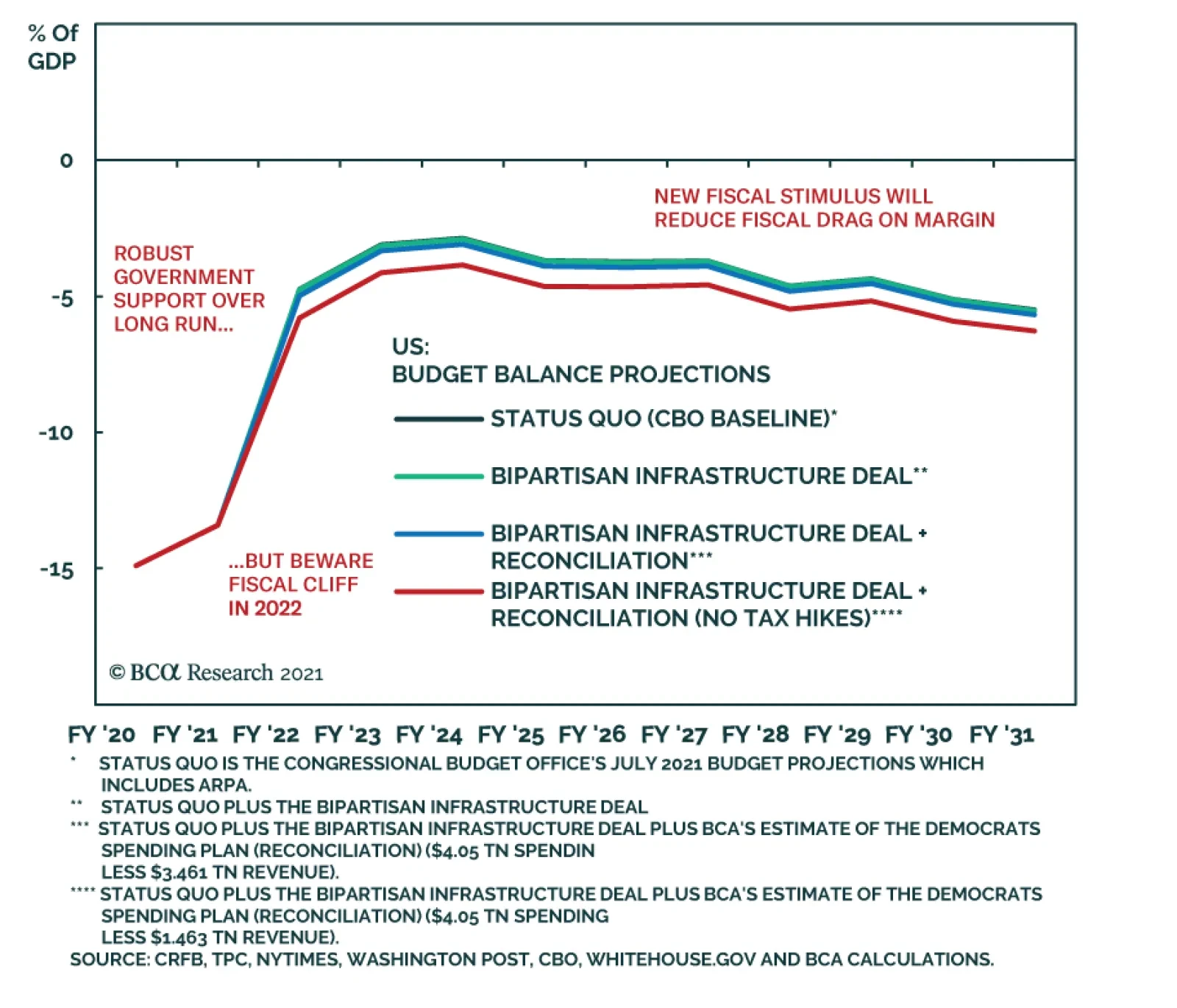
According to BCA Research’s Geopolitical Strategy service fiscal drag is probably overstated as governments are likely to increase deficit spending on the margin. US Congress is likely to pass Biden’s $550 billion bipartisan infrastructure bill (80%…