Sorry, you need to enable JavaScript to visit this website.
Skip to main content

Netherlands

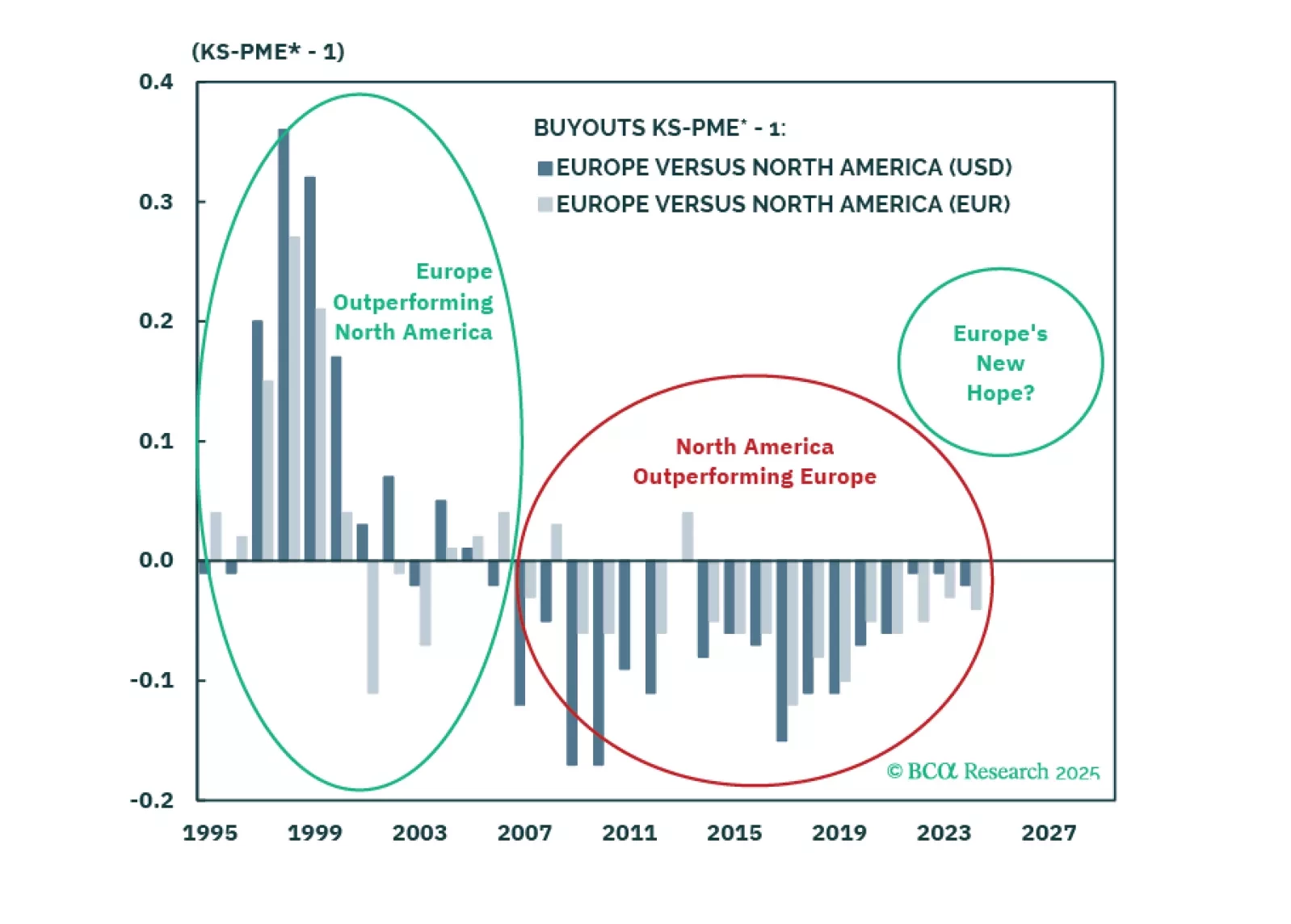
We are at a pivotal moment for Europe, supported by structural reforms and macro catalysts. While expanding credit markets and lower rates favor Private Equity over Private Credit, opportunities vary by segment. Large+ Buyouts are attractive as markets have priced in structural challenges. We downgrade Europe Private Credit, remain neutral on Europe Private Equity broadly but overweight Europe vs. North America in PE portfolios.

According to BCA Research's Geopolitical Strategy service, coalition politics will prevent radical policy changes in the Netherlands. The Dutch elections saw a shift to new and opposition parties as the team expected. The right-wing…

A series of notable events took place over the Thanksgiving holiday but none of them force us to change our fundamental assessments. The conflict in the Middle East is likely to escalate rather than de-escalate, while the Taiwan Strait has at least a 50/50 chance of seeing tensions escalate next year.

The Netherlands has a healthier and more stable economy and demography than its European peers. Investors should stay overweight developed European equities, including Dutch equities, relative to emerging European equities.

According to BCA Research’s European Investment Strategy service, the Dutch market will be the main European beneficiary of expanding spending on AI. The crucial factor constraining the deployment and expansion of AI is its voracious appetite for computing…

The AI revolution is having a large impact on many US stocks but European equities have not enjoyed the same benefits. Is Europe really devoid of AI plays?

Highlights Market-based geopolitical analysis is about identifying upside as well as downside risk. So far this year upside risks include vaccine efficacy, coordinated monetary and fiscal stimulus, China’s avoidance of over-tightening policy, and Europe’s stable political dynamics. Downside risks include vaccine rollout problems, excessive US stimulus, a Chinese policy mistake, and traditional geopolitical risks in the Taiwan Strait and Persian Gulf. Financial markets may see more turmoil in the near-term over rising bond yields and the dollar bounce. But the macro backdrop is still supportive for this year. We are initiating and reinitiating a handful of trades: EM currencies ex-Brazil/Turkey/Philippines, the BCA rare earth basket, DM-ex-US, and the Trans-Pacific Partnership markets, and global value plays. Feature Chart 1Bond Yield Spike Threatens Markets In Near Term Bond Yield Spike Threatens Markets In Near Term Bond Yield Spike Threatens Markets In Near Term Investors hear a lot about geopolitical risk but the implication is always “downside risk.” What about upside risks? Where are politics and geopolitics creating buying opportunities? So far this year, on the positive side, the US fiscal stimulus is overshooting, China is likely to avoid overtightening policy, and Europe’s political dynamics are positive. However, global equity markets are euphoric and much of the good news is priced in. On the negative side, the US stimulus is probably too large. The output gap will be more than closed by the Biden administration’s $1.9 trillion American Rescue Plan yet the Democrats will likely pass a second major bill later this year with a similar amount of net spending, albeit over a longer period of time and including tax hikes. The countertrend bounce in the dollar and rising government bond yields threaten the US and global equity market with a near-term correction. The global stock-to-bond ratio has gone vertical (Chart 1). Meanwhile Biden faces immediate foreign policy tests in the Taiwan Strait and Persian Gulf. These two are traditional geopolitical risks that are once again underrated by investors. The near term is likely to be difficult for investors to navigate. Sentiment is ebullient and likely to suffer some disappointments. In this report we highlight a handful of geopolitical opportunities and offer some new investment recommendations to capitalize on them. Go Long Japan And Stay Long South Korea China’s stimulus and recovery matched by global stimulus and recovery have led to an explosive rise in industrial metals and other China-sensitive assets such as Swedish stocks and the Australian dollar that go into our “China Play Index” (Chart 2). Chart 2China Plays Looking Stretched (For Now) China Plays Looking Stretched (For Now) China Plays Looking Stretched (For Now) While a near-term pullback in these assets looks likely, tight global supplies will keep prices well-bid. Moreover long-term strategic investment plans by China and the EU to accelerate the technology race and renewable energy are now being joined by American investment plans, a cornerstone of Joe Biden’s emerging national policy program. We are long silver and would buy metals on the dips. Chinese President Xi Jinping’s “new era” policies will be further entrenched at the March National People’s Congress with the fourteenth five-year plan for 2021-25 and Xi’s longer vision for 2035. These policies aim to guide the country through its economic transition from export-manufacturing to domestic demand. They fundamentally favor state-owned enterprises, which are an increasingly necessary tool for the state to control aggregate demand as potential GDP growth declines, while punishing large state-run commercial banks, which are required to serve quasi-fiscal functions and swallow the costs of the transition (Chart 3). Xi Jinping’s decision to promote “dual circulation,” which is fundamentally a turn away from Deng Xiaoping’s opening up and liberal reform to a more self-sufficient policy of import substitution and indigenous innovation, will clash with the Biden administration, which has already flagged China as the US’s “most serious competitor” and is simultaneously seeking to move its supply chains out of China for critical technological, defense, and health goods. Chart 3Xi Jinping Leans On The Banks To Save The SOEs Xi Jinping Leans On The Banks To Save The SOEs Xi Jinping Leans On The Banks To Save The SOEs Chinese political and geopolitical risks are almost entirely priced out of the market, according to our GeoRisk Indicator, leaving Chinese equities exposed to further downside (Chart 4). Hong Kong equities have traded in line with GeoRisk Indicator for China, which suggests that they also have downside as the market prices in a rising risk premium due to the US’s attempt to galvanize its allies in a great circumvention of China’s economy in the name of democracy versus autocracy. Chart 4China/HK Political Risk Priced Out Of Market China/HK Political Risk Priced Out Of Market China/HK Political Risk Priced Out Of Market China has hinted that it will curtail rare earth element exports to the US if the US goes forward with a technological blockade. Biden’s approach, however, is more defensive rather than offensive – focusing on building up domestic and allied semiconductor and supply chain capacity rather than de-sourcing China. President Trump’s restrictions can be rolled back for US designed or manufactured tech goods that are outdated or strictly commercial. Biden will draw the line against American parts going into the People’s Liberation Army. Biden has a chance in March to ease the Commerce Department’s rules implementing Trump’s strictures on Chinese software apps in US markets as a gesture of engagement. Supply constraints and shortages cannot be solved quickly in either semiconductors or rare earths. But both China and the US can circumvent export controls by importing through third parties. The problem for China is that it is easier for the US to start pulling rare earths from the ground than it is for China to make a great leap forward in semiconductor production. Given the US’s reawakening to the need for a domestic industrial policy, strategic public investments, and secure supply chains, we are reinitiating our long rare earth trade, using the BCA rare earth basket, which features producers based outside of China (Chart 5). The renminbi is starting to rolling over, having reached near to the ceiling that it touched in 2017 after Trump’s arrival. There are various factors that drive the currency and there are good macro reasons for the currency to have appreciated in 2016-17 and 2020-21 due to strong government fiscal and monetary reflation. Nevertheless the People’s Bank allowed the currency to appreciate extensively at the beginning of both Trump’s and Biden’s terms and the currency’s momentum is slowing as it nears the 2017 ceiling. We are reluctant to believe the renminbi will go higher as China will not want to overtighten domestic policy but will want to build some leverage against Biden for the forthcoming strategic and economic dialogues. For mainland-dedicated investors we recommend holding Chinese bonds but for international investors we would highlight the likelihood that the renminbi has peaked and geopolitical risk will escalate. There is no substantial change on geopolitical risk in the Taiwan Strait since we wrote about it recently. A full-scale war is a low-probability risk. Much more likely is a diplomatic crisis – a showdown between the US and China over Taiwan’s ability to export tech to the mainland and the level of American support for Taiwan – and potentially a testing of Biden’s will on the cybersecurity, economic security, or maritime security of Taiwan. While it would make sense to stay long emerging markets excluding Taiwan, there is not an attractive profile for staying long emerging markets excluding all of Greater China. Therefore investors who are forced to choose should overweight China relative to Taiwan (Chart 6). Chart 5Rare Earth Miners Outside China Can Go Higher Rare Earth Miners Outside China Can Go Higher Rare Earth Miners Outside China Can Go Higher Market forces have only begun to register the fact that Taiwan is the epicenter of geopolitical risk in the twenty-first century. The bottleneck for semiconductors and Taiwan’s role as middleman in the trade war have supported Taiwanese stocks. It will take a long time for China, the US, and Europe to develop alternative suppliers for chips. But geopolitical pressures will occasionally spike and when they do Taiwanese equities will plunge (Chart 7). Chart 6EM Investors Need Either China Or Taiwan ... Taiwan Most At Risk EM Investors Need Either China Or Taiwan ... Taiwan Most At Risk EM Investors Need Either China Or Taiwan ... Taiwan Most At Risk South Korean geopolitical risk is also beneath the radar, though stocks have corrected recently and emerging market investors should generally favor Korea, especially over Taiwan. The first risk to Korea is that the US will apply more pressure on Seoul to join allied supply chains and exclude shipments of sensitive goods to China. The second risk is that North Korea – which Biden is deliberately ignoring in his opening speeches – will demand America’s attention through a new series of provocations that will have to be rebuked with credible threats of military force. Chart 7Markets Starting To Price Taiwan Strait Geopolitical Risk Markets Starting To Price Taiwan Strait Geopolitical Risk Markets Starting To Price Taiwan Strait Geopolitical Risk Chart 8South Korea Favored In EM But Still Faces Risks Over Chips, The North South Korea Favored In EM But Still Faces Risks Over Chips, The North South Korea Favored In EM But Still Faces Risks Over Chips, The North   Chart 9Don't Worry About Japan's Revolving Door Don't Worry About Japan's Revolving Door Don't Worry About Japan's Revolving Door The North Korean risk is usually very fleeting for financial markets. The tech risk is more serious but the Biden administration is not seeking to force South Korea to stop trading with China, at least not yet. The US would need to launch a robust, multi-year diplomatic effort to strong-arm its allies and partners into enforcing a chip and tech ban on China. Such an effort would generate a lot of light and heat – shuttle diplomacy, leaks to the press, and public disagreements and posturing. Until this starts to occur, US export controls will be a concern but not an existential threat to South Korea (Chart 8). Japan is the geopolitical winner in Asia Pacific. Japan is militarily secure, has a mutual defense treaty with the US, and stands to benefit from the recovery in global trade and growth. Japan is a beneficiary of a US-driven tech shift away from excess dependency on China and is heavily invested in Southeast Asia, which stands to pick up manufacturing share. Higher bond yields and inflation expectations will detract from growth stocks more than value stocks, and value stocks have a larger market-cap weight in European and Japanese equity markets. Japanese politics are not a significant risk despite a looming election. While Prime Minister Yoshihide Suga is unpopular and likely to revive the long tradition of a “revolving door” of short-lived prime ministers, and while the Liberal Democratic Party will lose the super-majorities it held under Shinzo Abe, nevertheless the party remains dominant and the national policy consensus is behind Abe’s platform of pro-growth reforms, coordinated dovish monetary and fiscal policy, and greater openness to trade and immigration (Chart 9). Favor EU And UK Over Russia And Eastern Europe Russian geopolitical risk appears to be rolling over according to our indicator but we disagree with the market’s assessment and expect it to escalate again soon (Chart 10). Not only will Russian social unrest continue to escalate but also the Biden administration will put greater pressure on Russia that will keep foreign investors wary. Chart 10Russia Geopolitical Risk Will Not Roll Over Russia Geopolitical Risk Will Not Roll Over Russia Geopolitical Risk Will Not Roll Over While geopolitics thus poses a risk to Russian equities – which are fairly well correlated (inversely) with our GeoRisk indicator – nevertheless they are already cheap and stand to benefit from the rise in global commodity prices and liquidity. Russia is also easing fiscal policy to try to quiet domestic unrest. The pound and the euro today are higher against the ruble than at any time since the invasion of Ukraine. It is possible that Russia will opt for outward aggressiveness amidst domestic discontent, a weak and relapsing approval rating for Vladimir Putin and his government, and the Biden administration’s avowed intention to prioritize democracy promotion, including in Ukraine and Belarus (Chart 11). The ruble will fall on US punitive actions but ultimately there is limited downside, at least as long as the commodity upcycle continues. Chart 11Ruble Can Fall But Probably Not Far Ruble Can Fall But Probably Not Far Ruble Can Fall But Probably Not Far Biden stated in his second major foreign policy speech, “we will not hesitate to raise the cost on Russia.” There are two areas where the Biden administration could surprise financial markets: pipelines and Russian bonds. Biden could suddenly adopt a hard line on the Nordstream 2 pipeline between Russia and Germany, preventing it from completion. This would require Biden to ask the Germans to put their money where their mouths are when it comes to trans-Atlantic solidarity. Biden is keen to restore relations with Germany, and is halting the withdrawal of US troops from there, but pressuring Germany on Russia is possible given that it lies in the US interest and Biden has vowed to push back against Russia’s aggressive regional actions and interference in American affairs. The US imposed sanctions on Russian “Eurobonds” under the Chemical and Biological Weapons Control and Warfare Elimination Act of 1991 (CBW Act) in the wake of Russia’s poisoning of secret agent Sergei Skripal in the UK in 2018. Non-ruble bank loans and non-ruble-denominated Russian bonds in primary markets were penalized, which at the time accounted for about 23% of Russian sovereign bonds. This left ruble-denominated sovereign bonds to be sold along with non-ruble bonds in secondary markets. The Biden administration views Russia’s poisoning of opposition leader Alexei Navalny as a similar infraction and will likely retaliate. The Defending American Security from Kremlin Aggression Act is not yet law but passed through a Senate committee vote in 2019 and proposed to halt most purchases of Russian sovereign debt and broaden sanctions on energy projects and Kremlin officials. Biden is also eager to retaliate for the large SolarWinds hack that Russia is accused of conducting throughout 2020. Cybersecurity stocks are an obvious geopolitical trade in contemporary times. Authoritarian nations have benefited from the use of cyber attacks, disinformation, and other asymmetric warfare tactics. The US has shown that it does not have the appetite to fight small wars, like over Ukraine or the South China Sea, whereas the US remains untested on the question of major wars. This incentivize incremental aggression and actions with plausible deniability like cyber. Therefore the huge run-up in cyber stocks is well-supported and will continue. The world’s growing dependency on technology during the pandemic lockdowns heightened the need for cybersecurity measures but the COVID winners are giving way to COVID losers as the pandemic subsides and normal economic activity resumes. Traditional defense stocks stand to benefit relative to cyber stocks as the secular trend of struggle among the Great Powers continues (Chart 12). Specifically a new cycle of territorial competition will revive military tensions as commodity prices rise. Chart 12Back To Work' Trade: Long Defense Versus Cyber Back To Work' Trade: Long Defense Versus Cyber Back To Work' Trade: Long Defense Versus Cyber By contrast with Russia, western Europe is a prime beneficiary of the current environment. Like Japan, Europe is an industrial, trade-surplus economy that benefits from global trade and growth. It benefits as the geopolitical middleman between the US and its rivals, China and Russia, especially as long as the Biden administration pursues consultation and multilateralism and hesitates to force the Europeans into confrontational postures against these powers. Chart 13Political Risk Still Subsiding In Continental Europe Political Risk Still Subsiding In Continental Europe Political Risk Still Subsiding In Continental Europe Meanwhile Russia and especially China need to court Europe now that the Biden administration is using diplomacy to try to galvanize a western bloc. China looks to substitute European goods for American goods and open up its market to European investors to reduce European complaints of protectionism. European domestic politics will become more interesting over the coming year, with German and French elections, but the risks are low. The rise of a centrist coalition in Italy under Mario Draghi highlights how overstated European political risk really is. In the Netherlands, Mark Rutte’s center-right party is expected to remain in power in March elections based on opinion polling, despite serious corruption scandals and COVID blowback. In Germany, Angela Merkel’s center-right party is also favored, and yet an upset would energize financial markets because it would result in a more fiscally accommodative and pro-EU policy (Chart 13). The takeaway is that there is limit to how far emerging European countries can outperform developed Europe, given the immediate geopolitical risk emanating from Russia that can spill over into eastern Europe (Chart 14). Developed European stocks are at peak levels, comparable to the period of Ukraine’s election, but Ukraine is about to heat up again as a battleground between Russia and the West, as will other peripheral states. Chart 14Favor DM Europe Over EM Europe Favor DM Europe Over EM Europe Favor DM Europe Over EM Europe Chart 15GBP: Watch For Scottish Risk Revival In May GBP: Watch For Scottish Risk Revival In May GBP: Watch For Scottish Risk Revival In May Finally, in the UK, the pound continues to surge in the wake of the settlement of a post-Brexit trade deal, notwithstanding lingering disagreements over vaccines, financial services, and other technicalities. British equities are a value play that can make up lost ground from the tumultuous Brexit years. There is potentially one more episode of instability, however, arising from the unfinished business in Scotland, where the Scottish National Party wants to convert any victory in parliamentary elections in May into a second push for a referendum on national independence. At the moment public opinion polls suggest that Prime Minister Boris Johnson’s achievement of an EU trade deal has taken the wind out of the sails of the independence movement but only the election will tell whether this political risk will continue to fall in the near term (Chart 15). Hence the pound’s rally could be curtailed in the near term but unless Scottish opinion changes direction the pound and UK domestic-oriented stocks will perform well. Short EM Strongmen Throughout the emerging world the rise of the “Misery Index” – unemployment combined with inflation – poses a persistent danger of social and political instability that will rise, not fall, in the coming years. The aftermath of the COVID crisis will be rocky once stimulus measures wane. South Africa, Turkey, and Brazil look the worst on these measures but India and Russia are also vulnerable (Chart 16). Brazilian geopolitical risk under the turbulent administration of President Jair Bolsonaro has returned to the 2015-16 peaks witnessed during the impeachment of President Dilma Rousseff amid the harsh recession of the middle of the last decade. Brazilian equities are nearing a triple bottom, which could present a buying opportunity but not before the current political crisis over fiscal policy exacts a toll on the currency and stock market (Chart 17). Chart 16EM Political Risk Will Bring Bad Surprises EM Political Risk Will Bring Bad Surprises EM Political Risk Will Bring Bad Surprises Chart 17Brazil Risk Hits Impeachment Peaks On Bolso Fiscal Populism Brazil Risk Hits Impeachment Peaks On Bolso Fiscal Populism Brazil Risk Hits Impeachment Peaks On Bolso Fiscal Populism Bolsonaro’s signature pension reform was an unpopular measure whose benefits were devastated by the pandemic. The return to fiscal largesse in the face of the crisis boosted Bolsonaro’s support and convinced him to abandon the pretense of austere reformer in favor of traditional Brazilian fiscal populist as the 2022 election approaches. His attempt to violate the country’s fiscal rule – a constitutional provision passed in December 2016 that imposes a 20-year cap on public spending growth – that limits budget deficits is precipitating a shakeup within the ruling coalition. Our Emerging Market Strategists believe the Central Bank of Brazil will hike interest rates to offset the inflationary impact of breaking the fiscal cap but that the hikes will likely fall short, prompting a bond selloff and renewed fears of a public debt crisis. The country’s political crisis will escalate in the lead up to elections, not unlike what occurred in the US, raising the odds of other negative political surprises. Chart 18Reinitiate Long Mexico / Short Brazil Reinitiate Long Mexico / Short Brazil Reinitiate Long Mexico / Short Brazil While Latin America as a whole is a shambles, the global cyclical upturn and shift in American policy creates investment opportunities – particularly for Mexico, at least within the region. Investors should continue to prefer Mexican equities over Brazilian given Mexico’s fundamentally more stable economic policy backdrop and its proximity to the American economy, which will be supercharged with stimulus and eager to find ways to use its new trade deal with Mexico to diversify its manufacturing suppliers away from China (Chart 18). In addition to Brazil, Turkey and the Philippines are also markets where “strongman leaders” and populism have undercut economic orthodoxy and currency stability. A basket of emerging market currencies that excludes these three witnessed a major bottom in 2014-16, when Turkish and Brazilian political instability erupted and when President Rodrigo Duterte stormed the stage in the Philippines. These three currencies look to continue underperforming given that political dynamics will worsen ahead of elections in 2022 (possibly 2023 for Turkey) (Chart 19). Chart 19Keep Shorting The Strongmen Keep Shorting The Strongmen Keep Shorting The Strongmen Investment Takeaways We closed out some “risk-on” trades at the end of January – admittedly too soon – and since then have hedged our pro-cyclical strategic portfolio with safe-haven assets, while continuing to add risk-on trades where appropriate. The Biden administration still faces one or more major foreign policy tests that can prove disruptive, particularly to Taiwanese, Chinese, Russian, and Saudi stocks. Biden’s foreign policy doctrine will be established in the crucible of experience but his preferences are known to favor diplomacy, democracy over autocracy, and to pursue alliances as a means of diversifying supply chains away from China. We will therefore look favorably upon the members of the Comprehensive and Progressive Trans-Pacific Partnership (CPTPP) and recommend investors reinitiate the long CPTPP equities basket. These countries, which include emerging markets with decent governance as well as Japan, Australia, New Zealand, and Canada all stand to benefit from the global upswing and US foreign policy (Chart 20). Chart 20Reinitiate Long Trans-Pacific Partnership Reinitiate Long Trans-Pacific Partnership Reinitiate Long Trans-Pacific Partnership Chart 21Reinitiate Long Global Value Over Growth Reinitiate Long Global Value Over Growth Reinitiate Long Global Value Over Growth The Biden administration will likely try to rejoin the CPTPP but even if it fails to do so it will privilege relations with these countries as it strives to counter China and Russia. The UK, South Korea, Thailand and others could join the CPTPP over time – though an attempt to recruit Taiwan would exacerbate the geopolitical risks highlighted above centered on Taiwan. The dollar is perking up, adding a near-term headwind to global equities, but the cyclical trend for the dollar is still down due to extreme monetary and fiscal dovishness. Tactically, go long Mexican equities over Brazilian equities. From a strategic point of view we still favor value stocks over growth stocks and recommend investors reinitiate this global trade (Chart 21). Strategically, wait to overweight UK stocks in a global portfolio until the result of the May local elections is known and the risk of Scottish independence can be reassessed. Strategically, favor developed Europe over emerging Europe stocks as a result of Russian geopolitical risks that are set to escalate. Strategically go long global defense stocks versus cyber security stocks as a geopolitical “back to work” trade for a time when economic activity resumes and resource-oriented territorial, kinetic, military risks reawaken. Strategically, favor EM currencies other than Brazil, Turkey, and the Philippines to minimize exposure to economic populism, poor macro fundamentals, and election risk. Strategically, go long the BCA Rare Earths Basket to capture persistent US-China tensions under Biden and the search for alternatives to China.   Matt Gertken Vice President Geopolitical Strategy mattg@bcaresearch.com   We Read (And Liked) … Supply-Side Structural Reform Supply-Side Structural Reform, a compilation of Chinese economic and policy research, discusses several aspects of Chinese economic reform as it is practiced under the Xi Jinping administration, spanning the meaning and importance of supply-side structural reform in China as well as five major tasks.1 The book consists of contributions by Chinese scholars, financial analysts, and opinion makers in 2015, so we have learned a lot since it was published, even as it sheds light on Beijing’s interpretation of reform. 2015 was a year of financial turmoil that saw a dramatic setback for China’s 2013 liberal reform blueprint. It also saw the launch of a new round of reforms under the thirteenth Five Year Plan (2016-20), which aimed to push China further down the transition from export-manufacturing to domestic and consumer-led growth. Beijing’s renewed reform push in 2017, which included a now infamous “deleveraging campaign,” ultimately led to a global slowdown in 2018-19 that was fatefully exacerbated by the trade war with the United States – only to be eclipsed by the COVID-19 pandemic in 2020. Built on fundamental economic theory and the social background of China, the book’s authors examine the impact of supply-side reform on the Chinese financial sector, industrial sector, and macroeconomic development. The comprehensive analysis covers short-term, mid-term and long-term effects. From the perspective of economic theory, there is consensus that China's supply-side structural reform framework did not forsake government support for the demand side of the economy, nor was it synonymous with traditional, liberal supply-side economics in the Western world. In contrast to Say’s Law, Reaganomics, and the UK’s Thatcherite privatization reforms, China's supply-side reform was concentrated on five tasks specific to its contemporary situation: cutting excessive industrial capacity, de-stocking, deleveraging, cutting corporate costs, and improving various structural “weaknesses.” The motives behind the new framework were to enhance the mobility and efficiency of productive factors, eliminate excess capacity, and balance effective supply with effective demand. Basically, if China cannot improve efficiencies, capital will be misallocated, corporations will operate at a loss, and the economy’s potential will worsen over the long run. The debt buildup will accelerate and productivity will suffer. Regarding implementation, the book sets forth several related policies, including deepening the reform of land use and the household registration (hukou) system, and accelerating urbanization, which are effective measures to increase the liquidity of productive factors. Others promote the transformation from a factor-driven economy to efficiency and innovation-driven economy, including improving the property rights system, transferring corporate and local government debt to the central government, and encouraging investment in human capital and in technological innovation. The book also analyzes and predicts the potential costs of reform on the economy in the short and long term. In the short run, authors generally anticipated that deleveraging and cutting excessive industrial capacity would put more pressure on the government’s fiscal budget. The rise in the unemployment rate, cases of bankruptcy, and the negative sentiment of investors would slow China’s economic growth. In the medium and long run, this structural reform was seen as necessary for a sustainable medium-speed economic growth, leading to more positive expectations for households and corporates. The improved efficiency in capital allocation would provide investors with more confidence in the Chinese economy and asset market. Authors argued that overall credit risk was still controllable in near-term, as the corresponding policies such as tax reduction and urbanization would boost private investment and consumption in the short run. These policies increased demand in the labor market and created working positions to counteract adverse impacts. Employment in industries where excessive capacity was most severe only accounted for about 3% of total urban employment in 2013. Regarding the rise in credit risk during de-capacity, the asset quality of banks had improved since the 1990s and the level of bad debt was said to be within a controllable range, given government support. Moreover, in the long run, the merger and reorganization of enterprises would increase the efficient supply and have a positive effect on economic innovation-driven transformation. We know from experience that much of the optimism about reform would confront harsh realities in the 2016-21 period. The reforms proceeded in a halting fashion as the US trade war interrupted their implementation, prompting the government to resort to traditional stimulus measures in mid-2018, only to be followed by another massive fiscal-and-credit splurge in 2020 in the face of the pandemic. Yet investors could be surprised to find that the Politburo meeting on April 17, 2020 proclaimed that China would continue to focus on supply-side structural reform even amid efforts to normalize the economy and maintain epidemic prevention and control. Leaders also pledged to maintain the supply-side reform while emphasizing demand-side management during annual Central Economic Work Conference in December 2020. In other words, Xi administration’s policy preferences remain set, and compromises forced by exogenous events will soon give way to renewed reform initiatives. This is a risk to the global reflation trade in 2021-22. There has not been a total abandonment of supply-side reform. The main idea of demand-side reform – shifts in the way China’s government stimulates the economy – is to fully tap the potential of the domestic market and call for an expansion of consumption and effective investment. Combined with the new concept of “dual circulation,” which emphasizes domestic production and supply chains (effectively import substitution), the current demand-side reforms fall in line with the supply-side goal of building a more independent and controllable supply chain and produce higher technology products. These combined efforts will provide “New China” sectors with more policy support, less regulatory constraint, and lead to better economic and financial market performance. Despite the fluctuations in domestic growth and the pressure from external demand, China will maintain the focus on reform in its long-term planning. The fundamental motivation is to enhance efficiency and innovation that is essential for China’s productivity and competitiveness in the future. Thus, investors should not become complacent over the vast wave of fiscal and credit stimulus that is peaking today as we go to press. Instead they should recognize that China’s leaders are committed to restructuring. This means that the economic upside of stimulus has a cap on it– a cap that will eventually be put in place by policymakers, if not by China’s lower capacity for debt itself. It would be a colossal policy mistake for China to overtighten monetary and fiscal policy in 2021 but any government attempts to tighten, the financial market will become vulnerable. A final thought: it is unclear whether there is potential for an improvement in China’s foreign relations contained in this conclusion. What the western world is demanding is for China to rebalance its economy, open up its markets, cut back on the pace of technological acquisition, reduce government subsidies for state-owned companies, and conform better to US and EU trade rules. There is zero chance that China will provide all of these things. But its own reform program calls for greater intellectual property protections, greater competition in non-strategic sectors (which the US and EU should be able to access under recent trade deals), and targeted stimulus for sustainable energy, where the US and EU see trade and investment opportunities. Thus there is a basis for an improvement in cooperation. What remains to be seen is how protectionist dual circulation will be in practice and how aggressively the US will pursue international enforcement of technological restrictions on China under the Biden administration. Jingnan Liu Research Associate JingnanL@bcaresearch.com Footnotes 1 Yifu L, et al. Supply-Side Structural Reform (Beijing: Democracy & Construction Publishing House, 2016). 351 pages. Appendix: GeoRisk Indicator China China: GeoRisk Indicator China: GeoRisk Indicator Russia Russia: GeoRisk Indicator Russia: GeoRisk Indicator UK UK: GeoRisk Indicator UK: GeoRisk Indicator Germany Germany: GeoRisk Indicator Germany: GeoRisk Indicator France France: GeoRisk Indicator France: GeoRisk Indicator Italy Italy: GeoRisk Indicator Italy: GeoRisk Indicator Canada Canada: GeoRisk Indicator Canada: GeoRisk Indicator Spain Spain: GeoRisk Indicator Spain: GeoRisk Indicator Taiwan Taiwan: GeoRisk Indicator Taiwan: GeoRisk Indicator Korea Korea: GeoRisk Indicator Korea: GeoRisk Indicator Turkey Turkey: GeoRisk Indicator Turkey: GeoRisk Indicator Brazil Brazil: GeoRisk Indicator Brazil: GeoRisk Indicator Section III: Geopolitical Calendar

Highlights With a vaccine already rolling out in the UK and soon in the US, investors have reason to be optimistic about next year. Government bond yields are rising, cyclical equities are outperforming defensives, international stocks hinting at outperforming American, and value stocks are starting to beat growth stocks (Chart 1). Feature President Trump’s defeat in the US election also reduces the risk of a global trade war, or a real war with Iran. European, Chinese, and Emirati stocks have rallied since the election, at least partly due to the reduction in these risks (Chart 2). However, geopolitical risk and global policy uncertainty have been rising on a secular, not just cyclical, basis (Chart 3). Geopolitical tensions have escalated with each crisis since the financial meltdown of 2008. Chart 1A New Global Business Cycle A New Global Business Cycle A New Global Business Cycle Chart 2Biden: No Trade War Or War With Iran? Biden: No Trade War Or War With Iran? Biden: No Trade War Or War With Iran? Chart 3Geopolitical Risk And Global Policy Uncertainty Geopolitical Risk And Global Policy Uncertainty Geopolitical Risk And Global Policy Uncertainty Chart 4The Decline Of The Liberal Democracies? The Decline Of The Liberal Democracies? The Decline Of The Liberal Democracies? Trump was a symptom, not a cause, of what ails the world. The cause is the relative decline of the liberal democracies in political, economic, and military strength relative to that of other global players (Chart 4). This relative decline has emboldened Chinese and Russian challenges to the US-led global order, as well as aggressive and unpredictable moves by middle and small powers. Moreover the aftershocks of the pandemic and recession will create social and political instability in various parts of the world, particularly emerging markets (Chart 5). Chart 5EM Troubles Await EM Troubles Await EM Troubles Await Chart 6Global Arms Build-Up Continues Global Arms Build-Up Continues Global Arms Build-Up Continues   We are bullish on risk assets next year, but our view is driven largely from the birth of a new economic cycle, not from geopolitics. Geopolitical risk is rapidly becoming underrated, judging by the steep drop-off in measured risk. There is no going back to a pre-Trump, pre-Xi Jinping, pre-2008, pre-Putin, pre-9/11, pre-historical golden age in which nations were enlightened, benign, and focused exclusively on peace and prosperity. Hard data, such as military spending, show the world moving in the opposite direction (Chart 6). So while stock markets will grind higher next year, investors should not expect that Biden and the vaccine truly portend a “return to normalcy.” Key View #1: China’s Communist Party Turns 100, With Rising Headwinds Investors should ignore the hype about the Chinese Communist Party’s one hundredth birthday in 2021. Since 1997, the Chinese leadership has laid great emphasis on this “first centenary” as an occasion by which China should become a moderately prosperous society. This has been achieved. China is deep into a structural economic transition that holds out a much more difficult economic, social, and political future. Chart 7China: Less Money, More Problems China: Less Money, More Problems China: Less Money, More Problems The big day, July 1, will be celebrated with a speech by General Secretary Xi Jinping in which he reiterates the development goals of the five-year plan. This plan – which doubles down on import substitution and the aggressive tech acquisition campaign – will be finalized in March, along with Xi’s yet-to-be released vision for 2035, which marks the halfway point to the “second centenary,” 2049, the hundredth birthday of the regime. Xi’s 2035 goals may contain some surprises but the Communist Party’s policy frameworks should be seen as “best laid plans” that are likely to be overturned by economic and geopolitical realities. It was easier for the country to meet its political development targets during the period of rapid industrialization from 1979-2008. Now China is deep into a structural economic transition that holds out a much more difficult economic, social, and political future. Potential growth is slowing with the graying of society and the country is making a frantic dash, primarily through technology acquisition, to boost productivity and keep from falling into the “middle income trap” (Chart 7). Total debt levels have surged as Beijing attempts to make this transition smoothly, without upsetting social stability. Households and the government are taking on a greater debt load to maintain aggregate demand while the government tries to force the corporate sector to deleverage in fits and starts (Chart 8). The deleveraging process is painful and coincides with a structural transition away from export-led manufacturing. Beijing likely believes it has already led de-industrialization proceed too quickly, given the huge long-term political risks of this process, as witnessed in the US and UK. The fourteenth five-year plan hints that the authorities will give manufacturing a reprieve from structural reform efforts (Chart 9). Chart 8China Struggles To Dismount Debt Bubble China Struggles To Dismount Debt Bubble China Struggles To Dismount Debt Bubble Chart 9China Will Slow De-Industrialization, Stoking Protectionism China Will Slow De-Industrialization, Stoking Protectionism China Will Slow De-Industrialization, Stoking Protectionism Chart 10China Already Reining In Stimulus China Already Reining In Stimulus China Already Reining In Stimulus A premature resumption of deleveraging heightens domestic economic risks. The trade war and then the pandemic forced the Xi administration to abandon its structural reform plans temporarily and drastically ease monetary, fiscal, and credit policy to prevent a recession. Almost immediately the danger of asset bubbles reared its head again. Because the regime is focused on containing systemic financial risk, it has already begun tightening monetary policy as the nation heads into 2021 – even though the rest of the world has not fully recovered from the pandemic (Chart 10). The risk of over-tightening is likely to be contained, since Beijing has no interest in undermining its own recovery. But the risk is understated in financial markets at the moment and, combined with American fiscal risks due to gridlock, this familiar Chinese policy tug-of-war poses a clear risk to the global recovery and emerging market assets next year. Far more important than the first centenary, or even General Secretary Xi’s 2035 vision, is the impending leadership rotation in 2022. Xi was originally supposed to step down at this time – instead he is likely to take on the title of party chairman, like Mao, and aims to stay in power till 2035 or thereabouts. He will consolidate power once again through a range of crackdowns – on political rivals and corruption, on high-flying tech and financial companies, on outdated high-polluting industries, and on ideological dissenters. Beijing must have a stable economy going into its five-year national party congresses, and 2022 is no different. But that goal has largely been achieved through this year’s massive stimulus and the discovery of a global vaccine. In a risk-on environment, the need for economic stability poses a downside risk for financial assets since it implies macro-prudential actions to curb bubbles. The 2017 party congress revealed that Xi sees policy tightening as a key part of his policy agenda and power consolidation. In short, the critical twentieth congress in 2022 offers no promise of plentiful monetary and credit stimulus (Chart 11). All investors can count on is the minimum required for stability. This is positive for emerging markets at the moment, but less so as the lagged effects of this year’s stimulus dissipate. Chart 11No Promise Of Major New Stimulus For Party Congress 2022 No Promise Of Major New Stimulus For Party Congress 2022 No Promise Of Major New Stimulus For Party Congress 2022 Not only will Chinese domestic policy uncertainty remain underestimated, but geopolitical risk will also do so. Superficially, Beijing had a banner year in 2020. It handled the coronavirus better than other countries, especially the US, thus advertising Xi Jinping’s centralized and statist governance model. President Trump lost the election. Regardless of why Trump lost, his trade war precipitated a manufacturing slowdown that hit the Rust Belt in 2019, before the virus, and his loss will warn future presidents against assaulting China’s economy head-on, at least in their first term. All of this is worth gold in Chinese domestic politics. Chart 12China’s Image Suffered In Spite Of Trump 2021 Key Views: No Return To Normalcy 2021 Key Views: No Return To Normalcy Internationally, however, China’s image has collapsed – and this is in spite of Trump’s erratic and belligerent behavior, which alienated most of the world and the US’s allies (Chart 12). Moreover, despite being the origin of COVID-19, China’s is one of the few economies that thrived this year. Its global manufacturing share rose. While delaying and denying transparency regarding the virus, China accused other countries of originating the virus, and unleashed a virulent “wolf warrior” diplomacy, a military standoff with India, and a trade war with Australia. The rest of Asia will be increasingly willing to take calculated risks to counterbalance China’s growing regional clout, and international protectionist headwinds will persist. The United States will play a leading part in this process. Sino-American strategic tensions have grown relentlessly for more than a decade, especially since Xi Jinping rose to power, as is evident from Chinese treasury holdings (Chart 13). The Biden administration will naturally seek a diplomatic “reset” and a new strategic and economic dialogue with China. But Biden has already indicated that he intends to insist on China’s commitments under Trump’s “phase one” trade deal. He says he will keep Trump’s sweeping Section 301 tariffs in place, presumably until China demonstrates improvement on the intellectual property and tech transfer practices that provided the rationale for the tariffs. Biden’s victory in the Rust Belt ensures that he cannot revert to the pre-Trump status quo. Indeed Biden amplifies the US strategic challenge to China’s rise because he is much more likely to assemble a “grand alliance” or “coalition of the willing” focused on constraining China’s illiberal and mercantilist policies. Even the combined economic might of a western coalition is not enough to force China to abandon its statist development model, but it would make negotiations more likely to be successful on the West’s more limited and transactional demands (Chart 14). Chart 13The US-China Divorce Pre-Dates And Post-Dates Trump The US-China Divorce Pre-Dates And Post-Dates Trump The US-China Divorce Pre-Dates And Post-Dates Trump Chart 14Biden's Grand Alliance A Danger To China Biden's Grand Alliance A Danger To China Biden's Grand Alliance A Danger To China The Taiwan Strait is ground zero for US-China geopolitical tensions. The US is reviving its right to arm Taiwan for the sake of its self-defense, but the US commitment is questionable at best – and it is this very uncertainty that makes a miscalculation more likely and hence conflict a major tail risk (Chart 15). True, Beijing has enormous economic leverage over Taiwan, and it is fresh off a triumph of imposing its will over Hong Kong, which vindicates playing the long game rather than taking any preemptive military actions that could prove disastrous. Nevertheless, Xi Jinping’s reassertion of Beijing and communism is driving Taiwanese popular opinion away from the mainland, resulting in a polarizing dynamic that will be extremely difficult to bridge (Chart 16). If China comes to believe that the Biden administration is pursuing a technological blockade just as rapidly and resolutely as the Trump administration, then it could conclude that Taiwan should be brought to heel sooner rather than later. Chart 15US Boosts Arms Sales To Taiwan 2021 Key Views: No Return To Normalcy 2021 Key Views: No Return To Normalcy Chart 16Taiwan Strait Risk Will Explode If Biden Seeks Tech Blockade 2021 Key Views: No Return To Normalcy 2021 Key Views: No Return To Normalcy Bottom Line: On a secular basis, China faces rising domestic economic risks and rising geopolitical risk. Given the rally in Chinese currency and equities in 2021, the downside risk is greater than the upside risk of any fleeting “diplomatic reset” with the United States. Emerging markets will benefit from China’s stimulus this year but will suffer from its policy tightening over time. Key View #2: The US “Pivot To Asia” Is Back On … And Runs Through Iran Most likely President-elect Biden will face gridlock at home. His domestic agenda largely frustrated, he will focus on foreign policy. Given his old age, he may also be a one-term president, which reinforces the need to focus on the achievable. He will aim to restore the Obama administration’s foreign policy, the chief features of which were the 2015 nuclear deal with Iran and the “Pivot to Asia.” The US is limited by the need to pivot to Asia, while Iran is limited by the risk of regime failure. A deal should be agreed. The purpose of the Iranian deal was to limit Iran’s nuclear and regional ambitions, stabilize Iraq, create a semblance of regional balance, and thus enable American military withdrawal. The US could have simply abandoned the region, but Iran’s ensuing supremacy would have destabilized the region and quickly sucked the US back in. The newly energy independent US needed a durable deal. Then it could turn its attention to Asia Pacific, where it needed to rebuild its strategic influence in the face of a challenger that made Iran look like a joke (Chart 17). Chart 17The "Pivot To Asia" In A Nutshell The "Pivot To Asia" In A Nutshell The "Pivot To Asia" In A Nutshell It is possible for Biden to revive the Iranian deal, given that the other five members of the agreement have kept it afloat during the Trump years. Moreover, since it was always an executive deal that lacked Senate approval, Biden can rejoin unilaterally. However, the deal largely expires in 2025 – and the Trump administration accurately criticized the deal’s failure to contain Iran’s missile development and regional ambitions. Therefore Biden is proposing a renegotiation. This could lead to an even greater US-Iran engagement, but it is not clear that a robust new deal is feasible. Iran can also recommit to the old deal, having taken only incremental steps to violate the deal after the US’s departure – manifestly as leverage for future negotiations. Of course, the Iranians are not likely to give up their nuclear program in the long run, as nuclear weapons are the golden ticket to regime survival. Libya gave up its nuclear program and was toppled by NATO; North Korea developed its program into deliverable nuclear weapons and saw an increase in stature. Iran will continue to maintain a nuclear program that someday could be weaponized. Nevertheless, Tehran will be inclined to deal with Biden. President Hassan Rouhani is a lame duck, his legacy in tatters due to Trump, but his final act in office could be to salvage his legacy (and his faction’s hopes) by overseeing a return to the agreement prior to Iran’s presidential election in June. From Supreme Leader Ali Khamenei’s point of view, this would be beneficial. He also needs to secure his legacy, but as he tries to lay the groundwork for his power succession, Iran faces economic collapse, widespread social unrest, and a potentially explosive division between the Iranian Revolutionary Guard Corps and the more pragmatic political faction hoping for economic opening and reform. Iran needs a reprieve from US maximum pressure, so Khamenei will ultimately rejoin a limited nuclear agreement if it enables the regime to live to fight another day. In short, the US is limited by the need to pivot to Asia, while Iran is limited by the risk of regime failure. A deal should be agreed. But this is precisely why conflict could erupt in 2021. First, either in Trump’s final days in office or in the early days of the Biden administration, Israel could take military action – as it has likely done several times this year already – to set back the Iranian nuclear program and try to reinforce its own long-term security. Second, the Biden administration could decide to utilize the immense leverage that President Trump has bequeathed, resulting in a surprisingly confrontational stance that would push Iran to the brink. This is unlikely but it may be necessary due to the following point. Third, China and Russia could refuse to cooperate with the US, eliminating the prospect of a robust renegotiation of the deal, and forcing Biden to choose between accepting the shabby old deal or adopting something similar to Trump’s maximum pressure. China will probably cooperate; Russia is far less certain. Beijing knows that the US intention in Iran is to free up strategic resources to revive the US position in Asia, but it has offered limited cooperation on Iran and North Korea because it does not have an interest in their acquiring nuclear weapons and it needs to mitigate US hostility. Biden has a much stronger political mandate to confront China than he does to confront Iran. Assuming that the Israelis and Saudis can no more prevent Biden’s détente with Iran than they could Obama’s, the next question will be whether Biden effectively shifts from a restored Iranian deal to shoring up these allies and partners. He can possibly build on the Abraham Accords negotiated by the Trump administration smooth Israeli ties with the Arab world. The Middle East could conceivably see a semblance of balance. But not in 2021. The coming year will be the rocky transition phase in which the US-Iran détente succeeds or fails. Chart 18Oil Market Share War Preceded The Last US-Iran Deal Oil Market Share War Preceded The Last US-Iran Deal Oil Market Share War Preceded The Last US-Iran Deal Chart 19Still, Base Case Is For Rising Oil Prices Still, Base Case Is For Rising Oil Prices Still, Base Case Is For Rising Oil Prices Chart 20Biden Needs A Credible Threat Biden Needs A Credible Threat Biden Needs A Credible Threat The lead-up to the 2015 Iranian deal saw a huge collapse in global oil prices due to a market share war with Saudi Arabia, Russia, and the US triggered by US shale production and Iranian sanctions relief (Chart 18). This was despite rising global demand and the emergence of the Islamic State in Iraq. In 2021, global demand will also be reviving and Iraq, though not in the midst of full-scale war, is still unstable. OPEC 2.0 could buckle once again, though Moscow and Riyadh already confirmed this year that they understand the devastating consequences of not cooperating on production discipline. Our Commodity and Energy Strategy projects that the cartel will continue to operate, thus drawing down inventories (Chart 19). The US and/or Israel will have to establish a credible military threat to ensure that Iran is in check, and that will create fireworks and geopolitical risks first before it produces any Middle Eastern balance (Chart 20). Bottom Line: The US and Iran are both driven to revive the 2015 nuclear deal by strategic needs. Whether a better deal can be negotiated is less likely. The return to US-Iran détente is a source of geopolitical risk in 2021 though it should ultimately succeed. The lower risk of full-scale war is negative for global oil prices but OPEC 2.0 cartel behavior will be the key determiner. The cartel flirted with disaster in 2020 and will most likely hang together in 2021 for the sake of its members’ domestic stability. Key View #3: Europe Wins The US Election Chart 21Europe Won The US Election Europe Won The US Election Europe Won The US Election The European Union has not seen as monumental of a challenge from anti-establishment politicians over the past decade as have Britain and America. The establishment has doubled down on integration and solidarity. Now Europe is the big winner of the US election. Brussels and Berlin no longer face a tariff onslaught from Trump, a US-instigated global trade war, or as high of a risk of a major war in the Middle East. Biden’s first order of business will be reviving the trans-Atlantic alliance. Financial markets recognize that Europe is the winner and the euro has finally taken off against the dollar over the past year. European industrials and small caps outperformed during the trade war as well as COVID-19, a bullish signal (Chart 21). Reinforcing this trend is the fact that China is looking to court Europe and reduce momentum for an anti-China coalition. The center of gravity in Europe is Germany and 2021 faces a major transition in German politics. Chancellor Angela Merkel will step down at long last. Her Christian Democratic Union is favored to retain power after receiving a much-needed boost for its handling of this year’s crisis (Chart 22), although the risk of an upset and change of ruling party is much greater than consensus holds. Chart 22German Election Poses Political Risk, Not Investment Risk German Election Poses Political Risk, Not Investment Risk German Election Poses Political Risk, Not Investment Risk However, from an investment point of view, an upset in the German election is not very concerning. A left-wing coalition would take power that would merely reinforce the shift toward more dovish fiscal policy and European solidarity. Either way Germany will affirm what France affirmed in 2017, and what France is on track to reaffirm in 2022: that the European project is intact, despite Brexit, and evolving to address various challenges. The European project is intact, despite Brexit, and evolving to address various challenges. This is not to say that European elections pose no risk. In fact, there will be upsets as a result of this year’s crisis and the troubled aftermath. The countries with upcoming elections – or likely snap elections in the not-too-distant future, like Spain and Italy – show various levels of vulnerability to opposition parties (Chart 23). Chart 23Post-COVID EU Elections Will Not Be A Cakewalk Post-COVID EU Elections Will Not Be A Cakewalk Post-COVID EU Elections Will Not Be A Cakewalk Chart 24Immigration Tailwind For Populism Subsided Immigration Tailwind For Populism Subsided Immigration Tailwind For Populism Subsided The chief risks to Europe stem from fiscal normalization and instability abroad. Regime failures in the Middle East and Africa could send new waves of immigration, and high levels of immigration have fueled anti-establishment politics over the past decade. Yet this is not a problem at the moment (Chart 24). And even more so than the US, the EU has tightened border enforcement and control over immigration (Chart 25). This has enabled the political establishment to save itself from populist discontent. The other danger for Europe is posed by Russian instability. In general, Moscow is focusing on maintaining domestic stability amid the pandemic and ongoing economic austerity, as well as eventual succession concerns. However, Vladimir Putin’s low approval rating has often served as a warning that Russia might take an external action to achieve some limited national objective and instigate opposition from the West, which increases government support at home (Chart 26). Chart 25Europe Tough On Immigration Like US Europe Tough On Immigration Like US Europe Tough On Immigration Like US Chart 26Warning Sign That Russia May Lash Out Warning Sign That Russia May Lash Out Warning Sign That Russia May Lash Out Chart 27Russian Geopolitical Risk Premium Rising Russian Geopolitical Risk Premium Rising Russian Geopolitical Risk Premium Rising The US Democratic Party is also losing faith in engagement with Russia, so while it will need to negotiate on Iran and arms reduction, it will also seek to use sanctions and democracy promotion to undermine Putin’s regime and his leverage over Europe. The Russian geopolitical risk premium will rise, upsetting an otherwise fairly attractive opportunity relative to other emerging markets (Chart 27). Bottom Line: The European democracies have passed a major “stress test” over the past decade. The dollar will fall relative to the euro, in keeping with macro fundamentals, though it will not be supplanted as the leading reserve currency. Europe and the euro will benefit from the change of power in Washington, and a rise in European political risks will still be minor from a global point of view. Russia and the ruble will suffer from a persistent risk premium. Investment Takeaways As the “Year of the Rat” draws to a close, geopolitical risk and global policy uncertainty have come off the boil and safe haven assets have sold off. Yet geopolitical risk will remain elevated in 2021. The secular drivers of the dramatic rise in this risk since 2008 have not been resolved. To play the above themes and views, we are initiating the following strategic investment recommendations: Long developed market equities ex-US – US outperformance over DM has reached extreme levels and the global economic cycle and post-pandemic revival will favor DM-ex-US. Long emerging market equities ex-China – Emerging markets will benefit from a falling dollar and commodity recovery. China has seen the good news but now faces the headwinds outlined above. Long European industrials relative to global – European equities stand to benefit from the change of power in Washington, US-China decoupling, and the global recovery. Long Mexican industrials versus emerging markets – Mexico witnessed the rise of an American protectionist and a landslide election in favor of a populist left-winger. Now it has a new trade deal with the US and the US is diversifying from China, while its ruling party faces a check on its power via midterm elections, and, regardless, has maintained orthodox economic policy. Long Indian equities versus Chinese – Prime Minister Narendra Modi has a single party majority, four years on his political clock, and has recommitted to pro-productivity structural reforms. The nation is taking more concerted action in pursuit of economic development since strategic objectives in South Asia cannot be met without greater dynamism. The US, Japan, Australia, and other countries are looking to develop relations as they diversify from China.   Matt Gertken Vice President Geopolitical Strategy mattg@bcaresearch.com
  In a webcast this Friday I will be joined by our Chief US Equity Strategist, Anastasios Avgeriou to debate ‘Sectors To Own, And Sectors To Avoid In The Post-Covid World’. Today’s report preludes five of the points that we will debate. Please join us for the full discussion and conclusions on Friday, June 12, at 8:00 AM EDT (1:00 PM BST, 2:00 PM CEST, 8.00 PM HKT).   Highlights Technology is behaving like a Defensive. Defensive versus Cyclical = Growth versus Value. Growth stocks are not a bubble if bond yields stay ultra-low. The post-Covid world will reinforce existing sector mega-trends. Sectors are driving regional and country relative performance. Fractal trade: Long ZAR/CLP.   Chart of the WeekSector Defensiveness/Cyclicality = Positive/Negative Sensitivity To The Bond Price Sector Defensiveness/Cyclicality = Positive/Negative Sensitivity To The Bond Price Sector Defensiveness/Cyclicality = Positive/Negative Sensitivity To The Bond Price 1. Technology Is Behaving Like A Defensive How do we judge an equity sector’s sensitivity to the post-Covid economy, so that we can define it as cyclical or defensive? One approach is to compare the sector’s relative performance with the bond price. According to this approach, the more negatively sensitive to the bond price, the more cyclical is the sector. And the more positively sensitive to the bond price, the more defensive is the sector (Chart I-1).   On this basis the most cyclical sectors in the post-Covid economy are, unsurprisingly: energy, banks, and materials. Healthcare is unsurprisingly defensive. Meanwhile, the industrials sector sits closest to neutral between cyclical and defensive, showing the least sensitivity to the bond price. The tech sector’s vulnerability to economic cyclicality appears to have greatly reduced. The big surprise is technology, whose high positive sensitivity to the bond price during the 2020 crisis qualifies it as even more defensive than healthcare. This contrasts sharply with its behaviour during the 2008 crisis. Back then, tech’s relative performance was negatively correlated with the bond price, defining it as classically cyclical. But over the past year, tech’s relative performance has been positively correlated with the bond price, defining it as classically defensive (Chart I-2 and Chart I-3). Chart I-2In 2008, Tech Behaved Like ##br##A Cyclical... In 2008, Tech Behaved Like A Cyclical... In 2008, Tech Behaved Like A Cyclical... Chart I-3...But In 2020, Tech Is Behaving Like A Defensive ...But In 2020, Tech Is Behaving Like A Defensive ...But In 2020, Tech Is Behaving Like A Defensive This is not to say that the big tech companies cannot suffer shocks. They can. For example, from new superior technologies, or from anti-oligopoly legislation. However, the tech sector’s vulnerability to economic cyclicality appears to have greatly reduced over the past decade. 2. Defensive Versus Cyclical = Growth Versus Value If we reclassify the tech sector as defensive in the 2020s economy, then the post mid-March rebound in stocks was first led by defensives. Cyclicals took over leadership of the rally only in May. Moreover, with the reclassification of tech as defensive, the two dominant defensive sectors become tech and healthcare. But tech and healthcare are also the dominant ‘growth’ sectors. The upshot is that growth versus value has now become precisely the same decision as defensive versus cyclical (Chart I-4). Chart I-4Defensive Versus Cyclical = Growth Versus Value Defensive Versus Cyclical = Growth Versus Value Defensive Versus Cyclical = Growth Versus Value 3. Growth Stocks Are Not A Bubble If Bond Yields Stay Ultra-Low Some people fear that growth stocks have become dangerously overvalued. There is even mention of the B-word. Let’s address these fears. Yes, valuations have become richer. For example, the forward earnings yield for healthcare is down to 5 percent; and for big tech it is down to just over 4 percent. This valuation starting point has proved to be an excellent guide to prospective 10-year returns, and now implies an expected annualised return from big tech in the mid-single digits. Yet this modest positive return is well above the extremes of the negative 10-year returns implied and delivered from the dot com bubble (Chart I-5). Chart I-5Big Tech Is Priced To Deliver A Positive Return, Unlike In 2000 Big Tech Is Priced To Deliver A Positive Return, Unlike In 2000 Big Tech Is Priced To Deliver A Positive Return, Unlike In 2000 Moreover, we must judge the implied returns from growth stocks against those available from competing long-duration assets – specifically, against the benchmark of high-quality government bond yields. If bond yields are ultra-low, then they must depress the implied returns on growth stocks too. Meaning higher absolute valuations (Chart I-6 and Chart I-7). Chart I-6Tech's Forward Earnings Yield Is Above The Bond Yield, Unlike In 2000 Tech's Forward Earnings Yield Is Above The Bond Yield, Unlike In 2000 Tech's Forward Earnings Yield Is Above The Bond Yield, Unlike In 2000 Chart I-7Healthcare's Forward Earnings Yield Is Above The Bond Yield, Unlike In 2000 Healthcare's Forward Earnings Yield Is Above The Bond Yield, Unlike In 2000 Healthcare's Forward Earnings Yield Is Above The Bond Yield, Unlike In 2000 In the real bubble of 2000, big tech was priced to return 12 percent (per annum) less than the 10-year T-bond. Whereas today, the implied return from big tech – though low in absolute terms – is above the ultra-low yield on the 10-year T-bond. If bond yields are ultra-low, then they must depress the implied returns on growth stocks too. The upshot is that high absolute valuations of growth stocks are contingent on bond yields remaining at ultra-low levels. And that the biggest threat to growth stock valuations would be a sustained rise in bond yields. 4. The Post-Covid World Will Reinforce Existing Sector Mega-Trends If a sector maintains a structural uptrend in sales and profits, then a big drop in the share price provides an excellent buying opportunity for long-term investors. This is because the lower share price stretches the elastic between the price and the up-trending profits, resulting in an eventual catch-up. However, if sales and profits are in terminal decline, then the sell-off is not a buying opportunity other than on a tactical basis. This is because the elastic will lose its tension as profits drift down towards the lower price. In fact, despite the sell-off, if the profit downtrend continues, the price may be forced ultimately to catch-down. This leads to a somewhat counterintuitive conclusion. After a big drop in the stock market, long-term investors should not buy everything that has dropped. And they should not buy the stocks and sectors that have dropped the most if their profits are in major downtrends. In this regard, the post-Covid world is likely to reinforce the existing mega-trends. The profits of oil and gas, and of European banks will remain in major structural downtrends (Chart I-8 and Chart I-9). Conversely, the profits of healthcare, and of European personal products will remain in major structural uptrends (Chart I-10 and Chart I-11). Chart I-8Oil And Gas Profits In A Major ##br##Downtrend Oil And Gas Profits In A Major Downtrend Oil And Gas Profits In A Major Downtrend Chart I-9Bank Profits In A Major ##br##Downtrend European Banks Profits In A Major Downtrend Bank Profits In A Major Downtrend European Banks Profits In A Major Downtrend Bank Profits In A Major Downtrend Chart I-10Healthcare Profits In A Major Uptrend Healthcare Profits In A Major Uptrend Healthcare Profits In A Major Uptrend Chart I-11Personal Products Profits In A Major Uptrend Personal Products Profits In A Major Uptrend Personal Products Profits In A Major Uptrend   5. Sectors Are Driving Regional And Country Relative Performance Finally, sector winners and losers determine regional and country equity market winners and losers. Nowadays, a stock market’s relative performance is predominantly a play on its distinguishing overweight and underweight ‘sector fingerprint’. This is because major stock markets are dominated by multinational corporations which are plays on their global sectors, rather than the region or country in which they have a stock market listing. It follows that when tech and healthcare outperform, the tech-heavy and healthcare-heavy US stock market must outperform, while healthcare-lite emerging markets (EM) must underperform. It also follows that the tech-heavy Netherlands and healthcare-heavy Denmark stock markets must outperform. Sector mega-trends will shape the mega-trends in regional and country relative performance. Equally, when energy and banks underperform, the energy-heavy Norway and bank-heavy Spain stock markets must underperform. (Chart I-12 and Chart I-13). These are just a few examples. Every stock market is defined by a sector fingerprint which drives its relative performance.  Chart I-12Sector Relative Performance Drives... Sector Relative Performance Drives... Sector Relative Performance Drives... Chart I-13...Regional And Country Relative Performance ...Regional And Country Relative Performance ...Regional And Country Relative Performance If sector mega-trends continue, they will also shape the mega-trends in regional and country relative performance – favouring those stock markets that are heavy in growth stocks and light in old-fashioned cyclicals. Please join the webcast to hear the full debate and conclusions. Fractal Trading System*  This week’s recommended trade is to go long the South African rand versus the Chilean peso. Set the profit target and symmetrical stop-loss at 5 percent. In other trades, long Spanish 10-year bonds versus New Zealand 10-year bonds achieved its 3.5 percent profit target at which it was closed. And long Australia versus New Zealand equities is approaching its 12 percent profit target. The rolling 1-year win ratio now stands at 63 percent. Chart I-14ZAR/CLP ZAR/CLP ZAR/CLP   When the fractal dimension approaches the lower limit after an investment has been in an established trend it is a potential trigger for a liquidity-triggered trend reversal. Therefore, open a countertrend position. The profit target is a one-third reversal of the preceding 13-week move. Apply a symmetrical stop-loss. Close the position at the profit target or stop-loss. Otherwise close the position after 13 weeks. * For more details please see the European Investment Strategy Special Report “Fractals, Liquidity & A Trading Model,” dated  December 11, 2014, available at eis.bcaresearch.com.   Dhaval Joshi Chief European Investment Strategist dhaval@bcaresearch.com Fractal Trading System   Cyclical Recommendations Structural Recommendations Closed Fractal Trades Trades Closed Trades Asset Performance Currency & Bond Equity Sector Country Equity Indicators Bond Yields Chart II-1Indicators To Watch - Bond Yields Indicators To Watch - Bond Yields Indicators To Watch - Bond Yields Chart II-2Indicators To Watch - Bond Yields Indicators To Watch - Bond Yields Indicators To Watch - Bond Yields Chart II-3Indicators To Watch - Bond Yields Indicators To Watch - Bond Yields Indicators To Watch - Bond Yields Chart II-4Indicators To Watch - Bond Yields Indicators To Watch - Bond Yields Indicators To Watch - Bond Yields   Interest Rate Chart II-5Indicators To Watch - Interest Rate Expectations Indicators To Watch - Interest Rate Expectations Indicators To Watch - Interest Rate Expectations Chart II-6Indicators To Watch - Interest Rate Expectations Indicators To Watch - Interest Rate Expectations Indicators To Watch - Interest Rate Expectations Chart II-7Indicators To Watch - Interest Rate Expectations Indicators To Watch - Interest Rate Expectations Indicators To Watch - Interest Rate Expectations Chart II-8Indicators To Watch - Interest Rate Expectations Indicators To Watch - Interest Rate Expectations Indicators To Watch - Interest Rate Expectations  
Highlights New structural recommendation: long GBP/USD. The substantial Brexit discount in the pound makes it a long-term buy for investors who can tolerate near-term volatility. The most powerful equity play on a fading Brexit discount would be the U.K. homebuilders. Specifically, Persimmon still has a further 25 percent of upside. Take profits in long Euro Stoxx 50 versus Shanghai Composite. Within Europe, close the overweight to Switzerland and the underweight to the Netherlands. Stay overweight banks versus industrials. Stay overweight the Euro Stoxx 50 versus the Nikkei 225. Fractal trade: long NZD/JPY. Feature Chart of the WeekThe Pound Has Substantial Upside If The Brexit Discount Fades The Pound Has Substantial Upside If The Brexit Discount Fades The Pound Has Substantial Upside If The Brexit Discount Fades Carnival Says The Pound Is Cheap Carnival, the world’s largest cruise liner company, lists its shares on both the London and New York stock exchanges. But there is an apparent riddle: in London the shares trade on a forward PE of 8.8, while in New York they trade on 9.4. How can Carnival trade at different valuations on the two sides of the Atlantic when the market should instantly arbitrage the difference away? The answer to the riddle is that the London listing is quoted in pounds, the New York listing is quoted in dollars, while Carnival’s sales and profits are denominated in a mix of international currencies. Neither Brexit developments nor a potential Jeremy Corbyn led government will prevent the pound from rallying in the longer term.  Carnival is trading on a higher valuation in New York versus London because the market is expecting its mixed currency earnings to appreciate more in dollar terms than in pound terms. Put another way, the valuation differential is expecting the pound to appreciate versus the dollar to a ‘fair value’ of around $1.40 (Chart I-2). Likewise, BHP Billiton shares are trading on a higher valuation in their Sydney listing compared to their London listing. This valuation differential is expecting the pound to appreciate versus the Australian dollar to around A$2.00 (Chart I-3). Chart I-2Carnival Says The Pound Is Cheap Carnival Says The Pound Is Cheap Carnival Says The Pound Is Cheap Chart I-3BHP Billiton Says The Pound Is Cheap BHP Billiton Says The Pound Is Cheap BHP Billiton Says The Pound Is Cheap In other words, the market believes that neither Brexit developments nor a potential Jeremy Corbyn led government will prevent the pound from rallying in the longer term. We tend to agree. The Wrong Way To Pick Stock Markets… And The Right Way Before continuing with the pound’s prospects, let’s wander into the wider investment landscape. One important lesson from dual-listed companies like Carnival and BHP Billiton is that a multinational’s valuation will appear attractive in a market where the currency is structurally cheap.1 This lesson has deep ramifications. Today, multinationals dominate all the major stock markets, meaning that the entire stock market will appear cheap if its currency is cheap. The stock market will also appear cheap if it is skewed towards lower-valued sectors. But sectors trade on a low valuation for a reason – poor long-term growth prospects. Through the past decade, Japanese banks seemed a relative bargain, trading on a forward PE of less than half of that on personal products companies (Chart I-4). Yet Japanese banks were not a relative bargain. Quite the contrary. Through the past decade Japanese personal products have outperformed the banks by 500 percent! (Chart I-5) Chart I-4Japanese Banks Seemed A Relative Bargain... Japanese Banks Seemed A Relative Bargain... Japanese Banks Seemed A Relative Bargain... Chart I-5...But Japanese Banks Were Not A Relative Bargain ...But Japanese Banks Were Not A Relative Bargain ...But Japanese Banks Were Not A Relative Bargain Hence, beware of picking stock markets on the basis of observations such as ‘European stocks are cheaper than U.S. stocks’. Given that a stock market valuation is the result of its currency valuation and its sector composition, assessing relative value across major stock markets is extremely difficult, if not impossible. To repeat, Carnival appears to be trading at a valuation discount in London versus New York, but the cheapness is illusory. Here’s the right way to pick major stock markets. Identify your preferred sectors and currencies, and then pick the regional and country stock markets that are skewed to these preferred sectors and currencies. In this regard, large underweight sector skews also matter. For example, China and EM have a near-zero exposure to healthcare equities, so their performances tend to correlate negatively with that of the global healthcare sector – albeit the causality could run in either direction. Identify your preferred sectors and currencies, and then pick the regional and country stock markets that are skewed to these preferred sectors and currencies. In early May, we noticed that the extreme outperformance of technology versus healthcare was at a critical technical point at which there was a high probability of a trend reversal. This high conviction sector view implied overweight Europe versus China, as well as overweight Switzerland and underweight Netherlands within Europe (Chart I-6 and Chart I-7). Chart I-6When Tech Underperforms Healthcare, China Underperforms Switzerland When Tech Underperforms Healthcare, China Underperforms Switzerland When Tech Underperforms Healthcare, China Underperforms Switzerland Chart I-7When Tech Underperforms Healthcare, The Netherlands Underperforms Switzerland When Tech Underperforms Healthcare, The Netherlands Underperforms Switzerland When Tech Underperforms Healthcare, The Netherlands Underperforms Switzerland   Given that this sector trend reversal has played out exactly as anticipated, it is time to bank the profits:   Close long Euro Stoxx 50 versus Shanghai Composite. And within Europe, close the overweight to Switzerland and the underweight to the Netherlands. Right now, it is appropriate to overweight banks versus industrials. It is the pace of the bond yield’s decline that has weighed on bank performance this year. But if the sharpest decline in bond yields is behind us, as seems likely, then banks should fare better versus other cyclicals (Chart I-8). Chart I-8If The Sharpest Decline In Bond Yields Is Over, Banks Will Outperform Industrials If The Sharpest Decline In Bond Yields Is Over, Banks Will Outperform Industrials If The Sharpest Decline In Bond Yields Is Over, Banks Will Outperform Industrials Once again, this sector view carries an equity market implication: stay overweight the Euro Stoxx 50 versus the Nikkei 225 (Chart I-9). Chart I-9Euro Stoxx 50 Vs. Nikkei 225 = Global Banks In Euros Vs. Global Industrials In Yen Euro Stoxx 50 Vs. Nikkei 225 = Global Banks In Euros Vs. Global Industrials In Yen Euro Stoxx 50 Vs. Nikkei 225 = Global Banks In Euros Vs. Global Industrials In Yen The Pound Is A Long-Term Buy Back to the pound. The message from the dual listings of Carnival and BHP Billiton is that the pound is cheap, and this is neatly corroborated by the relationship between relative interest rates and the pound versus the euro and dollar. Based on the pre-Brexit relationship between relative real interest rates and the pound’s exchange rate, we can quantify the ‘Brexit discount’. Absent this discount, the pound would now be trading close to €1.30 and well north of $1.40 (Chart of the Week and Chart I-10). Chart I-10The Pound Has Substantial Upside If The Brexit Discount Fades The Pound Has Substantial Upside If The Brexit Discount Fades The Pound Has Substantial Upside If The Brexit Discount Fades In the Brexit psychodrama, we do not claim to know exactly how the next few days or weeks will play out. In the short term, Brexit is a classic non-linear system, and non-linear systems are inherently unpredictable. However, in the longer term we expect the Brexit discount to fade in any sort of transitioned resolution that allows the U.K. to adapt to a new trading relationship with the world, or alternatively to stay in a relationship broadly similar to the current one. Whatever the eventual endpoint is, the key requirement to remove the Brexit discount is to avoid a cliff-edge. We expect the Brexit discount to fade in any sort of transitioned resolution. The stumbling block to a resolution is that the three key actors – the EU, the U.K. government, and the U.K. parliament – have conflicting red lines, so the Brexit ‘Venn diagram’ has had no overlap. The EU will not countenance a customs border that divides Ireland; the current U.K. government wants a Free Trade Agreement, which implies casting away Northern Ireland into the EU customs union; and the current U.K. parliament – unless its intentions suddenly change – wants the whole of the U.K., including Northern Ireland, to remain in the EU customs union.   Given that the EU will not budge its red line, the only way to a lasting resolution is for the government and parliament red lines to realign, This could happen via parliament being willing to sacrifice Northern Ireland, via a second referendum, or via a general election in which the government’s intentions and/or the composition of parliament changed. Given a long enough investment horizon – 2 years or more – it is likely that the government and parliament will realign their red lines to a Free Trade Agreement or to a customs union, one way or another. On this basis, the substantial Brexit discount in the pound makes it a long-term buy for investors who can tolerate near-term volatility. Accordingly, today we are initiating a new structural recommendation: long GBP/USD.  For equity investors, the most powerful play on a fading Brexit discount would be the U.K. homebuilders (Chart I-11). Specifically, if the pound reached $1.40, Persimmon still has a further 25 percent of upside. Chart I-11U.K. Homebuilders Have Substantial Upside If The Brexit Discount Fades U.K. Homebuilders Have Substantial Upside If The Brexit Discount Fades U.K. Homebuilders Have Substantial Upside If The Brexit Discount Fades Fractal Trading System*  Based on its collapsed fractal structure, we anticipate a countertrend rally in NZD/JPY within the next 130 days. Accordingly, go long NZD/JPY setting a profit target of 3 percent and a symmetrical stop-loss. Chart I-12 NZD VS. JPY NZD VS. JPY For any investment, excessive trend following and groupthink can reach a natural point of instability, at which point the established trend is highly likely to break down with or without an external catalyst. An early warning sign is the investment’s fractal dimension approaching its natural lower bound. Encouragingly, this trigger has consistently identified countertrend moves of various magnitudes across all asset classes. The post-June 9, 2016 fractal trading model rules are: When the fractal dimension approaches the lower limit after an investment has been in an established trend it is a potential trigger for a liquidity-triggered trend reversal. Therefore, open a countertrend position. The profit target is a one-third reversal of the preceding 13-week move. Apply a symmetrical stop-loss. Close the position at the profit target or stop-loss. Otherwise close the position after 13 weeks. Use the position size multiple to control risk. The position size will be smaller for more risky positions.   * For more details please see the European Investment Strategy Special Report “Fractals, Liquidity & A Trading Model,” dated December 11, 2014, available at eis.bcaresearch.com. Dhaval Joshi, Chief European Investment Strategist dhaval@bcaresearch.com Footnotes 1 There are also several companies with dual listings in the U.K. and the euro area. Unfortunately, these valuation differentials have been temporarily distorted by the risk of a no-deal Brexit, in which EU27 investors may have been forbidden from trading in the U.K. listed shares. Fractal Trading System Cyclical Recommendations Structural Recommendations Fractal Trades The Pound Is A Long-Term Buy (And So Are Homebuilders) The Pound Is A Long-Term Buy (And So Are Homebuilders) The Pound Is A Long-Term Buy (And So Are Homebuilders) The Pound Is A Long-Term Buy (And So Are Homebuilders) The Pound Is A Long-Term Buy (And So Are Homebuilders) The Pound Is A Long-Term Buy (And So Are Homebuilders) The Pound Is A Long-Term Buy (And So Are Homebuilders) The Pound Is A Long-Term Buy (And So Are Homebuilders) The Pound Is A Long-Term Buy (And So Are Homebuilders) The Pound Is A Long-Term Buy (And So Are Homebuilders) The Pound Is A Long-Term Buy (And So Are Homebuilders) The Pound Is A Long-Term Buy (And So Are Homebuilders) Asset Performance Currency & Bond Equity Sector Country Equity Indicators Bond Yields Chart II-1Indicators To Watch - Bond Yields Indicators To Watch - Bond Yields Indicators To Watch - Bond Yields Chart II-2Indicators To Watch - Bond Yields Indicators To Watch - Bond Yields Indicators To Watch - Bond Yields Chart II-3Indicators To Watch - Bond Yields Indicators To Watch - Bond Yields Indicators To Watch - Bond Yields Chart II-4Indicators To Watch - Bond Yields Indicators To Watch - Bond Yields Indicators To Watch - Bond Yields   Interest Rate Chart II-5Indicators To Watch - Interest Rate Expectations Indicators To Watch - Interest Rate Expectations Indicators To Watch - Interest Rate Expectations Chart II-6Indicators To Watch - Interest Rate Expectations Indicators To Watch - Interest Rate Expectations Indicators To Watch - Interest Rate Expectations Chart II-7Indicators To Watch - Interest Rate Expectations Indicators To Watch - Interest Rate Expectations Indicators To Watch - Interest Rate Expectations Chart II-8Indicators To Watch - Interest Rate Expectations Indicators To Watch - Interest Rate Expectations Indicators To Watch - Interest Rate Expectations