Oil & Gas Equipment & Services
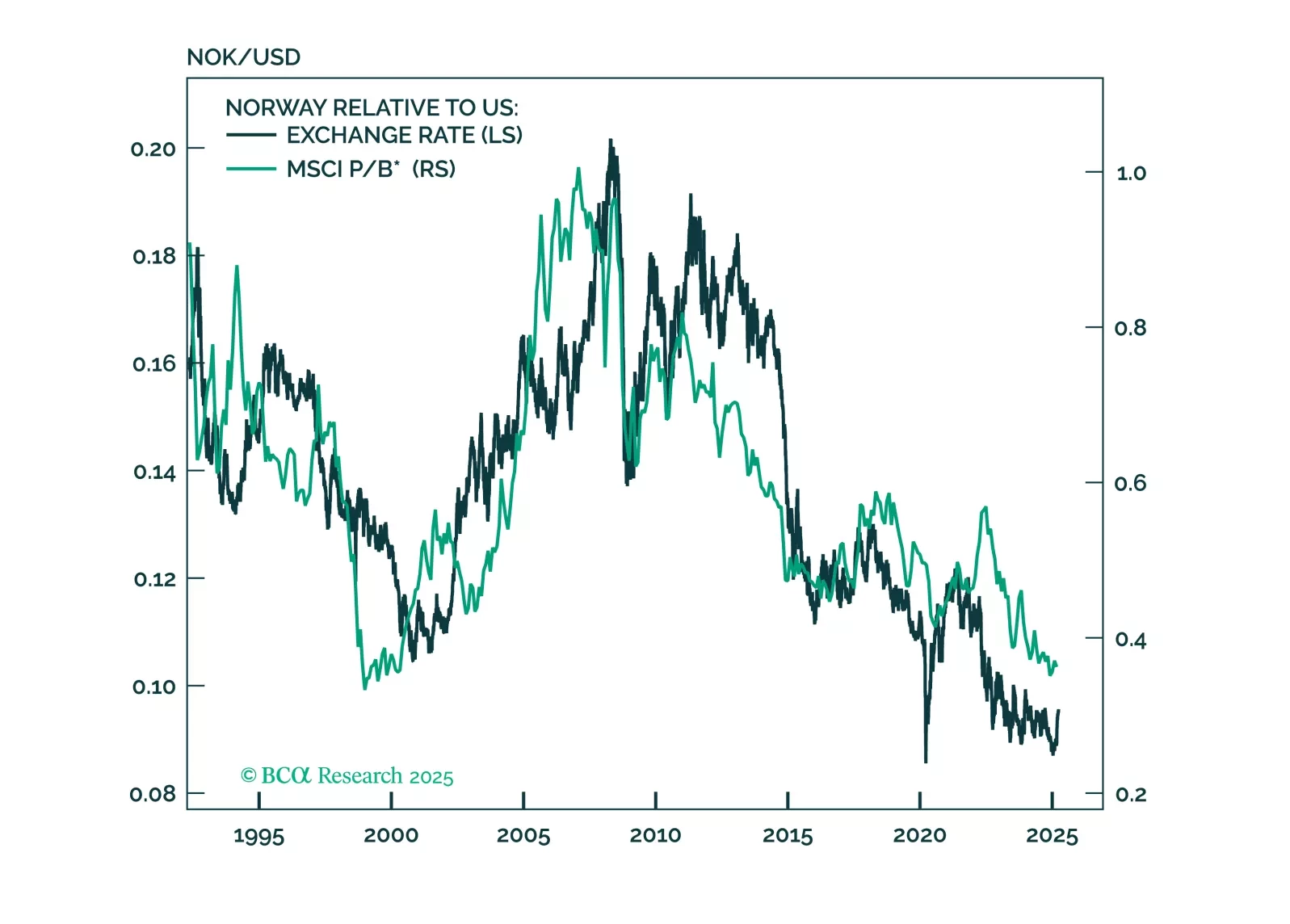
This report looks at investment implications, for Norwegian assets, given the recent meeting, from the Norges Bank.

China’s oil demand growth will moderate to a still robust 4%-6% in the next six-to-nine months. We recommend that investors in China’s onshore and offshore stock indexes overweight energy producers.
Executive Summary Earnings Growth Outpacing Multiple Expansion
Energy: After Seven Lean Years (Part II)
The US Energy sector is in a good place right now: Rising demand and faltering supply from OPEC 2.0 translate into a price of oil anchored at around $80 to $85/bbl. This price is twice the breakeven production cost for the majority of US producers. High prices have also created an opening for US Energy producers to restart Capex to increase production. Further, the Energy sector tends to outperform in an environment of high inflation and rising rates. As a real asset, oil is also a good inflation hedge, a quality that extends to Energy-related equities. The favorable macro backdrop is also complimented by bombed-out valuation. Meanwhile, technicals are overbought signaling that a near-term pause is needed for prices to reset. Bottom Line: We reiterate our cyclical overweight in the Energy sector, despite the rising probability or a near-term pullback. Within Energy, we recommend a cyclical overweight of the upstream and equipment & services segments, underweight midstream, and equal weight downstream and integrated stocks. Feature Dear client, In lieu of the February 28th publication, we will be sending you a Special Report on Wednesday, February 23rd written by our US Political Strategy service colleagues. Our regular weekly publication will resume Monday, March 7th. Kind Regards, Irene Tunkel Chief Strategist, US Equity Strategy Part I Recap Last week, in Part I of this Special Report, we described the structure of the Energy sector, its value chain, key industry drivers, and supply/demand/oil price dynamics. The Energy value chain consists of four distinct segments, with each segment corresponding to a section of the oil production value chain. The GICS classifies them as Oil & Gas Exploration and Production (Upstream or E&P), Oil & Gas Equipment and Services (E&S), Storage and Transportation (Midstream or S&T), and Refining and Marketing (Downstream or R&M). Integrated Oil & Gas straddles the entire supply chain (Integrated). Demand exceeds supply: We concluded that crude oil demand is expected to return to trend, driven by strong economic growth and the receding pandemic. In the meantime, production remains suppressed because of curtailments by OPEC 2.0 members, investment restraint from US producers, and multiple supply disruptions. Sizzling tensions with Iran, Russia, and a possible new market share war with the Saudis exacerbate supply problems and lead to heightened volatility in crude oil prices. The US Energy producers are ramping up supply: To meet the increasing oil demand, US shale oil producers are now perfectly positioned to pick up the slack in supply. To ramp up production, the US oil companies will have to invest in new and existing wells, starting a new Capex cycle, after “seven lean years” of Capex (Chart 1). There are early signs that the US Energy sector is in the early innings of new Capex and production. This week, we rely on our investment process, i.e., analysis of the macroeconomic backdrop, fundamentals, valuations, and technicals to shape our view on each segment of the Energy value chain. We are currently overweight the Energy sector and are ahead of the benchmark by 35%. Chart 1The Energy Industry Is In The Early Innings Of New Capex Cycle
The Energy Industry Is In The Early Innings Of New Capex Cycle
Macroeconomic Backdrop Can Withstand Rising Rates And High Inflation The Energy sector tends to outperform in the environment of high inflation and rising rates (Chart 2). As a real asset, oil is also a good inflation hedge, a quality that extends to Energy-related equities. Appreciating Dollar Is A Temporary Phenomenon There is a tight inverse relationship between the USD and energy prices due to the simple fact that commodity prices are quoted in dollars. Over the past seven years, the nominal WTI oil price has been over 70% inversely correlated with the strength of the USD trade-weighted index (TWI), with a beta of oil to USD of -1.6. That is, a 1% change in the TWI would be expected to translate into a $1.60/barrel change in the price of WTI (Chart 3). Chart 2The Energy Sector Is Resilient To Rising Rates
Energy: After Seven Lean Years (Part II)
Chart 3Price Of Oil And USD Are Inversely Correlated
Price Of Oil And USD Are Inversely Correlated
According to the BCA Research FX Strategy team, the recent dollar strengthening is a temporary phenomenon, catalyzed by the rising interest-rate differential with the rest of the world. However, historically, equity portfolio flows have been more important than other factors in explaining dollar moves. Rising rates undermine the performance of US equities and are likely to lead to a reversal in cross-border equity flows, damaging the key pillar of support for the dollar. Hence, risks to the dollar are on the downside. Fundamentals And Valuations The Energy Sector Is Enjoying Strong Sales EIA reports that “global oil consumption outpaced oil production for the six consecutive quarters, ending with the fourth quarter of 2021 (4Q21), which has led to persistent withdrawals from global oil inventories and significant increases in crude oil prices”.1 As a result of higher production, and WTI prices increasing from $52 to $85 over 2021, energy company sales have soared (Chart 4). Looking ahead, we expect sales growth to remain robust, albeit lower than in 2021: Not only are comparables more challenging, but economic growth is also decelerating. What can bring the strong sales growth to a halt? The answer is that it may be either higher prices or higher volumes: Surging prices destroy demand while surging volumes suppress oil prices, which, eventually, weigh on Capex and production. At the moment, both production levels and price are in a sweet spot: All segments of the value chain are benefiting from high but not excessive prices and volumes. Chart 4Energy Sales Surged In 2021
Energy Sales Surged In 2021
Chart 5Sector Profitability Is Tied To The Price Of Oil
Sector Profitability Is Tied To The Price Of Oil
Profit Recovery Continues The overall profitability of the Energy sector is also tightly linked to the price of oil (Chart 5). The BCA Research house view is WTI centered around $80-85, with substantial volatility triggered by geopolitical tensions. With oil prices likely peaking, barring any negative geopolitical developments, earnings growth normalization off the high levels is expected (Chart 6). However, even if they are slowing, Energy sector earnings are expected to grow by 26% over the next 12 months, exceeding S&P 500 earnings by 17%. Further, over the next five years, energy earnings growth is expected to re-accelerate towards the 26% range. Chart 6Energy Sector's Earnings Growth To Exceed The Market's
Energy Sector's Earnings Growth To Exceed The Market's
Chart 7Margins To Continue To Expand
Margins To Continue To Expand
Importantly, sector operating margins are expected to expand towards 10% (Chart 7), which is quite a feat considering the broad-based margin contraction of the other S&P 500 sectors and industries. Our verdict? Earnings growth expectations look darn good! Despite Recent Outperformance, Valuations Are Still Attractive The BCA valuation indicator, which is a composite of P/B, P/S, and DY relative to the S&P 500, standardized relative to its own history, shows that the sector is still undervalued (Chart 8), despite a recent run of performance – earnings growth still outpaces multiple expansion (Chart 9). The energy sector is currently trading with a nearly 40% discount to the S&P 500 (Table 1) on a forward earnings basis (12.4x vs 20.3x). Chart 8Still Undervalued…
Still Undervalued…
Still Undervalued…
Chart 9Earnings Growth Outpacing Multiple Expansion
Energy: After Seven Lean Years (Part II)
Table 1Valuation Summary
Energy: After Seven Lean Years (Part II)
Cheap But Overbought! Curiously, despite modest valuations, from a technical standpoint the sector appears overbought (Chart 10). Worse yet, our Energy Sentiment Composite is outright in the bullish zone (Chart 11) with a reading last achieved in 2009. This is certainly concerning, as euphoria is inevitably followed by panic and disappointment. However, we need to keep in mind that the technical indicators are short term in scope by design, and their main use is to help refine the position entry and exit timing. Chart 10...But Overbought!
...But Overbought!
...But Overbought!
Chart 11Sentiment Is Extended
Sentiment Is Extended
Why such a pronounced dichotomy with valuations? Technical indicators are based on returns, which have been rather outstanding for the sector, while valuations take into account earnings growth, which explains and justifies the surging returns. Too Much Cash Our analysis would be amiss if we did not bring energy companies’ free cash flow (FCF) into the discussion. With a curtailed supply of energy and rising prices, these companies have been awash in cash (Chart 12) – their FCF has increased by nearly 80% year over year, and profits have surged. What will companies do with this windfall? Well, first and foremost, during the seven lean years of extreme Capex discipline, these companies have gotten their commitment to returning cash to shareholders embedded in the corporate psyche, which is something that is unlikely to change fast. Energy continues to be the highest-yielding sector in the S&P 500 (Chart 13). However, having learned the lesson the hard way, many companies are adopting variable dividends to avoid potential disappointment if the oil price collapses. In addition to disbursing cash, the energy companies are paying off debt and are investing in expanding production. Chart 12Windfall Of Cash
Windfall Of Cash
Windfall Of Cash
Chart 13Energy Is The Highest Yielding Sector
Energy: After Seven Lean Years (Part II)
Investment Outlook By Segments Of The Energy Value Chain The macroeconomic backdrop for Energy appears benign, with rates rising, inflation elevated, and the dollar likely contained. The sector also appears attractive from both a profitability and a valuation standpoint. However, a near-term pullback is likely as the sentiment around the sector is overly bullish – but that is likely to be short-lived. While we like the sector overall, we aim to provide granular industry group recommendations. To do so, we will zoom in on each segment of the value chain. Oil And Gas Exploration & Production (Upstream) Strong demand recovery and OPEC 2.0 oil production shortages bode well for the US E&P companies, which are cautiously starting to restart capital investment and ramp up production. We expect the E&P, especially shale oil production, companies to be one of the best performing energy subsectors, with WTI anchored around a consensus of $80-85/bbl. The upstream segment is highly dependent on the price of oil, which is currently in a sweet spot: High but not high enough to cause demand destruction (Chart 14). With oil prices peaking, E&P sales growth is decelerating (Chart 15). However, upstream also benefits from the sustainable cost reductions achieved through improved experience in well siting, drilling, and completion techniques. Chart 14Upstream Earnings Depend On The Price Oil
Upstream Earnings Depend On The Price Oil
Chart 15Sales Growth Is Normalizing
Sales Growth Is Normalizing
As a result of growing, albeit decelerating, sales and effective cost management, E&P is one of the most profitable segments of the energy complex: Operating margins are currently at 22% and are expected to expand to 27% (Chart 16). From a valuation standpoint, the industry is trading at 10 times forward earnings, which represents an 50% discount to the S&P 500. The BCA valuation indicator for the industry group is also in the undervalued territory (Chart 17). Chart 16Margins To Continue To Expand
Margins To Continue To Expand
Chart 17E&P Is Still Cheap
E&P Is Still Cheap
E&P Is Still Cheap
Overweight Oil and Gas Exploration & Production industry Equipment And Services Is A High Octane Play On The New Capex Cycle Upstream Capex is revenue for E&S companies. After “seven lean years” of the Capex cycle, the fortunes of E&S companies are finally turning, with a rising price of oil finally enticing upstream companies to expand production by reopening existing and drilling new wells (Chart 18). According to CFRA, upstream Capex is expected to increase by 25% in 2022, and 7% in 2023. With the new energy Capex cycle in sight, Oil Services is the only energy segment for which sales growth is expected to accelerate over the coming year (Chart 19). In fact, sales will continue to grow at a healthy clip until the cycle matures – a time period measured in years. Chart 18Capex Has Restarted
Capex Has Restarted
Capex Has Restarted
Chart 19Sales Growth Is Rebounding Sharply
Sales Growth Is Rebounding Sharply
The profitability of the sector is also normalizing after a pandemic slump, and margins are expected to stay flat (Chart 20) despite industry labor costs rising sharply to 8% year over year (Chart 21). Earnings are expected to rise by a third in 2022, albeit off very low levels. Chart 20Profit Margins Will Stabilize
Profit Margins Will Stabilize
Chart 21Rising Wages Are Cutting Into Profitability
Rising Wages Are Cutting Into Profitability
In terms of valuations, the E&S industry is one of the cheapest in the sector, with the BCA Valuations Indicator standing at -1.5 standard deviations below a long-term average. We are positive on the Energy Equipment and Services space, which we consider a high octane play on the upcoming production increases and the new energy cycle. Overweight Energy Equipment and Services Storage And Transportation Will Benefit From Rising Production Volumes The midstream segment is one of the most profitable in the energy supply chain. This industry has high fixed costs, and its profitability is a function of production volume, not oil price. (Chart 22). From that standpoint, the industry is in a good place: US production volume, especially of shale oil, is poised to increase, filling the pipelines and driving sales growth. However, there are also challenges: Pipelines installed in older shales start to see original contractual commitments expiring, resulting in lower cash flows as the pipelines try to re-commit suppliers within a market that has an abundance of pipeline capacity. On the cost side, the S&T segment is seeing an increase in labor costs, with average hourly earnings (AHE) rising close to 10%. Chart 22Production Volume Is A Driver Of Midstream Segment's Profitability
Production Volume Is A Driver Of Midstream Segment's Profitability
With challenges on the sales side and rising costs, it is not surprising that the market expects earnings in the S&T industry to stay flat over the next year or so (Chart 23). Operating profit margins will contract over the next year from the 19% the industry is enjoying now to roughly 14% (Chart 24). Chart 23Midstream Earnings Are To Stay Flat
Midstream Earnings Are To Stay Flat
Chart 24Industry Is Highly Profitable But Margins Are Contracting
Industry Is Highly Profitable But Margins Are Contracting
In addition, it is important to note that pipelines run through public land. The recent tightening of EPA regulations and an administration hostile to fossil fuel may halt or slow down pipeline build-out. This may be a short-term negative as some companies may have to forego some of their investments. Over the long run, this may limit pipeline availability and lead to higher energy transportation and storage costs. Underweight Energy Storage and Transportation Industry Energy Refining And Marketing– Favorable Backdrop But No Oomph Similar to the midstream segment, refiners are a high fixed cost operation, and their business is only loosely dependent on the price of oil. Profitability of downstream companies is a function of capacity utilization of the refining facilities, and the crack spread or price differential between the price of crude and refined oil. Thanks to rising demand for oil, and rising volumes, capacity utilization stands at nearly 90% and is approaching pre-pandemic levels (Chart 25, bottom panel). Crack spreads are also high in absolute terms thanks to low inventories (Chart 25, top panel). Chart 25High Capacity Utilization and Wide Crack Spreads Are A Boon For Downstream…
High Capacity Utilization and Wide Crack Spreads Are A Boon For Downstream…
Chart 26...But Razor-Thin Margins Make The Industry Vulnerable
...But Razor-Thin Margins Make The Industry Vulnerable
With the upstream segment ramping up production, refining volumes should increase, further improving capacity utilization. And while margins are razor-thin, they are projected to increase over the next year (Chart 26). The key concern about the industry is that, with margins this narrow, there is little or no buffer to absorb changes in crack spreads or capacity utilization should oil prices rise or volumes decline. And yet, downstream, while cheap, is more expensive than Oil Services, midstream, or Integrated Oil. Equal-weight Energy Refining and Marketing industry Integrated Oil & Gas Is A Safe Bet Integrated Oil is an industry that is diversified across all the segments of the value chain. The characteristics that allowed Integrated Companies to maintain their stock prices better during the downturn – less financial leverage, less reinvestment volatility, stronger dividend support, and counter-cyclical improvement of downstream operations – will work against these stocks during an oil price recovery. As such, while Integrated stocks should benefit from higher prices and production volumes, this is a lower beta proposition: It is better to own Integrated Oil on the way down, but riskier and higher beta E&P or Oil Services stocks during the up leg of the energy cycle. Equal-Weight Integrated Oil & Gas Investment Implications The US Energy sector is in a good place right now: Rising demand and faltering supply from OPEC 2.0, translates into a price of oil anchored around $80 to $85/bbl. This price is twice the breakeven production cost for the majority of the US producers. Rising oil prices had resulted in windfall profits and surging free cash flow, which the Energy companies are dutifully returning to shareholders. High prices have also created an opening for US Energy producers to restart their Capex to increase production. This positive stance of upstream companies is benefiting the entire supply chain. Energy Equipment and Services providers are enjoying accelerated sales growth as E&P increases Capex. Transportation and storage companies are benefiting from higher volumes. And last, the downstream segment benefits from high-capacity utilization of its refineries and wide crack spreads thanks to low refined oil inventories. We are cyclically positive on the Energy sector, the fundamentals of which are solid, and for which valuations are modest. However, overextended technicals indicate that a near-term correction after a strong run is highly likely. We won’t sell to avoid the pullback but will use it as an opportunity to add to the existing positions. Within the Energy Sector, we are constructive on the upstream and E&S segments, both of which benefit from the high price of oil. We are less keen on the midstream segment, which, despite the benefits of increased production volume, is handicapped by rising labor costs, and expiring transportation contracts. And lastly, we are equal-weight the downstream segment, which, despite rising volumes and wide crack spreads, has razor-thin margins. Integrated Oil is the most diversified segment, which is more resilient during the down leg of the energy cycle, but too tame during the upcycle. Bottom Line We recommend a cyclical overweight to the Energy sector as it is in the early innings of the new energy cycle, thanks to surging demand and constrained production capacity out of the US. It is also the highest yielding sector in the S&P 500. However, a near-term pullback after a strong run is likely – we will leverage it to add to our existing overweight. We also recommend a cyclical overweight of the upstream and Oil Equipment & Services segment, underweight midstream, and equal weight downstream. Irene Tunkel Chief Strategist, US Equity Strategy irene.tunkel@bcaresearch.com Footnotes 1 https://www.eia.gov/outlooks/steo/ Recommended Allocation
Overweight Quarter-to-date the S&P energy services index is up 12% compared with the 2% rise in the broad market. While the steep rebound in oil prices primarily lies behind such stellar outperformance (top panel), our capex upcycle theme for 2018 should support this nascent recovery. Energy related capital spending budgets are not only rising in the U.S. (primarily in shale oil), but also globally. The global rig count is breaking out, and declining OECD oil stocks suggest that drilling activity will remain robust (second and third panels). Relative share price momentum does not yet fully reflect the rebound in industry investment (using national accounts) that remains in a V-shaped recovery since the Q1/2016 oil market trough (bottom panel). In sum, there are more gains in store for the S&P energy services index. Firming industry demand at a time when global energy capital spending budgets are renormalizing, along with rising crude oil prices, signal that high-beta energy services equities have more running room. Bottom Line: Stay overweight the S&P energy service index and see our Weekly Report for more details. The ticker symbols for the stocks in this index are: BLBG: S5ENRE: NOV, SLB, FTI, BHGE, HAL, HP.
CHART 12 Energy Servicers: The Phoenix Is Rising
Energy services shares have pulled back as oil prices have marked time over the last few weeks, but in the background, the conditions to sustain a rally are falling into place. The growth in total OECD oil stocks has rolled over decisively, and a continued supply/demand rebalancing should occur given that world oil production growth has slipped to nil courtesy of OPEC output cuts. The bond market has increased confidence that oil prices will not tumble anew, as reflected in the sharp narrowing in energy corporate bond spreads. Many companies have used the recovery in oil prices to refinance and bolster balance sheets, underscoring that the financial means to boost exploration exist. With energy services pricing power trying to make an early exit from deflation on only a small boost to the global rig count, there is scope for the attractively valued S&P oil & gas field services index to surprise on the upside. We have this at high-conviction overweight. The ticker symbols for the stocks in the S&P oil & gas field services index are: BLBG: S5ENRE - SLB, HAL, BHI, NOV, FTI, HP, RIG.
Energy Services Have Lagged, But Not For Long
Highlights Portfolio Strategy If the Fed is about to begin interest rate re-normalization in earnest, then investors should heed the message from historic sector performance during tightening cycles. The tech sector remains vulnerable to tighter monetary conditions. Downshift communications equipment to neutral and stay clear of software. The OPEC supply agreement reinforces our current energy sector bias, overweight oil services and underweight refiners. Recent Changes S&P Communications Equipment - Reduce to neutral. Table 1
Prepare For The Return Of Equity Volatility
Feature Chart 1Why Is Equity Vol So Low?
bca.uses_wr_2016_12_12_c1
The equity market has been in a remarkably low volatility uptrend in recent weeks, powered by hopes that political regime shifts will invigorate growth. Signs of economic life have also played a role. The risk is that investors have pulled forward profit growth expectations on the basis of anticipated fiscal stimulus that may disappoint. In the meantime, the tighter domestic monetary conditions get, the less likely equity resilience can persist, especially in the face of rising instability in other financial markets. Volatility has jumped across asset classes, with the bond market leading the charge. The MOVE index of Treasury bond volatility has spiked. Typically, the MOVE leads the VIX index of implied equity market volatility (Chart 1, second panel). Currency and commodity price volatility has also picked up. It would be dangerous to assume that the equity market can remain so sedate. If the economy is about to grow in line with analysts double-digit profit growth expectations and/or what the surge in some cyclical sectors would suggest, then a re-pricing of Fed interest rate hike expectations is likely to persist. Against this backdrop, it is instructive to revisit historic sector performance during past Fed tightening cycles. If one views the next interest rate hike as the start of a sustained trend based on the steep trajectory of expected profit growth embedded in valuations and forecasts, then it is useful to use that as a starting point rather than last year's token 'one and done' interest rate hike. Charts 2 and 3 show the one-year and two-year average sector relative returns after Fed tightening cycles have commenced. A clear pattern is evident: defensive sectors have been the best performers by a wide margin, followed by financials, while cyclical sectors have underperformed over both time horizons. To be sure, every cycle is different, but this is a useful frame of reference for investors that have ramped up growth and cyclical sector earnings expectations in recent months. There has already been considerable tightening based on the Shadow Fed Funds Rate, a bond market-derived fed funds rate not bound by zero percent (Chart 4, shown inverted, top panel). The latter foreshadows a much tougher slog for the broad market. The point is that tighter monetary conditions can overwhelm valuation multiples and growth expectations. Chart 212-Month Performance After Fed Hikes
Prepare For The Return Of Equity Volatility
Chart 324-Month Performance After Fed Hikes
Prepare For The Return Of Equity Volatility
Chart 4A Blow-Off Top?
A Blow-Off Top?
A Blow-Off Top?
The violent sub-surface equity rotation has presented a number of rebalancing opportunities. The defensive health care and consumer staples sectors have been shunned in recent weeks, with capital rotating into financials and industrials. As discussed previously, the industrials and materials sectors cannot rise in tandem for long with the U.S. dollar. These sectors should be used as a source of funds to take advantage of value creation in consumer discretionary, staples and health care where value has reappeared. Chart 5It's Not A ''Growth'' Trade
bca.uses_wr_2016_12_12_c5
Indeed, the abrupt jump in the cyclical vs. defensive share price ratio appears to have been driven solely by external forces, i.e. the sell-off in the bond market, rather than a shift in underlying operating profit drivers. For instance, emerging market (EM) equities and the cyclical vs. defensive share price ratio have tended to move hand-in-hand (Chart 5). The former are pro-cyclical, and outperform when economic growth prospects are perceived to be improving. Recent sharp EM underperformance has created a large negative divergence with the U.S. cyclical vs. defensive share price ratio. The surging U.S. dollar is a growth impediment for many developing countries with large foreign debt liabilities, and the lack of EM equity participation reinforces that the recent rise in industrials is not a one way bet. As a result, our preferred cyclical sector exposure lies in the consumer discretionary sector, and not in capital spending-geared deep cyclical sectors. A market weight in financials, utilities and energy is warranted, as discussed below, while the tech sector is vulnerable. A Roundtrip For The Tech Sector? After a semiconductor M&A-driven spurt of strength, the S&P technology sector has stumbled. As a long duration sector, technology has borne a disproportionate share of the backlash from a higher discount rate, similar to the taper-tantrum period in 2013. Then, bond yields soared as the Fed floated trial balloons about tapering QE. Tech stocks did not trough until yields peaked (Chart 6). In addition, a recovery in tech new orders confirmed that the sales outlook had brightened. Now, the capital spending outlook remains shaky, and tech new order growth is nil (Chart 6). Meanwhile, tech pricing power has nosedived (Chart 6). Domestic deflationary pressures are likely to intensify as the U.S. dollar appreciates, particularly against the manufacturing and tech-sensitive emerging Asian currencies. Tech sales growth is already sliding rapidly toward negative territory (Chart 7), with no reprieve in sight based on the contraction in emerging market exports, as well as U.S. consumer and capital goods import prices. Chart 6Tech Doesn't Like Rising Bond Yields
bca.uses_wr_2016_12_12_c6
Chart 7No Sales Growth
bca.uses_wr_2016_12_12_c7
True, tech stocks have a solid relative performance track record when the U.S. dollar initially embarks on a long-term bull market (Chart 8). Why? Because tech business models incorporate deflationary conditions, investors have been comfortable bidding up valuations in excess of the negative sales impact from a stronger U.S. dollar. Nevertheless, history shows that this relationship becomes untenable the longer currency appreciation persists. Chart 8 shows that in the final phase of the past two U.S. dollar bull markets, tech stocks have abruptly reversed course, rapidly ceding the previously accrued gains. Apart from a loss of competitiveness from currency strength, the new anti-globalization trend is bad for tech as it has the highest foreign sales exposure. The bottom line is that there is no rush to lift underweight tech sector allocations. In fact, we are further tweaking weightings to reduce exposure. For instance, software companies are worth another look through a bearish lens. Software sales growth is at risk from pricing power slippage amidst cooling final demand (Chart 9). Chart 8Beware Phase II Of Dollar Bull Markets
bca.uses_wr_2016_12_12_c8
Chart 9Sell Software...
bca.uses_wr_2016_12_12_c9
The financial sector is an influential technology sector end market. On the margin, financial companies are likely to reduce capital spending on the back of deteriorating credit quality. Chart 9 demonstrates that when financial sector corporate bond ratings start to trend negatively, it is a sign that software investment will stumble. A similar message is emanating from the decline in overall CEO confidence (Chart 10), which mirrors the relentless narrowing in the gap between the return on and cost of capital (Chart 8, bottom panel). Even C&I bank loans, previously an economic bright spot, are signaling that corporate sector demand for external funds and working capital are softening, consistent with slower capital spending. Against a backdrop of fading software M&A activity, we are skeptical that the S&P software index can maintain its premium valuation (Chart 11). Chart 10... Before Sales Erode
bca.uses_wr_2016_12_12_c10
Chart 11Not Worth A Premium
bca.uses_wr_2016_12_12_c11
Elsewhere, the communications equipment industry will have trouble sustaining this summer's outperformance. Communications equipment stocks broke out of a long-term downward sloping trend-line on the back of productivity improvement. Chart 12 shows that after a period of intense cost cutting, wage inflation was negative. Our productivity proxy, defined as sales/employment, is growing rapidly. These trends are supportive of profit margins, and at least a modest valuation re-rating from washed out levels. Nevertheless, our confidence that a major bullish trend change has occurred after years of underperformance has been shaken. The budding reacceleration in top-line growth has hit a snag. New orders for communications equipment have rolled over relative to inventories. Investment in communications equipment has dipped (Chart 13). The telecom services sector has scaled back capital spending (Chart 13, third panel), suggesting that final demand will continue to soften. It will be difficult for companies to maintain high productivity if revenue growth stagnates. Chart 12Productivity Strength...
bca.uses_wr_2016_12_12_c12
Chart 13... May Be Pressured
bca.uses_wr_2016_12_12_c13
Consequently, the most likely scenario is that relative performance is entering a base-building phase rather than a new bull market, warranting benchmark weightings. Bottom Line: Reduce the S&P communications equipment index (BLBG: S5COMM - CSCO, MSI, HRS, JNPR, FFIV) to neutral, in a move to further reduce underweight tech sector exposure. Stay underweight software (BLBG: S5SOFT - MSFT, ORCL, ADBE, CRM, INTU, ATVI, EA, ADSK, SYMC, RHT, CTXS, CA). Energy Strategy Post-OPEC Production Cut Chart 14Energy Stocks Need Rising Oil Prices
bca.uses_wr_2016_12_12_c14
The energy sector continues to mark time relative to the broad market, but that has masked furious sub-surface movement. We have maintained a benchmark exposure to the broad sector since the spring, but shifted our sub-industry exposure in October to favor oil field services over producers, while underemphasizing refiners. OPEC's recent agreement to trim flatters this positioning. Whether OPEC's announcement actually feeds through into meaningfully lower production next year and higher oil prices remains to be seen, but at a minimum, supply discipline should put a floor under prices. Rather than expecting the overall energy sector to break out of its lateral move relative to the broad market, we continue to recommend a targeted approach. The energy sector requires sustained higher commodity prices to outperform, and our concern is that a trading range is more likely (Chart 14). OPEC producers suffered considerable pain over the last two years as they overproduced in order to starve marginal producers of the capital needed for reinvestment. U.S. shale producers slashed capital expenditures by 65% from 2014 to 2016, and the International Oil Companies (IOCs) cut capital expenditures by 40% over the same period. Chart 15 shows that only OPEC has been expanding production. That has set the stage for limited global production growth, allowing for demand growth to eat into overstocked crude inventories in the coming years. OPEC's decision to trim output should mitigate downside commodity price risks, providing debt and equity markets with confidence to increase capital availability to the sector. With a lower cost and easier access to capital, producers, especially shale, will be able to accelerate drilling programs. The rig count has already troughed. The growth in OECD oil inventories has crested, which is consistent with a gradual rise in the number of active drilling rigs. As oversupply is absorbed, investment in oil field services will accelerate, unlocking relative value in the energy services space (Chart 16). Chart 15OPEC Cuts Would Help...
bca.uses_wr_2016_12_12_c15
Chart 16... Erode Excess Oil Supply
bca.uses_wr_2016_12_12_c16
This overweight position is still high risk, because it will take time to absorb the excesses from the previous drilling cycle. There is still considerable overcapacity in the oil field services industry, as measured by our idle rig proxy. Pricing power does not typically return until the latter rises above 1 (Chart 17). Companies will be eager to put crews to work and better cover overhead, and may accept suboptimal pricing, at least initially. Meanwhile, if EM currencies continue to weaken, confidence in EM oil demand growth may be shaken, eroding valuations. Still, we are willing to accept these risks, but will keep this overweight position on a tight leash and will take profits if OPEC does not follow through with plans to limit production. On the flipside, refiners will not receive any relief in feedstock prices, which should ensure that the gap between Brent and WTI prices remains non-existent (Chart 18). That is a strain on refining margins. Our model warns that there is little profit upside ahead. That is confirmed by both domestic and global trends. Chart 17Risks To A Sustained Rally
bca.uses_wr_2016_12_12_c17
Chart 18Sell Refiners
bca.uses_wr_2016_12_12_c18
Chart 19Global Capacity Growth
bca.uses_wr_2016_12_12_c19
Refiners have continued to produce flat out, even as domestic crude production has dropped (Chart 18). As a result, inventories of gasoline and distillates have surged, despite solid consumption growth. In fact, refined product output is about to eclipse the rate of consumption growth, which implies persistently swelling inventories. There is no export outlet to relieve excess supply. U.S. exports are becoming much less competitive on the back of U.S. dollar strength and the elimination of the gap between WTI and Brent input costs (Chart 19). Moreover, rising capacity abroad has trigged an acceleration of refined product exports in a number of low cost producer countries, including India, China and Saudi Arabia (Chart 19). Increased global refining capacity is a structural trend, and will keep valuation multiples lower than otherwise would be the case. The relative price/sales ratio is testing cyclical peaks, warning that downside risks remain acute. Bottom Line: Maintain a neutral overall sector weighting, with outsized exposure to the oil & gas field services industry (BLBG: S5ENRE - SLB, HAL, BHI, NOV, HP, FTI, RIG), and undersized allocations to the refining group (BLBG: S5OILR - PSX, VLO, MPC, TSO). Current Recommendations Current Trades Size And Style Views Favor small over large caps and growth over value.
The mini-consolidation in equities reflects the ongoing tension between market-supportive liquidity and a sketchy corporate profit backdrop.