Sorry, you need to enable JavaScript to visit this website.
Skip to main content

Oil & Gas Refining & Marketing

One commodity that has not reacted to the bullish demand-side news from the Politburo (see The Numbers) is crude oil. Brent shed over 2% on Thursday, in sharp contrast to Copper’s gains. Oil markets seem to be reacting to a bearish supply-side development…
According to BCA Research’s Geopolitical Strategy service, seven surprises with non-negligible odds could tip the scale in favor of Republicans for the White House by November 5. One of them is a war between Israel and Iran. Iran is still highly likely to…
The decline in oil prices accelerated this month. Although Wednesday’s moves reversed Tuesday’s sharp daily declines, Brent and WTI have fallen 11% and 10% so far in September, and 30% and 33% from their April peaks. Deteriorating demand likely drove these…
European regulatory carbon credits (EUAs) are becoming increasingly investable as an asset class. In a Special Report published last September, our Global Investment strategists agreed to the strategic bull case for EUAs, but highlighted a bearish view on…

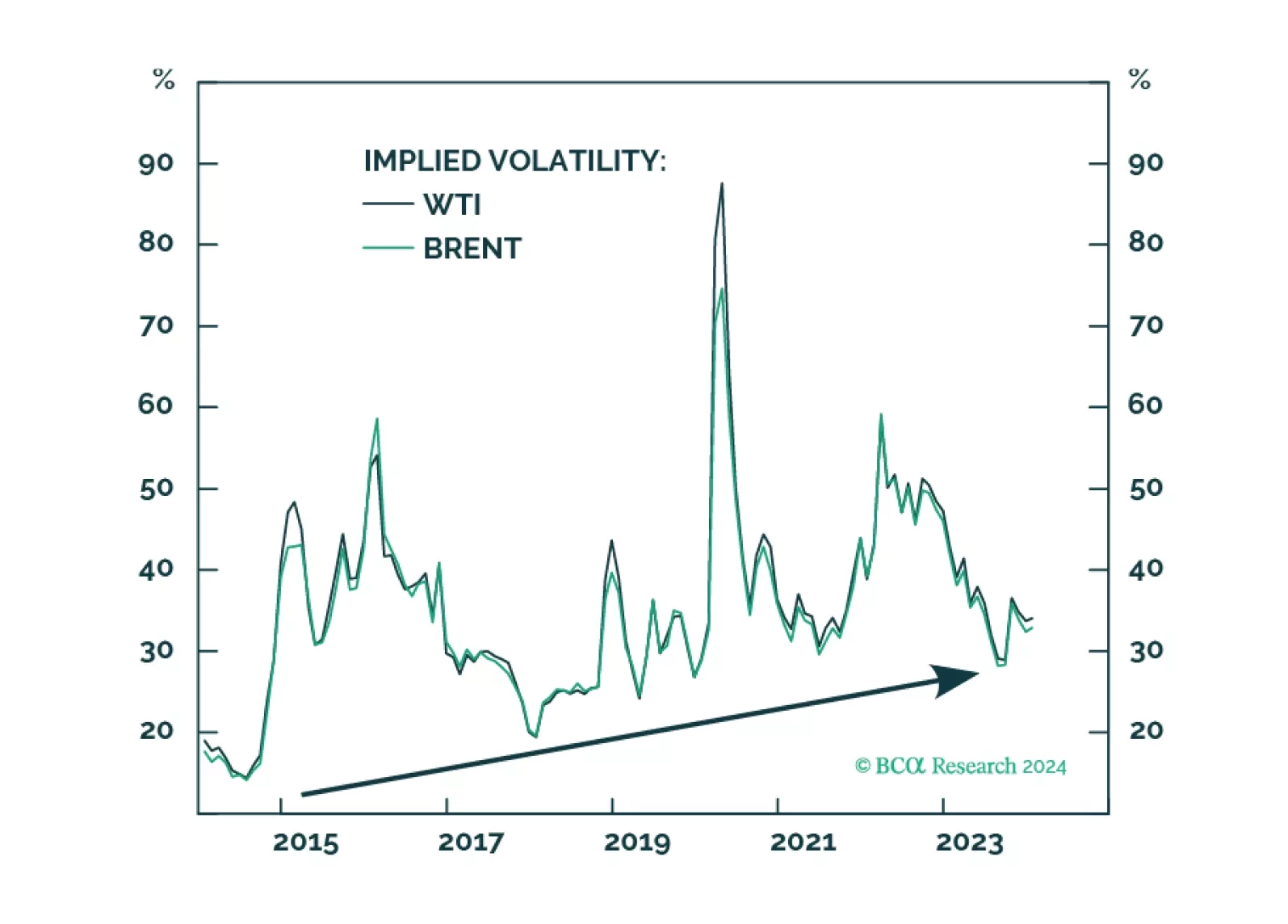
Commodity volatility will continue its rising trend since 2014. The US is on the brink of a major election, the outcome of which could reduce its willingness to engage with the outside world. So, states seeking to carve out their own spheres of influence are incentivized to raise the economic costs to the US and discourage its influence in their regions. These states can do this by interfering in key trading routes in their regions. As a result, geopolitical threats to maritime chokepoints are a structural as well as cyclical problem and will persist due to the revival of superpower competition.

China’s oil demand growth will moderate to a still robust 4%-6% in the next six-to-nine months. We recommend that investors in China’s onshore and offshore stock indexes overweight energy producers.

Executive Summary Earnings Growth Outpacing Multiple Expansion Energy: After Seven Lean Years (Part II) Energy: After Seven Lean Years (Part II) The US Energy sector is in a good place right now: Rising demand and faltering supply from OPEC 2.0 translate into a price of oil anchored at around $80 to $85/bbl. This price is twice the breakeven production cost for the majority of US producers. High prices have also created an opening for US Energy producers to restart Capex to increase production. Further, the Energy sector tends to outperform in an environment of high inflation and rising rates. As a real asset, oil is also a good inflation hedge, a quality that extends to Energy-related equities.  The favorable macro backdrop is also complimented by bombed-out valuation. Meanwhile, technicals are overbought signaling that a near-term pause is needed for prices to reset. Bottom Line: We reiterate our cyclical overweight in the Energy sector, despite the rising probability or a near-term pullback. Within Energy, we recommend a cyclical overweight of the upstream and equipment & services segments, underweight midstream, and equal weight downstream and integrated stocks.  Feature Dear client, In lieu of the February 28th publication, we will be sending you a Special Report on Wednesday, February 23rd written by our US Political Strategy service colleagues. Our regular weekly publication will resume Monday, March 7th. Kind Regards, Irene Tunkel Chief Strategist, US Equity Strategy Part I Recap Last week, in Part I of this Special Report, we described the structure of the Energy sector, its value chain, key industry drivers, and supply/demand/oil price dynamics. The Energy value chain consists of four distinct segments, with each segment corresponding to a section of the oil production value chain. The GICS classifies them as Oil & Gas Exploration and Production (Upstream or E&P), Oil & Gas Equipment and Services (E&S), Storage and Transportation (Midstream or S&T), and Refining and Marketing (Downstream or R&M). Integrated Oil & Gas straddles the entire supply chain (Integrated). Demand exceeds supply: We concluded that crude oil demand is expected to return to trend, driven by strong economic growth and the receding pandemic. In the meantime, production remains suppressed because of curtailments by OPEC 2.0 members, investment restraint from US producers, and multiple supply disruptions. Sizzling tensions with Iran, Russia, and a possible new market share war with the Saudis exacerbate supply problems and lead to heightened volatility in crude oil prices. The US Energy producers are ramping up supply: To meet the increasing oil demand, US shale oil producers are now perfectly positioned to pick up the slack in supply. To ramp up production, the US oil companies will have to invest in new and existing wells, starting a new Capex cycle, after “seven lean years” of Capex (Chart 1). There are early signs that the US Energy sector is in the early innings of new Capex and production. This week, we rely on our investment process, i.e., analysis of the macroeconomic backdrop, fundamentals, valuations, and technicals to shape our view on each segment of the Energy value chain. We are currently overweight the Energy sector and are ahead of the benchmark by 35%. Chart 1The Energy Industry Is In The Early Innings Of New Capex Cycle The Energy Industry Is In The Early Innings Of New Capex Cycle The Energy Industry Is In The Early Innings Of New Capex Cycle Macroeconomic Backdrop Can Withstand Rising Rates And High Inflation The Energy sector tends to outperform in the environment of high inflation and rising rates (Chart 2). As a real asset, oil is also a good inflation hedge, a quality that extends to Energy-related equities. Appreciating Dollar Is A Temporary Phenomenon There is a tight inverse relationship between the USD and energy prices due to the simple fact that commodity prices are quoted in dollars. Over the past seven years, the nominal WTI oil price has been over 70% inversely correlated with the strength of the USD trade-weighted index (TWI), with a beta of oil to USD of -1.6. That is, a 1% change in the TWI would be expected to translate into a $1.60/barrel change in the price of WTI (Chart 3). Chart 2The Energy Sector Is Resilient To Rising Rates Energy: After Seven Lean Years (Part II) Energy: After Seven Lean Years (Part II) Chart 3Price Of Oil And USD Are Inversely Correlated Price Of Oil And USD Are Inversely Correlated Price Of Oil And USD Are Inversely Correlated According to the BCA Research FX Strategy team, the recent dollar strengthening is a temporary phenomenon, catalyzed by the rising interest-rate differential with the rest of the world. However, historically, equity portfolio flows have been more important than other factors in explaining dollar moves. Rising rates undermine the performance of US equities and are likely to lead to a reversal in cross-border equity flows, damaging the key pillar of support for the dollar. Hence, risks to the dollar are on the downside. Fundamentals And Valuations The Energy Sector Is Enjoying Strong Sales EIA reports that “global oil consumption outpaced oil production for the six consecutive quarters, ending with the fourth quarter of 2021 (4Q21), which has led to persistent withdrawals from global oil inventories and significant increases in crude oil prices”.1 As a result of higher production, and WTI prices increasing from $52 to $85 over 2021, energy company sales have soared (Chart 4). Looking ahead, we expect sales growth to remain robust, albeit lower than in 2021: Not only are comparables more challenging, but economic growth is also decelerating. What can bring the strong sales growth to a halt? The answer is that it may be either higher prices or higher volumes: Surging prices destroy demand while surging volumes suppress oil prices, which, eventually, weigh on Capex and production. At the moment, both production levels and price are in a sweet spot: All segments of the value chain are benefiting from high but not excessive prices and volumes. Chart 4Energy Sales Surged In 2021 Energy Sales Surged In 2021 Energy Sales Surged In 2021 Chart 5Sector Profitability Is Tied To The Price Of Oil Sector Profitability Is Tied To The Price Of Oil Sector Profitability Is Tied To The Price Of Oil Profit Recovery Continues The overall profitability of the Energy sector is also tightly linked to the price of oil (Chart 5). The BCA Research house view is WTI centered around $80-85, with substantial volatility triggered by geopolitical tensions. With oil prices likely peaking, barring any negative geopolitical developments, earnings growth normalization off the high levels is expected (Chart 6). However, even if they are slowing, Energy sector earnings are expected to grow by 26% over the next 12 months, exceeding S&P 500 earnings by 17%. Further, over the next five years, energy earnings growth is expected to re-accelerate towards the 26% range. Chart 6Energy Sector's Earnings Growth To Exceed The Market's Energy Sector's Earnings Growth To Exceed The Market's Energy Sector's Earnings Growth To Exceed The Market's Chart 7Margins To Continue To Expand Margins To Continue To Expand Margins To Continue To Expand Importantly, sector operating margins are expected to expand towards 10% (Chart 7), which is quite a feat considering the broad-based margin contraction of the other S&P 500 sectors and industries. Our verdict? Earnings growth expectations look darn good! Despite Recent Outperformance, Valuations Are Still Attractive The BCA valuation indicator, which is a composite of P/B, P/S, and DY relative to the S&P 500, standardized relative to its own history, shows that the sector is still undervalued (Chart 8), despite a recent run of performance – earnings growth still outpaces multiple expansion (Chart 9). The energy sector is currently trading with a nearly 40% discount to the S&P 500 (Table 1) on a forward earnings basis (12.4x vs 20.3x). Chart 8Still Undervalued… Still Undervalued… Still Undervalued… Chart 9Earnings Growth Outpacing Multiple Expansion Energy: After Seven Lean Years (Part II) Energy: After Seven Lean Years (Part II) Table 1Valuation Summary Energy: After Seven Lean Years (Part II) Energy: After Seven Lean Years (Part II) Cheap But Overbought! Curiously, despite modest valuations, from a technical standpoint the sector appears overbought (Chart 10). Worse yet, our Energy Sentiment Composite is outright in the bullish zone (Chart 11) with a reading last achieved in 2009. This is certainly concerning, as euphoria is inevitably followed by panic and disappointment. However, we need to keep in mind that the technical indicators are short term in scope by design, and their main use is to help refine the position entry and exit timing. Chart 10...But Overbought! ...But Overbought! ...But Overbought! Chart 11Sentiment Is Extended Sentiment Is Extended Sentiment Is Extended Why such a pronounced dichotomy with valuations? Technical indicators are based on returns, which have been rather outstanding for the sector, while valuations take into account earnings growth, which explains and justifies the surging returns. Too Much Cash Our analysis would be amiss if we did not bring energy companies’ free cash flow (FCF) into the discussion. With a curtailed supply of energy and rising prices, these companies have been awash in cash (Chart 12) – their FCF has increased by nearly 80% year over year, and profits have surged. What will companies do with this windfall? Well, first and foremost, during the seven lean years of extreme Capex discipline, these companies have gotten their commitment to returning cash to shareholders embedded in the corporate psyche, which is something that is unlikely to change fast. Energy continues to be the highest-yielding sector in the S&P 500 (Chart 13). However, having learned the lesson the hard way, many companies are adopting variable dividends to avoid potential disappointment if the oil price collapses. In addition to disbursing cash, the energy companies are paying off debt and are investing in expanding production. Chart 12Windfall Of Cash Windfall Of Cash Windfall Of Cash Chart 13Energy Is The Highest Yielding Sector Energy: After Seven Lean Years (Part II) Energy: After Seven Lean Years (Part II) Investment Outlook By Segments Of The Energy Value Chain The macroeconomic backdrop for Energy appears benign, with rates rising, inflation elevated, and the dollar likely contained. The sector also appears attractive from both a profitability and a valuation standpoint. However, a near-term pullback is likely as the sentiment around the sector is overly bullish – but that is likely to be short-lived. While we like the sector overall, we aim to provide granular industry group recommendations. To do so, we will zoom in on each segment of the value chain. Oil And Gas Exploration & Production (Upstream) Strong demand recovery and OPEC 2.0 oil production shortages bode well for the US E&P companies, which are cautiously starting to restart capital investment and ramp up production. We expect the E&P, especially shale oil production, companies to be one of the best performing energy subsectors, with WTI anchored around a consensus of $80-85/bbl. The upstream segment is highly dependent on the price of oil, which is currently in a sweet spot: High but not high enough to cause demand destruction (Chart 14). With oil prices peaking, E&P sales growth is decelerating (Chart 15). However, upstream also benefits from the sustainable cost reductions achieved through improved experience in well siting, drilling, and completion techniques. Chart 14Upstream Earnings Depend On The Price Oil Upstream Earnings Depend On The Price Oil Upstream Earnings Depend On The Price Oil Chart 15Sales Growth Is Normalizing Sales Growth Is Normalizing Sales Growth Is Normalizing As a result of growing, albeit decelerating, sales and effective cost management, E&P is one of the most profitable segments of the energy complex: Operating margins are currently at 22% and are expected to expand to 27% (Chart 16). From a valuation standpoint, the industry is trading at 10 times forward earnings, which represents an 50% discount to the S&P 500. The BCA valuation indicator for the industry group is also in the undervalued territory (Chart 17). Chart 16Margins To Continue To Expand Margins To Continue To Expand Margins To Continue To Expand Chart 17E&P Is Still Cheap E&P Is Still Cheap E&P Is Still Cheap Overweight Oil and Gas Exploration & Production industry Equipment And Services Is A High Octane Play On The New Capex Cycle Upstream Capex is revenue for E&S companies. After “seven lean years” of the Capex cycle, the fortunes of E&S companies are finally turning, with a rising price of oil finally enticing upstream companies to expand production by reopening existing and drilling new wells (Chart 18). According to CFRA, upstream Capex is expected to increase by 25% in 2022, and 7% in 2023. With the new energy Capex cycle in sight, Oil Services is the only energy segment for which sales growth is expected to accelerate over the coming year (Chart 19). In fact, sales will continue to grow at a healthy clip until the cycle matures – a time period measured in years. Chart 18Capex Has Restarted Capex Has Restarted Capex Has Restarted Chart 19Sales Growth Is Rebounding Sharply Sales Growth Is Rebounding Sharply Sales Growth Is Rebounding Sharply   The profitability of the sector is also normalizing after a pandemic slump, and margins are expected to stay flat (Chart 20) despite industry labor costs rising sharply to 8% year over year (Chart 21). Earnings are expected to rise by a third in 2022, albeit off very low levels. Chart 20Profit Margins Will Stabilize Profit Margins Will Stabilize Profit Margins Will Stabilize Chart 21Rising Wages Are Cutting Into Profitability Rising Wages Are Cutting Into Profitability Rising Wages Are Cutting Into Profitability In terms of valuations, the E&S industry is one of the cheapest in the sector, with the BCA Valuations Indicator standing at -1.5 standard deviations below a long-term average. We are positive on the Energy Equipment and Services space, which we consider a high octane play on the upcoming production increases and the new energy cycle. Overweight Energy Equipment and Services Storage And Transportation Will Benefit From Rising Production Volumes The midstream segment is one of the most profitable in the energy supply chain. This industry has high fixed costs, and its profitability is a function of production volume, not oil price. (Chart 22). From that standpoint, the industry is in a good place: US production volume, especially of shale oil, is poised to increase, filling the pipelines and driving sales growth. However, there are also challenges: Pipelines installed in older shales start to see original contractual commitments expiring, resulting in lower cash flows as the pipelines try to re-commit suppliers within a market that has an abundance of pipeline capacity. On the cost side, the S&T segment is seeing an increase in labor costs, with average hourly earnings (AHE) rising close to 10%. Chart 22Production Volume Is A Driver Of Midstream Segment's Profitability Production Volume Is A Driver Of Midstream Segment's Profitability Production Volume Is A Driver Of Midstream Segment's Profitability With challenges on the sales side and rising costs, it is not surprising that the market expects earnings in the S&T industry to stay flat over the next year or so (Chart 23). Operating profit margins will contract over the next year from the 19% the industry is enjoying now to roughly 14% (Chart 24). Chart 23Midstream Earnings Are To Stay Flat Midstream Earnings Are To Stay Flat Midstream Earnings Are To Stay Flat Chart 24Industry Is Highly Profitable But Margins Are Contracting Industry Is Highly Profitable But Margins Are Contracting Industry Is Highly Profitable But Margins Are Contracting In addition, it is important to note that pipelines run through public land. The recent tightening of EPA regulations and an administration hostile to fossil fuel may halt or slow down pipeline build-out. This may be a short-term negative as some companies may have to forego some of their investments. Over the long run, this may limit pipeline availability and lead to higher energy transportation and storage costs. Underweight Energy Storage and Transportation Industry Energy Refining And Marketing– Favorable Backdrop But No Oomph Similar to the midstream segment, refiners are a high fixed cost operation, and their business is only loosely dependent on the price of oil. Profitability of downstream companies is a function of capacity utilization of the refining facilities, and the crack spread or price differential between the price of crude and refined oil. Thanks to rising demand for oil, and rising volumes, capacity utilization stands at nearly 90% and is approaching pre-pandemic levels (Chart 25, bottom panel). Crack spreads are also high in absolute terms thanks to low inventories (Chart 25, top panel). Chart 25High Capacity Utilization and Wide Crack Spreads Are A Boon For Downstream… High Capacity Utilization and Wide Crack Spreads Are A Boon For Downstream… High Capacity Utilization and Wide Crack Spreads Are A Boon For Downstream… Chart 26...But Razor-Thin Margins Make The Industry Vulnerable ...But Razor-Thin Margins Make The Industry Vulnerable ...But Razor-Thin Margins Make The Industry Vulnerable With the upstream segment ramping up production, refining volumes should increase, further improving capacity utilization. And while margins are razor-thin, they are projected to increase over the next year (Chart 26). The key concern about the industry is that, with margins this narrow, there is little or no buffer to absorb changes in crack spreads or capacity utilization should oil prices rise or volumes decline. And yet, downstream, while cheap, is more expensive than Oil Services, midstream, or Integrated Oil. Equal-weight Energy Refining and Marketing industry Integrated Oil & Gas Is A Safe Bet Integrated Oil is an industry that is diversified across all the segments of the value chain. The characteristics that allowed Integrated Companies to maintain their stock prices better during the downturn – less financial leverage, less reinvestment volatility, stronger dividend support, and counter-cyclical improvement of downstream operations – will work against these stocks during an oil price recovery. As such, while Integrated stocks should benefit from higher prices and production volumes, this is a lower beta proposition: It is better to own Integrated Oil on the way down, but riskier and higher beta E&P or Oil Services stocks during the up leg of the energy cycle. Equal-Weight Integrated Oil & Gas Investment Implications The US Energy sector is in a good place right now: Rising demand and faltering supply from OPEC 2.0, translates into a price of oil anchored around $80 to $85/bbl. This price is twice the breakeven production cost for the majority of the US producers. Rising oil prices had resulted in windfall profits and surging free cash flow, which the Energy companies are dutifully returning to shareholders. High prices have also created an opening for US Energy producers to restart their Capex to increase production. This positive stance of upstream companies is benefiting the entire supply chain. Energy Equipment and Services providers are enjoying accelerated sales growth as E&P increases Capex. Transportation and storage companies are benefiting from higher volumes. And last, the downstream segment benefits from high-capacity utilization of its refineries and wide crack spreads thanks to low refined oil inventories. We are cyclically positive on the Energy sector, the fundamentals of which are solid, and for which valuations are modest. However, overextended technicals indicate that a near-term correction after a strong run is highly likely. We won’t sell to avoid the pullback but will use it as an opportunity to add to the existing positions. Within the Energy Sector, we are constructive on the upstream and E&S segments, both of which benefit from the high price of oil. We are less keen on the midstream segment, which, despite the benefits of increased production volume, is handicapped by rising labor costs, and expiring transportation contracts. And lastly, we are equal-weight the downstream segment, which, despite rising volumes and wide crack spreads, has razor-thin margins. Integrated Oil is the most diversified segment, which is more resilient during the down leg of the energy cycle, but too tame during the upcycle. Bottom Line We recommend a cyclical overweight to the Energy sector as it is in the early innings of the new energy cycle, thanks to surging demand and constrained production capacity out of the US. It is also the highest yielding sector in the S&P 500. However, a near-term pullback after a strong run is likely – we will leverage it to add to our existing overweight. We also recommend a cyclical overweight of the upstream and Oil Equipment & Services segment, underweight midstream, and equal weight downstream.   Irene Tunkel Chief Strategist, US Equity Strategy irene.tunkel@bcaresearch.com       Footnotes 1     https://www.eia.gov/outlooks/steo/   Recommended Allocation
Highlights Both the massive inventory accumulation and robust underlying consumption have been driving Chinese crude imports in recent years. Chinese crude oil import growth will decelerate in 2021 due to a slower pace in the country’s oil inventory accumulation. The country’s underlying crude oil consumption growth will remain robust this year, which will support a still positive growth in Chinese crude oil imports this year. Strong Chinese crude oil imports are positive to global oil prices this year. Feature The gap between China’s total crude oil supply and its domestic crude oil consumption has been widening in recent years, due to a massive buildup in Chinese crude oil inventory (Chart 1A and 1B). In fact, China’s crude oil inventories have quadrupled in the past five years, exceeding two billion barrels as of November 2020 and are equal to about 70% of OECD total inventory (Chart 2). Chart 1AA Massive Buildup In Chinese Crude Oil Inventory A Massive Buildup In Chinese Crude Oil Inventory A Massive Buildup In Chinese Crude Oil Inventory Chart 1BChina: Total Crude Oil Supply Growth Has Exceeded Its Domestic Consumption Growth China: Total Crude Oil Supply Growth Has Exceeded Its Domestic Consumption Growth China: Total Crude Oil Supply Growth Has Exceeded Its Domestic Consumption Growth In addition, China’s crude oil import growth has been outpacing domestic oil consumption growth, while domestic production remains stagnant (Chart 3). Chart 2Crude Oil Inventories In China Have Quadrupled In The Past Five Years Crude Oil Inventories In China Have Quadrupled In The Past Five Years Crude Oil Inventories In China Have Quadrupled In The Past Five Years Chart 3China: Crude Oil Import Growth Has Been Stronger Than Its Domestic Consumption Growth China: Crude Oil Import Growth Has Been Stronger Than Its Domestic Consumption Growth China: Crude Oil Import Growth Has Been Stronger Than Its Domestic Consumption Growth Will China maintain its strong crude oil import growth this year? How will the interplay between domestic consumption and imports evolve in 2021? We expect China’s crude oil consumption growth to remain solid in 2021, growing at an annual rate of about 6-7% and up from the 4.5% growth rate reached in 2020. However, China’s crude oil imports are likely to increase by 4-6% in 2021 from the previous year, slower than the 7.2% growth seen in 2020. The moderation in Chinese oil imports in 2021 will mainly be due to a slower pace of crude oil inventory buildup. Understanding The Surge In Crude Oil Inventory Chart 4China's Crude Oil Inventory Buildup: One Major Driver Behind Its Strong Imports Since 2016 China's Crude Oil Inventory Buildup: One Major Driver Behind Its Strong Imports Since 2016 China's Crude Oil Inventory Buildup: One Major Driver Behind Its Strong Imports Since 2016 The massive buildup in domestic crude oil inventory has been one major driving force behind the strong growth in China's crude oil imports since 2016 (Chart 4). As oil prices continue to rebound, and given China’s existing large oil inventories, we think the pace of inventory accumulation in China will slow in 2021. Therefore, growth in Chinese oil imports this year will likely moderate. China’s crude oil imports currently account for about 75% of the country’s total crude oil supply. Since China’s domestic crude oil production has been stagnant in the last decade, the fluctuations in Chinese crude oil imports are largely driven by the change in the country’s total demand, which includes both domestic consumption and changes in inventories. China’s crude oil import growth has significantly outpaced domestic consumption growth in the past five years, leading to a buildup in inventory. China’s crude oil inventory includes Commercial Petroleum Reserves (CPR), which are held by refiners and traders; and Strategic Petroleum Reserves (SPR), which are held by the government. Our Chinese crude oil inventory proxy1 was constructed based on the crude oil flow diagram shown in Chart 5.  Chart 5How Did We Derive Our Chinese Crude Oil Inventory Proxy? Chinese Commodities Demand: An Unsustainable Boom? Part III: Crude Oil Chinese Commodities Demand: An Unsustainable Boom? Part III: Crude Oil Our research has suggested that since 2016, most of the buildup has occurred in CPR. This is due to the following: The government in 2015 required refiners to keep their inventory level at no less than their 15-days requirement for operation use. Chinese refinery capacity had been expanded at a compound annual growth rate (CAGR) of 2.8% during 2016-2019. These existing and new refineries have been building their inventories to meet government regulations in the past several years.  In addition, the government started to allow independent refineries to import crude oil by setting a quota in mid-2015, and the import quotas have been increased every year. In 2020, the quota reached 184.6 million tons, equaling to about 3,700 kbpd, nearly five times the quota in 2015. The total increase in imports of these independent refiners over the past five years was about 2,950 kbpd, accounting for 70% of the increase in the country’s total crude oil imports during the same period. Chart 6China: Rising Run Rates For Its Independent Refineries China: Rising Run Rates For Its Independent Refineries China: Rising Run Rates For Its Independent Refineries Independent refiners import crude oil for both refinery purposes and to meet the new inventory requirement. Over the last several years, the increased amount of quota has improved Chinese independent refiners’ profitability and refinery capacity run rate, as the import quota allows these private sector refiners to save operating costs by cutting out the “middleman” and by actively managing their own feedstocks. For example, Shandong has the largest number of independent refineries among all provinces. Chart 6 shows that the run rate of the region’s independent refineries has surged since 2016, from about 40% in that year to 75% this year. In addition, since 2016, the fluctuations in their run rates have become much more closely correlated with global oil prices.   Commercial crude oil users have much larger physical reserve space than the SPR. Notably, they tend to sharply increase their imports when crude oil prices are low.  In addition, inventory accumulation often occurs when credit/financing is available with low costs and refiners expect higher prices ahead. Meanwhile, our research shows the SPR development has been slowing considerably in recent years, resulting in little inventory buildup in SPR. The last time the National Bureau of Statistics (NBS) reported the SPR data was December 29, 2017. It showed the SPR was about 37.73 million tons by mid-2017, not far from the country’s target of 40 million tons for the first two phases2 of SPR. This suggests that the country was at least close to finishing its second phase of the SPR in 2017. Since then, there has been little information about the third phase of the SPR progress. We have only been able to find two pieces of news on that subject, and both suggest the construction of the third phase of SPR has been stagnant, and the planning of two sites only started in 2019. As the average construction time for projects in the second phase of SPR was about four years, we do not think these sites were completed in 2020. The NBS data shows that even during the period of mid-2015 and mid-2017, the SPR had only increased by 234 kbpd, about 117 kbpd per year. In comparison, the Chinese total crude oil inventory increased by 600-700 kbpd per year in 2016 and 2017. Clearly, SPR only accounted for a small share of the Chinese total crude oil inventory. Looking forward, we expect a much slower pace of crude oil inventory buildup in China in 2021. Our forecast is based on the following factors: Current Chinese crude oil inventories (CPR and SPR combined) are already in the upper range when comparing the OECD countries (Chart 7). Although the IEA data shows that Japan and Korea have oil stocks of 200 days and 193 days of their respective crude oil net imports, Chinese oil inventories are currently equivalent to 195 days of crude oil net imports and much higher than the 90 days the IEA requires OECD countries to hold. With Brent oil prices having risen by a lot from the April 2020 trough and elevated domestic crude oil inventories, both government and commercial users will likely slow their purchases of overseas oil for inventory accumulation. In comparison, Chinese crude oil inventory accumulation growth slowed sharply in 2018 when Brent oil prices rose by 95% from their trough in mid-2017 (Chart 8), A significant portion of Chinese oil inventory buildup was accumulated over the past five years. At 1,170 kbpd, the largest annual accumulation was in 2020, higher than the 700-900 kbpd fill per year during 2017-2019. Chart 7China's Crude Oil Inventory: No Longer Low China's Crude Oil Inventory: No Longer Low China's Crude Oil Inventory: No Longer Low Chart 8China: Rising Oil Prices Will Likely Slow Down Its Pace Of Crude Oil Inventory Accumulation China: Rising Oil Prices Will Likely Slow Down Its Pace Of Crude Oil Inventory Accumulation China: Rising Oil Prices Will Likely Slow Down Its Pace Of Crude Oil Inventory Accumulation We do not expect the fast inventory accumulation of 2020 to repeat in 2021. Instead, a mean-reversal in the inventory accumulation pace will likely occur. Table 1Our Estimates Of The Scale Of Chinese Crude Oil Inventory In 2021 Chinese Commodities Demand: An Unsustainable Boom? Part III: Crude Oil Chinese Commodities Demand: An Unsustainable Boom? Part III: Crude Oil Our baseline estimate based on China’s 2021 import quota and refinery capacity3 is that Chinese crude oil inventory will increase to 207-210 days of Chinese crude oil imports by this year-end, up from 192 days at last year-end (Table 1). With already-elevated crude oil inventory, the pace of the inventory accumulation in China will be slower than last year. Bottom Line: After a massive buildup over recent years, the pace of inventory accumulation in China will slow in 2021 and probably onwards as well. As a result, Chinese oil import growth will converge with the pace of domestic consumption growth. China’s Robust Crude Oil Consumption Growth In 2021 Chart 9China: Resilient Domestic Crude Oil Consumption Growth In 2020 China: Resilient Domestic Crude Oil Consumption Growth In 2020 China: Resilient Domestic Crude Oil Consumption Growth In 2020 Despite the pandemic outbreak, last year’s underlying consumption of crude oil in China was resilient at a year-on-year growth of 4.5%, even though the rate was smaller than the average growth of 6-7% in 2018-2019 (Chart 9).  The growth in oil consumption last year was mainly from the non-transportation sector. The output of non-transportation fuels, including fuel oil, naphtha, petroleum coke, and petroleum pitch, are mostly having impressive growth, suggesting strong consumption in sectors like chemical products, steel sector and infrastructure (Chart 10). For example, naphtha is the primary feedstock for ethylene production. Ethylene is the building block for a vast range of chemicals from plastics to antifreeze solutions and solvents. Transportation fuel consumption was weak in 2020, with the output of major transportation fuels including gasoline, diesel oil and kerosene in contraction (Chart 11). Chart 10Strong Consumption In Non-Transportation Sectors in 2020 Last Year Strong Consumption In Non-Transportation Sectors in 2020 Last Year Strong Consumption In Non-Transportation Sectors in 2020 Last Year Chart 11Transportation Fuel Consumption Was Weak In 2020 Transportation Fuel Consumption Was Weak In 2020 Transportation Fuel Consumption Was Weak In 2020 In 2021, we expect the underlying consumption growth of crude oil in China to increase to 6-7% from last year’s 4.5%. This will be in line with its growth in both 2018 and 2019 (Chart 9 on page 7). First, the consumption of transportation fuels will likely recover this year. Transportation fuels are the largest consuming sector for Chinese petroleum products. Based on British Petroleum data, gasoline, diesel and kerosene accounted for 55% of total Chinese oil consumption in 2019. We expect the transportation fuel consumption growth to be stronger (i.e., 6-7%) than its five-year compounded annual growth rate (CAGR) of 4.1% during 2015-2019. Chart 12China's Automobile Sales Correlated Well With Its Crude Oil Imports China s Automobile Sales Correlated Well With Its Crude Oil Imports China s Automobile Sales Correlated Well With Its Crude Oil Imports Automobile sales in China correlated well with the country’s crude oil imports (Chart 12, top panel). Despite a year-on-year contraction of 2% for the whole year of 2020, automobile sales had been strong with a double-digit growth nearly every month since May. Only 5% of these automobiles are new energy vehicles (NEV). About 80% of them are gasoline cars and 15% are diesel automobiles. Annual total car sales still account for about 9% of total existing automobiles (Chart 12, bottom panel). This means a 6-7% growth in the transportation consumption of passenger cars and commercial cars is very possible in 2021. The number of airports and airplanes are still on the uptrend in China. The CAGR of Chinese kerosene consumption rose from 10.1% during 2010-2014 to 10.6% during 2015-2019. This suggests that the kerosene consumption growth in China could reach 11% in 2021. Domestic gasoline and diesel prices are near decade lows (Chart 13). This will encourage consumption of these fuels. Second, the oil consumption growth in the industry sector will likely be larger than the 5% in the recent years (Chart 14). Based on the NBS data, the industry sector accounts for about 36% of China’s petroleum product consumption. Chart 13Low Domestic Gasoline And Diesel Prices Encourage Fuel Consumption This Year Low Domestic Gasoline And Diesel Prices Encourage Fuel Consumption This Year Low Domestic Gasoline And Diesel Prices Encourage Fuel Consumption This Year Chart 14Robust Oil Consumption Growth In The Industry Sector In 2021 Robust Oil Consumption Growth In The Industry Sector In 2021 Robust Oil Consumption Growth In The Industry Sector In 2021 Third, infrastructure spending and property market construction will slow in 2H2021 given the credit, fiscal, and regulatory tightening that has been taking place. However, construction only accounts for about 6% of Chinese petroleum product consumption.  Given all of this, achieving a 6-7% underlying consumption growth of crude oil in China this year is possible. Taking into consideration the slower pace of inventory buildup, we expect China’s crude oil imports to increase by 4-6% in 2021 over the previous year, slower than last year’s 7.2% growth. Bottom Line: The underlying consumption growth of crude oil in China is likely to increase to 6-7% in 2021 from last year’s 4.5%, providing solid support to China’s crude oil imports. What About Other Factors Affecting Chinese Crude Oil Imports? Currently, both domestic crude oil production and net exports of Chinese petroleum products exports are small contributors to the growth of Chinese crude oil imports. However, as the Chinese petroleum export sector becomes more competitive in the global market, it will likely take a bigger share of China’s crude oil imports going forward. Chart 15Net Exports Of Chinese Petroleum Products Are On The Uptrend Net Exports Of Chinese Petroleum Products Are On The Uptrend Net Exports Of Chinese Petroleum Products Are On The Uptrend We expect domestic crude oil output to be stagnant in 2021. The breakeven prices for most domestic oil fields are US$50-60 per barrel. Without a considerable rally in oil prices, the total domestic crude oil output is unlikely to pick up. Moreover, due to the massive crude oil inventory buildup in recent years, Chinese oil producers may constrain their output. In this scenario, a reduction in domestic crude oil output by 1-2% in 2021 from 2020 is possible. Nonetheless, this will only increase China’s oil imports by a small amount of about 40-80 kbpd. The net exports of Chinese petroleum products are on the uptrend (Chart 15). Currently net exports of Chinese petroleum products account for only about 6% of Chinese crude oil imports.  However, Chinese refineries are increasingly competitive in global gasoline and diesel markets, since most of the new refineries in the country are high technology equipped and highly efficient. In addition, last July, China started issuing export licenses to private refiners, and we expect the trend to continue. According to Bloomberg, China is set to surpass the US to become the world’s largest oil refiner in 2021. As such, in the coming years we expect rising Chinese exports of petroleum products will demand more imports of crude oil.  We expect Chinese petroleum products net exports to rise by 100-150 kbpd in 2021 15-20% growth from last year), which may increase our estimate of China’s year-on-year crude oil import growth from 4-6% to 5-7% in 2021. However, increasing Chinese petroleum product exports does not increase global final demand for oil. It cannot be viewed as a fundamentally bullish factor for oil prices. Bottom Line: Stagnant domestic crude oil output and rising net exports of Chinese petroleum products will also lead to an increase of China’s crude oil imports.  Investment Implications Chart 16China: An Increasingly Important Factor For Global Oil Demand China: An Increasingly Important Factor For Global Oil Demand China: An Increasingly Important Factor For Global Oil Demand Strong crude oil imports by China have supported global oil prices in recent years. China has become an increasingly important driving force of global oil demand. Its oil imports currently make up about 12% of global oil demand, more than doubled from a decade ago (Chart 16). The country’s crude oil imports will continue expanding this year. Even at a slower rate, the robust oil consumption and imports from China will remain a positive factor for global oil prices in 2021. Beyond 2021, however, the country’s crude oil import growth outlook is facing increasing downside risks. Demand that is due to inventory accumulation is ultimately finite and non-recurring. Moreover, more oil accumulations in 2021 on top of China’s already elevated oil inventories may weigh on Chinese oil imports beyond 2021. In the meantime, US crude oil producers may benefit from continuing strong purchases from China. In 2020, China significantly ramped up its crude oil imports from the US, as the country has pledged to boost purchases of US energy products under the phase one trade deal signed with President Trump in January 2020. Chart 17Chinese Imports Of US Crude Oil May Continue To Rise In 2021 Chinese Imports of US Crude Oil May Continue To Rise In 2021 Chinese Imports of US Crude Oil May Continue To Rise In 2021 In 2020, Chinese imports of US crude oil in volume terms were 155% higher from a year before (Chart 17, top panel). Its share of total Chinese crude oil imports also spiked from 1-2% in late 2019 to 7-8% in the past several months (Chart 17, bottom panel). In the meantime, China’s share of US crude oil export also jumped from 4.6% in 2019 to 14.7% last year. In 2021, our baseline view is that China will want to show goodwill to the newly elected Biden administration by continuing to boost its crude oil purchase from the US. This will benefit US crude oil producers. However, if China buys more from the US, it may buy less from other countries.   Ellen JingYuan He  Associate Vice President ellenj@bcaresearch.com     Footnotes 1By deducting crude oil used in refineries and in direct final consumption from the total supply, we derived the flow of inventory and the level of changes in inventory. By using the cumulative value of the flow inventory data, we were able to derive the stock of inventory. We assume the initial inventory in 2006 was zero. This assumption is reasonable as the first fill of the SPR was in 2007 and the stock of CPR was extremely low at that time as well. In addition, based on the data from the National Bureau of Statistics, we found out that the direct final consumption of crude oil without any transformation only accounted for about 1-2% of total supply. 2 In 2004, the government planned three phases of SPR construction, targeting 10-12 million tons of crude oil SPR for the first phase, 28 million tons for the second phase, and another 28 million tons for the third phase. 3The import quota for independent refiners in 2021 has been increased by 20% (about 823 kbpd), and the country’s refinery capacity will expand at about 500 kbpd per year over 2021-2025. Cyclical Investment Stance Equity Sector Recommendations
Highlights US refiners will raise capacity-utilization rates as demand revives, which will keep crude oil inventories draining through 2H20. Early data indicate COVID-19-induced lockdowns pushed demand for gasoline, diesel, jet fuel and other products in the US down by a massive 31.9% vs. five-year average levels between March and end-April (Chart of the Week).1 Supply destruction in the US shales, a surge in crude exports, and an import collapse catalyzed by unintended inventory accumulation kept storage from breaching operational capacity outside Cushing, OK, where NYMEX WTI futures deliver. We continue to expect WTI to average ~ $37/bbl this year and ~ $65/bbl next year. Brent will trade ~ $3/bbl higher. Two-way price risk – to the upside and downside – remains high. Feature US refiners did an extraordinary job of balancing their systems in the wake of this demand collapse, which, with impelling alacrity, propelled similarly rapid adjustments in pipeline, storage and shipping markets.  Getting a fix on the actual demand destruction in oil markets wrought by the COVID-19 pandemic is exceedingly difficult. Few regional markets track fundamental data in anything close to a timely manner, except for the US, where the Energy Information Agency (EIA) publishes early estimates of crude and refined-product output, consumption, exports and imports on a weekly basis. Of course, these data are preliminary and will be revised – perhaps substantially – post-publication. However, they are invaluable for getting an early read on the effects of an exogenous shock like the COVID-19 pandemic in an advanced economy. While this experience cannot be translated directly to the rest of the world, the analysis is useful in getting a handle on the order of magnitude of demand destruction globally. These early data flows indicate that, between March and the end of April, US refined-product demand fell a stunning 31.9% vs. its five-year average, as shown in the Chart of the Week. The collapse in US product demand led OECD demand lower by a similar magnitude, which is unsurprising, given the US accounted for ~ 20% of the 100mm b/d or so of products consumed globally prior to the COVID-19 pandemic. An analysis of these early data indicate US refiners did an extraordinary job of balancing their systems in the wake of this demand collapse, which, with impelling alacrity, propelled similarly rapid adjustments in pipeline, storage and shipping markets. These adjustments now are being reflected in forward curves for WTI and Brent, as market participants discount them. Chart of the WeekUS Refined-Products Demand Collapse Refiners' Rapid Response Drives US Oil-Market Rebalancing Refiners' Rapid Response Drives US Oil-Market Rebalancing Refiner Adjustments Propel Re-Balancing Depend upon it, sir, when a man knows he is to be hanged in a fortnight, it concentrates his mind wonderfully. - Samuel Johnson2 As the extent of the demand destruction became apparent in March, US refiners in PADDs 2 and 3 – the US Midwest and Gulf Coast, respectively, where ~ 75% of US refining capacity is situated – moved quickly to throttle back operations (Chart 2).3 Average utilization rates in both districts fell from a 1Q20 peak of 96.5% in January to 71.2% in April. In volumetric terms, this represented a decline of 4.1mm b/d in US refiner crude inputs (gross), leaving total inputs at 13.4mm b/d by the end of April (Chart 3). Chart 2US Refiners Quickly Ramped Down US Refiners Quickly Ramped Down US Refiners Quickly Ramped Down Chart 3US Refiners Throttle Back Run Rates As Product Demand Collapses US Refiners Throttle Back Run Rates As Product Demand Collapses US Refiners Throttle Back Run Rates As Product Demand Collapses Early data indicate pipelines and storage operators let it be known their systems were rapidly filling. This sudden ramping down in operations reduced refiners’ demand for flowing crude oil, leading to a sharp unintended accumulation of crude and product inventory in the US midcontinent and Gulf Coast, and the US East coast (PADD 1), which can receive more than 3mm b/d of refined product on the Colonial Pipeline, a 5,500-mile line running from Houston, TX, to the New York Harbor (Chart 4). With crude and product storage filling, anecdotal reports now confirmed in the early data indicate pipelines and storage operators let it be known their systems were rapidly filling, and that they soon would be denying access to their transportation and holding facilities. Word reached the US shale-oil basins, particularly the Permian and midcontinent fields in Oklahoma and North Dakota, where producers were forced to lay down rigs and choke back crude flows to reduce output (Chart 5).4 Chart 4Demand Collapse Leads To Unintended Inventory Accumulation Demand Collapse Leads To Unintended Inventory Accumulation Demand Collapse Leads To Unintended Inventory Accumulation Chart 5The Word Goes Out To Cut Production, As Pipelines and Storage Fill The Word Goes Out To Cut Production, As Pipelines and Storage Fill The Word Goes Out To Cut Production, As Pipelines and Storage Fill Additional data will be required to assess how quickly crude production ramped down in the US shales, but it appears the quick-response capability of this production allowed storage operators outside of Cushing, OK, to avoid even coming close to breaching the critical 80% operating capacity threshold of storage operators in these key districts. US Ramps Crude Exports, Slashes Imports Sharply lower refiner demand forced producers and traders to move crude oil out of the US as quickly as possible. In addition to sharply curtailing production, sharply lower refiner demand forced producers and traders to move crude oil out of the US as quickly as possible, which they did (Chart 6). US crude exports are up 26.9% y/y in 1H20, and likely will continue to remain strong. At the same time, US imports of crude oil have fallen 12.6% y/y as refiners continue to manage their own storage levels and system requirements. This will allow floating storage, particularly in the US Gulf, to be drawn down, as refiners return to normal utilization rates (Chart 7). Chart 6US Crude Exports Soar, Imports Collapse ... US Crude Exports Soar, Imports Collapse ... US Crude Exports Soar, Imports Collapse ... Chart 7… And Floating Storage Soars, Particularly In The US Gulf Refiners' Rapid Response Drives US Oil-Market Rebalancing Refiners' Rapid Response Drives US Oil-Market Rebalancing The only outlier in all of this was Cushing, OK, where the NYMEX WTI futures contract delivers. Production curtailments in the shales, surging crude exports and sharply lower imports kept storage levels under control, for the most part, as refined-product demand was collapsing in the US. Indeed, EIA data indicate storage levels in PADDs 2 and 3 overall remained below 65% of working-storage capacity throughout March and April. The only outlier in all of this was Cushing, OK, where the NYMEX WTI futures contract delivers. Storage in Cushing breached 80% of capacity in the last two weeks of April before falling back to ~ 70% by mid-May (Chart 8). The proximate cause of this appears to be a disorderly termination of trading in the NYMEX WTI contract for May delivery in Cushing.5 Chart 8Storage In Cushing, OK, Breached 80% Of Capacity Refiners' Rapid Response Drives US Oil-Market Rebalancing Refiners' Rapid Response Drives US Oil-Market Rebalancing US Product Demand Revival It’s still early days, but there are indications of demand reviving in the US. The Apple Mobility Index, which tracks consumer interest in travel, appears to move in line with US refined-product demand (Chart 9). Our expectation remains demand will revive in 2H20 and will increase sharply y/y in 2021, given the massive fiscal and monetary stimulus deployed in the US and globally. This, coupled with the massive supply cuts by OPEC 2.0 and producers outside the coalition, will allow prices to continue to rebound over this period.5 Brent prices likely will average $40/bbl this year and $68/bbl next year. We expect WTI to trade $2 - $4/bbl below Brent. That said, two-way price risk remains extremely high, as we have noted before. Output cuts by OPEC 2.0 and US shale-oil producers could overshoot, and take too much supply off the market as demand is recovering, while demand could once again collapse if a second wave of the COVID-19 pandemic emerges following the lifting of lockdowns globally. Chart 9US Interest In Travel Generally Appears To Be Picking Up US Interest In Travel Generally Appears To Be Picking Up US Interest In Travel Generally Appears To Be Picking Up     Robert P. Ryan Chief Commodity & Energy Strategist rryan@bcaresearch.com Fernando Crupi Research Associate Commodity & Energy Strategy FernandoC@bcaresearch.com   Commodities Round-Up Energy: Overweight WTI prices increased 74% since beginning of May as economies gradually ease lockdown measures and global voluntary and involuntary supply cuts intensify. In the US, total oil rig count fell 73% to an 11-year low of 237 rigs, reflecting weak investment appetite by producers. The IEA expects investment in the oil and gas sector to fall by $400 billion this year, led by a 32% decline in oil and gas investment. In trading markets, speculators are returning to WTI markets in expectations lower supply and reviving demand will drain inventories and move prices significantly up (Chart 10). Fund managers now hold 8-to-1 long contracts in WTI vs. 2-to-1 for Brent. Base Metals: Neutral The LMEX rose 10% since bottoming on March 23. Copper, aluminum, zinc and nickel are up by 15%, 6%, 9% and 13%. Iron ore prices dropped ~$2/MT on Tuesday as ore exports from Brazil’s Vale increased by 1.5mm tons, easing concerns about COVID-19 induced supply disruption in the country, according to Fastmarkets MB. Precious Metals: Neutral Record economic policy uncertainty in the US – and globally – keeps safe assets – chiefly gold and the US dollar – well bid (Chart 11). We expect the dollar will weaken as economies reopen and uncertainty wanes. As this unfolds, the risk of a temporary pullback in gold prices remains elevated. Medium to long term, persistent accommodative global monetary policy will continue to support the yellow metal’s upward trend. Ags/Softs:  Underweight According to the USDA, private exporters reported sales of 258k MT of soybeans for delivery to China split between the current and next marketing year, which was supportive of soybean futures prices. A weaker USD also is supporting grains, and rallying corn futures. Wheat was slightly down, as a softer USD positive is being offset by favorable weather conditions in the Black Sea export regions that compete with the US. Chart 10Speculators Are Returning to WTI Speculators Are Returning to WTI Speculators Are Returning to WTI Chart 11USD Well Bid By High Uncertainty USD Well Bid By High Uncertainty USD Well Bid By High Uncertainty     Footnotes 1     “Product Supplied” is the US EIA’s measure of demand.  2     From The Life of Samuel Johnson LL.D. Vol 3, by James Boswell. 3    PADD stands for Petroleum Administration for Defense Districts. 4    US Energy Secretary Dan Brouillette estimates as much as 2.2mm b/d of crude oil production has been shut in because of the COVID-19 pandemic. Please see US oil production shut-ins top 2.2 million b/d during pandemic: DOE chief published by S&P Global Platts May 21, 2020 5    Please see our April 30, 2020, report Stand By For Heavy Rolls: June WTI Could Go Below $0.00/bbl, which examines the anomalous behavior of May-delivery WTI futures traded on the NYMEX last month, which may have contributed to this dramatic deviation from the rest of the US storage market. Markets will, at some point in the near future, be looking for a detailed post-mortem surrounding the events that occurred during the termination of trading of the NYMEX of futures delivering in May at Cushing, when WTI futures traded as low as -$40.32/bbl (i.e., negative $40.32/bbl). Part of the proximate cause of the anomaly appears to be a failure by the CME Group, which operates the NYMEX, and the US Commodity Futures Trading Commission (CFTC), which regulates US futures exchanges, to ensure an orderly termination of trading in May 2020 WTI futures contracts. See also Column: U.S. commodities watchdog issues blunt warning over oil volatility published by reuters.com May 14, 2020. In future research, we will explore the implications a non-trivial probability of negative prices in the future poses for the oil and gas markets, particularly in re capex and investment generally.   Investment Views and Themes Recommendations Strategic Recommendations Tactical Trades Trade Recommendation Performance In 2020 Q1 Refiners' Rapid Response Drives US Oil-Market Rebalancing Refiners' Rapid Response Drives US Oil-Market Rebalancing Commodity Prices and Plays Reference Table Trades Closed in 2020 Summary of Closed Trades Refiners' Rapid Response Drives US Oil-Market Rebalancing Refiners' Rapid Response Drives US Oil-Market Rebalancing
Stick With Refiners Stick With Refiners Overweight US refiners enjoyed a solid run for the better part of 2019, but over the past three months have retraced roughly a third of those relative gains. Nevertheless, we remain overweight the S&P oil & gas refining & marketing (O&G R&M) index for three reasons. First, US gasoline inventories are on the cusp of contracting anew. Whittled down inventories have historically underpinned US refiners’ margins (gasoline inventories shown inverted, second panel). Second, historically rising crack spreads have been synonymous with expanding relative forward earnings growth. Thus, an inventory-led boost to refining margins should continue to underpin relative profit growth (third panel). Finally, the dollar is a key driver behind the entire commodity complex as well as commodity exposed equities. Since the 2015 manufacturing recession, US refiners have been tightly inversely correlated with the greenback and the current message is that the sell-off in the S&P O&G R&M index is near exhaustion (US dollar shown inverted, bottom line). Bottom Line: We remain overweight the S&P O&G R&M index. The ticker symbols for the stocks in this index are: BLBG – S5OILR – MPC, VLO, PSX, HFC.