Policy

Highlights The Scottish parliamentary election does not present a near-term risk of a second referendum on Scottish independence. Independence is possible down the road but very unlikely due to a host of economic and geopolitical challenges still relevant in the twenty-first century. Book gains on long CHF-GBP. Go long FTSE 100 versus developed markets excluding the United States. Feature British equities have underperformed developed markets over the past decade – even if we exclude the market-leading United States (Chart 1). The British equity market is heavily concentrated in cyclical sectors like financials and materials and has a low concentration in information technology and communications services. As such the bourse has sprung to life since the advent of the COVID-19 vaccine and the prospect of a government-stimulated global growth recovery. In keeping with our strategic preference for value over growth we also look constructively at British equities. A potential source of geopolitical and political risk is Britain’s ongoing constitutional crisis, which flared up with the failed Scottish independence referendum in 2014 and the successful referendum to leave the EU in 2016. Tensions within the UK and between the UK and EU are part of the same problem – a loss of popular confidence and trust in the current nation-state and governing institutions in the aftermath of hyper-globalization.1 This constitutional crisis added insult to injury for UK stocks by jacking up policy uncertainty and undermining the attractiveness of domestic-oriented UK companies that suffered from trade disruptions with the European Union. Chart 1UK Referendums Added Insult To Injury
UK Referendums Added Insult To Injury
UK Referendums Added Insult To Injury
Chart 2Post-Brexit Trading Range For GBP-EUR
Post-Brexit Trading Range For GBP-EUR
Post-Brexit Trading Range For GBP-EUR
Now the COVID-19 pandemic and its aftermath have changed the global scene entirely and Brexit is no longer Britain’s chief concern. But there is still a lingering question over Scotland’s status. The Scottish question has recently weighed on the British pound and reinforced the new trading range for the GBP-EUR exchange rate in the aftermath of a “hard” exit from the European Union (Chart 2). Scotland voted for a new parliament on May 6 and the preliminary results are coming in as we go to press. The pro-independence Scottish National Party is still the most popular party and even if it falls short of a majority, as online betting markets expect, it has pro-independence allies with which it could form a coalition (Chart 3). Its leader, Scottish First Minister Nicola Sturgeon, has promised to pursue a second popular referendum on seceding from the United Kingdom by 2023. Chart 3Betting Markets Doubt Single-Party Majority For SNP
United Kingdom Stays United
United Kingdom Stays United
British Prime Minister Boris Johnson, backed by a strong Conservative Party parliamentary majority, has vowed not to allow a second referendum, arguing that the 2014 plebiscite was supposed to lay the question to rest for a while. Scottish opinion in favor of secession stands at 43.6% today, right near the 44.7% that nationalists achieved in 2014 (Chart 4). Chart 4Support For Independence Ticks Down, Still Shy Of Majority
United Kingdom Stays United
United Kingdom Stays United
Our takeaway is to fade the Scottish risk. Book gains on our long CHF-GBP tactical trade. Go long British equities relative to DM-ex-US on the expectation of global economic normalization, which is beneficially for the outwardly oriented British multinationals that dominate the British bourse. Does Scotland Have Grand Strategy? The history of Scotland is marked by internal differences that prevent it from achieving unity and independence. Even in the twenty-first century, when many factors have coalesced to make Scottish independence more likely than at any time since the eighteenth century, the 2014 referendum produced a 10% gap in favor of remaining in the United Kingdom. This majority is all the more compelling when viewed from the perspective of geography because cross-regional support for the union is clear (Map 1). Map 1Scottish Independence Referendum Result, 2014
United Kingdom Stays United
United Kingdom Stays United
Why is Scotland always divided? Because it is trapped by the sea and adjacent to a greater power, England. England is usually strong enough to keep Scotland from consolidating power and asserting control over its maritime and land borders. Specifically, Scotland contains a small population (at 5.5 million today) and small economic base (GBP 155 billion in economic output at the end of 2022) dispersed over an inconvenient geography. The low-lying plains around the Firth of Forth that form the historic core of Scotland share a porous border with England. The highlands provide a retreat for Scottish forces during times of conflict, which makes it extremely difficult for southern forces, whether Roman or Anglo-Saxon, to conquer Scotland. But the highlands are equally hard for any standalone Scottish state to rule. Meanwhile the western isles are even more remote from the seat of Scottish power and vulnerable to foreign maritime powers. Since England could never conquer Scotland, its solution was to coopt the Scottish elite, who reciprocated, culminating in a merger of the two monarchies and then the two states in the seventeenth and eighteenth centuries. The British empire provided Scotland with peace, prosperity, and access to the rest of the world. History and geopolitics do not imply that Scottish independence is impossible, i.e. that union with the rest of Britain is inevitable and permanent. The Anglo-Scots union is only 314 or 418 years old, whereas Scotland existed as a recognizable kingdom for roughly six centuries prior to the joining of the crowns in 1603. It is entirely possible for Scotland to secede and break up the union known as Great Britain. The principle of rule by consent and modern democratic ideology make it difficult for London and Westminster to force Scotland into subjection like in the old days. In particular, American hegemony over Europe since WWII and the rise of the European Union have created a pathway for Scottish independence. England is no longer the indispensable gateway to peace and prosperity. Scotland can exist independently under the EU’s economic umbrella and the American security umbrella. Europe has always played a major role in Scotland’s political fate and has always held the key to independence. Independence usually failed because European powers failed to devote large and steady resources to supporting Scotland militarily and economically. France was Scotland’s greatest patron and would lend its support for Scottish rebellion. But France also consistently failed Scotland (and Ireland) at critical junctures when independence might have been obtained. This is because France’s interests lay in distracting England rather than adopting Scotland. Chart 5Scottish Energy Production In Decline
United Kingdom Stays United
United Kingdom Stays United
Today’s unified European continent could be a much greater patron than France ever was alone. The EU could assure Scotland of investment and access to markets even in the face of British resistance. However, the EU is still not politically unified: some members fear separatism in their own borders and therefore tend to oppose Scottish accession. It is possible that the EU could overcome this difficulty but only after a series of major events (on which more below). It took an American empire to clear the way for Irish independence. But Ireland has the moat of the Irish Sea – and the United Kingdom still retained Northern Ireland. Today the United States can be expected to keep its distance from quarrels within the UK or between the UK and EU. However, it does not have an interest in Scottish secession or any other disintegration of the UK, whether from a global security point of view (the West’s conflict with Russia) or even from the point of view of US grand strategy relative to Europe (prevention of a European empire that could challenge the US). An independent Scotland would struggle economically. Its declining base of fossil fuel reserves illustrates the problem of generating sufficient revenue to maintain the Scandinavian-style social welfare state that Scotland’s nationalists imagine (Chart 5). Scottish nationalists are keen to embrace renewable energy – and the Scottish Greens are pro-independence – yet Scotland is not a manufacturing powerhouse that will produce its own solar panels and windmills. In the face of economic difficulties, Scotland would become politically divided like it was for most of its history prior to union with England. England would revert to an obstructive or sabotaging role. It is telling that the Scottish voter turnout in the 2014 independence referendum was very strong – much stronger than in other recent elections and plebiscites, including the Brexit referendum in Scotland (Table 1). The implication is that it is much harder for Scotland to strike out on its own than it appears. Opinion polling cited above suggests that neither Brexit nor the COVID-19 pandemic has moved the needle decisively in the direction of independence. If anything it is the opposite. The Scottish National Party has lost momentum since 2014 and is losing momentum in advance of today’s local election, which has been pitched as the opportunity to make a second go at independence (Chart 6). Table 1Scotland: High Turnout In 2014 Independence Referendum Implies Firm Conclusion To Stay In UK
United Kingdom Stays United
United Kingdom Stays United
Chart 6Scottish National Party Losing Momentum Just Ahead Of Holyrood Election
Scottish National Party Losing Momentum Just Ahead Of Holyrood Election
Scottish National Party Losing Momentum Just Ahead Of Holyrood Election
Bottom Line: History suggests that the geopolitical and macroeconomic barriers to a unified and independent Scottish state are higher and stronger than they may appear at any given time, including the inevitable periods of tensions with England like today. The UK’s Saving Graces A fair question is whether the UK’s decision to leave the EU since 2016 has changed Scotland’s calculus. Brexit may also have affected the international context, reducing the EU’s willingness to intervene on the UK’s behalf and discourage Scottish ambitions. However, a handful of factors supports the continuation of the union despite Scotland’s grievances. The UK proved a boon amid COVID-19: While 62% of Scots voted against Brexit, the COVID-19 pandemic and recession have supplanted Brexit as the nation’s chief cause of concern. The UK and Scotland saw a higher rate of deaths during the biggest waves of the pandemic but now the pandemic is effectively over in the UK and Scotland, in stark contrast with the European Union (Chart 7). The UK has provided a net benefit to Scotland by inventing the vaccine and distributing it effectively (Chart 8). Scottish voters would have been worse off had they left the UK in 2014. Of course, Scottish nationalism is apparent in the fact that voters give the credit to Edinburgh while blaming London over its handling of the pandemic (Chart 9). But the underlying material reality – that being part of the UK provided a net benefit – will discourage independence sentiment. The Scottish Conservative Party and Labour Party are both in favor of sustaining the union and have benefited in opinion polling since the pandemic peaked. Chart 7COVID Deaths Collapse In ##br##United Kingdom
United Kingdom Stays United
United Kingdom Stays United
Chart 8Scotland Benefited From UK Vaccine And Rollout
United Kingdom Stays United
United Kingdom Stays United
Chart 9Scots Praise Edinburgh, Blame London On COVID Handling
United Kingdom Stays United
United Kingdom Stays United
Brexit is a cautionary economic tale: If Brexit is relevant to Scottish voters, it is not the source of grievance that it could have been. Prime Minister Boris Johnson achieved an exit and trade deal at the end of 2019-20 that largely preserves economic ties with the EU. True, the deal has problems that undermine the UK economy and enhance Scottish grievances. But these also serve as a warning to Scots who would attempt to exit the UK, highlighting the economic pitfalls of raising borders and barriers against one’s chief market. The UK’s trade is far more critical to Scotland’s economy than that of the EU (Chart 10). Chart 10Major Constraint On Scottish Independence
United Kingdom Stays United
United Kingdom Stays United
Unlike in the case of the UK and EU, Scotland shares the same currency and central bank with the UK. Scotland’s large banking sector stands to suffer drastically if the Bank of England ceases to be a lender of last resort. This would become a major problem at least until Scotland could be assured of admission into the EU and Euro Area. Otherwise redenomination into a national currency would deal an even greater financial and economic blow. Scots would face a far more painful economic divorce from the UK than the UK faced with the EU. The UK’s fiscal blowout helped Scotland: Since the bank run at Northern Rock in 2007, the UK and Scotland have suffered a series of crises. This instability should discourage risk appetite today when contrasted with the possibility of stimulus-fueled economic recovery. In particular, the UK government is no longer pursuing fiscal austerity – an economic policy that fanned the flames of Scottish secession back in 2012. Indeed, the UK tops the ranks of global fiscal stimulus, according to the change in government net lending and borrowing as reported by the IMF. The UK’s outlier status ensures that Scotland receives more fiscal support than it otherwise would have (Chart 11). A brief comparison with comparable countries – Ireland, Belgium, France, Norway, Portugal – reinforces the point. Chart 11Scotland Benefited From UK Fiscal Blowout
United Kingdom Stays United
United Kingdom Stays United
The UK’s aggressive policy of monetary and fiscal reflation is not a coincidence. It stems from the past two decades’ constitutional and political struggles – it is an outgrowth of domestic instability and populism. It includes an industrial policy, a green energy policy, and other rebuilding measures to combat the erosion of the state in the wake of hyper-globalization. Essentially the UK, even under a Tory government, is now about debt monetization and nation-building. While Scotland would have trouble bargaining for its share of EU resources, it benefits from the UK’s shift to government largesse and can use the threat of independence to receive greater funds from the United Kingdom. Geopolitics discourages a fledgling Scottish nation. Scotland hosts naval and air bases of considerable value to the UK, US, and broader NATO alliance. Former US President Trump’s punitive measures against the European allies and open doubts about the US’s commitment to NATO’s collective security illustrated the dangers of western divisions in the face of autocratic regimes like Russia and China. The US and EU are now recommitting to their economic and security bonds under the Biden administration. Scottish independence would undermine this recommitment and as such the small country would pit itself against the US, EU, and NATO. While the US and NATO would ultimately admit Scotland into collective security, for fear of cultivating a neutral Scotland that could eventually be exploited by Russia, they would likely discourage independence ahead of time to prevent a historic division within the UK and NATO. Chart 12No Urgency For A Second Referendum
United Kingdom Stays United
United Kingdom Stays United
As for the EU, the Spanish government has indicated that it would be willing to make an exception for Scottish independence if it were negotiated amicably with the United Kingdom.2 Such statements are doubtful, however, as any successful secession would lend ideological credibility to Spanish secessionism – not only in Catalonia but also in the Basque country and elsewhere. And Spain is not the only country that harbors deep hesitations over Scottish accession to the European Union. Belgium, Slovakia, and Cyprus could also oppose it. It only takes a single veto to halt the whole accession process. Ultimately the EU could accept Scotland, just as would NATO, to avoid the dangers of having a neutral state in a strategic location. But the point is that Scottish voters cannot be certain. For example, Scotland cannot secure EU accession prior to leaving the UK and yet to leave the UK and fail to achieve EU accession would render it a fledgling. This explains why Scottish voters are not eager to hold a new independence referendum (Chart 12). Bottom Line: The UK offers medical, economic, fiscal, and geopolitical advantages to Scotland that independence would revoke. The context of Great Power struggle with Russia and China means that an independent Scotland would probably ultimately be admitted into NATO and the EU – but Scottish voters cannot be certain, a factor that discourages independence at least in the short and medium run. Scottish Hurdles Table 2 highlights the historic results of Scottish elections according to political party, popular vote share, and share of seats in parliament. Early, tentative signs suggest that the Scottish National Party maxed out in 2011. The party has suffered from a leadership schism, offshoot parties, and a distraction of its key message since 2014. The implication is not only that Scottish independence is on ice for now but also that the tumultuous constitutional disagreements are subsiding and voters want to focus on economic recovery. Table 2Scottish National Party Hit High-Water Mark In 2011?
United Kingdom Stays United
United Kingdom Stays United
If the Scottish National Party manages to form a majority coalition capable of pushing forward a second referendum, it will face several hurdles. It will need a UK Supreme Court ruling on the legality of a referendum. If a referendum is declared legal (as it very likely will be), Scotland will need to forge an agreement with Prime Minister Boris Johnson to hold a referendum. If a referendum eventually is held and passes, an exit will need to be negotiated. In a post-Brexit world, investors cannot assume that any referendum will fail or that a referendum is a domestic political ploy that the ruling party has no serious intention of following through. Nevertheless it is true that the Scottish National Party could use the threat of a referendum to agree to negotiate a greater devolution of power from Westminster. The party could hold up England’s concessions as a victory while retaining the independence threat as leverage for a later date. Devolution in the past has strengthened the independence cause, as in the creation of the Scottish parliament in 1999. After all, a referendum loss would be devastating for the nationalists, whereas the threat of a referendum could yield victories without depriving the nationalists of their reason for being. It is notable that First Minister Nicola Sturgeon promised not to hold a “wildcat” referendum, in which Scotland holds a referendum regardless of what Westminster or the UK Supreme Court say. The implication is that Scottish nationalism is looking for a stable way to exit. But if stability is the hope then there is dubious support for independence in the first place. A wildcat referendum is theoretically still an option but a formal process with popular support is much more likely to result in a successful referendum than an informal process with dubious popular support. Chart 13Scotland’s Chronic Deficits
Scotland's Chronic Deficits
Scotland's Chronic Deficits
If Scottish independence succeeded in any wildcat referendum, an extreme controversy would follow as Edinburgh tried to translate this result to the formal political and constitutional sphere. If the referendum were not recognized by the UK then Scotland would be forced to secede unilaterally at greater economic cost. Otherwise a third referendum (second formal referendum) would need to be held to confirm the results. Any third referendum would be irrevocable. As with Brexit, the secessionists would have to carry one or more subsequent elections to execute the political will in the event of secession. The point for investors is that volatility would be prolonged as was the case with Brexit. A major complication in Scottish independence remains the problem of public finances. Scotland’s fiscal standing is weak. Scotland ran a 9.4% of GDP budget deficit prior to COVID-19, excluding transfers from the UK, which compensates for a gap of about 6% of GDP (Chart 13).3 The country maintains generous social spending alongside a low-tax regime. There is no sign of correction as all Scottish parties are proposing more expansive social spending in the parliamentary election. The Scottish National Party is even proposing universal basic income. Scotland’s emergency COVID deficits are larger than the UK’s as well and projections over the coming years suggest that they will stay elevated. Historically economic growth keeps closely in line with the rest of the UK and there is no reason to believe independence would boost growth. The implication is that Scotland would have to curtail spending or raise taxes to come into line with UK-sized deficits, which are not small (Chart 14).4 Of course Scotland would not embrace austerity unless financial market pressure forced it to do so. Chart 14Scottish Deficit Projected Larger Than UK
United Kingdom Stays United
United Kingdom Stays United
Scotland would become a high-debt economy. Its public debt-to-GDP ratio would be about 97%, on a back-of-the-envelope calculation. Back in 2013 estimates ranged around 80% of GDP.5 The Scottish National Party’s Sustainable Growth Commission projected in 2018 – before the pandemic blew an even wider hole in the budget deficit – that deficits would nearly have to be cut in half (i.e. capped at 5% of GDP and falling) to achieve a 50% debt-to-GDP ratio over 10 years.6 This is not going to happen. Scotland would also have to take on a portion of the UK’s national debt if it were to have an amicable divorce from the UK and retain the pound sterling. But then much of its newfound independence would be compromised from the beginning by legacy debt and monetary policy shackles. Similar restrictions would come with EU and euro membership. Any accession process after the pandemic would require conformity to the EU’s growth and stability pact, which limits deficits and debt. Redenomination into a national currency, as noted, would dilute domestic wealth, zap the financial industry, and self-impose austerity. Bottom Line: Even if the Scottish nationalists manage to put together a pro-independence majority in Edinburgh, they face a complex process in setting up a referendum. Its passage is doubtful based on the current evidence. But obviously in the wake of Brexit investors should not assume that a referendum attempt will fail or that a successful referendum will be thwarted by parliament after a “leave” vote. The timeline for a second referendum is not imminent – and Scottish independence is highly unlikely, albeit possible at some future date given that middle-aged Scots lean in favor of independence. Investment Takeaways We will conclude with two market takeaways: Chart 15UK Stocks Recovering From Referendum Fever
UK Stocks Recovering From Referendum Fever
UK Stocks Recovering From Referendum Fever
Chart 16Hindsight On How To Play A Constitutional Struggle
Hindsight On How To Play A Constitutional Struggle
Hindsight On How To Play A Constitutional Struggle
The UK’s referendum fever has compounded political uncertainty and contributed to negative factors for the UK equity market over the past decade. A segmentation of the FTSE 100 according to country shows that Scottish-based companies’ share prices rolled over in the aftermath of the 2014 referendum, while the non-Scottish segment performed better (Chart 15). The implication is not that the referendum caused stocks to fall but that the 2014 independence push was the result of national exuberance supercharged by high commodity prices. Enthusiasm for independence has been flat since that time. What is clear is that financial markets look even less favorably upon Scottish equities than other British equities – another sign of the economic problems that will ultimately discourage Scottish voters from going it alone. In advance of the Scottish election, we went tactically long the Swiss franc relative to the British pound to capitalize on jitters that we expected to hit the currency. This trade was in keeping with the long fall of GBP-CHF over the past decade (Chart 16). But the stronger forces of global stimulus, vaccination, economic normalization, and recovery will soon provide a tailwind for sterling yet again. Therefore we are booking 1% gains and shifting to a more optimistic outlook on the pound. With the Brexit saga and the COVID crisis in the rear view mirror, and the tail risk of Scottish independence unlikely, the pound can resume its upward trajectory – at least relative to the Swiss franc. International equities and cyclicals are also poised to continue rising as the world recovers. We recommend investors go long the FTSE 100 relative to developed markets excluding the United States. Matt Gertken Vice President Geopolitical Strategy mattg@bcaresearch.com Footnotes 1 Jeremy Black, “The Legacy of the Scottish Referendum,” Foreign Policy Research Institute E-Notes, September 22, 2014, fpri.org. 2 See Akash Paun et al, "Scottish Independence: EU Membership And The Anglo-Scottish Border," Institute For Government, March 2021, instituteforgovernment.org.uk. 3 See Eve Hepburn, Michael Keating, and Nicola McEwen, "Scotland’s New Choice: Independence After Brexit," Centre on Constitutional Change, 2021, centreonconstitutionalchange.ac.uk. 4 See David Phillips, "Updated projections of Scotland’s fiscal position – and their implications," Institute for Fiscal Studies, April 29, 2021, ifs.org.uk. 5 Granting that the UK’s general government gross debt stood at GBP 1.88 trillion at the end of 2020, and assuming that Scotland takes on a share of this debt equivalent to Scotland’s share of the UK’s total population and output (roughly 8%), the Scottish debt would stand at GBP 150 billion out of a Scottish GDP at current market prices of GBP 156 billion, or 97% of GDP. For the 2013 estimate of at least 80% of GDP, see David Bell, "Scottish Independence: Debt And Assets," Centre on Constitutional Change, December 3, 2013, centreonconstitutionalchange.ac.uk. 6 Scottish National Party, "Part B: The Framework & Strategy for the Sustainable Public Finances of an Independent Scotland," Sustainable Growth Commission, May 2018, sustainablegrowthcommission.scot. The commission’s debt curbs will have to be revised in the wake of COVID-19. For discussion see Chris Giles and Murie Dickie, "Independent Scotland would face a large hole in its public finances," Financial Times, April 2, 2021, ft.com.
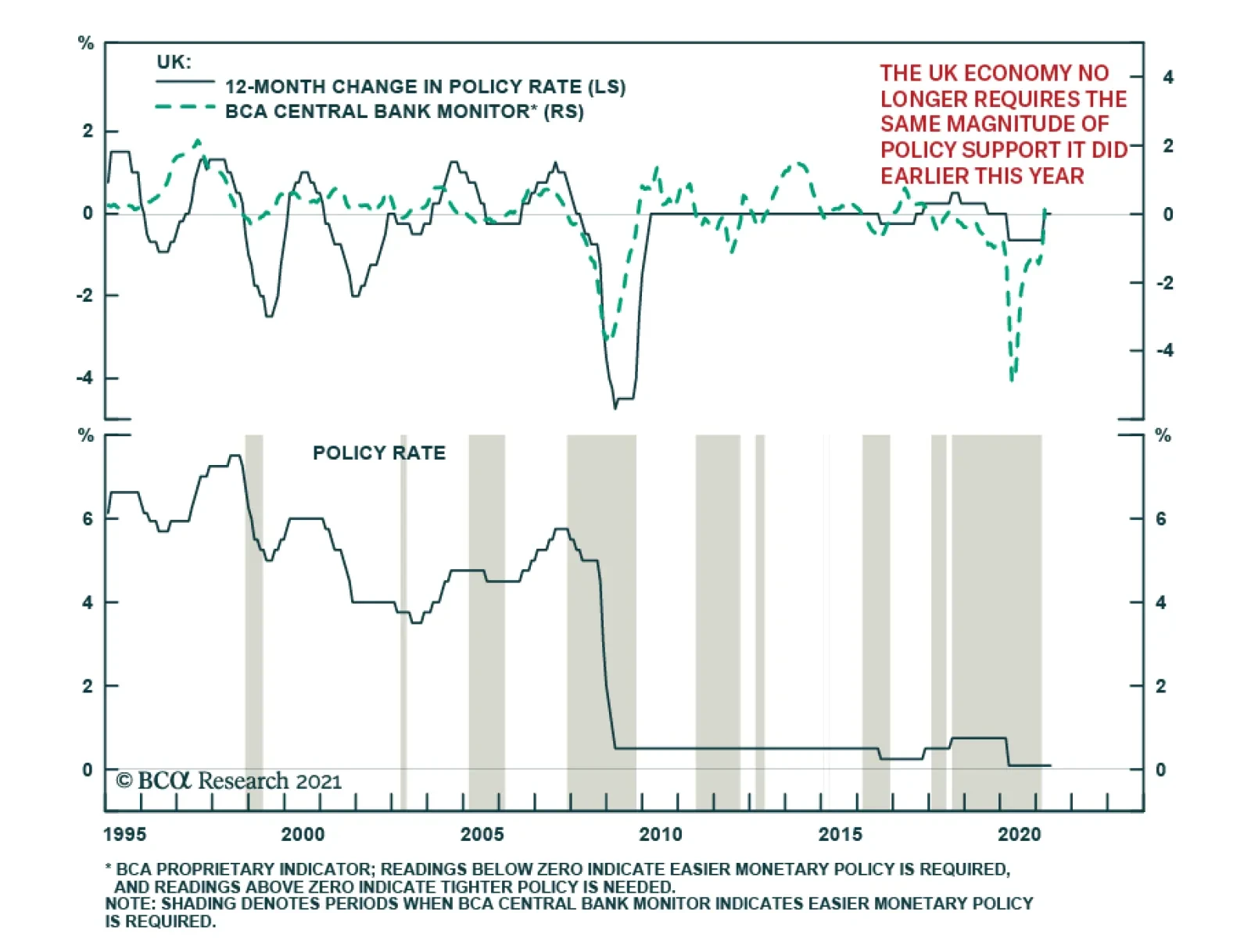
As expected, the Bank of England maintained the bank rate at 0.1% and kept the total target stock of asset purchases unchanged at its Thursday meeting. However, the central bank upgraded its growth outlook and now forecasts GDP to rise 7.25% in 2021 – up from…
Biden’s first 100 days can be summed up as the return of Big Government, i.e. “the Leviathan.” But markets are not afraid of one-off corporate tax hikes that only partially reverse the previous administration’s tax cuts amid a brand new stimulus-charged economic cycle. Biden’s approval rating after his first 100 days is comparable to that of Presidents Bill Clinton and George W. Bush, suggesting that he can accomplish a major legislative achievement. The $2.3 trillion American Jobs Plan will be watered down in Congress but not to a great extent. Green energy investments and funding for research and development will survive. Thus Biden’s plan will sow the seeds of a productivity mini-boom, if not a structural boom, in the 2020s. Republicans are favored to win the midterm elections in 2022 but investors should not make any decisions based on that expectation. The risk of Democrats keeping the House of Representatives – and therefore having a new chance to surprise with taxes in the second half of Biden’s term – is much greater than the historical pattern suggests. Stick with our long materials versus tech trade. Stick with short health care trades. Go long renewable energy stocks. Feature President Biden passed the 100 day mark at the end of April. The most striking characteristic of his administration is the giant deficit spending. Biden marks the symbolic return of the “leviathan,” i.e. the state, to American political economy. Normally the budget deficit tracks closely with the unemployment rate because rising unemployment causes tax revenue to fall and government spending to rise. The divergence between the deficit and unemployment became pronounced in 2016 and revealed the structural forces – e.g. slow growth, disinflation, high debt, inequality, populism – driving US policymakers to abandon fiscal discipline. But the 2016-20 political cycle combined with the pandemic broke the dam and the divergence is now gigantic (Chart 1). Chart 1Biden's First 100 Days: An Historic Divergence
Biden's First 100 Days: An Historic Divergence
Biden's First 100 Days: An Historic Divergence
All else equal, the implication is inflationary, though inflation will respond to a range of factors on different time frames. Signs of inflation today may well be under control, as Federal Reserve Chairman Jay Powell and Secretary of Treasury Janet Yellen believe, but over the long run we take the inflation risk seriously as the policy elite has fundamentally shifted to be vigilant about deflation, not inflation. Biden’s Approval Is “Just Enough” Biden’s popularity is “fair to middling” as his honeymoon comes to an end. His approval rating clocks in right between that of Presidents Barack Obama and Donald Trump (Chart 2A). He is not as popular and charismatic as Obama and not as unpopular and controversial as Trump. His approval among Democratic voters is higher than that of Obama, similar to Trump among Republicans, due to the fact that the US has hit historic levels of political polarization (Chart 2A, second panel). His embrace of left-wing policy is keeping him in good standing among Democratic voters but may become a liability during the 2022 midterm election (more on that below). Chart 2ABiden’s Approval Rating: Fair-To-Middling
Leviathan: Biden's First 100 Days
Leviathan: Biden's First 100 Days
Chart 2BBiden Close To Clinton, Bush At 100 Days
Leviathan: Biden's First 100 Days
Leviathan: Biden's First 100 Days
American presidential approval ratings have fallen continuously for decades and they typically fall after inauguration. This is true of Biden but he looks more like Presidents Bill Clinton or George W. Bush than Trump. His approval is likely to stay over 50% for the foreseeable future due to a supercharged economic recovery (Chart 2B). Trump stands out conspicuously in this chart for his negative net approval, which implies that on a relative basis Biden will be more capable in conducting policy. And yet Trump got his signature piece of legislation – the Tax Cut and Jobs Act – through Congress, which has some bearing on Biden’s proposals. Our political capital index (Appendix) shows that Biden will benefit from consumer confidence and wage growth shooting up, business sentiment strengthening, and polarization slightly abating due to a slight rise in Republican approval. While Biden’s Democratic Party has only the narrowest of majorities in the Senate, Biden’s signature legislative proposal – the American Jobs Plan – still has an 80% chance of passing in some form. Senate minority leader Mitch McConnell of Kentucky declared this week that Biden will not get any Republican votes for this package of infrastructure and corporate tax hikes but budget reconciliation is a ready way for the bill to pass on a partisan basis. Biden’s fiscal blowout should be seen as the culmination of a popular shift against fiscal discipline (or “austerity”) that took root in the middle of the last decade and was also expressed by Republican support for the big-spending President Trump. But it is more extravagant than what the Republicans proposed or would have been able to get had Trump been elected. Chart 3 highlights the difference between the Democratic and Republican spending proposals for the early 2021 COVID-19 relief bill and infrastructure plan. Chart 4 highlights the corporate tax increases Biden has proposed in excess of the Trump rate. Chart 3Biden’s Spending In Excess Of Republican Plans
Leviathan: Biden's First 100 Days
Leviathan: Biden's First 100 Days
Chart 4Biden’s Taxes In Excess Of Republican Plans
Leviathan: Biden's First 100 Days
Leviathan: Biden's First 100 Days
From an investment point of view, now is the perfect time to raise corporate taxes as the early cyclical surge in economic activity will prevent the one-off hit to earnings, which should be around 5%-8% according to our Global Investment Strategy, from hindering the stock market for long. The output gap, apparent from still relatively low industrial capacity utilization, will rapidly be plugged regardless of the tax hikes, as is evident from the surge in retail sales and core capital goods new orders and the decline in fuel inventories (Chart 5). The hyper-stimulated economy has been a key reason for our argument that Biden will mostly get what he wants, in terms of corporate taxes, since growth will be fine. The public is positively crying out for taxing corporations, as we showed in our April 7 missive and other reports. Chart 5The Output Gap Will Close Quickly
The Output Gap Will Close Quickly
The Output Gap Will Close Quickly
Given that Biden’s political capital is only “just enough,” and that it is falling over time, many investors believe that Biden’s major legislative proposals will be watered down beyond recognition. They will be watered down but the reconciliation process ensures that Democrats will pass at least one bill and that it will largely gratify the party’s preferences. And any watering down will affect tax hikes more so than spending, since tax hikes are the most controversial parts of the bill for moderate Senate Democrats. As Table 1 reveals, an infrastructure package with half the revenue increase is a $1.3 trillion addition to the budget deficit over the eight-to-15 year life-cycle of the bill, as opposed to a fictitious $341 billion in the event that all tax hikes pass Congress. Hence the paring back of Biden’s ambitions does not imply fiscal restraint and is not bullish for US Treasuries. Table 1Watering Down Biden’s Proposals Not Good For Deficit
Leviathan: Biden's First 100 Days
Leviathan: Biden's First 100 Days
A Productivity Boomlet How can we benchmark the magnitude of the structural transformation taking place in the US as a result of Biden’s Leviathanic spending proposals? From the perspective of government spending as a contributor to economic output, the Leviathan shrank in the decades after President Lyndon B. Johnson’s “Great Society” and Vietnam debacle. But from the perspective of government accounts, Big Government never actually went away (Chart 6), as Reagan used spending to win the Cold War and Clinton only enjoyed the briefest hiatus from deficits in the 1990s. From these charts we can conclude that Biden’s administration will create unprecedented spending and deficits that, taken with an extremely accommodative Fed, will increase the risk of substantially higher inflation over the 2020s. Chart 6Johnson’s ‘Great Society’ Versus Biden’s ‘Green Society’
Leviathan: Biden's First 100 Days
Leviathan: Biden's First 100 Days
Chart 7US Adds To Expansive Social Safety Net
Leviathan: Biden's First 100 Days
Leviathan: Biden's First 100 Days
Biden is not fighting an economic depression and world war, like Franklin D. Roosevelt, although the US has experienced a Great Recession and is entering a new cold war with China. So the shift should be seen as a generational change in the role of government and not as an ephemeral, four-year trend. This is true notwithstanding the fact that the US already spends a lot on health and education (Chart 7) and not as an ephemeral, four-year trend. The element of international competition is critical to the unique components of Biden’s spending package. Biden jettisoned the health care debates of the Obama era – to our surprise – and instead inaugurated the American foray into the global green energy race. Looking at the OECD’s measure of the “greenness” of global fiscal stimulus – and supplementing it with Biden’s proposed jobs plan – the US compares favorably with the EU and China (Chart 8). Chart 8US Enters The Green Energy Race
Leviathan: Biden's First 100 Days
Leviathan: Biden's First 100 Days
True, climate policy is more controversial in the US, which means it may well be frozen after Biden’s major bill. The EU and China will spend more on renewable energy and environmental protection because they are net energy importers and manufacturing powers. But the US is highly unlikely to exit the green race in the future, as younger generations care about it more than their elders and it is connected to the US strategic imperative of technological leadership. Biden will have opened up a new field of national policy, regardless of where on the field the players will fight over the ball at any given time. Biden is also pumping federal money into research and development, another area of geopolitical competition (Chart 9). The takeaway is that Biden’s first year in office – which may be his most consequential year in terms of legislation, particularly if he is a one-term president – is sowing the seeds for a productivity boom, or at least a mini-boom, in the coming years (Chart 10). The pace of productivity growth in the coming years is a matter of speculation and the long term trend is down. But the expected cyclical increase should be supplemented with the knowledge that the US is now aggressively monetizing debt, aggressively pursuing industrial policy and technological advancement, and aggressively competing with geopolitical rivals like China (and even allies like the EU). The likelihood of productivity breakthroughs may go up in such an extraordinary context. We cannot know but we cannot discount the possibility. Chart 9US Doubles Down On Tech Race
Leviathan: Biden's First 100 Days
Leviathan: Biden's First 100 Days
Chart 10Productivity Will Rise Cyclically But What About Structurally?
Productivity Will Rise Cyclically But What About Structurally?
Productivity Will Rise Cyclically But What About Structurally?
Vaccines And Immigration Elsewhere Biden’s first 100 days are less specific to his administration. The US is performing very well on the pandemic, both in innovating vaccines and distributing them, but an objective analysis will force Biden to share the credit with the Trump administration (Chart 11). On immigration, by comprehensively weakening enforcement and raising refugee allowances, all in the midst of a surging American economy, Biden will be vulnerable to Republican accusations of encouraging a humanitarian crisis on the border, vitiating rule of law, and making a cynical ploy to expand the Democratic voter base. The number of southwest border encounters by the Customs and Border Protection agency began to skyrocket over the past year – and as such it reflects structural factors that would have troubled a second Trump administration as well. But the election seems to have had an impact based on the inflection point in the data at the end of 2020 (Chart 12). Chart 11COVID-19 Vaccination Campaign On Track
COVID-19 Vaccination Campaign On Track
COVID-19 Vaccination Campaign On Track
Chart 12Immigration: Biden's Fatal Flaw?
Immigration: Biden's Fatal Flaw?
Immigration: Biden's Fatal Flaw?
Regardless, Biden has made the decision to cater to the pro-immigration side of his party and will now own this trend. It will be a unifying force for Republicans, although they remain deeply split over a range of issues and are not any closer to healing their wounds. The market impact is limited in the short run. In the medium run, if unchecked immigration feeds the nativist and populist elements of the Republican Party, then Biden’s decision could have a substantial impact on future US policy by generating a backlash. Our best guess at the moment is that Biden’s actions will reinforce the Republican Party’s embrace of Trump’s policy platform. Since Biden is not making major bipartisan legislative efforts to reform immigration comprehensively, the great immigration debate will return in 2024 or thereafter. Public opinion suggests Republican nativism is out of fashion but a large influx of immigrants could opinion over time as today’s issues fade. Thus Biden’s successes on economic recovery today are sowing the seeds of his party’s biggest vulnerability in domestic policy in future. But admittedly it is too soon to say whether this weakness will be effectively exploited by the opposition. In the meantime investors and corporations will cheer the prospect of cheap and abundant labor. An Overlooked Market Risk From The Midterm Elections This overview of Biden’s honeymoon period naturally refers to the 2022 midterm elections in several places. The Republicans will not be able to repeal Biden’s laws if they take the House of Representatives – or less likely the Senate – in the 2022 vote. But they will be able to grind proposals to a halt. The fate of Biden’s third major legislative proposal, the $1.8 trillion American Families Plan, will hang in the balance, as will green energy subsidies, the child tax credit, and various social initiatives. Much has been made about the 2020 US census and the reapportionment of seats in the House of Representatives according to the population. States that have a single party in control of the governor’s mansion and the legislature can gerrymander or redraw congressional districts as they please to favor their party. Table 2 shows that this partisan process could easily yield two Republican seats on a net basis. This is less than expected but Republicans only need a net of five seats to reclaim the House. Table 2US Census And Reapportionment Favors Republicans Slightly
Leviathan: Biden's First 100 Days
Leviathan: Biden's First 100 Days
Redistricting is an important theme because it perpetuates political polarization. But it is not important in determining who will win the House in 2022. The House has changed hands numerous times despite gerrymandered districts. Midterms almost always work against the president’s party. Only in 1934, during the Great Depression, and 2002, immediately after the Twin Towers were attacked, did voters strengthen a first-term president’s hold on Congress. Judging by Biden’s approval rating, Democrats would be lined up for a loss of far more than five seats on a net basis in 2022. They could lose 20 or more (Chart 13). As noted in the previous section, Republicans may find a rallying point on immigration. Chart 13Midterm Elections Dominated By Opposition Party – And Need For Checks And Balances
Leviathan: Biden's First 100 Days
Leviathan: Biden's First 100 Days
Having said that, investors should not make any decisions based on the midterm election. While Republicans have a 95% chance of winning the House according to the modern historical pattern, they have a lower 73% chance according to the online political betting hub Predictit.org, and we would side with the latter or even lower, at this early stage in the political cycle. The pandemic and social unrest of 2020, combined with the slow-growth 2010s and trade war, create a context of upheaval that is not entirely dissimilar to the exceptional midterm elections of 1932 and 2002. Biden’s rescue packages and the economic recovery will be a huge boon for the Democratic Party in 2024 and it is possible that they will reap some benefits even in 2022. This is especially the case because Trump and his allies will challenge establishment and elitist Republicans in the primary elections, which could result in Republicans losing five-to-nine seats. If they put up Trumpists in competitive, purple, or suburban districts, voters will swing toward moderate Democrats over populist Republicans in order to preserve the “bread and butter” gains of Biden’s agenda. The bottom line is that Republicans are favored to take the House in 2022 but the 75% odds are much more realistic than the 95% historical probability and possibly even too high. Gridlock would freeze Biden’s spend-and-tax agenda in place but the absence of gridlock would come as a surprise to investors who counted on a Republican victory. Tax hikes on wealthy individuals and capital gains – as projected in the American Families Plan – could still be on the table after the midterm. These tax hikes would still be unlikely to overturn the equity bull market but they could cause investors to reassess the overall policy setting for the worse. The implication would be that the 2020 political change marked a more lasting leftward shift in US policy. For example, taxes could go up beyond what Biden currently projects. Midterm risks should not trouble investors in the near term but they should be on the radar, particularly as the Republican primaries get underway next year and as investors get a better read on inflation in the wake of Biden’s mammoth spending. Investment Takeaways We would draw a few main investment takeaways from Biden’s first 100 days. In the short run, we would call attention to the “buy the rumor, sell the news” behavior exhibited by financial markets during President Trump’s first year in office with full party control of Congress. US equities stood to benefit from tax cuts, especially relative to the rest of the world, which would not receive tax cuts but could face trade tariffs. This expectation played out after Trump’s election but the market sold upon the news of his inauguration. It played out again after Republicans failed to repeal Obamacare, suggesting they might fail to cut taxes. The market correctly bid up US equities on the rumor that the GOP would then turn its full attention to cutting taxes. US equities outperformed until the end of the year when the tax cuts became a fait accompli, at which point the news was sold (Chart 14, top panel). The implication today is that US stocks, especially cyclical stocks and infrastructure-related plays, will continue generally to rally ahead of Biden signing the American Jobs Plan into law, likely around November. Obviously a correction could occur at any time but upon the signing of the law one should not be surprised to see some serious profit-taking. An analogy can also be drawn to renewable energy plays after the Democrats’ “Blue Sweep” in 2020. Markets have largely discounted the surge in renewable energy plays that occurred upon the recession in 2020 and the rising likelihood that Trump would lose reelection (Chart 14, bottom panel). This creates a buying opportunity for a long-term theme. Republicans will not be able to repeal Biden’s green projects and there is some risk that Democrats retain legislative control. And younger generations, even Republicans, are favorable toward the greening of society. Therefore we recommend going long US renewable energy stocks. It also follows that cyclical and value stocks have not yet exhausted their run against defensives and growth stocks. We will therefore hang onto our long materials / short Big Tech trade until we see more substantial signs that near-term disinflationary risks will derail this trade (Chart 15). We will also stick with our short managed health care trade – and our preference for health care equipment and facilities within the health care sector – despite the Democrats’ tentative decision to sideline the health care policies that would have hit the health insurers and Big Pharma. Chart 14Investment Takeaways: Buy The Green Hype (For Now)
Investment Takeaways: Buy The Green Hype (For Now)
Investment Takeaways: Buy The Green Hype (For Now)
Chart 15Housekeeping: Stick With Materials Over Tech
Housekeeping: Stick With Materials Over Tech
Housekeeping: Stick With Materials Over Tech
In the long run, we would point out that the shift away from Reaganism toward Johnsonianism – the return of Leviathan – is a lasting trend that will bring significant change to the US policy setting. These are mostly but not all inflationary. Larger immigration and a productivity boost are not inflationary. But large deficits, tax hikes, and wage pressures are inflationary. Therefore the risk of inflation has gone up in a historic way even though the magnitude of the risk can be overstated in the short term – when there is still slack in the economy – and there are still disinflationary factors that could work against the risk as events unfold. We remain cyclically bullish. Matt Gertken Vice President Geopolitical Strategy mattg@bcaresearch.com Appendix Table A1USPS Trade Table
Leviathan: Biden's First 100 Days
Leviathan: Biden's First 100 Days
Table A2Political Risk Matrix
Leviathan: Biden's First 100 Days
Leviathan: Biden's First 100 Days
Table A3Political Capital Index
Leviathan: Biden's First 100 Days
Leviathan: Biden's First 100 Days
Table A4APolitical Capital: White House And Congress
Leviathan: Biden's First 100 Days
Leviathan: Biden's First 100 Days
Chart A4BPolitical Capital: Household And Business Sentiment
Leviathan: Biden's First 100 Days
Leviathan: Biden's First 100 Days
Table A4CPolitical Capital: The Economy And Markets
Leviathan: Biden's First 100 Days
Leviathan: Biden's First 100 Days
Highlights A slower money and credit growth in China will eventually generate disinflationary pressures by weighing on demand for commodities. The PBoC has shifted its inflation anchor and policy framework to target core CPI and the PPI rather than headline CPI. Beijing is scaling back its fiscal supports and cooling the property sector to tackle local government and housing sector debt issues. In the next six to nine months we favor companies and sectors that will benefit from global economic recovery rather than China’s domestic demand. We are long CSI500 relative to China’s A shares. The CSI500 has a larger exposure to the global economy and lower valuation relative to China’s broad onshore market. Feature As a follow up to last week’s report, we look at another topic raised in recent client meetings: whether rapidly rising producer prices in China will morph into a broad-based inflationary risk and how macroeconomic policies will evolve to counter such a risk. Clients who believe that the ongoing producer price inflation is transitory cited China’s low consumer price inflation, and slowing money and credit growth, as leading indicators of budding disinflationary pressures. Advocates of sustained inflation pointed to robust recoveries and demand among advanced economies, extremely accommodative monetary conditions worldwide, massive fiscal stimulus in the US, a weak US dollar, and supply constraints. It remains to be seen what the worldwide pandemic’s impact will be on the balance between global production capacity and aggregate demand. In this report we analyze the PBoC’s inflation target and policy framework, and conclude that while China’s monetary policy has not become more hawkish, policy tightening seems to be taking place on the fiscal front. Is Inflation In China A Risk? It is debatable whether the strong rebound in GDP growth in Q4 last year and in Q1 this year has closed China’s output gap and will lead to widespread inflation. Given data distortions due to low-base effects from the previous year and uncertainty about China’s productivity and labor force growth, any calculation of the output gap will be unreliable. In addition, China’s employment statistics lack cyclicality and cannot be used to gauge inflationary pressure stemming from wage growth and unit labor costs. Chart 1A Rollover In Credit Growth Will Weigh On Chinese Demand For Commodities
A Rollover In Credit Growth Will Weigh On Chinese Demand For Commodities
A Rollover In Credit Growth Will Weigh On Chinese Demand For Commodities
Our cyclical view of inflation is therefore based on the framework that the ongoing moderation in China's money and credit growth will eventually generate disinflationary pressures by weighing on the country’s demand for and price of commodities (Chart 1). Furthermore, behind a resilient PPI, there are suggestions that the strength in China’s economy is still bifurcated. A narrow-based uptrend in the PPI lacks the ground for sustained inflation, and is unlikely to trigger a general tightening in monetary policy. While mounting global prices for raw materials propelled strong upstream PPI, producer prices for consumer goods and core consumer price inflation remain very subdued (Chart 2). The inconsistency in producer prices among various industries highlight the unevenness of the economic recovery and, importantly, persistently muted household consumption (Chart 3). Chart 2A Bifurcated Economic Recovery
A Bifurcated Economic Recovery
A Bifurcated Economic Recovery
Chart 3A Muted Recovery In Household Consumption
A Muted Recovery In Household Consumption
A Muted Recovery In Household Consumption
Chart 4Weak Price Transmission From Upstream To Downstream Industries
Weak Price Transmission From Upstream To Downstream Industries
Weak Price Transmission From Upstream To Downstream Industries
The transmission from upstream industrial PPI to the middle and downstream sectors has also been weak (Chart 4). It is evidenced in the faster growth of manufacturing output volume compared with price increases (Chart 5). This contrasts with the previous inflationary cycles, as well as mining and ferrous metals where surging prices for raw materials have way surpassed recovery in output volume (Chart 6). Given that price changes are more important to corporate profits than volume changes, Chinese middle-to-downstream industries face downward pressure on their profit margins and will likely deliver disappointing profits, despite a strong rebound in production. Chart 5China's Manufacturing Recovery: Stronger Volume Than Prices
China's Manufacturing Recovery: Stronger Volume Than Prices
China's Manufacturing Recovery: Stronger Volume Than Prices
Chart 6China's Upstream Industries: Prices Surged Faster Than Production
China's Upstream Industries: Prices Surged Faster Than Production
China's Upstream Industries: Prices Surged Faster Than Production
Furthermore, PMI input prices, which lead core CPI by about nine months, rolled over in April (Chart 7). While it is too soon to conclude that input prices have peaked, it is implied that upward pressure on core CPI from input prices may start to ease in 2H21. Bottom Line: So far there is no sign that elevated upstream producer prices will create sustainable inflationary pressure on consumer prices. Hence our view is that the PBoC will not respond to a rising PPI by further tightening monetary policy. Chart 7PMI Input Prices Have Rolled Over
PMI Input Prices Have Rolled Over
PMI Input Prices Have Rolled Over
Chart 8Core CPI And PPI Have Been The PBoC's Inflation Targets Since 2015
Core CPI And PPI Have Been The PBoC's Inflation Targets Since 2015
Core CPI And PPI Have Been The PBoC's Inflation Targets Since 2015
The PBoC’s Inflation Target Since 2015, China’s monetary tightening cycles have closely correlated with a combination of the core CPI and PPI instead of headline CPI (Chart 8). The shift to targeting core CPI and PPI occurred despite the central bank’s frequent mention of headline CPI as its inflation target. The reasons for the shift are twofold. First, swings in food and fuel prices have become much larger since 2014, often dominating fluctuations in headline CPI (Chart 9). Secondly, the price swings were often driven by supply-side factors and did not reflect changes in demand. Therefore, monetary policies could do little to mitigate inflationary or deflationary pressures. Furthermore, the PPI seems to play a greater role in the PBoC’s monetary policymaking than the headline and core CPI (Chart 10). The tighter relationship between the de facto policy rate and the PPI is not surprising, given that China’s ex-factory price inflation reflects changes in corporate pricing, profit, and inventory cycles – all are driven by the country’s money supply and credit cycles. Chart 9Large Swings In Food And Energy Prices Distorted Headline CPI In Recent Years
Large Swings In Food And Energy Prices Distorted Headline CPI In Recent Years
Large Swings In Food And Energy Prices Distorted Headline CPI In Recent Years
Chart 10PPI Plays A Greater Role In The PBoC's Monetary Policymaking
PPI Plays A Greater Role In The PBoC's Monetary Policymaking
PPI Plays A Greater Role In The PBoC's Monetary Policymaking
The relationship between the 7-day repo rate - the de jure policy rate - and the PPI has broken down since 2015 (Chart 11). Meanwhile, the 3-month repo rate has maintained a close relationship with the PPI (Chart 10, bottom panel). The change in the relationship is because the PBoC shifted its policy to target interest rates instead of the quantity of money supply since 2015 (Chart 12). Moreover, since 2016 the PBoC has generated monetary policy tightening measures through changes in its Macro Prudential Assessment Framework (MPA) rather than directly through interest rate hikes. Chart 11Relationship Between The 7-Day Repo Rate And The PPI Has Broken Down Since 2015...
Relationship Between The 7-Day Repo Rate And The PPI Has Broken Down Since 2015...
Relationship Between The 7-Day Repo Rate And The PPI Has Broken Down Since 2015...
Chart 12...Due To Monetary Policy Regime Shifted
...Due To Monetary Policy Regime Shifted
...Due To Monetary Policy Regime Shifted
Bottom Line: The PBoC has shifted its inflation anchor and policy framework since 2015. Core CPI and the PPI are now the main inflation targets. A Quiet Fiscal Tightening? Despite a jump in the PPI, the 3-month repo rate fell sharply in the past two months (Chart 10 on page 6, bottom panel). It is possible that the PBoC considers escalating producer prices as transitory and, therefore, intends to keep its overall policy stance unchanged. However, the PBoC’s relaxed policy response towards inflation risk may be explained by Beijing’s quiet tightening on the fiscal front. Chart 13The Central Bank Has Made Little Interbank Liquidity Injections Lately
The Central Bank Has Made Little Interbank Liquidity Injections Lately
The Central Bank Has Made Little Interbank Liquidity Injections Lately
The PBoC can hold its policy rates steady by supplying adequate liquidity to the interbank system through open market operations or by reducing the demand for liquidity. On a net basis, the PBoC has recently injected very little liquidity into the interbank system, implying that banks’ liquidity demand has likely softened (Chart 13). This might be a sign of weakening credit origination. In a previous report we discussed how fiscal stimulus has become a more relevant driver of China’s credit origination since the onset of the 2014/15 economic downcycle. A rising 3-month SHIBOR can be the result of rapid fiscal and quasi-fiscal expansions, which occurred in Q3 last year. A flood of local government bond issuance drained liquidity from commercial banks, which boosted the banks’ needs to borrow money from the interbank system and pushed up interbank rates. Despite higher interest rates, credit growth soared in Q3 as fiscal multiplier provided an imminent and powerful reflationary force to the economy. In contrast, local government bond issuance was down sharply in the first four months of this year, compared with 2019 and 2020. Local governments sold 222.7 billion yuan of special-purpose bonds (SPBs) from January to April, a plunge from 730 billion yuan of debt sold in the same period in 2019 and 1.15 trillion yuan in 2020. The total local government bond issuance in Q1 this year has also been 36% and 44% lower than in Q1 2019 and 2020, respectively. A lack of local governments’ appetite to borrow coupled with a shortage in profitable infrastructure projects might have contributed to the sharp drop in bond issuance this year. Local government financing and spending have been under increased scrutiny this year. Following the State Council Executive Meeting in late March, in which Premier Li Keqiang pledged to reduce government leverage ratio and raise regulatory standards on infrastructure investment, Beijing suspended two high-speed rail projects that were initiated by provincial governments. Messages from Politburo’s meeting last week reinforced our view that policymakers may be scaling back fiscal support while further tightening regulations in the property sector. Both aspects have the potential to cool China’s demand for industrial metals and global industrial material prices (Chart 14 and Chart 15). Chart 14A Slowdown In Chinese Manufacturing Demand Will Have A Greater Impact On Global Industrial Material Prices
A Slowdown In Chinese Manufacturing Demand Will Have A Greater Impact On Global Industrial Material Prices
A Slowdown In Chinese Manufacturing Demand Will Have A Greater Impact On Global Industrial Material Prices
Chart 15Lower Housing Demand In China Will Help To Cool Industrial Metal Prices
Lower Housing Demand In China Will Help To Cool Industrial Metal Prices
Lower Housing Demand In China Will Help To Cool Industrial Metal Prices
We expect the intensity of policy tightening to reach its peak between mid-year to third-quarter 2021. It is unclear at this point whether policymakers are willing to allow local governments to significantly undershoot their SPB quota for this year. Local governments reportedly experienced a shortage in profitable investment projects towards the end of last year, and thus, parked more than 10% of proceeds from 2020 SPB issuance at the central bank. The central government may be taking a wait-and-see attitude this year, and saving more fiscal dry powder for later this year when the economic slowdown becomes more meaningful. Bottom Line: Beijing is pulling back its fiscal supports and cooling the property sector to tackle local government and housing sector debt issues. The deleveraging efforts will curb China’s demand for commodities, and may work to ease inflationary pressure on prices for raw materials. Investment Conclusions The outlook for China’s risk asset prices remains bearish, at least in the next six months. If the credit and fiscal impulse slow enough to depress corporate pricing power, inflation will not be a problem because disinflationary pressures will resurface. However, the growth of corporate profits will disappoint (Chart 16). Beijing may be saving more fiscal dry powder for later this year. Still, SPBs are only a small part of local governments’ financing source for infrastructure projects. Given the central government’s renewed focus on reducing public debt, policymakers are unlikely to unleash fiscal power to significantly boost infrastructure spending or economic growth. In the next six to nine months, we favor companies and sectors that will benefit from global economic recovery rather than China’s domestic demand. With this week's report, we initiate a long position on the CSI500 index, which has a larger exposure to the global market and lower valuation relative to China’s broad onshore market (Chart 17). Chart 16Aggregate Corporate Profit Growth Will Slow Even Though Inflation Is No Longer An Issue
Aggregate Corporate Profit Growth Will Slow Even Though Inflation Is No Longer An Issue
Aggregate Corporate Profit Growth Will Slow Even Though Inflation Is No Longer An Issue
Chart 17Long CSI500/Broad Market
Long CSI500/Broad Market
Long CSI500/Broad Market
Jing Sima China Strategist jings@bcaresearch.com Cyclical Investment Stance Equity Sector Recommendations
Highlights Sweden’s economic recovery is robust and will deepen. Policy is accommodative. Very few advanced economies will benefit as much from the global economic rebound. The labor market will tighten, capacity utilization will increase, and inflation will rise faster than the Riksbank forecasts. On a one- to two-year investment horizon, the SEK is a buy against both the USD and the EUR. Despite their pronounced outperformance, Swedish stocks possess significantly more upside against both Eurozone and US equities over the remainder of the cycle. Swedish industrials will beat their competitors in both these markets. Nonetheless, China’s policy tightening creates a meaningful tactical risk, which selling Norwegian stocks can hedge. Italy’s fiscal plan constitutes a new salvo in Europe’s efforts to avoid last decade’s mistakes. Feature Last week, the Swedish Riksbank did not follow in the footsteps of the Norges Bank. The Swedish central bank acknowledged that the economy is performing better than anticipated and that the housing market is gaining in strength; yet, it refrained from hinting at any forthcoming adjustment to its policy rate or the pace of its asset purchase program. The positive outlook for the Swedish economy will force the Riksbank to tighten policy significantly before the ECB. As a result, we expect the Swedish Krona to outperform the euro and the US dollar. Moreover, investors should continue to overweight Swedish equities due to their large exposure to industrials and financials, even if they have already significantly outperformed the Euro Area. Sweden’s Economic Outlook The Swedish economy will accelerate, which will put pressure on resource utilization and fan inflationary risk in the years ahead. The degree of stimulus supporting Sweden is consequential. Chart 1A Dual Labor Market
A Dual Labor Market
A Dual Labor Market
On the fiscal front, the government support measures that have been announced since the beginning of the COVID-19 crisis currently amount to SEK420bn, or SEK197bn for 2020 (4% of GDP), and SEK223bn for 2021 (4.5% of GDP). Moreover, generous labor market protection and part-time employment schemes meant that the number of employees in permanent employment contracts remained stable during the pandemic (Chart 1). Thus, the bulk of the rise in Swedish unemployment came from workers on fixed-term contracts. Monetary policy remains very accommodative as well. The Riksbank left its repo rate unchanged at 0% through the crisis, but cut its lending rate from 0.75% to 0.1%. More importantly, the Swedish central bank is aggressively injecting liquidity into the economy. It set up a SEK500bn funding-for-lending facility in order to incentivize bank lending to the nonfinancial private sector, and started a SEK700bn QE program, which as of Q1 2021 had purchased SEK380bn securities and which will purchase another SEK120bn in Q2, with covered bonds issued by banks accounting for 70% of it. As a result, the amount of securities held on the Riksbank balance sheet will nearly triple by year end (Chart 2). Chart 2The Riksbank Is Open For Business
Take A Chance On Sweden
Take A Chance On Sweden
Beyond the monetary and fiscal stimulus, many factors point to greater economic strength for Sweden. Despite a slow start to the process, as of last week, nearly 30% of the Swedish population had received at least one vaccine dose, which is broadly in line with vaccination rates prevalent in France or Germany. Crucially, the pace of vaccination is accelerating at a rate of 13% per week. Even if this second derivative slows, more than 70% of the population will have received at least one dose by this summer. Thus, greater mobility is in the cards during the second quarter, which will boost household spending. Chart 3The Wealth Effect
The Wealth Effect
The Wealth Effect
The housing market also favors a pick-up in consumption. The HOX housing price index is growing at a 15% annual rate, its fastest expansion in over 5 years. As a result of the wealth effect, this rapid appreciation is consistent with a swift improvement in the growth rate of household expenditures (Chart 3). Moreover, spending on durable goods now stands 1.3% above its pre-pandemic levels, while spending on non-durables is back to pre-pandemic levels. This context suggests that increased mobility translates into greater spending. The industrial sector remains a particularly bright spot in the Swedish economy. Sweden is extremely sensitive to the global industrial and trade cycle, because exports represent 45% of GDP. Moreover, the highly cyclical intermediate and capital goods comprise 56% of the country’s foreign shipments, which accentuates the beta of the Swedish economy. BCA Research remains optimistic about the global industrial cycle. Sweden will reap a significant dividend. Already the Swedish PMI points to stronger industrial production, and the index’s exports component is roaring ahead (Chart 4). The potential for a greater uptake in consumption, capex, and durable goods spending in the rest of the EU (Sweden’s largest trading partner) bodes well for the Swedish manufacturing sector. Additionally, if the collapse in the US inventory-to-sales ratio is any indication for the rest of the world, a global restocking cycle is forthcoming, which will further boost Swedish industrial activity (Chart 4, bottom panels). Finally, global public infrastructure plans are on the rise, which will also help Sweden. Chart 4Sweden Is well Placed
Sweden Is well Placed
Sweden Is well Placed
Chart 5Brightening Labor Market Prospects
Brightening Labor Market Prospects
Brightening Labor Market Prospects
In this context, the Swedish labor market should tighten significantly in the approaching quarters. Already, job vacancies are rebounding, and redundancy notices have normalized, which matches both the GDP growth surprise in Q1 and the continued rise in the NIER Sweden Economic Tendency Indicator. Furthermore, the employment component of the PMIs stands at 58.9 and is consistent with a sharp improvement in job growth over the coming year (Chart 5). The expected labor market growth will contribute to an increase in capacity utilization, which will place upward pressure on wages and inflation. When the 12-month moving average of US and Eurozone imports rises, so does the Riksbank Resource Utilization Indicator, because global trade has such a pronounced effect on the Swedish economy (Chart 6). Meanwhile, greater resource utilization leads to accelerated inflation, greater labor shortages, and rising unit labor costs (Chart 7). Chart 6CAPU Will Rise
CAPU Will Rise
CAPU Will Rise
Chart 7The Coming Pressure Buildup
The Coming Pressure Buildup
The Coming Pressure Buildup
Bottom Line: As a result of generous stimulus and the global economic recovery, the Swedish economy is set to continue its rebound. Consequently, employment and capacity utilization will improve meaningfully, which will lead to a resurgence of inflation and wages in the coming 24 months. Investment Implications On a 12 to 24 months horizon, we remain positive on the Swedish krona and Swedish equities. Fixed Income And FX Chart 8Three Hikes By 2025
Three Hikes By 2025
Three Hikes By 2025
The backend of the Swedish OIS curve only discounts 75bps of hikes by 2025. This pricing is too modest (Chart 8). The Swedish economy will rebound further as the vaccination campaign advances, and rising house prices and household indebtedness will fan growing long-term risk to financial stability, both of which suggest that the Riksbank will have to change its tack in 2022. The great likelihood that the Fed will start tapering off its asset purchase toward the end this year, that the ECB will follow sometime in 2022, and that the Norges Bank will be increasing interest rates next year will give more leeway to the Swedish central bank. A wider Sweden/Germany 10-year government bond spread is not an appealing vehicle to play a more hawkish Riksbank down the road. This spread hit a 23-year high in March and now rests at 62bps or its 98th percentile since 2000. Moreover, the terminal rate proxy embedded in the German money market curve is currently so low that the spread between Sweden’s and the Eurozone’s terminal rate proxy stands near a record high. Hence, German yields already embed much more pessimism than Swedish ones. Nonetheless, BCA recommends a below benchmark duration exposure within the Swedish fixed-income space, as we do for other government bond markets around the world.1 A bullish bias toward the SEK is a bet on the Riksbank that offers a very appealing risk/reward ratio, according to BCA Research’s Foreign Exchange Strategy strategists.2 The krona is very cheap against both the euro and the US dollar, trading at 9% and 29% discounts to purchasing power parity, respectively. Moreover, the Swedish current account stands at 5.2% of GDP, compared to 2.3% and -3.1% for the Euro Area and the US, creating a natural underpinning under the SEK. Chart 9The SEK Loves Growth
The SEK Loves Growth
The SEK Loves Growth
Over the coming 12 to 24 months, cyclical forces favor selling EUR/SEK and USD/SEK on any strength. The SEK is one of the most cyclical G-10 currencies and has one of the strongest sensitivities to the US dollar. Hence, our positive global economic outlook and our FX strategists negative view on the greenback are synonymous with a weak USD/SEK. These same factors also mean that the krona will appreciate more than the euro, as the negative correlation between EUR/SEK and our Boom/Bust Indicator and global earnings growth illustrate (Chart 9). Equities We also like Swedish equities, but the state of the Swedish economy and the evolution of the Riksbank policy surprise have a limited impact on Swedish equities. The Swedish bourse is mostly about the evolution of the global business cycle. The Swedish benchmark heightened sensitivity to the global business cycle reflects its massive overweight in deep cyclicals, with industrials, financials, consumer discretionary, and materials accounting for 38.4%, 26.1%, 9.7% and 3.7% of the MSCI index respectively, or 78% altogether (Table 1). As a result, BCA’s preference for global cyclicals at the expense of defensives and this publication’s fondness for the recovery laggards like the industrial and financial sectors automatically translate into a favorable bias toward Sweden’s stocks.3 Table 1Mamma Mia! That’s A Lot Of Cyclicals
Take A Chance On Sweden
Take A Chance On Sweden
Valuations offer a more complex picture, but they do not diminish our predilection for Sweden. Swedish equities trade at a discount to US stocks but at a premium to Euro Area ones (Chart 10). However, Swedish stocks offer higher RoEs and profit margins than both the US and the Euro Area, while also sporting lower leverage (Chart 11). Thus, their valuation premium to Euro Area stocks is warranted and their discount to US ones is excessive, especially when rising yields hurt the relative performance of the growth stocks that dominate US indexes. Chart 10Swedish Discounts And Premia
Swedish Discounts And Premia
Swedish Discounts And Premia
Chart 11Profitable Sweden
Profitable Sweden
Profitable Sweden
The outlook for Swedish earnings is appealing, both in absolute and relative terms. The Swedish market’s extreme sensitivity to global economic activity means that Sweden’s EPS increase and beat US profits when the Riksbank Resource Utilization Indicator expands (Chart 12). These relationships are artefacts of the Swedish economy’s pro-cyclicality, which causes capacity utilization to interweave tightly with the global business cycle (Chart 6). Chart 12The Winner Takes It All
The Winner Takes It All
The Winner Takes It All
Chart 13Better Capex Play Than You
Better Capex Play Than You
Better Capex Play Than You
Global capex and infrastructure spending favor Swedish equities compared to Euro Area ones. Over the past thirty years, Sweden’s stocks have outperformed those of the Eurozone when capital goods orders in the advanced economies have expanded (Chart 13). This reflects the Swedish benchmark’s large overweight in industrials, a sector that is the prime beneficiary of global capex. Capital goods orders are recovering well, and their growth rate can climb higher, especially as western multinationals announce capex plans and as governments from the US to Italy intend to ramp up infrastructure spending. Moreover, the large pent-up demand for durable goods in the Eurozone further enhances the potential of industrial firms, and thus, of Swedish equities.4 Chart 14Another Sign Of Pro-Cyclicality
Another Sign Of Pro-Cyclicality
Another Sign Of Pro-Cyclicality
BCA Research’s positive cyclical stance on commodities offers another reason to overweight Sweden’s market relative to that of the US and the Euro Area. Our Commodity and Energy Strategy sister service anticipates significant further upside for natural resources, especially base metals, over the remainder of the business cycle.5 Commodity prices still have room to rally, because demand will grow as the global economy continues to recover and because the supply of natural resources has been constrained by a decade of low investment. As a result, rising metal prices will symptomatize strong economic activity around the world and will incentivize capex in commodity extraction, both of which will boost the revenue of industrial firms. Furthermore, commodity price inflation often corresponds with rising yields, which boosts financials as well. These relationships explain the Swedish stocks’ outperformance of US and Eurozone stocks, when natural resource prices rally, despite the former’s low exposure to materials (Chart 14). At the sector level, the appeal of Swedish industrials relative to those of the Eurozone and the US completes the rationale to favor Swedish equities in a global portfolio. Swedish industrials are just as profitable as US ones and are more so than Euro Area ones, while having significantly lower leverage than either of them (Chart 15). Additionally, for the past two years, the EPS growth of Swedish industrials has bested that of US and Eurozone ones. Yet, their forward P/E ratio trades in line with the US and the Euro Area, while the sell-side’s long-term relative earnings growth estimate is too depressed (Chart 16). The same observations are valid when comparing Swedish industrials to French or German ones. Hence, in the context of a global business cycle upswing, buying Swedish industrials while selling their US and Euro Area competitors is an appealing pair trade, especially since it also involves short USD/SEK and short EUR/SEK bets. Chart 15Attractive Swedish Industrials...
Attractive Swedish Industrials...
Attractive Swedish Industrials...
Chart 16...And Not Expensive
...And Not Expensive
...And Not Expensive
Despite our optimism toward Swedish stocks on a 12 to 24 months basis, investors must hedge a near-term risk. Chinese authorities are aiming to contain financial excesses and trying to restrain credit growth. As we showed four weeks ago, China’s excess reserve ratio is contracting, which points toward a slowdown in the Chinese credit impulse.6 Historically, such a development can hurt global cyclicals, and thus, also Swedish equities. However, BCA Research’s China strategists believe that Beijing will not kill off the Chinese business cycle; thus, the recent disappointment in the Chinese PMI is transitory.7 Chart 17Industrials vs Materials: Europe vs China
Industrials vs Materials: Europe vs China
Industrials vs Materials: Europe vs China
Materials more than industrials will suffer the brunt of a China slowdown, as the re-opening trade and capex cycle among advanced economies will create a buffer for the latter. Indeed, the performance of global industrials relative to materials stocks correlates with the evolution of the spread between the Euro Area and Chinese PMI (Chart 17). Thus, we recommend selling Norwegian equities to hedge the tactical risk inherent in an overweight on Sweden. As Table 1 above shows, Norway overweighs materials and energy (two sectors greatly exposed to China), hence, a temporary pullback in commodity prices should hurt Norwegian stocks more than Swedish ones. Bottom Line: The SEK is an inexpensive and attractive vehicle to bet on both the global business cycle strength and the Swedish economic recovery. Thus, investors should use any rebound in EUR/SEK and USD/SEK to sell these pairs. Moreover, Swedish stocks greatly overweight cyclical sectors, particularly industrials and materials. This sectoral profile renders Swedish equities as attractive bets on the global economy. Additionally, Swedish shares display alluring operating metrics. As a result, we recommend investors go long Swedish industrials relative to those of the US and Euro Area. They should also overweight Swedish equities against the US and the Eurozone. Consequent to some China-related tactical risks, an underweight stance on Norwegian stocks constitutes an attractive hedge to this Swedish exposure. A Few Words On Italy’s National Recovery And Resilience Plan Mario Draghi’s plan to revive the Italian economy, announced last week, is an important marker of Europe’s changing relationship with fiscal policy. Last decade, excessive austerity contributed to subpar growth, ultimately firing up concerns about debt sustainability in many peripheral economies, and fueled risk premia in Italy and Spain. Under the cover of the current crisis, and in the face of the changing political winds in Brussel and Berlin where fiscal rectitude is not the mantra it once was, national European governments are beginning to propose ambitious fiscal stimulus plans. The National Recovery and Resilience program illustrates these dynamics. The EUR248bn plan is a testament to the importance of the NGEU recovery program as well as the REACT EU recovery fund. Through these facilities, the EU will contribute EUR191.5bn to the fiscal plan via grants and loans. Italy will contribute the remainder of the funds. While the total amount disbursed over the next six years corresponds to 14% of Italy’s 2019 GDP, the Draghi government estimates that the program will add 3.2 percentage points to GDP between 2024 and 2026. Importantly, markets are not rebelling. Despite expectations that Italy would continue to run an accommodative fiscal policy, the BTP/Bund spreads remain stable. We can expect this trend of greater stimulus to be mimicked around the EU. Spain is another large recipient of the NGEU program, and it too is likely to increase stimulus beyond what the EU will fund. France will hold an election in May 2022, and President Macron has all the incentives to stimulate the economy between now and then. If, as we wrote last week, Germany shifts to the left in September, then this outcome will be guaranteed. Bottom Line: The Draghi plan is the first salvo of greater fiscal stimulus in the EU. This trend will help Eurozone growth improve relative to the US over the coming few years. Despite a loose fiscal policy, BTPs and other peripheral bonds will continue to outperform on the back of declining risk premia. Mathieu Savary, Chief European Investment Strategist Mathieu@bcaresearch.com Footnotes 1Please see Global Fixed Income Strategy “GFIS Model Bond Portfolio Q1/2021 Performance Review & Current Allocations: Grand Reopening,” dated April 6, 2021, available at gfis.bcaresearch.com 2Please see Foreign Exchange Strategy “2021 Key Views: Tradeable Themes,” dated December 4, 2020, available at fes.bcaresearch.com 3Please see European Investment Strategy “Summer Of ‘21,” dated March 22, 2021, available at eis.bcaresearch.com 4Please see European Investment Strategy “Winds Of Change: Germany Goes Green,” dated April 23, 2021, available at eis.bcaresearch.com 5Please see Commodity & Energy Strategy “Industrial Commodities Super-Cycle Or Bull Market?” dated March 4, 2021, available at ces.bcaresearch.com 6Please see European Investment Strategy “The Euro Dance: One Step Back, Two Steps Forward,” dated March 29, 2021, available at eis.bcaresearch.com 7Please see China Investment Strategy “National People’s Congress Sets Tone For 2021 Growth,” dated March 17, 2021, available at cis.bcaresearch.com Cyclical Recommendations Structural Recommendations Currency Performance
Take A Chance On Sweden
Take A Chance On Sweden
Fixed Income Performance Government Bonds
Take A Chance On Sweden
Take A Chance On Sweden
Corporate Bonds
Take A Chance On Sweden
Take A Chance On Sweden
Equity Performance Major Stock Indices
Take A Chance On Sweden
Take A Chance On Sweden
Geographic Performance
Take A Chance On Sweden
Take A Chance On Sweden
Sector Performance
Take A Chance On Sweden
Take A Chance On Sweden
Closed Trades
Highlights The kiwi will continue to benefit from a pandemic-free recovery and normalization in monetary policy from the RBNZ. However, the kiwi is becoming expensive according to most of our models. This will begin to impact growth via the trade channel. For the rest of the year, the NZD/USD could hit 75 cents, but will likely underperform other developed market currencies. Feature Chart I-1NZD And Relative Economic Growth
NZD AND RELATIVE ECONOMIC GROWTH
NZD AND RELATIVE ECONOMIC GROWTH
New Zealand has been one of the few countries to get the COVID-19 pandemic under control in short order. Since June of last year, the number of new infections has been practically zero. The vaccination program is lagging most other developed countries, but the authorities expect most citizens will be inoculated by the end of this year. The travel bubble with Australia has opened up the service sector to a recovery that remains the envy of most other developed economies. The New Zealand dollar has responded in tandem with the improvement in domestic conditions (Chart I-1). While the USD is up this year, NZD has still appreciated by about 1% against the dollar. From the March lows last year, the kiwi is up 22%, only trailing the Australian dollar and Norwegian krone within the G10. In this report, we explore the outlook for the kiwi, looking at key drivers such as the pandemic, the commodities boom, and the prospect for monetary policy amidst a hot housing market. In our view, the NZD still faces upside, but less so than other developed market currencies. A Robust Recovery Together with Singapore and Australia, Bloomberg ranks New Zealand as one of the safest places to be during the pandemic. This has allowed the manufacturing PMI in New Zealand to hit fresh highs, easily surpassing very robust activity in the US. Relative economic performance between New Zealand and its trading partners has tended to define the trend in the currency. The services sector is still trailing behind, as most of the world remains under lockdown (Chart I-2). However, a travel bubble has opened up with Australia, and it is fair to assume that service-sector activity is a coiled spring ready to rebound, especially as tourism constitutes a non-negligible share of New Zealand GDP (Chart I-3). Chart I-2A Recovery In Services Underway
A RECOVERY IN SERVICES UNDERWAY
A RECOVERY IN SERVICES UNDERWAY
Chart I-3Tourism Will Boost NZ GDP
TOURISM WILL BOOST NZ GDP
TOURISM WILL BOOST NZ GDP
Employment in New Zealand has already seen a sizeable recovery. The unemployment rate hit 4.9% in December, very close to the Reserve Bank of New Zealand’s (RBNZ) own estimate of NAIRU. Next week’s release should show an even more robust rebound. Inflation remains well contained at 1.5%, but as the economy begins to bump against supply-side constraints, this should change. The quarterly employment survey showed that wages are rising at a 4% clip. Eventually, a labour market that has fully recovered, burgeoning inflationary pressures and an economy open for business will mean the need for the RBNZ to maintain emergency monetary policy settings will be eliminated. A Terms-Of-Trade Boom While the domestic economy has benefited from strong government support, and very accommodative monetary policy settings, the external environment has also provided a gentle tailwind for the New Zealand economy. Over the last few decades, one of the key primary drivers of the NZD exchange rate has been terms of trade. New Zealand’s top exports are predominantly in agricultural commodities. Strong export growth has boosted the trade balance, both in volume and price terms (Chart I-4). An increasing trade balance naturally means that NZDs are being buffeted with demand. China has led the pack in imports from New Zealand vis-à-vis other countries by simple virtue of the fact that the authorities started injecting stimulus much earlier on, which helped ease domestic financing conditions. China is also New Zealand’s biggest export market. While the credit impulse in China is set to slow this year, demand for foodstuffs is less sensitive compared to demand for other higher-beta commodities. This will support New Zealand exports. At the same time, there has been a supply component to the boom in agricultural commodity prices. Adverse weather has impacted the planting season for many agricultural goods. As a result, stock-to-use ratios have begun to roll over, particularly in some of the goods that New Zealand exports (Chart I-5). This is likely to reverse, as farmers take advantage of higher prices and increase productivity. Chart I-4A Terms Of Trade ##br##Boom
A TERMS OF TRADE BOOM
A TERMS OF TRADE BOOM
Chart I-5Falling Stocks Have Boosted Agricultural Prices
FALLING STOCKS HAVE BOOSTED AGRICULTURAL PRICES
FALLING STOCKS HAVE BOOSTED AGRICULTURAL PRICES
In a nutshell, the outperformance of the kiwi has been a combination of supply shocks in the agricultural market, and an economy that has had an impressive rebound. Going forward, the kiwi should continue to do well versus the dollar as economic momentum picks up. The Housing Mandate Housing prices in New Zealand have been on a tear (Chart I-6). As a result, the government has mandated that house price considerations be tied into monetary policy decisions. The direct implication of this is that interest rates in New Zealand are set to increase. In the coming months, the labor market mandate for the RBNZ is about to become a lot tougher, because of the opposing forces between financial and economic stability. Tightening monetary policy too fast and too soon will expose the economy to a potential relapse in growth. But allowing housing prices to continue to become unaffordable for most residents is both politically untenable and economically unsustainable. The end game is likely to be as follows: The RBNZ will be quick to tighten monetary policy on domestic grounds and housing market concerns. This will provide a further boost to the kiwi. Yields in New Zealand are already among the highest in the G10, which will only accelerate with tighter monetary conditions. By the same token, the Chinese economy will likely slow as the credit impulse is peaking. This means New Zealand domestic growth will become more important for the NZD than external conditions. Countries with relatively easier monetary policy will see some benefit. Particularly, the Reserve Bank of Australia might lag the RBNZ. If this eventually benefits the Aussie economy, it might hurt the AUD/NZD cross now, but might make way for fresh long positions later (Chart I-7). Chart I-6A Housing Market Boom
A HOUSING MARKET BOOM
A HOUSING MARKET BOOM
Chart I-7Where Next For AUD/NZD?
WHERE NEXT FOR AUD/NZD
WHERE NEXT FOR AUD/NZD
Historically, housing prices in New Zealand have correlated quite strongly with the exchange rate. If the RBNZ is successful in engineering lower housing prices, it will also succeed in weakening the NZD (Chart I-8). Chart I-8House Prices And The Kiwi
HOUSE PRICES AND THE KIWI
HOUSE PRICES AND THE KIWI
We were stopped out of our long AUD/NZD trade last week for a modest profit of 2.3%. We are standing aside for the time being, but will be buyers of the cross at 1.05. This will likely be realized towards the end of this year when optimism on the kiwi is likely to peak. How High Can The NZD Bounce? Another reason why the rise in the NZD might soon face strong upside resistance is valuation. Usually, a rise in the NZD over a cycle goes uninterrupted until the cross becomes expensive. On this basis, the kiwi might soon peak. Our purchasing power parity (PPP) models point to a 10% overvaluation in the New Zealand dollar (Chart I-9) versus the USD. Chart I-9The NZD Is Expensive
THE NZD IS EXPENSIVE
THE NZD IS EXPENSIVE
One of our favorite metrics for the kiwi’s fair value is its real effective exchange rate relative to its terms of trade. On this basis, the New Zealand dollar is around fair value. On a longer-term real effective exchange rate basis (REER), the kiwi is 7.4% expensive, or 0.7 standard deviation above the mean (Chart I-10). Chart I-10The NZD Is Expensive
THE NZD IS EXPENSIVE
THE NZD IS EXPENSIVE
The equity market in New Zealand looks particularly vulnerable. Heavily weighted in defensive sectors, this bourse will be particularly vulnerable to a rise in yields that will derail potential equity inflows (Chart I-11). Chart I-11Kiwi Stocks Are Expensive
KIWI STOCKS ARE EXPENSIVE
KIWI STOCKS ARE EXPENSIVE
Chart I-12CHF/NZD Could Rise With Volatility
CHF/NZD COULD RISE WITH VOLATILITY
CHF/NZD COULD RISE WITH VOLATILITY
Another opportunity is to buy the CHF/NZD cross, which looks attractive at current levels (Chart I-12). Should markets experience some form of turbulence, the cross will benefit. Meanwhile, CHF/NZD just dipped to the upward sloping trend line that has dictated support levels for this cross since 2007. Thus, we recommend investors initiate a long position in CHF/NZD. Chester Ntonifor Foreign Exchange Strategist chestern@bcaresearch.com Currencies U.S. Dollar Chart II-1USD Technicals 1
USD Technicals 1
USD Technicals 1
Chart II-2USD Technicals 2
USD Technicals 2
USD Technicals 2
The data out of the US were mildly positive this week. Quarter-on-quarter annualized GDP growth came in at 6.4% in Q1, rising from 4.3% in the previous quarter. Initial jobless claims fell to 553K in the week ended April 23, from 566K the previous week. Consumer Confidence for April came in at 121.7 beating the expected 113. The S&P/Case-Shiller House Price Index rose 11.9% year-on-year in February. Fed maintained the target range for the Fed Funds rate at 0 to 0.25%. The US dollar DXY index was flat this week. Although the dollar advanced earlier in the week with treasury yields posting small gains, it weakened on Wednesday ahead of the Fed meeting. Compared to the record-breaking preliminary PMIs of last Friday, milder data this week and the dovish tone of the Fed aren’t helping the downward trend of the dollar. Report Links: Arbitrating Between Dollar Bulls And Bears - March 19, 2021 The Dollar Bull Case Will Soon Fade - March 5, 2021 Are Rising Bond Yields Bullish For The Dollar? - February 19, 2021 The Euro Chart II-3EUR Technicals 1
EUR Technicals 1
EUR Technicals 1
Chart II-4EUR Technicals 2
EUR Technicals 2
EUR Technicals 2
Recent euro area data have been soft. The IFO Business Climate Index inched up only 0.2 points to 96.8 and disappointed expectations of a much more significant increase to 97.8. The BNB Business Barometer of Belgium surprised to the upside and jumped to a decade high of 4.4 from a revised 1.04. The German GfK Consumer Confidence contracted to -8.8 for May and the French Consumer Confidence stayed the same in April. The euro strengthened by 0.5% against the US dollar this week. The uneven data out of Europe reflects differences in COVID restrictions throughout the region. Tighter measures were announced in some German regions and Belgium is easing restrictions. However, overall, we remain optimistic on the outlook for the entire region as the accelerating vaccination effort should support the economy reopening this summer. We are long EUR/CHF. Report Links: Relative Growth, The Euro, And The Loonie - April 16, 2021 Portfolio And Model Review - February 5, 2021 On Japanese Inflation And The Yen - January 29, 2021 The Japanese Yen Chart II-5JPY Technicals 1
JPY Technicals 1
JPY Technicals 1
Chart II-6JPY Technicals 2
JPY Technicals 2
JPY Technicals 2
The data out of Japan was scant this week. Bank of Japan maintained interest rates at -0.1%. Retail Sales in March grew 5.2% year-on-year, beating forecasts of 4.7%. The Japanese yen weakened by 0.5% this week. Due to the current state of emergency throughout the country, the Bank of Japan is ready to further ease monetary policy as needed and warned of the likelihood for consumption to stay depressed. That said, our intermediate term indicator is hinting at a rebound in the currency. Report Links: The Dollar Bull Case Will Soon Fade - March 5, 2021 On Japanese Inflation And The Yen - January 29, 2021 The Dollar Conundrum And Protection - November 6, 2020 British Pound Chart II-7GBP Technicals 1
GBP Technicals 1
GBP Technicals 1
Chart II-8GBP Technicals 2
GBP Technicals 2
GBP Technicals 2
The data out of the UK this week was positive. The Confederation of British Industry (CBI) retail sales volume balance rose to 20 in April from -45 in March, recording the sharpest growth since 2018. The British pound rose by 0.7% against the US dollar this week. The strong retail sales numbers came amidst lockdowns being lifted. While May will continue to see further restrictions eased, cable faces threats from its own success so far this year as well as UK’s recent political turmoil. Also, both the speculative positioning and our intermediate-term indicator are at elevated levels. Report Links: Portfolio And Model Review - February 5, 2021 The Dollar Conundrum And Protection - November 6, 2020 Revisiting Our High-Conviction Trades - September 11, 2020 Australian Dollar Chart II-9AUD Technicals 1
AUD Technicals 1
AUD Technicals 1
Chart II-10AUD Technicals 2
AUD Technicals 2
AUD Technicals 2
The data out of Australia have been soft lately. CPI in Q1 rose 0.6% versus Q4 last year, below the expected 0.9%. The year-on-year growth of 1.1% also undershot the 1.4% forecast. Trimmed mean CPI grew 0.3% on the prior quarter and 1.1% versus a year ago, both failing to beat expectations. The Q1 export price index rose 11.2% over the prior quarter, compared to the 5.5% rise in Q4. The Australian dollar rose by 1% against the US dollar this week. In addition to both CPI measures disappointing to the downside, a foreseeable peak in the commodity market driven by the slowdown in China can also be a downward drag on the currency especially when the sentiment on the Aussie is elevated. We are short AUD/MXN and were stopped out of our long AUD/NZD trade. Report Links: The Dollar Bull Case Will Soon Fade - March 5, 2021 Portfolio And Model Review - February 5, 2021 Australia: Regime Change For Bond Yields & The Currency? - January 20, 2021 New Zealand Dollar Chart II-11NZD Technicals 1
NZD Technicals 1
NZD Technicals 1
Chart II-12NZD Technicals 2
NZD Technicals 2
NZD Technicals 2
The data out of New Zealand have been neutral. Trade Balance in March improved by NZD 33M over a month ago and NZD 1690M a year ago. ANZ business confidence came in at -2 in April, higher than the -4.1 the prior month. The New Zealand dollar strengthened by 1% against the US dollar this week. We discuss the kiwi at length in the front section of this week’s report. The conclusion is that NZD faces near-term upside, but will lag other procyclical currencies over the longer term. Report Links: Portfolio And Model Review - February 5, 2021 Currencies And The Value-Versus-Growth Debate - July 10, 2020 Updating Our Balance Of Payments Monitor - November 29, 2019 Canadian Dollar Chart II-13CAD Technicals 1
CAD Technicals 1
CAD Technicals 1
Chart II-14CAD Technicals 2
CAD Technicals 2
CAD Technicals 2
The data out of Canada this week continue to be positive. Both Retail Sales and Core Retail Sales in February grew 4.8% over the prior month, comfortably exceeding the expectations of 3.7% and 4% growth, respectively. The Canadian dollar rose 0.8% against the US dollar this week. The loonie reacted positively to the strong retail numbers as it continues its path upward on strong inflation data of recent months and a hawkish Bank of Canada. However, even as the COVID case count appears to have peaked, there remains downside risks of very elevated commodity prices and our intermediate-term indicator still just off a recent peak. Report Links: Relative Growth, The Euro, And The Loonie - April 16, 2021 Will The Canadian Recovery Lead Or Lag The Global Cycle? - February 12, 2021 Currencies And The Value-Versus-Growth Debate - July 10, 2020 Swiss Franc Chart II-15CHF Technicals 1
CHF Technicals 1
CHF Technicals 1
Chart II-16CHF Technicals 2
CHF Technicals 2
CHF Technicals 2
There was scant data out of Switzerland this week. ZEW expectations for April came in at 68.3, slightly higher than the 66.7 from the prior month. The Swiss franc rose 0.4% against the US dollar this week. While the waning of investors’ sentiment and net speculative positioning may point to some softening in the near term, the recent COVID crisis in India can provide support to this risk-off currency. We are long EUR/CHF. Report Links: Portfolio And Model Review - February 5, 2021 The Dollar Conundrum And Protection - November 6, 2020 On The DXY Breakout, Euro, And Swiss Franc - February 21, 2020 Norwegian Krone Chart II-17NOK Technicals 1
NOK Technicals 1
NOK Technicals 1
Chart II-18NOK Technicals 2
NOK Technicals 2
NOK Technicals 2
The data out of Norway this week was positive. Core Retail Sales came in unchanged in March versus the prior month, but beat expectations of a 0.9% decline. The Norwegian krone was 0.8% higher against the USD this week. Norway fits the bill in terms of a post-pandemic boom. New COVID-19 cases are under control, the economy is rebounding, oil prices are strong and the central bank is on a path the raise interest rates this year. Being long the NOK is one of our strongest convictions calls in FX. We are long NOK/USD and NOK/EUR. Report Links: Portfolio And Model Review - February 5, 2021 Revisiting Our High-Conviction Trades - September 11, 2020 A New Paradigm For Petrocurrencies - April 10, 2020 Swedish Krona Chart II-19SEK Technicals 1
SEK Technicals 1
SEK Technicals 1
Chart II-20SEK Technicals 2
SEK Technicals 2
SEK Technicals 2
Data out of Sweden this week have been mixed. The Riksbank maintained the policy rate at 0%. Trade Balance in March came in at SEK4.1B versus SEK6B in the prior month. Retail sales in March grew by 2.6% month-on-month and 9.1% year-on-year, both an improvement versus the prior period. The unemployment rate in March rose to 10% versus 9.7% the prior month. The Swedish Krona strengthened 0.5% against the US dollar this week, continuing its upward momentum throughout April. The recent accommodative signals from the Riksbank meeting were within expectations amidst elevated COVID case counts and restrictions. Despite its commendable gains so far this month, we remain optimistic on this high beta currency as the eurozone recovery and global reflation are in sight. Report Links: Revisiting Our High-Conviction Trades - September 11, 2020 Updating Our Balance Of Payments Monitor - November 29, 2019 Where To Next For The US Dollar? - June 7, 2019 Trades & Forecasts Forecast Summary Core Portfolio Tactical Trades Limit Orders Closed Trades
Dear Client, In addition to our regular report, this week we are sending a Special Report written by my colleague Lucas Laskey from BCA Research’s Equity Analyzer service titled “Is The Reopening Trade Closed?”. The report discusses the state of the reopening trade through the lens of Equity Analyzer's factor model. I hope you find the report insightful. Additionally, please join us next week on Friday, May 7, 2021 at 10am EDT as I moderate a debate between my colleagues Arthur Budaghyan, BCA Research’s Chief Emerging Market Strategist, and Robert Ryan, Chief Commodity & Energy Strategist. Titled “A Debate On Commodities,” Arthur and Bob will discuss the outlook for commodities, touching on the trajectory both DM and China/EM growth will follow, the path for the US dollar, and other cyclical and structural forces currently shaping commodity markets. During the webcast, Arthur and Bob will highlight the areas they disagree on and the reasons behind their differing views. Best regards, Peter Berezin Chief Global Strategist Highlights Bitcoin is on a collision course with ESG. ESG interests will win out. Widespread adoption of cryptocurrencies, if it were to happen, would erode the purchasing power of traditional money, while robbing governments of billions of dollars in seigniorage revenue. Governments have already begun to take steps to thwart such an outcome. Restrictions on the use of cryptocurrencies will only increase over the coming years. The rollout of Central Bank Digital Currencies (CBDCs) represents an existential threat not only to cryptos, but potentially to credit card companies and online payment processors such as PayPal, Square, Venmo, WeChat Pay, and Alipay. Shorting cryptocurrencies, meme stocks, or any other high-flying asset is risky business. Fortunately, there is a way to flip the usual risk-reward from going short on its head. Rather than facing unlimited losses and a maximum gain of only 100% of the initial position, we outline a shorting strategy that caps the loss at 100% but allows for unlimited gains. Bitcoin’s Questionable ESG Record Crypto critics have often blamed cryptocurrencies for facilitating illicit transactions and enlarging the world’s carbon footprint. There is some truth to both claims. Motivated to avoid detection, online scammers, smugglers, and terrorists have been drawn to cryptocurrencies. Cryptos have also been used to evade capital controls and conceal wealth from the tax authorities. On the environmental side, Bitcoin mining now consumes more energy than entire countries such as Sweden, Argentina, and Pakistan (Chart 1). Moreover, about 70% of Bitcoin mining currently takes place in China, mainly using electricity generated by burning coal. A lot of the remaining mining occurs in countries such as Russia and Iran with questionable governance records. Chart 1How Dare You, Bitcoin
How To Short Bitcoin, Or Anything Else, Without Losing Your Shorts
How To Short Bitcoin, Or Anything Else, Without Losing Your Shorts
Cryptos And Inequality One criticism of Bitcoin that is less frequently mentioned is its role in exacerbating wealth inequality. We are not just talking about the small number of “whales” who amassed huge fortunes by buying or mining Bitcoin shortly after it was created. If these whales sell their coins at today’s prices and the price of Bitcoin eventually crashes, those early investors will have ended up profiting at the expense of smaller investors who bought at the top. While such a transfer of income may be unsavory, it is not much different from what happens when someone sells a high-flying stock to the proverbial bagholder just as the stock is peaking. The more interesting question is what happens if Bitcoin prices do not crash. It might be tempting to think that in such a scenario, no one would be worse off. But that is incorrect. There would still be losers, and importantly, these losers would consist of people who never bought or sold Bitcoin in their lives. To see why, ask yourself who suffers from counterfeit currency. One possibility is shopkeepers who inadvertently accept counterfeit cash and find themselves stuck with worthless money. But even if the counterfeit money is never detected, there would still be losers: Fake money dilutes the value of genuine money, making everyone who holds the genuine money worse off. Crypto evangelists like to argue that cryptocurrencies offer protection against the “debasement of fiat money.” Ironically, the widespread adoption of cryptocurrencies could produce a self-fulfilling cycle that leads to just such an inflationary outcome. If enough people decide to swap fiat currencies for cryptos, the dollar and other fiat monies could become “hot potatoes.” The price of cryptos would rise in relation to dollars. Feeling more wealthy, crypto holders would spend some of their wealth on goods and services. As long as the economy is operating below potential, this would not be such a bad thing since increased spending would generate more output and employment. However, once the output gap disappears, more spending would result in higher inflation. The purchasing power of fiat currencies would decline. The Empire Strikes Back Will governments allow such a massive transfer of wealth from holders of fiat currencies to holders of crypto currencies to occur? It seems highly unlikely. In order to entice people to hold on to their fiat currency bank deposits, central banks would have to raise interest rates. Debt-strapped governments would not like that. Governments also generate significant revenue from their ability to print currency and then exchange it for goods and services. For the US, this “seigniorage revenue” is around $100 billion per year (Chart 2). No government will want to part with this revenue. A financial system where loans and deposits are denominated in cryptocurrencies would be highly unstable. Even if the supply of each individual cryptocurrency were capped, the rise and fall of competing cryptocurrencies could still result in large shifts in the aggregate cryptocurrency money supply. Moreover, wild swings in cryptocurrency prices, both versus fiat currencies and one another, could destroy any semblance of price stability. The value of bank loans made in Bitcoin or other cryptos would experience great fluctuations. Powerless to issue cryptocurrencies themselves, central banks would not be able to provide unlimited liquidity support to commercial banks as they do now. The situation would resemble the US in the late 19th century when myriad currencies competed with one another and the financial system veered from one crisis to another (Chart 3). Chart 2Governments Will Not Part With Seigniorage Revenue
Governments Will Not Part With Seigniorage Revenue
Governments Will Not Part With Seigniorage Revenue
Chart 3An Inelastic Money Supply Historically Led To More Banking Crises
How To Short Bitcoin, Or Anything Else, Without Losing Your Shorts
How To Short Bitcoin, Or Anything Else, Without Losing Your Shorts
What Is It Good For? One might argue that the ultimate aim of cryptocurrencies is not to displace fiat money. Okay, but if Bitcoin can never truly function as a medium of exchange or a unit of account, what exactly underpins its utility as a store of value? At least with gold, you get an extremely rare metal, forged in the collision of neutron stars billions of years ago, that has great aesthetic value. With cryptos, you get fairy dust. In past reports, we referred to Bitcoin as a “solution in search of a problem.” In retrospect, that characterization was much too charitable. Bitcoin is a problem in search of a problem. Whereas the Visa network can process over 20,000 transactions per second, the Bitcoin network can barely process five (Chart 4). Bitcoin transactions take 10 minutes-to-an hour to complete compared to just a few seconds for most debit or credit card transactions. The average fee for a Bitcoin transaction is around $30. This fee has been rising, not falling, over the past few years (Chart 5). Chart 4Bitcoin: The Speed Of Transactions, Or Lack Of It
Bitcoin: The Speed Of Transactions, Or Lack Of It
Bitcoin: The Speed Of Transactions, Or Lack Of It
Chart 5Bitcoin: The Cost Per Transaction Is Rising
Bitcoin: The Cost Per Transaction Is Rising
Bitcoin: The Cost Per Transaction Is Rising
Look Out Below Table 1A Growing List Of Cryptocurrency Bans
How To Short Bitcoin, Or Anything Else, Without Losing Your Shorts
How To Short Bitcoin, Or Anything Else, Without Losing Your Shorts
Cryptos are heading for a world of pain. ESG concerns will force companies to step back from their newfound infatuation with these magic beans. Meanwhile, governments will tighten the screws on cryptocurrencies while rolling out their own digital monies. As my colleague Chester Ntonifor pointed out last week, a growing list of countries have already moved to ban Bitcoin transactions (Table 1). In addition, most G10 central banks have outlined their own digital currency plans (Map 1). Not only will Central Bank Digital Currencies (CBDCs) squeeze out decentralised cryptocurrencies, they will also pose an existential risk to credit card companies and online payment processors such as PayPal, Square, Venmo, WeChat Pay, and Alipay. Map 1Many Central Banks Are Planning A Digital Currency
How To Short Bitcoin, Or Anything Else, Without Losing Your Shorts
How To Short Bitcoin, Or Anything Else, Without Losing Your Shorts
The Risk Of Shorting Bitcoin These days, there is no shortage of ways to short Bitcoin. Many cryptocurrency platforms permit short selling. In addition, one can bet against Bitcoin through the futures market. To the extent that the fortunes of companies such as Coinbase are tied to the crypto market, one can also express a short view on cryptos through listed equities. Yet, shorting cryptos is a risky strategy. Cryptocurrencies do not have any intrinsic value. What you think a Bitcoin is worth depends on what others think it is worth and vice versa. At present, the value of all Bitcoins that have ever been issued is about $1 trillion. Eighteen cryptocurrencies have valuations exceeding $10 billion (Table 2). The market capitalization of all cryptocurrencies in circulation stands at $2 trillion. In contrast, the value of all the gold that has ever been mined is around $10 trillion (Chart 6). It is certainly possible that euphoric investors will push up the value of cryptocurrencies to the point that they are collectively worth more than all the gold in the world. Table 2Close To 20 Cryptos Have A Market Cap In Excess Of US$10bn
How To Short Bitcoin, Or Anything Else, Without Losing Your Shorts
How To Short Bitcoin, Or Anything Else, Without Losing Your Shorts
Chart 6Gold Versus Cryptocurrencies
Gold Versus Cryptocurrencies
Gold Versus Cryptocurrencies
To guard against this risk, one needs a prudent strategy for shorting not just high-flying cryptocurrencies, but any security whose price can rise significantly. Luckily, such a strategy exists. How To Short Without Losing Your Shorts Clients sometimes ask me what I invest my money in. The answer is that most of my liquid wealth is held in publicly traded US small cap stocks. I have been investing in this space for over two decades (prior to joining Goldman, I even wrote a blog about it). I used my knowledge of stock picking to develop an early version of BCA’s Equity Analyzer. David Boucher and his team have since transformed it into a powerful, state-of-the-art stock selection service. Table 3Don’t Be Like Melvin
How To Short Bitcoin, Or Anything Else, Without Losing Your Shorts
How To Short Bitcoin, Or Anything Else, Without Losing Your Shorts
Shorting small cap stocks is risky business. To limit the risk, I have employed a strategy that flips the usual risk-reward from shorting on its head. Normally, when you short a stock, your gain is capped at 100% of the initial position whereas your potential loss is unlimited. With my shorting technique, your potential loss is capped at 100% while your potential gain is unlimited. To illustrate how the strategy works, let us consider shorting one particular overpriced “meme” stock that has been in the news a lot this year. I won’t single out the name of the company, other than to note that it begins with “G” and ends with “stop.” At the time of writing, this mystery stock was trading at $180 per share. Suppose you shorted 1,000 shares at that price. The basic idea is to then short 2% more shares if the price falls by 1% and cover 2% of your shares if the price rises by 1%. So, in this case, you would increase your short position to 1020 shares if the price were to fall to around $178 but cover 20 shares (leaving you with 980 shares short) if the price were to rise to $182. Table 3 shows the number of shares you would need to be short for any given price between $5 and $360. If the price of the shares were to fall to $10 (double what it was last August), the strategy would generate roughly $3,060,000 in profits.1 In contrast, if the price were to rise to $360 per share, the strategy would incur a loss of $90,000. Even if the price went to infinity, the most you would lose is $180,000. There are a number of challenges to implementing this strategy: 1) It requires frequent trading; 2) gap downs and gap ups in the price could meaningfully hurt the results; 3) it is not always possible to short a stock and even when it is, the borrowing costs could be high, etc. Nevertheless, as a “rule of thumb,” I have found this strategy to be extremely effective in mitigating risk. Peter Berezin Chief Global Strategist pberezin@bcaresearch.com Footnotes 1 Notice that the profit of $3,060,000 from going short 1,000 shares in the case where the price of the stock falls from $180 to $10 is equal to 17 times the initial short position of $180,000 (i.e., $3,060,000 divided by 180,000 is 17). This is exactly the same return that one would earn if one went long the stock and the price rose from $10 to $180. In this case, the profit would also be equal to 17 times the initial investment (i.e., $1,800,000-$100,000 divided by $100,000 is 17). Global Investment Strategy View Matrix
How To Short Bitcoin, Or Anything Else, Without Losing Your Shorts
How To Short Bitcoin, Or Anything Else, Without Losing Your Shorts
Special Trade Recommendations
How To Short Bitcoin, Or Anything Else, Without Losing Your Shorts
How To Short Bitcoin, Or Anything Else, Without Losing Your Shorts
Current MacroQuant Model Scores
How To Short Bitcoin, Or Anything Else, Without Losing Your Shorts
How To Short Bitcoin, Or Anything Else, Without Losing Your Shorts
Highlights Biden’s first 100 days are characterized by a liberal spend-and-tax agenda unseen since the 1960s. It is not a “bait and switch,” however. Voters do not care about deficits and debt. At least not for now. The apparent outcome of the populist surge in the US and UK in 2016 is blowout fiscal spending. Yet the US and UK also invented and distributed vaccines faster than others. US growth and equities have outperformed while the US dollar experienced a countertrend bounce. While growth will rotate to other regions, China’s stimulus is on the wane. Of Biden’s three initial geopolitical risks, two are showing signs of subsiding: Russia and Iran. US-China tensions persist, however, and Biden has been hawkish so far. Our new Australia Geopolitical Risk Indicator confirms our other indicators in signaling that China risk, writ large, remains elevated. Cyclically we are optimistic about the Aussie and Australian stocks. Mexico’s midterm elections are likely to curb the ruling party’s majority but only marginally. The macro and geopolitical backdrop is favorable for Mexico. Feature US President Joe Biden gave his first address to the US Congress on April 28. Biden’s first hundred days are significant for his extravagant spending proposals, which will rank alongside those of Lyndon B. Johnson’s Great Society, if not Franklin Delano Roosevelt’s New Deal, in their impact on US history, for better and worse. Chart 1Biden's First 100 Days - The Market's Appraisal
Biden's First 100 Days - The Market's Appraisal
Biden's First 100 Days - The Market's Appraisal
The global financial market appraisal is that Biden’s proposals will turn out for the better. The market has responded to the US’s stimulus overshoot, successful vaccine rollout, and growth outperformance – notably in the pandemic-struck service sector – by bidding up US equities and the dollar (Chart 1). From a macro perspective we share the BCA House View in leaning against both of these trends, preferring international equities and commodity currencies. However, our geopolitical method has made it difficult for us to bet directly against the dollar and US equities. Geopolitics is about not only wars and trade but also the interaction of different countries’ domestic politics. America’s populist spending blowout is occurring alongside a sharp drop in China’s combined credit-and-fiscal impulse, which will eventually weigh on the global economy. This is true even though the rest of the world is beginning to catch up in vaccinations and economic normalization. As for traditional geopolitical risk – wars and alliances – Biden has not yet leaped over the three initial foreign policy hurdles that we have highlighted: China, Russia, and Iran. In this report we will update the view on all three, as there is tentative improvement on the Russian and Iranian fronts. In addition, we will introduce our newest geopolitical risk indicator – for Australia – and update our view on Mexico ahead of its June 6 midterm elections. Biden’s Fiscal Blowout From a macro point of view, Biden’s $1.9 trillion American Rescue Plan Act (ARPA) was much larger than what Republicans would have passed if President Trump had won a second term. His proposed $2.3 trillion American Jobs Plan (AJP) is also larger, though both candidates were likely to pass an infrastructure package. The difference lies in the parts of these packages that relate to social spending and other programs, beyond COVID relief and roads and bridges. The Republican proposal for COVID relief was $618 billion while the Republicans’ current proposal on infrastructure is $568 billion – marking a $3 trillion difference from Biden. In reality Republicans would have proposed larger spending if Trump had remained president – but not enough to close this gap. And Biden is also proposing a $1.8 trillion American Families Plan (AFP). Biden’s praise for handling the vaccinations must be qualified by the Trump administration’s successful preparations, which have been unfairly denigrated. Similarly, Biden’s blame for the migrant surge at the southern border must be qualified by the fact that the surge began last year.1 A comparison with the UK will put Biden’s administration into perspective. The only country comparable to the US in terms of the size of fiscal stimulus over 2019-21 so far – excluding Biden’s AJP and AFP, which are not yet law – is the United Kingdom. Thus the consequence of the flare-up of populism in the Anglo-Saxon world since 2016 is a budget deficit blowout as these countries strive to suppress domestic socio-political conflict by means of government largesse, particularly in industrial and social programs. However, populist dysfunction was also overrated. Both the US and UK retain their advantages in terms of innovation and dynamism, as revealed by the vaccine and its rollout (Chart 2). Chart 2Dysfunctional Anglo-Saxon Populism?
Dysfunctional Anglo-Saxon Populism?
Dysfunctional Anglo-Saxon Populism?
No sharp leftward turn occurred in the UK, where Prime Minister Boris Johnson and his Conservatives had the benefit of a pre-COVID election in December 2019, which they won. By contrast, in the US, President Trump and the Republicans contended an election after the pandemic and recession had virtually doomed them to failure. There a sharp leftward turn is taking place. Going forward the US will reclaim the top rank in terms of fiscal stimulus, as Biden is likely to get his infrastructure plan (AJP) passed. Our updated US budget deficit projections appear in Chart 3. Our sister US Political Strategy gives the AJP an 80% chance of passing in some form and the AFP only a 50% chance of passing, depending on how quickly the AJP is passed. This means the blue dashed line is more likely to occur than the red dashed line. The difference is slight despite the mind-boggling headline numbers of the plans because the spending is spread out over eight-to-ten years and tax hikes over 15 years will partially offset the expenditures. Much will depend on whether Congress is willing to pay for the new spending. In Chart 3 we assume that Biden will get half of the proposed corporate tax hikes in the AJP scenario (and half of the individual tax hikes in the AFP scenario). If spending is watered down, and/or tax hikes surprise to the upside, both of which are possible, then the deficit scenarios will obviously tighten, assuming the economic recovery continues robustly as expected. But in the current political environment it is safest to plan for the most expansive budget deficit scenarios, as populism is the overriding force. Chart 3Biden’s Blowout Spending
Biden’s First 100 Days In Foreign Policy (GeoRisk Update)
Biden’s First 100 Days In Foreign Policy (GeoRisk Update)
Biden’s campaign plan was even more visionary, so it is not true that Biden pulled a “bait and switch” on voters. Rather, the median voter is comfortable with greater deficits and a larger government role in American life. Bottom Line: The implication of Biden’s spending blowout is reflationary for the global economy, cyclically negative for the US dollar, and positive for global equities. But on a tactical time frame the rotation to other equities and currencies will also depend on China’s fiscal-and-credit deceleration and whether geopolitical risk continues to fall. Russia: Some Improvement But Coast Not Yet Clear US-Russia tensions appeared to fizzle over the past week but the coast is not yet clear. We remain short Russian currency and risk assets as well as European emerging market equities. Tensions fell after President Putin’s State of the Nation address on April 21 in which he warned the West against crossing Russia’s “red lines.” Biden’s sanctions on Russia were underwhelming – he did not insist on halting the final stages of the Nord Stream II pipeline to Germany. Russia declared it would withdraw its roughly 100,000 troops from the Ukrainian border by May 1. Russian dissident Alexei Navalny ended his hunger strike. Putin attended Biden’s Earth Day summit and the two are working on a bilateral summit in June. Chart 4Russia's Domestic Instability Will Continue
Russia's Domestic Instability Will Continue
Russia's Domestic Instability Will Continue
De-escalation is not certain, however. First, some US officials have cast doubt on Russia’s withdrawal of troops and it is known that arms and equipment were left in place for a rapid mobilization and re-escalation if necessary. Second, Russian-backed Ukrainian separatists will be emboldened, which could increase fighting in Ukraine that could eventually provoke Russian intervention. Third, the US has until August or September to prevent Nord Stream from completion. Diplomacy between Russia and the US (and Russia and several eastern European states) has hit a low point on the withdrawal of ambassadors. Fourth, Russian domestic politics was always the chief reason to prepare for a worse geopolitical confrontation and it remains unsettled. Putin’s approval rating still lingers in the relatively low range of 65% and government approval at 49%. The economic recovery is weak and facing an increasingly negative fiscal thrust, along with Europe and China, Russia’s single-largest export destination (Chart 4). Putin’s handouts to households, in anticipation of the September Duma election, only amount to 0.2% of GDP. More measures will probably be announced but the lead-up to the election could still see an international adventure designed to distract the public from its socioeconomic woes. Russia’s geopolitical risk indicators ticked up as anticipated (Chart 5). They may subside if the military drawdown is confirmed and Biden and Putin lower the temperature. But we would not bet on it. Chart 5Russian Geopolitical Risk: Wait For 'All Clear' Signal
Russian Geopolitical Risk: Wait For 'All Clear' Signal
Russian Geopolitical Risk: Wait For 'All Clear' Signal
Bottom Line: It is possible that Biden has passed his first foreign policy test with Russia but it is too soon to sound the “all clear.” We remain short Russian ruble and short EM Europe until de-escalation is confirmed. The Russian (and German) elections in September will mark a time for reassessing this view. Iran: Diplomacy On Track (Hence Jitters Will Rise) While Russia may or may not truly de-escalate tensions in Ukraine, the spring and summer are sure to see an increase in focus on US-Iran nuclear negotiations. Geopolitical risks will remain high prior to the conclusion of a deal and will materialize in kinetic attacks of various kinds. This thesis is confirmed by the alleged Israeli sabotage of Iran’s Natanz nuclear facility this month. The US Navy also fired warning shots at Iranian vessels staging provocations. Sporadic attacks in other parts of the region also continue to flare, most recently with an Iranian tanker getting hit by a drone at a Syrian oil terminal.2 The US and Iran are making progress in the Vienna talks toward rejoining the 2015 nuclear deal from which the US withdrew in 2018. Iran pledged to enrich uranium up to 60% but also said this move was reversible – like all its tentative violations of the Joint Comprehensive Plan of Action (JCPA) so far (Table 1). Iran also offered a prisoner swap with the US. Saudi Arabia appears resigned to a resumption of the JCPA that it cannot prevent, with crown prince Mohammed bin Salman offering diplomatic overtures to both the US and Iran. Table 1Iran’s Nuclear Program And Compliance With JCPA 2015
Biden’s First 100 Days In Foreign Policy (GeoRisk Update)
Biden’s First 100 Days In Foreign Policy (GeoRisk Update)
Still, the closer the US and Iran get to a deal the more its opponents will need to either take action or make preparations for the aftermath. The allegation that former US Secretary of State John Kerry’s shared Israeli military plans with Iranian Foreign Minister Javad Zarif is an example of the kind of political brouhaha that will occur as different elements try to support and oppose the normalization of US-Iran ties. More importantly Israel will underscore its red line against nuclear weaponization. Previously Iran was set to reach “breakout” capability of uranium enrichment – a point at which it has enough fissile material to produce a nuclear device – as early as May. Due to sabotage at the Natanz facility the breakout period may have been pushed back to July.3 This compounds the significance of this summer as a deadline for negotiating a reduction in tensions. While the US may be prepared to fudge on Iran’s breakout capabilities, Israel will not, which means a market-relevant showdown should occur this summer before Israel backs down for fear of alienating the United States. Tit-for-tat attacks in May and June could cause negative surprises for oil supply. Then there will be a mad dash by the negotiators to agree to deal before the de facto August deadline, when Iran inaugurates a new president and it becomes much harder to resolve outstanding issues. Chart 6Iran Deal Priced Into Oil Markets?
Iran Deal Priced Into Oil Markets?
Iran Deal Priced Into Oil Markets?
Hence our argument that geopolitics adds upside risk to oil prices in the first half of the year but downside risk in the second half. The market’s expectations seem already to account for this, based on the forward curve for Brent crude oil. The marginal impact of a reconstituted Iran nuclear deal on oil prices is slightly negative over the long run since a deal is more likely to be concluded than not and will open up Iran’s economy and oil exports to the world. However, our Commodity & Energy Strategy expects the Brent price to exceed expectations in the coming years, judging by supply and demand balances and global macro fundamentals (Chart 6). If an Iran deal becomes a fait accompli in July and August the Saudis could abandon their commitment to OPEC 2.0’s production discipline. The Russians and Saudis are not eager to return to a market share war after what happened in March 2020 but we cannot rule it out in the face of Iranian production. Thus we expect oil to be volatile. Oil producers also face the threat of green energy and US shale production which gives them more than one reason to keep up production and prevent prices from getting too lofty. Throughout the post-2015 geopolitical saga between the US and Iran, major incidents have caused an increase in the oil-to-gold ratio. The risk of oil supply disruption affected the price more than the flight to gold due to geopolitical or war risk. The trend generally corresponds with that of the copper-to-gold ratio, though copper-to-gold rose higher when growth boomed and oil outperformed when US-Iran tensions spiked in 2019. Today the copper-to-gold ratio is vastly outperforming the oil-to-gold on the back of the global recovery (Chart 7). This makes sense from the point of view of the likelihood of a US-Iran deal this year. But tensions prior to a deal will push up oil-to-gold in the near term. Chart 7Biden Passes Iran Test? Likely But Not A Done Deal
Biden Passes Iran Test? Likely But Not A Done Deal
Biden Passes Iran Test? Likely But Not A Done Deal
Bottom Line: The US-Iran diplomacy is on track. This means geopolitical risk will escalate in May and June before a short-term or interim deal is agreed in July or August. Geopolitical risk stemming from US-Iran relations will subside thereafter, unless the deadline is missed. The forward curve has largely priced in the oil price downside except for the risk that OPEC 2.0 becomes dysfunctional again. We expect upside price surprises in the near term. Biden, China, And Our Australia GeoRisk Indicator Ostensibly the US and Russia are avoiding a war over Ukraine and the US and Iran are negotiating a return to the 2015 nuclear deal. Only US-China relations utterly lack clarity, with military maneuvering in the Taiwan Strait and South China Sea and tensions simmering over the gamut of other disputes. Chart 8Biden Still Faces China Test
Biden’s First 100 Days In Foreign Policy (GeoRisk Update)
Biden’s First 100 Days In Foreign Policy (GeoRisk Update)
The latest data on global military spending show not only that the US and China continue to build up their militaries but also that all of the regional allies – including Japan! – are bulking up defense spending (Chart 8). This is a substantial confirmation of the secular growth of geopolitical risk, specifically in reaction to China’s rise and US-China competition. The first round of US-China talks under Biden went awry but since then a basis has been laid for cooperation on climate change, with President Xi Jinping attending Biden’s virtual climate change summit (albeit with no bilateral summit between the two). If John Kerry is removed as climate czar over his Iranian controversy it will not have an impact other than to undermine American negotiators’ reliability. The deeper point is that climate is a narrow basis for US-China cooperation and it cannot remotely salvage the relationship if a broader strategic de-escalation is not agreed. Carbon emissions are more likely to become a cudgel with which the US and West pressure China to reform its economy faster. The Department of Defense is not slated to finish its comprehensive review of China policy until June but most US government departments are undertaking their own reviews and some of the conclusions will trickle out in May, whether through Washington’s actions or leaks to the press. Beijing could also take actions that upend the Biden administration’s assessment, such as with the Microsoft hack exposed earlier this year. The Biden administration will soon reveal more about how it intends to handle export controls and sanctions on China. For example, by May 19 the administration is slated to release a licensing process for companies concerned about US export controls on tech trade with China due to the Commerce Department’s interim rule on info tech supply chains. The Biden administration looks to be generally hawkish on China, a view that is now consensus. Any loosening of punitive measures would be a positive surprise for Chinese stocks and financial markets in general. There are other indications that China’s relationship with the West is not about to improve substantially – namely Australia. Australia has become a bellwether of China’s relations with the world. While the US’s defense commitments might be questionable with regard to some of China’s neighbors – namely Taiwan (Province of China) but also possibly South Korea and the Philippines – there can be little doubt that Australia, like Japan, is the US’s red line in the Pacific. Australian politics have been roiled over the past several years by the revelation of Chinese influence operations, state- or military-linked investments in Australia, and propaganda campaigns. A trade war erupted last year when Australia called for an investigation into the origins of COVID-19 and China’s handling of it. Most recently, Victoria state severed ties with China’s Belt and Road Initiative. Despite the rise in Sino-Australian tensions, the economic relationship remains intact. China’s stimulus overweighed the impact of its punitive trade measures against Australia, both by bidding up commodity prices and keeping the bulk of Australia’s exports flowing (Chart 9). As much as China might wish to decouple from Australia, it cannot do so as long as it needs to maintain minimum growth rates for the sake of social stability and these growth rates require resources that Australia provides. For example, global iron ore production excluding Australia only makes up 80% of China’s total iron ore imports, which necessitates an ongoing dependency here (Chart 10). Brazil cannot make up the difference. Chart 9China-Australia Trade Amid Tensions
China-Australia Trade Amid Tensions
China-Australia Trade Amid Tensions
Chart 10China Cannot Replace Australia
China Cannot Replace Australia
China Cannot Replace Australia
This resource dependency does not necessarily reduce geopolitical tension, however, because it increases China’s supply insecurity and vulnerability to the US alliance. The US under Biden explicitly aims to restore its alliances and confront autocratic regimes. This puts Australia at the front lines of an open-ended global conflict. Chart 11Introducing: Australia GeoRisk Indicator (Smoothed)
Introducing: Australia GeoRisk Indicator (Smoothed)
Introducing: Australia GeoRisk Indicator (Smoothed)
Our newly devised Australia GeoRisk Indicator illustrates the point well, as it has continued surging since the trade war with China first broke out last year (Chart 11). This indicator is based on the Australian dollar and its deviation from underlying macro variables that should determine its course. These variables are described in Appendix 1. If the Aussie weakens relative to these variables, then an Australian-specific risk premium is apparent. We ascribe that premium to politics and geopolitics writ large. A close examination of the risk indicator’s performance shows that it tracks well with Australia’s recent political history (Chart 12). Previous peaks in risk occurred when President Trump rose to power and Australia, like Canada, found itself beset by negative pressures from both the US and China. In particular, Trump threatened tariffs and the Australian government banned China’s Huawei from its 5G network. Today the rise in geopolitical risk stems almost exclusively from China. There is potential for it to roll over if Biden negotiates a reduction in tensions but that is a risk to our view (an upside risk for Australian and global equities). Chart 12Australian GeoRisk Indicator (Unsmoothed)
Australian GeoRisk Indicator (Unsmoothed)
Australian GeoRisk Indicator (Unsmoothed)
What does this indicator portend for tradable Australian assets? As one would expect, Australian geopolitical risk moves inversely to the country’s equities, currency, and relative equity performance (Chart 13). Australian equities have risen on the back of global growth and the commodity boom despite the rise in geopolitical risk. But any further spike in risk could jeopardize this uptrend. Chart 13Australia Geopolitical Risk And Tradable Assets
Australia Geopolitical Risk And Tradable Assets
Australia Geopolitical Risk And Tradable Assets
An even clearer inverse relationship emerges with the AUD-JPY exchange rate, a standard measure of risk-on / risk-off sentiment in itself. If geopolitical risk rises any further it should cause a reversal in the currency pair. Finally, Australian equities have not outperformed other developed markets excluding the US, which may be due to this elevated risk premium. Bottom Line: China is the most important of Biden’s foreign policy hurdles and unlike Russia and Iran there is no sign of a reduction in tension yet. Our Australian GeoRisk Indicator supports the point that risk remains very elevated in the near term. Moreover China’s credit deceleration is also negative for Australia. Cyclically, however, assuming that China does not overtighten policy, we take a constructive view on the Aussie and Australian equities. Biden’s Border Troubles Distract From Bullish Mexico Story The biggest criticism of Biden’s first 100 days has been his reduction in a range of enforcement measures on the southern border which has encouraged an overflow of immigrants. Customs and Border Patrol have seen a spike in “encounters” from a low point of around 17,000 in 2020 to about 170,000 today. The trend started last year but accelerated sharply after the election and had surpassed the 2019 peak of 144,000. Vice President Kamala Harris has been put in charge of managing the border crisis, both with Mexico and Central American states. She does not have much experience with foreign policy so this is her opportunity to learn on the job. She will not be able to accomplish much given that the Biden administration is unwilling to use punitive measures or deterrence and will not have large fiscal resources available for subsidizing the nations to the south. With the US economy hyper-charged, especially relative to its southern neighbors, the pace of immigration is unlikely to slacken. From a macro point of view the relevance is that the US is not substantially curtailing immigration – quite the opposite – which means that labor force growth will not deviate from its trend. What about Mexico itself? It is not likely that Harris will be able to engage on a broader range of issues with Mexico beyond immigration. As usual Mexico is beset with corruption, lawlessness, and instability. To these can be added the difficulties of the pandemic and vaccine rollout. Tourism and remittances are yet to recover. Cooperation with US federal agents against the drug cartels is deteriorating. Cartels control an estimated 40% of Mexican territory.4 Nevertheless, despite Mexico’s perennial problems, we hold a positive view on Mexican currency and risk assets. The argument rests on five points: Strong macro fundamentals: With China’s fiscal-and-credit impulse slowing sharply, and US stimulus accelerating, Mexico stands to benefit. Mexico has also run orthodox monetary and fiscal policies. It has a demographic tailwind, low wages, and low public debt. The stars are beginning to align for the country’s economy, according to our Emerging Markets Strategy. US and Canadian stimulus: The US and Canada have the second- and third-largest fiscal stimulus of all the major countries over the 2019-21 period, at 9% and 8% of GDP respectively. Mexico, with the new USMCA free trade deal in hand, will benefit. US protectionism fizzled: Even Republican senators blocked President Trump’s attempted tariffs on Mexico. Trump’s aggression resulted in the USMCA, a revised NAFTA, which both US political parties endorsed. Mexico is inured to US protectionism, at least for the short and medium term. Diversification from China: Mexico suffered the greatest opportunity cost from China’s rise as an offshore manufacturer and entrance to the World Trade Organization. Now that the US and other western countries are diversifying away from China, amid geopolitical tensions, Mexico stands to benefit. The US cannot eliminate its trade deficit due to its internal savings/investment imbalance but it can redistribute that trade deficit to countries that cannot compete with it for global hegemony. AMLO faces constraints: A risk factor stemmed from politics where a sweeping left-wing victory in 2018 threatened to introduce anti-market policies. President Andrés Manuel López Obrador (known as AMLO) and his MORENA party gained a majority in both houses of the legislature. Their coalition has a two-thirds majority in the lower house (Chart 14). However, we pointed out that AMLO’s policies have not been radical and, more importantly, that the midterm election would likely constrain his power. Chart 14Mexico’s Midterm Election Looms
Biden’s First 100 Days In Foreign Policy (GeoRisk Update)
Biden’s First 100 Days In Foreign Policy (GeoRisk Update)
These are all solid points but the last item faces a test in the upcoming midterm election. AMLO’s approval rating is strong, at 63%, putting him above all of his predecessors except one (Chart 15). AMLO’s approval has if anything benefited from the COVID-19 crisis despite Mexico’s inability to handle the medical challenge. He has promised to hold a referendum on his leadership in early 2022, more than halfway through his six-year term, and he is currently in good shape for that referendum. For now his popularity is helpful for his party, although he is not on the ballot in 2021 and MORENA’s support is well beneath his own. Chart 15AMLO’s Approval Fairly Strong
Biden’s First 100 Days In Foreign Policy (GeoRisk Update)
Biden’s First 100 Days In Foreign Policy (GeoRisk Update)
MORENA’s support is holding at a 44% rate of popular support and its momentum has slightly improved since the pandemic began. However, MORENA’s lead over other parties is not nearly as strong as it was back in 2018 (Chart 16, top panel). The combined support of the two dominant center-right parties, the Institutional Revolutionary Party and the National Action Party, is almost equal to that of MORENA. And the two center-left parties, the Democratic Revolution Party and Citizen’s Movement, are part of the opposition coalition (Chart 16, bottom panel). The pandemic and economic crisis will motivate the opposition. Chart 16MORENA’s Support Holding Up Despite COVID
Biden’s First 100 Days In Foreign Policy (GeoRisk Update)
Biden’s First 100 Days In Foreign Policy (GeoRisk Update)
Traditionally the president’s party loses seats in the midterm election (Table 2). Circumstances are different from the US, which also exhibits this trend, because Mexico has more political parties. A loss of seats from MORENA does not necessarily favor the establishment parties. Nevertheless opinion polling shows that about 45% of voters say they would rather see MORENA’s power “checked” compared to 41% who wish to see the party go on unopposed.5 Table 2Mexican President’s Party Tends To Lose Seats In Midterm Election
Biden’s First 100 Days In Foreign Policy (GeoRisk Update)
Biden’s First 100 Days In Foreign Policy (GeoRisk Update)
While the ruling coalition may lose its super-majority, it is not a foregone conclusion that MORENA will lose its majority. Voters have decades of experience of the two dominant parties, both were discredited prior to 2018, and neither has recovered its reputation so quickly. The polling does not suggest that voters regret their decision to give the left wing a try. If anything recent polls slightly push against this idea. If MORENA surprises to the upside then AMLO’s capabilities would increase substantially in the second half of his term – he would have political capital and an improving economy. While the senate is not up for grabs in the midterm, MORENA has a narrow majority and controls a substantial 60% of seats when its allies are taken into account. In this scenario AMLO could pursue his attempts to increase the state’s role in key industries, like energy and power generation, at the expense of private investors. Even then the Supreme Court would continue to act as a check on the government. The 11-seat court is currently made up of five conservatives, two independents, and three liberal or left-leaning judges. A new member, Margarita Ríos Farjat, is close to the government, leaving the conservatives with a one-seat edge over the liberals and putting the two independents in the position of swing voters. Even if AMLO maintains control of the lower house, he will not be able to override the constitutional court, as he has threatened on occasion to do, without a super-majority in the senate. Bottom Line: AMLO will likely lose some ground in the lower house and thus suffer a check on his power. This will only confirm that Mexican political risk is not likely to derail positive underlying macro fundamentals. Continue to overweight Mexican equities relative to Brazilian. Matt Gertken Vice President Geopolitical Strategy mattg@bcaresearch.com Appendix 1 The market is the greatest machine ever created for gauging the wisdom of the crowd and as such our Geopolitical Risk Indicators were not designed to predict political risk but to answer the question of whether and to what extent markets have priced that risk. Our Australian GeoRisk Indicator (see Chart 11-12 above) uses the same simple methodology used in our other indicators, which avoid the pitfall of regression-based models. We begin with a financial asset that has a daily frequency in price, in this case the AUD, and compare its movement against several fundamental factors – in this case global energy and base metal prices, global metals and mining stock prices, and the Chilean peso. Australia is a commodity-exporting country. It is the largest producer of iron ore and is among the largest producers of coal and natural gas. It is also a major trading partner for China. Due to the nature of its economy the Australian dollar moves with global metal and energy prices and the global metals and mining equity prices. Chile, another major commodity producer also moves with global metal prices, hence our inclusion of the peso in this indicator. The AUD has a high correlation with all of these assets, and if the changes in the value of the AUD lag or lead the changes in the value of these assets, the implication is that geopolitical risk unique to Australia is not priced by the market. We included the peso as Chile is not as affected as Australia by any conflict in the South China Sea or Northeast Asia, which means that a deviation of the AUD from CLP represents a unique East Asia Pacific risk. Our indicator captures the involvement of Australia in a few regional and international conflicts. The indicator climbed as Australia got involved in the East Timor emergency and declined as it exited. It continued declining even as Australia joined the US in the Afghanistan and Iraq wars, which showed that investors were unperturbed by faraway wars, while showing measurable concern in the smaller but closer Timorese conflict. Risks went up again as the nation erupted in labor protests as the Howard government made changes to the labor code. We see the market pricing higher risk again during the 2008 financial crisis, although it was modest and Australia escaped the crisis unscathed due to massive Chinese stimulus. Since then, investors have been climbing a wall of worry as they priced in Northeast Asia-related geopolitical risks. These started with the South Korean Cheonan sinking and continued with the Sino-Japanese clash over the Senkaku islands. They culminated with the Chinese ADIZ declaration in late 2013. In 2016, Australia was shocked again when Donald Trump was elected, and investor fears were evident when the details of Trump-Turnbull spat were made public. The risk indicator reached another peak during the trade wars between the US and the rest of the world. Investors were not worried about COVID-19 as Australia largely contained the pandemic, but the recent Australian-Chinese trade war pushed the risk indicator up, giving investors another wall of worry. If the Biden administration forces Australia into a democratic alliance in confrontation with autocratic China then this risk will persist for some time. Jesse Anak Kuri Associate Editor Jesse.Kuri@bcaresearch.com We Read (And Liked) ... The Narrow Corridor: States, Societies, And The Fate Of Liberty This book is a sweeping review of the conditions of liberty essential to steering the world away from the Hobbesian war of all against all. In this unofficial sequel to the 2012 hit, Why Nations Fail: The Origins Of Power, Prosperity, And Poverty, Daron Acemoglu (Professor of Economics at the Massachusetts Institute of Technology) and James A. Robinson (Professor of Global Conflict Studies at the University of Chicago) further explore their thesis that the existence and effectiveness of democratic institutions account for a nation’s general success or failure. The Narrow Corridor6 examines how liberty works. It is not “natural,” not widespread, “is rare in history and is rare today.” Only in peculiar circumstances have states managed to produce free societies. States have to walk a thin line to achieve liberty, passing through what the authors describe as a “narrow corridor.” To encourage freedom, states must be strong enough to enforce laws and provide public services yet also restrained in their actions and checked by a well-organized civil society. For example, from classical history, the Athenian constitutional reforms of Cleisthenes “were helpful for strengthening the political power of Athenian citizens while also battling the cage of norms.” That cage of norms is the informal body of customs replaced by state institutions. Those norms in turn “constrained what the state could do and how far state building could go,” providing a set of checks. Though somewhat fluid in its definition, liberty, as Acemoglu and Robinson show, is expressed differently under various “leviathans,” or states. For starters, the “Shackled Leviathan” is a government dedicated to upholding the rule of law, protecting the weak against the strong, and creating the conditions for broad-based economic opportunity. Meanwhile, the “Paper Leviathan” is a bureaucratic machine favoring the privileged class, serving as both a political and economic brake on development and yielding “fear, violence, and dominance for most of its citizens.” Other examples include: The “American Leviathan” which fails to deal properly with inequality and racial oppression, two enemies of liberty; and a “Despotic Leviathan,” which commands the economy and coerces political conformity – an example from modern China. Although the book indulges in too much jargon, it is provocative and its argument is convincing. The authors say that in most places and at most times, the strong have dominated the weak and human freedom has been quashed by force or by customs and norms. Either states have been too weak to protect individuals from these threats or states have been too strong for people to protect themselves from despotism. Importantly, many states believe that once liberty is achieved, it will remain the status quo. But the authors argue that to uphold liberty, state institutions have to evolve continuously as the nature of conflicts and needs of society change. Thus society's ability to keep state and rulers accountable must intensify in tandem with the capabilities of the state. This struggle between state and society becomes self-reinforcing, inducing both to develop a richer array of capacities just to keep moving forward along the corridor. Yet this struggle also underscores the fragile nature of liberty. It is built on a precarious balance between state and society; between economic, political, and social elites and common citizens; between institutions and norms. If one side of the balance gets too strong, as has often happened in history, liberty begins to wane. The authors central thesis is that the long-run success of states depends on the balance of power between state and society. If states are too strong, you end up with a “Despotic Leviathan” that is good for short-term economic growth but brittle and unstable over the long term. If society is too strong, the “Leviathan” is absent, and societies suffer under a pre-modern war of all against all. The ideal place to be is in the narrow corridor, under a shackled Leviathan that will grow state capacity and individual liberty simultaneously, thus leading to long-term economic growth. In the asset allocation process, investors should always consider the liberty of a state and its people, if a state’s institutions grossly favor the elite or the outright population, whether these institutions are weak or overbearing on society, and whether they signify a balance between interests across the population. Whether you are investing over a short or long horizon, returns can be significantly impacted in the absence of liberty or the excesses of liberty. There should be a preference among investors toward countries that exhibit a balance of power between state and society, setting up a better long-term investment environment, than if a balance of power did not exist. Guy Russell Research Analyst GuyR@bcaresearch.com GeoRisk Indicator China
China: GeoRisk Indicator
China: GeoRisk Indicator
Russia
Russia: GeoRisk Indicator
Russia: GeoRisk Indicator
UK
UK: GeoRisk Indicator
UK: GeoRisk Indicator
Germany
Germany: GeoRisk Indicator
Germany: GeoRisk Indicator
France
France: GeoRisk Indicator
France: GeoRisk Indicator
Italy
Italy: GeoRisk Indicator
Italy: GeoRisk Indicator
Canada
Canada: GeoRisk Indicator
Canada: GeoRisk Indicator
Spain
Spain: GeoRisk Indicator
Spain: GeoRisk Indicator
Taiwan – Province Of China
Taiwan-Province of China: GeoRisk Indicator
Taiwan-Province of China: GeoRisk Indicator
Korea
Korea: GeoRisk Indicator
Korea: GeoRisk Indicator
Turkey
Turkey: GeoRisk Indicator
Turkey: GeoRisk Indicator
Brazil
Brazil: GeoRisk Indicator
Brazil: GeoRisk Indicator
Australia
Australia: GeoRisk Indicator
Australia: GeoRisk Indicator
Footnotes 1 "President Biden’s first 100 days as president fact-checked," BBC News, April 29, 2021, bbc.com. 2 "Oil tanker off Syrian coast hit in suspected drone attack," Al Jazeera, April 24, 2021, Aljazeera.com. 3 See Yaakov Lappin, "Natanz blast ‘likely took 5,000 centrifuges offline," Jewish News Syndicate, jns.org. 4 John Daniel Davidson, "Former US Ambassador To Mexico: Cartels Control Up To 40 Percent Of Mexican Territory," The Federalist, April 28, 2021, thefederalist.com. 5 See Alejandro Moreno, "Aprobación de AMLO se encuentra en 61% previo a campañas electorales," El Financiero, April 5, 2021, elfinanciero.com. 6 Penguin Press, New York, NY, 2019, 558 pages. Section III: Geopolitical Calendar
Highlights Rising CO2 emissions on the back of stronger global energy growth this year will keep energy markets focused on expanding ESG risks in the buildout of renewable generation via metals mining (Chart of the Week). EM energy demand is expected to grow 3.4% this year vs. 2019 levels and will account for ~ 70% of global energy demand growth. Demand in DM economies will fall 3% this year vs 2019 levels. Overall, global demand is expected to recover all the ground lost to the COVID-19 pandemic, according to the IEA. Rising energy demand will be met by higher fossil-fuel use, with coal demand increasing by more than total renewables generation this year and accounting for more than half of global energy demand growth. Demand for renewable power will increase by 8,300 TWh (8%) this year, the largest y/y increase recorded by the IEA. As renewables generation is built out, demand for bulks (iron ore and steel) and base metals will increase.1 Building that new energy supply will contribute to rising CO2, particularly in the renewables' supply chains. Feature Energy demand will recover much of the ground lost to the COVID-19 pandemic last year, according to the IEA.2 Most of this is down to successful rollouts of vaccination programs in systemically important economies – e.g., China, the US and the UK – and the massive fiscal and monetary stimulus deployed to carry the global economy through the pandemic. The risk of further lockdowns and uncontrolled spread of variants of the virus remains high, but, at present, progress continues to be made and wider vaccine distribution can be expected. The IEA expects a global recovery in energy demand of 4.6% this year, which will put total demand at ~ 0.5% above 2019 levels. The global rebound will be led by EM economies, where demand is expected to grow 3.4% this year vs. 2019 levels and will account for ~ 70% of global energy demand growth. Energy demand in DM economies will fall 3% this year vs 2019 levels. Overall, global demand is expected to recover all the ground lost to the COVID-19 pandemic, according to the IEA. Chart of the WeekGlobal CO2 Emissions Will Rebound Post-COVID-19
Global CO2 Emissions Will Rebound Post-COVID-19
Global CO2 Emissions Will Rebound Post-COVID-19
Coal demand will lead the rebound in fossil-fuel use, which is expected to account for more than total renewables demand globally this year, covering more than half of global energy demand growth. This will push CO2 emissions up by 5% this year. Asia coal demand – led by China's and India's world-leading coal-plant buildout over the past 20 years – will account for 80% of world demand (Chart 2). Chart 2China, India Lead Coal-Fired Generation Buildout
China, India Lead Coal-Fired Generation Buildout
China, India Lead Coal-Fired Generation Buildout
Demand for renewable power will post its biggest year-on-year gain on record, increasing by 8,300 TWh (8%) this year. This increase comes at the back of roughly a decade of an increasing share of electricity from renewables globally (Chart 3). As renewables generation is built out, demand for bulks (iron ore and steel) and base metals will increase.3 Building that new energy supply will contribute to rising CO2, particularly in the renewables' supply chains. Chart 3Share of Electricity From Renewables Has Been Increasing
Share of Electricity From Renewables Has Been Increasing
Share of Electricity From Renewables Has Been Increasing
ESG Risks Increase With Renewables Buildout Governments have pledged to invest vast sums of money into the green energy transition, to reduce fossil fuels consumption and deforestation, thus curbing temperature increases. In addition, banks have pledged trillions will be made available to support the buildout of renewable technologies over the coming years. The World Bank, under the most ambitious scenarios considered (IEA ETP B2DS and IRENA REmap), projects that renewables, will make up approximately 90% of the installed electricity generation capacity up to 2050. This analysis excludes oil, biomass and tidal energy. (Chart 4). Building these renewable energy sources will be extremely mineral intensive (Chart 5). Chart 4Renewables Potential Is Huge …
Renewables ESG Risks Grow With Demand
Renewables ESG Risks Grow With Demand
While we have highlighted issues such as a lack of mining capex and decreasing ore grades in past research – both of which can be addressed by higher metals and minerals prices – the environmental, social and governance (ESG) risks posed by mining are equally important factors for investors, policymakers and mining companies to consider.4 The mining industry generally uses three principal sources of energy for its operations – diesel fuel (mostly in moving mined ore down the supply chain for processing), grid electricity and explosives. Of these three, diesel and electricity consumption contributes substantially to mining’s GHG emissions. In the mining stage, land clearing, drilling, blasting, crushing and hauling require a considerable amount of energy, and hence emit the highest amounts of greenhouse gases (GHGs). Chart 5… As Are Its Mineral Requirements
Renewables ESG Risks Grow With Demand
Renewables ESG Risks Grow With Demand
The Environmental Impact Of Mining Under the scenarios depicted in Chart 5, copper suppliers could be called on to produce approximately 21mm MT of the red metal annually between now and 2050, which is equivalent to a 7% annual increase of supplies vs. the 2017 reference year shown in the chart. Mining sufficient amounts of copper, a metal which is critical to the renewable energy buildout, both in terms of quantity and versatility, will test miners' and governments' ability to extract sufficient amounts of ore for further processing without massively damaging the environment or indigenous populations' habitats (Chart 6). Chart 6Copper Spans All Renewables Technologies
Renewables ESG Risks Grow With Demand
Renewables ESG Risks Grow With Demand
A recent risk analysis of 308 undeveloped copper orebodies found that for 180 of the orebodies – roughly equivalent to 570mm MT of copper – ore-grade risk was characterized as moderate-to-high risk.5 High risk implies a lower concentration of metal in the ore deposits. Mining in ore bodies with lower copper grades will be more energy intensive, and thus will emit more greenhouse gases. Table 1 is a risk matrix of the 40 mines that have the most amount of copper tonnage in this analysis: 27 of these mines displayed in the matrix have a medium-to-high grade risk. Table 1Mining Risk Matrix
Renewables ESG Risks Grow With Demand
Renewables ESG Risks Grow With Demand
Another analysis established a negative relationship between the ore-grade quality and energy consumption across mines for different metals and minerals.6 This paper found that, as ore grade depletes, the energy needed to extract it and send it along the supply chain for further processing is exponentially higher (Chart 7). Lastly, a recent examination found that in 2018, primary metals and mining accounted for approximately 10% of the total greenhouse gases. Using a case study of Chile, the world’s largest producer of the red metal, the researchers found that fuel consumption increased by 130% and electricity consumption per unit of mined copper increased by 32% from 2001 to 2017. This increase was primarily due to decreasing ore grades.7 As ore grades continue to fall, these exponential relationships likely will persist or become more significant. Chart 7Energy Use Rises As Ore Quality Falls
Renewables ESG Risks Grow With Demand
Renewables ESG Risks Grow With Demand
Bottom Line: While technology can improve extraction, it cannot reduce the minimum energy required for the mining process. This increased energy use will contribute to the total amount of CO2 and other GHGs emitted in the process of extracting the ores required to realize a low-carbon future. Trade-Off Between CO2 Emissions And Economic Development A recent Reuters analysis highlights the gap between EM and DM from the perspective of their renewable energy transition priorities.8 Of the 17 UN Sustainable Development Goals (SDGs), “Taking action to combat climate change” takes precedence over the rest for DM economies. This is largely because they have already dealt with other energy and income intensive SDGs such as improvements in healthcare and poverty reduction. The large scale of unmet energy demand in developing countries poses a huge challenge to controlling CO2 emissions. The populations of these countries are growing fast and are projected to continue increasing over the next three decades. Rising populations, make the issue of a "green-energy transition" extremely dynamic – i.e., not only do EM economies need to replace existing fossil fuels, but they also need to add enough extra zero-emission fuel sources to meet the growth in energy demand. Bottom Line: Coupled with the increased amount of energy required to mine the same amount of metal (due to lower ore grades), rising energy demand resulting from a burgeoning population in EM economies - which use fossil fuels to meet their primary needs - will require more metals to be mined for the renewable energy transition. This will further increase the amount of carbon dioxide and other greenhouse gas emissions from mine activity, and increase the risk to indigenous populations living close-by to the sources of this new metals supply. ESG risks will increase as a result, presenting greater challenges to attracting funding to these efforts. Ashwin Shyam Research Associate Commodity & Energy Strategy ashwin.shyam@bcaresearch.com Robert P. Ryan Chief Commodity & Energy Strategist rryan@bcaresearch.com Commodities Round-Up Energy: Bullish OPEC 2.0 was expected to stick with its decision to return ~ 2mm b/d of supply to the market at its ministerial meeting Wednesday. Markets remain wary of demand slowing as COVID-19-induced lockdowns persist and case counts increase globally. The production being returned to market includes 1mm b/d of voluntary cuts by Saudi Arabia, which could, if needs be, keep barrels off the market if demand weakens. Base Metals: Bullish Front-month COMEX copper is holding above $4.50/lb, after breaching its 11-year high earlier this week. The proximate cause of the initial lift above that level was news of a strike by Chilean port workers on Monday protesting restrictions on early pension-fund drawdowns, according to mining.com. After a slight breather, prices returned to trading north of $4.50/lb by mid-week. Last week, we raised our Dec21 COMEX copper price forecast to $5.00/lb from $4.50/lb. Separately, high-grade iron ore (65% Fe) hit record highs, while the benchmark grade (62% Fe) traded above $190/MT earlier in the week on the back of lower-than-expected production by major suppliers and USD weakness. Steel futures on the Shanghai Futures Exchange hit another record as well, as strong demand and threats of mandated reductions in Chinese steel output to reduce pollution loom (Chart 8). Precious Metals: Bullish Rising COVID cases, especially in India, Brazil and Japan are increasing gold’s safe-haven appeal (Chart 9). The US CFTC, in its Commitment of Traders (COT) report for the week ending April 20, stated that speculators raised their COMEX gold bullish positions. At the end of the two-day FOMC meeting, the Fed decided against lifting interest rates and withdrawing support for the US economy. However, officials sounded more optimistic about the economy than they did in March. The decision did not give any sign interest rates would be lifted, or asset purchases would be tapered against the backdrop of a steadily improving economy. Net, this could increase demand for gold, as inflationary pressures rise. As of Tuesday’s close, COMEX gold was trading at $1778/oz. Ags/Softs: Neutral Corn and bean futures settled down by mid-week after a sharp rally earlier. After rising to a new eight-year high just below $7/bushel due to cold weather in the US, and fears a lower harvest in Brazil will reduce global grain supplies, corn settled down to ~ $6.85/bu at mid-week trading. Beans traded above $15.50/bu earlier in the week, their highest since June 2014, and settled down to ~ $15.36/bu by mid-week. Attention remains focused on global supplies. The uptrend in grains and beans remains intact. Chart 8
OCTOBER HRC FUTURES HIT A HIGH ON THE SHFE
OCTOBER HRC FUTURES HIT A HIGH ON THE SHFE
Chart 9
Covid Uncertainty Could Push Up Gold Demand
Covid Uncertainty Could Push Up Gold Demand
Footnotes 1 Please see Renewables, China's FYP Underpin Metals Demand, published 26 November 2020, for further discussion. It is available at ces.bcaresearch.com. 2 Please see Global Energy Review 2021, the IEA's Flagship report for April 2021. 3 Please see Renewables, China's FYP Underpin Metals Demand, published 26 November 2020, for further discussion. It is available at ces.bcaresearch.com. 4 We discussed these capex issues in last week's research, Copper Headed Higher On Surge In Steel Prices, which is available at ces.bcaresearch.com. 5 Please see Valenta et al.’s ‘Re-thinking complex orebodies: Consequences for the future world supply of copper’ published in 2019 for this analysis. 6 Please see Calvo et. al.’s ‘Decreasing Ore Grades in Global Metallic Mining: A Theoretical Issue or a Global Reality?’ published in 2016 for this analysis. 7 Please see Azadi et. al.’s ‘Transparency on greenhouse gas emissions from mining to enable climate change mitigation’ published in 2020 for this analysis. 8 Please see John Kemp's Column: CO2 emission limits and economic development published 19 April 2021 by reuters.com. Investment Views and Themes Strategic Recommendations Tactical Trades Commodity Prices and Plays Reference Table Trades Closed in 2021 Summary of Closed Trades
Higher Inflation On The Way
Higher Inflation On The Way
Highlights The US fiscal outlook has deteriorated substantially over the past two decades, as a consequence of the fiscal response to both the global financial crisis and the COVID-19 pandemic. US government debt-to-GDP is now nearly as high as it was at the end of the Second World War, and is projected by the US Congressional Budget Office (CBO) to explode higher over the coming 30 years. Some investors argue that extreme levels of government debt now virtually guarantee that interest rates will remain structurally low, and we test this claim alongside a scenario that limits the projected rise in the primary deficit. We find that US fiscal reform, when it eventually occurs, will likely be negative for health care stocks. We also note that even in a scenario where the US limits the size of its future primary budget deficit, net interest outlays will likely rise to elevated levels compared to history. A comparison with the Canadian experience in the 1990s suggests a structurally negative outlook for the US dollar, from an overvalued starting point. Finally, we note that the US fiscal outlook does not necessarily prevent an increase in interest rates over the coming few years in a scenario where investors raise their expectations for the neutral rate of interest, a possibility that we discussed in last month’s report. This scenario is not our base case view, but it is plausible and should actively be monitored by investors over the coming one to two years. For now, we do not expect that rising interest rates pose a risk to stocks over the coming 6-12 months. Investors should remain cyclically overweight equities within a multi-asset portfolio, and should maintain a below-benchmark level of duration on a risk-adjusted basis. In 2001, US government debt held by the public as a share of GDP stood at 31.5%, after having fallen roughly 16 percentage points from early 1993 levels. Today, as a result of both the global financial crisis and the COVID-19 pandemic, the debt to GDP ratio has risen to a whopping 100%, and is projected to rise meaningfully higher over the coming decades. Feature In this report we review the long-term US fiscal outlook in the wake of the pandemic, with a focus on the implications for interest rates. Some investors argue that extreme levels of government debt now virtually guarantee that interest rates will remain structurally low, and we test this claim alongside a scenario that limits the projected rise in the primary deficit. We find that US fiscal reform, when it eventually occurs, will likely be negative for health care stocks, whose fundamental performance has outstripped that of the broad equity market since the mid-1990s (reflecting pricing power that stands to be curtailed through regulation). We also note that even in a scenario where the US limits the size of its future primary budget deficit, net interest outlays will likely rise to elevated levels compared to history. A comparison with the Canadian experience in the 1990s suggests a structurally negative outlook for the US dollar, from an overvalued starting point. Finally, we note that the US fiscal outlook does not necessarily prevent an increase in interest rates over the coming few years in the hypothetical scenario that we described in last month’s report,1 i.e., an environment where the narrative of secular stagnation is challenged and investor expectations for the neutral rate rise closer to trend rates of economic growth. This scenario is not our base case view, but it is plausible and should actively be monitored by investors over the coming one to two years. For now, investors should remain cyclically overweight equities within a multi-asset portfolio, and should maintain a below-benchmark level of duration on a risk-adjusted basis. Debt Sustainability, And The CBO’s Baseline Projection When analyzing the US fiscal outlook, the Congressional Budget Office’s Long-Term Budget Outlook report is typically the reference point for investors. The report provides annual projections for the budget deficit and the debt-to-GDP ratio for the next three decades, as well as a breakdown of the projected deficit into its primary (i.e., non-interest) and net interest components. Charts II-1 and II-2 present the most recent baseline projections from the CBO, which clearly present a dire long-term outlook. The deficit and debt-to-GDP ratio are projected to be relatively stable over the next decade, but explode higher over the subsequent 20 years. In 2051, the CBO’s baseline projects that the budget deficit will be roughly 13% of GDP, with net interest costs accounting for approximately two-thirds of the deficit. Chart II-1The CBO’s Fiscal Outlook Is Extremely Negative
The CBO's Fiscal Outlook Is Extremely Negative
The CBO's Fiscal Outlook Is Extremely Negative
Chart II-2In 2051, The CBO Projects A 13% Annual Budget Deficit
May 2021
May 2021
In order to understand what is driving the CBO’s dire long-term budget and debt forecast, it is important to review the government debt sustainability equation shown below. The equation highlights that the change in a government’s debt-to-GDP ratio is approximately equal to 1) the primary deficit plus 2) net interest costs as a share of GDP, the latter being defined as the product of last year’s debt-to-GDP ratio and the difference between the average interest rate on the debt and the rate of GDP growth. Δ Debt-To-GDP Ratio ≈ Primary Deficit As A % Of GDP2 + (r-g)*(Prior Period Debt-To-GDP Ratio) Where: r = Average interest rate on government debt and g = Nominal GDP growth The equation highlights that expectations of a persistently rising debt-to-GDP ratio must occur either because of expectations of a persistent primary deficit, or expectations that interest rates will persistently exceed the rate of economic growth (or some combination of the two). This underscores why debt sustainability analysis often focuses on the primary budget balance, as a country’s debt-to-GDP ratio will be stable if no primary deficit exists and interest costs are at or below the prevailing rate of economic growth. Chart II-3 illustrates the source of the CBO’s projected rise in debt-to-GDP beyond 2031, by presenting the two components of the debt sustainability equation alongside the projected annual change in the debt-to-GDP ratio. The chart makes it clear that while the CBO is forecasting a sizeable primary deficit to continue, it is projected to grow at a slower pace than the debt-to-GDP ratio itself. The increasing rate at which the debt-to-GDP ratio is projected to grow in the latter years of the CBO’s forecast period is clearly driven by the interest rate component, meaning that “r” is projected to be greater than “g”. Chart II-4 presents this point directly, by highlighting that the CBO is forecasting the average interest rate on government debt to exceed that of nominal GDP growth in 2038, and to continue to exceed growth (by an increasing amount) thereafter. Chart II-3Decomposing The CBO's Projected Change In The Debt-To-GDP Ratio
Decomposing The CBO's Projected Change In The Debt-To-GDP Ratio
Decomposing The CBO's Projected Change In The Debt-To-GDP Ratio
Chart II-4The CBO's Projections Rest, In Part, On Rates Eventually Exceeding Growth
The CBO's Projections Rest, In Part, On Rates Eventually Exceeding Growth
The CBO's Projections Rest, In Part, On Rates Eventually Exceeding Growth
Three Adjustments To The CBO’s Baseline We make three adjustments to the CBO’s baseline in order to assess how the US fiscal outlook shifts under an interest rate path that is different than that projected by the CBO. First, we adjust the CBO’s projected budget deficit over the coming few years based on deficit forecasts from our US Political Strategy service following the passage of the American Recovery Plan act.3 Chart II-5We Test The Effect Of An Initially Higher, But More Sustainable, Rate Path
We Test The Effect Of An Initially Higher, But More Sustainable, Rate Path
We Test The Effect Of An Initially Higher, But More Sustainable, Rate Path
Next, we adjust the interest component of the total budget deficit based on a new path for short- and long-term interest rates that models a scenario in which the neutral rate of interest rises to, but not above, GDP growth (Chart II-5). In last month’s report we outlined a scenario in which this could feasibly occur,1 and the hypothetical path for interest rates shown in Chart II-5 thus incorporates both the negative budgetary impact of an earlier rise in interest rates and the positive budgetary impact of “r” never rising above “g”. We explicitly exclude any crowding out effect on long-term interest rates, based on the view that term premia are likely to remain muted in a world of low potential economic growth, unless a fiscal crisis appears to be imminent (see Box II-1). Box II-1 Arguing Against The CBO’s Crowding Out Assumption The CBO’s projection that interest rates will ultimately rise above the rate of economic growth rests on the view that increased government spending will absorb savings that would otherwise finance private investment (a “crowding out” effect). We agree that crowding out can occur over the course of the business cycle, especially in a scenario where increased government spending pushes output above its potential (creating a cyclical acceleration in inflation and eventually an increase in interest rates). But the CBO is assuming that high government debt-to-GDP ratios will crowd out private investment on a structural basis, and on this basis we disagree. First, Chart Box II-1 highlights that there is essentially no empirical relationship across countries between a country’s debt-to-GDP ratio and its long-term government bond yield. Japan is a clear outlier in the chart, but including Japan implies that the relationship is negative, not positive. Chart Box II-1There Is No Empirical Relationship Between Debt-To-GDP And Interest Rates
May 2021
May 2021
In addition, given that central banks directly control interest rates at the short-end of the curve, a structural crowding out effect can only manifest itself in the form of an elevated term premium embedded in longer-term government bond yields. Our bet is that term premia are likely to stay low in a world of low falling nominal growth, as evidenced by the experience of the past decade.4 Finally, we model the impact of two changes, beginning in 2031, that would work towards reducing the primary deficit: an increase in average government revenue to 20% of GDP (its peak level reached in 2000), and a slower pace of increase on major health care program spending. Despite the fact that population aging will increase mandatory spending on social security and health care over the coming three decades, the CBO has highlighted that the majority of the increase in spending towards these programs is projected to occur due to rising health care costs per person (Chart II-6). We thus model the impact of medical care cost control by limiting the rise in net mandatory outlays on health care programs between 2021 and 2051 to roughly half of what the CBO baseline projects. This adjustment does not prevent mandatory spending on health care programs from rising, given the strong political challenges involved in limiting spending increases that are caused by an aging population. Chart II-6The US Structural Primary Balance Is Heavily Impacted By Medical Costs
May 2021
May 2021
Charts II-7 and II-8 illustrate how these three adjustments impact the long-term US fiscal outlook. Relative to the CBO’s baseline projections, the American Recovery Plan (ARP) budget deficit forecasts from our US Political Strategy service imply that the debt-to-GDP ratio will be approximately three to four percentage points higher over the very near term, and roughly ten points higher over the long term. Chart II-7Even With Higher Rates, The Fiscal Outlook Is Meaningfully Less Bad…
Even With Higher Rates, The Fiscal Outlook Is Meaningfully Less Bad...
Even With Higher Rates, The Fiscal Outlook Is Meaningfully Less Bad...
Relative to this new baseline, an increase in interest rates to, but not above, the projected rate of nominal economic growth increases the debt-to-GDP ratio by an additional ten percentage points (20 points higher versus the CBO’s baseline) in the middle of the forecast period, but it lowers the debt-to-GDP ratio over the longer run by eliminating the effect of outsized interest rates magnifying a persistent primary deficit. Still, the debt-to-GDP ratio is projected to rise to a whopping 207% of GDP by 2051 in this scenario, with a budget deficit in excess of 10% of GDP. The third adjustment shown in Charts II-7 and II-8 underscores the impact on the US fiscal outlook of actions aimed at reducing the primary deficit. Increases in government revenue and the prevention of rising health care costs per person results in the debt-to-GDP ratio that is 64 percentage points lower in 2051 than in our normalized interest rate scenario. The budget deficit in this scenario still increases to approximately 6% of GDP thirty years from today, but in this case most of the deficit is due to the net interest component rather than the primary deficit, meaning that the debt-to-GDP ratio would be increasing at a much slower rate if interest rates were no higher than the rate of economic growth. Chart II-8 highlights that net interest spending in this scenario would rise to 4.5% of GDP, which would be meaningfully higher than the prior high of roughly 3% in the late 1980s and early 1990s. Chart II-8...With Higher Taxes And Medical Cost Control
...With Higher Taxes And Medical Cost Control
...With Higher Taxes And Medical Cost Control
Chart II-9A Meaningful, But Not Unprecedented, Rise In Net Interest Outlays
A Meaningful, But Not Unprecedented, Rise In Net Interest Outlays
A Meaningful, But Not Unprecedented, Rise In Net Interest Outlays
But that is far from unprecedented or necessarily consistent with a fiscal crisis. Chart II-9 also shows that Canada’s public debt charges rose to 6.5% of GDP in the early 1990s without triggering a public debt crisis. It is true that Canada subsequently embarked on a painful fiscal consolidation program in order to reduce its public debt burden, but this, in part, occurred because of a cyclically-adjusted primary deficit of approximately 3% - twice as large as that projected for the US in 2051 in our adjusted scenario shown in Charts II-7 and II-8. Revenue And Health Care Cost Reform Our third adjustment to the CBO’s long-term budget outlook involved changes to revenue and health care cost control to reduce the US’ projected primary deficit. Are these adjustments achievable? In our view, the answer is yes: As noted above, our scenario modeled these changes taking place a decade from today, which allows for policymakers and stakeholders to have a substantial amount of time to act and adjust to these changes. On the revenue front, we noted above that US government revenue has reached 20% of GDP in the past, in the year 2000. Chart II-10 highlights that while raising taxes will likely reduce US competitiveness, the US maintains a sizeable tax advantage relative to other advanced economies, and that this was true prior to the tax cuts that took place under the Trump administration. On the health care cost front, Chart II-11 highlights that US healthcare expenditure is much larger as a share of GDP than other countries, which was not the case prior to the 1980s. Chart II-12 highlights that this cost difference is entirely due to inpatient (i.e., hospital) and outpatient (i.e., drug) costs. While it is not clear what form it will take, it seems likely that future reforms by policymakers to eliminate rising health care costs per person will occur and can be achieved. Chart II-10The US Government Can Afford To Raise Revenue
The US Government Can Afford To Raise Revenue
The US Government Can Afford To Raise Revenue
Chart II-11The US Spends Much More On Health Care Than Other Countries
The US Spends Much More On Health Care Than Other Countries
The US Spends Much More On Health Care Than Other Countries
Chart II-12The US Significantly Outspends The World On Hospital And Drug Costs
May 2021
May 2021
The key point for investors is not whether these changes should or should not occur, but whether there are any feasible scenarios in which spiraling government debt and interest payments are avoided without the Fed purposely maintaining monetary policy at levels persistently below the rate of economic growth – and thus risking major inflationary pressure. Our analysis above highlights that there are; the question is when policymakers will choose to act and in what form. A potential tipping point may be when US government spending on net interest as a % of GDP exceeds its prior high, which occurs in 2026 in the scenario modeled in Chart II-8. In a scenario where reforms fail to materialize or where financial markets force policymakers to act, a fiscal risk premium could certainly emerge in longer-term government bond yields, which could lead the Fed to maintain lower short-term interest rates than it otherwise would. But this scenario is only likely to emerge after interest rates converge towards rates of economic growth, as US government debt will remain highly serviceable for some time if "r" remains meaningfully lower than "g". Investment Conclusions There are three potential investment implications of our research. First, the fact that rising medical costs have such a significant impact on the CBO’s projections of the primary deficit implies that fiscal reform, when it eventually occurs, will be negative for US health care stocks. Chart II-13 highlights that US health care sector earnings have outperformed broad market earnings since the mid-1990s, and that the sector has consistently delivered an above-average return on equity. This historical performance likely reflects the sector’s pricing power, which stand to be curtailed through regulatory efforts in a world where rising health care costs per person collide with fiscal belt-tightening. Interestingly, Chart II-12 highlighted that US per capita spending on medical goods is not significantly higher than in other developed markets, suggesting that the health care equipment & supplies industry may fare better over a very long term time horizon than overall health care. Second, Charts II-7 and II-8 highlighted that even if the US does raise revenue as a share of GDP and limits excessive growth in medical costs, a primary deficit will still exist and net interest outlays will still rise to elevated levels compared to what has historically been the case. We noted that Canada experienced a higher public debt burden in the 1990s and did not suffer from a fiscal crisis, but Chart II-14 highlights that the fiscal situation did weigh on the Canadian dollar, which progressively traded 10-20% below its PPP-implied fair value level over the course of the 1990s. Thus, the implication is that eventual fiscal reform in the US may be structurally negative for the US dollar, from an overvalued starting point (panels 3 and 4 of Chart II-14). Chart II-13Eventual Fiscal Reform Will Likely Be Negative For Health Care Stocks
Eventual Fiscal Reform Will Likely Be Negative For Health Care Stocks
Eventual Fiscal Reform Will Likely Be Negative For Health Care Stocks
Chart II-14The US Fiscal Outlook, Even With Some Reforms, Is Dollar-Negative
The US Fiscal Outlook, Even With Some Reforms, Is Dollar-Negative
The US Fiscal Outlook, Even With Some Reforms, Is Dollar-Negative
Finally, our scenario analysis highlights that very elevated levels of government debt do not guarantee that interest rates will remain structurally low, especially over the next decade when the US primary deficit is projected to remain relatively stable. For investors focused on forecasting the direction of 10-year Treasury yields from the perspective of valuation, it should be noted that the next decade is the relevant projection period for the Fed funds rate, not what occurs to net interest outlays in the two decades that follow. Over the very long run, it is true that there may ultimately be very strong political pressure on the Fed to keep interest rates below the prevailing rate of economic growth, as policymakers in 2030 will be able to avoid a structural adjustment to the primary deficit of roughly 1.1-1.3% of GDP for every percentage point that average interest rates on government debt are below nominal GDP growth. However, we noted above that this pressure is unlikely to build before the second half of this decade even in a scenario where interest rates rise significantly over the coming few years, and it remains an open questions whether the Fed will acquiesce to this pressure given its strong potential to fuel excess private sector leveraging. Over the coming one to two years, the key conclusion is that the US fiscal outlook is not likely to prevent an increase in interest rates over the coming few years in the hypothetical scenario that we described in last month’s report, i.e., an environment where the narrative of secular stagnation is challenged and investor expectations for the neutral rate rise closer to trend rates of economic growth. This remains a risk to our overweight stance towards risky assets and is not our base case view. But it does highlight the importance of monitoring long-dated rate expectations over the coming year, and argues, on a risk-adjusted basis, for a below-neutral duration stance within a fixed-income portfolio. Jonathan LaBerge, CFA Vice President The Bank Credit Analyst Footnotes 1 Please see The Bank Credit Analyst Special Report "R-star, And The Structural Risk To Stocks," dated March 31, 2021, available at bca.bcaresearch.com 2 Presented in this fashion, a budget deficit (surplus) is recorded with a positive (negative) sign. 3 For more information, please see US Political Strategy report “Biden’s Pittsburgh Speech And Legislative Agenda,” dated April 1, 2021, available at usp.bcaresearch.com 4 Please see “Term premia: models and some stylised facts”, by Cohen, Hördahl, and Xia, BIS Quarterly Review, September 2008.