Policy

Highlights The Senate will pass the $1.9 trillion American Rescue Plan largely as it stands. Markets will now turn to Biden’s second major reconciliation bill for FY2022 – the one with tax hikes. Democrats will go forward with tax hikes on corporations and the wealthy. But they will spend more than they tax for fear of squandering their term in power. Tax hikes threaten sectors like tech that already face headwinds from rising bond yields. The health sector is also at risk. Stick with cyclicals and value plays. Feature Markets have seesawed as volatility spikes in the face of rapidly rising bond yields. Value stocks such as financials stand to benefit relative to growth stocks as the market comes to grips with the first hint of normal inflation expectations since 2019 (Chart 1). Underlying the trend is a sea change in US fiscal policy. Chart 1Value Stocks To Reignite On Rising Bond Yields
Value Stocks To Reignite On Rising Bond Yields
Value Stocks To Reignite On Rising Bond Yields
The House of Representatives passed the $1.9 trillion American Rescue Plan so it will now go to the Senate for revision, back to the House for approval, and then to President Biden’s desk by around March 14. Investors will now turn to Biden’s second major legislative act prior to the 2022 midterm election cycle: the fiscal year 2022 budget reconciliation process. Before we outline the time frame and tax hikes that that process will entail, we should take a moment to review the current bill. Senate Will Pass American Rescue Plan Largely As Is The House version of the $1.9 trillion American Rescue Plan contains $1,400 household rebates, direct checks via the Internal Revenue Service, for people who make less than $75,000 per year (double those numbers for married couples). Unemployment benefits are supposed to rise from $300 to $400 per week for 73 weeks instead of 50 weeks, with an expiration on August 29 instead of March 14. Those with children or other dependents will receive additional payments. The bill also includes $75 billion for fighting COVID-19, $350 billion for state and local governments, $170 billion for schools and universities, $225 billion for small business, $38 billion for the airline industry and various other tax benefits for families and workers.1 Those who have been let go from their jobs can more easily retain their previous health insurance. Chart 2 provides a visual comparison of the American Rescue Plan with the $900 billion in fiscal relief passed at the end of 2020 prior to House passage and Senate revision. Already the Senate version excludes a hike to the minimum wage, from $7.25 to $15 per hour, as the Senate parliamentarian ruled that does not qualify under the “Byrd rule” because it does not directly impact spending or taxation.2 Vice President Kamala Harris, who is also president of the Senate, could reverse this decision but otherwise the minimum wage will have to be considered in a separate bill later. Chart 2American Rescue Plan
Taxes Will Rise But It Is Still A Fiscal Blowout
Taxes Will Rise But It Is Still A Fiscal Blowout
The Senate could pare back other aspects of the bill – such as state and local aid, given that local government revenues are in much better shape than expected. Chart 2 highlights that the state and local aid component is much larger this time around. Still, the purpose of Senate negotiations is to secure the votes of moderate Democrats, as winning over 10 Republicans is no longer feasible, and moderate senators are not going to sink the first legislative proposal of a president of their own party. The Senate is virtually guaranteed to pass the bill, likely by March 14 when current unemployment benefits expire. The bill’s economic impact will be to speed the vaccination process and provide another infusion of cash into households and various public institutions. Families are just starting to receive the last round of benefits passed in December and they had not exhausted the 14% year-on-year increase in real income that they saw as a result of last year’s CARES Act when the Coronavirus Response and Relief Act sent incomes soaring yet again (Chart 3). Economic growth will be supercharged as economic activity normalizes, consumer confidence recovers, and the service sector revives. Chart 3Washington Lavishes Households With Dole
Washington Lavishes Households With Dole
Washington Lavishes Households With Dole
Biden’s Second Bill Will Pass This Fall The second budget reconciliation procedure, for fiscal year 2022, will begin in mid-April. The formal deadline to adopt a budget resolution is April 15 but the average delay would put the resolution in June.3 The maximum delay would see the resolution passed in October but that is unlikely in today’s context (Diagram 1). After the resolution passes, the House and Senate must reconcile their budgets, pass the same bill, and send it to the president for his signature. Diagram 1Timeline Of Biden Administration’s Second Budget Reconciliation, FY2022
Taxes Will Rise But It Is Still A Fiscal Blowout
Taxes Will Rise But It Is Still A Fiscal Blowout
The average time between Congress adopting a budget resolution and the president signing a reconciliation bill into law is 150 days, putting completion on September 15, 2021. This period could easily extend to November. In the worst-case, judging by history, Democrats could fail to conclude the process until October 2022 – but that is highly unlikely. A delay till December of this year would be a fumble, but a more realistic fumble, say if moderate Democrats must be won over due to controversial provisions. The second reconciliation bill is supposed to consist of investments over a ten-year period rather than emergency relief for the lingering pandemic and economic recovery. Biden’s proposed $2-$3 trillion green infrastructure program is the highlight but we also expect Democrats to prioritize their health care plan, which is estimated to cost $1.7-$1.9 trillion. Hence $4 trillion is a reasonable expectation for new spending but in this case the headline spending figure will be at least partially defrayed by tax hikes, unlike the first reconciliation bill (Charts 4A & 4B). If Biden raises taxes by half as much as he intends, the full price tag would be $2 trillion. Chart 4ABiden Will Spend, Then Tax
Taxes Will Rise But It Is Still A Fiscal Blowout
Taxes Will Rise But It Is Still A Fiscal Blowout
Chart 4BBiden Will Spend, Then Tax
Taxes Will Rise But It Is Still A Fiscal Blowout
Taxes Will Rise But It Is Still A Fiscal Blowout
The precise contours of this bill will remain unknown until Biden presents an outline in April and the House of Representatives drafts a resolution. We test six different scenarios involving different assumptions about Biden’s tax-and-spend proposals, highlighted in Table 1. Generally, we assume that Democrats will much more readily compromise tax hikes rather than spending, given that they want to err on the side of firing up the economic recovery. They are just as capable as Republicans were in 2017 of manipulating the numbers when it comes to the reconciliation requirement that the budget deficit not increase beyond a ten-year time period. Table 1Scenarios For Biden’s Second Reconciliation Bill
Taxes Will Rise But It Is Still A Fiscal Blowout
Taxes Will Rise But It Is Still A Fiscal Blowout
The results are broken down in terms of revenue, expenditure, and net interest costs in Chart 5. The baseline is Biden’s campaign proposal. Scenario 1 assumes that Biden gets all of the spending he wants but is forced to compromise on tax hikes. Scenario 2 is more realistic as it assumes that Biden gets half of what he wants on both spending and taxes. Scenarios 3-6 examine what would happen if Biden were forced to strike out either his green infrastructure plan or his health and social security plan, depending on different revenue assumptions. In Scenarios 5 and 6 we grant Biden only half of his proposed taxes on corporations and wealthy folks, leaving other tax proposals to the side – otherwise the result would be a net tightening of fiscal conditions, which is neither intended nor politically possible. Chart 5Scenarios For Biden’s Second Reconciliation Bill
Taxes Will Rise But It Is Still A Fiscal Blowout
Taxes Will Rise But It Is Still A Fiscal Blowout
The impact on the budget deficit in each scenario is shown in Chart 6. The greatest economic stimulus would occur under Scenario 1, which would soon become a problem for investors as it would hasten inflation and rising interest rates. Chart 6Deficit Scenarios For Biden’s Second Reconciliation Bill
Taxes Will Rise But It Is Still A Fiscal Blowout
Taxes Will Rise But It Is Still A Fiscal Blowout
Scenario 2 is the most realistic policy scenario while being the least inflationary. By contrast, Scenario 4 is realistic but hardly less inflationary than the baseline case. In each of these scenarios it is important to bear in mind that the new government programs would be administered over a ten-year period and therefore the increase to the budget deficit would be more gradual than is the case of the American Rescue Plan, which clearly aims to be disbursed in the first few years. In the case of the Obama administration’s American Recovery and Reinvestment Act (2009) the peak in spending occurred in 2013, four years after the bill was passed (analogous to 2025 today) (Chart 7). Infrastructure and green energy projects are also expected to increase productivity and hence potential growth. Chart 7Infrastructure Spending Could Peak Four Years After Bill’s Passage, As In 2009-13
Taxes Will Rise But It Is Still A Fiscal Blowout
Taxes Will Rise But It Is Still A Fiscal Blowout
The Byrd rule will become even more important with Biden’s second reconciliation bill because the bill will contain a mishmash of Biden’s campaign proposals. Democrats will try to pass as much of their agenda via fast track as possible so as to meet promises ahead of the 2022 midterm election. An advantage of health care spending is that it is unlikely to be struck down by the Senate parliamentarian given that the Obama administration relied on reconciliation to pass a critical second installment to the Affordable Care Act (Obamacare). Biden’s health care plan is more popular than climate change policy, with both the general public and moderate Democrats, and it is guaranteed to pass reconciliation. Infrastructure spending faces greater challenges under reconciliation but they are not insurmountable. Infrastructure is normally handled via the traditional budget process or the Highway Trust Fund and some measures are likely to run afoul of the Byrd rule. Still, workarounds can be found.4 Hence the infrastructure plan is likely to be compromised but not prohibited due to technicalities. Even if infrastructure fails to make it into reconciliation, Biden can use the deadline to top up the exhausted Highway Trust Fund or to reauthorize the Surface Transportation Act as alternative pathways. It is not impossible to get Republican cooperation on infrastructure though the green agenda will meet resistance. The reconciliation process is nominally forbidden from increasing the budget deficit beyond ten years. Short-term spending is exempt, as is the case with the American Rescue Plan and its crisis-response measures, but the purpose of the second reconciliation bill is to invest in long-term, productivity-enhancing programs. A new government health insurance option and/or a green infrastructure buildout will take many years to implement and could increase deficits beyond the ten-year window. But Democrats, like Republicans, will be able to use accounting chicanery and gimmicks to make the budget outlook serve their purposes in passing the legislation. As long as they keep moderate members of the party on their side. Yes, Taxes Will Go Up … But That May Not Be All Bad For Markets Why should Democrats raise taxes at all? Why not focus on stimulus without taking on the political risk of higher taxes? After all, Republicans passed tax cuts via reconciliation without offsetting them by spending cuts. Was it not the higher taxes in Obamacare that greatly fueled resistance from Republicans and their victory in the House of Representatives in 2010? First, on the level of intentions, the Democrats clearly seek to increase taxes on corporations, high-income earners, and capital gains: Both Biden and Harris said they would raise taxes on the campaign trail and in the presidential debates despite the risk to their election prospects. Biden committed only to prevent tax hikes on those making less than $400,000 per year. Harris’s weakest moment in her debate with Mike Pence was her insistence that she would raise taxes but she stuck to her guns. Both factions of the Democratic Party want to raise taxes. Traditional Democrats view tax hikes as a way of paying for a larger government role in addressing social and economic imbalances. Populists view tax hikes as a way of redistributing from the ultra-rich. While budget deficits are not a general concern, combating inequality is a theme shared across the party. Second, on the level of capability, Democrats can get at least some of the tax increases that they want: The US is not overtaxed on the whole. True, Biden’s full tax agenda would push the US back up to the top of the OECD countries in terms of the corporate tax if an “integrated” view of both firm-level taxes and taxes on dividends and capital gains (Chart 8). But this point suggests that Biden will moderate his tax plan rather than abandon it altogether. Popular opinion did not favor Trump for cutting corporate taxes. Chart 8Biden’s Corporate Tax Proposal Would Make US An Outlier Again
Taxes Will Rise But It Is Still A Fiscal Blowout
Taxes Will Rise But It Is Still A Fiscal Blowout
The macroeconomic impact of raising taxes is manageable in the context of the extraordinary fiscal stimulus that the US is passing. There is no clear relationship between tax rates and economic growth but it is natural for the Democrats to fear that they could squander their term in power by excessive fiscal tightening. Yet the negative economic impact of raising the corporate rate is only 0.8% of GDP over the long run, and half of that if the corporate rate is raised only halfway to what Biden intends (25% instead of 28%) (Table 2), according to the conservative-leaning Tax Policy Foundation. Table 2Economic Impact Of Corporate Tax Not Dramatic
Taxes Will Rise But It Is Still A Fiscal Blowout
Taxes Will Rise But It Is Still A Fiscal Blowout
President Biden has the political capital early in his term to revise the Trump tax cuts according to Democratic prerogatives. His popularity will not hold up for long (Chart 9). And he only just has enough legislative power. While household sentiment is weak and economic conditions are moderate, both are set to improve as the pandemic fades and fiscal stimulus takes effect (Table 3). While tax hikes will embolden Republican opposition and the Democrats will have lost their chance to affect the tax code if Republicans win in 2022. At the moment, Republicans are divided and unpopular, so Democrats have a window of opportunity (Chart 10). Chart 9Thesis, Antithesis, Synthesis?
Taxes Will Rise But It Is Still A Fiscal Blowout
Taxes Will Rise But It Is Still A Fiscal Blowout
Chart 10Independents Up, Republicans Down
Independents Up, Republicans Down
Independents Up, Republicans Down
Table 3Political Capital Index
Taxes Will Rise But It Is Still A Fiscal Blowout
Taxes Will Rise But It Is Still A Fiscal Blowout
While Democrats could chuck all the Senate rules out the window in order to pass their spending plans without any offsets, this would anger moderates who tend to uphold Senate rules and norms. The party cannot afford to lose a single vote from their caucus in the Senate. Yet moderate Democrats are not against tax increases in principle. What they would oppose is either excessive tax hikes or a fiscal spending bonanza without any revenue offsets at all.5 It is entirely feasible to back-load tax increases so that they take effect in the latter half of the ten-year budget window, especially after the 2024 election. Treasury Secretary Janet Yellen is advising precisely this course of action and has herself argued that corporate tax hikes will go through.6 There may be some risk that Democrats go full left-wing populist and abandon any semblance of fiscal responsibility so as to supercharge the economy. So far they have agreed to maintain the Senate filibuster and scrap the minimum wage hike but this acceptance of Senate norms may not last as pressure builds. The second reconciliation bill is the last chance to fast-track major initiatives before the midterm. Vice President Harris could overrule the Senate parliamentarian across the board. This scenario is unlikely. The White House and Congress will find a balance that raises some revenue but errs on the fiscally accommodative side, as our scenarios above highlight. Investment Takeaways The market’s concern is that the Democrats will “overdo” the fiscal response and we fully share this concern. The American Rescue Plan alone will plug the output gap by almost three times more than the amount required. The coming tax hikes will not offset the wave of new spending that is coming down the pike. Democrats will partially reverse Trump’s tax cuts in the context of additional pump-priming that constitutes a net increase to the budget deficit. The net effect is inflationary. If Congress were to pass another $2 trillion bill without any substantial revenue offsets then the market would face an even bigger inflationary jolt and an even earlier return to rate hikes by the Fed. But this scenario is unlikely. So the inflationary risk is clear but investors need not panic in the short run. Our infrastructure trade is back on track as the reflation trade rumbles onward (Chart 11). The Democrats will get at least one more major bill passed and it will likely include at least half of Biden’s agenda, including around $2 trillion on green infrastructure. We will discuss the renewable energy portion at length in a forthcoming report. The health care sector faces headwinds from both Biden’s health policies and corporate tax hikes. The sectors that stand to benefit the most from a higher corporate tax rate are those that benefited least from Trump’s Tax Cut and Jobs Act – namely energy, industrials, materials, and financials, in that order (Chart 12A). These are also the cyclical plays that we favor in today’s accommodative policy environment. Chart 11Infrastructure Trade Back On Track
Infrastructure Trade Back On Track
Infrastructure Trade Back On Track
Chart 12ACyclicals Outperforming Health Care
Cyclicals Outperforming Health Care
Cyclicals Outperforming Health Care
Chart 12BCyclicals To Outperform Tech?
Cyclicals To Outperform Tech?
Cyclicals To Outperform Tech?
The same cyclical sectors are also trying to make headway against the tech sector, which stands to suffer from higher interest rates as well as higher taxes, including a minimum tax on book earnings, if that part of Biden’s agenda makes it through the negotiations this fall (Chart 12B). Matt Gertken Vice President Geopolitical Strategy mattg@bcaresearch.com Appendix Table A1APolitical Capital: White House And Congress
Taxes Will Rise But It Is Still A Fiscal Blowout
Taxes Will Rise But It Is Still A Fiscal Blowout
Table A1BPolitical Capital: Household And Business Sentiment
Taxes Will Rise But It Is Still A Fiscal Blowout
Taxes Will Rise But It Is Still A Fiscal Blowout
Table A1CPolitical Capital: The Economy And Markets
Taxes Will Rise But It Is Still A Fiscal Blowout
Taxes Will Rise But It Is Still A Fiscal Blowout
Table A2Political Risk Matrix
Taxes Will Rise But It Is Still A Fiscal Blowout
Taxes Will Rise But It Is Still A Fiscal Blowout
Table A3Biden’s Cabinet Position Appointments
Taxes Will Rise But It Is Still A Fiscal Blowout
Taxes Will Rise But It Is Still A Fiscal Blowout
Footnotes 1 See Jeff Drew, “House passes $1.9 trillion stimulus bill with a variety of small business relief,” and Alistair M. Nevius, “Tax provisions in the American Rescue Plan Act,” February 27, 2021, Journal of Accountancy, journalofaccountancy.com. 2 See “The Budget Reconciliation Process: The Senate’s ‘Byrd Rule,’” Congressional Research Service, December 1, 2020, fas.org. 3 The current delay centers on whether the Senate will confirm Biden’s appointee for director of the Office of Management and Budget, Neera Tanden, who lost support from key moderate Democrat Joe Manchin. If she does not receive a compensatory Republican vote then Biden will have to appoint someone else and the Senate will have to confirm. Thus the budget resolution could easily be delayed into May or June. 4 For the difficulties, see Peter Cohn, “Democrats plan a spending blowout, but hurdles remain,” Roll Call, January 11, 2021, rollcall.com. For workarounds, see Zach Moller and Gabe Horwitz, “Reconciliation: How It Works and How to Use It to Help American Workers Recover,” Third Way, February 1, 2021, thirdway.org. 5 See Alexander Bolton, “Democrats hesitant to raise taxes amid pandemic,” The Hill, February 25, 2021, thehill.com. 6 See Saleha Mohsin and Christopher Condon, “Yellen Favors Higher Company Tax, Signals Capital Gains Worth a Look”, Bloomberg, February 22, 2021, Bloomberg.com
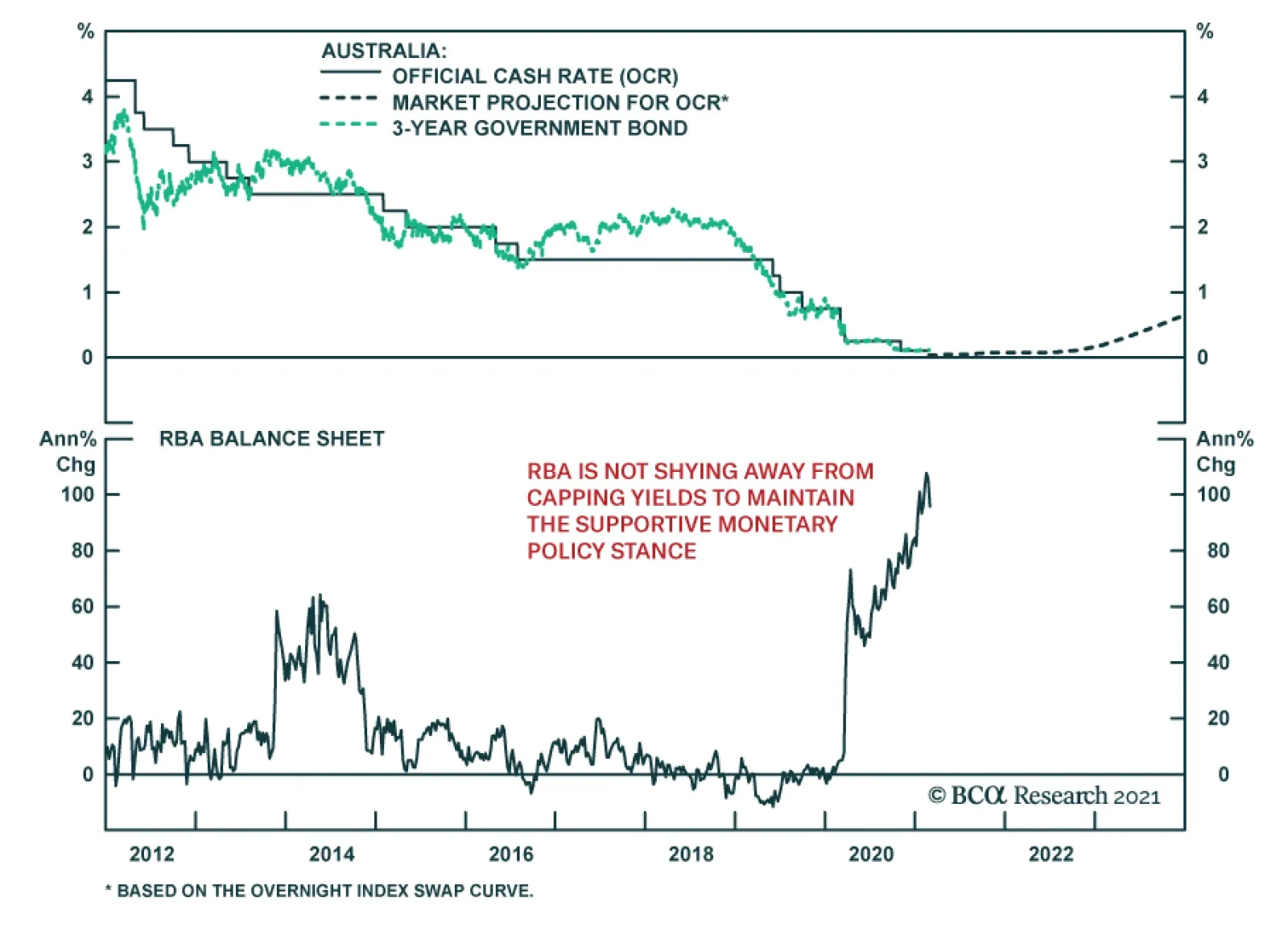
As expected, the Reserve Bank of Australia kept policy unchanged at its Tuesday meeting, maintaining the 10-basis point targets for the cash rate and the yield on the 3-year government bond. The RBA reiterated its commitment to keeping monetary…
Highlights Rising Global Yields: The increased turbulence in global bond markets is part of the adjustment process to a more positive outlook for global economic growth. Rising real yields are now the main driver of nominal yield movements, with stable inflation expectations indicating that investors are not overly concerned about a sustained inflation overshoot. Duration: Central bankers will eventually be forced to shift to less dovish interest rate guidance to reflect the new reality of faster growth and increased inflation pressures, but this is likely to not occur until much later in 2021, starting with the Fed. Maintain a below-benchmark cyclical duration stance in global bond portfolios. UST Yields & Spreads: The selloff in US Treasuries has pushed US yields to levels that are starting to look a bit stretched relative to yields from other major developed economies like Germany and Japan. This is especially true on a volatility-adjusted basis. As a result, we are closing our tactical US-Germany spread widening trade in bond futures at a profit of 1.8%. Feature Chart of the WeekBond Yields Are Rising Because Of Growth
Bond Yields Are Rising Because Of Growth
Bond Yields Are Rising Because Of Growth
The rapid surge in global bond yields seen so far in 2021 has led some commentators to declare that the dreaded “bond vigilantes” have returned to dole out punishment for overly stimulative fiscal and monetary policies (most notably in the US). The rapid pace of the bond selloff, with the 10-year US Treasury yield reaching 1.6% on an intraday basis last week, has raised fears that spiking yields could damage a fragile global economic recovery. This logic is backwards – it is surging growth expectations that are driving bond yields sustainably higher from deeply depressed levels. Global growth is projected to accelerate at a very rapid pace over the rest of this year and 2022. The combination of the Bloomberg consensus real GDP growth and inflation forecasts for the major developed economies suggest that nominal year-over-year GDP growth is expected to climb to 7.2% in the US, 8.4% in the UK and 6.4% in the euro area by year-end (Chart of the Week). Nominal growth in 2022 is expected to grow by another 5-7% across the same regions, suggesting a return to a slightly faster pace than prevailed during the pre-pandemic years of 2017-19 - even after a boom in 2021. Nominal longer-term global government bond yields, which had been priced for a pandemic-stricken economic backdrop, are now playing catch-up to the new reality of a post-pandemic, vaccinated world. Bond investors understand that the need for extreme monetary accommodation is ebbing, especially in the US where there will be an enormous fiscal impulse to growth in 2021 (and beyond). As a result, interest rate expectations are moving higher, fueling a repricing towards higher bond yields around the world. This process has more room to run. A Global Move Higher In Yields, For The Right Reasons Chart 2Reflationary Bear-Steepening Of Global Yield Curves
Reflationary Bear-Steepening Of Global Yield Curves
Reflationary Bear-Steepening Of Global Yield Curves
The cyclical rise in developed market bond yields that began last summer was initially focused on longer-maturity yields boosted by rising inflation expectations (Chart 2). The very front-ends of bond yield curves – which are more sensitive to expectations of changes in central bank policy rates – have remained subdued. The upward pressure on global bond yields is starting to infect some shorter maturities, however. 5-year government bonds yields in the UK, Canada and Australia rose 44bps, 42bps and 35bps, respectively, during the month of February. The latter two represented a near doubling of the level of the 5-year yield. In the case of the UK, the surge in 5-year Gilt yields came from a starting point of negative yields at the end of January. Last week, the 5-year US Treasury yield jumped a massive 22bps on a single day due to a poorly received US Treasury auction. Year-to-date, longer-term global bond yields have been rising more through the real yield component than higher inflation expectations (Charts 3A & 3B). This is a change in the dynamics from the latter half of 2020 when inflation expectations were the dominant force pushing global yields higher. Chart 3AReal Yields Are Driving The Recent Bond Selloff …
Real Yields Are Driving The Recent Bond Selloff...
Real Yields Are Driving The Recent Bond Selloff...
Chart 3B… Even In The Lower-Yielding Markets
...Even In The Lower-Yielding Markets
...Even In The Lower-Yielding Markets
This shift in “leadership” of the global bond market selloff has been broad-based. 10-year real yields from inflation-linked bonds have surged higher in the US (+35bps year-to-date), UK (+40bps), Australia (+44bps) and Canada (+25bps). Real 10-year yields have even inched up in France (+9bps), despite euro area growth suffering because of COVID-19 lockdowns. This coordinated rise in real bond yields comes on the heels of a sharp improvement in overall global economic momentum and improving expectations for future growth. Manufacturing PMIs, a reliable leading indicator of real yields in the developed markets, began a cyclical improvement in the middle of last year and, right on cue, global bond yields bottomed out toward the end of 2020 (Chart 4). The link between that strong growth momentum and real bond yields comes from expected changes in central bank policies. Our Central Bank Monitors for the US, euro area, UK, Japan, Canada and Australia – designed to measure cyclical pressures on monetary policy - have all moved significantly higher since mid-2020 (Chart 5). This suggests a diminished need for additional monetary stimulus because of rebounding economic growth and intensifying inflation pressures. The Monitors have climbed to above pre-pandemic levels in the US and Australia. Chart 4Real Yields Starting To Catch Up To Solid Growth
Real Yields Starting To Catch Up To Solid Growth
Real Yields Starting To Catch Up To Solid Growth
Chart 5Markets Starting To Discount Rate Hikes In 2023
Markets Starting To Discount Rate Hikes In 2023
Markets Starting To Discount Rate Hikes In 2023
Interest rate markets are responding to this cyclical pressure to tighten monetary policies by repricing the expected timing and pace of the next rate hiking cycle. Our 24-month discounters, which derive the amount of interest rate changes priced into overnight index swap (OIS) curves up to two years in the future, are now pricing in higher policy rates in the US (+40bps), the UK (+32bps), Australia (+36bps) and Canada (a whopping +82bps) by the first quarter of 2023. This repricing of interest rate expectations does conflict with current central bank forward guidance, to varying degrees. For example, the Fed continues to signal that there will not be any rate hikes until at least the end of 2023. Policymakers will not be overly concerned about higher government bond yields and shifting interest rate expectations, however, if there is limited spillover into broader financial market performance. In the US, the latest increase in real Treasury yields to date has had minimal impact on US equity market valuations or corporate bond yields (Chart 6A), suggesting no tightening of financial conditions that could impact future US economic growth. A similar situation is playing out in Europe, where higher longer-term real yields have had little impact on equity market valuations or the borrowing rates that the ECB is most concerned about, like Italian BTP yields (Chart 6B). Chart 6ANo Tightening Of Financial Conditions In The US...
No Tightening Of Financial Conditions In The US...
No Tightening Of Financial Conditions In The US...
Chart 6B...Or Europe
...Or Europe
...Or Europe
Currency valuations are a more important indicator of financial conditions for other central banks. For example, the Reserve Bank of Australia (RBA) has been explicit that its current policies – near-zero policy rates, yield curve control to anchor the level of 3-year bond yields and quantitative easing (QE) to moderate the level of longer-term yields – are intended to not only keep borrowing costs low but also dampen the value of the Australian dollar. At the moment, the US dollar is being pulled in different directions by the typical fundamental drivers. Real rate differentials between the US and other major developed economies remain unattractive for the greenback, even with the latest rise in US real yields (Chart 7). At the same time, growth differentials between the US and the other major economies are turning more USD-positive. For now, rate differentials are the more dominant factor for the US dollar and will remain so until the Fed begins to shift to a less dovish policy stance – an outcome that we do not expect until much later this year when the Fed will begin to prepare the market for a tapering of asset purchases in 2022. A sustainable bottoming of the US dollar, fueled by a shift to a less accommodative Fed, will also likely mark the end of the rising trend for global inflation expectations, given the links between the dollar, commodity prices and inflation breakevens (bottom panel). Central banks outside the US will continue to resist any unwelcome appreciation of their own currencies versus the US dollar. That means doing more QE when bond yields rise too quickly, as the RBA did this week and the ECB has threatened to do in recent comments from senior policymakers (Chart 8). Increasing the size of asset purchases is unlikely to sustainably drive non-US bond yields lower, however, in an environment of improving global growth that is causing investors to reassess the future path of interest rates. All more QE can hope to do at this point in the global business cycle is limit how fast bond yields can increase. Chart 7The USD Remains The Critical Reflationary Variable
The USD Remains The Critical Reflationary Variable
The USD Remains The Critical Reflationary Variable
Chart 8More QE Is Less Effective At Capping Bond Yields
More QE Is Less Effective At Capping Bond Yields
More QE Is Less Effective At Capping Bond Yields
Chart 9Markets With A Lower Yield Beta To USTs Are Outperforming
Markets With A Lower Yield Beta To USTs Are Outperforming
Markets With A Lower Yield Beta To USTs Are Outperforming
From an investment strategy perspective, the current growth-fueled move higher in global real bond yields does not change any of our suggested tilts. We continue to recommend a below-benchmark overall duration stance within global bond portfolios. Within our recommended country allocation among developed market government bonds, we continue to prefer a large underweight to US Treasuries and overweights to markets that are less susceptible to changes in US Treasury yields like Germany, France, Japan and the UK (Chart 9). We also continue to recommend only neutral allocations to Canadian and Australian government bonds (with below-benchmark duration exposure within those allocations), although we are on “downgrade alert” for both given their status as higher-beta bond markets with central banks more likely follow the Fed down a less dovish path later this year. Bottom Line: Rising real yields are now the main driver of nominal yield movements, with stable inflation expectations indicating that investors are not overly concerned about a sustained inflation overshoot. Central bankers will eventually be forced to shift to less dovish interest rate guidance to reflect the new reality of faster growth and increased inflation pressures, but this is likely to not occur until much later in 2021, starting with the Fed. Maintain a below-benchmark cyclical duration stance in global bond portfolios, with a large underweight allocation to US Treasuries. The UST-Bund Spread Widening Looks Stretched Chart 10Yield Chasing Has Been A Losing Strategy In 2021
Yield Chasing Has Been A Losing Strategy In 2021
Yield Chasing Has Been A Losing Strategy In 2021
Last August, we published a report discussing how “yield chasing” – a strategy of consistently favoring the highest yielding government bond markets – had become the default strategy for bond investors during the early months of the pandemic.1 We concluded that yield chasing would be a successful strategy for only as long as central banks stuck to their promises to maintain very loose monetary policy for the next few years. Investors would be forced to chase scarce yields in that environment, while worrying less about cyclical economic and inflation factors that could push up bond yields. Yield chasing has performed quite poorly so far in 2021. A basket of higher-yielding markets like the US, Canada and Australia has underperformed a basket of low-yielders like Germany, France and Japan by -1.4 percentage points (Chart 10). Obviously, such a carry-driven strategy would be expected to perform poorly during an environment of rising bond volatility as is currently the case. Markets that have been offering relatively enticing yields, like the US or Australia (Table 1), are actually generating the largest total return losses. Those higher-yielders have suffered more aggressive repricing of interest rate expectations, as discussed in the previous section of this report, leading to losses from duration that are dwarfing the higher yields. This is especially true in the US, where there remains the greater scope for an upward repricing of interest rate and inflation expectations. Table 1Government Bond Yields: Unhedged & Hedged Into USD
Are Central Banks Losing Control Of Bond Yields? No.
Are Central Banks Losing Control Of Bond Yields? No.
This suggests that investors must be cautious on determining when to consider increasing exposure to higher yielders like the US, even after Treasury yields have increased substantially. One way to evaluate that is to look at the spreads between US Treasuries and low yielders like Germany and Japan, relative to US bond volatility. In Chart 11, we show the spread of 10-year US Treasuries to 10-year German Bunds. To facilitate a fair comparison between the two, we hedge the Treasury yield into euros while adjusting the spread for duration difference between the two bonds. The currency-hedged and duration-matched Treasury-Bund spread is shown in the middle panel of the chart. In the bottom panel, we adjust that spread for US interest rate volatility by dividing the spread by the level of the MOVE index of US Treasury option volatility. On an unadjusted basis, the 10-year yield gap now sits at 175bps, +70bps higher than the lows seen in August 2020. That spread is narrower on a currency hedged basis, with the 10-year US Treasury yield hedged into euros +73ps higher than the 10-year German bund yield. Two conclusions stand out from the chart: The currency-hedged and duration-matched spread is still well below the prior peaks dating back to 2000; The volatility-adjusted spread is already one standard deviation above the mean value since 2000. In other words, there is scope for US Treasuries yields to continue rising relative to German Bund yields based on levels reached in past cycles. Yet at the same time, the spread provides a reasonable level of compensation compared to the riskiness (volatility) of Treasuries, also based on past cycles. We show the same chart for the spread between 10-year US Treasuries and 10-year Japanese government bonds (JGBs) in Chart 12. In this case, there is also scope for additional spread widening although the volatility-adjusted spread is still not as attractive as at previous peaks since 2000. Chart 11UST-Bund Spread Looking Stretched Vs UST Vol
UST-Bund Spread Looking Stretched Vs UST Vol
UST-Bund Spread Looking Stretched Vs UST Vol
Chart 12UST-JGB Spread Getting Stretched Vs UST Vol
UST-JGB Spread Getting Stretched Vs UST Vol
UST-JGB Spread Getting Stretched Vs UST Vol
The message from the volatility-adjusted Treasury-Bund spread lines up with that of the momentum measures of the unadjusted spread. The latter is historically stretched relative to its 200-day moving average, while the change in the spread over the past six months has been as rapid as any of the moves seen since the 2008 financial crisis (Chart 13). Adding it all up, positioning for additional widening of the Treasury-Bund spread is a much poorer bet from a risk versus reward perspective than it was even a few months ago. On a fundamental medium-term basis, however, there is still room for the Treasury-Bund spread to widen further. Relative inflation and unemployment (spare capacity) trends both argue for relatively higher US bond yields (Chart 14). In addition, the Fed is almost certainly going to start tightening monetary policy well before the ECB, thus policy rate differentials will underpin a wider bond spread – although that is already largely discounted in the spread on a forward basis (top panel). Chart 13UST-Bund Spread Momentum Looks Stretched
UST-Bund Spread Momentum Looks Stretched
UST-Bund Spread Momentum Looks Stretched
Chart 14Fundamentals Still Support A Wider UST-Bund Spread
Fundamentals Still Support A Wider UST-Bund Spread
Fundamentals Still Support A Wider UST-Bund Spread
Chart 15Stay Underweight US Vs. Germany On A Strategic Basis
Stay Underweight US Vs. Germany On A Strategic Basis
Stay Underweight US Vs. Germany On A Strategic Basis
Our fundamental fair value model of the 10-year Treasury-Bund spread shows that the spread is still cheap relative to fair value, which is rising (Chart 15). This suggests more medium-term upside in the spread, perhaps even by more than currently priced into the forwards over the next year. Based on this analysis, we see a case for maintaining a core strategic (6-12 month holding period) underweight position for the US versus Germany in our recommended country allocation within our model bond portfolio. At the same time, with the spread looking a bit stretched on some of the momentum and volatility-adjusted measures, we are taking profits on our tactical (0-6 month holding period) 10-year Treasury-Bund spread widening trade using bond futures, realizing a 1.8% return (see the Tactical Overlay table on page 18). Bottom Line: The selloff in US Treasuries has pushed US yields to levels that are starting to look a bit stretched relative to yields from other major developed economies like Germany and Japan. This is especially true on a volatility-adjusted basis. As a result, we are taking profits on our tactical US-Germany spread widening trade. However, we are maintaining our strategic overweight for Germany versus the US in our model bond portfolio, as fundamentals argue for a wider Treasury-Bund spread on a cyclical and strategic basis. Robert Robis, CFA Chief Fixed Income Strategist rrobis@bcaresearch.com Footnotes 1 Please see BCA Research Global Fixed Income Strategy Report, "We’re All Yield Chasers Now", dated August 11, 2020, available at gfis.bcaresearch.com. Recommendations The GFIS Recommended Portfolio Vs. The Custom Benchmark Index
Are Central Banks Losing Control Of Bond Yields? No.
Are Central Banks Losing Control Of Bond Yields? No.
Duration Regional Allocation Spread Product Tactical Trades Yields & Returns Global Bond Yields Historical Returns
Highlights Chart 1Back To Fair Value
Back To Fair Value
Back To Fair Value
February was a terrible month for the bond market. In fact, the Bloomberg Barclays Treasury Master Index returned -1.8%, its worst month since November 2016. The 5-year/5-year forward Treasury yield rose 37 bps. At 2.19%, it is now fairly valued for the first time since 2019, at least according to survey estimates of the long-run neutral fed funds rates (Chart 1). We outlined a checklist for increasing portfolio duration in our Webcast two weeks ago. So far, only two of the five items on our list have been checked. In particular, dollar sentiment and cyclical economic indicators continue to point toward higher yields, even though the market is now priced for a rate hike cycle that is slightly more hawkish than the Fed’s median forecast from December. We anxiously await this month’s revisions to the Fed’s interest rate forecasts. If the Fed’s forecasts remain unchanged from December, then we may get an opportunity to add some duration back into our recommended portfolio. Stay tuned. Feature Investment Grade: Neutral Chart 2Investment Grade Market Overview
Investment Grade Market Overview
Investment Grade Market Overview
Investment grade corporate bonds outperformed the duration-equivalent Treasury index by 65 basis points in February, bringing year-to-date excess returns up to +68 bps. The combination of above-trend economic growth and accommodative monetary policy supports positive excess returns for spread product versus Treasuries. Though Treasury yields have risen in recent weeks, this does not yet pose a risk for credit spreads. The 5-year/ 5-year forward TIPS breakeven inflation rate remains below 2%. We won’t be concerned about restrictive monetary policy pushing credit spreads wider until it reaches a range of 2.3% to 2.5%. Despite the positive macro backdrop, investment grade corporate valuations are extremely tight. The investment grade corporate index’s 12-month breakeven spread is down to its 2nd percentile (Chart 2). This means that the breakeven spread has only been tighter 2% of the time since 1995. The same measure shows that Baa-rated bonds have only been more expensive 3% of the time (panel 3). We don’t anticipate material underperformance versus Treasuries, but we see better value outside of the investment grade corporate space.1 Specifically, we advise investors to favor tax-exempt municipal bonds over investment grade corporates with the same credit rating and duration. We also prefer USD-denominated Emerging Market Sovereign bonds over investment grade corporates with the same credit rating and duration. Finally, the supportive macro environment means we are comfortable adding credit risk to a portfolio. With that in mind, we encourage investors to pick up the additional spread offered by high-yield corporates. Table 3ACorporate Sector Relative Valuation And Recommended Allocation*
Stay Bearish On Bonds
Stay Bearish On Bonds
Table 3BCorporate Sector Risk Vs. Reward*
Stay Bearish On Bonds
Stay Bearish On Bonds
High-Yield: Overweight Chart 3High-Yield Market Overview
High-Yield Market Overview
High-Yield Market Overview
High-Yield outperformed the duration-equivalent Treasury index by 115 basis points in February, bringing year-to-date excess returns up to +178 bps. Ba-rated credits outperformed duration-matched Treasuries by 111 bps on the month, besting B-rated bonds which outperformed by only 104 bps. The Caa-rated credit tier delivered 138 bps of outperformance versus duration-matched Treasuries. We view Ba-rated junk bonds as the sweet spot within the corporate credit space. The sector is relatively insulated from default risk and yet still offers a sizeable spread pick-up over investment grade corporates (Chart 3). We noted in our 2021 Key Views Special Report that the additional spread earned from moving down in quality below Ba is merely in line with historical averages.2 Assuming a 25% recovery rate on defaulted debt and a minimum required risk premium of 150 bps, we calculate that the junk index is priced for a default rate of 2.3% for the next 12 months (panel 3). This represents a steep drop from the 8.3% default rate observed during the most recent 12-month period. However, only 2 defaults occurred in January, down from a peak of 22 in July. Job cut announcements, an excellent indicator of the default rate, have also fallen dramatically (bottom panel). Overall, we see room for spread compression across all junk credit tiers in 2021 but believe that Ba-rated bonds offer the best opportunity in risk-adjusted terms. MBS: Underweight Chart 4MBS Market Overview
MBS Market Overview
MBS Market Overview
Mortgage-Backed Securities underperformed the duration-equivalent Treasury index by 26 basis points in February, dragging year-to-date excess returns down to -2 bps. The nominal spread between conventional 30-year MBS and equivalent-duration Treasuries widened 6 bps in February, but it remains low relative to the recent pace of mortgage refinancings (Chart 4). The MBS option-adjusted spread (OAS) tightened 1 bp on the month to 24 bps. This is considerably below the 57 bps offered by Aa-rated corporate bonds and the 42 bps offered by Agency CMBS. It is only slightly above the 22 bps offered by Aaa-rated consumer ABS. The plummeting primary mortgage spread was a key reason for the elevated refi activity seen during the past year. However, the spread has now recovered back to more typical levels (bottom panel). The implication is that further increases in Treasury yields will likely be matched by higher mortgage rates. This means that mortgage refinancings are likely close to a peak. A drop in refi activity would be a positive development for MBS returns, but we aren’t yet ready to turn bullish on the sector. First, relative OAS valuation favors Aa-rated corporates and Agency CMBS over MBS. Second, the gap between the nominal MBS spread and the MBA Refinance Index remains wide (panel 2) meaning that we could still see spreads adjust higher. Last year’s spike in the mortgage delinquency rate is alarming (panel 4), but it will have little impact on MBS returns. The increase was driven by household take-up of forbearance granted by the federal government. Our US Investment Strategy service has shown that a considerable majority of households will remain current on their loans once the forbearance period ends, causing the delinquency rate to fall back down.3 Government-Related: Neutral Chart 5Government-Related Market Overview
Government-Related Market Overview
Government-Related Market Overview
The Government-Related index underperformed the duration-equivalent Treasury index by 3 basis points in February, dragging year-to-date excess returns down to +21 bps (Chart 5). Sovereign debt underperformed duration-equivalent Treasuries by 95 bps in February, dragging year-to-date excess returns down to -116 bps. Foreign Agencies outperformed the Treasury benchmark by 31 bps on the month, bringing year-to-date excess returns up to +25 bps. Local Authority bonds outperformed by 63 bps in February, bringing year-to-date excess returns up to +203 bps. Domestic Agency bonds outperformed by 1 bp, bringing year-to-date excess returns up to +16 bps. Supranationals underperformed by 2 bps, dragging year-to-date excess returns down to +5 bps. We recently took a detailed look at valuation for USD-denominated Emerging Market (EM) Sovereigns.4 We found that, on an equivalent-duration basis, EM Sovereigns offer a spread advantage versus US corporates for all credit tiers except Ba. We recommend that investors take advantage of this spread pick-up by favoring investment grade EM Sovereigns over investment grade US corporates. Attractive countries include: Qatar, UAE, Saudi Arabia, Mexico, Russia and Colombia. We prefer US corporates over EM Sovereigns in the high-yield space. Ba-rated high-yield US corporates offer a spread advantage over EM Sovereigns and the extra spread available in B-rated and lower EMs comes from distressed credits in Turkey and Argentina. Municipal Bonds: Overweight Chart 6Municipal Market Overview
Municipal Market Overview
Municipal Market Overview
Municipal bonds underperformed the duration-equivalent Treasury index by 6 basis points in February, dragging year-to-date excess returns down to +102 bps (before adjusting for the tax advantage). Municipal bond spreads have tightened dramatically during the past few months and Aaa-rated Munis now look expensive compared to Treasuries, with the exception of the short-end of the curve (Chart 6). That said, if we match the duration and credit rating between the Bloomberg Barclays Municipal bond indexes and the US Credit index, we find that both General Obligation (GO) and Revenue Munis appear attractive compared to US investment grade Credit. Both GO and Revenue Munis offer a before-tax spread pick-up relative to US Credit for maturities above 12 years (bottom panel), the same goes for Revenue bonds in the 8-12 year maturity bucket (panel 3). Revenue bonds in the 6-8 year maturity bucket offer an after-tax yield pick-up versus Credit for investors with an effective tax rate above 0.3%. GO bonds in the 8-12 year and 6-8 year maturity buckets offer breakeven effective tax rates of 1% and 10%, respectively. All in all, municipal bond value has deteriorated markedly in recent months and we downgraded our recommended allocation from “maximum overweight” to “overweight” in January. However, investors should still prefer municipal bonds over investment grade corporate bonds with the same credit rating and duration. Treasury Curve: Buy 5-Year Bullet Versus 2/10 Barbell Chart 7Treasury Yield Curve Overview
Treasury Yield Curve Overview
Treasury Yield Curve Overview
Treasury yields moved up dramatically in February, with the curve steepening out to the 7-year maturity point and flattening thereafter. The 2/10 Treasury slope steepened 30 bps on the month to reach 130 bps. The 5/30 slope, meanwhile, held steady at 142 bps. Slopes across the entire yield curve traded directionally with yields for the bulk of February. That is, until last Thursday when a surge in bond yields occurred alongside flattening beyond the 5-year maturity point. As a result, the 2/5/10 butterfly spread spiked (Chart 7), moving into positive territory for the first time in a while (panel 4). This curve behavior raises an interesting question. Was last week’s sharp underperformance in the belly a one-off move driven by convexity selling and other technical factors, as many have suggested?5 Or, are we now close enough to a potential Fed liftoff date that we should expect some segments of the yield curve to flatten on days when yields rise? We will be watching the correlations between different yield curve segments and the overall level of yields closely during the next few weeks, but as of today, we think it’s premature to declare that the 5/10 slope has transitioned into a regime where it flattens on days when yields move higher. That being the case, we expect further increases in bond yields to coincide with a falling 2/5/10 butterfly spread, and we retain our recommended position long the 5-year bullet and short a duration-matched 2/10 barbell. TIPS: Overweight Chart 8TIPS Market Overview
TIPS Market Overview
TIPS Market Overview
TIPS outperformed the duration-equivalent nominal Treasury index by 39 basis points in February, bringing year-to-date excess returns up to +183 bps. The 10-year TIPS breakeven inflation rate rose 2 bps on the month to hit 2.17%. The 5-year/5-year forward TIPS breakeven inflation rate fell 15 bps in February to reach 1.91%. February’s TIPS outperformance was concentrated at the front-end of the curve, as investors started to price-in the possibility of higher inflation during the next year or two that eventually subsides. It’s interesting to note that, despite last month’s surge in bond yields, the 5-year/5-year forward TIPS breakeven inflation rate fell, moving further away from the Fed’s 2.3% to 2.5% target range in the process (Chart 8). The Fed will continue to strive for an accommodative policy stance at least until this target is met. Last month’s price action caused our recommended positions in inflation curve flatteners and real yield curve steepeners to perform very well, but we think further gains are possible in the coming months. The 2/10 CPI swap slope has only just dipped into negative territory (panel 4). With the Fed officially targeting a temporary overshoot of its 2% inflation target, this slope should remain inverted for some time yet. With the Fed also continuing to exert more control over short-dated nominal yields than over long-term ones, short-maturity real yields will continue to come under downward pressure relative to the long end (bottom panel). ABS: Overweight Chart 9ABS Market Overview
ABS Market Overview
ABS Market Overview
Asset-Backed Securities outperformed the duration-equivalent Treasury index by 3 basis points in February, bringing year-to-date excess returns up to +20 bps. Aaa-rated ABS outperformed by 2 bps on the month, bringing year-to-date excess returns up to +13 bps. Non-Aaa ABS outperformed by 9 bps on the month, bringing year-to-date excess returns up to +58 bps. The stimulus from last year’s CARES act led to a significant increase in household savings when individual checks were mailed last April. This excess savings has still not been spent, and now another round of checks is pushing the savings rate higher again (Chart 9). The large stock of household savings means that the collateral quality of consumer ABS is very high, with many households using their windfall to pay down debt (bottom panel). Investors should remain overweight consumer ABS and take advantage of strong collateral performance by moving down in credit quality. The Treasury department’s decision to let the Term Asset-Backed Loan Facility (TALF) expire at the end of 2020 does not alter our recommendation. Spreads are already well below the borrowing cost that was offered by TALF, and these tight spread levels are justified by strong household balance sheets. Non-Agency CMBS: Neutral Chart 10CMBS Market Overview
CMBS Market Overview
CMBS Market Overview
Non-Agency Commercial Mortgage-Backed Securities outperformed the duration-equivalent Treasury index by 12 basis points in February, bringing year-to-date excess returns up to +87 bps. Aaa Non-Agency CMBS underperformed Treasuries by 5 bps in February, dragging year-to-date excess returns down to +37 bps. Meanwhile, non-Aaa CMBS outperformed by 75 bps, bringing year-to-date excess returns up to +262 bps (Chart 10). We continue to recommend an overweight allocation to Aaa-rated Non-Agency CMBS and an underweight allocation to non-Aaa CMBS. Even with the expiry of TALF, Aaa CMBS spreads are already well below the cost of borrowing through TALF and thus won’t be negatively impacted. Meanwhile, the structurally challenging environment for commercial real estate could lead to problems for lower-rated CMBS (panels 3 & 4). Agency CMBS: Overweight Agency CMBS outperformed the duration-equivalent Treasury index by 11 basis points in February, bringing year-to-date excess returns up to +39 bps. The average index option-adjusted spread tightened 3 bps on the month to reach 42 bps (bottom panel). Though Agency CMBS spreads have completely recovered back to their pre-COVID lows, they still look attractive compared to other similarly risky spread products. This is especially true when you consider the Fed’s continued pledge to purchase as much Agency CMBS as “needed to sustain smooth market functioning”. Appendix A: Butterfly Strategy Valuations The following tables present the current read-outs from our butterfly spread models. We use these models to identify opportunities to take duration-neutral positions across the Treasury curve. The following two Special Reports explain the models in more detail: US Bond Strategy Special Report, “Bullets, Barbells And Butterflies”, dated July 25, 2017, available at usbs.bcaresearch.com US Bond Strategy Special Report, “More Bullets, Barbells And Butterflies”, dated May 15, 2018, available at usbs.bcaresearch.com Table 4 shows the raw residuals from each model. A positive value indicates that the bullet is cheap relative to the duration-matched barbell. A negative value indicates that the barbell is cheap relative to the bullet. Table 4Butterfly Strategy Valuation: Raw Residuals In Basis Points (As Of February 26TH, 2021)
Stay Bearish On Bonds
Stay Bearish On Bonds
Table 5 scales the raw residuals in Table 4 by their historical means and standard deviations. This facilitates comparison between the different butterfly spreads. Table 5Butterfly Strategy Valuation: Standardized Residuals (As Of February 26TH, 2021)
Stay Bearish On Bonds
Stay Bearish On Bonds
Table 6 flips the models on their heads. It shows the change in the slope between the two barbell maturities that must be realized during the next six months to make returns between the bullet and barbell equal. For example, a reading of 39 bps in the 5 over 2/10 cell means that we would only expect the 5-year to outperform the 2/10 if the 2/10 slope steepens by more than 39 bps during the next six months. Otherwise, we would expect the 2/10 barbell to outperform the 5-year bullet. Table 6Discounted Slope Change During Next 6 Months (BPs)
Stay Bearish On Bonds
Stay Bearish On Bonds
Appendix B: Excess Return Bond Map The Excess Return Bond Map is used to assess the relative risk/reward trade-off between different sectors of the US bond market. It is a purely computational exercise and does not impose any macroeconomic view. The Map’s vertical axis shows 12-month expected excess returns. These are proxied by each sector’s option-adjusted spread. Sectors plotting further toward the top of the Map have higher expected returns and vice-versa. Our novel risk measure called the “Risk Of Losing 100 bps” is shown on the Map’s horizontal axis. To calculate it, we first compute the spread widening required on a 12-month horizon for each sector to lose 100 bps or more relative to a duration-matched position in Treasury securities. Then, we divide that amount of spread widening by each sector’s historical spread volatility. The end result is the number of standard deviations of 12-month spread widening required for each sector to lose 100 bps or more versus a position in Treasuries. Lower risk sectors plot further to the right of the Map, and higher risk sectors plot further to the left. Chart 11Excess Return Bond Map (As Of February 26th, 2021)
Stay Bearish On Bonds
Stay Bearish On Bonds
Ryan Swift US Bond Strategist rswift@bcaresearch.com Footnotes 1 For a look at alternatives to investment grade corporates please see US Bond Strategy Weekly Report, “Searching For Value In Spread Product”, dated January 26, 2021, available at usbs.bcaresearch.com 2 Please see US Bond Strategy Special Report, “2021 Key Views: US Fixed Income”, dated December 15, 2020, available at usbs.bcaresearch.com 3 Please see US Investment Strategy Weekly Report, “The Big Bank Beige Book, January 2021”, dated January 25, 2021, available at usis.bcaresearch.com 4 Please see US Bond Strategy Weekly Report, “Searching For Value In Spread Product”, dated January 26, 2021, available at usbs.bcaresearch.com 5 https://www.bloomberg.com/news/articles/2021-02-25/convexity-hedging-haunts-markets-already-reeling-from-bond-rout?sref=Ij5V3tFi Fixed Income Sector Performance Recommended Portfolio Specification Corporate Sector Relative Valuation And Recommended Allocation
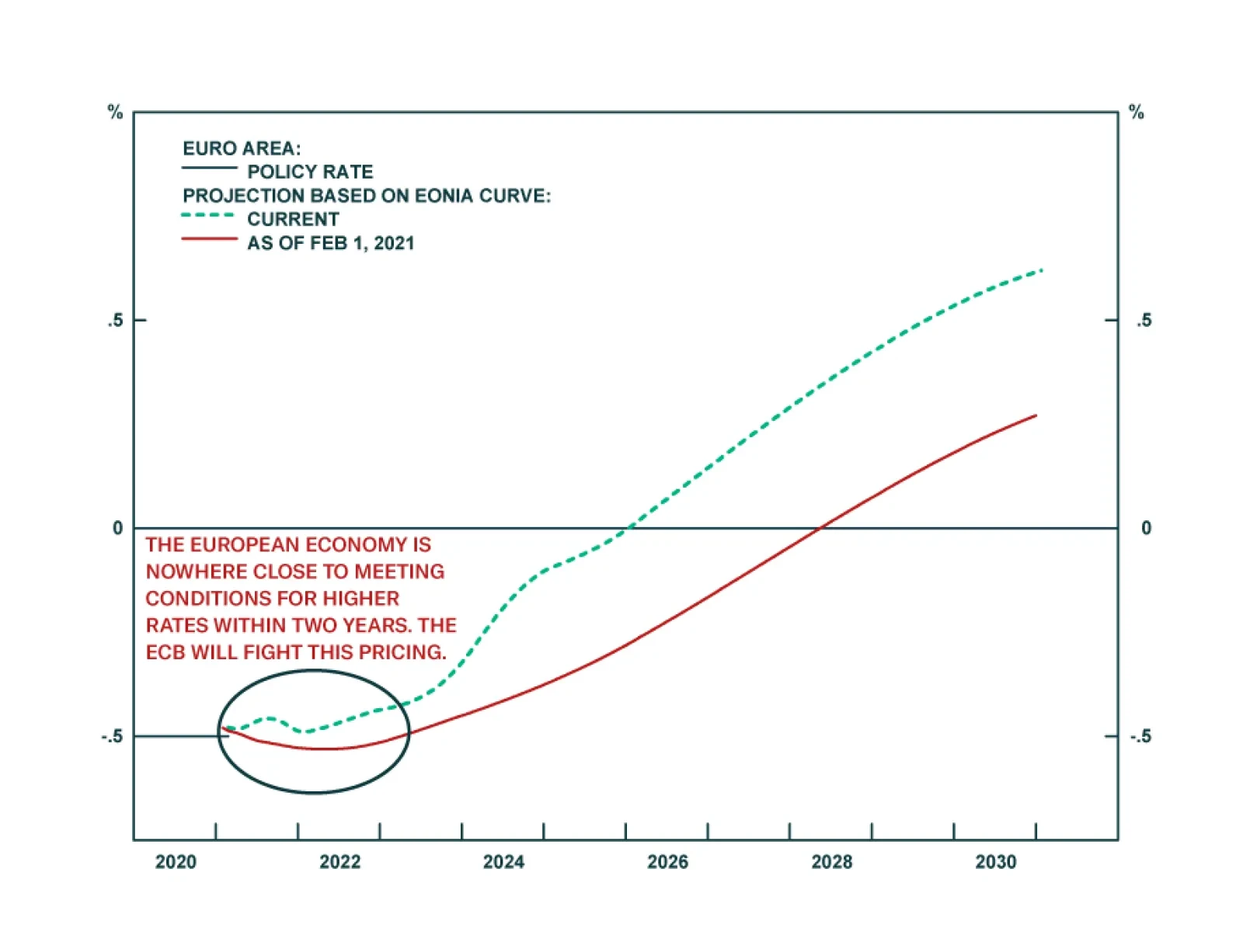
Central banks are becoming uncomfortable with the recent global yield moves. For example, many prominent members of the European Central Bank Governing Council are already suggesting that the ECB could increase the size of its asset purchase to stem the…
Dear Client, In addition to this week’s abbreviated report, we are sending you a Special Report on Bitcoin. I don’t recommend you buy it. Best regards, Peter Berezin Highlights Real government bond yields have increased in recent weeks, which could put further downward pressure on equity prices in the near term. Nevertheless, we continue to advocate overweighting equities over a 12-month horizon. Historically, rising real yields have been most toxic for stocks when yields have increased in response to hawkish central bank rhetoric. This is manifestly not the case today. The Fed’s accommodative stance should limit any near-term upward pressure on the US dollar. Investors should favor cyclical and value-oriented stocks over defensive and growth-geared plays. Higher Real Yields: A Near-Term Risk For Stocks Chart 1Government Bond Yields Have Increased Since Bottoming Last Year
Government Bond Yields Have Increased Since Bottoming Last Year
Government Bond Yields Have Increased Since Bottoming Last Year
Bond yields have jumped in recent weeks. After bottoming at 0.52% in August, the US 10-year Treasury yield has climbed to 1.54%, up from 0.93% at the beginning of the year. Government bond yields in the other major economies have also risen (Chart 1). While inflation expectations have bounced, the most recent increase in yields has been concentrated in the real component of bond yields (Chart 2). Optimism about a vaccine-led global growth recovery, reinforced by continued fiscal stimulus – especially in the US – has prompted investors to move forward their expectations of how soon and how high policy rates will rise (Chart 3). Chart 2AThe Real Component Has Fueled The Most Recent Rise In Bond Yields (I)
The Real Component Has Fueled The Most Recent Rise In Bond Yields (I)
The Real Component Has Fueled The Most Recent Rise In Bond Yields (I)
Chart 2BThe Real Component Has Fueled The Most Recent Rise In Bond Yields (II)
The Real Component Has Fueled The Most Recent Rise In Bond Yields (II)
The Real Component Has Fueled The Most Recent Rise In Bond Yields (II)
How menacing is the increase in bond yields to stock market investors? Chart 4 shows that there has been a close correlation between real yields and the forward P/E ratio at which the S&P 500 trades. The 5-year/5-year forward real yield, in particular, has moved up sharply, which could put further downward pressure on stocks in the near term. Chart 3Path Of Expected Policy Rates Being Revised Upwards
Path Of Expected Policy Rates Being Revised Upwards
Path Of Expected Policy Rates Being Revised Upwards
Chart 4Rise In Real Rates Is A Headwind For Equity Valuations
Rise In Real Rates Is A Headwind For Equity Valuations
Rise In Real Rates Is A Headwind For Equity Valuations
Nevertheless, we continue to advocate overweighting equities over a 12-month horizon. As we pointed out two weeks ago, rising real yields have historically been most toxic for stocks when yields have increased in response to hawkish central bank rhetoric. This is manifestly not the case today. In his testimony to Congress this week, Jay Powell downplayed inflation risks, stressing that the US economy was “a long way” from the Fed’s goals. He pledged to tread “carefully and patiently” and give “a lot of advance warning” before beginning the process of normalizing monetary policy. We expect the 10-year Treasury yield to stabilize in the 1.6%-to-1.7% range, still well below the level that would threaten the health of the economy. Favor Cyclical And Value-Oriented Stocks In A Weaker Dollar Environment The Fed’s accommodative stance should limit any near-term upward pressure on the US dollar. Whereas stocks are most sensitive to absolute changes in long-term real bond yields, the dollar is more sensitive to changes in short-term real rate differentials with US trading partners (Chart 5). Since the Fed is unlikely to tighten monetary policy anytime soon, US short-term real rates could fall further as inflation rises. Chart 5The Dollar Is Sensitive To Changes In Short-Term Real Rate Differentials
The Dollar Is Sensitive To Changes In Short-Term Real Rate Differentials
The Dollar Is Sensitive To Changes In Short-Term Real Rate Differentials
Chart 6Cyclical Stocks Tend To Benefit The Most From Stronger Global Growth And A Weaker Dollar
Cyclical Stocks Tend To Benefit The Most From Stronger Global Growth And A Weaker Dollar
Cyclical Stocks Tend To Benefit The Most From Stronger Global Growth And A Weaker Dollar
Cyclical stocks, which are overrepresented outside the US, tend to benefit the most from strengthening global growth and a weakening dollar (Chart 6). Value stocks also generally do well in a weak dollar-strong growth environment (Chart 7). Moreover, bank shares – which are concentrated in value indices – typically outperform when long-term bond yields are rising (Chart 8). Chart 7AA Weaker US Dollar And Stronger Global Growth Should Help Value Stocks (I)
A Weaker US Dollar And Stronger Global Growth Should Help Value Stocks (I)
A Weaker US Dollar And Stronger Global Growth Should Help Value Stocks (I)
Chart 7BA Weaker US Dollar And Stronger Global Growth Should Help Value Stocks (II)
A Weaker US Dollar And Stronger Global Growth Should Help Value Stocks (II)
A Weaker US Dollar And Stronger Global Growth Should Help Value Stocks (II)
Chart 8Bank Shares Typically Excel When Long-Term Bond Yields Are Rising
Bank Shares Typically Excel When Long-Term Bond Yields Are Rising
Bank Shares Typically Excel When Long-Term Bond Yields Are Rising
In contrast, as relatively long-duration assets, growth stocks often struggle when bond yields go up. The same is true for more speculative plays such as cryptocurrencies. In this week’s Special Report, we discuss the fate of Bitcoin, arguing that investors should resist buying it. Peter Berezin Chief Global Strategist pberezin@bcaresearch.com Global Investment Strategy View Matrix
When Good News Is Bad News
When Good News Is Bad News
Special Trade Recommendations
When Good News Is Bad News
When Good News Is Bad News
Current MacroQuant Model Scores
When Good News Is Bad News
When Good News Is Bad News
Highlights US Treasuries: The uptrend in US Treasury yields has more room to run. However, the primary driver is starting to shift from increased inflation expectations to higher real yields amid greater confidence on the cyclical US economic outlook. Fed Outlook: It is still too soon to expect the Fed to begin signaling a move to turn less accommodative. However, rising realized US inflation amid dwindling spare economic capacity will make the Fed more nervous about its ultra-dovish policy stance in the second half of 2021. This will trigger a repricing of the future path of US interest rates embedded in the Treasury curve, but a Taper Tantrum repeat will be avoided. US Duration: Maintain below-benchmark US duration exposure, with the 10-year Treasury yield likely to soon test the 1.5% level. Feature Chart 1A Cyclical Rise In Global Bond Yields
A Cyclical Rise In Global Bond Yields
A Cyclical Rise In Global Bond Yields
The selloff in global government bond markets that began in the final few months of 2020 has gained momentum over the past few weeks. The benchmark 10-year US Treasury yield now sits at 1.37%, up 45bps so far in 2021, while the 30-year Treasury yield is at a six-year high of 2.22%. Yields are on the move in other countries, as well, with longer-maturity yields moving higher in the UK, Canada, Australia, New Zealand – even Germany, where the 30yr is now back in positive yield territory at 0.20%, a 34bp increase over the past month alone. The main reason for this move higher in yields can be summed up in one word: “optimism”. Economic growth expectations are improving according to investor surveys like the global ZEW, which is a reliable leading indicator of global bond yields (Chart 1). Falling global COVID-19 case numbers with rising vaccination rates, combined with very large US fiscal stimulus measures proposed by the Biden administration, have given investors hope that a return to some form of pre-pandemic economic normalcy can be achieved later this year. That means faster global growth and a risk of higher inflation, both of which must be reflected in higher bond yields. With the 10-year US Treasury yield now already in the middle of our 2021 year-end target range of 1.25-1.5%, and the macro backdrop remaining bond-bearish, we think it is timely to discuss the possibility that our yield target is too conservative Good Cyclical News Is Bad News For Treasuries The more recent move higher in US Treasury yields is notable because it has not been all about higher inflation breakevens, as has been the case since yields bottomed in mid-2020; real yields are finally starting to inch higher. The 30-year TIPS yield now sits in positive territory at +0.09%, ending a period of negative real yields dating back to the pandemic-induced market shock of last spring (Chart 2). Real yields across the rest of the TIPS curve are also starting to stir, even at the 2-year point, yet remain negative. Thus, the price action has supported one of US Bond Strategy’s Key Views for 2021 that the real yield curve will steepen.1 This uptick in US real yields has occurred alongside a string of positive developments on the US economy, suggesting that improved growth prospects – and what that means for future US inflation and Fed policy - are the key driver. Improving US domestic demand US economic data is not only showing resilience but gaining positive momentum. The preliminary US Markit composite PMI (combining both manufacturing and services industries) for February rose to the highest level in six years (Chart 3). Retail sales in January rose by an eye-popping 5.3% versus the month prior, due in no small part to the impact of government stimulus checks issued in the December pandemic relief package. The Conference Board measure of consumer confidence also picked up in January. The improving trend in US data so far in 2021 is pointing to some potentially big GDP numbers – the New York Fed’s “Nowcast” is calling for Q1 real GDP growth of 8.3%. Chart 2US Real Yields Starting Are Stirring
US Real Yields Starting Are Stirring
US Real Yields Starting Are Stirring
Chart 3US Growing Faster Than Lockdown-Stricken Europe
US Growing Faster Than Lockdown-Stricken Europe
US Growing Faster Than Lockdown-Stricken Europe
Vaccine rollout success After a sloppy start to the COVID-19 vaccination program in the US, the numbers are starting to improve with 19% of the US population having received at least one dose (Chart 4). Numbers of new cases and hospitalizations due to the virus have been collapsing as well, a sign that new lockdowns can be avoided, particularly in the larger US coastal cities. The vaccination numbers are even higher in the UK, where Prime Minister Boris Johnson this week revealed an ambitious plan to fully reopen the UK economy by June. While the pace of inoculation has been far slower within the euro area and other developed countries like Canada, developments in the US and UK are a hopeful sign that the vaccines can help free the world economy from the shackles of COVID-19. Chart 4The US & UK Leading The Way On The Vaccine Rollout
Optimism Reigns Supreme
Optimism Reigns Supreme
Even more fiscal stimulus Our US political strategists expect the Biden Administration’s $1.9 trillion pandemic relief package (the “American Rescue Plan”) to be passed by the US Senate in mid-March via a simple majority through a reconciliation bill.2 A second bill is likely to be passed this autumn or next spring with a much larger number, potentially up to $8 trillion worth of spending on infrastructure, health care, child care and green projects over the next ten years (Chart 5). These are big numbers for a $21 trillion US economy that will increasingly need less stimulus as lockdowns ease. Chart 5Biden’s Agenda AFTER The American Rescue Plan
Optimism Reigns Supreme
Optimism Reigns Supreme
Chart 6Welcome Back, Inflation?
Welcome Back, Inflation?
Welcome Back, Inflation?
Chart 7Price Pressures From US Manufacturing Bottlenecks
Price Pressures From US Manufacturing Bottlenecks
Price Pressures From US Manufacturing Bottlenecks
The combined impact of fiscal stimulus, accommodative monetary policy, easy financial conditions and fewer pandemic related economic restrictions has the potential to boost US economic growth quite sharply this year. If US GDP growth follows the Bloomberg consensus forecasts, the US output gap will be fully closed by Q1/2022 (Chart 6).That would be a much faster elimination of the spare capacity created by the 2020 recession compared to the post-2009 experience, raising the risk of upside inflation surprises later this year and in 2022. Signs of growing inflation pressures will make many FOMC members increasingly uncomfortable, even under the Fed’s new Average Inflation Targeting strategy where inflation overshoots will be more tolerated. Already, there are signs of sharply increased price pressures in the US economy stemming from factory bottlenecks (Chart 7). US manufacturers have had to deal with pandemic-induced disruptions to supply chains, in addition to the unexpectedly fast recovery of US consumer demand from last year’s recession that left companies short of inventory.3 The ISM Manufacturing Prices Paid index hit a 10-year high in January, fueled by surging commodity prices, which is already showing up in some inflation data. The US Producer Price Index for finished goods jumped 1.3% in January – the largest monthly surge since 2009 – boosting the annual inflation rate to 1.7% from 0.8% the prior month. Chart 8A Boost To US Inflation Coming Soon From Base Effects
A Boost To US Inflation Coming Soon From Base Effects
A Boost To US Inflation Coming Soon From Base Effects
Chart 9Additional Upside US Inflation Risks
Additional Upside US Inflation Risks
Additional Upside US Inflation Risks
Chart 10US Shelter Inflation Set To Bottom Out
US Shelter Inflation Set To Bottom Out
US Shelter Inflation Set To Bottom Out
A pickup in US annual inflation rates over the next few months was already essentially a done deal because of base effect comparisons versus the collapse in inflation during the 2020 COVID-19 recession (Chart 8). Additional inflation pressures stemming from factory bottlenecks could provide an additional lift to realized inflation rates. When looking at the main components of the US inflation data, there is scope for a broad-based pickup that goes beyond simple base effect moves. Core Goods CPI inflation is now rising at a 1.7% year-over-year rate, the highest since 2012, with more to come based on the acceleration of growth in US non-oil import prices (Chart 9). Core Services CPI inflation has plunged during the pandemic and is now growing at a 0.5% annual rate. As the US economy reopens from pandemic restrictions, services inflation should begin to recover and add to the rising trend of goods inflation. This will especially be true if the Shelter component of US inflation also begins to recover in response to a tightening demand/supply balance for US housing (Chart 10). Bottom Line: US Treasury yields are rising in response to positive upward momentum in US economic growth, the likelihood of some pickup in inflation over the next 6-12 months and, most importantly, shifting expectations that the Fed will turn less dovish later this year. Evaluating The Fed’s Next Moves Fed officials have continued to signal that they are not yet ready to consider any change to monetary policy settings or forward guidance on future rate moves. In his semi-annual testimony before US Congress this week, Fed Chair Jerome Powell reiterated that the pace of the Fed’s asset purchases would only begin to slow once “substantial progress” has been made towards the Fed’s inflation and unemployment objectives. Powell also stuck to his previous messaging that the Fed would “continue to clearly communicate our assessment of progress toward our goals well in advance of any change in the pace of purchases”.4 According to the New York Fed’s Primary Dealer and Market Participant surveys for January, however, the Fed is not expected to stay silent on the topic of tapering for much longer. According to the surveys, the Fed is expected to begin tapering its purchases of Treasuries and Agency MBS in the first quarter of 2022 (Chart 11). A full tapering to zero (net of rollovers of maturing debt) is expected by the first quarter of 2023. Clearly, bond traders and asset managers believe that US growth and inflation dynamics will both improve over the course of this year such that the Fed will have little choice but to begin the signaling of tapering sometime before the end of 2021. Chart 11Fed Surveys Expect A Full QE Tapering In 2022
Optimism Reigns Supreme
Optimism Reigns Supreme
The Fed has been a bit more transparent on the conditions that must be in place before rate hikes would begin. Labor market conditions must be consistent with full employment, while headline PCE inflation must reach at least 2% and be “on track” to moderately exceed that target for some time. On that front, markets believe these conditions will all be met by early 2023, based on pricing in the US overnight index swap (OIS) curve. The first 25bp rate hike is now priced to occur in February 2023 (Chart 12). This is a big shift from the start of the year, when Fed “liftoff” was expected to occur in October 2023. Thus, in a span of just six weeks, interest rate markets have pulled forward the timing of the first Fed rate hike by eight months. Liftoff would occur almost immediately after the Fed was done fully tapering asset purchases, based on the timetable laid out in the New York Fed surveys, although Fed officials have noted that rate hikes could begin before tapering is complete. Chart 12Pulling Forward The Timing Of Future Fed Rate Hikes
Pulling Forward The Timing Of Future Fed Rate Hikes
Pulling Forward The Timing Of Future Fed Rate Hikes
In our view, the timetable laid out in the New York Fed surveys and in the US OIS curve is not only plausible but probable. If the US economy does indeed print the 4-5% real GDP consensus growth forecasts during the second half of this year, with realized inflation approaching 2% as outlined above, then it will be very difficult for the Fed to justify the need to maintain the current pace of asset purchases. The Fed will want to avoid another 2013 Taper Tantrum by signaling less QE well in advance, to avoid triggering a spike in Treasury yields that could upset equity and credit markets or cause an unwelcome appreciation of the US dollar. However, the New York Fed surveys indicate that the bond market is well prepared for a 2022 taper, so the Fed only has to meet those expectations to prevent an unruly move in the Treasury market. That means the Fed will likely signal tapering toward the end of this year. Chart 13Markets Expect A Negative Real Fed Funds Rate
Optimism Reigns Supreme
Optimism Reigns Supreme
The Fed can maintain caution on signaling the timing of the first rate hike once tapering begins, based on how rapidly the US unemployment rate falls towards the Fed’s estimate of full employment. The median projection from the FOMC’s latest Summary of Economic Projections is for the US unemployment rate to fall to 4.2% in 2022 and 3.7% in 2023, compared to the median longer-run estimate of 4.1%. Thus, if the Fed sticks to current guidance on the employment conditions that must be in place before rate hikes can begin, then liftoff would occur sometime in late 2022 or early 2023 – not far off current market pricing – as long as US inflation is at or above the Fed’s 2% target at the same time. Once the Fed begins rate hikes, the pace of the hikes relative to inflation will determine how high real bond yields can rise. The 10-year TIPS yield has become highly correlated over the past few years to the level of the real fed funds rate (Chart 13). The current forward pricing in US OIS and CPI swap curves indicates that the markets are priced for a negative real fed funds rate until at least 2030. That is highly dovish pricing that will be revised higher once the Fed begins tapering and the market begins to debate the timing and pace of the Fed’s next rate hike cycle. Thus, it is highly unlikely that real Treasury yields will stay as low as implied by the forward curves over the next few years. Bottom Line: It is still too soon to expect the Fed to begin signaling a move to turn less accommodative. However, rising realized US inflation amid dwindling spare economic capacity will make the Fed more nervous about its ultra-dovish policy stance in the second half of 2021. This will trigger a repricing of the future path of US interest rates embedded in the Treasury curve, but a Taper Tantrum repeat will be avoided. How High Can Treasury Yields Go In The Current Move? Our preferred financial market-based cyclical bond indicators are still trending in a direction pointing to higher Treasury yields (Chart 14). The ratio of the industrial commodity prices (copper, most notably) to the price of gold, the relative equity market performance of US cyclicals (excluding technology) to defensives, and the total return of a basket of emerging market currencies are all consistent with a 10-year US Treasury yield above 1.5%. With regards to other valuation measures, the 5-year/5-year Treasury forward rate is already at or close to the top of the range of the longer-run fed funds rate projection from the New York Fed surveys (Chart 15). We have used that range to provide guidance as to how high Treasury yields can go during the current bond bear market. On this basis, longer maturity yields do not have much more upside unless survey respondents start to revise up their fed fund rate expectations, something that could easily happen if inflation surprises to the upside in the back-half of the year. Chart 14Cyclical Indicators Support Rising UST Yields
Cyclical Indicators Support Rising UST Yields
Cyclical Indicators Support Rising UST Yields
Chart 15A Rapid Move Higher In UST Forward Rates
A Rapid Move Higher In UST Forward Rates
A Rapid Move Higher In UST Forward Rates
Chart 16This UST Selloff Not Yet Stretched
This UST Selloff Not Yet Stretched
This UST Selloff Not Yet Stretched
Finally, the rising uptrend in longer-maturity Treasury yields is not overly stretched from a technical perspective (Chart 16). The 10-year yield is currently 55bps above its 200-day moving average, but yields got as high as 80-90bps above the moving average during the previous cyclical troughs in 2013 and 2016. The survey of fixed income client duration positioning from JP Morgan shows that bond investors are running duration exposure below benchmarks, but not yet at the bearish extremes seen in 2011, 2014 and 2017. A similar message can be seen in the Market Vane Treasury Sentiment indicator, which has been falling but remains well above recent cyclical lows. Summing it all up, it appears that the 1.5% ceiling of our 2021 10-year Treasury yield target range may prove to be too low. A move 20-30bps above that is quite possible, although those levels would only be sustainable if the Fed alters the forward guidance to pull forward the timing of rate hikes. We view that as a risk for 2022, not 2021. Bottom Line: Maintain below-benchmark US duration exposure, with the 10-year Treasury yield likely to soon test the 1.5% level. Robert Robis, CFA Chief Fixed Income Strategist rrobis@bcaresearch.com Footnotes 1 Please see BCA Research US Bond Strategy Special Report, "2011 Key Views: US Fixed Income", dated December 15, 2020, available at usbs.bcaresearch.com. 2 Please see BCA Research US Political Strategy Weekly Report, "Don’t Forget Biden’s Health Care Policy", dated February 17, 2021, available at usps.bcaresearch.com. 3https://www.wsj.com/articles/consumer-demand-snaps-back-factories-cant-keep-up-11614019305?page=1 4https://www.federalreserve.gov/newsevents/testimony/powell20210223a.htm Recommendations The GFIS Recommended Portfolio Vs. The Custom Benchmark Index
Optimism Reigns Supreme
Optimism Reigns Supreme
Duration Regional Allocation Spread Product Tactical Trades Yields & Returns Global Bond Yields Historical Returns
Highlights Health care remains a top priority of the Democratic Party even though it is flying under the radar at the moment. Health care embodies the shift from small government to big government. While the 2021 budget reconciliation will hit Big Pharma and expand Medicaid, the 2022 reconciliation will seek a public health insurance option and Medicare role in price negotiations. If forced to choose between health care and climate change priorities, Democrats will choose health care. It is a bigger vote-winner. Stay short managed health care relative to the S&P 500. Go long health care facilities and equipment relative to the rest of the health sector. Feature The US Senate acquitted former President Donald Trump on a vote of 57-43 on February 13. No one was hanged.1 The trial was not economically or financially significant except insofar as it underscored peak US political polarization, US distraction from the global stage, and the extent of divisions within the Republican Party. Equity market volatility melted away as stocks surged higher on the generally positive backdrop of COVID vaccines and stimulus. Seven Republicans joined Democrats in voting to convict the former president of “incitement to insurrection.” Trump’s performance was worse than Bill Clinton’s but better than Andrew Johnson’s, though neither Clinton nor Johnson saw defections from their own party (Chart 1). The Republicans’ internal differences are serious enough to hobble them in the 2022 or 2024 elections but it is too soon to draw any hard conclusions. The Democratic agenda is also capable of bringing Republicans back together. Meanwhile the maximum of seven Republican defectors shows that it will be extremely difficult for Democrats to get 10 Republicans to join them in passing any controversial legislation in the Senate (Table 1). Hence the filibuster will remain in jeopardy over the long run if not in the short run. Also, in 2022, the Democrats have a chance to pick up seats in Pennsylvania and North Carolina. Chart 1Trump’s Acquittal And Historic Impeachment Results
Don't Forget Biden's Health Care Policy
Don't Forget Biden's Health Care Policy
Table 1The Seven Senate Republicans Who Defected From Trump
Don't Forget Biden's Health Care Policy
Don't Forget Biden's Health Care Policy
Biden’s Agenda After The American Rescue Plan Democrats are plowing forward with the first of two budget reconciliation bills, which enables them to pass legislation with a simple majority in the Senate. They hope to pass President Biden’s $1.9 trillion American Rescue Plan by mid-March, when unemployment benefits expire under the Consolidated Appropriations Act of 2020. The final sum might be a bit less than this headline number. The second budget reconciliation bill, for fiscal year 2022, will be passed in the autumn or next spring and will contain anywhere from $4 trillion to $8 trillion worth of additional spending on health care, child care, infrastructure, and green projects over a ten-year period (Chart 2). This number will be watered down in negotiation as the pandemic subsides and the aura of crisis dies down, reducing the willingness of moderate Democrats to vote for anything controversial. But investors should not doubt Biden’s agenda at this stage. If there is anything we know about the reconciliation process it is that the ruling party will get what it wants. Investors should plan accordingly: the output gap will be closed sooner than expected and inflationary pressures will build faster than expected, even though it will take a while for the labor market to heal. Chart 2Biden’s Agenda AFTER The American Rescue Plan
Don't Forget Biden's Health Care Policy
Don't Forget Biden's Health Care Policy
This policy combination of “loose fiscal, loose monetary” policy continues to drive stocks higher (and the dollar lower) despite the misgivings we noted about underrated geopolitical risks (Chart 3). A critical question is when the Fed will normalize monetary policy. This is not an apolitical question. Fed chair Jerome Powell’s term ends in February of 2022. He may contemplate tapering asset purchases prior to that date, causing troubles in the equity market, but actual tapering is more likely to occur in 2022, in the view of our US Bond Strategist Ryan Swift. Powell would only taper in 2022 if he is forced to do so by an ironclad policy consensus precipitated by robust inflation and possibly financial instability concerns. This timing gives President Biden an opportunity to nominate an ultra-dovish Fed chair. Rate hikes are entirely possible in 2022 but our political bias implies they are unlikely before 2023 (unless an ironclad consensus develops that they are necessary). Even in 2023, an ultra-dove will be reluctant to hike, depending on the context. And rate hikes are virtually off limits in 2024, at least until after the November election. This political timeline reinforces the view that the Fed will not be hiking anytime soon and investors should prepare for inflation risks to surprise to the upside over the coming years. Chart 3"Easy Fiscal, Easy Monetary" Policy Combination
"Easy Fiscal, Easy Monetary" Policy Combination
"Easy Fiscal, Easy Monetary" Policy Combination
The Senate parliamentarian has not yet ruled whether a federal minimum wage hike to $15 per hour can be included in the bill. Biden has accepted it may be cut but his party will push it through if possible. Last week we found that a higher minimum wage would not have a dramatic macroeconomic impact. Still, wages will rise in the coming years due to the cumulative effect of the Democratic Party’s policies. Higher wages, taxes, and regulatory hurdles will cut into corporate profits. But the passage of a higher minimum wage today would not in itself be a negative catalyst for equities. Rather, we would expect the rally to take a breather once the first reconciliation bill is finished (next week or in the coming weeks), since it will bring wage hikes, rate hikes, and tax hikes more clearly into view on the investment horizon. Unlike minimum wages, there is little controversy over whether budget reconciliation can be used to change the health care system. This was done in 2010 as the second critical part to President Barack Obama’s Affordable Care Act (Obamacare). Hence Biden is highly likely to get his health agenda passed, which is largely an agenda of entrenching and expanding Obamacare. That is, as long as he prioritizes health care above other structural reforms like climate change. We think he will. In the rest of this report we look at Biden’s health care policy and the implications for US financial markets. Biden’s Health Care Policy Health care has been a top priority of the Democrats since 1992 yet they have repeatedly lost control of the agenda due to surprise Republican victories in 2000 and 2016. Republicans expanded Medicare under Bush but then failed to repeal and replace Obamacare under Trump. Now Democrats have only the narrowest of majorities in the House and Senate and will push hard to solidify and build on Obamacare. There is a low chance that they will leave this issue unsettled under the Biden administration. If new obstacles arise, more political capital will be spent to secure health care reform at the expense of other policies on the agenda. COVID-19 reinforces the Democrats’ focus on health care. The US has seen around 1,500 deaths per million people, making it one of the worst performers amid the crisis, comparable to the UK and Italy (Chart 4). Yet COVID is only the latest in a line of US public health failings and it is important to put COVID into perspective. For example, among US adults aged 25-44 years old, all-cause excess mortality from March to July last year was about 11,899 more than expected. By contrast, during the same period in 2018, there were 10,347 unintentional deaths due to opioids (Chart 5).2 In other words, the COVID crisis last year was comparable to the opioid crisis in magnitude, at least for middle-aged people. Obviously COVID has taken a terrible toll and is a more deadly disease for the old and the sick. The point is that the public’s wrath over poor public health and the US government’s ineffectiveness is well established. A pandemic was foreseeable, and foreseen, yet not prepared for, and it came on top of the opioid crisis and the debate about 30 million Americans who lack health insurance. The Biden administration has the intention and the capability to address these issues. Chart 4US Handling Of COVID-19 Left Much To Be Desired
Don't Forget Biden's Health Care Policy
Don't Forget Biden's Health Care Policy
Chart 5Opioid Crisis Versus COVID Crisis
Don't Forget Biden's Health Care Policy
Don't Forget Biden's Health Care Policy
The structural problem is well-known: The US spends more than other countries on health care but achieves worse results (Charts 6A & 6B). When workers get fired they lose health care, as insurance is tied to employment. Those whose employers do not provide health care or who are unemployed count among the ranks of the roughly 30 million uninsured. This number has fallen from its peak at 47 million in 2010 when Obamacare was enacted but has crept upward again since Trump’s attempt to dismantle that law and the lockdowns of 2020 (Chart 7). This is a driver of popular discontent that has proven again and again to generate votes, including in key swing states. Chart 6AThe US Spends More On Health Care …
Don't Forget Biden's Health Care Policy
Don't Forget Biden's Health Care Policy
Chart 6B… But Sees Worse Avoidable Mortality
Don't Forget Biden's Health Care Policy
Don't Forget Biden's Health Care Policy
Chart 7Rising Number Of Uninsured Even Pre-COVID
Don't Forget Biden's Health Care Policy
Don't Forget Biden's Health Care Policy
A range of public opinion polling over many years shows that health care is a close second or third to the economy and jobs in voter priorities. Voters care more about COVID and health care than they do about climate change and the environment (Chart 8, first panel). Chart 8Public Opinion On Biden’s Priorities: Jobs, Health, Then Climate
Don't Forget Biden's Health Care Policy
Don't Forget Biden's Health Care Policy
Another important takeaway from this opinion polling is that voters could not care less about budget deficits. Big spending solutions are all the rage (Chart 8, second panel). The Biden administration is prioritizing economic recovery and the pandemic response but will also pursue its health care reforms. If this policy requires a tradeoff with infrastructure and renewables, we would expect health care to get the greater attention. Over the long run Obamacare can be replaced but not repealed. The law is getting more popular over time and entitlements get harder to repeal over time. Slightly more than half of voters have a favorable view of the law and only 34% have an unfavorable view. Only 29%of voters want to repeal or scale back the law while about 62% want to build on it or keep it as it is (Chart 9). Underscoring this polling is the fact that the law was modeled on a Republican plan and even Trump adopted several of the most popular provisions: requiring insurance coverage for patients with preexisting conditions and slapping caps on pharmaceutical prices through import and pricing schemes. The Supreme Court has ruled Obamacare constitutional and is not expected to change that ruling this spring. It could object to the individual mandate – the most controversial part of Obamacare that required each person to pay a tax penalty if they did not purchase health insurance. But if parts of the law are stricken, Democrats have the votes to patch it up or provide an alternative. Chart 9Obamacare Has Grown On American Public
Don't Forget Biden's Health Care Policy
Don't Forget Biden's Health Care Policy
Biden simultaneously shows that Democrats rejected the most popular alternative to Obamacare – “Medicare for All,” or single-payer government-provided health care – at least for the current presidential cycle. Medicare for All was co-sponsored by Vice President Kamala Harris and is still a long-term goal of the progressive wing of the Democratic Party. However, voters do not like the proposal when asked about its practical consequences (Chart 10). In the Democratic primary, only Senators Bernie Sanders and Elizabeth Warren argued for wholesale revolution in US health care that would see private insurance cease to exist and 176 million voters moved onto a public health system. Sanders’s plan would have cost an estimated $31 trillion, increasing the budget deficit by $13 trillion over 10 years, and would have encouraged the overuse of medical services due to the absence of a co-pay or fixed cost. This idea will not vanish but the Biden administration’s likely success in expanding Obamacare will lead the party to focus on other things (e.g. climate change). Chart 10Insufficient Public Demand For Government-Provided Health Care (For Now)
Don't Forget Biden's Health Care Policy
Don't Forget Biden's Health Care Policy
Biden’s big proposal is to add a public insurance option that would exist alongside current private insurance options. This idea was originally part of Obamacare but was removed during negotiations – precisely because the Democrats eschewed the use of budget reconciliation (again, not a constraint this time).3 The Biden plan is estimated to cost $2.25 trillion over 10 years and includes larger subsidies, the ability of workers to choose whether they want their employer-provided plan or the public option, automatic enrollment, a lower age of eligibility for Medicare (from 65 to 60), drug price caps, and various other provisions (Table 2). Table 2Biden’s Health Care Plan
Don't Forget Biden's Health Care Policy
Don't Forget Biden's Health Care Policy
Medicare, a giant consumer, would be able to negotiate drug prices directly with companies to drive down the price. Tax hikes on high-income earners and capital gains would pay for Biden’s policy. With public backing and full Democratic control of Congress, there is little that can stop Biden from achieving this health care policy, other than a change in direction from his party, which we do not expect. The first budget reconciliation only contains small parts of the Biden agenda, such as incentives for states to expand Medicaid under Obamacare and a reduction in Medicaid rebates for drug manufacturers.4 The second budget reconciliation process will have to cover health care and tax hikes. But the consensus view is that the second reconciliation will focus on infrastructure and green energy. This is a conflict of priorities that will have to be resolved. The research above suggests it will be resolved in favor of health care. This would leave the regular budget process as the means to advance infrastructure and green projects. Macro Impact Of Biden’s Health Care Policy The great health care debate over the past decade reflected the broad post-Cold War debate in the US over the role of government in the economy. It centered on whether government involvement should increase to expand health insurance coverage. Although private US health care spending accounts for 31% of total health care spending, and is thus larger than either Medicare (21%) or Medicaid (16%), the government has control of 44% of spending when all of its functions are added together. This share is set to increase now that the debate has been decided in favor of Big Government (at least for now). Future administrations might carve out more space for private choice and competition in health care but a permanent step-up in government involvement and regulation has occurred given the above points about Obamacare’s irrevocability. What are the macro consequences of such a change? The imposition of Obamacare may have contributed to the sluggish economic recovery in the wake of the Great Recession but the case is hard to examine objectively because the tax penalties only took effect in 2015-16 and then a new administration ceased implementation in 2017. In 2015 the Congressional Budget Office estimated that repealing Obamacare would increase the budget deficit by $353 billion over a ten year period but that it would also increase GDP by an average of 0.7% per year during the latter end of full implementation, thus boosting revenues and producing a net $137 billion increase in the budget deficit over ten years.5 In other words, Obamacare marginally tightened fiscal policy and encouraged some workers to cut their hours or stop working due to expanded subsidies, tax credits, and Medicaid eligibility.6 Repealing it would have reduced the tax burden on corporations and reduced the subsidy benefits to households but possibly with a slight boost to growth (Chart 11). Going forward, Biden’s policies are adjustments rather than a total overhaul but they would ostensibly add $2.25 trillion in spending and $1.4 trillion in revenue, resulting in a negative impact on the budget deficit (fiscal loosening) of $850 billion. The implication is that Biden’s plan would increase rather than decrease aggregate demand, albeit marginally in an era of already gigantic deficits. It would also remove some labor supply and eventually drag on GDP growth. Yet the impact of these effects is still uncertain given the general context of loose fiscal and loose monetary policy, the reduction in the number of uninsured people, and the potentially positive second-order effects of this increase in the social safety net for low-income families with high marginal propensities to consume. The bottom line is that the macro effects of Biden’s health plan will not be known for many years but the headline effect in the short run is an incremental addition to an already extremely loose fiscal policy setting. Chart 11Macro Effects Of Obamacare Repeal
Don't Forget Biden's Health Care Policy
Don't Forget Biden's Health Care Policy
The negative effects will largely fall on high-income earners, capital gains earners, and corporations who will provide the revenue to pay for the plan. The private health insurance industry faced an existential threat from the Sanders plan but it still faces a loss of customers and earnings from the Biden plan. The major difference between Obamacare and Bidencare is that Obamacare forced insurance companies to provide a basic insurance option to the public but did not offer a public option to compete with them. Therefore their customer base increased albeit at a lower profit. Whereas Biden’s plan will create a public competitor that will siphon off customers from private insurance. Biden proposed giving workers this choice anytime but in the presidential debates suggested there would be limits. Either way private insurers stand to lose customers over time. This is not a major political constraint given that Big Insurance gets little sympathy from the public but it will have a negative impact on innovation and productivity in the health sector. Meanwhile Medicare would reimburse hospitals, clinics, and drug providers less for their services and goods. This would weigh on the profitability of small and private medical outfits and favor large and public providers that receive government subsidies and can stomach higher costs. It would also take a toll on Big Pharma and biotech sectors which have operated in a lucrative environment of low taxes, low regulation, and sizable pricing power. The US government has enormous negotiating power in the market, especially over home care, hospitals, nursing homes, and prescription drugs. Private and public investment are roughly evenly split, with public money dominating health care research and private money dominating structures and equipment. The government accounts for about 40% of total drug spending and both political parties believe this influence should be used to keep costs down, as public opinion is increasingly dissatisfied with high drug costs.7 There is a lot more to be said about the US health care system. A risk of Biden’s health reform is that it will increase the demand for health services without arranging for consummate increases in supply. In this sense it is inflationary. Investment Takeaways Health care stocks and each of the health care sub-sectors – pharmaceuticals, biotech, managed health care, facilities, and equipment – underperformed the S&P500 index amid the passage of Obamacare from March 23 to November 20, 2010. Within the sector, managed health care (health insurance) and biotech suffered most when the legislation first hit while facilities and equipment suffered most over the whole legislative episode. Once the law took full effect in 2014-15, equipment and managed health care outperformed, facilities were flat, and pharma and biotech underperformed. A look at the performance of the health care sector relative to the S&P 500 over the past 13 years shows that the sector rallied on President Obama’s victories in 2008, fell during the passage of Obamacare, staged a recovery that continued through the Supreme Court’s decision to uphold the new law in June of 2012, and then dropped off (Chart 12 A). Health stocks benefited from the global macro backdrop from 2011-15. After 2015, when Obamacare took full effect, the business cycle entered its later stage, and populism emerged (with Sanders threatening a government takeover and Trump firing up the cyclical economy), health care stocks underperformed the market. Chart 12AHealth Sector's Response To Obamacare Saga
Health Sector's Response To Obamacare Saga
Health Sector's Response To Obamacare Saga
Subsequent rallies have occurred, notably on the outbreak of COVID-19, but have not been sustainable. When Republicans failed to repeal Obamacare, when various crises gave defensive plays a tailwind, when Biden won the Democratic nomination over Sanders or Warren, and when the pandemic arose, the sector surged, often due to risk aversion in financial markets. In the end the negative trend reasserted itself as the combination of rising risk sentiment and policy headwinds outweighed the underlying demographic tailwind for earnings as society aged. Since the Democratic sweep of government in the 2020 elections the sector is testing new lows in relative performance. Pharmaceuticals charted a similar course to the overall health sector but never regained their pre-Obamacare peak in relative performance. They have underperformed again and again since the rise of Bernie Sanders and are today touching new lows (Chart 12B). Chart 12BBig Pharma's Response To Obamacare Saga
Big Pharma's Response To Obamacare Saga
Big Pharma's Response To Obamacare Saga
A closer look at the sector since the 2020 election and especially the Democratic victory in the Senate shows that it continues to underperform the broad market. Facilities are the most resilient, pharma and biotech are trying to find a bottom, and equipment and managed health care have sold off. Relative to the health care sector, equipment and facilities are the outperformers but, again, pharma and biotech are trying to bottom (Chart 13). These results make sense as Biden’s biggest policy impact will be to stimulate demand for health care facilities and equipment while constraining profits for Big Insurance and Big Pharma via the public insurance option and allowing Medicare to negotiate drug prices. Thus equipment and facilities benefit from the political environment, pharma and biotech should be monitored to see if they break down to new lows on the passage of legislation, and managed health care gets the short end of the stick. Our US Equity Strategy service is neutral on the sector as a whole, overweight equipment, and underweight pharma. Chart 13Health Care Sector Response To Biden's Democratic Sweep
Health Care Sector Response To Biden's Democratic Sweep
Health Care Sector Response To Biden's Democratic Sweep
Putting it all together, health care stocks are good candidates for a short-term, tactical bounce when the exuberant stock rally suffers a correction but they are not yet candidates for strategic investments. They are not likely to find a bottom until Biden’s policies are passed, or the pro-cyclical macro backdrop has changed. Biden’s policies are high priority for his party and face low legislative and political hurdles to passage, yet will have a huge impact on the relevant industries – undercutting the private health insurance customer base and capping the profits of America’s drug makers. These changes will have long-term ramifications so they are not likely to be fully discounted yet. Previously health care firms had huge pricing power – they could charge whatever they wanted while they did not face the full might of the government in setting prices – but going forward that will change. Biotech and pharma have large profit margins that are exposed to this policy shift so they are exposed to further downside – we would not be bottom-feeders. Moreover pharmaceuticals make up 28% of the health sector while biotech makes up 13%, so that these sectors will weigh down the whole sector. One would think that health care would outperform during a global pandemic – and most sectors did see a big bounce during the height of the COVID-19 outbreak. But the pandemic has created the impetus for a stimulus splurge that has fired up the cyclical parts of the economy. It has also underscored the industry’s public role and undercut its profit-making capabilities, not least by producing a Democratic sweep bent on improving US health outcomes – at the expense of US health industry profits. In sum, from a tactical point of view, health care stocks are well-positioned for a near-term rally in relative performance but from a strategic point of view they continue to face policy headwinds and should be underweighted relative to the broad S&P 500. Tactically, stay short the managed health care sub-sector relative to the S&P 500 (Chart 14). Strategically, go long health care facilities and equipment relative to the health care sector. Chart 14Health Stocks Outlook Under Biden Administration
Health Stocks Outlook Under Biden Administration
Health Stocks Outlook Under Biden Administration
Matt Gertken Vice President Geopolitical Strategy mattg@bcaresearch.com Jesse Anak Kuri Associate Editor jesse.Kuri@bcaresearch.com Appendix Table A1APolitical Capital: White House And Congress
Don't Forget Biden's Health Care Policy
Don't Forget Biden's Health Care Policy
Table A1BPolitical Capital: Household And Business Sentiment
Don't Forget Biden's Health Care Policy
Don't Forget Biden's Health Care Policy
Table A1CPolitical Capital: The Economy And Markets
Don't Forget Biden's Health Care Policy
Don't Forget Biden's Health Care Policy
Table A2Political Risk Matrix
Don't Forget Biden's Health Care Policy
Don't Forget Biden's Health Care Policy
Table A3Biden’s Cabinet Position Appointments
Don't Forget Biden's Health Care Policy
Don't Forget Biden's Health Care Policy
Footnotes 1 During the election crisis [of 1876], Kentucky Democrat Henry Watterson urged that “a hundred thousand petitioners” and “ten thousand unarmed Kentuckians” go to Washington to see that justice was done. Years later, when he was sitting next to [Ulysses S.] Grant at a dinner party, Watterson told him, “I have a bone to pick with you.” “Well, what is it?” asked Grant. “You remember in 1876,” said Watterson, “when it was said I was coming to Washington at the head of a regiment, and you said you would hang me if I came.” “Oh, no,” cried Grant, “I never said that.” “I am glad to hear it,” smiled Watterson. “I like you better than ever.” “But,” added Grant drily, “I would, if you had come.” See Paul F. Boller, Jr, Presidential Campaigns: From George Washington To George W. Bush (Oxford: Oxford University Press, 2004 [1984]), p. 141. 2 See Jeremy Samuel Faust, Harlan M. Krumholz, and Chengan Du, “All-Cause Excess Mortality and COVID-19-Related Mortality Among US Adults Aged 25-44 Years, March-July 2020,” Journal of the American Medical Association, December 16, 2020, jamanetwork.com. 3 The death of Senator Edward Kennedy forced the Democrats to use reconciliation for the second part of President Obama’s health care reform, the Healthcare and Education Reconciliation Act of 2010. 4 Currently the Medicaid rebate cap is set at 100% of the cost of making a drug. Other provisions would include a boost for rural health care services (a partial reallocation of headline COVID relief funds) and an expansion of Obamacare tax credits and subsidies for unemployed workers to keep their former employer-provided insurance. These are mainly COVID relief measures rather than aspects of Biden’s long-term health agenda. See Julie Rovner, “KHN’s ‘What the Health?’: All About Budget Reconciliation,” Kaiser Family Foundation, February 11, 2021, khn.org; see also Nick Hut, “A look at some of the healthcare-specific provisions in the pending COVID-19 relief legislation,” Healthcare Financial Management Association, February 10, 2021, hfma.org. 5 For the CBO’s original report on repeal, see “Budgetary and Economic Effects of Repealing the Affordable Care Act,” Congressional Budget Office, June 19, 2015, cbo.gov. More recently see Paul N. Van de Water, “Affordable Care Act Still Reduces Deficits, Despite Tax Repeals,” Center for Budget and Policy Priorities, January 9, 2020, cbpp.org. 6 See BCA Global Investment Strategy, “The Fed’s Dilemma,” May 12, 2017 and “Four Key Questions On The 2018 Global Growth Outlook,” January 5, 2018, bcaresearch.com. Regarding the debate around Obamacare, promoters highlight the recovery in US growth and jobs – including full-time jobs and small-business jobs – by 2015. Critics say the recovery would have been stronger if not for the law. See e.g. Casey B. Mulligan, “Has Obamacare Been Good for the Economy?” Manhattan Institute, Issues Brief, June 27, 2016, manhattan-institute.org; Cathy Schoen, “The Affordable Care Act and the U.S. Economy: A Five-Year Perspective,” Commonwealth Fund, February 2016, commonwealthfund.org. 7 Republican Senator Chuck Grassley co-sponsored a bill with his Democratic counterpart Ron Wyden of Oregon that would penalize drug companies that raised drug prices faster than inflation. In a separate bill with Senator Amy Klobuchar of Minnesota, he also proposed to prevent big name drug companies from paying generic drug-makers to delay the introduction of generics to the market. These bills were not debated on the main floor because then-Senate Majority Leader Mitch McConnell was unenthused about them but they exemplify the bipartisan consensus on government intervention to push down drug prices.
Dear Client, This week, the US Bond Strategy service is hosting its Quarterly Webcast (today at 10:00 AM EST, 3:00 PM GMT, 4:00 PM CET, 11:00 PM HKT). In addition, we are sending this Quarterly Chartpack that provides a recap of our key recommendations and some charts related to those recommendations and other areas of interest for US bond investors. Please tune in to the Webcast and browse the Chartpack at your leisure, and do let us know if you have any questions or other feedback. To view the Quarterly Chartpack PDF please click here. Best regards, Ryan Swift, US Bond Strategist
Highlights This week, we present the second edition of the BCA Research Global Fixed Income Strategy (GFIS) Global Credit Conditions Chartbook—a review of central bank surveys of bank lending standards and loan demand. Feature The data on lending standards during the last quarter of 2020 are decidedly mixed. Credit standards for business loans continued to tighten in most countries (Chart 1). On the positive side, the pace of that tightening slowed, or is expected to slow, going into 2021. Importantly, the survey data for consumer loan demand in many countries paints a more optimistic picture for household spending than consumer confidence indices. In sum, the lending surveys indicate that the panoply of global fiscal and monetary stimulus measures introduced over the past year to help offset the financial shock of the pandemic have passed through, to some degree, into easier credit standards. This should help sustain the current trends of rising global bond yields and narrowing corporate credit spreads. Chart 1Mixed Data On Lending Standards
Mixed Data On Lending Standards
Mixed Data On Lending Standards
An Overview Of Global Credit Condition Surveys Chart 2Credit Standards And Spreads Are Correlated
Credit Standards And Spreads Are Correlated
Credit Standards And Spreads Are Correlated
After every quarter, major central banks compile surveys to assess prevailing credit conditions. The purpose is to obtain from banks an assessment of how their lending standards and demand for loans, for both firms and consumers, changed over the previous quarter. Most surveys also ask questions about the key factors driving these changes and expectations for the next quarter.1 For fixed income investors, these surveys are valuable for a few reasons. Firstly, data on consumer lending is a window into consumer health while business loan demand sheds light on the investment picture. These help derive a view on the path of future economic growth and interest rates and thus, the appropriate duration stance of a bond portfolio. Also, credit standards can tell us about the pass-through from fiscal and monetary policy measures to realized financial conditions (i.e. corporate borrowing rates). Most importantly, credit standards exhibit a direct correlation with corporate bond spreads (Chart 2). As they have access to detailed, non-public information on a large number of borrowers, loan officers are uniquely positioned to evaluate corporate health. When banks are tightening standards, they see an issue with the credit quality of either current or future loans, which impacts borrowing costs in the corporate bond market. Tightening standards indicate a worsening borrowing backdrop and weaker growth, which then pushes up corporate spreads. Vice versa, easing standards imply a favorable backdrop and plentiful liquidity—both bullish signs for spread product. US In the US, the net percent of domestic respondents to the Fed’s Senior Loan Officer survey that tightened standards for commercial and industrial (C&I) loans (measured as an average of small, middle-market, and large firms) fell significantly in Q4/2020 (Chart 3). The key issue, both for lenders that tightened and eased standards, was the economic outlook, with those that eased taking a more sanguine view and vice-versa. Chart 3US Credit Conditions
US Credit Conditions
US Credit Conditions
Chart 4Corporate Borrowing Costs Are Driving Easy Financial Conditions
Corporate Borrowing Costs Are Driving Easy Financial Conditions
Corporate Borrowing Costs Are Driving Easy Financial Conditions
The ad-hoc questions, asked in every instalment of the survey, discussed the outlook for 2021. On this front, US lenders expect easier lending standards over the course of the year, driven by an increase in risk tolerance and expected improvement in the credit quality of their loan portfolios. There was a marked improvement in demand for C&I loans in Q4/2020 although, on net, a small number of lenders still reported weaker demand over Q4/2020. Those that reported stronger loan demand cited financing for mergers and acquisitions as the biggest driver. Meanwhile, lenders reporting weaker demand primarily cited decreased fixed asset investment. However, the reasons for weaker demand were not all bad—many cited a reduced need for precautionary cash and liquidity. Over 2021, the outlook is quite bullish, with demand expected to hit all-time highs in net balance terms. The picture on the consumer side was buoyant in Q4 and that trend is expected to continue in 2021. A net +7% of banks increased credit limits on credit cards, while a moderately smaller share charged a narrower spread over cost of funds. However, in a trend we will continue to note for other regions in this report, there is a seeming divergence between consumer lending behavior and the sentiment numbers. This indicates a pent-up ability to spend that will likely be realized in full as pandemic restrictions begin to lift. After the economic outlook, increased competition from other banks and non-bank lenders was another leading factor behind easing standards. This is in line with our view that plummeting corporate borrowing costs are the primary driver of easy financial conditions in the US (Chart 4). We have shown that credit standards lead the US high-yield default rate by a one-year period; easier credit standards will further improve the default outlook, creating a virtuous cycle for as long as the Fed maintains monetary support. Euro Area In the euro area, lending standards continued to tighten at a faster pace in Q4/2020 even though that number had been expected to fall (Chart 5). The key reason was a worsening in risk perceptions due to continued uncertainty about the recovery. Persistently low risk tolerance also contributed to the tightening of standards. The tightening was somewhat worse for small and medium-sized enterprises than for large enterprises, and was also more pronounced in longer-term loans. This pessimistic outlook on credit standards is in line with an elevated high-yield default rate that has not shown signs of rolling over as it has in the US. Going into Q1/2021, standards are expected to continue tightening, albeit at a slightly slower rate. Chart 5Euro Area Credit Conditions
Euro Area Credit Conditions
Euro Area Credit Conditions
Chart 6Credit Standards For Major Euro Area Economies
Credit Standards For Major Euro Area Economies
Credit Standards For Major Euro Area Economies
Business credit demand was grim as well, weakening at a faster pace in Q4. This was driven by falling demand for fixed investments. Chart 7ECB Support Will Bring Down The Italy-Germany Spread
ECB Support Will Bring Down The Italy-Germany Spread
ECB Support Will Bring Down The Italy-Germany Spread
Inventory and working capital financing needs, which spiked dramatically in Q2/2020 due to acute liquidity needs, continued to contribute positively to loan demand - albeit to a much lesser extent than previous quarters as firms had already built up significant liquidity buffers. The decline in credit demand was also significantly larger for longer-term financing. Taken together with fixed investment demand, which has been in significant and persistent decline since Q1/2020, this is an extremely troubling trend for the euro area economy, confirming the ECB’s fears that the capital stock destruction wreaked by Covid-19 has permanently lowered potential long-term growth. After staging a tentative recovery in Q3/2020, consumer credit demand once again weakened in Q4/2020, attributable to declining consumer confidence and spending on durable goods as renewed pandemic lockdowns swept through Europe. However, low interest rates did contribute slightly to lifting credit demand on the margin. The divergence between consumer credit and confidence is not as dramatic in the euro area as in other regions. With demand expected to pick up in Q1, any narrowing in this gap is largely dependent on whether the EU can recover from what is already being called a botched vaccine rollout. Looking individually at the four major euro area economies, standards continued to tighten at a slow pace in Germany while remaining flat in Italy (Chart 6). Standards tightened more slowly in Spain due to an improvement in risk perceptions but tightened at a faster pace in France for the very same reason. Elevated risk perceptions in France could reflect concern about high debt levels among French firms. Going forward, firms expect the pace of tightening to slow in France and Spain, while picking up in Germany. Meanwhile, standards are expected to tighten outright in Italy in Q1/2021. Bank lending, however, continues to grow at the strongest pace since the 2008 financial crisis, reflecting the extent of the extraordinary pandemic-related measures (Chart 7). The ECB’s cheap bank funding through LTROs is helping support loan growth in the more fragile economies of Italy and Spain. In the face of this, investors should fade concern about an expected tightening in credit conditions in Italy that could drive up the risk premia on Italian government bonds. UK Chart 8UK Credit Conditions
UK Credit Conditions
UK Credit Conditions
In the UK, overall corporate credit standards remained mostly unchanged, with corporate credit availability deteriorating very slightly (Chart 8). The increased reticence to lend to small businesses is justified by small business default rates, which saw the worst developments since Q2/2020. The demand side, meanwhile, has been volatile. The massive demand spike in Q2/2020 to meet liquidity needs was followed by a commensurate decline in the following quarter. The picture now appears to be stabilizing, with demand recovering to a stable level and expected to grow moderately in Q1/2021. Household credit demand strengthened, while credit standards for secured and unsecured loans to consumers eased in last quarter of 2020. While the recovery in consumer confidence has been muted, expect the divergence between credit demand and sentiment to fade as the UK moves towards lifting restrictions and households look to satisfy pent-up demand. The two predominant narratives of Q4/2020 in the UK were positive developments on the vaccine and the Brexit deal, both contributing to a massive reduction in uncertainty. This is reflected in the survey data, with lenders reporting that the economic outlook and improving risk appetites will contribute to easier credit standards in Q1/2021. The UK is currently leading developed market peers in terms of cumulative vaccinations per capita. In addition, Prime Minister Johnson will be unveiling next week a roadmap out of lockdown, another positive sign for the heavily services-weighted economy. Japan Chart 9Japan Credit Conditions
Japan Credit Conditions
Japan Credit Conditions
After decades of perma-QE and ultra-low rates, the Japanese credit market behaves in a contrary way to most other markets. In Q2/2020 at the height of the pandemic, while other lenders were tightening standards, Japanese lenders were actually easing standards (Chart 9). Since then, there has been a significant drop in the number of firms reporting easier standards. More importantly, none of the firms in the Q4/2020 survey reported tightening, meaning that borrowing conditions have not changed significantly since the massive liquidity injection in response to the pandemic. So, it appears that demand is the primary driver of the Japanese credit market. On balance, firms reported weaker demand for loans in Q4, citing decreased fixed investment, an increase in internally generated funds, and availability of funding from other sources. As we discussed in our last Credit Conditions chartbook,2 business lending demand in Japan is typically countercyclical, meaning that firms usually seek funds for precautionary or restructuring reasons. Going into Q1, survey respondents expect an increase in loan demand, which is in line with the recent deterioration in business sentiment. On the consumer side, loan demand rebounded strongly in Q4. Leading factors were an increase in housing investment and consumption. As in the UK, there has been a divergence between consumer credit demand and sentiment which will likely resolve as the recent resurgence in Covid-19 cases is brought under control. Canada & New Zealand In Canada, business lending standards eased slightly in Q4/2020, coinciding with a rebound in business confidence (Chart 10). As in other developed markets, the recovery was driven by vaccine optimism and hopes of reopening in 2021. The more important story for the Bank of Canada (BoC), however, is the overheating housing market. As we discussed last week in a Special Report published jointly with our colleagues at BCA Research Foreign Exchange Strategy,3 ultra-low rates have helped fuel another upturn in the Canadian housing market, with housing the most affordable it has been in five years, according to the BoC’s indicator. The strength in the housing market was supported by easing standards on mortgage lending, indicating that monetary and regulatory measures to bolster the market have seen quick and efficient pass-through. Although we expect the BoC to remain relatively dovish, a frothy housing market, and the resulting financial stability issues, are a key risk to that view. In New Zealand, fewer lenders reported a tightening in business loan standards, while standards for residential mortgages continued to tighten at an unchanged pace from the previous survey (Chart 11). Decreased risk tolerance and worsening risk perceptions were the key factors behind reduced credit availability; these were partly offset by changes in regulation and a falling cost of funds. Standards are expected to ease, and business loan demand is expected to pick up remarkably, by the end of Q1/2021. Chart 10Canada Credit Conditions
Canada Credit Conditions
Canada Credit Conditions
Chart 11New Zealand Credit Conditions
New Zealand Credit Conditions
New Zealand Credit Conditions
On the consumer side, while standards for residential mortgages continued to tighten at an unchanged pace during the survey period, they are expected to ease going forward. As in Canada, house prices are at the forefront of the monetary policy discussion in New Zealand, which means that the expected easing in standards might actually pose a problem for the Reserve Bank of New Zealand. Meanwhile, although consumer loan demand did weaken over the survey period, it is expected to stage a recovery this quarter. This view is bolstered by a strong recovery in consumer confidence, which is working its way up to pre-pandemic levels. Shakti Sharma Research Associate ShaktiS@bcaresearch.com Appendix: Where To Find The Bank Lending Surveys A number of central banks publish regular surveys of bank lending conditions in their domestic economies. The surveys, and the details on how they are conducted, can be found on the websites of the central banks: US Federal Reserve: https://www.federalreserve.gov/data/sloos.htm European Central Bank: https://www.ecb.europa.eu/stats/ecb_surveys/bank_lending_survey/html/index.en.html Bank of England: https://www.bankofengland.co.uk/credit-conditions-survey/2020/2020-q4 Bank of Japan: https://www.boj.or.jp/en/statistics/dl/loan/loos/index.htm/ Bank of Canada: https://www.bankofcanada.ca/publications/slos/ Reserve Bank of New Zealand: https://www.rbnz.govt.nz/statistics/c60-credit-conditions-survey Footnotes 1 The weblinks to each individual survey for the US, euro area, UK, Japan, Canada and New Zealand can be found in the Appendix on page 12. 2 Please see BCA Research Global Fixed Income Strategy Report, "Introducing The GFIS Global Credit Conditions Chartbook", dated September 8, 2020, available at gfis.bcaresearch.com. 3 Please see BCA Research Foreign Exchange Strategy Special Report, "Will The Canadian Recovery Lead Or Lag The Global Cycle?", dated February 12, 2021, available at fes.bcaresearch.com. Recommendations The GFIS Recommended Portfolio Vs. The Custom Benchmark Index
GFIS Global Credit Conditions Chartbook Q1/2021: A Tentative Recovery
GFIS Global Credit Conditions Chartbook Q1/2021: A Tentative Recovery
Duration Regional Allocation Spread Product Tactical Trades Yields & Returns Global Bond Yields Historical Returns