Policy

Chinese onshore and offshore bank stocks have outperformed their respective broad markets by 26% and 24% since October. Despite deteriorating return on assets, return on equity and net interest margins, investors have sought out their high dividend yields and…
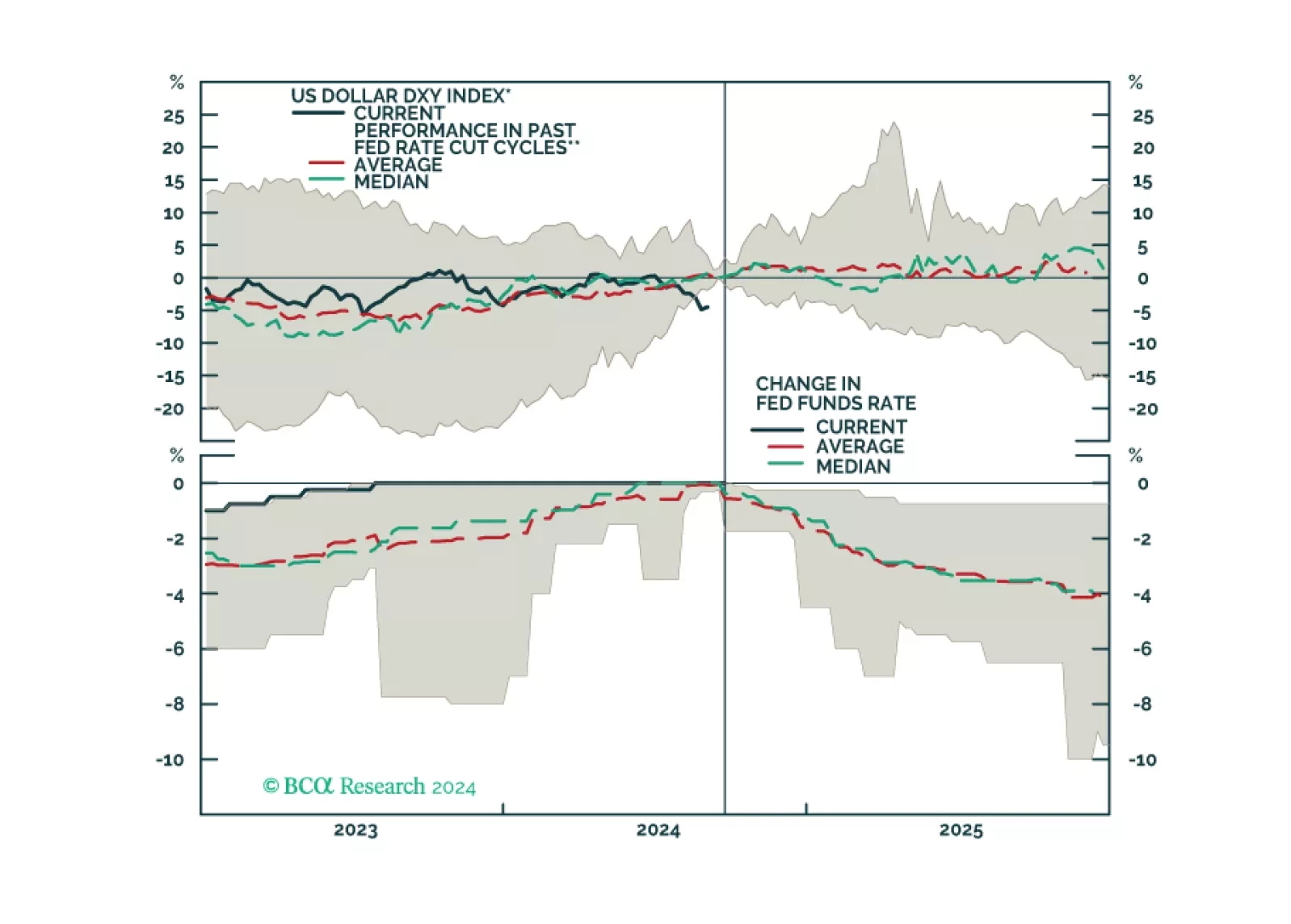
This Insight looks at potential dollar moves in the next six-to-twelve months.
China has notably diversified its export markets over the past two decades, reducing its dependence on the US and other DM economies and strengthening trade ties with EM nations. Since 2000, shipments to the US have halved (from 30% to 16% of total…
According to BCA Research’s Counterpoint Strategy service, the post-pandemic US economy has inverted from its usual ‘demand-constrained’ state to a highly unusual ‘supply-constrained’ state. This inversion is still a ways from normalizing, with labor demand…
Australia’s CPI inflation eased from 3.8% y/y to a higher-than-expected 3.5% in July. The trimmed-mean measure eased from 4.1% to 3.8%. However, the Commonwealth Energy Bill Relief Fund rebates contributed to July’s easing in price pressures. The…
US housing market data have been mixed. In June, the FHFA House Price index unexpectedly declined 0.1% m/m and the NAHB housing market index unexpectedly eased to 39 from a 41 reading. In July, starts and permits both disappointed, contracting 6.8% and 4.0%…
Last week, economists polled by Bloomberg revised their consensus 2024 US GDP forecasts upwards, from 2.3% to 2.5%. Government spending and private investment were both revised 0.3 ppts higher to 3.0% and 3.9%, respectively, while consumption growth forecasts…
The market is currently expecting the Fed to cut rates by 100 bps over the course of 2024 and by another 120 bps throughout the first eight months of 2025. However, our Global Investment strategists expect the extent of 2024 rate cuts to undershoot…
Chinese industrial profits rose by 4.1% y/y (3.6% YTD y/y) in July, from 3.6% (3.5%) in June. Upstream mining industries’ profits contracted 9.5% from January to July 2024, whereas downstream manufacturing sectors’ profits rose 5.0%. The NBS reported that…