Sorry, you need to enable JavaScript to visit this website.
Skip to main content

Qatar

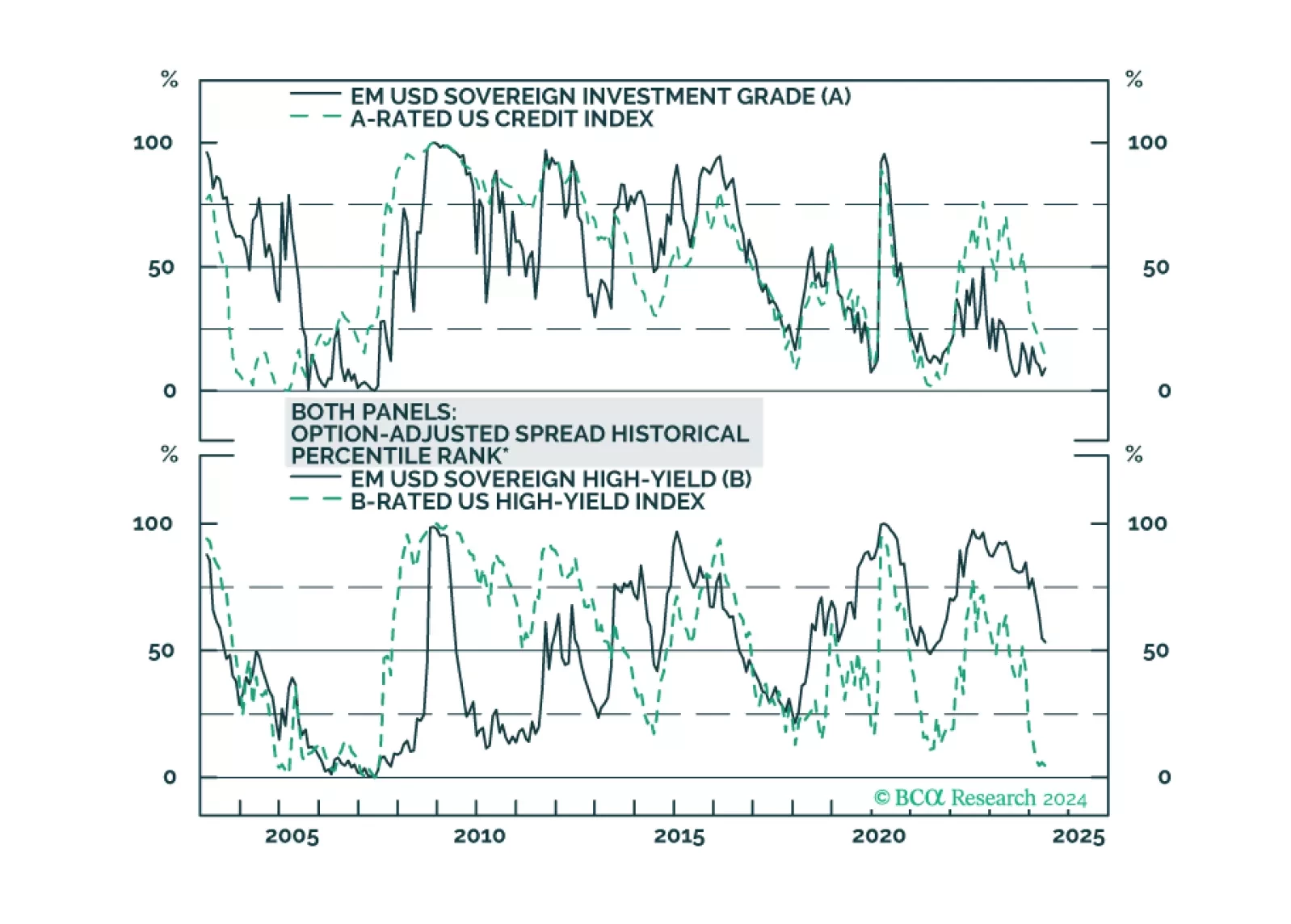
We dig into the USD-denominated Emerging Market Sovereign Index to see which credit tiers and countries offer value relative to US Credit.

According to BCA Research's Commodity & Energy Strategy service, Qatar will be the winner as it takes advantage of the global energy transition towards renewables and the world fragments under economic and military competition. Qatar recently…

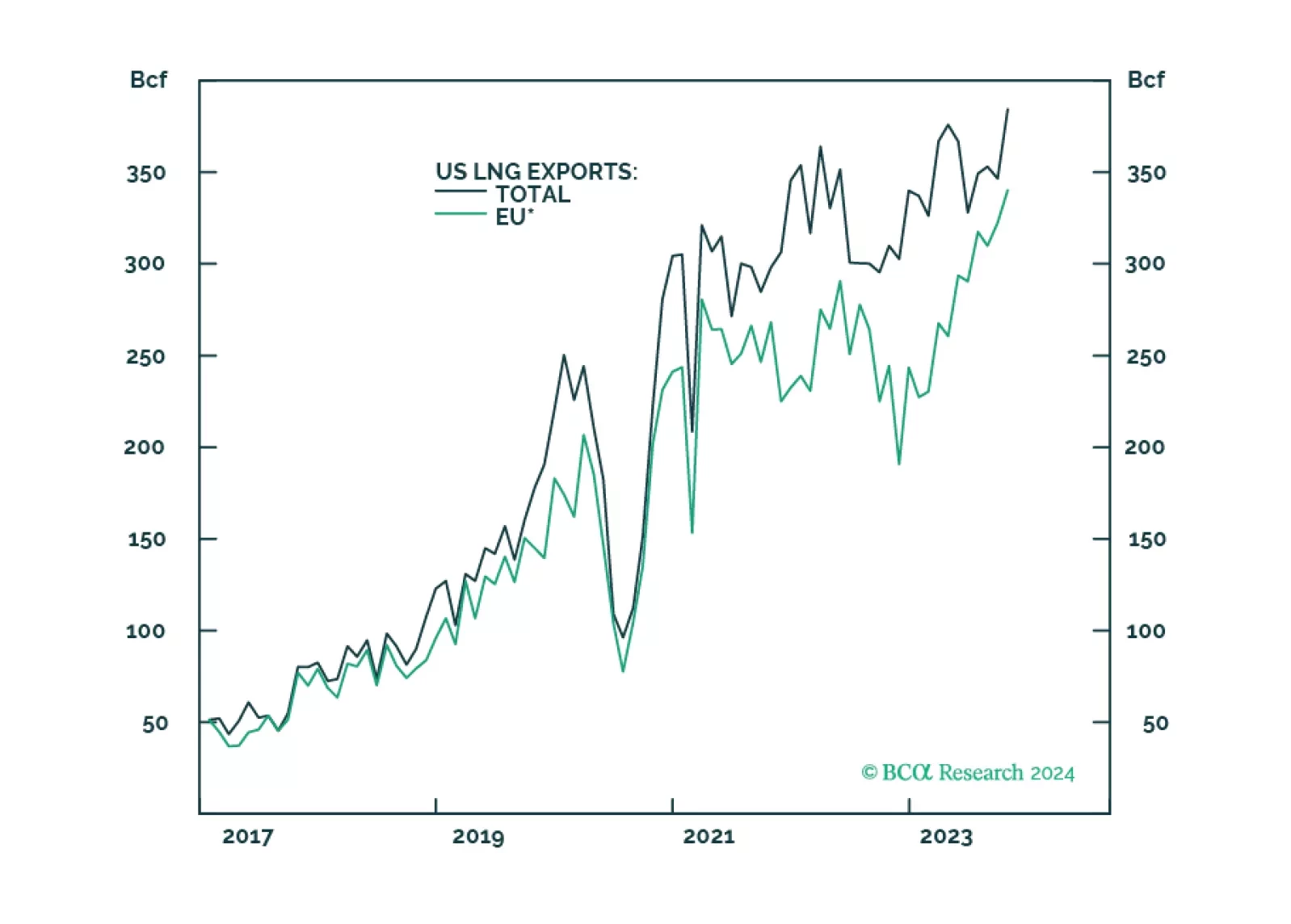
Qatar’s strategy to raise LNG output 84% by 2030 is a bold bet DM demand for energy security – and EM demand for affordable electricity to support economic and population growth – will remain a higher priority than eliminating fossil-fuel consumption over the next 20 years. This will accelerate the development of a global LNG spot market, which will increase demand for LNG tankers.

The attacks on Red Sea commercial tankers by Iran’s Yemeni proxies, the Houthi movement, are an inflation risk inasmuch as they lengthen voyage times for any shipping forced to avoid the Bab el-Mandeb Strait. The risk of an expansion of these attacks is, in our view, limited, given Iran’s inability to project naval power in the region.

Gulf Cooperation Council (GCC) oil producers stand the most to gain following the failed coup against the administration of Russian President Vladimir Putin. The biggest beneficiaries will be the Kingdom of Saudi Arabia (KSA), Qatar, and the UAE, all of…

China’s economic and diplomatic interests in the GCC region will expand, as will its military presence. Whether or not this stabilizes the region is yet to be determined, particularly if tensions in the South China Sea and other international waters traversed by both the US and China escalate. Underlying risk in energy markets will remain elevated. We remain bullish energy generally, and continue to favor equity ETF exposure to energy (XOP and XME), and commodity exposure via the COMT ETF.

Listen to a short summary of this report.     Executive Summary Higher Real Yields Have Weighed On Equity Valuations Higher Real Yields Have Weighed On Equity Valuations Higher Real Yields Have Weighed On Equity Valuations I had the pleasure of visiting clients in Saudi Arabia, Bahrain, and Abu Dhabi last week. In contrast to the rest of the world, the mood in the Middle East was very positive. While high oil prices are helping, there is also a lot of optimism about ongoing structural reforms. Petrodollar flows are increasingly being steered towards private and public equities. EM assets stand to benefit the most. Producers in the region are trying to offset lost Russian output, but realistically, they will not be able to completely fill the gap in the near term. Today’s high energy prices have largely baked in this reality, as reflected in strongly backwardated futures curves. There was no consensus about how high oil prices would need to rise to trigger a global recession, although the number $150 per barrel got bandied about a lot. Given that most Middle Eastern currencies are pegged to the dollar, there was a heavy focus on Fed policy. Market estimates of the neutral rate in the US have increased rapidly towards our highly out-of-consensus view. Nevertheless, we continue to see modest upside for bond yields over a multi-year horizon. Over a shorter-term 6-to-12-month horizon, the direction of bond yields will be guided by the evolution of inflation. While US CPI inflation rose much more than expected in May, the details of the report were somewhat less worrying, as they continue to show significant supply-side distortions. Bottom Line: Inflation should come down during the remainder of the year, allowing the Fed to breathe a sigh of relief and stocks to recover some of their losses. A further spike in oil prices is a major risk to this view.   Dear Client, Instead of our regular report next week, we will be sending you a Special Report written by Chester Ntonifor, BCA Research’s Chief Foreign Exchange Strategist, discussing the outlook for gold. We will be back the following week with the GIS Quarterly Strategy Outlook, where we will explore the major trends that are set to drive financial markets in the rest of 2022 and beyond. As always, I will hold a webcast discussing the outlook the following week, on Thursday, July 7th. Best regards, Peter Berezin Chief Global Strategist Peter in Arabia I had the pleasure of visiting clients in Saudi Arabia, Bahrain, and Abu Dhabi last week. This note summarizes my impressions and provides some commentary about recent market turmoil. The Mood in the Region is Very Positive In contrast to the rest of the world, the mood in the Middle East was upbeat. Obviously, high oil prices are a major contributor (Chart 1). Across the region, stock markets are still up for the year (Chart 2). Chart 1Oil Prices Have Shot Up Oil Prices Have Shot Up Oil Prices Have Shot Up Chart 2Middle Eastern Stock Markets Are Doing Relatively Well This Year Middle Eastern Stock Markets Are Doing Relatively Well This Year Middle Eastern Stock Markets Are Doing Relatively Well This Year   That said, I also felt that investors were encouraged by ongoing structural reforms, especially in Saudi Arabia where the Vision 2030 program is being rolled out. The program seeks to diversify the Saudi economy away from its historic reliance on petroleum exports. A number of people I spoke with cited the Saudi sovereign wealth fund’s acquisition of a majority stake in Lucid, a California-based EV startup, as the sort of bold move that would have been unthinkable a few years ago. I first visited Riyadh in May 2011 where I controversially delivered a speech entitled “The Coming Commodity Bust” (oil was $120/bbl then and copper prices were near an all-time high). The city has changed immensely since then. The number of restaurants and entertainment venues has increased exponentially. The ban on women drivers was lifted only four years ago. In that short time, it has become a common-day occurrence. Capital Flows Into and Out of the Region are Reflecting a New Geopolitical Reality In addition to high oil prices and structural reforms, geopolitical considerations are propelling significant capital inflows into the region. The freezing of Russia’s foreign exchange reserves sent a shockwave across much of the world, with a number of other EM countries wondering if “they are next.” Ironically, the Middle East has emerged as a neutral player of sorts in this multipolar world, and hence a safer destination for capital flows. On the flipside, the region’s oil exporters appear to be acting more strategically in how they allocate their petrodollar earnings. Rather than simply parking the proceeds of oil sales in overseas US dollar bank accounts, they are investing them in ways that further their economic and political goals. One clear trend is that equity allocations to both overseas public and private markets are rising. Other emerging markets stand to benefit the most from this development, especially EMs who have assets that Middle Eastern countries deem important – assets tied to food security being a prime example. Assuming that the current level of oil prices is maintained, we estimate that non-US oil exports will rise to $2.5 trillion in 2022, up from $1.5 trillion in 2021 (Chart 3). About 40% of this windfall will flow to the Middle East. That is a big slug of cash, enough to influence the direction of equity markets. Chart 3Oil Exporters Reaping The Benefits Of High Oil Prices An Oasis Of Optimism: Notes From The Middle East An Oasis Of Optimism: Notes From The Middle East Middle Eastern Energy Producers Will Boost Output, But Don’t Expect Any Miracles in the Short Term Russian oil production will likely fall by about 2 million bpd relative to pre-war levels over the next 12 months. To help offset the impact, OPEC has already raised production by 200,000 barrels and will almost certainly bump it up again following President Biden’s visit to the region in July (Chart 4). The decision to raise production to stave off a super spike in oil prices is not entirely altruistic. The region’s oil exporters know that excessively high oil prices could tip the global economy into recession, an outcome that would surely lead to much lower oil prices down the road. There was not much clarity on what that tipping point is, but the number $150 per barrel got bandied around a lot. Politics is also a factor. A further rise in oil prices could compel the US to make a deal with Iran, something the Saudis do not want to see happen. Still, there is a practical limit to how much more oil the Saudis and other Middle Eastern producers can bring to market in the near term. Today’s high energy prices have largely baked in this reality, as reflected in strongly backwardated futures curves (Chart 5). Chart 4Output Trends In The Major Oil Producers Output Trends In The Major Oil Producers Output Trends In The Major Oil Producers Chart 5Energy Prices On Both Sides Of The Atlantic An Oasis Of Optimism: Notes From The Middle East An Oasis Of Optimism: Notes From The Middle East Data on Saudi’s excess capacity is notoriously opaque, but I got the feeling that an extra 1-to-1.5 million bpd was the most that the Kingdom could deliver. The same constraints apply to natural gas. Qatar is investing nearly $30 billion to expand its giant North Field, which should allow gas production to rise by as much as 60%. However, it will take four years to complete the project. The share of Qatari liquefied natural gas (LNG) going to Europe has actually declined this year. About 80% of Qatar’s LNG is sold to Asian buyers under long-term contracts that cannot be easily adjusted. And even if those contracts could be rewritten, this would only bring limited benefits to Europe. For example, Germany has no terminals to accept LNG imports, although it is planning to build two. While there was plenty of sympathy to Europe’s plight in the region, there was also a sense that European governments had been cruising for a bruising by doubling down on strident anti-fossil fuel rhetoric over the past decade without doing much to end their dependence on Russian oil and gas. In that context, few in the region seemed willing to bend over backwards to help Europe. In the meantime, the US remains Europe’s best hope. US LNG shipments to Europe have tripled since last year. The US is now sending nearly three quarters of its liquefied gas to Europe. This has pushed up US natural gas prices, although they still remain a fraction of what they are in Europe. Huge Focus on the Fed Chart 6Most Of The Increase In Bond Yields Has Been In The Real Component Most Of The Increase In Bond Yields Has Been In The Real Component Most Of The Increase In Bond Yields Has Been In The Real Component Most Middle Eastern currencies are pegged to the dollar, and hence the region effectively imports its monetary policy from the US. Not surprisingly, clients were very focused on the Federal Reserve. Many expressed concern about the abrupt pace of rate hikes. One of our high-conviction views is that the neutral rate of interest in the US has risen as the household deleveraging cycle has ended, fiscal policy has become structurally looser, and a growing number of baby boomers have transitioned from working (and saving) to retirement (and dissaving). The markets have rapidly priced in this view over the course of 2022. The 5-year/5-year forward Treasury yield – a proxy for the neutral rate – has increased from 1.90% at the start of the year to 3.21% at present. Most of this increase in the market’s estimate of the neutral rate has occurred in the real component. The 5-year/5-year forward TIPS yield has climbed from -0.49% to 0.84%; in contrast, the implied TIPS breakeven inflation rate has risen from only 2.24% to 2.37% (Chart 6). Implications of Higher Bond Yields on Equity Prices and the Economy Chart 7Higher Real Yields Have Weighed On Equity Valuations Higher Real Yields Have Weighed On Equity Valuations Higher Real Yields Have Weighed On Equity Valuations As both theory and practice suggest, there is a strong negative correlation between real bond yields and equity valuations. Chart 7 shows that the S&P 500 forward P/E ratio has been moving broadly in line with the 5-year/5-year forward TIPS yield. The bad news is that there is still scope for bond yields to rise over the long haul. Our fair value estimate of 3.5%-to-4% for the neutral rate is about 25-to-75 basis points above current pricing. The good news is that a high neutral rate helps insulate the economy from a near-term recession. Recessions typically occur only when monetary policy turns restrictive. A few clients cited the negative Q1 GDP reading and the near-zero Q2 growth estimate in the Atlanta Fed GDPNow model as evidence that a US recession is either close at hand or has already begun (Chart 8). Chart 8Underlying US Growth Is Expected To Be Solid In Q2 An Oasis Of Optimism: Notes From The Middle East An Oasis Of Optimism: Notes From The Middle East We would push back against such an interpretation. In contrast to the -1.5% real GDP print, real Gross Domestic Income (GDI) rose by 2.1% in Q1. Conceptually, GDP and GDI should be equal, but since the two numbers are compiled in different ways, there can often be major statistical discrepancies. A simple average of the two suggests the US economy still grew in the first quarter. More importantly, real final sales to private domestic purchasers rose by 3.9% in Q1. This measure of economic activity – which strips out the often-noisy contributions from inventories, government expenditures, and net exports – is the best predictor of future GDP growth of any item in the national accounts (Table 1). Table 1A Good Sign: Real Final Sales To Private Domestic Purchasers Rose By 3.9% In Q1 An Oasis Of Optimism: Notes From The Middle East An Oasis Of Optimism: Notes From The Middle East As far as Q2 is concerned, real final sales to private domestic purchasers are tracking at 2.0% according to the Atlanta Fed model – a clear deceleration from earlier this year, but still consistent with a generally healthy economy. Growth will probably slow in the third quarter, reflecting the impact of higher gasoline prices, rising interest rates, and lower asset prices. Nevertheless, the fundamental underpinnings for the economy – low household debt, $2.2 trillion in excess savings, a dire need to boost corporate capex and homebuilding, and a strong labor market – remain in place. The odds of a recession in the next 12 months are quite low. Gauging Near-Term Inflation Dynamics A higher-than-expected neutral rate of interest implies that bond yields will probably rise from current levels over the long run. Over a shorter-term 6-to-12-month horizon, however, the direction of yields will be guided by the evolution of inflation. While the core CPI surprised on the upside in May, the details of the report were somewhat less worrying, as they continue to show significant supply-side distortions. Excluding vehicles, core goods prices rose 0.3% in May, down from a Q1 average of 0.7% (Chart 9). Recent commentary from companies such as Target suggest that goods inflation will ease further. Chart 9Goods Inflation Is Moderating, While Service Price Growth Is Elevated An Oasis Of Optimism: Notes From The Middle East An Oasis Of Optimism: Notes From The Middle East Stripping out energy-related services, services inflation slowed slightly to 0.6% in May from 0.7% in April. A deceleration in wage growth should help keep a lid on services inflation over the coming months (Chart 10). Chart 10A Deceleration In Wage Growth Should Help Keep Services Inflation Contained An Oasis Of Optimism: Notes From The Middle East An Oasis Of Optimism: Notes From The Middle East During his press conference, Fed Chair Powell described the rise in inflation expectations in the University of Michigan survey as “quite eye-catching.” Although long-term inflation expectations remain a fraction of what they were in the early 1980s, they did rise to the highest level in 14 years in June (Chart 11). Powell also noted that the Fed’s Index of Common Inflation Expectations has been edging higher. The Fed’s focus on ensuring that inflation expectations remain well anchored is understandable. That said, there is a strong correlation between the level of gasoline prices and inflation expectations (Chart 12). If gasoline prices come down from record high levels over the coming months, inflation expectations should drop.  Chart 11Consumer Long-Term Inflation Expectations Keep Rising, But Are Still Not At Historically High Levels Consumer Long-Term Inflation Expectations Keep Rising, But Are Still Not At Historically High Levels Consumer Long-Term Inflation Expectations Keep Rising, But Are Still Not At Historically High Levels Chart 12Lower Gasoline Prices Would Help Soothe Consumer Fears Over Inflation Lower Gasoline Prices Would Help Soothe Consumer Fears Over Inflation Lower Gasoline Prices Would Help Soothe Consumer Fears Over Inflation The Fed expects core PCE inflation to fall to 4.3% on a year-over-year basis by the end of 2022. This would require month-over-month readings of about 0.35 percentage points, which is slightly above the average of the past three months (Chart 13). Our guess is that the Fed may be highballing its near-term inflation projections in order to give itself room to “underpromise and overdeliver” on the inflation front. If so, we could see inflation estimates trimmed later this year, which would provide a more soothing backdrop for risk assets. Chart 13AUS Inflation Will Fall By More Than The Fed Expects If The Monthly Change In Core PCE Is Less Than 0.35% (I) US Inflation Will Fall By More Than The Fed Expects If The Monthly Change In Core PCE Is Less Than 0.35% (I) US Inflation Will Fall By More Than The Fed Expects If The Monthly Change In Core PCE Is Less Than 0.35% (I) Chart 13BUS Inflation Will Fall By More Than The Fed Expects If The Monthly Change In Core PCE Is Less Than 0.35% (II) US Inflation Will Fall By More Than The Fed Expects If The Monthly Change In Core PCE Is Less Than 0.35% (II) US Inflation Will Fall By More Than The Fed Expects If The Monthly Change In Core PCE Is Less Than 0.35% (II) Concluding Thoughts on Investment Strategy According to Bank of America, fund managers cut their equity exposure to the lowest since May 2020. Optimism on global growth fell to a record low. Meanwhile, bears outnumbered bulls by 39 percentage points in this week’s AAII poll (Chart 14). If the stock market is about to crash, it will be the most anticipated crash in history. In my experience, markets rarely do what most people expect them to do. Chart 14Sentiment Towards Equities Is Pessimistic Sentiment Towards Equities Is Pessimistic Sentiment Towards Equities Is Pessimistic Chart 15Global Equities Are More Attractively Valued After The Recent Sell-Off Global Equities Are More Attractively Valued After The Recent Sell-Off Global Equities Are More Attractively Valued After The Recent Sell-Off Chart 16US And European EPS Estimates Have Been Trending Higher This Year US And European EPS Estimates Have Been Trending Higher This Year US And European EPS Estimates Have Been Trending Higher This Year US equities are trading at 16.3-times forward earnings, with non-US stocks sporting a forward P/E ratio of 12.1 (Chart 15). Despite the decline in share prices, earnings estimates in both the US and Europe have increased since the start of the year (Chart 16). The consensus is that those estimates will fall. However, if our expectation that a recession will be averted over the next 12 months pans out, that may not happen. A sensible strategy right now is to maintain a modest overweight to stocks while being prepared to significantly raise equity exposure once clear evidence emerges that inflation has peaked. Peter Berezin Chief Global Strategist peterb@bcaresearch.com Follow me on        LinkedIn Twitter       View Matrix An Oasis Of Optimism: Notes From The Middle East An Oasis Of Optimism: Notes From The Middle East Special Trade Recommendations Current MacroQuant Model Scores An Oasis Of Optimism: Notes From The Middle East An Oasis Of Optimism: Notes From The Middle East
Highlights The US Climate Prediction Center gives ~ 70% odds another La Niña will form in the August – October interval and will continue through winter 2021-22. This will be a second-year La Niña if it forms, and will raise the odds of a repeat of last winter's cold weather in the Northern Hemisphere.1 Europe's natural-gas inventory build ahead of the coming winter remains erratic, particularly as Russian flows via Ukraine to the EU have been reduced this year. Russia's Nord Stream 2 could be online by November, but inventories will still be low. China, Japan, South Korea and India  – the four top LNG consumers in Asia  – took in 155 Bcf of the fuel in June. A colder-than-normal winter would boost demand. Higher prices are likely in Europe and Asia (Chart of the Week). US storage levels will be lower going into winter, as power generation demand remains stout, and the lingering effects from Hurricane Ida reduce supplies available for inventory injections. Despite spot prices trading ~ $1.30/MMBtu above last winter's highs – currently ~ $4.60/MMBtu – we are going long 1Q22 NYMEX $5.00/MMBtu natgas calls vs short NYMEX $5.50/MMBtu natgas calls expecting even higher prices. Feature Last winter's La Niña was a doozy. It brought extreme cold to Asia, North America and Europe, which pulled natural gas storage levels sharply lower and drove prices sharply higher as the Chart of the Week shows. Natgas storage in the US and Europe will be tight going into this winter (Chart 2). Europe's La Niña lingered a while into Spring, keeping temps low and space-heating demand high, which delayed the start of re-building inventory for the coming winter.  In the US, cold temps in the Midwest hampered production, boosted demand and caused inventory to draw hard. Chart of the WeekA Return Of La Niña Could Boost Global Natgas Prices A Return Of La Niña Could Boost Global Natgas Prices A Return Of La Niña Could Boost Global Natgas Prices Chart 2Europe, US Gas Stocks Will Be Tight This Winter NatGas: Winter Is Coming NatGas: Winter Is Coming Summer in the US also produced strong natgas demand, particularly out West, as power generators eschewed coal in favor of gas to meet stronger air-conditioning demand. This is partly due to the closing of coal-fired units, leaving more of the load to be picked up by gas-fired generation (Chart 3). The EIA estimates natgas consumption in July was up ~ 4 Bcf/d to just under 76 Bcf/d. Hurricane Ida took ~ 1 bcf/d of demand out of the market, which was less than the ~ 2 Bcf/d hit to US Gulf supply resulting from the storm.  As a result, prices were pushed higher at the margin. Chart 3Generators Prefer Gas To Coal NatGas: Winter Is Coming NatGas: Winter Is Coming US natgas exports (pipeline and LNG) also were strong, at 18.2 Bcf/d in July (Chart 4). We expect US LNG exports, in particular, to resume growth as the world recovers from the COVID-19 pandemic (Chart 5). This strong demand and exports, coupled with slightly lower supply from the Lower 48 states – estimated at ~ 98 Bcf/d by the EIA for July (Chart 6) – pushed prices up by 18% from June to July, "the largest month-on-month percentage change for June to July since 2012, when the price increased 20.3%" according to the EIA. Chart 4US Natgas Exports Remain Strong US Natgas Exports Remain Strong US Natgas Exports Remain Strong Chart 5US LNG Exports Will Resume Growth NatGas: Winter Is Coming NatGas: Winter Is Coming Chart 6US Lower 48 Natgas Production Recovering US Lower 48 Natgas Production Recovering US Lower 48 Natgas Production Recovering Elsewhere in the Americas, Brazil has been a strong bid for US LNG – accounting for 32.3 Bcf of demand in  June – as hydroelectric generation flags due to the prolonged drought in the country. In Asia, demand for LNG remains strong, with the four top consumers – China, Japan, South Korea, and India – taking in 155 Bcf in June, according to the EIA. Gas Infrastructure Ex-US Remains Challenged A combination of extreme cold weather in Northeast Asia, and a lack of gas storage infrastructure in Asia generally, along with shipping constraints and supply issues at LNG export facilities, led to the Asian natural gas price spike in mid-January.2 Very cold weather in Northeast Asia, drove up LNG demand during the winter months. In China, LNG imports for the month of January rose by ~ 53% y-o-y (Chart 7).3 The increase in imports from Asia coincided with issues at major export plants in Australia, Norway and Qatar during that period. Chart 7China's US LNG Exports Surged Last Winter, And Remain Stout Over The Summer NatGas: Winter Is Coming NatGas: Winter Is Coming Substantially higher JKM (Japan-Korea Marker) prices incentivized US exporters to divert LNG cargoes from Europe to Asia last winter. The longer roundtrip times to deliver LNG from the US to Asia – instead of Europe – resulted in a reduction of shipping capacity, which ended up compounding market tightness in Europe. Europe dealt with the switch by drawing ~ 18 bcm more from their storage vs. the previous year, across the November to January period. Countries in Asia - most notably Japan – however, do not have robust natural gas storage facilities, further contributing to price volatility, especially in extreme weather events. These storage constraints remain in place going into the coming winter. In addition, there is a high probability the global weather pattern responsible for the cold spells around the globe that triggered price spikes in key markets globally – i.e., a second La Niña event – will return. A Second-Year La Niña  Event The price spikes and logistical challenges of last winter were the result of atmospheric circulation anomalies that were bolstered by a La Niña event that began in mid-2020.4 The La Niña is characterized by colder sea-surface temperatures that develops over the Pacific equator, which displaces atmospheric and wind circulation and leads to colder temperatures in the Northern Hemisphere (Map 1). Map 1La Niña Raises The Odds Of Colder Temps NatGas: Winter Is Coming NatGas: Winter Is Coming The IEA notes last winter started off without any exceptional deviations from an average early winter, but as the new year opened "natural gas markets experienced severe supply-demand tensions in the opening weeks of 2021, with extremely cold temperature episodes sending spot prices to record levels."5 In its most recent ENSO update, the US Climate Prediction Center raised the odds of another La Niña event for this winter to 70% this month. If similar conditions to those of the 2020-21 winter emerge, US and European inventories could be stretched even thinner than last year, as space-heating demand competes with industrial and commercial demand resulting from the economic recovery. Global Natgas Supplies Will Stay Tight JKM prices and TTF (Dutch Title Transfer Facility) prices are likely to remain elevated going into winter, as seen in the Chart of the Week. Fundamentals have kept markets tight so far. Uncertain Russian supply to Europe will raise the price of the European gas index (TTF). This, along with strong Asian demand, particularly from China, will keep JKM prices high (Chart 8). The global economic recovery is the main short-term driver of higher natgas demand, with China leading the way. For the longer-term, natural gas is considered as the ideal transition fuel to green energy, as it emits less carbon than other fossil fuels. For this reason, demand is expected to grow by 3.4% per annum until 2035, and reach peak consumption later than other fossil fuels, according to McKinsey.6 Chart 8BCAs Brent Forecast Points To Higher JKM Prices BCAs Brent Forecast Points To Higher JKM Prices BCAs Brent Forecast Points To Higher JKM Prices Spillovers from the European natural gas market impact Asian markets, as was demonstrated last winter. Russian supply to Europe – where inventories are at their lowest level in a decade – has dropped over the last few months. This could either be the result of Russia's attempts to support its case for finishing Nord Stream 2 and getting it running as soon as possible, or because it is physically unable to supply natural gas.7 A fire at a condensate plant in Siberia at the beginning of August supports the latter conjecture. The reduced supply from Russia, comes at a time when EU carbon permit prices have been consistently breaking records, making the cost of natural gas competitive compared to more heavy carbon emitting fossil fuels – e.g., coal and oil – despite record breaking prices. With Europe beginning the winter season with significantly lower stock levels vs. previous years, TTF prices will remain volatile. This, and strong demand from China, will support JKM prices. Investment Implications Natural gas prices are elevated, with spot NYMEX futures trading ~ $1.30/MMBtu above last winter's highs – currently ~ $4.60/MMBtu. Our analysis indicates prices are justifiably high, and could – with the slightest unexpected news – move sharply higher. Because natgas is, at the end of the day, a weather market, we favor low-cost/low-risk exposures. In the current market, we recommend going long 1Q22 NYMEX $5.00/MMBtu natgas calls vs short NYMEX $5.50/MMBtu natgas calls expecting even higher prices. This is the trade we recommended on 8 April 2021, at a lower level, which was stopped out on 12 August 2021 with a gain of 188%.   Robert P. Ryan Chief Commodity & Energy Strategist rryan@bcaresearch.com Ashwin Shyam Research Associate Commodity & Energy Strategy ashwin.shyam@bcaresearch.com   Commodities Round-Up Energy: Bullish Earlier this week, Saudi Aramco lowered its official selling price (OSP) by more than was expected – lowering its premium to the regional benchmark to $1.30/bbl from $1.70/bbl – in what media reports based on interviews with oil traders suggest is an attempt to win back customers electing not to take volumes under long-term contracts. This is a marginal adjustment by Aramco, but still significant, as it shows the company will continue to defend its market share. Pricing to Northwest Europe and the US markets is unchanged. Aramco's majority shareholder, the Kingdom of Saudi Arabia (KSA), is the putative leader of OPEC 2.0 (aka, OPEC+) along with Russia. The producer coalition is in the process of returning 400k b/d to the market every month until it has restored the 5.8mm b/d of production it took off the market to support prices during the COVID-19 pandemic. We expect Brent crude oil prices to average $70/bbl in 2H21, $73/bbl in 2022 and $80/bbl in 2023. Base Metals: Bullish Political uncertainty in Guinea caused aluminum prices to rise to more than a 10-year high this week (Chart 9). A coup in the world’s second largest exporter of bauxite – the main ore source for aluminum – began on Sunday, rattling aluminum markets. While iron ore prices rebounded primarily on the record value of Chinese imports in August, the coup in Guinea – which has the highest level of iron ore reserves – could have also raised questions about supply certainty. This will contribute to iron-ore price volatility. However, we do not believe the coup will impact the supply of commodities as much as markets are factoring, as coup leaders in commodity-exporting countries typically want to keep their source of income intact and functioning. Precious Metals: Bullish Gold settled at a one-month high last Friday, when the US Bureau of Labor Statistics released the August jobs report. The rise in payrolls data was well below analysts’ estimates, and was the lowest gain in seven months. The yellow metal rose on this news as the weak employment data eased fears about Fed tapering, and refocused markets on COVID-19 and the delta variant. Since then, however, the yellow metal has not been able to consolidate gains. After falling to a more than one-month low on Friday, the US dollar rose on Tuesday, weighing on gold prices (Chart 10). Chart 9 Aluminum Prices Recovering Aluminum Prices Recovering Chart 10 Weaker USD Supports Gold Weaker USD Supports Gold       Footnotes 1      Please see the US Climate Prediction Center's ENSO: Recent Evolution, Current Status and Predictions report published on September 6, 2021. 2     Please see Asia LNG Price Spike: Perfect Storm or Structural Failure? Published by Oxford Institute for Energy Studies. 3     Since China LNG import data were reported as a combined January and February value in 2020, we halved the combined value to get the January 2020 amount. 4     Please see The 2020/21 Extremely Cold Winter in China Influenced by the Synergistic Effect of La Niña and Warm Arctic by Zheng, F., and Coauthors (2021), published in Advances in Atmospheric Sciences. 5     Please see the IEA's Gas Market Report, Q2-2021 published in April 2021. 6     Please see Global gas outlook to 2050 | McKinsey on February 26, 2021. 7     Please see ICIS Analyst View: Gazprom’s inability to supply or unwillingness to deliver? published on August 13, 2021.   Investment Views and Themes Recommendations Strategic Recommendations Tactical Trades Commodity Prices and Plays Reference Table Trades Closed in 2021 Summary of Closed Trades
The Qatar-Saudi Arabia rapprochement is positive for the medium-term outlook for Arab Gulf economies and stocks. Qatar managed to survive the air land and sea blockade by rerouting flights through Iran (with a $100 million/year price tag) and strengthening…
Highlights This week, Commodity & Energy Strategy is publishing a joint report with our colleagues at BCA's Energy Sector Strategy. Driven by the leadership of the Kingdom of Saudi Arabia (KSA) and Russia, OPEC 2.0 formalized the well-telegraphed decision to extend its production cuts for another nine months, carrying the cuts through the seasonally weak demand period of Q1 2018. The extension is will be successful in bringing OECD inventories down to normalized levels, even assuming some compliance fatigue (cheating) setting in later this year. Energy: Overweight. We are getting long Dec/17 WTI vs. short Dec/18 WTI at tonight's close, given our expectation OPEC 2.0's extension of production cuts, and lower exports by KSA to the U.S., will cause the U.S. crude-oil benchmark to backwardate. Base Metals: Neutral. Despite "catastrophic flooding" in March, 1Q17 copper output in Peru grew almost 10% yoy to close to 564k MT, according to Metal Bulletin. This occurred despite strikes at Freeport-McMoRan's Cerro Verde mine, where production was down 20.5% yoy in March. Precious Metals: Neutral. Our strategic gold portfolio hedge is up 2.61% since it was initiated on May 4, 2017. Ags/Softs: Underweight. The USDA's Crop Progress report indicates plantings are close to five-year averages, despite harsh weather in some regions. We remain bearish. Feature Chart 1Real OPEC Cuts Of ~1.0 MMb/d##BR##For Over 400 Days Real OPEC Cuts Of ~1.0 MMb/d For Over 400 Days Real OPEC Cuts Of ~1.0 MMb/d For Over 400 Days OPEC 2.0's drive to normalize inventories by early 2018 will be accomplished with last week's agreement to extend current production cuts through March 2018. In total, OPEC has agreed to remove over 1 MMb/d of producible OPEC oil from the market for over 400 days (Chart 1), supplemented by an additional 200,000-300,000 b/d of voluntary restrictions of non-OPEC oil through Q3 2017 at least, perhaps longer if Russia can resist the temptation to cheat after oil prices start to respond. Many of the participants in the cut, from both OPEC and non-OPEC, are not actually reducing output voluntarily, but have had quotas set for them that merely reflect the natural decline of their productive capacity, limitations that will be even more pronounced in H2 2017 than in H1 2017. With production restricted by the OPEC 2.0 cuts, global demand growth will outpace supply expansion by another wide margin in 2017, just as it did last year (Chart 2). As shown in Chart 3, steady demand expansion and the slowdown in supply growth allowed oil markets to move from oversupplied in 2015 to balanced during 2016; demand growth will increasingly outpace production growth in 2017, creating sharp inventory draws (Chart 4) that bring stocks down to normalized levels by the end of 2017 (Chart 5). Chart 2 Chart 3Production Cuts And Demand##BR##Growth Will Draw Inventories Production Cuts And Demand Growth Will Draw Inventories Production Cuts And Demand Growth Will Draw Inventories Chart 4Higher Global Inventory##BR##Withdrawals Through Rest Of 2017 Higher Global Inventory Withdrawals Through Rest Of 2017 Higher Global Inventory Withdrawals Through Rest Of 2017 Chart 5OECD Inventories To Be##BR##Reduced To Normal OECD Inventories To Be Reduced To Normal OECD Inventories To Be Reduced To Normal The extension of the cut through Q1 2018 will help prevent a premature refilling of inventories during the seasonally weak first quarter next year. The return of OPEC 2.0's production to full capacity in Q2 2018 will drive total production growth above total demand growth for 2018, returning oil markets from deliberately undersupplied during 2017 to roughly balanced markets in 2018, with stable inventory levels that are below the rolling five-year average. 2018 inventory levels will still be 5-10% above the average from 2010-2014, in line with the ~7% demand growth between 2014 and 2018. Compliance Assessment: Only A Few Players Matter In OPEC 2.0 OPEC's compliance with the cuts announced in November 2016 has been quite good, with KSA anchoring the cuts by surpassing its 468,000 b/d cut commitment. In addition to KSA, OPEC is getting strong voluntary compliance from the other Middle Eastern producers (except Iraq), while producers outside the Middle East lack the ability to meaningfully exceed their quotas in any case. OPEC's Core Four Remain Solid. The core of the OPEC 2.0 agreement has delivered strong compliance with their announced cuts. Within OPEC, the core Middle East countries Kingdom of Saudi Arabia, Kuwait, Qatar, and UAE have delivered over 100% compliance of their 800,000 b/d agreed-to cuts. We expect these countries to continue to show strong solidarity with the voluntary cuts through March 2018 (Chart 6). Iraq And Iran Make Small/No Sacrifices. Iraq and Iran were not officially excluded from cuts, but they were not asked to make significant sacrifices either. We estimate Iran has little-to-no capability to materially raise production in 2017 anyhow, and KSA is leaning on Iraq to better comply with its small cuts. Chart 7 shows our projections for Iran and Iraq production levels through 2018. Chart 6KSA, Kuwait, Qatar & UAE Carrying##BR##The Load Of OPEC Cuts KSA, Kuwait, Qatar & UAE Carrying The Load Of OPEC Cuts KSA, Kuwait, Qatar & UAE Carrying The Load Of OPEC Cuts Chart 7Iran And Iraq Production##BR##Near Full Capacity Iran And Iraq Production Near Full Capacity Iran And Iraq Production Near Full Capacity Iraq surged its production above 4.6 MMb/d for two months between OPEC's September 2016 indication that a cut would be coming and the late-November formalization of the cut. Iraq's quota of 4.35 MMb/d is nominally a 210,000 b/d cut from its surged November reference level, but is essentially equal to the country's production for the first nine months of 2016, implying not much of a real cut. Despite the low level of required sacrifice, Iraq has produced about 100,000 b/d above its quota so far in 2017 at a level we estimate is near/at its capacity anyway. KSA and others in OPEC are not pleased with Iraq's overproduction and have pressured it to comply with the agreement. We forecast Iraq will continue producing at 4.45 MMb/d. Iran's quota represented an allowed increase in production, reflecting the country's continued recovery from years of economic sanctions. We project Iran will continue to slowly expand production, but since the country is almost back up to pre-sanction levels, there is little remaining easily-achievable recovery potential. South American & African OPEC Capacity Eroding On Its Own. Chart 8 clearly shows how production levels in Venezuela, Angola and Algeria started to deteriorate well before OPEC formalized its production cuts, with productive capacity eroded by lack of reinvestment rather than voluntary restrictions. The quotas for these three countries (as well as for small producers Ecuador and Gabon) are counted as ~258,000 b/d of "cuts" in OPEC's agreement, but they merely represent the declines in production that should be expected anyway. With capacity deteriorating and no ability to ramp up anyway, these OPEC nations will deliver improving "compliance" (i.e. under-producing their quotas) in H2 2017, and are happy to have the higher oil prices created by the extension of production cuts by the core producers within OPEC 2.0. Libya and Nigeria Exclusions Unlikely To Result In Big Production Gains. Both Libyan and Nigerian production levels have been constrained by above-ground interference. Libyan production has been held below 1.0 MMb/d since 2013 principally by chronic factional fighting for control of export terminals, while Nigerian production--on a steady natural decline since 2010--has been further limited by militants sabotaging pipelines in 2016-2017. While each country has ebbs and flows to the amount of oil they are able to produce, we view both countries' problems as persistent risks that will continue to keep production below full potential (Chart 9). Chart 8 Chart 9Libya And Nigeria Production Could Go Higher##BR##Under Right (But Unlikely) Circumstances Libya And Nigeria Production Could Go Higher Under Right (But Unlikely) Circumstances Libya And Nigeria Production Could Go Higher Under Right (But Unlikely) Circumstances For Nigeria, we estimate the country's crude productive capacity has eroded to about 1.8 MMb/d from 2.0 MMb/d five years ago due to aging fields and a substantial reduction in drilling (offshore drilling is down ~70% since 2013). Within another year or two, this capacity will dwindle to 1.7 MMb/d or below. On top of this natural decline, we have projected continued sabotage / militant obstruction will limit actual crude output to an average of 1.55 MMb/d for the foreseeable future. Libyan production averaged just 420,000 b/d for 2014-2016, a far cry from the 1.65 MMb/d produced prior to the 2011 Libyan Revolution that ousted strongman Muammar Gaddafi. Since Gaddafi was deposed and executed, factional strife and conflict has persisted. Each faction wants control over oil export revenues and, just as importantly, wants to deny the opposition those revenues, resulting in a chronic state of conflict that has limited production and exports. If a détente were reached, we expect Libyan oil production could quickly rise to about 1.0 MMb/d of production within six months; however, we put the odds of a sustainable détente at less than 30%. As such, we forecast Libyan crude production will continue to struggle, averaging about 600,000 b/d in 2017-2018. Non-OPEC Cuts Hang On Russia In November, ten non-OPEC countries nominally agreed to restrict production by a total of 558,000 b/d, but Russia--with 300,000 b/d of pledged cuts--is the big fish that KSA and OPEC are relying on. Mexico's (and several others') agreements are window dressing, reframing natural production declines as voluntary action to rebalance markets. Through H1 2017, Russia has delivered on about 60-70% of its cut agreement, with compliance growing in Q2 (near 100%) versus Q1 (under 50%). From the start, Russia indicated it would require some time to work through the physical technicalities of lowering production to its committed levels, implying that now that production has been lowered, Russia could deliver greater compliance over H2 2017 than it delivered in H1 2017. We are a little more skeptical, expecting some weakening in Russia's compliance by Q4, especially if the extended cuts deliver the expected results of bringing down OECD inventories and lifting prices. Russia surprised us with stronger-than-expected production during 2016. Some of the outperformance was clearly due to a lower currency and improved shale-like drilling results in Western Siberia, but it is unclear whether producers also pulled too hard on their fields to compensate for lower prices, and are using the OPEC 2.0 cut as a way to rest their fields a bit. We have estimated Russian production returning to 11.3 MMb/d by Q4 2017 (50,000 b/d higher than 2016 average production) and holding there through 2018 (Chart 10), but actual volumes could deviate from this level by as much as 100,000-200,000 b/d. Mexico, the second largest non-OPEC "cutter," is in a position similar to Angola, Algeria, and Venezuela. Mexican production has been falling for years (Chart 11), and the nation's pledge to produce 100,000 b/d less in H1 2017 than in Q4 2016 is merely a reflection of this involuntary decline. As it has happened, Mexican production has declined by only ~60,000 b/d below its official reference level, but continues to deteriorate, promising higher "compliance" with their production pledge in H2 2017. Chart 10Russia Expected##BR##To Cheat By Q4 Russia Expected To Cheat By Q4 Russia Expected To Cheat By Q4 Chart 11Mexican Production Deterioration##BR##Unaffected By Cut Pledges Mexican Production Deterioration Unaffected By Cut Pledges Mexican Production Deterioration Unaffected By Cut Pledges Kazakhstan and Azerbaijan are not complying with any cuts, and we don't expect them to. Despite modest pledges of 55,000 b/d cuts combined, the two countries have produced ~80,000 b/d more during H1 2017 than they did in November 2016. We don't expect any voluntary contributions from these nations in the cut extension, but Azerbaijan's production is expected to wane naturally (Chart 12). While contributing only a small cut of 45,000 b/d, Oman has diligently adhered to its promised cuts, supporting its OPEC and Gulf Cooperation Council (GCC) neighbors. We expect Oman's excellent compliance will be faithfully continued through the nine-month extension (Chart 13). Chart 12Kazakhstan And Azerbaijan Not Expected##BR##To Comply With Any Cut Extension Kazakhstan And Azerbaijan Not Expected To Comply With Any Cut Extension Kazakhstan And Azerbaijan Not Expected To Comply With Any Cut Extension Chart 13Oman Has Faithfully Complied##BR##With Cut Promises To Date Oman Has Faithfully Complied With Cut Promises To Date Oman Has Faithfully Complied With Cut Promises To Date OPEC Extension Will Continue To Support Increased Shale Drilling Energy Sector Strategy believed OPEC's original cut announced in November 2016 was a strategic mistake for the cartel, as it would accelerate the production recovery from U.S. shales in return for "only" six months of modestly-higher OPEC revenue. As we cautioned at the time, the promise of an OPEC-supported price floor was foolish for them to make; instead, OPEC should have let the risk of low prices continue to restrain shale and non-Persian Gulf investment, allowing oil markets to rebalance more naturally. However, despite our unfavorable opinion of the strategic value of the original cut, since the cut has not delivered the type of OECD inventory reductions expected (seemingly due to a larger-than-expected transfer of non-OECD inventories into OECD storage), we view the extension of the cut as a necessary, and logical, next step. OPEC 2.0's November 2016 cut agreement signaled to the world that OPEC (and Russia) would abandon KSA's professed commitment to a market share war, and would instead work together to support a ~$50/bbl floor under the price of oil. Such a price floor dramatically reduced the investment risk for shale drilling, and emboldened producers (and supporting capital markets) to pour money into vastly increased drilling programs. Now that the shale investment genie has already been let out of the bottle, extending the cuts is unlikely to have nearly the same stimulative impact on shale spending as the original paradigm-changing cut created. The shale drilling and production response has been even greater than we estimated six months ago, and surely greater than OPEC's expectations. The current horizontal (& directional) oil rig count of 657 rigs is nearly twice the 2016 average of 356 rigs, is 60% higher than the level of November 2016 (immediately before the cut announcement), and is still rising at a rate of 25-30 rigs per month (Chart 14). The momentum of these expenditures will carry U.S. production higher through YE 2017 even if oil prices were allowed to crash today. Immediately following OPEC's cut, we estimated 2017 U.S. onshore production could increase by 100,000 - 200,000 b/d over levels estimated prior to the cut, back-end weighted to H2 2017, with a greater 300,000-400,000 b/d uplift to 2018 production levels. Drilling activity has roared back so much faster than we had expected, indicative of the flooding of the industry with external capital, that we have raised our 2017 production estimate by 500,000 b/d over our December estimate, and raised our 2018 production growth estimate to 1.0 MMb/d (Chart 15). Chart 14Rig Count Recovery Dominated##BR##By Horizontal Drilling Rig Count Recovery Dominated By Horizontal Drilling Rig Count Recovery Dominated By Horizontal Drilling Chart 15Onshore U.S. Production##BR##Estimates Rising Sharply Onshore U.S. Production Estimates Rising Sharply Onshore U.S. Production Estimates Rising Sharply Other Guys' Decline Requires Greater Growth From OPEC, Shales, And Russia We've written before about "the Other Guys' in the oil market, defined as all producers outside of the expanding triumvirate of 1) U.S. shales, 2) Russia, and 3) Middle East OPEC. While the growers receive the vast majority of investors' focus, the Other Guys comprise nearly half of global production and have struggled to keep production flat over the past several years (Chart 16). Chart 17 shows the largest offshore basins in the world, which should suffer accelerated declines in 2019-2020 (and likely beyond) as the cumulative effects of spending constraints during 2015-2018 (and likely beyond) result in an insufficient level of projects coming online. This outlook requires increasing growth from OPEC, Russia and/or the shales to offset the shrinkage of the Other Guys and simultaneously meet continued demand growth. Chart 16The Other Guys' Production##BR##Struggling To Keep Flat The Other Guys' Production Struggling To Keep Flat The Other Guys' Production Struggling To Keep Flat Chart 17 Risks To Rebalancing Our expectation global oil inventories will draw, and that prices will, as a result, migrate toward $60/bbl by year-end is premised on the continued observance of production discipline by OPEC 2.0. GCC OPEC - KSA, Kuwait, Qatar, and the UAE - Russia and Oman are expected to observe their pledged output reduction, but we are modeling some compliance "fatigue" all the same. Even so, this will not prevent visible OECD oil inventories from falling to their five-year average levels by year-end or early next year. Obviously, none of this can be taken for granted. We have consistently highlighted the upside and downside risks to our longer term central tendency of $55/bbl for Brent crude, with an expected trading range of $45 to $65/bbl out to 2020. Below, we reprise these concerns and our thoughts concerning OPEC 2.0's future. Major Upside Risks Chief among the upside risks remains a sudden loss of supply from a critical producer and exporter like Venezuela or Nigeria, which, respectively, we expect will account for 1.9 and 1.5 MMb/d of production over the 2017-18 period. Losing either of these exporters would sharply rally prices above $65/bbl as markets adjusted and brought new supply on line. Other states - notably Algeria and Iraq - highlight the risk of sustained production losses due to a combination of internal strife and lack of FDI due to civil unrest. Algeria already appears to have entered into a declining production phase, while Iraq - despite its enormous potential - remains dogged by persistent internal conflict. We are modeling a sustained, slow decline in Algeria's output this year and next, which takes its output from 1.1 MMb/d in 2015 down to slightly more than 1 MMb/d on average this year and next. For Iraq, where we expect a flattening of production at ~ 4.4 MMb/d this year and a slight uptick to ~ 4.45 MMb/d in 2018, continued violence arising from dispersed terrorism in that country in the wake of a defeat of ISIS as an organized force, will remain an ongoing threat to production. Longer term - i.e., beyond 2018 - we remain concerned the massive $1-trillion-plus cutbacks in capex for projects that would have come online between 2015 and 2020 brought on by the oil-price collapse in 2015-16 will force prices higher to encourage the development of new supplies. The practical implication of this is some 7 MMb/d of oil-equivalent production the market will need, as this decade winds down, will have to be supplied by U.S. shales, Gulf OPEC and Russia, as noted above. Big, long-lead-time deep-water projects requiring years to develop cannot be brought on fast enough to make up for supply that, for whatever reason, fails to materialize from these sources. In addition, as shales account for more of global oil supplies and "The Other Guys" continue to lose production to higher depletion rates, more and more shale - in the U.S. and, perhaps, Russia - and conventional Persian Gulf production will have to be brought on line simply to make up for accelerating declines. This evolution of the supply side is significantly different from what oil and capital markets have been accustomed to in previous cycles. Because of this, these markets do not have much historical experience on which to base their expectations vis-à-vis global supply adjustment and the capacity these sources of supply have for meeting increasing demand and depletion rates. Lower-Cost Production, Demand Worries On The Downside Downside risks, in our estimation, are dominated by higher production risks. Here, we believe the U.S. shales and Russia are the principal risk factors, as the oil industry in both states is, to varying degrees, privately held. Because firms in these states answer to shareholders, it must be assumed they will operate for the benefit of these interests. So, if their marginal costs are less than the market-clearing price of oil, we can expect them to increase production up to the point at which marginal cost is equal to marginal revenue. The very real possibility firms in these countries move the market-clearing price to their marginal cost level cannot be overlooked. For the U.S., this level is below $53/bbl or so for shale producers. For Russian producers, this level likely is lower, given their production costs are largely incurred in rubles, and revenues on sales into the global market are realized in USD; however, given the variability of the ruble, this cost likely is a moving target. While a sharp increase in unconventional production presently not foreseen either in the U.S. or Russian shales will remain a downside price risk, an increase in conventional output - chiefly in Libya - remains possible. As discussed above, we believe this is a low risk to prices at present; however, if an accommodation with insurgent forces in the country can be achieved, output in Libya could double from the 600k b/d of production we estimate for this year and next. We reiterate this is a low-risk probability (less than 25%), but, in the event, would prove to be significant additions to global balances over the short term requiring a response from OPEC 2.0 to keep Brent prices above $50/bbl. Also on the downside, an unexpected drop in demand remains at the top of many lists. This is a near-continual worry for markets, which can be occasioned by fears of weakening EM oil-demand growth from, e.g., a hard landing in China, or slower-than-expected growth in India. These are the two most important states in the world in terms of oil-demand growth, accounting for more than one-third of global growth this year and next. We do not expect either to meaningfully slow; however, we continue to monitor growth in both closely.1 In addition, we continue to expect robust global oil-demand growth, averaging 1.56 MMb/d y/y growth in 2017 and 2018. This compares with 1.6 MMb/d growth last year. OPEC 2.0's Next Move Knowing the OPEC 2.0 production cuts will be extended to March 2018 does not give markets any direction for what to expect after this extension expires. Once the deal expires, we expect production to continue to increase from the U.S. shales, and for the key OPEC states to resume pre-cut production levels. Along with continued growth from Russia, this will be necessary to meet growing demand and increasing depletion rates from U.S. shales and "The Other Guys." Yet to be determined is whether OPEC 2.0 needs to remain in place after global inventories return to long-term average levels, or whether its formation and joint efforts were a one-off that markets will not require in the future. Over the short term immediately following the expiration of the production-cutting deal next year, OPEC 2.0 may have to find a way to manage its production to accommodate U.S. shales without imperiling their own revenues. This would require a strategy that keeps the front of the WTI and Brent forward curves at or below $60/bbl - KSA's fiscal breakeven price and $20/bbl above Russia's budget price - and the back of the curve backwardated, in order to exert some control over the rate at which shale rigs return to the field.2 As we've mentioned in the past, we have no doubt the principal negotiators in OPEC 2.0 continue to discuss this. Toward the end of this decade, such concerns might be moot, if growing demand and accelerating decline curves require production from all sources be stepped up. Matt Conlan, Senior Vice President Energy Sector Strategy mattconlan@bcaresearchny.com Robert P. Ryan, Senior Vice President Commodity & Energy Strategy rryan@bcaresearch.com 1 Please see the May 18, 2017, issue of BCA Research's Commodity & Energy Strategy article entitled "Balancing Oil-Shale's Resilience And OPEC 2.0's Production Cuts," in which we discuss the outlook for China's and India's growth. Together, these states account for more than 570k b/d of the 1.56 MMb/d growth we expect this year and next. The article is available at ces.bcaresearch.com. 2 A backwardated forward curve is characterized by prompt prices exceeding deferred prices. Our research indicates a backwardated forward curve results in fewer rigs returning to the field than a flat or positively sloped forward curve. We explored this strategy in depth in the April 6, 2017, issue of BCA Research's Commodity & Energy Strategy, in an article entitled "The Game's Afoot In Oil, But Which One?" It is available at ces.bcaresearch.com. Investment Views and Themes Recommendations Strategic Recommendations Tactical Trades Commodity Prices and Plays Reference Table Trades Closed In 2017 Summary of Trades Closed in 2016 Extending OPEC 2.0's Production Cuts Will Normalize Global Oil Inventories Extending OPEC 2.0's Production Cuts Will Normalize Global Oil Inventories Extending OPEC 2.0's Production Cuts Will Normalize Global Oil Inventories Extending OPEC 2.0's Production Cuts Will Normalize Global Oil Inventories