Sorry, you need to enable JavaScript to visit this website.
Skip to main content

South Korea

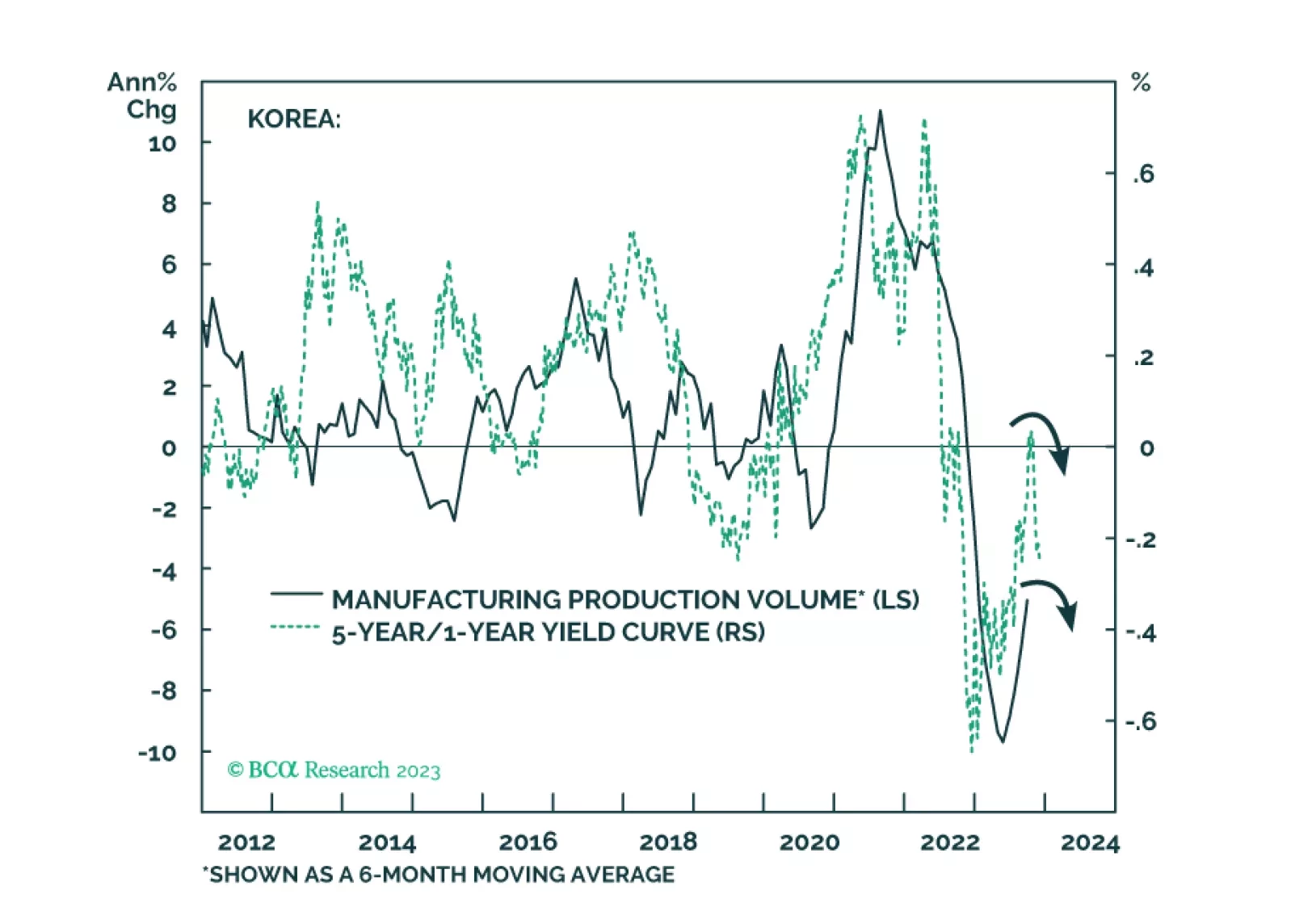
Executive Summary New Orders Of Chips Are Downbeat New Orders Of Chips Are Downbeat New Orders Of Chips Are Downbeat Emerging Asian semiconductor (semi) stocks have rallied considerably. While momentum could push them higher in the short term, stock prices are vulnerable to the downside due to shrinking demand over the next six months. We expect global semi demand to continue contracting, but the pace of decline will moderate in 2023H2. While demand has increased briskly for Artificial Intelligence-type semiconductors, this will not be enough to lift aggregate global chip sales out of contraction.  Meanwhile, geopolitical headwinds will persist and spark more disruptions of the worldwide semiconductor supply chain. Nevertheless, the structural outlook for global semiconductor demand remains constructive.   Bottom Line: The AI-fueled surge in semi share prices is not sustainable and will correct later this year. We are waiting for a better entry point to take advantage of structural tailwinds. Meanwhile, a boost in AI chip demand will marginally bring more orders to the Taiwan Semiconductor Manufacturing Company Ltd. (TSMC). We are upgrading Taiwanese tech from underweight to neutral within the EM equity benchmark. In addition, we remain overweight Korean tech stocks and the Korean Composite Stock Price Index (KOSPI) within the EM equity benchmark. Feature Chart 1Semiconductor Stocks vs. Sales: A Significant Divergence Semiconductor Stocks vs. Sales: A Significant Divergence Semiconductor Stocks vs. Sales: A Significant Divergence Semi stock prices have been rallying strongly since last October, even though sales of global semis are still in a deep downswing (Chart 1). We believe the rally in Asian semi stocks cannot be justified due to the poor semi demand outlook for 2023H2. AI-related chips only account for a tiny share (2%-3%) of world semi sales. A significant upsurge in the demand for AI chips will not be able to lift global semi sales out of contraction for the rest of this year. Semi consumption for smartphones, personal computers (PCs) and servers will continue to shrink. Meanwhile, recent semi export restrictions imposed by Japan and China’s ban on Micron will hamper worldwide semi sales this year. Hence, Asian semi stock prices will likely relapse in 2023H2 as the reality of disappointing global chip demand sets in. Global Semi Demand: A Bleak Outlook In 2023H2 The ongoing shrinkage in international semiconductor sales has been broad-based, with the deepest reduction having occurred in China (Chart 2). Furthermore, the magnitude of the decline in global semiconductor sales is the largest since 2009. According to the most recent S&P Global Electronics PMI report, the global electronics sector continued to signal shrinking demand in May, with new orders down for the tenth time in the past eleven months (Chart 3, top panel). The new orders component of the Taiwanese semiconductor PMI dropped below 40 after failing to move above the neutral 50 line (Chart 3, bottom panel). Chart 2Semiconductor Sales Are Contracting Across Regions Semiconductor Sales Are Contracting Across Regions Semiconductor Sales Are Contracting Across Regions Chart 3New Orders Of Chips Are Downbeat New Orders Of Chips Are Downbeat New Orders Of Chips Are Downbeat We expect world semi sales to continue contracting in 2023H2, based on the following factors: Domestic semi demand in China will fail to recover in the next six months. At best it will stagnate at a very low level. Given that China accounts for one-third of the world’s semi usage, global semi demand will not improve as long as China’s demand remains very weak. Both Taiwanese export orders from mainland China and mainland China’s semiconductor imports are still in a deep contraction (Chart 4). Despite China’s reopening, domestic sales of smartphones, PCs and other electronic goods in April were significantly below their pre-pandemic levels in April 2019 (Table 1). Chart 4Declining Semiconductor Demand In China Declining Semiconductor Demand In China Declining Semiconductor Demand In China Table 1China: Consumer Electronics Sales Emerging Asian Semiconductor Stocks: Downside Risks Amid The AI Frenzy Emerging Asian Semiconductor Stocks: Downside Risks Amid The AI Frenzy Chart 5Chinese Consumers Still Prefer To Save Than To Spend Chinese Consumers Still Prefer To Save Than To Spend Chinese Consumers Still Prefer To Save Than To Spend Chinese consumers still prefer to save rather than spend and invest (Chart 5). Last week’s EMS/CIS joint report pointed out that Chinese households are showing symptoms of a liquidity trap. High debt-servicing costs along with downbeat sentiment will curb the household demand for credit. Semi demand in the world outside China will also face recovery challenges in the next six months. Imports of Chinese electronic products by US and EU countries have plunged (Chart 6). Shrinking demand for consumer goods will impede the revival of semi consumption in the developed world, which accounts for over one-third of global semi sales (Chart 7). A review of major semiconductor-consuming sectors below also paints a dismal picture for global semi demand in the coming six months. Chart 6Falling US And EU Imports Of Electronics Falling US and EU Imports Of Electronics Falling US and EU Imports Of Electronics Chart 7DM Demand For Consumer Goods Will Continue Shrinking DM Demand For Consumer Goods Will Continue Shrinking DM Demand For Consumer Goods Will Continue Shrinking Mobile phones, traditional PCs and tablets: These electronic goods account for about 40% of global semi sales. Despite price cuts and heavy promotions from vendors, consumer demand remained sluggish due to overconsumption in previous years and slumping global growth. Thus, global shipments of mobile phones and PCs plunged by about 14% and 30%, respectively, in the first quarter from a year earlier. We expect international shipments of smartphones and PCs to continue to shrink, albeit more moderately, in the next six months. Given that China accounts for the lion’s share of the world’s shipments of mobile phones and PCs, the country’s production of these goods can be used as a proxy for their global shipments. The decline of the former indicates that global demand remains in deep contraction (Chart 8). Servers: Many companies facing macroeconomic uncertainties have not invested, which has resulted in a reduction in IT spending. This aspect has surfaced in a slowing demand for servers. Trendforce in May predicted a nearly 3% year-on-year drop in worldwide server shipment volumes in 2023. Nonetheless, the AI enthusiasm will drastically boost AI server sales this year. Last week Trendforce predicted a nearly 40% surge year-on-year in AI server shipments in 2023, raising AI servers’ share of total server shipments to about 9%. As servers account for only 10% of global semi sales, a 40% surge in AI server sales will boost global semi sales by a mere 0.4% this year compared with last year. Automotive: Auto output levels in major producing countries have been on an upward trajectory as the chip shortage in this sector has eased (Chart 9). In the second half of this year, we expect moderate growth in auto chip shipments due to high borrowing costs dampening the pace of auto sales in both developed and emerging markets. Chart 8Plunging Chinese Phone And PC Output Plunging Chinese Phone And PC Output Plunging Chinese Phone And PC Output Chart 9Auto Production Will Continue To Increase, Albeit At A Slower Rate Auto Production Will Continue To Increase, Albeit At A Slower Rate Auto Production Will Continue To Increase, Albeit At A Slower Rate Chart 10Inventory Adjustment Is Not Over Yet Inventory Adjustment Is Not Over Yet Inventory Adjustment Is Not Over Yet Industrial electronics: Global manufacturing production will likely remain in contraction for the rest of this year. Nevertheless, given the structural tailwinds for industrial electronics (more use of Internet of Things chips), we expect the growth of industrial electronic sales to slow to mid-single digits in the short term. Automobiles, servers and industrial electronics, which together account for about 30% of global semi sales, will experience positive but subdued growth (0-5%) for the rest of this year. However, such an increase will not be enough to offset ebbing demand in the consumer electronic goods sector in the next six months. Ongoing inventory digestion: Customer and channel inventories have come down, but some of them are still higher than normal (Chart 10). In recent earnings calls, major semiconductor companies mentioned that an inventory adjustment will continue to weigh on semi sales in 2023H2. In addition, companies whose inventories are at normal levels will be cautious in making orders to avoid an inventory buildup in view of heightened macroeconomic uncertainty. Geopolitical headwinds: US-China tensions persist and will cause more disruptions on the global semi supply chain. For example, the US banned exports of advanced node (sub-14 nanometer) chipmaking equipment to China last September. Thus, US semiconductor equipment makers including Applied Materials, Lam and KLA have seen sharp drops in their sales to China (Table 2). Japanese chipmaking tool companies will also face dramatic declines in their sales to China when Japan’s semi export ban takes effect on July 23, 2023. In addition, China’s ban on Micron will curtail that company’s semi sales this year. Bottom Line: Worldwide semi sales will continue to shrink through the rest of 2023 or at best stagnate at a very low level. Chart 11 shows that Taiwan’s semiconductor new export orders, which generally lead global semi sales by about three months, remain in a deep contraction. Table 2US Semi Equipment Producers' Shipments To China Emerging Asian Semiconductor Stocks: Downside Risks Amid The AI Frenzy Emerging Asian Semiconductor Stocks: Downside Risks Amid The AI Frenzy Chart 11Taiwan's Semiconductor New Export Orders Point To Lingering Contraction In Global Semiconductor Sales Taiwan's Semiconductor New Export Orders Point To Lingering Contraction In Global Semiconductor Sales Taiwan's Semiconductor New Export Orders Point To Lingering Contraction In Global Semiconductor Sales   A Divergence Between Share Prices And Sales Chart 12A Similar Divergence Between Semiconductor Share Prices And Sales In 2019 A Similar Divergence Between Semiconductor Share Prices And Sales In 2019 A Similar Divergence Between Semiconductor Share Prices And Sales In 2019 A similar divergence between semi share prices and sales occurred in 2019 (Chart 12). In that episode, the 5G hype pushed up semi stock prices. However, the current driver is an AI frenzy triggered by the release of ChatGPT and other large language models. While AI development is structurally positive and will underpin long-term global semi demand, its contribution to semi sales is very limited in the short term. We think there are low odds that global semiconductor producers' stock prices will continue to rally through the second half of 2023. Our reasons are as follows: AI chips only account for about 2-3% of global semi sales, much lower than the one-third share for smartphone chips. The surge in AI chip demand helps only a few companies while the boom in smartphone chips benefited a much larger pool of semiconductor players. Nvidia is the major beneficiary as revenues from its data center business grew by 14% year-on-year in the first quarter of the year. This is because many cloud service providers (CSPs) and enterprises buy Nvidia’s AI chips to use in existing data centers to improve operating performances and efficiencies. By contrast, new data centers, which can benefit more chip companies by using a wider variety of chips, are experiencing slower growth. This year, major CSPs constrained their data center investments as revenue growth in their cloud divisions decelerated. Hence, since the release of ChatGPT at the end of November 2022, two major data center chip suppliers – AMD and Intel – have not yet seen any gain in sales. AMD revenues from its data center & AI group remained almost flat in 2023Q1 and Intel’s plunged by 38% year-on-year in the same period. Chart 13China: No Restocking Of Chips This Time China: No Restocking Of Chips This Time China: No Restocking Of Chips This Time China boosted its overseas purchases of processor and controller chips in 2019H2 and 2020 to build up domestic inventory. However, the country is now in a destocking process (Chart 13). While it was difficult for China to produce processor and controller chips in 2019, this time China can produce many of these items banned by Japan. In addition, the value of such items is much lower than that of processor & controller chips. Bottom Line: Semi producers' stock prices will likely relapse due to bleak fundamentals in the next six months. Ramifications For Taiwanese And Korean Markets Chart 14High-Performance Computing Chips Drive TSMC Sales Emerging Asian Semiconductor Stocks: Downside Risks Amid The AI Frenzy Emerging Asian Semiconductor Stocks: Downside Risks Amid The AI Frenzy The rally in global semiconductor stocks will not be justified by improving sales for the rest of this year. We have low conviction on share prices US semiconductor design companies that may sustain their frenzy. We have a higher conviction that the share prices of Taiwanese and Korean semi producers will relapse in absolute terms in 2023H2. For TSMC, there is one positive: a boost in AI chip demand will bring more orders and improve the company’s capacity utilization rate in its 5nm and 7nm fabrication plants. The high-performance computing (HPC) sector has far exceeded the smartphone sector to account for the largest share of TSMC’s revenues in 2023Q1 (44% vs. 34%) (Chart 14). A year ago, HPC’s share was 41%, marginally higher than the 40% share for smartphones. However, we still believe Taiwanese tech is more vulnerable to the downside in absolute terms for the following reasons: A contraction in global smartphone and PC sales in the next six months will hurt TSMC’s top and bottom lines. After all, smartphone makers, smartphone chip designers and PC chipmakers accounted for over 50% of TSMC’s revenues last year. In comparison, only 6.3% of TSMC sales were from Nvidia in 2022. Chart 15Memory Chips Demand And Prices Still Face Some Downside Memory Chips Demand And Prices Still Face Some Downside Memory Chips Demand And Prices Still Face Some Downside Taiwan remains the epicenter of US-China tensions. Chinese authorities have become increasingly confrontational with the US. Taiwan holds the most advanced chipmaking technology which mainland China needs to advance its long-term strategic policies. Tensions between the US and China have escalated as the Japanese and Dutch governments joined the US to impose restrictive policies curbing tech development in China. Such an escalation has increased the policy uncertainty between Beijing and Taiwan, and the pressure may negatively impact Taiwanese tech stocks. For Korea’s Samsung and Hynix, the memory market is in a free fall due to plummeting demand (Chart 15). We expect more downside in Korean semi stock prices in absolute terms. Nonetheless, Korean tech stocks will benefit on the margin from the following factors: First, China’s ban on Micron will benefit Samsung and SK Hynix as 18% of Micron’s sales in 2022 came from China. Second, Micron announced late last year that it would reduce memory chip supply and make more cuts to its capital spending plan. This may slow the pace of the decline in global memory prices. Overall, we expect the Korean and Taiwanese equity indexes to decline in absolute terms in the months ahead like the majority of EM bourses. Nevertheless, we expect the KOSPI to outperform the EM benchmark and the Taiwanese stock index to be in line with EM stocks for the following reasons: Chart 16Multi-Year Theme: Favor Global Industrials Property And Manufacturing Investments' Weakness Will Cap Overall Capital Spending Property And Manufacturing Investments' Weakness Will Cap Overall Capital Spending Semiconductor stocks are an early cyclical play. They start outperforming the overall equity benchmark in the late stage of the global manufacturing downturn, which we expect to happen later this year.   In contrast, EM ex-China domestic demand is in the early stages of a downturn. Hence, many EM bourses dominated by domestic plays will underperform in the months ahead.   The overall Korean and Taiwanese export sectors will benefit from a cheapening currency. However, a depreciating currency will not help the profits of companies exposed to domestic demand. Finally, the KOSPI is a play on our multi-year theme of favoring global industrials   relative to other sectors (Chart 16). Bottom Line: In absolute terms, both Taiwanese and Korean semi stock prices will likely relapse in the next six months. Within the EM equity benchmark, we are upgrading Taiwanese tech stocks from underweight to neutral while remaining overweight Korean tech stocks and the KOSPI. Ellen JingYuan He Associate Vice President ellenj@bcaresearch.com  
The Global Manufacturing PMI was unchanged at 49.6 in May – below the 50 boom-bust line for the ninth consecutive month. The details of the release were mixed. On the one hand, the Production sub-component rose to an 11-month high of 51.5. On the other hand,…
Recent Asian trade data do not provide any optimism that the global manufacturing slump is nearing its end. South Korean exports collapsed by 16.1% y/y in the first 20 days of May. While the decline was broad-based, sales to China were particularly weak,…

Macro and geopolitical risks may spoil the narrow window for a stock market rally before recessionary trends rise to the fore.

No, the secular rise in geopolitical risk has not peaked. EU-China trade ties underscore the multipolar context, but this multipolarity is unbalanced, as the US has not reached a new equilibrium with its rivals. While the second quarter is murky, investors should stay defensive this year on the whole.

Remain cautious and defensive overall. Stay long DM Europe over EM Europe. Look for EM opportunities in Southeast Asia and Latin America over Greater China.

Stay short Greater China assets. Stay long Japanese yen. Hold back on Brazil for now but look forward to opportunities in future.

Please note I will be hosting a live webcast on September 29, 2022 at 9:00 AM HKT for the APAC region. I will discuss the global/China/EM macro outlooks and financial market implications. For clients in the Americas and EMEA, we had a webcast on September 28, 2022. You can access the replay via this link. Arthur Budaghyan Executive Summary Global Semi Stock Prices: Further Downside Ahead Global Semi Stock Prices: Further Downside Ahead Global Semi Stock Prices: Further Downside Ahead Global semiconductor stock prices are still vulnerable to meaningful downside over the next three months. Global semi consumption will contract due to the corresponding waning demand of smartphones, personal computers, and other consumer electronics. Global semi demand in sectors of automobiles and datacenters will continue growing. However, such an increase in demand cannot offset the demand reduction in other sectors. Semiconductor consumption in China has entered a contraction phase.  Semiconductor inventories have swelled. Alongside a sharp upsurge in chip production capacity, this increase in inventories will lead to chip price deflation in the next nine months. Nevertheless, the structural outlook for global semiconductor demand remains constructive. We are waiting for a better entry point for semi stocks.  Bottom Line: There is more downside in global semiconductor share prices as well as Taiwanese and Korean tech stocks. We will seek to recommend buying semiconductor stocks when a more material decline in semi companies’ profits is priced in their share prices. At the moment, we are downgrading Taiwanese stocks from neutral to underweight relative to the EM equity benchmark but are maintaining an overweight stance on the Korean bourse within an EM equity portfolio.   The global semiconductor equity index is breaking below its technical support (Chart 1). The implication is that these share prices are in an air pocket and investors should not chase a declining market. Based on previous cycles, we expect global semiconductor stocks to bottom late this year or early next year and semi sales to trough in 2023Q2. In the previous five cycles, global semi stocks always bottomed before global semi sales and lead times varied from three-to-six months. Chart 2 shows that Taiwan’s semiconductor new export orders lead global semi sales by about three months, and they continue to point to considerable downside in the global semi-industry. Chart 1Global Semi Stocks: Breaking Down Global Semi Stocks: Breaking Down Global Semi Stocks: Breaking Down Chart 2Global Semi Sales: More Downside Ahead Global Semi Sales: More Downside Ahead Global Semi Sales: More Downside Ahead The semiconductor industry has a history of cyclicality. Shortages have been followed by oversupply, which has led to declining prices, revenues, and profits for semi producers. This time is no exception Global Semi Sales: A Cyclical Slump Underway Global semiconductor demand began its downward trajectory in May of this year and will continue to slide in the next three-to-six months. Both the volume and value of China’s semiconductor imports are in a deep contraction and China’s imports from Taiwan have also plummeted (Chart 3). China is the world’s largest consumer of semiconductors, accounting for 35% of global demand. We expect semi sales to remain in contraction in China and to shrink in regions outside China in the next six-to-nine months (Chart 4).  Chart 3China's Semi Imports Plummeted China's Semi Imports Plummeted China's Semi Imports Plummeted Chart 4Semi Sales Will Contract Across Regions Semi Sales Will Contract Across Regions Semi Sales Will Contract Across Regions There are several important reasons for the retrenchment worldwide. First, the lockdowns around the world in 2020 and 2021 generated an unprecedented increase in online activities and a corresponding surge in demand for smartphones/PCs/tablets/game consoles/electronic gadgets. This was the main driving force for the boom in global semiconductor sales from 2020Q3 to 2022Q1. The excessive demand for consumer goods and electronics has run its course and global demand will sag in the next six months. As we have been contending since early this year, global exports are set to contract. Households that bought these goods in the past two years probably will not make new purchases in the near term. In addition, declining real disposable income and rising interest rates will constrain consumer spending. Smartphones, PCs, tablets, home appliances, and other household electronic goods consume about half of global semi output. In addition, rising job uncertainties resulting from China’s dynamic zero-COVID policy and slowing household income growth will curb consumption within China. Here are our takeaways for each segment: Chart 5China's Output Of Mobile Phones And PCs Has Been Shrinking China's Output Of Mobile Phones And PCs Has Been Shrinking China's Output Of Mobile Phones And PCs Has Been Shrinking Mobile phones: Mobile phones are the largest contributor to global semi sales, with a share of 31% as of 2021, based on the data from World Semiconductor Trade Statistics (WSTS). According to the International Data Corporation (IDC), global smartphone shipments are set to decline by 6.5% year-over-year in volume terms in 2022. Smartphone OEMs cut their orders drastically in 2022 because of high inventories and low demand, with no signs of an immediate recovery. China accounts for 67% of global mobile phone production and its mobile phone production has been contracting (Chart 5, top panel).   Traditional PCs and tablets: Based on data from the IDC, global traditional PC1  and tablet shipments are set to decline by 12.8% year-over-year in 2022 and by an additional 2.6% next year in volume terms. Computer production in China, which is the world’s largest computer producer and exporter, also shows massive downsizing (Chart 5, bottom panel).   Home appliances: China is also the largest producer and exporter of air conditioners (ACs), washing machines, refrigerators, and freezers. Except for a slight growth in AC output in response to heatwaves in China and Europe, China’s output of other home appliances will shrink. Globally, these industries accounted for about half of all semiconductor sales in 2021. Given the overconsumption of these goods worldwide over the past two years, we expect a material decline in these sectors in the next six-to-nine months. Second, automobiles, servers, and industrial electronics, which together account for about 30% of global semi sales, will have positive single-digit growth going forward. Yet, such an increase will not be enough to offset the lost demand from the consumer electronic goods sector in the next six-to-nine months.  Chart 6Global Auto Production Will Rise Global Auto Production Will Rise Global Auto Production Will Rise Automotive (accounts for 11% of world chip demand): The chip shortage in this sector has eased only moderately. Auto output levels in major producing countries remain well below their pre-pandemic levels (Chart 6). In light of improved foundry capacity, semiconductor producers will be able to produce automotive chips and reduce lingering shortages. However, for most chips to automakers, there are no supply shortages. Only a small number of categories of automotive chips, such as microcontrollers (MCU) and insulated-gate bipolar transistors (IGBT), are still in tight supply. Given that the total automotive sector only accounted for about 5% of total global semi sales last year, the recovery in global automobile output will contribute only limited growth to global semi sales.   Servers (account for 10% of world chip demand): The surge in online activities resulted in greater demand for cloud services and remote work applications, both of which require computer servers. Total server demand is comprised of data servers for cloud providers and private enterprises, with the former as the main driving force in recent years.  Data center expansion among cloud service providers will be driven by 5G, automotive, cloud gaming, and high-performance computing. After expanding by 10% last year, the pace of annual growth in global server shipments will likely be more moderate, to about 5%-6% in the next couple of quarters.   Chart 7Global Industrial Demand For Chips Is Set to Decelerate Global Industrial Demand For Chips Is Set to Decelerate Global Industrial Demand For Chips Is Set to Decelerate Industrial electronics (account for 9% of world chip demand): The growth rate in semi demand for this sector is falling. The global manufacturing new order-to-inventory ratio has plunged, and global manufacturing production is set to decline for the rest of this year and through to 2023H1 (Chart 7). Nevertheless, given structural tailwinds for industrial electronics, we expect semi demand in this sector to dip to single-digit growth in the near term rather than to contract.  Third, with semiconductor inventories having surged, new orders for chips, and hence their production, will plummet.   The length and intensity of the chip shortage, which started in 2020H2, triggered stockpiling among a broad range of customers, including manufacturers of smartphones and other consumer electronics. Moreover, the recent slowdown in smartphone/PC demand increased the inventory of silicon chips. Chart 8Semiconductor Inventory Overhang Semiconductor Inventory Overhang Semiconductor Inventory Overhang China had also stockpiled semiconductors from 2020Q2 to 2021Q4. With faltering demand, the country will continue its destocking process in the next couple of quarters. Semiconductor inventories in Taiwan and Korea have surged, corroborating the fact that the current cyclical downturn in the global semi sector will be a severe one (Chart 8). Hence, businesses in the semi supply chain will continue to draw upon their inventories rather than increase their semiconductors orders. This will reduce semiconductor demand meaningfully in the coming months. Bottom Line: The cyclical slump in worldwide semiconductor sales has further to go, with the sector’s sale volumes and prices projected to contract in the next six months. Semi producers will experience a substantial decline in their profits. Comparing Cycles Previous cycles may provide insight in the downside of the cyclical slump in global semi sales. In the previous five cycles, global semi sales experienced a contraction, ranging from 7% to 45% (Table 1). In the current cycle, global semi sales still had 7% year-over-year growth in 2022Q2 (Chart 9). Table 1Six Cyclical Downturns In Global Semiconductor Market Have Global Semi Stocks Hit Bottom? Have Global Semi Stocks Hit Bottom? Chart 9Global Semi Stocks And Global Semi Sales Global Semiconductor Market: Sales & Share Prices Global Semi Stocks And Global Semi Sales Global Semiconductor Market: Sales & Share Prices Global Semi Stocks And Global Semi Sales Global Semiconductor Market: Sales & Share Prices In fact, the current downturn could be deeper than the one between 2018 and 2019 (when sales contracted by 16%) for the following reasons: Sales of both cell phones and PCs will likely dwindle further this time than they did in 2018 to 2019. The pandemic boosted demand for consumer electronics, but this also brought forward future demand. In comparison with 2018, the current cycle might have a longer replacement cycle for mobile phones and PCs. Unlike 2019, global demand for consumer goods will likely contract rather than decelerate. This has ramifications for the duration and magnitude of the semi downturn.   Economic growth, and job and income uncertainties in China are much worse now than they were between 2018 and 2019. These factors will likely lead to a bigger cut in IT spending by both consumers and businesses, resulting in a larger downturn in global semi demand in this cycle. The tech battle between the US and China is more intense than in it was from 2018 to 2019. In mid-2018, the U.S. imposed a 25% tariff on Chinese imports of semiconductor goods, including machines and flat panel displays. China retaliated by imposing its own 25% tariff on U.S. exports of semiconductor goods, such as test equipment. This month, the US imposed new restrictions on NVIDIA and AMD in relation to selling artificial intelligence chips to Chinese customers. The US also plans to curb further its shipments of chipmaking tools to China. These plans will cut China’s imports of high-end semi products, for which producers enjoy high profit margins. In addition, the shortage of these chips will stall the development and sales of many consumer products within China, which will thereby reduce demand for other types of chips needed for consumer products. Chart 10Rapid Semi Capacity Expansion Worldwide Rapid Semi Capacity Expansion Worldwide Rapid Semi Capacity Expansion Worldwide Global semi capacity expansion has recently been much stronger in current cycle than it was in the 2016-2018 cycle. This may lead to a bigger supply surplus in this cycle than in the last one. It takes about 18-24 months, on average, to build a new semiconductor fabrication plant. Thus, large capital expenditures by semi producers in 2021-22 entail considerable new supply in 2023-24. According to IC Insights, the annual wafer capacity growth rates were 6.5% in 2020, 8.5% in 2021 and 8.7% in 2022. This compares with 4%-6.5% between 2016 and 2018 (Chart 10). Rapid capacity expansion typically leads to price deflation for chips and is therefore negative for the semi producers’ profitability and their share prices. Are global semi stock prices already pricing bad news? We do not think so. Nearly all major players saw a drop in revenues in the past cycle. In sharp contrast, only Intel’s revenues have dropped so far in the current cycle (Chart 11). Global semi stock prices will continue falling as companies report shrinking sales and earnings in the next couple of quarters. In former cycles when global semi stocks bottomed, investor sentiment – as measured by the net EPS revisions – was more downbeat than it is currently (Chart 12). Chart 11More Semi Companies' Sales Are Likely To Contract More Semi Companies' Sales Are Likely To Contract More Semi Companies' Sales Are Likely To Contract Chart 12Global Semi Stock Prices: Net EPS To Drop More Global Semi Stock Prices: Net EPS To Drop More Global Semi Stock Prices: Net EPS To Drop More Bottom Line: The global semiconductor sector’s cyclical slump could be deeper than it was in the 2018-2019 cycle. Hence, shares prices will fall considerably more than they did in late 2018. Ramifications For Taiwanese And Korean Markets Taiwanese and Korean semiconductor stock prices will probably continue to fall in absolute terms. The former recently broke its three-year moving average and the latter its six-year moving average (Chart 13). Chart 13Taiwanese And Korean Semi Stock Prices Will Fall Further Taiwanese And Korean Semi Stock Prices Will Fall Further Taiwanese And Korean Semi Stock Prices Will Fall Further Chart 14TSMC: Smartphone And HPC Make 81% Of Revenue Have Global Semi Stocks Hit Bottom? Have Global Semi Stocks Hit Bottom? For TSMC, the smartphone sector still accounts for 38% of revenues (Chart 14). Hence, a contraction in global smartphone sales in the next six-to-nine months could hurt the company’s top and bottom lines considerably. Meanwhile, the high-performance computing (HPC) sector became the largest contributor of TSMC revenues with a 43% share. A slowdown in data center investment and a decrease in GPU demand due to falling bitcoin prices will also materially affect the company’s profitability. In addition, the US government’s AI chips export restriction policy will decrease NVIDIA and AMD AI sales to China. According to NVIDIA’s news release, approximately US$400 million in potential chip sales to China (including Hong Kong) will likely be subject to this new restriction. AI chips are manufactured by TSMC with its advanced node technology and have a high-profit margin. Hence, the new policy will negatively impact TSMC’s revenues and profits. For Samsung, the memory market is in a free-fall due to plummeting demand (Chart 15). TrendForce expects the average overall DRAM price to drop by 13-18% in 2022Q4 because of high inventories in the supply chain and stagnant demand. The semi shipment-to-inventories ratios for both Taiwan and South Korea nosedived, pointing to lower semi stock prices in these two markets (Chart 16). Chart 15Samsung: Vulnerable To Sinking Prices Of Memory Chips Samsung: Vulnerable To Sinking Prices Of Memory Chips Samsung: Vulnerable To Sinking Prices Of Memory Chips Chart 16Semi Shipments-to-Inventory Ratios Plunged In Taiwan And Korea Semi Shipments-to-Inventory Ratios Plunged In Taiwan And Korea Semi Shipments-to-Inventory Ratios Plunged In Taiwan And Korea Bottom Line: Both TSMC and Samsung stock prices have more downside over the next three months.  Equity Valuations And Investment Conclusions The global semiconductor stock index in USD terms has tumbled by 45% from its recent peak. Multiples of semiconductor stocks are near their long-term average levels (Chart 17 and 18). These multiples could undershoot as they did in 2018-2019, which means even more downside is ahead. Chart 17Multiples Of Semi Stocks Could Undershoot Multiples Of Semi Stocks Could Undershoot Multiples Of Semi Stocks Could Undershoot Chart 18Multiples Of Semi Stocks Could Undershoot Multiples Of Semi Stocks Could Undershoot Multiples Of Semi Stocks Could Undershoot Aside from the profit outlook, higher US bond yields are also causing multiple compression for global semiconductor stocks (Chart 19). As to the allocation to semi stocks within an EM equity portfolio, we recommend downgrading Taiwan from a neutral allocation to underweight and reiterate an overweight stance on the KOSPI. The US-China geopolitical confrontation will escalate in the coming years and Taiwan is at the epicenter of this. These are relative calls, that is against the EM benchmark (Chart 20). We remain negative on their absolute performance. Chart 19Higher US Bond Yields = Multiple Compression In Global Semi Stocks Higher US Bond Yields = Multiple Compression In Global Semi Stocks Higher US Bond Yields = Multiple Compression In Global Semi Stocks Chart 20Downgrade Taiwan To Underweight Relative To The EM Benchmark Downgrade Taiwan To Underweight Relative To The EM Benchmark Downgrade Taiwan To Underweight Relative To The EM Benchmark   Finally, the structural outlook for global semiconductor demand remains constructive. We are waiting for a better entry point. We would recommend buying semiconductor stocks after pricing in a more material contraction in semi companies’ revenues and profits. Ellen JingYuan He Associate Vice President ellenj@bcaresearch.com Footnotes 1     Traditional PCs are comprised of desktops, notebooks and workstations.
Executive Summary Our negative view on the summer rally is coming to fruition, with equities falling back on the negative geopolitical, macro, and monetary environment. China is easing policy ahead of its full return to autocratic government this fall. Yet the Fourth Taiwan Strait Crisis has only just begun. Tensions can still deal nasty surprises to global investors. It is essential to verify that relations will thaw after the US midterm and Chinese party congress is critical. Russia continues to tighten energy supply as predicted. Ukraine’s counter-offensive is pushing back the time frame of a ceasefire deeper into next year. Putin may declare victory and quit while he is ahead – but Russia will not be forced to halt its invasion until commodity prices fall significantly. Sweden’s election will not interfere with its NATO bid; Australia’s new government will not re-engage with China; Malaysia’s election will be a positive catalyst; South Africa’s political risks are reawakening; Brazil’s risks are peaking; Turkey remains a leading candidate for a negative “black swan” event. China’s Confluence Of Domestic And Foreign Political Risk China's Confluence Of Domestic And Foreign Political Risk China's Confluence Of Domestic And Foreign Political Risk Asset Initiation Date Return LONG GLOBAL DEFENSIVES / CYCLICALS EQUITIES 2022-01-20 17.4% Bottom Line: Investors should stay defensive in the short run until recession risks and geopolitical tensions abate. Feature Last week we visited clients across South Africa and discussed a broad range of global macro and geopolitical issues. In this month’s GeoRisk Update we relate some of the key points in the context of our market-based quantitative risk indicators. While we were traveling, US-Iran negotiations reached a critical phase. A deal is said to be “closer” but we remain pessimistic (we still give 40/60 odds of a deal). The important point for investors is that the supply side of global oil markets will remain tight even if a deal is somehow agreed, whereas it will get much tighter if a deal is not agreed. China’s rollout of 1 trillion yuan ($146 billion) in new fiscal stimulus and rate cuts (5 bps cut to 1-year Loan Prime Rate and 15 bps cut to 5-year LPR) is positive on the demand side and supports our key view in our 2022 annual outlook that China would ease policy ahead of the twentieth national party congress. However, it is still the case that China is not providing enough stimulus to generate a new cyclical rally. Second quarter US GDP growth was revised slightly upwards but was still negative. Russia tightened control of European energy, as expected, increasing the odds of a European recession. Europeans are getting squeezed by rising energy prices, rising interest rates, and weak external demand. China Eases Policy Ahead Of Return To Autocracy China is facing acute political risk in the short term but it is also delivering more stimulus to try to stabilize the economy ahead of the twentieth national party congress this fall (Chart 1). The People’s Bank of China cut the benchmark lending rate by (1-year LPR) by 5 basis points, while authorities unveiled fiscal spending worth 1 trillion renminbi. Chart 1China's Confluence Of Domestic And Foreign Political Risk China's Confluence Of Domestic And Foreign Political Risk China's Confluence Of Domestic And Foreign Political Risk After the party congress, the regime is likely to “let 100 flowers bloom,” i.e. continue with a broad-based policy easing to secure the recovery from the Covid-19 shock. This will include loosening social restrictions and aggressive regulations against industrial sectors like the tech sector. It should also include some diplomatic improvements, especially with Europe. But it is only a short term (12-month) trend, not a long-term theme. Related Report  Geopolitical StrategyRoulette With A Five-Shooter China’s return to autocratic government under General Secretary Xi Jinping is a new, negative, structural factor and is nearly complete. Xi is highly likely to secure another decade in power and promote his faction of Communist Party stalwarts and national security hawks. The period around the party congress will be uncertain and dangerous. The exact makeup of the next Politburo could bring some surprises but there is very little chance that Xi and his faction will fail to consolidate power. The nomination of an heir-apparent is possible but of limited significance since Xi will not step down anytime soon or in a regular, predictable manner. Larger stimulus combined with power consolidation could spur greater risk appetite around the world, as it would portend a stabilization of growth and policy continuity. However, China’s underlying problems are structural. The manufacturing and property bust can be delayed but not reversed. China’s foreign policy will continue to get more aggressive due to domestic vulnerability, prompting foreign protectionism, export controls, sanctions, saber-rattling, and the potential for military conflict. Bottom Line: Investors should use any rally in Chinese assets over the coming 12 months as an opportunity to sell and reduce exposure to China’s historic confluence of political and geopolitical risk. Fourth Taiwan Strait Crisis Only Beginning The Fourth Taiwan Strait Crisis has only just begun. The previous three crises ranged from four to nine months in duration. The current crisis cannot possibly abate until November at earliest. Taiwan’s political risk will stay high and we would not buy any relief rally until there is a firm basis for believing tensions have fallen (Chart 2). Chart 2Taiwan: The Fourth Taiwan Strait Crisis Taiwan: The Fourth Taiwan Strait Crisis Taiwan: The Fourth Taiwan Strait Crisis If this year’s crisis were driven by US and Chinese domestic politics – the US midterm election and China’s party congress – then both Presidents Biden and Xi Jinping would already have achieved what they want and could proceed to de-escalate tensions by the end of the year – i.e. before somebody really gets hurt. The two leaders could hold a bilateral summit in Asia in November and agree to uphold the one China policy and status quo in the Taiwan Strait. We have given a 40% chance to this scenario, though we would still remain pessimistic about the long-term outlook for Taiwan. But if this year’s crisis is driven by a change in US and Chinese strategic thinking as a result of Russia’s invasion of Ukraine and China’s rising domestic instability, then there will not be a quick resolution on Taiwan. The crisis would grow next year, increasing the risk of aggression or miscalculation. We have given a 60% probability to this scenario, of which full-scale war comprises 20 percentage points. Bottom Line: Our geopolitical risk indicator for Taiwan spiked and Taiwanese equities rolled over relative to global equities as we expected. However, our oldest trade to capture the high long-term risk of a war in the strait – long Korea / short Taiwan – has performed badly despite the crisis. South Korea: China Stimulus A Boon But Not Geopolitics US-China rivalry – and the thawing of Asia’s once-frozen conflicts – is also manifest on the Korean peninsula, where the limited détente between the US and North Korea negotiated by President Donald Trump and Kim Jong Un has fallen apart. South Korea’s situation is not as risky as Taiwan’s but it is nevertheless less stable than it appears (Chart 3). Chart 3South Korea: Lower Geopolitical Risk Than Taiwan South Korea: Lower Geopolitical Risk Than Taiwan South Korea: Lower Geopolitical Risk Than Taiwan South Korea resumed its full-scale joint military exercise with the US, the Ulchi Freedom Shield, from August 22 to September 1. The drills involve amphibious operations and a carrier strike group. Full-scale drills were scaled down or cancelled under the Trump and Moon Jae-In administrations with the hopes of facilitating diplomacy and reducing tensions on the peninsula. North Korea was to discontinue ballistic missile tests and threats to the United States. But after the 2020 election neither Washington nor Pyongyang considered itself bound by this agreement. This year the US went forward with Ulchi Freedom even though regional tensions were sky-high because of House Speaker Nancy Pelosi’s visit to Taiwan and the De-Militarized Zone in Korea. The US is flagging its regional interests and power bases. North Korea is increasing the frequency of missile tests this year and is likely to conduct an eighth nuclear test. On August 17, it fired two cruise missiles towards the Yellow Sea. Pyongyang does not want to be ignored amid so many other geopolitical crises. It is emboldened by the fact that Russia and China will not be voting with the US for another round of sanctions at the United Nations Security Council due to the war in Ukraine and tensions over Taiwan. On August 11, South Korea responded to China’s insistence that the new government should abide by the “Three No’s,” i.e. three negatives that the Moon administration allegedly promised China: no additional deployments of the US’s Terminal High-Altitude Area Defense (THAAD) system, no Korean integration into US-led missile defense, and no trilateral military alliance with the US and Japan. Korea’s Foreign Minister Park Jin told reporters upon his return from China that the three no’s were “neither an agreement nor a promise.” South Korea’s new and conservative President Yoon Suk-yeol is unpopular and gridlocked at home but he is using the opportunity to reassert Korean national interests, including the US military alliance. Tension with the North and cold relations with China are coming at a time when the economy is slowing down. Korean GDP grew by 0.7% in Q2 2022 on a quarter-on-quarter basis, supported by household and government spending, while exports and investments shrank. Roughly a quarter of Korean exports go to China, its biggest trading partner. Korean exports to China have suffered due to China’s economic woes but cold relations could bring new economic sanctions, as China has hit South Korea before over THAAD. With the Yoon administration planning to bring the fiscal deficit back to below 3% of GDP next year, and a broader backdrop of weak Chinese and global demand, it is hard to find bright corners in the Korean economy in the near term. With Yoon’s basement level approval rating, he will resort to foreign policy to try to revive his political capital. Saber rattling and tough talk with North Korea and China will increase tensions in an already hot region – geopolitical risk is bound to stay high on the back of the Taiwan crisis. Bottom Line: On a relative basis, due to the ironclad US security guarantee, South Korea is safer than Taiwan. Investors wanting exposure to Chinese economic stimulus, electric vehicles, and semiconductors should go long South Korea. But some volatility is likely because the North’s eighth nuclear test will occur in the context of high and rising regional tensions. Australia: Stimulus Is Positive But No “Thaw” With China Australia is blessed with strong geopolitical fundamentals but it is seeing a drop in national security and economic security due to the deterioration of China relations. Domestic political turmoil is one of the consequences (Chart 4). Most recently Australia has been roiled by the revelation that former Prime Minister Scott Morrison secretly ran five ministries during the pandemic: the ministries of Home, Treasury, Finance, Resources, and Health. Chart 4Australian Geopolitical Risk Limited Australian Geopolitical Risk Limited Australian Geopolitical Risk Limited After an investigation and review by the Solicitor General Stephen Donaghue, Morrison’s action was determined to be legal, although highly inappropriate and inconsistent with the principles of responsible governance. Morrison’s appointments to these ministries were approved by the Governor General but the announcement or publication of appointments has always been the prerogative of the government of the day. One might think that this investigation is merely politically motivated but the Solicitor General is an apolitical position unlike the Attorney General, and Donaghue had been serving with Morrison, guiding him about the constitutionality of a vaccine mandate during the pandemic. The new Labor Party government of Prime Minister Anthony Albanese has vowed to be more transparent and will seek to enshrine a transparency measure into the law. Its political capital will improve, which is helpful for its ability to achieve its chief election promises. With the change of the government, it was hoped that there would be a thaw in the Australia-China relationship. China is Australia’s largest export destination and it erected boycotts against certain Australian exports in 2020 in response to Prime Minister Morrison’s inquiry into the origin of Covid-19. Hence Australia’s new defense minister, Richard Marles, met with his Chinese counterpart, General Wei Fenghe, on the sideline of the Shangri-La Dialogue in Singapore in June, which rekindled the hope that a thaw might happen. Yet a thaw is unlikely for strategic reasons, as highlighted by the Fourth Taiwan Strait Crisis, the Biden administration’s retention of former President Trump’s tariffs, and Australia’s fears of China’s rising influence in the Pacific Islands. The US and Australia are preparing for a long-term policy of containing China’s ambitions. A few days after his election, Prime Minister Albanese flew to Tokyo to attend a meeting of the Quadrilateral Security Dialogue (the Quad), sending a signal that there will be policy continuity with respect to Australian foreign policy. On May 26, Chinese fighter jets flew closely to an Australian surveillance plane on its routine operation and released aluminum chaffs that were ingested by the P8’s engines. An Australian warship, the HMAS Parramatta, was tracked by a People’s Liberation Army nuclear power submarine and multiple aircrafts on its way back from Vietnam, Korea, and Japan as part of its regional presence deployment in June. Currently Australia is hosting the Pitch-Black military exercise, with 17 countries participating. This exercise will last for three weeks – focusing on air defense and aerial refueling. It will also see the German air force with 13 military aircrafts deployed to the Indo-Pacific region for the very first time. They will be stopping in Japan after the exercise. As Australia’s policy towards China is unlikely to change, geopolitical risk will remain elevated. On the economic front, Australia’s misery index is at the highest point since 2000, with an unemployment rate at 3% and inflation at 6%. GDP growth in the first quarter was 0.8% compared to 3.6% in Q4 2021, propped up by government and household consumption while investment and exports contracted. The good news for the government is that it is inheriting this negative backdrop and can benefit from cyclical improvements in the next few years. Since the Labor government lacks a single-party majority in the Senate (where it must rely on the Greens and independents), it will be difficult for the government to raise new taxes. So far, Albanese has indicated that the budget to be tabled in October will focus on pre-election promises, which includes childcare, healthcare, and energy reforms. At worst, Australian government spending will stay flat, but it is unlikely to shrink considering Labor’s narrow control of the House of Representatives. Australian equities have not outperformed those of developed market peers despite high industrial metal prices. The stock market’s weak performance is attributable to the stumbling Chinese economy (Chart 5). Australian exports to China in June are still down 14% from June of last year. Chinese economic woes will be a headwind to Aussie growth and equity markets until next year, when Chinese stimulus efforts reach their full effect. Chart 5Australian Equities Have Yet to Benefit from Industrial Metal Prices Australian Equities Have Yet to Benefit from Industrial Metal Prices Australian Equities Have Yet to Benefit from Industrial Metal Prices On the other hand, the value of Australian natural gas and oil exports in June grew by 118% and 211% respectively (Chart 6), compared to June of last year. Chart 6Geopolitics: A Boon and Bane to Aussie Growth Geopolitics: A Boon and Bane to Aussie Growth Geopolitics: A Boon and Bane to Aussie Growth ​​​​​ Bottom Line: As China will continue stimulating the economy and global energy markets will remain tight, investors should look for opportunities in Aussie energy and materials stocks. Malaysia Closes A Chapter … And Opens A Better One? Rarely do we get to revisit our positive outlook on Malaysia – a Southeast Asian state with an ability to capitalize on the US break-up with China. On August 23, the embattled ex-prime minister of Malaysia, Najib Razak, lost his final appeal at the Federal Court in Putrajaya after being found guilty in 2020 for abuse of power, criminal breach of trust, and money laundering tied to Malaysia’s sovereign wealth fund, 1MDB. The high court instructed that he serves his 12-years prison sentence immediately, becoming the first prime minister to be imprisoned in the country’s 60-years plus of history. Political risk has weighed on the Malaysian economy for almost a decade starting with the contentious 2013 general election, which saw the collapse of non-Malay voter support for the ruling party. Then came the 2015 Wall Street Journal bombshell about 1MDB, and then the 2018 general election that resulted in Malaysia’s first change of government since independence. The pandemic also led to political crisis in 2020. Each crisis resulted in a successive weakening of animal spirits and ever lower investments, resulting in Malaysia’s loss of competitiveness (Chart 7). Malaysia’s cheap currency was unable to increase its competitiveness, due to the low investments in the economy, and reflected higher political risks in the country (Chart 8). Chart 7Political Risk Undermines Competitiveness Political Risk Undermines Competitiveness Political Risk Undermines Competitiveness ​​​​​​ Chart 8Cheap Currency Reflects Political Risk Cheap Currency Reflects Political Risk Cheap Currency Reflects Political Risk ​​​​​​ Nonetheless this entire saga has proved that Malaysia’s legal system is independent and that its political system is capable of holding policymakers accountable. The next general election will come in a matter of months and recent state elections bodes well for the institutional ruling party, the United Malay National Organization (UMNO), and its coalition, Barisan Nasional. The coalition is managing to claw back support from the Malay and non-Malay voters. The opposition had the bad luck of ruling during the pandemic and its rocky aftermath, which has helped to rehabilitate the traditional ruling party. We have long seen Malaysia as a potential opportunity. But we would advise investors to wait until the new election is held and a new government takes power before buying Malaysian equities. With the conclusion of its decade-long 1MDB saga, we would turn more bullish if the next election produces a sizeable and enduring majority, if the use of racial and sectarian rhetoric tones down, and if the governing coalition pursues pro-competitiveness policies. Bottom Line: Structurally, Malaysia is one of the largest exporters of semiconductors and will benefit from the US’s shift away from China and attempt to reconstruct supply chains so they run through the economies of allies and partners. Russia: Escalating To De-Escalate? Russia increased the number of active military personnel in a move that points to an escalation of the conflict with Ukraine and the West, even as Ukraine wages a counter-offensive against Russia in Crimea and elsewhere. The time frame for a ceasefire has been pushed further into next year. As long as the war escalates, European energy relief will be elusive. Our risk indicators will rise again (Chart 9). Chart 9Russia: Geopolitical Risk To Rise Again, Ceasefire Pushed Back Into Next Year Russia: Geopolitical Risk To Rise Again, Ceasefire Pushed Back Into Next Year Russia: Geopolitical Risk To Rise Again, Ceasefire Pushed Back Into Next Year Ukraine will not be able to drive Russians out of territory in which they are entrenched. It would need a coalition of western powers willing to go on the offense, which will not happen. Russia is also threatening to cut off the Zaporizhzhia nuclear power plant, ostensibly removing one-fifth of Ukraine’s electricity. Once the Ukrainian counter-offensive grinds to a halt, a stalemate will ensue, incentivizing ceasefire talks – but not until then. The Europeans will have to support Ukraine now but will become less and less inclined to extend the war as they get hit with recession. Russia says it is prepared for a long war but that kind of rhetoric is necessary for propaganda purposes. The truth is that Russia does not have great success with offensive wars. Russia usually suffers social instability in the aftermath. The best indicator for the duration of the war is probably the global oil price: If it collapses for any reason then Russia’s war machine will fall short of funds and the Kremlin will probably have to accept a ceasefire. This what happened in 2014-15 with the Minsk Protocols. Putin will presumably try to quit while he is ahead, i.e. complete the conquest and shift to ceasefire talks, while commodity prices are still supportive and Europe is economically weak. If commodity prices fall, Russia’s treasury dries up while Europe regains strength. So while military setbacks can delay a ceasefire, Russia should be seen as starting to move in that direction. The deal negotiated with Turkey and the United Nations to ship some grain from Odessa is not reliable in the short run but does show the potential for future negotiations. However, a high conviction on the timing is not warranted. Also, the US and Russia could enter a standoff over the US role in the war, or NATO enlargement, at any moment, especially ahead of the US midterm election. Bottom Line: Ukraine’s counteroffensive and Russia’s tightening of natural gas exports increases the risk to global stability and economic growth in the short run, even if it is a case of “escalating tensions in order to de-escalate” later when ceasefire talks begin. Italy: Election Means Pragmatism Toward Russia Italy’s election is the first large crack in the European wall as a result of Russia’s cutoff of energy. The party best positioned for the election – the right-wing, anti-establishment party called the Brothers of Italy – will have to focus on rebooting Italy’s economy once in power. This will require pragmatism toward Russian and its natural gas. Regardless of whether a right-wing coalition obtains a majority or the parliament is hung, Italian political risk will stay high in the short run (Chart 10). Chart 10Italy: Election Brings Uncertainty, Then Economic Stimulus Italy: Election Brings Uncertainty, Then Economic Stimulus Italy: Election Brings Uncertainty, Then Economic Stimulus Although the center-left Democratic Party (PD) is narrowing the gap with the Brothers of Italy in voting intentions, it is struggling to put together an effective front against the right-wing bloc. After its alliance with the centrist Azione party and +Europa party broke down, PD’s chance of winning has become even slimmer. Even if the alliance revives, the center-left bloc still falls short of the conservative parties. Together, the right-wing parties account for just 33% of voting intentions (Democrats at 23%, Greens and Left Alliance at 3%, Azione and +Europa at 7%). By contrast, the right-wing bloc has a significant lead, with 46% of the votes (Brothers of Italy at 24%, Lega at 14%, Forza Italia at 8%). They also have the advantage of anti-incumbency sentiment amid a negative economic backdrop. Unless some sudden surprises occur, a right-wing victory is expected, with Giorgia Meloni becoming the first female prime minister in Italy’s history. This has been our base case scenario for the past several months. But what does a right-wing government mean for the financial markets? In an early election manifesto published in recent weeks, the conservative alliance pledged full adhesion to EU solidarity and dropped their previous euroskepticism. This helps them get elected and is positive for investors. However, there are also clouds on the horizon: In the same manifesto, the right-wing parties pledged to lower taxes for families and firms, increase welfare, and crack down on immigration. These programs will add to Italy’s huge debt pile and eventually lead to conflicts with the ECB and other EU institutions. In the manifesto, they stated that if elected, they would seek to amend conditions of Italy’s entitlement to the EU Recovery Fund, as the Russia-Ukraine war has changed the context and priorities significantly. This could potentially put the EU’s grants and cheap loans at risk. Under the Draghi government, Italy has secured about 67 billion euros of EU funds. According to the schedule, Italy will receive a further 19 billion Euros recovery funds in the second half of 2022, if it meets previously agreed upon targets. The new government will try to accept the funds and then make any controversial policy changes. On Russia, the conservative parties claimed that Italy would not be the weak link within EU. They pledged respect for NATO commitments, including increasing defense spending. Both Meloni and her Brothers of Italy have endorsed sending weapons to support Ukraine. Still, we think that due to Italy’s historical link with Russia and the need to secure energy supplies, the new government would be more pragmatic toward Russia. On China, Meloni has stressed that Italy will look to limit China’s economic expansion if the right-wing alliance wins. She stated that “Russia is louder at present and China is quieter, but [China’s] penetration is reaching everywhere.” China will want to use diplomacy to curb this kind of thinking in Europe. Meloni also stated that she would not seek to pursue the Belt and Road Initiative pact that Italy signed with China in 2019. In short, we stand firm on our recommendation of underweighting Italian assets at least until a new government is formed. Europe Gets Its Arm Twisted Further The United Kingdom is going through a severe energy, water, and inflation crisis – on top of the long backlog at the National Health Service – as it stumbles through the aftermath of Covid-19 and Brexit. The Conservative Party’s leadership contest is a distraction – political risk will not subside after it is resolved. The new Tory leader will lack a direct popular mandate but the party will want to avoid an early election in the current economic context, creating instability. The looming attempt at a second Scottish independence referendum will also keep risks high, as the outcome this time may be too close to call (Chart 11). Chart 11UK: Tory Leaders A Sideshow, Risks Will Stay High UK: Tory Leaders A Sideshow, Risks Will Stay High UK: Tory Leaders A Sideshow, Risks Will Stay High Germany saw Russia halt natural gas flows through Nord Stream 1 as the great energy cutoff continues. As we have argued since April, Russia’s purpose is to pressure the European economies so that they are more conducive to a ceasefire in Ukraine. Germany will evolve quickly and will improve its energy security faster than many skeptics expect but it cannot do it in a single year. The ruling coalition is also fragile, even though elections are not due anytime soon (Chart 12). Chart 12Germany: Geopolitical Risk Still Rising Germany: Geopolitical Risk Still Rising Germany: Geopolitical Risk Still Rising France’s political risk will also remain high (Chart 13), as domestic politics will be reckless while President Emmanuel Macron and his allies only control 43% of the National Assembly in the aftermath of this year’s election (Chart 14). Chart 13France: Lower Geopolitical Risk Than Germany France: Lower Geopolitical Risk Than Germany France: Lower Geopolitical Risk Than Germany Chart 14Macron Will Focus On Foreign Policy Odds And Ends (A GeoRisk Update) Odds And Ends (A GeoRisk Update) Spain is likely to see its coalition destabilized and early elections, much like Italy this year (Chart 15). Chart 15Spain: Early Elections Likely Spain: Early Elections Likely Spain: Early Elections Likely Sweden, along with Finland, will be joining NATO, which became clear back in April. In this sense it is at the center of Russia’s conflict with the West over NATO enlargement, so we should take a quick look at the Swedish general election on September 11. Currently the left-wing and right-wing blocs are neck and neck in the polls. While the current Social Democrat-led government may well fall from power, Sweden’s new pursuit of NATO membership is unlikely to change. The right-wing parties in Sweden are in favor of joining NATO. The two parties that oppose NATO membership are the left-wing Green and Left Party. The Social Democrats were pro-neutrality until the invasion of Ukraine and since May have spearheaded Swedish accession to NATO. The pro-neutrality bloc currently holds 43 seats in the 349-seats Riksdag. It has a supply-and-confidence arrangement with the current government and is currently polling at 13%. If it was willing and able to derail Sweden’s NATO bid, it would already have happened. So the general election in Sweden is unlikely to stop Sweden from joining. However, Russia does not want Sweden to join and the entire pre- and post-election period is ripe for “black swan” risks and negative surprises. One thing that could change with the election is Sweden’s immigration policy. The Social Democrats are pro-immigration (albeit pro-integration), while the right-wing bloc is less so. Sweden has received a great many asylum seekers since the Syrian refugee crisis in 2015 and will be receiving more from Ukraine and Russia (Chart 16). Chart 16Asylum Seekers to Surpass 2015 Refugee Crisis Asylum Seekers to Surpass 2015 Refugee Crisis Asylum Seekers to Surpass 2015 Refugee Crisis Our Foreign Exchange Strategist Chester Ntonifor points out that the increase in asylum seekers could augment Swedish labor force and increase its potential growth in the long run, while in the short run it could increase demand in the domestic economy. But an increase in demand could also exacerbate inflation in Sweden, especially considering how much the Riksbank is behind the curve vis-à-vis the ECB. Our European Investment Strategy recommends shorting EUR/SEK as Sweden is less vulnerable to Russian energy sanctions. Sweden produces most of its energy from renewable sources. Relative to Europe, Canada faces a much more benign political and geopolitical environment (Chart 17). However, within its own context, it will continue to see more contentious domestic politics as interest rates rise on a society with high household debt and property prices. The post-Covid-19 period will undermine the Justin Trudeau government over time, though it is not facing an election anytime soon. Canada continues to benefit from North America’s geopolitical advantage, though quarrels with China will continue, including over Taiwan, and should be taken seriously. Aside from any China shocks we expect Canadian equities to continue to outperform most global bourses. Chart 17Canada: Low Geopolitical Risk But Not Happy Canada: Low Geopolitical Risk But Not Happy Canada: Low Geopolitical Risk But Not Happy South Africa: The Calm Before The Storm South Africa’s economy remains in a low growth trap, which is contributing to rising political risk (Chart 18). Electricity shortages continue to dampen economic activity. Other structural issues like 33.9% unemployment, worsening social imbalances, and a split in the ruling party threaten to cause negative policy surprises. Chart 18South Africa: Institutional Ruling Party At Risk South Africa: Institutional Ruling Party At Risk South Africa: Institutional Ruling Party At Risk The South African economy has failed to translate growth outcomes into meaningful economic development, leaving low-income households (the median voter) increasingly disenfranchised, burdened, and constrained. Last year’s civil unrest was fueled by economic hardships that persist today. Without a significant and consistent bump to growth, social and political risks will continue to rise. Low-income households remain largely state dependent. Fiscal austerity has already begun to unwind, well before the 2024 election, in a bid to shore up support and quell rising social pressures (Chart 19). Chart 19South Africa: Fiscal Easing Ahead Of 2024 Vote South Africa: Fiscal Easing Ahead Of 2024 Vote South Africa: Fiscal Easing Ahead Of 2024 Vote The fact that the social scene is relatively quiet for now should not be seen as a sign of underlying stability. For example, two of the largest trade unions led a nationwide labor strike last week – while we visited clients in the country! – but failed to “shut down” the country as advertised. Labor union constituents noted the ANC’s economic failures, demanded immediate economic reform, and advocated for a universal basic income grant. This action blew over but the election cycle is only just beginning. Looking forward to the election, President Cyril Ramaphosa’s ANC is still viewed more favorably than the faction led by ex-President Jacob Zuma, but Ramaphosa has suffered from corruption allegations recently that have detracted attention from his anti-corruption and reform agenda and highlighted the party’s shortcomings once again. The ANC’s true political rival, the far-left Economic Freedom Fighters (EFF), have so far failed to capitalize on the weak economic backdrop. The EFF is struggling with leadership battles, thus failing to attract as many soured ANC voters as otherwise possible. If the Economic Freedom Fighters refocus and install new leadership, namely a leader that better reflects the tribal composition of the country, the party will become a greater threat to the ANC. But the overall macro backdrop is a powerful headwind for the ANC’s ability to retain a parliamentary majority. Global macro tailwinds that supported local assets in the first half of the year are experiencing volatility due to China’s sluggish growth and now stimulus efforts. Cooling metals prices and slowing global growth have weighed on the rand and local equity returns. But now China is enacting more stimulus. China is South Africa’s largest trading partner, so the decision to ease policy is positive for next year, even though China’s underlying structural impediments will return in subsequent years. This makes it hard to predict whether South Africa’s economic context will be stable in the lead-up to the 2024 election. As long as China can at least stabilize in the post-pandemic environment in 2023, the ANC will not face as negative of a macro environment in 2024 as would otherwise be the case. Investors will need to watch the risk of political influence on the central bank. Recently the ANC resolved to nationalize the central bank. Nationalization is mostly about official ownership but a change in the bank’s mandate was also discussed. However, to change the bank’s mandate from an inflation target to an unemployment target, the ANC would need to change the constitution. Constitutional change requires a two-thirds vote in parliament, a margin the ANC does not hold. Constitutional change will become increasingly difficult if the ANC sheds more support in the 2024 general election, as expected. Bottom Line: Stay neutral on South Africa until global and Chinese growth stabilize. Political risk is rising ahead of the 2024 election but it is not necessarily at a tipping point. Brazil And Turkey: Election Uncertainty Prevails We conclude with two brief points on Brazil and Turkey, which both face important elections – Brazil immediately and Turkey by June 2023. Both countries have experienced different forms of instability as emerging middle classes face economic disappointment, which has led to political challenges to liberal democracy. Brazil – President Jair Bolsonaro’s popular support is rallying into the election, as expected, but it would require a large unexpected shift to knock former President Lula da Silva off course for re-election this October (Chart 20). Brazil’s first round vote will be held on October 2. If Lula falls short of the 50% majority threshold, then a second round will be held on October 30. Bolsonaro faces an uphill battle because his general popularity is weak – his support among prospective voters stands at 35% compared to Lula at 44% today and Lula at 47% when he left office in 2010. Meanwhile the macroeconomic backdrop has worsened over the course of his four-year term. Bolsonaro will contest the election if it is close so Brazil could face significant upheaval in the short run. Chart 20Brazil: Risk Will Peak Around The Election Brazil: Risk Will Peak Around The Election Brazil: Risk Will Peak Around The Election Turkey – President Recep Erdogan’s approval rating has fallen to 41%, while his disapproval has risen to 54%. It is a wonder his ratings did not collapse sooner given that the misery index is reaching 88%, with headline inflation at 78%. Having altered the constitution to take on greater presidential powers, Erdogan will do whatever it takes to stay in power, but the tide of public opinion is shifting and his Justice and Development Party is suffering from 21 years in power. Erdogan could interfere with NATO enlargement, the EU, Syria and refugees, Greece and Cyprus, North Africa and Libya, or Israel in a way that causes negative surprises for Turkish or even global investors. Turkey will be a source of “black swan” risks at least until after the general election slated for June 2023 (Chart 21). Chart 21Turkey: A Source Of 'Black Swans' Turkey: A Source Of 'Black Swans' Turkey: A Source Of 'Black Swans' We will revisit each these markets in greater detail soon. Matt Gertken Chief Geopolitical Strategist mattg@bcaresearch.com Jesse Anak Kuri Associate Editor Jesse.Kuri@bcaresearch.com Guy Russell Senior Analyst GuyR@bcaresearch.com ​​​​​​​Yushu Ma Research Analyst yushu.ma@bcaresearch.com Strategic Themes Open Tactical Positions (0-6 Months) Open Cyclical Recommendations (6-18 Months) Regional Geopolitical Risk Matrix Geopolitical Calendar
Listen to a short summary of this report.     Executive Summary US Lead On Mega-Sized Firms: Is A Peak Nigh? America's Lead On Mega-Sized Companies: Is A Peak Nigh? America's Lead On Mega-Sized Companies: Is A Peak Nigh? The US has been the star protagonist of global equity markets for decades. It offers investors the rare combination of a big economy and a large universe of mega-sized listed companies. In fact, the overwhelming majority of the top 20 largest firms globally by revenue today are American. But can the US maintain this degree of presence on this list over the next decade? We think that this is unlikely. For starters, a decline in the US’s footprint could be driven by the fact that there is a peculiar stagnation in the works in the middle tier of American firms. Given that this tier acts as a talent pool for big firms, a stagnation here could mean that the US spawns fewer super-sized firms. The high market share commanded by big American firms could also end up being a liability. This dominance could bait regulatory attention, thereby affecting these firms’ growth prospects. Finally, slowing GDP growth in the US, as compared to its Asian peers, will prove to be another headwind that American firms must contend with. What should strategic investors do to prepare for this tectonic shift? We recommend reducing allocations to US equities over the long run since the US’s weight in global indices will peak soon (or may have already peaked). Bottom Line: Irrespective of what the Fed does (or does not do), the US’s footprint in the global league tables of big firms by revenue will weaken over the next decade. Strategic investors can profit from this change by reducing allocations to US equities while increasing allocations to China as well as a basket of countries including Korea, Japan, Taiwan, and Germany.   Dear Client, This week, we are sending you a Special Report by Ritika Mankar, CFA, who will be writing occasional special reports for the Global Investment Strategy service on a variety of topical issues. Ritika makes the case that the US economy’s ability to spawn mega-sized companies may become increasingly compromised over the next decade. We will return to our regular publishing schedule next week. Best Regards, Peter Berezin, Chief Global Strategist US: Home To The Largest Number Of Big Listed Firms 2022 has been a turbulent year for US markets so far. But it is worth bearing in mind that the US has been the star protagonist of global equity markets for decades. This is because the US has offered investors a near-perfect trifecta constituting of: (1) A mega-sized economy; (2) A large universe of mega-sized listed companies; and (3) A track record of market outperformance. Specifically: Largest Economy: For over a century now, the US has been the largest economy in the world – a title it is expected to defend over the next few years (Chart 1). Large Listed Companies: The US’s high nominal GDP has also translated into high sales growth for its listed space. This, in turn, powered a great rise in the American equity market’s capitalization (Chart 2). In fact, the US’s market cap is so large today that it exceeds the cumulative market cap of the next four largest economies in the world, by a wide margin. So unlike Germany or China (which have large economies but small markets), the US has a large economy and is also home to some of the largest, most liquid stocks globally. Chart 1The US Will Remain The World’s Largest Economy For The Next Few Years America's Lead On Mega-Sized Companies: Is A Peak Nigh? America's Lead On Mega-Sized Companies: Is A Peak Nigh? Chart 2The Listed Universe In The US Has Grown From Strength To Strength America's Lead On Mega-Sized Companies: Is A Peak Nigh? America's Lead On Mega-Sized Companies: Is A Peak Nigh? Chart 3Growing Sales In The US Have Powered Its Outperformance Over The Past Decade Growing Sales In The US Have Powered Its Outperformance Over The Past Decade Growing Sales In The US Have Powered Its Outperformance Over The Past Decade Long History of Outperformance: And most importantly, the US market has a strong track record of outperformance. US markets have outperformed global benchmarks over the past decade thanks largely to the rapid sales growth seen by American firms (Chart 3). Notwithstanding the US’s star role in global markets thus far, in this report we highlight that the US’s heft will likely decline over the next decade. The Fed may or may not administer recession-inducing rate hikes in 2022. But irrespective of what the Fed does over the next 12-to-24 months, the US’s loss of influence in global equity markets appears certain because it will be driven by structural forces. Chart 4US Lead On Mega-Sized Firms: Is A Peak Nigh? America's Lead On Mega-Sized Companies: Is A Peak Nigh? America's Lead On Mega-Sized Companies: Is A Peak Nigh? Firstly, while behemoths such as Apple and Amazon have been attracting record investor attention, it is worth noting that the next tier of mid-sized American companies is no longer thriving as it used to. The reason why this matters is because history suggests that the pool of mid-sized companies acts as a superset for the big companies of tomorrow. So, if this talent pool is not booming today in the US, then there is likely to be repercussions tomorrow. Secondly, the US’s largest firms will have to contend with two structural headwinds over the next decade, namely increased regulatory attention and slowing growth. To complicate matters for American firms, competitors in Asia will not have this albatross around their neck. Hence, the US may remain the largest economy of the world a few years from now but is unlikely to be home to as many big, listed companies as it is today (Chart 4). The rest of this report quantifies the strength of these forces, and then concludes with actionable investment ideas.   Trouble In The Talent Pool Chart 5The US Is Home To Nearly A Dozen Mega-Sized Firms Today America's Lead On Mega-Sized Companies: Is A Peak Nigh? America's Lead On Mega-Sized Companies: Is A Peak Nigh? 2021 produced a special milestone for the American economy. This was the first year that ten listed American firms1 surpassed $200 billion in annual revenues (firms we refer to as ‘Big Shots’ from here on) (Chart 5). The US has been a global leader when it came to the size of its economy for decades, but last year it also became home to the largest number of big, listed corporations (Table 1). American Big Shots were striking both in terms of their number as well as their scale. In fact, such was their scale that the combined revenue of these ten Big Shots now exceeded the nominal GDP of major economies like India (Chart 6). Table 1The US Today Dominates The Global List Of Top 20 Firms America's Lead On Mega-Sized Companies: Is A Peak Nigh? America's Lead On Mega-Sized Companies: Is A Peak Nigh? Chart 6The Revenues Of US Big Shot Firms Are Comparable To India’s Nominal GDP! America's Lead On Mega-Sized Companies: Is A Peak Nigh? America's Lead On Mega-Sized Companies: Is A Peak Nigh? While the world has been captivated by the size that the US’s Big Shots have achieved (as well as the ideas of their unconventional founders), few have noticed that the talent pool for tomorrow’s Big Shots is no longer burgeoning. History suggests that most Big Shot firms tend to emerge from firms belonging to a lower revenue tier.  For instance, Amazon and Apple, which have revenues in the range of $350-to-$500 billion today, were mid-sized firms a decade ago with revenues in the vicinity of $50-to-$100 billion (Chart 7). Chart 7Most Big Shots Today Were The Mid-Sized Firms Of Yesterday America's Lead On Mega-Sized Companies: Is A Peak Nigh? America's Lead On Mega-Sized Companies: Is A Peak Nigh? This is why it is worrying that all is not well in the US’s ecosystem of mid-sized firms. If we define firms with annual revenues of $50-to-$200 billion as ‘core’ firms, then their share in the total number of American firms has stagnated over the past decade (Chart 8). Even the revenue share accounted for by core firms has been fading (Chart 9). This phenomenon contrasts with the situation in China, where the mid-sized firms’ cohort has been growing over the last decade (Charts 10 and 11). Chart 8Share Of Mid-Sized Firms In The US Has Stagnated America's Lead On Mega-Sized Companies: Is A Peak Nigh? America's Lead On Mega-Sized Companies: Is A Peak Nigh? Chart 9The Revenue Share Of US Mid-Sized Firms Is Also Falling America's Lead On Mega-Sized Companies: Is A Peak Nigh? America's Lead On Mega-Sized Companies: Is A Peak Nigh? Chart 10Share Of Mid-Sized Firms In China Is Expanding America's Lead On Mega-Sized Companies: Is A Peak Nigh? America's Lead On Mega-Sized Companies: Is A Peak Nigh? Chart 11The Revenue Share Of Chinese Mid-Sized Firms Is Rising America's Lead On Mega-Sized Companies: Is A Peak Nigh? America's Lead On Mega-Sized Companies: Is A Peak Nigh? Japan’s experience also suggests that when the mid-sized firms’ ecosystem weakens, the pipeline of future potential mega-cap companies get affected. In Japan, the proportion of core firms (Chart 12), as well as their revenue share (Chart 13), has not been growing as is the case, say, in China. And this is perhaps why, despite being the third-largest economy in the world today, Japan is home to only one listed mega-sized corporation with revenues of over $200 billion (Toyota). Image Chart 13The Revenue Share Of Japanese Mid-Sized Firms Has Plateaued America's Lead On Mega-Sized Companies: Is A Peak Nigh? America's Lead On Mega-Sized Companies: Is A Peak Nigh? The US May Have Hit Peak Oligopolization The fact that ten Big Shot firms (i.e., firms with annual revenues of over $200 billion) exist in the US today is remarkable. After all, the number of Big Shot firms in the US today exceeds the total number of Big Shots in the next four largest economies of the world combined (Chart 14). Chart 14The US Today Is The Global Hub For Mega-Sized Companies America's Lead On Mega-Sized Companies: Is A Peak Nigh? America's Lead On Mega-Sized Companies: Is A Peak Nigh? So why will the US’s leadership in this area come under pressure going forward? One reason is that the large size of American firms could itself become a liability. Specifically: Public Backlash Against The US’s Big Shots: The ten Big Shot firms of the US today account for more than a fifth of the revenue generated by all firms that constitute the MSCI US index (Chart 15). Also, the number of Big Shot firms, as a share of total firms, is high in the US (Chart 16). Chart 15Big Shots Account For More Than A Fifth Of Revenues Generated By The US Listed Space America's Lead On Mega-Sized Companies: Is A Peak Nigh? America's Lead On Mega-Sized Companies: Is A Peak Nigh? Chart 16A Large Proportion Of Firms In The US Are Very Big America's Lead On Mega-Sized Companies: Is A Peak Nigh? America's Lead On Mega-Sized Companies: Is A Peak Nigh? Notably, market leaders across a range of key sectors in the US account for an unusually large chunk of the sector’s revenues. Financials, Information Technology, and Consumer Discretionary together account for about half of the US equity market index’s weight. The dominant firm in each of these three sectors (as defined by MSCI) accounts for 15%-to-25% of that sector’s revenue (Chart 17). Market power usually benefits investors. But too much market power can be a problem. The growing oligopolization of the US economy has caused public dissatisfaction over the influence of corporations in the US to hit a multi-year high (Chart 18). Over 60% of Americans want major US corporations to have less influence. It is for this reason that the record scale acquired by American firms could prove to be an issue. American mega-scaled firms’ high market shares will provide them with pricing power, but this very power will end up baiting regulatory attention and anti-trust lawsuits which, in turn, will restrict their future growth rates. The fact that the US Federal Trade Commission (FTC) today is headed by a leader who wants to return the FTC to its trust-busting origins, and made her name by writing a paper arguing for Amazon to be broken up,2 is indicative of which way the wind is blowing. Chart 17Market Leaders In The US Are Too Big America's Lead On Mega-Sized Companies: Is A Peak Nigh? America's Lead On Mega-Sized Companies: Is A Peak Nigh? Chart 18Public Dissatisfaction With US Big Shot Firms Is High And Rising America's Lead On Mega-Sized Companies: Is A Peak Nigh? America's Lead On Mega-Sized Companies: Is A Peak Nigh? Interestingly, the speed at which the US restricts the market power of big firms will determine how quickly the US’s mid-sized firms begin to flourish again, thereby setting the stage for the US to spawn a new generation of big firms. Besides the growing regulatory risks for the US’s big firms, three other technical factors will end up slowing the pace at which the US can generate large firms, namely: Slowing GDP Growth: Since the US is a large and mature economy, the pace of its growth is bound to slow (Chart 19). Besides the deceleration in the US’s growth rate relative to its own past, it is projected to end up being lower than that of major economies like China. Chart 19US GDP Growth Is Set To Slow America's Lead On Mega-Sized Companies: Is A Peak Nigh? America's Lead On Mega-Sized Companies: Is A Peak Nigh? Big Business ≠ Big GDP Growth: While GDP growth receives a fillip when small firms grow, the high pricing power that very large firms command can end up constraining an economy’s growth rate. This is because large firms can charge monopolistic prices, thereby restraining demand. Secondly, mega-sized firms may actively invest in manipulating institutions to block upstarts,3 a dynamic that can restrict productivity growth as well. Chart 20The Revenue-To-Nominal GDP Ratio Is Already Elevated In The US America's Lead On Mega-Sized Companies: Is A Peak Nigh? America's Lead On Mega-Sized Companies: Is A Peak Nigh? Approaching Revenue Saturation: A cross-country comparison suggests that the revenue-to-nominal GDP ratio in the US is high1 (Chart 20). Only Japan has a superior ratio, which is likely to be an aberration rather than the norm (owing to Japanese firms’ unique tendency to prioritize revenues over profitability). Given that the US revenue-to-nominal GDP ratio is already elevated, it is likely that even as the US’s nominal GDP keeps growing, the pace of conversion of this GDP into revenues will stay the same or may even diminish over the coming decade.   Prepare For A Brave New World “German judges…first read a description of a woman who had been caught shoplifting, then rolled a pair of dice that were loaded so every roll resulted in either a 3 or a 9. As soon as the dice came to a stop, the judges were asked whether they would sentence the woman to a term in prison greater or lesser, in months, than the number showing on the dice…On average, those who had rolled a 9 said they would sentence her to 8 months; those who rolled a 3 said they would sentence her to 5 months; the anchoring effect was 50%.” – Daniel Kahneman, Thinking, Fast and Slow (Farrar, Straus and Giroux, 2011)   The US has been the largest economy in the world and has also been able to nurture some of the largest mega-scaled companies of today. Such is the might and size of these firms that it is impossible to imagine a world where American firms’ leadership could be disrupted. Moreover, it is mentally easier to extrapolate the US’s lead today into the future. It may even seem like there is no other alternative to the US since Japan’s economy has been stagnating, Europe lacks innovation, and the political environment in China is contentious. Also, it is true that the US today is the undisputed leader when it comes to qualitative factors such as the ability to attract top global talent, its education system, and its legal system. However, the case can be made that this belief (that the US’s lead on mega-sized companies will spill into the next decade) runs the risk of becoming a Kahneman-esque anchoring bias. This is because: History Suggests That Upsets Are The Norm: History suggests that the evolution of the top 20 global firms (by revenue) has been a story of upsets. For instance, Europe’s hold over this list in the 2000s was striking by all accounts (Chart 21). Back then, it would have been almost blasphemous to question Europe’s lead (Chart 22). But today firms from three Asian island-countries account for more companies on this list than all of pre-Brexit Europe put together. Chart 21In The 2000s, Europe Was The Epicenter Of Global Mega-Sized Firms America's Lead On Mega-Sized Companies: Is A Peak Nigh? America's Lead On Mega-Sized Companies: Is A Peak Nigh? Chart 22How The Mighty Can, And Do, Fall America's Lead On Mega-Sized Companies: Is A Peak Nigh? America's Lead On Mega-Sized Companies: Is A Peak Nigh? ​​​​​​​China’s Disadvantages < Its Competitive Advantages: Despite its political baggage, China has the most formidable capability today to displace the US’s leadership position on the league tables of top 20 global firms by revenue. This is because China has a thriving ecosystem of core firms (Chart 11) and is set to grow at a faster clip than the US over the next five years (Chart 19). Moreover, while the Chinese government’s tolerance for large tech giants could remain low, the establishment could be keen to grow firms in the industrials as well as financials space for the sake of common prosperity. EM Listed Space Can Catch Up: The listed space in the US has developed at an exceptionally fast pace relative to its peers. The gap between US nominal GDP and listed space parameters is low (Chart 20), while the gap is wider for countries like Germany, China, and several other EMs. Even in a ceteris paribus situation where nominal GDPs were to stay static, an increase in the size of the listed universe in other countries can adversely affect the US’s current footprint. So, what can investors do to prepare for this coming tectonic shift? We recommend reducing allocations to US equities since the US’s weight in global indices will peak soon. It is worth noting that this strategic investment recommendation dovetails nicely with our earlier view that strategic investors should rotate out of US stocks. Currently, about half of the 20 largest firms globally by revenue are American (Map 1). Owing to the dynamics listed above, the number of American firms in the global league of top 20 could fall from this high level to 7 or 8 over the coming decade. Given that this change is indicative of things to come, we would urge investors to reduce allocations to US equities in a global portfolio over a strategic horizon. A confluence of micro and macro factors is likely to result in the US’s weight in global indices to crest sooner rather than later. Map 1Could The Global Epicenter Of Big Firms Drift Eastwards Over The Next Decade? America's Lead On Mega-Sized Companies: Is A Peak Nigh? America's Lead On Mega-Sized Companies: Is A Peak Nigh? In fact, US equities’ weight in a global index like the MSCI ACWI could have already peaked (Chart 23) and could fall by 500-to-600bps over the next decade if the last year’s trend is extrapolated into the future. As regards to sectors, health care appears to be the key industry where the US’s footprint could weaken (Table 2). Chart 23Loss Of US Influence Will Create Space For Underrepresented Markets To Grow America's Lead On Mega-Sized Companies: Is A Peak Nigh? America's Lead On Mega-Sized Companies: Is A Peak Nigh? Table 2China’s Weight In Top 20 Firms Is Set To Grow America's Lead On Mega-Sized Companies: Is A Peak Nigh? America's Lead On Mega-Sized Companies: Is A Peak Nigh? As the US cedes its leadership position, we expect the global epicenter of mega-sized listed corporates to drift eastwards (Map 1). Specifically: China: Currently, less than a quarter of the 20 largest firms globally by revenue are Chinese (Map 1). It is highly likely that the number of Chinese firms in the global list of top 20 firms will increase. China should be able to spawn more mega-sized companies since it already has a cache of promising large and mid-sized companies. Chinese companies will also benefit from the high growth rate of China’s domestic economy. From a sectoral perspective, financials and industrials appear to be two sectors where China’s footprint could grow the most (Table 2). Asia Ex-China: Asian countries like Korea, Taiwan, and Japan could potentially end up growing their weight in global equity indices by becoming home to more than one company that makes it to the global league tables of large companies. Besides the high GDP growth rate on offer in their domestic markets (Chart 20), firms in these countries could increase scale by feeding a stimulus-fueled industrial boom in the US. Additionally, these Asian countries have a competitive advantage when it comes to high-tech manufacturing capabilities (Chart 24). This will ensure that they will accrue any offshore opportunities that arise. Taiwan has the potential to grow its presence in the Information Technology space, given its innate competitive advantages (Chart 24) and the positive structural outlook for global semiconductor demand. In the case of India, it is worth noting that the country’s influence in the world economy will be ascendant over the next decade as its growing middle class flexes its muscles. Despite this, the probability of an Indian firm making an appearance among the largest firms of the world is low given the unusually small size of Indian companies today. Europe: Distinct from the Asian countries listed above, Germany could benefit from the industrial boom in the US given its capabilities when it comes to high-end manufacturing (Chart 24). ​​​​​​​Even as we believe that oil faces a bleak future on a structural basis, if a commodities supercycle were to take hold over the next decade, then the UK and France could improve their presence in global equity benchmarks given that Europe is home to some large firms in the energy sector. A commodities supercycle will also end up benefiting China and the US, since some large energy producers are also located in these countries. Chart 24Korea, Japan, And Germany Have An Edge In Manufacturing, While Taiwan, Japan, And China Have An Edge In Semiconductors America's Lead On Mega-Sized Companies: Is A Peak Nigh? America's Lead On Mega-Sized Companies: Is A Peak Nigh? ​​​​​​​Appendix The Methodology The starting point for most country-level economic analyses tends to be a country’s nominal GDP. But as market economists we realized that some key advantages could be unlocked by focusing on ‘revenues’ generated by the listed universe of a country. These advantages include: Investment Focus: As compared to nominal GDP which ends up picking up signals about the health of the listed ‘and’ unlisted firms in any country, focusing on listed firms’ revenues allows us to home-in on the health of the listed space. This is a valuable merit since the listed space is what public equity investors can buy into. For example, India is the fifth largest economy of the world and is also one of the fastest growing economies globally. But India is also characterized by a listed space where the largest companies have revenues of only around $100 billion. This makes India less investable than countries like Taiwan or South Korea that have far smaller nominal GDPs as compared to India but are home to firms with revenue of around $200 billion. Taking note of this difference - between the size of a country’s nominal GDP and the size of investable firms in a country - is key for our clients. Focus On Cause, Not Effect: It is fashionable today in the financial press to focus on the daily changes in market capitalization of assets (and non-assets too). But it is critical to note that the market cap of a stock or the price of a security is a dependent variable. Revenue, on the other hand, is a key independent variable that influences prices. So, a focus on forecasting movement in revenues of companies in a country ten years down the line, can be a more fruitful exercise for strategic investors. Steady And Stable: Revenue generated by a firm, is also a superior measure as compared to the market capitalization of a firm because the latter can be volatile. Whilst it could be argued that earnings of a company as a variable also offer stability and influence prices, earnings suffer from one drawback which is that it is a function of revenues as well as costs. Revenues of companies on the other hand have a direct theoretical link to the nominal GDP of a country. So, to rephrase a popular adage - market cap is vanity, nominal GDP is sanity, but revenue is king. This is the reason why in this Special Report, we analyze investment opportunities through the lens of revenues generated by listed firms in some of the largest economies of the world. We do so by focusing on the constituents of MSCI Country Indices (Equity) for major world economies in 2021. ​​​​​​​ Ritika Mankar, CFA Editor/Strategist ritika.mankar@bcaresearch.com   Footnotes 1  Based on MSCI ACWI data for 2021. 2  Kiran Stacey, “Washington vs Big Tech: Lina Khan’s battle to transform US antitrust,” ft.com, August 2021. 3  Kathy Fogel, Randall Morck, and Bernard Yeung, “Big Business Stability And Economic Growth: Is What’s Good For General Motors Good For US?”, NBER Working Paper No. 12394, nber.org, July 2006.