United States

Sizable upward revisions to US growth projections – notably relative to its developed market counterparts – gave the US dollar a modest boost in the first quarter of 2021. The question is, where will the dollar go from here: Will it continue rising, or resume…

Highlights Duration: Foreign inflows and dollar strength may give us a reason to turn bullish on US bonds at some point in the future, but not yet. For now, investor sentiment toward the dollar is more consistent with rising US bond yields than falling US bond yields. Maintain below-benchmark portfolio duration. Municipal Bonds: The economic and policy back-drop is favorable for municipal bonds, but value is not universally attractive. Investors should favor long maturity General Obligation and Revenue bonds over investment grade corporates with the same credit rating and duration. Investors should also overweight taxable municipal bonds versus investment grade corporate credit. High-Yield Munis are fairly valued relative to High-Yield corporates. Economy: The US economy is currently suffering from a shortage of labor. That is, job openings are unusually high given the current unemployment rate. Feature The recent pullback in US bond yields continues to confound commentators. As we noted in last week’s report, the 10-year Treasury yield’s 8 basis point drop on April 15th occurred on a day when the US economic data surprised to the upside.1 Since then, bond yields have held steady even as the trend toward stronger economic data has persisted. Our explanation for the divergence between bond yields and the economic data is that the yield curve had already discounted a rapid economic recovery and the incoming data are simply confirming that narrative. But many alternative explanations have also been put forth to explain the drop in yields. One of those explanations is that the attractiveness of US bonds to foreign investors has resulted in a wave of foreign buying that has pushed US yields lower. Our view is that foreign interest might become a reason to turn bullish on bonds at some point, but it is not currently a meaningful factor weighing on US yields. Foreign Inflows Are Not To Blame For Falling US Bond Yields Chart 1 illustrates that US bond yields are significantly higher than yields in Germany and Japan (two of the other major developed bond markets), a dynamic that has been in place since 2013. However, US yields have both risen and fallen at different times since 2013, so the fact that they are higher than yields in Germany and Japan is not a sufficient reason to expect that foreign inflows will push US bond yields lower. One potential problem with Chart 1 is that it shows local currency bond yields. That is, if a German investor buys a 10-year US Treasury note today with a plan to sell it in three months, he is exposed to both the risk that the 10-year US yield will rise during the next three months and to the risk that the US dollar will depreciate against the euro. For this reason, many global fixed income investors choose to hedge the currency risk in their portfolios, an action that significantly alters the attractiveness of foreign bonds. The second and third panels of Chart 2 show the yield advantage in the 10-year US Treasury note compared to the 10-year German bund and 10-year JGB, respectively, after hedging all yields into a common currency. We assume a 3-month investment horizon. The message is that US yields are still highly attractive to foreign investors, even after the currency risk is hedged. Chart 1Higher Yields In US Bonds
Higher Yields In US Bonds
Higher Yields In US Bonds
Chart 2Dollar Sentiment Supports Higher Yields
Dollar Sentiment Supports Higher Yields
Dollar Sentiment Supports Higher Yields
In common-currency terms, German investors can pick up an extra 108 bps in the 10-year US Treasury note compared to the 10-year German bund, about the same amount of extra compensation that was available in 2014 and 2003 (Chart 2, panel 2). Japanese investors can pick-up even more extra compensation (115 bps) by moving out of 10-year JGBs and into US Treasuries, though US Treasuries looked even more attractive relative to JGBs in 2014 and 2003 (Chart 2, panel 3). Whether they hedge currency risk or not, there’s no doubt that foreign investors can gain a significant yield pick-up by moving into the US bond market. The more important question, however, is whether these international yield spreads tell us anything about the future direction of US bond yields. To answer that question, we look at two other periods when US yields were very attractive to foreign investors: 2003 and 2014. Hedged US yields were elevated in 2003, but the US dollar was also near the beginning of a multi-year bear market (Chart 2, panel 4) and investor sentiment toward the US dollar was deeply bearish (Chart 2, bottom panel). In that environment, the 10-year US Treasury yield moved higher for several years, despite its attractiveness to foreign investors. The opposite occurred in 2014. US bonds once again offered an attractive yield pick-up to foreign investors, but this time the US dollar was near the beginning of a bull run (Chart 2, panel 4) and investor sentiment was tilted in favor of a stronger dollar (Chart 2, bottom panel). The result is that US bond yields fell, aided by greater foreign demand. Looking at the contrast between 2003 and 2014, it is clear the spread between US yields and foreign yields is much less predictive of future bond moves than the path of the US dollar and investor sentiment toward the dollar. At present, with dollar sentiment deep into bearish territory (Chart 2, bottom panel), it is unlikely that foreign demand is weighing on US bond yields in any meaningful way. Bottom Line: Foreign inflows and dollar strength may give us a reason to turn bullish on US bonds at some point in the future, but not yet. For now, investor sentiment toward the dollar is more consistent with rising US bond yields than falling US bond yields. Maintain below-benchmark portfolio duration. Municipal Bonds: Better Than Credit The performance of municipal bonds since US Treasury yields troughed last August has been truly remarkable (Table 1). The Bloomberg Barclays Municipal Bond Index has returned +2.02% while comparable Treasury and Credit indexes booked losses. The outperformance has extended into Taxable Munis, where returns have been less negative than in Aa-rated Credit, and to High-Yield Munis which have outperformed their corporate counterparts. Table 1Total Returns Since The Bottom In Treasury Yields
Making Money In Municipal Bonds
Making Money In Municipal Bonds
Two main factors are responsible for the outperformance of municipal bonds. First, state & local government tax revenues recovered much more quickly than many anticipated at this time last year. In fact, they have already taken out their pre-COVID highs and are growing at a pace of 5.25% per year (Chart 3). Second, the federal government stepped in and delivered $350 billion of funding (~1.6% of GDP) to state & local governments as part of the recently enacted American Rescue Plan. This support comes on top of the spike in Federal Grants-In-Aid that resulted from the passage of last year’s CARES act (Chart 3, panel 3). It’s certainly true that state & local governments also faced incredibly high expenses last year as they battled the pandemic, yet they still managed to eke out positive net savings in 2020 as a whole (Chart 3, bottom panel). Chart 3S&L Government Balance Sheets Healing Quickly
S&L Government Balance Sheets Healing Quickly
S&L Government Balance Sheets Healing Quickly
The outlook for state & local government balance sheets will continue to brighten as the rapid economic recovery pushes up tax revenues and the American Rescue Plan’s transfers are doled out. This will support municipal bond returns. What’s more, President Biden’s recently announced plan to increase the income tax rate on high income individuals could bolster municipal bond performance. Granted, there is no guarantee that this proposed tax change will occur. The President will include the income tax hike in the American Families Plan, a proposal that will not hit the legislative agenda until 2022 as the government concentrates on passing the infrastructure-focused American Jobs Plan this year. There is a good chance that there won’t be enough time to pass the American Families Plan before the 2022 midterm election, after which the composition of Congress could change. Our US Political Strategy service puts the odds of the American Families Plan passing before the 2022 midterm at 50/50.2 Nevertheless, the mere threat of higher income taxes might be all it takes to drive interest toward tax-exempt municipal bonds. All in all, we see the President’s rhetoric as providing a tailwind to muni returns. Clearly, our view is that the economic landscape is positive for municipal bond performance. But value has deteriorated markedly in some parts of the sector, and investors need to be selective. The rest of this section considers where the most attractive municipal bond opportunities lie. Aaa Munis Versus Treasuries Investors should shy away from Aaa-rated municipal bonds. Aaa-rated Muni / Treasury yield ratios have already collapsed, particularly at the long-end of the curve (Chart 4). As is the case in corporate credit, investors need to move down the quality spectrum to find compelling opportunities. Chart 4Aaa Muni / Treasury Yield Ratios
Aaa Muni / Treasury Yield Ratios
Aaa Muni / Treasury Yield Ratios
Investment Grade Munis Versus Credit Some of those compelling opportunities can be found in lower-rated investment grade municipals, particularly relative to investment grade credit. If we match the credit rating and duration between the Bloomberg Barclays General Obligation (GO) Municipal Index and the Bloomberg Barclays Credit Index, we find that long-maturity GOs look very attractive (Chart 5). Investors facing a tax rate of 2% or higher receive a greater after-tax yield in GO Munis than in Credit at the very long-end of the curve (17+ years to maturity). GO Munis in the 12-17 year maturity bucket also look attractive relative to Credit, with a breakeven tax rate of 10%. The after-tax yield pick-up in GO Munis is less favorable in the belly of the curve. Investors in the 8-12 year maturity bucket face a breakeven tax rate of 28% and those in the 6-8 year maturity bucket face a breakeven tax rate of 39%. Revenue bonds offer better value than GOs. In fact, revenue Munis with maturities above 12 years offer a before-tax yield pick-up compared to Credit with the same credit rating and duration (Chart 6). Even at shorter maturities, the breakeven tax rate for revenue bonds versus Credit is fairly attractive. Investors in the 6-8 year maturity bucket face a breakeven tax rate of 28% and those in the 8-12 year maturity bucket face a breakeven tax rate of 18% Chart 5GO Munis Versus Credit
GO Munis Versus Credit
GO Munis Versus Credit
Chart 6Revenue Munis Versus Credit
Revenue Munis Versus Credit
Revenue Munis Versus Credit
Taxable Munis Chart 7Taxable Muni Spread Versus Credit Rating And Duration Matched Credit
Making Money In Municipal Bonds
Making Money In Municipal Bonds
Even though they won’t benefit from any upcoming changes to the tax code, taxable municipal bonds are an attractively priced alternative to investment grade Credit (Chart 7). After matching the duration and credit rating, the Bloomberg Barclays Taxable Municipal Index offers a yield pick-up of 43 bps versus investment grade Credit. Shorter maturities offer a yield pick-up of 30 bps and longer maturities offer 55 bps. These seem like yield premiums worth grabbing given the favorable economic environment for state & local government balance sheets. High-Yield Munis Chart 8High-Yield Munis Versus Corporates
High-Yield Munis Versus Corporates
High-Yield Munis Versus Corporates
Finally, we look at high-yield municipal bonds and find that they are fairly valued compared to high-yield corporate bonds. The High-Yield Municipal Index offers a yield that is only 88 bps below that of the credit rating and duration matched High-Yield Corporate Index, which is relatively high compared to recent years (Chart 8). That 88 bps yield differential translates to a breakeven tax rate of 21%. That is, any investor facing a tax rate above 21% will get a greater after-tax yield in high-yield Munis than in high-yield corporates. While the yield spread is reasonably attractive, it’s important to note that the High-Yield Municipal Index is extremely negatively convex (Chart 8, bottom panel) and thus prone to extension risk if bond yields rise. This means that the appearance of attractive relative value in high-yield Munis will quickly evaporate as bond yields rise and muni yields start getting compared to a longer-duration benchmark. All in all, we judge value in high-yield Munis to be neutral relative to high-yield corporates. Bottom Line: The economic and policy back-drop is favorable for municipal bonds, but value is not universally attractive. Investors should favor long maturity General Obligation and Revenue bonds over investment grade corporates with the same credit rating and duration. Investors should also overweight taxable municipal bonds versus investment grade corporate credit. High-Yield Munis are fairly valued relative to High-Yield corporates. Economy: The Labor Shortage Won't Last Chart 9Help Wanted!
Help Wanted!
Help Wanted!
An interesting recent economic development has been increased concern about the availability of labor. The Fed’s April 2021 Beige Book noted that “hiring remained a widespread challenge” and the number of small businesses having difficulty filling vacancies has spiked (Chart 9). This seems odd given that the economy is still missing 8.4 million jobs compared to February 2020. So what exactly is going on? The Beveridge Curve – the relationship between job openings and the unemployment rate – is the classic way to track shifts in structural unemployment (Chart 10). Notice that the curve has shifted sharply to the right during the past few months. This confirms the anecdotes from the Beige Book and the NFIB survey. There are, in fact, significantly more available jobs for the same unemployment rate. Chart 10The Beveridge Curve
Making Money In Municipal Bonds
Making Money In Municipal Bonds
If this rightward shift in the Beveridge Curve proves to be permanent, it would mean that the natural rate of unemployment is higher than we thought and that we should expect wage-driven inflationary pressures to emerge earlier in the recovery. However, we suspect that the recent rightward shift in the Beveridge Curve is not permanent and that it will move back toward more normal levels as COVID’s impact subsides. We see two possible reasons for the Beveridge Curve’s rightward shift. First, the combination of expanded unemployment benefits and stimulus checks on offer from the federal government may be discouraging people from going back to work, even as jobs become available. To the extent that this is a factor holding back job growth, it will soon subside. The last of the COVID stimulus checks are currently being delivered and expanded unemployment benefits will expire in September. Second, there are many other COVID-related reasons why people may be reluctant to go back to work. They could fear getting sick or may have increased responsibilities at home due to school or daycare closures. These factors too will eventually subside as the nation reaches herd immunity and slowly returns to normal. An industry breakdown of job openings provides some evidence that the rightward shift in the Beveridge Curve will prove transitory. Chart 11A shows that the ‘Leisure & Hospitality’ and ‘Education & Healthcare’ sectors have the highest rates of job openings, and Chart 11B shows that they have both seen large increases in job openings since the pandemic began. This tells us that the increase in job openings has been concentrated in those sectors most impacted by the pandemic. It stands to reason that the dynamic will reverse as COVID becomes less of a concern. Chart 11AJob Openings Rate By Industry
Making Money In Municipal Bonds
Making Money In Municipal Bonds
Chart 11BChange In Job Openings Rate By Industry
Making Money In Municipal Bonds
Making Money In Municipal Bonds
For bond investors, it’s worth noting that the current labor shortage means that the downward trend in the unemployment rate will not immediately be offset by a rapidly rising labor force participation rate. That is, we could see the unemployment rate reach the Fed’s target range relatively soon, but with a labor force participation rate that is well below pre-COVID levels (Chart 12). Fortunately, the Fed has told us that it wants to see both 3.5% - 4.5% unemployment and a return to pre-COVID participation rates before it will lift interest rates. Chart 12Fed Targets Both The Unemployment Rate And The Part Rate
Fed Targets Both The Unemployment Rate And The Part Rate
Fed Targets Both The Unemployment Rate And The Part Rate
In other words, the Fed also believes that the rightward shift in the Beveridge Curve will be transitory and it will not rush to tighten policy if the labor force participation rate remains low. Our own expectation is that labor shortage issues will be resolved by next year and that the Fed will be comfortable lifting rates before the end of 2022.3 Ryan Swift US Bond Strategist rswift@bcaresearch.com Footnotes 1 Please see US Bond Strategy Weekly Report, “A New Conundrum”, dated April 20, 2021, available at usbs.bcaresearch.com 2 Please see US Political Strategy Weekly Report, “Biden’s Pittsburgh Speech And Legislative Agenda”, dated April 1, 2021, available at usps.bcaresearch.com 3 For more details on our outlook for Fed policy please see US Bond Strategy Weekly Report, “A New Conundrum”, dated April 20, 2021, available at usbs.bcaresearch.com Fixed Income Sector Performance Recommended Portfolio Specification
Stock market margin debt charts have been making the rounds on the sell-side’s research and popping in the blogosphere and social media platforms. Some pundits showed margin debt as a nine-month rate of change and others as a year-over-year percentage change. Correcting for this FINRA margin debt balance, we (and others) have shown it as a percentage of GDP, and all these iterations highlight that margin debt has gone parabolic. Our long held view remains that margin debt uptake is a coincident stock market indicator and has little to no leading properties, neither at tops nor at bottoms. However, correcting margin debt balances versus the stock market capitalization makes the most sense to us. Our data set goes back to the 1930s and the latest tick up in relative margin debt balances is just that a tick up. The chart shows that it hovers near the historical mean, and while it is picking up momentum it is nowhere near previous excesses especially the two most recent ones during the dotcom bubble and the GFC. Crudely put, in momentum terms, the rate of relative growth will have to more than double from the current print, and in level terms margin debt as a percentage of market capitalization will have to jump to near 2.5% (from 2% currently) before it is in clear overshoot territory (top panel). Bottom Line: While some near-term caution is warranted on the prospects of the broad equity market that remains fully valued, margin debt is not yet at levels that have marked previous danger zones. China’s looming slowdown, and the Fed’s taper are the two key macro risks we continue to closely monitor.
Setting The Record Straight On Margin Debt
Setting The Record Straight On Margin Debt
Highlights The backdrop for global high-yield corporates remains positive, and a rebound in global GDP and earnings will help ease leverage and interest coverage concerns. With improving global growth taking over the reins from central bank liquidity as the primary driver of high-yield returns, we have decided to reassess the sources of value using some of our key indicators for junk bonds in the US and Europe. The US and euro area appear fairly evenly matched on our valuation metrics but euro area high-yield still offers good value on an absolute basis. We are therefore increasing our recommended allocation to overweight, matching our similar stance for US high-yield. Within the euro area, stay up in quality, favoring Ba-rated credit. Retail and consumer products are attractive bounce-back sectors as Europe emerges from lockdowns later this year. Feature Chart of the WeekCentral Bank Liquidity Has Driven High Yield Outperformance
Central Bank Liquidity Has Driven High Yield Outperformance
Central Bank Liquidity Has Driven High Yield Outperformance
The past year has been excellent for global high-yield corporate bonds. Unprecedented monetary and fiscal stimulus in response to the COVID-19 economic shock and market rout helped rapidly lower credit spreads in the final three quarters of 2020. As the vaccine rollout picked up pace and the reopening trade began to dominate earlier this year, high-yield corporates continued to perform well despite defaults hitting a post-2008 high (Chart of the Week). An improving outlook for the global economy is highly supportive for lower-rated corporate debt from a fundamental perspective, even if that same pickup in growth will put pressure on policymakers to dial back monetary accommodation. Already, growth in major central bank balance sheets – a reliable leading indicator of high yield outperformance – is slowing, with corporate spreads approaching historically tight levels. Thus, we feel it is timely to assess valuation metrics in the largest high-yield markets of the US and Europe – and the implications for regional high-yield allocations - as economic growth takes over the reins from central bank liquidity as the primary driver of spread product performance. A Cyclical Reduction In Corporate Credit Risk In its recently published Global Financial Stability Report,1 the IMF noted that the COVID-19 shock has pushed up global nonfinancial corporate leverage, measured as debt relative to GDP, to historical highs (Chart 2). Some of that rise is due to companies ramping up debt issuance over the past year in response to supportive monetary policy and favorable financial market conditions. Yet according to the IMF, about half of the rise in global corporate debt-to-GDP ratios from Q4/2019 to Q3/2020 was attributable to sharply lower output. Now, with economic growth set to stage a strong rebound this year – the IMF is forecasting global real GDP growth of 6.0% in 2021 and 4.4% in 2022 - a rising denominator should result in corporate debt-to-GDP ratios stabilizing or even falling over the next couple of years. This will help maintain a positive backdrop for corporate spread product, even if central banks like the Fed turn less dovish later this year, as we expect Corporate interest coverage, using the Refinitiv Datastream bottom-up aggregates of individual company data, paints a similar cyclical picture (Chart 3). The absolute level of coverage ratios fell sharply in 2020, accelerating pre-pandemic downtrends that had already been in place in both the US and Europe. Since Q4/2019, however, interest expense actually fell very slightly in the US, meaning that of the 1.5 point fall in the interest coverage ratio, 1.3 points can be attributed to declining corporate earnings over that period. The picture was also lopsided in the euro area, with 2.5 points of the 2.8 point decline in interest coverage over that same period attributable to falling profits. Chart 2Rising Leverage Is Not Just A Debt Story
Rising Leverage Is Not Just A Debt Story
Rising Leverage Is Not Just A Debt Story
Chart 3Falling Earnings Are Responsible For The Decline In Interest Coverage
Falling Earnings Are Responsible For The Decline In Interest Coverage
Falling Earnings Are Responsible For The Decline In Interest Coverage
Rapid improvements in economic growth momentum, fueled by reopening economies and increased fiscal stimulus (especially in the US), should lead to a cyclical rebound interest coverage ratios in both the US and Europe in 2021 and 2022. Bottom Line: The backdrop for global high yield corporates remains positive, and a rebound in global GDP and earnings will help ease leverage and interest coverage concerns. A Trans-Atlantic Comparison Of High-Yield Bond Valuations Chart 4Our Relative Overweight On US HY Has Been A Success
Our Relative Overweight On US HY Has Been A Success
Our Relative Overweight On US HY Has Been A Success
Since March of last year, we have maintained a recommended overweight stance on US high-yield versus European equivalents (Chart 4). That was originally a relative central bank play with the Fed including US high-yield in its corporate bond buying program, in contrast to the ECB that was only buying investment grade debt. Our relative regional allocation on high-yield corporates has worked out well, with the US outperforming the euro area by 3.9 percentage points (in excess return terms versus duration-matched government debt) since the pandemic peak in credit spreads last March. Today, with high-yield spreads back near historical tight levels and the momentum of excess returns starting to peak, a forward-looking reevaluation of our US versus Europe high-yield recommendation along value grounds is in order. To conduct our reassessment of value, we look at five key areas: default-adjusted spreads; 12-month breakeven spreads; volatility-adjusted spreads; credit quality curves; and, lastly, the relative carry offered by high-yield corporates in currency-hedged and unhedged terms. Default-Adjusted Spreads As discussed earlier in the report, fiscal and monetary support have helped stave off the worst for high-yield corporates on both sides of the Atlantic, with default rates spiking far less than the amount implied by the collapse in year-over-year GDP growth (Chart 5). Forecasts for 2021 are sanguine—Moody’s expects the trailing 12-month high yield default rate to reach 4.2% in the US and 2.6% in the euro area in 2021, in line with the IMF’s sharp upward revision to growth forecasts for both regions. The outlook for default-adjusted spreads, which look at the index option-adjusted spread (OAS) net of realized default losses, is much more positive in the euro area however, given that they have a much more attractive “starting point”. The realized default-adjusted spread in the euro area was already inching into positive territory last year, as opposed to the deeply negative spread in the US (Chart 6). This alone makes it much more likely that euro area high-yield will deliver a positive return net of default losses. Chart 5The Default Picture Is Expected To Improve
The Default Picture Is Expected To Improve
The Default Picture Is Expected To Improve
Chart 6Euro Area Spreads Are More Attractive On A Default-Adjusted Basis
Euro Area Spreads Are More Attractive On A Default-Adjusted Basis
Euro Area Spreads Are More Attractive On A Default-Adjusted Basis
In addition, the potential range for default-adjusted spreads (combining default rates and recovery rates, see the shaded boxes in the chart) is much narrower in the euro area given the lower post-crisis volatility in default rates in that region, making outcomes in the euro area far less uncertain than in the US. Volatility-Adjusted Spreads Chart 7Falling US Spreads Have Overshot The Level Implied By Equity Volatility
Falling US Spreads Have Overshot The Level Implied By Equity Volatility
Falling US Spreads Have Overshot The Level Implied By Equity Volatility
Another way to evaluate the attractiveness of the level of spreads, and how much further they could fall, is to compare them to standard macro volatility gauges like the US VIX and the European VSTOXX indices. Credit spreads and equity volatility are highly correlated, as both are measures of investor uncertainty that rise during risk-off episodes and vice versa. The ratio of corporate credit spreads to equity volatility, therefore, can signal if spreads appear stretched relative to the broader risk backdrop. The global rally in riskier credit has helped push down volatility-adjusted spreads for both regions, making them expensive relative to the historic mean (Chart 7). However, the divergence between volatility and high-yield spreads is much more pronounced in the US, where the volatility-adjusted spread, currently at all-time lows and 1.8 standard deviations below the mean, appears much less attractive. In contrast, while the euro area measure is still within one standard deviation of the mean and has room to fall further, as it did in 2007. 12-Month Breakeven Spreads To look at valuations in high yield corporates relative to history, we turn to our 12-month breakeven spread metrics. These measure how much spread widening is required over a one-year horizon to eliminate the yield advantage of owning corporate bonds versus a duration-matched position in government debt. We then show those breakeven spreads as a percentile ranking versus its own history, to allow comparisons over periods with differing underlying spread volatility. On this basis, there seems to be a bit more value in US high-yield spreads, with the 12-month breakeven at the 32nd percentile compared to the 18th percentile ranking for European high-yield. Both markets are not cheap on this metric, though, with the lion’s share of cyclical spread compression having already been realized (Chart 8). This additional value in the US is concentrated in the lower-quality tiers, with B-rated US HY looking most attractive (Chart 9). Chart 8US And Euro Area High-Yield Breakeven Spreads
US And Euro Area High-Yield Breakeven Spreads
US And Euro Area High-Yield Breakeven Spreads
Chart 9All Credit Tier Breakeven Valuations Are In the Bottom Half Relative To History
A Comparative Look At High-Yield Valuations In The US And Europe
A Comparative Look At High-Yield Valuations In The US And Europe
Credit Quality Curves To further inform our decision on value across credit tiers in the US and Europe, we look at credit quality curves, which measure the incremental spread pick-up earned from moving down to lower credit tiers. For example, we look at the spread differential between B-rated and Ba-rated high-yield bonds within the US or Europe. When making the comparisons, we adjust the spreads to account for duration differences between credit tier sub-indices and the overall regional high-yield index. This adjusts for slightly lower index durations as we move down in quality.2 Our colleagues at BCA Research US Bond Strategy have pointed out that the spread pickup earned from moving out of US Baa-rated bonds into Ba-rated bonds is elevated compared to typical historical levels.3 Credit quality curves in the euro area tell a similar story (Chart 10). The spread pickup from moving into Ba-rated credit is slightly higher in the euro area on a cross-country basis while there is a more attractive pickup in the US from moving further down in quality. Chart 10US & European HY Credit Quality Curves
US & European HY Credit Quality Curves
US & European HY Credit Quality Curves
Chart 11Euro Area Caa-Rated Spreads Have Room To Fall To Pre-COVID Lows
A Comparative Look At High-Yield Valuations In The US And Europe
A Comparative Look At High-Yield Valuations In The US And Europe
As quality curves have compressed across the board, we can also use the pre-COVID lows in these series as an anchor for how much more narrowing we could see (Chart 11). On that basis, there seems to be a bit more value left in the top two tiers of US high yield while there is more juice left in the euro area Caa-rated minus B-rated spread. The Caa-B spread differential is now quite expensive for the US, sitting -140bps below its pre-COVID low, a reflection of yield-chasing behavior by risk-seeking investors in an easy monetary policy environment. As the Fed begins to take its foot off the monetary accelerator within the next 6-12 months, as we expect, this credit tier is also most vulnerable to a repricing of default risk. Index Yield-To-Maturity Chart 12Junk Index Yields At All Time Lows
Junk Index Yields At All Time Lows
Junk Index Yields At All Time Lows
The hunt for yield by fixed income investors has driven down the index yield on lower-quality credit to all-time lows in both the US and euro area (Chart 12). This dynamic has played out at a time when falling interest rate differentials between the two regions have cut down the cost of hedging US dollar (USD) exposures into euros (or, alternatively, reduced the gain from hedging euro exposures into USD). Importantly, this reduction in the gains/losses from currency hedging allows for a more honest assessment of the relative attractiveness of yields on lower-rated corporates in the US and Europe, reflecting compensation for taking credit risk rather than currency risk. With the backdrop for spread product looking positive, it is worth considering the simple carry over a twelve-month period for holding high-yield debt, in both USD-hedged and unhedged terms (Chart 13). For the overall index and the Ba-rated tier, the US dominates completely, with investors in the euro area better off holding US credit even after paying the currency hedging cost. This dynamic is flipped at the B- and Caa-rated tiers, with euro area credit appearing dominant. Chart 13US Ba-Rated Debt Is Dominant On A Carry Basis
A Comparative Look At High-Yield Valuations In The US And Europe
A Comparative Look At High-Yield Valuations In The US And Europe
An Additional Point On High-Yield Sectors Sector composition will also be an important driver of high-yield returns going forward. In the April 2021 Global Financial Stability report, the IMF noted that global high-yield defaults in 2020 were concentrated in sectors most affected by the pandemic. On a relative basis, the US high-yield index appears more heavily weighted towards those sectors – a picture that becomes even more focused if Energy, which is the largest industry group in US high-yield, is considered as a pandemic-stricken industry (Chart 14). However, the euro area does have a slightly larger tilt towards the hard-hit Retail sector. Chart 14Oil And Gas Was Hardest-Hit In 2020
A Comparative Look At High-Yield Valuations In The US And Europe
A Comparative Look At High-Yield Valuations In The US And Europe
An important implication is that the sectors that suffered the most in 2020 are also the ones most poised for a snapback this year as economies reopen and growth recovers. One way to approach this from a relative valuation perspective is to look at the relative industry-level cross-country spreads between the US and Europe, compared to the change in global defaults by sector from 2019 to 2020 (Chart 15). Chart 15Sectors That Saw Rising Defaults In 2020 Are Poised For A Rebound
A Comparative Look At High-Yield Valuations In The US And Europe
A Comparative Look At High-Yield Valuations In The US And Europe
Sectors that saw a moderate-to-high number of defaults last year, such as Retail and Consumer products, offer higher spreads in the euro area. These will also be the sectors to benefit the most from a consumption rebound as Europe exits lockdowns. On the other hand, US spreads are more attractive than European spreads for the Media and Transportation sectors that saw a big increase in defaults in 2020. Importantly, while the US Energy sector also looks more relatively attractive on that basis, much of a post-COVID recovery has already been priced in, with US high-yield energy spreads below pre-pandemic lows. Investment Conclusions Having looked at our suite of valuation metrics, euro area and US high-yield appear quite evenly matched. On a default and volatility-adjusted basis, spreads in the euro area appear to offer more value while US high-yield largely wins out on a breakeven spread and carry basis. Thus, the case for favoring US high-yield over European equivalents is no longer as compelling as it has been for much of the past twelve months. We are therefore taking profits on our long-held recommended overweight stance on US high-yield versus European high-yield. We are implementing this change by upgrading our strategic euro area high yield allocation to overweight (4 out of 5), which matches our similar overweight recommended tilt for US high-yield (see table on page 15). Within our model bond portfolio, we are “funding” that upgrade by reducing the size of our recommended overweight exposure to core European sovereign debt in Germany and France (see the model bond portfolio tables on pages 13-14). On the margin, this decision also positions us favorably with regards to the consumption driven H2/2021 recovery in euro area economies highlighted by our colleagues at BCA Research European Investment Strategy.4 Within European credit, we recommend staying up in quality, favoring the Ba-rated tier as lower quality tranches do not offer adequate compensation for the increased credit risk. Bottom Line: Rebounding global growth will help maintain a favorable backdrop for global high yield credit. The US and euro area look evenly matched on our valuation metrics, but there is still good value on offer in the euro area on an absolute basis. Increase allocations to euro area high-yield, favoring the Ba-rated credit tier and Retail and Consumer Products industries, in particular. Shakti Sharma Senior Analyst ShaktiS@bcaresearch.com Footnotes 1https://www.imf.org/en/Publications/GFSR/Issues/2021/04/06/global-financial-stability-report-april-2021 2 Please see BCA Research US Bond Strategy Report, "Ba- Rated Bonds Look Best", dated February 9, 2021, available at usbs.bcaresearch.com. 3 Note that this adjustment is made to facilitate more accurate comparisons within the credit tiers of the high-yield universe. No such adjustment is made to the Baa-rated credit spread, which is higher-quality investment grade and therefore not part of the high-yield universe. 4 Please see BCA Research European Investment Strategy Special Report, "A Temporary Decoupling", dated April 5, 2021, available at eis.bcaresearch.com. Recommendations
A Comparative Look At High-Yield Valuations In The US And Europe
A Comparative Look At High-Yield Valuations In The US And Europe
Duration Regional Allocation Spread Product Tactical Trades Yields & Returns Global Bond Yields Historical Returns
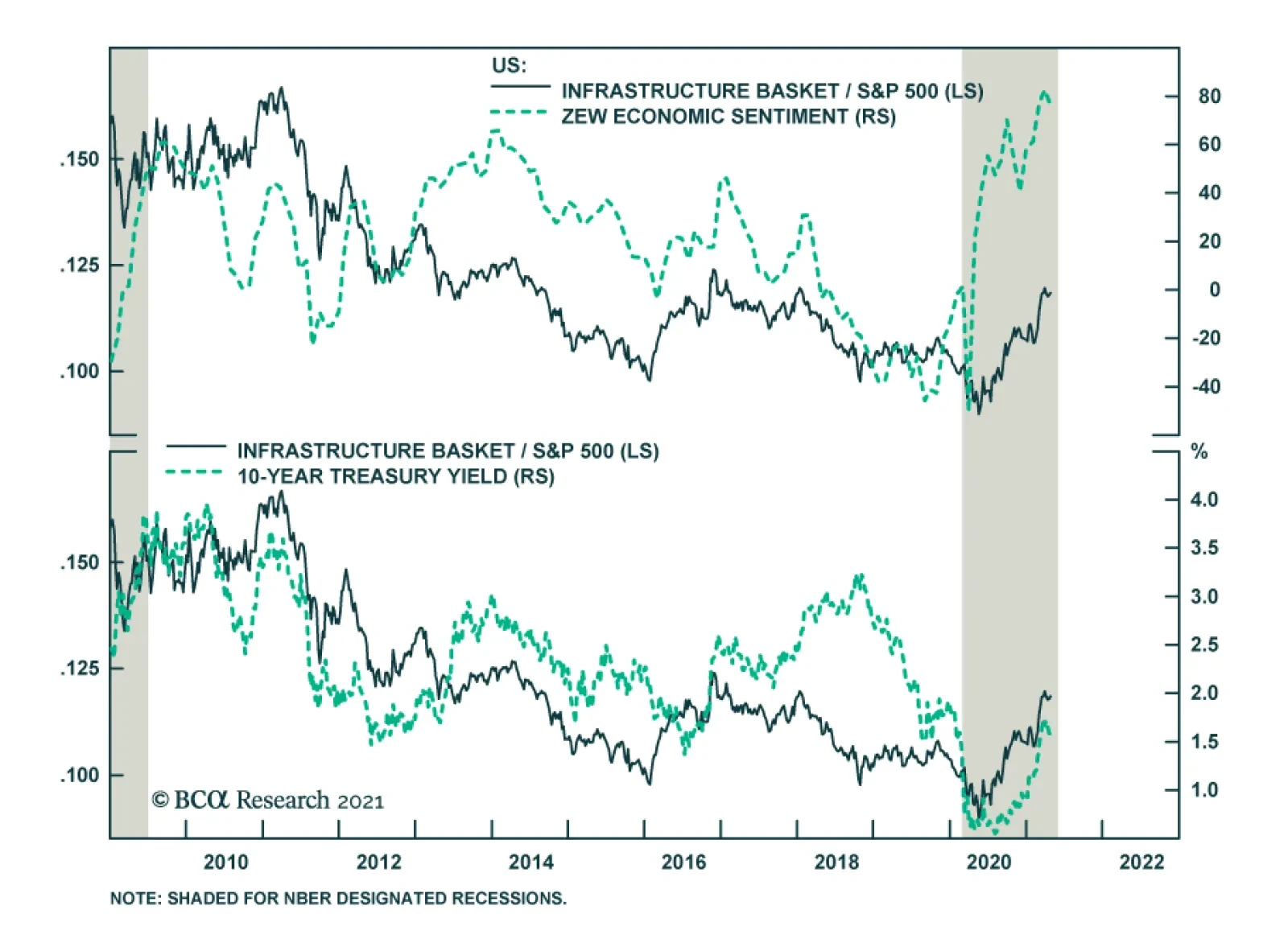
BCA Research’s US Equity Strategy & US Political Strategy service reiterate their recommendations in favor of the BCA Infrastructure Basket and the Biden Fiscal Advantage Equity Basket. President Joe Biden’s $2.3 trillion American Jobs Plan is shifting…
Highlights President Biden’s proposal to raise the capital gains tax rate from 20% to 43.4% is part of the American Families Plan, which at best has a 50% chance of passing before the 2022 midterm election. Biden will soon present the full outline of this $1 trillion bill. The legislative priority is the American Jobs Plan with infrastructure spending and corporate tax hikes. This bill has an 80% chance of passing by Christmas. If it passes by end of July, then the odds of passing the American Families Plan prior to the midterm will shoot up. But we expect it to take to November, which could render the families plan (and capital gains tax) a campaign issue for 2022. Republicans are much more likely to vote for infrastructure spending than tax hikes. Traditional infrastructure can be separated into a bipartisan bill with Republicans and passed along with a renewed highway authorization by September. This creates an alternate avenue for infrastructure. Democrats would still pass the rest of Biden’s American Jobs Plan via reconciliation, including corporate tax hikes, which will only be watered down a bit. We reiterate our recommendations in favor of the BCA Infrastructure Basket and the Biden Fiscal Advantage Equity Basket. Given the eight-year span of the US infrastructure proposals, we recommend a cyclical and structural overweight for these baskets. Feature President Joe Biden’s $2.3 trillion American Jobs Plan is shifting from the initial phase – “coordinated policy rollout” and media cheerleading – to the drawn-out process of congressional negotiation and voting. None of our core views on the bill have changed: we expect the bill to pass before the end of the year and to be similar to what Biden has proposed on both corporate tax hikes and spending. Some spending proposals can be offloaded, some tax hikes can be watered down, but the gist of the bill is known to investors. Scares over Biden’s proposed capital gains tax hike are premature as this bill must pass before Congress can turn to Biden’s second plan and individual tax hikes. In this special report with BCA’s US Equity Strategy, we update the status of the bill and then take a closer look at our BCA Infrastructure Basket. We recommend investors stick to this trade over a structural time horizon of 12 months-plus. Biden’s Bill Will Pass – Bipartisanship Is Possible But Separate Biden’s infrastructure plan will pass on a party-line vote through budget reconciliation. Republicans will reject tax increases; Democrats will muster all 50 of their caucus votes plus Vice President Kamala Harris. Procedurally, reconciliation has been cleared. The fiscal 2021 budget resolution will be revised and this will enable Democratic leaders to cram the infrastructure package into a new reconciliation bill, ostensibly to raise the debt ceiling, which is due to expire on July 31. Technical public debt default will loom in early fall to help the Democrats motivate stragglers to vote for the bill.1 Spending Compromises: The reconciliation process will keep the price tag of the bill from rising higher than the proposed $2.3 trillion, since it will mostly exclude “earmarks.” States will have to apply in a competitive bidding for funding for projects beginning sometime in 2022 rather than receive guarantees of special projects in exchange for their senator’s vote for the overall package. The headline price tag could be whittled down by about $1 trillion if a bipartisan deal is done. Biden’s proposal consists of $784 billion in traditional infrastructure, $647 billion in social welfare, $370 billion in green energy initiatives, $280 billion in tech initiatives, and $219 billion in business support (Chart 1). The Republicans might be willing to agree to most of the traditional infrastructure as well as some of the tech initiatives and business support (Chart 2). This means these measures could be removed from the bill and passed separately. This would leave the Democrats to pass the rest on their own, including corporate tax hikes, which they could do at earliest by the end of July and at latest by the end of December (Diagram 1). Or Democrats could pass the whole package alone. Chart 1American Jobs Plan Has $784Bn In Traditional Infrastructure
A Closer Look At Our Infrastructure Basket
A Closer Look At Our Infrastructure Basket
Chart 2Republicans Support Roads And Bridges
A Closer Look At Our Infrastructure Basket
A Closer Look At Our Infrastructure Basket
Diagram 1Timeline For Congress To Pass American Jobs Plan By End Of 2021
A Closer Look At Our Infrastructure Basket
A Closer Look At Our Infrastructure Basket
Tax Compromises: Much has been made of West Virginia Senator Joe Manchin’s claim that the corporate tax rate should not exceed 25%, as opposed to Biden’s preferred 28%. Manchin is not alone, however. Table 1 highlights other Senate Democrats who oppose a 28% rate. These decisive swing voters may get a reduction in the rate but we tend to doubt it will be modified much from the proposal. Corporate tax hikes are popular – including when presented as a responsible way to pay for infrastructure (Chart 3). A minimum corporate tax will play very well politically while the headline corporate rate can be toggled one or two percentage points to ensure the bill gets enough votes (Chart 4). Chart 3Independents Support Corporate Taxes For Infrastructure
A Closer Look At Our Infrastructure Basket
A Closer Look At Our Infrastructure Basket
Chart 4Voters Favor Corporate Tax Hike And Minimum Tax
A Closer Look At Our Infrastructure Basket
A Closer Look At Our Infrastructure Basket
Table 1Centrist Senators: Democrats Who Oppose A 28% Corporate Rate, Republicans Who Voted To Convict Trump Of Insurrection, And Others
A Closer Look At Our Infrastructure Basket
A Closer Look At Our Infrastructure Basket
Bipartisan infrastructure spending is possible but separate. Republicans are at risk of getting steamrolled by Democrats in the coming years. Democrats have stolen back the lead on infrastructure, manufacturing, trade, and China, yet they are free of the taint of mishandling the pandemic. Most importantly they have gotten hold of the magic money tree (Modern Monetary Theory), which enables them to expand the social safety net in a historic way that could boost the fortunes of their own party and its underlying principle of Big Government for a decade or more. Thus the pressure will be high on Republicans to show that they can govern and compromise – and infrastructure is the policy on which it is least painful for the GOP to join them. Republicans could hive off traditional “roads and bridges” – as well as tech competition with China – into a separate bill that could go forward on a bipartisan basis. There is a separate opportunity to pass infrastructure spending because the federal highway funding authorization, the 2015 FAST Act, expires on September 30 (Chart 5). The need to reauthorize this law will force lawmakers to act, thus presenting an opportunity to top up funding for traditional infrastructure projects.2 But this merely highlights that infrastructure spending has multiple avenues. If partisanship prevails as usual then Democrats will drive through their bill anyway. Chart 5US Infrastructure Spending In Recent Decades
A Closer Look At Our Infrastructure Basket
A Closer Look At Our Infrastructure Basket
The regular budget process will be gridlocked. The regular appropriations process for FY2022 will not be an avenue for increased spending. Limits on discretionary spending expire at the end of FY2021 so there are no limits on budget appropriations. But 60 votes are needed for appropriations. Republicans will be loath to assist Democrats on the normal budget while the latter achieve all their other priorities via reconciliation. The economy will not need extra spending. A continuing resolution – a stopgap measure that keeps appropriations at the same level as the previous year – is the likeliest outcome. Or a government shutdown, which might be useful for Republicans to rally their base after a demoralizing year, though it would hurt their standing among the general public. Biden’s $1 trillion American Families Plan will be presented on April 28. This bill could pass in H1 2022, if the American Jobs Plan passes by July, but it is just as likely to become the Democrats’ campaign platform for the 2022 midterms. This bill will require the House and Senate to draft a FY2022 concurrent resolution, which cannot be finalized prior to passing the FY2021 reconciliation bill for both parliamentary and budgetary reasons. The economy will be red hot and fiscal fatigue will be setting in. We stick with our subjective 50/50 odds of passage for this bill. This means that the market’s concern over the capital gains rate hike is premature. First, Democrats have been back-loading tax hikes to prioritize economic recovery – and minimize negative impacts prior to the midterm election – so there is no reason to expect the capital gains tax hike to be retroactive whenever the American Families Plan passes Congress. If Congress passes it in mid-2022 then it will most likely go into effect on January 1, 2023. Second, the capital gains rate itself will likely be watered down from Biden’s proposed 43.4% to something around 32%. The good news for investors is that Biden is proposing to keep the distinction between individual income and capital gains (thus preserving the “carried interest loophole”). The bad news is that he is also keeping the Obamacare surtax of 3.8% on capital gains for those making over $250,000 or more. The American Families Plan is not urgent for investors because it is less likely to pass than the American Jobs Plan – and Republicans could win the House in 2022. But if the latter passes by July then the odds of the former passing before the midterm will shoot up. The family plan also shows that there is an upside risk to the budget deficit outlook and inflation expectations (Chart 6). Chart 6Revised US Budget Deficit Projection Post-ARPA
A Closer Look At Our Infrastructure Basket
A Closer Look At Our Infrastructure Basket
Investment Implications Of Biden’s Sweeping Infrastructure Package While both the CBO and IMF currently project that the fiscal impulse will turn negative in 2022 (a mid-term election year) following a modest decrease this year, government largesse has staying power (Chart 7). Chart 7Fiscal Easing…
Fiscal Easing…
Fiscal Easing…
The populist shift in US politics will push government expenditures as a share of output to nose-bleed levels. Given the lack of adequate tax offsets, it will buttress government debt-to-GDP to levels last seen during WWII (Chart 8). True, debt sustainability largely depends on nominal GDP growth, but spendthrift politicians are unconcerned about paying back debt as interest rates are held low courtesy of an extremely accommodative Federal Reserve and (temporarily) well-behaved bond vigilantes. This is all welcome news for equities exposed to fiscal spending in general and for infrastructure-reliant shares in particular. Two weeks ago we matched different segments of Biden’s infrastructure proposal (Tables A1 and A2 in the Appendix) to eight ETFs and one stock that now comprise our Biden Fiscal Advantage equity basket (Chart 9).3 Today we reiterate our sanguine view on this basket – especially versus the NASDAQ 100, given the high concentration of tech stocks in these ETFs. Chart 8...And Debt Uptake Bode Well For Infrastructure Stocks
...And Debt Uptake Bode Well For Infrastructure Stocks
...And Debt Uptake Bode Well For Infrastructure Stocks
Chart 9Stick With The Biden Fiscal Advantage Basket
Stick With The Biden Fiscal Advantage Basket
Stick With The Biden Fiscal Advantage Basket
Importantly, Charts 7 & 8 highlight that a rising fiscal deficit and ballooning government debt are a boon for the BCA’s infrastructure stock basket both from a cyclical and structural perspective.4 Tack on the Fed’s 6.5% real GDP growth projections for calendar 2021 that are more or less in line with the Street’s economic expectations and even the shorter-term outlook brightens for these infrastructure-laden equities (real GDP forecast shown advanced, Chart 10). Chart 10Enticing Domestic Growth
Enticing Domestic Growth
Enticing Domestic Growth
Already, the US ZEW Indicator of Economic Sentiment is soaring following up the path of the ISM manufacturing survey, corroborating that the US economy is firing on all cylinders (top panel, Chart 11). While the recent bond market selloff has gone on hiatus, it will likely prove short-lived. The US population is on track to reach herd immunity sometime this fall and by then inflation will be rearing its ugly head (bottom panel, Chart 11). As a result, the 10-year US Treasury yield should resume its ascent (middle panel, Chart 11). Chart 11Plenty Of Upside Left
Plenty Of Upside Left
Plenty Of Upside Left
Historically, all these key macro indicators have been positively correlated with the relative share price ratio of BCA’s infrastructure equity basket and the current message is positive (Chart 11). Beyond the conducive domestic backdrop, likely in the back half of the year the rest of the world will also be on the cusp of getting back to normal – with China’s pace of deceleration being the sole question mark – heralding a synchronized global growth setting. Not only will the US twin deficits weigh on the greenback, but a looming commodity up-cycle is also a boon for hypersensitive commodity-exposed currencies. This dual boost coupled with the budding rebound in EMs is music to the ears of US infrastructure-reliant US conglomerates (Chart 12). Gelling everything together, our US and global capex indicators do an excellent job in encapsulating all of these moving parts. Chart 13 shows that both of our capital expenditure indicators are in V-shaped recoveries, with our global capex one probing multi-decade highs. Chart 12Alluring EM Growth
Alluring EM Growth
Alluring EM Growth
Chart 13Heed The Bullish Message From Our Capex Indicators
Heed The Bullish Message From Our Capex Indicators
Heed The Bullish Message From Our Capex Indicators
Bottom Line: The sweeping American Jobs Plan will bolster both the BCA infrastructure and BCA Biden Fiscal Advantage equity baskets. Given the multi-year span of this looming bill, we recommend a cyclical and structural overweight in both baskets. Matt Gertken Vice President Geopolitical Strategy mattg@bcaresearch.com Anastasios Avgeriou US Equity Strategist anastasios@bcaresearch.com Appendix Table A1
A Closer Look At Our Infrastructure Basket
A Closer Look At Our Infrastructure Basket
Table A2
A Closer Look At Our Infrastructure Basket
A Closer Look At Our Infrastructure Basket
Footnotes 1 Paul M. Krawzak, “More questions than answers in parliamentarian’s budget opinion,” Roll Call, April 8, 2021, www.rollcall.com. 2 Jinjoo Lee, “Road Is Smoother Than Expected For Infrastructure, Biden Plan Or Not,” Wall Street Journal, March 24, 2021, wsj.com. 3 As a reminder, the ticker symbols we included in this Equity Basket are: PAVE, PHO, QCLN, TAN, WOOD, SOXX, HAIL, GRID and SU. We choose SU as there is no pure play Canadian oil sands ETF trading in USD. 4 We first created this basket in late-2018 comprising a range of industrials and materials indexes that should see a positive reaction to a spur in infrastructure demand; Table A2 in the Appendix at the end of this report updates all the constituents in our basket.
Highlights The sheer magnitude of US fiscal stimulus makes forecasting especially challenging, … : It is very hard to say how unprecedented stimulus will impact the economy. … and it may already have scrambled established equity market patterns: Give a bored millennial a smartphone, a brokerage account app, commission-free trades and regular infusions of cash and you just might get a bear market bounce unlike any that’s ever been seen before. We are devoted to the idea that the simplest answers are the best and we think simplicity is particularly suited to navigating through elevated uncertainty: If growth is going to be solidly above trend and the Fed is going to maintain extremely accommodative monetary policy settings despite the risk of overheating, risk assets should outperform Treasuries and cash and investors ought to overweight them. Feature We spent much of last week speaking with investors outside of the US in a series of Zoom meetings. The themes that were most persistent in our discussions were inflation (Is it going to materialize and how bad could it be if it does?), the post-pandemic landscape (How will it be different and how should an investor position for it?), the duration of the equity bull market and the interest rate outlook. We had begun preparing a report that examined each of those themes in turn through the lens of our typical analytical process. As we progressed through that report, however, we found ourselves increasingly preoccupied with other topics we touched on in the calls and observations and questions that kept us thinking after the calls had ended. We will delve thoroughly into the themes that were raised on the calls as time goes by and evidence emerges that supports or challenges our current views. Those themes are important and will impact asset-allocation and security-selection decisions into at least the intermediate term. But this week we instead turn the spotlight on some of our impressions of the current economic landscape and how investors might navigate it. At the very least, it will serve as a change of pace, but we hope it will also be a jumping-off point for ongoing discussions about asset allocation and portfolio management. Uncharted Territory, Part One The word “unprecedented” got a lot of use and loomed over our analysis and recommendations. We believe in our analytical framework and we expect that financial markets and the US economy will most likely thrive over the next twelve months, supported by a “just-right” Goldilocks backdrop of outsized growth and extremely accommodative monetary policy. We think the probability of a “too-cold” outcome, in which growth disappoints despite the Fed’s best efforts, is steadily shrinking as vaccinations continue to outpace the rate required to confer herd immunity on the US by the end of September. While we think inflation will ultimately spell the end of the bull phases in financial markets and may even lead the Fed to induce a recession, we think it will be a couple of years before it can take root and bring about the market- and business-cycle denouements. The key word in those conclusions is think; we do not know that there will be a consumption surge that extends across several quarters, powering the US economy to grow at an inflation-adjusted rate of 4 to 5% across 2021 and 2022. We expect that the immunization campaign will squelch COVID-19 in the US at some point this summer, opening the way for the release of pent-up demand as households regain the full menu of consumption options and can once again return to restaurants, bars, airplanes, hotels, stadiums, concert venues, cinemas and theaters. Households have $2 trillion of excess savings to slake that demand, but we cannot know how much of them will be directed to consumption or the rate at which they will be released. It’s not that we don’t want to do the work; it’s that there is no empirical antecedent for this magnitude of fiscal transfers to households. The US has never before injected 25% of a year’s output into the economy across just two years (Chart 1). There is no way, then, to use past history to build a model regressing consumption growth against fiscal stimulus or a sudden surge in household savings driven by sweeping temporary constraints on activity. No way, at least, to build such a model with a reasonable degree of confidence in the predictive quality of its outputs. Chart 1We've Never Seen Anything Like This Before
We've Never Seen Anything Like This Before
We've Never Seen Anything Like This Before
The bottom line, then, is that no investor or researcher should attach a great deal of confidence to his/her current expectations. Everyone in investment management is paid to have an opinion, but all of us should have a healthy degree of humility about our current opinions. All of our views right now are necessarily low-conviction. We eagerly await the ongoing flow of data that will shed some light on whether the consumption surge is materializing and if so, the segments in which it will be concentrated. We are also closely monitoring vaccination progress and the ongoing efficacy of the extant vaccines because victory over COVID-19 by the summer is not assured, even if we do hold our base-case virus view with more conviction than our consumption views. Uncharted Territory, Part Two Shutting down activity to limit interactions fostering the spread of COVID-19 was an eminently logical public health measure. It also made sense to bolster the activity restrictions with direct cash transfers to households to cushion the economic blow of abiding by them. The distributions presumably encouraged compliance with the restrictions, helping to slow the spread of the virus, while also relieving economic distress. But the combination may have borne the unintended consequence of upending established stock market dynamics, a matter of little import for the overall economy but a critical issue for professional investors. Technical analysis is often derided by fundamentally-oriented investors as something akin to astrology or voodoo. We are not dogmatic and are happy to use any tool that might be of value; although we are neither skilled technical analysts nor traders, we accept that technical analysis is the most useful framework for assessing very short-term moves. Even fundamental investors with longer-term time frames may find price charts useful for selecting entry and exit points. Pattern recognition, after all, is an essential investment skill and it’s largely what forward-thinking investors are paying for when they invest in buzzy artificial intelligence applications. Something that upends typical market patterns is therefore important and the economic impact payments and federal unemployment insurance (UI) benefit supplements provided for by the CARES Act and the two rounds of follow-up legislation may have stood the relationship of retail and institutional investors to market movements on its head. The bottom four income quintiles of US households received considerably more aid from the federal government than they needed, strictly speaking. Two-thirds of all taxpayers received the full amount of all three economic impact payments and four-fifths received at least a phased-out portion of them while only 25 million people were out of work at the employment trough in April, less than 10 million were out of work when the second round of checks went out in January and just over 8 million were idled during the current round. Those who were unemployed are estimated to have received CARES Act UI benefits that exceeded their previous compensation by more than a third.1 The net effect is that many idled workers found themselves stranded for several months in 2020 with more money than they could spend. Homer Simpson would have blissfully napped his way through his furlough, with a mountain of empty Duff cans filling the space between the couch and the television, but it’s not a stretch to think that millennials in the same position turned to their phones to relieve their tedium and discovered the joys of commission-free trading in the palm of their hands. Retail investors have traditionally been viewed as being the last to arrive at the party, flooding in at market tops only to seep out at market bottoms, while the smart institutional money drove the trends that retail flows belatedly followed. Over time, institutions following the same cues and adhering to the same heuristics established recognizable bull- and bear-market patterns, like extended bottoming processes and regular backing-and-filling that aligned with Fibonacci retracement levels. The GameStop tempest earlier this year may have been a manifestation of the larger issue that the market had been swamped by newbies who didn’t know the rules and therefore wound up trampling them. A seasoned trader-turned-quantitative-investment-performance-analyst commented to us last summer that these were “not the markets we grew up in.” From his perch at a top hedge fund, he viewed retail flows as having been the catalyst for the market recovery that wiped out the entire pandemic decline with barely a pause for breath (Chart 2). Seasoned analysts and portfolio managers waiting for a consolidation of the initial bounce wound up turbo-charging it as they chased the retail flows that got there ahead of them. “They just couldn’t stand the underperformance any longer,” he said. Chart 2A Whole New Ballgame
A Whole New Ballgame
A Whole New Ballgame
See The Ball, Hit The Ball We follow careful analytical processes at BCA and our clients do as well, but we try not to overthink our investment conclusions once we reach them. We have found that the less a Little Leaguer is thinking about when s/he steps into the batter’s box, the better off s/he will be, and we think the approach applies to investors as well. Be as still as you can, watch the baseball out of the pitcher’s hand, step towards the pitcher and throw your hands at where you judge the ball will be just before it reaches home plate. Your weight will naturally follow your front leg and your hands and everything else will take care of itself if you correctly anticipated where the ball was headed. Our colleague Peter Berezin, BCA’s Chief Global Strategist, abides by a personal Investment Golden Rule: Stay bullish unless you think a recession is just around the corner. His rule aligns perfectly with our observation that bear markets and recessions tend to coincide (Chart 3). Although we cannot know how much of households’ aggregate excess savings will be spent or when, and we therefore cannot predict quarterly GDP growth to the nearest tenth of a percent, we are confident that the economy will grow at a rate well above its real annual long-run potential of 2%, provided that the pandemic doesn’t spring a nasty surprise on the US. If the economy does grow well above its trend rate in 2021 and 2022 (Chart 4), and the Fed lives up to its pledge to remove monetary accommodation only in response to lagged measures of consumer price inflation and labor market strength, stocks should comfortably generate returns in excess of those on cash and Treasuries and multi-asset investors should overweight them (Tables 1 and 2). Chart 3Recessions And Bear Markets Tend To Travel Together
Recessions And Bear Markets Tend To Travel Together
Recessions And Bear Markets Tend To Travel Together
Chart 4Earnings Grow When The Economy Grows, And Stocks Move With Earnings
Earnings Grow When The Economy Grows, And Stocks Move With Earnings
Earnings Grow When The Economy Grows, And Stocks Move With Earnings
Table 1Stocks Thrive When Policy Is Easy, ...
Late-Pandemic Impressions
Late-Pandemic Impressions
Table 2… Especially In Real Terms
Late-Pandemic Impressions
Late-Pandemic Impressions
Steering Portfolios Through Uncertainty Acknowledging the uncertainty inherent in predictions made in the current environment, with its unprecedented fiscal stimulus, is all well and good, but professional investors have a mandate to invest regardless of their conviction levels. How should they navigate through the next twelve months aside from overweighting equities in multi-asset portfolios? The basic rule guiding our answer in this case is to stay within sight of the shore if there’s a possibility that the weather might change suddenly. Given that no one knows how the big swing factors impacting output and the balance between capacity and aggregate demand – consumer caprice, anti-vaccination sentiment, reopening timetables and labor force participation – will turn out, we think that investors’ first order of business should be to prepare to shorten holding periods. Conviction levels will evolve over time as incoming data validate or contradict investment theses but it is important to be prepared mentally to manage portfolios more dynamically in line with unprecedented conditions. Individual managers and investment committees who prepare to adjust their procedures, perhaps by setting stop levels and/or rebalancing thresholds in advance, will find it much easier to do so in real time should it turn out to be appropriate. Investors may also consider reducing deviations from their benchmarks. Increasing the frequency of portfolio rebalancing, shifting from time to level thresholds, or tightening level thresholds are ways that investors with rebalancing guidelines could narrow deviations. Investors who don't rebalance can reduce their initial position deviations and/or their portfolio concentrations. Shortening holding periods and increasing rebalancing frequencies implies harvesting gains more often and is therefore tax-inefficient, but we think it may be worth sacrificing some tax efficiency to protect overall portfolio value at a time of elevated uncertainty. Doug Peta, CFA Chief US Investment Strategist dougp@bcaresearch.com Footnotes 1 Ganong, Peter and Noel, Pascal and Vavra, Joseph, US Unemployment Insurance Replacement Rates During the Pandemic (August 24, 2020). University of Chicago, Becker Friedman Institute for Economics Working Paper No. 2020-62.
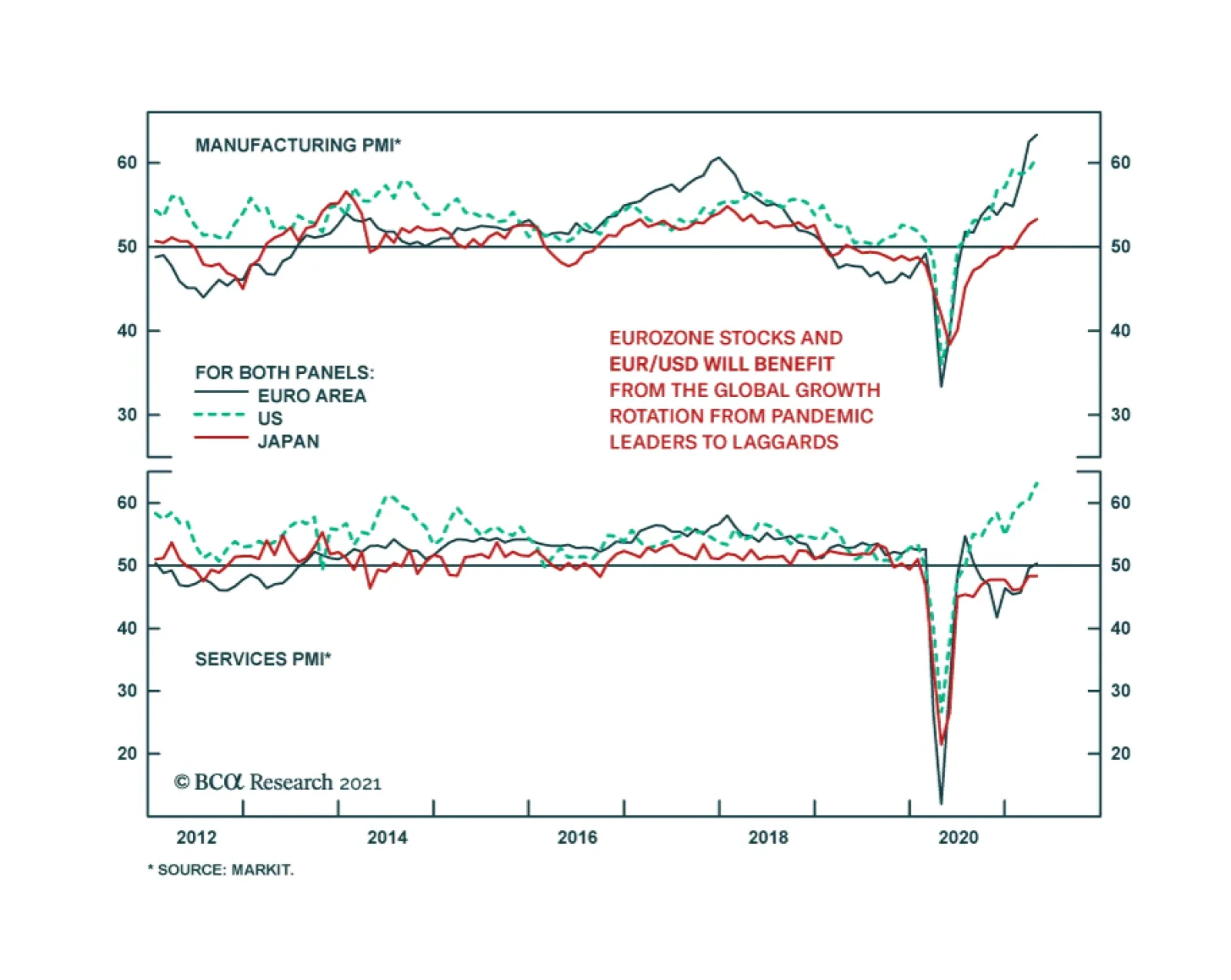
April’s flash Markit PMIs show that the economic recovery is firming across developed markets. The US composite PMI strengthened to 62.2 from 59.7. The Eurozone composite index surprised to the upside and gained 0.5 point versus expectations of a…
Highlights The Greens are likely to win control of Germany’s government in the September 26 federal elections. At least they will be very influential in the new coalition. Germany has achieved may of its long-term geopolitical goals within the EU. There is consensus on dovish monetary and fiscal policy and hawkish environmental policy. The biggest changes will come from the outside. The US and Germany have a more difficult relationship. While they both oppose Russian and Chinese aggression, Germany will resist American aggression. The Christian Democrats have a 65% chance of remaining in government which would limit the Greens’ controversial and ambitious tax agenda. The 35% chance of a left-wing coalition will frontload fiscal stimulus for the sake of recovery. The economy is looking up and a Green-led fiscal easing would supercharge the recovery. However, coalition politics will likely fail to address Germany’s poor demography, deteriorating productivity, and large excess savings. On a cyclical basis, overweight peripheral European bonds relative to bunds; EUR/USD; and Italian and Spanish stocks relative to German stocks. Feature Chart 1Germans Turn To A Young Woman And A Green
Winds Of Change: Germany Goes Green
Winds Of Change: Germany Goes Green
Germany is set to become the first major country to be led by a green party. At very least the German election on September 26 will see an upset in which the ruling party under-performs and the Greens over-perform (Chart 1). At 30%, online betting markets are underrating the odds that Annalena Baerbock will become the first Green chancellor in 2022 – and the first elected chancellor to hail from a third party (Chart 2). The “German question” – the problem of how to unify Germany yet keep peace with the neighbors – lay at the heart of Europe for the past two centuries but today it appears substantially resolved: a peaceful and unified Germany stands at the center of a peaceful and mostly unified Europe. There are a range of risks on the horizon but this positive backdrop should be acknowledged. Chart 2Market Waking Up To Baerbock’s Bid For Chancellorship
Winds Of Change: Germany Goes Green
Winds Of Change: Germany Goes Green
All of the likeliest scenarios for the German election will reinforce the current situation by perpetuating policies that aim for Euro Area solidarity. Even the green shift is already well underway, though a Green-led government would supercharge it. Nevertheless this year’s election is important because it heralds a leftward shift in Germany and will shape fiscal, energy, industrial, and trade policy for at least the coming four years. A left-wing sweep would generate equity market excitement in the short run – a positive fiscal surprise to supercharge the post-pandemic rebound – but over the long run it would bring greater policy uncertainty because it would cause a break with the past and possibly a structural economic shift (Chart 3). The Greens are in favor of substantial increases in taxation and regulation as well as big changes in industrial and energy policy. In the absence of a left-wing sweep, coalition politics will be a muddle and Germany’s existing policies will continue. Chart 3German Policy Uncertainty On The Rise
German Policy Uncertainty On The Rise
German Policy Uncertainty On The Rise
Regardless of what happens within Germany, the geopolitical environment is increasingly dangerous. Germany will try to avoid getting drawn into the US’s great power struggles with Russia and China but it may not have a choice. Germany’s Geopolitics The difficulty of German unification stands at the center of modern European history. Because of the large and productive German-speaking population, unification in 1871 posed a security threat to the neighbors, culminating in the world wars. The peaceful German reunification after the Cold War created the potential for the EU to succeed and establish peace and prosperity on the continent. This arrangement has survived recent challenges. Germany’s relationship with the EU came under threat from the financial crisis, the Arab Spring and immigration influx, Brexit, and President Trump’s trade tariffs. But in the end these events cemented the reality that German and Europe are strengthening their bonds in the face of foreign pressures. Germany achieved what it had long sought – preeminence on the continent – by eschewing a military role, sticking to France economically, and avoiding conflict with Russia. Since Germany has achieved many of its long-sought strategic objectives it has not fallen victim to a nationalist backlash over the past ten years like the US and United Kingdom. However, Germany is not immune to populism or anti-establishment sentiment. The two main political blocs, the Christian Democrats and the Democratic Socialists, have suffered a loss of popular support in recent elections, forcing them into a grand coalition together. Anti-establishment feeling in Germany has moved the electorate to the left, in favor of the Greens. The Greens have risen inexorably over the past decade and have now seized the momentum only five months before an election (Chart 4). Yet the Greens in Germany are basically an establishment political party. They participate in 11 out of 16 state governments and currently hold the top position in Baden-Württemberg, Germany’s third most populous and productive state. From 1998-2005 they participated in government, getting their hands dirty with neoliberal structural reforms and overseas military deployments. Moreover the Greens cannot rule alone but will have to rule within a coalition, which will mediate their more controversial policies. Chart 4Greens Surge, Christian Democrats Falter
Greens Surge, Christian Democrats Falter
Greens Surge, Christian Democrats Falter
Today Germany is in lock step with France and the EU by meeting three key conditions: full monetary accommodation (the German constitutional court’s challenges to the European Central Bank are ineffectual), full fiscal accommodation (Chancellor Angela Merkel agreed to joint debt issuance and loose deficit controls amid the COVID-19 crisis as well as robust green energy policies), and full security accommodation (German rearmament exists within the context of NATO and European security aspirations are undertaken in lock-step with the French). These conditions will not change in the 2021 election even assuming that the Greens take power at the head of a left-wing coalition. Bottom Line: Germany has virtually achieved its grand strategic aims of unifying and ruling Europe. No German government will challenge this situation and every German government will strive to solidify it. The greatest risks to this setup stem from abroad rather than at home. The Return Of The German Question? Germany’s geopolitical position can be summarized by Chart 5, which shows popular views toward different countries and institutions. The Germans look positively upon the EU and global institutions like the United Nations and less so NATO. They look unfavorably upon everything else. They take an unfavorable view toward Russia, but not dramatically so, which shows their lack of interest in conflict with Russia – they do not want to be the battleground or the ramparts of another major European war. They dislike the United States and China even more, and equally. Even if attitudes toward the US have improved since the 2020 election the net unfavorability is telling. Chart 5Germany More Favorable Toward Russia Than US?
Winds Of Change: Germany Goes Green
Winds Of Change: Germany Goes Green
Since the global financial crisis, and especially Russia’s invasion of Ukraine in 2014, Germany has built up its military. This buildup is taking place under the prodding of the United States and in step with NATO allies, who are reacting to Russia’s military action to restore its sphere of influence in the former Soviet space (Chart 6). Germany’s military spending still falls short of NATO’s 2% of GDP target, however. It will not be seen as a threat to its neighbors as long as it remains integrated with France and Europe and geared toward deterring Russia. Chart 6Germany And NATO Increase Military Spending
Winds Of Change: Germany Goes Green
Winds Of Change: Germany Goes Green
Chart 7Watch Russo-German Relations For Cracks In Europe’s Edifice
Winds Of Change: Germany Goes Green
Winds Of Change: Germany Goes Green
Russia’s aggressiveness should continue to drive the Germans and Europeans into each other’s arms. This could change if Putin pursues diplomacy over military coercion, for then he could split Germany from eastern Europe. The possibility is clear from Russia’s and Germany’s current insistence on completing the Nord Stream 2 pipeline despite American and eastern European objections. The pipeline is set to be completed by September, right in time for the elections – in no small part because the Greens oppose it. If the US insists on halting the pipeline then a crisis will erupt with Russia that will humiliate Merkel and the Christian Democrats. But the US may refrain from doing so in the face of Russian military threats (odds are 50/50). The Russian positioning over 100,000 troops on the border with Ukraine this year – and now reportedly ordering them to return to base by May 1 – amounts to a test of Russo-German relations. Putin can easily expand the Russian footprint in Ukraine and tensions will remain elevated at least through the Russian legislative elections in September. Germans would respond to another invasion with sanctions, albeit likely watering down tougher sanctions proposed by the Americans. What would truly change the game would be a Russian conquest of all of Ukraine. This is unlikely – precisely because it would unite Germany, the Europeans, and the Americans solidly against Russia, to its economic loss as well as strategic disadvantage (Chart 7). China’s rise should also keep Germany bound up with Europe. The Germans fear China’s technological and manufacturing advancement, including Chinese involvement in digital infrastructure and networks. The Greens are critical of the way that carbon-heavy Chinese goods undercut the prices of carbon-lite German goods. Baerbock favors carbon adjustment fees, a pretty word for tariffs. However, the Germans want to maintain business with China and are not very afraid of China’s military. Hence there is a risk of a US-German split over the question of China. If Germany should consistently side with Russia and China over US objections then it risks attracting hostile attention from the US as well as from fellow Europeans, who will eventually fear that German power is becoming exorbitant by forming relations with giants outside the EU. But this is not the leading risk today. The US is courting Germany and seeking to renew the trans-Atlantic alliance. Meanwhile Germany needs US support against Russia’s military and China’s trade practices. US-German relations will improve unless the US forces Germany into an outright conflict with the autocratic powers. Bottom Line: The US and Germany have a more difficult relationship now than in the past but they share an interest in deterring Russian aggression and Chinese technological and trade ambitions. Biden’s attempt to confront these powers multilaterally is limited by Germany’s risk-aversion. Scenarios For The 2021 Election There are several realistic scenarios for the German election outcome. Our expectation that the Greens will form a government stems from a series of fundamental factors. Opinion polling has now clearly shifted in favor of our view, with the Greens gaining the momentum with only five months to go. Grouping the political parties into ideological blocs shows that the race is a dead heat. Our bet is that momentum will break in favor of the opposition Greens, which we explain below. Meanwhile the Free Democrats should perform well, stealing votes from the Christian Democrats. The right-wing Alternative für Deutschland (AfD), while not performing well, is persistent enough to poach some votes from the Christian Democrats. These are “lost” votes to the conservatives as none of the parties will join it in a coalition (Chart 8). Chart 8Germany's Median Voters Shifts To the Left
Germany's Median Voters Shifts To the Left
Germany's Median Voters Shifts To the Left
The Christian Democrats bear all the signs of a stale and vulnerable government. They have been in power for 16 years and their performance in state and federal elections has eroded recently, including this year (Table 1). The public is susceptible to the powerful idea that it is time for a change. Chancellor Merkel’s approval rating is still around 60%, but in freefall, and her successful legacy is not enough to save her party, which is showing all the signs of panic: succession issues, indecision, infighting, corruption scandals. The Greens will be “tax-and-spend” lefties but the coalition matters in terms of what can actually be legislated (Table 2).1 Table 1AChristian Democrats Fall, Greens Rise, In Recent State Elections
Winds Of Change: Germany Goes Green
Winds Of Change: Germany Goes Green
Table 1BChristian Democrats Fall, Greens Rise, In Recent State Elections
Winds Of Change: Germany Goes Green
Winds Of Change: Germany Goes Green
Table 2Policy Platforms Of The Green Party
Winds Of Change: Germany Goes Green
Winds Of Change: Germany Goes Green
The fact that Christian Democrats and their Bavarian sister party, the Christian Social Union, saw such a tough race for chancellor candidate is an ill omen. Moreover the party’s elites went for the safe choice of Merkel’s handpicked successor, Armin Laschet, over the more popular Markus Soeder (Chart 9), in a division that will likely haunt the party later this year. Chart 9Christian Democrats And Christian Social Union Divided Ahead Of Election
Winds Of Change: Germany Goes Green
Winds Of Change: Germany Goes Green
Laschet has received a bounce in polls with the nomination but it will be temporary. He has not cut a major figure in any polling prior to now. Chart 10Dissatisfaction Points To Government Change
Winds Of Change: Germany Goes Green
Winds Of Change: Germany Goes Green
He has quarreled openly with Merkel and the coalition over pandemic management. He was not her first choice of successor anyway – that was Annagret Kramp-Karrenbauer, who fell from grace due to controversy over the faintest hint of cooperation with the AfD. There is a manifest problem filling Merkel’s shoes. Even more important than coalition infighting is the fact that Germany, like the rest of the world, has suffered a historic shock to its economy and society. The pandemic and recession were then aggravated by a botched vaccine rollout. General dissatisfaction is high, another negative sign for the incumbent party (Chart 10). Of course, the election is still five months away. The vaccine will make its way around, the economy will reopen, and consumers will look up – see below for the very positive macro upturn that Germany should expect between now and the election. Voters have largely favored strict pandemic measures and Merkel will have long coattails. This Christian Democrats and Christian Social Union have ruled modern Germany for all but 15 years and have not fallen beneath 33% of the popular vote since reunification. The Greens have frequently aroused more energy in opinion polling than at the voting booth. With these points in mind, we offer the following election scenarios with our subjective probabilities: Green-Red-Red Coalition – Greens rule without Christian Democrats – 35% odds. Green-Black Coalition – Greens rule with Christian Democrats – 30% odds. Black-Green Coalition – Christian Democrats rule with Greens – 25% odds. Grand Coalition (Status Quo) – Christian Democrats rule without Greens – 10% odds. Our subjective probabilities are based on the opinion polls and online betting cited above but adjusted for the Greens’ momentum, the Christian Democrats’ internal divisions, the “time for change” factor, and the presence of a historic exogenous economic and social shock. Geopolitical surprises could occur before the election but they would most likely reinforce the Greens, since they have taken a hawkish line against Russia and China. Bottom Line: The Greens are likely to lead the next German government but at very least they will have a powerful influence. Policy Impacts Of Election Scenarios The makeup of the ruling coalition will determine the parameters of new policy. Fiscal policy will change based on the election outcome – both spending and taxes. The Greens will be “tax-and-spend” lefties but the coalition matters in terms of what can actually be legislated.2 The Greens’ idea is to “steer” the rebuilding process through environmental policy. But if the left lacks a strong majority then the Greens’ more controversial and punitive measures will not get through. Transformative policies will weigh heavily on the lower classes (Chart 11). Chart 11Ambitious Climate Policy Will Face Resistance
Winds Of Change: Germany Goes Green
Winds Of Change: Germany Goes Green
The policy dispositions of the various chancellor candidates help to illustrate Germany’s high degree of policy consensus. Table 3 looks at the candidates based on whether they are “hawkish” (active or offensive) or “dovish” (passive or defensive) on a given policy area. What stands out is the agreement among the different candidates despite party differences. Nobody is a fiscal or monetary hawk. Only Baerbock can be classified as a hawk on trade.3 Nobody is a hawk on immigration. Nearly everyone is a hawk on fighting climate change. And attitudes are turning more skeptical of Russia and China, though not outright hawkish. Table 3Policy Consensus Among German Chancellor Candidates
Winds Of Change: Germany Goes Green
Winds Of Change: Germany Goes Green
Germany will not abandon its green initiatives even if the Greens underperform. The current grand coalition pursued a climate package due to popular pressure even with the Greens in opposition. Germans are considerably more pro-environment even than other Europeans (Chart 12). The green shift is also happening across the world. The US is now joining the green race while China is doubling down for its own reasons. See the Appendix for current green targets and measures, which have been updated in the wake of a slew of announcements before Biden’s Earth Day climate summit on April 22-23. Chart 12Germans Care Even More About Environment Than Other Europeans
Winds Of Change: Germany Goes Green
Winds Of Change: Germany Goes Green
Any coalition will raise spending more than taxes since it will be focused on post-COVID economic recovery. There has been a long prelude to Germany’s proactive fiscal shift – it has staying power and is not to be dismissed. A Christian Democratic coalition would try to restore fiscal discipline sooner than otherwise but there is only a 5% chance that it will have the power to do so according to the scenarios given above. The rest of Europe will be motivated to spend aggressively while EU fiscal caps are on hold in 2022, especially if the German government is taking a more dovish turn. Even more than the US and UK, Germany is turning away from the neoliberal Washington Consensus. But Germans are not experiencing any kind of US-style surge of polarization and populism. At least not yet. It may be a risk over the long run, depending on the fate of the Christian Democrats, the AfD, and various internal and external developments. Bottom Line: Germany has a national consensus that consists of dovish monetary, fiscal, trade, and immigration policies and hawkish (pro-green) environmental policy. Germany is turning less dovish on geopolitical conflicts with Russia and China. Given that a coalition government is likely, this consensus is likely to determine actual policy in the wake of this year’s election. A few things are clear regardless of the ruling coalition. First, Germany is seeking domestic demand as a new source of growth, to rebalance its economy and deepen EU integration. Second, Germany is accelerating its green energy drive. Third, Germany cannot accept being in the middle of a new cold war with Russia. Fourth, Germany has an ambivalent policy on China. Germany’s Macro Outlook Even before considering the broader fiscal picture, the outlook for German economic activity over the course of the coming 12 to 24 months was already positive. Our base case scenario for the September election, which foresees a coalition government led by the Green Party, only confirms this optimistic view. However, Germany is still facing significant long-term challenges, and, so far, there has not been a political consensus to address these structural headwinds adequately. The Greens offer some solutions but not all of their proposals are constructive and much will depend on their parliamentary strength. Peering Into The Near-Term… Germany’s economy is set to benefit from the continued recovery of the global business cycle, which is a view at the core of BCA Research’s current outlook.4 Germany remains a trading and manufacturing powerhouse, and thus, it will reap a significant dividend from the continued global manufacturing upswing. Manufacturing and trade amount to 20% and 88% of Germany’s GDP, the highest percentage of any major economy. Alternatively, according to the OECD, foreign demand for German goods accounts for nearly 30% of domestic value added, a share even greater than that for a smaller economy like Korea (Chart 13). Moreover, road vehicles, machinery and other transport equipment, as well as chemicals and related products, account for 53% of Germany’s exports. These products are all particularly sensitive to the global business cycle. They will therefore enhance the performance of the German economy over the next two years. Trade with the rest of Europe constitutes another boost to Germany’s economy going forward. Shipments to the euro area and the rest of the EU account for 34% and 23% of Germany’s exports, or 57% overall. Right now, the lagging economy of Europe is a handicap for Germany; however, Europe has more pent-up demand than the US, and the consumption of durable goods will surge once the vaccination campaign progresses further (Chart 14). This will create a significant boon for Germany, since we expect European consumption to pick up meaningfully over the coming 12 to 18 months.5 Chart 13Germany Depends On Global Trade
Winds Of Change: Germany Goes Green
Winds Of Change: Germany Goes Green
Chart 14Europe Has More Pent-Up Demand Than The US
Europe Has More Pent-Up Demand Than The US
Europe Has More Pent-Up Demand Than The US
Chart 15Vaccination Progress
Vaccination Progress
Vaccination Progress
Domestic forces also point toward a strong Germany economy, not just foreign factors. The pace of vaccination is rapidly accelerating in Germany (Chart 15). The recent announcement of 50 million additional doses purchases for the quarter and up to 1.8 billion more doses over the next two years by the EU points to further improvements. A more broad-based vaccination effort will catalyze underlying tailwinds to consumption. German household income will also progress significantly. The Kurzarbeit program was instrumental in containing the unemployment rate during the crisis, which only peaked at 6.4% from 5% in early 2020. However, the program could not prevent a sharp decline in total hours worked of 7%, since by definition, it forced six million employees to work reduced hours (Chart 16). One of the great benefits of the program is that it prevents a rupture of the link between workers and employers. Thus, the economy suffers less frictional unemployment as activity recovers and household income does not suffer long lasting damage. Meanwhile, the German government is likely to extend the support for households and businesses as a result of the delayed use of the debt-brake. The Greens propose revising the debt brake rather than restoring it in 2022 like the conservatives pledge to do. Chart 16Kurtzarbeit Saved The Day
Kurtzarbeit Saved The Day
Kurtzarbeit Saved The Day
The balance-sheet strength of German households means that they will have the wherewithal to spend these growing incomes. Residential real estate prices are rising at an 8% annual pace, which is pushing the asset-to-disposable income ratio to record highs. Meanwhile, the debt-to-assets ratio, and the level of interest rates are also very low, which means that the burden of serving existing liabilities is minimal (Chart 17). In this context, durable goods spending will accelerate, which will lift overall cyclical spending, even if German households do not spend much of the EUR120 billion in excess savings built up over the past year. As Chart 18 shows, while US durable goods spending has already overtaken its pre-COVID highs, Germany’s continues to linger near its long-term trend. Thus, as the economy re-opens this summer, and income and employment increase, the concurrent surge in consumer confidence will allow for a recovery in cyclical spending. Chart 17Strong Household Balance Sheets
Strong Household Balance Sheets
Strong Household Balance Sheets
Chart 18Germany Too Has More Pent-up Demand Than The US
Germany Too Has More Pent-up Demand Than The US
Germany Too Has More Pent-up Demand Than The US
Chart 19Positive Message From Many Indicators
Positive Message From Many Indicators
Positive Message From Many Indicators
Various economic indicators are already pointing toward the coming German economic boom.Manufacturing orders are strong, and economic sentiment confidence is rising across most sectors. Meanwhile, consumer optimism is forming a trough, and new car registrations are climbing rapidly. Most positively, the stocks of finished goods have collapsed, which suggests that production will be ramped up to fulfill future demand (Chart 19). Bottom Line: The German economy is set to accelerate in the second half of the year and into 2022. As usual, Germany will enjoy a healthy dividend from robust global growth, but the expanding vaccination program, as well durable employee-employer relations, strong household balance sheets, and significant pent-up demand for durable goods will also fuel the domestic economy. Our base case scenario that fiscal policy will remain accommodative in the wake of a political shift to the left in Berlin in September will only supercharge this inevitable recovery. … And The Long-Term In contrast to the bright near-term perspective, the long-term outlook for the German economy remains poor. The policies of any new ruling coalition are unlikely to address the problems of Germany’s poor demography, deteriorating productivity, and large excess savings. There is potential for a productivity boost in the context of a global green energy and high-tech race but for now that remains a matter of speculation. The most obvious issue facing Germany is its ageing population, counterbalanced by its fertility rate of only 1.6. Over the course of the next three decades, Germany’s dependency ratio will surge to 80%, driven by an increase in the elderly dependency ratio of 20% (Chart 20). The working age population is set to decline by 18% by 2050, which will curtail potential GDP growth. The outlook for German productivity growth is also poor. Germany’s productivity growth has been in a long-term decline, falling from 5% in 1975 to less than 1% in 2019. Contrary to commonly-held ideas, from 1999 to 2007, German labor productivity growth has only matched that of France or Spain; since 2008, it has lagged behind these two nations, although it has bested Italy. One crucial reason for Germany’s uninspiring productivity performance is a lack of investment. Some of this reflects the country’s austere fiscal policy. For example, in 2019, Germany’s public investment stood at 2.4% of GDP, which compares poorly to the OECD’s average of 3.8%, or even to that of the US, where public investment stood at 3.6% of GDP. This poor statistic does not even account for the depreciation of the German public capital stock. Since the introduction of the euro, net public investment has averaged 0.03% of GDP. The biggest problem remains at the municipal level. From 2012 to 2019, federal and state level net investment averaged 0.2% of GDP, while municipal net investment subtracted 0.2% of GDP on average. Hopefully, the new government will be able to address this deficiency of the German economy. The Greens are most proactive but they will face obstacles. The bigger problem for German productivity is corporate capex. Corporate investments have been low in this country. Since the introduction of the euro, the contribution of capital intensity to productivity in Germany has equaled that of Italy and has underperformed France and Spain. As a result, the age of the German capital stock is at a record high and stands well above the US or Eurozone average (Chart 21). Chart 20Germany Has Poor Demographics
Germany Has Poor Demographics
Germany Has Poor Demographics
Chart 21Germany's Capital Stock Is Ageing
Germany's Capital Stock Is Ageing
Germany's Capital Stock Is Ageing
The make-up of Germany’s capex aggravates the productivity-handicap. According to a Bundesbank study, the contribution to labor productivity from information and communication technology (ICT) capital spending has averaged 0.05 percentage points annually from 2008 to 2012. On this metric, Germany lagged behind France and the US, but still bested Italy. From 2013 to 2017, the contribution of ICT investment to productivity fell to 0.02 percentage points, still below France and the US, but in line with Italy. Looking at the absolute level of ICT or knowledge-based capital (KBC) investment further highlights Germany’s challenge. In 2016, total investment in ICT equipment, software and database, R&D and intellectual property products, and other KBC assets (which include organizational capital and training) represented less than 8% of GDP. In France, the US, or Sweden, these outlays accounted for 11%, 12%, and 13% of GDP, respectively (Chart 22, top panel). This lack of investment directly hurts Germany’s capacity to innovate. The bottom panel of Chart 22 shows that, for the eight most important categories of ICT patents (accounting for 80% of total ICT patents), Germany remarkably lags behind the US, Japan, Korea, or China. Chart 22Germany Lags In ICT investment
Winds Of Change: Germany Goes Green
Winds Of Change: Germany Goes Green
A major source of Germany’s handicap in ICT and KBC investment comes from small businesses, which have been particularly reluctant to deploy capital. A study by the OECD shows that, between 2010 and 2019, the gap of ICT tools and activities adoption between Germany’s small and large companies deteriorated relative to the OECD average (Chart 23). The lack of venture capital investing probably exacerbates these problems. In 2019, venture capital investing accounted for 0.06% of Germany’s GDP. This is below the level of venture investing in France or the UK (0.08% and 0.1% of GDP, respectively), let alone South Korea, Canada, Israel, or the US (0.16%, 0.2%, 0.4% and 0.65%, respectively). The Greens claim they will create new venture capital funds but their capability in this domain is questionable. Chart 23The Lagging ICT Capabilities Of Small German Businesses
Winds Of Change: Germany Goes Green
Winds Of Change: Germany Goes Green
Since Germany’s productivity growth is likely to remain sub-par compared to rest of the OECD and to lag behind even that of France or the UK, the only way for Germany to protect its competitiveness will be to control costs. This means that Germany cannot allow its recent loss of competitiveness to continue much further (Chart 24). Thus, low productivity growth will limit Germany’s real wages. Chart 24Germany's Competitiveness Is Declining
Germany's Competitiveness Is Declining
Germany's Competitiveness Is Declining
This wage constraint will negatively impact consumption. Beyond a pop over the coming 12 to 24 months, German consumption is likely to remain depressed, as it was in the first decade and a half of the century, following the Hartz IV labor market reforms that also hurt real wages. The Greens for their part aim to boost welfare payments, raise the minimum wage, and reduce enforcement of Hartz IV. Bottom Line: German excess savings will remain wide on a structural basis. Without a meaningful pick-up in capex, German nonfinancial businesses will remain net lenders. Meanwhile, households that were worried about their financial future in a world of low real-wage growth will also continue to save a significant share of their income. Consequently, the excess savings Germany developed since the turn of the millennia are here to stay (Chart 25). In other words, Germany will continue to sport a large current account surplus and exert a deflationary influence on Europe and the rest of the world. The policy prescribed by the various parties contesting the September election will not necessarily result in new laws that will reverse the issues of low capex and low ICT investment. The Greens will worsen the over-regulation of the economy. Barring a policy revolution that succeeds in all its aims (a tall order), we can expect more of the same for Germany – that is, a slowly declining economy. Chart 25Too Much Savings, Not Enough Investments
Too Much Savings, Not Enough Investments
Too Much Savings, Not Enough Investments
Chart 26Germany Scores Well On Renewable Power
Winds Of Change: Germany Goes Green
Winds Of Change: Germany Goes Green
That being said, some bright spots exist. Germany is becoming a leader in renewable energy, and it can capitalize on the broadening of this trend to enlarge its export market (Chart 26). Investment Implications Bond Markets The economic outlook for Germany and the euro area at large is consistent with the underweighting of German bunds within European fixed-income portfolios. Bunds rank among the most expensive bond markets in the world, which will make them extremely vulnerable to positive economic surprise in Europe later this year, especially if Germany’s fiscal policy loosens up further in the wake of the September election (Chart 27). Moreover, easier German fiscal policy should help European peripheral bonds, especially the inexpensive Italian BTPs that the ECB currently buys aggressively. Thus, we continue to overweight BTPs, and add Greek and Portuguese bonds to the list. Chart 27German Bunds Are Expensive
Winds Of Change: Germany Goes Green
Winds Of Change: Germany Goes Green
Chart 28German Yields Already Embed Plenty Pessimism About Europe
German Yields Already Embed Plenty Pessimism About Europe
German Yields Already Embed Plenty Pessimism About Europe
Relative to US Treasurys, the outlook for Bunds is more complex. On the one hand, the ECB will not tighten policy as much as the Fed later this cycle; moreover, European inflation is likely to remain below US levels this year, as well as through the business cycle. On the other hand, Bunds already embed a significantly lower real terminal rate proxy and term premium than Treasury Notes (Chart 28). Netting it all out, BCA Research Global Fixed Income Strategy service believes Bunds should outperform Treasurys this year, because they have a lower beta, which is a valuable feature in a rising yield environment.6 We will closely monitor risks around this view, because it is likely that the European economic recovery will be the catalyst for the next up leg in global yields, in which case German bunds could temporarily underperform. On a structural basis, as long as Germany’s productivity issues are not addressed by Berlin, German Bunds are likely to remain an anchor for global yields. Germany will remain awash in excess savings, which will act as a deflationary anchor, while also limiting the long-term upside for European real rates. Excess savings results in a large current account surplus; thus, Germany will continue to export its savings abroad and act as a containing factor for global yields. The Euro The medium-term outlook points to significant euro upside. Our expectation of a European and German positive growth surprise over the coming 12 months is consistent with an outperformance of the euro. The fact that investors have been moving funds out of the Eurozone and into the US at an almost constant rate for the past 10 years only lends credence to this argument (Chart 29). Our view on Germany’s fiscal policy contributes to the euro’s luster. Greater German budget deficits help European economic activity and curtail risk premia across the Eurozone. This process is doubly positive for the euro. First, lower risk premia in the periphery invite inflows into the euro area, especially since Greek, Portuguese, Italian, or Spanish yields offer better value than alternatives. Second, stronger growth and lower risk premia relieve pressure on the ECB as the sole reflator for the Eurozone. At the margin, this process should boost the extremely depressed terminal rate proxy for Europe and help EUR/USD. Robust global economic activity adds to the euro’s appeal, beyond the positive domestic forces at play in Europe. The dollar is a countercyclical currency; thus, global business cycle upswings coincide with a weak USD, which increases EUR/USD’s appeal. Nonetheless, if the boost to global activity emanates from the US, then the dollar can strengthen. This phenomenon was at play in the first quarter of 2021. However, the global growth leadership is set to move away from the US over the next 12 months, which implies that the normal inverse relationship between the dollar and global growth will reassert itself to the euro’s benefit. The European balance of payments dynamics will consolidate the attraction of the euro. Germany’s and the Eurozone’s current account surplus will remain wide, especially in comparison to the expanding twin deficit plaguing the US. Beyond the next 12 to 24 months, the lack of structural vigor of Germany’s and Europe’s economy is likely to shift the euro into a safe-haven currency, like the yen and the Swiss franc. A strong balance of payments and low interest rates (all symptoms of excess savings) are the defining features of funding currencies, and will be permanent attributes of the euro area if reforms do not address its productivity malaise. The Eurozone’s net international position is already rising and its low inflation will put a structural upward bias to the Euro’s purchasing power parity estimates (Chart 30). Those developments have all been evident in Japan and Switzerland, and will likely extinguish the euro’s pro-cyclicality as time passes. Chart 29Investors Already Underweight European Assets
Investors Already Underweight European Assets
Investors Already Underweight European Assets
Chart 30Upward Bias In The Euro's Fair Value
Upward Bias In The Euro's Fair Value
Upward Bias In The Euro's Fair Value
Chart 31Germany Has Not Outperformed The Rest Of The Eurozone
Germany Has Not Outperformed The Rest Of The Eurozone
Germany Has Not Outperformed The Rest Of The Eurozone
German Equities In absolute terms, the DAX and German equities still possess ample upside over the next 12 to 24 months. BCA Research is assuming a positive stance on equities, and a high beta market like Germany stands to benefit.7 Moreover, the elevated sensitivity to global economic activity of German equities accentuate their appeal. BCA Research likes European stocks, and German ones are no exception.8 The more complex question is how to position German equities within a European stock portfolio. After massively outperforming from 2003 to 2012, German equities have moved in line with the rest of the Eurozone ever since (Chart 31). Moreover, German equities now trade at a discount on all the major valuation metrics relative to the rest of the Eurozone (Chart 31, bottom panel). The global macro forces that dictate the outlook for German equities relative to the rest of the Eurozone are currently sending conflicting messages. On the one hand, German equities normally outperform when commodity prices rally or when the euro appreciates (Chart 32). On the other hand, however, German equities also underperform when global yields rise, or following periods when Chinese excess reserves fall, such as what we are witnessing today. With this lack of clarity from global forces, the answer to Germany’s relative performance question lies within European economic dynamics. Germany is losing competitiveness relative to the rest of the Eurozone (Chart 24 page 22) which suggests that German stocks will benefit less than their peers from a stronger euro in comparison to their performance in the last decade. Moreover, German equities outperform when the German manufacturing PMI increases relative to that of the broad euro area. The gap between the German and euro area manufacturing PMI stands near record highs and is likely to narrow as the rest of the Eurozone catches up. This should have a bearing on the performance of German stocks (Chart 33). Chart 32Mixed Global Backdrop For Germany's Relative Performance
Mixed Global Backdrop For Germany's Relative Performance
Mixed Global Backdrop For Germany's Relative Performance
Chart 33A European Economic Catch-Up Would Hurt German Equities
A European Economic Catch-Up Would Hurt German Equities
A European Economic Catch-Up Would Hurt German Equities
Finally, sectoral dynamics may prove to be the ultimate arbiter. Table 4 highlights the limited difference in sectoral weightings between Germany and the rest of the Eurozone, which helps explain the stability in the relative performance over the past nine years. However, the variance is greater between Germany and specific European nations. In this approach, BCA’s negative stance on growth stocks correlates with an overweight of Germany relative to the Netherlands. Moreover, our positive outlook on financials and bond yields suggests that Germany should underperform Italian and Spanish stocks. Table 4Sectoral Breakdown Across Europe Major Bourses
Winds Of Change: Germany Goes Green
Winds Of Change: Germany Goes Green
Matt Gertken Vice President Geopolitical Strategy mattg@bcaresearch.com Mathieu Savary, Chief European Investment Strategist Mathieu@bcaresearch.com Appendix: Global Climate Policy Commitments
Winds Of Change: Germany Goes Green
Winds Of Change: Germany Goes Green
Winds Of Change: Germany Goes Green
Winds Of Change: Germany Goes Green
Footnotes 1 See Matthew Karnitschnig, "German Conservatives Mired In ‘The Swamp,’" Politico, March 24, 2021, politico.eu. 2 The Greens are interested in a range of taxes, including a carbon tax, a digital services tax, and a financial transactions tax. They are also interested in industrial quotas requiring steel and car makers to sell a certain proportion of carbon-neutral steel and electric vehicles. See an excellent interview with Ms. Baerbock in Ileana Grabitz and Katharina Schuler, "I don’t have to convert the SUV driver in Prenzlauer Berg," Zeit Online, January 2, 2020, zeit.de. 3 See her comments to Zeit Online. 4 Please see BCA Research Global Investment Strategy Strategy Outlook "Second Quarter 2021 Strategy Outlook: Inflation Cometh?", dated March 26, 2021, available at gis.bcareseach.com. 5 Please see BCA Research European Investment Strategy Special Report "A Temporary Decoupling", dated April 5, 2021, available at eis.bcareseach.com. 6 Please see BCA Research Global Fixed Income Strategy Strategy Report "Harder, Better, Faster, Stronger", dated March 16, 2021, available at gfis.bcareseach.com. 7 Please see BCA Research Global Income Strategy Strategy Outlook "Second Quarter 2021 Strategy Outlook: Inflation Cometh?", dated March 26, 2021, available at gis.bcareseach.com. 8 Please see BCA Research European Income Strategy Strategy Report "Time And Attraction", dated April 12, 2021, available at eis.bcareseach.com.
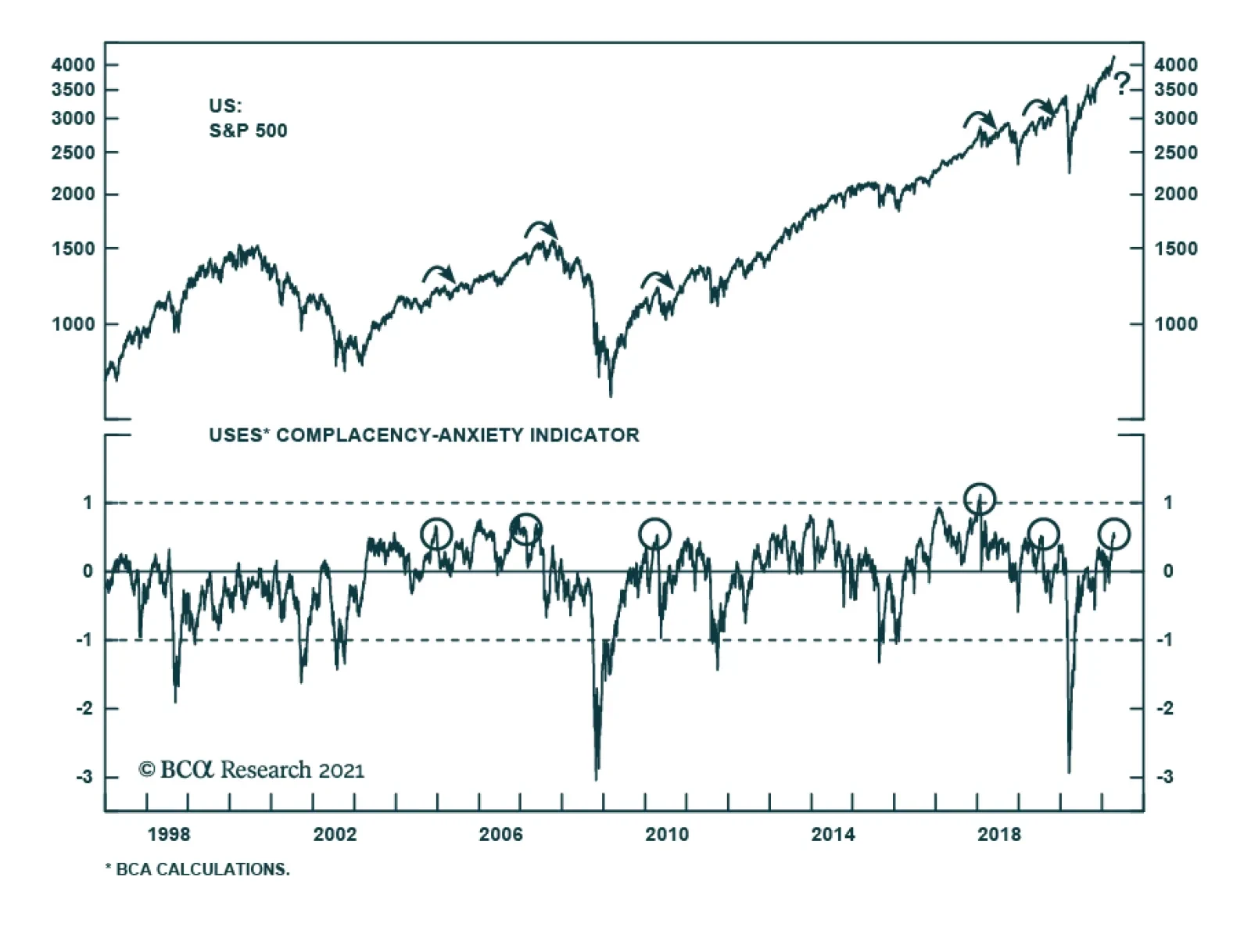
The S&P 500, Dow Jones Industrial Average, and NASDAQ all sank on Thursday on news that President Biden will propose raising the capital gains tax rate for wealthy Americans to 39.6% from the current base rate of 20% in order to fund social spending in…