Sorry, you need to enable JavaScript to visit this website.
Skip to main content

Lebanon

October seasonality tends to be negative for stocks in an election year. That is the only thing that has stayed our hand from shifting out of our tactical underweight on US equities, initiated – poorly – in July.
But the big macro news from September has not been bearish. The Fed has signaled jumbo cuts. Within seven weeks, the US central bank intends to cut by 100bps! Meanwhile, China appears to have reached a “policy bottom,” with its September 26 Politburo meeting signaling an extraordinary rhetorical shift towards fiscal policy. As such, we are starting to sniff out global reflation, akin to the 2015-2016 mid-cycle slowdown.
The labor market data still worries us. It is clearly deteriorating, on paper. Is it because of an imminent recession or “normalization?” It is difficult to say. We are open minded.
Finally, the Middle East tensions are again on the horizon. If Iran stays its hand against Saudi energy facilities – which we expect it to continue to do – the Iran-Israel conflict is a sideshow. Nonetheless, with global reflation afoot, we went long oil last week, on September 26. As such, geopolitics is a neat tailwind to that call.

Markets are rallying on Fed rate cuts and China stimulus but there will also be October surprises ahead of the US election, which Trump could still win. Russia’s conflict with the West is escalating and the Middle East is destabilizing further. Investors should favor US bonds but they should add some risk in emerging markets in response to China’s policy turn.

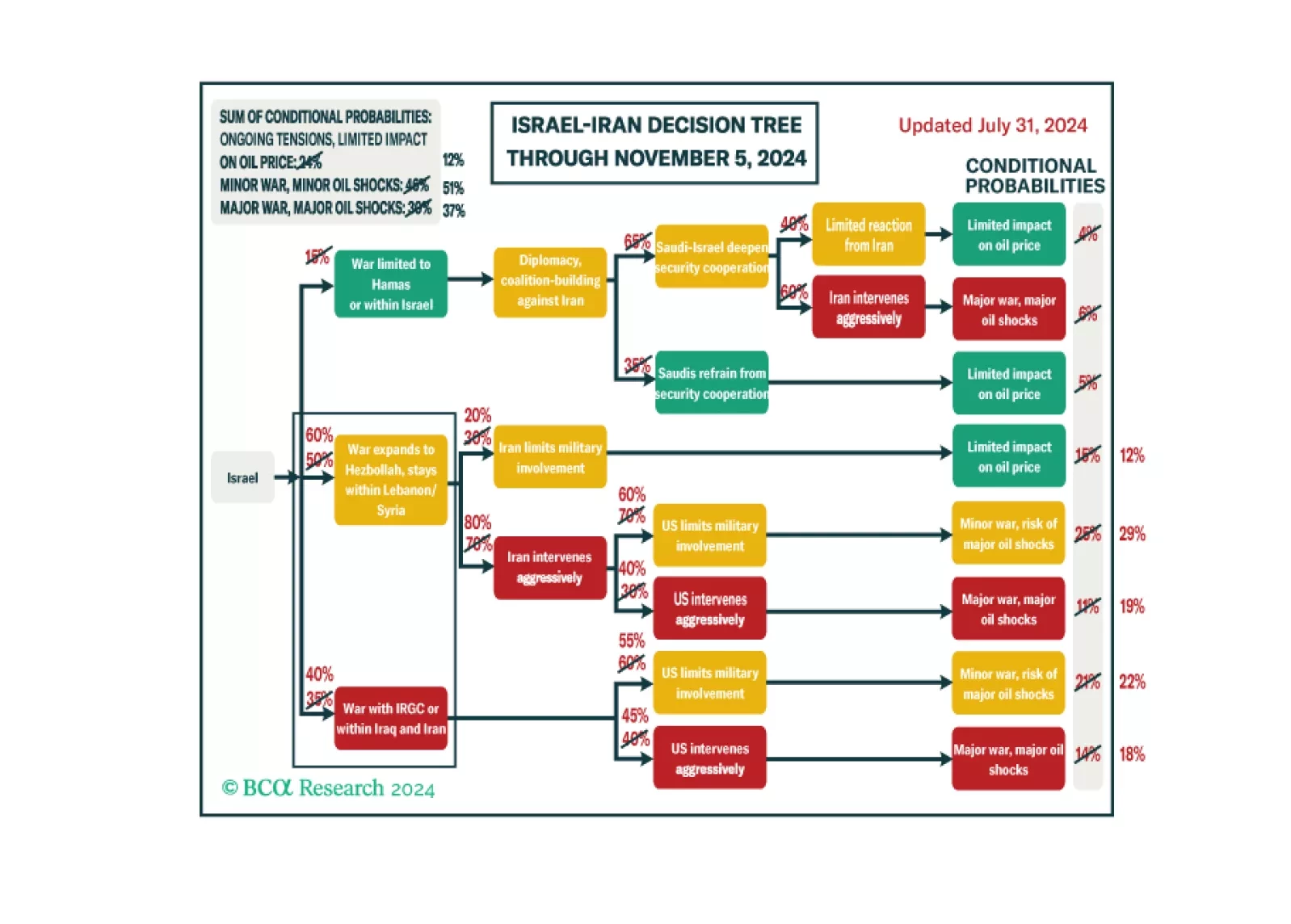
The war in the Middle East is expanding, upgrading our subjective odds of a major oil supply shock to 37% and underscoring our 60% odds of Republican victory in November. Volatility should spike again as investors contemplate the prospect of rising oil prices amid slowing US and global growth. Tactically investors should stay overweight energy stocks relative to other cyclicals and favor oil producers in the Americas rather than Middle East.

Highlights The Beirut blast calls attention to instability in the Shia Crescent. A turbulent push for political change will now ensue in Lebanon. Hezbollah’s and Iran’s political capital in Lebanon will suffer significantly. Lebanon is a red herring, but Iraq is a Black Swan. It is at risk of social unrest contagion. Iran’s financial troubles are weighing on its ability to maintain its sphere of influence. It is adopting a strategy of measured sabotage and deterrence against US interests in Iraq. The double whammy of low oil prices and pandemic is weighing on Saudi Arabia’s finances. Nevertheless it is prioritizing a cooperative relationship with Iraq. Iran could stage a major attack or President Trump’s poor election prospects could force him to “wag the dog.” Massive excess oil capacity will mute the oil market impact of a supply shortfall in Iraq. However, the risk becomes more relevant as demand recovers and markets rebalance in the second half of the year. Stay long Brent crude oil and gold. Feature The August 4 explosion at the Port of Beirut was devastating. It killed more than 220, wounded over 6000, left 300,000 homeless, and damaged buildings as far away as 9km from the site of the explosion. The blast added insult to injury to the country’s already troubled finances. Estimates for the cost of repair range anywhere between $5 billion and $15 billion. Global investors can largely write off the incident as an idiosyncratic shock. Even though emigration is likely to pick up, Lebanon’s population is only a third of Syria’s prior to its civil war. Assuming that a third of Lebanese become displaced abroad – a generous assumption more suitable to Syrian-style civil war than Lebanon’s situation – about 2 million Lebanese will be displaced, half of which will make their way to Europe or elsewhere outside the Middle East. As long as an antagonistic Turkey upholds its agreement with the EU, a mass exodus from Lebanon does not risk an unmanageable migrant crisis for Europe (Chart 1). Political tensions will rise and potentially lead to a populist backlash, given Europe’s battered economy. But Lebanon alone is not enough. The risk is broader Middle Eastern instability, which is a credible risk. Chart 1Middle Eastern Instability Could Fuel European Populism Middle Eastern Instability Could Fuel European Populism Middle Eastern Instability Could Fuel European Populism Thus Lebanon in itself is a red herring, but it is a bellwether for further unrest in the Middle East in countries that are not red herrings (Map 1). Map 1Lebanon Is A Red Herring; Iraq And Saudi Arabia Are Relevant From The Arab Spring To The Shia Crackup From The Arab Spring To The Shia Crackup A major conflict in Iraq is an underrated risk to global oil supply. The catastrophe calls attention to instability the Shia Crescent – a region in a tug of war between rival sectarian and geopolitical interests. Whereas the 2008 crisis led to the largely Sunni Arab states in the so-called Arab Spring, the 2020 crisis is piling pressure onto already unstable Shia states and regions: Iran, Iraq, Lebanon, Syria, and possibly eastern Saudi Arabia. Of particular significance is the fate of Iraq. Popular grievances are eerily similar to Lebanon’s. Baghdad is on shaky ground, yet the ramp up in US-Iran tensions going into the November US elections makes the threat of instability in Iraq more acute. As OPEC’s second ranked oil producer, a major conflict in Iraq poses an underrated risk to global oil supply. Supply losses are a tailwind to oil prices when market conditions are tight. However OPEC 2.0’s 8.3mm b/d of voluntary cuts means massive spare capacity is available globally to offset potential losses in Iraq, reducing the potential upside to oil prices. Nevertheless, this risk becomes more relevant as markets tighten on the back of a demand-side recovery, i.e. as balance is restored to the oil market and as excess spare capacity is eliminated. With oil markets likely rebalancing in 3Q20, unrest in Iraq poses an upside risk to our Commodity & Energy Strategy service’s expectation that 2H20 Brent prices will average $44/bbl and 2021 prices will average $65/bbl (Chart 2). Even though gold has already rallied 30% since mid-March, geopolitical risks including US-Iran tensions suggest any near-term selloff is a buying opportunity (Chart 3). The bullish gold narrative – geopolitical risks, falling dollar, and low real interest rates for the foreseeable future – remain intact even as the downturn gives way to a cyclical recovery. We continue to recommend gold on a strategic time horizon. Chart 2Oil Price Rally Remains Intact Oil Price Rally Remains Intact Oil Price Rally Remains Intact Chart 3Gold Is Due For A Breather Gold Is Due For A Breather Gold Is Due For A Breather Lebanon’s economic collapse highlights risks to other regional economies tied to the oil dependent Arab economies of the Persian Gulf. As the latter grapple with record low oil prices, production cuts, and the pandemic-induced recession, second-order effects will reverberate throughout the region, hitting economies such as Egypt and Jordan whose economic as well as political structures are intimately intertwined with Gulf Cooperation Council finances and policies. Lebanon’s Collapse Was Inevitable Lebanon was already going through an economic and financial meltdown before the explosion (Chart 4). Aside from the humanitarian loss, the economic impact is also profound. The country – highly dependent on imports of basic goods and suffering from food insecurity – must now contend with the loss of its main port and most of its grain reserves, destroyed in the explosion. As the dust settles, grief is morphing into anger on the streets. Regardless of whether the blast was due to happenstance or malice, the immediate cause was 2,750 tons of ammonium nitrate in storage for six years. The government was warned about the risks of the explosive chemicals at least four times this year – with the latest being on the day of the blast. Chart 4Beirut Port Explosion Accelerated Lebanon’s Collapse From The Arab Spring To The Shia Crackup From The Arab Spring To The Shia Crackup Mass protests are already taking place, calling on the government to be held accountable for criminal negligence. A controversial petition to return Lebanon to French mandate has gained more than 60,000 signatures. Prime Minister Hassan Diab’s seven-month-old cabinet has resigned. (It was put in place last year amid an earlier bout of unrest.) Official incompetence and neglect are in fact the best-case explanations for the explosion. Many questions remain unanswered. For instance, what triggered the fire? Israel swiftly denied any connection and offered humanitarian aid, while Hezbollah’s leader Hassan Nasrallah claimed to know more about the Port of Haifa than about Beirut Port. Early parliamentary elections and the cabinet’s resignation will not appease the protesters. Photos of Nasrallah, President Aoun, Speaker of Parliament Nabih Berri, and former Prime Minister Saad Hariri were among those hung by protesters in gallows in Martyrs’ Square over the weekend. Berri and Gebran Bassil are known to be the source of the cabinet’s decision-making power.1 They have veto over all decisions, large and small. During the mass protests in October 2019, Nasrallah stated that Hezbollah has two red lines:     Aoun must finish his term, which expires in 2022;     No early elections will be held, i.e. the speaker of the house will not be changed. While early elections have now been promised, these red lines highlight that corruption runs deep in Lebanon and opposition groups face an uphill battle against the establishment. A turbulent push for political change will now ensue. Hezbollah’s and Iran’s political capital in Lebanon will suffer significantly. Another Israeli confrontation with Hezbollah is not the base case but it could occur. Bottom Line: Lebanon is a failed state. As with the Arab Spring, the question is whether popular anger will prove contagious and spread to more market-relevant neighboring countries. The rally in the Israeli shekel in trade weighted terms since mid-March has already started to fizzle and may be tested further as turmoil in Lebanon raises the risk of confrontation. Contagion? In order for a geopolitical event in the Middle East to warrant investors’ attention, it must affect at least two of the following factors : (1) global oil supply, (2) geography of existential significance to a regional power, or (3) sectarian conflict which could lead to contagion. In this context, Lebanon is a red herring, but Iraq is not – therefore investors should watch to see if anything causes destabilization in Iraq. A decline in Iranian funds will weaken Tehran’s sphere of influence. Like Lebanon, Iraq is dominated by a highly corrupt sectarian system that has been plundering the wealth; people are suffering from rising rates of unemployment; and the regime is in the crosshairs of competing foreign agendas (Chart 5). Chart 5Iraqis And Lebanese Suffer Similar Grievances From The Arab Spring To The Shia Crackup From The Arab Spring To The Shia Crackup Iraq is in Iran’s sights because it aspires to establish a land bridge to the Mediterranean through a friendly “Shia Crescent” (Map 2). Iran’s modus operandi is to establish a presence in its neighbors’ domestic politics through Iran-backed factions. Map 2Iraq Essential To Iran’s Aspirational ‘Land Bridge’ To The Mediterranean From The Arab Spring To The Shia Crackup From The Arab Spring To The Shia Crackup Given the current state of Iran’s economy, it is not far-fetched to envision a significant drop in the funding of its foreign proxies (Chart 6). Historically these funds have followed the ebbs and flows of oil prices. For instance, in 2009, when faced with declining oil prices and US sanctions Iran’s funds to Hezbollah were estimated to have fallen by 40%. This happened again in 2014-16 and is not too different from today. Thus Iraq is at risk of contagion. Iran’s financial troubles are weighing on its ability to maintain its sphere of influence. Syrian fighters have reported paychecks being slashed, Iranian projects in Syria have stalled, and Hezbollah employees report to have missed paychecks and lost other benefits. Tehran’s finances are essential for Hezbollah’s survival.2 Iran’s proxies in Iraq are facing a similar fate.3 Chart 6Iran Suffering Under "Maximum Pressure" Iran Suffering Under "Maximum Pressure" Iran Suffering Under "Maximum Pressure" Bottom Line: Iraq faces an uptick in social unrest due to the poor living conditions and possible contagion from Lebanon. Meanwhile, Iran-backed groups there face a decline in funds from Tehran, which will send them searching for replacement funds. If Lebanon falters the world can usually ignore it but if Iraq falters the world will have to take notice. Saudi Arabia Prioritizes Revenue Over Growth Beirut’s foreign policy stances in recent years have been seen as appeasing Iran at the expense of Gulf Arab states.4 This trend coincides with a decline in Gulf Cooperation Council financing to Lebanon. Now the collapse in oil prices and pandemic have weighed on Saudi Arabia’s budget, which still depends on the energy sector for most of its revenues despite efforts to diversify. State revenues were down 49% year-on-year in Q2 pulling the budget deficit down to $29 billion (Chart 7). Riyadh is reassessing its priorities. Opting for revenue at the expense of growth, Riyadh has tightened the screws on its citizens. The government has had to pare back some of the benefits Saudis have long been accustomed to. The value-added-tax rate tripled from 5% to 15%, and a bonus cost-of-living allowance of $266 for public sector employees ended. The kingdom also announced plans to reduce spending on major projects by $26 billion – including some of those associated with Crown Prince Mohammed bin Salman’s reform agenda, Vision 2030. Chart 7Saudi Arabia Under Pressure From Double Whammy Saudi Arabia Under Pressure From Double Whammy Saudi Arabia Under Pressure From Double Whammy Severe economic turmoil poses a risk to the Saudi social contract in which citizens pledge allegiance to the ruling class in exchange for financial and social guarantees. The risk now is that the fiscal challenges dent Saudi citizens’ pocketbooks and thus impact social and political stability. However, oil prices are recovering to levels consistent with the kingdom’s fiscal breakeven oil price next year. The global economic recovery will begin to support the kingdom’s economy in the second half of this year (Chart 8). This will ease pressure on the budget and hence households. Moreover the slowdown is likely to hit foreign workers hardest and thus hasten the Saudization process. Foreign workers are the lowest hanging fruit and will be the first to find themselves jobless. In that sense the crisis is expediting some of Riyadh’s long-term reform targets. That said, there is still some risk of internal instability or even a palace coup. Tehran could incite sectarian tensions in the kingdom’s Eastern Province where an estimated 30-50% of the population is believed to be Shia. This is relevant given that nearly all Saudi oil production is located there. Chart 8KSA Benefits From EM GDP Growth ... KSA Benefits From EM GDP Growth ... KSA Benefits From EM GDP Growth ... Regarding the possibility of a palace coup, Crown Prince Mohammed bin Salman has spent this year cracking down on potential dissidents. Former Crown Prince Mohammed bin Nayef and King Salman’s only surviving full-brother Prince Ahmed bin Abdulaziz – both influential and well-liked – were among those detained in March. The kingdom’s contradictory policies – reform through repression – may eventually culminate in an overt political crisis. Though such a crisis may not occur until the time of royal succession. These economic and political challenges may force Saudi Arabia to adopt an inward stance. Its foreign interventions to date have been costly and come with little benefit – judging by the war in Yemen. It is also possible that Saudi Arabia, which is already the third largest defense spender globally, will try to strengthen its position vis-à-vis Iran. Crown Prince Mohammed bin Salman has already stated that the kingdom will pursue a nuclear program if Iran develops a nuclear bomb. This is relevant in today’s context with Iran no longer complying with restrictions to its nuclear program (Table 1). Saudi Arabia, like Iran, claims its nuclear program is for peaceful purposes – in order to generate nuclear power as part of efforts to diversify its economy.5 Table 1Iran No Longer Complying With 2015 Nuclear Deal From The Arab Spring To The Shia Crackup From The Arab Spring To The Shia Crackup Still, low oil prices tend to discourage petro states from engaging in conflict (Chart 9). Arab petro states may show restraint, at least until oil markets recover. Chart 9Low Oil Prices Discourage Petro States From Engaging In Conflict From The Arab Spring To The Shia Crackup From The Arab Spring To The Shia Crackup Overall weakness in oil-producing economies will hurt various countries that rely on remittances (Chart 10). The downturn will also hurt countries dependent on remittances from petro states in the region such as Egypt and Jordan. Bottom Line: The collapse in oil prices is forcing Saudi Arabia to reconsider its priorities and is expediting some long-term reforms. For now, it is adopting a pro-revenue rather than a pro-growth stance. This is likely to result in a focus inward for the kingdom. The implication is that countries that are leveraged to the petro-economies of the Gulf for remittances, bilateral aid, and capital flows will take a hit. These include Lebanon, Egypt, and Jordan. Chart 10Egypt And Jordan Also Vulnerable To Petro State Weakness Egypt And Jordan Also Vulnerable To Petro State Weakness Egypt And Jordan Also Vulnerable To Petro State Weakness Iraq Is The Prize Not unlike Lebanon, Iraq’s political class has been suffering a legitimacy crisis since protests erupted there last October resulting in the resignation of then-Prime Minister Adel Abdul Mahdi. However unlike Lebanon, Iraq is a significant geography for global investors. It is a major OPEC producer – second only to Saudi Arabia – accounting for 16% of the cartel’s production last year. The Iraqi oil minister’s first foreign trip was to the Saudi capital. This is not surprising. Iraq not only seeks Saudi leniency in OPEC 2.0 cuts, but also needs financial assistance to develop a natural gas field that will allow it to reduce dependence on Iran. Saudi Arabia also hopes to reduce Iraq’s dependence on Iranian natural gas and coax it into its sphere of influence. When it comes to crude oil, the additional 1mm b/d of voluntary cuts in June announced unilaterally by Saudi Arabia beyond its agreed OPEC 2.0 commitments are also a sign of Saudi willingness to accommodate Iraq and its non-compliance  (Chart 11).6 Saudi Arabia does not want to see Iraq’s newly elected government failing on the back of budgetary strain. In fact, al-Kadhimi is an opportunity for the Saudis. Formerly the director the National Intelligence Service with warm ties to the US, he is a champion of Iraqi sovereignty. Even though Iraq is being forced to compensate for past overproduction of oil in August and September, it was cajoled by the promise of a $500 million “bridging” loan from Saudi Arabia, to be repaid when oil markets recover. While financial assistance shows the kingdom’s commitment to Iraq, more significantly it reflects Riyadh’s desperation to revive oil markets and bring prices closer to its fiscal breakeven oil price amid the still uncertain demand outlook. Chart 11Saudi Arabia Willing To Accommodate Iraq From The Arab Spring To The Shia Crackup From The Arab Spring To The Shia Crackup Neither Saudi Arabia’s nor al-Kadhimi’s efforts are guaranteed to succeed in pulling Iraq out of Iran’s sphere. The prime minister received a rude awakening upon his arrest of 14 Kata’ib Hezbollah fighters in June on grounds of a plan to launch a rocket attack on US interest in Baghdad. They were swiftly released, and the case against them dropped. It is hard to curb Iranian influence. For its part, Iran stood behind al-Kadhimi’s nomination despite him being perceived as pro-Western. Tehran needed to avoid an anti-Iranian backlash on the streets of Baghdad if it had stood against him. Instead, Iran’s calculus was that it is in its best interest to swallow the pill and work with the new government at a time when Iraqi anger was targeted against US involvement rather than at Iranian interference. Prior to the US assassination of Qassem al-Suleimani and Abu Mahdi al-Muhandis on Iraqi soil, Iraqis were rebelling against Iran’s influence. That being said, Iran will maintain pressure on Iraq through continued attacks on US interests there (Table A1 in Appendix). This is also reflected in the July assassination of top Iraqi security expert Hisham al-Hashimi, who had previously advised the government on how to curb Iranian control. Iran was looking to make it to the US election in November without an escalation in tensions, hoping the US elections will result in a more dovish Democratic Party leadership averse to conflict with Iran. However, recent cyber-attacks on key Iranian infrastructure raise the likelihood that tensions will escalate ahead of the elections. The US is also threatening to maintain maximum sanctions even if the United Nations Security Council disagrees. As always, Iraq will find itself in the crossfire of any deterioration in relations. Bottom Line: Maintaining a cooperative relationship with Iraq aligns with both of Saudi Arabia’s interests there: limiting Iranian interference and supporting global oil markets through supply-side discipline. Iran will maintain pressure on Iraq’s new government through continued attacks on US interests. However, these attacks are supposed to fall short of killing US citizens and giving President Trump a reason to launch air strikes that could give him a patriotic boost in opinion polls. Nevertheless, tensions in the Gulf could escalate if Iran stages a major attack or if President Trump’s poor election prospects force him to “wag the dog.” In that case Iraqi oil supply would be disrupted. Investment Implications The Shia Crescent remains at heightened risk of instability on the back of Iran’s economic deterioration. Massive excess oil capacity will mute the oil market impact of a supply shortfall in Iraq. However, the risk becomes more relevant as demand recovers and markets rebalance in the second half of the year. Given that the Saudi loan will ensure Iraq’s commitment to compensatory production cuts in August and September, supply-side risks are a tailwind to oil prices in H2. The elevated risk of an escalation in US-Iran tensions also favors holding gold. President Trump’s polling has bottomed, yet he remains the underdog in the election – we maintain his odds of winning reelection are 35%. This raises the risk that he adopts a “war president” posture. Iran could become a target as the financial price of confronting Iran is negligible for Trump, whereas a major China confrontation could sink the stock market. The collapse in oil prices and pandemic have weighed on Saudi Arabia’s budget. It has adopted a revenue over growth posture. While this could be a risk to domestic stability, our base case is that it accelerates the kingdom’s long-term reforms. The oil market rout and economic downturn will hurt other countries in the region that are leveraged to Arab petro states – chiefly Egypt and Jordan. Investors should monitor risks to state stability in the coming years. Lebanon’s crisis will incentivize emigration, but given the relatively small size of its population, the major risk to Europe comes from any broader state failures and Middle Eastern instability rather than from Lebanon’s failure alone. If the Democratic Party wins the US election, as expected, then the US-Iran strategic détente will resume and Iran will get a lifeline. But the immediate transition will still be rocky given the Israeli and Saudi desire to exploit Iran’s extreme vulnerability and build leverage with Washington. The COVID-19 crisis heralds another round of Middle Eastern crisis, much as the 2008 crisis led to the Arab Spring. Stay strategically long Brent crude oil and gold. Also, in the wake of yesterday’s 15% pullback in silver, go strategically long silver (XAGUSD), which will continue benefiting from the same structural trends favoring gold but also outperform gold as the global economy recovers, given its greater industrial utility.     Roukaya Ibrahim Editor/Strategist Geopolitical Strategy RoukayaI@bcaresearch.com       Appendix Table A1Iran Adopting Deterrence Strategy In Iraq From The Arab Spring To The Shia Crackup From The Arab Spring To The Shia Crackup   Footnotes 1     Berri is of the Hezbollah-allied Amal Movement and has been parliamentary speaker since 1992, while Bassil is President Aoun’s son-in-law and president of the Free Patriotic Movement, which has the most seats in parliament. 2     Hezbollah gains legitimacy at home through its charity work that plugs the gap in services normally provided for by the government. 3    According to a commander of an Iran-backed paramilitary group in Iraq, Iran slashed its monthly funding to the top four militias by nearly half this year. Please see “Coronavirus and sanctions hit Iran’s support of proxies in Iraq,” Reuters, July 2, 2020. 4    Hezbollah has gained control over the foreign policy and Lebanon has recently taken stances that are seen as bowing to Iranian pressure. Lebanon did not attend a March 22, 2018 extraordinary Arab League meeting discussing violations committed by Iran. Prior to that, Beirut did not condemn Iranian attacks on a Saudi diplomatic mission in Tehran. 5    However an undisclosed facility for processing uranium ore in the northeast of the kingdom has recently appeared. 6    This is not unlike the US’s decision to extend sanction waivers by four months, allowing Baghdad to import Iranian energy in order to ensure that the new government of Prime Minister Mustafa al-Kadhimi can stand on its own and is not overly dependent on Iran.
BCA Research's Commodity & Energy Strategy and Geopolitical Strategy services conclude that the Beirut blast calls attention to instability in the Shia Crescent. The August 4 explosion at the Port of Beirut was devastating. It killed more than 220,…
Lebanese commercial banks are not only being squeezed by capital outflows and deposit withdrawals, they are also about to face a public debt default. Commercial banks own 37% of outstanding government debt. This will come on top of skyrocketing private-sector…
Feature Chart I-1Lebanese Bond Yields Have Surged To Precarious Levels Lebanese Bond Yields Have Surged To Precarious Levels Lebanese Bond Yields Have Surged To Precarious Levels In a May 2018 Special Report, we warned that a devaluation and government default were only a matter of time in Lebanon. The country's sovereign US dollar bond yields have now reached a whopping 21% and local currency interest rates stand at 18% (Chart I-1). On the black market, the Lebanese pound is already trading 12% below its official rate. A public run on banks and bank deposit moratorium, as well as public debt default and a massive currency devaluation are now unavoidable. A Classic Case Of EM Bank Run And Currency Devaluation… The current state of Lebanon’s balance of  payments (BoP) is disastrous: The current account (CA) deficit has oscillated between 10% and 20% of GDP in the past 10 years (Chart I-2). This wide CA deficit has been funded by speculative portfolio flows into local currency government bonds, sovereign bonds and bank deposits. However, since the middle of 2018 these inflows have dried up. In turn, to defend the currency peg to the US dollar and avoid a currency depreciation in the face of the BoP deficit, the Central Bank of Lebanon (BDL) has been depleting its foreign exchange (fx) reserves, i.e., the central bank has been financing the BoP deficit (Chart I-3). Chart I-2Lebanon's Chronic Current Account Deficit Lebanon's Chronic Current Account Deficit Lebanon's Chronic Current Account Deficit   Chart I-3Lebanon: The BoP Has Been Deteriorating Substantially Lebanon: The BoP Has Been Deteriorating Substantially Lebanon: The BoP Has Been Deteriorating Substantially   BDL’s gross fx reserves – including gold – have dropped from $48 billion in 2018 to its current level of $43 billion. We estimate that BDL’s net foreign exchange reserves excluding commercial banks’ US dollar deposits at BDL are at just $26 billion. This amount is insufficient in light of the panic-induced outflows the country and the banking system are experiencing.1  As a result of the two-week long bank shutdown amid massive protests, confidence in the banking system is quickly collapsing and capital is leaving Lebanon. Chart I-4Depositors’ Are Heading For The Exit Depositors' Are Heading For The Exit Depositors' Are Heading For The Exit Worryingly, as a result of the two-week long bank shutdown amid massive protests, confidence in the banking system is quickly collapsing and capital is leaving Lebanon.2   Moreover, after opening their doors, Lebanese commercial banks are now imposing unofficial capital controls – they are paying US dollar deposits in local currency only and are no longer providing dollar-denominated credit lines to businesses and importers. This will only intensify the panic among depositors. Chart I-4 illustrates that local currency deposits have already been declining while US dollar deposits have been slowing, and will likely begin contracting soon. In short, capital outflows will intensify in the coming weeks as people and businesses quickly realize that banks cannot meet their demand for deposits. Critically, we suspect Lebanese commercial banks are short on US dollars to meet people’s demand for the hard currency. Commercial banks’ net foreign currency assets stand at negative $70 billion or 127% of GDP. They hold, roughly, somewhere around $20 billion worth of US dollars in the form of liquid and readily available deposits (in banks abroad and deposits in the central bank) versus $124 billion worth of dollar deposits. Over the years, Lebanese commercial banks have been an attractive place for investors and residents to park their US dollars given the high interest rate paid by the banks. In turn, Lebanese commercial banks have been converting these US dollar deposits into local currency in order to buy government bonds. With domestic bonds yielding well above the rates on US dollar deposits - and given the exchange rate peg to the dollar - commercial banks have been de facto playing the carry trade. In addition, commercial banks also lent some of these dollars directly to the private sector. With the economy collapsing and the widening dollar shortage, banks will not be able to either collect their dollar loans or purchase dollars in the market.   Without new dollar funding – which is very likely to persist – banks will fail to meet the demand for dollars. As a result, a bank run is imminent. At this point, the sole option is for the central bank to keep pushing local interest rates higher to discourage capital flight and a run on the banks. Yet, at 18% and surging, interest rates will suffocate the Lebanese economy and the property market. This will dampen sentiment further and cause a bank run. Bottom Line: A bank run is brewing and bank moratorium as well as currency devaluation are inevitable. …As Well As Public Debt Default Lebanese commercial banks are not only being squeezed by capital outflows and deposit withdrawals, they are also about to face a public debt default. Chart I-5Public Debt Dynamics Are Toxic Public Debt Dynamics Are Toxic Public Debt Dynamics Are Toxic Lebanese commercial banks are not only being squeezed by capital outflows and deposit withdrawals, they are also about to face a public debt default. Commercial banks own 37% of outstanding government debt. This will come on top of skyrocketing private-sector non-performing loans and will push banks into outright bankruptcy. Lebanon’s fiscal and public debt dynamics have reached untenable levels. The fiscal deficit stands at 10% of GDP and total public debt stands at 150% of GDP (Chart I-5). Surging government borrowing costs will push interest payments as a share of government aggregate expenditures to extremely high levels. These are unsustainable fiscal and debt arithmetics (Chart I-6). Meanwhile, government revenues will decline as growth falters (Chart I-6, bottom panel). The pillars of the Lebanese economy – private credit growth and construction activity – have been already collapsing (Chart I-7). Chart I-6Surging Interest Rates Will Make Public Debt Servicing Impossible Surging Interest Rates Will Make Public Debt Servicing Impossible Surging Interest Rates Will Make Public Debt Servicing Impossible Chart I-7Lebanon: Domestic Economy Has Been Collapsing Lebanon: Domestic Economy Has Been Collapsing Lebanon: Domestic Economy Has Been Collapsing Bottom Line: The Lebanese government will be forced to default on both local currency and dollar debt. This will be the final nail in the coffin of the Lebanese banking system.    Ayman Kawtharani Editor/Strategist ayman@bcaresearch.com   Footnotes 1    BDL does not publish its holding of net foreign exchange reserves. However, other estimates of BDL’s net fx reserves  are even lower. Please refer to the following paper: Financial Crisis In Lebanon, by Toufic Gaspard and the following article: Lebanon Warned on Default and Recession as Its Reserves Decline. 2   Banks shut down allegedly as a result of the ongoing civil disobedience that was sparked by the government’s reckless decision to tax WhatsApp's call service. The protests quickly escalated to a country-wide uprising, causing the government to resign on October 29.
Highlights Lebanon and Iraq – the two countries most entrenched in Iran’s sphere of influence – are experiencing mass unrest. Protesters in both states are calling for the dismantling of sectarian based political systems, economic reforms, and reduced foreign interference. The unrest in Iraq is of greater consequence due to its role as a major global oil supplier. The widening rift between the rival Iraqi Shia blocs implies that any détente will be temporary.  We remain tactically long spot crude oil on the back of the geopolitical risks to supply amid an expected revival in global demand. Feature A wave of popular uprisings has swept over Lebanon and Iraq. While the riots are to a large extent a product of long-standing economic and governance failures, the timing is consequential. The Middle East is experiencing a paradigm shift. With the US reducing its strategic commitment to the region, most recently evidenced by the withdrawal of its troops from northeast Syria, a power vacuum has emerged. This opens up the necessity for foreign actors – Russia – as well as regional powers – Saudi Arabia, Iran, and Turkey – to fill the void. The evolution of power could be unsettling given that it will likely generate greater instability in a region that is fertile ground for unrest. Iran has so far emerged a winner in this dynamic. It has expanded its influence in Iraq since the US pullout, it has played a critical role in saving the Assad regime, and it has seen Saudi initiatives fail in Syria, Yemen, Lebanon, and Qatar. It is making progress toward building its ‘land bridge’ to the Mediterranean (Map 1).1 Map 1Iran’s Aspirational ‘Land Bridge’ To The Mediterranean Iraq's Challenge To Iran Is Underrated Iraq's Challenge To Iran Is Underrated The tensions brought about by the US withdrawal from the JCPOA further illustrate Iran’s growing regional sway. It has hardened its stance. Meanwhile the US and its allies have been vacillating. The Saudi coalition – mired in a war in Yemen and confronting domestic risks – is reluctant to engage in a full-scale confrontation.  Even though Iran has a higher pain threshold, it stands on shaky ground. Just last year it was rocked by domestic protests demanding less foreign adventurism. Lebanon and Iraq are the two countries most entrenched in Iran’s sphere of influence. Protesters in both countries are calling for greater national unity – demanding an overhaul of the political system, and arguing that the sectarian set-up has failed to meet their most basic needs. What occurs in Beirut and Baghdad will be of great consequence for Tehran. Deadlock In Iraq “Out, out, Iran! Baghdad will stay free!” - Chants by Iraqi protesters While both the grievances and demands of the protesters in Lebanon and Iraq are similar, the unrest in Iraq is of much greater consequence from a global investor’s perspective. The trigger was the removal of the highly revered Lieutenant General Abdul-Wahab al-Saadi from his position in the Iraqi army by Prime Minister Adel Abdul-Mahdi.2 The popular general was unceremoniously transferred to an administrative role in the Ministry of Defense. The sacking of al-Saadi – considered a neutral figure – was interpreted as evidence of Iranian influence and the greater sway of the Iran-backed Popular Mobilization Forces (PMF), an umbrella organization of various paramilitary groups. Iraqis all over the country responded by attacking the Iranian consulate in Karbala and offices linked to Iranian-backed militias. Chart 1AFertile Ground For Unrest In Iraq Fertile Ground For Unrest In Iraq Fertile Ground For Unrest In Iraq The protesters are also united in their economic grievances, frustrated at a political and economic system that is unwilling to translate economic gains to improved livelihoods for its people. The May 2018 parliamentary elections, which ushered in Prime Minster Abdul-Mahdi, failed to generate much improvement. The country continues to be plagued by high unemployment, corruption, and an utter lack of basic services (Charts 1A & 1B). This has ultimately resulted in a lack of confidence in Iraqi leadership who are being increasingly perceived as benefiting from the status quo at the expense of the populace. Chart 1BFertile Ground For Unrest In Iraq Iraq's Challenge To Iran Is Underrated Iraq's Challenge To Iran Is Underrated Most importantly, the ruling elite has failed to respond to key trends that emerged in last year’s parliamentary elections. The extremely low voter turnout reveals that Iraqis are disenchanted with the government's ability to meet their needs. Meanwhile the success of Shia cleric Moqtada al-Sadr’s Sairoon coalition – running on a platform stressing non-sectarianism and national unity – in securing the largest number of seats highlights the desire for a reduction of foreign interference (both Iranian as well as US/Saudi) in domestic politics. Where the election results failed to translate into real change for Iraq is in the appointment of the Prime Minister. Abdul-Mahdi – a technocrat – was a compromise candidate that surfaced as a result of a five-month long political standstill between the two rival Shia blocs, each claiming to have gained a majority of seats in parliament. On one end is the Iran-backed bloc led by Hadi al-Amiri head of both the Fatah Alliance and the PMF, and Nouri al-Maliki leader of the State of Law Coalition. On the other end is al-Sadr’s Sairoon coalition, which joined forces with Ammar al-Hakim of the Wisdom Movement, and champions greater unity and less foreign interference. The result has been a weak prime minister who is perceived to be incapable of pushing back against Iraq’s ruling elites and ushering in structural reforms. Instead the Prime Minister is seen as benefiting from a corrupt system. The rift between Iraq’s rival Shia blocks is deepening. Thus, the ongoing protests are to a great extent the result of the new government’s failure to heed the warnings brought about by the 2018 election and protests. They have served to deepen the rift between the rival Shia blocs. Last week Abdul–Mahdi responded to calls by al-Sadr and former Prime Minister Haider al-Abadi to resign by arguing that it is up to the main political leaders to agree to put forward a vote of no confidence in the Iraqi parliament. He agreed to resign, on condition that political parties jointly approve of a replacement. For now, that appears improbable. In a move that has been interpreted as a display of Iranian interference, al-Amiri changed heart after a reported meeting with Iranian Quds Force leader Qassem Suleimani last week in Baghdad. He backed down on his agreement to support al-Sadr to bring down Abdul-Mahdi, and has instead stated Abdul-Mahdi’s resignation will only bring about more chaos. This interference on the part of Iran was likely induced by fears that a crisis-stricken Iraq would weaken its hegemony over the region. Iraq is in a state of deadlock. A vote of no confidence would require a majority of 165 in parliament and would require the support of various Sunni and Kurdish parties (Chart 2). Al-Sadr is likely calculating that a new election is in his best interest. He would be able to capitalize on the movement given that he has aligned himself with the protesters, and will gain seats in parliament. Chart 2A Shia Schism In Iraq’s Parliament Iraq's Challenge To Iran Is Underrated Iraq's Challenge To Iran Is Underrated This would allow the nationalist bloc to gain a majority and appoint a government that is acceptable to the protesters. However, this scenario would also entail greater meddling from Iran, as it is unlikely to stand by idly as its influence wanes. As a result, we are likely to witness greater unrest as the rift between the two Shia blocs intensifies. Neither the US nor Saudi Arabia have an appetite to step in and provide the support necessary to counteract Iran. Moreover, Iran and its proxies in Iraq will not back down easily. At the same time, the geographical spread of the protest movement demonstrates that Iraqis are fed up with the current system.3 Despite the death of over 260 Iraqis, the protesters have yet to be deterred by the violence. This points to greater instability in Iraq as no side is backing down and the only foreign power willing and able to interfere is Iran. The impasse could be resolved if the main actors – the rival Shia blocs – agree to compromise. However, that is precisely what transpired last year and resulted in Abdul-Mahdi’s appointment. It ultimately led to only a temporary resolution of the unrest: a one-year deferral. If a similar compromise is reached in the current environment, it too will result in only a temporary détente. The grievances afflicting Iraqis cannot be resolved easily or swiftly. Iraq is in for an extended period of instability. Bottom Line: Iraqi protesters and authorities are in stalemate. The rift in the Shia bloc is deepening. There does not appear to be a clear path to bridge the demands and desires of the protesters and the leadership. Any détente will be temporary. Even if under a new election the protests translate to greater seats for the nationalist bloc, it will not translate to a de-escalation of domestic tensions. It may resolve the protests, but Iran-backed groups will retaliate. Iraq is in for an extended period of instability. Deadlock In Lebanon “All of them means all of them” “No to Iran – No to Saudi” - Chants by Lebanese protesters Just as Iraqi protesters are expressing national unity in calling for an end to sectarian politics and foreign interference, Lebanon’s protests stand out for crossing religious and regional divides. They have swept across the country, and include the Shia-dominated southern region where anger is even being directed at Hezbollah. Among the protesters’ demands is the removal of all three heads of the pillars of government – the Maronite Christian President Michel Aoun, the Sunni Prime Minister Saad Hariri, and the Shia Speaker of Parliament Nabih Berri. Rather than being a source of division, the unrest is a demonstration of unity among Lebanese of all ideologies against the entire political system. Since Prime Minister Saad Hariri’s resignation on October 29, the movement rages on. Protesters are claiming that they are unwilling to back down until all their demands are met, including a complete overhaul of the sectarian power-sharing system, which has defined the country’s politics since the end of the 1975-1990 civil war.4 Chart 3Economic Deterioration In Lebanon Economic Deterioration In Lebanon Economic Deterioration In Lebanon The movement and the protesters’ complaints are not surprising. The government has failed to prevent the economy from moving toward collapse. It has long been in decline, with Lebanese feeling the pinch of corruption, economic stagnation, high unemployment, and the effects of the massive influx of Syrian refugees (Chart 3).The trigger of the uprising, a tax on WhatsApp calls amid clear signs of a domestic liquidity shortage, is a delayed response to what citizens have already known and felt for some time: a deteriorating economic situation. While the protests were caused by these economic grievances, they persist due to a crisis of confidence between the political class and the masses. Neither concessions on the part of the government in the form of a list of reforms nor the prime minister’s resignation convinced protesters to halt the movement. The uprising appears set to remain steadfast so long as the current politicians remain in power. The challenge for Lebanon’s protesters – and political elite all the same – is that while the protesters are united in their demands, they have so far been headless. The protesters have refused to present a list of acceptable replacement leaders, insisting that it is the government’s role to propose potential alternatives to the people. This has led to deadlock and will be a hurdle for the government in negotiating with demonstrators. On the other side of the conflict, the current political class, including Hezbollah leader Hassan Nasrallah, has expressed warnings about the chaos that would ensue with a government resignation. According to the Lebanese constitution, following Hariri’s resignation President Aoun is now tasked with consulting Lebanon’s fractured parliament to determine the next prime minister – a role reserved for a Sunni Muslim. However, if history is any guide, this process could take months and protesters are not that patient. Given that Hariri has sidelined himself and – unlike Parliament Speaker Nabih Berri or Foreign Minister Gebran Bassil – he is not the core target of protesters’ ire, there is a possibility that he may once again be appointed to the post of prime minister. While the outgoing government will take on a caretaker role until a new one is formed, demonstrators are standing their ground. ​​This has generated a political standoff causing Lebanese assets to bear the brunt (Chart 4). The emergence of competing rallies – in the form of support for President Michel Aoun – only complicates and possibly prolongs the situation. For now, the army is staying on the sidelines, allowing the protests to be – for the most part – a peaceful one. However, with Hezbollah also subject to the protesters’ wrath, odds of greater regional tensions have increased. Hezbollah may attempt to regain lost support by provoking Israel. The instability could also prompt Hezbollah to reassert its willingness to use force against domestic enemies, namely any new government that attempts to disarm it. In the meantime, Lebanon’s economy and financial markets will remain under pressure. The economy depends on capital inflows from citizens living abroad to finance the large twin deficit and maintain the dollar peg. Thus, the decline in sentiment will weigh on the economy (Chart 5). While the government has not implemented official capital controls, banks have independently tightened restrictions and raised transaction fees to reduce capital outflow. Chart 4Further Unrest Ahead Further Unrest Ahead Further Unrest Ahead Chart 5Weak Sentiment Weighs On Lebanon's Economy Weak Sentiment Weighs On Lebanon's Economy Weak Sentiment Weighs On Lebanon's Economy Bottom Line: Lebanese protesters and the political class are in deadlock. The prime minister’s resignation has done little to ease the tension, and demonstrators are refusing to back down until a new non-sectarian, technocratic government is formed. The domestic economy will remain frail. Earlier this week the central bank asked local lenders to boost their liquidity by raising their capital by 20% or $4 billion in 2020 in anticipation of potential downgrades. A stabilization of the political situation is a necessary precondition to boost confidence and once again shore up capital inflows. Nevertheless, with the protest movement being largely headless, the path toward compromise with the government will be challenging, raising the odds of prolonged tensions. What Of Iran’s Sphere Of Influence? “Not Gaza, Not Lebanon, I Give My Life For Iran” - Chants by Iranian protesters, January 2018 Iran has a strong incentive to preserve the established systems in both Lebanon and Iraq. The protesters’ demands risk weakening its grip on power in the region. In both movements, pro-Iranian forces have taken a stance against the protests with Hezbollah in Lebanon advising against the resignation of Prime Minister Hariri while the Iran-backed bloc in Iraq voiced concern over the chaos that will ensue with the prime minister’s resignation. Meanwhile, Tehran’s position is hardening. Iran is taking further steps away from the nuclear deal, injecting uranium gas into centrifuges at its underground Fordow nuclear complex, making the facility an active nuclear site rather than a permitted research plant. Chart 6Popular Support For Iran’s Hardening Stance Iraq's Challenge To Iran Is Underrated Iraq's Challenge To Iran Is Underrated Chart 7US-Iran Détente Unlikely Iraq's Challenge To Iran Is Underrated Iraq's Challenge To Iran Is Underrated This reflects the loss of public support for the JCPOA and the loss of confidence that other countries will honor their obligations toward the nuclear agreement (Chart 6). In a speech on November 3 marking the fortieth anniversary of the 1979 US Embassy takeover, Supreme Leader Ayatollah Ali Khamenei renewed his ban on negotiations with the US. His stance mirrors public opinion, which is moving toward an increasingly unfavorable view of the US (Chart 7). However, this does not mean that President Hassan Rouhani’s administration is immune to popular discontent. Rather, with Iranians living through a continued economic deterioration and assigning the most blame to domestic mismanagement and corruption, there could be cracks forming in Iran as well (Chart 8). Chart 8A Case For Unrest In Iran? Iraq's Challenge To Iran Is Underrated Iraq's Challenge To Iran Is Underrated Bottom Line: The ongoing US withdrawal from the Middle East opens opportunities for Iran to increase its regional influence. It has been capitalizing on such opportunities by lending support to its proxies in Syria, Yemen, Iraq, and Gaza. However, the escalation of unrest in Lebanon and Iraq pose a risk to Iran’s grip on power in the region. On the one hand, if the movements there result in new governments, Iran will witness its wings clipped. This could incentivize retaliation and violence in Iraq, and provocations by Hezbollah along Lebanon’s southern border in an attempt to regain lost support. On the other hand, a prolonged standstill between protesters and the governments could result in greater Iranian influence over the long term. Other foreign powers are unwilling to wholeheartedly intervene to fill an emergent power vacuum. Investment Implications The risk of a decline in Iran’s control over its sphere of influence and the still unstable state of Iraqi domestic politics suggest that the geopolitical risk premium in oil prices should remain elevated. For now, President Trump is still enforcing sanctions and Iran’s oil exports have largely collapsed (Chart 9). The White House is continuing to add pressure by warning Chinese shipping companies – the largest remaining buyer of Iranian oil – against turning off their ships’ transponders. Chart 9The US Maintains Pressure On Iran Iraq's Challenge To Iran Is Underrated Iraq's Challenge To Iran Is Underrated News reports indicate that oil workers in Iraq’s southern region have started to join the government demonstrations. Moreover, reports on Wednesday indicate that the 30k b/d of production from the Qayarah oil field has been shut down due to road blockades in Basra that are preventing trucks from transporting crude to the Khor al-Zubair port. The geopolitical risk premium in oil prices should remain elevated. While the impact on the country’s oil production and exports have so far been minimal, a prolonged standoff between protesters and the government could result in supply outages. Today’s environment is notably different than that of the ISIS invasion of Iraq in 2014. Tensions then did not create a geopolitical risk premium in oil as they occurred amid an oil market share war, which kept supply abundant. Similarly, the September attack on Saudi Arabian oil facilities did not result in a lasting price spike as it occurred at a time of weak global demand. Moreover, Saudi Arabia possesses the technology and spare capacity that permitted it to swiftly restore output and maintain export commitments. The same cannot be said today about Iraq. A disruption there would be of greater consequence to oil markets, as illustrated by the 2008 Battle of Basra. Especially given Saudi Arabia's need to maintain high prices and amid the Aramco IPO and the tailwind created by a rebound in global growth. The fall in global economic policy uncertainty as the US and China move toward a trade ceasefire will weaken the dollar and support global demand for oil, which is overall bullish for oil prices. Moreover, US-Iran tensions remain unresolved which pose risks to production and shipping infrastructure in the region. We remain tactically long spot crude oil on the back of the geopolitical risks to supply as well as an expected revival in global demand. We are booking a 4.6% gain on our GBP-USD trade but remain long sterling versus the yen. Roukaya Ibrahim, Editor/Strategist Geopolitical Strategy RoukayaI@bcaresearch.com   Footnotes 1    The ‘land bridge’ is an aspirational route by which Iran would create a strategic corridor to the Mediterranean, stretching through friendly territory. 2   Lt. Gen. Abdul-Wahab al-Saadi was recognized and respected among Iraqis for fighting terrorism and his role in ridding the country of the Islamic State. The Iran-backed Popular Mobilization Forces were uneasy with Saadi’s close relationship with the US military. His abrupt removal was likely a result of the Iraqi government’s growing concern over al-Saadi’s popularity and rumors of a potential military coup. 3   Protests are occurring in all regions in Iraq. They are supported by Grand Ayatollah Ali al-Sistani. This is a significant development from the 2018 protests which were mainly concentrated in Iraq’s southern region. 4   Under the current system, Lebanon’s president has to be a Maronite Christian, the parliament speaker a Shiite Muslim and the prime minister a Sunni. Cabinet and parliament seats are equally split between the two Muslims groups and Christians.
Highlights Lebanon is facing genuine debt deflation, which is partially a by-product of its fixed exchange rate regime. To defend the exchange rate peg in the face of the country's chronic current account deficit, the central bank needs to keep interest rates sufficiently high to attract large foreign portfolio inflows. Higher rates in turn depress nominal growth and worsen the government's creditworthiness, which then leads to a higher risk premium and rising borrowing costs. A vicious cycle is probably commencing. Interest payments on government debt are unsustainably large and will continue rising as a share of government spending. Government debt restructuring and a major currency devaluation are only a matter of time. Feature Lebanon's sovereign credit (U.S. dollar bonds) offer enticing spreads and yields. Should investors buy/overweight or avoid/underweight these securities? Our analysis shows that this sovereign credit market should be avoided as spreads will widen further due to unsustainable fiscal dynamics (Chart 1). In short, Lebanon is facing a genuine debt deflation environment, which is partially a by-product of its fixed exchange rate regime. Image The Currency Peg: The Economy Bears The Brunt In the late 1980s and early 1990s, Lebanon was overshadowed by hyperinflation, which led to a plunge in its currency. A new government was formed in 1992 that instituted extremely tight monetary and fiscal policies, and the Lebanese pound was fixed to the U.S. dollar in 1999. The peg has been maintained ever since. These policies made sense in the post-war and hyperinflation era, when fiscal and monetary discipline were entirely lacking. The policies were initially successful as they brought down inflation, revived confidence and allowed the economy to grow. However, the authorities overstayed the currency peg. Over time, the currency has become expensive, as evidenced by the mushrooming current account deficit, which today stands at 20% of GDP (Chart 2). To defend the exchange rate peg in the face of the country's chronic current account deficit, the Banque Du Liban (BDL) - Lebanon's central bank - needs to keep interest rates sufficiently high to attract large foreign portfolio inflows. Please refer to Box 1 below for more information on Lebanon's peg and its damaging effects on the Lebanese economy. The ultimate outcome of these misguided macro policies is debt deflation where government borrowing costs rise above nominal GDP/government revenue growth, leading to interest expenses mushrooming as a share of income. Indeed, the interest payments the government makes on its debt have been extremely high, ranging between 25% and 49% of expenditures since 1993. The government, as a result, has been forced to squeeze fiscal spending and run primary surpluses - i.e. excluding interest payments - to afford these payments (Chart 3). Image Image   Moreover, high government borrowing costs have encouraged commercial banks to lend to the government at the expense of the private sector. On the whole, what the Lebanese economy needs today is lower interest rates and a cheaper currency in order to reflate the economy - boost nominal GDP growth - and place Lebanon's fiscal position and debt dynamics on a sustainable path. Doing so will also revive the private sector, as lower borrowing costs will free up government resources to be used on much-needed capital investments that will kick-start the economy. Further, if government bond yields drop, then local commercial banks will be incentivized to lend to the private sector. Productivity gains will then be realized, which is a key pillar for achieving sustainable and non-inflationary growth. Yet there are major blocks to implementing this policy regime shift of cutting interest rates and tolerating a weaker pound. Lebanese commercial banks are closely linked to the country's ruling political class, as a large number of banks have current or former government officials as members of their board of directors. Both commercial banks and the political class benefit from this arrangement.1 These limitations will not be overcome in the near future and the deflationary environment will deepen. Consequently, Lebanon's debt burden will continue to mushroom, and creditworthiness will deteriorate further. This will exert more upward pressures on Lebanese interest rates. Higher borrowing costs will in turn worsen these dynamics even more and put the Lebanese economy in a vicious circle. Bottom Line: The Lebanese economy is in a classic debt deflation environment. Dramatically lower interest rates and currency devaluation are the ultimate solutions. Global Tailwinds Are Disappearing One factor that has helped Lebanon in the past 10 years has been low U.S. short-term rates and bond yields. However, U.S. bond yields have risen quite a bit lately, and they will likely drift higher. The Federal Reserve will continue to raise rates in response to higher U.S. inflation and improving growth (Chart 4). The BDL will then be forced to increase interest rates in tandem to maintain an attractive interest rate differential versus the U.S. and keep attracting foreign capital to finance Lebanon's current account deficit (Chart 5). Image Image Worryingly, this involuntary tightening cycle by the BDL will come at a time when cyclical growth is already depressed in Lebanon, with no visible catalyst to reignite it on the horizon: The domestic loan impulse is weak and turning negative (Chart 6, top panel). This means purchasing power will remain subdued. Image Construction activity is depressed and loan growth for construction has stalled (Chart 6, panels 2 and 3). The tourism sector is hurting (Chart 6, panel 4). Gulf Cooperation Council (GCC) countries are still warning their citizens and dissuading them from travelling to Lebanon. This cautious policy by GCC countries is unlikely to change as Saudi-Iranian tensions continue to mount and have repercussions on Lebanon's fractured politics. Moreover, rising regional geopolitical tensions also mean that there is no clear resolution to end the Syrian civil war yet. This will remain a major constraint on Lebanon's economic outlook. Bottom Line: The Fed is raising rates and the BDL will have to tighten monetary policy in tandem. Growth will slump further and this will have major ramifications on Lebanon's fiscal outlook. Fiscal Sustainability: The Clock Is Ticking (Again) Given the dire economic outlook discussed above, Lebanon's fiscal dynamics are on a dangerous and unsustainable path: Government revenues will remain weak going forward as the growth outlook is uninspiring. Importantly, the government's tax revenues saw a one-off spike in 2017 due to a one-time increase in taxes related to income and capital gains, which will fade (Chart 7). The government's decision to increase the VAT by 1% to 11% will only raise government revenues on a one-time basis as well. Higher VAT taxes are also negative for consumption. Meanwhile, public sector waste is elevated and inefficiencies in this sector run high. In particular, around 34% of government expenditures accrue to personnel costs, and another 9% goes to Électricité du Liban (EDL), the country's power producer. The latter requires constant handouts by the government due its endemic lack of profitability. Budgetary cuts in these two sectors are unlikely to materialize given the ongoing political gridlock and numerous vested interests.2 We performed a debt simulation to project the fiscal trajectory in Lebanon and, according to our baseline scenario, the fiscal deficit will deteriorate to around 9% by the end of 2018 and remain at 9% in each of 2019 and 2020 - down from around 7% in 2017 (Chart 8, top panel). Image Image   Worryingly, public debt to GDP will reach 166% by 2020 and debt interest payments will hit 43% of total expenditures by 2020 (Chart 8, middle and bottom panels). This is a crucial threshold that is getting dangerously close to levels last seen in the early 2000s when the bond market rioted. Remarkably, even after Lebanon successfully raised $11 billion from international donors in the CEDRE Conference - which took place in Paris last month - sovereign yields have continued to creep higher (Chart 1, shown on page 1). For more information on our baseline scenario assumptions, please refer to Box 2 below. In addition, there are major risks to Lebanon's sovereign credit and economic activity that we do not take into account in our baseline scenario: First, U.S. inflation could rise much faster than the market expects, prompting higher rates in the U.S. This means the BDL will have to pursue even fiercer tightening, destroying the economy and causing a steeper selloff in the bond market. Second, oil prices could plunge anew. If this occurs, it would cause inflows from GCC countries to dry up and that would exert major downward pressure on the Lebanese pound. Bottom Line: There are significant risks that Lebanese sovereign spreads will widen substantially as the government's fiscal position deteriorates. What Reforms? Lebanon's structural outlook is dismal and meaningful reforms are unlikely due to permanent political paralysis. Accordingly, negative structural trends will persist: Image The productivity outlook is disastrous (Chart 9). Productivity has been falling sharply since 2011, partially due to a large influx of refugees fleeing the Syrian civil war. There is a lack of employment opportunities in Lebanon, and the brain drain phenomenon continues to darken the country's potential growth outlook. The public sector is bloated and inefficient; it also overshadows a private sector that is largely influenced by the interests of powerful government officials and business tycoons. Lebanon ranks 143 out of 180 countries in the Corruption Perceptions index. Further, Lebanon ranks below the 20th percentile in Rule of Law and Control of Corruption according to the World Bank.3 The private sector is also starved of credit. Commercial banks are incentivized to lend to the public sector at high interest rates rather than take risks and bet on the private sector (Chart 10, top panel).4 Finally, bank financing has favored industries that do not contribute to productivity, such as construction, real estate, trade and consumption, while lending to the manufacturing and agricultural sectors has stagnated (Chart 10, bottom panel). This phenomenon has hurt productivity and curtailed the economy's potential dynamism. Bottom Line: The structural growth outlook in Lebanon is dismal. Image Concluding Thoughts Lebanon is facing a dire economic and fiscal outlook, partially because of its tenacious decision to maintain the exchange rate peg. Image Low interest rates in the U.S. over the past 10 years have significantly delayed the date of reckoning on its public debt. But for the first time in almost a decade, the Fed is raising rates and U.S. dollar interest rates are mounting. The BDL will be forced to do the same, causing Lebanon's economy to slump into a downtrend. Nominal GDP and government revenue growth will continue to lag government bond yields, making the government's debt dynamics toxic. Government interest expenditures will rise to dangerous levels (43% of GDP by 2020) beyond which the public debt becomes unsustainable. Lebanon will in turn continue to convene in Paris with its international creditors for more short-term and unsustainable sugar fixes - as it did earlier this month. Ultimately, debt will reach unmanageable levels, and another Paris conference might not do the trick. The government will have no choice but to default. The public debt will then have to be restructured and international creditors (like the IMF) could insist on a major one-off devaluation as a precondition for a rescue package. Given the unsustainable fiscal trajectory and the untenable currency peg regime, we recommend global investors to stay away from Lebanese sovereign credit (Chart 11). In the long run, the currency will have to be devalued. Ayman Kawtharani, Associate Editor ayman@bcaresearch.com   Box 1 Understanding Lebanon's Peg Any country that pegs its currency to another has to sacrifice the independence of its monetary policy. In the case of Lebanon, the BDL is being forced to follow U.S. monetary policy. When the Fed hikes interest rates, risks of capital flowing out of the Lebanese economy rise, exerting downward pressure on the Lebanese pound. In response, the BDL is forced to hike rates to attract foreign deposit flows into the country and create upward pressure on the currency. On the other hand, if the Fed lowers rates, then the BDL has to reduce rates and preempt funds flowing into Lebanon, which exerts upward pressure on the pound. Image Further, the BDL is forced to follow the fed funds rate regardless of the state of the Lebanese business cycle. This causes unnecessary boom/bust cycles in the real economy. A somewhat flexible exchange rate is akin to a relief valve that behaves as a shock absorber, alleviating these boom/bust cycles. Pegging the currency ultimately means the economy bears the brunt of absorbing external shocks rather than exchange rates. For a currency peg to make economic sense, the business cycles of the two countries involved have to be somewhat in sync. Chart 12, however, shows that Lebanon's business cycle has no relation with that of the U.S. In fact, the relationship may even be inversed.5 Image Image Despite not being an oil exporting nation, Lebanon has largely depended on inflows from neighboring Gulf countries since the end of its civil war, which has made oil prices a crucial driver of its economy (Chart 13). The U.S. on the other hand is a much more diversified economy, and oil prices and its growth cycle do not always positively correlate. The Fed can and does raise rates regardless of what oil prices are doing (Chart 14). Therefore, Lebanon and the U.S. do not form an optimal common currency area, and pegging the Lebanese pound to the USD is a bad decision for the economy in the long run.         Box 2 Assumption For Debt Simulation Analysis The above analysis presents our baseline scenario which assumes the following for 2018, 2019 and 2020, respectively: 4.5%, 2.5% and 2% for nominal GDP growth; 4%, 3%, 3% for government revenue growth; 3% government expenditure growth in 2018 and 2% for each of 2019 and 2020; We also assumed an average interest on debt of 7%, 7.5% and 8% in 2018, 2019 and 2020, respectively.   1 For more details on the links between Lebanon’s banking sector and the ruling class, please refer to the following study authored by Dr. Jad Chaaban: “I’ve Got the Power: Mapping Connections between Lebanon’s Banking Sector and the Ruling Class”, Economic Research Forum, Working Paper, October 2016 2 For more information on the inefficiencies of Lebanon's electricity sector, please refer to the following article: http://www.georgessassine.com/electricity-sector-edl 3 Percentile rank among all countries in the World Bank ranges from 0 (lowest) to 100 (highest) rank 4For more information on the banking sector’s lending behavior and its implications on the Lebanese economy, as well as the wider economic inefficiencies in Lebanon that have led to dismal productivity growth, please refer to the following study authored by Dr. Toufic Gaspard: “Financial Crisis In Lebanon”, Konrad Adenauer Stiftung and Maison du Futur, August 2017 5 In order to measure the Lebanese real business cycle we use construction permits instead of real GDP growth. The former has more history than the latter. Further, construction tracks GDP growth very closely in Lebanon being one of the most important pillars of growth in the economy.